Introduction
Intimate partner abuse (IPA) is a serious public health concern (Mikton, Reference Mikton2010). It is defined as the psychological, physical or sexual abuse of an intimate partner or spouse (WHO, 2013). People usually do not report domestic abuse and its effects on their life, so the burden of IPA, and consequent reduced quality of life of its victims, remain unknown in Iran (Asadi et al., Reference Asadi, Mojgan, Yavarikia, Mohammad-Alizadeh-Charandabi and Nikan2017).
Globally, one in three women experience physical or sexual abuse perpetrated by an intimate partner (WHO, 2013). There are contradictory results about whether rates of abuse decrease or increase during pregnancy (Jasinski, Reference Jasinski2004). According to a population-based survey conducted in ten countries by the World Health Organization (WHO), the prevalence of physical abuse against pregnant women ranged from 1% in Japan to 28% in Peru in 2002 (WHO, 2005). The rate of overall IPA against pregnant women in Iran has been reported to be 56–72% in studies conducted from 2009 to 2012 (Jamshidimanesh et al., Reference Jamshidimanesh, Soleymani, Ebrahimi and Hosseini2013, Hassan et al., Reference Hassan, Kashanian, Hassan, Roohi and Yousefi2014; Hajikhani-Golchin et al., Reference Hajikhani-Golchin, Hamzehgardeshi, Hamzehgardeshi and Shirzad Ahoodashti2014; Farrokh-Eslamlou et al., Reference Farrokh-Eslamlou, Oshnouei and Haghighi2014).
The abuse of women during pregnancy is associated with many complications, including inadequate pregnancy care, inadequate pregnancy-related weight gain, vaginal bleeding, spontaneous abortion, pre-eclampsia, sexually transmitted infections, stress, reduced quality of life, dissatisfaction of pregnancy, drug and alcohol abuse, stillbirth, premature birth, low birth weight and newborn complications (Sarkar, Reference Sarkar2008; Han & Stewart, Reference Han and Stewart2014).
Men, like women, can also be the victims of IPA. Common complications among male victims of IPA include poor health status, chronic diseases, depression, chronic mental disorders, drug abuse, injuries and suicide (Coker et al., Reference Coker, Davis, Arias, Desai, Sanderson and Brandt2002; Grande et al., Reference Grande, Hickling, Taylor and Woollacott2003). One in seven men in the USA (Breiding et al., Reference Breiding, Black and Ryan2008) and one in eight in England have reported experiencing IPA (Office for National Statistics, 2014). The rate of IPA perpetration by men compared with their victimization varies in different contexts. For example, the rate of IPA against men has been found to be less than that against women in Africa (Gass et al., Reference Gass, Stein, Williams and Seedat2011), but equal in the USA (Mulawa et al., Reference Mulawa, Kajula, Yamanis, Balvanz, Kilonzo and Maman2018). In a study conducted in Tabriz, Iran, women of reproductive age reported a lower rate of IPA perpetration than victimization (Asadi et al., Reference Asadi, Mohammad-Alizadeh-Charandabi, Yavarikia and Mirghafourvand2018). In another study among married couples aged 17–50 years in Tehran, Iran, in 2006 men reported more IPA perpetration and women reported more IPA victimization (Mohamadkhani et al., Reference Mohamadkhani, Rezaei-Dogane, Mohamadi and Azadmehr2006).
There have been limited studies comparing the rate of IPA perpetration and victimization among pregnant women. In a study among high-risk African-American pregnant women, the reported rate of physical assault/sexual coercion perpetration by women was higher than that of the victimization of women (Shneyderman & Kiely, Reference Shneyderman and Kiely2013). In a study in Iran, the overall rate of IPA perpetration (including psychological aggression) was higher than that of victimization, but the rates of physical assault, as well as sexual coercion perpetration, were less than that of victimization among primigravida women aged 20–29 years (Mohammad-Alizadeh-Charandabi et al., Reference Mohammad-Alizadeh-Charandabi, Bahrami-Vazir, Kamalifard and Mirghafourvand2016).
Reported IPA predictors include race and ethnicity (Breiding et al., Reference Breiding, Black and Ryan2008), history of family abuse (Semahegn & Mengistie, Reference Semahegn and Mengistie2015), female partner age (Grande et al., Reference Grande, Hickling, Taylor and Woollacott2003), husband’s age (Breiding et al., Reference Breiding, Black and Ryan2008), educational level of couples (Mohamadian et al., Reference Mohamadian, Hashemian, Bagheri and Direkvand-Moghadam2016), employment status of couples, family income (Grande et al., Reference Grande, Hickling, Taylor and Woollacott2003; Semahegn & Mengistie, Reference Semahegn and Mengistie2015; Mohamadian et al., Reference Mohamadian, Hashemian, Bagheri and Direkvand-Moghadam2016; Jeyaseelan et al., Reference Jeyaseelan, Kumar, Neelakantan, Peedicayil, Pillai and Duvvury2007), duration of partnership and having fewer children (Mohamadian et al., Reference Mohamadian, Hashemian, Bagheri and Direkvand-Moghadam2016).
With the recent shift in Iran’s population policy towards growth, an increase in pregnancy rate is expected (Khamenei, Reference Khamenei2014). Given the high prevalence of IPA during pregnancy in Iran and limited comparative studies about IPA perpetration and victimization by men and women, this study aimed to compare the rates of IPA by pregnant women towards their husbands (perpetration), and their own experience of IPA from their husbands (victimization) and determine their predictors. The study also examined the prevalence of lifetime IPA.
Methods
Study population
This cross-sectional study was conducted on 525 pregnant women aged 15–49 years at 24–30 weeks of gestation who were visiting public health care centres/posts in Tabriz, Iran, in 2014. In Iran, the majority of pregnant women have health records in public health centre/posts and receive prenatal care free of charge.
The sample size was calculated as 349, given the previously reported prevalence of 35% for abuse during pregnancy (Hajikhani-Golchin et al., Reference Hajikhani-Golchin, Hamzehgardeshi, Hamzehgardeshi and Shirzad Ahoodashti2014), an error rate of 5% and a significance level of p<0.05. Considering a design effect of 1.5 due to cluster sampling, 524 persons was considered as the overall sample size. This study was conducted on 525 pregnant women.
The inclusion criteria included duration of marriage between 1 and 15 years, living with their husband during the past 12 months, literacy of middle school level or more, and first formal marriage of both wife and husband. Women with any of following conditions, or husbands with any of these, were excluded: serious known chronic disease or mental illness, drug abuse, a history of being in prison, a history of infertility or experience of a very stressful event (like death of first degree family members) in the past 9 months.
Data collection
The data were collected between June to December 2014 using a cluster random sampling method. Ten out of 39 active health centres and 11 out of 42 active health posts were randomly selected in Tabriz. Then, based on the number of pregnant women covered in each centre/post, a proper sample size for each centre/post was proportionally calculated according to the study sample size. The list of women covered by each centre was prepared and a number was assigned to each woman and participants were randomly selected according to the quota for each centre/post. Then, a researcher phoned the selected women and invited them to attend the centre/post to participate at the study after reviewing the inclusion and exclusion criteria and briefing them about the objectives, research methodology and confidentiality of data. Written informed consent was obtained from participants and data were collected through a self-administered questionnaire.
The data collection tools consisted of a socio-demographic questionnaire and the Revised Conflict Tactics Scales (CTS2). The CTS2 has 39 items and assesses prevalence and chronicity of IPA with five sub-scales including negotiation, psychological aggression, physical assault, sexual coercion and injury. It measures two levels of severity (minor and severe). In the study, IPA was assessed using four sub-scales (33 items): 8 items on psychological aggression (questions 1, 29, 41 and 57 related to minor psychological aggression and questions 19, 23, 55 and 59 related to severe psychological aggression); 12 items on physical assault (questions 3, 5, 11, 37 and 45 related to minor physical assault and questions 15, 21, 27, 31, 35, 51 and 63 related to severe physical assault); 7 items on sexual coercion (questions 9, 43 and 53 related to minor sexual coercion and questions 13, 39, 49 and 65 related to severe sexual coercion); and 6 items on injury (questions 7 and 61 related to minor injury and questions 17, 25, 33 and 47 related to severe injury). The CTS2 has 8 response categories (0 to 7) for each item; the category 0 corresponds to ‘never’ and category 7 corresponds to ‘not in the referent period but it did happen before’; the 1 to 6 response categories correspond to ‘once’, ‘twice’, ‘3 to 5 times’, ‘6 to 10 times’, ‘11 to 20 times’ and ‘more than 20 times’ in the referent period, respectively. The approximate mid-points of the frequency-response categories are used for scale-scoring purposes, i.e. ‘once’ is scored as 1; ‘twice’ as 2; ‘3 to 5 times’ as 4; ‘6 to 10 times’ as 8; ‘11 to 20 times’ as 15; and ‘more than 20 times’ as 25. The report of violence experience for any type of psychological aggression, physical assault, sexual coercion or injury was considered positive overall IPA.
The CTS2 items are presented as paired questions. The first question in a pair asks respondents to indicate how often they carried out each item (perpetration) and the second asks how often their partner carried out each behaviour (victimization). The default referent period is the past 12 months, but it can be used for any period of time (Straus et al., Reference Straus, Hamby, Boney and Sugarman1996). In this study, the referent period was 6 months. Selecting options 1 to 6 for any item of each subscale or scale was considered as ‘presence’, and selecting options 0 or 7 for all items of the subscale or scale was considered as ‘absence’ of that type of IPA. To assess the prevalence of lifetime IPA, option 7 was also considered as presence of IPA. Chronicity of minor and severe violence in each type among women with a positive experience of that type of violence was determined by adding up the mid-point scores of their items. The CTS2 has high internal consistency. The reported Cronbach’s alpha coefficients for various scales of the English version range from 0.79 to 0.95 (Straus et al., Reference Straus, Hamby, Boney and Sugarman1996). The reliability of the instrument was confirmed using the test–retest method with a correlation coefficient of 0.90 in Iran (Behboodi-Moghadam et al., Reference Behboodi-Moghadam, Eftekhar-Ardabily, Salsali, Ramezanzadeh and Nedjat2010).
In this study, the scale was administered twice to 20 eligible women with a 10-day interval (test–retest); intra-class correlation coefficients (ICC) were 0.93–0.99 and Cronbach’s alphas (consistency) were 0.70–0.87 for the CTS2 subscales.
Statistical analysis
Data were analysed using SPSS version 21. The McNemar test was used to compare the prevalence of IPA perpetration by, and victimization of, the sample women. Data for abuse chronicity did not follow a normal distribution. Therefore, the Wilcoxon test was used to compare chronicity of IPA perpetration and victimization. To determine the relationship of socio-demographic characteristics with prevalence of overall IPA perpetration and victimization, unadjusted and adjusted logistic regression with backward LR strategy was used. First, women’s and husbands’ variables, including age, duration of marriage, whether the woman received pre-pregnancy care, educational level of woman and her husband, woman’s and her husband’s employment, woman’s and her husband’s satisfaction with their employment status, sufficiency of income, interest in the sex of the fetus, having forced marriage and number of pregnancy, were entered into the unadjusted logistic regression separately. Then, variables significant at p<0.2 were entered into the adjusted logistic regression with a backward LR strategy to determine IPA predictors. Statistical significance was assessed at p<0.05.
Results
Participant characteristics
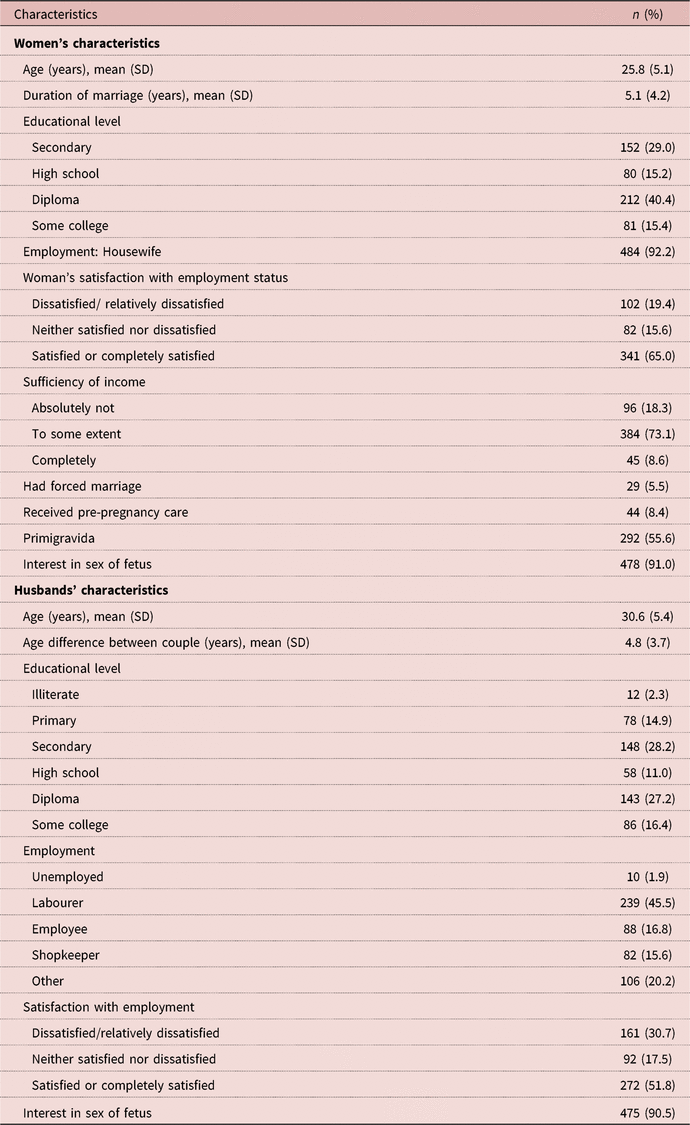
Of the 550 eligible women, 25 declined to attend the centres/posts to participate in the study, giving a sample size of 525. The mean ages of the women and their husbands were 25.8 and 30.6 years, respectively. The mean length of marriage and age difference between couples were 5.1 and 4.8 years, respectively. The majority of the women (92%) were housewives and 65% of them were satisfied or very satisfied with their employment status. Approximately half of the women’s husbands were working (45%), and about half of these (52%) were satisfied or very satisfied with their occupation (Table 1).
Socio-demographic characteristics of study participants and their husbands (N=525)

The data indicate number (percentage), unless otherwise specified.
Prevalence of IPA during pregnancy
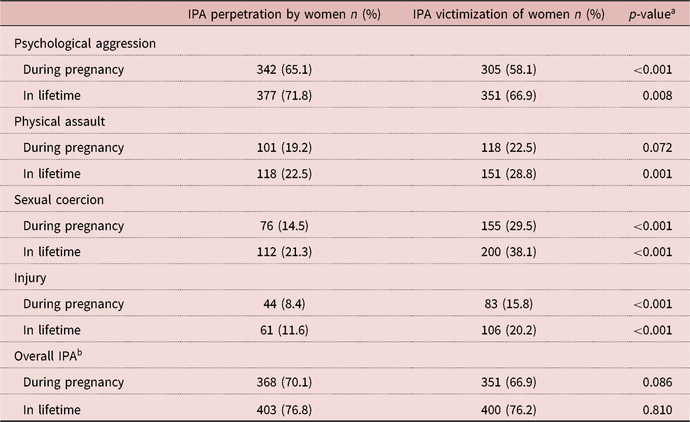
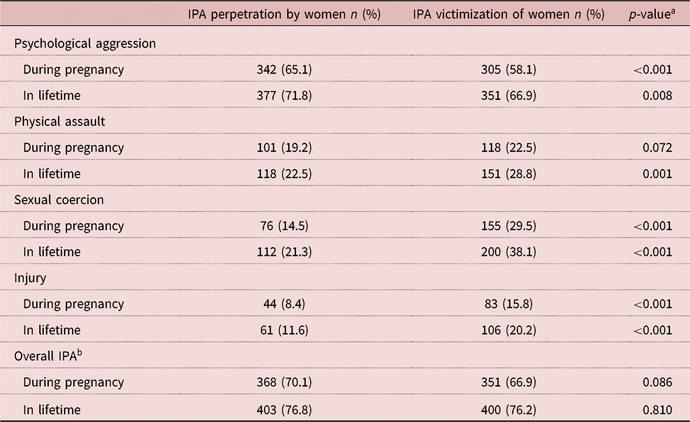
The overall rates of IPA of husbands by women (perpetration) and women’s experience of IPA from their husbands (victimization) were 70% and 67%, respectively, but the difference was not statistically significant (p=0.086). The most common type of IPA perpetration by women was psychological aggression (65%), followed by physical assault (19%) and sexual coercion (15%). The most common type of IPA experienced by women from their husbands (victimization) was psychological abuse (58%), followed by sexual coercion (30%) and physical assault (22%). The prevalence of psychological abuse by women (perpetration) was significantly higher than that experienced by women from their husbands (victimization). The prevalences of sexual coercion (15% vs 30%) and injury (8% vs 16%) perpetrated by women on their husbands were significantly lower than those experienced by the women from their husbands (p<0.001). There was no statistically significant difference between the prevalence of perpetration of physical violence towards husbands by women (19%) and that experienced by women from their husbands (22%) (p=0.072) (Table 2).
Prevalence of intimate partner abuse (IPA) by women of their husbands (perpetration) and experience of IPA by women from their husbands (victimization) during pregnancy and during their lifetime, as reported by study women (N=525)
a McNemar test.
b IPA experienced at least once for one of the items: psychological, physical, sexual or injury abuse.
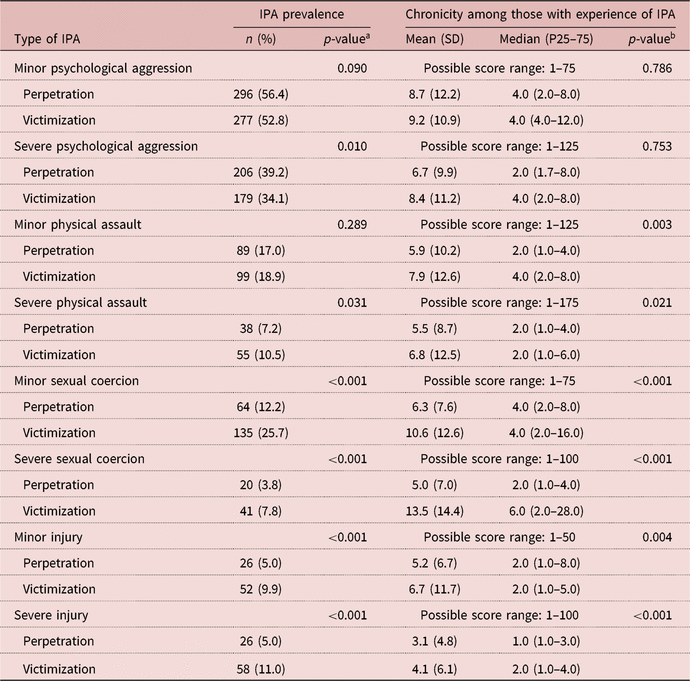
Minor psychological abuse was the most common type of IPA perpetration and victimization, with prevalences of 56% and 53%, respectively. The least common types of IPA perpetration and victimization were severe sexual coercion (4% and 8%, respectively), followed by minor injury (5% and 10%, respectively) and severe injury (5% and 11%, respectively) (Table 3).
Prevalence and chronicity of intimate partner abuse (IPA) of husbands by women (perpetration) and experience of IPA by women from their husbands (victimization) among couples during pregnancy, N=525

The higher the score, the more frequent the violence.
a The McNemar test was used to compare prevalences of IPA perpetration and victimization.
b The Wilcoxon test was used to compare chronicity of IPA perpetration and victimization.
Chronicity of IPA during pregnancy
Among couples who had experienced IPA, the chronicity of minor and severe physical assault of husbands by women was significantly lower than that of women by their husbands (p=0.003 and p=0.021 respectively). This was also the case for chronicity of minor and severe sexual coercion (p<0.001) and minor and severe injury (p=0.004 and p<0.001, respectively). However, there was no significant difference for the chronicity of minor and severe psychological aggression between perpetration and victimization (Table 3).
Lifetime IPA
There was no significant difference between the prevalence of lifetime overall IPA perpetration by women and victimization of women (77% vs 76%, p=0.810). The most common type of lifetime IPA was psychological aggression and the least common type was injury. The prevalence of lifetime psychological aggression of women towards their husbands was significantly higher than that of husbands towards women (72% vs 67%, p=0.008). The prevalences of all other types of IPA perpetration by women were significantly lower than IPA victimization of women (p<0.001) (Table 2).
Predictors of IPA
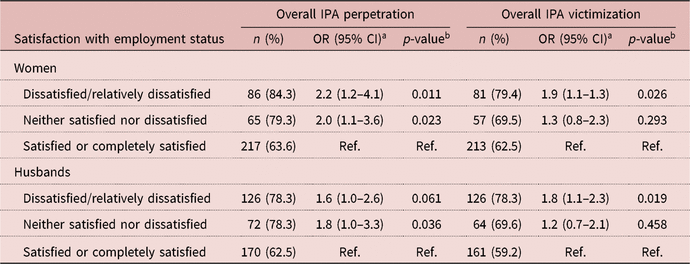
According to the results of the adjusted logistic regression model with a backward LR strategy, the women’s and husbands’ variables of age, duration of marriage, received pre-pregnancy care, educational level of woman and her husband, woman’s and her husband’s employment, sufficiency of income, interest in sex of fetus, having forced marriage, and number of pregnancy were excluded from the model as they did not have a significant relationship with abuse perpetration by women or victimization of women. However, the variables of wife’s satisfaction with her own employment status and husband’s satisfaction of his own job remained in the model and were predictors of abuse perpetration by women and victimization of women. The odds of overall IPA perpetration by women were about two times higher among women who were dissatisfied or relatively dissatisfied with their occupation compared with among satisfied or completely satisfied women (OR=2.2, 95% CI=1.2–4.1, p=0.011) and were about two times higher in women whose husbands were dissatisfied or relatively dissatisfied with their occupations than women whose husbands were satisfied or completely satisfied (OR=1.8, 95% CI=1.0–3.3, p=0.036).
The odds of overall IPA victimization of women were about two times higher in women who were dissatisfied or relatively dissatisfied with their occupation than in those who were satisfied or completely satisfied (OR=1.9, 95% CI=1.1–3.3, p=0.026), and about two times higher in women whose husbands were dissatisfied or relatively dissatisfied with their occupation than among those who were satisfied or completely satisfied (OR=1.8, 95% CI=1.1–2.3, p=0.019) (Table 4).
Prevalence of intimate partner abuse (IPA) of husbands by women (perpetration) and of women by their husbands (and victimization) during pregnancy by women’s and husbands’ satisfaction with their own occupations

a Odds Ratio (95% Confidence Interval).
b Multivariate logistic regression analysis with backward LR strategy.
Discussion
The study found that the perpetration of IPA by women in the first 6 months of pregnancy towards their husbands and the experience of IPA by these women from their husbands (victimization) were very common in Iran. No significant difference was found in the overall reported rates of IPA perpetration and victimization in these women. The most common type of reported IPA was psychological aggression. The rate of psychological aggression perpetrated by women was significantly higher than women’s experience of IPA. However, the rates of sexual coercion and injury perpetration by women were significantly lower than their experience of those types of abuse. Among women with experience of IPA, chronicity of minor and severe physical assault, sexual coercion and injury of women by their husbands were significantly higher than the perpetration of such abuse by women to their husbands. Wife’s satisfaction with her own employment status and husband’s satisfaction with his own job were predictors of overall IPA perpetration by women and victimization of women, respectively.
The overall rate of IPA victimization suffered by women was 67%. Similar results have been obtained in studies conducted in Gorgan, Iran (66%) (Hajikhani-Golchin et al., Reference Hajikhani-Golchin, Hamzehgardeshi, Hamzehgardeshi and Shirzad Ahoodashti2014) and West Azerbaijan (72%) (Hassan et al., Reference Hassan, Kashanian, Hassan, Roohi and Yousefi2014) using the same instrument (CTS2). This could be due to their close cultural similarity, especially between the two neighbouring provinces.
The rate of IPA victimization of women in the current study was higher than that reported in studies conducted in Tehran, the capital of Iran (57%) (Jamshidimanesh et al., Reference Jamshidimanesh, Soleymani, Ebrahimi and Hosseini2013) and Urmia, Iran (56%) (Farrokh-Eslamlou et al., Reference Farrokh-Eslamlou, Oshnouei and Haghighi2014). The difference in the results can be attributed to the different instruments used to assess IPA (Abuse Assessment Screen).
In the present study, psychological abuse was found to be the most commonly reported type of IPA. This is consistent with the findings of other studies in Iran (Jamshidimanesh et al., Reference Jamshidimanesh, Soleymani, Ebrahimi and Hosseini2013; Hajikhani-Golchin et al., Reference Hajikhani-Golchin, Hamzehgardeshi, Hamzehgardeshi and Shirzad Ahoodashti2014) and other countries (Moraes & Reichenheim, Reference Moraes and Reichenheim2002; Martin et al., Reference Martin, Harris, Li, Moracco, Kupper and Campbell2004). According to a study conducted in North Carolina, the course of pregnancy is associated with an increase in the rate of psychological abuse among couples (Martin et al., Reference Martin, Harris, Li, Moracco, Kupper and Campbell2004).
The rates of physical assault, sexual coercion and injury victimization suffered by the sample women were 22%, 29% and 16%, respectively. In a study conducted by the WHO in fifteen countries, the prevalence of physical assault of women during pregnancy ranged from 4% to 12% (WHO, 2005), and in a study conducted in India, it was found to be 26% (Jeyaseelan et al., Reference Jeyaseelan, Kumar, Neelakantan, Peedicayil, Pillai and Duvvury2007). The reported rate of sexual coercion in Gorgan, Iran, was 4% (Hajikhani-Golchin et al., Reference Hajikhani-Golchin, Hamzehgardeshi, Hamzehgardeshi and Shirzad Ahoodashti2014) and that in Urmia, Iran, 17% (Farrokh-Eslamlou et al., Reference Farrokh-Eslamlou, Oshnouei and Haghighi2014). The reported rate of injury of women in Brazil was 9% (Moraes & Reichenheim, Reference Moraes and Reichenheim2002). Also, another study conducted among pregnant women in India found the rate of ‘slap’ to be 16%, ‘hit’ 10%, ‘beat’ 10%, ‘kicked’ 9%, ‘use of weapon’ 5% and ‘harmed in any other way’ 6%. Eighteen per cent of women experienced at least one of these behaviours and 3% experienced all six (Peedicayil et al., Reference Peedicayil, Sadowski, Jeyaseelan, Shankar, Jain and Suresh2004).
In the present study, the reported rate of sexual coercion perpetration by women was lower than sexual coercion suffered by women, i.e. victimization (14% vs 29%). Similar results were obtained in previous studies conducted in Tabriz, Iran, among pregnant women aged 20–29 years (14% vs 21%), adolescent pregnant women (16% vs 31%) (Mohammad-Alizadeh-Charandabi et al., Reference Mohammad-Alizadeh-Charandabi, Bahrami-Vazir, Kamalifard and Mirghafourvand2016) and women of reproductive age (33% vs 54%) (Asadi et al., Reference Asadi, Mohammad-Alizadeh-Charandabi, Yavarikia and Mirghafourvand2018). The similarity of the results can be attributed to the identical scale (CTS2) used for IPA assessment, and the similarity of the study setting and culture. It could be that in traditional communities, women tend to respond less effectively to sexual coercion and are therefore more likely to succumb to it, and perhaps their attitudes regarding gender roles prohibit them from defending themselves against sexual coercion (Lacasse & Mendelson, Reference Lacasse and Mendelson2007).
The high prevalence of IPA and its different types may be due to the acceptance of abuse as a means of conflict handling, a lack of knowledge about legal rights by couples and the lack of serious attention to the issue of abuse. The wide range of abuse and differences in abuse perpetration and victimization results can be due to the difference in operational definition of abuse, inclusion criteria, samples size, instruments used, and socio-cultural differences. In the current study, IPA was evaluated with the CTS2, which produced higher results than other instruments, such as the Abuse Assessment Screen (AAS) and WHO’s Violence Scale (Desmarais et al., Reference Desmarais, Reeves, Nicholls, Telford and Fiebert2012).
The results showed differences between the prevalences of IPA victimization of, and perpetration by, women, in that the prevalence of psychological aggression perpetration was higher than its victimization; on the other hand, the prevalence of sexual coercion and injury victimization were higher. These findings are consistent with the results of studies conducted in the USA (Coker et al., Reference Coker, Davis, Arias, Desai, Sanderson and Brandt2002; Martin et al., Reference Martin, Harris, Li, Moracco, Kupper and Campbell2004) and Brazil (Moraes & Reichenheim, Reference Moraes and Reichenheim2002).
The mean rate of minor and severe abuse victimization of, and perpetration by, women among those with experience of IPA in the current study was lower than that found in a study conducted in Latin America by Newman and Campbell (Reference Newman and Campbell2011), except severe injury perpetration (3.1 vs 1.0) and victimization (4.1 vs 1.7). These differences could be due to the difference in samples (pregnant women aged 15–45 years in the current study versus pregnant adolescents in the other study), resulting in an increase in the rate of abuse among the second group. In addition, according to a study conducted in India, overall prevalence of moderate to severe physical abuse against women during pregnancy was lower than in the current study (Peedicayil et al., Reference Peedicayil, Sadowski, Jeyaseelan, Shankar, Jain and Suresh2004), which may be attributed to the difference in instrument and context.
According to the multivariate logistic regression, only the variables of women’s and husbands’ satisfaction with their own occupations were the predictors of IPA perpetration by women and victimization of women and there was no statistically significant relationship between the other socio-demographic characteristics and overall IPA perpetration by women and victimization of women. According to the results, the majority of housewives were satisfied with their employment status; in addition, women’s dissatisfaction with their employment status was a significant predictor of abuse perpetration and victimization among women. A study in Ethiopia reported women’s occupation as a predictor of IPA and lower rate of sexual abuse among housewives (Deribe et al., Reference Deribe, Beyene, Tolla, Memiah, Biadgilign and Amberbir2012). Also, a study conducted in India showed that women’s participation in paid employment increased the odds of them experiencing physical domestic violence (Pallikadavath & Bradley, Reference Pallikadavath and Bradley2018). This could be attributed to greater obedience of housewives to their husbands due to their economic and emotional dependency (Semahegn & Mengistie, Reference Semahegn and Mengistie2015). In general, the results of the Ethiopian study were inconsistent with those of the present study. Given the current cultural changes in Iran and trend towards the employment and social participation of women (Hasani, Reference Hasani2013), unemployment among housewives may result in conflict, as well as abuse among couples.
In addition, a husband’s dissatisfaction with his occupation was found to be a predictor of abuse among couples. Other studies have also reported a significant association between men’s occupation and the IPA of women. Unemployment (Mohamadian et al., Reference Mohamadian, Hashemian, Bagheri and Direkvand-Moghadam2016), part-time employment (Grande et al., Reference Grande, Hickling, Taylor and Woollacott2003) and inadequate income (Grande et al., Reference Grande, Hickling, Taylor and Woollacott2003; Sarkar, Reference Sarkar2008) have been given as risk factors for IPA of women, while higher socioeconomic status has acted as a protective buffer (Jeyaseelan et al., Reference Jeyaseelan, Kumar, Neelakantan, Peedicayil, Pillai and Duvvury2007). Men’s dissatisfaction with their job could result in psychological pressures as well as conflict and abuse among couples. Dissatisfied men may feel inferior to their wives, and try to fill this gap by showing abusive behaviours and establishing domination over the families and wives.
One limitation of this study is that it was not possible to compare violence status during pregnancy with that in the per- and post-partum periods due to the cross-sectional nature of the data. Another limitation is that the results cannot be generalized to the whole population, because it only surveyed women attending health care centres/posts to receive health care services, and those women who were not visiting such centres could not be included. In addition, the questionnaire was only completed by women, and their husbands were not involved in the study. The sensitivity of the subject surveyed may have affected the results and some women may have not correctly reported the real rate of violence; however, an attempt was made to control this by the self-administration of an anonymous questionnaire in a private environment and ensuring the confidentiality of the data.
In conclusion, this study showed high and similar prevalences of IPA perpetration by women and experience of violence by women (victimization) during pregnancy within the research population. Psychological aggression was the most common type of IPA, and the prevalence of its perpetration by women to their husbands was higher than that experienced by the women. Given the effect of abuse on the collapse of family life, health care authorities should take appropriate steps to prevent, identify and reduce IPA during pregnancy.
Acknowledgments
The authors thank the authorities of Tabriz University of Medical Sciences for the scientific and ethical approval and financial support of this research. They also thank the personnel of the health care centres/posts of Tabriz for their co-operation, and all the women who participated in this study. This study formed part of a master’s thesis (first author) at Tabriz University of Medical Sciences.
Funding
This study was funded by Tabriz University of Medical Sciences, Iran.
Conflicts of Interest
The authors have no conflicts of interest to declare.
Ethical Approval
Written informed consent was obtained from all participants. The study received ethical approval from the Tabriz University of Medical Sciences. The authors assert that the study complies with the Helsinki Declaration of 1975, as revised in 2008.