




No CrossRef data available.
What do parents know about the malformations afflicting the hearts of their children?
Published online by Cambridge University Press: 22 April 2005
Abstract
Traditionally, medical professionals have entrusted the parents of children with chronic illness with the task of imparting knowledge about the illness to the children. This practice assumes that parents understand the illness, and that they pass on their knowledge in a manner appropriate for the individual child. The aim of our study was to assess the knowledge that parents of children with a cardiac defect have about the malformation in the heart of their child. We sent a modified version of the Leuven questionnaire to 350 families. The questionnaire was filled in and sent back to our centre by 148 families. Parents showed a good knowledge of the name and anatomical characteristics of the cardiac disease suffered by their child. Parents with a child taking drugs were not very knowledgeable about the regime, side effects, and interaction with other drugs or food. Only one-quarter of the parents knew the definition of endocarditis, although almost two-fifths were aware that unexplained fever for more than 5 days was the most typical symptom. Less than half of the parents knew that endocarditis could recur. About two-fifths of parents knew the real possibility of their child being involved in competitive sports; but almost half of parents were unable to answer this question. The poor knowledge about particular aspects of the disease, treatment, and preventive measures revealed by our parents may have major consequences. The results of our study are relevant to general daily clinical practice.
Information
- Type
- Original Article
- Information
- Copyright
- © 2005 Cambridge University Press
More than four-fifths of children born with a cardiac anomaly in the past 2 decades now reach adolescence and adulthood.1 The transition from a paediatric setting of care to an adult one is often unsatisfactory. One of the most significant difficulties encountered by the parents of children with congenital heart defects is an accurate understanding of the problems related to the chronic illness. It has been reported that patients with diabetes mellitus and asthma have a poor knowledge of their condition.2, 3 Veldtman et al.4 found that this was also the case for children and adolescents with cardiac diseases.
Traditionally, medical professionals have entrusted the parents of children with chronic illness with the task of imparting knowledge about the illness to their children. This practice assumes that parents understand the illness, and that they pass on their knowledge in a manner appropriate for the individual child. Our aim in conducting this study was to assess the knowledge that parents of children with a cardiac defect have about the specific problems generated by the cardiac malformation in their child.
Methods
We mailed the so-called Leuven knowledge questionnaire for congenital heart disease, modified with the consent of the authors,5 to 350 families with a child affected by a congenital cardiac disease, chosen at random from among all patients regularly followed in our department. We excluded families of patients who had attended our outpatient clinic just once. In order to evaluate the ability of parents to read and understand the questions, we conducted a pilot study involving 30 parents of children receiving inpatient care in our department.
The questionnaire was sent with a covering letter that gave all the instructions necessary to fill in the questionnaire. We invited parents to answer together, as mother and father, every single question without the aid of the medical files relating to their child. We do not use any form of follow-up to solicit participation.
The modified Leuven questionnaire measures knowledge in 4 domains:
- the disease and its treatment;
- the prevention of complications, including endocarditis;
- physical activities; and
- reproductive issues.
We identified 13 topics (Table 1), and 26 questions, encompassing these four domains. The validity of the content of the questionnaire was examined by two paediatric cardiologists. Information on the primary medical diagnosis, past and current treatment, drug regimes, and history of endocarditis was collected from the medical records of the children. The researchers evaluated each of the answers given by the parents as “correct”, “does not know”, or “incorrect”. Question requiring multiple answers, and open questions, could also be scored as “incomplete”. We did not use any specific system for scoring.
Table 1. Topics attributed to the four domains of knowledge in congenital cardiac disease.

Statistical analysis
Continuous variables are presented as the mean plus or minus standard deviation, nominal variables as a percentage, and ordinal variables as the median and its range.
Answers to questions were rated as: correct, does not know, incorrect. We tested relationships between the educational levels of the parents and answers to different topics using the χ2-test.
Results
Of the 350 questionnaires posted, we received back 148 (42.2 percent) that had been filled in completely. About 7 percent of the questionnaires were returned by the National Mail Service because of errors or changes in address. The demographics and clinical characteristics of the children contained within our sample are summarised in Table 2.
Table 2. Demographic and clinical characteristics of the 148 families that completed and sent back the questionnaire.

Parents showed a good knowledge of the name and anatomical characteristics of the cardiac disease. A large part of them was able to locate the lesion on a diagram (Table 3).
Table 3. Frequency distribution of knowledge about the disease and its treatment.

The frequency of outpatient appointments, and the purpose of the follow-up, were well understood, although the prognosis was less well understood. In order to assess the prognosis, we asked the parents to answer three questions, first, what the treatment had resolved at the moment of the answer, and second and third, what they expected in the next future with regard to either another surgical intervention or an additional catheterization. We considered the answers given to be correct if they tallied with the expectations of the professional in 2 of the 3 categories.
The majority of the parents showed a good understanding of the kind of treatment of the disease being given by the medical and surgical staff (Table 3).
Parents with a child taking drugs were not very knowledgeable about the regime, side effects or interaction with other drugs or food (Table 3). This was a free text answer, and was marked as correct if all medications were appropriately inserted.
To assess knowledge about management of symptoms, the questionnaire listed 11 symptoms, of which 7 reflect deterioration of the cardiac disease requiring appropriate medical care, specifically dizziness, shortness of breath, palpitations, chest pain, fainting, increasing fatigue, and swollen feet and legs. Only 38 percent of the parents identified these symptoms and signs correctly, with the same percentage not knowing the response to this question. We considered an answer correct if the parents had recognized five or more of the seven relevant symptoms.
Only 28 percent of the parents knew the definition of endocarditis (Table 4), although 38 percent were aware that unexplained fever for more than 5 days was the most typical symptom. Less than half of the parents (44 percent) knew that endocarditis could recur.
Table 4. Knowledge about preventive measures, physical activities, and recurrence risk.

Parents showed a good knowledge about the most significant factors contributing to the onset of endocarditis, such as dental abscess, needle contamination, and body piercing and tattooing. It was less well appreciated that bacteria from cutaneous infections, and poor care of the nails and skin, can also contribute to the risk of endocarditis (Table 4). Most parents were aware of the importance of an annual dental check-up (Table 4).
Parents with a better understanding of the problems related to endocarditis had a higher educational level than the other parents (p equal to 0.005). It was interesting to note that the educational level of the mother was more relevant than that of the father in this context. We did not find differences in parental level of education and answers to any other questions.
About two-fifths of parents knew the real implications of their child being involved in competitive sports, with 45 percent of parents being unable to answer this question. The question about sport was associated with an explanation between brackets saying that a competitive sport was a sport necessitating a regular weekly-based training. The answer was judged to be incorrect if the parents did not answer in a fashion compatible with the information recorded in the letter sent after the attendance at the last outpatient clinic, where we usually specified this information for the parents. Most of the parents did not answer the question about inheritance of congenital heart diseases (Table 4).
We do not find knowledge differences among parents regarding the moment they were told about the cardiac lesions suffered by their child. This is probably related to the continuous refreshment we provided during their evaluations in the outpatient clinic.
Discussion
Knowledge of parents concerning the cardiac malformation suffered by their child is a prime factor in preparing the transition of the child to adulthood. It is usual practice in our centre to explain to all parents the nature of the lesion suffered by their child, and its short and long term implications at the time of the initial diagnosis and on subsequent consultations, or during any periods of inpatient care. Efforts are made to use lay terms, often aided by simple diagrams. We do not, however, routinely assess whether the information we have given has been understood. Our questionnaire was a formal but open forum in which our parents could express their beliefs regarding the health of their children, and allow the researcher to make a quantitative assessment of individual understanding.
Our findings indicate that parents were very knowledgeable about the name and anatomy of the malformation suffered by their child. We believe that this is a consequence of the good explanations of the malformation given to parents by the physicians and, if hospitalized, by the nurses, and the use of colour diagrams which are regularly given to the parents.
We were also positively impressed by the good understanding of the purpose of follow-ups and the specific treatment being used. Parents also showed a good understanding of recurrence, symptoms, and prophylaxis of endocarditis, but were less knowledgeable about the definition and risk factors of this complication. This result is quite good, and is probably related to the sustained educational efforts made by nurses and physicians. All parents routinely receive a leaflet about endocarditis at home. We must, however, check the understanding of the definition of endocarditis and its risk factors among our parents in order to improve knowledge in this sphere.
Parents were less clear concerning the physical potential of their children, and the possibility of them taking part in sporting activities. This understanding could probably be improved by more thorough information given by the physician in the discharge letter, or in a latter emanating from the outpatient clinic. Understanding was weakest about treatment using drugs, and possible inheritance of the malformation.
We believe that there are multiple reasons for the poor knowledge about the treatment using drugs, such as side effects, interaction with other drugs, or food. One reason may be the use of jargon, coupled with over-technical explanations given by specialists. Another potentially significant reason is that parents may think that treatment with drugs is something pertaining to specialists, and that their own deep understanding is unnecessary. They feel they can contact a cardiologist and ask for help if they have any questions. Inheritance of congenital cardiac diseases is a complex topic, and one not usually mentioned during hospitalization, or during assessments as outpatients. It is clear, nonetheless, that these two major topics must be explained better. The use of specific and dedicated leaflets may be a solution.
Clinical implications
Our poor knowledge revealed by our parents with regard to particular aspects of the disease suffered by their children, its treatment, and preventive measures, may have major consequences. For instance, parents must be made more knowledgeable about the risk factors for endocarditis, and how they can prevent their child from being exposed to these risks. Better awareness of symptoms indicating a deteriorating heart condition is also needed.
The finding that almost half of our parents did not know whether or not physical activities were contraindicated may result in harmful behaviours or inappropriate restrictions, which in turn compromise the social integration of their children.
A good understanding of the purpose of follow-ups is important in order to motivate the parents to comply with the scheduled appointments for outpatient assessment. This highlights the importance of the parents receiving good health education. Even when the cardiac lesions are considered benign, health care professionals still need to explain in detail the nature and progression of the disease.6
The results of our study are relevant to general clinical practice. Though our parents were found to be very knowledgeable about the lesion suffered by their child, and were satisfied with the information provided, our findings suggest that significant gaps still exist. The reason for such poor knowledge in some of the topics remains unclear. It is not possible for us to determine whether the parents have forgotten, that the information was never passed on in the first place, that incorrect information was given, or that the circumstances had changed.
Educational efforts should be an integral part of follow-up in order to enhance the understanding by parents of the different aspects of the malformation suffered by their child, and what strategies of management are appropriate to achieve the best outcome.7, 8
We believe that the involvement of multiple professionals, such as physicians, nurses, social workers, child life specialists, and psychologists, should be encouraged in order to provide the most thorough and relevant education to parents and children living with cardiac disease.
There is good evidence to suggest that quality of life, in terms of anxiety, “coping” with disease, and satisfaction with treatment, is enhanced by a good understanding of the condition. Parents experience distress and they need assistance to determine what is normal for their child and how to monitor the health and safety of their child.9 There can be no doubt that these aspects of quality of life for parents with a child affected by a cardiac disease can be improved by intensified efforts at audit to ensure better understanding. Such a process is likely to have important implications for centres dealing with adults with congenital cardiac malformations. Good parental understanding is an important starting point for an efficient transition from childhood to adulthood care.
We believe that we can use this methodology of assessing the knowledge of parents periodically in order to understand the possible improvement following specific and different educational programmes, such as brochures, meetings, and so on. In that way, it could be possible to triage parents that need a more significant support, avoiding the wastage of limited resources for this kind of activities.
Limitations of the study
Less than half of the families we contacted filled in and sent back the questionnaire. We can suppose that we received responses from the most motivated and satisfied parents, and this would be a source of bias. The parents filled in the questionnaire at home, and so there could be a “refreshment effect”, because they could have consulted the medical file of their child before answering the questions.
Conclusions
To the best of our knowledge, our study is the first to assess parental understanding of all the different problems related to the congenital cardiac malformation affecting their child. The results showed that the educational efforts of all the staff are producing encouraging results, but that there are still significant gaps in parental knowledge.
Acknowledgements
We thank Philip Moons for his remarks, comments, and suggestions during the preparation of this manuscript.
References
Perloff JK. Congenital heart disease in adults: a new cardiovascular subspecialty. Circulation 1991; 84: 1881–1889.Google Scholar
Chessa M, Cullen S, Deanfield J, et al. The care of adult patients with congenital heart defects: a new challenge. Ital Heart J 2004; 5: 178–182.Google Scholar
Eiser C, Town C, Tripp JH. Illness experience and related knowledge amongst children with asthma. Child Care Health Dev 1987; 14: 11–24.Google Scholar
Veldtman GR, Matley SL, Kendall L, et al. Illness understanding in children and adolescents with heart disease. Heart 2000; 84: 395–397.Google Scholar
Moons P, De Volder E, Budts W, et al. What do adult patients with congenital heart disease know about their disease, treatment, and prevention of complications? A call for structured patient education. Heart 2001; 86: 74–80.Google Scholar
Manning JA. Congenital heart disease and the quality of life. In: Engle MA, Perloff JK (eds). Congenital Heart Disease After Surgery: Benefits, Residua, Sequelae. Yorke Medical Books, New York, 1983, pp 347–361.
Kantoch MJ, Collins-Nakai RL, Medwid S, Ungstad E, Taylor DA. Adult patients's knowledge about their congenital heart disease. Can J Cardiol 1997; 13: 641–645.Google Scholar
Cetta F, Warnes CA. Adults with congenital heart disease: patient knowledge of endocarditis prophylaxis. Mayo Clin Proc 1995; 70: 50–54.Google Scholar
Sparacino PS, Tong EM, Messias DK, et al. The dilemmas of parents of adolescents and young adult with congenital heart disease. Heart Lung 1997; 26: 187–195.Google Scholar
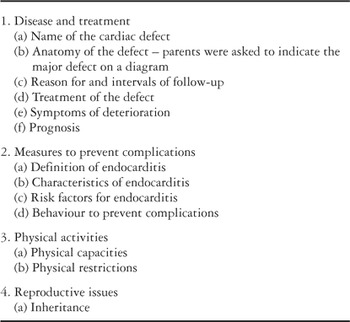
Table 1.
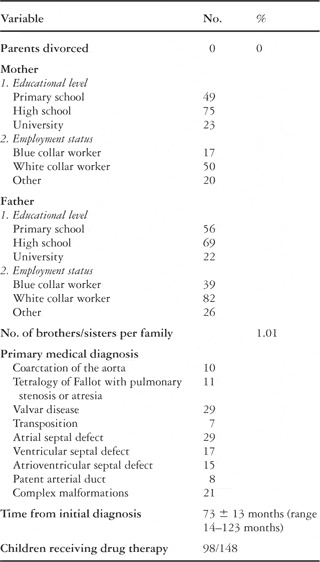
Table 2.
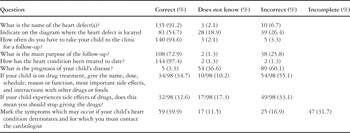
Table 3.
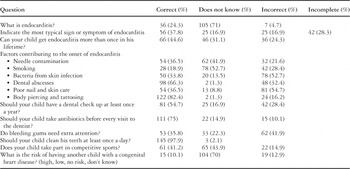
Table 4.
 You have
Access
- 20
- Cited by