Introduction
“Depressed mood most of the day, nearly every day, as indicated by either subjective report (eg, feels sad, empty, hopeless) or observation made by others (eg, appears tearful)” and “markedly diminished interest or pleasure in all, or almost all, activities most of the day, nearly every day (as indicated by either subjective account or observation)” are the 2 core diagnostic criteria of the Diagnostic and Statistical Manual of Mental Disorders, Fifth Edition (DSM-5) definition of major depressive disorder, and at least 1 of the 2 is mandatory (p. 160).1 The former criterion refers to negative (depressed) mood, while the latter refers to anhedonia.
In most patients fulfilling DSM criteria for major depression, both core symptoms are present, but a symptom profile analysis of physically ill patients in a general hospital fulfilling the criteria for major depression showed that one-fifth of them present anhedonia but not depressed mood, a status sometimes called “depression without depression.”Reference Sibitz, Berger and Freidl2 Moreover, the single symptom with the best predictive value in screening for depression was anhedonia followed by depressed mood and fatigue (overall misclassification rate : 23.8%, 24.1%, and 48.3%, respectively).Reference Sibitz, Berger and Freidl2 On the same lines, a psychometric evaluation of the different Diagnostic and Statistical Manual of Mental Disorders, Fourth Edition (DSM-IV) symptom criteria for major depression found anhedonia to be the symptom with the highest positive predictive value (88.7%).Reference Zimmerman, McGlinchey, Young and Chelminski3 KleinReference Klein4 contributed significantly to the central place of hedonic tone in depression when he described “a sharp, unreactive pervasive impairment of the capacity to experience pleasure or to respond affectively to the anticipation of pleasure” as a central feature of depression. Later, the concept of hedonic tone was further refined: a differentiation between physical (or sensory) and social (or affiliative/interpersonal) anhedonia and a differentiation between anticipatory (or motivational) and consummatory anhedonia were described.Reference Chapman, Chapman and Raulin5, Reference Treadway and Zald6 The problem with the DSM definition of anhedonia is that it is presented as a compound diagnostic criterion (“taking interest in and pleasure in” is taken into 1 item), and that it does not differentiate between sensory/physical and social/affiliative/interpersonal anhedonia.
It is remarkable that the DSM definition of major depression does include the presence of negative (depressed) mood but not the absence of absence of positive mood. Indeed, it is well known that positive mood is not the opposite of negative mood, and correlations between changes in negative mood and positive mood are understandably negative but rather small, which suggests that negative and positive mood are mainly independent dimensions.Reference Watson and Tellegen7, Reference Russell and Carroll8 While mood is considered to be more long lasting, affect and emotion can be considered to be more fluctuating over time. Numerous theoretical frameworks and classifications do exist on affect and emotion. Overall organizing principles seem to be positive or negative valence, activation or deactivation, intrapersonal or interpersonal (affiliative, social), control by circumstances, or control by the self. Positive affect motivates mastery, exploration, behavior activation, approach, and bonding behavior, while negative affect motivates withdrawal and behavior inhibition.Reference Tong9
Negative affect can be categorized as sad/depressed, anxious/nervous, ashamed/guilty, or hostile/irritable. Positive affect can be categorized in intrapersonal and interpersonal affects. The intrapersonal affect (circumplex model) can be categorized into activated (energetic, enthusiastic) or deactivated (serene, calm) affect, while the interpersonal affect (affiliative, social affect) can be categorized inward from others towards the self (safe, warmly surrounded) and from the self toward others (caring, compassionate).Reference Posner, Russell and Peterson10, Reference Depue and Morrone-Strupinsky11
The depression scales routinely used to assess changes during antidepressant treatment (Hamilton Depression Rating Scale [HDRS], Montgomery–Åsberg Depression Rating Scale [MADRS]) do not really take into account anhedonia, which is in sharp contrast with the central place of this concept in the definition of depression; moreover, they only assess changes in negative affect but not the changes in positive affect.Reference Hamilton12, Reference Montgomery and Åsberg13 Only one score on 1 out of the 17 items of the HDRS (score 2: loss of interest in activity, hobbies, or work on item 7 [work and interests]) and only 2 scores on 1 out of the 10 items of the MADRS (score 2: reduced ability to enjoy usual interest, and score 4: loss of interest in surroundings, loss of feelings for friends, and acquaintances on item 8 [inability to feel]) somewhat refer to the anhedonia (core) criterion of the DSM definition of major depression.
To the best of our knowledge, no published scale covers the entire spectrum of positive and negative affect and related anhedonia. A well-known scale that measures positive and negative affect is the Positive and Negative Affect Scale (PANAS); it covers the different negative affects (although feeling sad or depressed is not represented, only the extended version [PANAS +] also comprises sadness/depression), and it only covers the intrapersonal activated positive affect (neither intrapersonal deactivated positive affect nor the interpersonal positive affect is represented).Reference Watson, Clark and Tellegen14 Two well-known scales assessing the hedonic tone are the Snaith–Hamilton Pleasure Scale (SHAPS) and the Temporal Experience of Pleasure Scale (TEPS).Reference Snaith, Hamilton, Morley, Humayan, Gargreaves and Trigwell15, Reference Gard, Germans Gard, Kring and John16 The SHAPS assesses sensory as well as social anhedonia, but it was designed to measure “the ability to experience pleasure” (all items are formatted as “I would enjoy …”), which is a somewhat confusing concept; hence the questionnaire cannot differentiate between anticipatory and consummatory anhedonia.Reference Snaith, Hamilton, Morley, Humayan, Gargreaves and Trigwell15 The more recently developed TEPS does differentiate between anticipatory and consummatory pleasure, but the scope of the anticipatory sensory hedonic tone is very much focused on the sense of taste (4 out of the 10 items of the anticipatory subscale refer to eating) while omitting the other senses, and the social/affiliative/interpersonal anhedonia is not represented at all.Reference Gard, Germans Gard, Kring and John16
Therefore, the construction and development of a more comprehensive self-rating scale hat assesses the different aspects of positive and negative affect as well as the different aspects of hedonic tone was the purpose of the present study.
Materials and Methods
Selection of items and development of the scale (Figure 1)
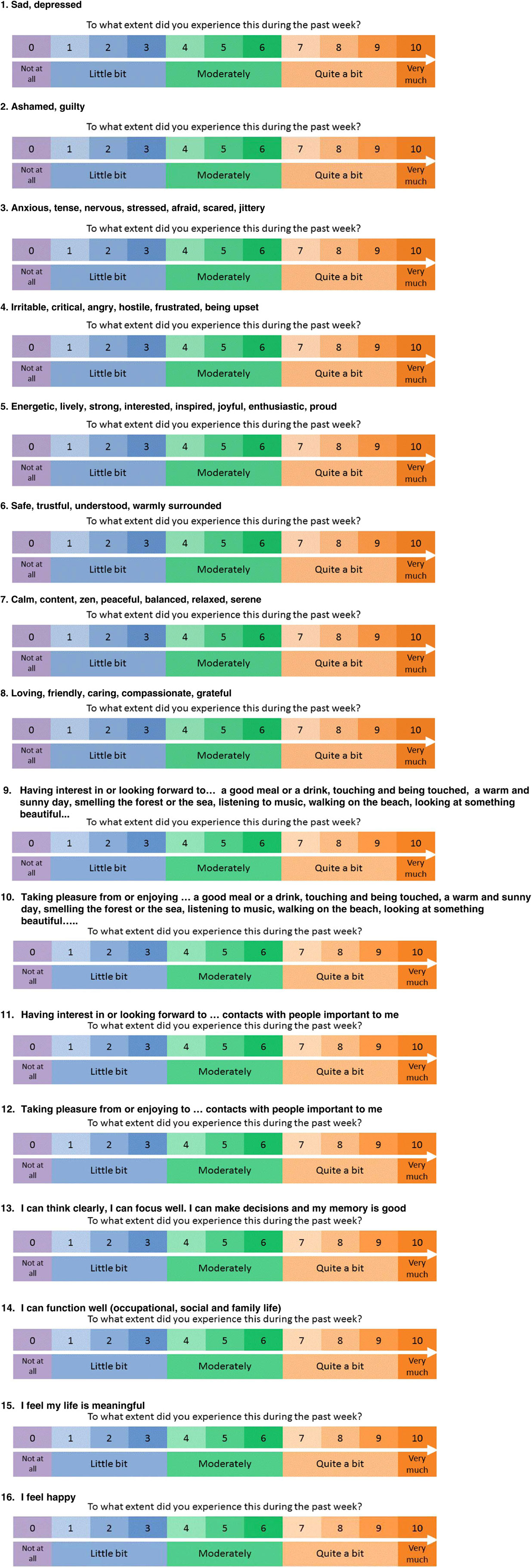
A deductive rational (Figure 1) strategy was used to select the items. The final choice of the items was based on the different theoretical models of positive and negative affect and of hedonic tone (as discussed above in the introduction section). In the final version, 4 items representing negative affect, 4 items representing positive affect (intrapersonal [activated, deactivated] and interpersonal [affiliative, ie, from others toward the self and from the self toward others]), and 4 items representing hedonic tone (anticipatory and consummatory for sensory and social/affiliative/interpersonal) were included. Each item comprises different words describing the affect, and they were tested in healthy volunteers as well as in patients in order to test whether subjects could grasp the gestalt represented by the different words. Moreover, 4 additional items, representing cognitive functioning, overall functioning, meaningfulness of life, and happiness, were included as independent variables. The former 2 additional items were chosen because of their general importance in depression research; meaningfulness of life was chosen because earlier research showed that this is the most important patient expectation in antidepressant treatment.Reference Demyttenaere, Donneau, Albert, Ansseau, Constant and van Heeringen17
The Leuven Affect and Pleasure Scale (LAPS)

A semi-anchored approach was chosen for assessments on each item. The question we used was “To what extent did you experience this during the past week?” and the scoring could vary between 0 and 10: not at all (score 0), a little bit (scores 1–3), moderately (scores 4–6), quite a bit (scores 7–9), and very much (10). Subscores can be calculated as the sum of items 1–4 (negative affect), 5–8 (positive affect), and 9–12 (hedonic tone); the 4 independent items are scored separately.
Test population: participants
The scale was administered in 2 college student populations and in 1 inpatient population. College student data come from a random subsample (N=138) of the baseline cohort of the Leuven College Surveys (LCS). The LCS consists of a series of ongoing Web-based self-report surveys of KU Leuven students. The survey was included in a routine psychomedical check-up organized by the university. All incoming freshmen (ie, census sampling) were sent a standard invitation letter for the check-up. Participants completed the survey on a desktop computer in the waiting room of the student health center. In this college student population, the Composite International Diagnostic Interview (CIDI) depression score and the CIDI anxiety score (both as continuous variables) were available. The study’s protocol was approved by the University Hospital Leuven Biomedical Ethical Board (B322201215611). Informed consent was obtained from all subjects who participated in the study. The CIDI screen was used and allowed to differentiate the college students into 2 groups: one group in good mental health not having a psychiatric disorder (N=111) and a second group screening positive for major depression (N=27).Reference Kessler and Ustun18 The mean CIDI depression score in both groups was 7.88±4.22 and 17.75±2.32, respectively (t=17.51; P<.001).
Inpatients (N=36) were all hospitalized patients within the University Psychiatric Center KU Leuven (UPC KU Leuven) with major depressive disorder (based on Diagnostic and Statistical Manual of Mental Disorders, Fourth Edition [DSM-V] criteria) as main diagnosis. In this inpatient population, the Hospital Anxiety and Depression Score (HADS) was also available.Reference Zigmond and Snaith19 The mean HADS depression and anxiety subscores were 15.2±3.4 and 13.6±3.5, respectively. The HADS depression subscore has 7 items: 2 are about negative affect (I feel as though I am slowed down, I have lost interest in my appearance) and 5 are about positive affect/hedonic functioning (I still enjoy the things I used to, I can laugh and see the funny side of things, I feel cheerful, I look forward with enjoyment to things, I can enjoy a good TV or radio program or book); there is reverse scoring for the latter.
Statistics
Descriptive statistics are provided using means (+/– standard deviations [SD]). The Spearman correlation coefficient was used to assess the associations between the items and the subscales. An exploratory factor analysis was also performed on the 12 items of the scale that assess negative affect, positive affect, and hedonic tone. Differences between the 3 groups of subjects on the LAPS subscales were calculated using univariate general linear models with Bonferroni post-hoc testing. We also included effect sizes expressed in η2. Results were considered to be significant at the 5% critical level (P<0.05). All calculations were performed using SPSS 10.0 statistical software (SPSS Inc., Chicago, IL, USA).
Results
Correlations between LAPS variables
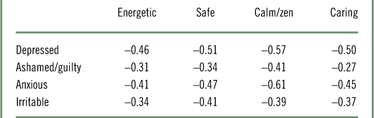
Correlations between positive and negative affect items are all negative, and most coefficients are below 0.50, with the lowest being between “ashamed/guilty” and “caring” (–0.27) and the highest between “anxious” and “calm/zen” (–0.61) (Table 1). Correlations between negative affect items are all positive: feeling depressed and sad is correlated with feeling ashamed and guilty (R=0.60), with feeling tense and anxious (R=0.58), and with feeling irritable (R=0.34); feeling ashamed and guilty is correlated with feeling tense and anxious (R=0.50) and with feeling irritable (R=0.29); and feeling tense and anxious is correlated with feeling irritable (R=0.59). Correlations between positive affect items are all positive: feeling energetic is correlated with feeling safe (R=0.60), feeling calm and zen (R=0.77), and feeling caring (R=0.75); feeling safe is correlated with feeling calm and zen (R=0.64) and feeling caring (R=0.67); and feeling calm and zen is correlated with feeling caring (R=0.72).
Correlations between positive and negative affect items

All correlations are statistically significant (P<0.001).
Correlations between the 4 independent variables are all positive and statistically significant (P<0.001): cognitive functioning is significantly correlated with overall functioning, with meaningfulness of life, and with happiness (R=0.83, 0.62, and 0.62, respectively); overall functioning is significantly correlated with meaningfulness of life and with happiness (R=0.62 and 0.66, respectively); and meaningfulness of life is significantly correlated with happiness (R=0.77).
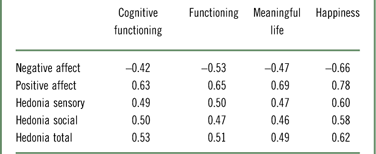
Correlations between the 4 independent variables (cognitive functioning, functioning, meaningful life, happiness), and affect (positive, negative) and hedonic function (sensory, social, total) show the highest coefficients with positive affect (between 0.63 and 0.78), followed by the coefficients with negative affect (between –0.42 and –0.66) and the coefficients with hedonic function (between 0.49 and 0.62) (Table 2).
Correlations between LAPS subscores and cognitive functioning, functioning, meaningful life, and happiness

All correlations are statistically significant (P<0.001).
Correlations between the LAPS variables and depression/anxiety scores
In the college student population, correlations between cognitive functioning, functioning, meaningful life, and happiness are –0.18, –0.29, –0.30, and –0.37 (P<0.05, P<0.001, P<0.001, and P<0.001) with the CIDI anxiety score and –0.24, –0.29, –0.32, and –0.37 (P<0.01, P<0.001, P<0.001, and P<0.001) with the CIDI depression score.
In the depressed inpatient population, correlations between cognitive functioning, functioning, meaningful life, and happiness are –0.10, –0.21, –0.16, and –0.30 (all nonsignificant) with the HADS anxiety subscore and –0.38, –0.53, –0.59, and –0.70 (P<0.05, P<0.001, P<0.001, and P<0.001, respectively) with the HADS depression subscore. The correlation between the sum score of the 2 HADS negative affect items and the 5 HADS positive affect/hedonic functioning items of the HADS depressions subscore is 0.48 (P<0.001). It is interesting to note that the correlations between cognitive functioning, functioning, meaningful life, and happiness are higher with the sum score of the 5 HADS positive affect/hedonic function items (R= –0.40, –0.45, –0.62, and –0.80; P<0.05, P<0.01, P<0.001, and P<0.001) than with the sum score of the 2 HADS negative affect items (R=–0.20, –0.49, –0.32, and –0.29; P=NS, P<0.01, P=NS, and P=NS).
Factor analysis
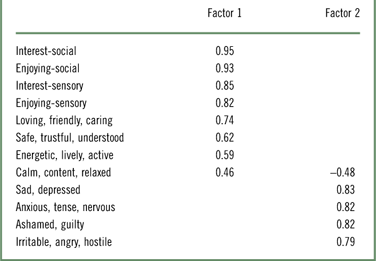
A exploratory factor analysis (Table 3) was performed with 12 items (4 positive affect items, 4 negative affect items, and 4 hedonic tone items). The pattern matrix resulted in a 2-factor solution (initial eigenvalues: cumulative 69.3%; total variance explained: 69.3%). The correlation between both factors was –0.46. Factor 1 is loaded by the 4 hedonic tone items and the 4 positive affect items, and factor 2 is loaded by the 4 negative affect items and 1 positive affect item (negative loading).
Exploratory factor analysis

Differences between mentally healthy college students, depressed college students, and depressed inpatients in the LAPS items
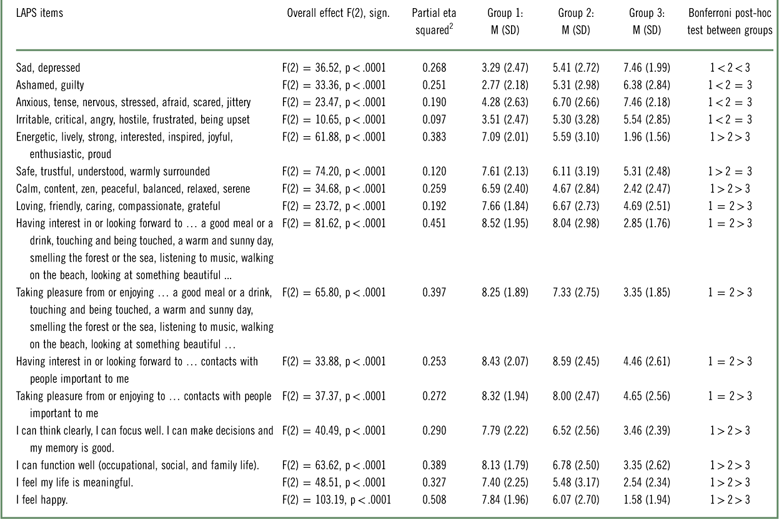
For all 16 LAPS variables, highly statistically significant differences were found between the 3 groups (P<0.001; see Table 4 and Figure 2). The 5 items that generated the highest effect sizes were “I feel happy” (partial η2=0.51), “Having interest in or looking forward to … a good meal or a drink, touching and being touched, a warm and sunny day, smelling the forest or the sea, listening to music, walking on the beach, looking at something beautiful ...” (partial η2=0.45), “Taking pleasure from or enjoying … a good meal or a drink, touching and being touched, a warm and sunny day, smelling the forest or the sea, listening to music, walking on the beach, looking at something beautiful …” (partial η2=0.40), “I can function well (occupational, social, and family life)” (partial η2=0.39), and “Energetic, lively, strong, interested, inspired, joyful, enthusiastic, proud” (partial η2=0.38).
Differences between 3 groups (healthy college students, depressed college students, and depressed inpatients) on the individual LAPS items

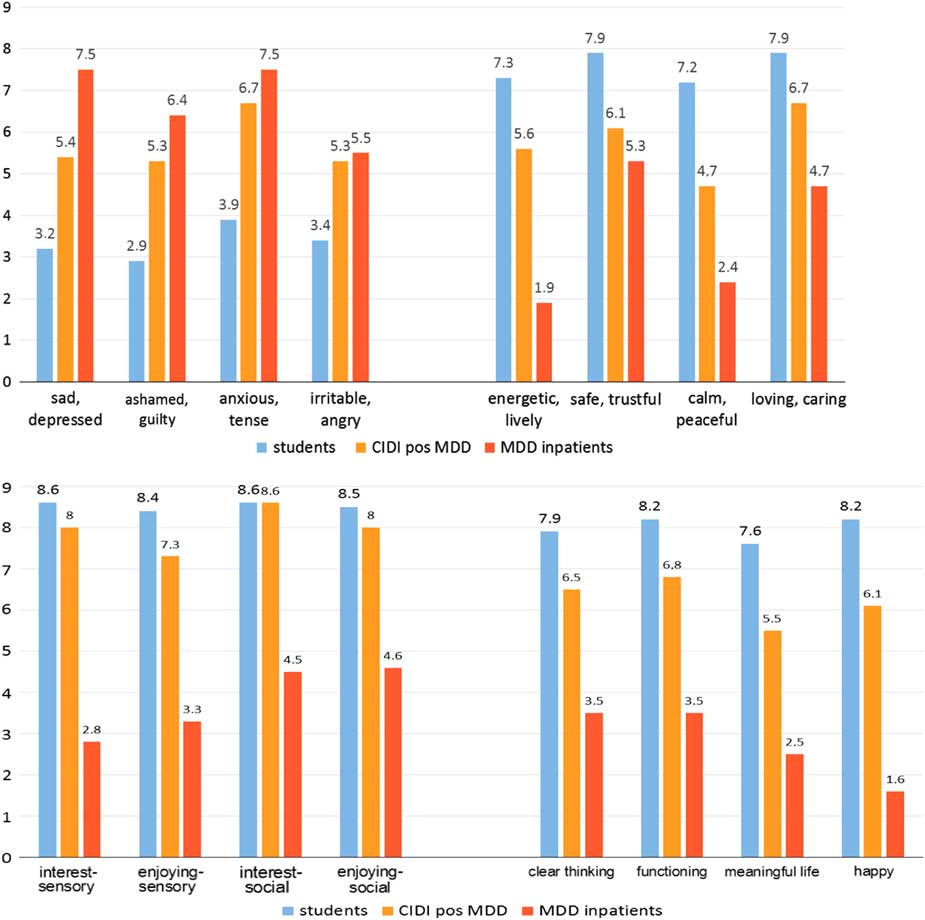
LAPS scores in healthy college students (students), in depressed college students (CIDI pos MDD), and in depressed inpatients (MDD patients).

Within the negative affect items, the effect size of change (partial η2) over the 3 groups of subjects was 0.27 for “sad, depressed,” 0.25 for “ashamed, guilty,” 0.19 for “anxious, tense,” and 0.10 for “irritable, angry.” Within the positive affect items, the effect size of change over the 3 groups of subjects was higher for the intrapersonal than for the interpersonal items: 0.38 for “energetic, active,” 0.26 for “safe, trustful,” 0.26 for “calm, content, balanced,” and 0.19 for “loving, caring.”
Within the hedonic tone items, the effect size of change (partial eta squared) over the 3 groups of subjects was higher for the sensory items than for the social/affiliative/interpersonal hedonia items: 0.45 and 0.40 (anticipatory and consummatory) versus 0.25 and 0.27 (anticipatory and consummatory), respectively.
Post-hoc Bonferroni tests were performed in order to investigate which groups of participants effectively differed (see Table 4). We found statistically significant differences (P≤0.01) in the 4 negative affect items between healthy and depressed college students, but the difference between depressed college students and depressed inpatients was only statistically significant for the item “sad, depressed.” In addition, we found significant differences (P≤0.01) in the 4 positive affect items between healthy college students and depressed college students, and between depressed college students and depressed inpatients (but statistically significant difference at the 0.05 level was not reached for the item “safe, trustful”).
No statistically significant differences were found in the hedonic tone items between healthy college students and depressed college students, but statistically significant differences (P≤0.01) were found between depressed college students and the depressed inpatients.
Statistically significant differences were found in the 4 independent items (cognitive functioning, overall functioning, my life is meaningful, I feel happy) between the healthy college students and the depressed college students, as well as between the depressed students and the depressed inpatients (P=0.02 for the difference in cognitive functioning between depressed college students and depressed inpatients, P≤0.01 for all other comparisons).
Discussion
As expected, all correlations between the positive and negative affect items are negative, but most are below –0.50, which suggests that positive and negative affect are mainly independent affects. This confirms the existing literature: in the first publication on the PANAS, the correlation between positive and negative affect experienced in the “past few days” was even lower (R=–0.22).Reference Watson, Clark and Tellegen14 In that same article, the correlation between the score on a standard self-rating questionnaire (Beck Depression Inventory [BDI]) and positive or negative affect was –0.35 and 0.56, respectively, again underscoring the idea that commonly used depression assessment scales do not really take into account changes in positive affect.Reference Watson, Clark and Tellegen14 Moreover, this further contradicts common sense knowledge that a decrease in negative affect automatically would result in an increase of positive affect, and we therefore suggest that changes in positive affect should be included in assessment tools for depression. Indeed, it has been shown that the presence of positive affect is a more powerful predictor of mortality than excess of negative affect, as well as in healthy populations (HR: 0.82; CI 0.76–0.89; P<0.001) and in disease populations (HR: 0.98; CI 0.95–1.00; P=0.03).Reference Chida and Steptoe20 It has also been shown that early changes (within 1 or 2 weeks of treatment) in positive affect are more predictive of a good antidepressant outcome than early changes in negative mood.Reference Geschwind, Nicolson, Peeters, van Os, Barge-Schaapveld and Wichers21, Reference Gorwood, Demyttenaere and Vaiva22
The correlations between positive affect, negative affect, hedonic tone, and the independent LAPS variables give some interesting results: the highest correlations with cognitive functioning, overall functioning, meaningful life, and happiness are with positive affect, and these correlations are always higher than with negative affect (between 0.63 and 0.78 versus between –0.42 and –0.66). The highly positive correlation between cognitive functioning and positive affect (R=0.66) is remarkable. It also fits with previously published data where a factor analysis was performed on all the items of the MADRS, HDRS, and BDI: 1 factor was loaded with the items interest, enjoyment, concentration, decision making, ability to feel, activity, energy, and sex: the authors called this dimension interest-activity, but the content suggests that it could also have been called positive affect-cognition.Reference Uher, Perlis and Henigsberg23 This indeed suggests that cognitive functioning and positive affect are closely related. Interestingly, this factor predicted poor outcome in the GENDEP study as well as in the STAR*D study, irrespective of the overall depression severity.Reference Uher, Perlis and Henigsberg23 This finding also fits with studies that have shown the intimate link between cognition and positive affect: mild increases in positive affect promote cognitive flexibility and reduced perseveration (while too much positive affect results in greater interference from novel distractors and greater overall distractibility).Reference Dreisbach and Goschke24
The correlations with cognitive functioning, overall functioning, meaningful life, and happiness are higher with the CIDI depression score than with the CIDI anxiety score and higher with the HADS depression subscore than with the HADS anxiety subscore. Interestingly, these correlations are higher with the 5 positive affect items of the HADS depression subscore than with the 2 negative affect items of the HADS depression subscore (–0.40 to –0.80 versus –0.20 to –0.49), again illustrating that positive affect has a stronger relation with cognitive functioning, overall functioning, meaningful life, and happiness than negative affect.
The factor analysis of the 12 items assessing negative affect, positive affect, and hedonic tone gives a clinically meaningful 2-factor solution, where one factor is loaded by the hedonic tone and the positive affect items and the other factor is loaded by the negative affect items (with one item, “calm, content, relaxed,” loading on both factors). The only moderately strong correlation between both factors again suggests that hedonic tone/positive affect on the one hand and negative affect on the other hand are mainly independent dimensions.
The analysis of the differences between healthy college students, depressed college students, and depressed inpatients gives some new and clinically relevant insights. The patterns of change over the 3 groups are different for negative affect, for positive affect, for hedonic tone, and for the 4 independent variables. First, the largest differences between the 3 groups were found for the single items feeling happy, sensory hedonic function (anticipatory and consummatory), overall functioning, and feeling energetic/active. Feeling happy shows the largest difference across the 3 groups of subjects and can be understood as a hybrid item that bridges affect and cognitive appraisal (analogous to the term satisfaction). Within negative affect, the highest partial η2 is found for “sad, depressed”; within positive affect, for “energetic, active”; and within hedonic tone, for “anticipatory sensory hedonic tone.”
Second, the data illustrate a rather consistent pattern of change in the variables over the 3 groups of subjects. For negative affect, the largest increase is from healthy college students to depressed college students, with only a marginal further increase from depressed college students to depressed inpatients. For positive affect, the decrease is large from healthy college students to depressed college students and from depressed college students to depressed inpatients. For the hedonic tone, there is only a marginal decrease from healthy college students to depressed college students, with a very important decrease from depressed college students to depressed inpatients. Different clinical definitions of “severity” in major depression have been suggested (number of positive DSM items, higher overall scores on depression rating scales, clinical global impression of severity, impact on functioning, outpatient versus inpatient setting, etc) but the present data suggest that a more dimensional approach—one that takes into account increased negative affect, decreased positive affect, and hedonic tone—could give added value in this debate. Changes in negative affect seem to differentiate best between healthy subjects and depressed subjects (but much less between different groups of depressed subjects), changes in positive affect seem to differentiate well between the 3 groups, and changes in hedonic tone seem to differentiate best between depressed subjects and depressed inpatients. Since standard scales do not take into account positive affect and hedonic tone, this has, to the best of our knowledge, not yet been described.Reference Hamilton12, Reference Montgomery and Åsberg13
Another intriguing finding is that, as well as for positive affect as for hedonic tone, the changes in the interpersonal/affiliative/social items are less pronounced. Indeed, the η2 squared is larger for the activated/deactivated items (0.38 and 0.26, respectively) than for the affiliative items (0.12 and 0.19, respectively) and larger for the sensory hedonic tone (0.45 and 0.40, respectively) than for the social hedonic tone (0.25 and 0.27, respectively). This suggests that even in severely depressed inpatients, the interpersonal/affiliative/social aspects are better protected. This finding fits within the interpersonal theory of suicide, which states that as long as one stays “connected” (here with caregivers: nurses, psychologists, and psychiatrists within the inpatient setting), one is protected against suicide. The interpersonal theory of suicide states that thwarted belongingness and perceived burdensomeness (and hopelessness about these states) are the essence of suicidality.Reference Van Orden, Witte, Cukrowicz, Braithwaite, Selby and Joiner25 It is indeed clinical knowledge that the relationship between “overall clinical severity” of depression and “suicidality” is only moderate. Further research investigating the LAPS and a more detailed suicidality assessment is needed to clarify this clinically very relevant issue. Further validation studies of the LAPS (in Dutch, English, French, Italian, and Spanish), where the LAPS is compared to a range of observer- and self-rating scales are ongoing and will be reported later.
Conclusion
The newly developed Leuven Affect and Pleasure Scale (LAPS) is a comprehensive depression assessment scale that integrates several theoretical frameworks on negative and positive affect an on anhedonia. The present data confirm that positive and negative affect are mainly independent dimensions, and that it seems to be clinically useful to differentiate between activate/deactivated positive affect and between sensory and social hedonic tone since they differentiate differently between a group of healthy college students, a group of depressed college students, and a group of depressed inpatients.
Disclosures
Glenn Kiekens, Philippe Mortier, and Ronny Bruffaerts have nothing to disclose. Koen Demyttenaere has the following disclosures: LivaNova: personal fees, consultant and speaker’s bureau; Servier: personal fees, consultant, advisory board, and speaker’s bureau; Johnson & Johnson: advisory board.