Management Implications
This work provides evidence that Miscanthus × giganteus produces greater height and biomass in wetland environments. Miscanthus × giganteus is potentially better suited to survive anthropogenic and environmental stressors in wetland habitats, because plants grown in this habitat had 3.8 times greater belowground biomass and associated starch reserves than those grown in upland habitats at 12 wk after treatment (WAT). Therefore, care should be taken by resource managers to mitigate M. × giganteus invasion opportunities of wetland habitats that border or are in close proximity to M. × giganteus upland plant stands. Because wetland sites are in close proximity to aquatic habitats, herbicides labeled for use in aquatic sites are commonly used for weed control in wetland environments. Glyphosate, imazamox, imazapyr, and penoxsulam are herbicides labeled for use in aquatic and terrestrial settings in the United States, and all four herbicides reduced M. × giganteus height and aboveground and belowground biomass at 6 and 12 WAT. This gives M. × giganteus resource managers new herbicide tools to manage M. × giganteus that escapes cultivation in uplands and invades wetland habitats.
Introduction
In recent decades, biofuel crops have been encouraged as a larger component of U.S. and global energy sources. However, desirable characteristics of prospective biofuel candidate species are often very similar to those of invasive weed species (i.e., rapid growth, excellent survivorship, multiple modes of reproduction, excellent competitive ability, ability to survive in a variety of habitats, etc.; Glaser and Glick Reference Glaser and Glick2012) and as such should give landowners pause before establishing biofuel crop stands near vulnerable habitats like wetland environments.
Giant miscanthus (Miscanthus × giganteus J.M. Greef & Deuter ex Hodkinson & Renvoize [sacchariflorus × sinensis]) (hereafter M. × giganteus) is a plant species cultivated as a biofuel source that has a unique ability among C4 plants to maintain high productivity in cold temperatures and higher temperate latitudes of the northern United States and Europe (Anderson et al. Reference Anderson, Arundale, Maughan, Oladeinde, Wycislo and Voigt2011a; Beale et al. Reference Beale, Bint and Long1996; Lewandowski et al. Reference Lewandowski, Clifton-Brown, Scurlock and Huisman2000; Naidu et al. Reference Naidu, Moose, Al-Shoaibi, Raines and Long2003). Miscanthus × giganteus is a perennial species with some biofuel stands recorded to maintain productivity for 25 yr (Lewandowski and Heinz Reference Lewandowski and Heinz2003). Predicted peak dry aboveground biomass of M. × giganteus was approximately 20,000 to 25,000 kg ha−1 in northern Europe (Ireland) and 35,000 to 40,000 kg ha−1 in southern European locations (Greece and Italy; Miguez et al. Reference Miguez, Zhu, Humphries, Bollero and Long2009). North American sites (Urbana, IL) were reported to produce 85,000 to 103,000 kg ha−1 (Dohleman et al. Reference Dohleman, Heaton, Arundale and Long2012) at similar latitudes to drier southern European sites (approximately 40° latitude; Miguez et al. Reference Miguez, Zhu, Humphries, Bollero and Long2009). Therefore, M. × giganteus was originally promoted as a highly productive bioenergy crop (Heaton et al. Reference Heaton, Dohleman and Long2008; Kim et al. Reference Kim, Kim, Jeong, Jang and Chung2012; Lewandowski et al. Reference Lewandowski, Clifton-Brown, Scurlock and Huisman2000; McCalmont et al. Reference McCalmont, Hastings, McNamara, Richter, Robson, Donnison and Clifton-Brown2017) ideally suited for marginal lands (Hillman et al. Reference Hillman2021), despite warnings from USDA’s Natural Resource Conservation Service (Casey et al. Reference Casey, Kaiser and Cordiesmon2011; Williams and Douglas Reference Williams and Douglas2011) and the National Wildlife Federation (Glaser and Glick Reference Glaser and Glick2012) suggesting potential invasive properties of M. × giganteus. However, some researchers have theorized, based on evapotranspiration rates, that M. × giganteus has the potential to radically alter hydrology of ecosystems, which could result in draining wetlands (McIsaac et al. Reference McIsaac, David and Mitchell2010; Vanloocke et al. Reference Vanloocke, Bernacchi and Twines2010). In constructed wetlands used for wastewater treatment, M. × giganteus increased CO2 emissions compared with another wetland plant species, vetivergrass [Vetiveria zizanioides (L.) Nash], and a non-vegetated wetland; increased CO2 production is one of the leading sources of worldwide greenhouse gas emissions (Maucieri et al. Reference Maucieri, Borin, Milani, Cirelli and Barbera2019; Robinson et al. Reference Robinson, Robinson and Soon2007).
Despite recommended cautions against planting near vulnerable sites, safeguards to keep biofuel species from escaping cultivation are often inadequate, and strategies to eradicate the standing biomass on abandoned biofuel sites are rare. Miscanthus × giganteus was originally marketed as a sterile biofuel crop thought to have a low potential to invade wetland sites; however, another species utilized as a sterile biofuel source, giant reed (Arundo donax L.), has been well documented invading wetland habitats (Hardion et al. Reference Hardion, Verlaque, Saltonstall, Leriche and Vila2014; Pilu et al. Reference Pilu, Bucci, Badone and Landoni2012, Reference Pilu, Manca and Landoni2013; Thornby et al. Reference Thornby, Spencer, Hanan and Sher2007). Unlike A. donax, the biology and ecology of most biofuel crops are understudied in natural area habitats like wetlands.
Wetland sites are some of the most biodiverse (Junk et al. Reference Junk, Brown, Campbell, Finlayson, Gopal, Ramberg and Warner2006) and productive habitats (Mitra et al. Reference Mitra, Wassmann and Viek2005) on earth but are also some of the most vulnerable and degraded habitats due to anthropogenic and environmental factors (Hu et al. Reference Hu, Niu and Chen2017a, Reference Hu, Niu, Chen, Li and Zhang2017b; Tickner et al. Reference Tickner, Opperman, Abell, Acreman, Arthington, Bunn, Cooke, Dalton, Darwall, Edwards, Garrison, Hughes, Jones, Leclere and Lynch2020). Due to the near-constant supply of moisture in wetlands and the high levels of productivity present, they are prime habitats for invasion by generalist species used as biofuel sources, like M. × giganteus. Because of the suspected threat of spread by vegetative propagules, precautions against wildfire, and weight of harvest equipment, Casey et al. (Reference Casey, Kaiser and Cordiesmon2011) stated M. × giganteus should not be planted on marginal sites such as floodplains, wetlands, or gullies or near sensitive natural areas.
Miscanthus × giganteus is ideal for use as biofuel due to its biomass output once established, low maintenance costs, and potential high ethanol output (Lewandowski et al. Reference Lewandowski, Clifton-Brown, Scurlock and Huisman2000). However, little is known about the biology or control of M. × giganteus in wetland habitats, because most research has focused on minimizing drought stress (Van der Weijde et al. Reference Van der Weijde, Huxley, Hawkins, Sembiring, Farrar, Dolstra, Visser and Trindade2017) and maximizing biomass production. Little work has been done to determine wetland habitat suitability for survival of M. × giganteus (Barney et al. Reference Barney, Mann, Kyser and DiTomaso2012; Mann et al. Reference Mann, Barney, Kyser and DiTomaso2012). Barney et al. (Reference Barney, Mann, Kyser and DiTomaso2012) reported variable (33% to 70%) survivorship of M. × giganteus growing in lowland riparian conditions in California, USA. In contrast, in a glasshouse experiment in California, Mann et al. (Reference Mann, Barney, Kyser and DiTomaso2012) found 100% viability and 38% to 48% greater biomass production of M. × giganteus grown in flooded soil conditions compared with plants grown in simulated drought conditions. Evidence from Barney et al. (Reference Barney, Mann, Kyser and DiTomaso2012) and Mann et al. (Reference Mann, Barney, Kyser and DiTomaso2012) suggest that M. × giganteus has the potential to invade and persist in wetland habitats. Regardless, M. × giganteus has been assessed as a low-risk invasive species for wetland habitats, because early genotypes were sterile triploids that reproduced vegetatively (Lewandowski et al. Reference Lewandowski, Clifton-Brown, Scurlock and Huisman2000). Fertile M. × giganteus genotypes have been developed to decrease costs of establishing large tracts for biofuel biomass (Pittman et al. Reference Pittman, Muthukrishnan, West, Davis, Jordan and Forester2015; Smith and Barney Reference Smith and Barney2014). Unfortunately, fertile M. × giganteus genotypes increase the risk of invasion in wetland habitats by providing another vector (i.e., seeds) for plant colonization of these habitats.
Many wetland resource managers in the United States can utilize 15 herbicides registered for general use in aquatic environments to control wetland weeds. Currently, only 2,4-D, carfentrazone, flumioxazin, glyphosate, imazamox, imazapyr, and topramezone have been screened for activity against M. × giganteus. Four of those herbicides (2,4-D [ester: 264, 528, and 1,056 g ae ha−1; amine: 0.53 g ai ha−1], carfentrazone [18 g ai ha−1], flumioxazin [107 g ai ha−1], and topramezone [9, 12, 18, and 36 g ai ha−1]) had no effect on plant biomass at 4 (Anderson et al. Reference Anderson, Voight, Bollero and Hager2010; Everman et al. Reference Everman, Lindsey, Henry, Glaspie, Phillips and McKenney2011; Li et al. Reference Li, Grey, Blanchett, Lee, Webster and Vencill2013) or 8 wk after treatment (WAT; Li et al. Reference Li, Grey, Blanchett, Lee, Webster and Vencill2013). However, three herbicides (glyphosate, imazamox, and imazapyr) did reduce M. × giganteus in these and other trials, such that further investigation is supported to determine whether these herbicides and others with similar modes of action will be useful for wetland resource managers trying to inhibit spread or colonization of M. × giganteus (Anderson et al. Reference Anderson, Voight, Bollero and Hager2010, Reference Anderson, Voight, Bollero and Hager2011b; Barksdale et al. Reference Barksdale, Byrd, Zaccaro and Russell2020; Everman et al. Reference Everman, Lindsey, Henry, Glaspie, Phillips and McKenney2011; Li et al. Reference Li, Grey, Blanchett, Lee, Webster and Vencill2013).
Glyphosate inhibits plant growth by inhibiting the shikimic acid pathway, which prevents formation of the aromatic amino acids tyrosine, tryptophan, and phenylalanine (Shaner Reference Shaner2014). Anderson et al. (Reference Anderson, Voight, Bollero and Hager2011b) reported applications of glyphosate at 3.6 kg ae ha−1 yielded a 59% reduction in M. × giganteus aboveground biomass at 2 WAT in a greenhouse. Anderson et al. (Reference Anderson, Voight, Bollero and Hager2011b) reported that 1.7 kg ae ha−1 glyphosate applied in spring or fall reduced M. × giganteus aboveground biomass 77% to 82% compared with nontreated controls at 4 WAT in field plots. Anderson et al. (Reference Anderson, Voight, Bollero and Hager2011b) also found that one glyphosate application (2.5 kg ae ha−1, regardless of season) in conjunction with tillage reduced biomass 92% to 99% at 8 WAT compared with nontreated plants, while tillage alone provided 87% to 93% aboveground biomass reduction. In a greenhouse experiment, Everman et al. (Reference Everman, Lindsey, Henry, Glaspie, Phillips and McKenney2011) found that foliar applications (0.84 kg ae ha−1) of glyphosate reduced M. × giganteus aboveground biomass 65% at 4 WAT compared with nontreated plants but also found that belowground biomass was unaffected. Finally, Barksdale et al. (Reference Barksdale, Byrd, Zaccaro and Russell2020), reported that glyphosate (1.3, 2.2, 4.5, and 7.3 kg ae ha−1) applied in 2013 reduced M. × giganteus aboveground biomass 85% to 93% at 52 WAT in field plots near Louisville, MS, and similarly reduced aboveground biomass 78% to 100% the following year (2014) in plots near Starkville, MS.
The herbicides imazamox and imazapyr inhibit the plant enzyme acetolactate synthase, which affects production of the branched-chain amino acids valine, leucine, and isoleucine (Shaner Reference Shaner2014). Anderson et al. (Reference Anderson, Voight, Bollero and Hager2010) reported that imazamox (22, 44, and 88 g ai ha−1) treatments reduced M. × giganteus aboveground biomass 59% to 65% at 4 WAT in a greenhouse. Additionally, in another greenhouse experiment, Everman et al. (Reference Everman, Lindsey, Henry, Glaspie, Phillips and McKenney2011) found imazamox applications (44 g ai ha−1) reduced M. × giganteus aboveground biomass 30% at 4 WAT but had no effect on belowground biomass. Li et al. (Reference Li, Grey, Blanchett, Lee, Webster and Vencill2013) reported foliar imazamox applications (79 g ae ha−1) reduced height of M. × giganteus 67% and 73% compared with nontreated plants in nursery field plots at 2 and 4 WAT but had no effect on aboveground plant biomass at 4 or 8 WAT. Finally, Barksdale et al. (Reference Barksdale, Byrd, Zaccaro and Russell2020) found that foliar imazapyr applications (56, 280, and 560 g ae ha−1) had no effect on M. × giganteus biomass at 52 WAT in field plots near Louisville, MS, while applications (560 g ae ha−1) to field plots near Starkville, MS, reduced aboveground biomass 65% at 52 WAT.
Unfortunately, none of the previously conducted herbicide trials were conducted on M. × giganteus grown in wetland habitats (Anderson et al Reference Anderson, Voight, Bollero and Hager2010, Reference Anderson, Voight, Bollero and Hager2011b; Barksdale et al. Reference Barksdale, Byrd, Zaccaro and Russell2020; Everman et al. Reference Everman, Lindsey, Henry, Glaspie, Phillips and McKenney2011; Li et al. Reference Li, Grey, Blanchett, Lee, Webster and Vencill2013); thus, M. × giganteus response to herbicide applications in wetland habitats is unknown. Reduced response is generally expected when herbicides are applied to drought-stressed plants or plants not actively growing due to environmental conditions. Additionally, because M. × giganteus growth appears to vary significantly between upland and wetland habitats, determination of herbicide effects on M. × giganteus in wetland habitats may be further confounded when attempting to extrapolate results of plants grown in upland trials to those in grown wetland habitats. The purpose of this project was to determine (1) M. × giganteus growth characteristics (height and biomass) in mesocosm conditions representing wetland versus upland habitats and (2) response of M. × giganteus in each habitat to herbicides labeled for general aquatic use in the United States.
Materials and Methods
This project was conducted at the Aquatic Plant Research Facility within the R.R. Foil Plant Research Center at Mississippi State University in the summer of 2014. This project had two phases: (1) wetland growth and (2) chemical control; each phase was repeated twice with 2 wk between trial runs.
Miscanthus × giganteus plants were established from rhizome propagules that were approximately 7.6-cm (3-in.) long and had at least one sprouting node. Propagules were placed in 3.8-L (1-gal) pots (15.2-cm diameter) filled with sand and amended with 2 g L−1 sediment of a slow-release fertilizer (Osmocote® Plus, ICL Fertilizers, 4950 Blazer Memorial Parkway, Dublin, OH 43017). After M × giganteus shoots reached 15.2-cm (6-in.) height, plants were moved into mesocosms for the duration of each project.
Wetland Growth
This phase was conducted in sixteen 378-L (100-gal) outdoor mesocosms per trial run for 12 wk. Five pots were placed in each mesocosm. Before water levels were established, one pot per mesocosm was removed, the height of the tallest leaf was recorded (to tip), and biomass was harvested and separated into above- and belowground tissues. Afterward, biomass was placed in labeled paper bags, then dried in a forced-air oven at 70 C for 5 d. After drying, plant biomass was weighed, and weights were recorded.
After pretreatment harvest, water was added to each mesocosm until the desired water depth was attained. There were four water-depth treatments: no permanent water (upland), water 5 cm above sediment, water at the sediment line, and water 5 cm below sediment. Each treatment was replicated four times, and water levels remained constant for the duration of the trial; plants in upland treatments were watered daily. At 6 and 12 wk after establishment, half the pots (two pots) in each mesocosm were harvested and processed in the same manner as pretreatment specimens.
Statistical Methods
A mixed model ANOVA procedure was used to determine whether differences existed among treatment means using water depth as a fixed effect and trial as a random effect. If differences were detected by ANOVA, a Fisher’s LSD test was conducted to further separate treatment means. Finally, a one-way ANOVA was conducted to determine whether differences existed among metrics within each treatment between the 6 and 12 WAT harvest events (e.g., 6 WAT aboveground biomass vs. 12 WAT biomass). All statistical tests were conducted at the alpha = 0.05 significance level (R Core Team 2021).
Chemical Control
This phase was conducted in forty 378-L (100-gal) outdoor mesocosms per trial run and lasted 16 wk. Five pots were placed in each mesocosm, and water was added to half the mesocosms to simulate a wetland habitat (water level at the sediment line), while the other half simulated an upland habitat. Water levels were maintained for the duration of the study. Plants were allowed to establish for 4 wk before herbicide treatments were administered. Before treatment, one pot per mesocosm was removed, the height of the tallest leaf to tip was recorded, and biomass was harvested and separated into above- and belowground tissues. Afterward, biomass was placed in labeled paper bags, then dried in a forced-air oven at 70 C for 5 d. After drying, plant biomass was weighed, and weights recorded.
There was a nontreated reference and four herbicide treatments administered to plants in each habitat type. Herbicide treatments were glyphosate (5,716.3 g ai ha−1; Rodeo® herbicide, 647 g ai L−1, Dow AgroSciences, 9330 Zionsville Road, Indianapolis, IN 46268), imazamox (560.4 g ai ha−1; Clearcast® herbicide, 120 g ai L−1, BASF, Carl-Bosch-Strasse 38, 67056 Ludwigshafen am Rhein, Germany), imazapyr (1,120.8 g ai ha−1; Habitat® herbicide, 240 g ae L−1, BASF), and penoxsulam (98.6 g ai ha−1; Galleon* SC, 240 g ai L−1, SePRO, 11550 North Meridian Street, Suite 600, Carmel, IN 46032). Each treatment was replicated four times. Glyphosate, imazamox, and imazapyr treatments included 1.0% v/v non-ionic surfactant, and penoxsulam included 0.5% v/v non-ionic surfactant (Dyne-Amic® Modified Vegetable Oil Surfactant Blend, Helena Chemical, 225 Schilling Boulevard, Suite 300, Colliersville, TN 38017). Herbicides were applied with a CO2-pressurized backpack sprayer at a target diluent rate of 935 L ha−1 (100 gal acre−1) at 276 kPa (40 PSI) with an 8002 EVS fan nozzle (TeeJet® Technologies, Spraying Systems, 200 West North Avenue, Glendale Heights, IL 60139). At 6 and 12 WAT, half the pots (2 pots) in each mesocosm were harvested and processed in the same manner as pretreatment specimens.
Statistical Methods
A mixed model ANOVA procedure was used to determine whether differences existed among treatment means for the fixed effects herbicide and habitat type; trial run was considered a random effect. If differences existed in habitat, then separate mixed model ANOVAs were conducted for each habitat type using treatment as a fixed effect and trial as a random effect. If no differences existed in habitat, then data were pooled, and a mixed model ANOVA was conducted with treatment as a fixed effect and trial a random effect. If differences were detected by ANOVA, a Fisher’s LSD test was conducted to further separate treatment means. All statistical tests were conducted at the alpha = 0.05 significance level (R Core Team 2021).
Results and Discussion
Wetland Growth
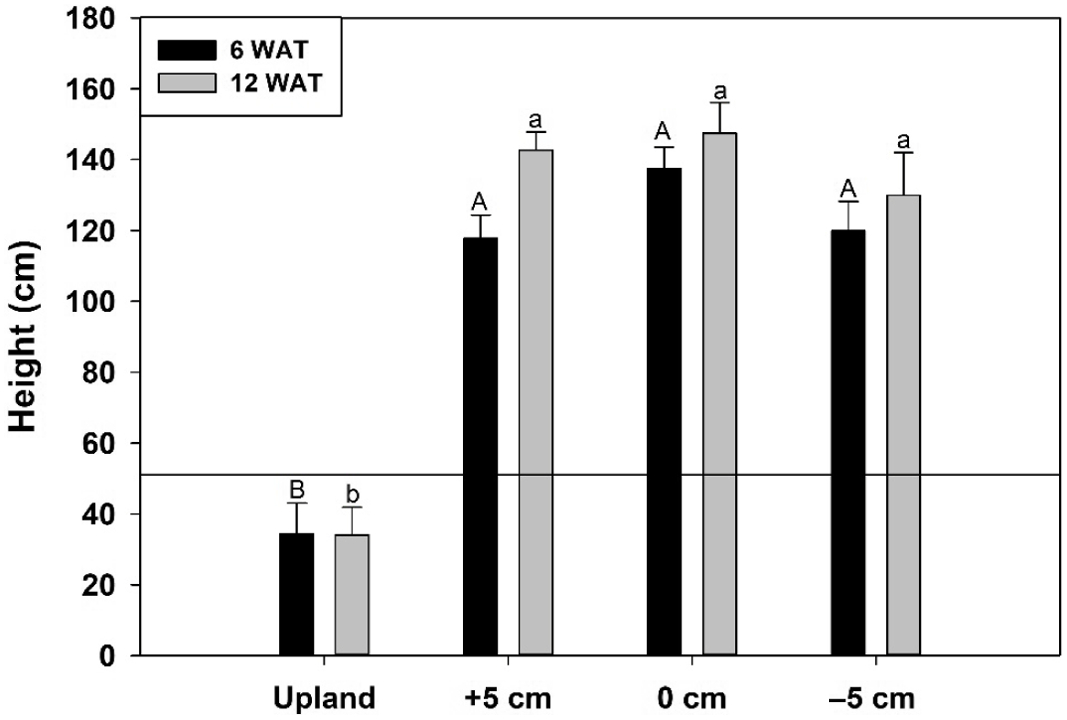
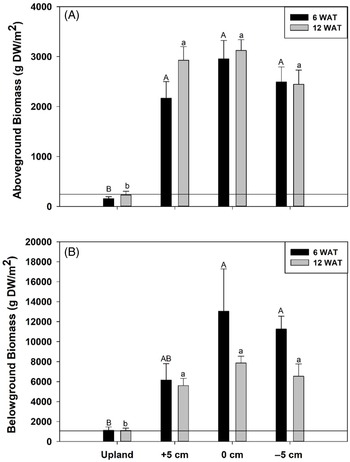
Miscanthus × giganteus height was not different among wetland treatments at 6 or 12 WAT; however, all plants in wetland treatments were 242% to 300% taller than those grown in an upland habitat at 6 WAT (34.4 cm; P < 0.0001) and 281% to 333% taller than upland plants at 12 WAT (34.1 cm; P < 0.0001; Figure 1). Similar to height, M. × giganteus biomass did not differ among wetland treatments, but all wetland treatments had greater biomass than plants grown in simulated upland habitats (Figure 2). Aboveground biomass of M. × giganteus in wetland treatments was greater than biomass of upland plants at 6 WAT (158 g dry weight [DW] m−2; P < 0.0001) and 12 WAT (230 g DW m−2; P < 0.0001; Figure 2A). Belowground biomass of M. × giganteus was also greater in wetland treatments than in plants in upland treatments at 6 WAT (1,114 g DW m−2; P = 0.0058) and 12 WAT (1,105 g DW m−2; P < 0.0001, Figure 2B). Mean belowground biomass of M. × giganteus grown in simulated uplands was greater than aboveground biomass at 6 WAT and 12 WAT. Similarly, mean belowground biomass of M. × giganteus grown in simulated wetlands (10,145 g DW m−2) was greater than aboveground biomass at 6 WAT (2,540 g DW m−2) and 12 WAT (6,660 vs. 2,833 g DW m−2). While plant metrics differed among treatments within a harvest event, there were no differences in plant metrics within a treatment among harvest events (e.g., 6 WAT upland aboveground biomass was not different from 12 WAT upland aboveground biomass; P > 0.05 for all).
Miscanthus × giganteus height at 6 and 12 wk after treatment (WAT) in upland and wetland habitats; each harvest event was analyzed separately; bars sharing the same letter are not different at the alpha = 0.05 significance level (n = 4); treatments on the x axis represent wetland water levels in relation to the sediment level in pots; the solid line is pretreatment height.

Aboveground (A) and belowground (B) Miscanthus × giganteus biomass at 6 and 12 wk after treatment (WAT); each harvest event was analyzed separately for each biomass type; bars sharing the same letter are not different at the alpha = 0.05 significance level (n = 4); treatments on the x axis represent wetland water levels in relation to the sediment level in pots; the solid lines are pretreatment biomass. DW, dry weight.

Belowground biomass recorded here was greater than that recorded in the northern United States (Illinois) and similar latitudes in Europe (Dohleman et al. Reference Dohleman, Heaton, Arundale and Long2012; Miguez et al. Reference Miguez, Zhu, Humphries, Bollero and Long2009); however, C4 species would be expected to increase biomass in warmer climates, as recorded for M. × giganteus (Miquez et al. Reference Miguez, Zhu, Humphries, Bollero and Long2009). Additionally, M. × giganteus was shown to produce greater biomass in lowland habitats compared with upland habitats (Barney et al. Reference Barney, Mann, Kyser and DiTomaso2012; Clifton-Brown et al. Reference Clifton-Brown, Lewandowski, Bangerth and Jones2002), suggesting that biomass should increase as soil moisture increases from upland to wetland habitats. Therefore, it is plausible that biomass yields would be greater in warmer climates with higher soil moisture in the southeastern United States (Mississippi) than those of cooler upland habitats in the northern United States or Europe. However, further work investigating M. × giganteus growth in field sites of the southeastern United States would be beneficial, as mesocosm plants were grown in ideal conditions (i.e., adequate moisture and nutrients, minimal competition, etc.) and may have attained plant height and biomass levels that are unlikely to be found in field sites under less than ideal growth conditions.
Chemical Control
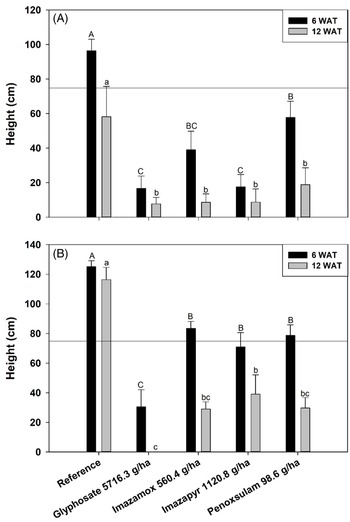
Miscanthus × giganteus height in simulated uplands was reduced 40% to 83% by herbicide treatments when compared with reference plants (96 cm) at 6 WAT (P < 0.0001) and 68% to 87% by herbicide treatments at 12 WAT (58 cm; P < 0.0001; Figure 3A). Miscanthus × giganteus height in simulated wetlands was reduced 33% to 76% by herbicide treatments when compared with reference plants (125 cm) at 6 WAT (P < 0.0001) and 66% to 100% by herbicide treatments at 12 WAT (116 cm; P < 0.0001; Figure 3B). At 6 WAT, M. × giganteus height was taller in upland habitats for plants treated with penoxsulam (58 cm) than plants treated with glyphosate (17 cm) or imazapyr (18 cm), while plants treated with imazamox were similar in height (39 cm) to plants treated with other herbicides (P < 0.0001; Figure 3A). By 12 WAT, there was no difference in height detected among the non-reference herbicide treatments in upland habitats (Figure 3A). In wetland habitats, glyphosate-treated M. × giganteus was shorter (31 cm) than plants treated with other herbicides (71 to 83 cm) at 6 WAT (P < 0.0001); there was no difference in plant height among other herbicide treatments (Figure 3B). At 12 WAT, M. × giganteus grown in wetland habitats and treated with glyphosate was shorter (0 cm) than plants treated with imazapyr (39 cm), while plants treated with imazamox (29 cm) and penoxsulam (30 cm) had heights similar those of plants treated with glyphosate or imazapyr (P < 0.0001; Figure 3B); glyphosate was the only herbicide treatment to reduce height 100% compared with nontreated references at 12 WAT (Figure 3B).
Miscanthus × giganteus height at 6 and 12 wk after treatment (WAT) in upland (A) and wetland habitats (B); each harvest event was analyzed separately within each habitat type; bars sharing the same letter are not different at the alpha = 0.05 significance level (n = 4); the solid lines are pretreatment height.

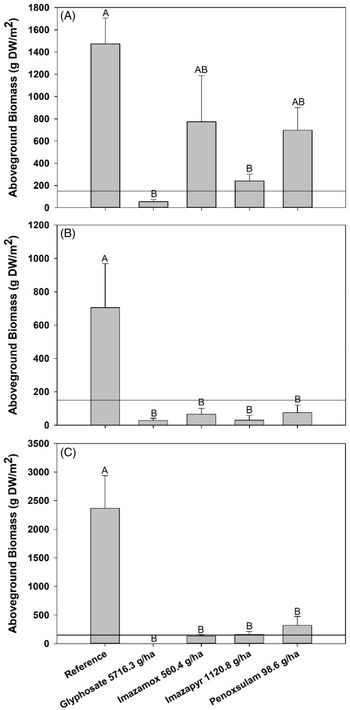
Aboveground biomass of M. × giganteus herbicide treatments did not differ by habitat type (P = 0.0514) at 6 WAT; therefore, those data were pooled for analysis (Figure 4A). At 6 WAT, aboveground biomass of glyphosate- and imazapyr-treated M. × giganteus was reduced 96% and 84%, respectively, compared with reference plants (1,474 g DW m−2; P = 0.0004; Figure 4A), while biomass of imazamox- and penoxsulam-treated plants was not different from biomass of references or glyphosate- or imazapyr-treated plants (Figure 4A). In upland habitats (Figure 4B), herbicide treatments reduced aboveground M. × giganteus biomass by 89% to 96% (P = 0.0002) compared with reference plants at 12 WAT. Similarly, in wetland habitats (Figure 4C), herbicide treatments reduced aboveground M. × giganteus biomass by 87% to 100% (P < 0.0001) compared with reference plants at 12 WAT. Glyphosate applied to M. × giganteus grown in a wetland habitat was the only treatment to reduce aboveground biomass by 100% (Figure 4C).
Aboveground Miscanthus × giganteus biomass at 6 (A) and 12 (B and C) wk after treatment (WAT) in combined (A), upland (B), and wetland (C) habitats; each harvest event (A vs. B or C) and habitat type (B vs. C) was analyzed separately; bars sharing the same letter are not different at the alpha = 0.05 significance level (n = 4); the solid lines are pretreatment biomass. DW, dry weight.

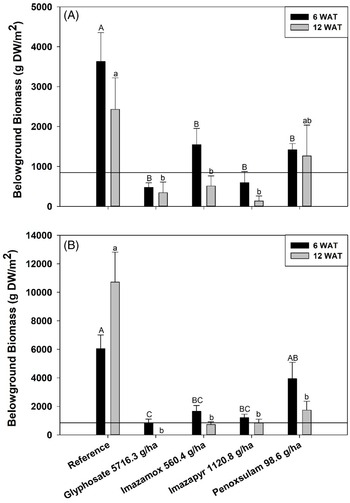
Belowground biomass of M. × giganteus was reduced 57% to 87% in upland habitats by herbicide treatments at 6 WAT (P < 0.0001) when compared with reference plants; there was no difference in biomass among herbicide-only treatments (Figure 5A). However, by 12 WAT, there was no difference in belowground biomass of upland-grown M. × giganteus treated with penoxsulam and reference plants (1,266 vs. 2,434 g DW m−2), while belowground biomass of plants treated with other herbicides remained suppressed 79% to 94% (P = 0.0079; Figure 5A). Additionally, there was no difference in belowground biomass of upland-grown M. × giganteus treated with penoxsulam and plants treated with other herbicides at 12 WAT (Figure 5A). In wetland habitats, M. × giganteus treated with penoxsulam had biomass (3,933 g DW m−2) similar to that of reference plants (6,041 g DW m−2) at 6 WAT, while other herbicide treatments had biomass reduced by 73% to 87% (P < 0.0001) compared with references (Figure 5B). Belowground biomass of wetland-grown M. × giganteus treated with imazamox (1,644 g DW m−2), imazapyr (1,204 g DW m−2), and penoxsulam (3,933 g DW m−2) was not different at 6 WAT (Figure 5B). By 12 WAT, all herbicide treatments had reduced belowground biomass of wetland-grown M. × giganteus by the 84% to 100% (P < 0.0001) when compared with reference plants (10,716 g DW m−2; Figure 5B).
Belowground Miscanthus × giganteus biomass at 6 and 12 wk after treatment (WAT) in upland (A) and wetland (B) habitats; each harvest event was analyzed separately within each biomass type; bars sharing the same letter are not different at the alpha = 0.05 significance level (n = 4); the solid lines are pretreatment biomass.

Because M. × giganteus was taller and had greater biomass in our simulated wetland habitats compared with upland habitats, it is plausible that M. × giganteus can readily invade wetland areas if it escapes cultivation from nearby upland sites. This suggests that after abandonment, M. × giganteus biofuel crops situated near wetlands should be eradicated or drastically reduced in order to protect vulnerable wetland areas. The herbicides investigated here had varying levels of reduction of M. × giganteus height and biomass when compared with nontreated reference plants. Glyphosate consistently reduced height and biomass of M. × giganteus in both simulated habitats at 6 and 12 WAT harvests and was the only herbicide treatment to provide 100% reduction of M. × giganteus in these trials. This suggests that glyphosate has potential as a stand-alone herbicide treatment for consistent reduction of M. × giganteus in abandoned cultivation sites or invaded wetland sites. At 6 WAT, imazamox failed to reduce M. × giganteus height in either wetland or upland habitat (Figure 4A); however, by 12 WAT, imazamox had reduced M. × giganteus height and biomass compared with reference plants in both habitats. Imazapyr reduced M. × giganteus height and biomass compared with reference plants in both habitats; however, imazapyr never achieved 100% reduction in height in wetland-grown plants (Figure 3B) or biomass (Figures 4C and 5B) at 12 WAT like those treated with glyphosate. At 6 WAT, penoxsulam failed to reduce aboveground biomass of M. × giganteus in either habitat, but by 12 WAT, aboveground biomass of plants was reduced in both habitats (Figure 4). However, at 12 WAT, penoxsulam had not reduced belowground biomass of M. × giganteus grown in simulated uplands, while plants in simulated wetlands had been reduced compared with reference plants (Figure 5). This suggests that penoxsulam may be a suitable long-term control option for M. × giganteus in wetlands but may not provide long-term reduction in uplands, as belowground biomass was no different from nontreated references at 12 WAT (Figure 5A). Because M. × giganteus is a perennial species that requires multiple growing seasons to fully establish and produce maximum biomass yield, chemical control strategies investigated here should be tested on established field populations to determine reduction efficacy.
Other herbicide mechanisms of action (MOAs) should also be investigated for control of M. × giganteus field populations. Foliar treatments of the graminicide sethoxydim (211 and 422 g ai ha−1) yielded 53% and 35% M. × giganteus biomass reduction, respectively, at 4 WAT in a greenhouse experiment (Anderson et al. Reference Anderson, Voight, Bollero and Hager2010). Enloe and Netherland (Reference Enloe and Netherland2017) found that sethoxydim (560 g ai ha−1) and fluazifop-p-butyl (210 g ai ha−1) reduced aboveground biomass of another invasive wetland grass species, torpedograss (Panicum repens L.) 76% to 94% and belowground biomass 69% to 90% in mesocosm trials. In another mesocosm trial, glyphosate (0.84 and 1.68 kg ai ha−1) tank-mixed with sethoxydim (0.53 kg ai ha−1) or fluazifop-p-butyl (0.42 kg ai ha−1) enhanced reduction of P. repens biomass when compared with either graminicide used alone (Enloe et al. Reference Enloe, Netherland and Lauer2018a). In Florida field plots, Enloe et al. (Reference Enloe, Netherland and Lauer2018b) reported no reduction of P. repens biomass at 1 yr after treatment with sequential sethoxydim applications (0.53 and 8.4 kg ai ha−1) compared with nontreated plants. Finally, Enloe et al. (Reference Enloe, Quincy, Netherland and Lauer2020) reported percent-cover reductions of P. repens at 8 mo after treatment (MAT) with fluazifop-p-butyl applications (6.7 and 11.2 kg ai ha−1), but another invasive wetland grass, paragrass [Urochloa mutica (Forssk.) T.Q. Nguyen], was unaffected; low-rate sequential herbicide applications (0.42 kg ai ha−1) did not affect either species at 11 MAT. Reported activity of sethoxydim and fluazifop-p-butyl (both acetyl-CoA carboxylase inhibitors) suggests that herbicides with a similar MOA should be investigated for use in controlling M. × giganteus in upland and wetland habitats. However, Barksdale et al. (Reference Barksdale, Byrd, Zaccaro and Russell2020) did not record biomass reduction of upland M. × giganteus with graminicides in field trials.
Finally, integrated control techniques should be investigated for control of M. × giganteus, as mechanical and biological control methods have been reported to reduce M. × giganteus growth (Barksdale Reference Barksdale2016; Barney et al. Reference Barney, Mann, Kyser and DiTomaso2012). Barney et al. (Reference Barney, Mann, Kyser and DiTomaso2012) reported damage to M. × giganteus by an unknown herbivore in lowland riparian habitats to such an extent that it precluded long-term growth assessment, suggesting that herbivory/grazing alone or as part of an integrated management strategy warrants further investigation. Simulated mowing reduced M. × giganteus rhizome production and biomass 59% to 71% at 13 WAT in a greenhouse experiment while increasing shoot density (34%) and aboveground biomass (83%), suggesting that treated plants utilized rhizome starch reserves to increase aboveground growth as a recovery mechanism after mowing (Barksdale Reference Barksdale2016). Repeated clipping of aboveground biomass of other perennial rhizomatous plant species has been shown to be a potential control mechanism if clipping is conducted frequently enough to repeatedly reduce plant biomass (Derr Reference Derr2008; Turnage et al. Reference Turnage, Madsen, Wersal and Byrd2019). Additionally, integrated techniques that utilize chemical and mechanical control methods have been shown to be effective on other invasive grass species capable of surviving in wetland environments (Derr Reference Derr2008), suggesting this integrated approach may enhance control of M. × giganteus growing in wetland habitats.
Acknowledgments
We would like to thank Brian Baldwin for supplying Miscanthus rhizomes for this study. We would also like to thank David Russell, Julie Gower, and Mary Shackleford for assistance in conducting this project. Mention of herbicide trade names does not constitute an endorsement of that product over those not mentioned by Mississippi State University or USDA. No conflicts of interest have been declared.