Introduction
InstitutionsFootnote 1 have been recognized as driving features of economic and human development. Yet they are not the only factors that make up the context in which the lives of people are embedded: institutions are profoundly related to other factors, typically of some structural kind, e.g. geography or demographics, local history, culture or economic diversification. Different institutional aspects are themselves likely to be dependent upon each other, as highlighted by various authors. On one hand, institutional complementarities explain the emergence and persistence of different varieties of capitalism. On the other hand, they partially condition the available possibilities for institutional change, as some institutions interlock with others and affect the costs of transiting in and out of a particular institutional landscape.
Within economics, much empirical investigation has concentrated on structural determinants of underdevelopment, often testing concurring hypotheses, for example whether geography may be more or less relevant than institutional quality for development trajectories: findings often hint that factors are interconnected, working through ‘direct’ as well as ‘indirect’ channels.
A tight ‘web’ of interconnections between factors used to explain outcomes in socio-economic, complicates the study of institutions within societies and economies: The existence of interconnections between structural factors makes it unlikely for a single institutional aspect to have a clearly identifiable effect on socio-economic development. Similarly, institutional change may be highly dependent on the concomitant change of other, connected, factors. Thus, empirical results based on exercises that single out and isolate a particular institution should be treated with care.
While there seems to be growing agreement that studying institutions and connected structural factors jointly is preferable, it remains a conceptual and empirical challenge how to treat complex inter-linkages. Potentially, interconnections may be of different magnitude, have unequal relevance, and enshrine very different relational dynamics – and all exist contemporaneously.
To partially disentangle such complexity, this paper introduces new typologies of relations that may link institutions and structural factors. First, it uses the metaphor of symbiotic relations, common in ecology, to expand our intuitive understanding of interconnections. Second, it proposes a methodological strategy that relies on network analysis in order to capture interconnections empirically.
The study is structured as follows: section 2 builds upon existing literature and argues that symbiotic relations may add to our intuitive understanding of structural interconnections. Focus is on the manifold nature of such connections and the possibility of asymmetries in them. Section 3 introduces an innovative methodological approach to empirically capture interconnections: correlation networks. This technique used in gene co-expression analysis is applied to a pool of factors, whose relevance for development has been studied in the literature: they are collected at the municipality level in Brazil for all 5,565 municipalities. The analysis identifies so-called centroids – the most interconnected factors – across different levels of socio-economic development. In section 4, the analysis is extended in order to detect asymmetric relationships. Section 5 discusses the empirical results in terms of the institutions–development link and section 6 briefly concludes.
1. Institutional interconnections
Too complex for one-way linearity
In studying the effect of institutions on development, they are often investigated in cross-sectional analysis, typically by isolating a single institutional factor.Footnote 2 In econometric analyses, however, the endogenous nature of institutions has been recognized as a potential limit to the validity of estimates. While instrumentation has represented the prevailing adjustment tool, many authors have argued for it to be an unsatisfactory method due to the scarcity of available instruments leading to the same variable being used as instrument for different indices of institutions and therefore being interpreted in varying ways (Pande and Udry, Reference Pande and Udry2006, pp. 6–10), with the effect of instruments probably being the echo of one or more of a diversity of underlying mechanisms (Ray, Reference Ray, Blume and Durlauf2007, p. 12).
Beyond these limits posed by reverse causality, there is a second major concern with framing the institutions–development link in a linear way: assuming that institutional quality (however conceived) is linearly connected to socio-economic development implies a specific functional role for institutions. They are interpreted as ‘serving’ the scope of improved systemic efficiency. For different reasons, however, such conception is problematic: on the one hand, it neglects the political economy aspect enshrined in institutions (Amable, Reference Amable2016). These tend to be the result of power struggles in societies, whose resolution does not necessarily lead to greater systemic efficiency, but may instead be ‘functional’ in the reproduction of existing power structures.
On the other hand, institutions can be viewed as enshrining elements of different evolutionary aspects, e.g. the evolution of cognitive psychology (Boyer and Petersen, Reference Boyer and Petersen2012, Reference Boyer and Petersen2013; Sindzingre, Reference Sindzingre2014), which is highly adapted to the specificity of the context. While functional for survival or social stability – such functionality may be (1) multidimensional and (2) potentially in contrast or indifferent to systemic efficiency as in the economic sense, for example.
Cross-sectional investigations of the institutions–development link may thus be tricky – especially quantitative ones – as institutions are likely to be ‘composite concepts’, combining measurable elements of form with unmeasurable elements of content, enshrining different semantic meaning in different places, to different groups, at different moments in time (Sindzingre, Reference Sindzingre2014). Yet empirical analysis of institutions remains a priority and continuously improving data make the challenge more relevant: can we push the boundaries of analysis further in order to improve our understanding of the institutions–development link? We need more insights on the mechanisms that make an institution relevant to development. Theoretic advancements suggest abandoning the point of view that an ideal-type institutional setup can be held accountable for outcomes in socio-economic development (Chang, Reference Chang2011). A more promising view seems to be one in which interconnections between institutions and other structural factors are investigated jointly.
Manifold links
When focusing on interconnections among structural factors, a first, implicit assumption is that two-way relationships matter, not only in the functioning of the single social structure, but also in its effect on society. Understanding how particular institutional forms and structural variables relate to each other provides important insight on (1) the persistence of particular institutional landscapes and (2) available policy options that seek to promote institutional change. The need to investigate different institutional arrangements jointly has been stressed, for example by Bassanini and Duval (Reference Bassanini and Duval2009), Belloc and Bowles (Reference Belloc and Bowles2013), Dacin et al. (Reference Dacin, Goodstein and Scott2002), Hodgson and Stoelhorst (Reference Hodgson and Stoelhorst2014), Langlois (Reference Langlois2016); Seo and Creed (Reference Seo and Creed2002) and Thévenon (Reference Thévenon2016).
The notion of path dependence (Arthur, Reference Arthur1989; Arthur et al. (Reference Arthur, Ermoliev and Kaniovski1987), crucial to the study of institutions and development, is itself drenched with the meaning of interconnections: institutional interdependencies lead to patterns of ‘circular and cumulative causation’ (Pagano and Vatiero, Reference Pagano and Vatiero2015, p. 275, adapted). Such processes result in self-reinforcing mechanisms, implicit in the notion of positive feedback (Pierson, Reference Pierson2004), thought to perpetuate certain structural features within a society, often shaping the possibilities of institutional change and the trajectories of socio-economic development. Typical interconnections are those between formal rules and informal constraints embodied in customs, traditions, and codes of conduct (North, Reference North1990, p. 6). Such mutual responses can form cultural–institutional conventions (Belloc and Bowles (Reference Belloc and Bowles2013), which are likely to shape the costs of institutional change, available policy options and the overall integrity, inertia and resilience of a complex institutional system.
For these reasons, much attention has been paid to so-called institutional complementarities,Footnote 3 investigated within the theory of the firm, innovation systems and broader institutional setups, e.g. to explain varieties of capitalism (Hall and Soskice, Reference Hall and Soskice2001; Streeck and Thelen, Reference Streeck and Thelen2005). Institutional complementarity is present when ‘the functional performance of an institution A is conditioned by the presence of another institution B and vice versa’ (Höpner, Reference Höpner2005, p. 383). Within economics, the notion of complementarity is essentially tied to whether an increase in one factor is associated with higher returns in the other factor (Crouch et al., Reference Crouch, Streeck, Boyer, Amable, Hall and Jackson2005), which may evoke an ex ante defined functionality. The literature on institutional complementarities has provided rich descriptions of the plurality of institutional landscapes, without necessarily falling into the functionalist fallacy. Complementary institutional arrangements may respectively constitute the institutional environment (Aoki, Reference Aoki2001, p. 225) for each other by constituting exogenous parameters. Institutions in one domain have (also) unintended effects on institutions in other domains, thereby possibly increasing the advantage of one arrangement with respect to another. The notion of advantage refers to the micro-foundations of institutional construction, which relies on some sort of specification of a game in which individuals seek to maximize their own payoffs. So while the literature on institutional complementarities comprises a much more holistic view of institutions – not merely functional for economic growth – it remains essentially tied to the micro-foundations of economics in which maximization principles predominate.
Examples of investigated institutional complementarities pertinent to the institution's development link include the interplay between belief systems and the institutional framework, legal institutions and economic development, land productivity and inequality or the delicate relation between culture, institutions and entrepreneurship, ethics and societal change. Theory suggests that all interactions are possible and should therefore be studied contemporaneously (Bassanini and Duval, Reference Bassanini and Duval2009, p. 54), but in some studies looking for systemic interactions between a specific policy and the overall institutional framework, such an attempt is typically abandoned when it comes to empirics: evidence, to date, tends to remain scattered in attempts to study specific relations between two institutions or structural factors.
While able to explain multiple equilibria and the persistence of inferior arrangements, this literature has still been criticized for being unable to combine the presumed locking-in effect between complementary factors with the dynamics needed to explain institutional change (e.g. Höpner, Reference Höpner2005; Amable, Reference Amable2016), as ‘neither does complementarity totally determine institutional change, nor is institutional change entirely independent from functionality, which is – in part – conditioned by complementarity’(Höpner, Reference Höpner2005, p. 385). This study seeks to contribute to our understanding of the underlying ‘structure of relationships’ (Langlois, Reference Langlois2016, p. 53), which should have important implications for dynamics and provide a methodological tool through which many relations can be investigated contemporaneously.
Drawing on ecology: symbiotic relationships
The quest to disentangle the complex web of interrelations between social structures in any context (local/national) – formal or informal – can be seen as analogous to the investigative purpose of ecology itself, which is ‘the science that deals with the specific interactions that exist between organisms and their living and non-living environment’ (Tomera, Reference Tomera1979, p. 89). Within institutional literature, most evolutionary approaches have focused on the principles of ‘variation’, ‘selection’ and ‘inheritance’ (or replication) in order to explain the mechanisms of change (Hodgson and Knudsen, Reference Hodgson and Knudsen2010; Kingston and Caballero, Reference Kingston and Caballero2009; Witt, Reference Witt2014). Approaches are typically not purely naturalistic, but foresee important cultural influences that are time and context-specific (Witt, Reference Witt2014), allowing for intentionality and for innovation in routines and practices.Footnote 4 This study introduces a new analogy derived from ecology, which shifts the focus from variation, selection and replication to complexity and interdependence by focusing on symbiotic relationships.
The advantage of the symbiotic lens is manifold: it implies neutrality in the ex ante conception of what an institution may ‘serve for’. Symbiosis refers to the ‘living together of unlike organisms’ (De Bary, Reference De Bary1879) and usually implies long-term biological interactions between them. The ancient Greek word symbiosis insinuates a joint coexistence with exchange between two phenomena, without ex ante superimposing a hierarchy between them nor specifying what the benefit of such interaction should be. Symbiotic relationships are not assessed, for example, in terms of their ability to ‘increase the number of cells’ or to ‘reduce the amount of CO2’. They are highly specific and open to the myriad of possible combinations with which living organisms may exchange.
Second, ecology bears an intrinsic connotation of complexity, intuitively recalling that no organism – and no pair of organisms – exists in isolation from others or from contextual features. In this sense, symbiosis may help institutional analysis widen its perspective from pairs of factors to manifold connections co-existing at the same time. Third, symbiosis intuitively evokes the underlying structures of a relationship; it may be beneficial or harmful for the functioning of either of the two components involved. Asymmetric relationships are highly interesting for the institutions–development link, as they allow for a blend between static and dynamic analysis.
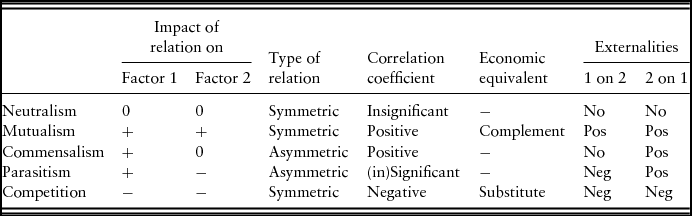
Can an analogy to relations among organisms help in understanding how structural factors characterizing societies interconnect? Symbiotic relationships in ecology imply close physiological contact. The intensity and nature of the relation may be different, and the degree of dependency between one organism and another can vary, too. Usually, five different types of symbiotic relationships are identified: neutralism, mutualism, commensalism, parasitism and competition.
Table 1 summarizes the key features of symbiotic relationships and plots them against possible economic equivalents: complements/substitutes and positive/negative externalities. The notions of ‘complement’ and ‘substitute’ correspond to symbiotic relationships with symmetric nature, e.g. mutualism or competition. However, asymmetric interactions cannot properly be expressed in these equivalents without losing parts of their intuitive meaning. Commensalism and parasitism enshrine more information on the structure of the relation. Externalities may be more adequate to capture the asymmetry of interactions, but they tend to be used to study indirect influences: to express asymmetry, it would be necessary to cross-compare externalities of the two factors studied. Commensalism and parasitism, on the other hand, intrinsically express such asymmetry.
Types of symbiotic relationships: key features

Source: Author's elaboration based on Cain et al. (Reference Cain, Bowman and Hacker2011).
Commensalism in ecology stands for a positive interaction, or a situation of so-called facilitation, in which ‘one or both species benefit and neither is harmed’ (Cain et al., Reference Cain, Bowman and Hacker2011, p. 306). While in mutualism the benefit is symmetric, in commensalism one species benefits more than the other. The positive effect of one organism on the other can be the provision of resources (food, shelter, space to grow in) or the increased efficiency with which the other organism works. A mutualist companion might reduce the load of the other's work (e.g. taking over parts of the digestion process) and increase its defences (e.g. reducing the negative effects of competitors, predators or parasites) (Cain et al., Reference Cain, Bowman and Hacker2011). Trophic mutualism (the exchange of energy or nutrients) can be transposed to resource mutualism in institutional analysis: for example, effective tax collection mechanisms can provide resources to other public institutions. Habitat mutualism implies the provision of functional space (e.g. within a hosting institution at a higher hierarchical level), or favourable local environmental conditions or increased tolerance of existing (adverse) conditions: the reduction of criminal behaviour in a certain area may have important ‘habitat’ effects on school attendance, social participation, political mobilization, etc. Service mutualism may for example be the public provision of higher quality schooling, facilitating the structural transformation of the economy from industry to services.
Such categories of mutualism can mix in a relationship: one part may benefit from trophic mutualism, while the other enjoys service mutualism. Symbiotic relations are further not bound to be stable, but may change with surrounding environmental conditions: a positive interaction may turn into competition and vice versa depending on environmental stress, the accessibility of resources and the presence of other species. Mutualism can often be the outcome of coevolution and become compulsory when turning highly specific to the features of the two species involved. Yet facultative mutualism also exists with a less specific exchange of advantages: seedlings that benefit from the shade of an adult desert plant can obtain this from a range of different plants. Commensalism is never obligatory for the species that is not benefiting, but may be for the one drawing the benefit.
Parasitism has many analogies to commensalism. Evolutionary mutations and adaptations play a role in the constant ‘battle’ between host defences and parasite counter-defences: one-sided or two-sided adaptations can turn host–parasite relationships into a mutualist relation in which none of the parties is harmed. Clearly the durations of the organisms’ life-cycles play a role: within a given time-frame, species with shorter life cycles have more opportunity for mutation and adaptation. Similarly among institutional factors: an economic policy has a different life-cycle from that of a constitution, and production processes cannot be changed with the same velocity as tax incidence.
So while representing a new conceptual perspective for interactions, symbiotic relationships are not disconnected from the notions of variation, selection and replication – evolution! – of generalized Darwinism. Evolutionary tendencies may provoke entry and exit from relations. Further, some organisms may be more apt for survival due to the specific relations they have engaged in. In this sense, this study has commonalities with previous attempts to explain institutional interdependencies through a co-evolutionary perspective on institutional complementarities. Battistini and Pagano (Reference Battistini and Pagano2008) treat ‘selection complementarities’ as equivalent to institutional complementarities and investigate how complementary optimization across natural and sexual selection is likely to have spurred the development of the human brain. The authors focus on epistatic relations, which are gene interactions within the same organism that have important commonalities with symbiosis.
This study views social structures as analogous to organisms and refrains from hypothesizing choice mechanisms at the individual level. This has the advantage of not relying on representative agents and specific behavioural assumptions. On the other hand, it remains agnostic with respect to one of the key drivers of institutional change, namely human choice and action.
2. Correlation networks
To study the complex interconnections between structural factors, this paper proposes to use correlation networks that are common in medical research, e.g. the investigation of gene co-expression networks, in which the scope is the identification of pathways and of centrally located genes. This technique has contributed to identifying brain cancer and obesity genes or for greater insights on atherosclerosis.Footnote 5 A correlation network is a network whose ‘adjacency matrix is constructed on the basis of pairwise correlations between numeric vectors’ (Horvath, Reference Horvath2011, p. 91). Pairwise correlation coefficients calculated on a given sample of observations become the edges that link together different nodes/vertexes, which in this case are the variables of interest. Correlation networks are weighted, undirected networks. Networks implicitly embed a relational perspective and provide a cognitive tool to grasp complexity, as they are ‘entangled webs characterized by many-to-many relationships’ (Ansell, Reference Ansell2006, pp. 76–8, adapted).
While correlation networks have predominantly been developed and used to study gene interactions within a single genotype (epistasis), the technique is here applied in a different way, by focusing on interactions across structural factors. In what follows, the network concept of social position is transposed to the position a structural factor assumes within the context considered, itself resembling a ‘web of interrelated structural conditions’ (von Jacobi, Reference von Jacobi2014a, p. 18). The correlation then proxies what in social network analysis is influence, or affection. In correlation networks, factors that are close to each other are likely to assume symbiotic relationships, displaying some kind of relevance to the existence of the other.
Appropriate data: meso-level structural factors
Correlation network analysis requires (1) a critical number of factors under investigation, as the method can be considered to be a step-wise data reduction technique (Horvath, Reference Horvath2011, p. 108); (2) a sufficient amount of observations on which to compute correlation coefficients; (3) measures of institutions and structural factors that tend to be quantitative, continuous and normally distributed. These are heavy restrictions when it comes to investigating institutions. To respond to these requirements, subnational data are used. Scaling down the analysis from the macro (country) level to the mesoFootnote 6 – here, municipality – level has advantages and disadvantages: in favour are certain constants in latent factors such as history or culture, which in macro cross-sectional studies cannot fully be accounted for. Within the same country, there is expected to be less variability. A disadvantage is that some of the most crucial social structures – such as culture, language and factors of institutions (for example, constitutions, legal origins, elements of polity and regulation of the market) do not vary, and cannot therefore be included in the analysis.
Brazil is a federal state with three government levels that concur in legislative activity: the federal union, 26 states and 5,565 municipalities. The municipal level is the lowest level of autonomous governance. This study includes municipal variables that have been identified as relevant to the institutions–development link in a dedicated meso-level dataset that comprises factors measured in 2009 or 2010.
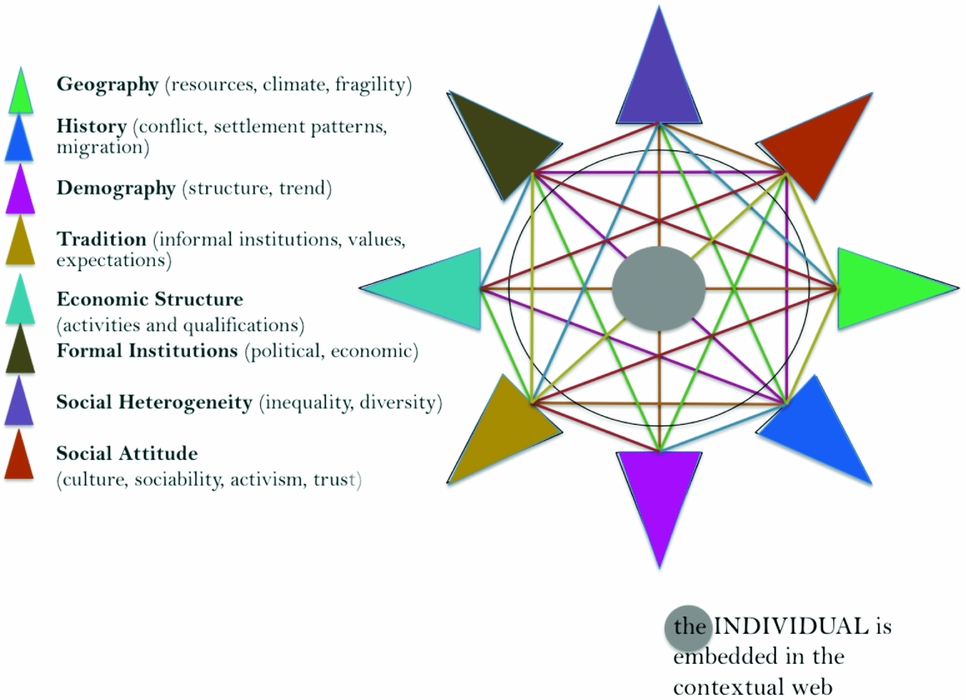
Figure 1 tentatively groups factors investigated in the institutionalist and development economics literature: geography, history, demography, economic structure, formal institutions, social heterogeneity and elements of social attitude and tradition, which comprise informal institutions. For a complete description of the 54 variables included into the analysis, ordered by thematic area, and for data sources, see the Online Supplementary Material, Appendix A.Footnote 7
The contextual web. Conditions are interlinked.

Demographic aspects considered are population size, density, dependency ratio and urbanization. In terms of economic structure, the prevalence and productivity of agriculture are included, covering characteristics of the labour market such as employment growth in the previous 10 years and the prevalence of jobs in the public sector; proxies for the ‘thickness’ of the local economy, such as diversification of GDP, dependence on external transfers and the prevalence of formality in transactions. Geographic characteristics include the presence of natural resources, touristic attractiveness and the density of transportation services. Formal institutions at the municipal level mainly include policy choices, such as public spending, but also the shape of transfers received and taxes collected, access to justice, institutional collaborations held with other government levels across different thematic areas and the presence and functional strength of so-called Conselhos Municipais – thematic, participatory councils in which citizens and public servants decide jointly upon the local policy agenda.
Social heterogeneity may undermine what Hodgson and Stoelhorst (Reference Hodgson and Stoelhorst2014) call the human foundations of cooperation and therefore plays a crucial role in the institutions–development link: indicators of ethno-age fractionalization, wage diversity, adult illiteracy and child poverty are used. It captures elements of social attitude, female empowerment, incidence of art groups, presence of cultural equipment,Footnote 8 but also the incidence of suicide on death rates is considered.
A disclaimer is necessary at this point. A neat distinction between these thematic areas has often turned out to be tricky. Further, with reference to other categorizations of institutional variables (Kunčič, Reference Kunčič2014), the factors included somehow mix elements of so-called institutional quality with economic outcomes. This choice is intended in order to depict interconnections that are statistically detectable without superimposing any direction of causality ex ante – an approach justified by the extensive debate on reverse causality between institutions and economic development. The factors considered are also ‘embedded’ (Williamson, 2000, discussed in Kunčič, Reference Kunčič2014) to different degrees, with social attitude variables mostly catching slow-moving (deeply embedded) social structures and spending variables displaying shorter life cycles.
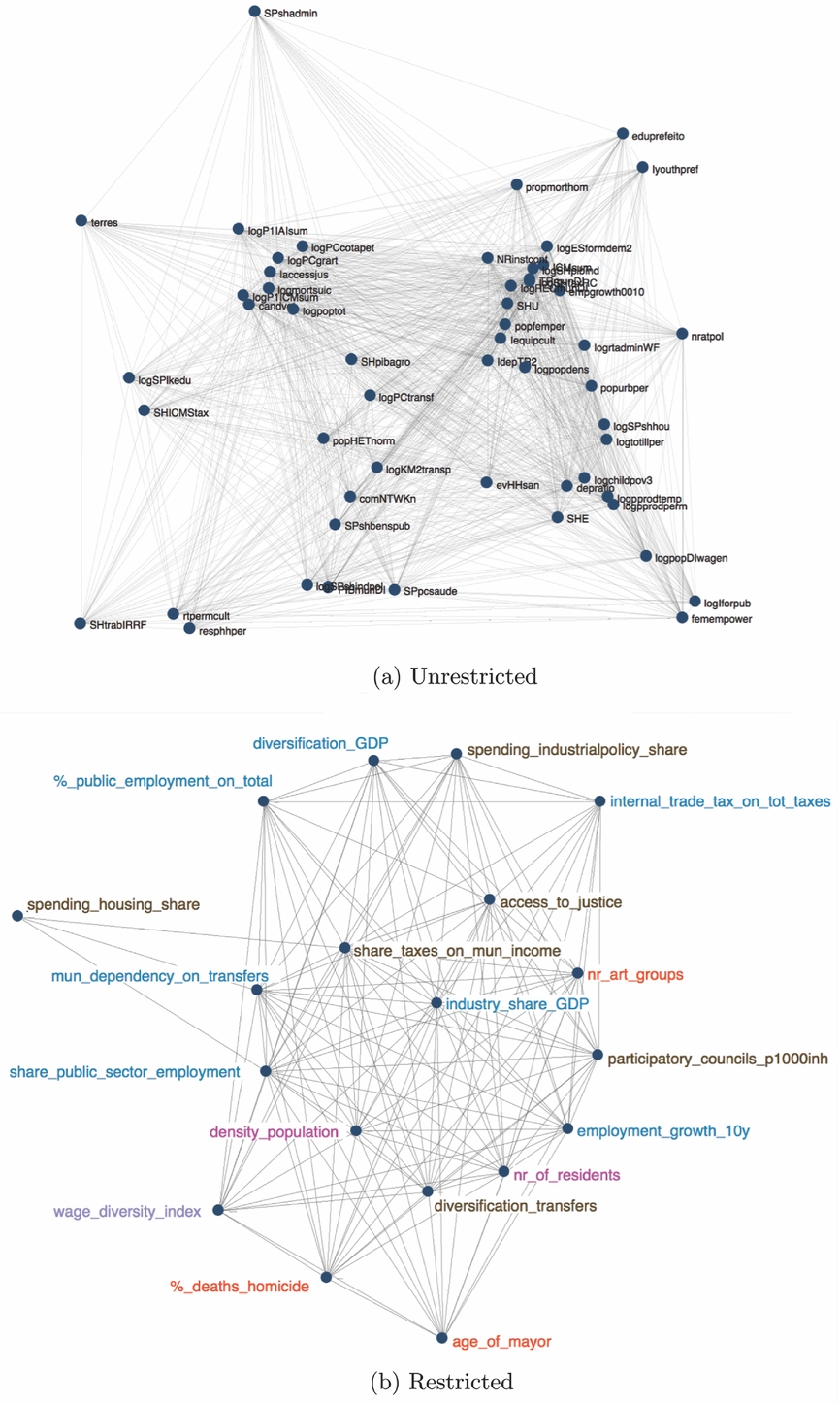
Figure 2 depicts the complete correlation network computed over 5,565 Brazilian municipalities. Panel 2a shows how dense the network is in terms of significant correlation coefficients among all variables, while in panel 2b, the network is restricted to coefficients with absolute value above 0.30. Colours of the labels in 2b are consistent with Figure 1. (For correspondence between labels in Panel 2b and Figure 1, see Table 1 in the Online Supplementary Material.)
Correlation networks without and with threshold on correlation coefficients (absolute value above 0.30).

Centroids: most interconnected factors
Some of the most interesting information conveyed by network analysis is the identification of so-called centroids: nodes with central positions within the network. Centroids may be social structures engaged in more symbiotic relationships, possibly being relevant for others that depend upon them, e.g. those that deliver most resources, services or potential habitat to others. A brief resume of the most commonly used network statistics and their implication for the current analysis follows:
Unweighted degree centrality counts the number of links that a node has and measures how well connected a node is in the overall network (Alatas et al., Reference Alatas, Banerjee, Chandrasekhar, Hanna and Olken2012). Here, it counts the number of structural variables with which the single factor correlates at statistically significant levels.
Weighted degree centrality is the aggregate of the weights of edges – here, the absolute value of the correlation coefficient – connected to the node. Factors with greater weighted degree centrality display higher (and/or more) statistically significant correlation coefficients with other factors.
Closeness centrality considers how connected each factor is to the totality of other factors. A vertex is closer if the sum of shortest paths to all other nodes in the network is smaller. In a correlation network, a closer vertex is one whose paths to all other vertexes are characterized by stronger correlations.Footnote 9 Closeness centrality can proxy independence (Bavelas, 1950; Leavitt, 1951 in Freeman (Reference Freeman1977), as nodes are less dependent on others to maintain own relations. For the analysis of social structures, factors with high closeness centrality are particularly interesting for policy interventions that seek structural change. They exert widespread influence in the overall network, through direct and indirect effects, as their influence can be thought to be propagated through third factors: any change in them may potentially have system-wide effects. Yet very close factors can also imply greater transition costs: policy interventions on them may be more difficult, due to manifold interlocking, yet possibly the most efficient – if successful – as the spread through the contextual web is potentially fastest (Freeman, Reference Freeman1977).
Betweenness centrality is greater for those nodes that are positioned on the shortest paths linking other pairs of nodes. Social structures with greater betweenness centrality ‘channel’ or ‘forward’ indirect effects between other factors of the network. They can also be interpreted as ‘bottlenecks’: as impulses need to pass through them, they can exert influence on the entire contextual web by ‘withholding or distorting information in transmission’ (Freeman, Reference Freeman1977, p. 221). For this reason, nodes with highest betweenness centrality are often interpreted as occupying positions of ‘control’. In this analysis, they may constrain the unfolding of other effects and connections.
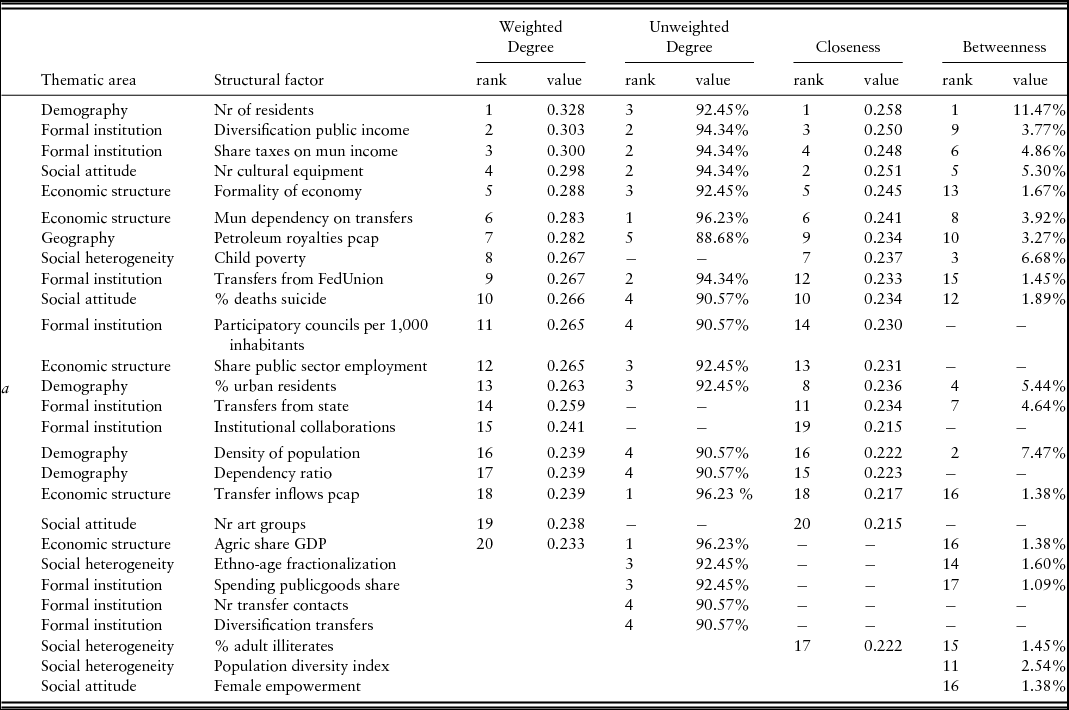
Table 2 summarizes the municipal structural factors that emerge as centroids in Brazil.Footnote 10 For each network statistic, the 20 most central variables are reported in terms of rank and value. Institutional, demographic, economic and social attitude variables are all present at higher ranks. Of the geographic factors included, only the presence of petroleum assumes a central role. Across different centrality measures the number of residents is the single most connected factor, followed by the presence of cultural equipment and the share of taxes on total municipal income. Diversification of public income and formality of the local economy also rank high. The unweighted degree centrality shows how high density and reciprocity of the network are, confirming that interconnections are massive. Interestingly, measures of social heterogeneity tend to assume higher betweenness, although the percentage of paths on which these factors lie (of the potential total) is not particularly high. Heterogeneity may in fact mediate other connections, affecting the amount or quality of information/incentives being transmitted and shared. Other potential ‘bottlenecks’ are demographic factors such as population density and degree of urbanization.
Most central positions in the correlation network; Brazilian municipality-level structural factors

a Computed on correlation coefficients with 1% statistical significance. Missing values indicate any rank below the 20th.
Central structural factors and socio-economic development
Can the results on centroids help us explain which structural factors matter in socio-economic development? Brazil is still a very heterogeneous country in terms of institutional, social and economic development, therefore municipalities included can be considered currently as being at diverse levels of the development process.Footnote 11
The analysis subdivides the overall population of 5,565 municipalities according to their levels of economic development – using five quintiles of an index of economic development: the employment and income (emprego e renda) pillar of the FIRJAN tripartite index of municipal development.Footnote 12 A correlation network for each of the development levels considered is computed – each calculated on a sample of approximately 1,100 municipalities. The five networks are comparable and do not display significant structural differences, apart from a slight trend of increasing density and decreasing network centralization at higher levels of development. Higher density is associated with greater relevance of identified centroids (Horvath, Reference Horvath2011).
As a next step, network statistics are computed to check whether the centrality of structural factors changes at different levels of development.Footnote 13 Three different typologies of structural factors can be identified:
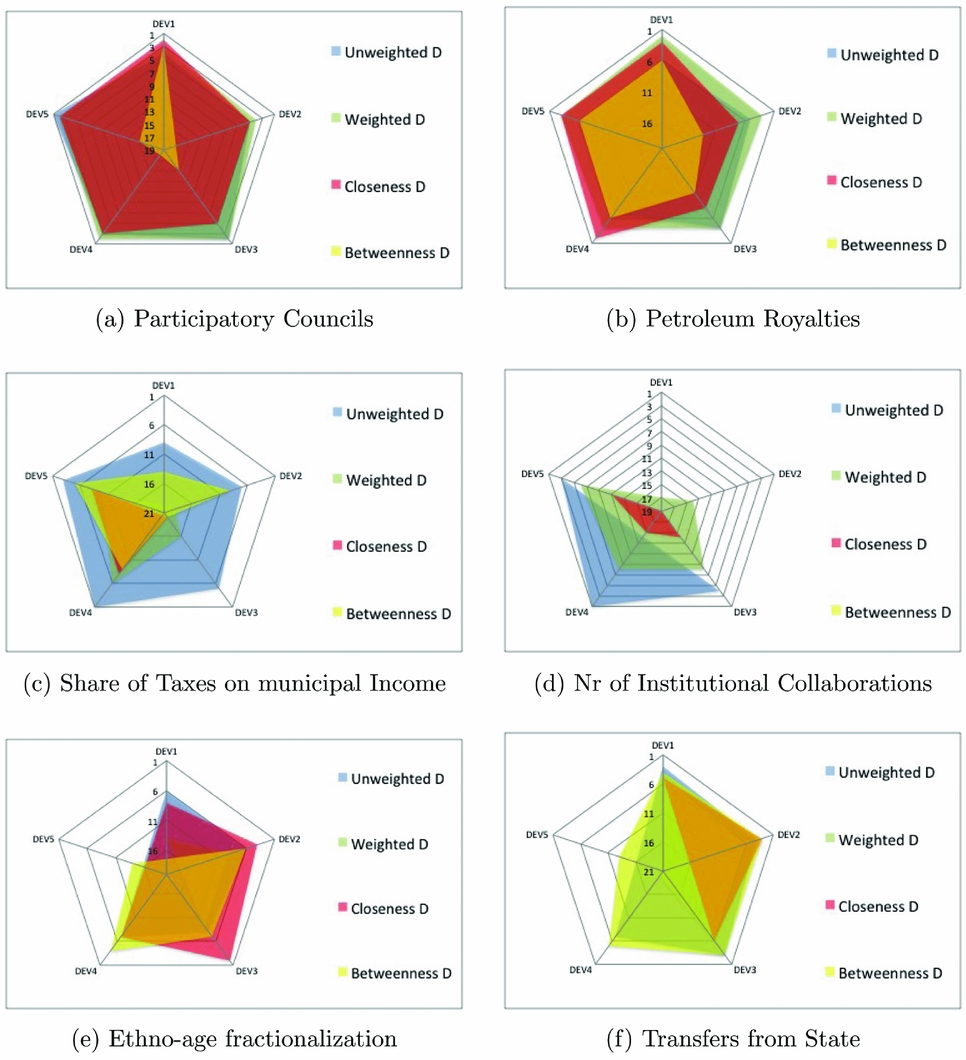
• Universal factors: tend to maintain a central position in the network across different development levels – in this analysis, participatory councils, petroleum royalties and the number of residents.
• Emergers: tend to acquire more central positions in the network with increasing development levels – here the share of taxes on municipal income, the number of institutional collaborations, the presence of art groups, the share of public sector employment and access to justice.
• Egressors: tend to lose centrality in the network with increasing development levels – here the transfers coming from higher levels of government, the incidence of adult illiteracy and child poverty, per capita spending on health and ethno-age fractionalization.
Figure 3 depicts examples of the three typologies described by comparing their ranks in different network statistics across development levels. Participatory councils consistently achieve very high ranks in terms of degree and closeness centrality: this rather innovative and democratic Brazilian institution is tightly intertwined with many other factors, hinting that greater strength in such councils plays a role in a series of themes in the municipality.Footnote 14 Betweenness however tends to decrease with development, quite contrary to what happens with the royalties derived from the presence of petroleum in the municipality: this endowment of a natural resource maintains a central role across development levels in all network measures. Increasing betweenness centrality possibly hints that more interconnections between structural factors are mediated by the presence of royalties.
Examples of central structural factors across development levels with constant (upper), increasing (middle) and decreasing (lower) importance.

In the second (middle) panel of Figure 3, two examples of emerging factors are depicted: the share of taxes on municipal income and the number of institutional collaborations that the municipality entertains. While institutional collaborations tend to bring along more direct connections to other structural factors, greater capacity to collect taxes tends to acquire closeness (more direct and indirect connections) and betweenness, displaying the ‘bottleneck’ effect we expect – but only at higher levels of development.
Some factors also tend to lose their centrality with increasing development (lowest panel of Figure 3): ethno-age fractionalization captures educational differences across different ethnic and age groups. It tends to be very central at medium-lower levels of development, and becomes a ‘bottleneck’ factor (high betweenness) at the second, third and fourth quintile of development, but subsequently ceases to being of relevance in the landscape of Brazilian municipalities. In a similar way, the amount of transfers received from the federal State are a crucial element at lower levels of development and tend to disappear among most developed municipalities – as expected.
The analysis tends to show that (1) the centroids identified in the overall network tend to be robust in the sense of reappearing in the five different sub-networks. However (2) correlation networks among structural factors are not static, but change across different contexts. A focus on different stages of development reveals that (3) some structural factors always play a central role in the Brazilian municipality, whereas others tend to be more relevant to the least/most developed municipalities.
3. Detecting asymmetric relationships
Network actors ‘gain their structural positions by virtue of the connections, or edges, they share with other nodes’ (Green Jr and Wasserman, Reference Green and Wasserman2013, p. 8). Once verified that correlation networks change across different stages of development, the next question that this analysis addresses is whether asymmetric relationship can be detected – and whether they contribute to explaining change in the overall contextual web. To identify symbiotic relationships with an asymmetric character, it is necessary to construct a directed network, requiring the identification of directions of influence between nodes. This necessitates refinement of the computation of the interconnection network, in particular the construction of a network based on regression models (Horvath, Reference Horvath2011, ch. 13). The analysis uses two-way quantile regressions, as these allow us to detect the relevance of predictors at different points of the response distribution. For example, tax collection might be a predictor for the share of municipal spending on public goods – but only for municipalities with relatively high spending on public goods (e.g. at the eightieth quantile), not for those located at the twentieth quantile of the distribution of spending on public goods.
By analysing the relevance that factor A has in explaining changes in factor B – at different moments of the distribution of factor B – it is possible to detect which factor grows ‘more dependent’ on the other. To identify asymmetry, it is necessary to investigate each link between two factors in both directions and to compare the relative ‘dependence’ of one factor on the other. For simplicity, the analysis focuses on commensalist relations only. Commensalism of B over A is identified if the correlation between A and B is positive, and the ‘dependence’ of B on A is greater than the ‘dependence’ of A on B. Asymmetric ‘dependence’ relations can potentially be expressed in terms of supermodularity conditions (Aoki, Reference Aoki2001, p. 226), but the formal treatment proposed in this study is slightly different. Further details on such treatment, its relation to supermodularity and on how to derive a directed network using two-way quantile regressions are provided in the Online Supplementary Material, Appendix F. There, it is also possible to see a figure reporting all commensalist relations that can be detected among structural factors at the municipality level in Brazil.
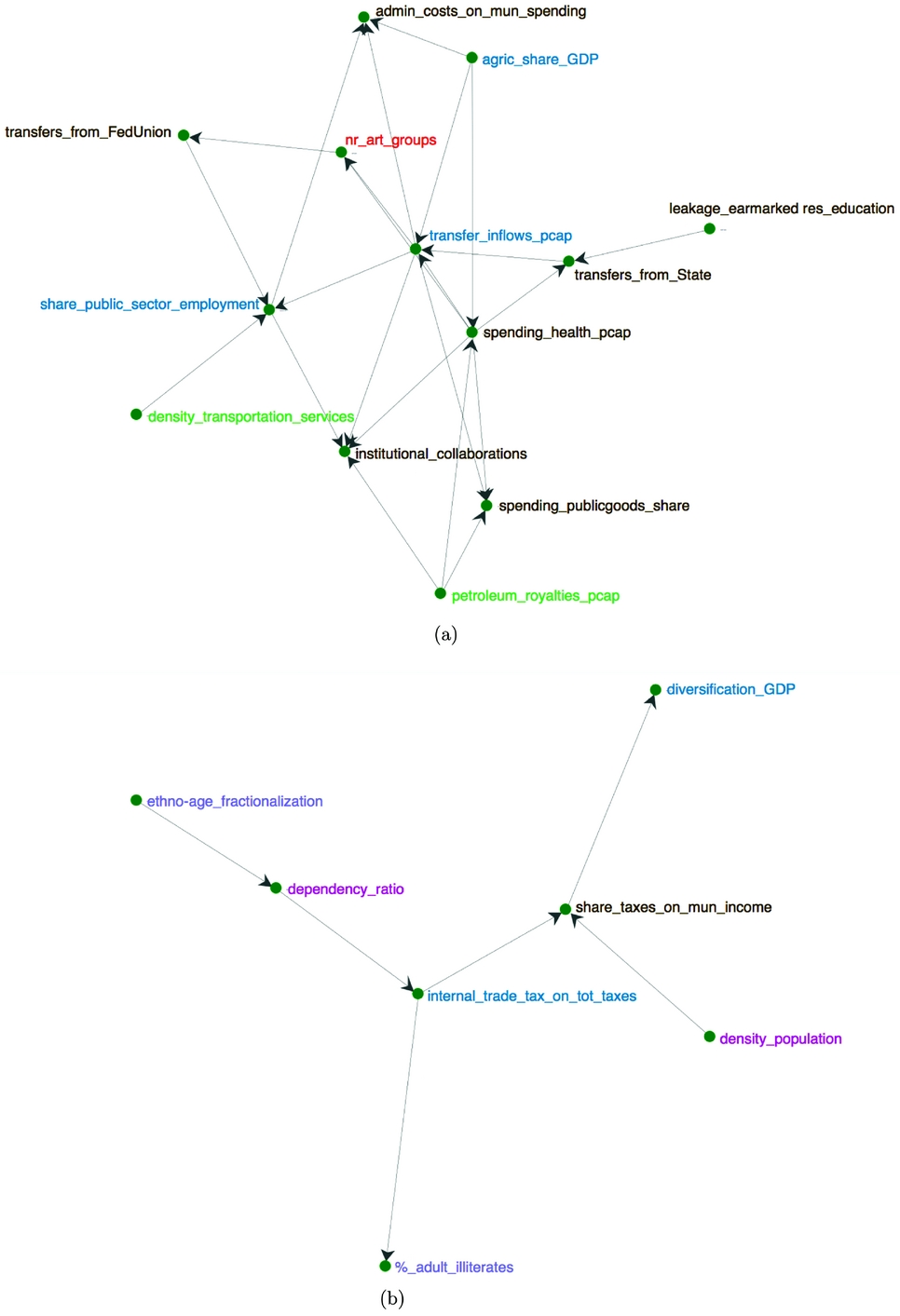
The directed network is far less dense than the initial correlation network. Figure 4 magnifies the relations of the two major components of the directed network. Arrows stand for the direction of ‘benefit’, going towards the factor gaining more from the asymmetric relationship. In the largest component (Figure 4a), it is mainly institutional and economic factors that are related, but also two geographic ones appear. An exemplary description: Institutional Collaborations is the beneficiary of most commensalist relations: they increase with (1) per capita spending on health, (2) per capita inflows of transfers, (3) petroleum royalties and (4) the ratio of public employees to the total municipal workforce. The first three are likely to provide resources but also habitat, while the latter is a case of service mutualism, given that institutional collaborations rely on public workforce.
Commensalist (directed) network: zoom into the two major components (a) Largest component of commensalist relationship network. (b) Second major component of commensalist relationship network.

In the largest component it is easy to reencounter some centroids identified in the correlation network, e.g. the per capita inflow of transfers or spending on health: both take and give benefits in multiple asymmetric relations, but are prevalently benefactors to others. The second component (4b), on the other hand, resembles a chain of relations without clear centroids. Social heterogeneity seems to be connected to reproductive choices leading to higher dependency ratios,Footnote 15 which are connected to a greater incidence of the Brazilian production and circulation (ICMS) tax on total taxes collected – possibly through consumption patterns. This much discussed internal commercial tax (see Higgins and Pereira, Reference Higgins and Pereira2014; WB, 2016) and density of population seem to provide resources and habitat for the deepening of tax incidence, which provides fertile ground for diversification of municipal GDP. In the Online Supplementary Material, Annex F, further details on the factors involved in commensalist relations are provided.
4. Institutional interconnections and change
The results presented so far are valid only for Brazil, whose heterogeneous character and impressive size, however, make it an ideal ‘laboratory’ to study development and structural interconnections. From the results so far produced, the following can be highlighted.
First, the study confirms the intuition that has gained momentum in the literature that different structural factors, including institutions, are deeply intertwined. An important deduction is that it is highly problematic to separate out a single factor and to infer its (independent) effect on socio-economic development. Empirical attempts to do this are highly likely to suffer from multicollinearity and from reverse causality, which significantly affect econometric estimates.
Second, despite tight interconnections, some structural factors are centroids to that ‘context’ in which individual lives are embedded: they matter more than others because of the plurality and strength of connections that they nurture with other factors. Identifying such centroids may help to design policies that seek institutional or structural change, as transition costs and bottleneck effects become more evident. Third, the importance of centroids can vary across different stages of development: some structural factors seem to be evolutionary universalsFootnote 16 while others gain or lose relevance with improved economic development.
Fourth, the identification of asymmetric relationships provides a new perspective on the investigation of dynamics of interconnections. For example: the number of institutional collaborations of the municipality is commensalist on other different factors that tend to provide monetary (inflows of transfers) and human (more administrative personnel) resources but also more scope (higher spending levels) for collaboration. This feature of municipal institutional activity has also been identified as gaining importance in the correlation network with increasing levels of development. We may deduce that the influence of institutional collaborations can only slowly emerge with the consolidation and increase of those factors it depends upon. A similar interpretation seems to be plausible for the role of taxes collected in the municipality, which is also commensalist on other factors and acquires greater centrality with increasing development. Probably, structural factors have to achieve a certain tipping-point (Pierson, Reference Pierson2004) in order to create new connections with other structural factors.
Universal centroids, on the other hand, tend not to be engaged in commensalist relationships, or at least not to benefit from them, which implies some dependence on others. This may explain their persistence at central positions across development levels. A focus on commensalist relations seems to be least able to explain the dynamics of factors that exit their central position with greater development. An analysis of parasitic relationships may improve findings as it could inform on how the relevance of factors is reduced. In this analysis, egressors merely tend to assume less central positions within the commensalist network, either because they are endpoints (not benefiting from other factors), such as ethno-age fractionalization, or because their dependencies are endpoints in the network.
Apart from such promising results, some limitations of the methodology need to be highlighted. Care is necessary in the selection of variables, requiring delicate calibration between sufficient amounts and avoiding redundancy of measured entities. The extension to quantile regressions should also be used with care: direct causal relationships, despite asymmetry, may be tainted by noise and omitted variables in single two-way relations. The methodology is adequate when used to explore potentially relevant links for further analysis. For a more in-depth discussion of limits and potentials, see the Online Supplementary Material, Appendix G.
5. Conclusions
This study has tried to deepen our understanding of the complex interconnections between social structures, including institutions. It has proposed a conceptual framework based on an analogy to ecology – symbiotic relationships – in order to stress the importance of potentially manifold and asymmetric links. A methodological strategy has been proposed to capture the complexity of interconnections, and applied to the analysis of Brazilian municipalities.
Results have shown (1) how densely intertwined different structural factors are, yet (2) that some factors may indeed be regarded as centroids of the Brazilian municipal context. The relevance of centroids across different levels of economic development (3) is found to be stable for some factors, whereas others emerge or exit their central role as development increases. Participatory councils and petroleum royalties are examples of universal centroids, whereas, for example, the share of taxes on municipal income, incidence of art groups and the intensity of institutional collaborations gain centrality with higher development. Social heterogeneity and incoming transfers are examples of factors that lose centrality in the Brazilian municipal context as it reaches higher economic development.
(4) A first empirical application to identify commensalist relationships hints that parts of such change in centrality may be explained by asymmetries in connections, which see some factors depending on others and therefore growing faster as their ‘benefactors’ grow. Further investigation of such cumulative dynamics is necessary, however.
Supplementary material
To view supplementary material for this article, please visit https://doi.org/10.1017/S1744137417000558
Acknowledgements
The author would like to thank three anonymous reviewers, and Geoffrey Hodgson, Samuel Bowles, Ugo Pagano, Thorvald Gran, Renata Targetti, Francesco Scervini and Enrica Chiappero-Martinetti for comments on previous versions. Research on this article has benefited from an internship at UNU-WIDER, as well as funding from Fondazione Giangiacomo Feltrinelli (Laboratorio Expo) and from EU-FP7 CrESSI grant nr. 613261.