Chest pain is one of the most common reasons for referral to paediatric cardiology outpatient clinics. In most cases, unlike adult chest pain, the cause is not cardiac and does not require any intervention. It has been reported that cardiac-related chest pains (such as acquired-CHDs, pericardial, myocardial, or coronary artery diseases, and arrhythmia) are among the causes of chest pain at rates ranging from 0 to 5%. Reference Danduran, Earing and Sheridan1 Idiopathic chest pain and other non-cardiac causes (such as thoracic cage diseases, musculoskeletal pain, gastrointestinal tract, and pulmonary diseases) account for the vast majority of chest pain in the children. Reference Sabri, Ghavanini and Haghighat2
Although cardiac causes are few, managing chest pain in children is challenging for the patient, their families, and clinicians. Reference Sert, Aypar and Odabaş3–Reference Solinas, Raucci and Terrazzino6
Unexplained chest pain other than cardiac or non-cardiac causes is associated with comorbidities that lead to poor quality of life and continued use of healthcare services. Although no cardiac or non-cardiac cause was detected in the evaluations, it remains a critical source of concern for adolescents who perceive their pain as severe and life-threatening. Reference Lee, Gilleland and Campbell7,Reference Reddy and Singh8
Idiopathic and psychogenic causes are significant origins of chest pain in children, and the trigger of pain in these patients is generally considered to be hyperventilation, stressful life events, depression, and anxiety without an organic aetiology, and it has been reported that there is a significant relationship between impaired emotional and social functionality. Reference Eliacik, Bolat and Kanik9 Up to 70% of patients with unexplained chest pain report that episodes of chest pain limit their ability to work or perform daily activities such as walking, physical exercise, and household chores. Reference Eslick and Talley10 These problems are usually persistent, and these patients tend to present to emergency departments and cardiology clinics repeatedly. Frequent hospital admissions prevent children from school and also limit parents from going to work. Reference Gesuete, Fregolent and Contorno11 So this is not cost-effective. Therefore, recognition and appropriate treatment of unexplained chest pain is likely to improve family functioning as well as child functioning.
Although psychosocial causes are frequently emphasised among the causes of chest pain in studies, detailed explanations about which factors are related are very few. The original value of the study is that it will examine the factors associated with chest pain in children in more detail. Therefore, the present study aimed to investigate the relationship of this situation with the psychological symptoms of the parents, parental attitudes, family functionality, the child’s mental state, and difficult life events.
Participants and methods
Selection of participants
This study was performed between March 2021 and December 2022. At this time interval, approximately 433 adolescent (11-18 years old) children were admitted to the Pediatric Cardiology Outpatient Clinic of Manisa Celal Bayar University Faculty of Medicine due to chest pain. All of these patients had a history of previous admission to the emergency department or hospital admission, including paediatrician evaluation. All patients underwent a comprehensive cardiac examination, including history, physical examination, electrocardiogram, and echocardiogram. Causes of chest pain were classified as cardiac and non-cardiac (respiratory system, musculoskeletal system, gastrointestinal system, psychogenic, idiopathic). Fifty of 59 (13.6%) patients with cardiac-related chest pain were followed up for structural heart diseases, and cardiac pathology was detected in only nine patients (2.07%) at the first admission. Concerning chest pain with non-cardiac reasons, 16 patients (3.69%) had respiratory system-related chest pain, 121 patients (27.9%) had due to musculoskeletal system, eight patients (1.84%) had due to gastrointestinal tract, 22 patients due to mental disorder (5%) diagnosed and 207 patients (47.8%) without any cause (idiopathic) were present.
All patients with idiopathic chest pain without known psychiatric diseases, mental retardation, organic brain diseases, or chronic organic problems were referred to child psychiatry for psychiatric evaluation. Only 43 patients were admitted to the paediatric and adolescent outpatient clinic for evaluation. A clinical interview was conducted by a child psychiatrist for 43 patients included in the study. For this purpose, “Schedule for Affective Disorders and Schizophrenia for School-Age Children. Present and Lifetime Version-DSM-5” was used in the interview. The participants and their families were also given scales to fill out.
For the healthy control group, patients admitted to the paediatric cardiology outpatient clinic for pre-sport control, who had not been diagnosed with an organic or psychiatric disorder before, and whose parents and themselves volunteered to participate in the study were included. Moreover, the children of the hospital staff who were informed about the study and who wanted to be healthy volunteers were evaluated. The patient and control groups were matched according to age and gender. A clinical interview was performed by a child psychiatrist in the control group, and 33 cases without psychiatric disorders were included in the study. The participants and their families were given scales to fill out.
Scales to be used in the study were Family Assessment Device, Parent Attitude Research Instrument, SCL 90 Mental Symptoms Checklist, DSM-5 Level 2 Somatic Symptoms Scale, and sociodemographic data form.
Data acquisition tools/scales
Sociodemographic data form
The sociodemographic form used in the study was developed by researchers. It included questions evaluating the patients’ age, gender, school status and level of success, relations with friends, relations with teachers, whether s/he continued a social activity, whether s/he had experienced a stressful life event, whether s/he had been exposed to violence, education level of parents, work status of parents, parents coexistence, whether there is a medical or mental illness in the family, whether there was an incompatibility in the family and clinical symptoms of chest pain.
Schedule for affective disorders and schizophrenia for school-age children. present and lifetime version-DSM-5
It is an interview schedule developed by Kaufman et al. to detect the presence of mental disorders in children. It is administered through consultation with parents and the child, consisting of three parts. In the initial interview, which is the first part, information such as the child’s demographic information, application complaint, and general health status are obtained. In the second part, both past and current symptoms are evaluated, and the presence of mental disorders is investigated. The third part consists of evaluation and observation results to confirm DSM-5 diagnoses. It was adapted into Turkish by Ünal et al. Reference Kaufman, Bırmaher and Brent12,Reference Ünal, Öktem and Çetin Çuhadaroğlu13
DSM-5 level 2 somatic symptoms scale 11–17 years child form
It is a self-report scale that evaluates somatic symptoms in children. The patient health questionnaire is an adaptation of physical symptoms, having 13 items. Each item asks the child to rate the severity of his or her physical symptoms over the past seven days. It is rated on a 3-point scale (0 = not bothered at all; 1 = a bit bothered; 2 = very bothered). The total score can range from 0 to 26. Higher scores indicate more severe physical symptoms. It was adapted into Turkish by Sapmaz et al. 14,Reference Sapmaz, Demirgören and Ülker15
SCL 90-R, symptom check list-90 revised
It is a self-report scale that evaluates the severity of psychiatric symptoms in adults. It contains a total of 90 items questioning nine different dimensions. The person is asked to rate the extent to which s/he has experienced the symptom in the relevant item in the last seven days. Each item in the scale provides a five-point Likert-type rating (“0 = not at all,” “1 = very little,” “2 = moderately,” “3 = quite a lot,” “4 = extremely”). The scale was developed by Derogatis and adapted into Turkish by Dağ. In this study, it was filled out by the parent who was with the child during the evaluation. Reference Derogatis and Cleary16,Reference Dağ17
Family Assessment Device
It is a scale that evaluates family functions. It consists of a total of 60 questions in seven subscales. These subscales are problem-solving, communication, roles, emotional responsiveness, affective involvement, behaviour control, and general functions. Family Assessment Device scores range from 1 (healthy) to 4 (unhealthy). As the mean score calculated for each subscale approaches 4, it indicates that the unhealthiness in terms of that function increases. The scale was developed by Epstein and adapted into Turkish by Bulut. In this study, it was filled out by the parent who was with the child during the evaluation. Reference Epstein, Bolwin and Bishop18,Reference Bulut19
Parental attitude research instrument
It consists of 60 items in five subscales. These subscales are over-parenting, democratic attitude and equality recognition, attitude of hostility and rejection, marital discordance, and authoritarian attitude. Each item is scored between 1 (I do not find it appropriate) and 4 (I find it appropriate). In the scale, items 2, 29, and 44 are reverse coded. The increase in scores in factors other than the “democratic attitude and recognition of equality” dimension indicates negative parental attitudes. It was developed by Schaefer and Bell and adapted into Turkish by Le Compte et al. In this study, it was filled in by the parent who was with the child during the evaluation. Reference Oner20–Reference LeCompte and LeCompte22
Ethical considerations
For this study, permission was obtained from the ethics committee of Celal Bayar University Faculty of Medicine (11.02.2021-21801). The research was conducted per the criteria of the Declaration of Helsinki. Before the data collection forms were applied, the study groups were informed about the study, and volunteerism was considered in participating.
Statistics
All results were analysed with the Windows SPSS 22.0 Program. Continuous variables were presented as mean and standard deviation and categorical variables as numbers and percentages. Chi-square/Fischer’s exact test for categorical data and t-test/Mann–Whitney U test for numerical data were used to compare variables between groups. The statistical significance level was accepted as p < 0.05.
Results
The study included 76 children aged 11–18 years, 43 of whom had chest pain and 33 of whom were controls, and their mothers. Children in the chest pain group were 7 (16.3%) boys and 36 (83.7%) girls, with a female/male ratio of 5.28. There were 11 (33.3%) boys and 22 (66.7%) girls in the control group, with a female/male ratio of 2. There was no significant difference between the genders (p = 0.083).
The mean age of the children in the chest pain group was 15.27 ± 1.90 years, and 14.40 ± 2.48 in the control group, with no statistically significant difference between the two groups (p = 0.101).
No statistical difference was determined between the two groups when the state of parental coexistence was evaluated (p = 0.126). When the parents’ education levels were examined, it was observed that the education level of both parents was significantly lower in the group with chest pain (p = 0.000 and p = 0.000, respectively). When the working status of the parents was evaluated, the working rate of the mother was less and statistically significant in the chest pain group (p = 0.033), and no statistical difference was determined between the groups regarding the fathers’ employment status (p = 0.207). While there was no significant difference regarding family history of mental illness, physical illnesses were significantly higher in the chest pain group (p = 0.060, p = 0.049, respectively). The sociodemographic and clinical characteristics of the patient and control groups are presented in Table 1.
The sociodemographic and clinical characteristics of the patient and control groups

When evaluated in terms of psychosocial risk factors, life events causing difficulties, derangement in the family, loss of a close person, and exposure to violence were found to be statistically significantly higher in the group with chest pain (p = 0.004, p = 0.036, p = 0.001, p = 0.001). Physical violence, sexual violence, and emotional violence, which are the sub-dimensions of exposure to violence, were higher in the group with chest pain, and a statistically significant increase was observed in the emotional violence subgroup (p = 0.046). The presence of academic problems was significantly higher in the chest pain group (p = 0.001). Out-of-school social activity was significantly lower in the chest pain group (p = 0.001). The evaluation regarding psychosocial risk factors between the groups is summarised in Table 2.
Evaluation of groups in terms of psychosocial risk factors

A psychiatric disorder was detected in 29 (67.4%) of the children in the chest pain group. When the diagnoses were evaluated, anxiety disorder was present in 22 cases (51.2%), depressive disorder in 18 cases (41.9%), Attention-deficit/hyperactivity disorder in 4 cases (9.3%), obsessive-compulsive disorder in 2 cases (4.7%), and oppositional defiant disorder in 1 case (2.3%), and 1 case had mourning diagnosis.
The presence of different somatic symptoms was evaluated with the DSM-5 somatic symptoms scale. The total scale score was 10.94 ± 4.36 in the chest pain group and 4.96 ± 4.49 in the control group, with a significant difference (p = 0.001).
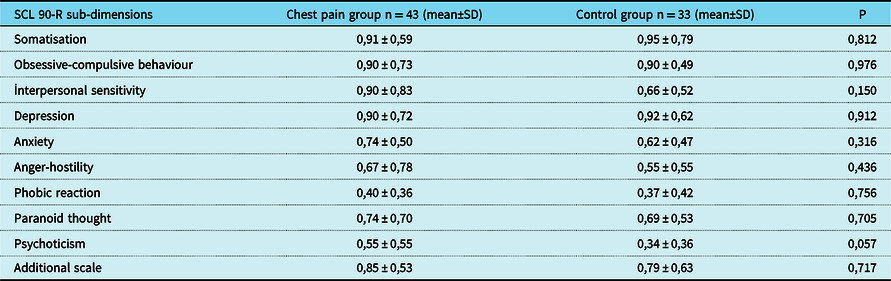
There was no statistically significant difference between the subgroups regarding somatisation, obsessive-compulsive behaviour, interpersonal sensitivity, depression, anxiety, anger-hostility, phobic reaction, paranoid thought, psychoticism, additional scale, general symptom subgroups in the symptom screening test (SCL 90-R) scores used to evaluate the parents’ psychological symptoms (Table 3).
Comparison of the parents’ SCL 90-R score averages in the groups

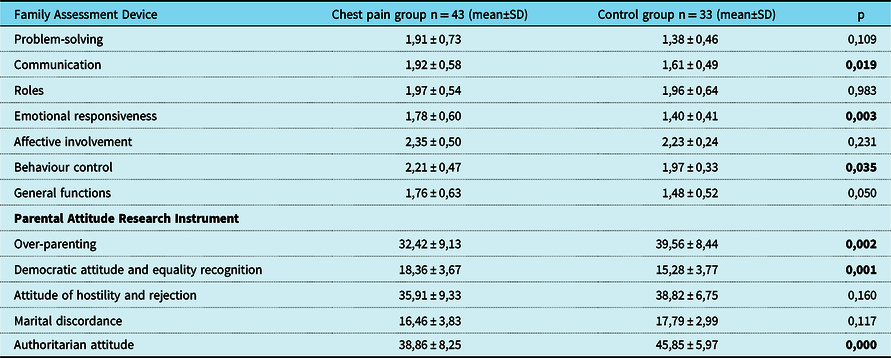
When the family functions of both groups were evaluated (Family Assessment Device), communication, emotional response, behaviour control, and general functions sub-dimension scores were statistically significantly higher in families in the chest pain group (p = 0.019, p = 0.003, p = 0.035, p = 0.050, respectively) (Table 4).
Comparison of the mean scores of the parents in the groups on the Family Assessment Device and the parental attitude research instrument

Excessive motherhood and pressure-discipline sub-dimension scores in Parent Attitude Research Instrument were statistically significantly lower in the group with chest pain, while democratic attitudes were significantly higher (p = 0.002, p = 0.001, p = 0.000, respectively) (Table 4).
Discussion
When 433 patients admitted to our paediatric cardiology outpatient clinic with chest pain were grouped as cardiac and non-cardiac causes, 50 of 59 (13.6%) patients with cardiac-related chest pain were followed up due to structural heart diseases. We detected cardiac pathology in only nine patients (2.07%) at the first admission. Concerning chest pain with non-cardiac reasons, there were 5% of patients diagnosed and followed up with a mental disorder, and 47.8% of whom no cause was found (idiopathic). In a study by Li Chen et al. on 3,477 children under 18, chest pain was idiopathic in 52.1%, psychogenic in 0.06%, and cardiac in 6.7. Reference Chen, Duan and Li23 In the study of Khairandish Z et al., in 194 children aged 1–18 years who were admitted to the cardiology clinic with chest pain, 9.7% were determined to have a cardiac cause, a non-cardiac cause of 43.3% to be idiopathic, and a psychogenic cause to be 29.9%. Reference Khairandish, Jamali and Haghbin24 In another study in which children who were admitted to the paediatric cardiology outpatient clinic with chest pain were evaluated diagnostically, the frequency of chest pain was 43.8% for the musculoskeletal system, 28.1% for idiopathic, 14.7% for psychogenic, and 0.5% for cardiac cause. Reference İrdem, Duras and Sazak25 These current studies have revealed that idiopathic causes of chest pain admissions to paediatric cardiology outpatient clinics are quite common. This situation, which will cause unexplained and recurrent hospital admissions, can create a burden for patients, parents, and the health system. Therefore, this study aimed to evaluate the psychosocial factors that may be associated with medically unexplained chest pain.
Our study determined psychiatric disorders in 67.4% of the children in the chest pain group. When the diagnoses were evaluated, it was observed that the diagnoses of anxiety disorder and depressive disorder were higher. A study demonstrated that approximately 74% of patients with non-cardiac chest pain had psychiatric symptoms, and the most common symptom was anxiety, while conversion disorder and depression symptoms were also quite common accompanying psychiatric symptoms. Reference Tunaoglu, Olgunturk and Akcabay26 In a study examining the prevalence of DSM-IV psychiatric disorders in children and adolescents with non-cardiac chest pain complaints, Lipsitz et al. revealed that psychiatric disorder was diagnosed in 59% of the patients, with anxiety disorder being common. Reference Lipsitz, Masia and Apfel27 In another study, children with non-cardiac chest pain and children with asymptomatic benign heart murmur were evaluated. Anxiety, anxiety sensitivity, and physiological arousal levels were higher in the group with non-cardiac chest pain. Reference Lipsitz, Masia-Warner and Apfel28 In different studies conducted in Turkey, when compared to healthy controls, anxiety and depression levels were significantly higher in the non-cardiac chest pain group in self-report scales. Reference Eliacik, Kanik and Bolat29,Reference Kenar, Örün and Yoldaş30 This information is also consistent with the fact that young people with different somatic complaints show higher rates of anxiety and depressive disorder compared to the healthy control group. Reference Malas, Ortiz-Aguayo and Giles31 A follow-up study showed that high-level psychosomatic symptoms detected during adolescence increase the risk of developing both depressive and anxiety disorders even after three and six years. Reference Giannotta, Nilsson and Åslund32 The presence of somatic symptoms in adolescence is associated with more referrals to mental health outpatient clinics in adulthood. Reference Bohman, Låftman and Cleland33 Therefore, detailed evaluation of children presenting with somatic complaints such as chest pain and close monitoring for psychiatric symptoms, if necessary, may be a crucial preventive factor in diagnosing mental disorders in adulthood.
When family functionality was evaluated, our study determined problems in the family assessment scale communication, emotional responsiveness, and behavioural control in the case group. Furthermore, familial incompatibility and family history of physical illness were reported to be significantly higher in the case group. Patients with medically unexplained recurrent pain complaints and their families report worse family functioning than children and adolescents without such health problems. Reference Liakopoulou-Kairis, Alifieraki and Protagora34,Reference Campo, Jansen-McWilliams and Comer35 Adverse family environment factors such as disorganisation, low adjustment, and family conflict are predictors of medically unexplained physical symptoms in adolescents. Reference Terre and Ghiselli36 The literature has suggested that somatic symptoms and related illness behaviours may function as a means of diverting attention from family problems, such as general family or parental conflict and emerge as a homeostatic mechanism for conflict avoidance. Reference Terre and Ghiselli36,Reference Minuchin, Baker and Rosman37 In a follow-up study evaluating whether poor family functioning in childhood causes somatic symptoms in early or late adolescence, poor family functioning at age 15 was associated with somatic symptoms at ages 15 and 18. Reference Winding and Andersen38 Family functionality is strongly associated with both prognosis and psychosocial functionality during the treatment of somatic symptoms in children and adolescents. Reference Eminson39,Reference Hoffman, Bibby and Bennett40
The communication sub-dimension of the family assessment scale evaluates whether there is effective communication in the family and whether people directly express what they want to say. In the emotional responsiveness sub-dimension, whether family members openly express their feelings and show the most appropriate response to stimuli is evaluated. In the behaviour control sub-dimension, the way of setting standards and providing discipline for the behaviours of family members is evaluated. Reference Mansfield, Keitner and Dealy41 Somatisation is the experience and expression of psychosocial distress through somatic symptoms. Reference Jenkins and Smart42 Alexithymia (difficulty recognising and expressing emotions) and emotional regulation were associated with somatic complaints. Reference Yavuz, Erdur and Isik43,Reference Gilleland, Suveg and Jacob44 In our study, problems were detected in communication, emotional responsiveness, and behaviour control, similar to the literature.
While there was no significant difference in terms of family history of mental illness, we determined the presence of physical illness to be significantly higher in the chest pain group. It is known that the disease experience of a relative in childhood is a predisposing factor for somatisation. Reference Malas, Ortiz-Aguayo and Giles31,Reference Elliott, Thompson and Fobian45 Children can learn illness behaviour by observing. Children may have found that they only attracted attention when physically ill. The child may be exempt from his usual responsibilities with the sick role. The result of our study is compatible with the literature.
When family life and child-rearing attitudes (Parent Attitude Research Instrument) were evaluated, excessive motherhood and pressure-discipline sub-dimensions were statistically significantly lower in the group with chest pain, while democratic attitudes were significantly higher. These results indicated that positive parenting attitudes were higher in the case group. In a study conducted with 2,415 adolescents from eight different countries, the relationship between parental rearing styles and somatic symptoms was examined, and somatisation was significantly associated with parenting styles in the models examined, even after controlling for country, gender, and sociodemographic status. While mothers’ level of psychological control and anxious parenting increased somatic symptoms, higher levels of father support and lower levels of father’s psychological control were associated with lower levels of somatic symptoms. Reference Seiffge-Krenke, Sattel and Cavdar46 The results were different from our study. This is because the parent, who knew that s/he was involved in a study investigating the causes of somatic symptoms, may have displayed a defensive attitude and answered in that direction. Another reason might be that single parent was included in our study. The attitudes of the excluded parent may be negative. A third factor may be that the relationship between parental attitudes and somatic complaints, as shown in different studies, is related to the physiological response of adolescents to these behaviours. For adolescents with high physiological responses, maladaptive parenting was associated with high somatisation, while the relationship between parenting behaviour and somatisation was not significant for adolescents with low physiological responses. Reference Rousseau, Grietens and Vanderfaeillie47 As another factor, there may be indirect links between all parenting dimensions and adolescent somatisation through parenting stress. Reference Rousseau, Grietens and Vanderfaeillie48 It is crucial to make evaluations in this respect in new studies.
When life events causing difficulties were evaluated in our study, the loss of a close person, exposure to violence, and chest pain were significantly higher in the group.
7.1% of the cases reported physical violence, 16.7% sexual violence, and 35.7% emotional violence. Other somatic complaints were significantly higher in children in the chest pain group. Childhood trauma (e.g., sexual abuse, physical abuse, emotional abuse, neglect) has long been considered critical in the development of somatisation. Reference Malas, Ortiz-Aguayo and Giles31 Eslick et al. also demonstrated that emotional/verbal abuse and physical abuse were significantly more common in people with unexplained chest pain. Reference Eslick, Koloski and Talley49 Asnes et al. reported that stressful situations were associated with the onset of pain in almost all patients in a group diagnosed with psychogenic chest pain. Reference Asnes, Santulli and Bemporad50 Between 25 and 30% of patients report stressful life events such as death in the family, major illness, accident, separation from family, or school change. Reference Lam and Tobias51
The present study also revealed that children in this group have more academic problems and limitations in social activities outside of school. In the study of Eliaçık et al., both school functionality and social functionality were significantly lower in the chest pain group, and headache and back pain were also detected at higher rates. Reference Eliacik, Bolat and Kanik9
Many variables, such as the socioeconomic status of the family, the education level of the family, behavioural characteristics, the development of the child, and the relationship with their parents, may have an impact on somatic symptoms in adolescents. Our study did not detect any difference in parental coexistence, but both mother’s and father’s education level and the mother’s employment status were significantly lower in the group with chest pain. In the literature, no relationship was determined between parental union status, education level, employment status, and somatic symptoms. Reference Winding and Andersen38,Reference Seiffge-Krenke, Sattel and Cavdar46
In conclusion, in our study, family problems, emotional and sexual violence, academic problems, decreased social functions, and mental disorders were higher in children with unexplained chest pain than in the control group. The studies in the literature evaluate different somatic findings together, and the present study is one of the few that evaluates family functionality and difficult life experiences related to chest pain.
The paediatric cardiologist should be careful about psychiatric problems in children and adolescents with recurrent chest pain, considering that they are often the centre of last resort for these patients, and we recommend that psychiatric evaluation be included in diagnostic research to prevent unnecessary medical diagnostic procedures in children describing unexplained chest pain, as well as to prevent the potential for diagnosing mental disorders in both children and adults. Besides, follow-up studies will contribute to this issue.
Acknowledgements
None.
Author contribution
F.A. and S.YS are mentioned as the first author because of the equality in the study. F.A and S.YS. contributed to the study’s conception, and participated in data acquisition, data interpretation, and writing of the manuscript. C.K. collected data. All authors contributed to the study’s conception, participated in data acquisition, and approved the final version.
Financial support
This research received no specific grant from any funding agency, commercial or not-for-profit sectors.
Competing interests
None.