Post-transplant outcomes for orthotopic heart transplantation are significantly worse in patients with pulmonary hypertension before transplantation.Reference Murali, Kormos and Uretsky 1 Although most patients undergo right heart catheterisation before listing, its use as a monitoring tool while awaiting transplantation is limited by its invasive nature and use of ionising radiation. This poses a particular problem for infants and children awaiting transplantation, as the time on the waiting list can range from months to years.Reference Jeewa, Manlhiot, Kantor, Mital, McCrindle and Dipchand 2 Transthoracic echocardiography is commonly used for non-invasive estimation of right heart pressures based on older studies validating the tricuspid regurgitation gradient against right heart catheterisation in a heterogeneous group of predominantly adults.Reference Currie, Seward and Chan 3 , Reference Berger, Haimowitz, Van Tosh, Berdoff and Goldberg 4
Although commonly used in children, more recent studies have focussed on the use of echocardiography as a predictor of outcome in specific populations.Reference Kirkpatrick 5 , Reference Slaughter, Pakrashi, Jones, South and Shah 6 Conflicting evidence exists regarding the absolute agreement between the tricuspid regurgitation gradient and right heart catheterisation-derived right ventricular systolic pressure in the paediatric CHD population, with almost no data on the paediatric cardiomyopathy population.Reference Groh, Levy and Holland 7 , Reference Friedberg, Feinstein and Rosenthal 8 Several studies looking at the tricuspid regurgitation gradient in the adult cardiomyopathy population have shown wide limits of agreement with pulmonary artery pressure and worse predictive value with more severe cases of pulmonary hypertension.Reference Attaran, Ramaraj, Sorrell and Movahed 9 , Reference Kouzu, Nakatani, Kyotani, Kanzaki, Nakanishi and Kitakaze 10 We hypothesise that Doppler echocardiographic measurements of tricuspid regurgitation are not reliable for the estimation of pulmonary artery pressure in the cardiomyopathy population. We expect these differences to persist irrespective of the type of cardiomyopathy.
Materials and methods
A retrospective review of our paediatric cardiac catheterisation and echocardiography database was performed from 2003 to 2012, and all patients with cardiomyopathy and biventricular circulation who underwent a diagnostic right heart catheterisation before or after listing for orthotopic heart transplantation were identified. At our institution, all patients undergo a diagnostic catheterisation before listing for orthotopic heart transplantation, except for those with clinical instability and low likelihood of pulmonary hypertension. Those found to have elevated pulmonary vascular resistance undergo vasoreactivity testing with 100% FiO2 and inhaled nitric oxide and are treated with pulmonary vasodilators as needed. All patients with echocardiograms obtained >30 days after catheterisation, those with inadequate tricuspid regurgitation envelope to assess gradients, and those with right ventricular outflow tract obstruction were excluded. Demographic and haemodynamic data were compared between all groups.
Patients were further categorised as dilated, restrictive, and non-compaction cardiomyopathy patients, based on their diagnosis code on the catheterisation and echocardiogram reports, and confirmed via chart review. Only one patient had a mixed form of cardiomyopathy and was categorised as “other”. Hypertrophic cardiomyopathy was not included as we do not routinely perform cardiac catheterisation in these patients and there were no patients with hypertrophic cardiomyopathy listed for transplantation during this time period.
Echocardiography
At our institution, all patients undergo complete echocardiography studies according to a comprehensive imaging protocol. All standard transthoracic echocardiography views are obtained, with oblique views utilised to optimise the insonation angle for Doppler interrogation based on colour Doppler flow. The original studies from all patients were reviewed, and tricuspid regurgitation envelope was assessed from multiple windows for quality and insonation angle. The highest velocity from the best quality envelope using continuous wave spectral Doppler interrogation was used for analysis. The modified Bernoulli equation (4VReference Jeewa, Manlhiot, Kantor, Mital, McCrindle and Dipchand 2 ) was used to estimate right ventricular systolic pressure from the tricuspid regurgitation gradient.
Pulmonary hypertension assessment
All haemodynamic data from right heart catheterisation were collected from the official reports. Pulmonary hypertension was defined as mean pulmonary artery pressure >25 mmHg or indexed pulmonary vascular resistance >3 WU×m2. The correlations between tricuspid regurgitation and right ventricular systolic pressure and mean pulmonary artery pressure were assessed. The agreement between the tricuspid regurgitation gradient and the right ventricular systolic pressure obtained during catheterisation was assessed using the Bland–Altman method. The analysis was performed twice: first without accounting for right atrial pressure and then repeated after adding the catheterisation-derived right atrial pressure to the tricuspid regurgitation gradient. We further assessed agreement between echocardiography and catheterisation between the different cardiomyopathy groups as well.
We postulated two potential sources of discrepancy between echocardiography and catheterisation: increased time interval between echocardiography and catheterisation, and baseline haemodynamic differences between those with poor agreement and good agreement between echocardiography and catheterisation. We defined poor agreement of the tricuspid regurgitation gradient as a discrepancy between echocardiogram and catheterisation of ±10 mmHg or higher. We tested these two postulated sources of discrepancy by the following:
-
∙ assessing correlation and agreement in patients with echocardiography and catheterisation studies <7 days apart,
-
∙ comparing baseline haemodynamic data between patients with poor agreement (Group 1) and good agreement (Group 2). The analysis was repeated after adding the catheterisation-derived right atrial pressure to the tricuspid regurgitation gradient.
Statistical analysis
Comparisons between continuous variables were performed using Student’s t-test with p<0.05 considered as statistically significant. Pearson’s correlation coefficient was used to assess relationships between continuous variables. Agreement between continuous measurements was assessed using the Bland–Altman method.Reference Bland and Altman 11 In brief, the Bland–Altman method assesses the agreement between two different methods of clinical measurement by determining the magnitude of difference between measurements in the same patient. The mean bias and 95% limits of agreement define the interval within which 95% of the measurement varies between the two methods. Our Institutional Review Board approved this study and consent was waived.
Results
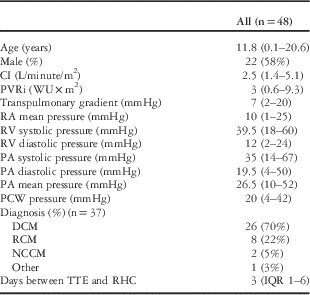
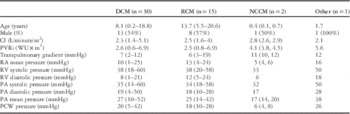
We identified 37 patients who underwent 48 catheterisation procedures and had an echocardiogram with an adequate tricuspid regurgitation envelope for measurement within a month of the procedure (median 3 days, interquartile range 1–6 days). Demographics are presented in Table 1. The median indexed pulmonary vascular resistance and mean pulmonary artery pressure for the entire cohort met criteria for pulmonary hypertension. None of the patients were excluded from the transplantation list because of pulmonary hypertension.
Demographics.

CI=cardiac index; DCM=dilated cardiomyopathy; IQR=interquartile range; NCCM=non-compaction cardiomyopathy; PA=pulmonary artery; PCW=pulmonary capillary wedge; PVRi=pulmonary vascular resistance index; RA=right atrium; RCM=restrictive cardiomyopathy; RHC=right heart catheterisation; RV=right ventricle; TTE=transthoracic echocardiography
Data presented as median (range) or number (%), except as noted
Pulmonary hypertension assessment
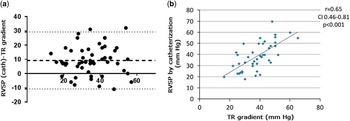
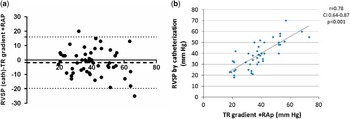
There was a modest correlation (r=0.65, confidence interval 0.46–0.81, p<0.001) between the tricuspid regurgitation gradient and right ventricular systolic pressure by catheterisation, but agreement was poor between the two modalities with wide 95% limits of agreement (Fig 1). Echocardiography appeared to consistently underestimate the right ventricular systolic pressure by catheterisation across all severities. There was a modest but lower correlation between tricuspid regurgitation and mean pulmonary artery pressure (r=0.6, confidence interval 0.34–0.75, p<0.001). When the analysis was repeated after adding the catheterisation-derived right atrial pressure to the tricuspid regurgitation gradient, there was an improvement in the correlation (r=0.78, confidence interval 0.64–0.87, p<0.001); however, although the addition of right atrial pressure resulted in an improvement in agreement with minimal mean bias, the 95% limits of agreement remained wide (Fig 2).
( a ) Bland–Altman plot of catheterisation-derived right ventricular systolic pressure (RVSP) versus tricuspid regurgitation (TR) gradient for all patients. ( b ) Comparison between RVSP by catheterisation and TR gradient by echocardiogram with correlation coefficient, confidence interval (CI).

( a ) Bland–Altman plot of catheterisation-derived right ventricular systolic pressure (RVSP) versus tricuspid regurgitation (TR) gradient+catheterisation-derived mean right atrial pressure (RAP) for all patients. ( b ) Comparison between RVSP by catheterisation and TR gradient+catheterisation-derived mean RAP with correlation coefficient, confidence interval (CI).

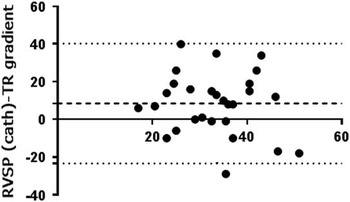
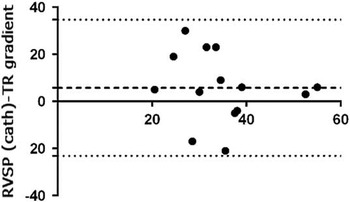
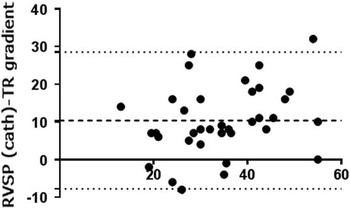
Data were separated by cardiomyopathy diagnosis and are presented in Table 2. We limited our subanalysis to those with dilated and restrictive cardiomyopathy, given the limited number of patients with other cardiomyopathies. Overall, the correlation of tricuspid regurgitation gradient to catheterisation-derived right ventricular systolic pressure and mean pulmonary artery pressure was similar between the two groups. For dilated cardiomyopathy, there was a good-to-modest correlation between the tricuspid regurgitation gradient and catheterisation-derived right ventricular systolic pressure (r=0.72, confidence interval 0.46–0.85, p<0.001) and mean pulmonary artery pressure (r=0.68, confidence interval 0.4–0.81, p<0.001). Agreement between tricuspid regurgitation gradient and catheterisation-derived right ventricular systolic pressure showed wide 95% limits of agreement (Fig 3). For restrictive cardiomyopathy, there was a good correlation between tricuspid regurgitation gradient and catheterisation-derived right ventricular systolic pressure (r=0.76, confidence interval 0.34–0.87, p<0.001) and mean pulmonary artery pressure (r=0.71, confidence interval 0.24–0.82, p<0.001). Agreement between tricuspid regurgitation gradient and catheterisation-derived right ventricular systolic pressure showed wide 95% limits of agreement as well (Fig 4).
Bland–Altman plot of catheterisation-derived right ventricular systolic pressure (RVSP) versus tricuspid regurgitation (TR) gradient in patients with dilated cardiomyopathy.

Bland–Altman plot of catheterisation-derived right ventricular systolic pressure (RVSP) versus tricuspid regurgitation (TR) gradient in patients with restrictive cardiomyopathy.

Demographic and haemodynamic data by cardiomyopathy type.

CI=cardiac index; DCM=dilated cardiomyopathy; NCCM=non-compaction cardiomyopathy; PA=pulmonary artery; PCW=pulmonary capillary wedge; PVRi=pulmonary vascular resistance index; RA=right atrium; RCM=restrictive cardiomyopathy; RV=right ventricle
Data presented as median (range) or number (%), except as noted
Assessment of sources of discrepancy between echocardiography and catheterisation
In total, 36 of 48 (75%) right heart catheterisation procedures had an echocardiogram performed within 7 days. Shorter time interval (<7 days) between the two modalities did not significantly change the correlation between the tricuspid regurgitation gradient and catheterisation-derived right ventricular systolic pressure (r=0.7, confidence interval 0.49–0.84, p<0.001) and mean pulmonary artery pressure (r=0.65, confidence interval 0.41–0.81, p<0.001). Agreement between tricuspid regurgitation gradient and catheterisation-derived right ventricular systolic pressure was not affected by a decreased time interval between studies (Fig 5).
Bland–Altman plot of catheterisation-derived right ventricular systolic pressure (RVSP) versus tricuspid regurgitation (TR) gradient in patients who underwent echocardiogram and catheterisation <7 days apart.

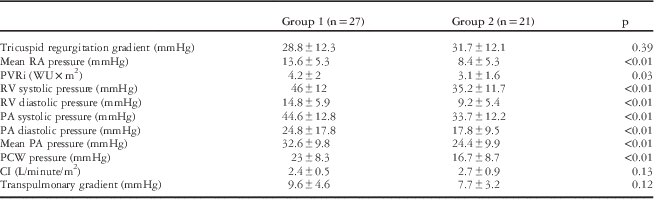
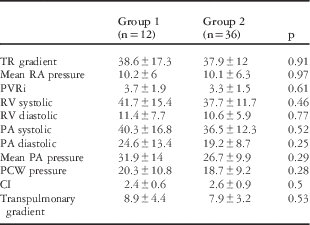
Haemodynamic data between those with poor agreement (Group 1) and good agreement (Group 2) are shown in Table 3. The mean tricuspid regurgitation gradient, cardiac index, and transpulmonary gradient did not differ between the two groups. Group 1 had significantly higher catheterisation-derived right ventricular systolic pressure, mean pulmonary artery pressure, indexed pulmonary vascular resistance, pulmonary capillary wedge pressure, and mean right atrial pressure compared with Group 2. The analysis was repeated with the catheterisation-derived right atrial pressure added to the tricuspid regurgitation gradient and the population was subdivided again. There were fewer patients in Group 1 and there were no differences in haemodynamic data (Table 4). There was no statistical difference in time interval between echocardiography and catheterisation between the adjusted Group 1 and Group 2 patients (p=0.39).
Comparison of haemodynamic data between those with poor agreement (Group 1) and good agreement (Group 2).

CI=cardiac index; PA=pulmonary artery; PCW=pulmonary capillary wedge; PVRi=pulmonary vascular resistance index; RA=right atrium; RV=right ventricle
Data presented as mean±SD
Comparison of haemodynamic data (after adding catheterisation-derived mean right atrial pressure to the tricuspid regurgitation (TR) gradient) between those with poor agreement (Group 1) and good agreement (Group 2).

CI=cardiac index; PA=pulmonary artery; PCW=pulmonary capillary wedge; PVRi=pulmonary vascular resistance index; RA=right atrium; RV=right ventricle
Data presented as mean±SD
Discussion
Our study shows that echocardiographic estimation with the tricuspid regurgitation gradient does not have good agreement with catheterisation-derived right ventricular systolic pressure in the paediatric heart failure population. Although the tricuspid regurgitation gradient showed a modest-to-good correlation with catheterisation-derived haemodynamics, the magnitude of the 95% limits of agreement was clinically significant, varying by as much as ±20 mmHg. These findings are in agreement with the recent literature questioning the accuracy of the tricuspid regurgitation gradient in the paediatric population, particularly in patients with elevated pulmonary pressures.Reference Groh, Levy and Holland 7 , Reference Kalogeropoulos, Georgiopoulou, Borlaug, Gheorghiade and Butler 15 To our knowledge, this is the first study to investigate the utility of tricuspid regurgitation gradient and Doppler echocardiography to estimate right heart pressures specifically in the paediatric cardiomyopathy population.
Early studies have shown excellent correlation between the tricuspid regurgitation gradient and catheterisation-derived right ventricular systolic pressure.Reference Currie, Seward and Chan 3 , Reference Berger, Haimowitz, Van Tosh, Berdoff and Goldberg 4 A criticism of these studies is that they only assessed correlation and not agreement between the modalities; one of the main limitations of correlation is that it can be excellent despite clinically significant differences in agreement. There are some data in the paediatric population showing good correlation between echocardiography and right heart catheterisation, but data on agreement are limited.Reference Slaughter, Pakrashi, Jones, South and Shah 6 , Reference Friedberg, Feinstein and Rosenthal 8 , Reference Bossone, Bodini, Mazza and Allegra 12 Recent publications have focussed on surrogate measures of pulmonary hypertension, such as the time–velocity integral of the right ventricular outflow tract, the morphology of the spectral Doppler pattern in the left pulmonary artery, the utilisation of tissue Doppler parameters, among others.Reference Abbas, Fortuin, Schiller, Appleton, Moreno and Lester 13 , Reference Nakahata, Hiraishi and Oowada 14 Yet, many of these techniques are not in routine clinical use, whereas estimation of right ventricular systolic pressure by tricuspid regurgitation gradient is used in the majority of echocardiography laboratories. The tricuspid regurgitation gradient is often used interchangeably with catheterisation-derived right ventricular systolic pressure; however, there are limited data to support this level of agreement between the two modalities. Groh et alReference Groh, Levy and Holland 7 found limited agreement between the two modalities in assessing pulmonary hypertension in a paediatric population. Similar findings have been reported in children with pulmonary hypertension and chronic lung disease, particularly in cases with elevated pulmonary pressures.Reference Kirkpatrick 5 In the paediatric cardiomyopathy population, there are no published data that assess the agreement between the tricuspid regurgitation gradient and catheterisation-derived right ventricular systolic pressure. Much of the existing data in the heart failure population are on adults, with conflicting evidence to support or refute the agreement between echocardiography and catheterisation-derived right ventricular systolic pressure.Reference Kalogeropoulos, Georgiopoulou, Borlaug, Gheorghiade and Butler 15
We found a modest correlation between the tricuspid regurgitation gradient and catheterisation-derived right ventricular systolic pressure, which is similar to previously published data. Our study further determined that agreement between the two modalities was limited, with clinically significant 95% limits of agreement. A shorter interval (<7 days) between echocardiography and catheterisation did not improve the agreement between the two methods. To assess for differences between baseline haemodynamics, which may contribute to the inaccuracy of the tricuspid regurgitation gradient, we dichotomised the patients into those with poor agreement (Group 1) and good agreement (Group 2) between echocardiography and catheterisation. The initial analysis without accounting for right atrial pressure showed significant differences in haemodynamic data between the two groups; however, after adding the catheterisation-derived right atrial pressure, this difference was no longer statistically significant. Although the addition of the catheterisation-derived right atrial pressure increased the number of patients with good agreement, 12 patients (25%) still had a difference of >10 mmHg between echocardiography and catheterisation. The mean right atrial pressure was not statistically different between the adjusted Group 1 and Group 2 patients (10.2±6 versus 10.1±6.3, p=0.97), suggesting that other factors in addition to right atrial pressure play a role in affecting the agreement between the two modalities.
Although the addition of the right atrial pressure should improve the accuracy of the tricuspid regurgitation gradient, it is often difficult to estimate the right atrial pressure in children. The echocardiographic estimation of right atrial pressure in growing children often requires indexing to body surface area and lacks standardised nomograms.Reference Kutty, Li, Hasan, Peng, Rangamani and Danford 16 There are also some data that suggest that the discrepancy in tricuspid regurgitation gradient is independent of the addition of the right atrial pressure, particularly in those with elevated right heart pressures. Groh et al found that agreement between the tricuspid regurgitation gradient and catheterisation-derived right ventricular systolic pressure worsened with elevated right ventricular systolic pressure, defined by the authors as >1/2 systemic and >2/3 systemic. In their study, echocardiography and catheterisation were performed simultaneously to minimise significant differences in haemodynamic conditions. They found that the level of agreement between the two modalities was worse in those with higher right ventricular systolic pressure, even after adjusting for the simultaneously obtained catheterisation-derived right atrial pressure. This may explain the varying levels of agreement and consistently wide 95% limits of agreement in our population, which had median values of mean pulmonary artery pressure and indexed pulmonary vascular resistance of 26.5 mmHg and 3 WU×m2, respectively.
The aetiology of worsening agreement between echocardiography and catheterisation in the setting of pulmonary hypertension may be due to pressure recovery and abnormalities in atrial size, atrial compliance, and fluid viscosity. Extensive research in aortic stenosis shows that Doppler gradient discrepancies are due to variable pressure recovery and significant kinetic energy loss to heat in larger receiving chambers.Reference Bach 17 Giardini and TacyReference Giardini and Tacy 18 studied the effect of atrial size, compliance, interaction of the regurgitant jet with the atrial wall, and fluid viscosity on Doppler-derived regurgitation gradients in in vitro models. They found that the Doppler-derived regurgitation gradients underestimated the true pressure gradient with smaller atrial size, interaction of the regurgitant jet with the atrial wall, and increased fluid viscosity. Variability in atrial compliance and fluid viscosity may possibly explain why the tricuspid regurgitation gradient underestimated the catheterisation-derived right ventricular systolic pressure in the paediatric cardiomyopathy population.
Limitations
The main limitations to our study are the retrospective nature of our study, the variable duration of time between echocardiography and catheterisation in our patients, and the potential haemodynamic differences between an anaesthetised patient during catheterisation and a conscious patient during echocardiography. Although our transthoracic echocardiography data were not obtained simultaneously, the agreement between tricuspid regurgitation and catheterisation-derived right ventricular systolic pressure did not change despite examining a group of patients with studies occurring within 7 days. In addition, other studies have shown poor agreement despite simultaneous measurement of tricuspid regurgitation gradient and catheterisation-derived right ventricular systolic pressure. The differences in baseline state, although unavoidable in a retrospective study, represent the real-life situation encountered for almost all patients.
Conclusion
Transthoracic echocardiographic estimation of right ventricular systolic pressure by tricuspid regurgitation gradient shows good correlation but limited agreement with catheterisation-derived right ventricular systolic pressure. Tricuspid regurgitation gradients should be interpreted with caution in this population and additional methods of non-invasive haemodynamic assessment should be considered.
Acknowledgements
None.
Financial Support
This research received no specific grant from any funding agency, commercial or not-for-profit sectors.
Conflicts of Interest
None.