In March 2017, The Centre for the Less Good Idea, founded by William Kentridge in Johannesburg, inaugurated its first season with four short plays by Samuel Beckett: Rough for Theatre I (late 1950s), Not I (1972), Play (1963), and Catastrophe (1982). Kentridge, who directed Catastrophe, is a South African artist whose body of work spans an impressive array of mediums from drawing, animation, printing, tapestry, sculpture, and installation to theatre, opera, and performance. He had already engaged with Catastrophe in the same city more than 30 years prior when he staged the dramaticule in two 1984 productions. Footnote 1 The relevance of Beckett for Kentridge, and in particular of Catastrophe for his animated film Monument (1990) from the series Drawings for Projection, has already been noted (see Krauss Reference Krauss2000; Maltz-Leca Reference Maltz-Leca2013, Reference Maltz-Leca2018). However, the artist has turned to the writer’s work over the course of his decades-long career more extensively, profoundly, and consistently than has been suggested to date. Kentridge repeatedly finds in Beckett a productive point of reference especially when he reflects on making artworks in the studio. These reflections are both discursively articulated in interviews, statements, and other writings; and illustrated in lecture-performances — a hybrid dramatic form that combines speech, live action, and video projections — that Kentridge has devised. While Beckett is by no means the only figure to assist the artist in this endeavor, his significant yet unobtrusive role deserves a closer look.
Kentridge’s 2017 staging of Catastrophe is a good place to begin unravelling his Beckett. Written in French in 1982 for the then political prisoner Václav Havel in communist Czechoslovakia, and premiered at the Festival d’Avignon in July of the same year, Catastrophe exposes the power relationships between a theatre Director (D), his female Assistant (A), the Protagonist (P), and the lighting technician Luke (L) as they rehearse the “[f]inal touches to the last scene,” in search of a pose for P that will trigger a “storm of applause” from the audience (Beckett [Reference Beckett and Auster1982] 2006:485, 489). Speechless, manipulated like a prop, and thus completely objectified as an item on display by the end of the rehearsal, P ultimately hijacks D’s “catastrophe” when — against A’s suggestion that P might do so, which D forcefully rejects — he does in fact raise his head in a final act of explicitly verboten agency. Footnote 2 Beckett’s most openly political work, Catastrophe is at the same time, through and through, a mise en abyme that offers a reflexive commentary on its own status and function as a piece of theatre. What is more, Catastrophe also points to Beckett as an authoritarian director of his own plays in the theatre, who insisted on the minutest details in his productions, while submitting his actors at times to prolonged immobility, bodily confinement, or impossibly fast speech (for which he later apologized), precisely in works such as Not I, Play, and Catastrophe itself. The political, the artistic, and the biographical merge in Catastrophe in a multilayered configuration whose levels of meaning are structurally analogous to one another.
At Catastrophe’s political-artistic-biographical nexus are themes, structures, and forms that resonate with Kentridge’s work. In 2017, when restaging the only Beckett play that he has ever directed, the artist makes it his own by responding to these resonances from the vantage point of his own oeuvre. In doing so, he recasts Catastrophe as what could be referred to as a “studio play”: “a demonstration in a […] theatre of what happens in the studio” (Kentridge Reference Kentridge and Rosalind2014:184). The differences between Beckett’s dramatic text and Kentridge’s 2017 production — especially as regards stage directions for props, costumes, gestures, postures, and movement — transform the dramaticule into a sound chamber, a hall of mirrors, or a compendium, where fragments of the artist’s past activity reflect, refract, and interact with each other in new ways to bring about new meanings. Footnote 3
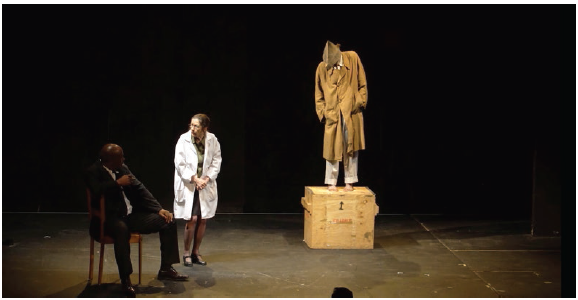
As the curtain rises to reveal the stage of Catastrophe at The Centre for the Less Good Idea (LGI), we behold a tableau vivant (fig. 1) that diverges in several ways from Beckett’s instructions, which read:
D in an armchair downstairs audience left. Fur coat. Fur toque to match. Age and physique unimportant.
A standing beside him. White overall. Bare head. Pencil on ear. Age and physique unimportant.
P midstage standing on a black block 18 inches high. Black wide-brimmed hat. Black dressing-gown to ankles. Barefoot. Head bowed. Hands in pockets. Age and physique unimportant.
D and A contemplate P. Long pause. (Beckett [Reference Beckett and Auster1982] 2006:485)
Catastrophe by Samuel Beckett, directed by William Kentridge at The Centre for the Less Good Idea, 2017. Performers, from left: Hamilton Dhlamini as D(irector), Vanessa Cooke as A(ssistant), and Xolani Dlamini as P(rotagonist). (Screenshot by TDR; courtesy of Kentridge Studio)

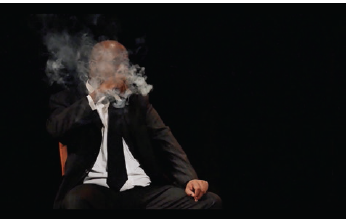
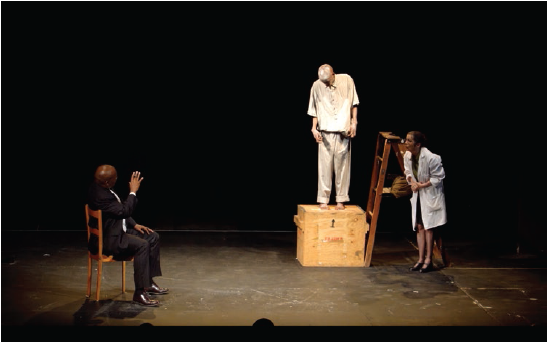
Unlike Beckett’s D, Kentridge’s sits indeed downstairs audience left, but on a straight-backed wooden chair, dressed in a black pinstriped suit, bare-headed and bald, a cigar in his mouth. Head bowed as if in thought, poorly lit, D is hardly visible onstage except that he is the focus of the stage composition, which places him at the downstage end of an imaginary diagonal line that passes from P’s leftward-tilted shoulders and bowed head, through A’s gaze, cast leftward at D. Standing on an unpolished, light-brown wooden box marked with the word FRAGILE in red and a black arrow pointing up towards him, Kentridge’s P wears a brown paper helmet and a long brown overcoat, just short enough to show the rolled trouser legs of his “ash […] night attire” (Beckett [Reference Beckett and Auster1982] 2006:486). His A does not keep her pencil on her ear but in the right pocket of her white lab coat, the sleeves of which are also rolled. Neither she nor D contemplate P in this stage-setting opening. Only after a moment of stillness do they both turn to observe P, in coordinated and exaggerated movements that alternate with looks they exchange between themselves, before A utters the first line of the play “A: ( finally) Like the look of him?” (485).
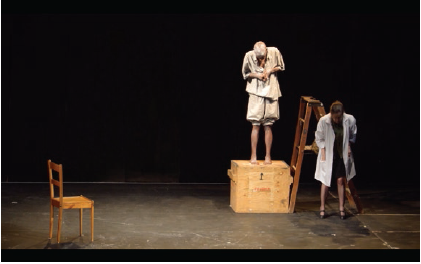
The enunciation structure of this initial scene — which the props, costumes, spatial organization, postures, gazes, and movements described above put into place — reconfigures Beckett’s web of relationships among the three characters, while at the same time redirecting the audience’s perception and, hence, understanding. Kentridge establishes a stronger parallelism than Beckett between A and P by way of their rolled sleeves and trousers, the equally big and bulging pockets of their lab coat and overcoat, respectively, as well as their mirrored postures of bowed heads, bare knees, and joined “clawlike” hands later in the play (486; fig. 2). At the same time, the analogously bowed heads of D and P connect them closely from the very beginning (and with A, as the representation takes its course), just like their common baldness, skin color, and, again, similar hand shapes or gestures do. More than correlation, a sort of inversion seems to be at play between Kentridge’s D and P, since the one to be clad in black is D rather than P, and since D’s near invisibility at curtain rise foreshadows P’s almost complete plunging into darkness at the end. Finally, Kentridge’s staging links A and D right from the start, more tightly than Beckett’s stage directions, from their synchronous turn toward P to their subsequent gesturing and pointing in his direction to A sitting in D’s chair when he leaves the stage to “see how it looks from the house,” never to appear again (487).
Catastrophe by Samuel Beckett, directed by William Kentridge at The Centre for the Less Good Idea, 2017. Performers, from left: Xolani Dlamini as P and Vanessa Cooke as A. (Screenshot by TDR; courtesy of Kentridge Studio)

Pairing up in various formations, Kentridge’s D, A, and P engage in unstable, temporary, and multifaceted relationships. Rosalind E. Krauss is among the first to tackle the thematic links between Catastrophe and Monument, while also highlighting the structural analogy between the artist’s process as he moved repeatedly between the drawings on the wall when working on this short animated film from the Drawings for Projection series, and the camera to film them, on the one hand; and A’s movements between D and P in Beckett’s Catastrophe, on the other. While I agree with Krauss that Catastrophe’s metatheatricality — the play’s demonstration in the theatre through theatrical means of how theatre works — can be mapped onto the artist’s studio activity and construed as a play about “what happens in the studio,” Kentridge’s 2017 Catastrophe complicates this reflexive mapping beyond a reading of A as “artist” and a focus on the spatial dimension of her movement patterns.
In fact, the intricate relationships between D, A, and P in Kentridge’s 2017 production, along with his other idiosyncratic staging choices, illustrate in a nutshell the complexities of the artist’s process. To begin with, there is Kentridge’s understanding of his artmaking self as split between the artist as maker and the artist as viewer, observer, or critic. Akin to A who manipulates P as if he were a prop, while at the same time timidly suggesting alterations to his pose and giving him some lines to “utter,” Footnote 4 the artist as maker “need[s] to get [his] hands dirty” when experimenting with the possibilities of his mediums in a trial-and-error modus operandi that deliberately avoids dismissing from the outset any impulsive idea, no matter how marginal, “less good,” or bad it may appear (Kentridge Reference Kentridge and Rosalind2014:63). “Blind impulse”; “being led by a line,” “the nose,” “or the body”; “a necessary stupidity”; and “making a safe space for uncertainty” in the studio are some of the phrases that Kentridge uses to articulate how doing and acting upon matter take precedence over predetermined ideation in his process (3, 20, 22, 108, 175). Footnote 5 However, the artist as viewer or critic that D embodies in many respects is never far away and only kept at bay with difficulty, intruding upon the maker with his authoritarian cross-examination and orders. Footnote 6 For Kentridge, this alter ego figure is highly problematic when operating from an Enlightenment ideal of certainty, knowledge, and programmatic foresight grounded in Plato’s myth of the cave, which the artist has frequently taken to task, because violence and “the interrogator’s spotlight” as modalities of imposing this ideal are more often than not its corollaries. Footnote 7 P’s terrified look at the end of the 2017 Catastrophe — when the dramatic text remains silent in his facial expression, whereas other productions have actualized this indeterminacy with countenances such as defiance, for instance — problematizes the meaning of P’s final act of disobedience by showing the disastrous effects of D’s invasive commands when they are submissively executed by A. More dead than alive and panting, does Kentridge’s P really assert himself as he raises his head, or does he maybe just reflexively react to the stimulus of the light shone on him by Luke, less human than a barely living creature?
Catastrophe offers Kentridge the matrix for demonstrating not only a hierarchical, and hence potentially conflictual, relationship between the artist as maker and the artist as viewer — a conflict that he has dramatized in many studio films from the series Drawing Lessons (2009/10–ongoing). Rather, when A proposes to join P’s hands and D accepts the suggestion — unlike her other suggestions, which he rejects — the two work together in a process of making and looking, testing a couple of postures before D finally settles on the one he deems apt. In this case, D does not impose his preformed image on P through A. He recognizes the right height of P’s joined hands when he sees it, just like A had recognized in P’s “clawlike” hands the potential, the fitting “material” and shape, for creating a compelling joined-hands picture. Recognition as opposed to knowledge plays an important role in Kentridge’s process as an “insight we did not know we knew,” which highlights “our part in the construction of the image” and thus makes us aware “of the activity of ourselves” (2014:22, 31). For Kentridge, images are not the stuff of epistemology: they do not vehiculate knowledge, nor are they, as Plato would have it, deceptive illusions. Rather, the nature of images is fundamentally performative: they trigger our “agency of viewing” and reveal to us our seeing, its mechanisms, and its limits, the “gap between the object and its representation,” which we “fill in” by “leaping” back and forth between that which we actually perceive, our visual expectations, and our past experience, in an unescapable drive towards meaning (31).
While A and D’s balanced collaboration on finding P’s joined-hands posture shows making, looking, and recognition in action at the “site of generation” of the image, the way they go about achieving P’s “catastrophic” pose illustrates another important aspect of Kentridge’s nonscripted, open process: Kentridge makes the artwork from overdetermined, polysemic fragments that he tends to in no particular order and organizes in a coherent yet loose narrative or whole, full of “gaps” and spots of indeterminacy, in the hope that they will activate the audience’s recognition and self-aware meaning-making at the “site of reception” (169). Even though he is standing in full view on his base, Beckett’s P is almost unseen in the beginning due to his black gown and hat, a mere shadow or silhouette that Kentridge must have appreciated as such. His bare feet are the only visible body part. By the end of the play P is reduced to a detached head, his other various body parts — face, skull, hands, neck, shins, knees — having been exposed and worked on by A and D, one after the other but not in a methodical head-to-toe or toe-to-head fashion. In Catastrophe’s trajectory, P’s wholeness as full humanness passes from blind knowledge to dim memory by way of fragmented sighting and naming: “ill seen, ill said,” indeed. Footnote 8 Although much more visible than Beckett’s at times, Kentridge’s P, like his 2017 production overall, is just as fragmented, colliding and collaging leitmotivs from the artist’s lexicon, art-historical and cultural references, as well as “rumours of a different life” from outside the studio, on top of the dramaticule’s background, to infuse them all with potential new meanings (Kentridge Reference Kentridge and Rosalind1989).
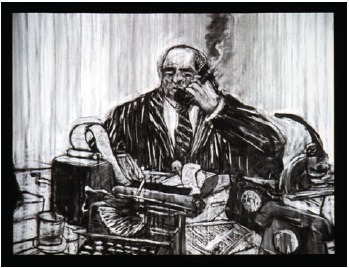
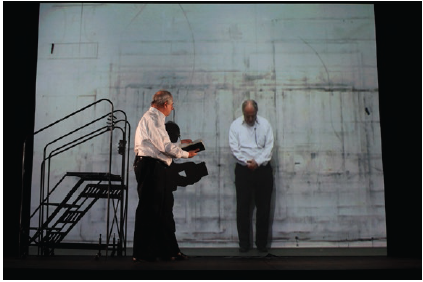
Consider Kentridge’s D (fig. 3). Materializing from the smoke of his cigar, D recalls the character of Soho Eckstein smoking his own cigar in several of the artist’s Drawings for Projection animated films (fig. 4). Footnote 9 Earlier works, such as the poster for the play Randlords and Rotgut (1978) and the silkscreen Art in a State of Siege (1988), which depict Soho-like smoking figures, also come to mind, as does, assisted by P’s “ash” night attire and his “ash” molting skull, the phrase “Smoke, ashes, fable” and the larger quote embedding it: “Where are they all now? Smoke, ashes, fable? Or perhaps they are no longer even fable” (Kapuscinski 1983:107). Excerpted from Ryszard Kapuscinski’s writings on the end of colonial empires, which thematize time, transience, downfall, and history, Footnote 10 the sentences are inscribed on a number of Kentridge’s works: the print Casspirs Full of Love (1989), the drawn arched triptych Arc/Procession: Smoke, Ashes, Fable (1990), and the animated drawings Weighing and Wanting (1997–98) and Zeno Writing (2002). Kentridge’s 2017 exhibition at Sint-Janshospitaal in Bruges was also titled “Smoke, Ashes, Fable” (see Kentridge Reference Kentridge and Rosalind2017). In the artist’s Catastrophe from the same year, D and P function then as interrelated facets not only of the artist’s process but also, through the word-image relationships between their smoke and ashes, of history’s process — which is consonant with the political-artistic nexus of Beckett’s play. These and other works by Kentridge swarm not only around D’s smoking cigar, but also around his chair, watch, suit, and expression when shouting at A; P’s plinth, paper helmet, skull, and head isolated by Luke’s lighting; as well as A’s notetaking and, especially, the ladder that she drags onstage and climbs on to alter P’s pose. The ladder is the most surprising prop in the artist’s 2017 Catastrophe, because it does not merely modify but adds a foreign term to Beckett’s stage directions. Particularly resonant are artworks across mediums that combine more than one of these fragments as main components of Kentridge’s vocabulary, and even more so those that also match Catastrophe’s utter reflexivity. The lecture-performance I Am Not Me, The Horse Is Not Mine (2008) is one of them.
Catastrophe by Samuel Beckett, directed by William Kentridge at The Centre for the Less Good Idea, 2017. Performer: Hamilton Dhlamini as D. (Screenshot by TDR; courtesy of Kentridge Studio)

William Kentridge, drawing for the film History of the Main Complaint (1995–96), charcoal on paper, 48 × 63 in. (121.9 × 160 cm), Museum of Contemporary Art Chicago. (Courtesy of Kentridge Studio)

Putting Kentridge’s studio onstage by projecting its empty walls as setting, this theatrical monologue casts the live artist himself (WK), his shadow, and two of his video projections (WK1 and WK2) in roles that bring to mind D, A, and P at times. The piece, a studio play proper, dramatizes the creative process related to Kentridge’s work on Shostakovich’s Gogol-inspired opera, The Nose (1928). Footnote 11 After teasing out the “terror of hierarchy” and “the division of the self” as main themes in Gogol’s short story of the same title (Kentridge [2008] Reference Kentridge and Rosalind2010:31), while at the same time highlighting the reflexive authorial device that masks a gap in the narrative behind an all-enveloping mist, Kentridge focuses on the second theme and traces a genealogy in literature of bodily fragmentation — noses achieving agency and separating from their bodies — as a metaphor for the polyphony of the creative process from Cervantes, to Sterne, to Dada. The spatial, temporal, and material (dis-)integration of and interaction between WK, WK1, and WK2 — who push, pull, climb, and sit on ladders, chairs, and armchairs akin to D and A; read or write notes, like A; and strike P-like postures: hands joined and head bowed (fig. 5) — illustrate the split of the artist, which the second part of the highly reflexive lecture-performance addresses explicitly with regard to what happens in the studio. Footnote 12
William Kentridge, I Am Not Me, The Horse Is Not Mine (2008), performance at the Museum of Modern Art, New York, 4 March 2010. (Photo by Paula Court; courtesy of Kentridge Studio)

The studio emerges as a site where the artist’s figures struggle against the “limit of understanding,” “the [panic-stricken] inability to make sense of all the fragmentary ideas that are lying around,” “bouncing back off the inside walls of our head” while “a sense that things should connect [despite] gaps [that] are too wide” pushes to find “how to put the pieces together, between Gogol, Sterne, Cervantes, Shostakovich […]. What is the relationship of the nose to the absurd, to the historical facts?” Both the creative subject and the artistic object in the making are piecemeal and porous at the points “where we meet the outside world” of art, culture, biography, and history, “waiting for some way through, some way to let a new spark get from outside us in, or inside us out,” all the while attempting to remain “aware of things that are inside, that move outwards, and things that are outside that move in” (Kentridge [2008] Reference Kentridge and Rosalind2010:37, 39, 41, 42). The busy traffic on the “multilayered highway of consciousness” in the studio (Christov-Bakargiev and Kentridge [Reference Christov-Bakargiev, Kentridge and Rosalind1999] Reference Kentridge and Rosalind2017:14) shuttles not only between artistic selves, but also between selves and/as others, inside and/as outside, the personal and/as the public, biography and/as history. In I Am Not Me, The Horse Is Not Mine the collision into meaningful coherence of disconnected bits and pieces circulating along all these dimensions at the same time is shown to happen, paradoxically, by means of the gaps and fragments themselves — when the absurdity of parts severed from wholes is understood to also characterize Shostakovich’s and others’ purges after the stopping of his Nose, in terms of the “Communist Party […] eating itself, […] disintegrating[,] divid[ing] against itself, tearing itself apart” (Kentridge [2008] Reference Kentridge and Rosalind2010:44, 46). The acting out of the “transcript of the plenum of the Central Committee of the Communist Party of the Union of Soviet Socialist Republics, February 1937” demonstrates in the last part of this multivocal monologue, through in extenso quotation, how “it’s not only a self that disintegrates, that splits itself apart, it’s also the speech itself, and language, which stops making any sense” (Kentridge [2008] Reference Kentridge and Rosalind2010:46, 44).
Echoing through Kentridge’s Catastrophe as studio play, I Am Not Me, The Horse Is Not Mine highlights aspects of the creative process as well as its interrelationships with the workings of history. It places the external circumstances of the dramaticule’s genesis — Havel’s political imprisonment in communist Czechoslovakia — in the continuation of those impacting Shostakovich’s The Nose, while at the same time foregrounding other layers of historical-political signification relevant to the 2017 production, to which the evocation of past works by the artist has already alerted us. While Beckett mentions thrice that D, A, and P’s “[a]ge and physique [are] unimportant,” Kentridge’s casting choices point to the fact that these aspects are in fact imbued with meanings. Played by the same actress as in the two 1984 productions, A not only connects across decades moments in the artist’s oeuvre, suggesting a continuity of preoccupations, but also invites comparisons between what Catastrophe might have meant in apartheid South Africa under the state of emergency and what it may mean in 2017. Footnote 13
Embodied by a white and a black actor, respectively, in 1984, D and P mirrored in the play the sociopolitical relationships prevailing outside it at the time. “Whitening” P’s skull, hands, knees, and other bared flesh (Beckett [Reference Beckett and Auster1982] 2006:487, 488) acquired additional sinister connotations in this context. More than 30 years later, D and P’s common blackness problematizes the initially clear-cut divide between black and white. How is this choice to be understood? As genuinely political, I maintain, in the sense that the artist assigns to this word when stating: “I am interested in a political art, that is to say an art of ambiguity, contradiction, uncompleted gestures and uncertain endings,” an art that although not an “illustration of apartheid [is] certainly spawned by and feed[s] off the brutalized society left in its wake” (in Tone [Reference Tone1999] 2017:n.p.). Footnote 14 It would be too easy, definitive, and hence apolitical to posit black D as simply the ascendence, on the “historical chain of being” (Kentridge Reference Kentridge and Rosalind2014:28), of a new oppressor class from the midst of the oppressed in postapartheid South Africa. Deeper than yet another master-slave dialectic in the long march of history, D and P’s correlation gestures toward a self-division, a disintegration, a decomposition of the social body and the body politic, the ultimate outcome of which D’s exit, P’s death-stricken face, and A’s disappearance from view hint at as a possible (dead-)end of history.
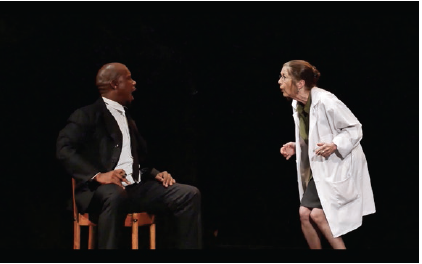
Some of the ambiguous meanings that the racial (and implied class) relationships between D, P, and A bring about in Kentridge’s 2017 Catastrophe reflect and refract through similar ambiguities in Other Faces (2011), a work summoned up by D’s appearance, especially when he shouts at A (fig. 6). In this attitude, D is a live foil to the drawn black man opposite Soho Eckstein in the car collision and ensuing road-rage scene that the artist depicts in this last-to-date drawing for projection. However, here already, the two are not only opponents but also — similarly dressed and yelling — mirror images of each other, while at the same time individualizing the violence of the lynching mob into which the crowd witnessing their traffic accident transforms. D as Soho as xenophobe as aggressor, but also, at the very same time, D as A as P as subaltern as victim and so on, these are some of the many associative, clashing, implied, and fragmentary meanings devised to collide in Kentridge’s 2017 Catastrophe. It is up to the audience to notice and not so much untangle once and for all but keep trying to organize the fragments into tentative wholes. The artwork thus achieves its political effect in that it both triggers the audience’s meaning-making agency and places on the audience the responsibility for the meaning it creates. Footnote 15
Catastrophe by Samuel Beckett, directed by William Kentridge at The Centre for the Less Good Idea, 2017. Performers, from left: Hamilton Dhlamini as D and Vanessa Cooke as A. (Screenshot by TDR; courtesy of Kentridge Studio)

D’s dismissal of “This craze for explicitation! Every i dotted to death! Little gag! For God’s sake!” (Beckett [Reference Beckett and Auster1982] 2006:487) reflects Kentridge’s appreciation for the ambiguous as political in art, which his P also illustrates. Footnote 16 Unlike Beckett’s P — who stands on the box in his “old grey pyjamas, head bowed, fists clenched” after A has taken off his “black dressing-gown to ankles,” and whose fists she then unclenches upon D’s orders (Beckett [Reference Beckett and Auster1982] 2006:485, 487) — Kentridge’s P never has his fists properly clenched. The unclenching of the clenched fists and their subsequent molding into a joined-hands prayer-like pose can be read too easily as a disempowering gesture, which turns P from a potential fighter into a supplicant. Footnote 17 Not only are the fists of Kentridge’s P never clenched (fig. 7), but his joined-hands posture, which foregrounds his two middle fingers as pointers, is uncertain, one of its possible interpretations being that of an offending gesture. The artist’s staging choices as regards P’s fists echo his 1981 statement:
[T]he art of the clenched fist rings a bit hollow. The painters, who for fear of reducing the political import of their work, reduce their images to systematised diagrams of discontent (either torn trousers and hunched shoulders or fists — sentiment or bombast), create only scarecrows. We are fooled for a minute but after that we can ignore the work quite safely. (Kentridge Reference Kentridge and Rosalind1981:47)
Catastrophe by Samuel Beckett, directed by William Kentridge at The Centre for the Less Good Idea, 2017. Performers, from left: Hamilton Dhlamini as D, Xolani Dlamini as P, and Vanessa Cooke as A. (Screenshot by TDR; courtesy of Kentridge Studio)

Staging Catastrophe as a studio play in 2017, Kentridge shows the tightrope act that the artist needs to perform to strike a balance between an unconvincing and unchallenging political “art of the clenched fist,” on the one hand, and an apolitical art that eschews “the narrative, the illustrational,” on the other, whose makers “shy away from a look at their private, public and historical lives […, in] an avoidance of themselves, a fear of taking responsibility for who they are. Which shows up in the works, even when well lit” (47). The private, the public, the historical, and the artistic are inevitably interconnected, Kentridge suggests, and transpire in the work whether the artist likes it or not.
And so we circle back to the artist as always transpiring in the artwork, in the wake of a creative process that “chang[es] the self into the third person.” This transmutation is effected not by looking at oneself in the mirror but by handling oneself as an other that the artist places in situations that test one’s skills, abilities, and limitations. The result is willingly or unwillingly “a kind of self-portrait” that is revealing yet at a remove: “whatever you produce, whether you like it or not, it is who you are” (Kentridge Reference Kentridge and Rosalind2016). From this angle, P’s terrified look that D produces with the assistance of A and which is extremely well lit by Luke also represents D’s unflattering self-disclosure that sharply contrasts with his domineering and confident behavior. This is Kentridge’s, not Beckett’s, contradiction between explicit and implied aspects of D, which has both artistic and political dimensions. It takes its place among other contradictions that the artist introduces in his 2017 staging of the dramaticule, among which the antithesis between P’s clothing and D and A’ s verbal exchange on it is particularly jarring.
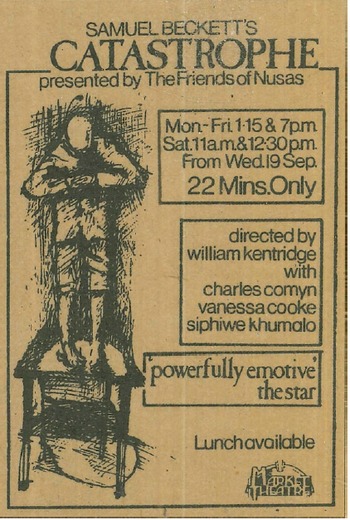
The clash between the seen and the said at the very beginning of the play — where a brown paper helmet is called a “black wide-brimmed hat” and a matching brown overcoat is called a “black dressing-gown to ankles” (Beckett [Reference Beckett and Auster1982] 2006:485) — draws the audience’s attention and alerts them not to suspend their disbelief. At the same time, P’s costume is strongly highlighted by this incongruity and acquires, in the light of Catastrophe’s utter reflexivity, meanings relating to Kentridge’s drawing process as foundational practice: “Walking around the studio, not imagining the specific images, but pacing out scale, brown paper drawings of this size, one and a half meters square” (Kentridge Reference Kentridge and Rosalind2014:31; emphasis added). This particular description attaches to preparatory drawings for one of the artist’s rotating assemblage-sculptures representing a “typewriter in sections” that is “exploded back together” into a coherent whole when perceived from a specific angle (Kentridge Reference Kentridge and Rosalind2014:30). One of Kentridge’s characteristic motifs, the fragmented word-producing typewriter suggests a shattering of words and images parallel to that which characterizes the opening of his 2017 Catastrophe. While the size of the described square of brown paper corresponds roughly to the length of P’s brown overcoat, the material support itself recalls other works by the artist. Especially salient are his early posters and drawings for theatre sets, printed or made on brown paper, such as the 1984 Catastrophe poster itself (fig. 8), while prints that represent figures wearing (news)paper helmets and cloths also come to mind (Anti-Waste [1991] from the series Little Morals, for instance).
Poster of Samuel Beckett’s Catastrophe, directed by William Kentridge, with actors Charles Comyn, Vanessa Cooke, and Siphiwe Khumalo, at the Market Theatre, Johannesburg, 1984. (Courtesy of Kentridge Studio)

The flying apart of words and images, of knowledge and visual perception, fragments coherent meaning-making while exposing the necessary interplay, to which we are usually oblivious, between percept and concept in the construction of any view. It also confirms Kentridge’s interest in the anarchy of the absurd as an antidote to coercive reason, which he finds masterfully at play in other theatre pieces by Beckett. It is not surprising then to find many of the idiosyncrasies from the 2017 Catastrophe join the playwright’s Waiting for Godot (1953) in the artist’s studio as the locus of a “practical epistemology.” “Trying to parse the specific nature and activity of the studio” in the fourth of the Six Drawing Lessons that he delivered as the 2012 Norton Lectures at Harvard University, Kentridge calls on Beckett in the final section titled “Making a safe space for stupidity” when, during his live performance, he projects and interacts with a montage of images showing excerpts from previous works, as well as the artist walking, working, and acting out passages from Godot at different times in his studio (Kentridge Reference Kentridge and Rosalind2014:124–28). In 2002, while lecturing on the art of Bruce Nauman at the Dia Center for the Arts in New York, Kentridge had already drawn on Beckett to explain some of the main differences between what happens in Nauman’s studio and his. Footnote 18
Acknowledging the American artist’s pioneering studio films that investigate the creative process and artist figure, which Nauman made in the late 1960s and early 1970s, Kentridge places them in the lineage of Jackson Pollock’s action painting filmed by Hans Namuth and the prior 20th-century history of representing the artist in the studio. While Pollock’s studio activity — in which producing an object is still at stake although the subject in charge of the production process is given equal importance — contrasts Nauman’s, who completely discards the object in order to fully focus on the artist’s performance in a given setting, Kentridge perceives both practices, unlike his own, as analogously confident and pre-set. In Nauman’s case the assertiveness, Kentridge suggests, consists in his early self-declaration as artist, on the one hand, and Nauman’s disregard for the little interest, even disinterest, that his repetitive, dreary, non-narrative studio films likely elicit in the audience watching them, on the other hand.
The precise scripting of Nauman’s studio performances comes into play when Kentridge mentions the diagrammatic drawings that the artist made in preparation for his film Slow Angle Walk (Beckett Walk) (1968). Noting that Nauman talks about his preoccupations with studio activities that go on and on pointlessly, without anything ever happening, as being consonant with those described in Beckett’s writings, Kentridge affirms his own love for the author whose works he understands nonetheless differently. It may well be that repetition, monotony, nothing happening, and waiting are themes in Beckett’s works, but, Kentridge maintains, the stage is filled in the meanwhile with the characters’ time-passing mime, and music-hall and circus-like acts that entertain the spectators. The content and the medium, the said and the seen or done are not in tune in Beckett but diverge. To illustrate this point, Kentridge ends his lecture on Nauman by reading almost in full the playwright’s mime Act Without Words II (1959), a set of instructions for a variety of actions to be carried out by two mimers onstage, while the looplike end of the piece assigns it the meaning of eternal return. What is more, during the discussion following the talk, Kentridge ponders that if he were to ever make a studio piece such as Nauman’s Mapping the Studio I (Fat Chance John Cage) (2001) — which removes from the work not only the art object but also the artist as performing subject, leaving the studio as an empty space where some fringe activity of nonhuman animals like cats and mice might occur — he would still try to think more like Beckett and find the drama in this barest of situations, namely that which drives the cats and mice, so as to (trans)form it into an artwork.
It is quite possible that the discrepancy that Kentridge notes between Nauman’s Beckett and his own is also due to the fact that Nauman refers mainly to Beckett the fiction writer, quoting novels such as Watt (1953) and Molloy (1951), which challenge traditional narrative techniques, while Kentridge draws primarily on Beckett the playwright and theatre director who pushes the dramatic medium to its limits as he probes the minimal parameters needed for a stage performance. Kentridge’s extensive background in the theatre from his student years in the mid-1970s when he cofounded the Junction Avenue Theatre Company in Johannesburg, to his training at Jacques Lecoq’s international theatre school in Paris in 1981–82, to his collaborations with the Handspring Puppet Company on theatrical productions since 1992, as well as his staging of operas beginning in 2003, explains the particular attention that the artist pays to the dramatic form, and to Beckett as one of its main innovators in the second half of the 20th century, in his attempt to “bring the theatre world back into the studio” (Kentridge Reference Kentridge and Rosalind2003).
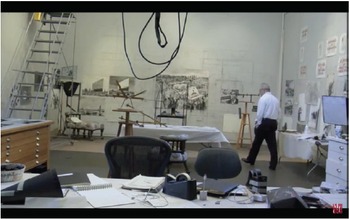
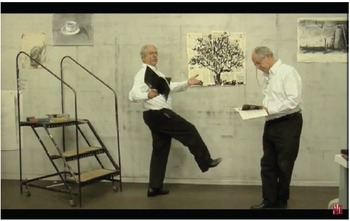
Since 7 Fragments for Georges Méliès, Journey to the Moon, and Day for Night (all 2003), Kentridge’s own studio films, the artist has been bringing back the theatre to the studio and putting the studio onstage in many works and ways that present aspects of dramatic performance as metaphors of the creative process. The excerpts from Waiting for Godot that Kentridge acts in his studio and shows as part of a montage during his fourth 2012 Norton Lecture, as well as other explicit and implicit references to the play elsewhere in the lectures, participate in the artist’s theatricalization of his process. In the first Godot sequence Kentridge includes in the lecture, mixed passages from Lucky’s disintegrating “thinking” monologue, which culminates in utter nonsense, are spoken over images of two WK figures walking ever faster in opposite directions around the studio. WK1 and WK2 personify here the idea and the material, which orbit each other and whose eventual collision will result in the artwork. The twins split from a previous single figure of the artist circling his workspace on and on in a temporary “truce between the artist as maker and the artist as observer” that this procrastinating yet necessary “parcours d’atelier” brings about (Kentridge Reference Kentridge and Rosalind2014:124, 49–55). The division into WK1 and WK2 is followed by their reintegration in Kentridge as “thinking” Lucky that then separates again into another pair of WK1 and WK2 as Vladimir and Estragon. The studio set(ting)s in which the various phases of these transformations occur change and thus connote, together with the endless rounds, the passage of time (figs. 9, 10, 11).
William Kentridge, “Drawing Lesson Four. Practical Epistemology: Life in the Studio.” The Charles Eliot Norton Lectures, 2012, Mahindra Humanities Center at Harvard. Video projection of the artist in his studio, during live lecture-performance. (Screenshot by TDR; courtesy of Mahindra Humanities Center at Harvard)

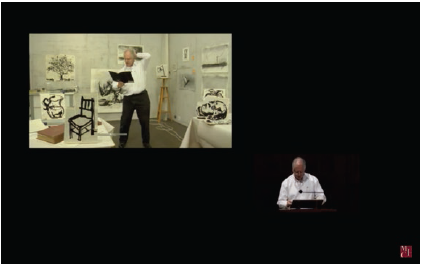
William Kentridge, “Drawing Lesson Four. Practical Epistemology: Life in the Studio,” The Charles Eliot Norton Lectures, 2012, Mahindra Humanities Center at Harvard. Video projection during live lecture-performance showing Kentridge as Lucky in his studio, in a contrapposto posture. (Screenshot by TDR; courtesy of Mahindra Humanities Center at Harvard)

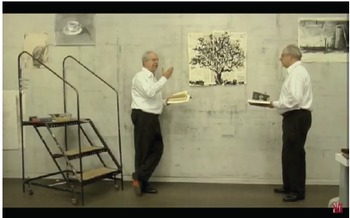
William Kentridge, “Drawing Lesson Four. Practical Epistemology: Life in the Studio.” The Charles Eliot Norton Lectures, 2012, Mahindra Humanities Center at Harvard. Video projection during live lecture-performance showing WK 1 and WK 2 as Vladimir and Estragon in the artist’s studio. (Screenshot by TDR; courtesy of Mahindra Humanities Center at Harvard)

Godot offers Kentridge fertile ground for demonstrating fundamental aspects of his creative process. The active waiting in the play becomes the productive deferment by circumvolutions in the studio, while the structural, temporal, character, and thematic dualities of Beckett’s piece — with its two acts, two consecutive days, two pairs of characters, two “boy” brothers, and so on — help Kentridge to illustrate the “A as B” blueprint of his metaphorical doublethink: “the double figure of the metaphor” (Kentridge Reference Kentridge and Rosalind2014:126). Not only Lucky’s “thinking” monologue but also the dance performance preceding it in Godot, interlinked as the two acts of a reflexive “play within the play,” are alluded to in the 2012 Norton Lecture montage through an animation of Ubu as a radio/camera, dancing with one of the artist’s signature motifs: the transmogrifying cat. Footnote 19 Taken from Kentridge’s film Ubu Tells the Truth (1997) and spliced into the sequence of Kentridge as Lucky, these moving drawings are the background against which live Kentridge wonders about the ways in which the “particle collision” between idea and material could be drawn (126). In 1998, in his “Director’s Note” on the play Ubu and the Truth Commission (1996–97), the artist had already mentioned having considered a production of Waiting for Godot with Handspring Puppet Company as a show “for puppets and perhaps only one fragment of animation in the middle when Lucky and Pozzo THINK” (Kentridge Reference Kentridge and Rosalind1998:x). Footnote 20 Although this project did not materialize at the time, Kentridge’s montage 15 years later in the Norton Lecture points to and realizes it differently.
In “[t]he studio as brain,” Kentridge as Lucky shows and tells the artist’s attempts at “squeez[ing] an insight from the rock of stuck thought” and “put[ting] the different ideas, images, and fragments together” (Kentridge Reference Kentridge and Rosalind2014:124–25), which we have already seen and heard him do in I Am Not Me, The Horse Is Not Mine. Kentridge pushes further Lucky’s stalled and decomposing thinking by quoting disorderly and inaccurately only bits and pieces from his monologue, on a soundtrack that also contains music, interjections, panting, and other sounds, with the live artist speaking concurrently onstage at times, which makes the lines difficult to distinguish. Snippets from the following passages come through:
[…] for reasons unknown no matter what matter the facts are there and considering what is more much more grave that in the light of the labors lost of Steinweg and Peterman it appears what is more much more grave that in the light the light the light of the labors lost of Steinweg and Peterman that in the plains in the mountains by the seas by the rivers […] Given the existence as uttered forth in the public works of [Greenberg and Krauss] of a personal God quaquaqua […] with [a great] white beard quaquaquaqua […] I resume [I resume] alas alas on on in short in fine on on abode of stones who can doubt it I resume but not so fast I resume the skull [shrinks and wastes and concurrently] […] Given the existence as uttered forth in the public works of Puncher and Wattmann of a personal God quaquaquaqua with [a great] white beard quaquaquaqua […]Footnote 21
The artist performs Lucky by reading from a black notebook while moving and gesturing amidst a dozen drawings and linocuts placed around him on studio walls and tables as elements of a stage design: pictures of a chair, a jug, and a reclining head in the foreground; a rhinoceros, a tree, a flag, a couple of landscapes, a bird in flight, a partly visible plant, and one or two unrecognizable smaller pictures, possibly portraits, in the background. All are part of the artist’s signature lexicon. Words and images come together and fly apart. Kentridge’s “rock of stuck thought” echoes Lucky’s “abode of stones” and “labors lost of Steinweg and Peterman”; Lucky’s “skull” resonates with Kentridge’s linocut head; while the drawn landscapes on the walls find their counterparts in “the plains in the mountains by the seas by the rivers” of the play. Meaning in tatters is signified by a babbling “God quaquaquaqua” that Kentridge as Lucky invokes by raising his arms or striking an ape pose while facing the flying dove drawing. The flag with a cross evokes similar images from the video installation I Am Not Me, The Horse is Not Mine (2008) edited in the same montage, which point in their turn to the Russian avantgarde and more precisely Kazimir Malevich’s painting Black Cross (1915). Through the glass of the artist’s 2017 Catastrophe, D’s idiosyncratic chair finds here in its linocut form another Beckett connection.
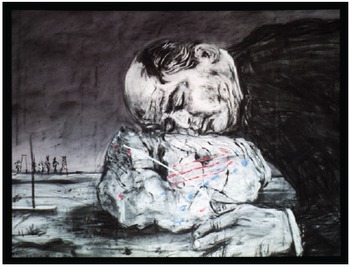
More complex syntaxes that combine several of these images — say, the stones-rocks with the skulls-heads and the landscapes — irradiate further away in the past of Kentridge’s corpus, reaching especially some of his drawings for projection such as Felix in Exile (1994) and Weighing and Wanting (1997–98). There, the heads and bodies of murdered victims turn into the stones of a landscape that erases the history of human violence, or else the living’s intermingling with the mineral proves problematic: Soho Eckstein — whose stony name takes its place among Lucky’s Steinwegs and Petermans — rests his head on a comforting rock that nonetheless entraps his wife, Mrs. Eckstein (fig. 12). At the same time, the artist’s explanation that “the rock is another way of drawing the inside of Soho’s head” and his observations on “the rock of apartheid,” which is crushing, “possessive, and inimical to good work,” are not far away either (Kentridge [1998] Reference Kentridge and Rosalind2013:306; also in Krauss Reference Krauss2000:4). These skulls as heads as brains as stones as rocks — where the inside and the outside, the artistic and the political, the domestic and the public, the idea and the material, “the formal interest” in an image and “the chain of associations the image leaves in its wake” collide (306) — are the Beckett-mediated genealogy of the disembodied close-up on P’s well-lit face at the end of Kentridge’s 2017 Catastrophe. Footnote 22
Still from William Kentridge, Weighing and Wanting (1998), 35 mm animated film transferred to video, color, sound, 6:20 min., private collection. (Courtesy of Kentridge Studio)

The other images that make up the stage designs of the studio, both in the Kentridge-as-Lucky performance and in that of WK1 and WK2 as Vladimir and Estragon, prompt equally rich associative links in interaction with Beckett’s text, which crisscross the artist’s body of work. On either side of one of his distinctive representations of abundant trees — which contradicts Beckett’s stage directions calling for an (almost) leafless one akin to that actualized by Alberto Giacometti in 1961 Footnote 23 — Kentridge’s Gogo and Didi act a brief excerpt from the beginning of the play (fig. 13). They skip, transform, and reorganize the lines while demonstrating, through vaudeville movements and gestures filmed at times in reverse and montaged at unconventional speeds, the “different degrees of tension” (known as “the seven levels of tension”) that the artist learned at Jacques Lecoq’s theatre school, as metaphors for “heat[ing] things up” to the point of fusion between matter and thought in the studio (Kentridge Reference Kentridge and Rosalind2014:125, 124). The very visible ladder prop is most directly inherited from the lecture-performance I Am Not Me, The Horse Is Not Mine and passed on in a wooden avatar to A, who uses it idiosyncratically in the 2017 Catastrophe to carry out D’s orders on manipulating P. On the wall, characteristic drawings of a landscape, a cup, and a head in profile, likely from the contemporaneous animated film Other Faces (2011), complete the rebus that Kentridge, constructing his own Beckett, invites us to reconstruct in our own way and turn. Footnote 24
William Kentridge, “Drawing Lesson Four. Practical Epistemology: Life in the Studio.” The Charles Eliot Norton Lectures, 2012, Mahindra Humanities Center at Harvard. Video projection during live lecture-performance showing WK 1 and WK 2 as Vladimir and Estragon in the artist’s studio. (Screenshot by TDR; courtesy of Mahindra Humanities Center at Harvard)

This is the artwork as asen, which the artist tackles in the fifth Norton Lecture titled “In Praise of Mistranslation” to highlight the gap not only between the different fragments of the artwork but also between its meanings at the site and time of generation, on the one hand, and of reception, on the other. A West African “monument to a dead person” in the form of “an iron disk on a pole” that supports “figures and objects” cut out of sheet metal, the asen is made by an artisan following the instructions of a donor to honor the deceased. The meaning of an asen becomes ever more blurred in the series of mistranslations between the facts of the life to be honored; the patron’s understanding of them; the maker’s interpretation of the commission that combines visual with verbal directions, which often contain puns; and, finally, the later beholder in the museum where the asen now conserved is deprived of the context “of the specific trio that contributed to the piece.” Despite these many gaps, “the piece does not become mute,” but allows, on the contrary, the present viewer to multiply the possible combinations among the asen’s represented objects and figures, and so understand it in manifold ways (Kentridge Reference Kentridge and Rosalind2014:133–34).
The asen itself, the three agents, and the procedures involved in its making implicitly stand for the artwork, the different artist figures, and the creative process that Kentridge discourses about and demonstrates in the Norton Lectures. Moreover, noting that an asen is an “invitation to make our own asen, our own translation of the objects into a sentence […] — folded paper and cardboard, cut out figures — take the rhinoceros, the different linocuts, put them together, make a miniature theatre in which the objects can be slid about, repositioned, to make a sentence on the stage,” the artist explicitly reinforces the theatre-as-studio and studio-as-theatre metaphors. The examples that he gives at this point of “[a]n asen of a head and a jug or a chair,” the rhinoceros mentioned above, as well as references to “a tree […], the flag” describe in fact the stage setting in his studio during the Kentridge-as-Lucky montaged sequence in the previous lecture (136). The artist’s 2017 Catastrophe is, I suggest, another Beckett version of the “asen of a head and a jug or a chair,” in which P’s head and D’s chair materialize two of its terms.
The reciprocal metaphors of the work, the studio, and the stage as asen, demonstrated thanks to Beckett, show the word-image relationships, which are fundamental to theatre, to be equally important in the construction of the artist’s pieces in other mediums. Footnote 25 The asen metaphors also foreground ideas such as: understanding as misunderstanding, assigning multiple meanings to a work, and establishing unexpected connections, like that between a traditional West African practice and artifact, on the one hand, and one of the most paradigmatic Western plays of the 20th century, on the other. The beholder’s agency, be it the viewer or the artist, is thus revealed to play an essential role in activating artworks, keeping their meanings on the move, and giving them a new life across gulfs of space and time.
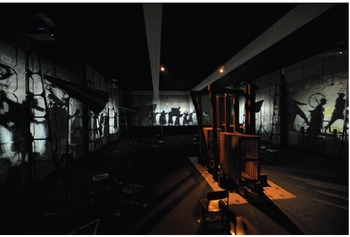
Time, its passage, and its passing have of course been present in Kentridge’s studio with Beckett’s Waiting for Godot all along, as the medium of process. While studio time — with its endless circling, repetitive gestures and movements, stuck thought, productive procrastination, and defensive sleeping — may well leave its traces in the final work, “holding time to the world of the studio” remains in fact unaccounted for (Mahindra Humanities Center [2012] 2021, video 4; Kentridge Reference Kentridge and Rosalind2014:124). The sixth and last Norton Lecture titled “Anti-entropy,” on which the artist worked simultaneously with his installation The Refusal of Time (2012) (fig. 14) and the performance Refuse the Hour (2012), explicates time as a major theme in his oeuvre, whose many variations the previous lectures addressed implicitly (165). Countering time’s entropic effects on the work — from reducing “the infinite possibilities” inherent in it “when one is circling the studio, about to begin” (176), to fragmenting it beyond reintegration in any kind of whole, even tentative and temporary, to freezing forever the movement of its meanings — turns out to be one of the main challenges in the studio.
William Kentridge, The Refusal of Time, 2012. 5-channel video with sound, 30 min., with megaphones and breathing machine (“elephant”). A collaboration with Philip Miller, Catherine Meyburgh, and Peter Galison. Ishikawa Collection (Okayama). Installation view, Parasophia: Kyoto International Festival of Contemporary Culture 2015 Prelude [Exhibition] William Kentridge: The Refusal of Time, former Rissei Elementary School, Kyoto, Japan, 2014. (Photo by Kunihiro Shikata; courtesy of Parasophia Office; © William Kentridge)

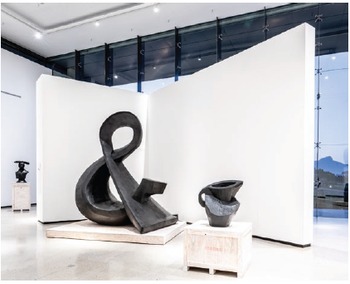
Catastrophe as studio play and asen demonstrates the pressure of time on process through D’s haste and chronometer, both of which Kentridge highlights by modifying Beckett’s stage directions: he multiplies D’s “Get going” and has him consult his watch only once, not twice, which foregrounds the gesture. In the sections titled “L’humana fragilita” and “Pneumatic time” of the last Norton Lecture, the artist discusses “the internal clock of our heart,” “the clock as body, and the body as clock,” “holding our breath against time,” and “breathing [as] both enacting and […] resist[ing] time,” as themes developed in many of his works before The Refusal of Time and Refuse the Hour (Kentridge Reference Kentridge and Rosalind2014:163, 167). In this context, the box inscribed with the word FRAGILE on which P stands in the 2017 Catastrophe — similar to those that Kentridge has used both to install The Refusal of Time and as plinths for his sculptures (fig. 15) — as well as P’s heavy breathing at the end of the play, which was already there in Monument, expand the theme of time already at play in the dramaticule.
Installation view of William Kentridge’s exhibition Why Should I Hesitate: Sculpture at Norval Foundation, Cape Town, 24 August 2019–27 July 2020. (Photo courtesy of Kentridge Studio)

Topoi commonly associated with Beckett’s artistic credo are also a part of Kentridge’s Beckett, albeit not always explicitly stated. The artist’s preference for “the less good idea” and “stupidity”; his “room of failures” for abandoned developments in The Refusal of Time and the Norton Lectures; and his ending of the latter by imagining an integration of his Johannesburg self in the studio with his lecturing self at Harvard in terms of a dialogue between Beckett’s “To fail. To fail better…” and Tennyson’s “To strive. To find. […] and not to yield” (Kentridge Reference Kentridge and Rosalind2014:178, 184) recall Beckett’s own statements on working from “impotence [and] ignorance,” and his penchant for “failing”: “to be an artist is to fail, as no other dare fail”; “Ever tried. Ever failed. No matter. Try again. Fail again. Fail better” (Beckett in Shenker Reference Shenker1956; Beckett [Reference Beckett and Auster1949] 2006:563; Beckett [Reference Beckett and Auster1983] 2006:471). In addition, Kentridge’s musings on his process — such as: “An inability to know what should be made, or how to make, or why it should be made […]. The need and not-need to make something. This is not an image I am burning to show, or story or experience I need to tell: this is the not-need; but the pressure for something to be there: the need” (Kentridge Reference Kentridge and Rosalind2014:155) — echo Beckett’s reflections on art: “The expression that there is nothing to express, nothing with which to express, nothing from which to express, no power to express, no desire to express, together with the obligation to express” (Beckett [Reference Beckett and Auster1949] 2006:556). Footnote 26
Kentridge not only demonstrates and conceives of his work and process in terms of Beckett, be it in Catastrophe as studio play, his pronged Godot studio montage in the Norton Lectures, or his artist talk on Bruce Nauman. Rather, he thinks about this very demonstration and conception, in his second-degree thinking about thinking as it were, through Beckett. A pinnacle of his post-factum reflections on his process, the artist describes the Norton Lectures that draw on “every thought I had ever had, or remembered someone else’s having” as “a prod, a goad to the [audience’s] activity of thinking, of understanding how we have to make sense of the world from these contradictory, different fragments” (Kentridge Reference Kentridge and Rosalind2014:3; Kentridge Reference Kentridge and Rosalind2013:46). The lectures as thinking-inducing prod or goad have the same function as the goad prodding the characters into acting in Beckett’s mime Act Without Words II (1959) that the artist quotes almost in full as a conclusion to his 2002 talk on Nauman’s studio pieces and as a preamble to his own to come.
Kentridge’s Beckett is maybe best described in terms of him performing or becoming Beckett, by slightly modifying the artist’s explanation of how Godot could be staged with Vladimir and Estragon acted as a dog and a cat.
In any event, it is taking some attribute outside us, its catness, its dogness [Beckett’s work] — something we can observe, something we can become expert in, absorbing it. It is outside us, but it corresponds to something in us, which we hope it will attach to, and grow and make clearer. But there is also a reverse transmogrification. (Kentridge Reference Kentridge and Rosalind2014:144)
To perform or become Beckett, then, is to clarify Kentridge. As to how Beckett himself is made clearer by this transmogrifying secondary reading, there is another text to be written.