The body image construct has long been conceptualized as a complex and multifaceted construct comprising several aspects of how people experience their bodies. Although body image encompasses positive and negative aspects such as body dissatisfaction, body shame, and body preoccupation, most theories, research, and practices focused for many years on understanding, preventing and treating only its negative aspects (Smolak & Cash, Reference Smolak, Cash, Cash and Smolak2011; Tiggemann, Reference Tiggemann2015).
Recently research attention has turned toward positive body image, which refers to love and acceptance of one’s body (including aspects that are inconsistent with societal body ideals), and appreciation of its functions and singularity (Tylka, Reference Tylka and Cash2012). Positive body image is different from negative body image, and it should not be represented as low levels of negative body image. This construct is more complex, associated with several positive aspects such as body appreciation, acceptance, and love for the body, broad conceptualization of beauty, spirituality, inner positivity, filtering protective information to the body, confident behavior and self-care (Tylka & Wood-Barcalow, Reference Tylka and Wood-Barcalow2015a).
Body appreciation has been the central organizing variable within the investigations of positive body image. It can be defined as accepting, holding favorable opinions toward, and respecting one’s body, while also rejecting the appearance standards of beauty disseminated in the media as the single conceptualization of beauty (Avalos, Tylka & Wood-Barcalow, Reference Avalos, Tylka and Wood-Barcalow2005). This construct can be measured via the Body Appreciation Scale (BAS), which was developed by Avalos et al. (Reference Avalos, Tylka and Wood-Barcalow2005). It has 13 items, which loaded on one factor, having satisfactory factor loadings via exploratory and confirmatory factor analysis and assessed the three aspects of body appreciation (i.e., body acceptance, body respect, and body protection by rejecting media appearance infiuences). In addition, BAS measures the same construct equally for both sexes (Tylka, Reference Tylka2013).
Researchers have utilized the BAS to understand better features, correlates, and potential outcomes of positive body image. Its scores were positively related to positive indicators of health as intuitive eating, self-compassion, positive affect, life satisfaction, women’s sexual arousal and satisfaction, and enjoyment-based physical activity (Swami, Stieger, Haubner, & Voracek, Reference Swami and Chamorro-Premuzic2008; Tylka & Kroon van Diest, Reference Tylka and Kroon van Diest2013; Wasylkiw, MacKinnon, & MacLellan, Reference Wasylkiw, MacKinnon and MacLellan2012; Satinsky, Reece, Dennis, Sanders, & Bardzell, Reference Satinsky, Reece, Dennis, Sanders and Bardzell2012; Homan & Tylka, Reference Homan and Tylka2014). Furthermore, BAS scores were inversely correlated with negative indicators such as body checking behaviors, social physique anxiety, internalization of societal appearance ideals, body image avoidance, self-comparison, and maladaptive perfectionism (Andrew, Tiggemann, & Clark, Reference Andrew, Tiggemann and Clark2014; Iannantuono & Tylka, Reference Iannantuono and Tylka2012; Swami, Mada, & Tovée, Reference Swami, Hwang and Jung2012; Tylka & Kroon van Diest, Reference Tylka and Kroon van Diest2013).
Its unidimensional factor structure has been supported in samples of college and community women and men from the USA, UK, and Germany (Swami, Hadji-Michael, & Furnham, Reference Swami and Chamorro-Premuzic2008; Swami, Stieger et al., Reference Swami, Hadji-Michael and Furnham2008), and adolescents of both sexes from Spain (Jáuregui-Lobera & Bolaños-Ríos, Reference Jáuregui-Lobera and Bolaños-Ríos2011). However, the different cultural settings have shown certain variations of BAS structure in many non-Western and Western samples wherein some of its items do not load on its primary factor, as verified in samples of Malaysian and Chinese women (Swami & Chamorro-Premuzic, Reference Swami and Chamorro-Premuzic2008), Indonesian women and men (Swami & Jaafar, Reference Swami and Jaafar2012), Zimbabwean women (Swami, Mada et al., Reference Swami, Hwang and Jung2012), and South Korean college women and men (Swami, Hwang, & Jung, Reference Swami, Hwang and Jung2012), women and men from Hong Kong (Ng, Barron & Swami, Reference Ng, Barron and Swami2015), including Brazilian samples of men and women (Swami et al., Reference Swami, Campana, Ferreira, Barrett, Harris and Tavares2011), men (Campana, Reference Campana2011), older adults of both sexes (Ferreira, Neves & Tavares, Reference Ferreira, Neves and Tavares2014), and Brazilian men with spinal cord injuries (Neves, Lorey, Campana, Ferreira, & da Silva, Reference Neves, Lorey, Campana, Ferreira and da Silva2015).
In the first validation performed in Brazilian samples, exploratory factor analysis led to an identification of two factors, but the second factor (comprising Items 8, 9 and 12) obtained low internal reliability value (α =.67). The researchers chose to exclude these items from the scale, resulting therefore in a one-factor scale with ten items (Swami et al., Reference Swami, Campana, Ferreira, Barrett, Harris and Tavares2011). In the second validation study conducted by Campana (Reference Campana2011) with Brazilian men, a model with two factors was tested: (1) one’s body appreciation and (2) care for the body. These factors were based on conceptual definitions of positive body image, gathering the central features of this construct described by Avalos et al. (Reference Avalos, Tylka and Wood-Barcalow2005). Thus, the first factor met the characteristics favorable opinion of the body and body acceptance, despite the weight and the second one refers to respect for the body, meeting its needs and adoption of healthy behaviors and protection against media images. A unidimensional version for men was obtained after excluding four items (6, 7, 9 and 11).
In the third validation study with older adults of both sexes, a new bidimensional model for BAS emerged, after excluding five items (2, 8, 9, 12 and 13). This structure was considered the best solution because of its parsimonious indices, which indicated that this model better explained the observed data (Ferreira et al., Reference Ferreira, Neves and Tavares2014). The last study published with Brazilian samples investigated positive body image in physically active men with spinal cord injuries. Also, a bidimensional solution for the BAS appears to be a valid and reliable scale for the investigation of positive body image, with Items 8, 9, 11, 12 and 13 being eliminated (Neves et al., Reference Neves, Lorey, Campana, Ferreira and da Silva2015). Despite these differences, all versions have thus far demonstrated evidence of validity and internal reliability.
However, none of these Brazilian studies evaluated the body appreciation in adolescent samples. Therefore, the aim of the present study was to adapt the BAS to the Brazilian adolescent population and verify their psychometric properties (e.g., factor structure, internal reliability, construct, concurrent and criterion validity) in a sample of Brazilian young adolescents of both sexes.
Method
Participants
The initial sample comprised 352 participants, but it was reduced to 347 (171 male and 176 female) after rejecting any of those who presented some intellectual prejudice, which was informed by the school coordination, or showed any comprehension and language difficulties. The final group comprised young adolescents, all of whom were elementary school students drawn from two state schools and three private schools (located in cities of small and medium size). The sample size was calculated taking into account the recommended 10:1 ratio of the number of participants to the number of test items (Pasquali, Reference Pasquali2010).
Also three expert researchers in psychological evaluation, two researchers with remarkable experience in studies on body image, two Portuguese teachers of Elementary school and one Primary Education school coordinator participated in the study. They contributed to the adaptation of the items so as to be understandable by the target population.
Measures
Body Appreciation Scale (BAS)
This 13-item instrument evaluates the appreciation of the body (love, care for, protect and preserve the body), an aspect of positive body image (Avalos et al., Reference Avalos, Tylka and Wood-Barcalow2005). The BAS factor structure comprises a single dimension that shows adequate internal consistency (α = .93) and good temporal stability over a period of three weeks apart (r =.90, p <.001) among college females. Afterward, Tylka (Reference Tylka2013) administered the instrument in distinct male and female adult samples, reinforcing the evidence of factorial and concurrent validity of the instrument as well as the internal consistency of the scale of values (α = .94 for women and α = .92 for men), and the equivalence of the construct between the sexes. BAS items are rated along a 5-point scale and are averaged to obtain an overall body appreciation score. Items 9 and 12 present statements contrary to the appreciation of the body so therefore have their scores reversed. BAS study in Brazilian young adolescents will be taken from the version translated by Swami et al. (Reference Swami, Campana, Ferreira, Barrett, Harris and Tavares2011) for adults of both sexes.
Brazilian Figure Rating Scale for children (FRS)
This instrument was made and validated for Brazilian children aged 7 to 12 years old by Kakeshita (Reference Kakeshita2008). It consists of 11 silhouettes of each sex presented on individual cards, with progressive variations in the range of measures, from leaner (Body Mass Index [BMI] = 12 kg/m2) to the widest (BMI = 29 kg/m2). For perceptual body image, the participant has to choose the silhouette that most closely matches the image he has of his body at the time (Current BMI). The value of the estimation of body image is obtained by the operation Current BMI – Real BMI, and results similar to zero indicate an accurate perception, negative results indicate an underestimation of body size while positive ones indicate its overestimation. Next, the participant must show the silhouette he would like to have (Desired BMI). The overall rate of dissatisfaction is provided by the operation Desired BMI - Current BMI, so that results equal to zero are indicators of satisfaction and positive or negative results indicate degrees of dissatisfaction, longing larger or smaller silhouettes, respectively.
Procedure
The researchers requested the permission of the BAS original authors, as well as the Brazilian researcher who conducted the study of the cross-cultural adaptation of BAS, to use this scale. Both authors were favorable to the performed validation process among Brazilian young adolescents. Ethical approval was obtained from the ethics committee of the university. The process of the BAS items adaptation counted on the collaboration of professionals described above and three students in the 6th year.
The suggestions of all these participants were compiled into a single version. Collaboration invitation to the author responsible for the BAS translation into Brazilian Portuguese via e-mail was also carried out. The BAS version was sent with the appropriate changes and requested new suggestions as well as the opinion on the changes made, approaching the Beaton, Bombardier, Guillemin, and Ferraz (Reference Beaton, Bombardier, Guillemin and Ferraz2002) recommendations for cross-cultural adaptation of instruments.
The informed consent form was obtained from the student’s parents before the data collection. The BAS application was carried out together, in the classroom, by two researchers trained to assist and supervise adolescents in case of any doubts. Upon its completion, the collection of anthropometric measurements (weight/height) was performed by the main researcher. This procedure was done individually in another room or at the back of the classroom, respecting the participant’s privacy.
Analysis
A structural equation model or Confirmatory Factor Analysis (CFA) was employed to determine the BAS factorial validity to test whether the original model provided a good fit to the data. We used six adjustment indices to determine how well the original models fit the data, namely: χ2, GFI (Goodness-of-fit Index), NFI (Normed Fit Index), CFI (Comparative Fit Index), TLI (Tucker-Lewis Index) and RMSEA (Root Mean Square Error of Approximation).
The χ2 evaluates the model fit by comparing the sample correlation matrix with the estimated correlation matrix in the model. Lower values, in this case, indicate a good fit, reflecting the small gap between the structure of the observed data and the hypothetical model. The NFI, CFI, and TLI compare the hypothetical model to a “null” model (typically an independent model whose covariance among all variables is zero) or a worst fit, considering the complexity of the model. These rates vary from 0 to 1, with values close to 1 indicating a well-adjusted model. According to Bentler (Reference Bentler1990), NFI, CFI and TLI values above 0.90 indicate a good fit of the model.
The RMSEA index estimates how well the model parameters reproduce the population covariance. Models with RMSEA close to zero accurately reproduce population covariance. According to Brown (Reference Brown2006), values up to .06 indicate a reasonable fit of the model, though there are cases in which an RMSEA up to .08 wherein the model is still considered valid. The GFI index measures the relative amount of variance, and covariance is estimated jointly explained by the matrix. Their values range from 0 to 1, the model being well set with a value close to 1.
Multivariate normality of the data, which is necessary for the proper use of the estimation method in the AFC, was verified through the graph “Quantile-quantile chi-squared versus the square of the Mahalanobis distance”. The analyses were performed using SPSS 20.0 software AMOS.
The internal consistency was assessed by calculating the Cronbach’s alpha coefficient, with values greater than or equal to .70 being accepted (Hair Junior, Anderson, Tatham & Black, Reference Hair Junior, Anderson, Tatham and Black2005). Evidence of concurrent validity was verified by the existence of consistent and significant correlations between BAS scores and BMI, body image dissatisfaction and accuracy estimation. To obtain criterion validity of evidence the comparison of the BAS scores was conducted between groups of different weight status, through a one-way ANOVA. These analyses were performed using SPSS 17.0 software, adopting an 5% significance.
Results
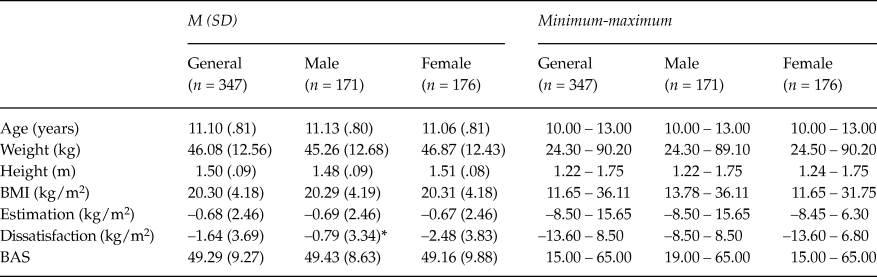
The sample characteristics are described in Table 1. The male and female groups were statistically different for body image dissatisfaction, (DIF = 1.678; t(345) = 4.31; p <.05), and the girls wanted to be thinner with regard to boys. For BAS scores, there was no statistical difference between the sexes (p > .05).
Descriptive Statistics (Mean, Standard Deviation, Minimum and Maximum Values) of Quantitative Variables in the Overall Sample (n = 347) and Stratified by Sex (Male, n = 171; Female, n = 176)
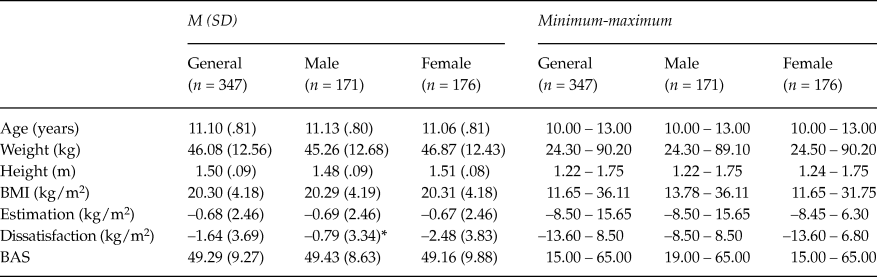
Note. * p <,05; Student’s t-test.
Item adaptation for the target population
Only three items (5, 9 and 10) have not changed from the version obtained from the cross-cultural adaptation by Swami et al. (Reference Swami, Campana, Ferreira, Barrett, Harris and Tavares2011). We conducted the changes from suggestions of the participants involved, but especially with respect to conceptual definitions of the body appreciation construct (love, care for, protect and preserve the body), which is a component aspect of positive body image, as described by the original authors of the BAS (Avalos et al., Reference Avalos, Tylka and Wood-Barcalow2005), plus the Tylka settings (2012).
The changes were made to make the items more understandable by the target population, specifying some words and expressions in its concrete sense. For example, in Item 9, the verb take could be interpreted by the target population as its concrete meaning in Portuguese drink, and it was necessary to specify the word attitude. In Item 12, the original sentence is too long, so we opted for a more direct construction, defining the words media and attitudes.
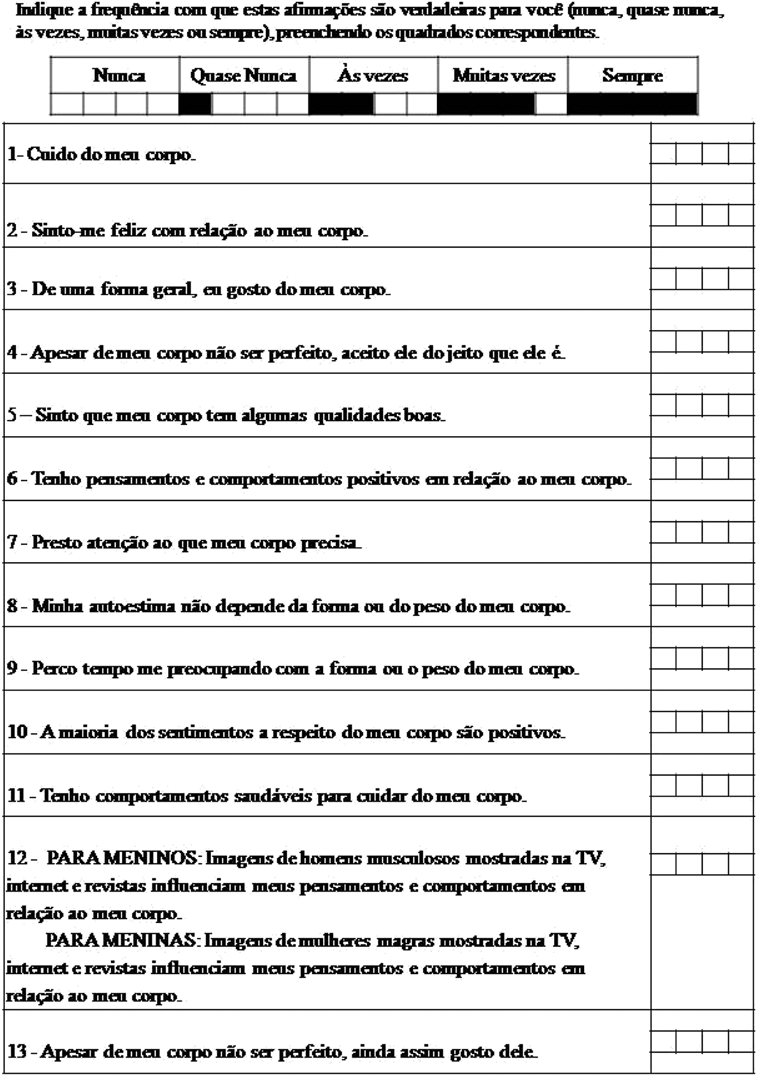
Regarding the answer options, the terms rarely and often were replaced by almost never and many times, especially considering the suggestions of the adolescents interviewed, which also corroborated the placement of experts to change these options. The options never, sometimes and always were kept to be easily understood by the target population. Still, a non-verbal scale was included, in order to introduce more interactive and concrete options. Along with the verbal scale, the participant must fill in or paint one square for almost never, two squares for sometimes, three for many times and all of them for always. If the participant answer is never, he/she should not paint any square.
The main researcher involved in the BAS cross-cultural adaptation for the Brazilian population also assessed the changes in the items and deemed them appropriate, regarding content, explaining that the items were consistent with the construct evaluated by the BAS. The final version of the BAS obtained from these changes is presented in Figure 1.
Final Version of Body Appreciation Scale (BAS) for Brazilian Adolescents.

Psychometric properties evaluation
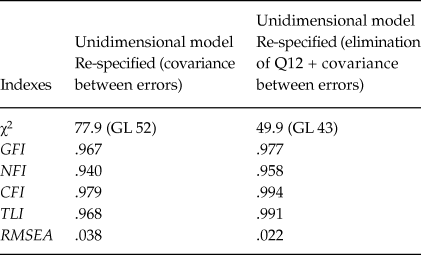
The BAS original unidimensional model had satisfactory adjustments, χ2 = 77.9 (GL 52), GFI = 0.967, NFI = 0.940, CFI = 0.979, TLI = 0.968, RMSEA =.038. Although the items are suitable, it was noted that Item 12 had low factor loadings (.023), therefore the decision was made to delete it to verify if the resulting model would be even better. However, in the next adjustment, a significant change in the indices was not observed, χ2 = 49.9 (GL 43), GFI = 0.977, NFI = 0.958, CFI = 0.994, TLI = 0.991, RMSEA = .022). The change in RMSEA was very small, and the model without deleting Item 12 has already made an RMSEA less than .06, which, according to Brown (Reference Brown2006), indicates an acceptable fit of the model. Adjustment indices of these models are shown in Table 2.
Adjustment Indices of the Unidimensional Model for the Body Appreciation Scale (BAS)

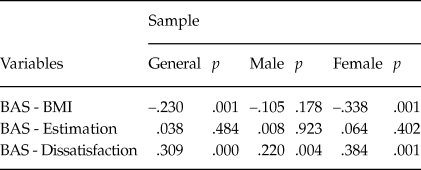
Regarding the evidence of concurrent validity, the values of the correlation between the BAS scores and the BMI, estimation and dissatisfaction/satisfaction are presented in Table 3. A negative correlation between the BAS scores and the BMI was obtained for the overall sample (r = –.230, p < .001) and female group (r = –.338, p < .001). This result indicates that the decrease in BMI accompanies an increase of body appreciation.
Convergent Validity of the Body Assessment Scale (BAS) for the Overall Sample (n = 347) and Stratified by Sex (Male, n = 171; Female, n = 176)

Correlation analyses between BAS scores and FRS indices indicate that the increase of dissatisfaction indices (i.e., the change in the direction of negative indices - dissatisfaction with the desire to weigh less - to rates close to zero or positive - satisfaction or dissatisfaction with the desire to weigh more) accompany an increase in the BAS scores. That is, the higher the body appreciation, the lower the desire to weigh less, both in the total sample (r =.309, p < .001) and for stratified groups (boys: r =.220, p < .005, girls: r = .384, p < .001). There was no correlation between the estimation indices and BAS values.
For analysis of criterion validity, ANOVA was performed excluding the participants whose weight status was classified as extreme underweight (n = 1) and underweight (n = 3). The one-way ANOVA showed that there were significant effects of the weight status of groups for BAS scores, F(2, 340) = 6.66; p < .05. The Tukey post hoc indicated that the BAS scores of the participants of normal weight group are significantly higher than those of the obese group (p < .05), indicating that normal-weight individuals have greater body appreciation when compared to obese.
The internal consistency was adequate for the total sample (α = .804) and for boys and girls, with Cronbach’s alpha values of .752 and .851, respectively.
Discussion
The adaptation of the Brazilian version of BAS for adolescents aged 10 to 13 years was properly conducted. The terms pointed out by experts, teachers and students of the target population were changed because they were difficult to be understood by the target population, seeking to maintain a maximum correspondence with the Brazilian version obtained in the study of Swami et al. (Reference Swami, Campana, Ferreira, Barrett, Harris and Tavares2011). We verified the psychometric qualities of BAS among young adolescents in this sample by the evidence of its factor structure, satisfactory values of internal consistency and significant association with BMI and body dissatisfaction (evidence of concurrent validity).
The factor structure set to the original factor structure of BAS, keeping the 13 items (Avalos, et al. Reference Avalos, Tylka and Wood-Barcalow2005). From the CFA, the factor structure proposed in the original theoretical model is appropriate given the satisfactory model fit indices obtained in this study. This result corroborates other studies conducted in Western populations wherein the BAS original unidimensional structure has been confirmed (Avalos et al., Reference Avalos, Tylka and Wood-Barcalow2005; Jáuregui-Lobera & Bolaños-Ríos, Reference Jáuregui-Lobera and Bolaños-Ríos2011; Swami, Hadji-Michael et al., Reference Swami and Chamorro-Premuzic2008; Swami, Stieger et al., Reference Swami, Stieger, Haubner and Voracek2008; Tylka, Reference Tylka2013).
On the other hand, the present study goes against the results obtained with other Brazilian samples wherein the bidimensional models were verified (Ferreira et al., Reference Ferreira, Neves and Tavares2014; Neves et al., Reference Neves, Lorey, Campana, Ferreira and da Silva2015) and unidimensional models, with the elimination of some items (Campana, Reference Campana2011; Swami et al., Reference Swami, Campana, Ferreira, Barrett, Harris and Tavares2011). The BAS bidimensional structures were also found in non-Western samples, including populations of Malaysia, South Korea, Indonesia and Hong Kong (Ng et al., Reference Ng, Barron and Swami2015, Swami & Chamorro-Premuzic, Reference Swami and Chamorro-Premuzic2008, Swami et al., Reference Swami, Hwang and Jung2012; Swami & Jaafar, Reference Swami and Jaafar2012). Such changes in the factor structure of the BAS indicate cultural differences that permeate the concept and experience of body appreciation (Ng et al., Reference Ng, Barron and Swami2015).
The correlation values found between BAS scores, FRS indices, and BMI suggest evidence of concurrent validity, revealing their negative association with BMI and positive association with satisfaction (less desire to weigh less), especially for girls. Thus, while low levels of body dissatisfaction and body concerns do not reflect, in themselves, a positive body image, the reduced desire to weigh less following a greater body appreciation indicates body acceptance unlinked to the societal appearance ideals (Tylka, Reference Tylka and Cash2012).
The negative association between BAS scores and BMI was observed in other studies with women and men from most Western and non-Western countries (Jáuregui-Lobera & Bolaños-Ríos, Reference Jáuregui-Lobera and Bolaños-Ríos2011; Ng et al., Reference Ng, Barron and Swami2015; Swami & Chamorro-Premuzic, Reference Swami and Chamorro-Premuzic2008; Swami & Jaafar, Reference Swami and Jaafar2012; Tylka & Kroon van Diest, Reference Tylka and Kroon van Diest2013; Tylka & Wood-Barcalow, Reference Tylka and Wood-Barcalow2015b; Webb, Butler-Ajibade, & Robinson, Reference Webb, Butler-Ajibade and Robinson2014), including Spanish adolescents (Jáuregui-Lobera & Bolaños-Ríos, Reference Jáuregui-Lobera and Bolaños-Ríos2011).
However, the association between lower BMI and higher BAS scores indicate that body appreciation decreases among those with higher BMI. Thus, these data show that the proportion of adolescents with higher body appreciation rates includes those with lower BMI values and who are satisfied with their body image. This relationship is most evident regarding the results obtained from the comparison between groups, since the BAS scores of the normal-weight group were significantly higher than the overweight group.
Otherwise, the negative association between BMI and BAS scores agrees with other related data in the literature indicating that the presence of body dissatisfaction is associated with low self-esteem and eating health risk behaviors in children and adolescents who are overweight and obese (Bibiloni, Pich, Pons & Tur, Reference Bibiloni, Pich, Pons and Tur2013; Mendes, Araújo, Lopes & Ramos Reference Mendes, Araújo, Lopes and Ramos2014; Sonneville et al., Reference Sonneville, Calzo, Horton, Haines, Austin and Field2012).
Concerning the internal consistency of the BAS, Cronbach’s alpha values were satisfactory both for the general sample and for groups stratified by sex, obtaining values higher than .75, which provides evidence of scale reliability (α > .70; Hair et al., Reference Hair Junior, Anderson, Tatham and Black2005). The value obtained in the overall sample (α = .804) is similar to that reached by Campana (Reference Campana2011) with Brazilian men (α = .81), but were lower than those obtained in the original scale validation (α = .93; Avalos et al., Reference Avalos, Tylka and Wood-Barcalow2005).
Although this is the first study among adolescents aged between 10 to 13 years old using the BAS, some limitations can be identified: reduced number of associations between the instrument’s scores with other relevant constructs, including variables such as favorable opinion of body protection, self-esteem, acceptance, respect, resilience, personality aspects and media literacy; absence of clinical samples to comparison, as groups with eating disorder or even other diagnosis in which bodily health is impaired, as types of cancer, for example. Also we did not collect data on ethnicity, although we do know the majority of students were white in the private schools sampled and black in public ones. Our intention in grouping both private and public settings was to generalize to ethnically diverse adolescents.
In this sense, there should be further research with the objective of understanding factors that influence body appreciation, not only in adolescent samples but also throughout child development, adulthood and old age. Given the positive associations between psychological well-being and the negative associations with psychological stress, it is important to detect individuals with low body appreciation using the BAS version for Brazilian adolescents to develop and examine interventions that increase body enjoyment (Tylka, Reference Tylka2013).
It is also crucial to conduct the cross-cultural adaptation to Brazilian population of the second version of the BAS, recently published by Tylka and Wood-Barcalow (Reference Tylka and Wood-Barcalow2015b), and its validation in Brazilian samples, including younger and older adolescents. The BAS–2 eliminated specific versions for sex and language based on body dissatisfaction, including new items based on positive body image research, which accurately represents this construct. The final version of BAS–2 resulted in 10 items, 5 of them original from BAS, with appropriate psychometric indicators in American samples.
Halliwell, Jarman, Tylka, and Slater (Reference Halliwell, Jarman, Tylka and Slater2017) recently adapted the BAS–2 to a younger sample of children aged 9–11 with relatively few modifications, while maintaining the psychometric integrity of its scores. This children version of BAS–2 serves as an essential component within research to understand and estimate children’s positive body image. This further reinforces the need for the cross-cultural adaptation to Brazilian children and young adolescents of the BAS–2.
The BAS version is suitable for administration in the Brazilian adolescent population as a way of analyzing the positive aspects of body image. Confirmatory factor analyses supported the original unidimensional model for the BAS. Analyses also showed concurrent and criterion validity for the BAS as its scores were correlated with BMI and body image dissatisfaction and there were significant differences between normal weight and obese groups. The BAS obtained satisfactory values of internal consistency among the Brazilian adolescent samples of both sexes.