Introduction
Pseudoscorpions (Arachnida: Pseudoscorpiones) are small (2–8 mm) predatory microarthropods that reach their peak species diversity in the tropics (Harvey Reference Harvey2007). Pseudoscorpions hunt other small arthropods, and those in the suborder Iocheirata paralyse their prey with venom from glands in their chelae (Dos Santos and Coutinho-Netto Reference Dos Santos and Coutinho-Netto2006). Wyochernes asiaticus (Arachnida: Pseudoscorpiones: Chernetidae) is the northernmost pseudoscorpion (Buddle Reference Buddle2015), living in Beringia, the region of what is now the Yukon Territory, Canada, Alaska, the United States of America, and parts of far eastern Russia that remained unglaciated in the last glacial maximum (Hopkins Reference Hopkins1982). Wyochernes asiaticus is broadly distributed in Beringia from 64 to 67 °N, living mainly in the gravel beds of seasonally inundated streams (Fig. 1; Buddle Reference Buddle2015). During summer, W. asiaticus has only moderate thermal tolerances (the critical thermal minimum and maximum are approximately –4 °C and +38 °C, respectively) but is remarkably resistant to submersion and anoxia (Anthony et al. Reference Anthony, Buddle and Sinclair2016). Much of what we know about W. asiaticus is about its natural history in the summer, and nothing is known about its physiology in winter. Anthony et al. (Reference Anthony, Buddle and Sinclair2016) speculate that W. asiaticus needs to seasonally acclimatise to acquire significant cold tolerance to survive the low temperatures of the Arctic winter.
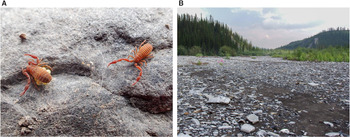
A, Wyochernes asiaticus collected from B, Sheep Creek (66.8 °N, 136.3 °W), Yukon Territory, Canada.

Pseudoscorpions are one of the four arachnid orders (alongside spiders and scorpions) with venom-producing glands (Murienne et al. Reference Murienne, Harvey and Giribet2008; Cabezas-Cruz and Valdés Reference Cabezas-Cruz and Valdés2014; Benavides et al. Reference Benavides, Cosgrove, Harvey and Giribet2019). The chemical composition of arachnid venom is diverse and usually contains a mix of nonpeptide low molecular–weight toxins (e.g., free organic acids, amino acids, biogenic amines, and neurotransmitters) and small (e.g., agatoxins, 5–10 kDa) and large (e.g., latrotoxins, ∼130 kDa) polypeptide neurotoxins (Grishin Reference Grishin1999; Escoubas et al. Reference Escoubas, De Weille, Lecoq, Diochot, Waldmann and Champigny2000; King and Hardy Reference King and Hardy2013). Because the neurotoxins are encoded in the genome and expressed in the transcriptome, they can be readily pinpointed from sequence information, and over 42 000 arachnid toxin nucleotide sequences have been identified (Quintero-Hernández et al. Reference Quintero-Hernández, Ortiz, Rendón-Anaya, Schwartz, Becerril, Corzo and Possani2011). Venom glands appear to be present throughout the suborder Iocheirata (Benavides et al. Reference Benavides, Cosgrove, Harvey and Giribet2019), and putative venom protein sequences have been identified for Globocreagris pinalenoensis (Arachnida: Pseudoscorpiones: Neobisiidae) from the southwestern United States of America (Hughes Reference Hughes2017), the subtropical Synsphyronus apimelus (Arachnida: Pseudoscorpione: Garypidae) from Western Australia (Santibáñez-López et al. Reference Santibáñez-López, Ontano, Harvey and Sharma2018), and the house pseudoscorpion Chelifer cancroides (Arachnida: Pseudoscorpiones: Cheliferidae) (Krämer et al. Reference Krämer, Pohl and Predel2019).
With suitably broad input material, transcriptomes can provide near exome–level information about the organism. Transcriptome sequences can also be used to identify stress-related genes, such as heat shock proteins and antioxidants. Thus, in high-latitude species that are expected to have robust resistance to stress, a transcriptome can identify the major genes and gene families whose expression is associated with extreme polar environments. However, among polar arthropods, only one insect (the Antarctic midge Belgica antarctica (Diptera: Chironomidae)) has an annotated genome (Kelley et al. Reference Kelley, Peyton, Fiston-Lavier, Teets, Yee and Johnston2014) and transcriptome (Teets et al. Reference Teets, Peyton, Ragland, Colinet, Renault, Hahn and Denlinger2012; Teets and Denlinger Reference Teets and Denlinger2013). Microarray data (and attendant sequenced expressed sequence tag libraries) are also available for Antarctic (Cryptopygus antarcticus (Collembola: Entomobryidae)) (Purać et al. Reference Purać, Burns, Thorne, Grubor-Lajšić, Worland and Clark2008) and Arctic (Megaphorura arctica (Collembola: Onychiuridae)) (Clark et al. Reference Clark, Thorne, Purać, Burns, Hillyard and Popović2009) collembola. Among arachnids, mites are an important component of both Antarctic and Arctic systems (Block and Convey Reference Block and Convey1995; Coulson Reference Coulson2007), and spiders are the dominant arthropod predators in Arctic tundra (Coulson Reference Coulson2007; Bowden and Buddle Reference Bowden and Buddle2012). However, to our knowledge, there is only a single polar arachnid transcriptome available, for the Antarctic mite Alaskozetes antarcticus (Sarcoptiformes: Ameronothridae) (Meibers et al. Reference Meibers, Finch, Gregg, Glenn, Assani and Jennings2019).
Here, we report a de novo transcriptome for W. asiaticus collected in summer from Yukon Territory, Canada and exposed to a variety of environmental stressors. From this transcriptome, we identified putative genes encoding venom proteins, as well as genes hypothesised to facilitate stress tolerance. Our study provides a genetic basis for future work investigating the biology of this Beringian relict, as well as the evolution of arachnids and stress tolerance in polar arthropods.
Materials and methods
Pseudoscorpion collection and treatment
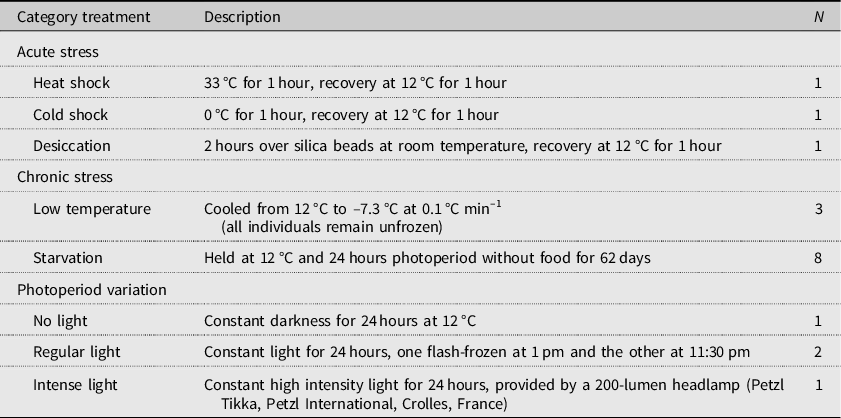
We collected W. asiaticus by hand from beneath rocks at Sheep Creek, Yukon Territory, Canada (66.8 °N, 136.3 °W, 562 m elevation; Yukon Scientists and Explorers Permit 15-10S&E) in July 2015 (Fig. 1). We housed the animals in perforated 1.7-mL centrifuge tubes that were contained in a plastic bag with moistened cotton wool, and we transported them in an insulated box to the University of Western Ontario (London, Ontario, Canada). We held the animals at 12 °C and 24 hours light for up to 10 days in a Sanyo MIR 154 incubator (Sanyo Scientific, Bensenville, Illinois, United States of America), mimicking summer collection conditions in the Yukon. To generate a transcriptome that captured gene expression under a diverse range of conditions, we exposed the pseudoscorpions (n = 18; average mass 0.64 ± 0.16 mg) to various treatments (Table 1). For temperature treatments, we cooled or heated individuals in 1.7-mL microcentrifuge tubes placed in an aluminium block surrounded by 50% ethylene glycol circulated from a programmable refrigerated bath (Lauda Proline 3530, Würzburg, Germany). We conducted all photoperiod and starvation treatments in the Sanyo MIR 154 incubator. Following treatments, we flash-froze individuals in liquid nitrogen and stored them at –80 °C until RNA extraction.
Treatment of Wyochernes asiaticus in this study before RNA extraction.

N, number of individuals exposed to each treatment.
RNA extraction and cDNA library preparation
We pooled the 18 whole pseudoscorpions, homogenised them in 0.3-mL TRIzol (Invitrogen, Burlington, Ontario, Canada), and extracted RNA according to manufacturer’s instructions. We purified RNA using the RNeasy Mini kit (Qiagen, Mississauga, Ontario, Canada) according to manufacturer’s instructions and measured absorbance at 260 nm to determine the RNA concentration. Génome Québec (Montréal, Québec, Canada) performed quality analysis with an Agilent Bioanalyzer, prepared a cDNA library from mRNA transcripts, and sequenced paired-end 125-bp reads on the Illumina HiSeq 2500 platform (Illumina, San Diego, California, United States of America).
De novo transcriptome assembly and annotation
We assembled the transcriptome using a pipeline similar to that of Toxopeus et al. (Reference Toxopeus, Des Marteaux and Sinclair2019). Briefly, using Cutadapt, we removed Illumina adapter sequences and discarded sequences shorter than 15 nucleotides or containing unknown bases (Martin Reference Martin2011), then assembled an initial transcriptome with a minimum contig length of 200 nucleotides using Trinity, version 2.2.0 (Grabherr et al. Reference Grabherr, Haas, Yassour, Levin, Thompson and Amit2011; Haas et al. Reference Haas, Papanicolaou, Yassour, Grabherr, Blood and Bowden2013) on the SHARCNET computing cluster, https://www.sharcnet.ca. To account for potential microbial contamination (e.g., in the gut or on surface of the animals), we used MEGAN6 to identify and filter out bacterial, fungal, viral, and unannotated transcripts from our assembled transcriptome (Huson et al. Reference Huson, Auch, Qi and Schuster2007). We conducted all further analyses on this set of filtered transcripts. We then analysed the transcriptome assembly “completeness” using BUSCO, version 1.22 (Simão et al. Reference Simão, Waterhouse, Ioannidis, Kriventseva and Zdobnov2015) to compare the filtered transcriptome (all contigs) to a database of arthropod benchmark universal single copy orthologues.
We used Trinotate, version 3.0.1, https://trinotate.github.io/, to assign putative identities to each contig (putative transcript) from the W. asiaticus transcriptome using BLASTx and BLASTp (e-value threshold = 1 × 10⁻³) against the UniProt database (September 2016). Trinotate also identified Gene Ontology (GO) and Kyoto Encyclopedia of Genes and Genomes (KEGG) terms, as well as protein family (Pfam) domains associated with each contig. Finally, we quantified the proportion of Trinotate annotations that belonged to major taxonomic groups, especially within the Chelicerata.
Characterisation of stress transcripts and putative venom proteins
To identify putative genes that facilitate survival in polar environments, we sorted transcripts from the transcriptome into categories pertaining to stress response, energy metabolism, cell signalling, and transport of cryoprotectants, ions, and water. To identify putative venom proteins, we used BLASTx analyses to compare the W. asiaticus transcriptome to the publicly available venom-gland transcriptomes from two other pseudoscorpion species, C. cancroides (Krämer et al. Reference Krämer, Pohl and Predel2019) and S. apimelus (Santibáñez-López et al. Reference Santibáñez-López, Ontano, Harvey and Sharma2018). The other transcriptomic study of pseudoscorpion venom glands (Hughes Reference Hughes2017) did not have publicly available sequences. From these analyses, we identified two venom protein classes, ctenitoxins and agatoxins, for further investigation.
Because the W. asiaticus transcriptome was generated from whole-body homogenates rather than from extracted venom glands, we verified our venom protein identification using two methods. First, we used the default parameters in MUSCLE, version 7 (Edgar Reference Edgar2004) to align putative venom proteins from the W. asiaticus transcriptome to those from C. cancroides and S. apimelus protein venom sequences. We then used MEGA X (Kumar et al. Reference Kumar, Stecher, Li, Knyaz and Tamura2018) to construct maximum likelihood gene trees for these same sequences and for other arachnid venom sequences available in UniProt. Briefly, we used the maximum likelihood method and JTT matrix-based model (Jones et al. Reference Jones, Taylor and Thornton1992). We obtained initial trees for ctenitoxins and agatoxins first by applying neighbour-join and BioNJ algorithms to a matrix of pairwise distances that had been estimated using the JTT model and then by selecting the topology with the highest likelihood value.
The annotated transcriptome of W. asiaticus is available via the National Center for Biotechnology Information (NCBI) Transcriptome Shotgun Assembly database (accession number GIHV01000000), with raw reads in the Sequence Read Archive database (accession number PRJNA600090).
Results and discussion
Transcriptome summary
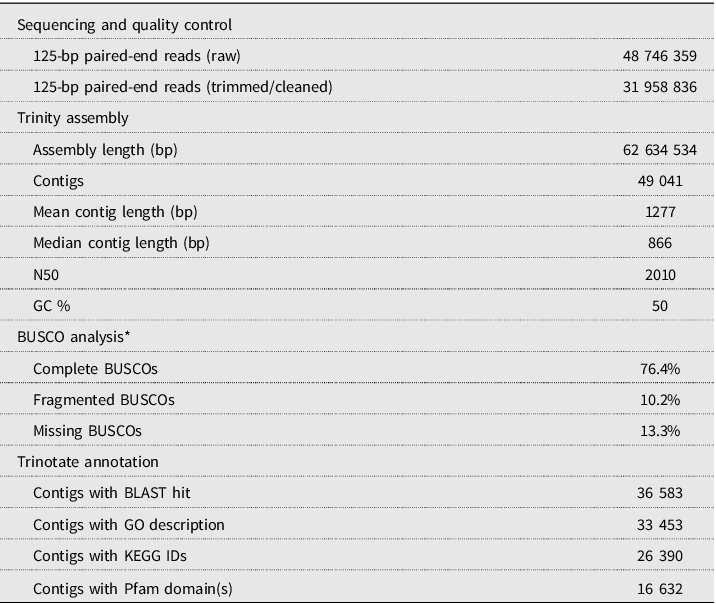
We assembled 32 million 125-bp paired-end reads into a transcriptome that included 226 412 contigs, or putative transcripts (Table 2; Supplementary material, Table S1). This number of contigs is similar to those of other unannotated pseudoscorpion de novo transcriptome assemblies, which include 100 000–200 000 contigs (Hughes Reference Hughes2017; Santibáñez-López et al. Reference Santibáñez-López, Ontano, Harvey and Sharma2018; Krämer et al. Reference Krämer, Pohl and Predel2019). After filtering out unannotated and nonanimal transcripts using MEGAN6, the resulting W. asiaticus transcriptome contained 49 041 contigs (Table 2), similar to the annotated transcriptome of S. apimelus venom glands (37 148 annotated contigs; Santibáñez-López et al. Reference Santibáñez-López, Ontano, Harvey and Sharma2018). The average guanine–cytosine content of the assembled contigs was 50%, which is higher than other chelicerate sequence datasets – for example, the house spider Parasteatoda tepidariorum (Araneae: Theridiidae) (35.9%; Posnien et al. Reference Posnien, Zeng, Schwager, Pechmann, Hilbrant and Keefe2014), the tick Amblyomma americanum (Ixodida: Ixodidae) (45.1%; Gibson et al. Reference Gibson, Smith, Fuqua, Clay and Colbourne2013), and the mite Tetranychus urticae (Trombidiformes: Tetranychidae) (37.8%; Grbić et al. Reference Grbić, Van Leeuwen, Clark, Rombauts, Rouzé and Grbić2011). Our approach of exposing animals to a suite of ecologically relevant stressors resulted in an assembly that included 76.4% complete and 10.2% fragmented arthropod benchmark universal single copy orthologues (Table 2). The W. asiaticus transcriptome is therefore incomplete but of average quality relative to other published arthropod transcriptome assemblies, which can range from low (e.g., 62% in a species of the ant, Aphaenogaster picea (Hymenoptera: Formicidae: Myrmicinae)) (Stanton-Geddes et al. Reference Stanton-Geddes, Nguyen, Chick, Vincent, Vangala and Dunn2016) to very high (94% in the tick, Dermacentor variabilis (Ixodida: Ixodidae)) (Rosendale et al. Reference Rosendale, Romick-Rosendale, Watanabe, Dunlevy and Benoit2016).
Summary of Wyochernes asiaticus transcriptome de novo assembly, following filtering out of non-Animalia annotations. See Supplementary material, Table S1 for the pre-filtering summary.

bp, base pairs; BUSCO, benchmark universal single copy orthologues; GC %, percentage of transcriptome comprised of guanines and cytosines; N50, weighted median statistic; GO, Gene Ontology; KEGG, Kyoto Encyclopedia of Genes and Genomes; Pfam, protein family.
* Percentage of 2675 arthropod benchmark universal single copy orthologues (BUSCOs) in the MEGAN-filtered transcriptome assembly.
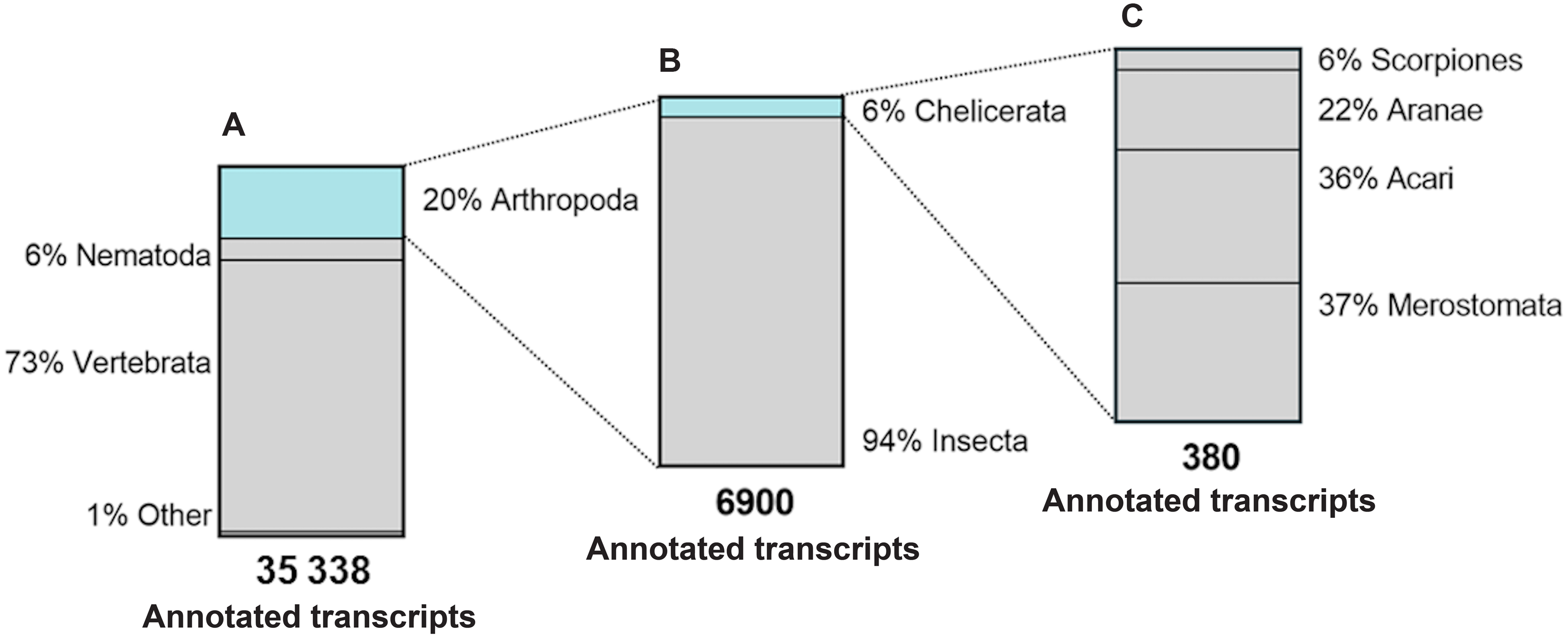
Trinotate used BLAST to assign putative identities to 75% of contigs in the filtered assembly, many of which were also functionally annotated with GO, KEGG, or Pfam IDs (Table 2; Supplementary material, Table S2). Few of the Trinotate annotations were sequences from arthropods, and even fewer were specifically from arachnids. Of the 35 338 annotated transcripts, only 20% had top BLAST hits to a sequence from another arthropod (Fig. 2A), and merely 6% of the arthropod sequences were from chelicerates (Fig. 2B). The chelicerate sequences were mostly from true spiders (Araneae), mites and ticks (Acari), and horseshoe crabs (Xiphosura: Limulidae), and a small fraction were from scorpions (Scorpiones) (Fig. 2C). Similar underrepresentation of arthropod-specific annotation has been observed in transcriptomic studies of other microarthropod and arachnid species – for example, the pseudoscorpion, S. apimelus (Santibáñez-López et al. Reference Santibáñez-López, Ontano, Harvey and Sharma2018), and the araneid spider, Pardosa pseudoannulata (Araneae: Lycosidae) (Li et al. Reference Li, Yan, Wang, Song and Wang2017).
Phylogenetic distribution of annotated transcripts in the Wyochernes asiaticus transcriptome. The proportion of putative transcripts with annotations from each major taxon is included for A, Animalia, B, Arthropoda, and C, Chelicerata.

Although we had few Trinotate annotations of chelicerate origin, we found high similarity between the W. asiaticus transcriptome and other pseudoscorpion transcriptomes. Based on BLAST analysis, 28 754 W. asiaticus transcripts aligned to transcripts from the C. cancroides transcriptome (Krämer et al. Reference Krämer, Pohl and Predel2019), with an average similarity of 78% (Supplementary material, Table S3). Only 69 transcripts were publicly available from S. apimelus, but all of them aligned with W. asiaticus transcripts in a BLAST analysis, with an average similarity of 73% (Supplementary material, Table S4). We therefore speculate that the taxonomic bias in our Trinotate annotation reflects a bias in the UniProt database, which contains approximately fivefold more vertebrate sequences than invertebrate sequences (https://www.uniprot.org/downloads [accessed 22 November 2019]).
Wyochernes asiaticus expresses putative genes related to stress tolerance
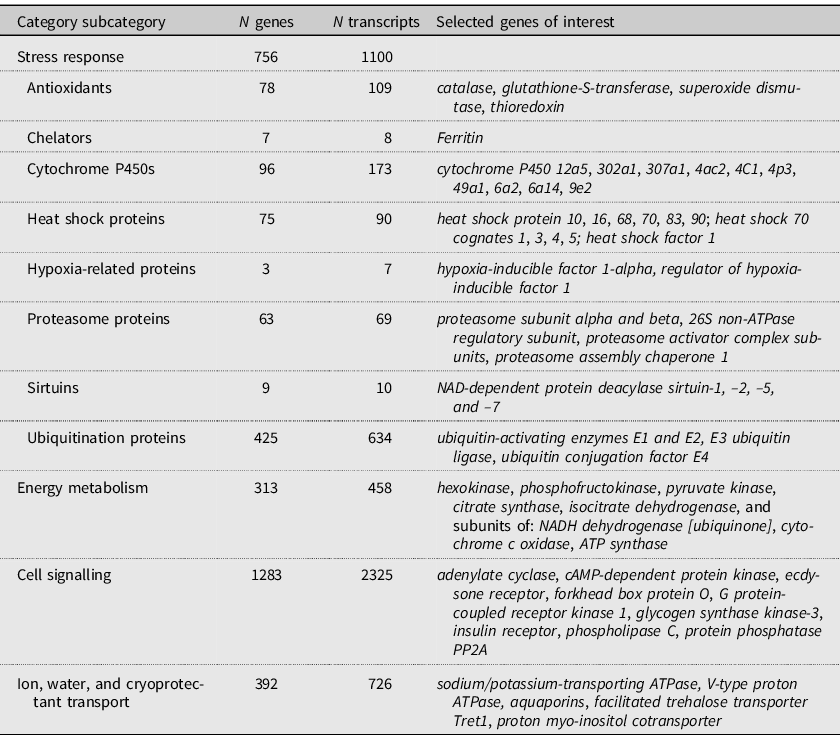
Most of the 12 875 GO terms assigned to the putative transcripts in our assembly were associated with the major GO classification “biological processes” (67%), with the remainder in the “molecular function” (23%) and “cellular components” (10%) categories, with most GO subcategories related to the cell cycle, DNA replication, and transcription (Supplementary material, Fig. S1 and Table S5). Although our study did not allow us to determine the transcriptomic responses to specific stressors, we highlight in this study putative genes that could facilitate pseudoscorpion survival in polar environments, including those involved in general stress response and detoxification, metabolism, cell signalling, and transport (Table 3; Supplementary material, Table S6). Follow-up experimental studies will be important for validating the function of these expressed genes in tolerating challenging abiotic conditions.
Summary of putative transcripts and genes in categories of biological interest from the Wyochernes asiaticus transcriptome, including the number (N) of putative transcripts and genes in those categories. Selected genes of interest within each category are included. See Supplementary material, Table S2 for sequence identities and descriptions of all the transcripts in these categories.

High temperatures, low temperatures, desiccation, and oxidative stress can all cause accumulation of damaged proteins and toxic metabolites (Goldberg Reference Goldberg2003). Heat shock protein expression in many arthropods is thought to be important for survival of these stressors (Joplin et al. Reference Joplin, Yocum and Denlinger1990; Rinehart et al. Reference Rinehart, Hayward, Elnitsky, Sandro, Lee and Denlinger2006; Benoit et al. Reference Benoit, Lopez-Martinez, Phillips, Patrick and Denlinger2010; Basha et al. Reference Basha, O’Neill and Vierling2012). We detected 90 transcripts that putatively encode heat shock proteins in the W. asiaticus transcriptome. We identified four small molecular–weight heat shock proteins (e.g., Hsp16, Hsp28; see Supplementary material, Table S6), which are synthesised first during cellular stress to stabilise proteins in an ATP-independent manner (Jakob et al. Reference Jakob, Gaestel, Engel and Buchner1993). The other 86 transcripts were heat shock factors (e.g., heat shock cognate 70) that induce the expression of heat shock proteins, and high molecular–weight heat shock proteins (e.g., Hsp70, Hsp83; see Supplementary material, Table S2), which help stabilise and refold damaged proteins during cellular stress (Sorger Reference Sorger1991; Becker and Craig Reference Becker and Craig1994). Taken together, the expression of these small and large heat shock proteins alongside heat shock factors could facilitate W. asiaticus tolerance to abiotic stressors in the polar environment by mitigating protein denaturation (Becker and Craig Reference Becker and Craig1994; Rinehart et al. Reference Rinehart, Hayward, Elnitsky, Sandro, Lee and Denlinger2006).
The W. asiaticus transcriptome included transcripts putatively encoding over 600 ubiquitination- and proteasome-related proteins (Supplementary material, Table S6), which is an expected number of transcripts given that most genomes encode 500–600 ubiquitin ligases and at least 100 proteins involved in proteasome assembly (Kaiser and Huang Reference Kaiser and Huang2005). These proteins can facilitate or regulate the degradation of damaged proteins (Pickering and Davies Reference Pickering and Davies2012). The transcriptome also contained more than 100 cytochrome P450 transcripts (Supplementary material, Table S6). Cytochrome P450s are a widely diverse and numerous family of proteins that can improve survival under stress through detoxification of harmful metabolites (Chang and Kam Reference Chang and Kam1999) and are also upregulated in response to stress in other arthropods such as after ultraviolet-light stress in the red flour beetle, Tribolium castaneum (Coleoptera: Tenebrionidae) (Sang et al. Reference Sang, Ma, Qiu, Zhu and Lei2012), and oxidative stress in the Eastern honey bee, Apis cerana cerana (Hymenoptera: Apidae) (Zhu et al. Reference Zhu, Zhang, Liu, Chen, Li and Xu2016). Finally, we noted 10 transcripts encoding sirtuins (Supplementary material, Table S6), which are posttranslational modification enzymes that regulate the cellular responses to stress (Verdin et al. Reference Verdin, Hirschey, Finley and Haigis2010; Nogueiras et al. Reference Nogueiras, Habegger, Chaudhary, Finan, Banks and Dietrich2012; Wu et al. Reference Wu, Wu and Wei2014).
We did not expose the pseudoscorpions in this study to hypoxia. Nonetheless, we still detected seven transcripts (Supplementary material, Table S6) that could promote hypoxia tolerance, which is consistent with the ability of W. asiaticus to survive prolonged periods submerged in low-oxygen water (Anthony et al. Reference Anthony, Buddle and Sinclair2016). For example, W. asiaticus has transcripts encoding the transcription factor hypoxia-inducible factor (HIF-1α; Semenza Reference Semenza2007) and the antioxidant thioredoxin protein (Arnér and Holmgren Reference Arnér and Holmgren2000), both of which can promote survival in low-oxygen environments. Oxidative damage accumulates in response to hypoxia (Walker and Benzer Reference Walker and Benzer2004) or prolonged chilling (Lalouette et al. Reference Lalouette, Williams, Hervant, Sinclair and Renault2011), and many cold- or hypoxia-tolerant arthropods upregulate antioxidant enzymes in response to, or in anticipation of, low-oxygen stress in order to mitigate the adverse effects of oxidative damage on cellular function (Joanisse and Storey Reference Joanisse and Storey1998; Meibers et al. Reference Meibers, Finch, Gregg, Glenn, Assani and Jennings2019; Torson et al. Reference Torson, Yocum, Rinehart, Nash and Bowsher2019). We identified more than 100 transcripts in W. asiaticus that encode what appears to be a near-complete complement of antioxidant enzymes (e.g., thioredoxin, catalase, superoxide dismutase, glutathione transferase, and reductase; Supplementary material, Table S6). This diverse list of antioxidant enzymes in our de novo assembly suggests that W. asiaticus has significant antioxidant capacity.
Wyochernes asiaticus expresses genes encoding putative venom proteins
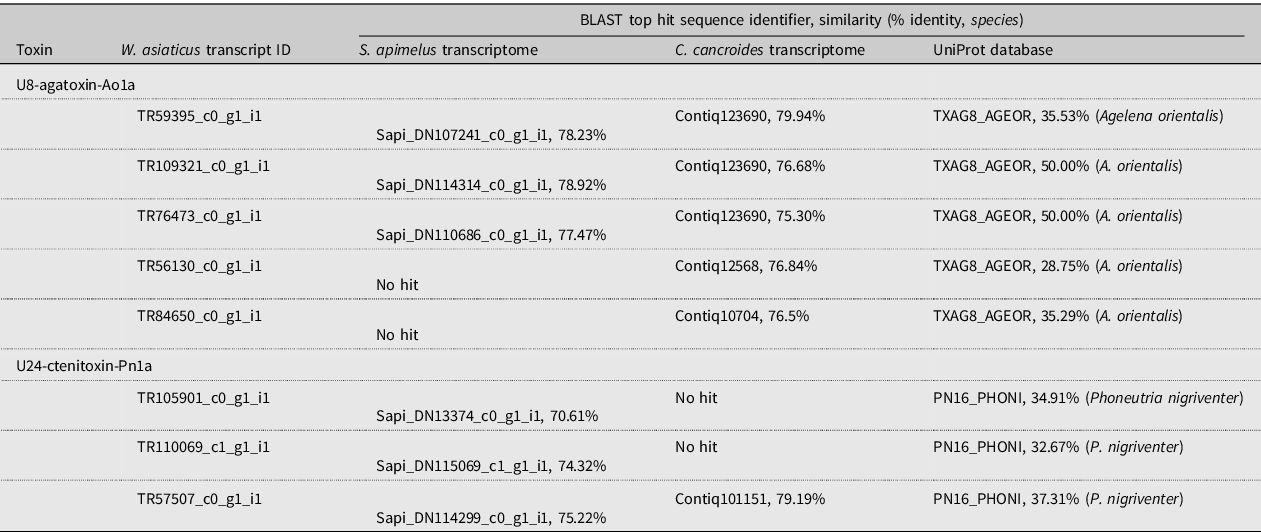
We identified transcripts that encode proteins with homology to two families of venom proteins in W. asiaticus through comparisons to venom-gland transcriptomes from other pseudoscorpion species (Table 4). Wyochernes asiaticus had 35 transcripts with high (greater than 65% identity) similarity to those encoding venom proteins from S. apimelus (Santibáñez-López et al. Reference Santibáñez-López, Ontano, Harvey and Sharma2018), including putative ctenitoxins, agatoxins, and various enzymes (phospholipases, serine proteases, and metalloproteases) and protease inhibitors (Supplementary material, Table S4). The majority (77%) of these 35 W. asiaticus transcripts also had high similarity to contigs from the unannotated C. cancroides venom-gland transcriptome (Supplementary material, Table S3; Krämer et al. Reference Krämer, Pohl and Predel2019). Because our transcriptome was based on whole-body homogenates, not venom glands, we cannot confirm whether the W. asiaticus transcripts that encode enzymes and protease inhibitors are specific to venom: these transcripts may have been expressed in nonvenom-gland tissue. However, the W. asiaticus transcripts that encode putative agatoxins and ctenitoxins are likely candidates for venom proteins in this species (Table 4).
Summary of BLASTx results comparing putative venom proteins in the Wyochernes asiaticus transcriptome to protein sequences translated from two publicly available pseudoscorpion transcriptomes (Synsphyronus apimelus and Chelifer cancroides) and protein sequences from the UniProt database (Trinotate annotation). See Supplementary material, Tables S2, S3, and S4 for full BLASTx results.

Wyochernes asiaticus expressed five transcripts that encode U8-agatoxin, the same agatoxin expressed in venom glands of S. apimelus and C. cancroides (Table 4). Agatoxin sequences from all three pseudoscorpion species had similar conserved regions (Supplementary material, Fig. S2), suggesting homology among these sequences. Wyochernes asiaticus expressed three transcripts encoding putative ctenitoxin proteins, with high sequence similarity and alignment to ctenitoxin sequences from venom glands of other pseudoscorpions (Table 4; Supplementary material, Fig. S3). There was low support for distinct clades of pseudoscorpion and spider agatoxin sequences, based on maximum likelihood trees (Supplementary material, Fig. S4A), which could support high sequence similarity among U8-agatoxin sequences from venomous arthropods. However, sequence similarity among spiders and W. asiaticus is less than 50%, which suggests multiple paralogues have been retained by both spiders and pseudoscorpions. The pseudoscorpion ctenitoxin sequences formed a monophyletic group in a maximum likelihood tree containing sequences of spider ctenitoxins (Supplementary material, Fig. S4B), suggesting ctenitoxins in venomous pseudoscorpions are more similar to each other than they are to ctenitoxins from other venomous arachnids. Furthermore, the placement of pseudoscorpion sequences on this tree also suggests there might be multiple ctenitoxin alleles.
The presence of agatoxins and ctenitoxins in all three published pseudoscorpion transcriptomes suggests that these venom proteins are important components of pseudoscorpion venom. Ctenitoxins are relatively small arachnid-specific toxin peptides (approximately 48 amino acids) that bind to and inhibit sodium channels in insects and mammals (Emerich et al. Reference Emerich, Ferreira, Cordeiro, Borges, Pimenta and Figueiredo2016). Agatoxins are also small toxin peptides (approximately 66 amino acids), originally described from the venom of funnel web spiders (Agelenopsis aperta (Araneae: Agelenidae)), and inhibit calcium and sodium channels in insects (Lundy and Frew Reference Lundy and Frew1994). Because both classes of toxins are insect ion-channel inhibitors, they likely help W. asiaticus paralyse their prey by inhibiting neuromuscular function (Lundy and Frew Reference Lundy and Frew1994).
Summary
Here, we assembled the first de novo transcriptome of a Beringian microarthropod. We identified important transcripts encoding stress-related proteins that could contribute to W. asiaticus survival in polar environments. Furthermore, we identified transcripts encoding two families of putative venom proteins, the first in this pseudoscorpion genus. Our unique dataset will be a useful resource for future investigations on the biology of Canadian pseudoscorpion and other arachnid species.
Acknowledgements
The authors thank Chris Buddle and Mhairi McFarlane for their assistance with specimen collection, and Alex Torson, Meghan Duell, and three anonymous referees for constructive comments that improved the manuscript. This research was supported by the Natural Sciences and Engineering Research Council of Canada (NSERC) via a Discovery Grant to BJS and NSERC Post-graduate scholarships to JEL, JT, and SEA, and by Polar Knowledge Canada via a Northern Scientific Training Program grant to SEA.
GenBank. The annotated transcriptome of W. asiaticus is available via the NCBI Transcriptome Shotgun Assembly (TSA) database (accession number GIHV01000000), with raw reads in the Sequence Read Archive (SRA) database (accession number PRJNA600090).
Supplementary material
To view supplementary material for this article, please visit https://doi.org/10.4039/tce.2021.2.