The historiography of the past two decades of the demographic history of 16th- and 17th-century Ottoman Anatolia has seen diverse and often conflicting arguments among historians. Whether the Ottoman Empire witnessed “population pressure” in the 16th century, and whether this was followed in the 17th century by a serious “demographic crisis,” considered by some historians as a “catastrophe,” have constituted the central theme of the debate. The roots of these issues can be traced as far back as the early works of Ömer Lütfi Barkan in the 1940s and 1950s.1
See esp. Ö. L. Barkan, “Türkiye'de İmparatorluk Devirlerinin Büyük Nüfus ve Arazi Tahrirleri ve Hakana Mahsus İstatistik Defterleri,” İstanbul Üniversitesi İktisat Fakültesi Mecmuası 2, 1 (1940): 20–59: ibid., 2, 2 (1941): 214–47; idem, “Tarihi Demografi Araştırmaları ve Osmanlı Tarihi,” Türkiyat Mecmuası 10 (1951–53): 1–27; idem, “Essai sur les donnees statistiques des registres de recensement dans l'Empire Ottoman aux XVe et XVIe siecles,” Journal of the Social and Economic History of the Orient 1, 1 (1958): 9–36. See also his later works on the subject: “Research on the Ottoman Fiscal Surveys,” in Studies in the Economic History of the Middle East, ed. Michael A. Cook (London: Oxford University Press, 1970), 163–71; and “894 (1488/1489) Yılı Cizyesinin Tahsilatına Ait Muhasebe Bilançoları,” Belgeler 1, 1 (1964): 1–117.
It appears that the disagreements not only arose as a result of the different models of historical demography developed by diverse schools of thought, but that they also owed much to the highly disputed nature of the sources that provide the bulk of quantitative data for the demographic history of the Ottoman Empire.
2 For a detailed re-evaluation of the related literature within the larger framework of the Braudelian Mediterranean world, see Halil İnalcık, “The Impact of the Annales School on Ottoman Studies and New Findings,” Review 1, 3–4 (1978): 69–96.
When looking at the sources, one immediately realizes that the central part of the debate falls into the realm of what is known as “defterology,”3
The historian who first used the term “defterology” was Heath Lowry, himself being a prominent defterologist. For his major monographical works, as well as his discussion of some methodological problems involved in the use of these defters, see his Trabzon Şehrinin İslamlaşma ve Türkleşmesi, 1461–1583 (Istanbul: Boğaziçi Üniversitesi Yayınları, 1981); idem, Studies in Defterology, Ottoman Society in the Fifteenth and Sixteenth Centuries (Istanbul: Isis Yayınevi, 1992). For a critical evaluation of this field, see esp. Colin Heywood, “Between Historical Myth and Mythohistory: The Limits of Ottoman History,” Byzantine and Modern Greek Studies 12 (1988): 315–45; and for a more recent critique, see Fatma Acun, “Osmanlı Tarihinin Genişleyen Sınırları: Defteroloji,” Türk Kültürü İncelemeleri Dergisi 1 (2000): 319–32. For another work that deals well with the major problems of defterological studies, see Mehmet Öz, XV–XVI. Yüzyıllarda Canik Sancağı, (Ankara: TTK Basımevi, 1999). The number of monographical studies in local history for which these defters constitute the principal sources has increased substantially in the past two decades. These works have also contributed significantly to the development of complicated terminology and the problems of Ottoman demographic history. For the most important, see Michael A. Cook, Population Pressure in Rural Anatolia, 1450–1600 (London: Oxford University Press, 1972); Leyla Erder, “The Measurement of Pre-industrial Population Changes: The Ottoman Empire from the 15th to 17th Century,” Middle Eastern Studies 11 (1979): 284–301; Leila Erder and Suraiya Faroqhi, “Population Rise and Fall in Anatolia, 1550–1620,” Middle East Studies 15 (1979): 328–45; Bekir Kemal Ataman, “Ottoman Demographic History (14th–17th Centuries). Some Considerations,” Journal of Economic and Social History of the Orient 35, 2 (1992): 187–98; Maria Todorova and Nikolai Todorov, “The Historical Demography of the Ottoman Empire: Problems and Tasks,” in Scholar, Patriot, Mentor: Historical Essays in Honor of Dimitrije Djordjevic, ed. Richard B. Spence and Linda L. Nelson (Boulder, Colo.: East European Monographs, 1992), 151–72. For a bibliographical essay on population movements in the Ottoman Empire, see Daniel Panzac, “La Population de l'Empire Ottoman et de ses Marges du XVe au XIXe Siècle: Bibliographie (1941–80) et Bilan Provisoire,” Revue de l'accident Musulman et de la Méditerranée 31 (1981): 119–37.
a sub-field of Ottoman historiography covering works based on the series of Ottoman tax registers, mainly of the 15th and 16th centuries (
tahrir defters). Barkan was the first historian to present these sources to the world of Ottomanists, in the 1940s.
4 See Barkan, “Türkiye'de İmparatorluk Devirlerinin.”
In his seminal article “Tarihi Demografi Araştırmaları ve Osmanlı Tarihi,” he presented the preliminary results of the painstaking work of his team in İstanbul on a whole series of
defters of the 16th century. Also discussing some methodological aspects of Ottoman demographic history and its sources, Barkan pointed in that article to the main trends of population movements in the Ottoman Empire in that century.
However, Barkan's pioneering works on Ottoman demographic history were not followed until the late 1960s,5
The only exception to this in Turkey was Halil İnalcık's publication of the earliest extant register in the Ottoman archive, relating to Albanian lands. See Halil İnalcık, Hicri 835 Tarihli Suret-i Defter-i Sancak-ı Arvanid (Ankara: TTK Basımevi, 1954).
when some historians turned to the same sources for their works on local history. The new explosion in the use of
tahrir registers came from the 1970s onward, soon leading to the development of a separate field—
defterology—with its sophisticated methods, distinct terminology, and, inevitably, growing debates among the specialists. Thus, Ottoman historical demographic studies were largely developed as part of local-history research and focused primarily on the period between the mid-15th and late 16th centuries.
6 Nejat Göyünç'sXVI. Yüzyılda Mardin Tarihi (Istanbul: İ. Ü. Edebiyat Fakültesi Yayını, 1969; repr. Ankara: Türk Tarih Kurumu, 1991) deserves special mention here in that it was the first example of this kind of study in modern Turkey.
During the past two decades, however, the research and debates have expanded to include the 17th century, basing themselves almost exclusively on
avarız and
cizye registers, which until then had attracted little attention in demographic studies.
7 Bruce McGowan, Economic Life in Ottoman Europe: Taxation, Trade, and Struggle for Land, 1600–1800 (Cambridge: Cambridge University Press, 1981); Linda Darling, Revenue Raising and Legitimacy: Tax Collection and Finance Administration in the Ottoman Empire, 1560–1660, (Leiden: E. J. Brill, 1996); Oktay Özel, “Changes in Settlement Patterns, Population and Society in Rural Anatolia: A Case Study of Amasya, 1576–1642” (unpublished Ph.D. thesis, University of Manchester, 1993); idem, “17. Yüzyıl Osmanlı Demografi ve İskan Tarihi İçin Önemli bir Kaynak: ‘Mufassal’ Avarız Defterleri,” XII. Türk Tarih Kongresi, Ankara, 12–16 Eylül 1994, Kongreye Sunulan Bildiriler (Ankara: TTK Yayını, 1999), 3:735–44. Here Machiel Kiel deserves special mention for his works, each of which are among the most significant contributions to the field particularly in terms of the discussion of the problematic nature and utility of these sources. See his “Remarks on the Administration of the Poll Tax (Cizye) in the Ottoman Balkans and the Value of Poll Tax Registers (Cizye Defterleri) for Demographic Research,” Etudes Balkaniques 4 (1990): 70–104; Aynı Yazar, “Anatolia Transplanted? Patterns of Demographic, Religious and Ethnic Changes in the District of Tozluk (N. E. Bulgaria), 1479–1873,” Anatolica 17 (1991): 1–27; idem, “Hrazgrad-Hezargrad-Razgrad: The Vicissitudes of a Turkish Town in Bulgaria,” Turcica 21–23 (1991).
Barkan's article suggested substantial growth in the population of the Ottoman Empire in the 16th century, and subsequent case studies of various districts of the empire have generally confirmed his findings.8
While the main objective of this study is not to discuss well-known but still little appreciated aspects of defterological studies, because of the nature of the sources and the question of the reliability of the data they contain, I believe that it is imperative to remind the reader of the fact that all the arguments developed and discussed here are based on the records of the tax-paying population only, both rural and urban, whose status was well defined by law and regularly and systematically recorded with the utmost care in the survey registers. Other sectors of the society at large, including marginal groups such as gypsies, generally went unrecorded. Similarly, a certain portion of the peasantry might have not been recorded because of their particular services to the government, although we know that in most cases they were also included in the registers with a mention of their special status even if they were tax-exempt. Furthermore, a large portion of urban society—members of the military class, for example—were not subject to systematic survey. Despite all this, a regularly and systematically recorded portion of Ottoman society constitutes in itself an important database for historical demographic inquiry, allowing us to clearly follow the main population trends as well as certain aspects of demographic change. What follows is an example of this kind, of study, and like other such studies, it should be read with these limitations in mind. For a discussion of the subject, see Mehmet Öz, “Tahrir Defterlerinin Osmanlı Tarihi Ara\unhboxştırmalarında Kullanılması Hakkında Bazı Düşünceler,” Vakıflar Dergisi 22 (1991): 509–37; Fikret Yılmaz, “16. Yüzyılda Edremit Kazası” (unpublished Ph.D. thesis, Ege University, İzmir, 1995), 192–205. On avarız and cizye registers, see Oktay Özel, “Avarız ve Cizye Defterleri,” in Osmanlı Devleti'nde Bilgi ve İstatistik, ed. Halil İnalcık and Şevket Pamuk (Ankara: DE, 2000), 33–50.
The
tahrir registers of the period clearly show doubling (in some cases even more) in the recorded tax-paying population, in urban and rural areas, during the century.
9 Since it is unnecessary and practically impossible to give here a complete list of defterological studies that do not deal totally with population changes in the Ottoman Empire during the 16th century, I will refer only to those mentioned in n. 3. A relatively recent publication that discusses the relevant findings of these studies is Öz, Canik. See also Kemal Çiçek, “Tahrir Defterlerinin Kullanımında Görülen Bazı Problemler ve Metod Arayışları,” Türk Dünyası Araştırmaları 97 (1995): 93–111; İnalcık, “Impact of the Annales School.”
In his meticulous work published in 1972, Michael Cook developed the argument that, especially in the second half of the 16th century in some parts of rural Anatolia, the population grew to the extent that it exceeded the amount of arable land available for cultivation. To him, this was an indication of “population pressure.”
10 Cook, Population Pressure.
This argument concurred in a sense with the view of Mustafa Akdağ, who years earlier had referred, though implicitly, to the population growth of the same period, which, according to him, resulted in the increase in the number of peasants without land (
çiftbozan levends). To Akdağ, this was an important factor in the eventual breakdown of the inner balance of the village economy and society, as well in the emergence of the ensuing
Celali rebellions and widespread terror in the Ottoman countryside at the turn of the 17th century.
11 Mustafa Akdağ, Celali İsyanları, 1550–1603 (Ankara: Ankara Üniversitesi Yayını, 1963). (For a later, extended version, see Celali İsyanları. Türk Halkının Dirlik ve Düzenlik Kavgası (Istanbul: Bilgi Yayınevi, 1975). Idem, Türkiye
nin İktisadi ve İçtimai Tarihi, 2 vols. (Istanbul: Tekin Yayınevi, 1971).
The correlation that Akdağ established between demographic, socio-economic factors and political developments was later discussed—and to some degree, criticized—by Halil İnalcık and Huricihan İslamoğlu-İnan.
12 See Halil İnalcık, “Military and Fiscal Transformation in the Ottoman Empire, 1600–1700, ”Archivum Ottomanicum 6 (1980): 283–337; idem, “Impact of the Annales School,” 80–83; Huricihan İslamoğlu-İnan, State and Peasant in the Ottoman Empire: Agrarian Power Relations and Regional Economic Development in Ottoman Anatolia during the Sixteenth Century (Leiden: E. J. Brill, 1994).
The main criticism of Akdağ's argument focused on the point that the early-17th-century phenomenon of the large-scale abandonment of villages could not be explained simply by economic and demographic factors. Akdağ's critics drew attention instead to what are called “pull” factors, such as various opportunities that they thought the cities would have offered to peasants, as well as to the peasants' desire to enter the military class, which would at least guarantee them a steady income.
13 İnalcık, “Military and Fiscal Transformation”; İslamoğlu-İnan, State and Peasant, 185. See also Suraiya Faroqhi, “Political Tension in the Anatolian Countryside around 1600: An Attempt at Interpretation,” in Türkischhe Miszellen, Robert Anhegger Festschrift, Armağanı, Melanges, ed. J. L. Bacque-Grammont et al. (Istanbul, 1987), 117–30.
At this point comes the important question: what were the factors triggering the peasant masses to leave their villages at the end of the sixteenth century, becoming the main source of manpower for the great Celali rebellions and the widespread terror that was to devastate the Anatolian countryside throughout the 17th century?14
For the details of the first stage of the uprisings and the nature of the Celali rebellions in general, see William J. Griswold, The Great Anatolian Rebellion, 1000–1020/1591–1611 (Berlin: Klaus Schwarz, 1983); Karen Barkey, Bandits and Bureaucrats: The Ottoman Route to State Centralization (Ithaca, N.Y.: Cornell University Press, 1994). I have already referred to M. Akdağ's classic Celali İsyanları.
As an explanation, scholars have often referred to the increasing tax burden and the oppressive attitudes of local officials toward peasants, both of which appear to have been a general phenomenon of this period.
15 See, for example, McGowan, Economic Life in Ottoman Europe. See also Halil İnalcık, “Adaletnameler,” Belgeler 2, 3–4 (1965): 49–145; idem, “The Ottoman Decline and Its Effects upon the Reaya,” in Aspects of the Balkans, Continuity and Change: Contributions to the International Balkan Conference, University of California, Los Angeles 1969, ed. H. Birnbaum and S. Vryonis (The Hague: Mouton, 1972), 338–54. Suraiya Faroqhi, however, emphasizes the “political” nature of peasants' exodus from the villages under such conditions, thus expressing her doubt, apparently on the basis of the works of İslamoğlu-İnan, about the role of a demographic pressure. See Suraiya Faroqhi, “Political Activity among Ottoman Taxpayers and the Problem of Sultanic Legitimation (1570–1650),” Journal of Economic and Social History of the Orient 35 (1992): 38–39.
Not rejecting the role of these factors, Akdağ developed the argument that the expanding rural population could no longer be absorbed by the village economy, forcing many peasants to search for a living elsewhere. İnalcık, however, while accepting to a certain extent the role of demographic pressure, puts an emphasis on the desperate need of the Ottoman government for more soldiers using firearms during the long and difficult years of war at the end of the 16th century. According to him, this need resulted in the formation of the
sekban and
sarıca troops, which would soon turn into
Celali brigands. This coincided with the peasants' desire to enjoy the privileged position of the military class of that same period, even though the socio-economic position of the members of the military was also deteriorating.
16 İnalcık, “Military and Fiscal Transformation.”
The final point of debate relates to 17th-century developments. A central theme is whether or not one can speak of a “demographic crisis.” The main discussion revolves around the effects of the Celali rebellions and focuses on what is termed “depopulation,” which is generally considered to be closely linked to these rebellions. The debate over the extent and nature of the radical decrease in the recorded tax-paying population was further developed by Bruce McGowan to the point of a “demographic catastrophe.”17
McGowan, Economic Life in Ottoman Empire.
McGowan's method and his somewhat controversial findings and interpretations in his works on the Balkan lands, which were based nearly exclusively on the quantitative evidence provided in
avarız and
cizye registers, were later criticized by Maria Todorova.
18 Maria Todorova, “Was There a Demographic Crisis in the Ottoman Empire in the Seventeenth Century?” Etudes Balkaniques 2 (1988): 55–63.
While addressing once more the disputed nature of these sources, Todorova used the same figures with different criteria and centered her criticism on the misunderstanding and misinterpretation of the data offered by these registers; thus, she came to an opposite and no less controversial conclusion. She claimed that one could hardly speak even of a considerable decrease in Ottoman population in the 17th century, let alone a demographic catastrophe.
In the following article, I will re-evaluate the main issues in this debate in the light of recent research, arguing that all were part of a complex historical phenomenon that cannot be explained by reductionist, single-factor approaches and unfounded interpretations. I will also emphasize that, although there are many black holes in Ottoman demographic history, one can still reasonably speak of a general demographic crisis during the late 16th and early 17th centuries.
THE 16TH CENTURY: FROM POPULATION “PRESSURE” TO CELALİ REBELLIONS
In her study on the dynamics of agricultural production, population growth, and urban development in 16th century north-central Anatolia, İslamoğlu-İnan, referring to the case of the Tokat and Çorum districts, argues that population growth in the Ottoman Empire never reached the point of “pressure” that was described by Michael Cook.19
İslamoğlu-İnan, State and Peasant, esp. chap. 4.
İslamoğlu-İnan's view appears to have found a certain degree of support, becoming an argument often referred to by other Ottomanists.
20 See, for example, Faroqhi, “Political Activity” idem, “Crisis and Change, 1590–1699,” in An Economic and Social History of the Ottoman Empire, 1300–1914, ed. Halil İnalcık and Donald Quataert (Cambridge: Cambridge University Press, 1994), 433–38; idem, “Seeking Wisdom in China: An Attempt to Make Sense of the Celali Rebellions,” in Zafar Name: Memorial Volume of Felix Tauer, ed. Rudolf Veselly and Eduard Gombar (Prague: Enigma Corporation, 1996), esp. 104.
In elaborating her argument, İslamoğlu-İnan suggests that the fragmentation of reaya
çiftliks, which is clearly revealed by the
tahrir registers, did not necessarily mean that the peasants became landless. She further argues that the peasants in question reacted to the worsening conditions in terms of the imbalance between population growth and the insufficient amount of arable land by (1) intensifying cultivation; (2) reclaiming unused and forested lands to cultivation; and (3) changing crop patterns, or rationalizing agriculture, and altering consumption habits.
21 İslamoğlu-İnan, State and Peasant, 149–54, 156.
She then claims that the population growth did not reach the extent of eventually forcing the peasants to leave their lands. The great increase in population in this respect is explained by the possibility of internal or westward migration and the sedentarization of pastoralist nomads.
22 Ibid., 143, 146–48. Frequent movements of pastoral nomads and peasants from the less secure eastern provinces to the western parts of the empire during the course of Ottoman history seem to be a historical fact. See Halil İnalcık, “Introduction: Empire and Population,” in İnalcık and Quataert, Economic and Social History, 31 ff. However, we have no clear evidence of any significant migration taking place in the region in question in the period concerned. Furthermore, recent research has revealed that the high level of growth in population was the case not only in the western cities but also across Anatolia, in both urban and rural areas. See, for example, İsmet Miroğlu, XVI. Yüzyılda Bayburd Sancağı (Istanbul, 1975); idem, Kemah ve Erzincan Kazası (1520–1566) (Ankara: TTK Basımevi, 1990); Mehmet Ali Ünal, XVI. Yüzyılda Harput Sancağı (1518–1566) (Ankara: TTK Basımevi, 1989); Orhan Kılıç, XVI. Ve XVII, Yüzyıllarda Van (1548–1648)(Van: Van Belediye Başkanlığı Kültür ve Sosyal İşler Müdürlüğü Yayınları,1997).
The increase in the number of recorded
caba (landless married men) and
mücerred (landless unmarried men) similarly is accounted for by the possibility of an increased demand for wage labor in the face of intense cultivation.
23 İslamoğlu-İnan, State and Peasant, 143, 154.
As seen in this argument, İslamoğlu-İnan suggests, first, that the peasant movements in Anatolia in the second half of the 16th century were of a migratory nature; and second, that the migration to cities during this period was in fact the result of the “preference” of peasants, especially younger ones, who, under the “drudgery of work” in the Anatolian countryside, chose to enter into the service of provincial administrators as irregular soldiers or join medreses (theology schools) as students.24
Ibid., 156. There are many problems in this argument. First, it is highly questionable to assume that entering the askeri class was a matter of “preference” for Ottoman peasants, given the strict rules delimiting such movements. Second, it seems to be chronologically premature to speak of the existence of such retinues composed of irregular soldiers within the Ottoman provincial-military organization under the timar system during the first three quarters of the 16th century, although çiftbozan levend groups existed in the Ottoman countryside well before that century. The present level of our knowledge of such retinues suggests that it was instead a phenomenon of the years prior to or during the Celali movements at the turn of the 17th century. Third, speaking about the “drudgery of work” as a factor behind Anatolian peasants' leaving the land while rejecting apparent economic and demographic constraints of the period is not convincing. I will touch on these issues later. Cf. Barkey, Bandits and Bureaucrats, 150 ff.
The migration of peasants therefore should not necessarily be seen as evidence of a subsistence crisis or of the inability on the part of the village economy to absorb an increasing population.
25 İslamoğlu-İnan, State and Peasant, 156.
In other words, according to İslamoğlu-İnan, we cannot speak here of demographic pressure. In saying this, however, she fails to note that the phenomenon of intensifying cultivation and shifting crop patterns, which was seen during the second half of the 16th century in many other parts of Anatolia, can also be linked to economic and demographic pressure, as well as to developing markets and monetary changes.
26 See, for example, Öz, “Osmanlı Klasik Döneminde Tarım”; Yunus Koç, “XVI. Yüzyılın İkinci Yarısında Köylerin Parçalanması Sorunu: Bursa Kazası Ölçeğinde Bir Araştırma,” unpublished paper presented at the Eighth Turkish Congress of History, Ankara, 4–8 October 1999. I thank Dr. Koç for permitting me to use this paper.
However, the main argument of her work is not the analysis of certain historical phenomena that she had previously accepted. Instead of dwelling on the subsistence crisis, the apparent drop in per-capita production
vis-à-vis a considerable rise in prices, the fragmentation of peasant farms, and the increasing number of landless peasants,
27 See Huricihan İslamoğlu-İnan, “M. A. Cook's Population Pressure in Rural Anatolia, 1450–1600: A Critique of the Present Paradigm in Ottoman History,” Review of Middle East Studies 3 (1978?): 120–35. İslamoğlu-İnan deals with the price rise in another article: see Huricihan İslamoğlu and Suraiya Faroqhi, “Crop Patterns and Agricultural Production Trends in Sixteenth-Century Anatolia” Review 2, 3 (1978). For the problem of price increases in connection with population growth, see also Mustafa Akdağ, “Osmanlı İmparatorluğu'nun Kuruluşu ve İnkişafı Devrinde Türkiye'nin İktisadi Vaziyeti” Belleten 13 (1949): 497–571. See also Ömer Lütfi Barkan, “Price Revolution of the Sixteenth Century: A Turning Point in the Economic History of the Near East” International Journal of Middle East Studies 6, 1 (1975): 8–15. Cf. İnalcık, “Impact of the Annales School” 83 ff. The latest contribution to the discussion is from Şevket Pamuk, who re-evaluates the findings of Barkan and his interpretation of price movements in the Ottoman Empire: See Şevket Pamuk, “The Price Revolution in the Ottoman Empire Reconsidered,” International Journal of Middle East Studies 33 (2001): 69–89.
she focuses on how population growth affected the peasant economy and relationships in the Ottoman countryside.
28 İslamoğlu-İnan, State and Peasant, 149.
While analyzing the reasons behind the migration from rural to urban areas in Anatolia, she tries to minimize the extent of demographic factors behind this movement, thus rejecting the thesis of population pressure. In doing this, she seems to overemphasize the possibilities mentioned earlier instead of attempting a closer analysis of the evidence provided by the sources she is using.
29 As far as the later historiography is concerned, it was Karen Barkey who developed a systematic critique of İslamoğlu-İnan's argument. Barkey argues that İslamoğlu-İnan, along with İnalcık, has overstated the role of “pull factors” in peasants' leaving their lands and emphasizes the impact of declining economic conditions and rapid growth in population—in the landless and unmarried population, in particular—in Anatolia during the 16th century: see Barkey, Bandits and Bureaucrats, 148 ff.
The findings of recent studies of the neighboring north-central Anatolian districts of Canik and Amasya, as well as İslamoğlu-İnan's own sources on the regions of Çorum and Tokat, appear to support the argument for considerable demographic pressure, as suggested by Cook particularly for north-central Anatolia during the second half of the 16th century.30
See Öz, Canik; Özel, “Changes.”
In that region, for example, the fragmentation of peasant farms reached high levels, and the ever-shrinking plots of land recorded in the name of certain peasant households (
hane) began increasingly to be cultivated by more adult peasants or households.
31 See Cook, Population Pressure, 25; Öz, “Tahrir Defterlerinin,” 433, 436. Cf. Feridun Emecen, XVI. Asırda Manisa Kazası (Ankara: TTK Basımevi, 1989), 232–33.
In addition, the number of landless peasant households (
caba [-bennak]) increased, for example in the Amasya district to nearly 40 percent of the total recorded households; moreover, this figure does not include unmarried adult men, who constitute nearly half of the recorded male population.
32 The proportion of landless peasant households to total households reached more than 50 percent in some nahiyes of the kaza of Amasya (Özel, Changes, 75–76, 78). Note that these figures were reached via a detailed examination of the tax register of the region dated 1576 (TD 26, d-ı Kadime Archive, General Directorate of Deeds and Surveys, Ankara) and include neither those peasants recorded in the registers as “caba” (landless) who in fact were co-cultivating lands belonging to others, usually relatives, nor those using plots of land not yet allocated with “tapu” (the title deed) to a peasant family, the standards being simply recorded as zemin (land).
Another point further clarifies the picture. In her study, İslamoğlu-İnan wrongly interprets the term “caba” in the tahrir registers as “landless unmarried man,” whereas it clearly refers to “landless married man.”33
For earlier references to this misinterpretation and its implications, see Oktay Özel, “XV–XVI. Yüzyıllarda Osmanlı İmparatorluğu'nda Kırsal (Zırai) Organizasyon: Köylüler ve Köyler” (unpublished M.A. thesis, Hacettepe University, Ankara, 1986), 80–81; Mehmet Öz, “Osmanlı İmparatorluğu'nda Devlet ve Köylü İlişkileri Hakkında Bir Kitap,” Türkiye Günlüğü 16 (1991): 151–56. For a similar case, see Erder and Faroqhi, “Population Rise and Fall.”
As a consequence, the proportion of unmarried men in the total adult male population—for example, in the region of Tokat between 1554 and 1576—appears to reach 70 percent,
34 See İslamoğlu-İnan, State and Peasant, 209, Table VI/5.
while in other parts of Anatolia in the same period it varies between 20 percent and 40 percent.
35 Özel, “Köylüler ve Köyler,” 81. See also Öz, Canik, 48.
This high percentage, which is difficult to explain, drops to about 45 percent when the term
caba is taken in its correct meaning as clearly defined in the law codes (
kanunname) of the province in question.
36 Yediyıldız, Ordu Kazası, 150; Ahmed Akgündüz, Osmanlı Kanunnameleri ve Hukuki Tahlilleri (Istanbul: Fey Vakfı Yayini, 1993), 6:203; ibid. (1994), 8:431.
This still significant rise in the number of unmarried men is paralleled by a similar level of decrease in the number of landless married men in the very same district during the same period. In other words, the proportion of married men in the total adult male population in the Tokat countryside in 1574 shows a decrease of nearly 30 percent compared with the situation twenty years earlier, while the number of unmarried men increased even more in the same period.
37 Cf. Erder and Faroqhi, “Population Rise and Fall”; Mübahat S. Kütükoğlu, XV ve XVI. Asırlarda İzmir Kazasının Sosyal ve İktisadi Yapısı (İzmir: Büyük Şehir Belediyesi Yayını, 2000), 67–116. Speaking of the “possibility” of the surveyors' overly meticulous attitudes in this particular survey or of an unrecorded change in the ways of recording of unmarried men who were not even liable to taxation in some parts of this province (see Yediyıldız, Ordu Kazası, 150; Öz, Canik, 44–45) seems to me to be an assumption of an unnecessarily speculative or overcautious mind. See Cook, Population Pressure, 13; cf. Öz, Canik, 52. For a more detailed discussion of this assumption, see Özel, “Changes,” 148–49.
How can this be interpreted? One possible explanation could be that, during this period, young adult men found it increasingly hard to get married under the worsening economic conditions, thus expanding the unmarried adult male population.
The remarkable increase in the proportion of both landless and unmarried adult men in the central lands of the province of Rum in Anatolia during the second half of the 16th century is also observable in the Amasya and Canik districts.38
Although I have limited my examination to north-central Anatolia, similar developments were seen in other parts of Anatolia. For an example, see Suraiya Faroqhi, “Peasants of Saideli in the Late Sixteenth Century,” Archivum Ottomanicum 8 (1983): 215–50, in which Faroqhi develops the argument that, despite the fact that land was still abundant in the region, it was not always easy for the peasants to take new land under cultivation mainly because of economic or technological constraints and because of the geographical distance of such lands from their villages (see esp. p. 224). Cf. Barkey, Bandits and Bureaucrats, 148–50.
According to the
tahrir registers for these districts, the proportion of
mücerreds to the total adult male population in 1576 was 45.8 percent in Canik and 44.8 percent in Amasya. Similarly, the proportion of the landless married men (
caba) to the same total again in 1576 was 35 percent in Canik and 31.7 percent in Amasya. In other words, the combined proportion of unmarried and landless married men among the total adult male population at the turn of the last quarter of the 16th century was around 80 percent in the Canik region and around 76 percent in Amasya.
39 See Öz, Canik, 44–45, 49, 51–52; Özel, “Changes,” 69–70, 75–76, 146. The drastic increase in the number of recorded unmarried adult men between the 1530s and the 1570s seems to have been a general phenomenon all over Anatolia. For another example of this, see Yılmaz, “Edremit,” 160 (the total given at the end of Table VIII). According to the table, this sector of the population in rural areas between the 1520s and the 1570s increased threefold, from 429 to 1,289, in the northwestern Anatolian district of Edremit. It would have been interesting to see the changes in the same period in the proportion of landless married men in the overall total male population in the same district. Yılmaz unfortunately does not provide the breakdown of these categories.
Given the assumption that the proportion of young people (younger than fifteen years) among the population as a whole was from one-third to one-half in pre-industrial societies,
40 Carlo M. Cipolla, The Economic History of World Population, 5th ed. (Baltimore: Penguin Books, 1970), 83.
these proportions of unmarried men in north-central Anatolia may be seen as not significantly abnormal. But when taken together with the number of landless married man, this obviously points to a serious imbalance between the population and the economy. This in turn also lends support to the notion, first suggested by Mustafa Akdağ and later cautiously mentioned as a possibility by Cook along with Leyla Erder and Suraiya Faroqhi, of serious difficulties in marriage conditions (late marriage or non-marriage) in the Anatolian countryside.
41 See Erder and Faroqhi, “Population Rise and Fall” 337. Cf. Todorova and Todorov, “Historical Demography,” 161.
Having said this, one observes in some cases a different picture of the changing proportions of different sectors of rural society in 16th-century Anatolia. In the western Anatolian district of Lâzıkıyye (Denizli) between the 1520s and the 1570s, for example, we see an extraordinary increase (159.59%) in the number of households holding the minimum amount of land (a bennak, or less than half a farmstead), while the proportion of those holding a full farmstead or half a farmstead decreased significantly (to 51.10% and 30.05%, respectively). Interestingly, this was accompanied by a drastic fall in the number of unmarried adult men (75.77%).42
See Turan Gökçe, XVI–XVII. Yüzyıllarda Lâzıkıyye (Denizli) Kazâsı (Ankara: TTK Basımevi, 2000), 343.
In this case, it seems that the observed population growth followed a different path. While the young unmarried men increasingly left their villages for brigandage or to fill the
medreses as “students” (
suḥte) by mid-century
43 (which meant that they went unrecorded in their villages), the increasing number of peasant households who stayed in their villages found less and less land to cultivate. Such fluctuations in the composition of the rural population of Anatolia in the second half of the 16th century indicate a situation that cannot be seen as “normal.” Behind all these developments, one clearly observes demographic pressure, although its consequences varied from region to region.
There is further evidence that points to such pressure. Leaving aside the general population growth that is evident particularly from the second quarter of the century onward, one observes signs of dense settlement particulary in the lowlands and on high plateaus suitable for cultivation. Some plots of land hitherto uninhabited or unused, the mezraas, were either reactivated as supplementary arable land for peasants of nearby villages or were increasingly turned into permanent settlements during the 16th century.44
See Margaret L. Venzke, “The Question of Declining Cereals Production in the Sixteenth Century: A Sounding on the Problem-solving Capacity of the Ottoman Cadastres,” Journal of Turkish Studies 8 (1984): esp. 261–64. The fragmentation of villages and the formation of new villages by inhabitants of existing ones can be seen as another dimension of the same phenomenon. See Koç, “XVI. Yüzyılın İkinci Yarısında Köylerin Parçalanması Sorunu.” See also Kütükoğlu, İzmir, 58–59.
One can add to this the increasing cases of lands newly opened to cultivation either from marginal lands or through the clearance of woodland.
45 Despite the fact that the limits of the arable land were reached both in area and in productivity in the districts of Amasya and Canik, it is puzzling to see the presence in 1576 of a few plots of land recorded in the registers as “unallocated” (mevkuf zeminha). See, for example, TD 26; cf. Özel, “Changes,” 76–78. It is difficult to clarify whether these pieces of land were in reality left uncultivated. The presence of such plots may perhaps be accounted for by the possibility of factors Faroqhi refers to in her “Peasants of Saideli” (see n. 38). For a lengthy discussion of the problem, see Öz, Canik, 190–93. Nevertheless, considering the very sporadic nature of such cases in the region under examination, I do not think this makes any considerable difference in the overall economic and demographic conditions described in these pages.
Parallel to this, there were instances of semi-nomadic Turkoman groups establishing permanent settlements (
etrakiye villages) in the mountain fringes, where they appear to have engaged in small-scale agriculture and animal husbandry.
46 On these developments, see Xavier de Planhol, De La Plaine Pamphylienne aux Lacs Pisidiens, Nomadisme et Vie Paysanne (Paris, 1958); idem, “Geography, Politics and Nomadism in Anatolia,” International Social Science Journal 11 (1959): 525–31; Wolf-Dieter Hütteroth, Landlische Siedlungen im Südlischen Inneranatolien in den Letzten Vierhundert Jahren (Göttingen, 1969); Halil İnalcık, “Settlements,” in İnalcık and Quataert, Economic and Social History, 158–71; idem, s.v. “Mazra'a,” Encyclopaedia of Islam, 2nd ed. We follow the earlier stages of the process of gradual sedentarization of nomads in the increasing records of villages founded by groups referred to as “etrakiye,” “cemaat,” or “taife” in the tahrir registers of the 16th century. See, for example, Kayseri and Amasya defters preserved in Ankara in the Tapu Kadastro Genel Müdürlüğü Kuyud-ı Kadime Arşivi, TD 26, 44, 136. Cf. İslamoğlu-İnan, State and Peasant, 177–78; Fikret Adanır, “Mezraa: Zu Einem Problem der Siedlungs-und Agrargeschichte Südosteuropas im Ausgehenden Mittelalter und in der Frühen Neuzeit,” in Deutschland und Europa in der Neuzeit, Festschrift für Karl Otmar Freiherr von aretin zum 65. Geburtstag, ed. Ralph Melville, Claus Scharf, Martin Voght, and Ulrich Wengenroth (Stuttgart, 1988), 193–204; Emecen, Manisa, 235-36; Kütükoğlu, İzmir, 97; Yılmaz, “Edremit,” 186 ff.
Despite the silence of the registers as to the cause of such cases, this clearly shows that arable land was expanding, probably at the expense of pasture land, which was essential to the pastoral life and economy. It seems that, in the Amasya region, for example, the density of rural settlement observable in the 16th century was never to be reached again, even by the turn of the 20th century.
47 See Özel, “Changes.” Cf. Faroqhi, “Political Tension,” 129. On a similar phenomenon of high population density in some regions in 14th-century Europe—density that was not to be reached again until the early 20th century—see Carlo M. Cipolla, Before the Industrial Revolution: European Society and Economy, 1000–1700, 3rd ed. (London: Routledge, 1993), 130–31.
In addition, the urban population of this period witnessed a considerable increase. There are signs that big cities as regional centers, such as Tokat, received migrants of rural origin, most of whom are likely to have been the landless and unmarried peasants from the countryside mentioned earlier. It is highly probable that such cities continued to attract these people throughout the second half of the 16th century,
48 Cf. Kütükoğlu, İzmir, 114.
despite the efforts of the central government to prevent such population movements with strict rules and regulations developed to maintain the “pre-determined boundaries” of the social and economic order in both rural and urban areas.
49 See İnalcık, “Introduction,” 29–41; idem, “Impact of Annales School” Faroqhi, “Political Tension” Mehmet Öz, “Bozok Sancağında İskan ve Nüfus (1539–1642),” XII. Türk Tarih Kongresi, Ankara, 12–16 Eylül 1994, Kongreye Sunulan Bildiriler (Ankara: TTK Yayini, 1999), 3:787–94. See also Özel, “Changes. It should be emphasized here, however, that apart from some general and highly superficial remarks on sporadic cases, the real extent, with an empire-wide chronological map of such migratory movements in Ottoman history, has not yet been documented.
I think all this points to the fact that Anatolia—at least, in the north-central parts—was under pressure from rapid population growth in the second half of the 16th century. It also indicates an apparent subsistence crisis in the Anatolian countryside. The demographic pressure therefore appears to be a historical reality in 16th-century Anatolia; it cannot simply be ruled out as a hypothetical claim. It seems to have been a phenomenon that had diverse effects throughout society, including on urban dwellers and nomads, at least in some parts of Anatolia in the second half of the 16th century.
50 Cf. Todorova and Todorov, “Historical Demography,” 156–57.
In this context, it is not unreasonable to view these demographic changes as a significant factor in the spread of the great Celali rebellions, and especially in the continuous terror in the Ottoman countryside that began in the late 16th century and escalated in the early 17th century. It also seems more than a coincidence that the human source of this general devastation was largely generated by the changing conditions in the Ottoman countryside in the late 16th century. Population pressure in this respect should seriously be considered. This important subject of discussion deserves a separate study. However, it should be pointed out here that the “pull” factors suggested by İslamoğlu-İnan and İnalcık, such as the opportunities offered by cities to the villagers in difficulty, the urgent need of the Ottoman government for more soldiers using firearms, and the employment of already rootless peasants to this end, no doubt possess a certain degree of validity. It is evident that the government's crucial decision to resort to this destabilized human element as a short-term solution to its military needs led to the dangerous mobilization of this “floating mass” in the Anatolian countryside at the turn of the 17th century. However, at this point it is perhaps more important to emphasize the very presence of such a peasant mass in itself. Many of these peasants—landless, unmarried, and living at the limits of survival while searching for a better life elsewhere—were open, despite restrictions, to the attractiveness of outside factors.51
Also to be pointed out here is the pressure coming from the ehl-i örf, who tended to raise, often through illegal means, the amount of the tax burden of peasants to compensate for the shrinking value of their dirliks or holdings. See Faroqhi, “Political Activity.” Cf. Amy Singer, “Peasant Migration: Law and Practice in Early Ottoman Palestine,” New Perspectives on Turkey 8 (1992): 49–65. In addition, compared with most other parts of the empire, in the province of Rum the peasants paid twice as much tithe (öşr) on crops produced because of the malikane-divani system that was widely applied in this part of Anatolia (see Öz, Canik, 124).
Finally, it is also evident that this mass of peasants, the “surplus population”52
İnalcık, “Impact of the Annales School,” 73; Faroqhi, “Political Tensions,” 119.
who had already begun to leave their villages in large numbers more visibly from the 1580s onward, were not only attracted by such “pull” factors; they also resorted to “other” ways of life, including illegal activities such as brigandage.
53 As mentioned earlier, the other development, that appears to have been directly linked to the worsening economic conditions and demographic pressure was the tendency among young people to become students in medreses, where they thought they would secure a certain degree of self-subsistence, and as medrese graduates they hoped to enter the askeri class. See Akdağ, Celali İsyanları. Cf. Gökçe, Lâzıkıyye, 36 ff. For a critical assessment of these options for young peasants, see Barkey, Bandits and Bureaucrats, 156 ff.
A cursory look at the increasing records of such cases in
mühimme registers of the period bears witness to this. It is highly likely that the “
tüfenkendaz” groups (those who used firearms) that the Ottoman government employed were these
levends of peasant origin, whose numbers appear to have been constantly increasing in the Anatolian countryside in the last quarter of the century, or even earlier, rather than being peasants who, despite all difficulties, stayed in their villages to continue their modest life. We do not yet know, however, the real extent of the crucial phenomenon of what can be termed “
levendization” in rural Anatolia, which seems to have developed more toward independent brigandage or employment as
sekban and
sarıca in the retinues of provincial administrators,
54 Together with Akdağ's Celali İsyanları, Mustafa Cezar's work remains the most comprehensive study of this phenomenon. See Mustafa Cezar, Osmanlı Tarihinde Levendler (Istanbul, 1965).
rather than intermittent employment as mercenaries by the government. It is therefore highly unlikely that the peasants' leaving their villages (
çiftbozanlık), which had intensified prior to the great
Celali devastation, can be fully explained by the “pull” factors without knowing the real extent of this levendization and without knowing how many of these groups were employed by the government as mercenary troops and how often.
55 İnalcık is of the opinion that these “brigand soldiers” played an important part in the Celali rebellions of the period (see his “Military and Fiscal Transformation”), while Caroline Finkel, who undertook detailed research on the administration of the Ottoman campaigns in Hungary at the most crucial moment of these rebellions, points out that the number of “tüfenkendaz” sekbans recruited from Anatolia for these campaigns was quite insignificant. See C. Finkel, The Administration of Warfare: The Ottoman Military Campaigns in Hungary, 1593–1606 (Vienna, 1988), 40–46. On this point, one should also pay attention to Barkey's comment that the Celali bands in Anatolia were the “result of a process of low-level militarization” that had already begun in the countryside by the late 16th century. According to Barkey, this militarization was the outcome of the government's response to the existing “crisis of the Ottoman peasants.” It is in this context that Barkey, having prioritized the importance of economic and demographic pressure, acknowledges the effect of employment opportunities within the military and access to arms—phenomena on which İnalcık lays particular emphasis (see Barkey, Bandits and Bureaucrats, 154–55).
It is also important in this context to keep in mind the critical difference between the peasants' hopes and search for a better life in cities and the despair that hopelessly scattered them in search of other options such as brigandage. It can even be suggested that, compared with other opportunities in cities, brigandage per se was a more attractive option for them.
THE 17TH CENTURY: A “DEMOGRAPHIC CRISIS”?
While the rapid population growth of the 16th century seems well established, research on various parts of the empire, including Anatolia, the Balkans, and Syria, points to an opposite phenomenon from the turn of the 17th century onward: a serious fall in population.56
For a general evaluation of these phenomena, see Faroqhi, “Crisis and Change,” 438–47.
Signs of the change in this direction are observed from the late 16th century onward, becoming marked in the 17th century.
57 See Erder and Faroqhi, “Population Rise and Fall.”
The main argument among scholars dealing with the subject has focussed primarily on the extent of the decrease in population. Historians working on this period refer again to the disputed nature of the sources, on the one hand, and the problem of interpretation, on the other. How reliable are the sources of the 17th century—namely, the
avarız and
cizye registers, which provide only quantitative data for demographic developments? How can the picture revealed by these sources be interpreted? Some go further to ask whether there was any real decrease in population, while others present the decrease as an obvious historical fact, speaking of a serious “crisis” or even a “catastrophe.”
As mentioned earlier, McGowan developed the thesis of “demographic catastrophe” on the basis of his examination of these registers58
The “icmal” avarız registers that McGowan used are, as the title suggests, the summary registers prepared usually on the basis of judicial districts (kaza), which give only the totals of the tax units for avarız levies (avarız-hanes), units consisting of varying numbers of actual households. As is well known, unless it is openly stated in the registers it is impossible to know how many actual households make up an “avarız-hane.” Going by these records, it is no more than mere speculation to make any population estimate (on these problems, see Özel, “Avarız ve Cizye Defterleri”). The “mufassal” (detailed) avarız registers, which are referred to later, however, are of a different kind of recording, on the basis of comprehensive provincial surveys, the actual households or hanes being recorded in the same way as the tahrir registers (see n. 59).
belonging to the Balkan provinces. He starts by observing a dramatic drop in the taxable population recorded in these registers and concludes that this was a manifestation of a serious demographic crisis that in some cases reached catastrophic levels. According to McGowan, this was mainly the result of (1) the long wars and chaotic events of the period; and (2) the dispossession of the peasantry under an increasing tax burden and exploitation. However, he does not rule out the possible effects of other factors that may well have contributed to this result, such as famine, typhus or plague epidemics, or the climatic change in Europe which is generally called the “Little Ice Age.” Some historians claim that this climate change manifested itself in the Ottoman Empire as increasing rainfall and unseasonable freezing and occurrence of heavy snow.
59 McGowan, Economic Life, 80–104. For the most recent work on the possible effects on the Ottoman lands of climatic changes, see W. J. Griswold, “Climatic Change: A Possible Factor in the Social Unrest of Seventeenth Century Anatolia,” in Humanist and Scholar: Essays in Honor of Andreas Tietze, ed. Heath W. Lowry and Donald Quataert (Istanbul: Isis Press, 1993), 36–57.
Criticizing the approaches that tend to analyze the issue within the disputed context of the “17th century crisis,” Todorova, maintains that the changes that took place in the demographic structure of the Ottoman Empire during the 17th century cannot be understood in such a framework.60
Todorova, “Was There?” 58.
argues that demographic phenomena have their own distinct rules and chronology of development and that they should not be evaluated in terms of conjunctural economic and political developments.
61 Although I generally agree with Todorova's reservations about the direct and somewhat superficial comparability of the demographic developments in the Ottoman Empire in this period with the so-called ‘crisis’ in Europe, it does seem problematic, to think of demographic phenomena being completely independent of conjunctural social and economic conditions. As seen in this survey, the Ottoman case of the 16th and 17th centuries is, I think, clear proof of such complex relationships.
Therefore, it would be erroneous to link the population growth of the 16th century necessarily to social progress, and adverse development to the so-called crisis. Referring to McGowan's argument, Todorova raises a question: leaving aside the methodological problem of whether the population decrease can be considered a sign of demographic crisis, did such a population fall in fact occur in the Ottoman Empire in the 17th century? She then goes on to question the extent to which the drop in population that is observed in the available sources represented a real loss. To Todorova, this drop can well be accounted for by certain historical developments of the period, such as migration and re-nomadization, large-scale abandonment of villages by peasants, or their evasion of registration. Similarly, the apparent fall she refers to in the non–Muslim population of the Balkans in this context may be seen to be a false decrease.
62 Todorova, “Was There?” 61. See also Todorova and Todorov, “Historical Demography,” 156–57.
The first point to be emphasized in this part of the debate is that the problem of interpretation of the relevant data, contained in the sources used by both McGowan and Todorova, is valid for other similar material, including the tahrir registers. There is no doubt that every single piece of research requires the utmost attention in this respect. It should be remembered, however, that the collections of sources employed in this discussion belong to two periods—the 1530s and the 1700s—neither of which includes any part of the 17th century. The degree to which the nearly 170-year-gap between these dates allows us to analyze the long-term demographic developments is highly questionable. Furthermore, this line of argument clearly says nothing about the short-term fluctuations that took place in the Ottoman Empire in the late 16th and first half of the 17th century. To develop a more meaningful and sound argument, therefore, one should make use of the same kind of sources for these periods or search for other sources available in the Ottoman archives.
Recent research has revealed the importance of a new series of archival sources. The most significant perhaps are the detailed avarız registers, which appear to have been compiled for the first time for various parts of the empire in the first quarter of the 17th century and continued during the rest of the century. These are different from the summary-type avarız-hane registers used by McGowan. Prepared in the same way as the tahrir registers of the previous century, the detailed avarız registers enumerate the entire tax-paying population as “nefer” (adult men, married and unmarried) in various categories, as well as the members of the ruling class (askeri) who in one way or another held possessions liable to avarız taxes or extraordinary levies, which were turned into regular annual payments sometime around the turn of the 17th century.63
See Linda Darling, “Avarız Tahriri: Seventeenth and Eighteenth Century Survey Registers,” Turkish Studies Association Bulletin 10 (1986): 23–26; idem, Revenue and Legitimacy; Özel, “17. Yüzyıl Demografi ve İskan Tarihi İçin Önemli bir Kaynak.” Cf. Gökçe, Lâzıkıyye, 12–14; Özer Ergenç, Osmanlı Klasik Dönemi Kent Tarihçiliğine Katkı. XVI. Yüzyılda Ankara ve Konya (Ankara: Ankara Enstitüsü Vakfı, 1995), 53.
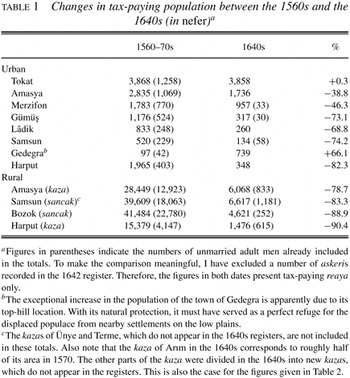
The few studies undertaken on these sources in comparison with the tahrir registers of the late 16th century point to a radical decrease of around 80 percent in the recorded tax-paying population of the north-central Anatolian districts of Amasya, Canik, and Bozok in the first half of the 17th century, with a corresponding figure of around 70 percent in the district of Tokat (See Table 1).64
Cf. R. J. Jennings, “Urban Population in Anatolia in the Sixteenth Century: A Study of Kayseri, Karaman, Amasya, Trabzon and Erzurum,” International Journal of Middle East Studies 7 (1976): 21–57; Kiel, “Anatolia Transplanted?” For the figures in the table, see M. Ali Ünal, “1056/1646 Tarihli Avarız Defterine Göre 17. Yüzyıl Ortalarında Harput,” Belleten 51 (1987): 119–127; Özel, “Changes,” 143–54; Mehmet Öz, “XVII. Yüzyıl Ortasına Doğru Canik Sancağı,” in Prof. Dr. Bayram Kodaman'a Armağan, ed. M. Ali Ünal (Samsun, 1993), 193–206; idem, “Bozok Sancağında İskan ve Nüfus (1539–1642).” On the Tokat region, see Ali Açıkel, “Tokat Örneğinde XVII. Yüzyılın İlk Yarısında Osmanlı Sosyal Yapısındaki Buhran,” ed. Hasan Celal Güzel et al., Türkler (Ankara: Yeni Türkiye Yayınları, 2002), 10:348–58. Açıkel appears to have carried out research very similar to the research I undertook for the Amasya region. Although I have not seen his original study, Açıkel points in his article to a 67.98 percent drop in the recorded tax-paying population in the Tokat countryside during the same period. Because his figures are presented in a different form, I have not included Tokat in the table.
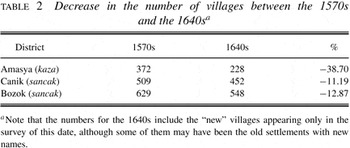
In the case of Amasya, 30–40 percent of the villages that existed in the 1570s appear by the 1640s to have been abandoned or ruined. A similar pattern, though less dramatic, is observable in the neighboring districts of Canik, Bozok, and Tokat (See
Table 2).
65 On Amasya, see TD 26 and TD 776. Cf. Özel, “Changes,” 136–43. For the figures for the districts of Canik and Bozok, see Mehmet Öz, “Population Fall in Seventeenth Century Anatolia: Some Findings for the Districts of Canik and Bozok,” Archivum Ottomanicum (forthcoming). I thank Mehmet Öz for allowing me to use his findings. See also Öz, “XVII. Yüzyıl Ortasına Doğru Canik Sancağı”; idem, “Bozok Sancağında İskan ve Nüfus.” Açıkel finds that 16.55 percent of the villages in the Tokat district (forty-eight villages) disappeared between 1574 and 1942, and the number of villages temporarily abandoned during the period was much higher: Açıkel, “Tokat Örneğinde,” 150–51. On the question of lost settlements during this period, see Suraiya Faroqhi, “Anadolu'nun İskanı ve Terkedilmiş Köyler Sorunu,” in Türkiye'de Toplumsal Bilim Araştırmalarında Yaklaşım ve Yöntemler (Ankara, 1976), 289–302. See also İnalcık, “Mezra'a” EI2; idem, An Economic and Social History, 165–66.
A significant portion of the villages in the district of Amasya, some of which seem to have disappeared, were those that emerged in the period of the 16th-century expansion with relatively small numbers of inhabitants either on fertile plains or high plateaus.
66 Özel, “Changes,” 138–39. Similar changes are observed in other parts of Anatolia. See Erder and Faroqhi, “Population Rise and Fall,” 332; Koç, “XVI. Yüzyılın İkinci Yarısında Köylerin Parçalanması Sorunu.”
This was accompanied by the disappearance of the
etrakiye villages of the mountain fringes. Similarly, there is evidence that the Turkomans of the Bozok region of central Anatolia, who had gradually adopted a sedentary lifestyle during the 16th century, had largely returned to nomadic life by the mid-17th century.
67 Mehmet Öz of Hacettepe University and I have been working on the extant detailed avarız registers in the Ottoman Archives and hope to publish in the near future the results regarding these developments. For the time being, see Özel, “Changes”; idem, “17. Yüzyıl Demografi ve İskan Tarihi İçin Önemli bir Kaynak”; Öz, “XVII. Yüzyıl Ortasına Doğru Canik Sancağı”; idem, “Bozok Sancağında İskan ve Nüfus”. Cf. Yunus Koç, XVI. Yüzyılda Bir Osmanlı Sancağının İskân ve Nüfus Yapısı (Ankara: Kültür Bakanlığı, 1989). See also M. Ali Ünal, “1056/1646 Tarihli Avarız Defterine Göre 17. Yüzyıl Ortalarında Harput.” Ünal published the register he used in this work. See M. Ali Ünal, “1646 (1056) Tarihli Harput Kazâsı Avârız Defteri,” Tarih İncelemeleri Dergisi 8 (1997): 9–73.
It should not be forgotten that this was a period with a number of extraordinary historical developments, mainly connected with the Celali depredations. It is the period in which the sources increasingly speak of frequent “Celali invasions” and of members of the provincial military-administrative class (ehl-i örf) roaming the countryside with their retinues of hundreds of horsemen under the pretext of inspection. At the mercy of the Celali bands and these brigand officials, the peasants dispersed (“perakende ve perişan olub”), leaving their villages en masse (“celây-ı vatan idüb”). City dwellers were not immune to such attacks, either. Contemporary sources unanimously refer to the famines frequently witnessed in the countryside and to the enormous damage they caused to the state treasury (“memlekete kıtlık, devlet hazinesine külli zarar gelmeğle”).68
On the extent of these developments throughout the 17th century, see Halil İnalcık, “Adaletnameler”; idem, “The Ottoman Decline and Its Effects upon the Reaya,” in Aspects of the Balkans: Continuity and Change, ed. H. Birnbaum and S. Vryonis (The Hague, 1972), 338–54. Cf. Özel, “Changes,” chap. 4.
Furthermore, the combined effects of these events on rural structure and village life in the Anatolian countryside are likely to have had an adverse effect on the birthrate, the real extent of which may never be known because of the shortcomings of the available sources. To this should be added the increase in the death rate under conditions of constant and widespread
Celali terror and wars, which would have affected not only adult men, but also women, children, and elderly people—that is, those who were most vulnerable to human and natural calamities.
69 Detailed avarız registers of the mid-17th century tend to record a not insignificant number of widowed women (dul havâtin) under a separate category (see, for example, TD 776 of Amasya). This may be seen as a social manifestation of the increasing death rate in the male population as well as of the position of the women who lost their husbands during the Celali period. One should, however, consider the possibility that this may reflect an ordinary situation in which widowed women, too, were carefully recorded on the basis of property that made them liable to avarız taxes as the heads of households.
All of these taken together with the possibility of the phenomenon of late marriage turning into one of temporary non-marriage point to extraordinary historical circumstances. Compared with the general conditions of the 16th century that allowed, mainly through military expansion, the growing population to integrate into an expanding system, the 17th century was a period of shrinking military and economic resources that created the conditions for a general crisis and depredation. Contrary to Todorova's argument, therefore, it is not mere speculation to speak of a general demographic crisis—at least, for Ottoman Anatolia in the first half of the 17th century.
Whether such a crisis was a general phenomenon in the entire empire in this period—and, if it was, whether there was any degree of recovery during and after the time of Köprülüs in the later part of the century—can be shown only through further case studies.70
A limited number of works on this period point to a situation that was no better than that in the early 17th century: see Gökçe, Lâzıkıyye, 44, 46. Furthermore, the population of the city of Lâzıkıyye (Denizli), for example, decreased significantly (36.22%) between 1678 and 1699: ibid., 95–96.
The question of the extent of the
Celali terror that appears to have continued throughout the 17th century in different parts of the empire should be kept in mind when examining the problem. Particularly important in this respect is the extent of the terror's destructive effects on rural structure,
71 The extent of the Celali movements and the ensuing destruction in Anatolia appear still to be a matter of doubt among some historians on the assumption that this was a point highly exaggerated in the contemporary nasihatname literature. This somewhat ad hoc claim may say something about the nature of this particular source. However, it is clear that it does not take into account the ample evidence that many other sources of diverse nature present and that the increasing number of case studies undertaken since Akdağ clearly attest. We are now in a far stronger position than Akdağ was decades ago in evaluating, and even quantifying to a certain degree, the extent of rural destruction that the Anatolian countryside underwent during this period. Faroqhi, who has spent perhaps more time and effort than anyone else on the nature of the Celali rebellions, points out in a recent article the apparent neglect of historians of the extent of rural destruction caused by the Celalis: see, Faroqhi, “Seeking Wisdom in China,” 111–12.
given the facts that the rural economy, both agricultural and pastoral, was the main source of wealth for the imperial treasury and that the complex relationships of revenue distribution, which constituted the backbone of the whole military and administrative structure of the empire, were based mainly on the stability of both rural life and the economy. Also crucial is the frequency of natural disasters such as famine, epidemics, drought, earthquakes, floods, and heavy snow in the Ottoman Empire during the 17th century.
72 On famine—not an infrequent occurrence in Anatolia during this period—see Lütfi Güçer, XVI–XVII. Asırlarda Osmanlı İmparatorluğu'nda Hububat Meselesi ve Hububattan Alınan Vergiler (Istanbul: İstanbul Üniversitesi İktisat Fakültesi Yayını, 1964). For an example of the negative effects of famine and other natural disasters on agricultural life in the Manisa district in the mid-16th century, see Emecen, Manisa, 243–44. For a study of some cases of plague in 17th-century Anatolia, see R. J. Jennings, “Plague in Trabzon and Reactions to It according to Local Judicial Registers” in Humanist and Scholar, 27–35. On later periods, see Daniel Panzac, Osmanlı İmparatorluğu'nda Veba (1700–1850), trans. Serap Yılmaz (Istanbul: Tarih Vakfı Yurt Yayını, 1997). The destructive effects of drought and famine on crop patterns and daily lives of peasants in the 16th- and 17th-century Ottoman Empire are often referred to in local studies. For an example, see Yılmaz, “Edremit,” 88 ff. For a detailed chronological history of earthquakes in the Ottoman Empire, see N. N. Ambraseys and C. F. Finkel, The Seismicity of Turkey and Adjacent Areas: A Historical Review, 1500–1800 (Istanbul: Eren Yayını, 1995). On the dramatic consequences of famine and epidemics in the same periods in Europe, see Cipolla, Before the Industrial Revolution, 128–34.
It should immediately be pointed out, however, that the apparent decrease in the recorded tax-paying population in the early-17th-century registers employed in this study does not necessarily imply that 70–80 percent of the rural population simply died as a result of wars or natural or human-made disasters. A significant proportion of this “loss” in population may well be accounted for by many peasants' forming the human source of the hundreds of Celali bands that were still active in the Anatolian countryside at the time of the surveys in the 1640s. Alternatively, some peasants may simply have evaded registration, thus going unrecorded in the registers. One can only speculate about this point. Nevertheless, the early-17th-century loss of population as reflected in the contemporary survey registers and interpreted in this study is too high to be explained only by such possibilities. Even if these are taken into account, it is more than likely that the picture presented by these registers still remains the most significant evidence for a serious demographic fluctuation in Ottoman Anatolia at the turn of the 17th century.73
For a lengthier discussion of this point, see my “Changes,” 203–204; idem, “17. Yüzyıl Demografi ve İskan Tarihi İçin Önemli Bir Kaynak”, 741–42; idem, “Banditry, State and Economy: On the Financial Impact of the Celali Movement in Ottoman Anatolia” paper presented at the Ninth International Congress of Economic and Social History of Turkey, Dubrovnik, Croatia, 20–23 August 2001 (in press).
THE OTTOMON CASE IN COMPARATIVE PERSPECTIVE
Let us turn at this point to the larger context of the nature of these demographic developments. İnalcık considers the case of late-16th-century overpopulation in Anatolia—or, as Cook puts it, the apparent imbalance between economic resources and the increasing population—to be an overall “population crisis” with social and economic complications.74
İnalcık, “Introduction,” 30.
Considering Carlo Cipolla's assertion that, in pre-industrial agrarian societies, fluctuations such as sudden and drastic falls in population could be expected when population growth exceeded certain limits,
75 Cipolla, Economic History of World Population, 82, 88–91, 97.
it seems quite reasonable to approach the extraordinary demographic movements, whether rapid growth or drastic fall, as two phases of a general crisis.
76 Cipolla's argument may sound mechanistic and old-fashioned, reminding us of a certain philosophical understanding of socio-historical events, but as Todorova has rightly emphasized (sometimes contradicting herself in her own argument), demographic movements have their own working mechanisms, which have close and complex relationships with social and economic phenomena. I will discuss this point further in the context of neo-Malthusian approaches.
Approached from this perspective, the population pressure that Cook suggests for the second half of the 16th century can also be seen as an indication of such a crisis in Ottoman Anatolia. In the light of the findings of recent research, the period from the mid-16th to mid-17th century, with its up-and-down swings, may therefore be considered a period of general crisis in the demographic history of the Ottoman Empire—a crisis whose first stage manifested itself in the form of “pressure” (or overpopulation), and the second stage in the form of “implosion” (or depopulation). If true, does this take us back to the neo–Malthusian “population cycle,” which has long constituted the central theme of scholarly debates in demographic studies?
77 See Emmanuel Le Roy Ladurie, “Peasants,” in The Cambridge Modern History, XIII Companion Volume, ed. Peter Burke (Cambridge: Cambridge University Press, 1979); idem, The Peasants of Languedoc (Urbana, Ill., 1974). Cf. İnalcık, “Settlements,” 159.
The scope of the present study is limited to the re-interpretation of old evidence in the light of new evidence concerning the 16th- and 17th-century population changes in Ottoman Anatolia in the hope that it will contribute to the revival of the debate among specialists. Although taking the present examination beyond this point deserves a separate study, it is not totally without benefit to make some brief remarks on these questions to place the Ottoman case in the wider theoretical context of the worldwide population movements in the early modern period.
The role of population changes in history has been a subject for both demographers and historians since the publication of the classic works of T. R. Malthus and David Ricardo.78
For the later editions of these works, see T. R. Malthus, An Essay on the Principle of Population, ed. D. Winch (Cambridge: Cambridge University Press, 1992); David Ricardo, The Works and Correspondence of David Ricardo, ed. P. Sraffa (Cambridge: Cambridge University Press, 1951–73).
Based on their arguments about the nature of population movements in history and the relationships between population and the economy, which have often been regarded as too mechanical to comprehend the complex nature of historical development and explain its diversity, there emerged in the 20th century many revisionist attempts to modify or refine the Malthusian and Ricardian demographic “laws” or to refute them categorically.
The resultant debates among scholars have thus evolved around what is termed the “neo-Malthusian” approach, among whose principal defenders were historians such as Emmanuel Le Roy Ladurie and M. M. Postan.79
For a selection from their works, see M. M. Postan, “Some Agrarian Evidence of Declining Population in the Later Middle Ages,” Economic History Review, 2nd series 2 (1949–50), repr. in Essays on Medieval Agriculture and General Problems of the Medieval Economy (Cambridge: Cambridge University Press, 1973), 186–213; idem, “Medieval Agrarian Society in its Prime: England,” in Cambridge Economic History of Europe, vol. 1, 1966; Emmanuel Le Roy Ladurie, “L'histoire immobile,” Annales 29 (1974); see also idem, Les Paysans du Languedoc, 2 vols (Paris: S.E.V.P.E.N., 1966).
It was mainly on their works concerning late medieval and early modern France and England that Robert Brenner launched in the late-1970s a counter-argument rejecting the primary role of demographic changes in the rise of European capitalism in general and in income distribution in particular. However, he never categorically denied the importance of what he referred to as “demo-economic” trends in long-term historical developments.
80 Robert Brenner, “Agrarian Class Structure and Economic Development in Pre-Industrial Europe,” Past and Present 70 (1976): 30–75; idem, “The Agrarian Roots of European Capitalism,” Past and Present 97 (1987): 16–113, both reprinted in The Brenner Debate: Agrarian Class Structure and Economic Development in Pre-Industrial Europe, ed. T. H. Aston and C. H. E. Philpin (Cambridge: Cambridge University Press, 1985).
What he sharply criticized was the mechanistic application to history of demographic models, which have almost been exclusively associated with Malthus via Le Roy Ladurie in particular. With the participation of other specialists, the “Brenner debate” led to a productive discussion among historians that was to have a strong influence on later historiography. It greatly contributed to the worldwide shift in historiography from the emphasis on demographic–economic processes as the main factors in historical change toward a greater focus on the political–distributional level, resulting finally in bringing the “state” back into historical analysis in the 1980s and 1990s.
81 See Peter B. Evans et al., ed., Bringing the State Back In (Cambridge: Cambridge University Press, 1985).
Concurrently—or, perhaps, as a reaction to this tendency—some scholars, the most prominent of whom was Jack Goldstone, returned to the primary role of demographic–ecological changes in the development of history.82
See Jack A. Goldstone, Revolution and Rebellion in the Early Modern World (Berkeley: University of California Press, 1991). See also his earlier work, “East and West in the Seventeenth Century: Political Crises in Stuart England, Ottoman Turkey, and Ming China” Comparative Studies in Society and History 30 (1988): 103–41.
According to Goldstone, population in principle moved independently for reasons exogenous even to the economy and played a central role particularly in the political crises of early modern societies.
83 Goldstone, Revolution 28–29.
Goldstone's “post-Malthusian” approach once more brought attention to the role of demographic factors in history on the widest scale across time and space, covering areas stretching from Europe to China and in the period from the late medieval ages to the 20th century.
All of these debates have found echoes in Ottoman historiography. İslamoğlu-İnan, who wrote in the 1980s mainly about the agrarian economy of Anatolia, also touched on population changes in Anatolia. She closely followed the current discussions revolving around Wallerstein's “capitalist world system” approach along with the Brenner debate, with certain reservations toward both based to some extent on the works of Ester Boserup.84
Ester Boserup dealt with population pressure in agrarian societies and produced her major work in the late 1960s. According to Boserup, these societies were not technologically stagnant; therefore, relative scarcity of arable land did not necessarily imply serious limitations on agricultural production. She concluded that population growth did not have dramatic effects on the agricultural economies of pre-modern periods. See Ester Boserup, The Conditions of Agricultural Growth: The Economics of Agrarian Change and Population Pressure (Chicago: Aldine Publishing, 1965).
I have already discussed İslamoğlu-İnan's argument, which places heavy emphasis on the determining power of the state and its role in socio-political and distributional processes in the Ottoman Empire.
Although I agree with her in rejecting any deterministic mechanical and reductionist single-factor approach in history, her somewhat eclectic theoretical approach underestimates the precarious balance between population and resources that were in fact closely connected in late medieval and early modern agrarian societies. I also agree with her that the roots of population changes are not necessarily internal to the agricultural economy. But this does not mean that demographic changes—rises or falls—have no negative effects or do not put strain on the economy in general and state finance in particular. Indeed, Goldstone's entire work convincingly shows how population changes that occurred often syncronously across the world during the 16th and 17th centuries led to eventual state breakdowns, following strikingly similar patterns, albeit in different forms.
Goldstone himself included the Ottoman Empire in his comprehensive study of “state breakdowns” in the early modern period. His post-Malthusian demographic approach, which in the main argues that “revolutions are the result of multiple problems, arising from long-term shifts in the balance of population and resources”85
Goldstone, Revolution, xxiv.
deserves closer attention because of its direct relevance to the central argument of the present study. Goldstone develops the argument that the more or less simultaneous state breakdowns during the late 16th and 17th centuries in Europe, the Ottoman Empire, and China were the best examples of the recurrent waves of similar events in history. All of these originated mainly from a periodic, cyclic imbalance between population growth and inflexible economic and political systems.
86 In this respect, Goldstone's treatment of the Ottoman case places the price increases of the late 16th century, the crisis in state finance, and the widespread
Celali rebellions into this worldwide context. In doing this, he refers to old evidence concerning the socio-economic and political manifestations of this period of crisis, such as the increase in the number and overall proportion of young unmarried men in the population, the fragmentation of peasant farms, and the increase in landlessness. He then emphasizes the peasants' ensuing search for other means of livelihood outside their villages. All of this eventually contributed directly to the
Celali uprisings.
The new findings presented in this study once more confirm and consolidate this picture. However, a more important point in Goldstone's argument is that population growth has a non-linear or disproportionate effect particularly on marginal groups—in our case, the unmarried men and the landless.87
Goldstone also draws attention to a close connection between price increases and population growth and points to similar disproportionate effects of both on groups with fixed salaries—the timar holders, in the Ottoman case.
Using Goldstone's own words, “[I]ncreases in total population generally produce a much larger increase” in these marginal populations “… than in the population as a whole.”
88 Leaving aside Goldstone's other arguments, which obviously open new horizons for future comparative studies in Ottoman history, this point alone is particularly important for the argument of the present study. If his argument is correct, the figures presented in this study become more significant because they show a substantial increase in the size of the sectors of rural society that were gradually “marginalized” under the conditions of population growth. If so, one might expect even further increases in these populations in the last quarter of the 16th century—increases that cannot be observed because we have no surveys available for this period. When the landless and unmarried young men are taken together with the discontented timar holders, who had also lost much of their income under the inflationary trend that went hand in hand with population growth, it is not a coincidence that these were the very groups that formed the main source of Celali bands and rebel armies in the 17th century. One can further assume that the large-scale destruction caused in the Anatolian countryside by the Celali terror, coupled with wars, resulted in what Brenner describes as the “disruption of production leading to further demographic decline, rather than a return to equilibrium.”89
Brenner, “The Agrarian Roots of European Capitalism,” in The Brenner Debate, 224. I think that Brenner's point makes no essential change in the neo-Malthusian theory of the two-phase demographic cycle. His emphasis on human-made catastrophe, which in fact was the case in Ottoman Anatolia in the early 17th century, may at best only extend the second phase of the Malthusian adjustment process.
This last point, which is perhaps Brenner's only contribution to the neo-Malthusian debate, although he developed it as a counter-argument to the theory of Malthusian adjustment, relates to the very point at which we started to evaluate the Ottoman case in a wider historical context. Implicit in my line of argument throughout this study is that the Malthusian approach still has merit in population studies and offers much, particularly in terms of the nature of demographic changes in essentially agrarian societies. One should also remember the remarks of another prominent historian, Guy Bois, that knowledge of demographic changes is essential to understanding the development of societies in which small-scale family production is the basic economic unit and in which “reproduction takes place on that scale according to an economic/demographic process.”90
Guy Bois, “Against the Neo-Malthusian Orthodoxy,” in The Brenner Debate, 117.
As such a society, the Ottoman peasantry was vulnerable to demographic changes, and the developments in 16th- and 17th-century rural Anatolia can be re-interpreted in this context.
91 It may be illuminating at this point to consider Cipolla's comment on population growth in medieval and early modern societies in Europe. He points out that even relatively low growth rates over a long period might result in explosive situations, thus showing the vulnerability of peasant societies to changes in population. He also argues that, even at the beginning of the 14th century before the Black Death, many areas of Europe were already overpopulated in relation to prevailing levels of production and technology: see Cipolla, Before the Industrial Revolution, 130. This is a good example of different levels at which one can identify a case of “overpopulation” under diverse circumstances. One should note that neither Goldstone nor Cipolla sees pre-industrial societies as stagnant and inflexible in response to changing conditions. What they rightly emphasize instead is that the choices that such societies had were seriously limited by the availability of natural resources and technology.
Does this take us to demographic and economic determinism? Certainly not. No reasonable mind can suggest such a deterministic approach after the decades-long debates over the complex nature of historical development. What this may mean instead is that demographic analysis can be further developed and refined to widen our perspective, as impressively exemplified by the works of scholars such as Cipolla, Goldstone, and many others.
CONCLUSION
Whatever the fruits of discussing the problem at such a theoretical level, in the case of Anatolia it is perhaps more important to bear in mind the geographical dimension of the population changes in the late-16th- and early-17th-century Ottoman Empire. The crucial question is how representative the cases of demographic pressure in Anatolia described here were as far as the whole empire was concerned.92
For some similar developments in the Balkans, see esp. McGowan, Economic Life in Ottoman Europe. See also Fikret Adanır, “Tradition and Rural Change in Southeastern Europe during Ottoman Rule,” in The Origins of Backwardness in Eastern Europe: Economics and Politics from the Middle Ages until the Early Twentieth Century, ed. Daniel Chirot (Berkeley: University of California Press, 1989), 131–76; idem, “The Ottoman Peasantries, c. 1360–c. 1860” in The Peasantries of Europe from the Fourteenth to the Eighteenth Centuries, ed. Tom Scott (London: Longman, 1998), 269–310.
Furthermore, one may ask the same question for Anatolia only, considering the fact that in some parts of Anatolia the population seems to have remained within reasonable limits,
93 Faroqhi, “Political Tensions,” esp. 127–30. Cf. Singer, “Peasant Migration,” 62–63. Wolf Hütteroth, who has carried out research in the historical geography of the region, points out that the steady increase in the number of tax-payers recorded in the 16th century in northern Syria and southeastern Anatolia may not in fact indicate real growth in population because of the incomplete nature of the earliest register. He suggests that such an increase may at best show the expansion of rural settlements into the hitherto uncultivated arable lands: Wolf Hütteroth, “High Population Increase in the 16th Century?” unpublished paper presented at the Ninth International Congress of Economic and Social History of Turkey, Dubrovnik, 20–23 August 2001. I agree with Hütteroth that the apparent incompleteness of most of the earliest registers of different regions should be taken into account when interpreting the figures given in these registers. But this still does not account for the high level of increase both in the recorded tax-payers and, to a lesser extent, in the number of village settlements observed in the later surveys. I argue that the demographic changes that took place especially during the mid- to late 16th century cannot simply be explained by the expansion of settlements without taking into consideration the size and density of arable land as well as the socio-economic composition of the society. I have already pointed out that such an expansion may well be seen as yet another indication of demographic pressure in the north-central Anatolia.
although substantial growth in the 16th century was a general phenomenon throughout the Empire. It is therefore imperative to pay attention to voices that emphasize regional differences in terms of demographic changes—differences that depended largely on the quality and quantity of the land, climatic conditions, economic opportunities, and, as Karen Barkey rightly suggests, the patron–client relations at the local level and in the empire in general.
94 Barkey, Bandits and Bureaucrats, 148.
It is also clear that population growth does not necessarily or automatically mean “pressure.” What this study shows in this respect is that one can speak of such pressure in at least some parts of the empire—in this case, the north-central Anatolian province of Rum. Whether the apparent rise in population resulted in similar pressure elsewhere in Anatolia or throughout the empire toward the end of the century remains a question. Nevertheless, this study has also pointed out that the Celali rebellions and widespread terror in the Anatolian countryside were closely related to the demographic growth of the 16th century.
At this point, it is important to return to the sources, the nature and interpretation of which constitute an significant part of the debate. There is no doubt that the comprehensive series of imperial tahrir, avarız, and cizye registers of various kinds (separate evkaf tahrir registers included), which offer the only quantitative data for demographic studies, have been, and still are, the principle sources. But it has increasingly become apparent that the qualitative information that these sources provide is equally important in terms, for example, of settlement patterns, and abandoned or lost settlements. Mühimme and sicil collections available for the period in question, as well as other archival materials such as the account books of certain foundations (vakıfs),95
As an example, see Suraiya Faroqhi, “A Great Foundation in Difficulties: Or Some evidence on Economic Contraction in the Ottoman Empire of the Mid-Seventeen Century,” Revue D'Histoire Magrebine 47–48 (1987): 109–21; idem, “Agricultural Crisis and the Art of Flute-Playing: The Wordly Affairs of the Mevlevi Dervishes (1595–1652),” Turcica 20 (1988): 43–70. See also Kayhan Orbay, “The Financial Administration of an Imperial Waqf in an Age of Crisis: A Case Study of Bayezid II's Waqf in Amasya (1594–1657),” (unpublished M.A. thesis, Department of History, Bilkent University, Ankara, 2001). Cf. Ergenç, Ankara, 54.
often provide useful and sometimes extremely important insights into the complex historical developments of the time. Only through cross-examination can one make a reasonably convincing evaluation of demographic changes in general, and of the degree of reliability of the figures given in the sources in particular. Nevertheless, the varying roles of factors affecting the birth-to-death ratio remain an important issue that is unlikely, perhaps impossible, to clarify given the shortcomings of the present sources.
96 On the central importance of mortality in demographic changes, see Goldstone, Revolution, 27–29. On the factors that distinguish “catastrophic” mortality from “normal” mortality, such as war, famines, and epidemics, see Cipolla, Before the Industrial Revolution, 3–5, 127 ff. As the reader may have noticed, I have occasionally touched on the importance of the change in fertility and mortality rates in drastic population movements in general but have not elaborated the point in the context of Anatolia during the period under examination. One may justifiably think that the dramatic events of this period, such as long and exhausting wars, destruction of rural structure, and negative changes in climate, could have resulted in such a change in fertility and mortality rates, with mortality significantly overtaking the fertility. Under such conditions, which may be comparable to those of the Hundred Years' War and the Thirty Years' War in Europe, one might expect a development in Anatolia similar to that described by Cipolla: “a peak of catastrophic mortality would cancel out the previous demographic gains and the cycle would start all over again. In this way the frequency and severity of the peaks of catastrophic mortality determined the population trend.” (ibid., 132–33).
However discouraging repeated mention of such methodological problems and the questioning of the reliability and shortcomings of the source material may be, there seem to be no easy solutions to the problems of Ottoman demographic history of the period in question.
Author's note: The initial version of this article was presented at the Eighth International Congress of Economic and Social History of Turkey, Bursa, 18–22 June 1998. The author thanks Halil İnalcık, Rifa'at Ali Abou El-Haj, Paul Latimer, Mehmet Öz, Fikret Yılmaz, and anonymous IJMES reviewers, as well as its editors, for their valuable suggestions.