


Introduction
In recent years, the ability to detect early psychosis has become a focus of research. Yung and colleagues have led the way in researching this area by developing operational criteria aimed at identifying young people experiencing an at-risk mental state (ARMS) that represents ultra-high risk of developing psychosis (Yung et al., Reference Yung, McGorry, McFarlane, Jackson, Patton and Rakkar1996). As a result of the development of these criteria, a number of research trials have been conducted with the aim of developing a preventative approach for people who experience ARMS (McGlashan et al., Reference McGlashan, Zipursky, Perkins, Addington, Miller and Woods2006; McGorry et al., Reference McGorry, Yung, Phillips, Yuen, Francey and Cosgrave2002; Morrison et al., Reference Morrison, French, Walford, Lewis, Kilcommons and Green2004) and, while not conclusive, they suggest that a preventative approach based on treatment of people meeting ARMS criteria is promising. It is also likely that studying psychological processes within the ARMS population will be informative regarding the development of psychosis.
There have been several cognitive models proposed that seek to explain the development of psychosis (Bentall, Reference Bentall2003; Garety, Kuipers, Fowler, Freeman and Bebbington, Reference Garety, Kuipers, Fowler, Freeman and Bebbington2001; Morrison, Reference Morrison2001). Morrison (Reference Morrison2001) states that it is the appraisal of the intrusion that mediates the relationship between the intrusion and its associated distress and consequent disability. This appraisal is influenced by beliefs that are formed through life experiences regarding the self, the world and others. Subsequently, the appraisal of the experiences will determine whether those experiences are believed to be culturally acceptable (i.e. not psychotic) or culturally unacceptable (i.e. psychotic), and that this will result in responses that will inhibit or exacerbate such experiences (Morrison, Reference Morrison2001).
In recent years, there has been an increase in research exploring such appraisals in both clinical and non-clinical populations. Paranoid thinking in the general population has been investigated using virtual reality methods (Freeman et al., Reference Freeman, Pugh, Antley, Slater, Bebbington and Gittins2008). Participants were assessed on persecutory thinking in relation to a virtual reality experience (a train ride populated by neutral characters). Although the majority of participants reported non persecutory concerns that the characters were neutral or friendly, a “substantial minority” reported paranoid concerns that were predicted by anxiety, worry, cognitive inflexibility and perceptual anomalies (Freeman et al., Reference Freeman, Pugh, Antley, Slater, Bebbington and Gittins2008).
A number of studies have compared people meeting ARMS criteria to non-patient samples, and to people with psychosis (Brett, Johns, Peters and McGuire, 2009; Morrison et al., Reference Morrison, French, Lewis, Roberts, Raja and Neil2006; Morrison, French and Wells, Reference Morrison, French and Wells2007). Results from these studies have generally found that those who were experiencing ARMS and psychosis showed higher endorsements of negative metacognitive beliefs (e.g. negative beliefs about uncontrollability of thoughts) than non-patient samples. However, these differences became non-significant when anxiety and depression were controlled for (Brett et al., Reference Brett, Johns, Peters and McGuire2009).
Using similar comparison groups, Brett et al. (Reference Brett, Peters, Johns, Tabraham, Valmaggia and McGuire2007) also found that appraisals differentiated the clinical and non-clinical groups. Overall, the undiagnosed participants reported appraising their experiences as relatively more positive and benevolent, with a less negative and more positive emotional response. It was also suggested that reduced distress in the non-diagnosed group may have been related to the perceived controllability of the anomalous experiences (Brett et al., Reference Brett, Peters, Johns, Tabraham, Valmaggia and McGuire2007). This research suggests that there are noticeable differences in the way clinical and non clinical populations appraise unusual experiences and thus further research is needed is investigate whether this impacts directly on the distress associated with these experiences.
No research has directly investigated the relationships between the appraisal of anomalous experiences and distress in people experiencing ARMS using experimental techniques that involve manipulation of appraisals and examination of the effects on subsequent distress. The aim of this study was to investigate whether the information a person receives about an experience can change their appraisal (of the experience) and subsequently affect the associated distress. We hypothesized that participants in the negative information manipulation group were more likely to experience higher levels of distress and anxiety after completing the card trick task than the participants in the no information neutral manipulation group. A secondary hypothesis was that belief in the appraisals (explanations of the card trick task) would be significantly related to levels of distress and state anxiety.
Method
Participants
All participants from the Early Detection of Psychosis service (EDIT) were contacted to take part in the study; 26 responded and were recruited. The EDIT service is an NHS service for people between the ages of 14–35 who are experiencing ARMS. The service provides cognitive therapy (CT) with the aim of preventing the onset of first episode psychosis (FEP). All participants had been assessed as having an ARMS, within the past year, determined utilizing the comprehensive assessment for at risk mental states (CAARMS) (for ARMS criteria see Phillips, Yung and McGorry, Reference Phillips, Yung and McGorry2000) The CAARMS was administered by a clinical psychologist within the team trained to administer this measure. Not all participants were currently experiencing attenuated psychotic symptoms but were all currently receiving cognitive therapy for the prevention of psychosis. The mean age was 21.9 years (SD = 4.55) and the male to female ratio was 18:8. Participants were excluded if they were deemed a current risk to themselves or currently experiencing distressing attenuated psychotic symptoms (this was decided on by the participant's therapist from the service on a case by case basis).
Measures
Community Assessment of Psychic Experiences (CAPE; Stefanis et al., Reference Stefanis, Hanssen, Smirnis, Avramopoulos, Evdokimidis and Stefanis2002). The CAPE is a 42 item self-report questionnaire. This measure has been designed to assess psychotic-like experiences (PLEs) in the general population. This measure was utilized as, although all participants were deemed as meeting “at risk” criteria within the past year, some could have currently been symptom free. It is made up of three scales; positive (e.g. “do you ever feel destined to be someone very important”); negative (e.g. “do you ever feel you are not a very animated person?”); and depressive (e.g. “do you feel as if there is no future for you?”). If participants endorse an experience they are then asked to respond to the second scale, which measures the degree of distress associated with that experience.
The Subjective Units of Distress Scale (SUDS, pre and post task; Foa, Grayson and Steketee, Reference Foa, Grayson, Steketee and Boulougouris1982). The SUDS is a semi-quantitative evaluation tool with a scale ranging from 0 = no distress to 10 = maximum distress. This questionnaire aims to measure participants’ current feelings of distress. Participants were asked to rate their current distress levels prior to completing the task. The SUDS is commonly used to assess habituation of fear during studies where the participant has been exposed to a distressing situation.
The State Trait Anxiety Inventory (SAI: Speilberger, Gorusch, Lushene, Vagg and Jacobs, Reference Speilberger, Gorusch, Lushene, Vagg and Jacobs1983). The state-trait anxiety inventory scale is a 40-item self-report measure of state and trait anxiety. For the current study, only the “state” part of the STAI was utilized. This part consists of 20 questions that determine how the respondent “feels right now” whereas the trait anxiety scale consists of questions pertaining to how the respondent “generally feels”.
Procedure
All clients from the EDIT service who had met criteria for ARMS in the past year were sent a letter inviting them to participate in the study. If clients chose to participate they completed a consent form, then the CAPE measure. Once participants had completed the CAPE they were randomly allocated to one of the two groups. Randomization was conducted using a sealed envelope design and was not based on any scores given on the CAPE. The two groups were: Group 1 (negative information appraisal manipulation group) and Group 2 (the no information neutral appraisal manipulation group). The group to which the participant was assigned determined the instructions they were given for the computerized card trick task. The randomization aimed to split participants as evenly as possible into two groups. In Group 1, there were 12 participants and in Group 2 there were 14 participants.
Information for the card trick task
Once allocated to a group, each group received the same information; however, group 1 received extra information. All groups received the following instructions: “Please mentally select a card from the following cards. Focus your attention on this card. Do not say the name of the card out loud. After you have memorized the card, please press any button. The computer will then try to guess which card you have chosen and this card will then be taken away from the group of cards. Please complete this task three times”. Group 1 (negative information group) then received negative information: “Some people have suggested that if the computer can guess your card correctly, at least two out of the three times, then this could be particularly worrying for the person”. Group 2 received no extra information.
Card trick
The card trick was one that had been adapted from the internet (http://sprott.physics.wisc.edu/pickover/esp2.html). This is a computerized task, which involves the participant being shown six playing cards (cards that are only face cards). The participant is then asked to choose one of the cards and remember it. They are then instructed that the card, which they have chosen, will be selected and removed from the set of cards once they have pressed a key. When the participant has pressed a key to continue, they are shown a set of five completely different playing cards (again these will all be face cards), which will only be shown for 3 seconds. This ensures that the card they originally chose will not be present. This task therefore, relies on the fact that the person will only scan the new set of cards for the one they chose originally and they will not notice that all the cards are totally different from the original ones that were presented. This is a phenomenon that has been reported to work with good accuracy (Linney and Peters, Reference Linney and Peters2007). Participants were asked to complete this task three times.
Explanation (appraisal) of the card trick task
Participants were then asked to rate their conviction of belief on a visual analogue scale (where 0 = do not believe this at all and 100 = totally believe this) of the following explanations (the type of appraisal being tapped into is in parentheses): (1) It is a trick and works the same with everybody (non-psychotic explanation); (2) It works because the computer system is able to read people's minds and it is not specific to me (belief in mind-reading non-specific); (3) It works because people project their thoughts onto the computer system. It works the same with everybody and is not specific to me (belief in thought projection, non specific); (4) It is a trick that is part of a bigger conspiracy by others against me (paranoid beliefs); (5) It works because the computer system is able to read people's minds and it is specific to me (belief in mind-reading, specific). These questions are taken from the aforementioned study conducted by Linney and Peters (Reference Linney and Peters2007).
Data analysis
The data were considered to follow a normal distribution if the distribution appeared normal via visual inspection of the histogram and examination of skewness and kurtosis. Those that did not possess adequate distribution and could not be successfully transformed were the five appraisal variables. Therefore, all data analyses excluding those including the five appraisal variables were conducted using parametric analyses.
Results
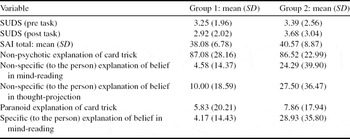
Descriptive statistics for the SUDS (pre and post), the SAI and the appraisals of the card trick task are presented (Table 1). For the appraisals, participants were asked to rate each appraisal on a score of 0–100, 0 being no belief in the appraisal and 100 being 100% belief in the appraisal.
Descriptive statistics

A univariate analysis of variance (ANOVA) revealed no significant differences between the two groups on age (F(1,25) = .003, p > .05). A chi-square analysis showed no significant gender differences between the groups (χ2 (1) = .35, p > .05). Before the hypothesis could be tested, a multivariate ANOVA (MANOVA) was conducted to examine whether the two groups differed significantly on the total scores of the three subscales of the CAPE (positive, negative and depressive). The MANOVA revealed no overall significant differences between the two groups on CAPE scores (F6,19) = 1.41, p > .05).
Manipulation check
In order to check if the manipulation of information given to the participants before the task had been successful, a Kruskall-Wallis independent samples non-parametric test revealed that there was a significant effect of group on the conviction ratings for the specific mind-reading appraisal (H(1) = 7.31, p < .01). However, there was no significant effect of group on the conviction rating for; the non-psychotic appraisal (H(1) = 1.83, p > .05), the non-specific mind-reading appraisal (H(1) = 2.38, p > .05), the non-specific thought projection (H(1) = 3.43, p > .05), and the paranoid appraisal (H(1) = 1.26, p > .05). After examination of the median scores for the two groups on the mind-reading specific appraisal, it was found that Group 2 (the no information manipulation group) actually scored higher than Group 1 (the negative information manipulation group). This suggests the manipulation of information within the two groups was not successful.
Hypothesis testing
To test the main hypotheses a repeated measures ANOVA (using the information groups as the between group variable and the pre and post SUDS scores as the within groups variable) was conducted to examine whether the information group (negative or no information) was related to levels of distress. This revealed no significant difference between the pre and post SUDS scores, (F(1, 24) = .005, p > .05), and also there was no effect of group on pre and post SUDS scores, (F(1, 24) = .767, p > .05). To test the secondary hypothesis, a univariate ANOVA was conducted to examine the effect of manipulation group on SAI score. The results from the ANOVA revealed no significant differences between the two groups on SAI scores, (F(1, 25) = .628, p > .05).
A post hoc non-parametric correlational analysis was then conducted on the relationship between the conviction scores on the appraisals of the card task and levels of distress. For this, the data for the two groups were collapsed and analyzed as one group variable (as the groups only differed significantly on one variable). The Spearman's Rho correlation co-efficient revealed there was a significant negative correlation between SUDS post task and the non-psychotic appraisal of the task (r = –.57, p < .01). Suggesting that the higher the conviction of the non-psychotic appraisal, the less distressed the person felt after completing the task. No significant correlations were found between any of the other appraisals and the SUDS post task. Similarly, no significant correlations were found between any of the appraisal variables and the SAI score.
Finally, a further post hoc test was conducted by dividing the participants into two groups; a group of participants who endorsed the non-psychotic appraisal more than 50% (n = 19), and a group of participants who endorsed the non-psychotic appraisal less than 50% (n = 7). The split was conducted in this manner as the previous correlation analysis revealed a strong significant relationship between the non-psychotic appraisal and distress. A Mann-Whitney independent samples non-parametric test was then conducted to examine if there were any differences between the two groups on levels of distress and anxiety. The Mann-Whitney test revealed that the group who endorsed the non-psychotic appraisal less than 50% scored significantly higher than the group who endorsed the non-psychotic appraisal more than 50%, both on post SUDS scores (U = 16.500, z = –2.920, p < .01) and SAI scores (U = 35.500, z = –1.796, p < .05).
Discussion
The aim of this study was to test an element of a cognitive model of psychosis (Morrison, Reference Morrison2001) in a population ideally suited to analyzing the processes involved in the development of psychosis; specifically, the link between appraisals and their associated distress. This was achieved by investigating whether the information a person receives about an experience can change their appraisal (of the experience) and subsequently affect their emotional response to it. Overall, the manipulation of the groups was not successful as only one significant difference was found between the two groups (mind-reading specific scores). Interestingly, Group 2 (no information) scored much higher than Group 1 for this appraisal. This could suggest that the manipulation had an affect, albeit in the opposite direction desired. For this appraisal, potentially receiving no information about the task could have made the participants more likely to endorse the more unusual belief of mind-reading.
Significant relationships were also found between non-psychotic (i.e. culturally acceptable) appraisals and lower levels of distress (as measured by the SUDS), plus those with lower conviction in the non-psychotic (i.e. culturally acceptable) appraisal reported significantly more distress and state anxiety.
The manipulation check revealed that the attempted experimental manipulation of appraisals had failed. The lack of increase in distress and anxiety post task may have been due to participants feeling more anxious or distressed prior to taking part in the study. Therefore, pre-task scores may have been higher than post-task scores due to the fact that anxiety levels could have reduced after completing the task, and at this stage participants would have realised that it was not a particularly difficult or anxiety provoking task.
When the two groups were collapsed and analyzed as one group, the first correlational analysis suggested that if a person has a non-psychotic explanation of an anomalous experience, they are likely to report lower levels of distress (as measured by the SUDS). Furthermore, a lower endorsement of the non-psychotic appraisal was significantly associated with higher levels of distress and state anxiety. These results are consistent with a cognitive model of psychosis, which suggests that endorsement of culturally acceptable versus unacceptable appraisals is an important distinction in the responses to psychotic experiences (including distress). However, no significant relationships were found between the psychotic appraisals and distress or anxiety. This may be because participants who took part had either finished or were near the end of a course of CT with the EDIT service. Therefore, some of the participants may have been deliberately trying to utilize strategies taught in CT, such as evidential analysis and the generation of alternative, non-psychotic explanations (Morrison, Renton, Dunn, Williams and Bentall, Reference Morrison, Renton, Dunn, Williams and Bentall2004), which may have led to lower endorsements of the psychotic appraisals. It is also possible that use of the non-psychotic appraisal as a dependent variable is more appropriate, since the endorsement of the various psychotic appraisals is likely to be a much more idiosyncratic process.
Furthermore, the content of the appraisals differed in terms of experiences being “specific” or “non specific” to the person. Future research could explore whether those who felt that experience was “non specific” to them were less distressed because of the normalizing aspect of the statement. If the person felt they were alone in experiencing the anomalous occurrence, it is likely they would report higher levels of distress than those who felt others were also susceptible to it. Normalizing is a central part of cognitive therapy for those experiencing psychosis (Morrison, Reference Morrison2005) and ARMS (Morrison et al., Reference Morrison, French, Walford, Lewis, Kilcommons and Green2004) and as such one would expect the endorsement of “non specific” appraisals would be associated with lower levels of distress.
There were some limitations in the current study. The small sample size may have led to the study being under-powered, and the heterogeneity with an ARMS population may further confound this; however, there is little research that examines appraisals within the ARMS population, and our study may help to inform future power calculations for further research on this topic. A further limitation was that the instructions the researcher developed for the participants regarding the task were not worded in such a manner that influenced their appraisal of the task. Should future studies of this nature be conducted, the researcher must ensure that any experimental manipulations accurately induce positive or negative appraisals, with extensive piloting required to check the effectiveness of the manipulation. However, it may have been more appropriate to simply let the participants make their own appraisal of the task based on the choices given, and develop groups to compare distress based on those choices. Other aspects of the design that could have been problematic include repetition of the task, which may have reduced the likelihood of unusual appraisals, and a failure to utilize baseline information in the randomization process (e.g. stratifying by types of unusual beliefs). Issues such as the non-epidemiologically representative, small sample would need to be addressed should this study be replicated in the future. As a result, the reliability and generalizability of the results should be done so with caution.
Although these results should be viewed with caution, the potential clinical implications should be discussed. The study showed correlations between non-psychotic (reality based) thinking and lower levels of distress. This is important information that can inform clinical practice. A key element of CT for ARMS is to help the client generate alternative explanations of their unusual experiences. Therefore, this study adds to the evidence that having more reality based or culturally acceptable interpretations of unusual experiences may help to lower levels of distress. Consequently, both psychotic and non-psychotic appraisals should be assessed and incorporated into cognitive case formulations that could then be targeted through CT.
In addition to this, as part of the recruitment process, the investigator asked the therapists from the EDIT service to ask their clients for feedback about their involvement in the study. The feedback received from a number of therapists suggested that using the card trick was a very helpful, concrete and visual way of explaining how thoughts about an unusual experience can affect distress. This suggests that the card trick could be a tool utilized with clients who find it difficult to relate how their thoughts about unusual experiences can directly affect their distress in response to the experience. Further exploration of the utilization of this tool would be useful.
Acknowledgements
We would like to thank all of the clients who took part in the research and the staff from the EDIT service for their help with recruitment.



Comments
No Comments have been published for this article.