Introduction
Aging is accompanied by several changes. The most pronounced and consistently reported are loss of vision and hearing, a decrease in muscular strength (sarcopenia), increases in blood pressure and blood glucose, and a reduction in cognitive functioning (Rowe and Kahn, Reference Rowe and Kahn1987; Cruz-Jentoft et al., Reference Cruz-Jentoft2010). As these changes increase, the person becomes less able to perform activities of daily living (ADL), which in turn affects his/her level of independence (Santos et al., Reference Santos, Lebrão, Duarte and Lima2008).
The ability to perform ADL has been referred to as functional status (Ramos, Reference Ramos2003). A primary reason for assessing functional status in older people is because functional decline cuts across different health conditions (Santos et al., Reference Santos, Lebrão, Duarte and Lima2008). Information regarding diseases in old age is necessary to determine treatment, but it does not provide information on self-care capacity or the ability to remain a functioning member of society. Thus, functional status provides additional information on the impact of diseases. Moreover, decline in functional status has been associated with loss of quality of life, poorer self-reported health, and increased odds of mortality in older people (Ramos et al., Reference Ramos, Simões and Albert2001).
Functional status is usually assessed by asking subjects about their ability to perform basic activities of daily living (BADL; eating, dressing, grooming, walking, getting in and out of bed, bathing, and being capable of using the bathroom), and instrumental activities of daily living (IADL; using the telephone, grocery shopping, preparing meals, housekeeping, taking medication, using transportation, and handling one's finances) (Burns et al., Reference Burns, Lawlor and Craig1999).
Several variables have been associated with functional status in older persons. Longitudinal studies conducted worldwide in community-dwelling subjects have shown that declines in BADL and IADL may be influenced by socio-demographic variables (age, education, gender, marital status, race), medical conditions (heart or pulmonary disease, neurological or psychiatric diseases, diabetes, hypertension, cancer, and arthritis) cognitive deficits, and health behaviors (smoking, drinking, and physical activity) (Barberger-Gateau et al., Reference Barberger-Gateau, Chaslerie, Dartigues, Commenges, Gagnon and Salamon1992; Reynolds and Silverstein, Reference Reynolds and Silverstein2003; Fujiwara et al., Reference Fujiwara2008). In Brazil, onset of BADL and IADL disability in community-dwelling older people has been associated with the same variables in longitudinal and cross-sectional studies (Ramos et al., Reference Ramos, Simões and Albert2001; Fiedler and Peres, Reference Fiedler and Peres2008; Santos et al., Reference Santos, Lebrão, Duarte and Lima2008; Fillenbaum et al., Reference Fillenbaum, Blay, Andreoli and Gastal2010). The variables described above interact with each other so that the level of influence of each factor on functional status may be altered by the presence of another. For example, the addition of baseline behavioral factors such as health behaviors (e.g. smoking), cognitive function, and negative affect changed the predictive value of medical factors in a model of ADL decline in a sample of older people from a longitudinal study (Reynolds and Silverstein, Reference Reynolds and Silverstein2003).
Among all of the factors associated with functional status, age has been the most consistently reported and has a central role in functional decline. In a recently published investigation, Fillenbaum et al. (Reference Fillenbaum, Blay, Andreoli and Gastal2010) examined dependency level in BADL and IADL in a representative sample of community-dwelling Brazilian older people in the state of Rio Grande do Sul, Brazil. Nearly 40% of the subjects assessed needed help with one or more activities of daily living, and the need for help almost doubled with each succeeding decade of living. Another important study was conducted by Hogan et al. (Reference Hogan, Ebly and Fung1999), who investigated the role of age in disability in a sample of cognitively intact seniors from Canada. These authors compared disability in old–old subjects with younger seniors (65–84 years of age), and examined whether diseases had a similar impact on the two groups. They found disability in old–old subjects (85 years of age or more), even in those without the relevant disease risk factors. Also, nearly twice as many of the subjects from the 85+ years group had functional disabilities compared to those aged 65–84 years old. In the 85+ group, age was the only significant explanatory variable for moderate, severe, or total disability and for problems in several of the ADL assessed, whereas non-dementing diseases were more significant as explanatory variables for disability in the 65–84 years range.
Hogan et al. (Reference Hogan, Ebly and Fung1999) aimed to investigate the role of age and non-dementing diseases on functional decline, and therefore their sample included subjects with several medical conditions such as arthritis, obesity, stroke, high blood pressure, heart disease, and respiratory problems. However, in view of the fact that their results suggest a central role for age in functional decline, especially in the old–old, it would be important to further investigate the nature and extent of functional impairment that can be attributed solely to advancing age. A possible strategy for this is to study subjects who are cognitively intact (i.e. without dementia) and also have the least number of diseases and chronic conditions as possible in order to focus on other variables that could affect ADL performance. To our knowledge, no such study has been conducted.
The study of ADL performance in healthy and cognitively intact subjects may have important implications. First, the assessment of functional status is part of the diagnosis of dementia according to the National Institute on Aging and the Alzheimer's Association workgroup (McKhann et al., Reference McKhann2011), and, the Diagnostic and Statistical Manual of Mental Disorders (DSM-IV-TR) (American Psychiatric Association, 2000). Functional status is also one of many criteria for ‘successful aging’ (Depp and Jeste, Reference Depp and Jeste2006). Rowe and Kahn used this term in 1987 to differentiate between the usual agers, which include healthy subjects with high risk for developing diseases, and successful agers, which include high-functioning subjects with low risk for developing diseases (Rowe and Kahn, Reference Rowe and Kahn1987). To date, there is no single accepted definition of successful aging, but functional status is the most common criterion for its definition (Depp and Jeste, Reference Depp and Jeste2006). For this reason, functional status has been used as an independent variable in research on successful aging (Chaves et al., Reference Chaves, Camozzato, Eizirik and Kaye2009).
In view of the use of ADL performance for dementia screening and the importance of research on ADL for health-care policies, a parameter of “normality” according to social-demographic variables might be useful for both clinical and research purposes.
The objectives of our study were the following: to evaluate the performance on activities of daily living of a sample of healthy Brazilian older people without dementia, and to analyze its relation to socio-demographic variables.
Methods
Sample selection
We conducted a secondary analysis of data collected for two previous epidemiological dementia studies with the same methods, between 2002 and 2004 in large cities in southeast of Brazil (Lopes et al., Reference Lopes2007; Bottino et al., Reference Bottino2008). In both studies, a cluster random sampling of individuals aged 60 years and over from three different socio-economic classes (upper, middle, and low) was used. This strategy was chosen to ensure that the sample was representative of the various socio-economic classes of these cities. The division of these cities districts’ into different socio-economic groups was based on the data from the 2000 census, provided by the “Fundação Instituto Brasileiro de Geografia e Estatística” (Brazilian Institute and Association for Geography and Statistics; FIBGE, 2002). Local Ethics Committees approved both investigations and all subjects signed an informed consent of participation in the studies.
We combined the databases of these epidemiological studies, which resulted in a sample of 2,708 subjects. Given the objectives of the current study, only healthy and cognitively intact participants were selected for analysis. We considered as being healthy those subjects who did not have a history of self-reported health conditions (stroke, Parkinson's disease, head trauma, epilepsy or other neurological disease, schizophrenia or other psychiatric disease, heart attack, HIV, hepatitis and arthritis). We considered as being cognitively intact subjects who did not have cognitive and family/caregiver-assessed ADL impairment, or depressive syndrome. These data had been obtained through cognitive assessment conducted in the subjects and report from informants. After utilizing these selection criteria, we obtained a sample of 1,111 participants.
Diagnosis of cognitive and caregiver-assessed ADL impairment
Diagnosis of cognitive and functional impairment has been described in greater detail elsewhere (Bottino et al., Reference Bottino2008). In brief, a combination of cognitive tests and functional scales were used: the Mini-Mental State Examination (MMSE) (Folstein et al., Reference Folstein, Folstein and McHugh1975) and the Fuld Object Memory Evaluation (FOME) (Fuld et al., Reference Fuld, Masur, Blau, Crystal and Aronson1990) were administered to the subjects; the Informant Questionnaire on Cognitive Decline in the Elderly (IQCODE) (Jorm and Jacomb, Reference Jorm and Jacomb1989) and the Bayer-Activities of Daily Living Scale (B-ADL) (Hindmarch et al., Reference Hindmarch, Lehfeld, Jorgh and Erzigkeit1998; Folquitto et al., Reference Folquitto2007) were administered to a relative or informant.
Subjects were considered as cognitively intact if their scores were above the cut-off points for both cognitive tests (MMSE and FOME) and below the cut-off scores for both functional scales (B-ADL and IQCODE). The cut-off scores utilized were the following: FOME score <35, IQCODE score >3.40, and B-ADL score >3.19. Due to the schooling heterogeneity of the Brazilian population, different MMSE cut-off scores were used for each educational level according to recommendations by Brucki et al. (Reference Brucki, Nitrini, Caramelli, Bertolucci and Okamoto2003) for utilization of this test in our population. These suggested cut-off scores were based on the median values obtained from Brucki et al. (Reference Brucki, Nitrini, Caramelli, Bertolucci and Okamoto2003) for different educational groups. The MMSE cut-off scores utilized were the following: illiterate subjects, <20; 1–4 years of schooling, <25; 5–8 years of schooling, <27; more than 9 years of schooling, <28.
Diagnosis of depressive syndrome
A 10-item instrument, the D-10 (scores from 0 to 10), was administered to participants to evaluate depressive symptoms. Questions were related to the presence of symptoms most of the time during the past two weeks, and the participants chose YES or NO as an answer. This scale was described in greater detail elsewhere (Barcelos-Ferreira et al., Reference Barcelos-Ferreira, Pinto, Nakano, Steffens, Litvoc and Bottino2009).
Assessment instruments and questionnaires
Activities of daily living were assessed with the Brazilian version of the Older Americans Resources and Services questionnaire (BOMFAQ, Fillenbaum, Reference Fillenbaum1988; Ramos, Reference Ramos2003). The OARS (Older American Resources and Services) consists of 14 items pertaining to level of independence in BADL and IADL. For each item, the subject answers whether he/she can perform a certain activity without help, whether he/she needs some help or whether he/she is completely unable to perform the activity by him/herself. These data were obtained directly from the subjects, and this instrument was not part of the diagnostic process described above.
The following instruments were also administered to the subjects: socio-demographic questionnaire; inventory of personal history and habits; clinical inventory; and socioeconomic classification scales, stratified into five socio-economic levels (from A, the highest level, to E, the lowest level). These instruments were not part of the diagnostic process.
Design
Dependent variable: ADL performance
We analyzed the subjects’ performance using individual items of the BOMFAQ scale and a global measure of ADL performance. Since the number of subjects who reported the need for assistance with BADL was very small (n = 19, 02%), only IADL items of the scale were analyzed. For the individual items, subjects’ answers were classified into one of two categories: independent (subject was able to perform activity without help) or non-independent (subject needed some help or was unable to perform activity). To obtain a global measure, the individual IADL items were summed, and the sum was recoded to indicate no problem present (subject was able to perform all activities without help) versus any problem present (subject needed help or was unable to perform at least one activity).
Given our objective (to analyze functional status), if the subject had answered that he/she had never performed a given activity, he/she was excluded from the analysis of that particular item. This was the case for some men for activities such as preparing a meal, shopping or doing housework, which are generally performed only by women in Brazilian culture.
Independent variables: socio-demographic variables
The social and demographic variables used in this study were the following: age, gender, years of education, and marital status. For descriptive purposes, years of education were divided into four groups (illiterate, 1–4, 5–8, and 9 or more years of schooling), and age into three ranges (60–69, 70–79, and 80 or more years old).
Statistical analysis
Our analysis was based on the frequency and percentage of subjects who needed help in IADL according to age, gender, years of education, and marital status. The associations between socio-demographic variables and IADL performance in individual items and in the global measure were analyzed using Monte Carlo simulated χ2 test with Bonferroni correction for multiple pairwise comparisons. The Bonferroni correction was adopted as a post-hoc of χ2 test to identify differences between levels of variables with three or more categories. The corrected level of significance was determined by dividing the adopted level of significance by the number of pairwise comparisons. The level of significance adopted for each analysis is indicated in Table 2. Then, a logistic regression was conducted to evaluate the association between global performance and socio-demographic variables at the same time. The logistic model included all socio-demographic variables and we did not apply any techniques of variable selection. Afterwards, a second model was tested, evaluating the possible interaction between age and years of education. The level of significance for the logistic regression analysis was set at α = 0.05 (or 5%).
The statistical analysis was performed using the Statistical Package for Social Sciences (SPSS) for Windows, version 14.0.
Results
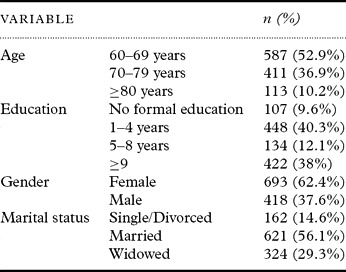
Socio-demographic characteristics of the sample are shown in Table 1. There were no gender differences with respect to age [F(1,1108) = 0.114, p = 0.735] or education (χ2 = 4.879, df = 3, p = 0.181). There were minor age differences with respect to years of education [F(3,1106) = 2.753, p = 0.041]. Post-hoc Tukey test showed that subjects with no formal education tended to be older than participants with nine or more years of formal education (p = 0.055).
Socio-demographic characteristics of the sample

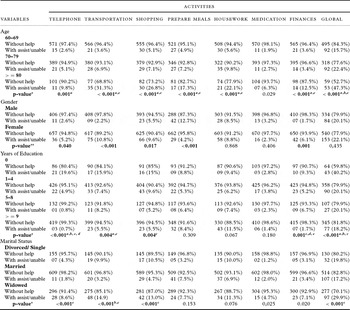
Approximately one-fifth (n = 237, 21.3%) of the subjects in our sample reported need for assistance or being unable to do at least one IADL. The most commonly encountered functional problems were with housework (8.7% of the subjects had reported a disability for this function), followed by shopping (8.1%), transportation (7.6%), preparing meals (7.0%), administering one's own finances (4.4%), using the telephone (4.2%), and medication (2.6%). After dividing these subjects into different groups according to socio-demographic variables, we found associations between many socio-demographic variables and worse IADL performance in the analysis of individual items (Table 2). When global performance was analyzed, we observed associations between worse IADL performance and all socio-demographic variables (p < 0.001) with the exception of gender (p = 0.435) (Table 2).
Subjects with and without disability in IADL and their distribution in relation to age, gender, years of education, and marital status

*Monte Carlo simulated χ2 test with Bonferroni correction for multiple comparisons (corrected level of significance for each analysis is shown in parenthesis). **Monte Carlo simulated χ2 (α = 0.05)
Age Groups: a60–69 group ≠ ≥ 80 group; b60–69 group ≠ 70–79 group; c70–79 group ≠ ≥ 80 group (α′ = 0.0167); Years of Education Groups: a0 group ≠ 1–4 group; b0 group ≠ 5–8 group; c0 group ≠ ≥ 9 group; d1–4 group ≠ ≥ 9 group; e5–8 group ≠ ≥ 9 group (α′ = 0.0125); Marital Status Groups: aSingle/Divorced group ≠ Widowed group; bSingle/ Divorced group ≠ Married group; cMarried group ≠ Widowed group (α′ = 0.0167)
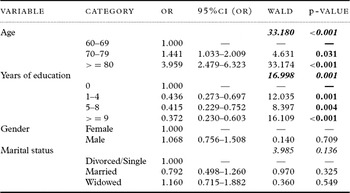
The logistic regression analysis results indicated that “higher age” (p < 0.001) and “lower education” (p = 0.001) remained significantly associated with presence of difficulties in IADL. Compared to the 60–69 year olds, those in the next older decade (70–79 year olds) are approximately 1.5 times more likely to have an IADL impairment, and those a decade or more older (80 years of age or more) are four times more likely to be impaired. Moreover, subjects aged 80 years or more are significantly more likely to be impaired than the 70–79 year olds. Regarding education, subjects with any level of formal education (groups 1–4, 5–8, and 9 or more years of education) had a decreased chance of having difficulties in IADL compared with illiterate subjects. However, in this sample, increasing years of education were not significantly associated with better IADL performance (Table 3). The interaction between age and years of education was tested on a second logistic regression model but it was not significant.
Logistic regression model of association between IADL disability and social-demographic variables using global performance

OR: 1.000 indicates reference category.
Discussion
Our study focused on the functional status of healthy and cognitively intact older persons and its relation to socio-demographic variables using a representative sample from the community. We found that, even in the absence of several conditions that could impact ADL performance, including both cognitive and medical conditions, some subjects reported needing help or being unable to perform some instrumental activities, especially those aged 80 years and over (almost half of the participants from this group reported difficulty in at least one IADL). Compared with those in the seventh decade of life, those in the eighth decade are nearly 1.5 times as likely, and those in the ninth decade and higher four times as likely, to require help with ADLs. On the other hand, with the exception of only a few subjects, there were no reports of need for help with BADL items of the scale.
These results suggest a central role for age in IADL decline and are in agreement with a study that observed disability in old–old cognitively intact subjects (85 years of age or more), even in those without several relevant disease risk factors, and that age was the only significant explanatory variable for moderate to total disability in these subjects (Hogan et al., Reference Hogan, Ebly and Fung1999). Our study also gives support to the finding that the need for help with ADLs almost doubles with each successive decade of living among community-dwelling subjects (Hogan et al., Reference Hogan, Ebly and Fung1999; Fillenbaum et al., Reference Fillenbaum, Blay, Andreoli and Gastal2010).
Though age is not a disease or disorder that directly affects daily functioning, it is associated with changes in several physiologic systems that have been shown to be important for functional status. Recent reports from the literature have given much attention to two different changes associated with age: the decline in attention and executive systems of the brain (Mahoney et al., Reference Mahoney, Verghese, Goldin, Lipton and Holtzer2010) and the loss of muscle mass and strength (sarcopenia) (Cruz-Jentoft et al., Reference Cruz-Jentoft2010).
Executive functioning has been shown to be an important determinant of functional status for both self-reported and performance-based BADL and IADL in community-dwelling older people from different ethnic groups (Grigsby et al., Reference Grigsby, Kaye, Baxter, Shetterly and Hamman1998). Since we have not used any measures of executive function in our sample, one possible explanation for our results may be that those described here as cognitively intact may have had undetected executive impairments that may have influenced their ability to carry out IADL. Future studies should address the relation between executive functions and IADL in older people without relevant risk factors for functional decline (i.e. clinical, neurological, or psychiatric conditions known to affect functional status).
Another possible explanation for the association between increasing age and worse IADL performance may be connected with the age-related loss of muscle mass and strength (sarcopenia) (Cruz-Jentoft et al., Reference Cruz-Jentoft2010). Reduced handgrip strength, which is one of the criteria for sarcopenia, has been shown to be a predictor of IADL decline in a 3-year follow-up study with non-disabled Japanese aged 65 years or more (Ishizaki et al., Reference Ishizaki, Watanabe, Suzuki, Shibata and Haga2000). Therefore, it would also be important for future studies to investigate the relation between primary sarcopenia (i.e. sarcopenia with no other evident cause than aging) and IADL performance.
The data presented here on IADL decline in healthy and cognitively intact seniors has several implications. First, in agreement with the study of Hogan et al. (Reference Hogan, Ebly and Fung1999), our study suggests that prevention of several medical and cognitive conditions that have been shown to affect IADL would only be partially effective in maintaining independent functioning in old–old subjects. This is particularly important for public policies, since the need for help with ADL adds a significant burden to healthcare services, family members, and caregivers (Ramos et al., Reference Ramos, Simões and Albert2001). Thus, further studies on factors associated with prevention of IADL impairment are needed.
Our findings also have implications related to clinical practice. Although many studies have attempted to rule out factors related to or predictive of functional decline in older people, no consensus has been reached on what to expect from a person of a given age in terms of IADL or ADL in the absence of medical conditions that could account for functional decline. This is particularly important for clinical purposes, since ADL decline is an essential feature of dementia (American Psychiatric Association, 2000; McKhann et al., Reference McKhann2011). In a recent publication from the National Institute on Aging and the Alzheimer's Association, it has been determined that the diagnosis of dementia is applicable only if the subject has cognitive or behavioral (neuropsychiatric) symptoms that interfere in ADL and at work and represent a decline from previous levels of functioning and performing (McKhann et al., Reference McKhann2011). A critical feature of these criteria for dementia is that determination of whether or not there is ADL disability is a clinical judgment made “on the basis of the individual circumstances of the patient” and “description of daily affairs of the patient obtained from the patient and from a knowledgeable informant” (McKhann et al., Reference McKhann2011, p. 3). If ADL decline is to be judged, then it would be helpful to make this judgment based on established criteria on IADL in healthy and cognitively intact seniors.
Another main finding of our study was that subjects with no education tended to have more difficulties in IADL in comparison with educated subjects. In a meta-analysis of the literature, Depp and Jeste found that in developed countries, health-related and biological variables are the strongest factors related to successful aging (Depp and Jeste, Reference Depp and Jeste2006), with little evidence that demographic variables influence this process. Our results appear contrary to Depp and Jeste's findings (Depp and Jeste, Reference Depp and Jeste2006). However, as shown by a recently published study conducted in Brazil (Chaves et al., Reference Chaves, Camozzato, Eizirik and Kaye2009), social-economic and social-demographic variables may have an important role in IADL decline in developing countries. In fact, education has been related to IADL performance in previous studies conducted in the Brazilian population (Parahyba and Veras, Reference Parahyba and Veras2008; Santos et al., Reference Santos, Lebrão, Duarte and Lima2008). Results from the logistic regression analysis conducted here showed that education is significantly associated with functional status along with age, corroborating Chaves et al. (Reference Chaves, Camozzato, Eizirik and Kaye2009).
Since the Brazilian population is heterogeneous regarding socio-demographic variables, and in view of the large number of older people with low education in the country, it is important to understand the effects of lifetime schooling and cognitive stimulation on functional status. Our results suggest that low education has an effect on functional status even in the absence of medical conditions that could affect IADL performance.
The current study had some limitations. First, due to the criteria of functional and cognitive impairment used (Lopes et al., Reference Lopes2007; Bottino et al., Reference Bottino2008), some normal subjects (i.e. without cognitive and functional impairment) may have been excluded from the analysis. Second, we could not be sure that all medical conditions responsible for IADL decline were absent. For example, we did not exclude subjects based on the presence of conditions such as diabetes or arterial hypertension, which have been reported to have an effect in IADL performance in community-dwelling older persons (Reynolds and Silverstein, Reference Reynolds and Silverstein2003). Furthermore, since clinical data were obtained from self-report, subjects may have had subtle hearing and vision impairments that might impact at some level their ability to perform activities of daily living. Therefore, it would be interesting to test subjects who are healthy and cognitively intact and also do not have conditions we could not control in our study.
We also collected medical data from reports of participants, which can present problems regarding the accuracy of information. However, a recent report from the literature shows that evaluation of mental-physical comorbidity based on physician-diagnosed and patient self-report can yield similar results and have high rates of agreement (Baumeister et al., Reference Baumeister, Kriston, Bengel and Härter2010).
A final limitation comes from the fact that we assessed the effects of age and other socio-demographic variables using a cross-sectional design. In order to overcome possible cohort effects, future studies should use a longitudinal analysis.
In spite of these limitations, the current study suggests that functional decline in IADL might be part of a “normal” aging process. In that sense, it is a process that is likely to occur independently of other factors, being accelerated or becoming “pathological” when other conditions are present (medical conditions, for example).
Conflict of interest
None.
Description of authors' roles
C.M.C. Bottino and M.A. Lopes designed the epidemiological studies that originated the data used in this paper and supervised the data collection. J. Litvoc assisted in the design of these epidemiological studies. P.F. Zuccolo formulated the research questions reported here, analyzed the data, and wrote the paper. R. Avila assisted with formulating the research questions and writing the paper. C.M.C. Bottino supervised the elaboration of this paper. E.Y. Nakano was responsible for the statistical design of the study and for carrying out the statistical analysis.
Acknowledgments
Both epidemiological studies were supported by Fundação de Apoio à Pesquisa do Estado de São Paulo (FAPESP) (grant No 01/05959-7).
We would like to thank Mariana Kneese Flaks, PhD, for her support and suggestions on the elaboration of this paper.