Recognized as one of the most important pathogens in healthcare settings, Clostridioides difficile resulted in half a million infections among US inpatients in 2011.Reference McDonald, Gerding and Johnson1 Although much is known about the contribution of symptomatic patients to transmission of C. difficile in healthcare settings, asymptomatic C. difficile colonization has recently garnered attention as a potential reservoir for transmission. Asymptomatic carriage is being increasingly recognized among hospitalized adults, which has resulted in anecdotal reports of identification and isolation of these patients despite a lack of recommendations on testing or management. We conducted a survey to assess current clinical testing practices for asymptomatic carriers of C. difficile and to determine whether such testing is common.
Methods
The Infectious Diseases Society of America (IDSA) Emerging Infections Network (EIN) is a provider-based emerging infections sentinel network,Reference Pillai, Beekmann, Santibanez and Polgreen2 which is funded by the Centers for Disease Control and Prevention (CDC) and sponsored by the IDSA. EIN surveyed 1,309 US-based adult infectious disease specialists from November 29 through December 23, 2017. Two reminders followed an initial invitation by e-mailed link or faxed paper copy to nonresponders. No incentive for participation was provided. A confidential 9-question multiple choice/open-ended survey contained questions regarding identification of patients with asymptomatic carriage of C. difficile, isolation, and management. Data analysis was performed with SAS version 9.4 software (SAS Institute, Cary, NC). For open-ended questions, comments were systematically reviewed, coded for relevant themes, and grouped into categories.
Results
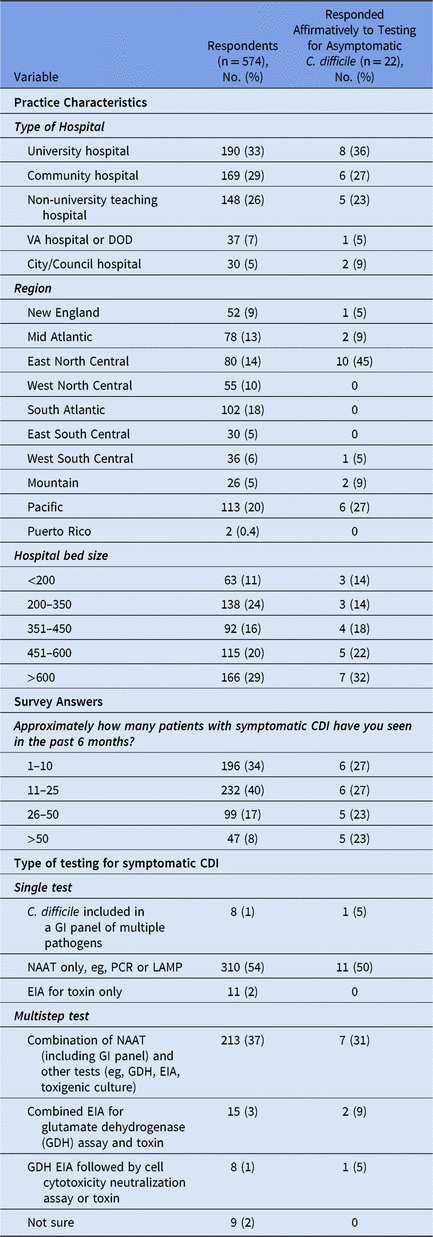
A total of 679 EIN physician members completed the survey, for a response rate of 52%. Of these, 105 respondents (15%) indicated that they had not seen patients with symptomatic CDI in the past 6 months and were excluded from further analysis; none of these 105 respondents reported testing asymptomatic patients. The remaining 574 (85%) respondents indicated that they had seen patients with symptomatic C. difficile infection (CDI) in the past 6 months. Of these, 166 (29%) worked in a hospital with >600 hospital beds, and 523 (91%) indicated that the nucleic acid amplification test (NAAT) was either conducted as a single step or in multistep algorithm laboratory testing for symptomatic C. difficile (Table 1). Of the 574 respondents, 22 (4%) indicated testing patients for asymptomatic carriage of C. difficile. Of these 22 respondents, 36% practiced in university-affiliated hospitals and 32% in >600 bed hospitals (Table 1).
Characteristics of Respondents and Those That Responded Affirmatively to Testing for Asymptomatic Patients, EIN Survey, 2017

Note. VA, Veterans Affairs; DOD, Department of Defense; NAAT, nucleic acid amplification test; PCR, polymerase chain reaction; LAMP, loop-mediated isothermal amplification EIA, enzyme immunoassay; GI, gastrointestinal; GDH, glutamate dehydrogenase.
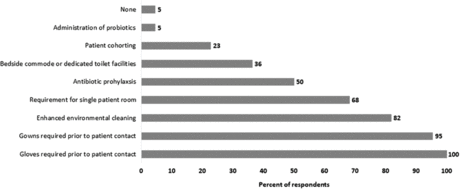
Of those who reported testing patients to detect asymptomatic carriers, the reasons for screening included (1) being cared for on selected units (n = 11, 50%) such as intensive care and oncology/hematopoietic cell transplant units, having a previous history of CDI (n = 5, 23%), (2) being in long-term care prior to admission (n = 4, 18%), and (3) being part of a hospital-wide nonselective screening approach (n = 4, 18%). Rectal swab (n = 11, 50%) was the most common specimen tested. Once asymptomatic carriage of C. difficile was detected, contact precautions were most often instituted, followed by enhanced environmental cleaning (Fig. 1). Of those who reported using antibiotic prophylaxis (n = 10) in detected asymptomatic carriers, oral vancomycin (80%) was the most commonly used antibiotic. The most common reasons for prescribing antibiotic prophylaxis included use of other antibiotics (50%) and because carriage was identified (40%). Among asymptomatic carriers who developed diarrhea (n = 18), repeat C. difficile testing was performed in 44%; empiric treatment without repeat testing was started in 39%.
Reported interventions when asymptomatic C. difficile carriers were detected, Emerging Infections Network Survey, 2017 (n = 22).

Discussion
A nationwide survey among US infectious disease physicians indicated that screening for asymptomatic carriers for C. difficile among hospitalized adults was uncommon. The low occurrence of screening for asymptomatic carriers may be indicative of uncertainty regarding their contribution to transmission, lack of data on how to act on this information, and costs associated with active surveillance. In addition, at the time of the survey, the guidelines recommended neither detection nor management of such patients.Reference Dubberke, Carling and Carrico3 The current 2017 IDSA/SHEA guidelines reiterate this recommendation.Reference McDonald, Gerding and Johnson1
Prevalence of asymptomatic colonization in the community settings has varied from 0% to 18% among healthy adults.Reference Galdys, Nelson and Shutt4, Reference Schaffler and Breitruck5 In acute-care settings, colonization has ranged from 5% to 21%, and in long-term care facilities colonization has ranged from 0% to 51%.Reference Furuya-Kanamori, Marquess and Yakob6, Reference Crobach, Vernon and Loo7 Approximately 15% of asymptomatic carriers receive the diagnosis of CDI.Reference McDonald, Gerding and Johnson1 Based on the existing but limited information, the incubation period is considered relatively short in most patients. However, the etiology of diarrhea in previously asymptomatic carriers, whether due to C. difficile or other causes, may be unclear. Additionally, asymptomatic carriers, including those who have recovered from CDI but remain colonized, may have developed antibodies that protect them from the effects of C. difficile toxins, but may still serve as a potential reservoir for transmission to others within a healthcare setting and in the community.Reference Crobach, Vernon and Loo7, Reference Longtin, Paquet-Bolduc and Gilca8
The most common reasons reported for screening in this survey were concerns about CDI in vulnerable patient populations (intensive care units, oncology and/or HCT units, previous history of CDI) and the previous location where the patient resided. The survey did not ask at what point during the patient’s hospital care that screening was performed. Although real-time interventional studies are scarce, mathematical modeling studies predict that screening for C. difficile carriage on admission could mitigate healthcare-associated CDI (HA-CDI) when bundled with other prevention measures.Reference Longtin, Paquet-Bolduc and Gilca8, Reference Grigoras, Zervou, Zacharioudakis, Siettos and Mylonakis9 A single-center quasi-experimental study by Longtin et alReference Longtin, Paquet-Bolduc and Gilca8 demonstrated a 62% reduction in the rates of CDI after implementing an active surveillance protocol. In a recent study of outbreaks, the same authors did not find a difference in rates when screening was instituted.Reference Paquet-Bolduc, Gervais and Roussy10 Currently, patient screening either at the time of hospital admission or during hospitalization is not recommended.Reference McDonald, Gerding and Johnson1 Although rectal swabs were the most commonly reported screening specimen, often the perirectal swab is used. Perirectal swab samples have 70%–99% sensitivity for the detection of C. difficile colonization, which is comparable with rectal swab samples; however, perirectal swabs are less invasive and may be used in patients with neutropenia.Reference Crobach, Vernon and Loo7
Of concern is the use of antibiotics in carriers. As mentioned earlier, at the time of this survey, the 2014 Strategies update recommended against treatment or decolonization of asymptomatic carriers.Reference Dubberke, Carling and Carrico3 This has been reiterated in the recent IDSA/SHEA updated clinical practice guidelines, which recommend against treatment if such a patient were to be identified due to the lack of evidence.Reference McDonald, Gerding and Johnson1 Treatment of carriers failed to show benefit in eradicating disease or reducing rates of HA-CDI and studies suggest that oral vancomycin may be particularly disruptive to the microbiome and may increase the risk for CDI once stopped.Reference Johnson, Homann and Bettin11
The results of this survey may not be generalizable because the survey was sent to EIN members who may not be representative of the majority of infectious disease physicians. In addition, self-reported responses may be subject to bias.
Screening to detect asymptomatic carriers appears to be an uncommon practice. Future studies that improve our understanding of asymptomatic C. difficile carrier epidemiology (including burden), risk they pose for transmission (eg, duration of shedding, contagiousness, infectious dose), and of the effects of interventions that might prevent transmission to others (eg, transmission-based precautions, use of antibiotics, and unintended consequences) may better inform those who identify and manage these patients, and how these patients impact transmission within healthcare settings.
Acknowledgements
The cross-sectional survey was created in collaboration with Alexander Kallen, MD, MPH (DHQP, CDC, Atlanta). We thank the infectious disease physicians who participated in this survey. The findings and conclusions in this report are those of the authors and do not necessarily represent the official position of the Centers for Disease Control and Prevention (CDC). Its contents were solely the responsibility of the authors and do not necessarily represent the official views of the CDC or the Department of Health and Human Services.
Financial support
Support for the survey was provided by the Centers for Disease Control and Prevention (Cooperative Agreement no. 1 U50 CK000477).
Conflicts of interest
Dr Dubberke reports grants from Centers for Disease Control and Prevention. All other authors report no conflicts of interest relevant to this article.