Reading is a fundamental human capacity. The mechanisms by which the human brain decodes single words have been of special interest to a broad cross section of researchers. Despite much progress that has ever been made, there remains a matter of active debate concerning whether visual word recognition involves discrete and sequentially organized modules or a highly interactive system (e.g.,Carreiras et al., Reference Carreiras, Armstrong, Perea and Frost2014; Heilbron et al., Reference Heilbron, Richter, Ekman, Hagoort and Lange2020; Price & Devlin, Reference Price and Devlin2011; Whaley et al., Reference Whaley, Kadipasaoglu, Cox and Tandon2016).
The temporally modular feedforward models propose that visual word recognition is processed in discrete, hierarchically organized modules in a feedforward manner (Coltheart & Curtis, Reference Coltheart and Curtis1993; Jobard, Crivello & Tzourio-Mazoyer, Reference Jobard, Crivello and Tzourio-Mazoyer2003; Levy et al., Reference Levy, Pernet, Treserras, Boulanouar, Berry, Aubry, Demonet and Celsis2008). Feedforward theorists assert that only when orthographic access is completed does other higher-level linguistic representations (e.g., phonology, morphology, semantics) begin to proceed (Davis, Reference Davis2012). However, according to the interactive activation (IA) models, mental processes are cascaded in a way that all processes are operating continuously, with the current (partial) output of one process immediately available as an input for the upcoming process (Mcclelland, Reference Mcclelland1979). Mcclelland and Rumelhart (Reference Mcclelland and Rumelhart1981) later extended this formulation in which ongoing activation of a higher-level process feeds back to a lower-level process. Connectionists posit a highly interactive system in which word recognition is achieved with bidirectional connections between lower- and higher-level representations throughout the entire orthographic–phonological–lexical–semantic network (Seidenberg, Reference Seidenberg2010).
A central focus of empirical studies in visual word recognition literature is the nature of the processes in which two or more independent variables produce additive or interactive effects on response times (RTs) or event-related potentials (ERPs) (Borowsky & Besner, Reference Borowsky and Besner1993; Holcomb, Reference Holcomb1993; O’Malley, Reynolds & Besner, Reference O’Malley, Reynolds and Besner2007; Scaltritti, Balota & Peressotti, Reference Scaltritti, Balota and Peressotti2013; van Petten & Kutas, Reference van Petten and Kutas1990; Yap & Balota, Reference Yap and Balota2007). By the additive-factors logic (Sternberg, Reference Sternberg1969), additive effects of two factors suggest that these two factors influence discrete stages of processing independently; in contrast, interactive effects are taken as evidence that these two factors influence at least one stage of processing in common. Stimulus quality, word frequency, and semantic context are the most studied three psycholinguistic variables in visual word recognition literature and reflect processes at the orthographic, lexical, and semantic levels, respectively (e.g., Aschenbrenner & Yap, Reference Aschenbrenner and Yap2019; Stolz & Besner, Reference Stolz and Besner1998; Yap, Balota & Tan, Reference Yap, Balota and Tan2013). The joint effects among those three variables are often taken as evidence which can shed light on the feedforward versus interactive debate concerning the underlying cognitive mechanism of visual word recognition.
Behavioral research has presented a conundrum: stimulus quality and word frequency yield additive effects, but both variables interact with semantic context. One account to resolve the additive–interactive discrepancy may be that the nature of the process in visual word recognition is task dependent (e.g., O’Malley et al., Reference O’Malley, Reynolds and Besner2007; Scaltritti et al., Reference Scaltritti, Balota and Peressotti2013; Yap & Balota, Reference Yap and Balota2007). For example, Yap and Balota (Reference Yap and Balota2007) found that additive effects of stimulus quality and word frequency were only observed in the lexical decision task (LDT) while interactive effects were found in both pronunciation and semantic categorization tasks. As such, addictive effects may reflect task-specific lexical decision operations rather than the underlying mechanism of word recognition system (O’Malley et al., Reference O’Malley, Reynolds and Besner2007; Scaltritti et al., Reference Scaltritti, Balota and Peressotti2013; Yap & Balota, Reference Yap and Balota2007).
Different from behavioral measures which reflect an end state of processing in the system as a whole, electroencephalography (EEG) taps the synchronized neuronal activity over time evoked by some cognitive event. With this inherent advantage, EEG allows us to delve into the internal temporal dynamics underlying the neural processes involved in visual word recognition (Carreiras et al., Reference Carreiras, Armstrong, Perea and Frost2014). Thus, the introduction of this time-sensitive technique with a temporal resolution in milliseconds can provide direct temporal evidence regarding how information flows in the brain circuits.
The N150/170 and N250 are among two earlier markers of visual word recognition. The left lateralized N150/170 is sensitive to orthographic stimuli but not to other stimuli such as symbols (Duñabeitia et al., Reference Duñabeitia, Dimitropoulou, Grainger and Hernández2012). This early ERP component is significantly larger to mismatches between prime and target letter case (Petit et al., Reference Petit, Grainger, Midgley and Holcomb2005). The N250 is sensitive to orthographic similarity (i.e., the degree of prime–target orthographic overlap), being larger for targets that partly overlap with their primes than targets that completely overlap with their primes. The N250 has a wide-spread scalp distribution over frontal scalp areas (Grainger & Holcomb, Reference Grainger and Holcomb2009; Holcomb & Grainger, Reference Holcomb and Grainger2006). Moreover, N250 is also modulated by lexical factors such as letter identity or the phonological status of the letters (Duñabeitia, Perea & Carreiras, Reference Duñabeitia, Perea and Carreiras2009). Traditionally, the N400, a negative-going potential that peaks centroparietally over the scalp approximately 400 ms after stimulus onset, is a reflection of post-lexical aspects of semantic analysis (Kutas & Hillyard, Reference Kutas and Hillyard1980). N400 amplitudes are found to be larger for words that are unrelated to their primes. The N400 is also sensitive to orthographic and/or phonological analysis (Deacon et al., Reference Deacon, Dynowska, Ritter and Grose-Fifer2004). Additionally, the P200, which is basically associated with visual processes, is reported to be sensitive to sublexical orthographic or phonological processing in visual Chinese character processing with a positive wave distributed at the frontal-central sites (Hsu et al., Reference Hsu, Tsai, Lee and Tzeng2009; Kong et al., Reference Kong, Zhang, Zhang and Kang2012; Kong et al., Reference Kong, Zhang, Kang, Du, Zhang and Wang2010).
However, there are only a couple of ERP studies with conflicting findings which have examined the joint effects among stimulus quality, word frequency, and semantic context in visual word recognition (Holcomb, Reference Holcomb1993; van Petten & Kutas, Reference van Petten and Kutas1990; Zhang, Zhou & Wang, Reference Zhang, Zhou and Wang2020). Actually, the effects of stimulus degradation on behavioral and ERP measures of semantic priming were earlier examined by Holcomb (Reference Holcomb1993). In a block of trials, the target words or pseudowords, which were preceded by either semantically related or unrelated prime words, were presented in an intact manner (intact block) or a degraded manner (degraded block). Subjects were asked to make speeded lexical decisions. Behaviorally, subjects made faster and more accurate responses to semantically related target words than to unrelated ones (behavioral semantic priming effect), and faster and more accurate responses to intact target words than to degraded ones (behavioral stimulus degradation effect). The interaction between semantic context and stimulus quality was observed with the priming effects being greater when the target was degraded. At the electrophysiological level, although semantically unrelated target words were found to elicit larger N400 than related ones (ERP semantic priming effect), no significant ERP difference between the intact and degraded blocks was observed (ERP stimulus degradation effect) in the time domain of the N150/170, P200, and N400 components. Moreover, there was no significant interaction between these two factors on any ERP components. This earlier ERP result seemed to run counter to the IA models.
In contrast, the interactive effects of two variables reported by a couple of ERP studies (van Petten & Kutas, Reference van Petten and Kutas1990; Zhang et al., Reference Zhang, Zhou and Wang2020) provide evidence in favor of the IA models. An earlier ERP study examined the effects between word frequency and sentence context (i.e., linear word position in the sentence) in a reading task (van Petten & Kutas, Reference van Petten and Kutas1990), wherein frequency effects reflect lexical-level processing and word position effects index the increasing influence of context at the post-lexical level. An interaction between these two factors was observed, with N400 frequency effects being prominent for the sentence-initial words, attenuated for the sentence-intermediate words, and absent for the sentence-final words. Thus, word frequency seemed not to influence N400 amplitude for words presenting late in a sentence. Moreover, in a recent ERP study we observed a significant interaction between stimulus quality and word frequency on N400-like amplitude in visual Chinese character recognition (Zhang et al., Reference Zhang, Zhou and Wang2020). Specifically, in a trial, the target stimulus, which was either a one-character Chinese word of high frequency or low frequency, was presented in either high or slight degradation. Then a probe character followed which was either identical to or different from the target one. Subjects were required to make target–probe matching judgments. The behavioral results showed a significant degradation by frequency interaction with the RTs being slower for the target stimuli in high degradation than for those in slight degradation in the low-frequency condition. The ERP results also demonstrated a significant degradation by frequency interaction on N400-like amplitude. Therefore, both behavioral and ERP results converged on the interaction of these two factors.
Scarce evidence as there may be, the conflicting ERP findings from the absence of a stimulus degradation by semantic priming interaction in Holcomb’s study (1993) and from the presence of interactions between stimulus quality and word frequency in our recent study (Zhang et al., Reference Zhang, Zhou and Wang2020) and between sentence context and word frequency in an earlier study (van Petten & Kutas, Reference van Petten and Kutas1990) prompt a revisit to the joint effects of stimulus quality and semantic context on ERP components. This helps to adjudicate the theoretical debate between temporally modular feedforward processing and highly interactive processing during visual word recognition on one hand and to delineate the above-mentioned behavioral conundrum on the other.
The present ERP study aimed to determine whether the joint effects of stimulus quality and semantic context were additive or interactive in visual word recognition. Stimulus quality refers to whether a visual stimulus is presented in an intact or degraded manner. Intact words are recognized faster and more accurately than degraded words (Becker, Reference Becker1979). Meanwhile, words preceded by semantically related primes (e.g., DOG–CAT) are recognized faster and more accurately than words preceded by unrelated primes (e.g., MOON–CAT), yielding semantic priming effects (Meyer, Schvaneveldt & Ruddy, Reference Meyer, Schvaneveldt, Ruddy and Rabbitt1975). Stimulus quality is often considered to influence an early pre-lexical encoding stage (Besner & Roberts, Reference Besner and Roberts2003; Holcomb, Reference Holcomb1993; Reynolds & Besner, Reference Reynolds and Besner2004), while semantic priming effects are taken as a marker of a later semantic processing. It is well documented in behavioral studies that there is an interaction between stimulus quality and semantic context on the RTs, with larger semantic priming effects for degraded targets than for intact ones (e.g., Balota et al., Reference Balota, Yap, Cortese and Watson2008; Becker & Killion, Reference Becker and Killion1977; Besner & Smith, Reference Besner and Smith1992; Borowsky & Besner, Reference Borowsky and Besner1993; Brown & Besner, Reference Brown and Besner2002; Meyer et al., Reference Meyer, Schvaneveldt, Ruddy and Rabbitt1975; Thomas, Neely & O’Connor, Reference Thomas, Neely and O’Connor2012). However, some studies indicated additive effects (i.e., no interaction) between these two factors (e.g., Aschenbrenner & Yap, Reference Aschenbrenner and Yap2019; Brown & Besner, Reference Brown and Besner2002; Ferguson, Robidoux & Besner, Reference Ferguson, Robidoux and Besner2009; Robidoux, Stolz & Besner, Reference Robidoux, Stolz and Besner2010; Stolz & Neely, Reference Stolz and Neely1995).
Despite addressing the identical variables, the present study differed from Holcomb’s study (1993) in two aspects: first, different levels of degradation were used in the present study (i.e., slightly vs. highly degraded) and Holcomb’s study (i.e., intact vs. slightly degraded). In Holcomb’s study (1993), null ERP stimulus degradation effect was observed, suggesting that there might be a ceiling effect for the slightly degraded words which can be accessed as easily as intact words. However, in our previous study using slightly and highly degraded stimuli (Zhang et al., Reference Zhang, Zhou and Wang2020), ERP stimulus degradation effect was found. Second, different tasks were used in the present study (i.e., delayed character-matching task, DCMT) and Holcomb’s study (i.e., LDT). Using a LDT may elicit a decision-related P300 that overlaps with N400 and thus contaminates N400 (Deacon et al., Reference Deacon, Dynowska, Ritter and Grose-Fifer2004). Moreover, using a DCMT, our previous study found an interaction between stimulus quality and word frequency on N400 (Zhang et al., Reference Zhang, Zhou and Wang2020).
Subjects were instructed to make target–probe matching (i.e., identical or different) judgments of one-character Chinese words in a prime–target–probe trial flow. We manipulated the target character at two levels of visual degradation (high, slight) and at two levels of semantic priming (related, unrelated). For the manipulation of stimulus degradation, the present study manipulated stimulus quality of the target character at two (high vs. slight) degradation levels, identical to our previous study (Zhang et al., Reference Zhang, Zhou and Wang2020). For the manipulation of semantic context, the target character was either semantically related or unrelated to the prime character. Previous ERP research on visual word recognition has defined a series of components (for a review, see Grainger & Holcomb, Reference Grainger and Holcomb2009). Among these ERP components, the N250 and the N400 are of specific interest for the present study because the N250 is sensitive to orthographic similarity (Carreiras et al., Reference Carreiras, Gillon-Dowens, Vergara and Perea2009) and the N400 is modulated by semantic processing (Kutas & Hillyard, Reference Kutas and Hillyard1980). Based on the ERP findings in relevant previous studies (van Petten & Kutas, Reference van Petten and Kutas1990; Zhang et al., Reference Zhang, Zhou and Wang2020), we predict that there would be an interactive effect between stimulus quality and semantic context on the N400 component. If the joint effect of stimulus quality (i.e., the orthographic level) and semantic context (i.e., the semantic level) is interactive, then it suggests that the lower-level representation continuously cascades into the higher-level semantic network, thus yielding an interaction with bidirectional connections between orthographic and semantic nodes. Moreover, we predict that there would be N250 degradation effects, on the basis of our previous ERP study which found that the character degradation elicited N250-like effects (Zhang et al., Reference Zhang, Zhou and Wang2020). Behaviorally, we predict that there would be an interaction of stimulus quality and semantic context on the RTs, based on previous studies (Scaltritti et al., Reference Scaltritti, Balota and Peressotti2013; Yap et al., Reference Yap, Balota and Tan2013; Yap & Balota, Reference Yap and Balota2007).
Materials and methods
Subjects
Twenty right-handed students (11 females, nine males; mean age = 21.6, SD = 1.9) from a local university were paid to participate in this study. All the subjects reported to have normal or corrected-to-normal vision and were native Chinese speakers. A written informed consent was collected from each subject. The study protocol was approved by the Ethics Committee of Southwest University, China.
Design and materials
The experiment followed a 2 (priming: related, unrelated) × 2 (degradation: high, slight) within-subject design. All stimuli were one-character Chinese words. We firstly chose 400 pairs of semantically related words out of 800 words as candidate stimuli (Beijing Language Institute, 1986). An independent cohort of 20 undergraduates assessed the semantic relatedness of these word pairs with a 7-point scale. Based on the screening of semantic relatedness (M = 5.35 points, SD = 1.37), we finally selected 560 words that yielded 280 prime–target pairs of the most semantically related words as the experimental stimuli (see Appendix). For priority consideration of semantic relatedness, the prime–target character frequency defied a match. As such, the prime character group (for frequency: M = 210.85 per million, SD = 546.81; for stroke count: M = 9.94, SD = 3.22) and the target character group (for frequency: M = 40.72 per million, SD = 13.02; for stroke count: M = 10.10, SD = 3.34) differed in frequency (t = 5.229, p < .001) but matched in stroke count (t = 0.411, p > .05).
From the master list, four sublists with each 70 prime–target related pairs were formed. Prime–target unrelated pairs were formed by rearranging related primes and targets in each sublist so that there was no prime–target semantic association. A Latin-square counterbalance design was used such that across subjects each sublist occurred in the related and unrelated condition and in the highly and slightly degraded condition an equal number of times, but within subjects each sublist was presented once.
One hundred and forty additional characters (for frequency: M = 45.03 per million, SD = 45.97; for stroke count: M = 10.15, SD = 3.06) and 140 characters out of the 280 targets were selected to serve as probes in a prime–target–probe trial flow. The target–probe pairs were pseudo-randomly arranged in each of four experimental conditions (i.e., related vs. unrelated, highly vs. slightly degraded), with one half of trials being the target–probe different and the other half identical.
For stimulus degradation manipulation, the target stimuli were configured as follows. Each target character in black font ST (Song Ti) 39 pt was at the center of a 245 × 245 pixel white background in a Macromedia Flash 8.0 environment (Macromedia Company, San Francisco, CA, USA) and saved as a smoothed bitmap image. The image was then impoverished with the PicFrag program (Snodgrass & Hirshman, Reference Snodgrass and Hirshman1991) into a highly (level 5) or slightly (level 6) degraded stimulus, with the proportions of unmasked pixels for two levels being 34% and 49%, respectively, using the formula to calculate the unmasked ratio Ps (exposure ratios) for the degraded images [i.e., P (block pixel, level n) = r (8 –- level n), where r = 0.7, the block pixel is 16 × 16 when the level is equal to 5 and 6]. Finally, the image size was readjusted to 45 × 45 pixels and further reversed into a white character in a black background with Adobe Photoshop (8.0 version). Likewise, the prime stimuli in font ST 39 pt and the probe stimuli in font XKT (Xing Kai Ti) 39 pt were similarly configured but without being impoverished. The prime and target stimuli were always the same in font, whereas the target and probe stimuli differed in font such that subjects made target–probe matching on the basis of the characters’ whole identities rather than their partial visual features. The size of each image was 1.43° both vertically and horizontally.
Procedure
Each subject completed four experimental blocks in which targets in related highly degraded (R-H), unrelated highly degraded (UR-H), related slightly degraded (R-S), or unrelated slightly degraded condition (UR-S) were randomly assigned to each block. A 16-trial practice block preceded the experiment using additional characters. There was a 3-min break between blocks.
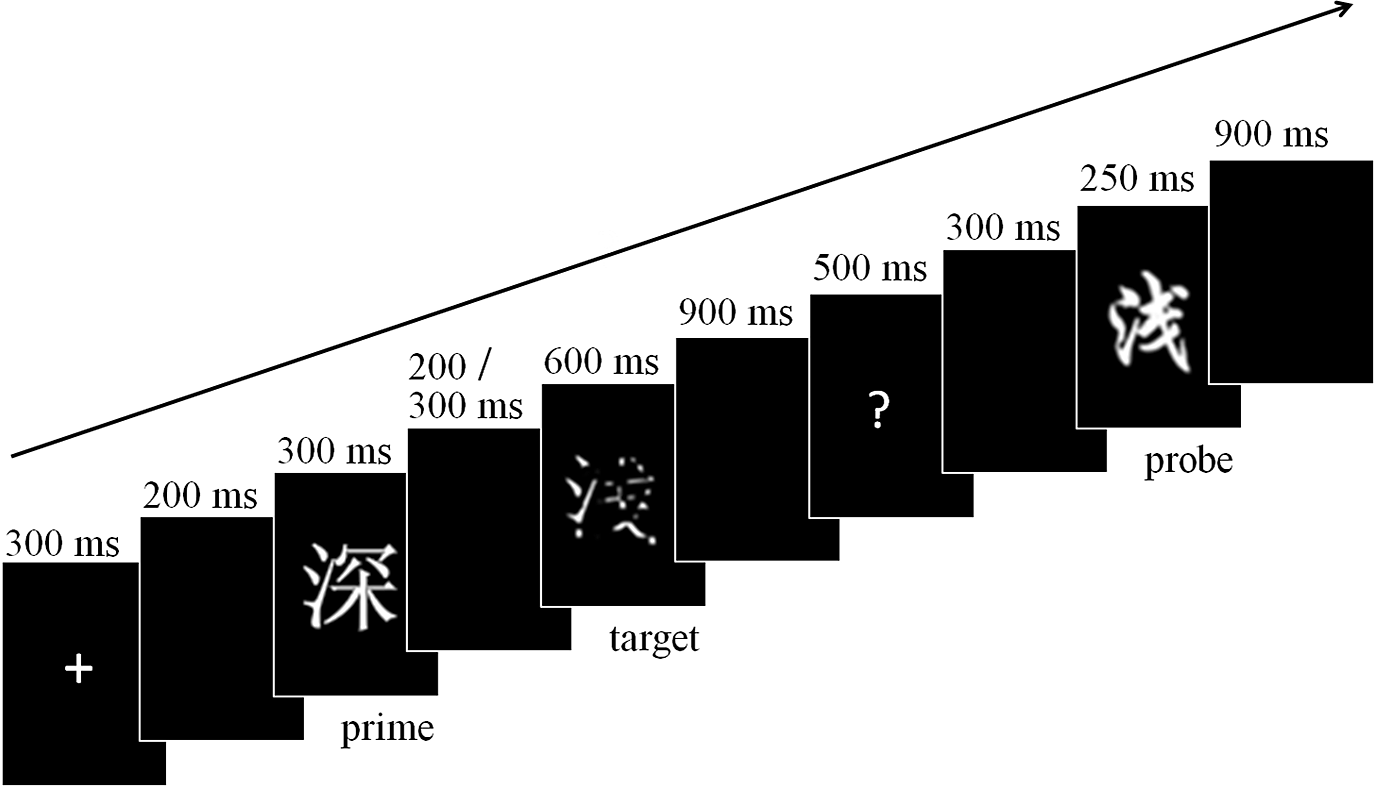
Each trial followed a prime–target–probe flow (see Figure 1): a) a 300-ms cross fixation, followed by a 200-ms blank screen; b) a 300-ms prime character, followed by a blank screen for 200 ms or 300 ms at random; c) a target character in either high or slight degradation, which was either semantically related or unrelated to the preceding prime character, was presented for 600 ms, followed by a 900-ms blank screen; d) a 500-ms question mark, followed by a 300-ms blank screen; and e) a probe character, which was either identical to or different from the target, was presented for 250 ms, followed by a blank screen which remained on the screen for 900 ms or disappeared upon responses. Subjects were required to make target–probe matching (i.e., identical or different characters) judgments by button pressing as quickly and accurately as possible upon the probe presentation. The thumbs used for “yes (i.e., identical)” and “no (i.e., different)” responses were counterbalanced across subjects. Subjects were advised to blink only in the interval between the trials.
A prime–target–probe trial flow. The target character which is presented in either slight or high degradation is preceded by either a semantically related or unrelated prime character. The target character is then followed by a probe character which is either identical to or different from the target character. Subjects make target–probe matching judgments.

ERP recording and data analysis
EEG was recorded from 64 scalp sites with tin electrodes mounted on an elastic cap (Brain Products GmbH, Germany). The EEG data were referenced to the left and right mastoids (i.e., averaged mastoid reference) and a ground electrode was placed on the medial frontal aspect (at AFz electrode). Moreover, vertical eye movements were recorded with electrodes placed on the supraorbital and infraorbital ridges of the right eye. Horizontal eye movements were measured with electrodes laterally placed on the outer canthi of both eyes. The EEG and electrooculogram (EOG) signals were amplified through a bandpass filter of 0.01–100 Hz and digitally sampled at 500 Hz per channel. The impedance of all electrodes was <5 kΩ.
ERPs were time-locked to the onset of the target, with the 200-ms pre-target period used as a baseline. The EEG pattern was segmented into epochs beginning at 200 ms before the target, which lasted for 800 ms after the target. For each condition with 70 trials, only epochs associated with correct responses were averaged. Excluded from the average were the trials with EOG artifacts (i.e., trials in which the EOG voltage exceeded ± 80 μV), amplifier clippings, bursts of electromyographic activity, or peak-to-peak deflections exceeding ± 80 μV, leaving the averaging numbers of the segments as 59.81 (SD = 6.12), 56.94 (SD = 5.75), 64.25 (SD = 6.26), and 63.38 (SD = 6.07) for R-H, R-S, UR-H, and UR-S conditions, respectively.
Results
Behavioral data
Linear mixed effects were performed for the analyses of RTs (including only correct responses) and accuracy, respectively. All analyses were carried out in R (v.3.1.2; R Core Team, 2018), using the lme4 (v.1.1-21; Bates et al., Reference Bates, Mächler, Bolker and Walker2014) and lmerTest (v.3.1-0; Kuznetsova, Brockhoff & Christensen, Reference Kuznetsova, Brockhoff and Christensen2017).
Response times
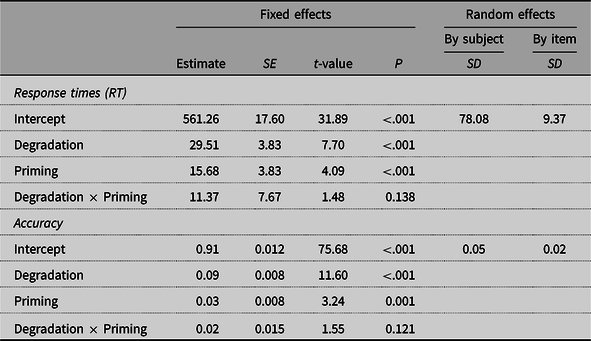
Response errors and RTs exceeding a threshold of three SDs by subject and by condition were excluded from analysis (11.5% of the data). RTs were entered as the dependent variable in a linear mixed model analysis (see Table 1). Degradation and priming were entered as fixed effects, while subject and item were entered as random effects. The analysis yielded a significant main effect of degradation (estimate = 29.51, p < .001), with subjects responding faster to slightly than to highly degraded characters (546 ms vs. 576 ms), and a significant main effect of priming (estimate = 15.68, p < .001), with subjects responding faster to related than to unrelated characters (553 ms vs. 569 ms). The interaction was not significant (estimate = 11.37, p = .138). Then, we conducted statistical power analyses for the interaction of stimulus degradation and semantic priming on the RTs using R software with pwr (https://CRAN.R-project.org/package=pwr). According to the equation, the effect size f was 0.316. We computed the ideal sample size (Cohen, Reference Cohen1988) as 40 given that the ideal statistical power for any study is considered to be 0.8 (Malone, Nicholl & Coyne, Reference Malone, Nicholl and Coyne2016) and the significance level is 0.05.
Results of the linear mixed models on mean RTs and response accuracy

Note: All factors were coded using contrast coding as follows: degradation (-0.5 = slight, 0.5 = high), priming (−0.5 = related, 0.5 = unrelated). Model formula for response times: RT ∼ 1 + priming + degradation + priming × degradation + (1 | subject) + (1 + | item). Model formula for accuracy: ACC ∼ 1 + priming + degradation + priming × degradation + (1 | subject) + (1 + | item).
Response accuracy
To analyze the proportion of correct responses, we also conducted a linear mixed model analysis with degradation and priming entered as fixed effects and subject and item as random effects (see Table 1). The analysis yielded a significant main effect of degradation (estimate = 0.09, p < .001) with subjects responding more accurately to slightly than to highly degraded characters (94.9% vs. 93.4%) and a significant main effect of priming (estimate = 15.68, p = .001) with subjects responding more accurately to related than to unrelated characters (94.7% vs. 93.6%). The interaction was not significant (estimate = 0.02, p = .121). We also conducted statistical power analyses for the interaction of degradation and priming on the accuracy. The effect size f was 0.438 and the ideal sample size was 21 with 0.8 statistical power and at the 0.05 significance level.
ERP data
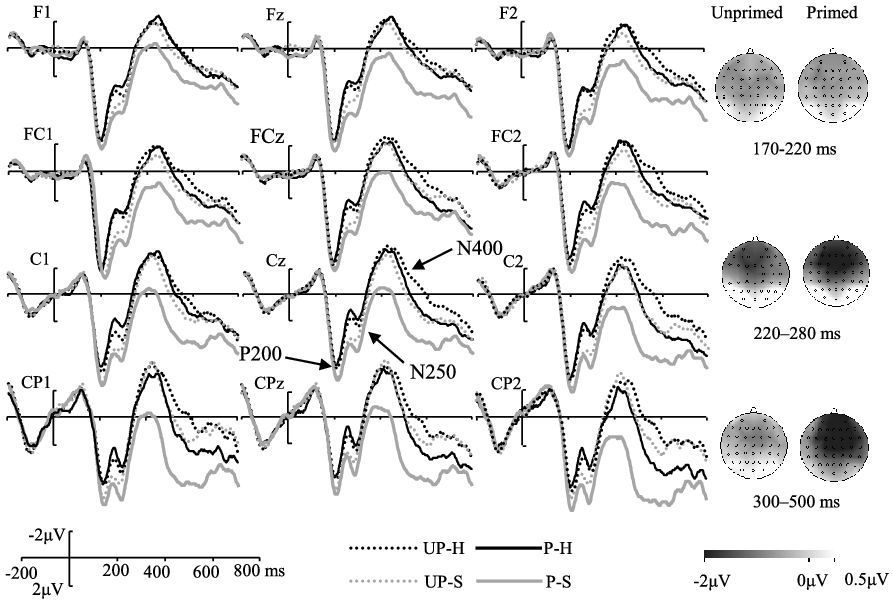
As shown in Figure 2, visual inspection of the grand mean waveforms and conventional windows for identifying ERP components in visual word recognition experiments (Holcomb & Grainger, Reference Holcomb and Grainger2006) revealed a positive peak in the 170–220 ms post-stimulus time window, a negative peak in the 220–280 ms time window, and a negative peak in the 300–500 ms time window. They were identified as P200, N250, and N400, respectively. Mean ERP amplitudes from each time window were computed for each participant for all four conditions. On the basis of previous ERP studies on visual word recognition and the scalp distributions (P200: frontal-central; N250: frontal; N400: centroparietal) of the three components (Holcomb & Grainger, Reference Holcomb and Grainger2006; Wu et al., Reference Wu, Mo, Tsang and Chen2012; Zhang et al., Reference Zhang, Zhou and Wang2020), we chose the following 12 electrode sites (i.e., F1, Fz, F2, FC1, FCz, FC2, C1, Cz, C2, CP1, CPz, CP2) to compute and analyzed the mean amplitudes of these components in the noted time windows. The measurement of the ERP amplitudes was conducted on data digitally filtered offline with a bandpass of 0.01–30 Hz. A three-way repeated-measures ANOVA with priming (unrelated vs. related), degradation (slight vs. high), and electrodes as within-subjects factors was conducted on mean amplitude. The degrees of freedom of the f-ratio were corrected according to the Greenhouse–Geisser method. Significant interactions were followed by pairwise comparisons, with Bonferroni correction.
Left: Grand average ERP plots for unrelated highly degraded (UR-H), unrelated slightly degraded (UR-S), related highly degraded (R-H), and related slightly degraded (R-S) conditions at F1, Fz, F2, FC1, FCz, FC2, C1, Cz, C2, CP1, CPz, and CP2 electrodes. Right: Topographical maps of the voltage amplitudes for differences between slight and high degradation levels under unrelated and related conditions in the time windows of 170–220, 220–280, and 300–500 ms.

170–220 ms (P200). The three-way repeated-measures ANOVA on mean amplitude with degradation, priming, and electrode site revealed only a significant main effect of degradation [F (1, 19) = 9.91, MSE = 11.01, η2 = 0.343, p = .005], with higher P200 peaks for slightly than highly degraded targets regardless of priming conditions. Neither significant main effect of priming nor significant interaction between degradation and priming was observed [Fs < 1]. The statistical power analyses for the interaction showed the effect size f being 0.063 and the ideal sample size being 978 with 0.8 statistical power and at the 0.05 significance level. These findings suggested that there were only the degradation effects on the P200.
220–280 ms (N250). The three-way repeated-measures ANOVA showed only a significant main effect of degradation [F (1, 19) = 38.27, MSE = 23.08, η2 = 0.668, p < .001], with higher N250 amplitude for the highly than slightly degraded targets regardless of priming conditions. There was no significant main effect of priming [Fs < 1]. Moreover, there was no significant interaction between degradation and priming [F (1, 19) = 1.91, MSE = 0.99, η2 = 0.091, p = .183]. As there was a trend-to-significance interaction, we conducted statistical power analyses for the interaction of degradation and priming on N250. The effect size f was 0.316 and the ideal sample size was 40 with 0.8 statistical power and at the 0.05 significance level. These findings suggested that there were only degradation effects.
300–500 ms (N400). The three-way repeated-measures ANOVA demonstrated significant main effects of degradation [F (1, 19) = 28.40, MSE = 389.34, η2 = 0.599, p < .001] and priming [F (1, 19) = 55.39, MSE = 224.77, η2 = 0.745, p < .001], with higher negativity for the highly than slightly degraded targets and for the unrelated than related targets. There was a significant interaction between degradation and priming [F (1, 19) = 12.26, MSE = 147.29, η2 = 0.392, p = .002], suggesting that the lower-level visual representation cascades into the higher-level semantic network. The statistical power analyses for the interaction showed the effect size f being 0.803 and the ideal sample size being 7 with 0.8 statistical power and at the 0.05 significance level. Further analyses exhibited a significant priming effect on the slightly degraded targets [p < .001] but not on the highly degraded targets [Fs < 1], and a significant degradation effect on both related and unrelated targets [p < .001; p = .040]. These results suggest that there was a prominent priming effect only for the slightly degraded targets and that there were degradation effects regardless of the priming conditions. Moreover, a significant interaction between degradation and electrode site was observed [F (11, 209) = 4.29, MSE = 3.91, η2 = 0.184, p = .002]. Further analyses were performed over each electrode and revealed larger N400 degradation effects at the centroparietal electrode sites (F1 [p = .018], Fz [p = .026], FCz [p = .016], FC1 [p = .020], FC1 [p = .004], Cz [p = .001], C1 [p < .001], C2 [p = .004], CPz [p < .001], CP1 [p = .003], CP2 [p < .001]. No other significant interactions were found.
Discussion
The present study investigated behavioral and neural correlates of the joint effects between stimulus quality and semantic context in visual word recognition. Subjects made target–probe matching decisions to one-character Chinese words which were presented in high or slight degradation and which were preceded by either semantically related or unrelated prime words. Analysis of ERPs revealed interactive effects of stimulus quality and semantic context on the N400 component. Moreover, we observed degradation effects on the P200, N250, and N400. However, at the behavioral level, there was no stimulus degradation by semantic priming interaction on RTs. We will now discuss the results in light of the theoretical and methodological considerations.
The ERP results demonstrated a stimulus degradation by semantic priming interaction, with more prominent N400 semantic priming effects for slightly than highly degraded targets. N400 is an index of semantic processing (Kutas & Hillyard, Reference Kutas and Hillyard1980). The N400 effects are interpreted in terms of post-lexical (semantic integration) versus pre-lexical (orthographic or phonological) processing (Deacon et al., Reference Deacon, Dynowska, Ritter and Grose-Fifer2004). Recently, Kutas and Federmeier (Reference Kutas and Federmeier2011) assumed that lower-level and higher-level processes in word recognition intersect at the level of semantic access itself. In the present study, stimulus quality may be influencing an earlier pre-lexical encoding stage while semantic priming may be influencing a later semantic retrieval stage. Thus, the interaction between stimulus quality and semantic context on N400 component suggests that visual activations can be cascaded to semantic stages of processing, wherein the ongoing visual processing of degraded stimulus in the current stage begin at its early point in processing to affect the subsequent semantic stage of processing that modulates the N400 amplitude. Therefore, stimulus quality modulates the N400 amplitude and interacts with semantic priming on the N400 amplitude.
Our ERP result challenges strictly hierarchical feedforward views and aligns with the interactive cognitive architecture of visual word recognition. This finding is consistent with a couple of ERP evidence which favors the IA views of visual word recognition. Indeed, our previous ERP study in a target–probe matching task showed interactive effects between stimulus quality and word frequency, with larger N400 frequency effects for the target stimuli in high degradation than those in slight degradation (Zhang et al., Reference Zhang, Zhou and Wang2020). Moreover, an earlier ERP study in a reading aloud task found an interaction between sentence context and word frequency on N400 (van Petten & Kutas, Reference van Petten and Kutas1990).
The present electrophysiological evidence for the interaction between stimulus quality and semantic context on the N400 is theoretically relevant in the light of the broader debate on the extent to which visual word recognition is accessed in a hierarchical, feedforward manner or within an interactive framework. In the temporally modular feedforward models, word recognition processes occur in a hierarchical, feedforward fashion such that higher-level linguistic representations are not accessed until the lower-level orthographic access is completed (Coltheart & Curtis, Reference Coltheart and Curtis1993; Jobard et al., Reference Jobard, Crivello and Tzourio-Mazoyer2003; Levy et al., Reference Levy, Pernet, Treserras, Boulanouar, Berry, Aubry, Demonet and Celsis2008). In contrast, the IA models propose that word recognition includes multiple levels of processing in a fully interactive network, with information flowing in both directions across the different levels (Mcclelland, Reference Mcclelland1979; Mcclelland & Rumelhart, Reference Mcclelland and Rumelhart1981). For example, both the dual-route cascaded model (Coltheart et al., Reference Coltheart, Rastle, Perry, Langdon and Ziegler2001) and the connectionist dual (Perry, Ziegler & Zorzi, Reference Perry, Ziegler and Zorzi2007) process model implement cascaded activation within an IA framework and predict interactive effects between stimulus quality and semantic context. As predicted, in the present study we observed an interaction between a variable that affects the character/letter level (i.e., stimulus degradation) and a variable that affects higher-level semantic processing (i.e., semantic priming).
There is ample evidence from behavioral, electrophysiological (EEG), magnetoencephalographic (MEG), electrocorticographic (ECoG), and functional magnetic resonance imaging (fMRI) studies in favor of interactive framework as the more biologically plausible explanations for visual word processing. Behaviorally, higher-level linguistic representations, such as phonological (Rastle & Brysbaert, Reference Rastle and Brysbaert2006), morphological (Deutsch et al., Reference Deutsch, Frost, Pollatsek and Rayner2005), lexical (Duñabeitia et al., Reference Duñabeitia, Perea and Carreiras2009), and semantic information (Frost, Reference Frost2012), have been observed to influence the lower-level early pre-lexical encoding stage of visual word recognition. EEG studies also found that higher-level lexical–phonological–semantic information constrains orthographic form-level processing in the N250 (Carreiras et al., Reference Carreiras, Gillon-Dowens, Vergara and Perea2009; Carreiras, Vergara & Perea, Reference Carreiras, Vergara and Perea2007; Duñabeitia et al., Reference Duñabeitia, Perea and Carreiras2009; Holcomb & Grainger, Reference Holcomb and Grainger2007). Notably, MEG (Woodhead et al., Reference Woodhead, Barnes, Penny, Moran, Teki, Price and Leff2014), ECoG (Whaley et al., Reference Whaley, Kadipasaoglu, Cox and Tandon2016), and fMRI (Heilbron et al., Reference Heilbron, Richter, Ekman, Hagoort and Lange2020) findings suggest the interaction between different levels of linguistic processing and thus challenge strictly hierarchical, feedforward views of visual word recognition. Taken together, the multi-disciplinary evidence is aligned with the interactive account of visual word recognition.
Though the degradation by priming interaction on the N400 amplitude in the present study seems to provide unambiguous evidence against the temporally modular feedforward models, we are here parsimonious to make an alleged assertion in favor of the IA model. Notably, in contrast to the ERP degradation by priming interaction found in the present study and the ERP degradation by frequency interaction observed in a previous study (Zhang et al., Reference Zhang, Zhou and Wang2020), Holcomb (Reference Holcomb1993) did not observe the degradation by priming interaction on N400, thus presenting a particular challenge to the IA models.
One salient possibility for the ERP discrepancy may result from the difference in the manipulation of task demands (i.e., LDT vs. DCMT) between Holcomb’s study (1993) and the present study. Actually, behavioral research has shown that the additive effects between two variables in visual word recognition are specific to LDT, merely reflecting task-specific operations (O’Malley et al., Reference O’Malley, Reynolds and Besner2007; Scaltritti et al., Reference Scaltritti, Balota and Peressotti2013; Warrington et al., Reference Warrington, Mcgowan, Paterson and White2018; Yap & Balota, Reference Yap and Balota2007; Zhang et al., Reference Zhang, Zhou and Wang2020). Moreover, a few recent EEG and MEG studies examined the task effects using different task demands and found task-dependent effects (Chen et al., Reference Chen, Davis, Pulvermüller and Hauk2015; Faísca, Reis & Araújo, Reference Faísca, Reis and Araújo2019; Wang & Maurer, Reference Wang and Maurer2017; Wang & Maurer, Reference Wang and Maurer2020; Yang et al., Reference Yang, Wang, Shu and Zevin2012). Therefore, the nature of the process in visual word recognition is likely to be modulated by the task context. Notably, both spatial and temporal evidence has pointed to that there is task-induced top-down modulation merely on early stage of visual-orthographic processing within 200 ms (Chen et al., Reference Chen, Davis, Pulvermüller and Hauk2015; Faísca et al., Reference Faísca, Reis and Araújo2019; Wang & Maurer, Reference Wang and Maurer2020), which suggests that the N400 amplitude can reflect processes that are independent of task demands.
An alternative possibility may be attributed to language-specific attributes (Zhang et al., Reference Zhang, Zhou and Wang2020). The semantic access of a visual word in alphabetic systems involves phonological mediation (Rayner et al., Reference Rayner, Foorman, Perfetti, Pesetsky and Seidenberg2010), which possibly retards cascaded visual activation across subsequent stages to the stage of semantic processing. In contrast, Chinese visual processing can be sufficiently or rapidly cascaded to semantic stage of processing because there is direct semantic access to Chinese characters from orthography with little phonological mediation (Zhou & Marslen-Wilson, Reference Zhou and Marslen-Wilson1999).
Additionally, a third account may result from the manipulation of stimulus degradation levels. Specifically, in Holcomb’s study (1993), the slightly degraded and intact targets showed no differences on any ERP components. No differences even at the early visual stage of processing suggest a ceiling effect: the visual processing of the slightly degraded targets ended rapidly in the LDT before it cascaded into semantic processing, as did the processing of intact targets. In contrast, we observed degradation effects on P200, N250, and N400, suggesting that subjects in the present study and a previous study (Zhang et al., Reference Zhang, Zhou and Wang2020) would involve more effortful semantic access to the highly (as compared to slightly) degraded targets in an attempt to match the following probes. As a result, the visual processing could cascade into the semantic stage of processing and thus interacted on the N400 amplitude.
A reconciliation with the additive–interactive debate is to assume a remarkably adaptive lexical processor (Aschenbrenner & Yap, Reference Aschenbrenner and Yap2019). This lexical processor can be dynamically fine-tuned to psycholinguistic variables, yielding additive or interactive effects. Indeed, converging behavioral evidence suggests this to be the case. The extent to which processing levels in word recognition are additive or interactive may be affected by the experimental task demands (Yap & Balota, Reference Yap and Balota2007), proportion of related primes (Aschenbrenner & Yap, Reference Aschenbrenner and Yap2019; Ferguson et al., Reference Ferguson, Robidoux and Besner2009), presence or absence of nonwords (Masson & Kliegl, Reference Masson and Kliegl2013; O’Malley & Besner, Reference O’Malley and Besner2008), relative prime–target associative strength (Masson & Kliegl, Reference Masson and Kliegl2013; Robidoux et al., Reference Robidoux, Stolz and Besner2010), and semantic association direction (Thomas et al., Reference Thomas, Neely and O’Connor2012). Additionally, variance across orthographies (Frost, Reference Frost2012; Zhang et al., Reference Zhang, Zhou and Wang2020) and stimulus degradation levels (Holcomb, Reference Holcomb1993; Zhang et al., Reference Zhang, Zhou and Wang2020) may also modulate visual word recognition.
Higher N250 amplitude for highly degraded targets than slightly degraded targets was observed in the present study. This negativity is thought to be involved in processes at the sublexical–lexical interface. The N250 is sensitive to the degree of prime–target orthographic overlap, being more negativity to targets that are unrelated to primes than those that are repeated primes (Grainger & Holcomb, Reference Grainger and Holcomb2009; Holcomb & Grainger, Reference Holcomb and Grainger2006). Wang et al. (Reference Wang, Cui, Wang, Tian and Zhang2004) also found a N250-like component and explained that this component reflects the brain activity for detecting cognitive information mismatches or conflicts. In the same vein of this mismatch account, it is the degradation levels that modulate the N250 in the present study: the more the degraded stimuli, the higher the amplitude.
In addition, we observed higher P200 effects on slightly degraded targets than highly degraded targets. This positivity is thought to be an earlier marker in Chinese character recognition and reflects orthographic and phonological processing (Kong et al., Reference Kong, Zhang, Zhang and Kang2012; Kong et al., Reference Kong, Zhang, Kang, Du, Zhang and Wang2010; Liu, Perfetti & Hart, Reference Liu, Perfetti and Hart2003). For example, Kong et al. (Reference Kong, Zhang, Zhang and Kang2012) found that controls elicited higher P200 effects than visually similar characters. Interestingly, in contrast to logographic characters, the P200 has not been reported to involve lexical processing of visual word recognition in alphabetic scripts. However, the P200 modulation at the sublexical processing seems to be language general. For example, syllable frequency has been found to modulate the P200 component in studies on visual recognition in European languages (Chetail, Colin & Content, Reference Chetail, Colin and Content2012; Kwon, Lee & Nam, Reference Kwon, Lee and Nam2011).
Behaviorally, we did not obtain a RT degradation by priming interaction, demonstrating a dissociation between RT and N400 amplitude. Interestingly, Holcomb (Reference Holcomb1993) observed a significant degradation by priming interaction with RTs but not with ERPs and explained the dissociation between behavioral and ERP measures in terms of different sets of cognitive operations involved. In our view, this apparent discrepancy between the RT and ERP results may stem from a couple of aspects. Firstly, the centroparietal N400 reflects processes that the orthographic information cascades into the semantic stage of processing, thus yielding an interaction between two levels of representation, whereas the RT data reflect the net result or end state of having recognized characters. Alternatively, we may attribute the absence of interaction with RTs more to the use of delayed target–probe matching task. Unlike the ERP measures which were time-locked to the target onset, the behavioral responses occurred after the probe presentation. Therefore, the behavioral results merely showed indirect RTs of processing the targets and thus should be interpreted with caution. Additionally, the absence of degradation by priming interaction on RT in the present study may be attributed to small sample size. The power analysis for the interaction of stimulus quality and semantic priming on the RT in the present study showed that the ideal sample size is 40. This is also true for the interaction of stimulus quality and semantic priming on N250. Therefore, the absence of interaction on the RTs or ERP components in the present study may result from a small sample size. However, with approximately 60 valid trials for each experimental condition, we obtained significant ERP results from 20 subjects in the interaction of stimulus quality and semantic priming on N400.
Some limitations need to be considered. First, as a few ERP studies found task-dependent effects using different task demands (Chen et al., Reference Chen, Davis, Pulvermüller and Hauk2015; Faísca et al., Reference Faísca, Reis and Araújo2019; Wang & Maurer, Reference Wang and Maurer2017; Wang & Maurer, Reference Wang and Maurer2020; Yang et al., Reference Yang, Wang, Shu and Zevin2012), the present study used only a single task. As such, future ERP research is needed using both LDT and DCMT and making a direct comparison of effects from different task demands. Second, language-specific properties and degradation levels are needed to be controlled if we want to justify the interaction of stimulus degradation and semantic priming on the N400. Third, the difference in character frequency between prime and target stimuli may be a confounding factor that needed to be considered.
In summary, the interactive effects of stimulus quality and semantic context on N400 in the present study suggest that the impact of stimulus quality is not constrained to the pre-lexical processing stage. Rather, the direct impact of stimulus degradation can be further cascaded to the semantic processing stage, such that the stimulus quality and semantic context may influence at least a common processing stage at the semantic level, before all the processing is completed. However, the nature of the process in which stimulus quality and semantic priming produce joint effects in visual word recognition may be dynamically adaptive, depending on the task (Yap & Balota, Reference Yap and Balota2007) or stimulus contexts (e.g., Aschenbrenner & Yap, Reference Aschenbrenner and Yap2019; Ferguson et al., Reference Ferguson, Robidoux and Besner2009; Masson & Kliegl, Reference Masson and Kliegl2013; O’Malley & Besner, Reference O’Malley and Besner2008; Robidoux et al., Reference Robidoux, Stolz and Besner2010; Thomas et al., Reference Thomas, Neely and O’Connor2012). Despite much behavioral evidence, there has been little to no ERP evidence that can be used to justify this assumption about the adaptive lexical processor. As the adaptive modulation of the information flow for visual word recognition is mostly temporal in nature, the time-sensitive EEG technique can shed light on the temporal order of neural processes. More future ERP work is needed to depict the underlying mechanism of adaptive word recognition system involved in visual word recognition.
Declaration of competing interest
No potential conflict of interest was reported by the authors.
Acknowledgements
This study was funded by the National Social Science Foundation of China (21XYY001 and 18XYY003), the Humanities and Social Science Foundation of Chongqing Municipal Education Committee (YYK20316 and 19SKGH002).
Appendix
280 prime–target pairs of semantically related one-character Chinese words with the first character as the prime and the second as the target