In studies of linguistic change, progressive and conservative behavior has typically been approached in terms of the social evaluation of linguistic features. As Labov (Reference Labov2001:437, 463, 511) noted, linguistic forms are apt to become associated with abstract social dimensions or polarities such as formal/informal, higher/lower, rural/urban, older/younger, and local/outsider. However, he also found that in the majority of cases concerning sound changes, most speakers will be identified as in-betweens with respect to such polarities (see also Eckert, Reference Eckert2000:139–141). Moreover, the linguistic behavior of those associated with these social evaluations need not be consistently polarized either. In Labov's Philadelphia study (2001:511–518), nonconformist, upwardly mobile working-class women emerged as the leaders of phonological changes. However, although they led changes that were not stigmatized, they nonetheless proved conservative with respect to stigmatized features. Similar patterns of mixed progressive and conservative behavior were found by Maclagan, Gordon, and Lewis (Reference Maclagan, Gordon and Lewis1999) when they compared individual speakers' behavior with regard to ongoing sound changes in New Zealand English.
On the other hand, not all changes, even phonological ones, are socially indexed. Labov (Reference Labov2001:28–29) argued that abstract linguistic structures are not generally likely to become highly socially stratified or strongly evaluated in social perception (although there are exceptions, such as negative concord). One of the reasons for this may be the much lower overall frequency of grammatical as opposed to phonological variables (Milroy & Gordon, Reference Milroy and Gordon2003:169–172). The question, therefore, arises of whether linguistic changes reveal similar overall patterns of diffusion regardless of their possible social evaluation. The issues we investigate in this study, which examines both morphological and syntactic changes, are two-fold. We will begin by considering whether most people have variable grammars with regard to processes of nonphonological, syntactic change, which, according to Labov (Reference Labov2001), need not carry strong social evaluation. Our second, related question is how consistently language users are progressive or conservative with respect to ongoing changes, both at the level of the language community and as individuals. We hypothesize that the participation of individuals in a change in progress could also be a function of its duration: the longer the change takes to run its course, the more in-between people could be expected to take part in the process. Finding answers to these questions will contribute to our understanding of, in Tagliamonte and D'Arcy's (2007:199) words, “what it means to ‘participate’ in linguistic change.”
Most sociolinguistic studies that analyze language change are based on the apparent-time construct and compare the language use of contiguous generations at a given point in time. An apparent-time analysis anchored in the present cannot capture slow, long-term processes of change, for which real-time data are required. In this study, we analyze individual language users' participation in six morphological and syntactic changes in English as they unfold in real time over three centuries. These forms and structures diffuse across the whole language community, and today form part of most mainstream modern varieties of English (as defined by Trudgill, Reference Trudgill1999:6). To be able to compare individual behavior as the changes progress, we analyze them in their different phases along the S-curve of change. For this purpose, we have operationalized the model introduced by Labov (Reference Labov1994:83–84), which divides a linguistic change into five phases: incipient, new and vigorous, mid-range, nearing completion, and completed (Nevalainen & Raumolin-Brunberg, Reference Nevalainen and Raumolin-Brunberg2003:55).
The methodological issues we set out to investigate in this paper are how to identify, with respect to a given phase of an ongoing linguistic change in the language community at large, (i) those who have variable grammars and (ii) those who are either progressive or conservative, as opposed to the in-betweens, who are those who cannot be seen as either progressive or conservative. Using the computational techniques we developed to tackle these issues, we analyze the distribution of variable language users in general, and progressive and conservative language users in particular, for six linguistic changes that were ongoing between the early 15th and late 17th centuries. These techniques are also used to identify the leaders of multiple linguistic changes, the “movers and shakers” in Tudor and Stuart England, and contrast them with their conservative contemporaries.Footnote 1
PREVIOUS RESEARCH
As the studies sampled by Labov (Reference Labov2006:380–403) suggested, over the last forty years, more sociolinguistic work has been done on morphology than on syntax and much more on phonology than on morphology and syntax put together.Footnote 2 Discussing syntactic and morphological variation, Chambers (Reference Chambers2009:56–57) maintained that grammatical variables function as widespread class markers in present-day English. They also distinguish traditional regional dialects (Trudgill, Reference Trudgill1999). In recent years, there has been an upsurge in sociolinguistic work on changes in progress in syntactic and discourse features (e.g., Macaulay, Reference Macaulay2006; Tagliamonte & D'Arcy, Reference Tagliamonte and D'Arcy2007, Reference Tagliamonte and D'Arcy2009). Regional and areal variation have similarly become foci of interest, and quantitative studies are conducted using electronic corpora to shed light on morphological and syntactic differences between varieties of English (e.g., Kortmann, Reference Kortmann, Aarts and McMahon2006; Kretzschmar, Anderson, Beal, Corrigan, Opas-Hänninen, & Plichta, Reference Kretzschmar, Anderson, Beal, Corrigan, Opas-Hänninen and Plichta2006; Nevalainen, Taavitsainen, Pahta, & Korhonen, Reference Nevalainen, Taavitsainen, Pahta and Korhonen2008:part II).
Sociolinguists analyzing present-day variation normally track processes of language change in apparent time by comparing the linguistic usage of successive generations from a synchronic vantage point. The transmission of linguistic change is traced in generational terms, and the younger age groups are typically shown to be more advanced than the older. The evidence that has accumulated suggests that it is not the youngest but the second youngest, adolescent age group that leads ongoing processes of change. This is the case, for example, in the sound changes discussed by Labov (Reference Labov2001) and the morphosyntactic and discourse-pragmatic changes analyzed by Tagliamonte and D'Arcy (Reference Tagliamonte and D'Arcy2009). As Tagliamonte and D'Arcy (Reference Tagliamonte and D'Arcy2009:99) noted, however, models of language change in progress should also account for life-long incrementation, that is, communal as well as generational processes of change. They also report variation among the changes they studied and conclude that
to understand the location of the peaks or, conversely, to explain their absence, it appears essential to contextualize a language change in terms of its stage of development. The peak for future going to is negligible, for example, because this change appears to be nearing a point of stabilization and ongoing change is progressing very slowly. (Tagliamonte & D'Arcy, Reference Tagliamonte and D'Arcy2009:99)
In contemporary sociolinguistics, the study of real-time variation is still comparatively rare, but a number of earlier apparent-time studies have been replicated or supplemented by adding data from new generations (Bailey, Reference Bailey, Chambers, Trudgill and Schilling-Estes2004; Chambers, Reference Chambers2009:206–219; Labov, Reference Labov1994:85–112; Sankoff, Reference Sankoff and Brown2006). Real-time and apparent-time approaches are combined, for example, by Chambers (Reference Chambers1998) in his study of 20th-century Canadian English. In most of these studies, the time period investigated does not exceed thirty years. However, with the availability of suitable materials, such as the spoken Origins of New Zealand English (ONZE) corpus (Gordon, Maclagan, & Hay, Reference Gordon, Maclagan, Hay, Beal, Corrigan and Moisl2007) and systematic monitor corpora, tracing recent change in English in real time is becoming possible (Allen, Beal, Corrigan, Maguire, & Moisl, Reference Allen, Beal, Corrigan, Maguire, Moisl, Beal, Corrigan and Moisl2007; Davies, Reference Davies2009).
Within Scandinavian dialect studies, several researchers have used real-time data in combined trend and panel studies (e.g., Kurki, Reference Kurki2005, and Nahkola & Saanilahti, Reference Nahkola and Saanilahti2004 on Finnish; Sundgren, Reference Sundgren2002, Reference Sundgren2009 on Swedish). Their findings include changes in adult language over the course of an individual lifespan. One of the most interesting studies for present purposes is Kurki (Reference Kurki2005), which took into account the phase of the change. He argued that variation between individuals is greatest in the mid-range phase of change and compared the progression of linguistic changes with the motions of the accordion, widening in the middle.
The study of long-term language change in its social context is the domain of historical sociolinguistics (for overviews, see Ammon, Mattheier, & Nelde, Reference Ammon, Mattheier and Nelde1999; Conde Silvestre, Reference Conde Silvestre2007; Hernández-Campoy & Conde Silvestre, forthcoming; Nevalainen, Reference Nevalainen, van Kemenade and Los2006a; Nevalainen & Raumolin-Brunberg, Reference Nevalainen and Raumolin-Brunberg2005). One of the obvious challenges for historical sociolinguists is mapping the course of linguistic change over time. Comparing precise age groups, such as preadolescents and adolescents, is rarely possible with the data sources that have been preserved, and sociolinguistic work has to be carried out on data produced by the literate adult population. The research reported in Nevalainen and Raumolin-Brunberg (Reference Nevalainen and Raumolin-Brunberg2003) was based on a corpus of personal correspondence and investigated 14 processes of grammatical change that supralocalized by diffusing through England between the early 15th and late 17th centuries.
The study of the temporal courses of these changes in the language community at large revealed vastly different overall durations, some processes running their course in less than a hundred years, others covering the whole time span of the corpus. We found that the progress of these processes significantly correlated with the writers' domicile, gender, and social status, as well as, in many cases, the register of the interaction. Processes that ultimately diffused throughout England originated in various regions. Women tended to lead vernacular changes, whereas men were the leaders of processes related to educated and professional written usage. The apparent-time analyses we carried out indicated that changes spread both generationally and communally. We were also able to tentatively establish that these changes varied with respect to the number of individuals who used both the recessive and incoming forms at the various stages of the change in progress (Nevalainen & Raumolin-Brunberg, Reference Nevalainen and Raumolin-Brunberg2003:83–100). In addition, Raumolin-Brunberg (Reference Raumolin-Brunberg2005, Reference Raumolin-Brunberg, Facchinetti and Rissanen2006) discussed linguistic leadership in Early Modern English. Her main finding was that the categories of progressive language user varied depending on the phase of the change.
RESEARCH QUESTIONS
Aims
The aim of this paper is to model and describe the degree to which language users participate in ongoing linguistic changes as they unfold in real time. The first question we raise is the extent of variable use of the incoming and recessive variants at a given stage of a change in progress. We measure variable use in terms of the proportion of individuals in the corpus who use both variants. Although we discuss the average patterns of use in the community, our analysis is based on individual variability compared with that of their reference population (cf. Nevalainen & Raumolin-Brunberg, Reference Nevalainen and Raumolin-Brunberg2003:92–98).
One of the issues we consider is the connection of variable use with the structural status of the linguistic elements undergoing change. The changes we have selected for analysis make it possible to compare different areas of grammar and contrast syntactic and morphological processes. This analysis tests the hypothesis that people vary more in their use of changing abstract structural patterns because these processes are, as Labov (Reference Labov2001:28–29) argued, less likely to be associated with social evaluation than lexical and phonological changes (henceforth, the abstract structural pattern hypothesis). In his unpublished work, Labov (1993, cited in Meyerhoff, Reference Meyerhoff1999 and 2001:78) formulated this principle as follows: “Members of the speech community [socially] evaluate the surface forms of language but not more abstract structural features.” We consider this notion by enquiring whether the syntactic and morphological changes we analyze are associated with different profiles of variable use. More specifically, we are interested in whether syntactic changes such as the rise of the direct object of the gerund (writing 0the letter vs. writing ofthe letter) are associated with more variable use among the section of English population we have access to than simpler morpheme-replacement processes such as the replacement of the second-person subject pronoun ye by you.
The second, related question we address is whether the majority of the people who participate in an ongoing change can be identified as falling between the leaders and laggards of linguistic change, as Eckert (Reference Eckert2000) and Labov (Reference Labov2001) found with the sound changes they investigated. Our data enable us to focus on the temporal ranges of these processes, which vary from rapid, completed changes such as the generalization of you in the 16th century to slower processes such as reduction of the determiners mine and thine to my and thy between the 15th and 17th centuries. The longer a change takes to be completed and remains variable, the more people it affects (Milroy, Reference Milroy1992:221–222; Nevalainen & Raumolin-Brunberg, Reference Nevalainen and Raumolin-Brunberg2003; see Patterns of diffusion). In their real-time study, Nahkola and Saanilahti (Reference Nahkola and Saanilahti2004) found that features acquired as variable tend to undergo quantitative changes over the course of individual speakers' lifetimes, thus increasing communal variation. We, therefore, expect long-term changes to show more variation and in-between users per period than changes that run their course relatively more rapidly—a phenomenon we will refer to as the time-depth effect.
Another issue we will focus on is the extent to which processes of change are propelled by the outnumbering of conservative by progressive individuals throughout their trajectories (progressive pull). In the final part of the paper, we analyze in more detail individual linguistic behavior with respect to several simultaneous changes with the aim of discovering the patterns that emerge from our material. In particular, we want to identify those individuals and social contexts that either are in the vanguard of ongoing changes or significantly lag behind them, thus polarizing the processes.
Concepts used
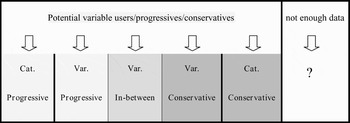
Figure 1 clarifies the concepts and procedures we have adopted. A basic division is made between potentially variable or progressive/conservative individuals as opposed to those who do not provide enough data for a reliable analysis. The potentially variable group is then analyzed during each phase of each linguistic change using the quantitative methods we have developed to distinguish (i) individuals with actual variable use from those whose use is categorical, and (ii) individuals who are progressive or conservative from ones who are neither. Those variable language users who are neither progressive nor conservative count as in-betweens. All in-betweens have variable grammars with respect to an ongoing process of change. In contrast, not all progressive or conservative individuals are characterized by variable use. Some of them are categorical, using either incoming or recessive variants all the time.
Progressive, in-between, and conservative language users, both categorical (Cat.) and variable (Var.).

The six linguistic processes we have selected for analysis involve morphological and syntactic changes that were in progress between 1410 and 1680. All but one were completed during this period, and their trajectories follow an S-shaped curve. This means that it is possible to trace the changes from their incipient or at least their “new and vigorous” (in Labov's terms) stages to completion. In Nevalainen and Raumolin-Brunberg (Reference Nevalainen and Raumolin-Brunberg2003:55), we associated the five phases of linguistic change proposed by Labov (Reference Labov1994) with the gradual diffusion of the incoming variant of the linguistic variable as follows:
- Incipient
below 15%
- New and vigorous
between 15% and 35%
- Mid-range
between 36% and 65%
- Nearing completion
between 66% and 85%
- Completed
over 85%
In this paper (with the exception of the final section, on individuals), the measure we introduce to estimate the duration of a change is the time span during which its median frequency progresses from .15 to .85, that is, from incipient to completed. We have excluded the incipient stage because (i) in many cases, our data from this period are sparse and (ii) the earliest stage of a change often fails to provide evidence for the supralocalization of the incoming feature. The categorization of changes that have passed .85 as completed takes account of the fact that there are contexts in which the recessive form typically lingers on (Nevalainen & Raumolin-Brunberg, Reference Nevalainen and Raumolin-Brunberg2003:53–82). In the sections on variability, we have selected the mid-range (median falling between .36 and .65) of each change in progress as the focus of our interest. As the S-curve model of change indicates, during this stage, overall variation in the language community is at its greatest, and thus presumably any distinctions between morphological and syntactic processes are maximized (cf. Kurki, Reference Kurki2005).
MATERIAL AND LINGUISTIC VARIABLES STUDIED
The corpus
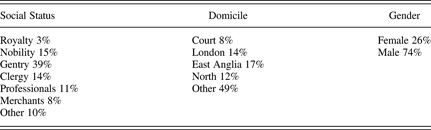
The material for this study comes from the Corpus of Early English Corre-spond-ence (CEEC). The Late Middle and Early Modern English sections of the corpus (1410–1681) were compiled as part of our historical sociolinguistics project at the University of Helsinki in the 1990s (Nevalainen & Raumolin-Brunberg, Reference Nevalainen and Raumolin-Brunberg1996, Reference Nevalainen and Raumolin-Brunberg2003; Raumolin-Brunberg & Nevalainen, Reference Raumolin-Brunberg, Nevalainen, Beal, Corrigan and Moisl2007). This core version of the CEEC includes regionally and socially stratified material from 778 people over a period of 270 years, categorized according to social status, domicile, and gender in Table 1.
Composition of the Corpus of Early English Correspondence, 1410–1681

The letters included in the corpus are all personal in that they were written by one individual to another; they range from private to official but typically consist of family correspondence, business, and news. The number of individuals analyzed in this paper exceeds the number of letter writers (778) in the corpus. A person can reappear in consecutive 20-year periods as his or her chronological age advances. It is worth noting that the same set of people is analyzed in simultaneous changes.
We initially analyzed all the data in 20-year periods and subsequently, when studying community grammars in Nevalainen & Raumolin-Brunberg (Reference Nevalainen and Raumolin-Brunberg2003), combined these into 40-year periods. In the present study, in order to be able to locate the different phases of ongoing changes, each of which have their own temporal courses, we have used both the 20-year and sliding 40-year averages for the reference populations (i.e., averages of individual averages; see Hinneburg, Mannila, Kaislaniemi, Nevalainen, & Raumolin-Brunberg, Reference Hinneburg, Mannila, Kaislaniemi, Nevalainen and Raumolin-Brunberg2007).
Linguistic changes
The linguistic changes to be discussed involve six sets of binary linguistic variables, (1)–(6), which come from different linguistic subsystems and have partly different regional origins. The incoming forms and constructions all diffused throughout the literate section of the language community during the period analyzed. The processes will be introduced according to the type of change. The morphological variables (1)–(4) consist of alternative realizations of the possessive determiners (my vs. mine), personal (you vs. ye) and relative pronouns (which vs. the which), and third-person singular verbal suffixes (-s vs. -th); these synonymous morpheme pairs formed part of the Late Middle and Early Modern English morpheme inventory. The more abstract, syntactic variables (5), (6) in turn consist of alternative realizations of two dependency phenomena: the use, with sentential negation, of negative polarity items (nonassertive indefinites) versus negative concord; and the direct versus of object of the gerund. The following survey discusses the origins of and linguistic constraints on the use of these variables.

During the Middle and Early Modern English periods, the possessive determiners mine and thine lost their final -n- element, resulting in the present-day forms my and thy. In its early phases, the change was phonologically conditioned, as it was first introduced into those forms that preceded words with initial consonants (except for /h/). Later, the incoming -n-less forms came to be used before words with initial /h/ and vowels. Some particular lexical items, such as eye and own, appeared with the old form longer than other words (for details, see Nevalainen & Raumolin-Brunberg, Reference Nevalainen and Raumolin-Brunberg2003; Schendl, Reference Schendl, Hickey and Puppel1997). Our analysis is based on vowel-initial environments.
Examples (1a)–(1e) illustrate the use of the possessives my/mine and thy/thine in the CEEC. Example (1a) shows that the old form was still occasionally employed with words beginning with a consonant in the late 15th century. Examples (1b) and (1c) illustrate the new usage, whereas (1d) and (1e) show that the longer form could still be found at the turn of the 17th century.
(1) (my) variable
a. Myn lord Chanselere come not here sone I come to Lundun (William Paston II, 1454; Paston, I, 155)
b. lr~es patents concernyng the Creation of my Erledom, (Edward Stanley, Earl of Derby, 1537; Derby, 130)
c. I beseech you commend me to my uncle Charles and my Aunt (Arabella Stuart, 1603; Stuart, 181)
d. hath so assured me of the constancie of fortune in myne endevors (Nathaniel Bacon II, 1613; Cornwallis, 13)
e. and by many others how thyne owne credit made (Philip Gawdy, 1593; Gawdy, 78)

The replacement of subject ye by you is part of the transformation of the second-person pronoun system in Late Middle and Early Modern English. The main processes involved in this transformation were the gradual extension of the deferential plural pronoun ye/you to the singular, leading to the disappearance of thou/thee, and the transfer of the object form you to the subject function in both the singular and the plural.
Examples (2a)–(2c) illustrate this change. In examples (2a) and (2b), William Dalton still uses the old form, whereas William Kesten, writing at the same time, employs the new. Example (2c) shows the mixed usage typical of the first half of the 16th century.
(2) (you) variable
a. Plese it you to vnderstond that Will Cely told me that ye had no knowledge from me fir payment of the xx li. ye of your curtesy delyuerd vnto William Lemster my seruaunte / to my gret marvel. (William Dalton, 1487; Cely, 228)
b. I wnderstonde that yow haue ben sore seke ande now well rewiwid, (Thomas Kesten, 1479; Cely, 67)
c. you knowe for a certenty and a thinge without doubt, that you be bownden to obey your souerain lorde your Kyng. And therfore are ye bounden to leaue of the doute of your vnsure conscience in refusinge the othe, (Sir Thomas More, 1534; More, 505)

Like the adoption of you as subject, the selection of which illustrates the ongoing drift toward fewer pronoun options in English. However, it is important to point out that, in this case, change does not involve a new form replacing an old element in the same way as it does with the other variables discussed in this article, because the which never was the dominant form, but remained a minority variant in the broader language community.
The grammatical profiles of the relative pronouns which and the which were practically identical until around 1500 (Raumolin-Brunberg, Reference Raumolin-Brunberg, Taavitsainen, Nevalainen, Pahta and Rissanen2000). Examples (3a) and (3b) illustrate the nonrestrictive and (3c) and (3d) the restrictive use. Both pronouns appeared as subjects, objects, and adverbials. From 1500 onward, some grammatical specialization took place, so that which was preferred in the subject function and the which in prepositional phrases. Example (3e) shows a late example of the latter usage, also taken over by which, as in (3f).
(3) (which) variable
a. And we shal make a good ende, be þe grace of Oure Lord, which haue you in hise gouernance. (Thomas Scales, 1450s; Paston, II, 196)
b. And as ffor your gownys of chamlet and dublettes of sylke, I have bought hem: the which shall plese yow ryght well, (Elizabeth Stonor, 1476; Stonor, II, 19)
c. And Sir, I beseche your maistershipe to delyver to John Burton the moneye the whyche is dewe to me (Godard Oxbryge, 1478; Stonor, II, 49)
d. And I send John Bookyng a copy of the panell wheche I shewed yow (Thomas Howes, 1454; Paston, II, 106)
e. that Heroick resolutions in woemen are things of the w ch I have never bin transported wth greate admiration nor can bee (John Wilmot, 1670s; Wilmot, 270)
f. I have received both your letters, the one from Calais, the other from Rouen: by which I understand you are in health, for which the Donor be praysed. (Henry Oxinden, 1644, OxindenII,51)

The replacement of the third-person indicative suffix -(e)th by -(e)s, a long and complex process, has received a great deal of attention in the literature (e.g., Holmqvist, Reference Holmqvist1922; Kytö, Reference Kytö1993; Ogura & Wang, Reference Ogura, Wang and Britton1996). A linguistic analysis of this change can focus on the suffix-final consonant or look at it in combination with the preceding vowel.Footnote 3 If the focus is placed on the shift from the ending -th to -s, the change can be characterized as one long development beginning in the North in the 10th century and ending with the disappearance of the most resistant forms hath and doth in the 18th century. This approach excludes the third alternative, zero, which was a genuine, albeit rare, option at least in some varieties, covering less than 2% of the cases in the Early Modern English section of the Helsinki Corpus (Kytö, Reference Kytö1993:118; for regional use in the CEEC, see Nevalainen, Raumolin-Brunberg, & Trudgill, Reference Nevalainen, Raumolin-Brunberg, Trudgill, Fisiak and Trudgill2001).
The lexicon also played a significant role: according to Ogura and Wang (Reference Ogura, Wang and Britton1996), the frequency of the verb was a major factor in the diffusion of the incoming form. In this study, we employ the traditional two-suffix variable, -th versus -s, but our analysis takes into account the lexical diffusion of the process by considering changes to have and do as separate processes and excluding these items from the analysis of lexical verbs. Examples (4a) and (4b) illustrate Late Middle English use of -th and -s. Examples (4c) and (4d) present cases of mixed usage in the late 16th century, when the new suffix was rapidly spreading throughout the country.
(4) (s) variable
a. Bykerton tellyth me þat she lovyth yow weell. (John Paston II, 1477; Paston I, 499)
b. Syr, my Loord comendys hym harttely wnto yow, and thankys yow of your letter, (Richard Cely jr., 1481; Cely, 109)
c. lyckewisse your Joyner comendes hime vnto you & sayes he will mack you such good stufe & suche good peneworthes as he hoopeth shall weall licke you & contente you … (Philip Henslowe, 1593; Henslowe, 279)
d. and therfor do require, that a question may, upon allegeance, be demanded by yourselfe of the mastar Gray, whether he knoweth not the price of my bloude, wiche shuld be spild by bloudy hande of a murtherar, wiche some of your nere-a-kin did graunt. A sore question, you may suppose, but no other act than suche as I am assured he knowes, and therfor I hope he wyl not dare deny you a trouthe; (Elizabeth I, 1585; Royal 1, 11)

Negative concord or multiple negation has been extensively studied in modern sociolinguistics and is included among the five primitives of vernacular dialects (Chambers, Reference Chambers2009:258; Labov, Reference Labov2001:78; Smith, Reference Smith2001). To put it simply, this is variation between clauses with several negative elements, typically a sentential negator followed by one or more negative indefinites, and those with only one negative element accompanied by one or more nonassertive indefinites (negative polarity items like any). What we study here is the historical shift from the typical Old and Middle English usage of two or more negative elements in a clause toward the employment of a single such element in later times.
We have followed Nevalainen (Reference Nevalainen, Fisiak and Krygier1998) and Nevalainen and Raumolin-Brunberg (Reference Nevalainen and Raumolin-Brunberg2003:71–72) in counting as cases of multiple negation all expressions with a NEG-element (not or any overtly negative form) plus the determiner no; the pronouns none, no one, nobody, nothing, and nought; the adverbs never and nowhere (examples (5a) and (5b)); the additives neither, nor, and ne (example (5c)); and the correlative neither … nor. Single negation correspondingly involves a NEG-element plus the determiner any; the pronouns any, anyone, anybody, anything, and aught; the adverbs ever and anywhere (examples (5d) and (5e)); the additive either; and the correlative either … or. Example (5f) illustrates variable use in a single sentence. Our data show that correlative and additive structures retained multiple negation longer than simple units.
(5) (neg) variable
a. he woll not in no maner wise lese your favour (Richard Page, 1482; Stonor II, 153)
b. I thinke ye weare never yet in no grownd of mine, and I never say no man naye. (Henry Savill, 1544; Plumpton, 247)
c. the dewke of Gelder send me no vord vat I sale do, nor heelpes me nat with notheng, as Petter sale chove yov, (Edmund de la Pole, 1505; Rerum, I, 254)
d. it hath bene for that I haue not hade anything to wryt of to your aduauncement. (Thomas Cromwell, 1523; Cromwell, I, 313)
e. I dyd not name any summe unto them (Edmund Grindall, 1582; Hutton, 69)
f. there shall no poore neghebore of myne berre no losse by eny chaunce hapned in my howse. (Thomas More, 1529; More, 423)

It is known that gerunds— the -ing forms that have roughly the same distribution as nouns or noun phrases—have undergone a gradual transformation from full abstract nouns into verbal structures. This process meant that the typical modifiers used changed from nominal (i.e., adjectives) to verbal (i.e., adverbs). The part of the gerund structure that follows the headword offers one of the clearest manifestations of verbalization, the shift from of-phrase to direct object. As it has been shown that the most important developments took place in gerundial constructions that functioned as prepositional complements (Fanego, Reference Fanego1996), we have focused on these.
In Late Middle English and Early Modern English, the gerund was indeed an unstable construction, often involving both nominal and verbal elements. According to De Smet (Reference De Smet2008), three major types can be detected: definite nominal gerunds, as in example (6a), and bare nominal gerunds, (6b), both with an of-phrase, and bare verbal gerunds, (6c), with a direct object. However, hybrid structures also existed, as shown by examples (6d)–(6f). De Smet (Reference De Smet2008) argued that, despite some overlap, the three major types developed functional specializations of their own, and the bare verbal gerund won the race against the bare nominal because of its greater syntactic flexibility. The definite nominal structure acquired some specific functions that were related to the role of the definite article and has thus remained as an alternative up to the present day.
Following Fanego's argument (1996) about the significance of the way the object of the gerund was expressed, we have focused on this issue and based our study on a binary analysis of the use of of-phrases (examples (6a), (6b), (6d) vs. direct objects (6c), (6e), (6f)). Our analysis thus includes the -ing forms in prepositional complements with either nominal or verbal characteristics or both. Forms displaying distinct properties of lexicalized nouns, such as plural marking (e.g., writings ‘written documents’), were excluded (Nevalainen & Raumolin-Brunberg, Reference Nevalainen and Raumolin-Brunberg2003:65, 80; Raumolin-Brunberg, Reference Raumolin-Brunberg1991:86–89).
(6) (ing) variable
a. And as for the makyng of that litill hous, he toke (John Paston I, 1450s; Paston, I, 74)
b. heyr is dyveres sent to proson for byeng of grayn (Richard Preston, 1552; Johnson, 1541)
c. I promis myselfe the contentment of meeting you; (Lucy Russell, 1614; Cornwallis, 23)
d. as you have done by contynuall charging of monney (Ambrose Saunders, 1552; Johnson, 1610)
e. that might give us some usefull Informations towards the further discovering this villaine's forgeries (Samuel Pepys, 1679; Pepys, 87)
f. Of my often troubling you concerning this matter your fatherhoode my iudge as you shalbe best aduised, (John Becon, 1574; Bacon, 251)
Social trajectories of change
The diffusion of the concurrent changes followed various social trajectories. The following brief summary, based on Nevalainen and Raumolin-Brunberg (Reference Nevalainen and Raumolin-Brunberg2003), is intended to serve as background information on the social embedding of the six changes.
In terms of gender, our findings were not very different from what has been claimed about the tendency for women to spearhead linguistic changes in Present-day English. Four of the listed changes were led by women, namely, the (my), (you), (s), and (ing) variables. In the other two shifts, (which) and (neg), men were ahead of women, a phenomenon that seems to go back to the usage of these variables in administrative and legal language. In contrast to today's world, these spheres of life were generally out of reach for women in medieval and early modern times.
Because of the varying availability of material written by women of lower social ranks, social stratification was only studied in men's letters. We found clear social stratification in the progress of four changes, in particular in the early stages and mid-range. This stratification did not seem to occur when the changes were nearing completion. In the mid-range, (you) was led by the middle ranks, (my) and (s) by the lower ranks, and (neg) by the professional writers among the gentry and middle ranks. An important finding was that in order for a change to spread rapidly, it had first to be adopted by the topmost echelons of society. We also saw that social aspirers or the upwardly mobile often relied on avoidance before a presumably positive social value was established for the new form. In the early stages of the diffusion of verbal -s, for example, they avoided the incoming form altogether and later used it less than the lower ranks. It was only when -s had become the majority form among all ranks that aspirers began to use it extensively, even surpassing the upper ranks (Nevalainen & Raumolin-Brunberg, Reference Nevalainen and Raumolin-Brunberg2003:150–153).
The incoming forms of two of the variables, (my) and (s), had Northern origins. However, London played an important role in the diffusion of both of them, as it took over the leadership at a critical period. On the whole, the capital region, which in our analysis is represented by the City of London and the Royal Court at Westminster, was mostly ahead of the other two geographical areas studied, the North and East Anglia, during the diffusion of new forms through the language community. This leadership from the capital is very clear with (you) and (neg), whereas in the case of (ing), it is not quite as obvious for some of the phases of the change. As regards (which), the London merchant community markedly favored the which at a time when which was preferred elsewhere.
QUANTITATIVE METHODS
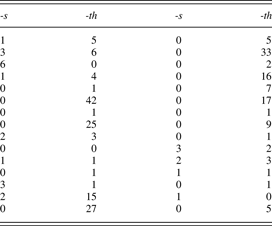
It is not a trivial matter to distinguish a progressive individual from a conservative one in our data, as the number of observations per individual varies widely and the total number of observations can sometimes be quite small. We adopted the following method in defining the distinction between progressive and conservative language users. Given a linguistic variable and a person, we want to test whether the person is progressive or conservative, or whether her/his usage of the variable conforms to the general pattern. That is, our aim is to test whether the observed frequencies of the recessive (old) and incoming (new) form of the linguistic variable deviate substantially from the frequencies for the reference population. This comparison cannot be made directly by computing the frequencies of the new form, as the total number of occurrences of the variable has also to be taken into account. By way of an example, consider the data shown in Table 2.
Use of -s and -th by 30 individuals, 1500–1519
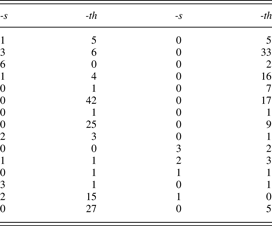
In Table 2, the frequency of the incoming form -s is about .1 if one simply pools all the observations together, or .2 if one uses the method of “averaging averages,” that is, if one first computes the estimate for each individual and then uses the average of these as the estimate (Hinneburg et al., Reference Hinneburg, Mannila, Kaislaniemi, Nevalainen and Raumolin-Brunberg2007).
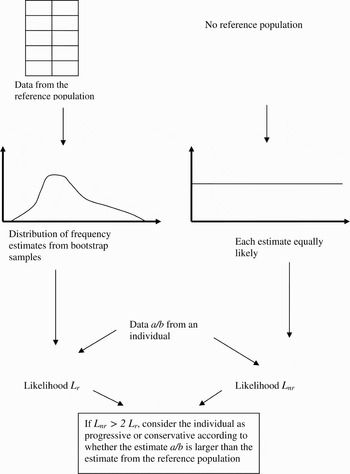
Let us assume that we have an individual who uses the incoming form -s once and the old form not at all; the data for this person amount to 1/0. The frequency of use of the new form is 1.0, but it seems clear that we cannot consider the individual progressive on the basis of such a small amount of evidence. On the other hand, if the data for the individual were 15/1, that is, if he or she used the new form 15 times and the old form only once, we would be tempted to say that this individual is progressive with respect to the ongoing change. In a systematic study, we have to take into account both the amount of evidence produced by the individual we are interested in and the amount of evidence there is for the reference population. Figure 2 presents a flowchart for this approach, which is discussed in more detail in the following section.
The process of deciding whether an individual is progressive or conservative.

Method
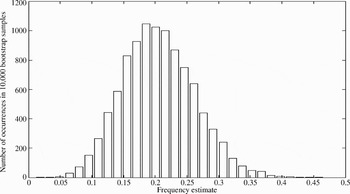
We use the bootstrap method (see, e.g., Efron & Gong, Reference Efron and Gong1983; Efron & Tibshirani, Reference Efron and Tibshirani1993), as described in Hinneburg et al. (Reference Hinneburg, Mannila, Kaislaniemi, Nevalainen and Raumolin-Brunberg2007), to obtain information about the variation in the use of the new form as opposed to the old one. The bootstrap method is based on forming new datasets by sampling, with replacement, from the original dataset. Given a dataset with n observations, we form a new dataset by selecting, with replacement, n random observations from this dataset. Thus, a single observation can be included in the bootstrap sample several times, or not at all. From the bootstrap sample, we compute the frequency of usage of the new form by taking the average of personal averages. If the data are very homogeneous, there is little variation in the frequencies of the bootstrap samples. For the real data shown in Table 2, the frequency of the new form varies from one bootstrap sample to another. A histogram of the frequencies obtained from different bootstrap samples is shown in Figure 3.
Histogram for the data in Table 2 in 10,000 bootstrap samples.

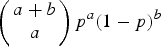
Each bootstrap sample gives us an estimate for the frequency of the new form for the whole dataset. Given such an estimate, we can compute the probability of occurrence of the frequencies for a specific individual. That is, if in a bootstrap sample, the frequency of the new form is p, and a single individual has frequencies a/b, then the probability of those frequencies occurring is simply the binomial likelihood
Given a set of k bootstrap samples with frequencies p i, we estimate the probability of the observation a/b by averaging the probabilities:
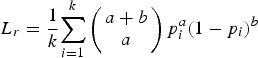
This quantity L r is an estimate of how likely or unlikely the observation a/b is, given the reference background of all the other observations (r stands for reference population). We compare L r against the likelihood L nr of the observation a/b in the case when nothing is known about the other persons (nr for no reference population). In that case, the null hypothesis is to consider that each possible value of the frequency p is equally likely. Thus, instead of having the frequency p i obtained from the bootstrap sample, the frequency we have is 1/i, for i varying from 1/k to (k-1)/k:

Given L r and L nr, we consider a person to be progressive or conservative, if L nr > 2L r, that is, if his/her observation a/b is at least twice as likely when considered without the background information. The individual is considered to be conservative if his/her individual frequency a/b is lower than the average of averages of the reference population, and progressive if the individual frequency is greater than the average of averages. The choice of the coefficient 2 in the condition L nr> 2 L r (or, equivalently, in L r/L nr < .5) is arbitrary, but using different values does not make much difference to the conclusions.
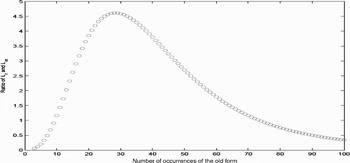
Continuing our example, Table 3 shows what the probabilities L r and L nr are for the cases where the frequencies of the new and the old forms are (6,0), (6,1), …, (6,10). We see that for the cases (6,0), …, (6,6), the ratio L r/L nr is below the threshold of .5; in this case, the person is considered to be progressive, as the estimate from the person's individual data is higher than the estimate for the reference population. Figure 4 shows the behavior of the ratio L r/L nr for the case where the number of uses of the new form is 6, and the number of uses of the old form varies from 3 to 100. We see that the ratio again becomes less than .5 when the number of uses of the old form falls between 88 and 100. Individuals with frequencies falling within this interval are considered conservative.
Ratio L r/L nr when the number of uses of the new form is six, for different number of uses of the old form.

Likelihoods L r and L nr for data of the form 6/b, with b = 0, …, 10

Data selection
In this subsection, we specify some details of our data-selection procedure. We only examined periods for which there was data on the use of the variable in question for at least 5 individuals, and each of the variants was used at least 10 times in total across all individuals. For each period that satisfied these criteria, 1,000 bootstrap samples were generated for each linguistic variable analyzed.
This procedure for determining whether an individual was progressive or conservative was applied only if the person had at least six occurrences of the variable (i.e., the sum of the occurrences of the old and the new variant for the person was at least 6). Individuals satisfying this condition were considered to be potentially conservative or progressive, and the actual number of progressives and conservatives were computed from this subset for each time period studied. Those individuals whose distribution of new and old forms did not reach the required probability level were characterized as in-betweens, that is, neither progressive nor conservative.
The analysis of variable use was similarly based on a minimum of six occurrences. If a person had at least six occurrences of the linguistic variable, he or she was regarded as a potential variable language user. However, a minimum of three occurrences of both the incoming form and of the recessive form were required for an individual to be categorized as displaying a variable grammar of the linguistic variable in question. Both progressive and conservative individuals can naturally have variable grammars, but they need not: both groups also include individuals with categorical grammars (cf. Figure 1).
VARIABILITY IN MID-RANGE
Patterns of diffusion
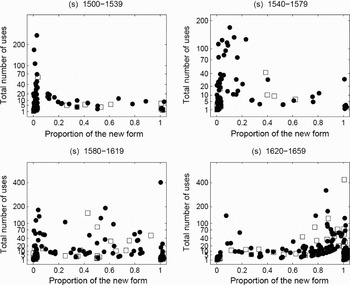
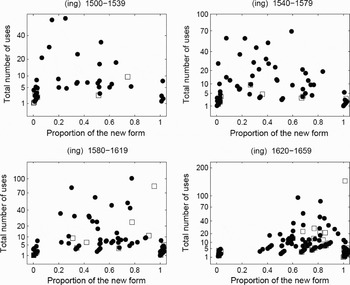
Let us compare the temporal progression of three ongoing changes to better appreciate their different trajectories and the variable use of the incoming forms. In Figures 5–7, the quadratic scale has been used on the y-axis and jitter has been added to show multiple observations with the same value. Men are denoted by filled circles and women by open squares.
Diffusion of verbal -s, 1500–1660.

Diffusion of -ing with direct object, 1500–1660.

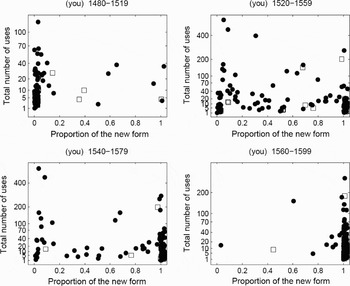
Diffusion of you in the subject function, 1480–1600 (note the overlapping period, 1540–1579).

Figure 5 shows a scatter plot of the diffusion of verbal -s through the CEEC population of writers in four consecutive periods. In the first two periods, the use of the new form has a median frequency of around .15; with the bulk of the writers to the left of the diagram, the process is still in the incipient stage. In the third period, the incoming form has reached a median frequency of .41 and is in mid-range. Individuals now cover the whole range of variation. In the fourth period, the informants cluster on the right, and the change is nearing completion.
The same time span, 1500–1660, looks rather more diffuse for the (ing) variable in Figure 6. Only in the last period can we see a distinct clustering. It is worth noting that Figure 6 includes exactly the same set of people as Figure 5.
As shown by Figure 7, the situation is much more polarized for the change in the (you) variable, which covers a much shorter time span than either (s) or (ing). In the first subperiod, the process of change from ye to you is still incipient, and in the last, it is completed, with nearly all writers using the incoming form. The bulk of the change takes place between 1520 and 1580. A period overlapping the second and the last (1540–1579) is included to show the rapidity of the process. Because the overall profiles of the three changes considered look rather different, we may assume that, although they are superficially similar in mid-range—the phase that displays the most variation—their profiles of use also diverge at this stage. We will explore these profiles in more detail.
Variable use in mid-range
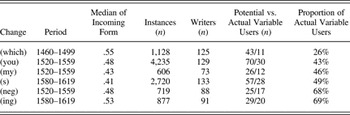
Let us first turn to variable use, the prerequisite for in-between linguistic behavior, and focus on the incoming form in the middle of its mid-range stage. Table 4 shows that all six incoming forms have a median frequency between .40 and .55 at this stage. The confidence intervals of these medians fall within the mid-range, between .36 and .65 (except for (s), where the lower boundary is .33). We use these data to test whether abstract structural patterns behave differently from less complex processes of change in terms of variable use.
Writers with variable use of the incoming form in mid-range

Table 4 shows that the proportions of writers who use both the incoming and recessive forms vary considerably, ranging between 25% and 70% of all those who potentially could have been variable, depending on the change. The two extremes are represented by the (which) and (ing) variables: (which) has an average of 26% of variable use, whereas (ing) has as high a proportion as 69%. A similarly high proportion, 68%, is found with the (neg) variable. Using a two-sided binomial test, the proportion of these variable users can be shown to be statistically significantly smaller than expected in the case of (which), and larger than expected with (neg) and (ing). The rest of the changes fall between these two extremes, and their proportions of variable users do not reach the 5% significance level.
Overall, morphological changes would appear to show a lower relative frequency of variable use than complex syntactic changes. This could be taken as an indication that not as much social or stylistic evaluation is attached to abstract structural patterns as to morphological changes, and, in particular, to the use of pronoun replacements, which remains more polarized even at mid-range. The two more complex morphophonemic variables, (my) and (s), fall between the syntactic changes and the pronominal changes, but on closer analysis are closer to the less polarized end, with higher proportions of variable users than (you) and especially (which).Footnote 4 Whether this finding has more to do with the leveling of the social evaluation of these originally Northern forms during the mid-range part of the change than with their linguistic properties remains an open question.
Progressive and conservative language use in mid-range
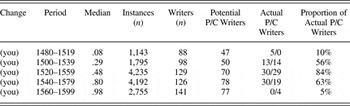
In the previous section, it was seen that the mid-range phase of an ongoing real-time change was an interesting stage with respect to the number of variable users. Next, we analyze the same phase with respect to the proportions of those whose use of the new forms can be considered either progressive or conservative relative to the broader language community. This analysis is connected with the linguistic properties and the duration of the change. Table 5 presents the distribution of these progressive and conservative individuals in mid-range of five of the changes whose entire trajectories from incipient to completed are covered by the CEEC.Footnote 5
Progressive (P) and conservative (C) writers in mid-range

aPeriod during which the median frequency of the incoming form progresses from .15 to .85.
The measure we use to estimate duration, the median frequency of the change in progress, runs from .15 to .85, showing that the diffusion of verbal -s only began in the latter half of the 16th century (cf. Table IV in the Appendix). The incoming form is evidenced in our Northern data in the 15th century and even makes an appearance in the City of London toward the end of the century but its supralocalization started to gain momentum only a century later.
Table 5 suggests a correlation between the approximate duration of the change and the proportion of progressive and conservative language users in mid-range. The longer a process of change takes to reach completion, the fewer progressive and conservative writers there are in the mid-range stage, and vice versa. For the slowest change, (ing), less than one-third of potential progressive or conservative users actually fulfill that potential, whereas for the most rapid one, the rise of subject you, the proportion is 84%.
The relevance of time depth is also suggested by the two-sided binomial significance tests we ran to check whether the number of progressive and conservative individuals in mid-range differed significantly from the probability of progressives and conservatives in the earlier and later stages of the change in progress. The general finding was that the slower the process, the fewer significant differences were found throughout. Most of these differences occurred in mid-range. As Table 5 shows, for all the processes, except (ing), there are more progressive and conservative language users in mid-range than expected.
In the case of the object of the gerund, the duration in time and level of abstraction of the variable undergoing change may conspire to produce the outcome. The particular relevance of duration is, however, borne out when the two abstract structural patterns, (ing) and (neg), are compared. Negative concord takes a much shorter time to disappear than the direct object of the gerund takes to be generalized, which is reflected in their respective proportions of polarized users. Both these processes are of Southern origin, and in both cases, progressive language users outnumber conservatives in all phases except the final one, where there is no difference.
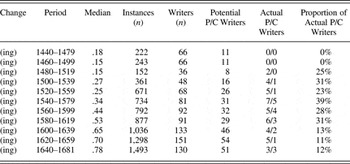
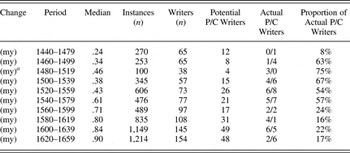
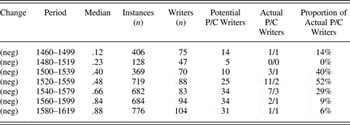
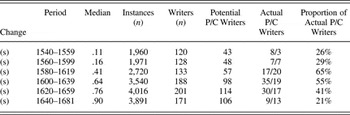
An examination of the overall trajectories of the changes analyzed indicates that the proportion of progressive and conservative people does not exceed 50% of those who have the potential to be so (see Tables I–V in the Appendix). In this respect, our results support the generalization that most people can be expected to fall within the in-between category during a change in progress. This is particularly the case in the early and late stages of the change, whereas the proportion of progressive and conservative individuals is at its highest in the mid-range phase. As shown by Table 5, with a rapidly progressing change such as (you), the proportion of progressives and conservatives rises as high as 84%, and with a protracted one such as (ing), it remains as low as 31%. In neither case do we have any direct evidence for social evaluation of the variable. Both appear to have diffused from the south and been promoted by women rather than men.
Throughout their trajectories, the changes we have analyzed are typically characterized by progressive pull, that is, the number of progressive language users outnumbers the conservatives (Tables I–V in the Appendix).Footnote 6 This leaves us wondering whether it is, in fact, the same people who are in the vanguard of most these processes, the literate “movers and shakers” of Tudor and Stuart England.
PROGRESSIVE AND CONSERVATIVE INDIVIDUALS
Having discussed variable use and progressive and conservative individuals on an aggregate level, let us now change our angle and focus on individual language users experiencing several concurrent changes in progress. The existence of several ongoing changes can be taken for granted in any speech community at any given time, and we have already seen that this was the case in Early Modern England. People may or may not participate in the linguistic changes around them, and this participation has been found to correlate with their social backgrounds, communicative situations, and personal characteristics. It is worth noting that this involvement most often takes place unconsciously.
Previous sections have demonstrated that it is possible to identify leaders, laggards, and in-betweens in the diffusion of six changes in Early Modern English. So far, the changes have been discussed separately. In this section, we would like to focus on all the six changes simultaneously and ask whether it is possible to find people who are linguistically more progressive or conservative than others. Like Labov (Reference Labov2001:323–411), we would like to see whether there are people who lead several changes at the same time but, unlike him, we are also interested in whether there are others who lag behind everybody else in a number of changes.
Given the diverging linguistic profiles and social trajectories of the six changes, the likelihood of general linguistic leadership or conservatism might not appear very strong. Indeed, we have seen in previous studies, especially Nevalainen and Raumolin-Brunberg (Reference Nevalainen and Raumolin-Brunberg2003), that the changes discussed here vary in terms of their rapidity, direction (from below vs. from above), regional background, correlation with gender and social status, and phase. Each change seems to have a history of its own, and leaders and laggards might be specific to a particular change. On the other hand, there are similarities between the changes. As far as chronology is concerned, four changes—(you), (which), (my), and (neg)—have all run their course by the earliest decades of the 17th century. Apart from (which) and (neg), all the shifts show the characteristics of change from below rather than from above. Two—(s) and (my)—had their origin in the North. Women were ahead of men in (you), (my), (ing), and (s), whereas men led the (neg) and (which) variables.
Linguistic leadership can also be connected with the system of social networks. Thus, we might expect to find more progressive people among those who occupy central positions in their social networks, as Labov (Reference Labov2001:325–365) found with regard to the new and vigorous phase of several phonological changes in Philadelphia. On the other hand, in the incipient phase, leaders may be found among geographically mobile people, who may be expected to have a great many weak links, a characteristic that, according to Milroy and Milroy (Reference Milroy and Milroy1985), promotes the diffusion of linguistic changes.
For this part of our study, we have concentrated on the period 1500–1619, thus excluding the earliest phases of changes, which typically only yield a small number of progressive and conservative language users (Tables I–V). The later limit has been placed at a time when four of the changes—(you), (my), (which), and (neg)—have reached the completed phase. We have included all individuals who were singled out as progressive or conservative for any one stage in the progress of at least two changes, and for whom there was sufficient data for at least five changes. The latter criterion requires at least six occurrences of the variable, as described in the quantitative methods. It is clear that this method excludes people with small amounts of data, but we have considered it important to look at several changes to acquire a full picture of the linguistic behavior of the individual letter writers.Footnote 7 This analysis concentrates on individuals; thus, individuals whose letters span more than one 20-year period have been counted only once, and the information for each individual has been collected from all the 20-year periods their letter-writing career covers.
For the period in question, we identified 33 progressive and 15 conservative individuals. Among them, 10 people were both progressive and conservative. The total number of potential progressive and conservative language users with sufficient data was 52, which means that 63% of these people were progressive in at least two changes. The proportion of conservative users is 29%. Although there is every reason to be cautious in the interpretation of these figures, we might nevertheless argue that they lend support to the idea of progressive pull. This result is in line with the findings from individual changes in the Appendix Tables I–V, showing that there is no symmetry between the numbers of progressive and conservative individuals, but the progressive individuals typically outnumber the conservative ones in all phases except the nearly completed one. It is important to note that during all periods, our data contain material by adults of varying age groups so that we cannot assume that the progressive pull would be caused only by younger generations being more progressive than the older.
In addition, the fact that more than 60% of all potentially progressive or conservative individuals turned out to be progressive in at least one stage of at least two changes is a further indication of the variability of individual linguistic behavior. What this finding shows is that only a minority were consistent in their in-between usage, whereas the majority diverged from it at some point in either a progressive or a conservative direction. We may assume that this variation to a large extent reflects the varying social trajectories of the changes.
Progressive individuals
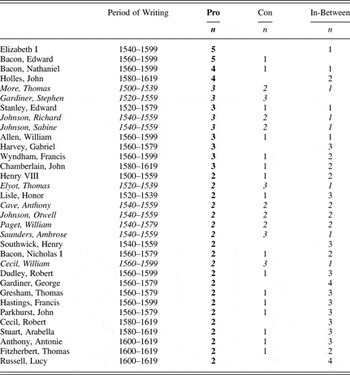
Let us begin this section by looking at the most progressive individuals, those who are progressive in at least one stage of four or five changes, in other words, people who well deserve the appellation “leader of linguistic changes.” Table 6 lists all progressive individuals,Footnote 8 those who are progressive at least in two changes, and gives the number of changes in which they have been found to be progressive, conservative or in-between, that is, neither progressive nor conservative. The names in italics refer to people who were both progressive and conservative in at least two changes.
Progressive individuals, 1500–1619

As the table indicates, there is no person who led all six changes, but two people, Queen Elizabeth I and Edward Bacon, are progressive in five ongoing changes. Furthermore, two people, Nathaniel Bacon and John Holles, are progressive in four changes. These low numbers suggest that, although at different points of time there are likely to be people who are ahead of their contemporaries in the adoption of several incoming forms, their proportion might not be very high.
Queen Elizabeth I is progressive in all changes except (which), in which she is an in-between user. It might be surprising that a person of the topmost social stratum should lead such a large number of linguistic changes, as present-day sociolinguistic studies tend to claim that the topmost layers are rarely active in promoting linguistic change. However, a more detailed look at Elizabeth's characteristics shows that her role is not so exceptional after all. Her level of education surpassed that of most contemporary women and, as queen, she had access to language that normally belonged to the male sphere, viz. administration. On the other hand, she was never educated to become the ruler of the country, in other words, to adopt a male social role; her accession only took place after her two siblings, Mary and Edward, had died.
In her study of the way the social role of Queen Elizabeth was reflected in language, Vuorinen (Reference Vuorinen2002) compared certain linguistic features of Elizabeth's language with the usage of a number of contemporary women and men. Her findings show that, linguistically, Elizabeth resembles women more than men. The combination of female and male identities may provide us with some explanation for Elizabeth's progressiveness; she can be seen leading changes from below, which is typically what women do, but she is also progressive in (neg), which has been shown to be led by men in high administrative positions (Nevalainen & Raumolin-Brunberg, Reference Nevalainen and Raumolin-Brunberg2003:149–151).
Elizabeth's role as a leader of linguistic changes is also significant in another respect. Our studies of the diffusion of early modern changes indicate that, for a change to spread rapidly in society, it is important that the topmost strata adopt it. In other words, it is likely that the shifts examined in this study spread rapidly due to Elizabeth and other upper-rank adopters. Moreover, Elizabeth's central role in her social networks most likely promoted the diffusion of the variants she adopted in their new and vigorous phase, as with the individuals Labov found to be leaders in Philadelphia.
Edward Bacon, in turn, is among the leaders of all changes except for (s), in which he is conservative. This is only to be expected for a member of an East Anglian family, as this region adopted the sibilant suffix later than the other areas studied (Nevalainen & Raumolin-Brunberg, Reference Nevalainen and Raumolin-Brunberg2003:177–180). Sir Nathaniel Bacon, Edward's elder brother, was progressive in four changes—(ing), (which), (you), and (neg); conservative in (s); and in-between in (my). Like his brother, he was educated at Cambridge and Gray's Inn. He had a long influential career as a local politician in Norfolk and certainly identified with this region (Hassell Smith, Reference Hassell Smith2004–5).
Although our bottom-up examination of the language of individual language users was originally intended to locate people who were ahead of their contemporaries in several changes, the discovery of two brothers with similar levels of progressiveness in fact shows that it is not only individuals, but also groups of people or their networks that are likely to surface in this analysis. The similarity of the two brothers is no surprise, as we can assume that they acquired their language in the same environment from the same caregivers, family members, teachers, and friends. Our finding concerning the progressiveness of the Bacon family is actually supported by the fact that the father of the two brothers, Sir Nicholas Bacon, is also among the progressive people in Table 6. Moreover, the list includes Sir Thomas Gresham, a distant relative and Nathaniel Bacon's father-in-law, who can be assumed to belong to the same social network.
The last in this group of leaders of linguistic changes is John Holles, Earl of Clare, progressive in four changes—(s), (ing), (which), and (my)—and in-between in (you) and (neg). His letters date from a somewhat later period than those of the Bacons. Although Holles lived in Nottinghamshire, he spent much time in the capital area, actively participating in the work of the Parliament and searching for social advancement. His colossal ambition and regular visits to London and the Court may have induced him to adopt the prestigious capital usage. Although social aspirers like him have been shown to be conservative and cautious in adopting new forms before knowing their social value, the changes at issue had passed their mid-range and become accepted at Court by the time Holles wrote his letters.
A look at the remaining people in Table 6 confirms the pattern observed. On the one hand, we find individuals who stand alone, on the other, groups, families, and social networks sharing linguistic choices. In addition, at least one social factor, gender, appears significant, because all 5 women included in the group of 52 people studied here are among the progressive users.
Among the progressive individuals standing alone, we find people such as William Allen, Roman Catholic priest and cardinal, who from 1565 lived in exile on the continent, and John Chamberlain, a London gentleman, who was a prolific letter writer known for his accurate descriptions of events in the capital. The group of progressive networks includes families such as the Johnsons, with two members, Richard and Sabine, progressive in three changes and a third member, Otwell, in two. The Johnsons were wealthy merchants active in London and Calais in the middle of the 16th century, and their network also included Anthony Cave, Ambrose Saunders, and Henry Southwick.
Other important circles consisted of administrators from various periods who formed networks with each other and the royalty, including Thomas More, Stephen Gardiner, Henry VIII, Thomas Elyot, William Paget, William Cecil, John Parkhurst, and Robert Cecil. These people's participation in the changes was not necessarily identical, but the number of these names occurring in italics in Table 6 also raises an interesting issue, that is, that most of these men actually combined progressiveness with conservatism.
A look at this phenomenon, the combination of progressiveness and conservatism, brings us back to the discussion of the phases of change along the S-curve. It seems that this type of polarization generally took place when most of the changes were in their new and vigorous and/or mid-range phases, but not later. This idea of a trend of declining polarization finds support in the fact that, in general, the proportion of individuals occupying in-between positions increases with time, so that the third column in Table 6 shows higher numbers than the other columns for those who are progressive in two changes and wrote their letters after 1560.
Conservative individuals
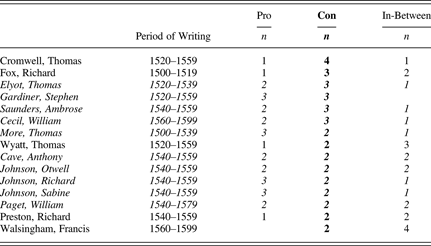
Linguistic conservatism has not attracted much attention in sociolinguistics, except when connected with age. It is generally held that older people participate in ongoing changes less often than their younger contemporaries do (e.g., Chambers, Reference Chambers2009:215–217). The conservatism of the most conservative person in our data, Thomas Cromwell, can hardly be explained by age alone, as his letters date from the time he was middle aged, 38–45 years old. As Table 7 indicates, he was conservative in four changes—(s), (which), (you), and (my). Cromwell was progressive in (neg) and in-between in (ing). Rather than age, Cromwell's linguistic behavior may be linked with his social rise from his origin as a brewer/smith/fuller's son to his position as chief minister to Henry VIII. As an ambitious social aspirer, Cromwell probably relied on a strategy well-known in the language of the upwardly mobile, namely the avoidance of new linguistic forms until their social value becomes established (see, e.g., Nevalainen & Raumolin-Brunberg, Reference Nevalainen and Raumolin-Brunberg2003:152–153).
Conservative individuals
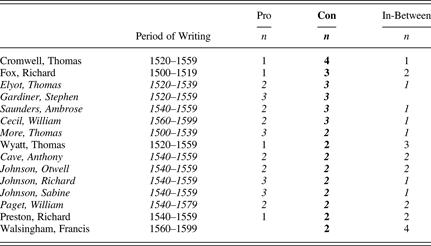
The second individual named in Table 7, Richard Fox, Bishop of Winchester, was quite an old man, between 50 and 72 years of age, when he wrote the letters included in the CEEC. He, too, rose socially, from son of a yeoman to bishop and the highest administrative officer in the country, Lord Privy Seal, under Henry VII. We may assume that both old age and social aspiration account for the conservatism Fox shows in three changes—(s), (ing), and (you). He was progressive in (my) and in-between in (which) and (neg). The remaining conservative individuals in three changes—Thomas Elyot, Stephen Gardiner, Ambrose Saunders, and William Cecil—were also progressive in at least two changes. They represent two different groups: Elyot, Gardiner, and Cecil were administrators, whereas Saunders belonged to the London-Calais merchant community.
Among those who were conservative in two changes, there were only three who did not combine conservatism with progressiveness. Thomas Wyatt, Richard Preston, and Francis Walsingham had different positions in society. Two belonged to the upper gentry, working for the government. Sir Thomas Wyatt (1503–1542) came to be known as a poet, but also acted for Henry VIII as an ambassador. Sir Francis Walsingham (1532–1590) was Secretary of State to Queen Elizabeth. Richard Preston, a servant to the Johnson merchant family, represents the lower social orders.
Our analysis identified laggards in the same way as it did leaders, picking out both individuals and groups. The most conservative people were found among upwardly mobile administrators. The fact that several people combined progressiveness with conservatism seems to reflect the various social trajectories of the ongoing changes. As many of these people lived in London and/or worked in the national administration, we might conclude that the acceptance of some of the changes in the capital region varied a great deal, and that families, groups, and networks picked their combinations of the incoming forms in different ways.
Finally, as with Table 6 for the progressive individuals, Table 7 also reveals a concentration of conservative people during the earlier phases of the changes. This might seem somewhat unexpected, given the overall progressive pull in all the changes apart from (my). On the other hand, as Tables I–V in the Appendix indicate, the proportion of progressive and conservative individuals tends to diminish toward the completion of the changes in favor of the in-between use, which may have a bearing on the figures in Table 7.
DISCUSSION
Individuals and social evaluation
It's a recurring observation in sociolinguistic research that speakers' participation in ongoing phonological changes is connected with the social evaluation of these changes. In this study, we wanted to assess the degree to which language users participate in morphological and especially syntactic changes, which are supposed to be less likely to take on symbolic value in the community. However, as Labov (Reference Labov1994:26) pointed out, the issue of the social evaluation of an ongoing change is an empirical question. It is further complicated in a historical study such as ours because our access to linguistic attitudes before the age of prescriptivism remains indirect and incomplete.Footnote 9
Historical sociolinguistic research has nevertheless discovered some potential macrolevel evidence for contemporary social evaluation in Early Modern England. For example, the direction of the supralocalizing processes we have investigated is identifiable: they diffuse either from north to south or, more typically, from south to north. The VARBRUL analyses carried out in Nevalainen and Raumolin-Brunberg (Reference Nevalainen and Raumolin-Brunberg2003:189–201) suggested that these changes continued to be region- and gender-driven throughout their trajectories. We were also able to detect differences between social ranks during the diffusion of incoming variants, although our material, produced by literate individuals, provides only restricted access to the linguistic usage of the lower social ranks. The vast majority of the population was illiterate in the Tudor and Stuart period (Cressy, Reference Cressy1980; see Nevalainen & Raumolin-Brunberg, Reference Nevalainen and Raumolin-Brunberg2003:40–43). However, the linguistic behavior of social aspirers, who rose from humble origins to positions of social preeminence, gives us some indication that social evaluation must have been associated with features spreading from the north to the south (Nevalainen & Raumolin-Brunberg, Reference Nevalainen and Raumolin-Brunberg2003:139–154). In the present study, the most conservative people during the period 1500–1619 turned out to be male social aspirers.
Although we have analyzed successful processes of supralocalization as a result of which incoming forms were generalized throughout the country, it is less easy to find a single common denominator for those individuals among the literate population who were predominantly progressive. Queen Elizabeth, a unique individual, stands out in that, over a period of sixty years, she was found to be progressive in as many as five processes of change and conservative in none. Significantly, however, even among those predominantly progressive, the common pattern included not only in-between use but also conservatism with regard to some changes. At the same time, it is noteworthy that people did not change from conservative to progressive, or vice versa, with regard to a given process of change. There were only two individuals who did that in our data, in one change each.
These findings are of relevance to the study of real-time language change in individuals. The patterns we have observed to some extent complicate the dichotomous distinction between generational and communal change (Labov, Reference Labov1994:83–84). As people rarely proved to be either progressive or conservative, we can argue that models of real-time change ought to pay more attention to the in-between status in varying linguistic and social circumstances. The quantitative methods we developed in this study for relating individual linguistic behavior to the community in real time enabled us to perform a more detailed analysis of changes of varying linguistic complexity and duration in time.
Groups and communities
Comparing the progress of contemporaneous changes in a dataset produced by a single individual provides a window onto that person's participation in ongoing processes of language change. Similar patterns of participation were found to characterize certain identifiable groups of individuals, both progressive and conservative, including those at Court and in the London merchant community. To be able to identify such groups and local communities, we have collected extensive metadata on individual letter writers (Raumolin-Brunberg & Nevalainen, Reference Raumolin-Brunberg, Nevalainen, Beal, Corrigan and Moisl2007). The broader contextualization of these writers in turn benefits from a combination of linguistic and historical research (cf., e.g., Nurmi, Nevala, & Palander-Collin, Reference Nurmi, Nevala and Palander-Collin2009; Shephard & Withington, Reference Shephard and Withington2000).
Our combination of analysis of the English language community at large and focus on the four regions shown in Table 1 proved useful, as the processes we have discussed became supralocalized throughout the literate sections of Tudor and Stuart England. Table III in the Appendix shows that even the use of negative concord largely disappeared from the literate social strata during the period under study. However, it was possible to establish a pattern of social stratification emerging as early as the 16th century with regard to this variable, as the incoming usage emanated from the upper ranks and professional circles (Nevalainen, Reference Nevalainen, Fisiak and Krygier1998; Nevalainen & Raumolin-Brunberg, Reference Nevalainen and Raumolin-Brunberg2003:146). This pattern was reconfirmed using the 18th-century extension of the CEEC, which contains more data from the lower social ranks (Nevalainen, Reference Nevalainen2006b). Obviously, the study of real-time language change becomes more representative socially the closer we get to full literacy.
In one case, our chosen level of abstraction proved too high to capture the ongoing process. The (which) variable was marked by both social stratification and regional localization (Nevalainen & Raumolin-Brunberg, Reference Nevalainen and Raumolin-Brunberg2003:146, 176). The data from the latter half of the 15th century were demographically skewed, in that they included, for the first time, representatives of the City of London wool-merchant community. In contrast to writers from the other regions represented in the corpus, these merchants systematically favored the complex form the which (Raumolin-Brunberg, Reference Raumolin-Brunberg, Taavitsainen, Nevalainen, Pahta and Rissanen2000). The findings presented in Table 4 reflect this situation. The vast majority of the people used plain which by this time, and variable use was not found in the language community to the same extent as with other ongoing changes. These findings support our hypothesis that morphological variables are less commonly associated with variable use than more complex or abstract syntactic variables. Regional skewing of this kind also illustrates one of the problems associated with real-time studies. Bailey (Reference Bailey, Chambers, Trudgill and Schilling-Estes2004:326–327), among others, cautioned sociolinguists against confusing demographic change—in our case, demographic discontinuity—with actual linguistic change. It is therefore significant that, with the exception of another process of northern origin, the diffusion of verbal -s, the same late medieval merchant community did not stand out in this way with respect to the other changes analyzed.
Patterns of change
In this real-time study, we also approached linguistic variability, progressiveness, and conservatism at the community level in terms of the relative structural complexity of the linguistic elements undergoing change, as well as the temporal trajectories of these changes. Because the processes we analyzed all diffused supralocally, this approach left open the degree of actual social evaluation of these variables. However, the large number of people with variable grammars we found with processes involving abstract structural patterns, the object of the gerund and negation, suggests a relative lack of linguistic focusing in the mid-range of these processes, despite the social variation attested with the (neg) variable in earlier research at the aggregate, intergroup level. Its variable use may also partly reflect one of its linguistic contexts, additive-correlative constructions, which were remarkably slow in admitting nonassertive forms (not … neither > not … either; Nevalainen & Raumolin-Brunberg, Reference Nevalainen and Raumolin-Brunberg2003:71–72). The (ing) and (neg) variables can be contrasted with the considerably more polarized processes involving pronoun replacements, the (you) and (which) variables, and the phonologically conditioned (my) variable.
We found that the proportions of progressive and conservative individuals correlated with the courses of the changes over time: the longer a process took to run its course, the larger the proportion of in-betweens in mid-course. An examination of the overall trajectories of the changes analyzed reveals that in most 40-year periods, in-betweens in fact formed the majority. They were outnumbered by progressive and conservative language users in rapid changes and in morphological changes more generally. In these cases, progressive language users typically outnumbered conservative users. The notion of progressive pull was thus substantiated by the data.
Temporal trajectory and structural abstraction combined in long-term processes such as the rise of the direct object of the gerund. Although the (neg) and (ing) variables returned equally large proportions of variable use in mid-range, the (neg) variable displayed a higher proportion of progressive and conservative writers than (ing), which diffused more slowly. However, apart from internal linguistic variation, social evaluation may also be reflected in this polarization. Social aspirers promoted single negation with nonassertive forms from mid-range on, whereas no such pattern emerged with the gerund (Nevalainen & Raumolin-Brunberg, Reference Nevalainen and Raumolin-Brunberg2003:143, 145–146). More data on individuals should be analyzed to substantiate findings based on aggregate data.Footnote 10
Computational model
Our computational method for identifying progressive and conservative language users is based on the premise that being progressive or conservative is a relative and not an absolute property. That is, a person is progressive only if her/his usage of the incoming form is significantly different from the overall usage of the feature (i.e., that of the reference group). Thus, we have to compare the data produced by the person against the background provided by other language users. Our method is based on summarizing the background data by bootstrap estimates of the frequency of the new form, and then estimating whether the data of the person in question is less likely to come from this distribution than from its alternative, the uniform distribution (i.e., the a priori distribution when there is no reference group).
Whether a person can be judged to be progressive or conservative depends on the amount of data available. This is why our method, based on individual language users, only compares the number of progressives and conservatives with those who have enough data to qualify, on the basis of the number of observations, as either progressive or conservative. Similarly, the number of persons in the reference group has to be sufficiently large for any conclusions to be drawn.
The rationale for this computational method is, we feel, compelling. The drawback of the technique is that it is fairly complex and hence not very user-friendly. Additionally, we need to specify what “less likely” in the preceding description means, that is, the method has a parameter that needs to be set by hand. However, once set, it makes the results comparable between different datasets. It may not be easy to find a computationally simpler method with the results remaining comparable over an extended real-time dataset, in this case, the period of 270 years. The method can also be applied to various other research tasks where comparisons of a single observation against a background are needed. Thus, it is not limited to linguistic applications alone.
CONCLUSIONS
In this study, we have analyzed processes of linguistic change in terms of linguistically progressive and conservative individuals, on the one hand, and of variable grammars, on the other. The results indicate that in the mid-range phase of a change in progress morphological features are less apt to be used variably than abstract structural patterns. Depending on the actual duration of the change, linguistic processes differ in terms of proportions of progressive and conservative language users (time-depth effect). The more protracted the process, the fewer individuals can be labeled as progressive or conservative, whereas in rapid changes there are fewer in-betweens. These two phenomena combine to produce the extreme cases of a rapid pronoun change with proportionately fewer in-between language users and a protracted syntactic change with proportionately fewer progressive and conservative individuals. However, in most cases, progressive individuals outnumber conservatives throughout the process (progressive pull).
These findings can partly explain the puzzle of the same set of people promoting some ongoing changes while remaining in-between or even conservative with respect to some others. There are few consistently progressive or conservative language users in our real-time data. A minority of individuals and groups of individuals, however, stand out in that they are progressive or conservative with respect to several of the changes studied. Interestingly, many of these multiply progressive and conservative individuals wrote their letters at a time when the changes were in either their new and vigorous or their mid-range phase. Their social status varied from the ruling monarch to the gentry and London merchants. The networks involving the Royal Court and top administrators, which included a number of progressive individuals, seem to play an important role in paving the way for the six changes investigated to become part and parcel of Present-day Standard English.
Appendix
The (ing) variable

The (my) variable

aCf. note 6.
The (neg) variable

The (s) variable

The (you) variable

COMPENDIUM
Personal details of the progressive and conservative individuals (three to five changes)
Allen, William (1532–1594). Roman Catholic priest and cardinal. Oxford. Born in Lancashire, in exile on the continent since 1565.
Bacon, Edward (1548?–1618). Gentleman. Son of Sir Nicholas Bacon (1510–1579), Lord Keeper. Cambridge and the Inns of Court. East Anglia.
Bacon, Sir Nathaniel (1546?–1622). Gentleman. Son of Sir Nicholas Bacon (1510–1579), Lord Keeper. Cambridge and the Inns of Court. Zealous favorer of moderate Puritanism. Local administrator in East Anglia.
Cecil, William, Lord Burghley (1520–1598). Secretary of State, Lord Treasurer, Master of the Court of Wards under Elizabeth I. Cambridge and the Inns of Court. Born in Lincolnshire, active at the Royal Court.
Chamberlain, John (1553–1628). Gentleman, letter writer, commentator. Cambridge and the Inns of Court. London.
Cromwell, Thomas (1485?–1540). Secretary to Cardinal Wolsey, King Henry VIII's chief minister, peer 1540. Self-made man with little formal education. Born in Putney, active in London and at the Royal Court.
Elizabeth I (1533–1603). Queen of England 1558–1603. Daughter of Henry VIII and Anne Boleyn. Classical education by private tutors.
Elyot, Thomas (1490?–1546). Gentleman, diplomat, author. Oxford. Born in Suffolk, active at the Royal Court and in Europe, retired to Cambridgeshire. Ambassador to Charles V.
Fox, Richard (1447?–1528). Bishop of Winchester, Lord Privy Seal under Henry VII. Oxford and Paris. Born in Lincolnshire, active in various parts of the country.
Gardiner, Stephen (1495/8–1555). Bishop, Ambassador, Henry VIII's chief minister. Cambridge. Born in Norfolk, active in London and Europe.
Harvey, Gabriel (1552/3–1631). Scholar and writer. Cambridge. Born in Essex, lived in London before returning to Essex in the 1590s.
Holles, John, Earl of Clare (d. 1637). Upwardly mobile gentleman, comptroller of Prince Henry's household. Cambridge and the Inns of Court. Nottinghamshire.
Johnson, Richard (1521?–). Wool merchant, younger brother and business partner of John Johnson. London and Calais.
Johnson née Saunders, Sabine. Wife of wool merchant John Johnson. Northamptonshire and London.
More, Sir Thomas (1478–1535). Knight. Lawyer, secretary to Henry VIII, Lord Chancellor. Oxford and the Inns of Court. Humanist scholar. London.
Saunders, Ambrose (?). Wool merchant, business partner of John Johnson. Brother of Sabine Johnson née Saunders. Calais and Antwerp.
Stanley, Edward, Earl of Derby (1509–1572). Magnate with Catholic sympathies. Privy councilor under both Mary and Elizabeth I. Born in Lancashire, active at the Royal Court and in northern counties.
Wyndham, Francis (d. 1592). Judge. Cambridge and the Inns of Court. Born in Norfolk, active in London and Norfolk.