Introduction
Neoproterozoic and older cratons are inferred to have been positioned against the eastern margin of Gondwana forming a late Precambrian supercontinent (Hoffman Reference Hoffman1991, Moores Reference Moores1991). The estimated ages of a major rifting event that separated the Gondwana fragment from the remainder of the supercontinent range from late Neoproterozoic to early Cambrian (Dalziel Reference Dalziel1991, Reference Dalziel1992, Storey et al. Reference Storey, Alabaster, Macdonald, Millar, Pankhurst and Dalziel1992, Storey Reference Storey1993).
Identification of rift related sequences and establishment of their ages is instrumental in determining this part of Gondwana history.
A Neoproterozoic age for rifting, prior to the onset of the Ross orogeny, was inferred for many of the oldest metasedimentary rocks along the present day Transantarctic Mountains (Bond et al. Reference Bond, Nickeson and Kominz1984, Bell & Jefferson Reference Bell and Jefferson1987, Moores Reference Moores1991, Dalziel Reference Dalziel1992, Stump Reference Stump1992, Storey Reference Storey1993, Rowell et al. Reference Rowell, Rees, Duebendorfer, Wallin, Van Schmus and Smith1993). However, recent radiometric dating has demonstrated that many of these metasediments are Cambrian or younger (Millar & Storey Reference Millar and Storey1995, Encarnacion & Grunow Reference Encarnacion and Grunow1996, Rowell et al. Reference Rowell, Gonzales, McKenna, Evans, Stump, Van Schmus and Ricci1997, Reference Rowell, Van Schmus, Storey, Fetter and Evans2001) and, as yet, Neoproterozoic rocks are reported from two areas only. In the central Transantarctic Mountains, metabasites aged 668 ± 1 Ma (U–Pb) indicate late Neoproterozoic formation of oceanic crust east of the Antarctic Craton (Goodge et al. Reference Goodge, Myrow, Williams and Bowring2002), and in south Victoria Land a pillow lava with a Sm–Nd mantle separation age of 700–800 Ma in the Skelton Glacier area has continental rift affinities (Rowell et al. Reference Rowell, Rees, Duebendorfer, Wallin, Van Schmus and Smith1993). This paper provides the first description of a sequence of rift-related igneous and sedimentary rocks formed in the Victoria Land segment of the Transantarctic Mountains during the Neoproterozoic.
The oldest metasediments in south Victoria Land comprise the Skelton Group (Gunn & Warren Reference Gunn and Warren1962) and are dominated by calc–silicate, marble, biotite and amphibole schist with minor metabasites, quartzofeldspathic and pelitic horizons (Gunn & Warren Reference Gunn and Warren1962, Blank et al. Reference Blank, Cooper, Wheeler and Willis1963, Lopatin Reference Lopatin and Adie1972, Skinner Reference Skinner and Craddock1982, Findlay et al. Reference Findlay, Skinner and Craw1984, Allibone Reference Allibone1992, Cook Reference Cook1997). These rocks vary in strain and metamorphic grade but in almost all, original features are lost or poorly preserved (Walcott & Craw Reference Walcott and Craw1993, Cook Reference Cook1997, Cook & Craw Reference Cook and Craw2001, Reference Cook and Craw2002). Deformation and metamorphism of the Skelton Group was associated with pluton emplacement and occurred during various stages of orogenesis, the earliest of which began c. 551 Ma (Rowell et al. Reference Rowell, Rees, Duebendorfer, Wallin, Van Schmus and Smith1993, Cook & Craw Reference Cook and Craw2002).
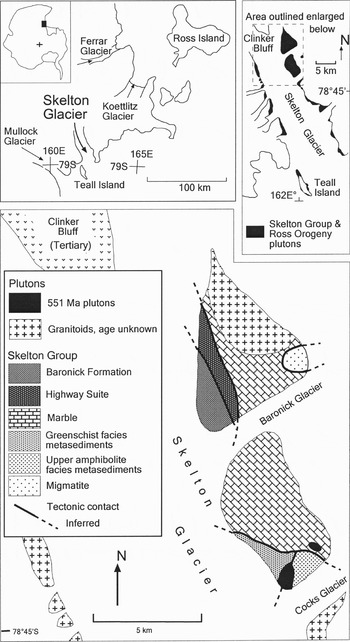
In the Skelton Glacier area (Fig. 1), the Skelton Group occurs in numerous, kilometre scale fault-bounded crustal slices, each slice containing different rock types and having different structural and metamorphic character. Juxtaposition of these slices occurred along greenschist facies shear zones before 551 Ma (Rowell et al. Reference Rowell, Rees, Duebendorfer, Wallin, Van Schmus and Smith1993, Encarnacion & Grunow Reference Encarnacion and Grunow1996, Cook & Craw Reference Cook and Craw2002). Many of the least deformed and metamorphosed Skelton Group rock types are found along the Skelton Glacier and include local occurrences of conglomerate, pillow lavas, dykes and small metabasite plugs (Skinner Reference Skinner and Craddock1982, Rowell et al. Reference Rowell, Rees, Duebendorfer, Wallin, Van Schmus and Smith1993, Cook Reference Cook1997, Cook & Craw Reference Cook and Craw2002). Of these, the Baronick Formation (Fig. 1) shows the most original features of any major unit. The Baronick Formation and the adjacent Highway Suite (Fig. 1) were originally included in the Cocks Formation of Skinner (Reference Skinner and Craddock1982). Rather than being a single metasedimentary formation, our mapping demonstrates that the Cocks Formation incorporates several fault bounded, lithologically distinct slices, leading to abandonment of the name by Cook & Craw (Reference Cook and Craw2002). Instead, the metasediments and associated igneous rocks are referred to by the tectonic slice in which they are found. However, the Baronick Formation and the Highway Suite are very distinct, identifiable units so are named specifically.
Locality map of Skelton Glacier showing the position of the Baronick Formation and Highway Suite, some of the fault bounded crustal slices of Skelton Group in the vicinity, and the location of the two 551 Ma intrusions of Rowell et al. (Reference Rowell, Rees, Duebendorfer, Wallin, Van Schmus and Smith1993) and Encarnacion & Grunow (Reference Encarnacion and Grunow1996).

The Baronick Formation and Highway Suite contain the largest and most compositionally diverse exposure of igneous rock associated with sedimentation anywhere in the Skelton Group. These two formations are relatively undeformed when compared to the rest of the Skelton Group and provide a rare opportunity to use sedimentary and igneous features to evaluate the tectonic environment during formation of the Skelton Group.
Baronick Formation
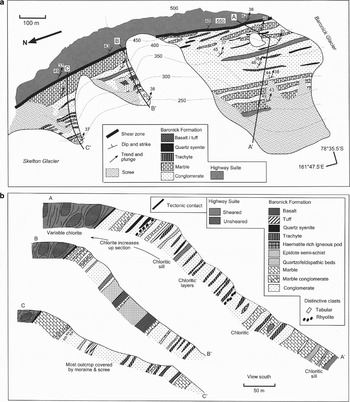
The Baronick Formation is exposed for approximately 2 km along strike at the confluence of the Baronick and Skelton Glaciers (Fig. 1) and has a minimum thickness of 500 m (Fig. 2). It includes metamorphosed, coarse-grained clastic sediments and volcanic to sub-volcanic igneous layers which are inferred to be coeval (Fig. 2b). Marble forms the only other volumetrically significant beds and there is virtually no argillaceous material. This assemblage is one of the most distinct in the Skelton Group because of the high proportion of conglomerate, and because the clasts are derived from mafic and felsic volcanic to sub-volcanic rock types in contrast to the quartzite-dominated clasts elsewhere in the Skelton Group (Cook Reference Cook1997). The Baronick Formation is sheared against and structurally underlies the Highway Suite (Fig. 2), an igneous assemblage comprising 100% gabbroic and doleritic intrusions. Some gabbro sills related to the Highway Suite intrude the Baronick Formation parallel to bedding. The Baronick Formation and Highway Suite were together incorporated into a fault bounded crustal slice during regional metamorphism and deformation, and this slice was faulted into its present position, adjacent to greenschist facies marble, before 551 Ma (Rowell et al. Reference Rowell, Rees, Duebendorfer, Wallin, Van Schmus and Smith1993, Encarnacion & Grunow Reference Encarnacion and Grunow1996, Cook & Craw Reference Cook and Craw2002).
a. Geological map of the Baronick Formation and the contact with the Highway Suite at the confluence of the Skelton and Baronick Glaciers. The locations of detailed cross sections of Fig. 2b are also indicated. b. Detailed cross sections through the Baronick Formation and the sheared contact with the Highway Suite. Structural pods of gabbro and diorite in the Highway Suite are shown schematically.

The Baronick Formation is albitized and all rock types are metamorphosed. However, strain was partitioned mainly into the finest grained material and regional metamorphism has not totally obscured primary characteristics.
Conglomerate
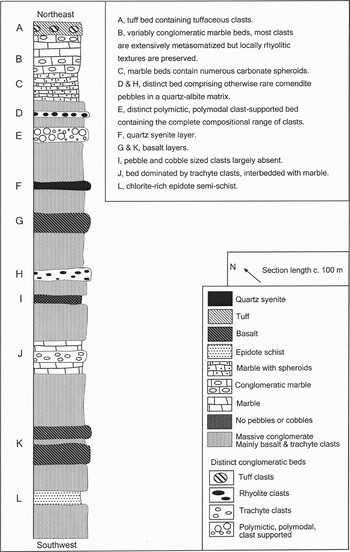
Massive conglomerate occurs in layers up to 30 m thick and forms approximately 80% of the formation (Fig. 2). Poorly defined, metre-scale beds have no distinct boundaries and merge laterally so that individual beds are difficult to define. The rare but distinct beds, which have well defined margins, reach 4 m thickness and occur within massive units, or are interbedded with marble (Fig. 3).
Detailed section taken parallel to the upper part of section A (Fig. 2b). Replacement of biotite by chlorite and additional chlorite growth defining foliation becomes increasing abundant towards the structural top of this section. Most of the section is massive conglomerate dominated by sand and small pebbles, larger clasts are concentrated in distinct beds.

Clasts are very well rounded, 1 to 25 cm sized oblate ellipsoids distributed throughout the section, although larger clasts tend to be concentrated in distinct beds. Rare spheroidal clasts consisting only of coarse-grained albitized trachyte and are found in one bed (Fig. 3). Most of the poorly bedded conglomerate has bimodal distribution of lithic fragments, comprising pebbles and cobbles supported in a matrix of coarse sand and up to 25% fine-grained recrystallized phyllosilicate-rich material. Conglomerates forming well-defined beds are texturally distinct from massive conglomerate, generally having a higher clast:matrix ratio, resulting in clast supported beds. They are also markedly polymodal and polymictic and tend to contain most of the largest clasts (Fig. 3). Tabular clasts ranging from 15 to 20 cm long, 2 to 3 cm wide, are rare and are concentrated in distinct beds (Fig. 2).
Pebble- and cobble-sized clasts are dominated by trachyte and basalt in variable proportions but locally, in distinct beds, include comendite or marble. A variety of sand-sized grains are recognized, including fragments and euhedral crystals of albite, biotite-albitite and rarely quartz, phyllosilicate and haematite-magnetite or pyrite. Beds dominated by comendite clasts are rare and have a sand-sized component of albite and quartz fragments, with rare mica, resulting in an essentially monomictic bed (Fig. 3). Layers of conglomeratic basaltic tuff are also monomictic, the clasts having a similar composition to matrix (Fig. 3). Tabular clasts comprise a very fine- to fine-grained sand-sized assemblage of recrystallized biotite, albite, calcite and opaque minerals and are finely bedded on the millimetre scale. These clasts locally contain pebbles and resemble epidote semi-schist and conglomerate matrix in beds nearby. Rarely, some of the ellipsoidal clasts are themselves conglomeratic, having a matrix rich in recrystallized biotite, albite phenocrysts and opaque minerals. Embedded in this matrix are coarse sand-sized trachyte or mafic albitite clasts.
Pebbles and cobbles of igneous origin
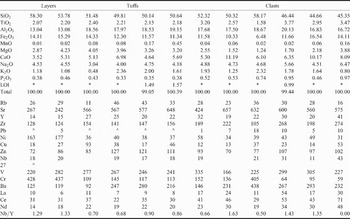
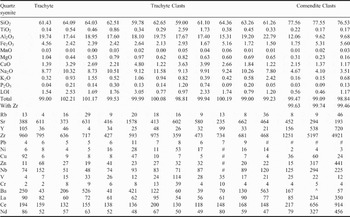
Trachyte: Trachyte occurs as oblate pebbles and spheroidal cobbles. Igneous euhedral prisms and oriented laths of feldspar form 95 to 98% of clasts. Spherical, coarse-grained trachyte cobbles contain 2 cm euhedral feldspar phenocrysts forming 40% of the clast. All feldspar is now albite (An0-4); simple twinning is common and anhedral epidote, quartz and muscovite are present as inclusions. Biotite and/or chlorite form up to 5% of the clasts with trace quantities of opaque minerals and quartz. Carbonate is most common in clasts surrounded by marble matrix where it makes up to 40% of the rock. Apatite is an accessory mineral. Geochemical analysis reveals 59.0–64.4% SiO2, 15.3–19.8% Al2O3 and 8.7–11.6% Na2O (Tables I–III).
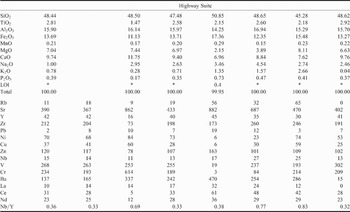
Whole rock major (wt%) and trace element (ppm) concentrations for igneous rock types.

* LOI greater than 2 Wt%, analyses recalcuated LOI free, ∧elements below detection limit, # no analysis
Whole rock major (wt%) and trace element (ppm) concentrations for igneous rock types. Baronick Formation mafic rocks.

* LOI greater than 2 Wt%, analyses recalcuated LOI free, ∧elements below detection limit, # no analysis
Whole rock major (wt%) and trace element (ppm) concentrations for igneous rock types. Baronick Formation evolved rocks.

* LOI greater than 2 wt%, analyses recalcuated LOI free, ∧elements below detection limit, # no analysis
Comendite: Oblate spheroidal clasts of comendite, 1 to 5 cm across, are uncommon in the Baronick Formation but are concentrated in two distinct beds in which clasts of other compositions are rare (Fig. 3). Comendite is the only clast lithology that is not also seen as layers in the Baronick Formation. Igneous textures are preserved, with most clasts containing elongate domains of fine-grained quartz and feldspar in a banded but non-foliated matrix. The matrix is oriented around phenocrysts of euhedral, simple twinned feldspar (3 mm) and anhedral quartz (2 mm), and comprises accessory albite, quartz, zircon, monazite, iron oxides and minor biotite. SiO2 ranges from 76.5–77.6% and Zr from 1251–5197 ppm, Nb from 125–294 ppm, and Al2O3 is also high, from 9.6–12.1% (Table III).
Basalt: Basaltic sand to small cobble-sized, oblate spheroidal clasts are common throughout the Baronick Formation and retain igneous textures in the form of randomly oriented euhedral feldspar laths. Feldspar is now albite and the groundmass is predominantly biotite with albite and trace quantities of pyrite and haematite-magnetite, quartz and epidote. Calcite is prominent in the groundmass, or as veins in some clasts, and forms up to 20% of the rock. Pyroxene and amphibole are absent. SiO2 ranges from 42.7–57.3% (Tables I–III). K2O ranges from 0.8–2.3%, Na2O from 4.3–6.2 and Al2O3 from 16.1–20.1% reflecting the presence of biotite and albite. MgO values from 1.24–3.88% and Ni values from 31–58 ppm. are low, and P2O5 is high compared to the remainder of the formation and to the Highway Suite (Table I).
Basaltic tuff: Rare clasts of basaltic tuff (Fig. 3) are petrographically similar to layers (below) and comprise prominent large feldspar crystals in a fine-grained recrystallized matrix, interpreted as a tuffaceous texture. Minerals include large subhedral feldspar in an albite, biotite, chlorite, opaque matrix with accessory epidote and quartz. Calcite and muscovite replace most large feldspars and are also common in the groundmass along with carbonate veins.
Other metasediments
Marble: Marble occurs as grey beds at the lower end of sections A and C, as white and grey beds at the top of all sections (Fig. 2) and interlayered with conglomerate further north along Skelton Glacier. Bed thickness ranges from 0.05 to 5 m and most marble beds form lenticular horizons, although continuous beds extend laterally up to 350 m (Fig. 2). Marble beds are locally conglomeratic, containing ellipsoidal clasts of carbonate and metasomatized lithic material of unknown origin (Fig. 2b) indicating that the carbonate component is also reworked, although fine-grained impurities are absent from the carbonate matrix. Mono- and polycrystalline quartz clasts and albite fragments are generally less than 1 mm and are minor components in layers at the top of section A (Fig. 2b). Marble is the only lithology that is totally recrystallized and comprises a metamorphic assemblage of medium- to fine-grained carbonate, accessory graphite and trace serpentine, muscovite, talc and pyroxene. Marble also occurs as clasts in conglomerates elsewhere in the formation.
Marble and carbonate-rich beds at the top of all three sections contain numerous spheroidal and elliptical carbonate bodies from 2 to 10 mm in diameter which resemble pisoliths (Fig. 3). The elliptical bodies consist of finer grained carbonate than the matrix marble and, in some, concentric layers are visible in hand specimen. Other marble beds containing similar bodies are prominent at various points along the north bank of Skelton Glacier and some of these beds also contain lithic fragments.
Epidote semischist: Centimetre- and metre-thick beds of epidote semischist (Fig. 2) comprise fine-grained quartz and albite fragments in a metamorphic assemblage of fine-grained biotite and/or chlorite, with euhedral epidote, magnetite and hematite, or pyrite and pyrrhotite. The matrix has millimetre scale calcite and quartz veins and millimetre sized lenses of quartz-biotite or iron oxides/sulphides-quartz-biotite.
Quartzofeldspathic pelite: Quartzofeldspathic pelite occurs as very rare, finely layered centimetre scale beds (Fig. 2). The beds are fine-grained, equigranular, and comprise a metamorphic assemblage of biotite, feldspar, quartz and rare chlorite. This rock type was not found as clasts within the formation.
Igneous layers
Igneous layers parallel to bedding occur throughout Baronick Formation (Fig. 2) but no diagnostic field relations were found to distinguish their origin as sills or flows. They are included in Baronick Formation because some are interpreted as tuffs (see below) and the petrological and geochemical similarity of layers with conglomerate clasts suggests a penecontemporaneous origin. These rocks are metamorphosed and partially recrystallized, but they are unfoliated and the minor structural and metamorphic overprint does not obliterate primary textures.
Quartz syenite: Quartz syenite forms laterally discontinuous layers, less than 1 m thick and extending for 100 m along strike. These layers occur next to well defined beds and none were observed interlayered with massive conglomerate (Fig. 2). Minerals include an intergrown igneous assemblage of feldspar and quartz either in sub-equal proportions or with quartz confined to the groundmass. Rutile and zircon are accessory minerals, feldspar is now albite and metamorphic biotite is present in trace and accessory amounts. Quartz syenite was not found as clasts in the sediments.
Trachyte: Trachyte forms fine-grained, discontinuous layers less than one metre thick interlayered with well bedded and massive conglomerate (Fig. 2). Feldspar comprises 95 to 99% of the layers and occurs as elongate euhedral and feathery laths in domains oriented sub-parallel to layering or in a matrix of fine-grained albite and minor quartz. Metamorphic muscovite, or biotite and/or chlorite form up to 5%, and trace minerals include either magnetite and hematite, or pyrite and pyrrhotite. Some carbonate is present as veins or in the groundmass and all feldspar is now albite (An0 to An4). Whole rock major element analysis show SiO2 at 61.4%, which is within the range of trachyte clasts (above), and similar Al2O3 (19.7%), and Na2O (8.8%) (Table III).
Basalt: Concordant basaltic rocks form fine-grained (millimetre scale), discontinuous horizons up to 3 m thick (Fig. 2). Igneous textures include euhedral and feathery laths of feldspar comprising up to 60% of the assemblage with metamorphic biotite and/or chlorite comprising up to 50%. Magnetite and hematite, or pyrite and pyrrhotite, form up to 20% and quartz occurs as either a trace or an accessory mineral. Amphibole and pyroxene are absent and all feldspar is now albite. Metamorphic calcite is prominent in the groundmass or as veins in up to 30% of some layers. Locally, the structural bases of basaltic layers are brecciated and contain over 50% quartz-carbonate vein material. These rocks are chemically similar to basaltic clasts (above) having 51.4 and 57.4% SiO2, 12.5 and 12.8% Al2O3, 4.4 and 4.5% Na2O, 1.0 and 1.1% K2O and 2.87 and 4.23%, MgO (Table II). Ni is high compared to other mafic rocks in the formation at 163 and 177 ppm, and 0.38–0.46% P2O5 is lower than that of the clasts. The mineralogy is consistent with an origin similar to that of spillites. Mineralogy and field relations clearly distinguish these basalt layers from the Highway Suite (below).
Basaltic tuff: Basaltic tuffs are fine-grained beds containing prominent 1–2 cm, semi-aligned feldspar grains and are texturally distinct from the basalts described above. Basaltic tuffs locally contain clasts, up to 2 cm, of material identical to the rest of the layer. Minerals include large euhedral feldspar in a metamorphic assemblage of albite, biotite, chlorite, opaque minerals with accessory epidote, muscovite and quartz. Most large feldspars are albite partially replaced by calcite, biotite and/or muscovite, and carbonate veining is common. Whole rock major element analysis show a more restricted SiO2 range of 47.2–50.6% than the basaltic clasts but less than that of the basalt layers. Al2O3 (17.0–19.2%) is similar to the basaltic clasts (Table II). K2O, from 0.5–2.2% reflects the high mica content and Na2O from 2.9–4.8% is consistent with albite feldspar. MgO is reasonably low from 3.24–4.05% and Ni is low from 36–40 ppm. P2O5 ranges from 0.33 to 0.43, similar to the basaltic layers but generally less than that of the clasts. Basaltic tuffs are interbedded with matrix-supported conglomerate (Fig. 2). The fine-grained, recrystallized matrix, absence of distinct interlocking feldspar grains, and presence of large feldspar crystals creates a texture distinct from that of the other basaltic rocks and suggests these layers were deposited as tuffs.
Highway Suite
The Highway Suite occurs in a block less than 1 km wide and at least 4 km long, and comprises mutually intrusive metre scale dolerite and gabbro plugs. The Highway Suite is sheared against the structurally underlying Baronick Formation (Fig. 2) and the north-eastern boundary is in tectonic contact with greenschist facies marble (Cook & Craw Reference Cook and Craw2002). In addition to the main exposure, two sills of the Highway Suite intrude the Baronick Formation parallel to bedding. Original igneous textures such as interlocked plagioclase laths, euhedral phenocrysts and skeletal magnetite are recognizable, but commonly the intrusives are altered, many minerals are anhedral with inclusions, and partial or total replacement of igneous texture is common. The dominant mineral assemblage is plagioclase-pyroxene-magnetite with variable amounts of deuteric amphibole, secondary biotite, chlorite, calcite, epidote and sericite. Whole rock analyses (Table I) show a SiO2 range 43.9–50.9% revealing these metabasites to be similarly evolved as basalt layers of Baronick Formation and with Al2O3 and CaO values reflecting their alteration. MgO ranges from 2.15 to 8.11 with most samples having more than 6.50%, and Ni ranges from 6 to 84 ppm. with most samples being in the higher range. There is a wider range of P2O5, from 0.17 to 0.73, than in the Baronick Formation.
A fine-grained (less than 0.5 mm) plagioclase-biotite-magnetite rock type is a rare component of the intrusions. Plagioclase occurs as euhedral and subhedral 3 mm phenocrysts in a plagioclase-rich groundmass, forms 60% of the rock and is partially replaced by euhedral epidote. Metamorphic biotite, present in the groundmass and as secondary inclusions in plagioclase, forms 30% of the rock and locally is partially replaced by chlorite. Secondary calcite is found throughout the groundmass and as inclusions in plagioclase. Biotite is suspected to result from total alteration of pyroxene or amphibole, neither of which are found in these bodies. These samples have similar mineralogy to basaltic layers in Baronick Formation but are not thoroughly albitized.
Structure and regional metamorphism
Baronick formation
The finest grained matrix material now comprises metamorphic biotite and annealed carbonate. Original textures are retained in the sand-sized fraction and truncation of igneous textures at clast margins indicates absence of significant internal deformation and recrystallization although many ellipsoidal clasts show evidence of tectonic thinning along their long axes. Marble is the only rock type that is totally recrystallized and where present, clasts contain metasomatic talc and calcite (Fig. 3). Carbonate is common in most rock types, either in the groundmass or as veins forming up to 20% of the rock, and element mobility is indicated by the occurrence of carbonate, talc and quartz in pressure shadows adjacent to clasts. The biotite-actinolite-epidote-talc-albite mineralogy indicates greenschist facies metamorphism.
All basaltic, trachytic and rhyolitic rock types and feldspar fragments in conglomerate matrix are albitized. However, this albitization does not accompany a regional metamorphic fabric, nor has it involved textural change.
A poorly developed bedding-parallel foliation defined by semi-aligned biotite is present in some igneous layers, but an igneous or tectonic origin has not been determined. In metasediments, clasts lie parallel to bedding and ellipsoidal clasts produce a persistent, well defined lineation plunging 38 to 55° SE. Variably aligned biotite and chlorite define a foliation best developed in extensively veined epidote semi-schists. This foliation has a constant dip (45° ENE) and is sub-parallel to bedding. Boudinaged veins, elongate biotite rich clasts, aligned biotite and recrystallized quartz forming sub-grains strung out parallel to foliation are common in epidote semi-schists. Elipsoidal and rare augen-shaped clasts indicate minor deformation in other layers. Small scale structures occurring locally within beds include spaced shear bands 45° to foliation, millimetre scale shear zones and fractured feldspar. Rarely beds are very well foliated parallel to bedding, all biotite is replaced by chlorite, calcite veins are parallel to foliation and large feldspar crystals are plastically deformed. Layers are locally brecciated and some undeformed vein arrays are oriented sub-parallel to foliation. A locally developed post-foliation crenulation lineation plunges steeply to the north and centimetre scale kinks in biotite rich layers have a random orientation.
Highway suite
Actinolite, feldspar, biotite and elongate magnetite define a spaced upper greenschist facies foliation and, in general, shearing has produced a mass of foliated metabasite with locally extensive development of biotite and calcite obscuring original intrusive relations. However, strain heterogeneity has left relatively undeformed pods where igneous textures are locally preserved. Shearing in sills that intrude the Baronick Formation is defined by oriented actinolite, biotite and chlorite and tectonic foliation is common.
Contact between the Baronick and Highway Formations
In the Baronick Formation, direct replacement of biotite by chlorite along the pre-existing bedding parallel foliation increases up section and in some layers up to 90% of the phyllosilicate is chlorite. Replacement of biotite by chlorite also occurs in the adjacent Highway Suite where foliation becomes pervasive in high strain zones around lesser deformed pods, and increases in intensity towards the structural base. Here igneous textures are absent and mafic intrusives form a strongly foliated, highly strained zone striking subparallel to foliation in the Baronick Formation. The extensive replacement of biotite by chlorite in these intensely foliated zones suggests the Highway Suite and Baronick Formation underwent greenschist facies retrogression subsequent to biotite grade deformation during final juxtaposition. There is insufficient evidence to determine the extent of movement under lower or upper greenschist facies conditions or if there has been overprinting of an earlier tectonic or primary contact associated with igneous activity.
Geochemistry
Albitization
The thorough albitization, and the absence of amphibole and pyroxene in basalts distinguishes the Baronick Formation from other metaigneous layers in the Skelton Glacier area. Albitization has produced high Na2O, Al2O3 and low CaO (Tables I–III); characteristics not developed to the same extent in the Highway Suite which is not completely albitized and which contains amphibole and pyroxene. Albitization has preserved original feldspar textures, and is not related to deformation or restricted to igneous rocks of a particular composition. Mineralogy of the Baronick Formation basalts is consistent with greenschist facies metamorphism of chlorite- and albite-bearing metabasalts altered to the extent that amphibole and pyroxene are absent. This alteration commonly results from either sea water interaction with magma, or late magmatic metasomatism by hydrothermal solutions (Patwardhan & Bhandari Reference Patwardhan, Bhandari and Amstutz1974, Bamber Reference Bamber and Amstutz1974) suggesting alteration of the Baronick Formation is related to volcanic activity at the source. Similar alteration has not affected other volcanic or sub-volcanic rock types within the Skelton Group (Cook Reference Cook1997), suggesting regional metamorphism or diagenesis are not the cause.
Mafic rocks
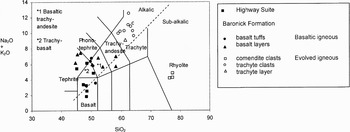
Mafic rocks of both formations have high LOI due to secondary hydration and carbonatisation and those with LOI greater than 3% are recalculated volatile free to 100%. Mobile elements Sr, K, Rb and Ba show no systematic variation when Zr is used as an index of differentiation. However, despite mobility of alkalis during alteration and metamorphism, immobile elements indicate retention of original characteristics (below, Fig. 4) and are compared with those from well characterized modern suites to aid classification.
Classification of igneous rock types using total alkalis vs silica ratios. Fields from Middlemost (Reference Middlemost1994), the alkaline/sub-alkaline boundary from Miyashiro (Reference Miyashiro1978).

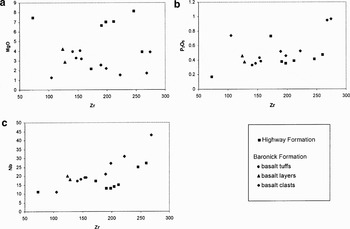
Baronick Formation: Many samples from the Baronick Formation (Table II) have unusually low MgO and Ni and high to very high P2O5 and Nb contents (Fig. 5), more typical of evolved alkaline basalts such as hawaiites. TiO2 and Zr are also relatively high, even in the most primitive basaltic layers, but no clear enrichment of TiO2 with differentiation is present due to fractionation of iron-titanium oxides. With one exception, mafic rocks in the Baronick Formation have Nb/Y ratios greater than 0.67, which along with the spatial association of the metabasites with alkali trachytes (below) indicates alkaline character (Table II, Winchester & Floyd Reference Winchester and Floyd1977).
a. MgO:Zr ratio showing unusually low MgO and relatively high Zr of the Baronick Formation, and the generally higher MgO of the Highway Suite. b. P2O5:Zr ratio showing a spread in P2O5 reflecting variable mantle derived enrichment and the generally lower P2O5 in the Highway Suite. c. Nb:Zr ratios showing very high Nb. Parallel trends shown for the Highway Suite and basalt clasts from the Baronick Formation may reflect a slight difference in source composition for each.

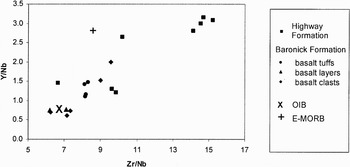
Neither Ti, P nor Nb are abundant in continental crust and their high values in the Baronick Formation reflect trace element enrichment in their parent mantle rather than crustal contamination (Hawksworth et al. Reference Hawksworth, van Calsteren, Rogers, Ellam, Menzies, Menzies and Hawksworth1987). Y/Nb values (Fig. 6) less than 1.3 and up to 2.0 are comparable with P-MORB and T-MORB respectively (Le Roex et al. Reference Le Roex, Dick, Reid, Frey, Erlank and Hart1983). Zr/Nb values ranging from 6.2 to 9.55 are also comparable to MORB derived from a source enriched in incompatible elements (Le Roex Reference Le Roex, Menzies and Hawksworth1987, Leat et al. Reference Leat, Thompson, Morrison, Hendry and Dickin1988) and are typical of some OIB (Basaltic Volcanism Study Project 1981) and of intercontinental rifting (Deniel et al. Reference Deniel, Vidal, Coulon, Vellutini and Piguet1994).
Y/Nb:Zr/Nb ratios. E-MORB and OIB from Sun & McDonough (Reference Sun, McDonough, Saunders and Norry1989).

Highway Suite: Independent element ratios and fractionation tend to divide the Highway Suite into two groups, one showing a similar level of enrichment as the Baronick Formation and the other, significantly less enrichment for a given degree of fractionation. Most samples of the Highway Suite (Table I) have higher MgO and Ni, and lower P2O5 and Nb (Fig. 5) than the Baronick Formation. All but three samples of the Highway Suite have Nb/Y less than 0.67, indicating that much of the Highway Suite is typical of sub-alkaline basalt although a smaller group of samples plotting with similar values to the Baronick Formation shows alkaline affinity. Zr/Nb ratios between 6.5 and 10 are similar to the Baronick Formation and indicate some enrichment of the magma source, but a distinct group ranging from 14 to 15.2 indicates derivation from a less enriched source (Fig. 6; Le Roex et al. Reference Le Roex, Dick, Reid, Frey, Erlank and Hart1983). Y/Nb values higher than 0.9 and a distinct group greater than 2.5 indicate P- and T-MORB respectively (Fig. 6; Le Roex et al. Reference Le Roex, Dick, Reid, Frey, Erlank and Hart1983).
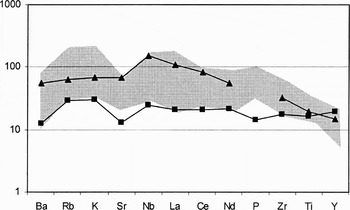
Mafic rocks from both formations are normalized following Thompson et al. (Reference Thompson, Morrison, Hendry and Parry1984), whereby Rb, K and P are normalized to primitive terrestrial mantle and the remaining elements to chondrite. Spider diagrams illustrate LREE, Nb, Ti and P enrichment reflecting an enriched source rather than crustal contamination. Immobile elements produce a gradient between that of enriched MORB (Humphris et al. Reference Humphris, Thompson, Schilling and Kingsley1985) and intraplate alkaline basalts of Sun (Reference Sun1980) (Fig. 7). Y is relatively low indicating residual garnet in the source, a feature in magmas of plume origin (Le Roex et al. Reference Le Roex, Dick, Reid, Frey, Erlank and Hart1983, Humphris et al. Reference Humphris, Thompson, Schilling and Kingsley1985).
Comparison of element abundances from all mafic rocks normalized to chondrite or to primitive terrestrial mantle (Thompson et al. Reference Thompson, Morrison, Hendry and Parry1984). The shaded field encompasses the full element range of Baronick Formation mafic rocks and the Highway Suite. The two spiderlines outline the gradients of enriched MORB (squares) from Humphris et al. (Reference Humphris, Thompson, Schilling and Kingsley1985) and intraplate alkaline basalts of Sun (Reference Sun1980) (triangles).

Evolved igneous rocks
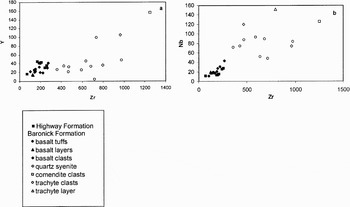
Minor occurrence of secondary epidote and muscovite in trachytes suggest plagioclase and K-feldspar phenocrysts may originally have been present. However, despite alkali mobility, alkalis vs. silica ratios indicate trachyte/quartz-syenite compositions for clasts and layers (Fig. 4), consistent with trace element geochemistry. Rare earth and other trace elements are high in the trachytes (e.g. up to 99 ppm Y; up to 152 ppm Nb; 359–975 ppm Zr; Fig. 8) and are very high in the comendites (156–720 ppm Y; 125–294 ppm Nb; 85–350 ppm La; 217–914 ppm Ce; 79–456 ppm Nd; 1251–5197 ppm Zr, Fig. 8, Tables I–III), typical of within plate magmatic activity (Barberi et al. Reference Barberi, Santacroce and Varent1974).
High field strength elements in the evolved igneous rocks of Baronick Formation compared with the mafic rocks of the Baronick Formation and the Highway Suite. Comendite clasts with greater than 1300 ppm Zr are excluded. a. Y:Zr, b. Nb:Zr

Discussion of geochemistry
Alkali basalts of the Baronick Formation have characteristics of P- and T-MORB derived from enriched mantle. A distinctive feature of the Baronick Formation is the bimodal association of the alkaline basalts and trachytes/comendites. The presence of comendites in the Baronick Formation reflects stagnation of parental alkali basalts and advanced fractionation along a quartz saturated trend prior to emplacement. Examples are found in intraplate environments associated with modern plumes (e.g. Harris Reference Harris1983).
Some samples with alkali characteristics indicate that part of the Highway Suite has a source in common with or very similar to that of the Baronick Formation, and formed in a tectonic environment incorporating enriched MORB asthenosphere. However, much of the Highway Suite has sub-alkaline or transitional alkaline composition and intrudes Baronick Formation, implying derivation of younger magma from a more MORB-like source.
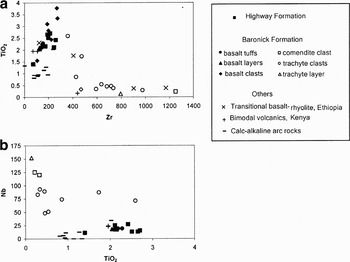
The bimodal association, extent of alkalinity and trace element ratios are similar to intraplate rocks, particularly of continental rifts. Geochemical similarities occur with the alkaline associations of the African rift, especially the bimodal Naivasha association, (Davies & Macdonald Reference Davies and McDonald1987; Fig. 9) and the transitional basalt-benmoreite-trachyte association (Baker et al. Reference Baker, Goles, Leeman and Lindstrom1977) of the East African Rift, Kenya. In the East African Rift, compositional diversity is common but mafic rocks are generally transitional to alkaline and reflect an enriched mantle source (Bailey Reference Bailey1983). Trachytes and rhyolites are associated with the basalts either by fractionation (Bailey Reference Bailey1983) or contamination (Davies & Macdonald Reference Davies and McDonald1987).
Trace element abundances for the Highway Suite and igneous rock types in the Baronick Formation. Comendite clasts with greater than 1300 ppm Zr are excluded where Zr is used as an index of fractionation. Also shown for comparison are calcalkaline Andean volcanic and southwest Pacific island arc rocks (Ewart Reference Ewart and Thorpe1982), the bimodal transitional basalt-comendite suite from the Naivasha complex, Kenya (Davies & Macdonald Reference Davies and McDonald1987, Macdonald et al. Reference MacDonald, Davies, Bliss, Leat, Bailey and Smith1987) and the transitional basalt comendite suite from the Boina centre Ethiopia (Barberi et al. Reference Barberi, Ferrara, Santacroce, Treuil and Varet1975). a. TiO2:Zr Calcalkaline Andean volcanic and southwest Pacific island arc rocks show lower TiO2 at comparable levels of fractionation due to crustal contamination. Continental rift related rocks from Africa have similar TiO2, Zr and Nb ratios. b. Nb:TiO2.

Similarities are also seen with the transitional to mildly alkaline series of Ethiopia (Weaver et al. Reference Weaver, Sceal and Gibson1972, Gibson Reference Gibson1972, Barberi et al. Reference Barberi, Santacroce and Varent1974, Reference Barberi, Ferrara, Santacroce, Treuil and Varet1975, Fig. 9) and the Djibouti volcanic series in the Afar depression (Deniel et al. Reference Deniel, Vidal, Coulon, Vellutini and Piguet1994). The Ethiopia and Djibouti volcanics mark the site of plume influenced continental separation at the triple junction between the continental African rift and the Red Sea and Gulf of Aden rifts and extension has advanced to sea floor spreading. The volcanic rocks in the Afar-Ethiopia area exhibit a range of chemical compositions due to mantle source heterogeneity including a plume component and upper depleted mantle. Crustal contamination of evolved rocks is limited to the very early stages of volcanic activity. The SiO2 content of Baronick Formation comendites is similar to that of evolved rhyolite from the Boina centre, Ethiopia (Barberi et al. Reference Barberi, Ferrara, Santacroce, Treuil and Varet1975), although Na2O is slightly higher due to albitization. Zr and REE contents of Baronick Formation comendites and trachytes are four to five times higher than those from similar rocks in either the Boina centre (Barberi et al. Reference Barberi, Ferrara, Santacroce, Treuil and Varet1975) or from the basinite-phonolite suite of Mount Kenya (Baker Reference Baker, Fitton and Upton1987) due to stagnation and marked fractionation.
Depositional environment
In the Baronick Formation, sand-sized grains of albite, mono-mineralic quartz and biotite, and epidote semi-schists are consistent with derivation from the same mafic to evolved, volcanic to sub-volcanic source as the igneous clasts. Basalt, quartz syenite and trachyte layers are similar in composition to the clasts, indicating igneous activity coeval with deposition, and clast derivation from the same igneous source that gave rise to the layers. Comendite clasts have no directly comparable in situ deposits and their occurrence in essentially monomictic beds may represent a spatially distinct protolith. The predominance of igneous debris in the sediments suggests a closed basin environment with an almost exclusively igneous source.
Clasts of conglomerate and conglomeratic marble indicate recycling of sedimentary deposits, and local reworking with little transport is indicated by intra-layer clasts in basaltic tuff and by tabular clasts which represent disrupted, possibly slumped beds. The association of well rounded trachyte cobbles, carbonate sedimentation and massive, poorly sorted conglomerates can result from erosion in a fluvial or coastal environment followed by transport to a shelf sea or deep water basin. Rapid transport and deposition of well rounded clasts by debris flows or similar processes accounts for the extensive massive, poorly sorted conglomerates with the rarer, well defined conglomerate beds resulting from intermittent lower density currents.
Age of continental rifting
In the Skelton Glacier area, the variously deformed and metamorphosed metasediments and associated igneous rocks of the Skelton Group are cut by faults and shear zones forming a variety of distinct tectonic slices (Cook & Craw Reference Cook and Craw2002). The combined Baronick Formation and Highway Suite form one of these slices. 551 ± 4 Ma granitoid plutons intruded the metamorphosed and sheared Skelton Group (Rowell et al. Reference Rowell, Rees, Duebendorfer, Wallin, Van Schmus and Smith1993, Encarnacion & Grunow Reference Encarnacion and Grunow1996, Cook & Craw Reference Cook and Craw2002) requiring a minimum age for deposition, and intrusion of the Baronick Formation and Highway Suite c. 551 Ma. (Fig. 1).
Regional correlation
The geological evolution of Victoria Land is not well constrained. Recent work has shown that correlation within the Skelton Group across numerous fault bounded blocks is problematic and although the rocks are generally similar across the group no conclusive correlations have been made (Cook Reference Cook1997, Cook & Craw Reference Cook and Craw2001, Reference Cook and Craw2002). However, in the remainder of the Skelton Group rare greenschist facies pillow lavas and minor metabasite layers ranging from greenschist to upper amphibolite facies are geochemically consistent with a continental rift environment (Rowell et al. Reference Rowell, Rees, Duebendorfer, Wallin, Van Schmus and Smith1993, Cook Reference Cook1997). Elsewhere along the Antarctic sector of the eastern Gondwana margin correlatives are sparse. South of Byrd fault volcanics and associated carbonate rocks once thought to be Neoproterozoic are now demonstrably Cambrian and have been linked to tectonics associated with an active eastern Gondwana margin (Pankhurst et al. Reference Pankhurst, Storey, Millar, Macdonald and Vennum1988, Millar & Storey Reference Millar and Storey1995, Rowell et al. Reference Rowell, Van Schmus, Storey, Fetter and Evans2001). The one exception to date is a 668 ± 1 Ma (U–Pb) tholeiitic gabbro associated with basaltic pillow lava (Goodge et al. Reference Goodge, Myrow, Williams and Bowring2002). These rocks occur inboard of the Cambrian volcanics and are inferred to have formed in an oceanic setting during development of an Atlantic-type rifted margin, before accretion of a microcontinent with the East Antarctic Craton (Borg et al. Reference Borg, DePaolo and Smith1990).
In western New South Wales, along the Australian sector of the eastern Gondwana margin, the Mount Arrowsmith Volcanics comprise a Neoproterozoic alkali magma series with a U–Pb age of 586 ± 7 Ma (Crawford et al. Reference Crawford, Stevens and Fanning1997). Volcanic rocks include transitional alkaline basalts, trachybasalts, trachyandesites with rare alkali rhyolites and comendites, and they are associated with shallow marine sediments including oolitic limestone. Mount Arrowsmith Volcanics are comparable to basalts and alkali rhyolites of the Afar Rift and are inferred to have formed during Neoproterozoic continental rifting (Crawford et al. Reference Crawford, Stevens and Fanning1997).
The Mount Arrowsmith Volcanics, Baronick Formation and Highway Suite are chemically similar, and both the Mount Arrowsmith Volcanics and the Baronick Formation have petrological similarities and are associated with limestone deposits. No maximum age has been determined for the Baronick Formation or Highway Suite, but the pre 551 Ma age determined from cross-cutting plutons does not preclude formation at a similar time as the Mount Arrowsmith Volcanics. All three are inferred to have formed in a continental rift environment comparable to that of modern-day Afar. The petrological and geochemical similarities of the Baronick Formation and Highway Suite with the Australian volcanics may suggest that the Skelton Group has more in common with western New South Wales than with the poorly known gabbro and pillow lavas of Antarctica south of Byrd fault.
Summary
Geochemical characteristics of igneous rocks are instrumental in determining the depositional environment of the Skelton Group. The Baronick Formation and Highway Suite have limited outcrops covering only 5 km2 of altered and metamorphosed rock, but nevertheless they represent the largest and most compositionally diverse area of igneous rock within the Skelton Group. Geochemistry indicates a similar tectonic environment during formation of both. The Baronick Formation comprises a bimodal association of volcanic to sub-volcanic layers and volcaniclastics. The volcanic layers of the Baronick Formation were albitized at source and some were eroded and deposited as volcaniclastics. Layers, tuffs and conglomerate clasts of alkali basalt are derived from an enriched mantle, and trace elements suggest characteristics of plume and transitional MORB. Layers and conglomerate clasts of trachyte and comendite show no evidence of significant crustal contamination and are consistent with fractionation of an alkali parent. Comparison with well characterized modern suites suggests a continental rift environment with the presence of comendites indicating a period of stagnation during the rifting process. Subsequent deposition occurred as debris flows into a marine basin during continued igneous activity in response to continued rifting.
The Highway Suite comprises a fault bounded slice of gabbroic and doleritic plugs and also dolerite sills which intrude conglomerates of the Baronick Formation. Part of the Highway Suite is of alkaline composition with characteristics of plume and transitional MORB and is chemically similar to the Baronick Formation. However, some of the formation has sub-alkaline compositions and some suggests derivation from a less enriched, more MORB-like source. Both alkaline and sub-alkaline components are comparable to modern rifts, with the sub-alkaline and less enriched components possibly representing greater development of the rifting process and less influence of a plume. The modern Ethiopian-Afar rift represents magmatism preceding establishment of the southern Red Sea–Gulf of Aden spreading centre and provides the best modern day analogy for the Baronick Formation and Highway Suite.
A continental margin is the likely depositional site of both carbonate and conglomerates derived from the adjacent, rift-related volcanic slopes. Redeposition, debris flows and possible slumping are consistent with an active tectonic environment such as that associated with volcanic activity during continental rifting.
Juxtaposition of the Highway Suite and Baronick Formation occurred during regional metamorphism with final shearing in the Skelton Glacier area pre 551 Ma. This marks the first confirmed intracontinental igneous activity prior to the Cambrian activity found farther to the south.
Acknowledgements
Funding was provided by The Ross Dependency Research Committee and the University of Otago with field support from the New Zealand Antarctic Programme, RNZAF, VXE-6 Squadron (US Navy), Dave Craw and Ross Cullen. Discussions with Dave Craw and Chuck Landis helped to clarify some ideas expressed here. Tony Crawford, Bert Rowell, Dick Glenn, John Encarnacion and Bob Thomas reviewed the manuscript.