The lack of routine application of economic evaluations in introducing new health interventions has led to neglecting of the cost effectiveness criteria although losing the opportunity to negotiate price with the industry in lower middle-income countries (LMIC). Expert committees in these countries, however, evaluate other aspects such as the epidemiology, disease burden, effectiveness of the intervention, ethical issues, and the cost of intervention when introducing new treatments. The use of cost effectiveness criteria and making economic evidence widely available in LMICs may also enable the health policy makers to lobby for funding cost-effective interventions (Reference Shillcutt, Walker, Goodman and Mills1;Reference Ozawa, Mirelman, Stack, Walker and Levine2).
Dengue is the most rapidly spreading mosquito-borne viral disease in the world that has caused large epidemics, strained the health systems causing economic losses (Reference Bhatt, Gething and Brady3–Reference Shepard, Undurraga and Halasa6). The health, socio-economic, and political impact of the disease is high in Sri Lanka. In 2017, the reported number of dengue cases in Sri Lanka exceeded 185,688 (7). The risk of death associated with dengue hemorrhagic fever (DHF), particularly in younger age groups makes it highly sensitive socially as well as politically.
With the increasing morbidity and mortality, the economic burden of dengue has also increased significantly. The total cost of dengue management in year 2012 has been estimated to be USD 2,489,849 in Colombo district only, with the cost of prevention exceeding USD 972,845 (Reference Thalagala, Tissera and Palihawadana8). Increasing case load and hospitalizations during the subsequent years would have caused these costs to escalate to much higher values, even though it has not been measured quantitatively after 2012.
In addition, there is a greater loss of productivity due to loss of work, carer burden, and deaths. In a study evaluating the economic cost of hospitalized non-fatal pediatric dengue in Sri Lanka it has been estimated that the total cost per illness for an episode of DHF was SLR 29,744 (USD 228.8) and the same per episode of dengue fever (DF) was SLR 14,326 (USD 110.2) (Reference Senanayake, Jayasinghe, Wijesundera and Manamperi9).
Due to significant morbidity, deaths, economic burden, and the fear associated with the disease, dengue has become a highly sensitive topic both socially and politically in Sri Lanka. The inability to control dengue has been a political slogan for many years. Thus, the successive governments have tried many different strategies to effectively control the deadly infection. However, the current preventive strategies have failed to control the spread of disease and the rising incidence in an effective manner. Different new preventive strategies have been tried and suggested in this context. A vaccination strategy against dengue has also been suggested by many experts.
Dengue is caused by any one of the four serotypes of dengue virus (DENV-1, DENV-2, DENV-3, or DENV-4). The CYD-TDV is the world's first dengue vaccine. It is a chimeric, live-attenuated, tetravalent vaccine, and it has been licensed in thirteen countries until now. Even though six vaccines have been in the process of clinical development, only the Sanofi-Pasteur vaccine, Dengvaxia, has completed phase III trials (10;Reference Ferguson, Rodríguez-Barraquer and Dorigatti11). In Sri Lanka, Dengvaxia has been approved for a phase III randomized clinical trial currently being conducted.
The performance of vaccine in terms of preventing dengue has been shown to be of variable magnitude across a variety of settings. The effectiveness of Dengvaxia also varies according to the serostatus of the individual that it is higher among the seropositives (82 percent) than the seronegatives (52 percent) (Reference Villar, Dayan and Arredondo-Garcia12–Reference Hladish, Pearson and Chao14). In addition to the lower vaccine effectiveness among seronegative individuals, it has also been shown that there could be an additional risk of breakthrough dengue infections among seronegative young children aged 2–5 years (Reference Aguiar, Stollenwerk and Halstead15).
Considering this recent evidence that Dengvaxia is causing increased incidence of severe dengue infections needing hospitalization among seronegative individuals, the Strategic Advisory Group of Experts on Immunization (SAGE) of the World Health Organization (WHO) amended the original recommendations (16) in April 2018 advising a pre-vaccination screening strategy for countries considering a dengue vaccination program. The vaccine manufacturer Sanofi-Pasteur agreed on the same recommendations in a short communication and modified the vaccine's label to include this new evidence (17).
In these circumstances, it is essential that due consideration is given to the safety concerns in assessing the cost effectiveness of dengue vaccination in any setting. It may also be rational to restrict the vaccination strategy to seropositive individuals, according to the recommendations of the latest WHO position paper on dengue vaccination.
Cost effectiveness of the dengue vaccine has been modeled previously in several settings including Thailand (Reference Lee, Connor and Kitchen18), Singapore (Reference Carrasco, Lee and Lee19), Philippines (Reference Shim20), and Brazil (Reference Durham, Ndeffo Mbah and Medlock21). The vaccination strategy has been found to be cost effective at $237, $200, $72, and $53 in Brazil, Thailand, Philippines, and Singapore, respectively (Reference Lee, Connor and Kitchen18–Reference Durham, Ndeffo Mbah and Medlock21). However, the authors could not find any study in the literature, evaluating the dengue vaccine cost effectiveness merged with a pre-vaccination screening strategy. To our knowledge, this study may therefore be one of the first examples of an economic evaluation of the dengue vaccine where mandatory pre-vaccination screening is considered, following the recommendations of the latest WHO position paper.
Due to the higher combined costs of screening plus vaccination, the budget impact of funding the strategy will be heavy particularly in LMICs including Sri Lanka with a low health budget. Thus, a budget impact assessment was also performed together with the cost effectiveness analysis. Because the incidence of illness, serostatus, morbidity, and mortality differed significantly from one geographic region of the country to the other, district-specific cost effectiveness and the budget impact estimates were also estimated.
Methodology
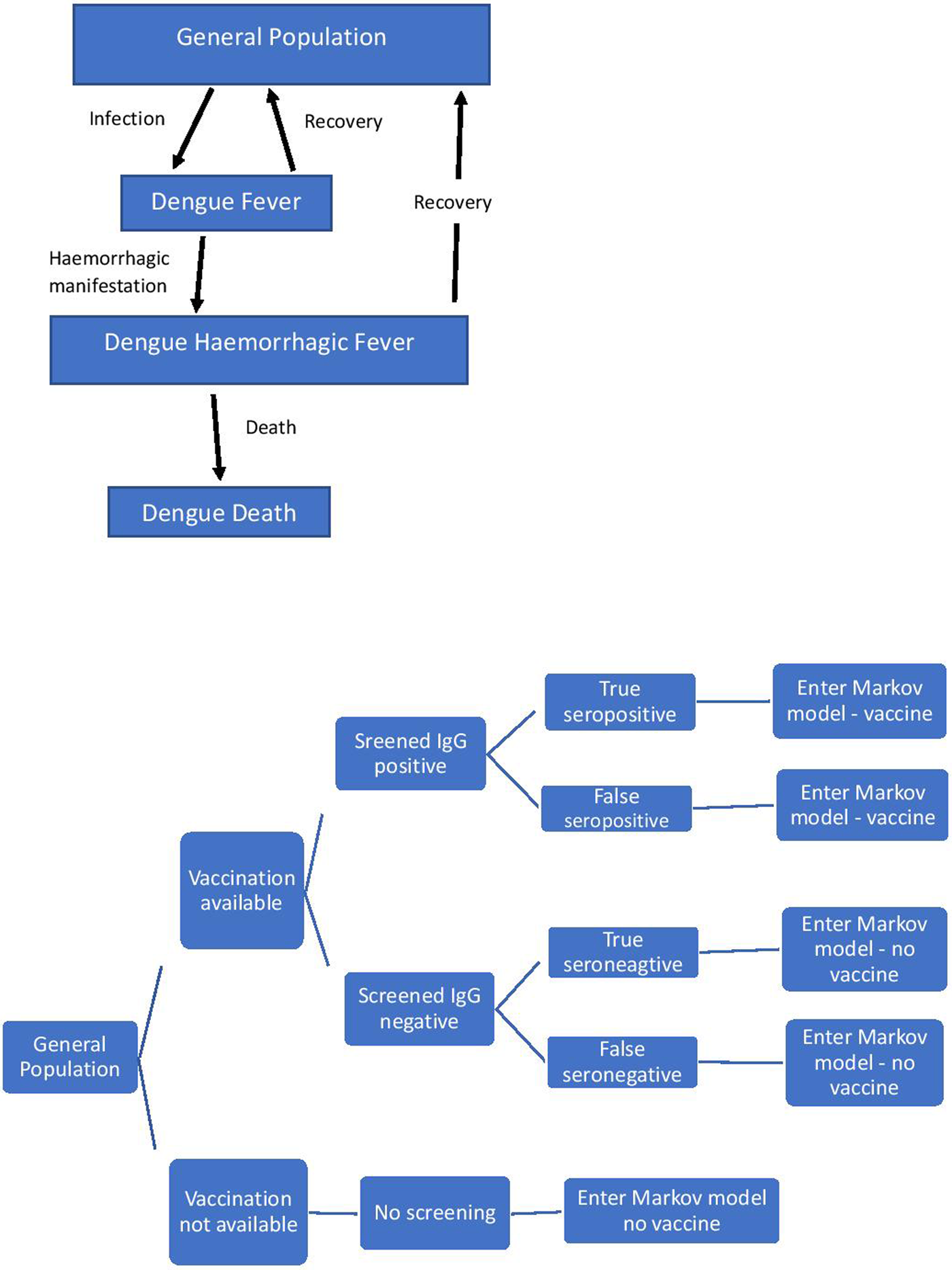
Using Microsoft Excel, a decision analytic Markov model was developed to estimate the cost effectiveness and the budget impact of a predicted screening plus vaccination strategy. A hypothetical dengue vaccination strategy combined with a mandatory pre-vaccination screening was the intervention tested, where the study sample was a single birth cohort aged 9 years. The pre-vaccination screening test was a dengue immunoglobulin (IgG) antibody test to detect the serostatus of the population of interest. Subsequently, it was considered that vaccine was only offered to seropositive individuals. Typical vaccination strategy will be the currently recommended three-dose regime given at 0, 6, and 12 months to children aged 9 years and thereafter (10). The structure of the Markov model and the diagrammatic representation of the model dengue vaccination strategy is depicted in Figure 1.
The structure of the Markov model and the diagrammatic representation of the model dengue vaccination strategy.

A time horizon of 10 years was used for the cost effectiveness analysis. Similar time horizons have been used in previous models evaluating dengue vaccine cost effectiveness. Because the serological patterns of dengue change over time, time horizons greater than 10 years was considered inappropriate. Budget impact assessment was performed on an annual basis.
Data Inputs
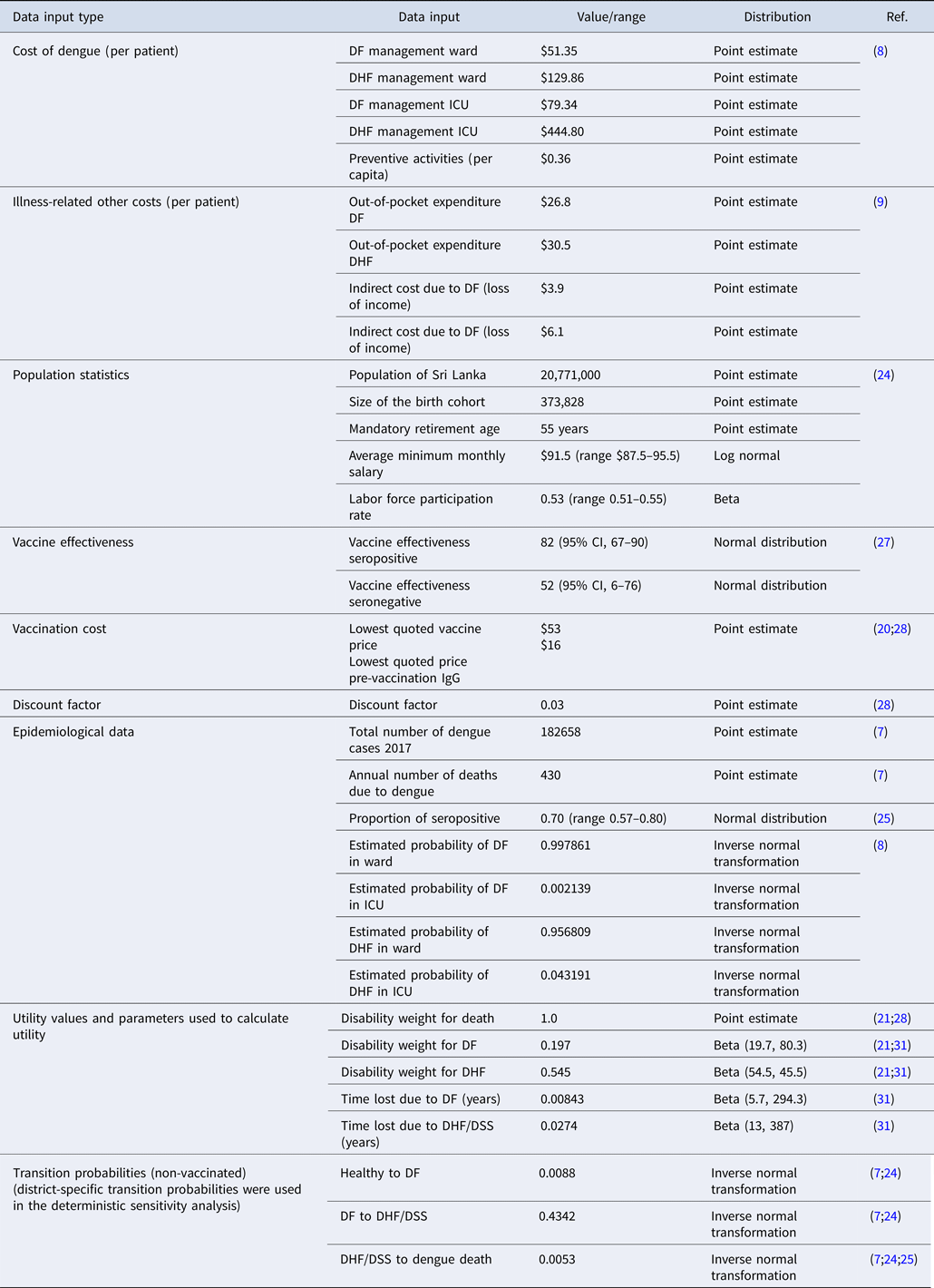
Data inputs were derived from the published data on the cost of dengue management, cost of dengue prevention, dengue morbidity, hospital admissions, dengue health utilization pattern, transition probabilities, dengue seroprevalence, screening test performance, cost of screening, dengue vaccine effectiveness, and the cost of the vaccine. Other important parameters such as life expectancy (LE) and population parameters were derived from reliable data sources such as life tables and population census and statistics of Sri Lanka. All available data inputs were shortlisted, and the uncertainty was recorded with the confidence limits whenever available. When there is uncertainty, but exact data were not available on the distribution, an arbitrary range of values were mapped around the point estimate, complying with accepted distribution norms. The data inputs used and the range of values with data sources are listed in Table 1.
Data inputs, range of values, and data sources used in model building

Cost of Dengue Management and Control Activities
The main source document for extracting cost data related to cost of dengue management was a Sri Lankan study assessing the health system cost for dengue management and control. This study has been conducted by the Epidemiology Unit, Sri Lanka in year 2012 (Reference Thalagala, Tissera and Palihawadana8). In this study, the different elements of dengue control and management has been comprehensively reviewed. The individual fixed and variable costing elements have been enumerated, and the total plus disaggregated costs of dengue control and management have been detailed. Per capita cost of dengue prevention was directly extracted from this study. The individual cost of dengue management in the ward and intensive care unit settings was also available for pediatric as well as adult age groups. A group of experts were consulted to verify that the management of dengue follows the same guidelines as in year 2012. The current dengue management guidelines are based on the source document published in year 2012 (22), thus justifying the use of costing data from 2012 study. All costs were converted to the present values.
Out-of-Pocket Expenditure and Short-Term Productivity Loss due to Dengue
It is understood that in Sri Lanka, government health expenditure is about 55 percent of the total health costs (23). Thus, households absorb a considerable proportion of disease-related health costs as out-of-pocket expenditure. Disease-specific out-of-pocket expenditure related to DF and DHF has been estimated in Sri Lanka in year 2014 (Reference Senanayake, Jayasinghe, Wijesundera and Manamperi9). The same study estimated the short-term productivity loss of illness. These costs were extracted and converted to the present values.
Long-Term Productivity Loss and Economic Impact due to Dengue
There are no long-term sequelae of DF or DHF after recovery. The long-term productivity of dengue is only related to associated deaths. The productivity loss was calculated using the following formula:
 $$\eqalign{{{\rm Productivity}\,{\rm loss}} \cr = &[{{\rm Mandatory}\,{\rm retirement}\,{\rm age}\; - \; \lcub{{\rm Max} \;\lpar {{\rm Age} \;\,{\rm at}\,{\rm death}\,{\rm or}\,{\rm 18}} \rpar} \rcub}] \cr & \times \, {\rm Average}\,{\rm minimum}\,{\rm monthly}\,{\rm salary}\,{\rm of}\,{\rm a}\,{\rm Sri}\,{\rm Lankan}\,{\rm worker} \cr & \times \, 12 \times {\rm Labor}\,{\rm force}\,{\rm participation}\,{\rm rate}}$$
Age of death of a dengue patient is the age of the vaccinated cohort. Subsequent ages were calculated by the addition of Markov cycle length to those remaining at the end of each cycle until the Markov model time horizon. Mandatory retirement age, salary details, and labor force participation rate were obtained from the Department of Census and Statistic of Sri Lanka Web site (24). The overall productivity loss was converted to a per capita value to be included in the model. Because the minimum values were used in this analysis, the estimate provided a conservative baseline value to prevent overestimation of cost effectiveness. Because the long-term productivity losses were based on dengue deaths, it applies even beyond the time horizon of the model. Thus, the total productivity loss across the life span of the patient was considered.
Annual Transition Probabilities
Transition probabilities were derived using the age standardized annual dengue incidence, the seroprevalence of dengue, the proportion of DF to DHF in Sri Lanka (7), and age standardized death rates due to dengue (24). The district-specific transition probabilities were derived using the same data disaggregated to the district level. Because Sri Lanka has a very strong and accurate notification system, this estimation of transition probabilities can be considered to be accurate. It was assumed that the annual transition probability of ‘dengue fever to dengue death’ was zero. This is due to the inability of DF to cause fatal events without transforming into DHF:
 $$\eqalign{& {\rm Annual}\;{\rm transition}\;{\rm from}\;{\rm healthy}\;{\rm to}\;{\rm dengue}\;{\rm fever}\,{\rm in}\;{\rm a}\;{\rm given}\;{\rm district} \cr & \qquad = \displaystyle{{{\rm Annual}\,{\rm age} - {\rm specific}\,{\rm dengue}\,{\rm incidence}\,{\rm for}\,{\rm district}} \over {{\rm Estimated}\,{\rm mid}-{\rm year}\,{\rm population}\,{\rm per}\,{\rm age}\,{\rm category}}}}$$
 $$\eqalign{& {\rm Annual}\;{\rm transition}\;{\rm from}\;{\rm dengue}\;{\rm fever}\;{\rm to}\;{\rm hemorrhagic}\;{\rm fever}\;{\rm in}\;{\rm a}\, \cr & \qquad {\rm given}\; {\rm district} \cr & = \displaystyle{{\eqalign{& {\rm Annual}\;{\rm age} - {\rm specific}\;{\rm dengue}\;{\rm hemorrhagic}\;{\rm fever}\;{\rm incidence}\;{\rm for}\, \cr & \quad \quad {\rm district}}} \over {{\rm Annual}\,{\rm age}-{\rm specific}\,{\rm incidence}\,{\rm of}\,{\rm dengue}\,{\rm fever}}}}$$
 $$\eqalign{& {\rm Annual}\,{\rm transition}\,{\rm from}\,{\rm dengue}\,{\rm hemorrhagic}\,{\rm fever}\,{\rm to}\,{\rm dengue}\,{\rm death}\, \cr & \quad {\rm in}\,{\rm a}\, {\rm given}\,{\rm district} \cr & \quad = \displaystyle{{{\rm Annual}\,{\rm age}-{\rm specific}\,{\rm dengue}\,{\rm death}\,{\rm numbers}\,{\rm for}\,{\rm district}} \over {{\rm Annual}\,{\rm age}-{\rm specific}\,{\rm number}\,{\rm of}\,{\rm dengue}\,{\rm hemorrhagic}\,{\rm fever}}}}$$
Pre-Vaccination Screening Test Performance
The currently used commonly available dengue IgG antibody test in Sri Lanka was considered for the pre-vaccination screening. The range of sensitivity, specificity, and the predictive values were extracted from the published studies. The vaccine was assumed to be given to the proportion of test positive children (Reference Senaratne and Noordeen25;Reference Fry, Meyer and Semple26).
Cost of Screening Test
According to the WHO recommendations, the standard screening test for diagnosing past dengue infection is the dengue IgG antibody enzyme-linked immunosorbent assay test. This test is not currently available as a routine test in the public sector in Sri Lanka. Thus, the cost of IgG antibody testing was obtained from the private sector. The cost of screening was estimated using a range of prices for the total cost of screening including staff time, equipment cost, and other administrative costs.
Cost of Vaccination
The cost data from other settings were used to depict the incremental cost effectiveness ratio (ICER) at the given prices. The lowest price of vaccination in any country was from Philippines (Reference Shim20) and was used in the base case analysis of cost effectiveness in the Sri Lankan setting. A range of costs were used including the lowest quoted price and the other higher price estimates from different settings. The cost of vaccination was only considered for seropositive individuals. Because the costs of vaccination were recorded for different years, the relevant costs were converted to present values prior to be applied in the model.
Vaccine Effectiveness
Because local data with regard to the vaccine effectiveness was not available, effectiveness data from other countries were used. Differential effectiveness among seropositive and seronegative individuals were modeled using the proportion of seropositive individuals in the local setting (Reference Hadinegoro, Arredondo-García and Capeding27;Reference Shim28).
Model Building, Outputs, Sensitivity Analysis, and Model Calibration
Two hypothetical birth cohorts aged 9 years identical to each other were used as intervention (vaccination) and control groups. Both cohorts were assumed to have equal exposure to all other preventive programs including integrated vector control. Using annual transition probabilities, the probabilities of DF, DHF, and dengue deaths exiting the Markov cycle each year was enumerated. The process continued until the completion of Markov time horizon of 10 years. Vaccine effectiveness was included as the differential protective factor for vaccination arm. The cost of managing of DF, DHF in the ward and ICU settings were multiplied by the annual exiting probabilities to calculate the cost of dengue management at each annual end point. The total number of deaths each year was multiplied by the cost of death (productivity loss) to estimate the costs due to dengue deaths each year. The cost of screening for detecting seropositive individuals was added to each person whereas the cost of vaccination was only added to the seropositive individuals of the vaccination arm. It was assumed that all those who are screened positive will be subsequently vaccinated, irrespective of the test sensitivity, as there's no possibility of excluding the false positives. However, the impact of vaccinating seropositive children was captured by estimating the probability of absolute increase in severe dengue due to inappropriate vaccination, and the subsequent increase in the costs and deaths due to the increased occurrence of severe dengue among vaccinated seropositive children.
Similarly, the ones screened negative was excluded from vaccination as it is impossible to explore the serological status beyond the capacity of the available screening test. However, when calculating the vaccine effectiveness among the seropositive, an adjustment was made to accommodate the variation induced by test sensitivity and the positive/negative predictive values. The impact of vaccinating the false negatives is that some children who actually should be getting the vaccine, ends up not getting it. This effect was also captured in the model.
All costs and life-years were discounted with standard discounting factors. The difference in costs and quality adjusted life-years (QALYs) in vaccination arm and control arm was used to calculate ICER values at the cheapest price of the vaccine provided in any other setting ($53).
Deterministic sensitivity analysis was used to calculate district-specific ICER values and the budget impact using district level incidence data and death rates. Probabilistic sensitivity analysis was performed around model input parameters with a considerable uncertainty. The relatively robust input variables, where a point estimate was used, were not considered in the probabilistic sensitivity analysis. Ten thousand input parameter sets and respective ICER values were estimated and the aggregated ICER value was calculated. Using standard methods of model calibration in health economic models (Reference Karnon and Vanni29;Reference Vanni, Karnon and Madan30), the model was calibrated taking average LE at birth of Sri Lanka as a calibration target. Outputs were filtered using a cut off LE ± 2.5 percent to improve the accuracy of the predictions in Sri Lankan setting.
Another deterministic sensitivity analysis was performed assuming that a vaccine was available with similar effectiveness to CYD-TDV, however without the additional risk of breakthrough dengue infections among seronegative individuals. It allowed to predict the impact of this safety issue on the overall cost effectiveness of the vaccine. The pre-vaccination screening was not considered for this hypothetical vaccine and it was also considered that the vaccine was universally offered to all individuals aged 9 years irrespective of their serological status.
Results
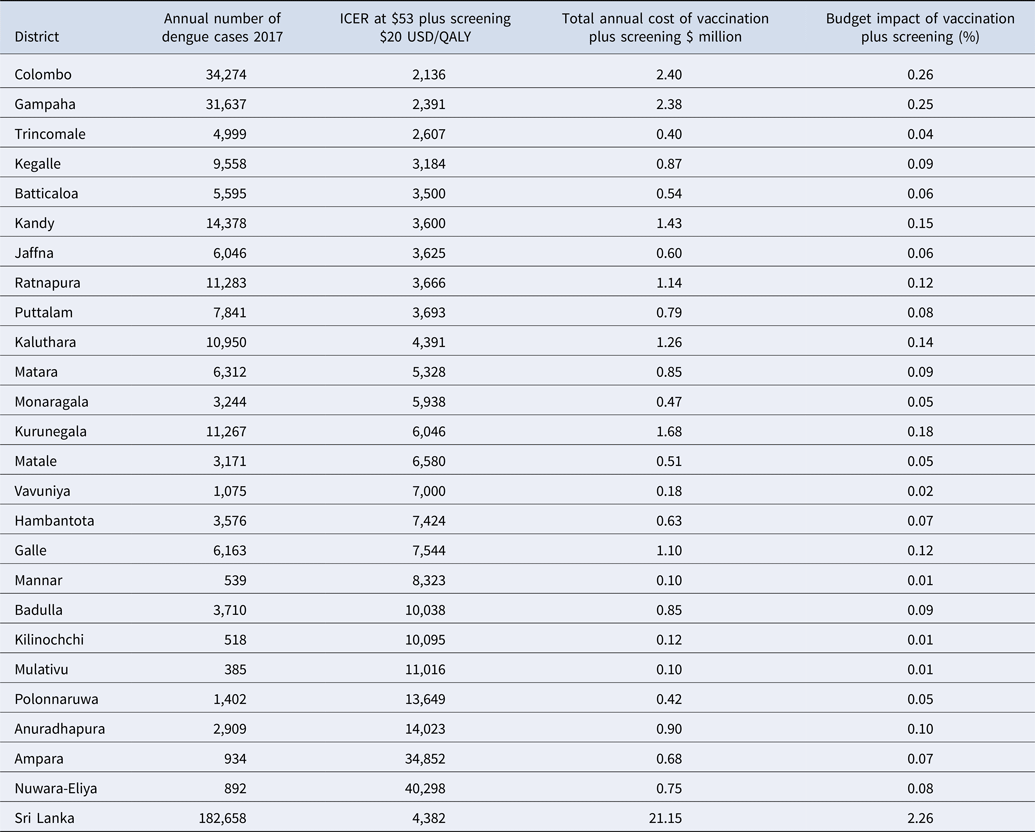
The ICER at a total vaccination price of $73 (vaccine price $53 and screening cost $20) was 4,382 USD/QALY for Sri Lanka, and 2,136 USD/QALY in the district of Colombo. The cost effectiveness of the vaccine reduced significantly with the falling incidence of dengue where the highest ICER (40,298 USD/QALY) was recorded in the district of Nuwara-Eliya. The annual cost of vaccination of one birth cohort at this rate will be 21.15 million USD (3,807 million SLR) with a budget impact of 2.26 percent of total annual health expenditure of Sri Lanka.
Table 2 summarizes district-specific ICER values and the budget impact of vaccination at the district level. The model outputs were sensitive to vaccine effectiveness, dengue incidence, seroprevalence, and transition probabilities.
District-specific ICERs and the budget impact of vaccination

The model outputs were highly sensitive to the fact that the currently available CYD-TDV vaccine required pre-vaccination screening to determine serostatus.
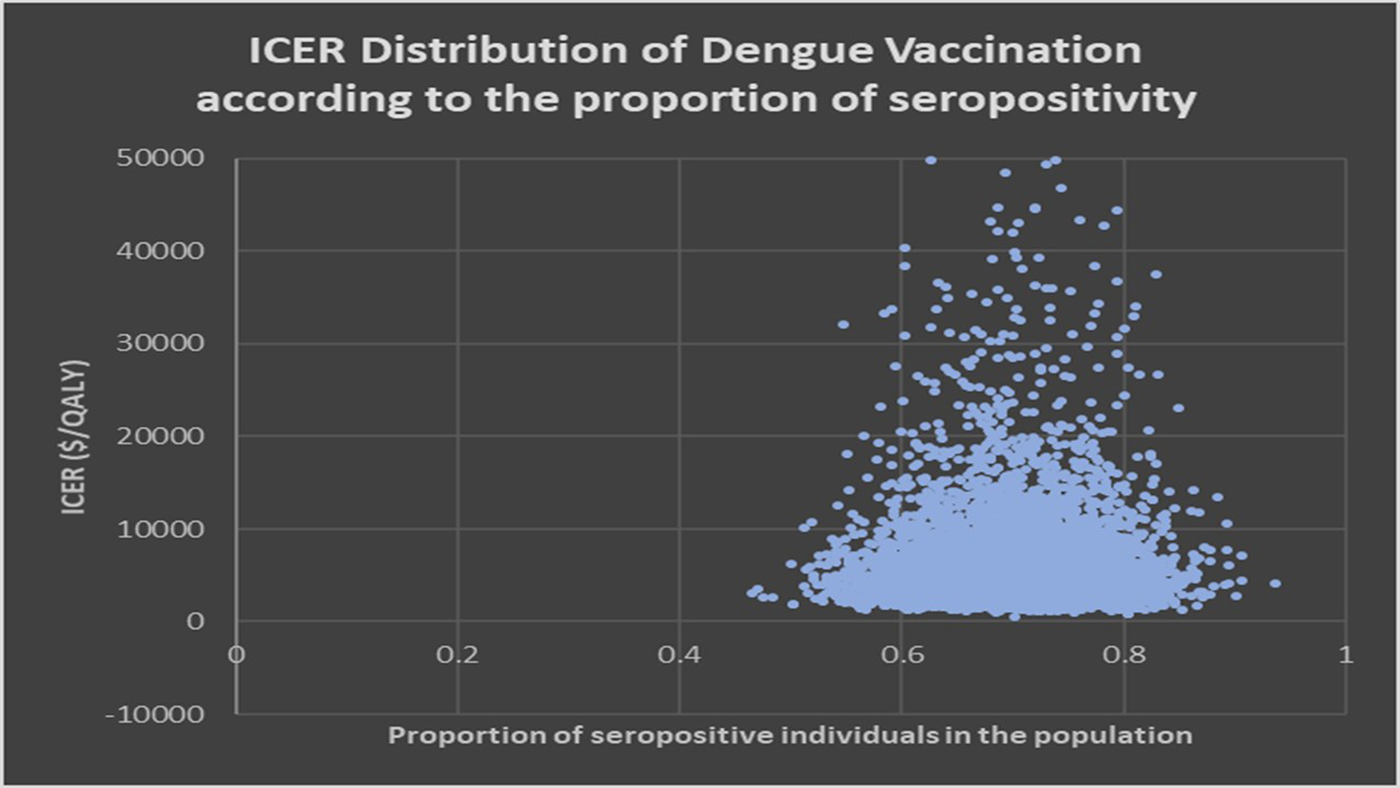
Figure 2 displays the overall output of the probabilistic sensitivity analysis in a cost effectiveness plane. It could be confidently observed that the vaccination strategy is predicted to contribute positively with QALYs at an additional cost, in almost all scenarios, taking into consideration, the uncertainties of seroprevalence, screening test performance, incidence, mortality, and vaccine effectiveness.
Probabilistic sensitivity analysis depicting the distribution of ICER.

Discussion
This analysis was performed under the assumption that all other preventive strategies for dengue control continue at the present intensity and coverage. In a dynamic Markov model-based economic evaluation of vector control in six countries, it has been shown that sustained vector control plays an important role in keeping the disease burden down even under a highly targeted and low cost immunization strategy (Reference Fitzpatrick, Haines and Bangert31). Thus, the two comparative strategies were vaccination plus all other preventive measures versus other preventive measures without vaccination. It was considered that vaccination was preceded by an essential pre-vaccination screening procedure to determine the serostatus of individuals following which only the seropositive individuals were considered as eligible for vaccination.
Considering the total cost of the vaccination to be USD73 (USD53 for the vaccine plus USD20 for the pre-vaccination screening test), the vaccination strategy was estimated to have an ICER of 2,136 USD/QALY in the district of Colombo. There was significant district-wise variation of vaccine cost effectiveness where the ICER for the district of Nuwara-Eliya was as high as 40,298 USD/QALY. The incidence of dengue infection varied significantly across different geographic regions of the country. This is due to the significant variation in altitude, rainfall, humidity, and the resultant mosquito and patient density. This variation in incidence was the main factor influencing the regional variation of cost effectiveness within Sri Lanka.
Because the currently used screening test for detecting serostatus has a high positive predictive value (of about 96 percent) (Reference Fry, Meyer and Semple26;Reference Hadinegoro, Arredondo-García and Capeding27), nearly all patients who are detected antibody positive are true positives. This is an important characteristic of the currently available test, which helps to confidently evaluate and select the eligible population for vaccination (the seropositive children). However, even with this high positive predictive value, about 4 percent of those screened positive for dengue IgG antibodies will still be false positives, thus exposing them to the risk of more severe dengue following vaccination (similar to seronegative children). The model outputs were highly sensitive to the fact that the currently available CYD-TDV vaccine required pre-vaccination screening to determine serostatus, indicating that a vaccine that is universally safer among both seronegatives and seropositives could become more cost effective than the currently available version.
In evaluating the cost effectiveness of the vaccine in individual districts, it was assumed that there is no influence of the vaccination program beyond the boundaries of the respective district. Thus, the protection provided by scenarios such as traveling of populations between the districts was not considered. People from many parts of the country reach Colombo (the capital city) on daily and weekly basis for work-related and other matters. It is understood that many such travelers acquire the infection from the work places in Colombo district where the dengue incidence and the mosquito density is the highest. Thus, a reduction of dengue incidence through a successful vaccination program in the district of Colombo would have positive impact on the disease control of other districts in the country. The influence of this factor would make the vaccine more cost effective than currently estimated by the model. Thus, the model estimates on the district-specific cost effectiveness are conservative and minimum.
The model outputs produce a reasonably accurate estimate and a platform to guide a policy decision with regard to a future dengue vaccination program in Sri Lanka. However, further epidemiological data on the serostatus and age-specific incidence rates at low-incidence settings may be required to further refine the process of identifying the most relevant geographic and demographic factors with regard to the target groups particularly in low-incidence settings.
The model did not consider the possibility of errors in notification, and the possible inaccuracies of recording the exact setting of case detection. However, given that the overall incidence is accurately counted at the district level, the possibility of such minor inaccuracies affecting the overall outcome of the model is negligible.
Given the greater budget impact of vaccination, the implementation of a vaccination program for geographic territories with low incidence may need to have strong justifications and a greater willingness to pay values. Even though the vaccination strategy is shown to be cost effective at higher prices, the greater budget impact of a single vaccine is a challenging factor in mobilizing resources.
The concerns of vaccine safety in terms of the reported additional risk of breakthrough dengue infections among seronegative children was found to be the most significant factor affecting the cost effectiveness of the vaccine. Even if the pre-vaccination screening would significantly reduce the possibility of a seronegative child being vaccinated, it is not entirely impossible due to the chance of false positive test results. If the safety concerns for the seronegative children did not exist, the vaccine would become cost effective in the districts with higher incidence of dengue as the pre-vaccination screening is not necessary and as the vaccine can be universally administered irrespective of the serological status. In this scenario, a safer version of the vaccine has the potential to become cost saving in several districts.
The Ministry of Health could adopt this model to predict the cost effectiveness of any future dengue vaccination strategy using CYD-TDV or any other alternative vaccine where district and age-specific outcome values could be obtained by simply feeding in the relevant vaccine effectiveness data and the total vaccination cost. The model could also be easily modified to predict the cost neutral price of any vaccine, as a tool for negotiating price with the industry whenever relevant. It is also possible to adopt this model to predict the cost effectiveness of dengue vaccination with or without pre-vaccination screening in other countries of the region.
Conclusions
The cost effectiveness of the predicted dengue vaccination strategy following pre-vaccination screening showed a significant regional variation across the districts of Sri Lanka. The need to perform pre-vaccination screening is a major factor influencing the cost effectiveness of the vaccine.
Cost effectiveness and budget impact estimates are better disaggregated to the regional/district level as the estimates could vary significantly within the same country, based on disease epidemiology.
Acknowledgments
The authors acknowledge the Epidemiology Unit, Ministry of Health, Sri Lanka for making epidemiological and dengue costing data freely available in online and electronic media.
Financial support
This research received no specific grant from any funding agency, commercial, or not-for-profit sectors.
Conflict of interest
None.