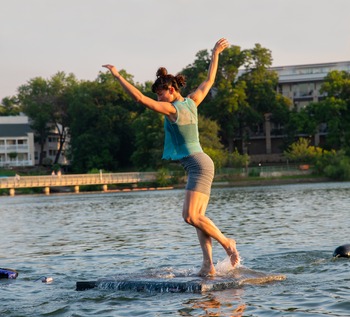
In 2020–2021, because of the coronavirus pandemic and required social distancing measures, Austin, Texas–based choreographer Kathy Dunn Hamrick created the work Lake Dances. Given that Hamrick wanted to keep her company members employed, dancing outdoors seemed like the best, and perhaps only, option. Serendipitously, Hamrick's collaborator and production designer, Stephen Pruitt, had for some years envisioned floating dance platforms on Lady Bird Lake—a body of water in downtown Austin surrounded by parks and walking trails. Hamrick and Pruitt agreed that the time was right to bring this idea to fruition, eventually developing two different platform sizes, six foot square and eight foot square, stabilized by a grid of floats (Photo 1).
Lake Dances, Kathy Dunn Hamrick Dance Company, Austin, Texas. June 2021.
Photographer: Stephen Pruitt/Fluxion Photography. Dancer: Carissa Topham.

Hamrick and the dancers experimented and cultivated the work over the next year, choreographing a series of solos and duets that could be sequenced in different combinations. Rehearsals on the lake depended on the various locations, conditions, and currents to determine what was possible on any given day, and the work maintained a quality of choreographic research and improvisation even as the movement became more set; the platforms, resting on the surface of the water like rafts, moved with the motion of the dancers and the lake itself, and water splashed onboard. According to Hamrick, Lake Dances was never intended to be a “performance” per se. Rather, it was a dance practice, and over the months, many people saw it by coincidence while passing by.
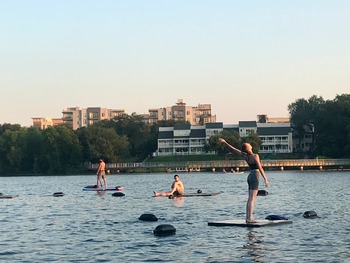
When I was able to see the work in June 2021, pandemic restrictions had recently been lifted, providing a different context. Lady Bird Lake and its surrounding banks were full of newly liberated people engaged in recreation: walking, biking, paddling, hoverboarding. Pruitt and a handful of volunteers in canoes shuttled dancers to and from the platforms throughout the work, indistinguishable from dozens of other people on the water (Photo 2). At one point, I saw a leg stretched and held up in the air, and I had to shift my position to determine whether it was a dancer warming up or a paddleboarder doing yoga.
Lake Dances, Kathy Dunn Hamrick Dance Company, Austin, Texas. June 14, 2021.
Left to right: anonymous passerby on paddleboard, dancer Jairus Carr, dancer Alyson Dolan. Photographer: Caroline S. Clark.

In this first version I witnessed, the performers came to stillness after finishing the dance but did not bow. Even so, an ending was discernable through a visible difference in embodied affect; after the pause, the dancers busied themselves with preparing to go ashore. Some scattered applause began. As soon as the initial clapping started, those of us onshore joined in while the dancers were picked up by volunteers rowing canoes. Without bows, the “end” was problematized by the process of ending. All the “backstage” business was in plain sight and not much different than the business around it of hauling canoes, paddleboards, and platforms out of the water and loading them onto vehicles. Everyone was sweaty with exercise or simply from the summer heat, chugging water from their own bottles. People were still exercising and playing on the water, and others were just arriving.
When I asked Hamrick about bows for Lake Dances a few days later, she related that she had not “felt a need” for the work to have bows “because there is no narrative arc. It's not a priority for this piece.” Given that the movement sequences were reordered for each event along with the ever-present need to improvise with the environment, the choreography aligned more with postmodern happenings rather than structural modernism. “It's more about the experience,” Hamrick mused. She continued, saying that Lake Dances fit in as “an organic part of the environment, like a flower or a cloud. There's no physical separation; we're all sharing.” In such a context, she concluded, “bows would feel artificial” (Reference Hamrick2021).
The second time I attended Lake Dances, however, the question of how do we end had become a mild crisis. As a result of my questions, Hamrick had been thinking about our conversation over the next several days. When I came to the lakeshore, she relayed that she had discussed it with the dancers, and now the decision of whether to bow or not was “driving them crazy.” The company had decided not to bow in keeping with Hamrick's artistic process; but as it turned out, they did—spontaneously. The performers finished dancing at slightly different times, facing the shore. What followed then was an “awkward” moment when negotiation, potentialities, and understandings all seemed to collide. After a pause of stillness, clapping began and grew. The dancer closest to shore giggled slightly and led an unrehearsed, modern dance-style bow in which the other performers joined seamlessly. Then, the company shifted to everyday movement dynamics while helpers rowed in to collect the dancers and disassemble the platforms. Hamrick approached me afterward: “That was unplanned.” We agreed that it felt right, however, and thought about why: there were more people in attendance; people had brought camp chairs so there were people sitting to watch; it was the final weekend of Lake Dances before the company went on break for the summer; and families and friends of the performers were present. Comparatively, then, the interactive field was different and generated a swell of clapping, to which the performers responded in the form of culturally coded bows. I joked to Hamrick: “It's because the parents are here. You have to bow for the parents.” It was not entirely a joke, though. When a sense of passing, contingent community has been created through dancers and audience members, the familiarity of ritual helps to process emotions, acknowledge relationships with each other, and (seemingly) consign the experience to a past that can be remembered and discussed.
Lake Dances provides an illustration of both the topic of this research and its importance to the field. Why don't live performances of dance, theater, and music simply end? What do bows and applause provide that is so necessary, so ingrained in Eurocentric dance? In a previous publication and conference presentations about this topic, I focused more on performativity and the ritual structures of curtain calls, building on a foundation informed by anthropologist Victor Turner. The bracketing that rituals provide facilitates the recalibration of identities and relationships toward new, postshow lives. I also asserted that curtain calls, as contingent mini-performances, signify the “liveness” of live dance through actions that draw attention to its seeming disappearance (2014). By contrast, dance for camera (i.e., designed as video art rather than the recording or archiving of stage performances) never includes bows.
For this special issue of Dance Research Journal on coming together, I felt a renewed inspiration to investigate curtain calls with a change in focus on theatrical performances as provisional gatherings of the participants involved. The world making of dance performances potentially engages dancers, audience members, staff, critics, funders, influencers, and artistic collaborators—people who might not congregate together otherwise. Through bows, applause, and the affiliated nuances of these practices, human beings negotiate their terms of disengagement through coded gestures based on cultural knowledge. Critical inquiry into curtain calls, therefore, reveals an intersubjective complexity in dance performance—coming together—through attention to how participants leave a transitional group—moving apart.
Jane Desmond, in her chapter “Embodying Difference: Issues in Dance and Cultural Studies” from Meaning in Motion, makes an assertion that guides this investigation: “To get at what the ‘stakes’ are in movement, to uncover the ideological work it entails, we can ask what movements are considered ‘appropriate’ or even ‘necessary’ within a specific historical and geographical context, and by whom and for whom such necessities obtain” (Reference Desmond and Desmond1997, 32). From this perspective, the study of bows and applause, rather than being simply a niche, academic detour, reveals paradigms that seek to frame dance and the body. How might the “stakes” revealed by critical investigation into curtain calls support or diminish participants?
Also providing counsel, sociologist Sara Lawrence-Lightfoot, in her 2012 text Exit: The Endings that Set Us Free, proposes that her readers pay more attention to leave-taking from communities so that we may “honor endings in a way that is substantive and inspirational, creative and collective, structured and improvisational, that speaks to the heart and the head …” (232). Through doing so, she hopes people may “[develop] a language for leave-taking” (4). Accordingly, my purpose in this analysis is to provide foundational discourse with which those involved in dance can make informed decisions about whether or not to add these culturally generated behaviors of leave-taking, iterative of shifting agendas of relationships, power, and meaning, onto their presentations and why.
Terminology and Framing
This article is centered in theater-sited, or concert, dance with the hope that this point of entry will be helpful in stimulating broader and more diverse discussions. I begin with tracing bows and clapping in concert dance from roots in Greek and Roman theater and European court life—what has been called “Western” theatrical dance—because curtain call practices are closely connected to these cultural legacies. Nonetheless, I strongly align with dance studies scholars who are challenging such assemblages of knowledge, which privilege narratives of Euro- and US-centric evolutionary ascendency in theatrical dance. My intention in this article is to contribute toward unpacking these narratives through critical theorizing. My perspective is based on research in modern dance and ballet practices as a dance artist, teacher, and audience member of multiple forms in conversation with dance communities principally in, but not limited to, the United States.
Despite the centuries-long and pervasive tradition of taking bows, this practice is curiously under-investigated. Although individual dances themselves are studied with detail, insight, and depth, rarely, in person or in scholarship, is there additional description or analysis of their bows. This neglect reveals itself in a lack of adequate terminology. The phrase “curtain call” seems problematic, even quaint: What if there is no curtain? Who is calling whom? However, the word “bow,” and its gendered cousin “curtsy,” refer technically to a specific category of gestural movement linked to historically power-laden hierarchies and not the larger, ecological situation. Nonetheless, I offer a working definition of “curtain calls” for the purposes of this article: the discursively informed, interactive practices between performers and audience members, such as bows and applause, occurring at the conclusion of live performance.
Furthermore, a literature review in dance is scarce to nonexistent. As bows and applause continue to be an integral part of the majority of dance performances both inside and outside of the theater, it is surprising that this gap exists. Sometimes, though, the most “normal” and normalizing practices are the ones most likely to be overlooked and may, through critical inquiry, reveal hidden assumptions, functions, and paradigms. In previous presentations, I suggested that curtain calls contain dancing bodies in Eurocentric theatrical cultures through rituals of remembrance and “closure” akin to funerals, featuring both performers and audience members in states of transition and, when used across cultures, functioning as colonization. In such an interpretation, dance artists should consider whether containment serves their purposes (2014). The lens of social gathering, however, reveals other important facets within such a complex situation, and Lawrence-Lightfoot proposes a relevant insight into why the endings of events may lack scholarship: in the United States, the promise of coming together for beginnings is celebrated much more than the dispersal of endings. It is a cultural value and historical narrative to embark on new enterprises, she writes, but “ignoble,” by contrast, to end them (Reference Lawrence-Lightfoot2012, 6–11). Perhaps such a cultural perspective illuminates why scholars have largely focused elsewhere than the rituals that end performances; it may be part of what Lawrence-Lightfoot calls “the paradoxical ubiquity and invisibility of exits—big and small” (11). To be sure, curtain calls more often feel celebratory rather than ignoble, but in resonance with Lawrence-Lightfoot, critical inquiry into these practices remains largely invisible despite their ubiquity. As theatrical researcher Baz Kershaw quips, “The scholarly silence surrounding applause is, as they say, deafening” (Reference Kershaw2001, 134). Interdisciplinary scholarship, then, necessarily informs this study. I find broader interest in clapping as opposed to bows, particularly in fields such as political rhetoric and sociology—literature that I weave into this article. I also bring forward my observations from five decades participating in and observing diverse forms of dance, specifically the past ten years since I took an interest in this particular topic.
My analysis proceeds from a foundation of three theoretical premises: (1) Curtain calls are performances, especially in light of Richard Schechner's definition of performance and multiple identities (Reference Schechner1985, 35–37); moreover, curtain calls feature identities in the process of transformation. (2) Bows and applause are performative as discursive, organizing processes that make available potentialities of function and meaning. (3) Curtain calls function in mutually contingent, reciprocal relationships with the dance just completed, each informing and transforming the other.Footnote 1
Historical Analysis
In the study of dance history (or any history), it is impossible to know when the phenomenon of bows and clapping began; the most we can do is point to historical markers or artifacts that describe an iteration of these practices within a continuum of change. Nonetheless, historical analysis is crucial to this investigation because curtain calls in any present moment reassert the operations and values of multiple times and places.
Clapping and other behaviors emerge early on in ancient Greek and Roman texts as strategic practices negotiating relationships of power in oration, democracies, and spectacle. By this time, structures of cues and applause throughout an event were already thriving. Besides clapping, the audiences of ancient Greece seem to have had lively, even boisterous options of finger snapping, shouting, hissing, and waving of robes or handkerchiefs (Garber Reference Garber2013).
Both “plaudits” and “applause” come from a Latin root meaning “to strike” and “to explode.” In some Roman plays, such as the comedies of Plautus, the lead actor would instigate applause to conclude the performance with the cue “Valete et plaudite,” meaning “Goodbye and applause,” demonstrating interaction with the audience as an acknowledged form of bracketing (Sharrock Reference Sharrock2009, 251). Even the hiring of influencers (“claques”) among spectators to manipulate the mood of an event is a millennia-old practice; classics scholar Leanna Bablitz provides several examples in Actors and Audience in the Roman Courtroom, including those hired to clap, cheer, laugh, and even remain silent (Reference Bablitz2007, 134). For instance, the emperor Nero commanded over five thousand young men to learn three of the latest styles of applause coming from Alexandria, Egypt: flat-handed clapping (“bricks”), cupped-hand clapping (“roof tiles”), and humming/buzzing mouths (“bees”) (Reference Bablitz2007, 135). These men assembled to cheer Nero whenever he sang (Garber Reference Garber2013).
From these first descriptions of audience responses, then, these practices were recognized to wield influence. Art historian Holt N. Parker emphasizes how the ancient Roman theater regulated sociopolitical power as much as any other arena of public opinion. Citing Cicero's accounts of the stir caused by specific personalities arriving to witness gladiatorial and other events, Parker claims, “Scholars have seriously underestimated the importance of applause in the theater to the elite Roman.… When he entered the theater, the elite Roman had to pass the census of the people” (Reference Parker1999, 169–170). Importantly, Parker weighs the operations of power in this context with those who could wield it: the audience. The performers—gladiators, actors, pantomimes, and prostitutes—had little to no power, no matter their success (Reference Parker1999, 169–170).Footnote 2
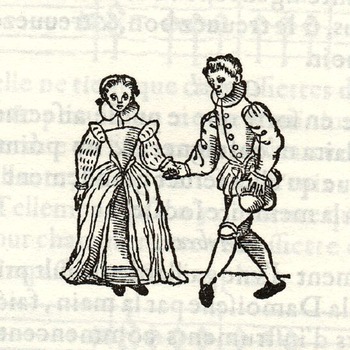
Historical tracing in scholarship then seems to drop away, after the political and social maneuvering of applause as described by ancient Greek and Roman authors, to that of bows in Quattrocento Italian social dance manuals for the upper classes.Footnote 3 Every dance began with a riverenza, which dance scholar Jennifer Nevile analyzes as a “formal greeting,” functioning to reinforce cultural values of social hierarchy and emotional restraint (Reference Nevile2008, 88). Following the migration of courtly dance to France, Thoinot Arbeau's Orchesographie of Reference Arbeau1589 contains illustrations detailing how the bow, or révérence, had specific techniques relating to gender and circumstance (Photo 3). As early dance scholar Emily Winerock explains, “Bowing framed everyday social interactions, like meeting, greeting, and dancing, delineating their beginnings and endings” (Reference Winerock2018, 211). As organizing codes, then, bowing negotiated the terms of engagement and detachment with others (i.e., the creation and dispersal of social spaces). Importantly, Winerock emphasizes, these manuals, made for the upper social classes only, address bowing customs for a readership of “elites,” so it is not clear whether or how other social classes may have used bows to engage and disengage (Reference Winerock2018, 212).Footnote 4
“La Reverance.” From Thoinot Arbeau's Orchesographie, 1589, p. 61.

Dance scholar Norman Bryson further describes bowing as one of many disciplines that centered on the body at the French royal court of Versailles (especially during the reign of Louis XIV, 1661–1715): “The bow was part of daily movement through space; it was difficult to execute correctly, and manuals were profuse in the pages and diagrams they devoted to its graceful execution” (Reference Bryson and Desmond1997, 59). In this way, bows functioned in everyday court life to recalibrate prestige and power through the details of lowering oneself and gesture (Reference Bryson and Desmond1997, 59). It is not surprising, then, that the etymology for “curtsy” stems from “courtesy” and “court” in how bowing negotiated relationships between givers and receivers.Footnote 5 The Versailles era provides a historical marker for the transition of ballet du cour from dancing among the ruling classes, as political maneuvering, to their patronage of nonruling class, trained dancers separated onto the proscenium stage. Traces of Versailles remain in curtain calls in theatrical settings, particularly in how performers face the audience at all times; people at court never turned their back on the royal presence, walking backward as dancers do after bowing to this day (Winerock Reference Winerock2018, 210). After all, Michel Fokine, the eminent ballet choreographer, asserts in Reference Fokine and Cohen1916 that “bowing” is one of the “foundations on which ballet was built” (Fokine Reference Fokine and Cohen1916, 106).
However, turning to theater, sixteenth–seventeenth-century English luminary Ben Jonson provides welcome depth to historical perspectives on how performers and audience members interact. He describes theatrical performance and applause as “coterminous.… [A]pplause defines the theater in much the same way that waves define the shore” (Kershaw Reference Kershaw2001, 134). This evocative image of the edges of water and sand establishing an ever-changing, entangled boundary echoes the ebb and flow of applause. His description seems presciently modern in its analysis of mutual identity making.
The dance audiences of previous centuries certainly behaved differently than the focused, contemplative-seeming audiences of today. For example, ballet in late nineteenth-century Paris and imperial Russia displayed “consumption culture” wherein male attendees gazed at dancers’ bodies, using applause to negotiate sexual patronage after the show while some dancers openly solicited benefactors while performing (Bryson Reference Bryson and Desmond1997; Belenky Reference Belenky2022). In these cases, a patron's clapping shifted to include the beginnings of a favored dancer's entrance “on credit” (Bryson Reference Bryson and Desmond1997, 72). These audiences from the nineteenth to early twentieth centuries, as well as those of other performing arts, were more “unruly,” freely eating, drinking, smoking, talking, and even rioting during performances prior to World War II (such as the infamous Paris debut of Vaslav Nijinsky, Igor Stravinky, and Nicolas Roerich's Le Sacre du Printemps) (Kershaw Reference Kershaw2001). As the twentieth century progressed, though, US audiences became “tamed” into submission in “sacralized” theater spaces (Kershaw Reference Kershaw2001, 141; Levine Reference Levine1988, 83–168). Audience members reidentified themselves and their relationships of engagement with artists over the course of the twentieth century from patron of the arts, to client, and then “customer” (Kershaw Reference Kershaw2001, 135). Performing arts audiences in the United States, in Kershaw's analysis, have become “polite” to the extent that clapping occurs almost automatically during designated times (Reference Kershaw2001, 141).
In the present day, although there may be some clapping during the entrance of a favored or eminent dancer, perhaps iterating historical traces from expressions of courtesy or credit at the beginnings of dances, applause is now consistently associated with the ends of theatrical dance forms. It is true that, within this context, stylistic variety and creativity exist, yet it has been my experience that even the most experimental of performances may still conclude with a traditional bow sequence tacked on following predictable patterns of spatial orientation, timing, and dynamic flow. What is at stake, then, without the organizing processes of a bow when a dance concert ends, especially in a theater? Eventually audience members tire of clapping and begin wandering to the exit, variously confused, amused, delighted, or irritated from the breach of form. For the performers and staff, there might be some dissatisfaction as well; without signifiers of responsiveness from the audience, the meanings and values of the dancers’ and crew's efforts might remain uncertain or seem unrecognized. Given these outcomes, whereas a bow in a proscenium theater may be altered or eliminated, often the decision not to bow comes down to practicality, such as when a site-specific dance concludes with all the performers getting into a car and driving away from spectators. In this example, the structure has already been broken, rendering curtain calls a moot action even when attendees clap afterward.
By comparison, immersive theater and dance offer notable examples of foregoing curtain calls—exceptions that illuminate traditional practices by contrast. Immersive dance and theater scholar Julia M. Ritter notes how many of these types of events, in which audience members coauthor their experiences along with performers, do not include bows and applause by design; to do so would rupture the immersion when the intent is to blur the boundaries between realities.Footnote 6 Without the codes for bracketing the performance, how patrons transition into postshow life takes place differently. Ritter cites Rose Biggin, who observes that people in attendance sometimes report an “immersive theatre hangover” after shows and feeling “physically changed” (Reference Ritter2021, 165). Perhaps at least some of these sensations result from the intention of immersive theater to problematize the idea of containing the show to a time and place in the past. It would be interesting to see how these feelings might also relate to the performers, bonded as they are to one another through the shared activity of dance. Although any research is anecdotal at this stage, when and how might dancers benefit from goodbye rituals, large and small, with audiences and one another?
To sum up, histories iterate in a field of potentiality from which curtain calls constellate their various forms and functions. Curtain calls illustrate social scientist Luce Giard's assertion that the life of a gesture exists in repetition and continued efficacy, but as times change, a gesture evolves yet still contains “illusions, ostracisms, errors, and prejudices.… Thus, an entire tight fabric of rites and habits, of beliefs and presuppositions, armed with its own unique logic, and making up in its own way a system, determines and models technical gestures practiced as useful, necessary, and credible” (Giard Reference Giard, Giard and Tomasik1998, 203). Historical analysis helps people to identify whether and how such practices fit their intentions in dancing.
Relationships: Contingent Community Making of the Theater
Curtain calls ostensibly provide an ending to the assembly of people for a performance event through a recognizable structure for the initiated, a movement-based exit sign or “force quit” for the stage. However, curtain calls themselves have a process to get through that takes time and effort. Along these lines, theater phenomenologist Bert States describes the curtain call as “a decompression chamber halfway between ‘the depths’ of art and the thin air of reality” (Reference States1981, 371), whereas theater semiotician Martin Revermann likens the curtain call to “the end of a prolonged period of imprisonment, both emotional and physical” (Reference Revermann2008, 197). Through their metaphors, both scholars describe bows and applause as states of transition facilitated by curtain call rituals. If the participants disperse away from one another after a dance concert, how have they been together during it, and why does it matter?
Turner's theorizing of rituals has been helpful when considering curtain calls, and in this article, I return to Turner's concept of liminal states as a thinking frame for how performances engage performative bracketing. Dance concerts in a theater lend themselves easily to analysis as a ritual with clear structures signaling a separation from everyday life, a transitional community transforming together in the liminal state, and a return, as persons transformed, to what Turner calls “the quotidian world”—the world of the lobby, or backstage, and beyond (Reference Turner1986, 101). This structure can even be implemented for the larger event of a dance concert as a whole, containing within it the smaller structure of the curtain calls themselves. However, whereas Turner conceives liminality as creating equality among all participants, later anthropologists have pointed out that this idealistic conception does not truly exist,Footnote 7 and performance studies scholars problematize a seeming neatness of time, space, and affect afforded by this model.Footnote 8 What Turner does offer, though, is the acknowledgment of ritual operations for participants to end and leave an interactive, responsive gathering that transforms individuals and their relationships within a community, transformations that resonate beyond an event.
The participants within the curtain call experience both a sense of self and the group, generating how they may act/interact throughout leave-taking. Accordingly, contemporary discourse in phenomenology contributes new assertions regarding how bodies may not exist solely in individuated space and time when they gather. Arts scholar Erin Manning, building on the phenomenology of Brian Massumi and Alfred North Whitehead's process philosophy, asserts that each person is “always more than one” (2013). In her words,
The point is that the same macro-event creates different bodyings in different ecologies co-constituted by different emergent milieus. Not only that: these different contemporary bodyings also create potential resonances, sharing not the content of the experience per se, but the quality of how the ecologies unfold.… There is no body that isn't always already collective, always already active in the relational interweaving of more than one tending, more than one phase, more than one ecology in the making. (27)
Such an ecology of people, things, and intangibles together, therefore, is in a continuous process of change (Whitehead Reference Whitehead1978, 215; Manning Reference Manning2013, 216). So, although Manning, like many other scholars, does not directly address the endings of events, I suspect that for her, perhaps, endings and their rituals are transitions, incompletions, activated by the cultural milieu. Nonlinear codes of theatrical propriety create an affect that feels like an ending; as Manning states: “Affect is the feeling-vector of individuation's process as it tunes to dephasing. It is transformative. And it is collective. It is collective because it is always coincident with the forces that bring it into being and which it activates” (2013, 27). In such a philosophy, the experience of feeling like an individual does not preclude the experience of feeling like part of a group and vice versa.
Undoubtedly, bodies are coming together in a theater and moving apart from one another in relationships of connection, and “kinesthetic empathy” studies investigate such a biosocial approach. Contemporary study of kinesthetic empathy builds upon late twentieth-century and early twenty-first-century discoveries regarding mirror neurons in conversation with developments in phenomenology and the philosophy of Gilles Deleuze and Félix Guattari.Footnote 9 Mirror neurons seem to be involved in how, when someone moves an arm, for example, the neural activity is similar in both the mover and another person observing the movement. For dance scholar Dee Reynolds, kinesthetic empathy suggests an “in-between” constantly emerging; as she states, an audience member “can be invested as both subject and object in a shared materiality and flow of choreographed movement …” (Reynolds and Reason Reference Reynolds and Reason2012, 129). In other words, if dance occurs (in multiple ways) in the responsive, imaginative bodies of those onstage, in the audience, or backstage, and among various people hearing about it beforehand and afterward, then the performance generates afterlives as dispersed, kinesthetic affects in an ongoing process. This way of being together confounds any paradigm of separation that seeks to dominate or define others.
Techniques of Negotiation
Scholars outside of performance studies seem to be tempted to universalize the body through ascribing clapping to babies and gorillas as an instinct or citing non-Eurocentric cultures with movement practices of lowering the body as a sign of respect (and thereby “proving” a universality rooted in Eurocentric worldviews). For example, semantic scholar Anna Wierzbicka, in Reference Wierzbicka1995, categorizes bows as one of fifty-five universal “primitives” of nonverbal language (209). Similarly, as an introduction to applause, cultural theorist Steven Connor seems to find it necessary to include some farfetched claims of applause as an extension of primate behavior related to violence (Reference Connor, Bull and Back2003, 67). These universalizing approaches incite Kershaw to speculate jokingly about such scholarship in curtain calls: “Perhaps applause—like sexual congress and laughing—is in itself a thoughtless act, maybe a response arising from a basic impulse or reflex action over which … we have no control. Hence applause fits us out for hegemonic submission” (Reference Kershaw2001, 135). His words draw attention to what is at stake in this critical inquiry.
Although Wierzbicka's foundational philosophy is outdated, she does touch on an important point when describing how performers lower themselves before an audience as a socially constructed interaction the meaning of which is not necessarily connected to the feelings of the participants (Reference Wierzbicka1995, 234). Correspondingly, semiotician John Richardson also identifies “applause” as a sociological strategy. He writes: “Affective practices like [clapping] are learnt rather than autonomous responses—that is, they are relatively routine, relatively ordered and prefigured processes which relate to specific social encounters, social actions and social relations” (Reference Richardson2020, 13). When connecting such ideas about affective practices with a thinking, social body, the idea of affect becomes much more nuanced. What is gained by adding the body back into this situation but retiring the idea of universal primitivism? What would it mean instead to consider an intelligent body, one that strategizes options within a constantly changing continuum of historical, cultural, and social dimensions—a body that knows things but does not need to language them first in order to act?
During curtain calls everyone has interdependent roles to play through well-honed actions. These are conducted largely without verbal cues (save those of a stage manager) within the discursive matrix of movement organizing bodies and relationships (Hamera Reference Hamera2007, 23–24). Bows and applause follow well-established patterns of timing, spatial orientation, dynamic flow, and negotiated behaviors. In this way, participants generate and regenerate a sense of community organized and sustained through cooperative physical techniques (Reference Hamera2007, 5). Similarly, Luce Giard, Pierre Mayol, and Michel de Certeau investigate gestures as the negotiation of context and relationships, public and private (de Certeau Reference de Certeau and Rendall1984; de Certeau, Giard, and Mayol Reference de Certeau, Giard, Mayol, Giard and Tomasik1998). Altogether, curtain calls function as an ecology of embodied practice between performers, audience members, and staff, enabling regeneration of cultural structure/systems.
In addition, the potential exists for small acts of improvised agency within the gathering. Individuals co-generate the unique, organizing logic of such a system, and de Certeau is known for promoting potential “microfreedoms” for participants through these everyday gestures as tactics for living (de Certeau, Giard, and Mayol Reference de Certeau, Giard, Mayol, Giard and Tomasik1998, xxii–xxiii). Audience members may have more seemingly overt freedoms in how they respond through clapping, standing, shouting, leaving, etc., but dancers (and staff) have degrees of freedom as well. Dance scholar Judith Hamera explores systems of “technique” as organizing vectors, providing dancers with microfreedoms of agency:
Dance techniques, however codified or “elite,” are routine tactics for living, not simply abstract grammars for moving. As practices of everyday community life, they build connections between what dancers do onstage and off, how they feel about their work and their lives, and ways they reflect on their relationships to their bodies, to history, to the ineffable, and to one another. (2007, xi)
Framing techniques as embodied negotiations, Hamera establishes how dance technique may serve as an “enabler” and an “escape clause” for interacting subjects (Reference Hamera2007, 23–24, 208). To borrow Hamera's terms, bows and applause serve as enablers to provide structure that does something; escape clauses function, in big and small ways, toward a literal-seeming escape of the gathering. Such performative rituals induce contingent, transitional spaces through which participants negotiate the incipient terms of separation through gesture and soundscape. To theorize interrelating in this way reveals embodied cultural iterations in their myriad labors of the moment.
Altogether, then, clapping and bowing seem to generate each other. They also generate themselves in/as community. In 1984, political speech analyst J. Maxwell Atkinson published the foundational idea that when one person begins clapping, this signals to the rest of the audience that applause is an acceptable response. He termed this expectation a “claptrap” (47). This is one example from interdisciplinary scholars who analyze repeating patterns of rhetoric and applause as interactivity in political theater. Reminiscent of the mixing of politics and theater in ancient Rome, political speech analysis provides insight into other performance-based activities. Atkinson's term “claptrap” resonates with Hamera's concerns about traps; she writes that the “performative templates” of dance, although “arranging, deepening, and enchanting communities,” can also be “traps” (Reference Hamera2007, 208).Footnote 10 The techniques of Eurocentric concert dance, as an ecology, seem to put a lot of energy into structuring claptraps. Certainly, the production cues used to initiate and sustain curtain calls, such as curtain movement that conceals and reveals, music ending, and changes in lighting, all display how the staff is integral to the whole process. When no curtain or lighting cues exist and a pause is taken instead, the dancers display a change from the movement aesthetics of the dance to a bow-related aesthetic appropriate to the genre. Then, choreographies of bows, such as walking forward, tipping the head or curtsying, and walking backward, are clear signals. In addition, there are nuances that can be particularly effective toward stimulating increased ovations—nuances that de Certeau might identify as microfreedoms of agency and that seasoned performers can deploy particularly well. The timing of raising hands to the audience, suspended, before nodding the head forward; raising the eyebrows in delight; smelling a bouquet—these movements invite audience members to applaud more. Such actions function as tactics in a co-emerging world. In much the same way, Atkinson emphasizes delivery of political speeches in addition to content toward inviting applause most effectively (Reference Atkinson1984, 234). More applause signals more success both for the politician and the dancer, who then negotiate a feedback loop of taking another bow.
Psychologist S. E. Clayman expands upon motivations to applaud by proposing that individual audience members track acceptable behavior through “mutual monitoring” and that a fear of clapping in isolation gradually shifts into a fear of being the one not clapping (Bull and Wells Reference Bull and Wells2002, 232–233). The effects of ensemble among the audience may be such that applause indicates how people gather and attend to their role as a group rather than or in addition to the quality of a given dance. Sociologist Kirill Postoutenko adds that the “human propensity to cooperation” may be more significant in the amplitude of clapping than the dancing:
In fact, the mere fact of applauding at a political conference or musical performance has little to do with the content of the speeches and nothing whatsoever to do with the semiotic construction of applause: rather, the listeners clap to speakers/performers because they prefer “going with the flow” to other strategies, and also because they believe this particular behavior to be most suitable under given circumstances. (Postoutenko, Reference Postoutenkon.d., 4–5)
“Going with the flow” resonates with a dynamic, responsive matrix that generates its own instructions. Clapping with the group is not only the most efficient way to get on with the ritual, it is also the safest way to get along with one another. This monitoring is not always in synchrony, however; linguists Peter Bull and Pam Wells term those failures of cue signaling with appropriately responsive applause “mismatches” (Reference Bull and Wells2002, 232). Two immediate examples come to mind of entrapment in a curtain call mismatch. Occasionally, a company with a prearranged number of bows exceeds the duration of an audience's clapping; as the lights go to blackout and the applause dies down, the audience members stand to shuffle out, only to have the lights came back up with expectant dancers taking another bow. The cornered audience finds itself resuming applause, this time perhaps as an unplanned, standing ovation. Oppositely, an audience may demand another bow from dancers, then another, and another.
Richardson also illustrates mutual monitoring among audience members in his evaluation of a Holocaust commemoration ceremony. The audience had been asked not to clap beforehand because of the nature of the event: “Today is a ceremony, not a performance” (Reference Richardson2020, 8).Footnote 11 Nonetheless, some in attendance clapped anyway from time to time. Richardson observed that the “affective action” of applause made everyone else uncomfortable because of the contextual mismatch. The impropriety of clapping agitated audience members who followed instructions and did not clap, Richardson posits, because “as a collectivity, the audience had failed to coordinate their behaviour as properly directed” (Reference Richardson2020, 10). As a result, some non-clapping participants engaged in whispers and/or slight movements that signaled their awareness of the clapping policy while simultaneously chastising the offenders.
The size of the theater itself shapes how people gauge their responses and monitor the situation. With larger spaces and crowds comes more anonymity and, with that, different options for interactive responses. The differences between pandemic and theater applause offer opportunities for comparison. Adrian Scribano and Angélica De Sena, in their Reference Scribano and De Sena2020 study of clapping and noisemaking from balconies in Buenos Aires, Argentina, in honor of essential workers during the coronavirus pandemic, observe that the tensions of individuality versus anonymity play a role in applause (283–284). In a city, participants are dispersed, largely anonymous, and voluntary; in a theater, audience members are massed together in one space, and clapping is expected and, to some degree, surveilled. With pandemic noisemaking, people were not assessing the labor of specific essential workers; in the theater, applause is understood to be an assessment of the choreography and performance whether or not it actually is. A sense of anonymity within a gathering affects the materiality and flow of engagement between persons. Similarly, researchers Michelle Duffy, Gordon Waitt, and Chris Gibson describe how sound and movement in street parades help “to envelop the participants and audience in a rhythmic time-space that offers a sort of aural ‘safety blanket’ under which celebration, dancing, clapping, and singing along can be enjoyed unselfconsciously” (Reference Duffy, Waitt and Gibson2007, 15). It would seem to follow that the more audience members present and the larger a theater is, the more of an aural–and visual–safety blanket one has for microfreedoms of response. By contrast, the more intimate an audience, the more an attendee is aware of being seen and heard as an individual both by other audience members and, potentially, the performers.
Meaning Making
I contend that applause, to reiterate Hamera, provides techniques of release and escape—quite literally. It is not necessarily easy or comfortable to sit in a theater and pay attention to a dance concert for an hour or two, and clapping may serve as a cathartic action to process the intake of a dance performance—dispersing built-up feelings and thoughts, kinesthetic empathy from the dancing, and/or the stress of paying attention. Participants have multiple, diverse strategies of desire at play: supporting a friend or family member onstage through sound and movement, demonstrating cultural savvy to a client, precipitating the opportunity to leave, etc. For example, in what he identifies as the more recent trends of “consumerist theatre,” Kershaw contends that audiences are more likely to indulge in standing ovations these days as self-congratulations on money well spent and, consequently, more reticent to acknowledge dislike of performances because to do so would admit money wasted (Reference Kershaw2001, 144). More and more, though, I recognize that I simply enjoy the kinesthetic sensations of clapping, especially when joining with other people doing the same after being seated and quiet. Although some dimensions of the experience may be a trap, others may be a release. Therefore, audience response is not a simple “applause-o-meter” indicating collective assessment of the dance material. The actions of audience members reflect the complexities of their individual needs and desires within, referent to, and constitutive of, larger situations.
As their historical markers suggest, bows and applause may continue to iterate power relationships, patronage, and displays of consumerism. However, I never learned that as a participant. Instead, in some forgotten moment, I came to understand that, during curtain calls, the dancers are thanking the audience while the audience thanks the dancers. Lawrence-Lightfoot considers the importance of such interactions and attention when leaving others as a way of conveying respect: “The trust and rapport of respectful relationships [are] built on knowing that in the end, someone would not just disappear and walk away, but would find a way of recognizing the importance and visibility of good departures” (Reference Lawrence-Lightfoot2012, 9). Perhaps the ending rituals—expressing thanks—of technique classes in ballet, modern dance, and other Eurocentric forms extend to actions onstage, given Hamera's theorizing of techniques. Each dance class develops its own reiterative momentum from one time and place to the next, whether using traditional révérences, requiring students to line up to thank the teacher, giving and receiving applause, or ending in meditative quiet. An understanding of bows and applause as embodied signifiers of gratitude seems widespread in Eurocentric cultures, even though their histories are not so simple. Nevertheless, in contexts in which one or more participants feel that curtain calls mean “thank you,” then thanking occurs along with multiple other functions.
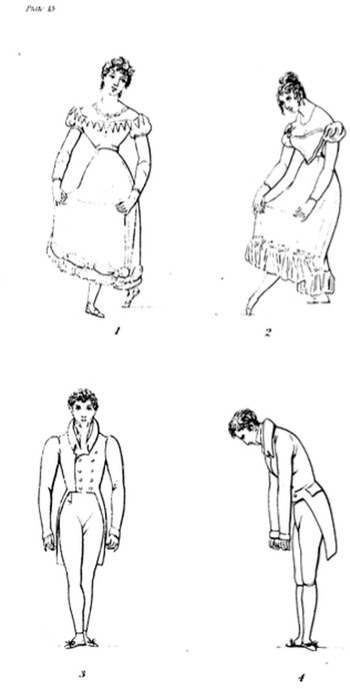
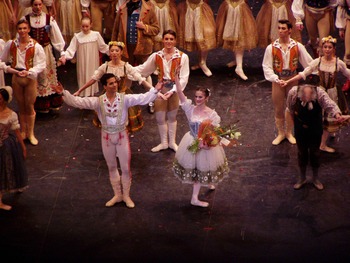
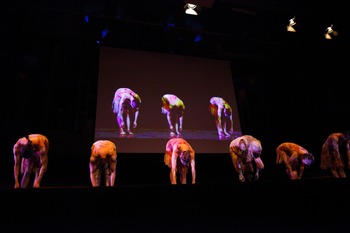
The performative sequencing of bows also communicates to audiences how to ascribe value. In classical ballet, bows occur in reverse order of importance, beginning with the ensemble or corps de ballet, and then proceeding through to featured performers (Photo 5). When there is live music, the maestro or musicians then take their bow, and if present, a choreographer often culminates the event. This placement enacts a valorization of the choreographer reflective of traditional, Eurocentric narratives about how ballet is created. Bows in modern dance, by contrast, often represent the more humanist ideals of equality as seen in that dance form's history. An example of this would be a horizontal line of dancers, each on two feet in parallel position, rolling through the spine down and up as in technique class, bowing together as equals (more or less) in space (Photo 6). Over the past several decades, modern dancers have sometimes adopted a practice, after taking their own bows, to gesture to production crew members in the lighting booth or elsewhere and begin clapping themselves. These acknowledgments range from prearranged choreography to spontaneous signals. Such sharing of the limelight, although audiences often cannot see for whom they are clapping and do not necessarily know why, is “nice” in terms of equality and community making, but not necessarily thought through. One of the messages that I take away from such a practice is that the company could not afford to pay the crew what they are worth, so they are thanking the crew in an alternate fashion. Less cynically, perhaps such egalitarian gestures signal the valuing of a co-creative team.
Plate 15. From Carlo Blasis's The Code of Terpsichore. (Blasis, [1830] Reference Blasis1976)

Elena Glurdjidze as Swanilda and Arionel Vargas as Franz in the English National Ballet's production of Coppelia. March 12, 2008. Wikimedia Commons.

Bangarra Dance Theatre, Sydney, Australia. May 23, 2011.
Wikimedia Commons.

More confusing, though, is when dancers begin clapping for audiences. Attempting to decode the situation, the message seems to be you showed up, you made it through, or good clapping! London theater critic Lyn Gardner addresses this same phenomenon in Reference Gardner2000 with her essay on audience behaviors, “Just Shut Up and Sit Down”: “Actors themselves are increasingly prone to applauding their audiences. This suggests a disturbing lack of confidence in both the play and their own abilities—as if they are astonished that we are there at all” (4). Perhaps this confusion is why, when dancers begin to clap for audiences, curtain calls inevitably begin to falter and end; I am clapping for you clapping for me is not a sustainable sentiment. Given the theorizing presented in this article, however, I believe that the dancers’ good intentions may be inspired by techniques of community making and energized by cathartic release.
Conclusion
Undoubtedly, enthusiasm of applause in theatrical dance concerts is considered to be an evaluation of the dance presented. Positive experiences of a show inspire more clapping, cheering, smiles, and standing—negative or indifferent experiences less so. However, individuals within an audience are not solely engaged in (or necessarily care about) assessment. A field of potentialities exist that can only take place within the mechanisms of dispersal afforded by curtain calls, including releasing pent-up energy, iterating cultural and historical paradigms, shifting identities, expressing gratitude, potentiating the future, and making communities. As the world gradually returns to live performance after the isolation of the pandemic, performers and audiences also return to curtain calls, and bows and applause take on a new function: the celebration of being together again after shared tribulation. When I attended my first dance performance after fourteen months of pandemic restrictions, as people began to clap, a wave of cheering erupted as well. So many emotions were being processed by each person, in their own way, in a shared, contingent space. Live dance was back.
While this article introduces a largely historic, theoretical, and autoethnographic inquiry into curtain calls, many questions have been raised. What other historical references to bows and applause exist? How do volume, type, and duration of audience responses relate to how audiences and/or dancers really feel about a work? What options have artists tried regarding bows, and when do various choices function best? How might dramaturgy extend into curtain call choices? Because curtain calls contain power-laden iterations of gesture from Eurocentric cultures, when might it be appropriate or not for dances from other cultural roots to take a bow in the context of a stage performance, and what are the issues at play in making such a decision? The critical study of bows, applause, and other types of interactivity between performers, audience members, and others offers dance practitioners choices toward thoughtfully negotiating the terms of engagement and disengagement in groups contingently assembled for dance events.