INTRODUCTION
Current predictions estimate that worldwide, the number of people ≥65 years of age is increasing at a rate of 870,000 per month (Kinsella & He, Reference Kinsella and He2009). The United States Department of Health and Human Services estimates that this population will increase to 55,000,000 by 2020 and to 71,500,000 by 2030, doubling the prevalence of older adults since 2004 (Miller et al., Reference Miller, Zylstra and Standridge2000; Administration on Aging, United States Department of Health and Human Services, 2005).
Today, the majority of medical costs are incurred at the very end of life, and are higher for residents who report that their doctors had not discussed their treatment preferences (Zhang et al., Reference Zhang, Wright and Huskamp2009). According to Bomba (Reference Bomba2006), “life-sustaining procedures are frequently administered in direct contradiction to the resident's wishes.” Nursing facilities, with nearly 1,500,000 current residents in the United States (Murray & Laditka, Reference Murray and Laditka2010), and an average length of stay of 24 months (Hoover et al., Reference Hoover, Siegel and Lucas2010), will continue to care for a growing number of patients. Intrator et al. (Reference Intrator, Zinn and Mor2004) found that during a 180 day observation period, between 0% and 41.7% of nursing home residents were re-hospitalized.
Earle et al. (Reference Earle, Park and Lai2003) identify communication, shared decision-making, advance directives, and pain management as indicators of good quality care for end-of-life cancer residents. The introduction of medical orders for life-sustaining treatment (MOLST) (New York State Department of Health, 2010) in New York and physician orders for life-sustaining treatment (POLST) (Center for Ethics in Health Care, 2008a) in other states has given patients and their families the ability to document in medical records specific preferences for end-of-life treatment choices.
MOLST was approved in 2008 by the New York State Department of Health for use throughout the state (New York State, 2008). POLST or MOLST programs are either in development or endorsed in 41 states as of September of 2012 (Center for Ethics in Health Care, 2008b). The MOLST form clearly documents resident wishes by centralizing critical life-sustaining treatment orders on one bright pink form that is easily recognized in case of an emergency (Sam et al., Reference Sam, Pekmezaris and Nouryan2011). As Pekmezaris et al. (Reference Pekmezaris, Breuer and Zaballero2004) demonstrated, specificity is critical in ensuring that wishes, such as cardiopulmonary resuscitation, hospitalization, and artificial nutrition, are honored (Alabi & Haines, Reference Alabi and Haines2009; Ehlenbach et al., Reference Ehlenbach, Barnato and Curtis2009). Once completed, the MOLST form accompanies the resident across care settings (Vo et al., Reference Vo, Pekmezaris and Guzik2011).
State and federal regulations require that nursing homes maintain written policies and procedures addressing advance directives, such as healthcare proxies and orders not to resuscitate, MOLST forms and living wills (New York State Department of Health, 2007). In 2011, ~ 35% of nursing home residents in the United States had no advance directive on record, identifying obvious opportunities for improvements, to be spear-headed by palliative care and long-term care professionals (Jones et al., Reference Jones, Moss and Harris-Kojetin2011). In addition, a previous study by Levin et al. (Reference Levin, Li and Weiner2008) found a median of 0 days between signing of do not resuscitate (DNR) orders and death, which raises the critical issue of timing in relation to the process of advance directive completion, from initial conversation to final document execution.
METHOD
This was a cross-sectional chart review. Subjects were residents of two skilled nursing facilities operating in the New York metropolitan area, with 256 and 200 beds, respectively. Investigators reviewed the charts of all 294 long-term care residents (both living and deceased) of these two nursing facilities, between January 1, 2008 and October 31, 2010. Subacute rehabilitation residents were excluded. A data collection tool was created to tabulate the categorical variables collected. This study was approved by the health system institutional review board (IRB).
Of the 294 whose charts were reviewed, 112 residents were excluded because: 1) they were admitted prior to January 4, 2007 (n = 108), the day MOLST was approved for use in nursing homes in New York State, or 2) they had an executed MOLST form prior to admission (n = 4), resulting in a total sample of 182.
Endpoint Variables
Demographic data such as age, gender, ethnicity, primary clinical diagnosis, date of admission, and date of death (or if still alive at the time of last review, date of last follow-up) were collected from the residents' charts. In addition, date of MOLST execution, documentation of decision-maker consent, documentation of a healthcare proxy and/or living will, and wishes regarding cardiopulmonary resuscitation (CPR), DNR, comfort measures, hospital transfers, artificial nutrition and hydration, antibiotics, intubation, and mechanical ventilation were collected from all relevant sections of the MOLST.
Statistical Methods
The statistical approach was primarily descriptive in nature. Descriptive statistics such as means and proportions are presented. Group comparisons (i.e., between genders, ethnicities, diagnoses) were performed using either the t test/ANOVA or the Mann–Whitney test/Kruskal–Wallis test for continuous variables, and either the χ2 test or Fisher's exact test for categorical variables.
Analysis of the time from admission to MOLST signing was performed using standard survival analysis techniques. The Kaplan–Meier product limit estimates along with their corresponding 95% confidence intervals (CIs) were calculated, using Greenwood's formula to compute the standard errors. Subjects that did not sign the MOLST form as of the time of last follow-up time in the chart review were considered censored for MOLST status. In this context, “censored” can be taken to mean “incomplete” because it is not known if the subjects signed after the last follow up, or refused to sign, however, these subjects are still included in the analysis in order to accurately utilize all available information. Comparisons of time from admission to MOLST signing among groups (e.g., gender, ethnicity, age groups) were performed using the log-rank test.
Similar methods were used for the analysis of time from MOLST signing/execution to death. Residents who had not reached the endpoint event “death” were also considered censored for survival status. Comparisons of time from MOLST to death were performed using the log-rank test.
Sample Size Considerations
The sample size in this study was derived from the number of long-term care residents (with or without a signed MOLST between January 2007 and October 2010) at the two skilled nursing facilities. The sample size was based on feasibility rather than a formal power calculation.
RESULTS
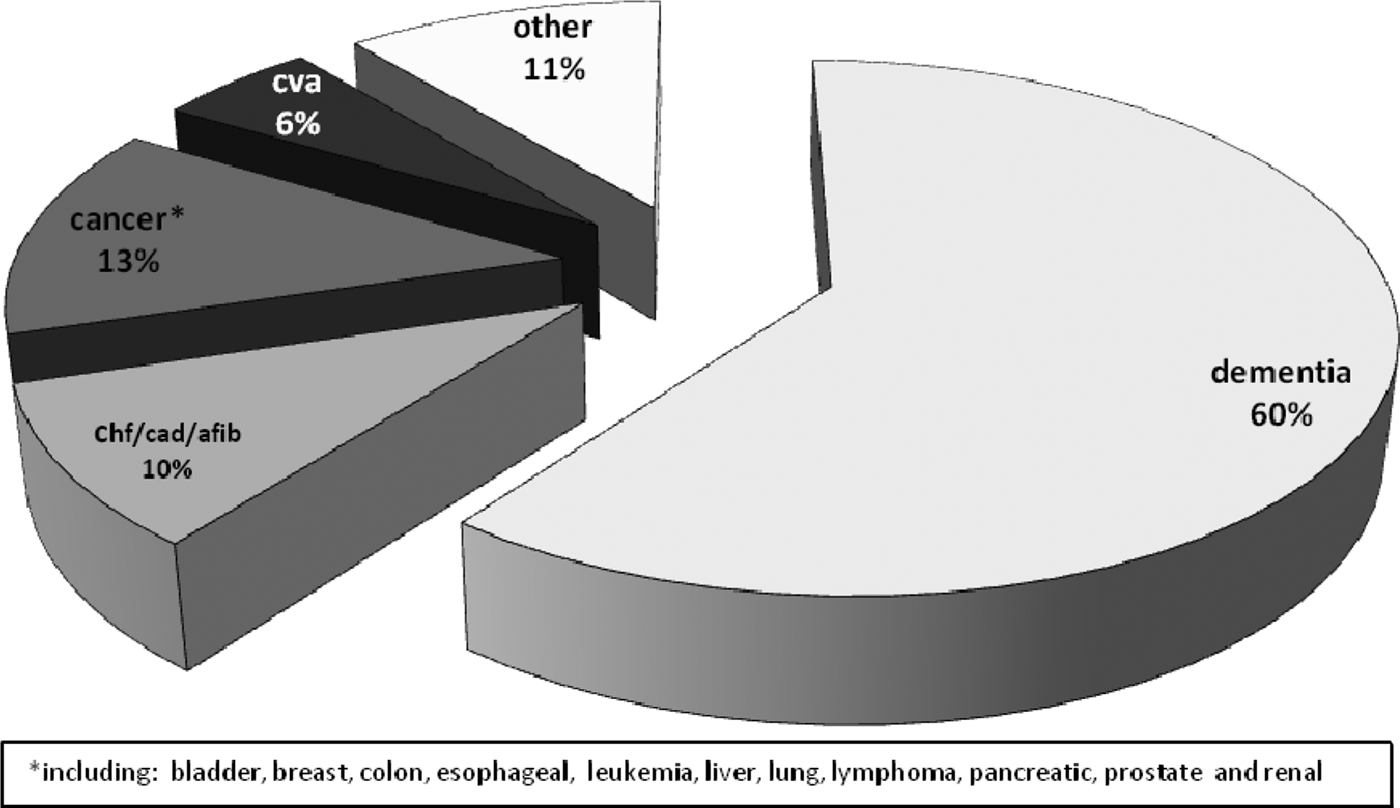
The sample consisted of 57 males (31.3%) and 125 females (68.7%); 91% (165/182) were Caucasian; 9% (17/182) were African-American, Hispanic, or Asian; 91.8% (167/182) were ≥65 years or older at admission. Overall, mean age at admission was 83.4 (SD = 10 years). The most common primary diagnosis for all participants was dementia (60.4%), followed by cancer (13.2%), including bladder, breast, colon, esophageal, leukemia, liver, lung, lymphoma, pancreatic, and prostate; heart diseases and disorders (9.9%); stroke (5.5%); and other (11%; see Fig. 1).
Primary diagnoses for study participants (n = 182).

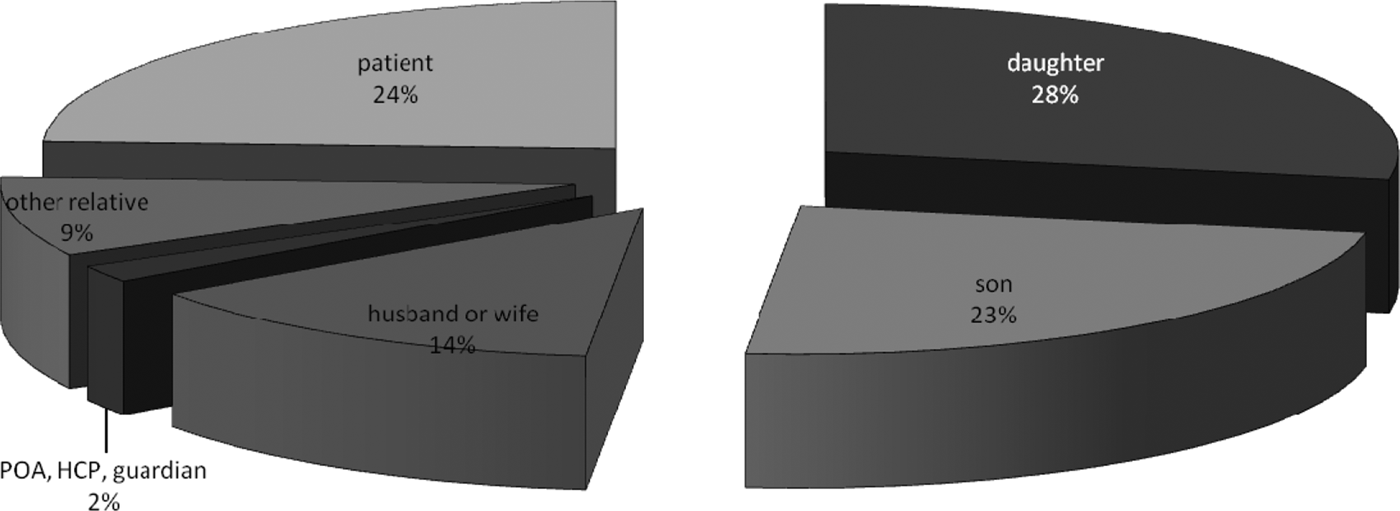
As of the date of the last chart review, 88.5% (161/182) of the long-term care residents had signed MOLST forms in their medical charts. Twenty-four percent (39/161) of the MOLST forms were executed by the residents themselves and 51.6% (83/161) were signed either by a son or a daughter; husbands and wives signed 13.7% of the time (22/161), whereas the remainder (11%, or 17/161) were either signed by healthcare proxies, individuals with power of attorney, or other relatives (Fig. 2).
Who is signing the MOLST? (n = 161).
The median time from admission to MOLST signing was 48 days (95% CI: 12–119 days). Almost one fourth (24.73%) signed on the day of admission. Approximately 37% of the residents signed the MOLST by the 7th day after admission, and 47% signed by the 21st day. Only 3% of residents died the day their MOLST was signed, whereas 12% died within 1 week of signing, and 22% died within 30 days of signing.
Caucasians were more likely to sign a MOLST earlier than non-Caucasians, but not significantly earlier (p = 0.17): median time from admission to MOLST signing for Caucasians was 21 days (95% CI: 10–98 days) and for non-Caucasians was 229 days (95% CI: 32–616 days). Almost one third of Caucasians signed the MOLST by the first day of admission 30.3% (95% CI: 23.9–37.9%); for non-Caucasians, this percentage was lower, at 11.8% (95% CI: 3.1–39.4%). There were no statistically significant differences between males and females or between subjects <65 years and ≥65 years of age with respect to time from admission to MOLST signing.
Twenty-five percent of residents died, on average, 45 days after MOLST execution. There were no significant differences with respect to survival time among those who signed a MOLST, between males and females, or between age groups. There was a slightly higher (but not significant) survival in the non-Caucasians than Caucasians, among those who signed a MOLST (p = 0.08). The median survival time for Caucasians was 20.4 months whereas for non-Caucasians, median survival was not estimable because of the small sample size.
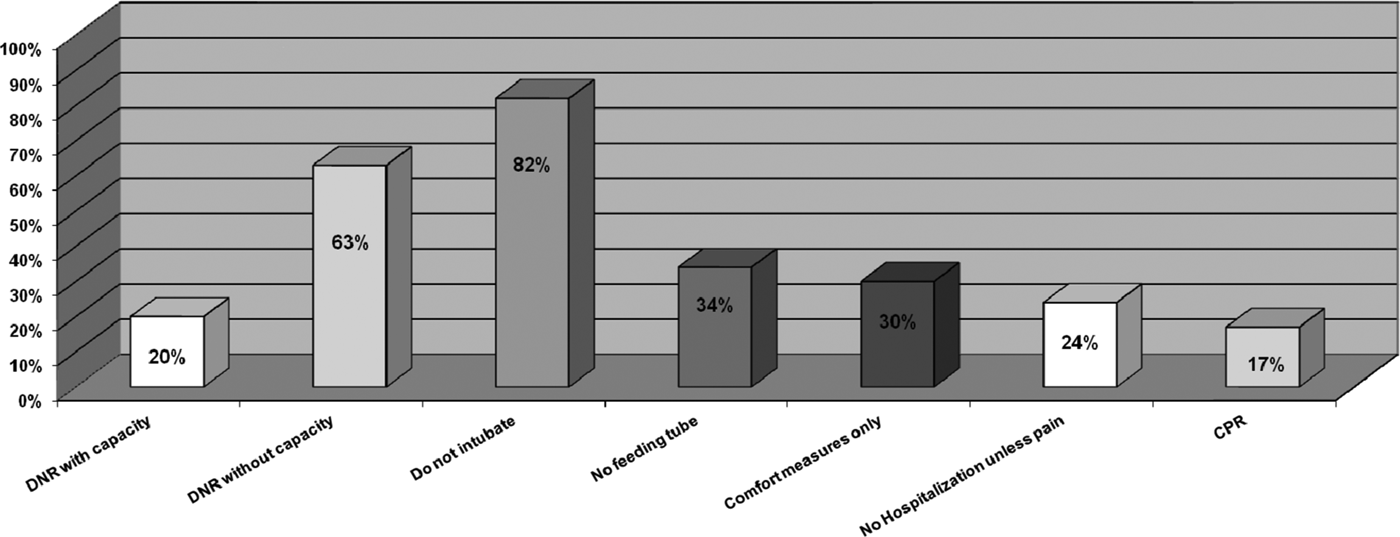
Among those who signed the MOLST, 16.8% (27/161) wanted CPR; 19.9% (32/161) signed a DNR “with full capacity;” and 62.7% (101/161) had a relative, individual with power of attorney, or healthcare proxy sign a DNR for them “without full capacity” (Fig. 3). There was a higher proportion of subjects ≥ 65 years of age who signed a DNR without capacity (i.e., someone else had to sign for them) than of those <age 65 (67% vs. 15%; p < 0.0001).
MOLST form: Patient preferences (n = 161).
Among those who signed the MOLST, 45.3% (73/161) had a healthcare proxy, and 8.1% (13/161) had a living will. No subjects had a documented oral (rather than written) advance directive. There were no differences among those who signed by gender or ethnicity. There was a significantly higher proportion of subjects ≥65 years of age who had a healthcare proxy than of those <65 years of age (48.6% vs. 7.7%; p = 0.007).
Among those who signed the MOLST and did not want CPR, 35.8% (48/134) wanted comfort measures only, 9.7% (13/134) chose to have limited medical interventions, 2.2% (3/134) wanted to receive all needed treatments, and 52.2% (70/134) did not check off any of the three choices. There were no differences between genders, age groups, or ethnicities.
Among those who signed the MOLST and did not want CPR, 97.8% (131/134) also chose “do not intubate” (DNI), whereas 1.5% (2/134) wanted a trial period of intubation.
Among those who signed the MOLST and did not want CPR, 29.1% (39/134) chose no hospitalization unless pain or severe symptoms could not be controlled, and 8.2% (11/134) wanted to be sent to the hospital if necessary. Sixty-three percent (84/134) did not want to be hospitalized under any circumstances. There were no differences between genders, age groups, or ethnicities.
Finally, among the 68 subjects who signed a MOLST and died, 87% had their wishes met.
DISCUSSION
Although the MOLST had been mandated for only 1 year at the start of study enrollment, it was interesting to see that 89% of long-term residents had executed MOLST forms. This percentage is strikingly higher than previously reported in United States nursing facilities. This result may be largely a function of the focus of the healthcare administration in a health system that has given priority to palliative care initiatives. Despite this difference, only 24% of MOLST forms were signed by the residents themselves, leaving the vast majority to the healthcare proxy. Our findings suggest that further education initiatives with regard to advance directives should target potential healthcare proxies as well as patients.
Unfortunately, this study was not geared to explore whether this high proportion meant that families were following earlier patient directives or had come to a decision based on the inexorable downward clinical course of the patient. The discussion of end-of-life preferences is best undertaken proactively with the patient, while that person still has the capacity to understand the critical implications of the decision-making.
The fact that almost one third of residents signed a MOLST on their first day of admission indicates that there was a purposeful staff approach to ascertain patient wishes. Further study is needed to determine why most residents and/or their proxies do not complete the MOLST until later. The MOLST is not just a DNR form; it is a record of treatment preferences meant to clarify the care a resident wants, that is, a clinical guide for the interdisciplinary team.
A limitation of this study was the utilization of a convenience sample, which restricted the study's generalizability, particularly when looking at subsets of the data.
In this era of growing time constraints and increased regulations, medical professionals caring for patients at end of life urgently need a clear and simple approach to the goals of care for their residents. The MOLST is an ideal tool in caring for older adults, providing concrete guidance, not only with regard to DNR and DNI status at time of death, but for practical approaches for the interdisciplinary team to use in daily care. Further studies need to address the factors that facilitate the timely implementation of advance directives in nursing facilities. Identifying targeted team efforts that better prepare residents and family members to face impending end-of-life issues in a timely manner will result in respecting the individual treatment goals of older adults in nursing facilities.
ACKNOWLEDGMENTS
The authors gratefully acknowledge the administrative support of Maria Ilagan and Jill Cotroneo.