INTRODUCTION
The extent of biological invasions has increased rapidly over the past half century (Pyšek & Richardson, Reference Pyšek and Richardson2010). The Millennium Ecosystem Assessment (2005) recognized biological invasions as one of the five main causes of declines of biodiversity and a major pressure on several types of ecosystems, with both ecological and economic impacts. The impacts of alien species on their new environment include altering ecosystem functioning (Raizada et al., Reference Raizada, Raghubanshi and Singh2008), decreasing native species abundance and richness via competition, predation, hybridization and indirect effects (Blackburn et al., Reference Blackburn, Cassey, Duncan, Evans and Gaston2004; Gaertner et al., Reference Gaertner, Breeyen, Hui and Richardson2009), changing community structure (Çinar et al., Reference Çinar, Katagan, Öztürk, Egemen, Ergen, Kocatas, Önen, Kirkim, Bakir, Kurt, Dagli, Kaymakçi, Açik, Dogan and Özcan2006; Hejda et al., Reference Hejda, Pyšek and Jarošík2009), re-structuring the food web, altering gene pools (Occhipinti-Ambrogi, Reference Occhipinti Ambrogi2001), impacting human health and causing substantial economic losses (McGeoch et al., Reference McGeoch, Butchart, Spear, Marais, Kleynhans, Symes, Chanson and Hoffman2010).
The Mediterranean Sea has been largely under the influence of alien species. Different transport pathways are involved in species transfer between different zoogeographic regions, but shipping and man-made canals (e.g. the Suez Canal) are the most important (Minchin et al., Reference Minchin, Galil, David, Gollasch, Olenin, Gollash, Galil and Cohen2006). Almost 1000 alien species have been reported from the region to date, of which 80% have been assigned to a single pathway and 12% to two or more possible pathways (Zenetos et al., Reference Zenetos, Gofas, Morri, Rosso, Violanti, García Raso, Çinar, Almogi-Labin, Ates, Azzurro, Ballesteros, Bianchi, Bilecenoglu, Gambi, Giangrande, Gravili, Hyams-Kaphzan, Karachle, Katsanevakis, Lipej, Mastrototaro, Mineur, Pancucci-Papadopoulou, Ramos Esplá, Salas, San Martín, Sfriso, Streftaris and Verlaque2012).
Sipunculans are widely distributed in the world's oceans from intertidal to abyssal depths (Cutler, Reference Cutler1994). They play an important role in bioerosion of calcareous habitats and rocks (Cutler, Reference Cutler1968; Peyrot-Clausade et al., Reference Peyrot-Clausade, Hutchings and Richard1992); as components of the diet of many fishes, sea anemones, decapod crustaceans, gastropods, sea stars, crabs and cephalopods (Kohn, Reference Kohn, Rice and Todorović1975; Taylor, Reference Taylor1989); and as bioturbators and active burrowers in sediments (Murina, Reference Murina1984).
The phylum has almost 150 species worldwide (Cutler, Reference Cutler1994) and 36 species are known from the Mediterranean Sea (Açik, Reference Açik2011; Ferrero-Vicente et al., Reference Ferrero-Vicente, Saiz-Salinas, Açik and Sanchez-Lizaso2016). A total of eight alien Sipuncula species belonging to four families have been found from the region. Among them, four species (Phascolosoma (P.) scolops, Phascolion (P.) caupo, P. (P.) convestitum and Aspidosiphon (A.) elegans) were reported to have become established in the Mediterranean Sea, two species (Apionsoma (A.) misakianum and Aspidosiphon (A.) mexicanus) were considered as casual or established in the area, and two species (Apionsoma (A.) trichocephalus and Nephasoma (N.) eremita) were regarded as casual (Zenetos et al., Reference Zenetos, Gofas, Verlaque, Çinar, García Raso, Bianchi, Morri, Azzuro, Bilecenoglu, Froglia, Siokou, Violanti, Sfriso, San Martín, Giangrande, Katagan, Ballesteros, Ramos-Esplá, Mastrototaro, Ocaña, Zingone, Gambi and Streftaris2010; Açik, Reference Açik2011; Çinar et al., Reference Çinar, Bilecenoğlu, Ozturk, Katağan, Yokeş, Aysel, Dağli, Açik, Ozcan and Erdoğan2011; Ferrero-Vicente et al., Reference Ferrero-Vicente, Saiz-Salinas, Açik and Sanchez-Lizaso2016).
This paper reviews the status of alien Sipuncula species reported from Mediterreanean coasts and gives comments on their establishment success, mode of introduction and ecological properties.
METHODS
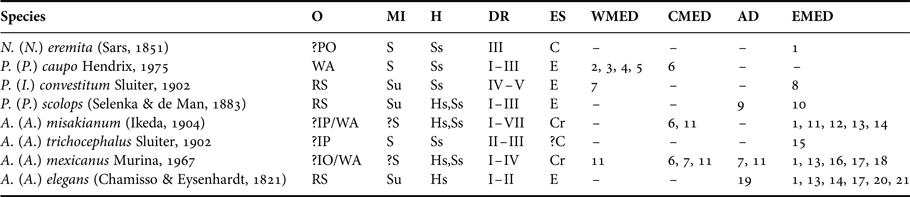
The list of the alien Sipuncula species has been prepared based on species records along the coasts of the Mediterranean Sea. Their area of origin, mode of introduction, establishment success, depth and habitat distributions in the area are given in Table 1. The establishment success of alien sipunculans was grouped into three main categories, namely established, casual and cryptogenic. Established species are alien species with self-maintaining and self-perpetuating populations and species with at least two records in the area spread over time and space, while casual species are those which have been reported only once in the region. Cryptogenic species have no definite evidence of their native or introduced status (Zenetos et al., Reference Zenetos, Gofas, Verlaque, Çinar, García Raso, Bianchi, Morri, Azzuro, Bilecenoglu, Froglia, Siokou, Violanti, Sfriso, San Martín, Giangrande, Katagan, Ballesteros, Ramos-Esplá, Mastrototaro, Ocaña, Zingone, Gambi and Streftaris2010). Brief descriptions of the species and their distributional and ecological characteristics are also given. SURFER software was used for mapping of the distribution pattern of the alien Sipuncula species in the Mediterranean Sea.
The list of alien Sipuncula species from the Mediterreanean Sea. The habitat and depth preferences of alien species along the coasts together with their possible origins, mode of introduction and establishment success are also given.

O, Origin (IP, Indo-Pacific; RS, Red Sea; WA, Western Atlantic; IO, Indian Ocean and PO, Pacific Ocean), MI, mode of introduction (Su, Suez Canal and S, Shipping), H, Habitat (Hs, hard substratum (including algae, sponge), Ss, soft substratum (including phanerogames)), DR, Depth range: (I: 0–10 m, II: 11–50 m, III: 51–100 m, IV: 101–200 m, V: 201–400, VI: 401–500 m VII: 501–2500 m), ES, Establishment success (E, established; C, casual and Cr, cryptogenic), WMED, Western Mediterranean; CMED, Central Mediterranean; AD, Adriatic Sea; EMED, Eastern Mediterranean.
1. Açik (Reference Açik2011); 2. Ferrero-Vicente et al. (Reference Ferrero-Vicente, Loya-Fernández, Marco-Méndez, Martínez–García and Sánchez-Lizaso2011); 3. Ferrero-Vicente et al. (Reference Ferrero-Vicente, Loya-Fernández, Marco-Méndez, Martínez–García, Saiz- Salinas and Sánchez-Lizaso2012); 4. Ferrero-Vicente et al. (Reference Ferrero-Vicente, Del-Pilar-Ruso, De-La-Ossa-Carretero and Sánchez-Lizaso2013a); 5. Ferrero-Vicente et al. (Reference Ferrero-Vicente, Marco-Méndez, Loya-Fernández and Sánchez-Lizaso2013b); 6. Mifsud & Saiz Salinas (Reference Mifsud and Saiz Salinas2011/2012); 7. Pancucci-Papadopoulou et al. (Reference Pancucci-Papadopoulou, Murina and Zenetos1999); 8. Murina (Reference Murina1964); 9. Murina & Zavodnik (Reference Murina and Zavodnik1986); 10. Açik et al. (Reference Açik, Murina, Çinar and Ergen2005); 11. Saiz Salinas (Reference Saiz Salinas2016), 12. Açik (Reference Açik2007); 13. Açik (Reference Açik2008a); 14. Açik (Reference Açik2010b); 15. Murina et al. (Reference Murina, Pancucci-Papadopoulou and Zenetos1999); 16. Açik (Reference Açik2009); 17. Açik (Reference Açik2010a); 18. Çinar et al. (Reference Çinar, Katagan, Ozturk, Bakir, Dağli, Açik, Dogan and Bitlis2012); 19. Zavodnik (Reference Zavodnik, Arko-Pijevac, Kovacic and Crnkovic1998); 20. Wesenberg-Lund (Reference Wesenberg-Lund1957); 21. Açik (Reference Açik2008b).
RESULTS AND DISCUSSION
Based on the compilation of papers on sipunculans reported from the coasts of the Mediterranean Sea, the phylum is represented by a total of eight alien species belonging to four families. The species are categorized by their origins, the mode of introduction and their habitat and depth preferences (Table 1). The establishment success is assigned for each species.
The main pathways for the introduction of established alien sipunculans to the Mediterranean are shipping (one species) and the Suez Canal (three species). The eastern Mediterranean hosts a higher number of alien sipunculans (seven species) due to its proximity to the Suez Canal and dense shipping traffic (Çinar et al., Reference Çinar, Bilecenoğlu, Ozturk, Katağan, Yokeş, Aysel, Dağli, Açik, Ozcan and Erdoğan2011). Of the eight alien sipunculans reported from the region, four species can be classified as established, two species as casual and two species as cryptogenic. The status of the casual species could be changed to established species if further evidence of their presence in other areas is provided. Although Apionsoma (A.) trichocephalus was found with a high density (400 ind. m−2) in the Nile Delta (Murina et al., Reference Murina, Pancucci-Papadopoulou and Zenetos1999), this species was classified as a casual alien species in the region as there is no other evidence showing its successful establishment in the region.
Among the alien sipunculans, three species (Phascolosoma (P.) scolops, Apionsoma (A.) misakianum and Aspidosiphon (A.) mexicanus) occurred on both hard and soft substrata, four species (Nephasoma (N.) eremita, Phascolion (P.) caupo, Phascolion (I.) convestitum and Apionsoma (A.) trichocephalus) only on soft substrata, and one species (Aspidosiphon (A.) elegans) only on hard substrata. Established and casual alien sipunculans species were reported between 0 and 260 m depths. The cryptogenic species A. (A.) misakianum was found at 2287 m depth in South Crete and at 0–460 m depths in other parts of the Mediterranean Sea (Açik, Reference Açik2014; Saiz Salinas, Reference Saiz Salinas2016). Aspidosiphon (A.) mexicanus, which seems to be another cryptogenic species, has a wide distributional range in the Mediterranean Sea. It was found at depths ranging from 25 to 429 m (Ferrero-Vicente et al., Reference Ferrero-Vicente, Saiz-Salinas, Açik and Sanchez-Lizaso2016).
The morphological, distributional and ecological aspects of the alien sipunculans are given below.
Nephasoma (Nephasoma) eremita (Sars, 1851)
DESCRIPTION
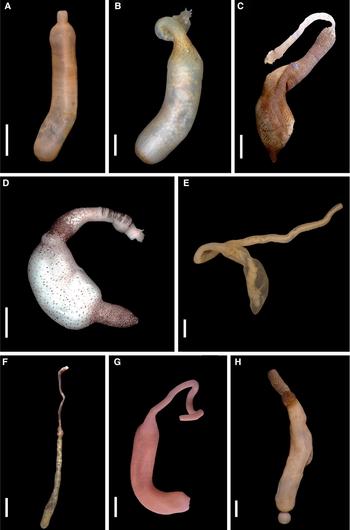
Body wall smooth, pale creamy tan to dark reddish brown (Figure 1A). Cylindrical trunk with abrupt taper to introvert. Unclear transverse and parallel grooves present on trunk wall. Mouth at distal end of introvert surrounded by digitiform tentacles. Hooks absent. Two retractor muscles attached to posterior one-third of trunk. Oesophagus attached to retractor muscles by connective tissue. Two nephridia present. Nephridiopores anterior to anus.
External morphology of species. (A) Nephasoma (N.) eremita, (B) Phascolion (P.) caupo, (C) Phascolion (I.) convestitum, (D) Phascolosoma (P.) scolops, (E) Apionsoma (A.) misakianum, (F) Apionsoma (A.) trichocephalus, (G) Aspidosiphon (A.) mexicanus, (H) Aspidosiphon (A.) elegans. Scale bars: A = 2 mm, B = 0.5 mm, C and D = 2 mm, E = 0.5 mm, F = 1 mm, G = 2 mm, H = 1 mm (A, E = from Açik, Reference Açik2011, B–D, F = from Ferrero-Vicente et al. Reference Ferrero-Vicente, Saiz-Salinas, Açik and Sanchez-Lizaso2016; G = from Açik, Reference Açik2014, H = from Açik, Reference Açik2008b).

DISTRIBUTION AND ECOLOGY
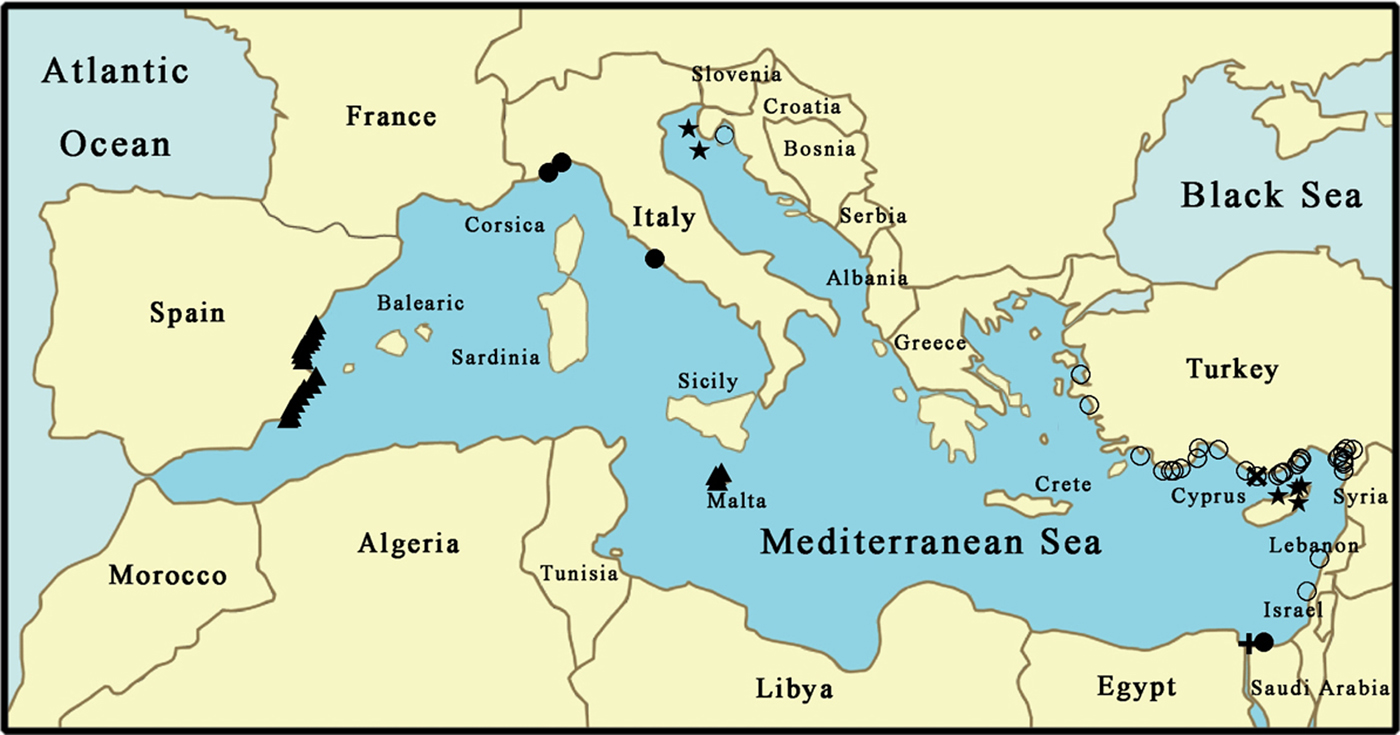
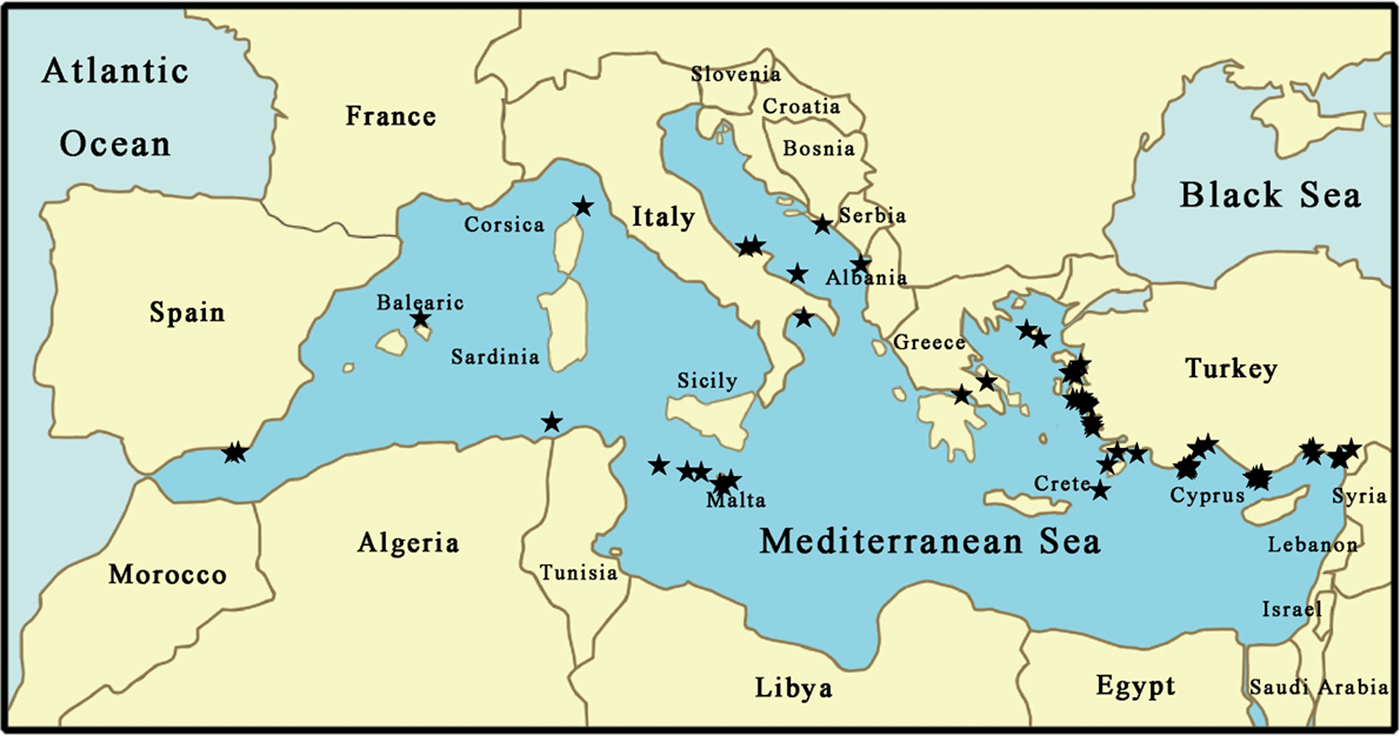
Nephasoma (Nephasoma) eremita was previously reported from the northern and southern Atlantic, Arctic, Antarctic and eastern Pacific coasts (Cutler, Reference Cutler1994). In the Mediterranean, it was only reported from the Levantine coast of Turkey (Anamur) on muddy sand at 75 m depth (Figure 2) and considered to have been introduced to the area in the ballast waters of ships (Açik, Reference Açik2011). As only one individual of this species was found in the Mediterranean Sea, this species was classified as a casual alien species.
Distribution of Nephasoma (N.) eremita ( ), Phascolion (P.) caupo (
 ), Phascolion (I.) convestitum (
 ), Phascolosoma (P.) scolops (★), Apionsoma (A.) trichocephalus (
 ) and Aspidosiphon (A.) elegans (○) in the Mediterranean Sea.

Phascolion (Phascolion) caupo Hendrix, 1975
DESCRIPTION
Body semi-transparent, lightly yellowish (Figure 1B). Introvert longer than trunk length. Scattered broad-based hooks with tip rounded. Cone-shaped holdfast papillae dark, sparse and tall. Blister-shaped papillae scattered along trunk. Ventral retractor muscle thinner than dorsal. One nephridium present. Two retractor muscles partially fused.
DISTRIBUTION AND ECOLOGY
Phascolion (P.) caupo was previously known from the south-eastern United States (Cutler, Reference Cutler1994). In the Mediterranean (Figure 2), it was first reported from different areas of the Spanish Mediterranean coast with a high number of individuals between 7 and 45 m depths (Ferrero-Vicente et al., Reference Ferrero-Vicente, Saiz-Salinas, Açik and Sanchez-Lizaso2016) and subsequently from the Maltese coast between 20 and 60 m depths (Mifsud & Saiz Salinas, Reference Mifsud and Saiz Salinas2011/2012). It was found in soft sediment and usually inhabited empty gastropod shells and polychaeta tubes (Mifsud & Saiz Salinas, Reference Mifsud and Saiz Salinas2011/2012; Ferrero-Vicente et al., Reference Ferrero-Vicente, Saiz-Salinas, Açik and Sanchez-Lizaso2016). This species can be accepted as an established alien species for the region. It could have been introduced to the area by ballast waters of ships.
Phascolion (Isomya) convestitum Sluiter, 1902
DESCRIPTION
Body wall semi-transparent (Figure 1C). Introvert with large, recurved hooks. Holdfast papillae highly variable, from large and bulbous to small and compact; some with granular material around border, others with hardened material around border or without hardened material. Dorsal retractor muscle with single origin whereas ventral muscle with two origins. Gut with loose coils. One nephridia present. Short, strong fixing muscle attaching coils to body wall between roots of ventral retractor. No spindle muscle. Two eyespots present.
DISTRIBUTION AND ECOLOGY
Phascolion (Isomya) convestitum is distributed from the Pacific, Indonesia, Gulf of Aden and Red Sea. It was rarely reported in the Mediterranean Sea (French coasts, Tyrrhenian Sea, Ligurian Sea and Egypt) on sand/silty sediment at depths ranging from 140 to 260 m (Pancucci-Papadopoulou et al., Reference Pancucci-Papadopoulou, Murina and Zenetos1999; Ferrero-Vicente et al., Reference Ferrero-Vicente, Saiz-Salinas, Açik and Sanchez-Lizaso2016). It is a Lessepsian migrant (Açik et al., Reference Açik, Murina, Çinar and Ergen2005).
Phascolosoma (Phascolosoma) scolops (Selenka & de Man, 1883)
DESCRIPTION
Trunk opaque, light brownish (Figure 1D). Introvert with regular pigmented bands. Dome-shaped to mammiform, reddish brown preanal papillae at base of introvert. Less than 25 rings of hooks with visible triangle and clear streak. Two characteristic dark lines crossing clear area of each hook. Hooks unidentate, sometimes with small secondary tooth. Longitudinal muscles gathered into 19–24 bands. Spindle muscle well developed, attached to posterior end of trunk. Contractile vessel simple. Two pairs of retractor muscles and two eyespots present.
DISTRIBUTION AND ECOLOGY
Phascolosoma (Phascolosoma) scolops was previously reported from the Indo-West Pacific region, Red Sea and eastern Atlantic Ocean (Cutler, Reference Cutler1994). In the Mediterranean (Figure 2), it was first reported from the Adriatic Sea on hard bottom at 35–65 m depths (Murina & Zavodnik, Reference Murina and Zavodnik1986) and subsequently from the northern Cyprus on rocks, seagrass Posidonia oceanica and the algae Cystoseira crinita at 0–10 m depths (Açik et al., Reference Açik, Murina, Çinar and Ergen2005). As it occurs solely in the Indo-Pacific region and the Red Sea, it could be considered as a Lessepsian migrant (Açik et al., Reference Açik, Murina, Çinar and Ergen2005).
Apionsoma (Apionsoma) misakianum (Ikeda, 1904)
DESCRIPTION
Body wall thin, semi-transparent (Figure 1E). Introvert longer than trunk length. Small, numerous brown papillae on posterior part of trunk. Introvert with 50–82 rings of hooks. Most distal rings of small hooks with 4–5 spinelets. Intestine spiral attached to posterior part of trunk by spindle-muscle. Four thin retractor muscles originating near middle of trunk, both pairs close to ventral nerve cord. Bilobed nephridia similar in size. Nephridiopores located in front of anus. Two black eyespots present.
DISTRIBUTION AND ECOLOGY
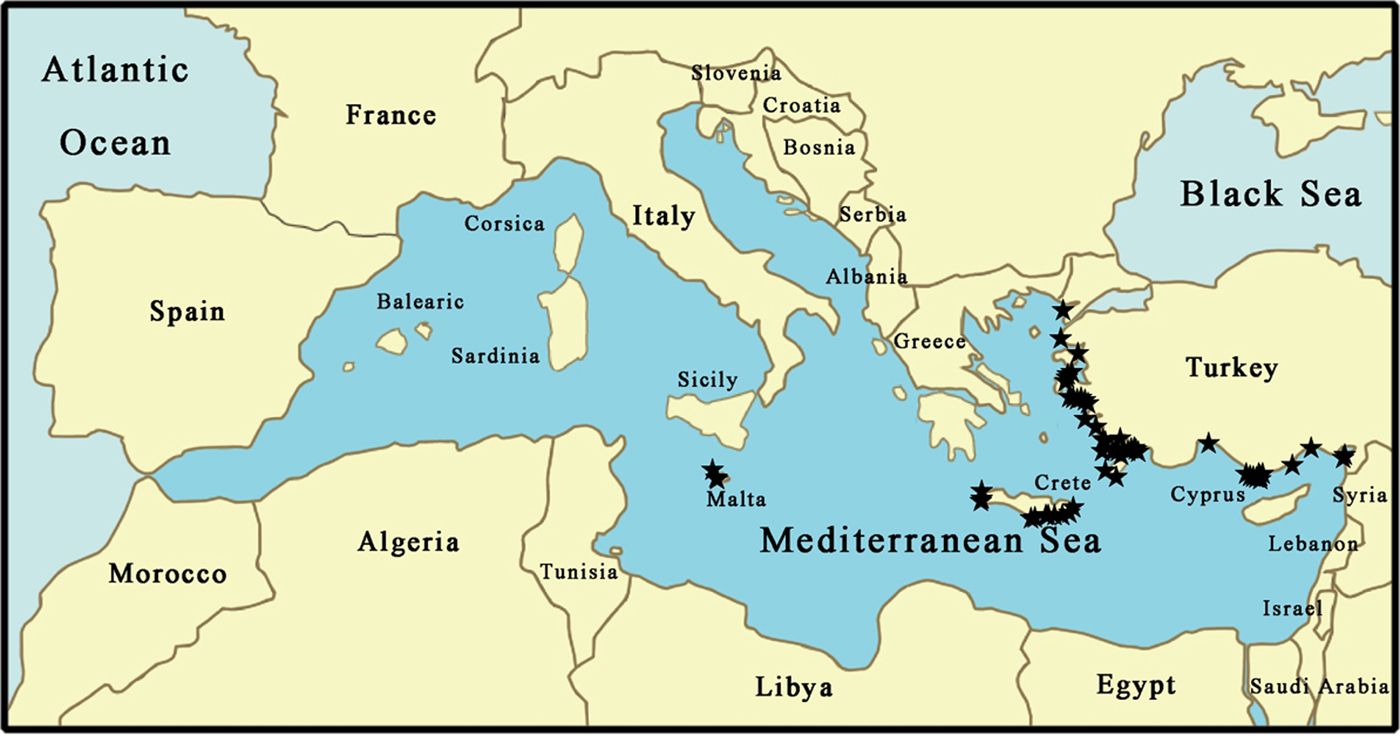
Apionsoma (Apionsoma) misakianum was previously reported from the Indian, Pacific and western Atlantic Oceans (Cutler, Reference Cutler1994). In the Mediterranean (Figure 3) it was first reported from the Aegean Sea at 41–195 m depth (Açik, Reference Açik2007, Reference Açik2008a) and subsequently from the Levantine coasts of Turkey at 0–200 m depth (Açik, Reference Açik2010b, Reference Açik2011), from Crete at 69–2287 m depth, from Rhodos at 115–160 m depth and from Malta at 60–460 m depth (Mifsud & Saiz Salinas, Reference Mifsud and Saiz Salinas2011/2012; Saiz Salinas, Reference Saiz Salinas2016). It was previously mentioned that this species could have been introduced to the area by ballast waters of ships. This species is usually found in sandy/muddy sediments, but also has been reported from algae (Halopteris scoparia and Ellisolandia elongata), seagrass Posidonia oceanica, pores of calcareous rocks and rodolith facies (Açik, Reference Açik2007, Reference Açik2008a, Reference Açik2010b, Reference Açik2011; Mifsud & Saiz Salinas, Reference Mifsud and Saiz Salinas2011/2012; Saiz Salinas, Reference Saiz Salinas2016). It is often associated with empty tubes of serpulid polychaetes (Vermiliopsis sp. and Serpula sp.) and shells of molluscs (Antalis panorma) (Açik, Reference Açik2007).
Distribution of Apionsoma (A.) misakianum in the Mediterranean Sea.

The majority of alien species (80% of total number of species) were generally encountered in shallow waters and no alien species in the Mediterranean has previously been reported at great depths (>200–500 m) (Çinar et al., Reference Çinar, Bilecenoğlu, Ozturk, Katağan, Yokeş, Aysel, Dağli, Açik, Ozcan and Erdoğan2011). However, the sipunculan worm Apionsoma (A.) misakianum was recently found at 2287 m depth off South Crete (Saiz Salinas, Reference Saiz Salinas2016) and widely distributed in the Mediterranean Sea. Therefore, it is unclear at this stage whether this species is really an alien species for the region. With regards to its worldwide distributional ranges, there is a discontunity in its actual distribution; absent in the eastern Atlantic. This species was first reported in the Mediterranean by Açik (Reference Açik2007) from the Aegean Sea, but now it is known in almost every part of the Mediterranean. To clarify its alien status, the previous reports of species Apionsoma from the region should be re-examined to determine if A. (A.) misakianum occurred in the area for a long time. It is therefore suggested that this species should be accepted as a cryptogenic species, rather than an established alien species. Molecular analysis to be performed on specimens from different parts of the world might shed more light on where this species is originating from.
Apionsoma (Apionsoma) trichocephalus Sluiter, 1902
DESCRIPTION
Trunk slender, spindle-like and semi-transparent (Figure 1F). Introvert 8–14 times trunk length. Scattered round papillae at posterior end of trunk. Hooks and tentacles absent. Two pairs of thin retractor muscles attached to middle of trunk. Rectal caecum absent. Two bilobed nephridia present. Nephridiopores anterior to anus.
DISTRIBUTION AND ECOLOGY
Apionsoma (A.) trichocephalus was previously reported from the north and south Atlantic Ocean, north and south Pacific Ocean, Indian Ocean and Gulf Aden (Cutler, Reference Cutler1994). In the Mediterranean (Figure 2), the only published record of the species came from the Nile Delta on muddy bottom at depths ranging from 24 to 75 m (Murina et al., Reference Murina, Pancucci-Papadopoulou and Zenetos1999). This species could have been introduced to the area by ballast waters of ships as it was absent (or at least not reported) in the Red Sea. As there is only one documented report of this species in the region, this species is classified as a casual species.
Aspidosiphon (Akrikos) mexicanus Murina, 1967
DESCRIPTION
Body wall thin, light yellowish (Figure 1G). Anal shield weakly developed with ill-defined platelets. Caudal shield not clear. Introvert at typical angle (45–50°) with main trunk axis. Hooks unidentate, uncompressed, scattered and small. Intestinal spiral attached to posterior part of trunk by spindle muscle. Contractile vessel simple. Two single lobed nephridia present. Nephridiopores posterior to anus. Eyespots absent.
DISTRIBUTION AND ECOLOGY
Aspidosiphon (A.) mexicanus is known from the western Atlantic Ocean, Indian Ocean and Mediterranean Sea (Pancucci-Papadopoulou et al., Reference Pancucci-Papadopoulou, Murina and Zenetos1999). In the Mediterranean, only a few specimens of this species were recorded from Malta, the Lampedusa Islands, the Adriatic and the Greek coasts until 2008 (Pancucci-Papadopoulou et al., Reference Pancucci-Papadopoulou, Murina and Zenetos1999). Records made after this date showed that this species is widely distributed from littoral waters to 429 m depth (Figure 4) in the eastern and western basins of the Mediterranean Sea (Açik, Reference Açik2008a, Reference Açik2009, Reference Açik2010a, Reference Açik2011, Reference Açik2014; Mifsud & Saiz Salinas, Reference Mifsud and Saiz Salinas2011/2012; Çinar et al., Reference Çinar, Katagan, Ozturk, Bakir, Dağli, Açik, Dogan and Bitlis2012; Saiz Salinas, Reference Saiz Salinas2016). It has been collected from sandy mud, muddy sand, sand, mud, gravel bottoms, empty mollusc shells, rocks, Posidonia oceanica and Zostera marina (Ferrero-Vicente et al., Reference Ferrero-Vicente, Saiz-Salinas, Açik and Sanchez-Lizaso2016). As it is distributed in the western Atlantic and Indian Oceans, it is difficult to determine at this stage from where and how it has been introduced to the Mediterranean. Therefore, this species should be accepted as a cryptogenic species at the time being. A molecular analysis is needed to understand its origin (Açik, Reference Açik2011).
Distribution of Aspidosiphon (A.) mexicanus in the Mediterranean Sea.

Aspidosiphon (Aspidosiphon) elegans (Chamisso & Eysenhardt, 1821)
DESCRIPTION
Body wall thin and semi-transparent (Figure 1H). Introvert as long as trunk length. Ungrooved anal shield granulous. Caudal shield usually weakly developed. Bidentate hooks on rings located on distal part of introvert. Dark conical hooks scattered on proximal part of introvert. Intestinal tract with about 14–20 coils, attached by spindle muscle. Retractors originating from 14 to 30% of distance to posterior end of trunk. Nephridiopores anterior or posterior to anus. Two black eyespots present.
DISTRIBUTION AND ECOLOGY
Aspidosiphon (A.) elegans was previously reported to be a common species in the shallow waters of the Indian and western Pacific Oceans, and the Red Sea (Cutler, Reference Cutler1994). Wesenberg-Lund (Reference Wesenberg-Lund1957) firstly reported it within the Mediterranean from the Israeli coast (Figure 2). It was later found at 0–14 m depths in the Rijeka Bay (Adriatic Sea), and in shallow waters along the Turkish and Lebanese coasts (Figure 2) (Zavodnik, Reference Zavodnik, Arko-Pijevac, Kovacic and Crnkovic1998; Açik, Reference Açik2008b, Reference Açik2014; Saiz Salinas, Reference Saiz Salinas2016). This species has been found in various habitats including Posidonia oceanica, algae, calcareous rock, mussel and the coral Cladocora caespitosa (Açik, Reference Açik2008a, Reference Açikb, Reference Açik2010a, Reference Açikb, Reference Açik2011).
Aspidosiphon (A.) elegans, a lessepsian migrant, is known to be a bio-eroder of calcareous substrates such as rocks, stones and corals (Cutler, Reference Cutler1994). When it attains a high population density in the area, it may cause serious damage to these habitats. The magnitude of its impact on the habitats as a bio-eroder species should be studied and monitored.
The records of the alien sipunculan species found in the region is increasing day by day, partly due to the increase in the number of studies conducted in the area, and partly through the impacts of pathways and the range extensions of alien species (Çinar et al., Reference Çinar, Bilecenoglu, Öztürk, Katagan and Aysel2005; Zenetos et al., Reference Zenetos, Gofas, Morri, Rosso, Violanti, García Raso, Çinar, Almogi-Labin, Ates, Azzurro, Ballesteros, Bianchi, Bilecenoglu, Gambi, Giangrande, Gravili, Hyams-Kaphzan, Karachle, Katsanevakis, Lipej, Mastrototaro, Mineur, Pancucci-Papadopoulou, Ramos Esplá, Salas, San Martín, Sfriso, Streftaris and Verlaque2012). Invasive alien species may have ecological, economic or health-related influences, especially after they succeed in establishing dense populations, or presenting invasive characters. This study sheds more light on the morphological, distributional and ecological features of alien sipunculans in the Mediterrenean Sea. Such studies might also provide extensive information about ecological and functional roles of aliens in the ecosystems. Therefore, monitoring of alien species especially in large international harbours, estuarine areas, deltas and aquaculture facilities should be performed.
ACKNOWLEDGEMENTS
I am indebted to the anonymous referees for their constructive comments on the manuscript.