


Introduction
Bipolar disorder (BD) is characterized by episodes of mania or hypomania and usually episodes of depression (American Psychiatric Association, 2013; World Health Organisation, 2018). Manic episodes include symptoms such as inflated self-esteem and an increase in goal-directed activity. A major depressive episode is characterized by symptoms such as reduced pleasure in activities and feelings of worthlessness (American Psychiatric Association, 2013; World Health Organisation, 2018). The lifetime prevalence is around 1% (Merikangas et al., Reference Merikangas, Jin, He, Kessler, Lee, Sampson and Karam2011), and diagnosis is associated with considerable impact on functioning even outside of acute mood episodes (Sanchez-Moreno et al., Reference Sanchez-Moreno, Martinez-Aran, Tabares-Seisdedos, Torrent, Vieta and Ayuso-Mateos2009).
A number of studies have found that psychological interventions may be beneficial in BD. A meta-analysis (Oud et al., Reference Oud, Mayo-Wilson, Braidwood, Schulte, Jones, Morriss and Kendall2016) found reduced relapse rates and hospital admissions, with group interventions linked to fewer symptoms of depression. Individual studies of group-based psychoeducation and cognitive behavioural therapy (CBT) have also found an impact on functioning (Castle et al., Reference Castle, Berk, Berk, Lauder, Chamberlain and Gilbert2007; Patelis-Siotis et al., Reference Patelis-Siotis, Young, Robb, Marriott, Bieling, Cox and Joffe2001).
A smaller body of research has focused on changes outside of symptom improvements and relapse rates. Recovery-focused CBT has also been shown to improve perceived personal recovery (Jones et al., Reference Jones, Smith, Mulligan, Lobban, Law and Morrison2015). Camardese et al. (Reference Camardese, Vasale, D’Alessandris, Mazza, Serrani, Travagliati and Janiri2018) found that a psychoeducational and psychological programme improved self-reported insight and resilience. Etain et al. (Reference Etain, Scott, Cochet, Bellivier, Boudebesse, Drancourt and Fouques2018) demonstrated improvements in knowledge about BD and illness perception following psychoeducation. Crowe and Inder (Reference Crowe and Inder2018) interviewed young people with BD 5 years after therapy had ended, finding qualitative themes of understanding and self-awareness around bipolar as well as learning to live well with it. An online intervention has also been shown to improve recovery, wellbeing and quality of life (Todd et al., Reference Todd, Jones, Hart and Lobban2014).
Studies have shown that those with BD often feel stigmatized. Warwick et al. (Reference Warwick, Mansell, Porter and Tai2019) reviewed qualitative research about factors leading to distress in BD and found a theme of stigma. Nilsson et al. (Reference Nilsson, Kugathasan and Straarup2016) found perceived stigmatization on a numbers of factors such as friendships and trustworthiness, with more than half reporting feeling stigmatized around hospitalization and perceived ability to work. A study in multiple European countries found around one-fifth had moderate or high levels of self-stigma, and this was predicted by factors such as education, employment and social contact (Brohan et al., Reference Brohan, Gauci, Sartorius and Thornicroft2011). Studies suggest that such self-stigma correlates with symptoms of depression, mania and anxiety (Gilkes et al., Reference Gilkes, Perich and Meade2018; Howland et al., Reference Howland, Levin, Blixen, Tatsuoka and Sajatovic2016;), poorer social adjustment (Perlick et al., Reference Perlick, Rosenheck, Clarkin, Sirey, Salahi, Struening and Link2001) and poorer quality of life (Post et al., Reference Post, Pardeller, Frajo-Apor, Kemmler, Sondermann, Hausmann and Hofer2018). Karidi et al. (Reference Karidi, Vassilopoulou, Savvidou, Vitoratou, Maillis, Rabavilas and Stefanis2015), however, found that such stigmatization was less intense than seen in those with a diagnosis of schizophrenia, and did not impact functioning. There has been little research on whether psychological therapy helps to reduce stigma, although Nilsson et al. (Reference Nilsson, Kugathasan and Straarup2016) found such an effect following psychoeducation.
Bipolar disorder is also associated with low self-esteem: a meta-analysis of 19 studies found overall lower self-esteem in BD compared with controls, although higher than those with depression alone (Nilsson et al., Reference Nilsson, Jøorgensen, Craig, Staarup and Licht2010). Such low self-esteem occurs outside of mood episodes (Blairy et al., Reference Blairy, Linotte, Souery, Papadimitriou, Dikeos, Lerer and Macciardi2004). Other research has shown that outside of episodes self-esteem is not lower in BD but it is more variable (Knowles et al., Reference Knowles, Tai, Jones, Highfield, Morriss and Bentall2007), and those with BD show more self-esteem changes in response to successes and failures (Pavlova et al., Reference Pavlova, Uher, Dennington, Wright and Donaldson2011). There is also some evidence of a relationship between self-esteem and feelings of stigma in BD (Hayward et al., Reference Hayward, Wong, Bright and Lam2002). There is, however, little research on psychological interventions around self-esteem in BD specifically, although Etain et al. (Reference Etain, Scott, Cochet, Bellivier, Boudebesse, Drancourt and Fouques2018) found improved self-esteem following psychoeducation.
This study therefore aimed to add to the limited literature on whether psychoeducational groups for BD improve factors outside of mood symptoms, specifically perceived recovery, diagnosis perception and BD-specific self-esteem and perceived stigma.
Method
Design
A case series was used, evaluating changes in standardized measures pre- and post-group. This was conducted as a service evaluation: measures were used as part of standard care so ethics approval was not needed. Approval was given as a service evaluation by the hosting National Health Service (NHS) trust research and audit service. Participants gave written consent for their data to be used for this evaluation.
Service and group content
The service is an NHS secondary care community mental health service for working age adults with severe and enduring mental health problems. The group ran for 12 weeks and was facilitated by a cinical psychologist or cognitive behavioural therapist supported by a nurse/care coordinator or assistant psychologist. The session content was based on a number of previous papers, in particular the book by Colom and Vieta (Reference Colom and Vieta2006), with more direct use of CBT thought-challenging techniques and mindfulness incorporated.
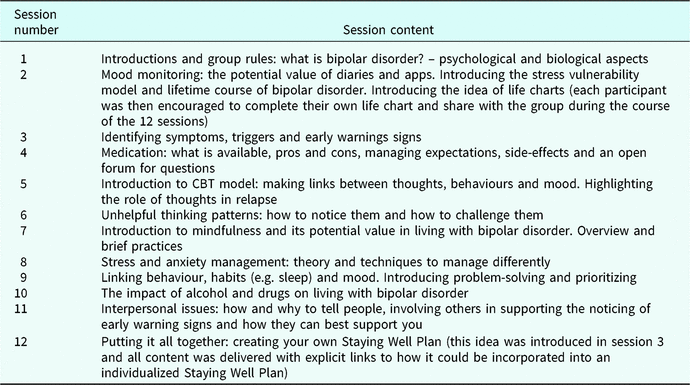
The data used are from three groups run separately over a 2-year period. Referrals were made to the group from staff in the community mental health teams. Each participant had an individual appointment or telephone call with the group facilitator to orient them to the group and discuss expectations. The group met weekly at the team base and ran for 2 hours with a break in the middle. A PowerPoint presentation was used to convey the session content, and these were made available as hand-outs. The group contained some didactic delivery of information but also emphasized the sharing of experiences, learning from and supporting one another. Questions and discussion was encouraged. A psychiatrist or pharmacist delivered the session on medication. Table 1 summarizes the content of each of the 12 sessions. The group tackled the factors measured here specifically in the following ways:
Group session content

Recovery
Awareness of early warning signs and triggers, behavioural strategies to cope with these, the role of thoughts in relapse, mood monitoring, issues around medication, the role of sleep and behaviours in mood, a relapse prevention plan to summarize, using mindfulness to prevent relapse, coping strategies for anxiety.
Diagnosis perception
Education about symptoms, types of BD, continuum with normality, prevalence, genetic and brain factors, psychological factors such as early bereavement and households with high expressed emotion, lifetime course of BD, impact of life events and relation to stress-vulnerability model, impact of substance use.
Self-esteem and stigma in relation to BD
Discussing similar issues with fellow service users, self-disclosure of lived experience from staff running group if relevant and helpful, discussion of celebrities with a diagnosis of BD.
Discussion of prevalence of BD, impact of genetics and early bereavements to normalize and validate.
Discussion of BD not defining who you are, connecting with important parts of your identity outside of BD diagnosis, using CBT thought-challenging techniques to tackle self-critical thoughts, discussion of how to tell friends family and employers, ways to challenge misconceptions or stigmatizing attitudes towards BD.
Measures
The following questionnaires were given out before the group started and in the final session of the group.
Author-constructed questions
Participants had to mark on a visual analogue scale ‘Not at all’ to ‘A lot’ for ‘To what extent do you feel you…?’ for a number of questions such as:
Understand what can trigger mood changes for you.
Can recognize the early warning signs of becoming unwell.
Are aware of your thinking patterns and how these relate to mood episodes.
Can take action to prevent relapse.
Higher scores on these questions represented greater understanding/awareness.
Views on Manic Depression Questionnaire (Hayward et al., cited in Lam et al., Reference Hayward, Lam, Jones and Hayward2010)
This is a 14-item measure of self-esteem and perceived stigma around BD (e.g. ‘I am able to do things as well as most other people’ and ‘Most people believe that a BD sufferer is just as trustworthy as the average person’); α in current sample pre = .77. The term ‘manic depression’ was changed to ‘bipolar disorder’ for this measure. Lower scores represent greater stigma.
The Brief Illness Perception Questionnaire (Broadbent et al., Reference Broadbent, Petrie, Main and Weinman2006)
This is a 9-item questionnaire designed to assess the cognitive and emotional representations of illness (e.g. ‘How well do you feel you understand your illness?’ and ‘How much control do you feel you have over your illness?’). This was completed for BD diagnosis specifically. There are no total scores for this measure; each question’s response is analysed individually.
Bipolar Recovery Questionnaire (Jones et al., Reference Jones, Mulligan, Higginson, Dunn and Morrison2013)
This is a 36-item questionnaire measuring recovery experiences in BD (e.g. ‘I can have mood experiences and still get on with my life’ and ‘I am unsure about the reasons behind some of the experiences I have had’); α in current sample pre = .82. Higher scores represent greater perceived recovery.
Participant characteristics
All participants had a diagnosis of BD (Type 1 or Type 2); 43.5% (n = 10) also had a secondary diagnosis such as emotionally unstable personality disorder, anorexia, alcohol dependence or an anxiety disorder. Gender was 73.9% (n = 17) female, and all participants reported their ethnicity as White European. Ages ranged from 20 to 62 years, with a mean of 43 years.
Statistical analysis
For individual missing items on standardized measures, mean substitution was used. The scales of views of BD and bipolar recovery were normally distributed: Shapiro-Wilk = .93, p > .05 and .91, p > .05. A repeated measures multiple analysis of variance was used to analyse changes from pre to post using an intent-to-treat (ITT) analysis with pre-data being used as post-data for those who did not complete the group.
Results
Out of the 23 participants who started the group, 87% (n = 20) completed and 13% (n = 3) dropped out (defined as attending less than half the sessions and/or actively saying they no longer wished to attend). For those who dropped out, the number of sessions attended ranged from 1 to 4 out of 12, with a mean of 2.7; for completers, the number of sessions attended ranged from 7 to 12 out of 12, with a mean of 10.7. Reasons given for drop-out included one person reporting feeling too low or oversleeping at times and finding it hard to attend, another was looking for work so could not commit to weekly sessions, and the final participant who dropped out stopped attending with no reason given and could not be contacted.
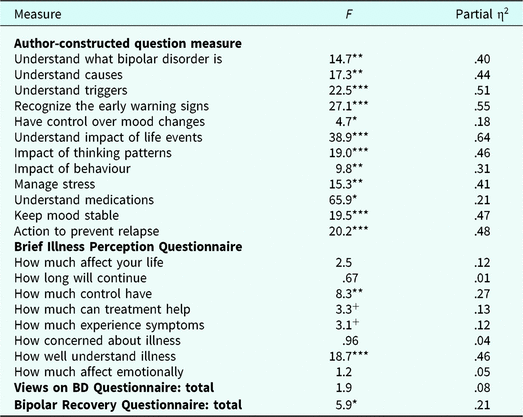
Table 2 summarizes the univariate results for pre- and post-group changes in all of the measures for the intent-to-treat analysis. This showed a number of statistically significant improvements on all of the author-constructed questionnaires around factors such as understanding life events, understanding their triggers and impact of thinking patterns. All of these significant changes were for higher scores post-group representing greater understanding and awareness.
Univariate results of MANOVA: changes pre- and post-group in all measures for intent-to-treat analysis

*p < .05, **p < .01, ***p < .001, +non-significant trend, p < .10.
There were significant changes on the Brief Illness Perception Questionnaire post-group with a greater sense of control over BD and more understanding about it, as well as non-significant trends for an increased feeling that treatment can help. There was also a trend for reporting that individuals experienced more symptoms post-group.
The overall total on the Views on Bipolar Disorder Questionnaire did not change significantly. There was a significant change in scores on the Bipolar Recovery Questionnaire, with higher overall scores representing greater perceived recovery: mean total 2109.9 pre and 2272.1 post.
Discussion
The study aimed to examine the effects of a CBT-based BD psychoeducation group on views about diagnosis, perceived recovery, and diagnosis-specific self-esteem and stigma. The results show overall higher perceived recovery in relation to BD following the group, in line with Jones et al. (Reference Jones, Smith, Mulligan, Lobban, Law and Morrison2015). This demonstrates the positive impact of psychoeducational interventions on factors outside of relapse rates and mood symptoms, and is in line with the recovery model of mental health which emphasizes the importance of factors such as identity, hope and optimism about the future and empowerment (Leamy et al., Reference Leamy, Bird, Le Boutillier, Williams and Slade2011). It is also important to note the relatively low drop-out rates for the group; this demonstrates its acceptability and feasibility within this population.
Changes on diagnosis perception suggest improved understanding of BD and a greater sense of control of symptoms. Clients reported a better understanding of the role of thinking patterns and behaviour in relapse further demonstrating improved recovery. They also showed an increase in perceived ability to keep mood stable, take action to prevent relapse and greater awareness of early warning signs and triggers, in line with the work of de Andrés et al. (Reference de Andrés, Aillon, Bardiot, Bourgeois, Mertel, Nerfin and Aubry2006), who found that group therapy increased perceived ability to cope with relapse. Similarly Etain et al. (Reference Etain, Scott, Cochet, Bellivier, Boudebesse, Drancourt and Fouques2018) showed that improvements in functioning following psychoeducation were mediated by change in diagnosis perception. Experiencing symptoms was in the opposite direction to that expected, with individuals reporting more symptoms: this might represent becoming more aware of their early warning signs which is one of the group aims.
However, other factors such as how much it affects life and how concerned participants were about diagnosis did not change. In particular, there were no improvements on the Views on Manic Depression Scale which measures self-esteem and stigma in relation to BD. This is surprising given that stigma has been shown to be less likely in those who have received psychoeducation (Nilsson et al., Reference Nilsson, Kugathasan and Straarup2016), and psychological and psychoeducational programmes have also been shown to improve self-esteem in BD (Etain et al., Reference Etain, Scott, Cochet, Bellivier, Boudebesse, Drancourt and Fouques2018). The measure used has not been validated and although in this sample it had a high Cronbach’s alpha level it might not be a valid measure of BD-specific stigma. Another measure of broader self-esteem such as the Rosenberg Self-Esteem Scale may have had different results (Rosenberg, 1989). It may be that the group content did not address stigma and self-esteem directly, or that other approaches such as multi-family group psychoeducation (Madigan et al., Reference Madigan, Egan, Brennan, Hill, Maguire, Horgan, Flood, Kinsella and O’Callaghan2012), might have been more effective. It might have also been that changes in perceived stigma or self-esteem linked to the diagnosis had not yet emerged as the group had only just finished and a longer follow-up was needed to detect changes.
This study is limited by a number of factors. There was a short follow-up: the current study tried to assess changes at 3- and 6-month follow-up, but only received five completed questionnaires for each so could not use these data. There was also no comparison control group which would be needed to control for input from the wider mental health team and non-specific factors may have impacted perceived recovery; unstructured peer support may prove a useful active control condition for future research. The small sample size also prevents any definitive conclusions and it may be that stigma and self-esteem are shown to improve with a larger sample size. All participants were White European, which prevents generalizability of the findings to other ethnic groups. Public surveys in the UK have shown less knowledge and less positive attitudes and intended behaviour towards those with mental illness in minority ethnic groups (Evans-Lacko et al., Reference Evans-Lacko, Henderson and Thornicroft2013), thus challenging self-stigma and self-esteem in relation to BD may be especially difficult within populations.
However, the results suggest that psychoeducation groups may help perceived recovery in BD; future research should help confirm this and determine effective ways of tackling stigma and improving self-esteem within this population.
Acknowledgements
The authors thank all the service users for taking part; Mma Yeebo, Megan Jansen and Emma Perry for their help with data entry; and Wendy Turton for her help designing the group and service evaluation.
Conflicts of interest
The authors have no conflicts of interest with respect to this publication.
Financial support
This work was partially supported by Research Capability Funding from the National Institute of Health Research via Solent NHS Trust.
Key practice points
(1) A CBT-based psychoeducation group improved perceived recovery in those with bipolar disorder.
(2) There were also improvements in views about the diagnosis and perceived ability to cope.
(3) Drop-out rates were low, suggesting acceptability.
(4) There was no benefit on bipolar disorder-related self-esteem and stigma; further work is needed to see how to improve self-esteem and self-stigma within this population.



Comments
No Comments have been published for this article.