Introduction
Behavioral and psychological symptoms of dementia (BPSD) are composed of a heterogeneous range of psychological reactions, psychiatric symptoms and problem behaviors occurring in people with dementia of any etiology (Mega et al., Reference Mega1996). The prevalence of mental and behavioral disturbance in patients with dementia varies from 25% to 90% in different studies using various methods for different clinical populations (Ferri et al., Reference Ferri, Ames and Prince2004; Chiu et al., Reference Chiu2006). BPSD in patients with Alzheimer's disease (AD) are very common (Shimabukuro et al., Reference Shimabukuro, Awata and Matsuoka2005; Tatsch et al., Reference Tatsch2006; Liu et al., Reference Liu2007), with delusions, activity disturbance, and anxiety being among the most commonly reported BPSD in Asian AD populations (Shimabukuro et al., Reference Shimabukuro, Awata and Matsuoka2005; Chiu et al., Reference Chiu2006; Liu et al., Reference Liu2007). BPSD increase caregiver burden and is the major reason for earlier institutionalization of patients with dementia (Steele et al., Reference Steele1990; Kasper and Shore, Reference Kasper and Shore1994).
There is also a wide variation of BPSD prevalence in long-term care facilities; in some studies, the prevalence is as high as 79–90% of the residents exhibiting at least one behavioral disturbance (Brodaty et al., Reference Brodaty2001; Margallo-Lana et al., Reference Margallo-Lana2001; Zuidema et al., Reference Zuidema2007). The most frequently reported BPSD are psychosis (delusion/hallucination), depression, activity disturbance or aggression. Some studies focused on a specific sub-set of BPSD, such as agitation/aggression and other disruptive behaviors (Testad et al., Reference Testad, Aasland and Aarsland2007). In one study, the researchers reported a differential prevalence of BPSD in patients at different stages of dementia. They found that depression had a higher prevalence in patients with mild dementia and that delusions were most frequently reported in those with moderate dementia, while aberrant motor behaviors were most commonly seen in patients with severe dementia (Margallo-Lana et al., Reference Margallo-Lana2001).
Very few studies have investigated the prevalence of BPSD across different types of long-term units (Ballard et al., Reference Ballard2001; Margallo-Lana et al., Reference Margallo-Lana2001). No previous reports have compared the prevalence and characteristics of BPSD between community-dwelling AD patients and AD patients living in long-term care facilities. Therefore, we aimed to investigate and compare the prevalence and characteristics of BPSD in these two populations and to test the hypothesis that there are more BPSD in AD patients living in the long-care units than their community-dwelling counterparts.
Methods
Subjects
Subjects in this study were in one of two groups. The community-dwelling group was composed of patients with AD who attended a memory clinic at the National Taiwan University Hospital between January 2004 and May 2007. The institution group was composed of residents who participated in the survey of dementia prevalence in long-term care facilities including residential houses (RH), assisted living facilities (ALF), and nursing homes (NH) between January 2003 and February 2004 (Chen et al., Reference Chen2007). Long-term care facilities were categorized as (1) RH, retirement centers for apparently healthy elders wishing to live independently; (2) ALF for people in need of assistance with activities of daily living without relatives to support them; and (3) NH for people with major illness and physical dependence in need of nursing and basic medical care. The professional caregivers in the different types of institution were either registered nurses or trained attendants, and they must have cared for the patients for more than three months.
The diagnosis of probable AD was made in the patients who attended the memory clinic, while a diagnosis of possible AD was given to patients living in the long-term care facilities, both according to NINCDS-ADRDA criteria with a minor modification to allow inclusion of those with the age of onset over 90 (McKhann et al., Reference McKhann1984). This was because neuroimaging information was usually not available for residents in the long-term care facilities. We excluded those patients with a Hachinski ischemic score > 4 (Hachinski et al., Reference Hachinski1975). For patient/caregiver dyads who attended the memory clinic, we excluded those pairs with shift-worker or hired caregivers. All subjects and their principal caregivers gave their informed consent. The study was approved by our institute review board.
Assessment
We took a comprehensive history from each patient and gave them complete neurological and physical examinations. The participants received evaluations of the Chinese version of the Mini-mental State Examination (MMSE) to assess their general cognitive function (Shyu and Yip, Reference Shyu and Yip2001). We interviewed the principal caregivers (family caregivers for the community patients and professional caregivers for the institution patients) of the AD patients using the Clinical Dementia Rating scale (CDR) to determine the severity of dementia and also administered the Chinese version of the Behavioral Pathology in Alzheimer's Disease Rating Scale (BEHAVE-AD) to identify BPSD in the patients over the past three months (Morris, Reference Morris1993; Lam et al., Reference Lam2001). The principal caregivers were interviewed by a clinical psychologist or research assistants trained by the same clinical psychologist (Hua). We obtained a good inter-rater reliability (intra-class correlation 0.82) of the trainees with the outpatient subjects.
The BEHAVE-AD is a 26-item observer rating scale, comprising seven main categories: (1) paranoid and delusion ideation; (2) hallucinations; (3) activity disturbances; (4) aggressiveness; (5) diurnal rhythm disturbance; (6) affective disturbance; and (7) anxiety and phobias. The 26th item on the survey is a global rating of the severity of the patients’ BPSD, in which 0 indicates “not at all troubling to the caregiver or dangerous to the patient” and 3 indicates “severely troubling to the caregiver or dangerous to the patient.”
Statistical analysis
Non-parametric variables were examined by using the Pearson χ2 test. ANOVA was performed for between-group comparison of the parametric variables in the demographic and clinical data. We performed ANOVA for between-group comparisons of the BPSD while controlling for age, gender, and education through linear regression. Odds ratios of different subscales were computed between different groups. Correlation analysis was conducted to examine relationships between BPSD and patient characteristics. Statistical significance was defined at a level of p < 0.05, two-tailed. Commercially available software (SPSS version 11.0; SPSS, Inc.; Chicago, IL) was used.
Results
In total, data from 138 patients from the memory clinic and 173 living in the long-term care facilities (RH 49, ALF 61, NH 63) were collected (Table 1). There were significant differences between the two groups in age (F = 60.84, p = 0.000), distribution of gender (Pearson χ2 = 9.14, p = 0.002), years of education (F = 54.07, p = 0.000), and MMSE (F = 12.754, p = 0.000). The mean CDR of the two groups was of similar dimension (community 1.68 (0.91), institution 1.67 (0.88), F = 0.18, P = 0.895). There was also no significant group effect in the distribution of dementia severity in terms of CDR (Pearson χ2 = 0.659, p = 0.883). Females were predominant in both groups. The performance of MMSE is education dependent (Pearson ρ = 0.24, p = 0.000). Thus, we controlled for age, gender and years of education in ANOVA for all between-group comparisons of BPSD severity and also in correlation analyses.
Demographic and clinical data of AD patients cared for in the community and in institutions

a T/F/M = total/female/male
b Education reported in number of school years
AD = Alzheimer's disease; CDR = clinical dementia rating; MMSE = Mini-mental State Examination; SD = standard deviation
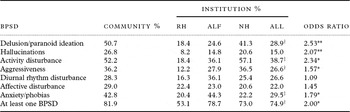
The prevalence of at least one BPSD among the memory clinic outpatients (81.9%) was significantly higher than that of the institution patients (74.9%; χ2 = 6.404, p = 0.011). The BPSD profile of each group was similar but not identical (Figure 1A). The most frequent symptom in both groups was activity disturbance (community 52.2%, institution 38.7%; χ2 = 15.428, p = 0.000). In the outpatients group, this was followed by delusion/paranoid ideation (50.7%), anxiety/phobias (42.8%) and aggressiveness (36.2%). In the institution group, it was followed by anxiety/phobias (29.5%), delusion/paranoid ideation (28.9%), and aggressiveness (26.6%). There was a significant group effect in these five leading BPSD symptoms (all p < 0.05; Table 2, Figure 1A).
A: Profile of behavior and psychological symptoms of Alzheimer's disease between institution residents (gray lines) and memory clinic outpatients (black lines). B: Profile of behavior and psychological symptoms of Alzheimer's disease between patients with early/ mild dementia (CDR 0.5, 1; gray lines), and patients with moderate/ severe dementia (CDR 2, 3; black lines).
Par = delusion/ paranoid ideation; Hal = hallucination; Act = activity disturbance; Agg = aggressiveness; Diu = diurnal rhythm disturbance; Af = affective disturbance; Anx = anxiety/ phobias
*Pearson's χ2, p < 0.05; **p < 0.01.

Prevalence and odds ratio of BPSD among AD patients in the community and in different types of institution

*Pearson χ2, p < 0.05; **p < 0.01 between community and institution; †p < 0.05; ‡p < 0.05 between different types of institution.
BPSD = behavioral and psychological symptoms of dementia; odds ratio (95% confidence interval) of community over institution; RH = residential houses; AF = assisted living facilities; NH = nursing homes
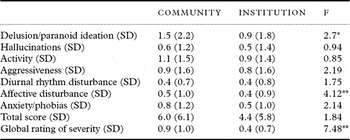
The scores of delusion/paranoid ideation (F = 2.70, p = 0.031) and affective disturbance (F = 4.12, p = 0.003) on the BEHAVE-AD subscales, and global rating of severity (F = 7.48, p = 0.000) representing caregiver burden were significantly different between the outpatients and the institution residents. All showed greater severity in the outpatient group (Table 3).
Mean BEHAVE-AD scores of community and institution AD patients

BEHAVE-AD = Behavioral Pathology in Alzheimer's Disease Rating Scale; AD = Alzheimer's disease
*p < 0.05, **p < 0.01, ANOVA controlling for age, gender, and education years
We further explored the effect of institution type on the prevalence and characteristics of BPSD. The prevalence of BPSD among AD patients living in different types of institutions was significantly different on at least one BPSD (χ2 = 9.02, p = 0.011), delusion/paranoid ideation (χ2 = 7.89, p = 0.019), activity disturbance (χ2 = 17.75, p = 0.000), aggressiveness (χ2 = 8.39, p = 0.015), and anxiety/phobias (χ2 = 9.95, p = 0.007; Table 2). NH led in delusion/paranoid ideation (NH 41.3%, ALF 24.6%, and RH 18.4%), activity disturbance (NH 57.1%, ALF 36.1%, and RH 18.4%) and aggressiveness (NH 36.5%, ALF 27.9%, and RH 12.2%). ALF led in anxiety/phobias (ALF 44.3%, NH 22.2%, and RH 20.4%). ALF also had the highest prevalence of at-least-one BPSD (ALF 78.7%, NH 73.0%, and RH 53.1%). In terms of severity, the only significant institutional type effect was on activity disturbance (F = 4.24, p = 0.001). Post hoc analysis revealed that NH patients had more activity disturbance than patients living in RH (p = 0.000) and in ALF (both p = 0.007). Aggressiveness (p = 0.019) and total scores (p = 0.022) were higher in NH than in RH.
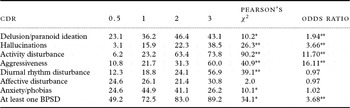
The prevalence of BPSD paralleled the severity of dementia in terms of CDR (Table 4). In order to obtain a comparison of the profile of BPSD in memory clinics versus institutions, we merged the CDR 0.5 and CDR 1 groups to form an early and mild AD group, and we merged the CDR 2 and 3 groups to form a moderate and severe AD group. We could readily see the growing prevalence of activity disturbance (14.9% to 67.2%) and aggressiveness (16.4% to 41.8%) when the dementia progressed from early and mild to moderate and severe (Figure 1B).
Prevalence and odds ratio of BPSD (%) in AD patients at different stages

BPSD = behavioral and psychological symptoms of dementia; AD = Alzheimer's disease; CDR = clinical dementia rating; Odds ratio (95% confidence interval) of moderate and severe AD (CDR 2, 3) versus early and mild AD (CDR 0.5, 1)
*p < 0.05; ** p < 0.01
We computed the odds ratios (95% CI) of memory clinic patients over institution residents and found that the memory clinic outpatients had increased risks of having at least one BPSD (OR 2.0, p = 0.008), delusion/paranoid ideations (OR 2.53, p = 0.000), hallucinations (OR 2.07, p = 0.01), activity disturbance (OR 2.43, p = 0.018), aggressiveness (OR 1.57, p = 0.067), and anxiety/phobias (OR 1.79, p = 0.015) than their institution counterparts (Table 2). In the same vein, the moderate and severe group had increased risks of having at least one BPSD (OR 3.68, p = 0.000), delusion/paranoid ideation (OR 1.94, p = 0.004), hallucinations (OR 3.66, p = 0.000), activity disturbance (OR 11.7, p = 0.000), and aggressiveness (OR 16.11, p = 0.000) than those with early and mild dementia. Female gender increased the risk for affective disorder (OR 4.27, p = 0.000) and anxiety/phobias (OR 1.88, p = 0.011).
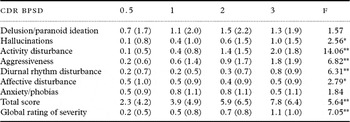
We examined the relation between CDR stage and BPSD dimension (Table 5) by performing correlation analyses controlling for age, gender and education. We found that the total scores (Pearson ρ = 0.32, p = 0.000), global ratings of severity (ρ = 0.33, p = 0.000), and subscales for hallucinations (ρ = 0.21, p = 0.000), activity disturbance (ρ = 0.46, p = 0.000), aggressiveness (ρ = 0.32, p = 0.000), and diurnal rhythm disturbance (ρ = 0.27, p = 0.000) were all significantly correlated with the CDR stages. We also examined the correlation between age, education years and BPSD on all subjects by controlling dementia severity (CDR scores) and found that only age was positively associated with increased diurnal rhythm disturbance (ρ = 0.13, p = 0.024).
Mean scores of BEHAVE-AD in AD patients at different stages

BPSD = behavioral and psychological symptoms of dementia; AD = Alzheimer's disease; BEHAVE-AD = Behavioral Pathology in Alzheimer's Disease Rating Scale
*p < 0.05, **p < 0.01, ANOVA controlling for age, gender and education (standard deviation)
Discussion
The presence of BPSD is considered a common reason for placement in long-term care facilities. However, in contrast to what we proposed at the beginning of the study, we found that memory clinic AD patients appeared to exhibit more symptoms of BPSD than their institutionalized counterparts. How do we explain this unexpected finding?
We propose two possible explanations: the “caregiver factor” and the “institution effect”. The “caregiver factor” could stem from the caregivers’ emotional state, leading them to influence their reports of BPSD (Sink et al., Reference Sink2006). The global rating of severity scale of BEHAVE-AD without an objective frequency assessment reflects caregiver distress. Our family caregivers reported a significantly higher global rating of severity but not the total scores of BEHAVE-AD, which implies that our family caregivers suffered more care giving distress from BPSD than did the professional caregivers. They were especially sensitive and vulnerable to delusion/paranoid ideation and affective disturbance compatible with a previous report (Tan et al., Reference Tan, Wong and Allen2005). There is a strong correlation between the severity of behavioral disturbances and caregiver distress, and vice versa (Sink et al., Reference Sink2006; Matsumoto et al., Reference Matsumoto2007; Neil and Bowie, Reference Neil and Bowie2008). Furthermore, the amount of time that the family caregivers observed the BPSD might also be crucial. In a study of Taiwanese caregivers of family members with dementia, more than 70% of the caregivers spent more than 40 hours per week in caregiving (Huang et al., Reference Huang2009); while the professional caregivers were shift-workers. The family caregivers usually spent much more time with the dementia patients than their institutional counterparts did.
Though not identical, the BPSD profiles of the two groups were similar (Figure 1A), and the distribution of dementia severity of the two groups in terms of CDR was also similar. Both findings imply that the two populations might have the same patient composition in terms of AD pathology. Therefore, there is a possible “institution effect” that makes the difference. The institution could have some positive effect on the BPSD of AD patients. In some special care units for dementia, the design of both the physical and social environment, as well as staff treatment, may have a positive effect on BPSD (Zeisel et al., Reference Zeisel2003). In addition, supportive routine and leisure activities may promote the well-being of elderly patients with dementia (Wood et al., Reference Wood2005) and the positive peer relationships may contribute to their quality of life (Bergland and Kirkevold, Reference Bergland and Kirkevold2006). These are the positive sides of institutionalized care. However, this may not be the reality for our AD patients living in long-term care facilities since there are very few AD special care facilities in Taiwan.
On the other hand, treatment of BPSD has often been through the use of medication. High levels of antipsychotic prescription for patients with dementia in care facilities is a long-recognized problem (Margallo-Lana et al., Reference Margallo-Lana2001). While less than one-third of the community-dwelling dementia patients received psychotropic drugs (Chiu et al., Reference Chiu2006; Chan et al., Reference Chan2007), roughly half of the patients living in a care environment received psychotropics (Margallo-Lana et al., Reference Margallo-Lana2001; Lakey et al., Reference Lakey2006). The percentage of patients using sedative drugs in nursing homes was also remarkably high (Sonntag et al., Reference Sonntag2006). Therefore, patients who live in institutions might be prescribed more sedative or psychotropic drugs than their community counterparts. Thus, less BPSD in patients living in institutions might be the result of high levels of psychotropic drug usage. Furthermore, all treatments with sedatives and psychotropics have some adverse effects for patients with dementia, such as sleepiness, dizziness and unsteadiness. These would produce some potential risks, such as choking with aspiration pneumonia, or falling with fracture or head injury. In some cases, the family caregivers hesitate to use psychotropics or sedatives on their beloved family members, choosing instead to put up with more BPSD.
Our study revealed that behavioral problems, including delusion/paranoid ideation, hallucination, activity disturbances, aggressiveness, diurnal rhythm disturbance and behavioral problem severity were significantly associated with the severity of dementia, which is in agreement with many previous studies in both community and institutionalized populations (Tan et al., Reference Tan, Wong and Allen2005).
Our study had some limitations. The first is that we did not have complete medication information for the dementia patients living in the long-term care facilities. The assumption that the institution group received more antipsychotic treatment than their community counterpart in this study was based on our previous work (Chiu et al., Reference Chiu2006) and findings in the literature (Margallo-Lana et al., Reference Margallo-Lana2001; Lakey et al., Reference Lakey2006; Sonntag et al., Reference Sonntag2006; Chan et al., Reference Chan2007). Furthermore, one needs a longitudinal study to confirm the institution effect in reducing BPSD by comparing BPSD of the residents on admission to unit care and BPSD at a later time. The other problem is that we had a diagnosis of probable AD for the community group and possible AD for the institution group, which were at different diagnostic levels of the NINCDS-ADRDA criteria. However, this is a minor point; we took comprehensive histories and performed complete neurological examinations on the participants, and we excluded those subjects with a high risk of vascular dementia. A recent study has confirmed the validity of NINCDS-ADRDA clinical diagnostic criteria with both probable and possible AD (Ranginwala et al., Reference Ranginwala2008).
Conclusion
Institution effect and the family caregiver factor were two possible explanations for the higher prevalence and severity of BPSD in the community patients. Institutions provide a stable care environment that helps reduce BPSD. Family caregivers may report more BPSD on account of their higher caregiving distress and closer observation of the patients’ behavior. High levels of antipsychotic prescriptions for dementia in the long-term care facilities and reluctance of the family caregiver to use psychotropics may also play a role.
Conflict of interest
None.
Description of authors’ roles
T. W. Cheng collected the data, carried out statistical analysis, and wrote the paper. T. F. Chen designed and carried out the study. P. K. Yip designed the study research and supervised the data collection. M. S. Hua trained the raters for BEHAVE-AD and supervised the data analysis. C. C. Yang assisted the statistical design of the study. M. J. Chiu designed and carried out the study; designed the statistical analysis and wrote the paper.
Acknowledgment
The study was sponsored by a grant from the Department of Health, Taiwan in 2004.