Mars Orange Paste Ware is a highly recognizable ware of the Middle Preclassic-period Mamom Sphere (600–300 BC). It is known for its fine “Mars” orange paste, thin-walled forms, red-orange slip, and frequent incised decoration. The ware is most common in Middle Preclassic-period assemblages in Central Belize, but also found in the Central Peten, and Pasión River regions. Although it has the characteristics of an early trade ware, Mars Orange Paste Ware has not been the focus of intensive study since the mid-twentieth century. In this study, we use new data from Holtun, Guatemala, and a synthesis of previous studies to argue that this ware was produced in the northeastern Maya Lowlands and distributed from Central Belize to the west.
“Orange Tuff Ware” and “Mars Orange Ware”
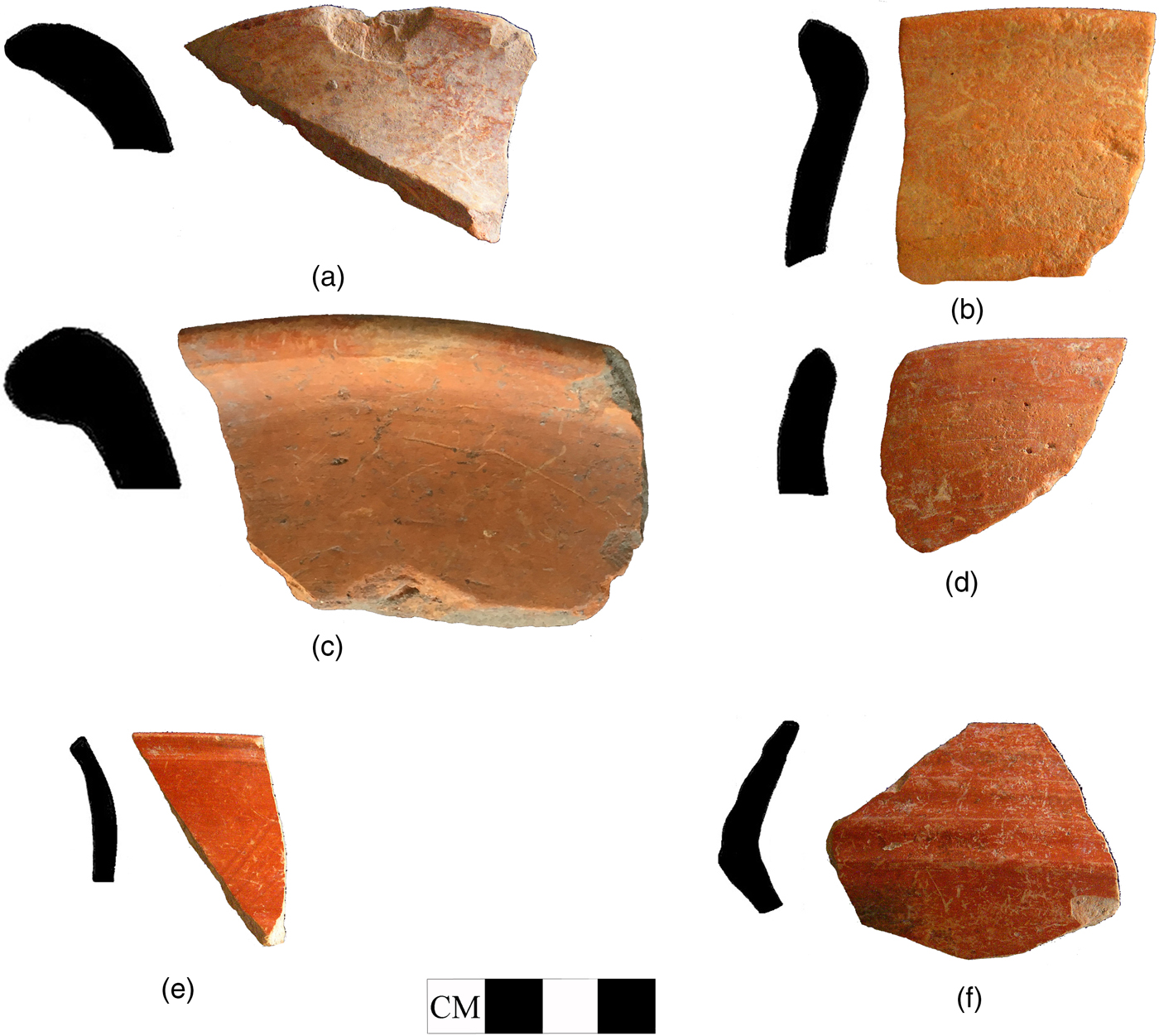
The study of Mars Orange Paste Ware began at Uaxactun, Guatemala, where Ricketson and Ricketson (Reference Ricketson and Ricketson1937:230–232) first defined “Orange Tuff Ware” based on its orange-colored paste with volcanic inclusions. Forms included small serving bowls, dishes, jars (occasionally with spouts and handles), and plates. Surfaces were smoothed, slipped red, and polished. Decoration was common and occurred as preslip fine-line incision or grooved-incision (Smith Reference Smith1955: Figures 14c17, 14d1–8; Figure 1). Smith renamed the ware “Mars Orange Ware” in 1955 (Smith Reference Smith1955:31–33, 115), and asked Shepard to perform a petrographic analysis on six sherds from Uaxactun. Shepard found that all sherds contained volcanic ash in varying quantities but differed in texture and minor inclusions. Inclusions were rare, medium-sized grains of quartz, fragments of tourmaline and zircon, ferruginous lumps, and cryptocrystalline calcite (Shepard Reference Shepard and Smith1955 in Smith Reference Smith1955:32). She compared the thin sections of Mars Orange Paste Ware to thin sections of ceramics with volcanic ash from the Classic periods and determined that the clay fabric, size, and type of inclusions were significantly different between Mars and the Classic wares. Although Smith and Shepard were successful in defining the physical and technological characteristics of the ware, little was known about its production and distribution. Subsequent studies would indirectly address some of these questions, but any attempt to answer them would require an interregional synthesis.
Mars Orange Paste Ware sherds from Holtun, Guatemala: (a) Savana Orange: Rejolla Variety (jar), (b) Savana Orange: Savana Variety (bowl), (c) Savana Orange: Rejolla Variety (bowl), (d) Savana Orange: Rejolla Variety (bowl), (e) Reforma Incised: Mucnal Variety (bowl), (f) Reforma Incised: Mucnal Variety (bowl). Photos by Michael G. Callaghan. (Color online)

Synthesis of Mars Orange Paste Ware in The Maya Lowlands
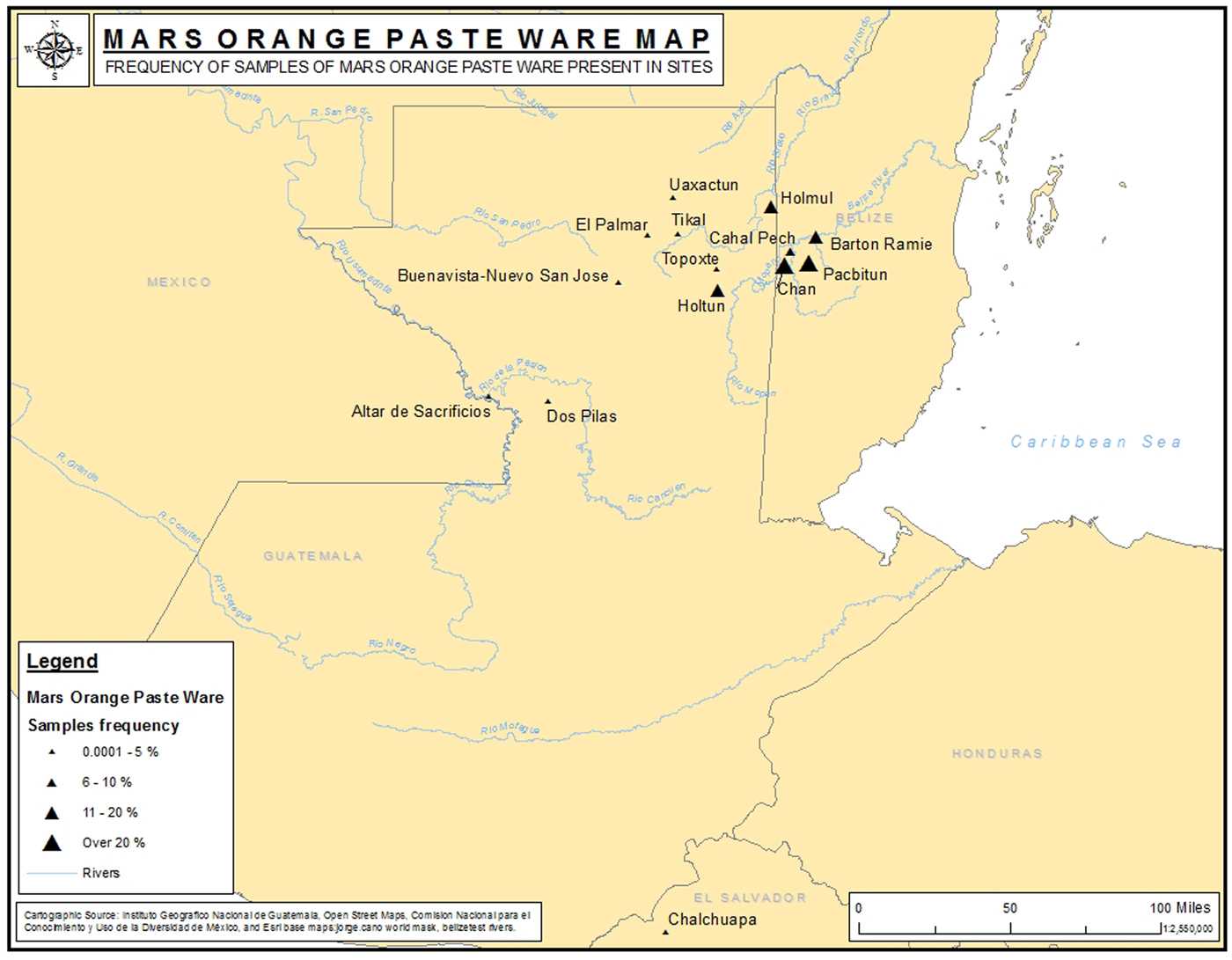
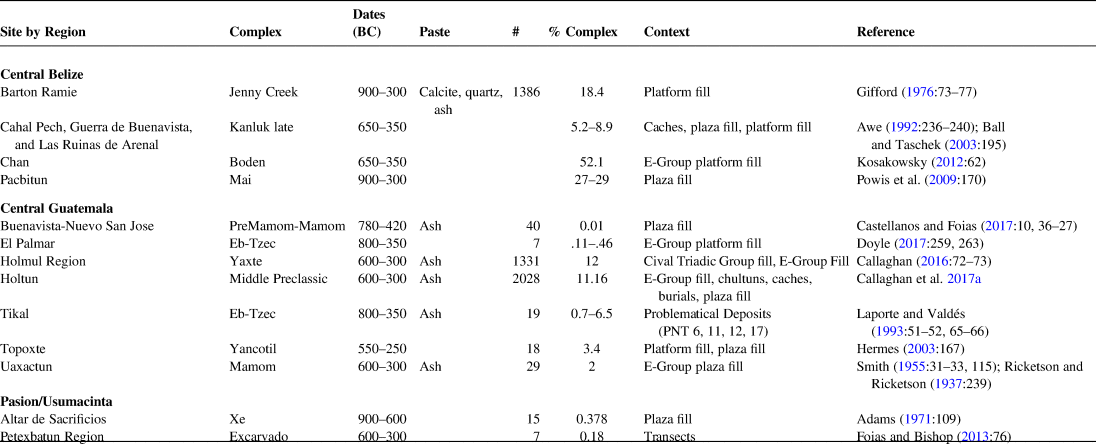
Table 1 presents a new synthesis of previous research on Mars Orange Paste Ware. The data are organized geographically according to subregions within the Maya Lowlands. The subregions that contain reported frequencies include Central Belize, Central Guatemala, and the Pasión/Usumacinta. Table 1 is not exhaustive and only lists sites for which frequencies or complex percentages of Mars Orange Paste Ware are reported. In this report, complex totals from Holtun refer to all classifiable slipped and unslipped Middle Preclassic samples. Studies from other sites use different methods for creating frequencies. Although data from the sites listed in Table 1 were gathered using different methods, we believe the data are reliable enough to make comparisons and reveal a number of patterns. First, Mars Orange Paste Ware production began at the end of the pre-Mamom Horizon (800–600 BC) and continued through the end of the Mamom Sphere (600–300 BC). Second, the ware is most frequent in the Central Belize subregion and decreases in frequency at sites outside this region (Figure 2). Third, there are ash paste variants and more than one reported calcite paste variant. The ash paste tradition likely has its origins in the Central Belize subregion and was circulated more widely. The calcite variants were likely local.
Map showing sites with reported Middle Preclassic Complex percentages of Mars Orange Paste Ware (map by Rodrigo Guzman). (Color online)
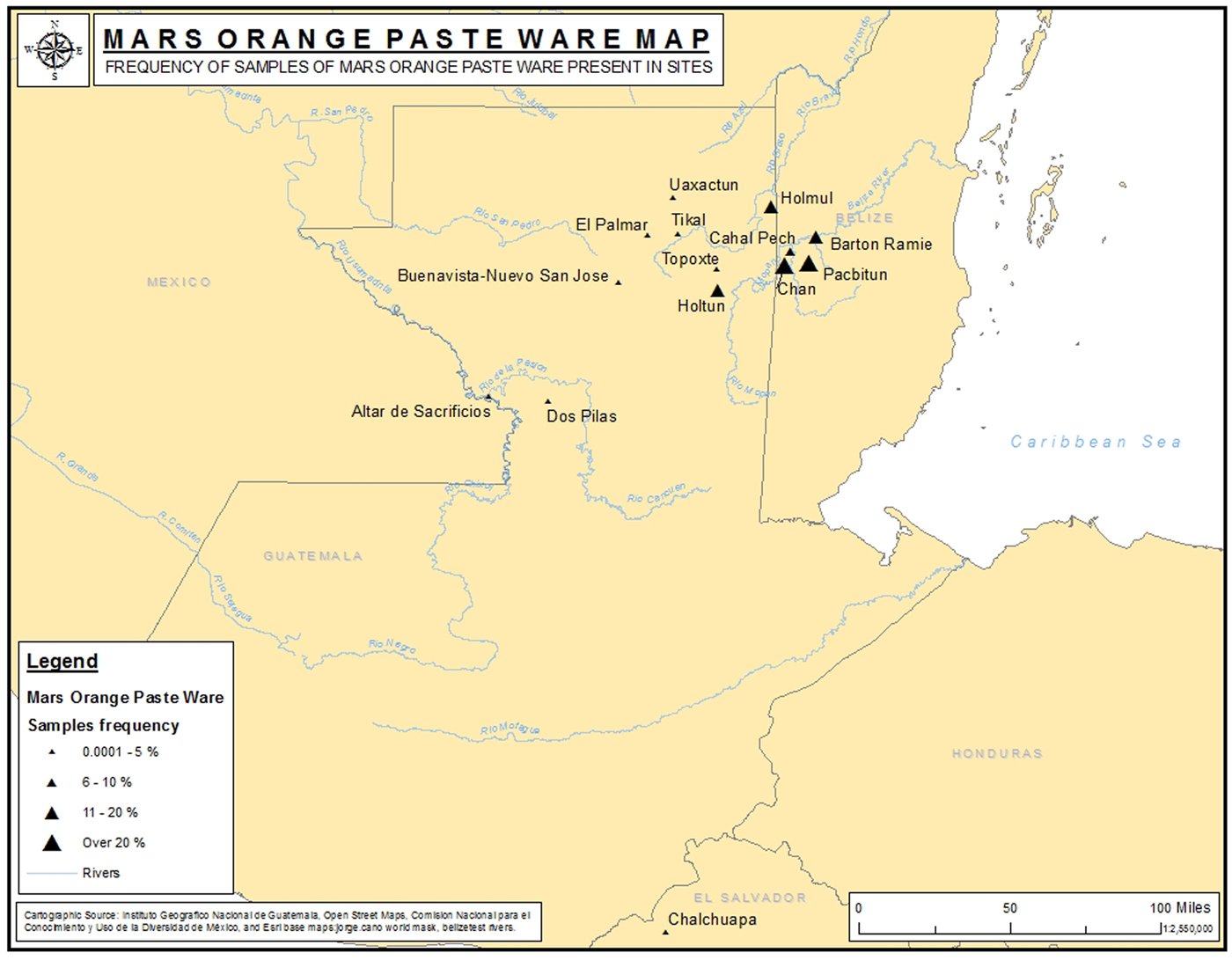
Table Showing Mars Orange Paste Ware Data from Lowland Maya Sites with Published Frequencies or Complex Percentages.

Taking into account these preliminary data, we can formulate assumptions to test against Mars Orange Paste Ware found at Holtun in the Central Guatemala subregion near Belize. The ware should be found in frequencies between 5% and 10%, because Holtun is located between Topoxte (3.4%) and Cahal Pech (8.9%). Furthermore, Mars Orange Paste Ware at Holtun should be found in type: varieties with a diversity of decorative modes comparable to sites in Central Belize and the Peten. We expect pastes to contain volcanic ash, because the site is close enough to participate in short-distance trade or acquisition of pottery directly from Central Belize. Finally, compositional studies should indicate similarity to Central Belize ceramics and/or dissimilarity to Central Guatemala ceramics.
Mars Orange Paste Ware from Holtun, Guatemala
Holtun, Guatemala has been the focus of archaeological investigations since 2010 (Kovacevich et al. Reference Kovacevich, Callaghan, Castillo, Guzman, Arroyo, Arragon and Mejia2012). Holtun is an intermediate-sized center with documented occupation from the Middle Preclassic through Terminal Classic periods (800 BC–AD 900). The site is situated 35 km southwest of Tikal and 12.3 km south of Yaxha and consists of a monumental epicenter built atop a karstic hill containing 12 groups and 86 structures, all showing evidence of stone construction. Monumental architecture includes a Middle Preclassic E-Group, Late Preclassic Triadic Group, ballcourt, masonry causeway, and patio groups. Residential groups are located to the northwest and southeast, with the densest occupation in the northwest. Excavations at Holtun have yielded a significant sample of well-stratified ceramic material dating to the Middle Preclassic period, including Mars Orange Paste Ware.
Mars Orange Paste Ware at Holtun is similar to Smith's description at Uaxactun (Smith Reference Smith1955:31–33). The distinguishing characteristic of the ware is its bright orange-colored paste (5YR5/8, 6/8), which contains volcanic ash or a few discernible inclusions. Surfaces are smoothed and can be unslipped or slipped red (10R4/8). Nevertheless, at Holtun, finishing includes a variety of decorative modes including incision, grooved-incision, chamfering, punctation, red slip, black slip, cream slip, and zoned slipping. These modes can appear alone or in combination, resulting in both defined and previously undefined type: varieties. Defined type: varieties in the Savana Group include Savana Orange: Savana Variety, Savana Orange: Rejolla Variety, Reforma Incised: Reforma Variety, and Reforma Incised: Mucnal Variety.
Mars Orange Paste Ware at Holtun can be dated by its association with carbon in sealed stratified layers of Middle Preclassic-period fill in Group F, Plaza A. Carbon dates returned a range between 2504 ± 31 BP (AA105226) and 2469 ± 32 BP (AA105225), or cal BC 788–489 (2σ range IntCal13; Callaghan et al. Reference Callaghan, Pierce, Kovacevich and Glascock2017a). There are two identifiable paste variants of Mars Orange Paste Ware at Holtun. Both are defined by size and frequency of volcanic ash inclusions. The first variant is orange (5YR5/8,6/8), fine, with small, infrequent ash inclusions. The second variant is the same color, also fine, but with a noticeable increase in frequency and size of ash inclusions. Ongoing petrographic study confirms the presence of ash and defines the coarser paste variant as volcanic particles with a mode diameter of approximately 0.6 mm with rare fused particles and rhyolitic tuff tempering a micaceous matrix (Figure 3a–b). The finer variant shows fewer and smaller ash grains (< 0.5 mm), which appear to be a natural inclusion in an otherwise finer micaceous matrix (Figure 3c–d).
Photomicrographs of Mars Orange Paste Ware: (a) coarse variant (plane polarized light); (b) coarse variant (cross-polarized light); (c) fine variant (plane polarized light); (d) fine variant (cross-polarized light). Photos by William D. Gilstrap. (Color online)

Mars Orange Paste Ware is further differentiated from other Middle Preclassic wares by its chemical composition. A sample of 98 Middle Preclassic-period sherds including 25 Mars Orange Paste Ware sherds was submitted to the University of Missouri Research Reactor (MURR) for neutron activation analysis (NAA; Callaghan et al. Reference Callaghan, Pierce, Kovacevich and Glascock2017b). Results showed Mars Orange Paste Ware formed its own chemical composition group characterized by high levels of potassium, scandium, rubidium, cesium, and iron, while being notably low in calcium. Analysis showed the Mars Orange Paste Ware group is dissimilar to other archaeological ceramics in the MURR database from Guatemala, indicating a production origin external to Middle Preclassic-period Holtun. Although chemical data place the samples in the same compositional group, the petrographic data indicate that pastes vary enough to suggest that Mars Orange Paste Ware do not all share the same paste recipe and likely came from multiple production units within a subregion. Taken together with frequency data, the chemical signature and presence of volcanic inclusions further support production and exchange from Central Belize, possibly using volcanic clays or temper from the Maya Mountains area (see Ford et al. Reference Ford, Spera, Christensen, Ownby, Druc and Masucci2017 for alternate sources of ash).
Mars Orange Paste Ware comprises 11.16% of all Middle Preclassic Complex ceramics classified at Holtun to date. Group F-B (the E-Group plaza) contains the most Mars Orange Paste Ware, the most type: varieties, decorative modes, and forms. The ware is also found in sealed chultuns with midden debris including large quantities of Pomacea flagellata shells in Groups A and C, as well as a sealed chultun in residential Group 8.
DISCUSSION
The ash-paste tradition of Mars Orange Paste Ware was likely produced in the Central Belize subregion where it comprises between 18% and 52% of Middle Preclassic ceramic complexes. The frequency and distribution data show that Mars Orange Paste Ware experiences a falloff from the Central Belize subregion (Figure 2). This pattern suggests down-the-line trade. These data show that Mars Orange Paste Ware is a short-distance trade ware that decreases in frequency with increased distance from Central Belize. Mars Orange Paste Ware has been found in ritual contexts (e.g., E-Group, caches, chultuns), so it is tempting to suggest it was used mainly in public ritual events, but without unequivocal household excavation contexts, this assertion remains speculative, but testable.
Beyond distributions, Mars Orange Paste Ware at Holtun offers opportunities to investigate new avenues of craft organization and communities of practice. For example, new petrographic evidence demonstrates that although decorative modes are similar, raw materials and manufacture processes differ. This observation indicates that production units may have shared some technological practices, although not all. We present this research as a starting point for studies of Mars Orange Paste Ware and look forward to future studies emphasizing compositional studies, forms, decorative modes, and contexts of consumption.
Acknowledgments
This research was funded by a National Science Foundation senior grant (BCS-1430954) and National Science Foundation grant to the Archaeometry Laboratory at MURR (BCS-1415403). Thanks to Karla J. Cardona Caravantes, Co-Director of the Holtun Archaeological Project, and the Instituto de Antropología e Historía (IDAEH) for facilitating export of the samples. Thanks to three anonymous reviewers for their helpful and substantive critiques.
Data Availability Statement
All primary data were generated by the coauthors and authors of figures where indicated. Data are maintained by the Holtun Archaeological Project, University of Central Florida.