1. Introduction
Understanding why many workers exert great effort at work is a challenging endeavour for mainstream economists, who assume that workers are adverse to effort. Confronted with what they call ‘anomalous’ experimental findings – the workers’ exerting greater effort than required in response to employers’ higher than competitive wage offers; the workers and employers’ honouring of unenforceable promises; the costly punishment of employers’ unfair behaviour (Charness and Kuhn, Reference Charness and Kuhn2011) – mainstream economists have come to admit that moral considerations, namely fairness, are crucial for an understanding of behaviour at work (Akerlof, Reference Akerlof1982; Fehr and Gintis, Reference Fehr and Gintis2007; Rebitzer and Lowell, Reference Rebitzer, Lowell, Ashenfelter and Card2011). (The use of the term ‘moral’, though, is largely avoided.) In fact, all strands of economic literature now recognize that when workers are treated fairly, they perform consummately, i.e. exert more effort than strictly required (Edwards, Reference Edwards2012; Hart, Reference Hart2008).
Most of the ‘anomalous’ behaviour at work has been accounted for in economics and other social sciences by acknowledging that agents possess a sense of justice. Thus, mainstream economists introduce preferences for fairness, in the form of ‘non-standard’ parameters, into enlarged, more realistic utility functions (Rebitzer and Taylor, 2011). Organizational scholars focus on the norms of justice to explain work behaviour and understand why given outcomes or processes are considered (un)fair (Crawshaw et al., Reference Crawshaw, Cropanzano, Bell and Nadisic2013). Institutional economists have taken a more comprehensive approach to the moral issues involved in work; they always have been concerned not only with the fairness of managerial practices but also with the legitimacy of the power asymmetry underlying the Employment Relationship (ER). However, institutionalists have focused on the morality and legitimacy of the ER itself and of the objective conditions of work, rather than on whether the subjective experience of work involves moral dimensions.
Our argument is that fairness alone cannot explain a series of behavioural phenomena prevalent in work contexts, more specifically, (1) why most workers voluntarily perform consummately, not perfunctorily; (2) why workers commit to work and work organizations; and (3) why workers generally accept authority. Some mainstream models do address these questions but we will show that the account provided is incomplete. We argue that there are facets of human morality, other than fairness, that motivate behaviour at work and these must be considered if we are to glean a full understanding of this behaviour. We claim that a comprehensive account of the moral dimensions of the ER is lacking in the mainstream and the institutional economics literature. The present paper intends to fill this gap.
It must be emphasized that our argument is descriptive and analytical, not prescriptive; i.e. we aim to provide a descriptive understanding of the moral drives of behaviour at work, not to deliver normative justification or condemnation of any particular moral judgement or concern. However, if our argument is to cover the whole range of issues raised by the moral dimensions of salaried work, a line must be crossed and normative considerations addressed. Moreover, in light of the decline in standard employment contracts and the debate on the relevance of traditional forms of labour legislation, our argument is meant to apply to both standard and non-standard forms of employment.
We believe there are two main reasons for the absence of a full appreciation of the moral dimensions of the ER in the literature. First, the conception most scholars have of the moral domain is partial rather than comprehensive; second, most studies address the specific components of the ER separately rather than looking at them as a whole.
We therefore begin by presenting the moral conception that inspires our analysis, namely Haidt and Joseph (Reference Haidt, Joseph, Carruthers, Laurence and Stich2008)’s Moral Foundations Theory (MFT). Section 3 maps the main specificities of the ER, namely, (1) the nature of the object of exchange – work – is not a commodity but a meaningful human activity; (2) the labour contract is irreducibly incomplete – its compliance relies on informal obligations; and (3) the ER is an authority relationship. In section 4, we examine the ER's specific components in the light of MFT to build an integrative framework of the moral dimensions of the ER. Section 5 outlines the far-reaching implications of the moral dimensions of the ER for institutional regulation, in both labour and corporate law.
2. The various facets of the moral domain
Moral Foundations Theory
The main claim of Moral Foundations Theory (MFT) is that the moral domain has been narrowed inappropriately to issues of harm/care and fairness/justice. Haidt and co-authors proposed a theory (MFT) intended to bridge and integrate two disciplinary contributions: the anthropological work of Shweder et al. (Reference Shweder, Much, Mahapatra, Park, Brandt and Rozin1997) and Fiske (Reference Fiske1992), namely their survey of the relational models and moral concerns across the globe, and the developments in evolutionary psychology of the 1990s. MFT identifies fiveFootnote 1 sets of moral foundations defined as ‘the psychological primitives that are the building blocks from which cultures create moralities’ (Haidt and Joseph, Reference Haidt, Joseph, Carruthers, Laurence and Stich2008: 381). All five foundations systematically appear in cross-cultural surveys and have deep evolutionary roots; they are the result of the longstanding adaptive challenges faced by our ancestors for millions of years.
In the 1980s, there was some consensus that justice and care were the two foundations of the moral domain, defined as consisting of ‘prescriptive judgments of justice, rights and welfare pertaining to how people ought to relate to each other’ (Turiel, cited in Graham et al., Reference Graham, Iyer, Nosek, Haidt, Koleva and Ditto2011: 366–7). The autonomy and the welfare of the individual would be the starting points of ethical enquiry and the moral domain would be limited to concerns about individuals harming or unfairly treating other individuals. Shweder et al. (Reference Shweder, Much, Mahapatra, Park, Brandt and Rozin1997: 138–9) named this the ‘ethics of autonomy’; it relies on concepts such as care, rights and justice; is individual-based; centred on agency and the obligations that derive from being a person. But cross-cultural studies show that while the ethics of autonomy seem to prevail in WEIRD (Western, Educated, Industrialized, Rich and Democratic) societies and social groups, in most traditional societies and popular social classes the moral domain is more extensive and includes group-level moral concerns such as authority, loyalty, respect and tradition. Shweder et al. (Reference Shweder, Much, Mahapatra, Park, Brandt and Rozin1997: 138–9) named this type of moral concern the ‘ethics of community’, as its aim is to preserve institutions and social order; it is an ethic that relies on concepts such as duty, hierarchy and interdependency; is group-based; and is centred on the obligations that derive from being a member of a community. While the ethics of autonomy have ‘individualizing foundations’, the ethics of community have ‘binding foundations’; they are about binding people together into larger groups and institutions.Footnote 2
The insight of MFT is to bring all these kinds of moral concerns together whilst acknowledging their irreducible distinctness. Moral foundations yield rules or principles with independent normativity that generates moral evaluations; and are powerful enough to trigger intrinsic motivation to pursue appropriate behaviour and to punish violators (Haidt and Joseph, Reference Haidt, Joseph, Carruthers, Laurence and Stich2008). MFT allows for intuitive and emotional bases for moral judgements as well as deliberate reasoning processes (Graham et al., Reference Graham, Iyer, Nosek, Haidt, Koleva and Ditto2011). The adult mind is endowed with moral intuition that connects the perception of a pattern in the social world to specific moral emotions and to a cognitive evaluation. The connections between moral intuitions, moral emotions and moral evaluations result from evolutionary processes (Haidt and Joseph, Reference Haidt, Joseph, Carruthers, Laurence and Stich2008).
It is worth emphasizing that MFT began with an observation of facts rather than with a stipulated definition of the moral domain, like it would in moral philosophy. The departure point was that many of the practices described by anthropologists fit with the two processes uncovered by evolutionary biology: kin selection and reciprocal altruism. In fact, the idea that human morality derives from innate mental systems shaped by evolutionary processes is now accepted by many evolutionary scholars (see references in Graham et al., Reference Graham, Haidt, Koleva, Motyl, Lyer, Wojcik and Ditto2013). To test their claims, Haidt and co-authors developed a set of psychological methods and measures ranging from self-report surveys to psychophysiological and neuroscientific methods (Graham et al., Reference Graham, Haidt, Koleva, Motyl, Lyer, Wojcik and Ditto2013; Reference Graham, Iyer, Nosek, Haidt, Koleva and Ditto2011). These methods allowed them to provide initial convergent and discriminant validity for their five moral foundations model.
The five moral foundations
MFT's first moral foundation is care, which stems from the ability to feel the pain and suffering of others, an ability that derives from the adaptive challenge of having to care for vulnerable offspring for an extended period of time. This foundation underlies the virtues of caring, kindness, concern and responsibility for others’ well-being. Compassion, related to the anthropological facts of human vulnerability and interdependence, is the major associated emotion. Individuals are motivated to protect the young and vulnerable kin and to act to relieve suffering.
The second foundation is fairness/reciprocity, which is related to the evolutionary process of reciprocal altruism stemming from opportunities to engage in and benefit from non-zero-sum interactions. This foundation generates ideas of justice, trustworthiness/honesty, rights and autonomy. The emotional reactions associated with fairness/reciprocity are gratitude, anger and guilt. It must be emphasized that it is these emotions, together with thoughtfully generated moral appraisals, that motivate people to act in ways to maintain or restore justice. That is, reciprocating or punishing unfair behaviour is triggered by the moral emotions implemented in the brain as much as by cost–benefit calculations.
The third foundation is in-group/loyalty; this is related to the human evolutionary history and well-studied tendency to aggregate into tribes/groups that compete with other tribes. While justice is mainly associated to dyadic interactions, this foundation involves in-group cooperation and the consequent competition with out-group members. Conflicts between groups call upon virtues such as loyalty and self-sacrifice for the group, virtues themselves triggered by emotions like group pride, belongingness and rage at traitors. The destructive potential of this moral foundation must not be overlooked.
The fourth moral foundation is authority, a foundation shaped by the human evolutionary history of hierarchical social interactions. ‘Authority ranking’ is one of the four forms of relational models that are found in all cultures (Fiske, Reference Fiske1992),Footnote 3 and the existence of a propensity toward authority in groups is now clearly documented in social psychology (Tyler and Lind, Reference Tyler and Lind1992). According to Rai and Fiske (Reference Rai and Fiske2011), the relational context influences moral judgements: an act judged as right, just or fair in a given relational context may be judged morally wrong in another type of context. Thus, authority-based relationships entail specific moral features, the understanding of which requires a distinction between power and authority – one that Fiske argues Westerners often fail to make.
Bowles (Reference Bowles2004:345) defines power as follows: ‘For B to have power over A, it is sufficient that, by imposing or threatening to impose sanctions on A, B is capable of affecting A's actions in ways that advance B's interests, while A lacks this capacity with respect to B’. Like power, authority is an interpersonal and asymmetrical relationship in which a person influences another person's behaviour. But, unlike power, the exercise of authority does not involve the threat/use of sanctions, nor is it ‘susceptible to arbitrary use to the detriment of others and in violation of ethical principles’ (Bowles, Reference Bowles2004:344). Rather, authority is based on consent on the part of subordinates, and obedience is conditional on the observance of certain ethical conditions (Tyler and Lind, Reference Tyler and Lind1992). Authority is a form of directive power, but a power without coercion.
In authority relationships, subordinates take the directives as pre-emptive reasons for acting (McMahon, Reference McMahon1994), i.e. the authority's directive to do X is not considered in conjunction with the other reasons to do X, but instead pre-empts these reasons. Individuals suspend their judgement; they do not act on their judgement but rather perform the actions they are directed to perform. The moral foundation of authority consists of the disposition to suspend one's own judgement and seeing this as the right thing to do.
Importantly, in the societies studied by anthropologists, hierarchical relationships are two-way: subordinates must show deference but superiors must protect them (Fiske, Reference Fiske1992). The exercise of authority in traditional societies requires that people endowed with authority take on moral responsibility for maintaining order and justice, i.e. responsibility is the counterpart of exercising authority. But in fact persons in authority often take the opportunity to exploit subordinates for their own benefit; indeed, evidence shows that those in authority are tempted to be exploitative (Tyler and Lind, Reference Tyler and Lind1992). Nonetheless, the tendency in WEIRD countries to see all inequalities of power as forms of oppression and exploitation has led to the normative and pro-social side of authority being overlooked. When perceived as legitimate, authority generates virtues of leadership and impartiality in superiors and of obedience and deference in subordinates. The associated emotions are respect in subordinates and care for subordinates in superiors. We call attention to the fact that in an authority relationship the behaviour of the two parties, not only that of subordinates, is subject to moral drives.
Finally, the fifth foundation, purity/sanctity, is the only one that results not from adaptive social challenges but from nutritive concerns. Humans developed cognitive and emotional adaptations related to disgust that helped them avoid illness and contagion. This food evaluation and rejection system evolved into ideas about sacredness and purity, related to virtues such as chastity and vices like obsession with impure objects or persons. As this foundation is only present in work that is experienced as a calling, one that is progressively disappearing (Muirhead, Reference Muirhead2004), our analysis below retains only the first four moral foundations.
Lastly, as underlined by Hodgson (Reference Hodgson2013), a distinction must be made between explanations for the origin of the human dispositions to form moral judgements and the persistence of such dispositions. According to MFT, morality is both innate and dependent on environmental influences in the sense that the human mind is ‘organized in advance of experience’, and so it is prepared to learn the moral norms that prevail in the culture in which the person happens to live (Graham et al., Reference Graham, Iyer, Nosek, Haidt, Koleva and Ditto2011).Footnote 4 The moral sense is hence universal but at the same time variable; the five moral foundations are a legacy of evolution but how they are ranked in importance and how they evolve are specific to a particular culture. Thus, some societies ground their moral order on the development of one, two or all five moral foundations; the prevalent morality in a community is not given in advance – it is built by the institutional setting.
3. Mapping the employment relationship
As insightfully expressed by Williamson (Reference Williamson1983/1975: ix), ‘the trick in every case is to understand what is being contracted for’. In the case of the employment relationship (ER), the performance of work, a human activity most workers want to be meaningful, is exchanged for a wage and tasks designed under efficiency constraints. In addition to this deep asymmetry in the content of what is exchanged, the ER is established between two deeply dissimilar entities – a person who will perform the work in person and as a person and an employer, an impersonal (collective and institutional) entity pursuing economic goals. Thus, the exchange of work involves at least two specific peculiarities when compared to other economic transactions; the first is related to the nature of the object being exchanged and the second to the ontologically different nature of the contractors.
The object of exchange – work – is not a commodity but a meaningful human activity
The assumption of work as a disutility – quite the opposite of seeing work as a significant activity – forms the bedrock of standard labour economics. Work is associated to disutility because it is supposed (Spencer, Reference Spencer2015): (1) to be painful; (2) to be the opportunity cost of leisure; (3) to entail the exertion of effort, for which humans have a natural aversion. Marx and other prominent thinkers consider work to be valuable in itself, because humans can achieve self-realization through work when it is performed in non-alienating contexts; on the other hand, standard economics initially assumed that humans work for the sole purpose of earning an income. However, the core finding of experimental evidence collected in recent decades is that there is no universal ‘shirking’ or ‘effort avoidance’ but rather that the effort made is highly dependent on the relationship between employer and employee (Charness and Kuhn, Reference Charness and Kuhn2011); this led economists to acknowledge that the disutility assumption fails to provide an inadequate explanation of behaviour at work. Thus, a stimulating range of models now incorporate preferences for cooperation (Rob and Zemsky, Reference Rob and Zemsky2002), fairness (Akerlof, Reference Akerlof1982) and identity (Akerlof and Kranton, Reference Akerlof and Kranton2005) as non-pecuniary sources of worker motivation. Nevertheless, there is insufficient research in the mainstream literature into the profoundly distinctive nature of work, and in particular the fact that meaning is an important part of work.
Muirhead (Reference Muirhead2004: 8) depicts the ideal of meaningful or fulfilling work as a noble and democratic longing ‘that reflects that part of the human spirit that affirms its dignity’. It is the kind of person one would like to be that is at stake in work. The fact that work means strikingly different things to different people must not be eluded, though. Some people focus on the material benefits of work and cultivate no other prospect, while others experience work as a calling and associate it with the belief and will to make the world a better place. Also, there has always been a tension between the tasks that societies need to have done (some of which are manifestly boring and unfulfilling) and what individuals expect from work (Muirhead, Reference Muirhead2004).Footnote 5 Moreover, work is never without its discipline; it requires determination to endure what is difficult for the sake of giving our best. There is actually some disutility in work; the dignity afforded by work is not a gift, it has to be deserved.
Most normative accounts relate meaningful work to autonomy, i.e. the ability to form a conception of good life and act on it (Bowie, Reference Bowie1998; Roessler, Reference Roessler2012; Schwartz, Reference Schwartz1982). Taking a prescriptive rather than normative perspective, Rosso et al. (Reference Rosso, Dekas and Wrzesniewski2010) surveyed the psychological and organizational literature to understand where and how employees actually find meaning in work. Based on the various sources of meaningful work pinpointed in the literature (namely, the self, others, the work context and spiritual life), as well as on the mechanisms that drive perceptions of the meaningfulness of work, the authors build an overarching theoretical model that identifies the two key dimensions that seem most fundamental to the creation or maintenance of meaningful work. One represents a continuum that ranges from a desire for agency to a desire for communion, which captures whether the source of meaning lies within the individual or in some kind of collective group, while the other represents a continuum from self-directed to other-directed action. It is at the intersection of these two dimensions that meaningful work is most likely to be experienced. Humans are driven to separate, assert and create (in pursuing agency), just as they are driven to contact, connect and unite (in pursuing communion). Likewise, ‘work experiences oriented toward the self can be experienced as meaningful as can experiences oriented toward others’ (Rosso et al., Reference Rosso, Dekas and Wrzesniewski2010: 114).
The application of the scale developed by Steger et al. (Reference Steger, Dik and Duffy2012) to measure the two dimensions supports the relevance of the model; the results highlight ‘the importance of reciprocal dynamics between individuals and groups; the individual works to benefit the self and the collective, and the fruits of this work enhance both self and collective’ (Steger et al., Reference Steger, Dik and Duffy2012: 324).
Thus, notwithstanding the fact that, for some people, work is simply a means to income, evidence shows that the meaningfulness of work rests to a large extent on the impact workers perceive their work has on others or on society; this impact is what makes workers believe they are valuable and worthy individuals. Muirhead (Reference Muirhead2004)’s view that part of the meaningfulness of work comes from its contribution to the greater (social, communal) good, hence seems to be confirmed, to the detriment of the perspectives that exclusively emphasize self-oriented motives. What is critical in the meaning of work is that it must simultaneously benefit the community and possess an intrinsic value that accrues to those who do it (Muirhead, Reference Muirhead2004).Footnote 6 That work is meaningful obviously helps explain why workers choose to perform consummately, providing greater effort than required.
The irreducible incompleteness of the employment relationship
It is critical to consider carefully not only the nature of the object being exchanged but also the circumstances of the exchange. The ER is based on a more or less formal employment contract. According to contract law, contracts may be defined as ‘agreements under which two parties make reciprocal commitments in terms of their behaviour – a bilateral coordination arrangement’ (Brousseau and Glachant, Reference Brousseau and Glachant2003: 3). (Note the moral flavour of ‘reciprocal commitments’)
It is consensual in economics that the ER is pervaded by two major sources of uncertainty or incompleteness. First, no employment contract can ever be complete, comprehensive, because no one can fully specify all contingent possibilities. Second, the promises in terms of behaviour that are implicit in the contract are largely unenforceable. The employees’ level of effort is observable ex post by the contracting parties but cannot be verified by outsiders, like the events in a court; it is said to be unverifiable and is consequently non-contractible and non-enforceable. Indeed, employees have to choose between performing perfunctorily, i.e. carrying out the tasks at the minimally acceptable level of effort, and performing consummately, i.e. using their abilities without deliberate restraint. Only perfunctory (basic) performance can be enforced; consummate (exemplary) performance is always discretionary since no court can enforce it; mainstream economists hence assume that most workers behave perfunctorily.Footnote 7
But empirical evidence questions the relevance of the suspicion about workers’ disposition to exert effort. The fact that workers respond to generous wage offers with higher than required effort levels (Charness and Kuhn, Reference Charness and Kuhn2011) proves that the effort provided is indeed largely discretionary. Large-scale surveys show that workers do often choose to perform consummately (Minkler, Reference Minkler2004). As what is being exchanged is manifestly not enforceable, one can only conclude that the parties are actually exchanging ‘partial gifts’ (Akerlof, Reference Akerlof1982). Why do they do so?
The incompleteness of the ER makes the exchange of work not a market exchange but a ‘social exchange’, i.e. one that involves a series of interactions that generate informal, unspecified, obligations (Cropanzano and Mitchell, Reference Cropanzano and Mitchell2005). Fehr and Gintis (Reference Fehr and Gintis2007) emphasize that this profoundly transforms labour markets. First, profit-maximizing firms now have an incentive to pay high (fair) wages (since this induces a high level of effort); wages are thus no longer determined solely by the laws of supply and demand. Second, as informal obligations cannot be enforced, the parties tend to establish long-term relationships so as to create trust between them. Third, the distribution of earnings is more equal under social exchange conditions since employees can vary effort depending on the proposed wages and employers are motivated to offer fairer wages.
Because of incompleteness, the ER is a social exchange that evolves over time into trusting and mutual commitments, as long as both parties respect the rules of reciprocal exchange. The sustainability of cooperation is nonetheless conditional on punishment options; specifically, it depends on the possibility and effectiveness of the punishment of self-regarding individuals by strong reciprocators. It must also be underlined that cooperation depends on the existence of strong reciprocators. This is how mainstream economics now conceives the ER: it is primarily a bilateral symmetrical exchange in which fairness norms rationally emerge and persist (provided certain institutional conditions, like punishment options, are met). But if the ER is indeed a bilateral exchange between employer and employee, it is not symmetrical (see below).
The relational and collective character of work
A work organization, and a firm in particular, is not just an (employing) entity; it is also an aggregate of individuals organized into groups and communities. Working actually involves entering into a large set of distinct relationships, not only with the employer but with various parties. In work organizations, employees are members of many groups since they have to work together to generate products or services; production is a collective activity. Empirical research suggests that interactions with other workers or groups influence the meaning of work; membership in and connection to work groups may provide individuals with meaningfulness by making them experience a sense of community, a shared common identity (Kluver et al., Reference Kluver, Frazier and Haidt2014; Rosso et al., Reference Rosso, Dekas and Wrzesniewski2010). In economics, Akerlof and Kranton (Reference Akerlof and Kranton2005) show that organizational identity and attachment to an organization lead workers to put in higher rather than lower levels of effort with little wage variation.
The employment relationship is an authority relationship
Contracts have been defined above as ‘bilateral coordination arrangements’. In the case of the employment contract, authority/subordination is the coordination arrangement that came to be considered appropriate, that is, an asymmetrical relationship. Simon (Reference Simon1951)’s much cited definition is consistent with the characterization of authority given above: ‘B [the boss] exercises authority over W [the worker] if W permits B to select x [the task to be performed]’ (Simon, Reference Simon1951: 294; our emphasis). Comparing this with Bowles’ definition of power is illuminating: employers have discretion regarding which task to select to the extent that workers permit them to do so – authority is power without coercion.Footnote 8 Simon seems to take such permission – and obedience – for granted provided the task belongs to the worker's ‘area of acceptance’. But, and this is a core trait of authority, compliance with an authority directives cannot be assumed; research shows that people do not automatically accept authorities’ decisions (Tyler and Lind, Reference Tyler and Lind1992). What justifies and what legitimates authority?
Authority in the ER raises issues seldom addressed in the literature. First, all accounts of authority conceive it as primarily a relation between natural persons (McMahon, Reference McMahon1994). In effect, the personal aspect of authority is a key element in the psychology of legitimacy and obedience (Tyler and Lind, Reference Tyler and Lind1992). Yet the employment contract is established between a worker and a firm, an entity not endowed with moral capacity. We shall see that this heterogeneity in the nature of the contractors does not hamper the justification of authority but does raise concerns regarding its legitimacy.
Second, following McMahon (Reference McMahon1994), one must distinguish between expert and ‘E-authority’, which is based on an informational or knowledge advantage of one party over another, and cooperative or ‘C-authority’, the function of which is to facilitate mutually beneficial cooperation among employees with divergent aims. Whereas E-authority may be analysed in terms of a principal–agent relationship, C-authority – authority hereafter -, which is the form of authority most prevalent in work organizations, is not bilateral but collective in character. ‘The very nature of authority is the transfer of power from many to one’ (Tyler and Lind, Reference Tyler and Lind1992:164).
As referred, the effectiveness of authority is conferred by those whose actions are directed. According to McMahon (Reference McMahon1994), what justifies authority, i.e. the reason subordinates comply with directives is that, from the moral standpoint of each member, complying is better than the state of affairs that would be obtained were directives disregarded. Like power, by facilitating cooperation, authority allows ‘for Pareto-improving outcomes’ (Bowles, Reference Bowles2004). Subordinates would suspend their judgement and temptation to free ride because they believe this advances their aims. However, we agree with Oosterhout (Reference Oosterhout2007) that McMahon's account of authority comes down to a relatively straightforward cost–benefit analysis and that his appeal to collective rationality does not satisfactorily explain workers’ reluctance to free ride. Hence, contrary to McMahon's explicit position and instead following MFT, we conceive of authority as unavoidably entailing a moral component. When accepting authority, subordinates are (unconsciously) accepting the existence of a good that is morally higher than strictly individual goods. The grounding of deference to authority ultimately entails a normative rather than an exclusively calculative facet.
That authority is a normative and collective device enabling people who disagree on what is appropriate to obey directives, renounce free riding and act in concert, is absent from mainstream models of authority. Aghion and Tirole (Reference Aghion and Tirole1997)‘s seminal paper deals with how to better allocate decision rights between a principal and an agent but does not address the subordination issue. Similarly, in Bolton and Dewatripont (Reference Bolton, Dewatripont, Gibbons and Roberts2013)’s survey of the contractual literature, most of the reviewed models examine instances of E-authority whose constitutive characteristic is to eliminate disagreement and reasons for non-compliance. However, the last pages of the survey do address ‘interpersonal authority’, in which compliance is problematic because agents suspect that principals may exploit them. The problem is framed in terms of employers’ opportunism rather than employees’ obedience, which is ultimately explained by the principal's threat to dissolve the relationship (e.g. Van den Steen, Reference Van den Steen2010), meaning that authority/subordination is analytically transformed into a power relationship.
4. An integrative framework of the moral dimensions of the employment relationship
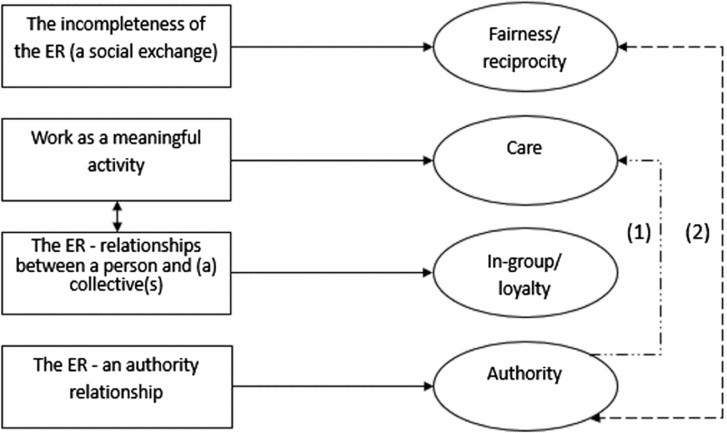
It is recalled that our aim is to explain (1) why workers often discretionarily provide a consummate rather than perfunctory performance, (2) why they commit to their job and/or work organization, and (3) why they accept authority. Our argument is that these behaviours are grounded on distinct moral foundations. Figure 1, which relates the abovementioned specific traits of the ER to four of the five moral foundations described in Section 2, seeks to provide this explanation. The model integrates the arguments previously developed into a unified framework.
The integrated model of the moral dimensions of the employment relationship

As referred, the incompleteness of the ER makes it a social rather than a purely contractual exchange. Fairness and reciprocity prevail because the ER relies on implicit obligations: high levels of effort are exchanged for fair wages and fair treatment. The fairness/reciprocity foundation involves prescriptions about the way people ought to relate to each other. This is the moral dimension of the ER most studied by economists (see the behavioural, organizational and relational contract literature) and other social scientists.Footnote 9 It is consensually acknowledged in our societies that workers want fairness/reciprocity to permeate the exchange of work and that their behaviour is powerfully influenced by judgements about fairness.
Experiencing work as meaningful is shown to depend heavily on the work's perceived social utility. This suggests that work contains a care moral dimension. Since the meaningfulness of work relies on both whether work contributes to one's well-being and whether it contributes to a greater (social, communal) good, the care dimension involves self-interest as well as concern with others’ well-being. On the one hand, the sense of pride one may get from work and the desire to do the job well are related to one's dignity and sense of self-worth. On the other, work activities oriented toward and useful to others are also shown to make work meaningful (Rosso et al., Reference Rosso, Dekas and Wrzesniewski2010).
The third specificity of the ER presented above is that work entails a diversified set of relationships, namely between the worker and the firm but also relationships between the worker and groups of co-workers. These relationships are all pervaded by the in-group/loyalty moral foundation since (1) the employment contract involves the worker's commitment to pursue the firm's interest and (2) the worker inevitably enters into implicit commitments with other persons and collectives of persons for production purposes. Both types of commitment call for loyalty either to the firm as a collective entity or to groups/communities of particular persons. The worker feels bound to the community (Kluver et al., Reference Kluver, Frazier and Haidt2014; Akerlof and Kranton, Reference Akerlof and Kranton2005) which, in normal and non-exploitative circumstances, translates into loyal behaviour.
As reported above, the communion end of one of the two dimensions of meaningful work is closely associated with the relational and collective character of work (hence the two-way arrow between these two specificities of the ER in Figure 1). This suggests that the moral foundations of care and loyalty are closely related in the experience of work; work is driven by the desire to benefit oneself and others (care, which pertains to the ethics of autonomy) and by the feeling and desire to be part of a community (loyalty, which pertains to the ethics of community). The tension between self (ego) and others, which is the hallmark of morality, is inherent in work if it is to be meaningful. Agency and communion, the ‘two fundamental modalities of human existence’ (Rosso et al., Reference Rosso, Dekas and Wrzesniewski2010), are always present and are often conflictual in work.
The authority specificity of the ER is not usually associated with a (positive) moral dimension; on the contrary, it is generally seen as its very negative attribute. However, given that authority is not to be confused with power or coercion, the ability and need to respect authority is a pervasive phenomenon of the work experience, just as it is of most social life. Most workers have a subordinate role in relation to some superior (or organizational rule) to whom they must defer and whom they must obey. In MFT, it is the authority moral foundation that grounds moral obligations towards institutions and that confers them legitimacy.
But, as highlighted above, the evolutionary and anthropological literature shows that the effectiveness of human authority is associated with the subordinates’ perception that those in authority assume the responsibility to protect them and maintain order and justice (asymmetrical reciprocity, noblesse oblige). And this is what Simon missed; he rightly saw that authority, the delegation of one's decision power to another person, entails a component of consent but he overlooked the fact that consent must be grounded. Unlike formal hierarchical power, in order for authority to exist as such, it needs to be perceived as legitimate. In the ER, since the authority relationship involves the worker as a person and a firm (an amoral entity), it cannot be assumed that the firm undertakes the responsibility that encompasses the moral counterpart of authority. This may explain why historically authority came to be institutionalized. That is, since authority in the ER is not (solely and primarily) exercised in terms of interpersonal authority, labour movements have developed throughout history and succeeded in forcing institutional arrangements such as labour laws that act to mitigate the abuse of employers and institutionalize the employers’ obligations of care/protection (dash arrow (a) in Figure 1).
Finally, our model, and our everyday work experience, shows that two largely conflicting moral foundations are activated in workplaces: fairness/equality as the core moral principle of democratic societies; and authority, which is constitutively unequal (dash arrow (b)). In fact, empirical evidence shows that the legitimacy of (C-)authority in firms might only be granted by appropriate combinations of fairness and authority, which alone can ensure the effectiveness of authority: ‘attitudes about the legitimacy of authorities appear to be a key antecedent of compliance’ (Tyler and Lind, Reference Tyler and Lind1992: 124). Specifically, it is judgements about procedural justice, i.e. about whether decision-making procedures are perceived to be fair, that prove to be the strongest and most consistent predictor of compliance with authority's directives. For example, the opportunity to voice one's view about the assigned goal results in more acceptance and better performance (Tyler and Lind, Reference Tyler and Lind1992). It is now largely documented by organizational studies that voluntary deference to organizational authorities is grounded in justice attributions (Crawshaw et al., Reference Crawshaw, Cropanzano, Bell and Nadisic2013; Folger, Reference Folger, Coyle-Shapiro, Shore, Taylor and Tetrick2004).
It is now time to give a concise response to our three opening questions.
-
(1) It is only by considering the interaction between all four moral dimensions involved in the ER that we can fully understand why workers willingly perform consummately rather than perfunctorily. True, the fairness/reciprocity moral foundation, linked to the incompleteness of the employment contract, plays a key role in driving workers to provide a high level of effort (as shown, for example, in Fehr and Gintis, Reference Fehr and Gintis2007; Hart, Reference Hart2008; Rebitzer and Lowell, Reference Rebitzer, Lowell, Ashenfelter and Card2011), but the care foundation, associated with the meaningfulness of work, cannot help but motivate commitment to work at least as powerfully as fairness requires. However, the perception that authority is illegitimate, or that the employer is disloyal, may damage the perceived meaningfulness of work, hinder positive reciprocal behaviour and trigger disengagement at work. Focusing on one rather than on the integrative result of all four moral drives at work limits our ability to reach a more comprehensive understanding of effort at work.
-
(2) Akerlof and Kranton (Reference Akerlof and Kranton2005) have insightfully argued that workers commit to their work organization on the basis of identity considerations. We provide here an alternative account grounded on loyalty, which stresses the collective nature of work and productive processes. Proposing loyalty – a moral foundation belonging to the ethics of community – challenges the overemphasis that the literature places on self-oriented mechanisms. Indeed, even motives that are quite distal from the self are frequently addressed in the psychology literature in ways related to the self (Rosso et al., Reference Rosso, Dekas and Wrzesniewski2010), a bias prevailing also in mainstream economics, which considers all motivation as stemming from individual preferences subsumed into one utilitarian box (Hodgson, Reference Hodgson2014).
-
(3) Finally, our explanation of why workers accept authority breaks with that provided by mainstream models, as already underlined. Although mainstream economists might well agree with part of our justification of authority, they never address the legitimacy issue raised by authority. Furthermore, obedience is ultimately explained by fear of punishment or withdrawal of pecuniary benefits, i.e. authority is not theoretically viewed as a phenomenon distinct from power.
Contrary to mainstream models, which usually end up devising appropriate pecuniary incentives to promote motivation at work, our integrative framework raises normative issues that call for institutional and policy considerations. Regarding the authority moral foundation in particular, it is appropriate institutional shaping of the relationship between employees and the authority, rather than outcome incentives, that best secure obedience and compliance.
5. Normative implications of the moral dimensions of the employment relationship
(Moral dimensions in) labour law
Under the law, the ER is considered an agency relationship in which the agent (employee) agrees to act on behalf of the principal (employer), and to pursue the latter's interest rather than his/her own. It is acknowledged that the laws of agency inescapably impose a specific duty of loyalty on agents (Duska, Reference Duska, Freeman and Bowie1992). Sen (Reference Sen2002) also understands the agency relationship as an instance of commitment: the agent sees him/herself as charged with furthering the principal's interest; he/she acts as if the principal's goal is also his/her own. By assuming at the outset that agents are likely to renege on their commitments, mainstream economists have adopted the notion of agency whilst dropping the element of loyalty endorsed in agency law.
Masten (Reference Masten1988) emphasizes that the employment contract is a specific instance of agency relationship in that it embodies a unique set of obligations and responsibilities: ‘upon entering an employment relationship, every employee accepts an implied duty to ‘yield obedience to all reasonable rules, orders, and instructions of the employer’ . . . In addition to obedience, an employer has the right to expect loyalty, respect, and faithfulness from his employees’ (Masten, Reference Masten1988: 185,187, our emphasis). But, and this is a crucial point, the counterpart of the right to allocate, direct and control work attributed to the employer is that he/she is responsible for the outcomes of the employees’ acts and for the employees’ physical, psychological and economic security. One of the basic notions of the labour law conception of the ER is that the employee's moral duty of obedience to authority is linked to the employer's moral responsibility of protection (Charmettant, Reference Charmettant2012). Indeed, labour law emerged as an autonomous legal domain because of the inequality of bargaining power constitutive of the ER. Its aim is precisely to lessen the risk of abuse of workers by devising a set of protective rules.
Very interestingly, almost all the moral dimensions comprised in our integrative model are explicitly mentioned in labour law: the duty of loyalty and obedience to the employer's authority, and the employers’ responsibility for workers’ protection.
However, one cannot avoid taking stock of the fact that the employment contract, in its typical form, is being replaced in firms’ contracting practices by the increasing use of fixed-term contracts, hiring workers through employment agencies and establishing (false) contracts for services. This growing exposure of wage-dependent workers to risk and insecurity led Mark Freedland to propose a new foundation for the legal institution of the employment relation, one that would ‘work with the full category of all contracts personally to execute any work or labour and to entitle this category as the personal work contract’ (Freedland, Reference Freedland2006: 4). His proposal is meant to cross the binary divide between employment and self-employment, a statute now often perversely assigned as a semi-independent work relationship in which the worker actually depends on one particular firm.
It is far from easy to draw the dividing line between what would or would not fall into labour law. One of the differentiating elements put forward by Freedland (Reference Freedland2006: 11) is ‘personality or personal-ness’, by which he means the extent to which the work contract requires that work to be performed by the contracting person himself or herself.Footnote 10 Another differentiating element is the modality in which the work is to be provided: either in subordination or in autonomy. Employment law should cover a broad range of situations from the full subordination stipulated in the conventional contract to the independent contract for services endowed with full autonomy – for which employment law would cease to apply. The test for dependent-worker status would no longer be phrased solely in terms of subordination and a right to control, but would comprise all situations in which ‘personal’ and ‘economic’ dependence are present. What Freedland is really aiming at when developing the personal work contracts concept is the construction of fairness in employment contracts, because he believes the recent evolution of contractual forms, management practices and industrial relations opens up a normative gap in employment legislation that raises the need to redress subordination and rebalance the ER in the interest of the worker in all types of work contracts.
But instead of an extension or reinforcement of employment law, when faced with the proliferation in the quantity and variety of non-standard forms of employment, some economists advocate the end of employment law as it exists (which is consistent with the liberal/mainstream ‘ER as a social exchange’ view). The fact that hierarchies are becoming less prevalent and that autonomy at work seems to be increasing is also often invoked to argue for the obsolescence of the standard employment contract. However, ‘autonomy’ at work is actually very much controlled: while work objectives are indeed often set with the consent of workers who are then free to choose the methods they find most appropriate, work outcomes are intensely monitored and assessed, extensive reporting procedures are instituted and employees are increasingly made accountable for their outcomes. That is, subordination is taking different forms – including self-exploitation – but is not disappearing from the world of work. Current managerial practices often end up actually undermining the social exchange dimension of the ER, in which fairness and reciprocity norms could develop, surreptitiously moving from an authority framework to a (soft) power paradigm.
The integrated model of the moral dimensions of the ER proposed here strives to highlight the extent to which work may be meaningful and fulfilling but also to show that, precisely because it involves moral drives and the authority moral foundation, the ER renders workers very vulnerable to the abuse of power and (self-)exploitation. The normative implication of our analytical arguments is that the regulation of the ER should be improved rather than abolished. The end of employment law would mean the end of the ‘mutual obligations’ it establishes. Since the workers’ obligations are inherent in the performance of work, those obligations that remain unaddressed are the protective facets of labour law, those related with the employers’ responsibility.
As observed by Deakin: ‘if the institution of the contract of employment is increasingly being challenged, that challenge is more normative than descriptive – it is a challenge to the employment model as a normative point of reference’ (Deakin, Reference Deakin2007: 76). The rise in unemployment and non-standard contractual forms severely undermines workers’ bargaining power, suggesting that a normative renewal of employment law alone is clearly insufficient to ensure a proper regulation of the ER. Institutional devices are required that enable workers to enforce the legal mandates and influence the norms by which they are governed at work. Addressing the legitimacy of authority provides the ground for this normative argument.
Legitimating authority – the involvement of employees in firms’ governance
There is a very close connection between the way in which the ER is conceived and the theory of the firm. Of the four specificities of the ER set out above, mainstream economists concentrated on its incompleteness. The authority character of the ER – and consequently of the firm – has been famously denied by Alchian and Demsetz (Reference Alchian and Demsetz1972: 777): the firm ‘has no disciplinary power of fiat, no authority, no disciplinary action any different in the slightest degree from ordinary market contracting between any two people’. However, agency relationships as defined in all contractual theories of the firm (and in law) are authority relationships, in that they assume that agents consent to act on behalf of principals and subject to their control. But introducing authority as a defining element of the ER implies not only recognizing the hierarchical nature of the firm – as in transaction cost theory – but also recognizing the firm's responsibility towards employees as the moral counterpart of the authority dimension. This theoretical claim epitomizes a radical break with Friedman (Reference Friedman1970)’s statement that the firm's only responsibility is towards shareholders – a statement endorsed by all mainstream theories of the firm, since there is indeed no place in contractual theories for the accountability of managerial discretion towards employees.
To be effective, the exercise of power does not need to be legitimate – the threat of sanctions suffices. By contrast, compliance with authority's directives is problematic because autonomous judgement may always be reactivated; i.e. obeying may cease to be a pre-emptive reason to act. That is why authority must be justified to those whose actions are directed. It has been argued above that because the function of authority is to facilitate mutually beneficial cooperation, it is justified if the members of the collective endeavour judge that mutual cooperation will be achieved; they will therefore do better by complying, since they can reap their part of the respective benefits. This is an instrumentalist justification of authority (Christiano, Reference Christiano2004), based on the value of the outcomes of the exercise of authority, namely the fact that it contributes to advancing the welfare of all the members of the community.Footnote 11
But this argument could be used to justify even a totalitarian regime. Hence our distinction between the justification and the legitimacy (or moral validity) of authority. The latter, as empirically documented by Tyler and Lind (Reference Tyler and Lind1992) (see above), requires that the procedures used to take decisions and to generate the authoritative directives are judged as being just – this is a proceduralist justification of authority (Christiano, Reference Christiano2004). In the case of the firm, this can only be achieved through workplace democracyFootnote 12 of the kind insightfully specified by McMahon (Reference McMahon1994: 133, original emphasis): ‘I regard democracy as reflexive authority, a way of exercising authority in which those who are subject to authority collectively determine the authoritative directives that will guide them.’ In practical terms, this means managers are to be made accountable to workers, and not solely to shareholders. This accountability can take various forms: workers’ substantial participation in corporate governance entities; the democratic election of managers; (effective and well-functioning) works councils; and various combinations of these and other forms.
Workplace democracy is particularly important when conflictual moral values are competing in firms’ decisions; for example fairness and the workers’ welfare may be hard to conciliate with efficiency in the marketplace. This conflict of values reinforces the need for collective deliberation. It is important to note that in McMahon's conception of democracy as reflexive authority – which we share – the people who have a right to participate in decisions are those whose actions are guided by authority, namely shareholders and employees, but not those who are affected by those decisions, like consumers or other external stakeholders.
Thus, acknowledging the authority dimension of the ER, and the related moral foundation, combined with normatively considering the conditions for its legitimacy, calls for the design of mechanisms that can be used by employees to influence managerial policy. This drastically different view of firm governance entails a deep reform of corporate law. Indeed, it is corporate law that sets up how individuals are to bind together and interact within firms; employment law deals only with the relations between the employee and the firm and has no hold on the choice of managerial practices. Hence, whereas employment law institutionalizes the care counterpart of authority (arrow (a) in Figure 1), a change in governance law involving workers in corporate bodies would institutionalize the positive relationship between authority and fairness (arrow (b) in Figure 1); only this can provide legitimacy to authority. Contrary to mainstream economics, which tends to call for the curtailing of legislative intervention in economic life, our approach calls for an audacious legislative reconstruction of corporate law (Favereau, Reference Favereau2015).
Conclusion
Our point of departure is that the fairness concerns increasingly invoked by economists to account for behaviour at work cannot entirely explain why most workers exert greater effort than required, why they commit to their organization and why they accept authority. In our view, the lack of a comprehensive account of the moral dimensions of the employment relationship in the literature is due to the fact that (1) most scholars uphold a monist rather than a pluralist conception of the moral domain and that (2) most analyses address the core specificities of the ER separately.
We begin by presenting the Moral Foundations Theory and the four moral foundations it identifies, namely care, fairness/reciprocity, in-group/loyalty and authority. We then systematize the main specificities of the ER: (1) work is not a commodity but a meaningful human activity; (2) the ER is established between two dissimilar entities – a person who performs work in person and as a person and a firm, an impersonal (collective) entity not endowed with moral ability; (3) the labour contract is irreducibly incomplete – its compliance relies on informal commitments and obligations; and (4) the ER is an authority relationship.
These specificities are then related to the four moral foundations to build an integrative framework of the moral dimensions of the ER. The merit of MFT is that it maps a moral domain that goes beyond the individual-based ‘ethics of autonomy’ centred on justice, rights and welfare values, to encompass the group-level ‘ethics of community’ that addresses authority, duty, respect and loyalty and focuses on the way people bind together into larger groups. This second kind of ethics allows the collective character of work and the authority nature of the ER to be accounted for. Although these features of the ER have always been emphasized by institutional economics, and overlooked by mainstream economics, their moral foundations have seldom been examined.
Workers willingly provide more effort than required not solely because of fairness concerns toward their employer (the incompleteness of the employment contract), but also because work is meaningful to the extent that it allows one's own and others’ welfare to be promoted. They commit to their work organization because working involves relating and being loyal to various groups and communities within the firm. Finally, they accept authority/subordination because they have a moral disposition to suspend their own judgement and comply with authority's directives instead when they judge that this allows them to achieve beneficial mutual cooperation.
Acknowledging the diversity of the moral dimensions of the ER not only gives rise to a more comprehensive understanding of behaviour at work, but also calls for institutional transformation. Due recognition of the moral motives involved in the ER sheds light on the workers’ vulnerability to abuse of power and (self-)exploitation, which suggests the need to strengthen rather than discard employment law. In turn, given that authority can only be really effective if it is justified to and judged legitimate by those whose actions are directed, workers should participate in the firm's decisions and governance bodies. This is a radical break with mainstream economics and neo-liberal thought since it means making management accountable to workers rather than only to shareholders. Focusing exclusively on one moral dimension of the ER could be theoretically and normatively misleading; analysis should always consider interactions across all four dimensions.
The reflection on the moral dimensions of the ER presented here is preliminary and should be further developed. The analysis of the role of freedom – a moral foundation recently introduced by MFT – in the ER is a highly promising and much needed line of enquiry. The way in which freedom interacts with the other moral motives should be explored both analytically and normatively. Examining the implications of our integrated model for the theory of the firm and organizational economics is another interesting line of research.
Identifying the moral dimensions of the ER provides a greater understanding of behaviour at work but, more importantly, it also contributes to clarifying what must be demanded of work, and the critical standards that must be set for work to be decent.
Acknowledgements
I would like to thank the two referees for their extremely detailed and constructive comments and suggestions. Addressing their remarks contributed to very substantial improvements to the paper.