Introduction
Astyanax lacustris, commonly known as lambari or yellow tail tetra, is a small characid fish widely distributed across rivers and reservoirs in South America (Yasui et al., Reference Yasui, Porto-Foresti, Castilho-Almeida, Senhorini, Foresti and Baldisserotto2020, Reference Yasui, Ferreira do Nascimento, Pereira-Santos, Santos Silva, Coelho and Visintin2022). With an elongated body, silvery coloration, and distinct yellow markings, this species is well adapted to camouflage within densely vegetated and shaded aquatic habitats (Kelley et al. Reference Kelley, Taylor, Hart and Partridge2017; França et al., Reference França, Magalhães, Mendes and Ribeiro2024). Beyond its ecological role, A. lacustris has attracted growing interest in aquaculture and reproductive biotechnology due to its ease of management and high natural reproductive performance under captive conditions (Yasui et al. Reference Yasui, Ferreira do Nascimento, Pereira-Santos, Santos Silva, Coelho and Visintin2022).
In externally fertilizing fishes, sperm motility is one of the most critical determinants of fertilization success, as it reflects the ability of spermatozoa to reach and penetrate the egg ooplasm in the aquatic medium (Merino et al., Reference Merino, Risopatrón, Valdebenito, Figueroa and Farías2023). Sperm Motility can be modulated by both endocrine and environmental cues, including hormonal induction and the presence of females, which may influence the quality and behaviour of male gametes (Yasui et al., Reference Yasui, Senhorini, Shimoda, Pereira-Santos, Nakaghi, Fujimoto, Arias-Rodriguez and Silva2015). Although the effects of hormonal induction and female presence on A. lacustris sperm quality have been examined previously (Yasui et al., Reference Yasui, Senhorini, Shimoda, Pereira-Santos, Nakaghi, Fujimoto, Arias-Rodriguez and Silva2015), earlier studies focused primarily on motility immediately after activation and during long-term storage.
The present study advances this knowledge by investigating: (i) the combined effects of hormonal induction and female presence on sperm motility and concentration when broodstock are maintained together in the same recirculating aquaculture system (RAS); and (ii) how these factors influence sperm quality when males and females originate from different production systems – RAS and biofloc technology (BFT).
By addressing these complementary scenarios, this work aims to deepen the understanding of physiological and environmental drivers of sperm quality in A. lacustris, contributing to more effective assisted reproduction protocols and informing broodstock management strategies in aquaculture.
Material and methods
Study site and ethical considerations
The study was carried out at the Academic Unit of Serra Talhada (UAST) of the Federal Rural University of Pernambuco (UFRPE), located in Serra Talhada, Pernambuco, Brazil. All experiments were conducted at the Biotechnology and Reproduction Center (NUBIOR) and complied with the ethical standards established by the UFRPE Animal Ethics Committee (protocol CEUA No. 5765091123).
Pre-experimental management
Prior to the trials, A. lacustris were maintained in RAS or in biofloc technology (BFT) systems, depending on the treatment. Stocking density was 100 fish per 500 L, and fish were fed twice daily with commercial feed containing 40% crude protein. In the RAS, water quality parameters were monitored daily, with mean values of water temperature (26.40 ± 1.08 °C), dissolved oxygen (7.28 ± 0.07 mg L −1), pH (8.05 ± 0.01), and electrical conductivity (2.20 ± 0.01 mS cm −1). In the biofloc technology system (BFT), the mean values were water temperature (25.74 ± 1.38°C), dissolved oxygen (7.36 ± 0.21 mgL −1), pH (8.31 ± 0.06), and electrical conductivity (2.18 ± 0.00 mS cm −1).
Experiment 1 – effect of hormonal induction and female presence in the same system (RAS)
Twenty-four specimens (16 males and 8 females) from RAS were kept together in the same tank for 40 days prior to the trial. Fish were then assigned to two groups: one received hormonal induction with carp pituitary extract (CPE), and the other served as a non-induced control. Four experimental treatments were tested:
-
1. Non-induced males with females (control);
-
2. Induced males with females;
-
3. Induced males without females;
-
4. Non-induced males without females.
For hormonal induction and semen collection, fish from each treatment were allocated to separate 60-L tanks (50- L working volume) equipped with constant aeration and thermostats set at 28°C. All procedures related to anaesthesia, hormonal induction, semen collection, and motility evaluation are detailed in Sections 2.5 and 2.6.
Experiment 2 – effect of hormonal induction and female presence from different production systems
This experiment was divided into two sub-trials:
(a) Males and females from different RAS units, kept separated by sex for 40 days;(b) Males from RAS paired with females from a BFT system, with both sexes reared in separate tanks for 40 days.
In both cases, a completely randomized design was applied, with the same four treatments described in Experiment 1 and five replicates per treatment. Hormonal induction and semen analysis followed the protocols described in SectionsHormonal induction protocol and Semen collection and motility assessment.
Hormonal induction protocol
Hormonal induction was performed according to Nascimento et al. (Reference do Nascimento, Monzani, Pereira-Santos, Niedzielski, Senhorini, Silva, Nakaghi and Yasui2020), using a single intraperitoneal injection of crude carp pituitary extract (CPE) at a dose of 2.0 mg kg-1 body weight, diluted in 0.9% sodium chloride (NaCl) saline solution. Non-induced fish received an equivalent volume of physiological saline. After injection, fish were held in 50-L aerated tanks at 28°C until semen collection.
Semen collection and motility assessment
Sperm collection and analysis were performed according to the protocols described by Nascimento et al. (Reference do Nascimento, Siqueira-Silva, Pereira-Santos, Fujimoto, Senhorini, Nakaghi and Yasui2017) and Lázaro et al. (Reference Lázaro, Rocha, Monzani, Nakaghi, Senhorini and Yasui2021). Semen was obtained by gentle cephalocaudal abdominal stripping and transferred to microtubes containing 400 µL modified Ringer’s solution (NaCl 128.3 mM; KCl 23.6 mM; CaCl2 3.6 mM; MgCl2 2.1 mM) to immobilize spermatozoa. For motility evaluation, 1 µL of semen was placed on glass slides pre-treated with saline and bovine serum albumin (BSA) to prevent cell adhesion, activated with 19 µL distilled water, and examined under an optical microscope equipped with a Nikon Digital Sight 1000 CCD camera. Total motility (%) was estimated at 10, 20, 30, 40, and 50 s after activation.
Statistical analysis
All values are expressed as mean ± standard deviation (SD). Before running the comparisons, the data were checked for normal distribution using the Shapiro–Wilk test and for homogeneity of variances with Levene’s test. When both assumptions were satisfied, differences among treatments were evaluated by one-way ANOVA, and significant results were explored with Tukey’s honestly significant difference (HSD) test. In cases where at least one group failed the normality assumption, we applied the non-parametric Kruskal–Wallis test, followed, when appropriate, by pairwise Mann–Whitney tests with Bonferroni-adjusted significance levels. The analyses were performed in STATISTICA v. 10.0 (StatSoft, Tulsa, USA), adopting a threshold for statistical significance of P < 0.05.
Results
Experiment 1 – effect of hormonal induction and female presence in the same system (RAS)
Sperm motility in A. lacustris varied significantly over time and between treatments (P < 0.05; Figure 1), reflecting the combined influence of hormonal induction and female presence. At 10 s post-activation, hormonally induced males displayed the highest motility, reaching 97.25 ± 0.87% without females and 91.25 ± 3.10% with females. In contrast, non-induced males showed markedly lower values, particularly in the absence of females (35.00 ± 5.0%).
Sperm motility (%) of lambari (Astyanax lacustris) as a function of time activation (seconds).
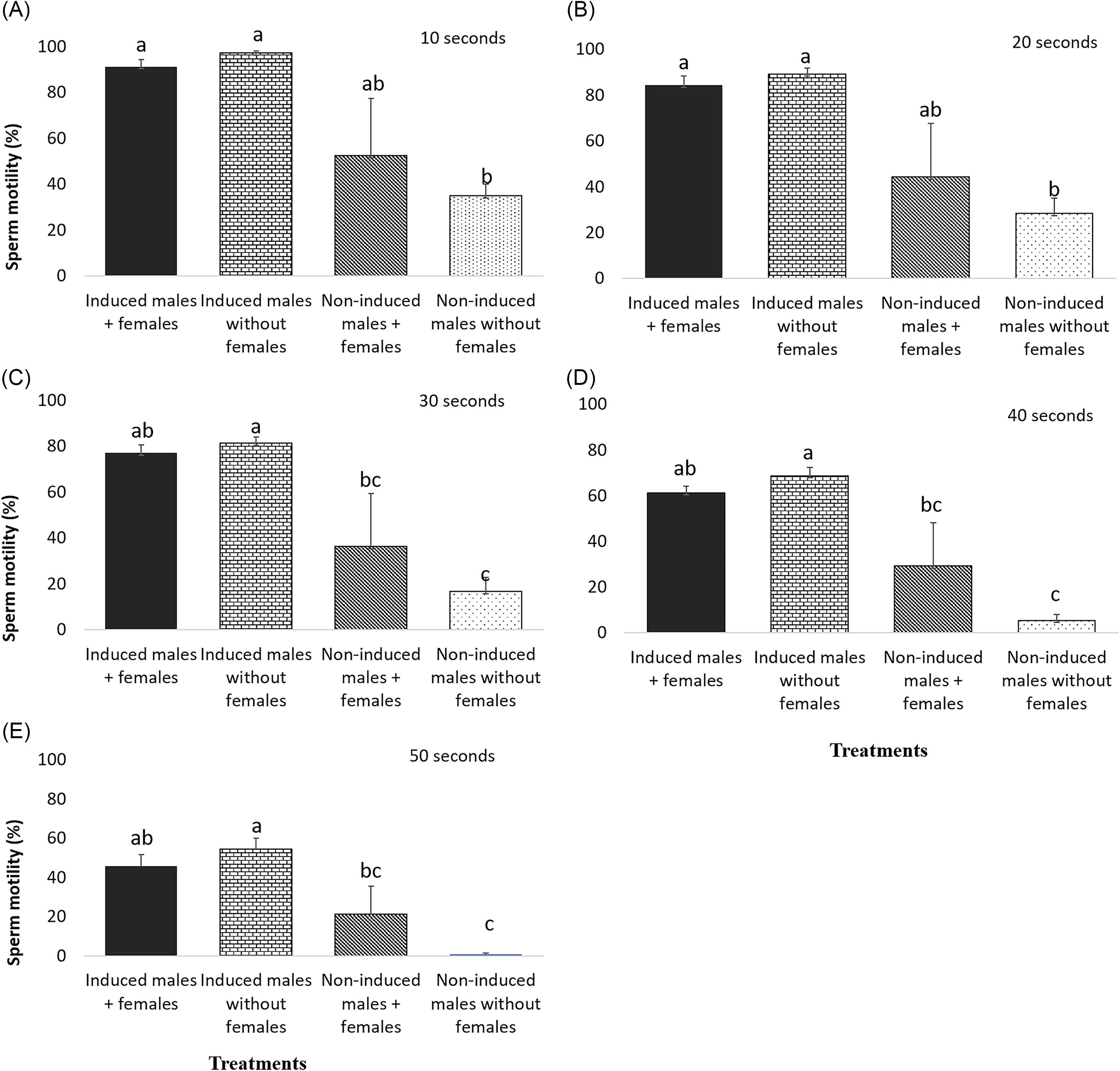
Figure 1 Long description
The bar graph compares sperm motility percentage of lambari across different treatments and time intervals. The x-axis represents four treatments: Induced males plus females, Induced males without females, Non-induced males plus females, and Non-induced males without females. The y-axis represents sperm motility percentage, ranging from 0 to 100. The graph is divided into five panels labeled A to E, each representing different time intervals: 10 seconds, 20 seconds, 30 seconds, 40 seconds, and 50 seconds. Each panel contains four vertical bars corresponding to the treatments. The bars are color-coded: solid black for Induced males plus females, dotted for Induced males without females, diagonal stripes for Non-induced males plus females, and polka dots for Non-induced males without females. The bars are annotated with letters indicating statistical significance. In general, sperm motility is highest in Induced males plus females and lowest in Non-induced males without females across all time intervals. All values are approximated.
As activation time progressed, motility declined across all treatments, though the reduction was slower in induced groups. At 30 s, induced males still maintained motility above 70%, whereas non-induced males without females dropped to 16.66 ± 6.01%. The presence of females slightly improved motility in non-induced males, especially after 20 s, but had no measurable effect in induced males.
By 50 s, induced groups remained active –54.50 ± 5.60% without females and 45.75 ± 5.93% with females – while non-induced males without females exhibited almost complete loss of motility (0.66 ± 0.66%). These results confirm hormonal induction as the primary factor sustaining motility, with female presence providing only a modest benefit when males were not induced.
Sperm concentration did not differ significantly among treatments (P = 0.9542). Mean values (× 108 spermatozoa mL −1) were: non-induced males with females (T1: 8.79 ± 3.82), Induced males with females (T2: 8.79 ± 3.82), Induced males without females (T3: 8.79 ± 3.82), and non-induced males without females (T4: 10.15 ± 3.28).
Experiment 2 – effect of hormonal induction and female presence from different production systems
Males and females from different RAS units
In this scenario, hormonal induction again produced the highest motility values at all time points (Figure 2). At 10 s, induced males achieved 92.60 ± 1.12% without females and 92.00 ± 1.22% with females. Among non-induced males, motility at 10 s was higher in the presence of females (75.00 ± 4.47%) than in their absence (66.00 ± 6.78%).
Effect of hormonal induction and female presence from different production systems.
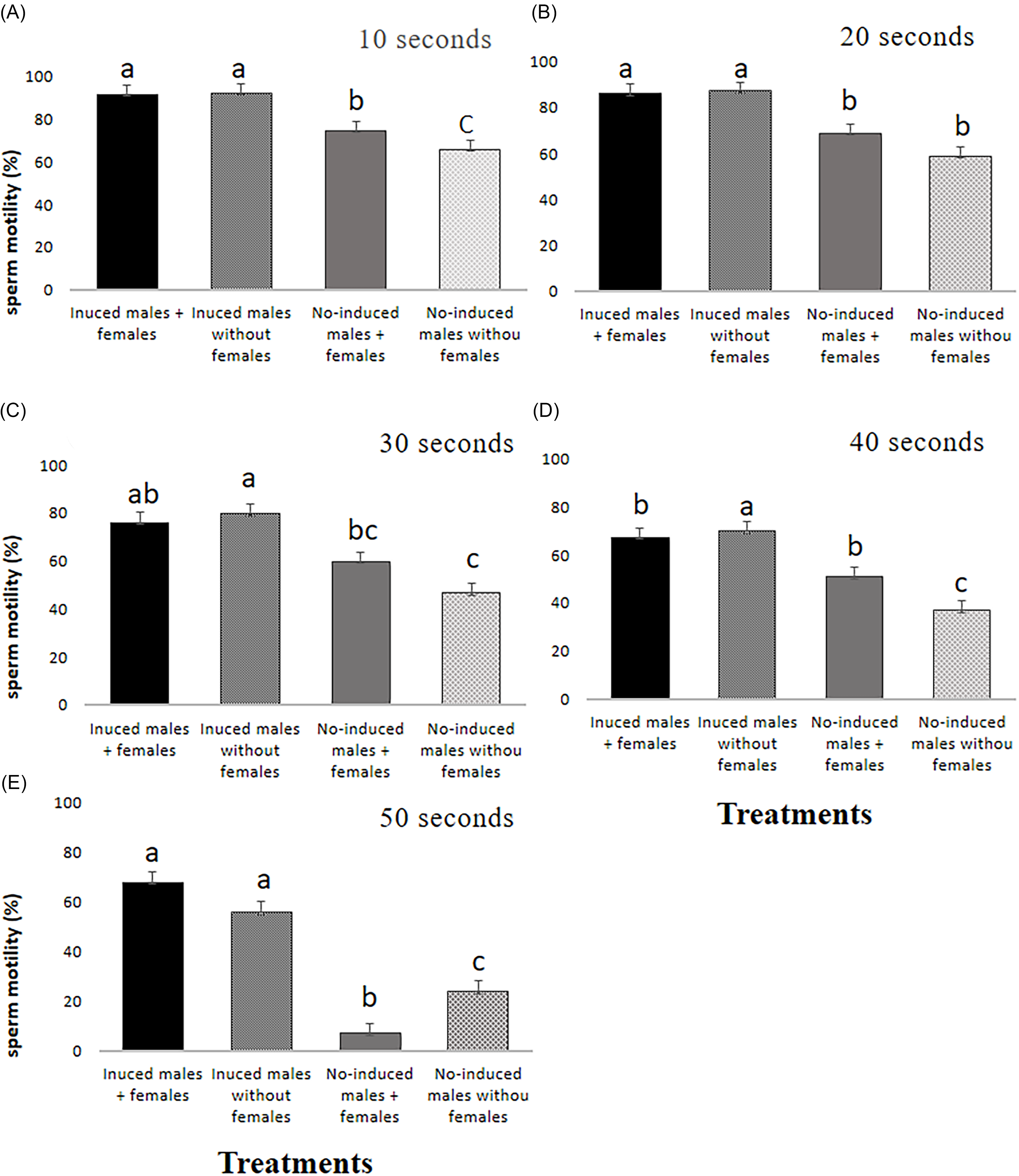
Figure 2 Long description
The bar graph compares sperm motility percentages over time for four different treatments: induced males with females, induced males without females, no-induced males with females, and no-induced males without females. The x-axis represents time intervals in seconds (10, 20, 30, 40, and 50 seconds), and the y-axis represents sperm motility percentage. Each time interval has four bars representing the different treatments. The bars are color-coded: black for induced males with females, gray for induced males without females, purple for no-induced males with females, and patterned for no-induced males without females. At 10 seconds, induced males with females and without females show the highest motility, followed by no-induced males with females, and the lowest motility is for no-induced males without females. At 20 seconds, the trend is similar with induced males with females and without females showing the highest motility, followed by no-induced males with females, and the lowest motility is for no-induced males without females. At 30 seconds, induced males without females show the highest motility, followed by induced males with females, no-induced males with females, and the lowest motility is for no-induced males without females. At 40 seconds, induced males without females show the highest motility, followed by induced males with females, no-induced males with females, and the lowest motility is for no-induced males without females. At 50 seconds, induced males with females and without females show the highest motility, followed by no-induced males with females, and the lowest motility is for no-induced males without females. All values are approximated.
A significant difference emerged at specific time points during the motility assessment. At 30 s, non-induced males with and without females exhibited similar motility values. At 40 s, non-induced males in the presence of females showed higher motility than those without females, whereas at 50 s the opposite pattern was observed, with higher motility in males without females (Figure 2). These results indicate that the effect of female presence on sperm motility in non-induced males was transient and time-dependent rather than consistently stimulatory or inhibitory.
Sperm concentration also differed significantly among treatments (P = 0.0114). Post hoc comparisons revealed that Induced males with females (8.9 ± 3.8 × 10⁷ spermatozoa mL −1) exhibited significantly higher values than non-induced males with females (3.9 ± 1.6 × 10⁷ spermatozoa mL −1) and non-induced males without females (3.5 ± 2.0 × 10⁷ spermatozoa mL −1; P = 0.0476 for both). Induced males without females (1.0 ± 6.3 × 10⁸ spermatozoa mL −1) did not differ significantly from the other treatments.
Males from RAS with females from BFT
Here, hormonal induction was once again the determining factor for motility maintenance, with induced males showing no difference between the presence or absence of females (Figure 3). However, for non-induced males, the pattern was reversed: the presence of BFT females reduced motility compared to isolated males. At 10 s, non-induced males with BFT females recorded 45.00 ± 4.47%, falling to 7.00 ± 3.74% at 50 s, while those without females maintained 66.00 ± 5.34% at the start and 24.00 ± 5.10 % at the end of the observation period.
Sperm motility (%) of lambari (Astyanax lacustris) as a function of time after activation (seconds).
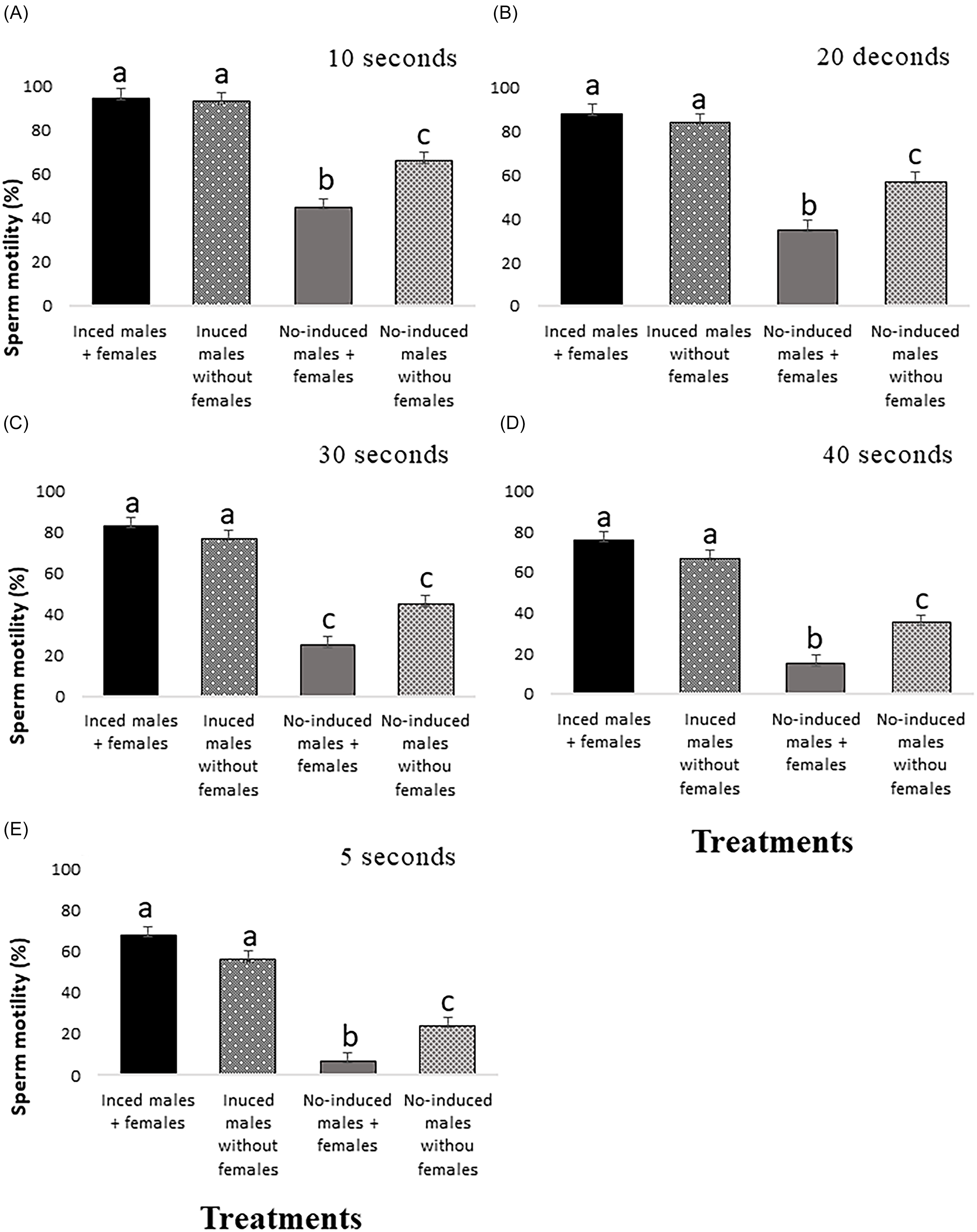
Figure 3 Long description
The bar graph compares sperm motility percentage of lambari as a function of time after activation in seconds. The x-axis represents different treatments: Inced males with females, Inuced males without females, No-induced males with females, and No-induced males without females. The y-axis represents sperm motility percentage. There are five sets of bars, each corresponding to different time intervals: 5 seconds, 10 seconds, 20 seconds, 30 seconds, and 40 seconds. Each set contains four vertical bars representing the different treatments. The bars are color-coded: black for Inced males with females, dotted for Inuced males without females, solid gray for No-induced males with females, and patterned for No-induced males without females. The graph shows that induced males maintain higher sperm motility regardless of the presence of females, while no-induced males show lower motility, especially without females. The trends indicate that hormonal induction significantly affects motility maintenance over time. All values are approximated.
Sperm concentration differed significantly among treatments (P = 0.0071). Non-induced males with females (1.9 ± 1.5 × 10⁷ spermatozoa mL −1) showed significantly lower values than both Induced males with females (7.3 ± 0.7 × 10⁷ spermatozoa mL −1) and Induced males without females (7.7 ± 1.4 × 10⁷ spermatozoa mL −1; P < 0.05). Non-induced males without females (7.7 ± 4.8 × 10⁷ spermatozoa mL −1) did not differ significantly from the other treatments.
Discussion
Hormonal induction markedly improved sperm motility in A. lacustris, sustaining high activity for longer periods compared to non-induced males. This finding corroborates previous reports in the same species (Yasui et al., Reference Yasui, Senhorini, Shimoda, Pereira-Santos, Nakaghi, Fujimoto, Arias-Rodriguez and Silva2015; Carneiro-Leite et al., Reference Carneiro-Leite, Bashiyo-Silva, Oliveira, Borges, Sanchez, da Silva, Lobato, Rodrigues-Lisoni, Veríssimo-Silveira and Ninhaus-Silveira2020) and reinforces the effectiveness of carp pituitary extract in enhancing seminal quality. In artificial reproduction, the ability to obtain and maintain highly motile spermatozoa at the time of fertilization is essential for the success of techniques such as artificial fertilization, chromosomal manipulation, and advanced biotechnologies like triploidization, gynogenesis, and androgenesis (Paes et al., Reference Paes, da Silva, do Nascimento, Valentin, Senhorini and Nakaghi2014; Adamov et al., Reference Adamov, Nascimento, Maciel, Pereira‐Santos, Senhorini, Calado, Evangelista, Nakaghi, Guerrero, Fujimoto and Yasui2017; Nascimento et al., Reference do Nascimento, Bertolini, Lopez, Nakaghi, Monzani, Senhorini, Vianna and Yasui2021).
The consistently high motility observed in hormonally induced males, regardless of female presence or broodstock origin, indicates that endocrine stimulation alone is sufficient to trigger and sustain sperm activation in A. lacustris. In contrast, improvement was observed in non-induced males when females were present, suggesting a possible stimulatory effect mediated by pheromonal or behavioural signals. Similar responses have been reported in other externally fertilizing fish, where chemical cues from ovulating females can influence gamete activation (Elofsson et al., Reference Elofsson, Van Look, Borg and Mayer2003; Yasui et al., Reference Yasui, Senhorini, Shimoda, Pereira-Santos, Nakaghi, Fujimoto, Arias-Rodriguez and Silva2015).
Sperm concentration results supported these observations. In Experiment 1, where broodstock were maintained together in the same RAS, concentration did not differ among treatments, indicating that under uniform pre-spawning conditions, hormonal induction and female presence do not markedly alter sperm output. In contrast, when males and females were kept in separate RAS units (Experiment 2), induced males with females exhibited higher sperm concentration than some non-induced groups, suggesting that endocrine stimulation may enhance spermiation rates when fish have not shared the same environment. A different trend was observed when RAS males were paired with BFT females, as non-induced males showed lower sperm concentration than induced males. This finding indicates that hormonal induction promotes more consistent reproductive outcomes across different production systems, whereas non-induced males display greater variability in sperm output depending on broodstock origin.
When broodstock originated from different production systems, hormonal induction once again proved decisive for maintaining motility. In the case of males and females from separate RAS units, non-induced males showed lower performance when paired with females from another unit, particularly at later activation intervals, which may indicate reduced efficacy of chemical cues when fish have not shared the same water environment. This system-specific environmental imprinting has been suggested in other freshwater species and may influence reproductive synchronization (Elofsson et al., Reference Elofsson, Van Look, Borg and Mayer2003). In the RAS–BFT pairing, the presence of BFT females reduced motility in non-induced males compared to males kept isolated. This negative effect may be linked to differences in microbial communities, water chemistry or stress responses between systems, potentially interfering with chemical communication or inducing behavioural changes (DeGraaf et al., Reference DeGraaf, King, Benton and Berlinsky2004; Di Chiacchio et al., Reference Di Chiacchio, Almeida, Leal and Viveiros2017). In hormonally induced males, such system-related effects were absent, further supporting the notion that endocrine stimulation can override environmental incompatibilities.
In practical terms, the results of this study underscore hormonal induction as the most effective strategy for ensuring high-quality semen in A. lacustris, both in terms of motility and, in some contexts, sperm concentration. When hormonal induction is not applied, however, male reproductive performance becomes more sensitive to the origin and rearing environment of females – whether from the same RAS unit, a different RAS unit or a BFT system – resulting in variable and time-dependent effects on sperm motility and sperm concentration. Altogether, these findings refine reproductive management protocols for A. lacustris and may be applicable to other small characids under intensive aquaculture conditions.
Acknowledgements
The authors are grateful to the Federal Rural UFRPE, especially the Academic UAST and the Biotechnology and Reproduction Center (NUBIOR), for providing essential infrastructure and technical assistance throughout this work. We also acknowledge the Foundation for the Support of Science and Technology of the State of Pernambuco (FACEPE) for its financial support (Grant APQ-1075-5.06/22), which was fundamental to the completion of this study.
Competing interests
None.
Funding
We thank the Foundation for the Support of Science and Technology of the State of Pernambuco (FACEPE) for financial support (Grant APQ-1075-5.06/22).
Ethical standards
All experiments followed the ethical standards established by the UFRPE Animal Use Ethics Committee (CEUA protocol no. 5765091123).