The agenda is a key part of all bargaining processes. It shapes the strategies actors adopt, as well as the substantive nature of any agreement that can be reached. It is not, however, simply an exogenous factor that structures bargaining interactions. It is dynamic and can change throughout the bargaining process as actors strategically manipulate the set of issues being negotiated in order to influence the resulting outcome. The use of such agenda-changing strategies is particularly prevalent in international bargaining, where institutions are rarely in place to set the bargaining agenda. Instead, states write and re-write that agenda for themselves.
The study of ‘issue linkage’ provides important insights that can help us understand the role that the agenda plays in international bargaining. Analyzing issue linkage as a structure allows us to explore how the issues on the agenda influence states’ strategies when bargaining over those issues, and the outcomes that result. Analyzing issue linkage as a strategy allows us to evaluate the bargaining agenda as something that can be strategically manipulated by states as they add and subtract issues from the discussion. Both aspects of issue linkage are key for understanding international bargaining processes.
However, while we have a fairly robust understanding of issue linkage as a bargaining structure, we have relatively little understanding of issue linkage as a bargaining strategy.Footnote 1 This limits our understanding of how and why the bargaining agenda comes to be structured in a particular way, and also limits our ability to understand the outcomes that result. I seek to address this problem by explaining when and why states will try to change the bargaining agenda as a part of their overarching bargaining strategy. By doing so, our ability to understand the agenda as a dynamic feature of international bargaining processes is increased.
I argue that we can understand when and why states are likely to add or subtract issues from the bargaining agenda by combining: (1) an analysis of the interests states have regarding whether or not to adopt these different issue-linkage strategies, with (2) an analysis of the credibility problems that can limit their ability to effectively do so.Footnote 2 The result is a multi-part argument. In particular, states facing a costly no-agreement outcome have no real interest in weakening the potential agreement by subtracting issues from the agenda, but do have an interest in strengthening the agreement by adding new issues to it. However, given the credibility problems associated with using an issue-addition strategy, they can only effectively do so when an agreement is unlikely to be reached on the issues currently on the bargaining agenda. In contrast, states that would have to pay significant costs if an agreement is reached have no real interest in further strengthening the agreement by adding more issues to the agenda, but do have an interest in weakening the agreement by removing costly issues from it. However, given the credibility problems associated with using an issue-subtraction strategy, they can only effectively do so when the current bargaining agenda is likely to yield a (costly) agreement.
To test this argument, I draw on an original large-N dataset that codes states’ bargaining strategies in the multilateral climate-change negotiations held in Bali (2007) and Copenhagen (2009). Statistical analyses of these data indicate that the factors identified in this article do affect states’ choice regarding whether or not to adopt an issue-linkage bargaining strategy, as well as the type of issue-linkage strategy they choose. Interestingly, however, these effects pull in different directions – some states want to add issues and bring about a strong agreement, while others want to subtract issues and weaken the agreement. I conclude by discussing how these opposing incentives are likely to influence the substantive nature of the bargaining agenda in climate-change negotiations, as well as the questions they raise for future work.
THE STRATEGIC USE OF ISSUE LINKAGE
The issue-linkage literature devotes significant attention to understanding how characteristics of the issue-linkage structure (i.e., the bargaining agenda) as independent variables, affect states’ bargaining behavior,Footnote 3 and thus the way their interests are reflected in the resulting outcome.Footnote 4 Early studies focus on whether or not issues are linked together in a negotiation, arguing that linking issues together for joint agreement fosters cooperation among states.Footnote 5 More recent work highlights the empirical existence of this type of cooperative effect in certain international settings.Footnote 6 Other studies dig deeper into characteristics of the linkage itself, arguing that linking issues together does not always induce cooperation.Footnote 7 The effect of issue linkage depends on the types of issues that are linked.Footnote 8 Overall, regardless of how the issues on the table are analyzed, the current literature shows that the structure of the bargaining agenda affects states’ bargaining interactions in important ways.
However, the bargaining agenda is also a dependent variable that can be manipulated by states through the use of issue linkage as a bargaining strategy. A state could put a new issue on the agenda by offering concessions (i.e., a ‘side payment’) on that issue in order to win on other issues already on the table.Footnote 9 A state could also try to take an issue off the agenda – either by simply making such a request, or less cooperatively, by threatening to veto the entire agreement if certain issues are not removed from the discussion.Footnote 10 The first strategy is a type of issue addition; the second is a type of issue subtraction.Footnote 11 In most international negotiations, states have some ability to adopt both types of issue-linkage strategies.Footnote 12 The question therefore becomes: under what conditions will they do so?
I argue that two factors are likely to affect states’ strategic use of issue addition and issue subtraction. The first factor relates to the interests states have in reaching an agreement. Some states want an international agreement to move policy requirements beyond the status quo for the issues on the agenda. These states are worse off if current policy requirements remain the same than they would be if an agreement moving those policy requirements forward was reached. I refer to these states as states that face a costly no-agreement outcome. In contrast, some states face having to make significant policy adjustments if an agreement is reached on the issues on the agenda.Footnote 13 These states face a more costly outcome if an agreement moving policy requirements forward is reached than they would face if status quo policy requirements remained in place. I refer to these states as states that face a cost-imposing agreement. These different types of states have different interests regarding the resulting agreement. These interests create varying incentives for states to use issue-addition and/or issue-subtraction strategies. However, whether or not these incentives can be effectively acted upon depends on characteristics of the current bargaining agenda.
The second factor, therefore, relates to characteristics of the current bargaining agenda – specifically, whether or not the distribution of issues on the agenda is likely to foster or hinder states’ ability to reach a bargaining agreement. As highlighted by the issue-linkage literature, an agenda characterized by issues that are differently valued exists when opposing states place most importance on winning on different issues. This type of structure creates a zone of agreement,Footnote 14 and a behavioral incentive for states to exchange concessions across the issues, with each winning on the ones most salient to their interests.Footnote 15
This type of agenda fosters states’ ability to reach a bargaining agreement.Footnote 16 In contrast, a bargaining agenda characterized by issues that are not differently valued exists when states with opposing interests each place most importance on winning on the same issue (or issues), regardless of the other issues included in the negotiation. When this type of agenda characterizes the negotiation, a zone of agreement is unlikely to exist.Footnote 17 This creates an incentive against the offering of concessions,Footnote 18 hindering states’ ability to reach an agreement.Footnote 19 Together, these two factors influence when and why states are likely to adopt issue-linkage strategies.
Using Issue Addition
A state’s bargaining strategy is characterized by issue addition if it tries to bring a new issue into the discussion while, at the same time, leaving the current issues on the table. If this type of strategy is used, the set of issues being simultaneously discussed for potential agreement is increased. The result would be a ‘substantively stronger’ agreement – i.e., an agreement that moves the policy outcome farther from the current status quo than an agreement that only deals with the original set of issues would have moved it.Footnote 20 States with an interest in a substantively strong agreement are, therefore, likely to want to use issue addition.
However, using an issue-addition strategy also comes with costs, as it often involves offering concessions on some outside issue in exchange for concessions on the original ones. The costs of these offered concessions can be fairly significant for the adding state. For example, European Union (EU) states with an interest in EU enlargement offered to undertake redistributive policies benefiting economically weaker states in return for their support for the enlargement process. The result was an agreement that did lead to enlargement of the EU – the policy outcome on the original issue that enlargement-supporting states wanted, but that they were not likely to get absent their use of issue addition.Footnote 21 However, adding redistributive policies to the discussion in order to win support for enlargement came with costly financial concessions for the enlargement-supporting states.
Understanding the costs and benefits associated with using issue addition is important, because the offer of concessions on an added issue must be credible to be effective – i.e., the offering state must have a strategic incentive to comply with the policy concessions it is offering on the new issue. For this incentive to exist, two conditions associated with the costs and benefits of issue addition must hold. First, the receiving state must be willing to concede on the original issues. So the concessions being offered on the new issue must yield benefits to the receiving state that exceed the costs of conceding on the original ones. Second, the costs to the offering state that are associated with making an offer large enough for this first condition to hold must be outweighed by the benefits it would receive by winning on the original issues.Footnote 22 If these two conditions hold, both states will receive a net gain if they comply with the policy concessions they made in order to receive reciprocal compliance from the other side.Footnote 23 Knowing that reciprocal compliance yielding a net gain will follow, a strategic incentive exists for those states to exchange concessions in the first place.
However, these two conditions do not always hold. Winning on the original issues might not yield a benefit large enough to outweigh the cost of the concessions a state would have to make to get the other side to concede on the original issues. If this is the case, offering concessions on a new issue would not be a credible strategy because the offering state would have no incentive to comply with its offer. Expecting that the offering state will not comply with its concession offer, the receiving state would have no incentive to concede on the original issues in the first place. Therefore, no benefit would stem from making an offer of concessions on an outside issue. Moreover, making such an offer but then not complying with it would also come with the cost associated with reneging on a promise and being seen as an untrustworthy partner in cooperative interactions.
This means that a state is only likely to use issue addition as a bargaining strategy when the promises underpinning such a strategy can be credible – i.e., when the cost of the concessions a state would have to make to be able to win on the original issues is outweighed by the benefits of winning on those issues. Whether or not this type of cost–benefit configuration will exist depends on the interests a state has in reaching a substantively strong agreement on the issues currently on the table, as well as characteristics of the bargaining agenda that affect states’ ability to reach such an agreement.
States facing a costly no-agreement outcome
The costs associated with the no-agreement outcome affect a state’s interest in reaching a substantively strong agreement, and, thus, its interest in using an issue-addition strategy. These costs are shaped by the substantive nature of the issues being negotiated. If the agenda deals with an issue area where the policies of other states are consistent with a state’s interests, that state faces few costs if a cooperative agreement is not reached. However, if other states’ current policies regarding the issues on the agenda go against a state’s interests, the inability to reach a cooperative agreement on those issues will be costly for that state. This type of state has an incentive to reach an agreement that moves other states’ policies regarding the issues on the agenda as far as possible away from the ones they currently have in place. Issue addition can help it do so by fostering an exchange of concessions that allows it to win on the issues currently on the agenda. However, a state can only effectively use issue addition when the promises underpinning this strategy can be credible.
The distribution of states’ interests across the issues on the bargaining agenda affects the credibility with which the promises underpinning an issue-addition strategy can be made. As demonstrated by the issue-linkage literature, if the issues on the current agenda are differently valued, an agreement is likely to be reached on those issues. Regardless of the costliness of a state’s no-agreement outcome, it is unlikely to have to face those costs. Using issue addition and offering concessions to the other side in order to secure a beneficial agreement on the original issues is unnecessary and costly. A state is, therefore, unlikely to use an issue-addition strategy when negotiating over an agenda characterized by issues that are differently valued.
In contrast, if the issues on the agenda are not differently valued, an agreement is unlikely to be reached. This forces states to face the costly no-agreement outcome. A state can use issue addition to avoid that outcome by offering concessions on an outside issue in order to foster an exchange of concessions between that issue and the original ones, thus bringing about an agreement. The greater the costs associated with that no-agreement outcome, the more likely it is that the benefit of using an issue-addition strategy – even minus the cost of doing so – will yield a higher payoff than remaining with the current bargaining agenda and having to face the cost of not reaching an agreement. When a state finds itself in this type of strategic situation, an offer of concessions on an outside issue can be credible, and thus effective in achieving its interest in reaching a beneficial agreement on the original issues.
Consider the 1982 negotiations within the European Economic Community (EEC) over the renewal of EEC sanctions against Argentina.Footnote 24 Most EEC states argued that the cost of renewing these sanctions outweighed the benefits. However, renewing them was very important to the United Kingdom, as they provided leverage in its dispute with Argentina over the Falkland Islands. Absent a renewal, the EEC sanctions on Argentina would expire, and the leverage the United Kingdom gained from them in the dispute would disappear. Consequently, the United Kingdom faced a costly no-agreement outcome associated with this bargaining agenda.
At the same time, this one issue – the question of renewing sanctions on Argentina – was the central focus of states on both sides of the negotiation. This is a key feature of a bargaining agenda characterized by issues that are not differently valued. Consistent with this type of agenda, bargaining impasse resulted in these negotiations, forcing the United Kingdom to face its costly no-agreement outcome.
The United Kingdom, therefore, had an incentive to use issue addition to put an issue of importance to the other EEC states on the bargaining agenda, so that the new set of issues being discussed would be differently valued. A beneficial agreement on the original sanctions issue could then be reached. This is precisely what it did. It brought the negotiation of the EEC budget into the discussion of the sanctions, offering to accept a larger agricultural budget than it wanted in exchange for concessions by the other EEC states to renew the sanctions on Argentina. The issues now being jointly considered were differently valued by the EEC states. The sanctioning issue was most salient to the United Kingdom, while the budget issue was most salient to other EEC states.Footnote 25 Once these issues were linked together, an exchange of concessions (and an agreement) was possible.
Overall, a state that has a more costly no-agreement outcome and is bargaining over issues that are less differently valued is more likely to derive benefits from using an issue-addition strategy that outweighs the costs of doing so. It is thus more likely to adopt this type of bargaining strategy, all else constant. This argument leads to a first testable hypothesis:
Hypothesis 1: All else constant, when the issues on the agenda are less differently valued, states facing a more costly no-agreement outcome are more likely to use an issue-addition strategy.
States facing a cost-imposing agreement
In contrast, states facing the potential to have to make costly policy adjustments if an agreement is reached on a given set of issues have little incentive to use issue addition. Such a strategy not only keeps the current set of (costly) issues on the table, but it also imposes an additional cost on the adding state to do so. The greater the policy-adjustment costs that would be imposed by an agreement, the less likely it is that a state would want to use issue addition to help bring about that agreement and/or to further strengthen it.
This lack of incentive to use issue addition exists regardless of whether the issues on the agenda foster or hinder agreement. If the issues on the agenda are structured in a way that hinders agreement, a state that faces having to make costly policy adjustments if an agreement is reached has little incentive to pay the cost of using issue addition in order to create an issue- linkage structure that will bring about that (cost-imposing) agreement. If the issues on the agenda are structured in a way that fosters agreement, using issue addition and offering concessions on a new issue would only strengthen the policy-adjustment requirements that state would be required to make. A state that would have to make significant policy adjustments if an agreement was reached on the original issues, alone, therefore has little incentive to use an issue-addition strategy. Instead, when an agreement is likely to be reached, it has an incentive to try to reduce the policy changes it would be required to make – either by watering down the agreement or preventing the agreement from being reached, altogether.
Consider the UN Security Council negotiations in the 2000s that were designed to respond to the humanitarian crisis in Darfur by placing sanctions on Sudan. In these negotiations, China faced significant policy-adjustment costs from agreement. It had strong trade links with Sudan – both economic (involving oil trade, in particular) and military (involving arms trade). If an agreement was reached, China would have to pay the cost of cutting off the flow of oil it was importing from Sudan, as well as the cost of cutting off arms exports to it. Given the costly policy-change requirements associated with agreement on this sanctions issue, China had no interest in further increasing the costs of such an agreement by offering side-payments to help bring it about. Indeed, rather than add an issue to try to secure the sanctions agreement, China (informally) vetoed the potential agreement several times.Footnote 26
Overall, the greater are the policy-adjustment costs a state expects will stem from agreement on a given set of issues, the less likely it is to have an incentive to use an issue-addition strategy.Footnote 27 This argument leads to a second testable hypothesis:
Hypothesis 2: All else constant, the more costly the policy adjustments a state faces from a potential agreement, the less likely it is to adopt an issue-addition bargaining strategy.
Using Issue Subtraction
Issue subtraction is a strategy designed to remove certain issues from the bargaining agenda. If it succeeds, the scope of the potential agreement would be reduced, and the result would be a ‘substantively weaker’ agreement – i.e., an agreement that does not move the policy outcome as far from the current status quo as an agreement on the full set of original issues would have moved it.Footnote 28 A state with an interest in securing an agreement that remains close to status quo policies is, therefore, likely to have an incentive to use issue subtraction.
However, using this strategy comes with a cost. While it might help a state to avoid having to make the costly policy adjustments that would be required by a strong agreement, a state using issue subtraction must often wield a veto threat against the entire agreement in order to get other states to be willing to set aside issues that they care about. Exerting such a threat comes with the reputational cost of being seen as unwilling to cooperate with other states, and can harm interstate relations.Footnote 29 Consider the negotiations at the 2009 Copenhagen climate-change conference. One of the main goals of these negotiations was the creation of legally-binding emission reduction targets for all major greenhouse gas emitters – both developed and developing.Footnote 30 Toward the end of the conference, an agreement laying out binding emission reduction requirements for all major greenhouse gas emitters was very close to being reached.Footnote 31 However, India and China wielded a veto threat over the entire conference to get the issue of developing country mitigation targets removed from the agreement. They argued that placing high, legally-binding emission reduction requirements on developing countries was unfair, and that they would not sign the agreement unless this issue was taken off the table.Footnote 32 Consistent with the argument that using an issue-subtraction strategy comes with reputational costs, the result of their veto threat was heated debate and ‘raised voices’ from both sides of the bargaining table, with many walking away with a strongly held belief that India and China had ‘sabotaged’ the negotiations.Footnote 33
Understanding the costs and benefits that are associated with using issue subtraction is important, because the veto threat that a state often has to use to get an issue removed from the agenda must be credible to be effective – i.e., a state must be willing to carry out the veto threat if its demands for issue subtraction are not met. The cost to the threatening state associated with reaching an agreement on the full set of issues must, therefore, be greater than the cost associated with remaining at the no-agreement outcome. If it is not, the threatening state would not have an incentive to act on its veto threat. It would actually prefer to reach an agreement – even if doing so is somewhat costly – than to remain at the no-agreement outcome, which would be imposed if it carried out the veto. Knowing that the veto threat is an empty one, opposing states would not concede and allow issue subtraction to occur. They would simply move ahead with an agreement on the full set of agenda items, knowing that agreement would not actually be blocked by the threatening state. In such a situation, the veto threat underpinning an issue-subtraction strategy would not only be ineffective, but it would also come with the cost of backing down and being seen as weak.
A state is thus only likely to use issue subtraction as a bargaining strategy when the threats underpinning such a strategy can be credible – i.e., when the cost of reaching an agreement on the full set of agenda items is greater than the cost associated with carrying out a veto threat and remaining at the no-agreement outcome. Whether or not this type of cost–benefit configuration will exist depends on the interests a state has in watering down the agreement, as well as characteristics of the bargaining agenda that affect states’ ability to reach such an agreement.
States facing a cost-imposing agreement
The costliness of the policy adjustments an agreement would require a state to make affect its interest in reaching a substantively weaker agreement, and thus its interest in using an issue-subtraction bargaining strategy. These costs are shaped by the substantive nature of the issues being negotiated. An agenda that deals with a policy area in which a state is not significantly involved, or in which it is already a policy ‘entrepreneur,’ will impose few policy-adjustment costs on that state if a cooperative agreement is reached. However, an agenda designed to move policy forward in an issue area in which a state is a ‘laggard’ can impose potentially significant policy-adjustment costs on that state if an agreement is reached. This type of state has an incentive to water down the agreement and lessen those potential policy-adjustment costs – i.e., to use issue subtraction. However, it can only effectively do so when the threats underpinning this strategy can be credible.
The distribution of states’ interests across the issues on the agenda affects the credibility of issue subtraction strategies. If the issues on the agenda are not differently valued, it is unlikely that an agreement will be reached.Footnote 34 Because an agreement is not likely to be reached, any policy change that would have been required by that agreement is not likely to be imposed. Regardless of the costliness of the policy changes that potential agreement would require, a state would have little incentive to pay the costs of issue subtraction to water down the ‘already-unlikely’ agreement.
However, if the issues on the agenda are differently valued, an agreement is likely to be reached,Footnote 35 and states would have to pay the costs associated with the agreement’s required policy changes. The greater the costs associated with those required policy changes, the more likely it is that the cost of using issue subtraction and remaining at the status quo would be offset by the benefit of not having to pay the policy-adjustment costs associated with reaching an agreement. The veto threat underpinning an issue-subtraction strategy can be credible, because the state would have an incentive to carry it out. When issues are more differently valued, a state facing the possibility of having to make more costly policy adjustments if an agreement is reached is, therefore, more likely to use issue subtraction.
Consider the Strategic Arms Limitation Treaty (SALT) II negotiations that took place between the United States and the Soviet Union in the 1970s. These negotiations were designed to reduce the American and Soviet manufacturing of nuclear weapons. The United States placed most importance on limiting the nuclear capabilities of the Soviet Union, while the Soviet Union placed most importance on limiting the nuclear capabilities of the United States. The main issues on the table were, indeed, differently valued by the two states, allowing a trade-off to be possible between them. At the same time, each side faced significant policy-adjustment costs if such an agreement was reached. They would each be forced to limit their own nuclear arsenals, which were seen as important for protecting their strategic interests. Both sides responded to this bargaining situation with an issue-subtraction strategy. The United States removed the requirement for the reduction of what it considered to be essential defensive weapons (such as the Trident and cruise missiles). The Soviet Union removed the requirement for the reduction of most of its ‘heavy ICBM’ launchers. The result was a less robust agreement than it could have been if it required a limitation of all strategic weapons. However, because of their interest in limiting the requirement to reduce weapons they considered central to their own strategic position in the system, both used issue subtraction in order to water down the agreement and protect those interests.
Overall, a state that faces having to make more costly policy adjustments if an agreement is reached and is bargaining over issues that are more differently valued is more likely to derive benefits from using an issue-subtraction strategy that outweigh the costs of doing so. It is, therefore, more likely to adopt this type of bargaining strategy, all else constant. This argument leads to a third testable hypothesis.
Hypothesis 3: All else constant, when the issues on the agenda are more differently valued, states that face more costly policy adjustment requirements from an agreement are more likely to use issue subtraction.
States facing a costly no-agreement outcome
In contrast, states facing a costly no-agreement outcome have little incentive to use issue subtraction. For these states, remaining at the status quo comes with costs. They would prefer to have the agreement move the policy outcome as far from that status quo as possible. However, a state risks losing the entire agreement and having to remain at the (costly) status quo if it wields a veto threat – a tactic that often characterizes an issue-subtraction strategy. Even if this is not the case, subtracting an issue ‘weakens’ the substance of the potential agreement – i.e., it leads to an outcome that does not move policy as far from the (costly) status quo as an agreement that included all of the issues would have moved it. Even further disincentivizing the use of issue subtraction, states pay costs when they try to remove issues from the agenda. Using issue subtraction would not only leave the policy outcome closer to the costly status quo, but a cost would have to be paid to do so. A state that faces a costly no-agreement outcome, therefore, has little incentive to use an issue subtraction strategy.
This lack of incentive exists regardless of whether the issues on the agenda foster or hinder agreement. If the issues on the agenda are structured in a way that hinders agreement, a state facing a costly no-agreement outcome would have an incentive to bring about an agreement in some way. However, it would have an incentive to do so in a way that keeps the agreement on the original issues as strong as possible, rather than in a way that waters it down. It would thus have an incentive to use issue addition, not issue subtraction. If the issues on the agenda are structured in a way that fosters agreement, a state facing a costly no-agreement outcome would have an incentive to leave the agenda as it is. Doing so would allow an agreement to be reached and the costly no-agreement outcome to be avoided. In both cases, this type of state has little incentive to use issue subtraction.
Consider the negotiations in the Copenhagen climate-change conference in 2009. Many issues were on the table, revolving around questions related to the mitigation of greenhouse gas emissions and providing aid to developing states to help them adapt to the adverse effects of climate change. If an agreement was not reached, the status quo would remain – an outcome characterized by the fact that many major greenhouse gas emitters were not required to reduce their emissions, as well as the fact that all emissions reduction requirements currently in place would lapse in 2012 with the expiration of the Kyoto Protocol.
Small island states like Tuvalu faced significant costs if the status quo continued unabated – costs related, in particular, to the rise in sea levels associated with climate change. Absent a reduction in greenhouse gas emissions, this problem would only continue to worsen. Indeed, these states argued that allowing things to continue without taking significant action posed a threat to their very survival.
So we would expect these states to have little incentive to water down the agreement through the use of issue subtraction. Consistent with this expectation, these small island states did not try to limit the scope of the agreement by removing issues from the table. Instead, they were some of the most active states in pushing for a comprehensive and strong agreement that would make important policy advances on all of the issues on the agenda. They even pushed hard for the inclusion of issues that were, at best, tangentially related to them – for example, support for states dealing with drought and desertification.Footnote 36 Rather than try to water down the agreement, the small island states were some of the biggest supporters of having a strong agreement that covered all issues related to climate change.
Overall, states that face costs if an agreement moving policy beyond the status quo on the original issues is not reached, therefore, have little incentive to water down the agreement by using issue subtraction. The greater are the costs a state faces if status quo policy remains, the less incentive it has to use of this type of strategy. This argument leads to a fourth testable hypothesis:
Hypothesis 4: All else constant, the more costly the no-agreement outcome for a state, the less likely it is to adopt an issue-subtraction bargaining strategy.
EMPIRICAL ANALYSIS
In the sections above, I laid out a four-part argument regarding when a state is likely to adopt issue addition or issue subtraction as a bargaining strategy, providing illustrative examples of this argument at work in a variety of different negotiations. The remainder of this article tests the resulting empirical predictions in one specific set of negotiations – multilateral climate-change negotiations.
The UN Framework Convention on Climate Change (UNFCCC), which entered into force on 21 March 1994, established standing climate-change negotiations and created the ‘Conference of the Parties’ (COP) as its highest decision-making authority. The COP is made up of representatives from each state that is a party to the UNFCCC, and meets each year in a variety of forums to keep international cooperation regarding climate change moving forward. These forums include general plenary sessions, meetings of the Subsidiary Body on Scientific and Technological Advice (SBSTA) and Subsidiary Body for Implementation (SBI), various working group (‘Contact Group’) meetings, and a high-level plenary session.
These different negotiations are not only interesting and politically important, but their bargaining agendas can be influenced by interested states, making issue linkage readily available as a bargaining strategy.Footnote 37 An analysis of states’ bargaining strategies across the multiple negotiations that took place in each of the COPs can, therefore, be used to test the argument presented above. Moreover, because these bargaining interactions involve the same set of states dealing with the same overarching issue area, analyzing states’ bargaining strategies across them allows the argument to be tested while holding many potentially mitigating factors constant.Footnote 38
The unit of analysis is ‘conference-negotiation-state strategy.’ The bargaining strategy adopted by each state in each of the various negotiations that took place in two recent COPs – Bali (2007) and Copenhagen (2009) – is analyzed.Footnote 39 The data for the analysis come from a review of archived webcasts of the negotiations in each of these two COPs.Footnote 40
Dependent variables: issue addition and subtraction
To test Hypotheses 1 and 2, the first analysis focuses on states’ use of issue addition as a bargaining strategy. The dependent variable is dichotomous – coded 1 if a state adopted an issue-addition bargaining strategy in a particular negotiation, and 0 if it did not.Footnote 41 A state’s bargaining strategy is coded as being characterized by issue addition under two conditions. First, a state is coded as having used issue addition if it suggested that an issue not already on the bargaining agenda should be brought into the discussions.Footnote 42 A state’s bargaining strategy is also coded as being characterized by issue addition if it suggested creating a working group (‘Contact Group’) to discuss a new issue. By doing so, a state is essentially pushing for that issue to be added to the Contact Group level of negotiations.Footnote 43
To test Hypotheses 3 and 4, the second analysis focuses on states’ use of issue subtraction. The dependent variable is dichotomous – coded 1 if a state adopted an issue-subtraction strategy in a particular negotiation, and 0 if it did not. A state’s bargaining strategy is coded as being characterized by issue subtraction under two conditions. First, a state is coded as having used an issue-subtraction strategy if it explicitly suggested that an issue currently on the bargaining agenda be removed from the discussions.Footnote 44 A state’s bargaining strategy is also coded as being characterized by issue subtraction if it suggested moving discussions of an issue from the current negotiation to another level of negotiations within that COP – i.e., removing it from the bargaining agenda in the current negotiation.Footnote 45
Costs from agreement
As discussed above, the substantive nature of the bargaining agenda influences the costs associated with reaching an agreement. In the climate-change negotiations analyzed here, one of the main goals was to reduce global greenhouse emissions by placing specific emission reduction requirements on states. The emissions reduction actions states were expected to adopt in the resulting agreement were to be ‘nationally appropriate,’ based on a principle of ‘common but differentiated responsibilities,’ and applied to both developed and developing countries. States responsible for a greater degree of emissions were, therefore, expected to take on greater commitments to reduce emissions.
An indicator of the costliness of the policy adjustment requirements likely to stem from an agreement is therefore the level of greenhouse gases currently being emitted by a state. I include a measure each state’s level of carbon dioxide (CO2) emissions (kt) in the models to capture the costs that reaching an agreement would likely impose on a particular state.Footnote 46 Larger values of this variable indicate that a state would likely have to implement more significant policy adjustments to comply with any climate-change agreement that was reached.
Hypothesis 2 predicts that states facing more costly policy changes if an agreement is reached should be less likely to use issue addition. As a stand-alone factor, this variable should therefore exert a negative and statistically significant effect on the likelihood a state will use an issue-addition bargaining strategy.
No-agreement costs
Another factor influencing a state’s incentive to use an issue-linkage strategy is the costliness of its no-agreement outcome. In the context of climate-change negotiations, the costliness of a state’s no-agreement outcome is characterized by the adverse effects of unregulated greenhouse gas emissions that if faces, and its ability to deal with those effects. Therefore, I code the costliness of each state’s no-agreement outcome by drawing on two factors. I use the ‘Environmental Vulnerability Index’ (EVI) indicators to construct a measure of each state’s vulnerability to climate change.Footnote 47 I then weight this measure by a state’s gross domestic product (GDP) per capita, which captures its wealth, and thus its own ability to deal with any environmental problems it faces. The resulting measure captures a state’s environmental vulnerability to climate change, as well as its ability to deal with those climate-change problems unilaterally, making it less dependent on an agreement for help.Footnote 48 States with the most costly no-agreement outcome face significant environmental impacts from climate change and have few resources to deal with those problems. States with the least costly no-agreement outcome face few adverse effects from climate change and have significant resources to deal with any problems they do face.Footnote 49
Hypothesis 4 predicts that states facing a more costly no-agreement outcome should be less likely to use issue subtraction. As a stand-alone factor, this variable should, therefore, exert a negative and statistically significant effect on the likelihood a state will adopt an issue- subtraction bargaining strategy.
Differently-valued issues
I argue that the degree to which the issues on the bargaining agenda are (or are not) differently valued exerts important effects on states’ likelihood of adopting an issue-linkage strategy. A variable is included in the models to capture the degree to which the issues on the bargaining agenda were differently valued in these various climate-change negotiations.
The coding rule stems from a logic derived in the formal issue-linkage literature, which demonstrates that linking issues together that are more differently valued creates a larger zone of agreement,Footnote 50 while the linkage of issues that are less differently valued reduces (or eliminates) the zone of agreement, all else constant.Footnote 51 I have built on this logic elsewhere, proposing empirical coding rules that capture the average size of the zone of agreement created by linking together a given set of issues. These rules were used to code the bargaining agenda in various negotiations among the states of the EU.Footnote 52 Here, I used this same coding procedure to measure the degree to which the issues on the table were differently valued in the climate-change negotiations I am analyzing.Footnote 53 Larger values indicate that a larger zone of agreement was created by the linkage of the issues on the agenda, and thus that the issues on the agenda were more differently valued, all else constant.
Interaction effects
The predictions of Hypotheses 1 and 3 involve the interaction of these variables. Therefore, I interact the Differently-valued issues variable with the No-agreement costs and CO 2 emissions variables in order to test these hypotheses.
Larger values of the first interaction term, Differently-valued issues × No-agreement costs, indicate a state with a more costly no-agreement outcome bargaining in a negotiation characterized by issues that are valued more differently. Because Hypothesis 1 predicts that a state with a more costly no-agreement outcome will be more likely to adopt an issue-addition strategy in negotiations characterized by issues that are valued less differently, this interaction term should exert a negative and statistically significant effect on the likelihood that a state will adopt an issue-addition bargaining strategy.
Larger values of the second interaction term, Differently-valued issues × CO 2 emissions, indicate a state with greater levels of CO2 emissions engaged in a negotiation characterized by issues that are valued more differently. Hypothesis 3 predicts that a state facing greater costs associated with the policy-adjustment requirements a climate-change agreement would impose (i.e., with greater CO2 emissions) will be more likely to adopt an issue-subtraction strategy in negotiations characterized by issues that are valued more differently. This interaction term should, therefore, exert a positive and statistically significant effect on the likelihood a state will adopt an issue-subtraction bargaining strategy.
Control variables
Variables are also included in the models to control for variation in potential mitigating factors. First, a variable is included to control for a state’s material power, which could impact its ability to use either type of issue-linkage strategy effectively. States with greater economic resources are more likely to be able to use issue addition and offer side payments to other states. They are also more likely to be able to sustain the reputational costs of issue subtraction, given that they are potentially more important cooperative partners in the international system than are weaker states. A measure of each state’s GDPFootnote 54 is included in the models to control for its potential effect on states’ ability to adopt issue-linkage strategies.Footnote 55
Three additional variables are included to account for differences in states’ likelihood of adding or subtracting issues in the different bargaining forums of each COP. First, because states are likely to use issue linkage to add or remove Contact Groups from the conference, negotiations within these Contact Groups, themselves, might differ from other COP bargaining interactions, where creating and/or removing an entire Contact Group might be a more likely strategy. A variable is included in the models to control for this potentially mitigating effect.Footnote 56 Second, parties to the Kyoto Protocol that take place during each COP are specifically designed to deal with Kyoto Protocol-related issues and the reduction commitments of Annex I states. However, given that other issues such as emission reduction requirements for developing countries are included in other parts of the conference, it is possible they may be linked to these Kyoto Protocol negotiations as well.Footnote 57 This might lead to the use of issue linkage strategies -- both by states that want to make such linkages, as well as those that want to prevent them. A variable is included to control for these potential effects. Finally, negotiations in the high-level plenary session fall at the end of each COP, after all other negotiations have taken place. A state’s likelihood of using issue addition or issue subtraction is likely to differ from its likelihood of using these strategies in earlier bargaining interactions in the conference. A variable is included in the models to control for this potentially mitigating effect.Footnote 58
Technical Description of Statistical Models
To test the hypotheses laid out above, I employ a multilevel logit technique. Two factors drive this modeling choice. First, the dependent variables are dichotomous. Logit models are, therefore, appropriate for the analyses. Second, the data are ‘multilevel’ in nature – individual states’ bargaining strategies (level 1) are clustered together within the separate negotiations that take place within each COP (level 2), which are clustered together within each COP itself (level 3).Footnote 59 This clustering must be taken into account. The multilevel model does so by including random effects at each of these levels in the data.Footnote 60
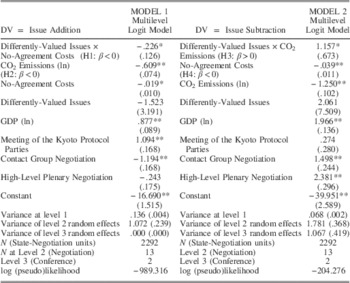
Two multilevel logit models are run. Model 1 tests Hypotheses 1 and 2 by analyzing states’ use of issue addition as a bargaining strategy. Model 2 tests Hypotheses 3 and 4 by analyzing states’ use of issue subtraction as a bargaining strategy. The results of these multilevel logit analyses are reported in Table 1.
Testing Issue Addition and Issue Subtraction Hypotheses.

*Indicates p<.10, ** indicates p<.05.
Standard errors indicated in parentheses.
Statistical Results
The statistical tests provide empirical support for the argument presented above. First, in the analysis of issue addition presented in Model 1, a negative and statistically significant effect is associated with an increase in a state’s CO2 emissions. This effect is consistent with Hypothesis 2, which argues that states with greater levels of CO2 emissions should be less likely to use issue addition as a bargaining strategy. Indeed, a one standard deviation increase in a state’s CO2 emissions is associated with about an 80 percent decrease in the odds it will adopt an issue-addition strategy.Footnote 61
The analysis of issue subtraction presented in Model 2 also supports the predictions of the theory. A negative and statistically significant effect is associated with an increase in the costs of not reaching an agreement for a given state. This effect is consistent with Hypothesis 4, which argues that states facing a more costly no-agreement outcome should be less likely to adopt an issue-subtraction strategy. Indeed, a one standard deviation increase in the costliness of a state’s no-agreement outcome is associated with over a 20 percent decrease in the odds it will adopt an issue-subtraction bargaining strategy.Footnote 62
The results reported in Models 1 and 2 are also consistent with the more complex interactive predictions laid out by Hypotheses 1 and 3. As shown in Model 1, the interaction term, Differently-valued issues×No-agreement costs, exerts a negative and statistically significant effect on the likelihood a state will use issue addition. This is consistent with Hypothesis 1, which argues that states facing a more costly no-agreement outcome should be more likely to adopt an issue-addition strategy when the bargaining agenda is characterized by issues that are less differently valued. As shown in Model 2, the interaction term, Differently-valued issues × CO 2 emissions, exerts a positive and statistically significant effect on the likelihood a state will use issue subtraction. This effect is consistent with Hypothesis 3, which argues that states with more CO2 emissions should be more likely to adopt an issue-subtraction bargaining strategy when the issues on the table are more differently valued.
While the statistical effects associated with these interaction terms are important and interesting, it should be noted that they only hold at the 90 percent confidence level. This is not surprising, however, because the standard error for each component term is conditional on the location of the other. The theoretical argument underpinning Hypotheses 1 and 3 reflects this logic, leading us to expect these interactions to exert statistically significant effects on states’ use of issue linkage at some times but insignificant effects at others. This likely explains why the effects, overall, are significant at only the 90 percent confidence level. To evaluate the interaction effects and the logic underpinning Hypotheses 1 and 3 fully, we must therefore understand how they vary as the value of the component terms vary. Figures 1 and 2 illustrate these nuanced effects. Drawing on the results reported in Table 1, Figures 1 and 2 plot the marginal effects associated with the interaction terms in Models 1 and 2, respectively, along with their 95 percent confidence intervals.Footnote 63
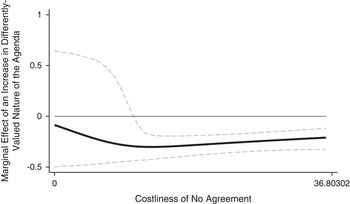
Bargaining over more differently valued issues: marginal effect at different no-agreement values Note: 95% Confidence Intervals Indicated.

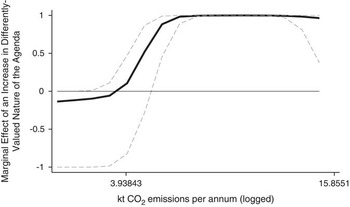
Bargaining over more differently valued issues: marginal effect at different levels of CO2 emissions Note: 95% Confidence Intervals Indicated.

These marginal effects highlight the change in the likelihood a state will adopt an issue- linkage strategy that is associated with a one-unit change in the degree to which the issues being negotiated are differently valued. A negative marginal effect indicates a decrease in likelihood, while a positive marginal effect indicates an increase in likelihood. As noted above, these marginal effects, themselves, can also change as a function of some other independent variable. In the analysis in Figures 1 and 2, this second variable relates to the characteristics of the bargaining states.
Figure 1 shows the marginal effect that increasing the degree to which the issues on the agenda are differently valued has on the likelihood a state will use issue addition. Moreover, it shows how that marginal effect changes depending on the costliness of a state’s no-agreement outcome. Based on the predictions of hypothesis 1, we would expect that when the issues on the agenda are more differently valued, a negative marginal effect would be associated with the likelihood a state will use issue addition. However, we would only expect to observe this negative effect when a state faces a costly no-agreement outcome. Both statistically significant negative effects and statistically insignificant effects should therefore be present, depending on the costliness of a state’s no-agreement outcome. The marginal effects reported in Figure 1 show these dynamics at work in climate-change negotiations.
First, for states that face a costly no-agreement outcome (i.e., that fall toward the right-hand side of the x-axis in Figure 1), statistically significant (p<.05), negative marginal effects are associated with a one-unit increase in the degree to which the issues being negotiated are differently valued. These negative marginal effects are consistent with the logic underpinning Hypothesis 1. When the issues on the agenda are not differently valued, an agreement is unlikely to be reached. States facing significant no-agreement costs therefore have an incentive to use issue addition in order to increase the likelihood of agreement. This incentive decreases when more differently-valued issues are on the agenda, because bargaining over issues that are more differently valued makes reaching an agreement more likely without a state having to pay the costs associated with using issue addition. A one-unit increase in the degree to which the issues being negotiated are differently valued should therefore be associated with a decrease in the likelihood that a state will use issue addition. Negative marginal effects are consistent with this prediction.
Second, for states that do not face a costly no-agreement outcome (i.e., that fall on the left-hand side of the x-axis), statistically insignificant marginal effects are associated with an increase in the degree to which the issues being negotiated are differently valued. This is also consistent with the logic underpinning Hypothesis 1. If the issues on the agenda are differently valued, an agreement characterized by a mutually beneficial exchange of concessions is likely to be reached. Offering a side-payment on a new issue in order to help bring about an agreement is unnecessary, as well as costly. Little incentive exists, therefore, for states to adopt such a strategy when the issues on the agenda are differently valued. These states also have little incentive to use issue addition when the issues on the agenda are not differently valued and an agreement is not likely to be reached. They face few, if any, costs if the status quo remains. The cost of using issue addition is, therefore, likely to exceed any (small) cost associated with remaining at the status quo.
Regardless of whether or not the issues on the agenda are differently valued, states that face few no-agreement costs have little incentive to use issue addition.Footnote 64 A change in the differently-valued nature of the issues on the agenda should, therefore, not make them any more or less likely to do so. Statistically insignificant marginal effects are consistent with this logic.
Figure 2 shows the marginal effect that increasing the degree to which the issues on the agenda are differently valued has on the likelihood a state will use issue subtraction. Moreover, it shows how that marginal effect changes depending on the costliness of the policy adjustments a climate-change agreement would likely require (captured in this analysis by a state’s level of CO2 emissions). Based on the predictions of Hypothesis 3, we would expect a positive marginal effect to be associated with the likelihood a state will use issue subtraction when issues on the agenda are more differently valued. However, we would expect to observe this effect only when a state would have to make more costly policy adjustments if a climate-change agreement is reached. Both statistically significant positive effects and statistically insignificant effects should therefore be present, depending on a state’s level of CO2 emissions. The marginal effects reported in Figure 2 show these dynamics at work in climate-change negotiations.
First, for states with a fairly significant level of CO2 emissions (i.e., those that fall toward the right-hand side of the x-axis in Figure 2), statistically significant (p<.05), positive marginal effects are associated with an increase in the degree to which the issues being negotiated are differently valued. These positive marginal effects are consistent with the logic underpinning Hypothesis 3. When the issues are not differently valued, states that would be required to take on fairly significant commitments to reduce emissions if a climate-change agreement is reached have little incentive to pay the costs of using issue subtraction to weaken the agreement (and thus, lessen those policy-adjustment costs), because such an agreement is not likely to be reached in the first place. However, these states do have an incentive to use issue subtraction when the issues being negotiated are more differently valued, and thus more likely to result in a (costly) agreement. Bargaining over an agenda characterized by issues that are more differently valued should, therefore, be associated with a greater likelihood that a state will use issue subtraction. Positive marginal effects are consistent with this prediction.
Second, statistically insignificant marginal effects are associated with an increase in the degree to which the issues being negotiated are differently valued when a state has low levels of CO2 emissions (i.e., it falls on the left-hand side of the x-axis). This is also consistent with the logic underpinning Hypothesis 3. Holding all else constant, states emitting low levels of CO2 will have to pay few, if any, costs to reduce their emissions. They have no strong incentive, therefore, to pay the cost of using issue subtraction to weaken an agreement, regardless of the likelihood an agreement would be reached.Footnote 65 Bargaining over issues that are more differently valued, which increases the likelihood of agreement, is not likely, therefore, to change these states’ incentive to use issue subtraction. Statistically insignificant marginal effects are consistent with this logic.
Overall, the empirical analyses of Hypotheses 1–4 demonstrate how the theory presented in this article can help us to understand when and why states are likely to alter the bargaining agenda by adopting either issue-addition or issue-subtraction bargaining strategies. Their motivations stem from the interests states have in reaching an agreement, as well as the characteristics of the issues on the current agenda.
CONCLUSION
The agenda is a key feature of international bargaining processes. It not only shapes the strategies and outcomes associated with the process, but it is dynamic and can be manipulated by states. In this article, I have argued that states facing a costly no-agreement outcome have an incentive to strengthen the agreement by using issue addition. In contrast, states facing potentially significant policy-adjustment costs if an agreement is reached have an incentive to weaken the agreement by using issue subtraction. However, whether or not they can do so depends on the characteristics of the bargaining agenda and how those characteristics affect the credibility of the promises and threats that underpin these issue-linkage strategies. Then I demonstrated how these factors affect states’ strategic bargaining behavior in multilateral climate-change negotiations in empirically relevant ways.
These dynamics raise an interesting question. The two types of states that are likely to have an interest in adopting an issue-linkage strategy have competing interests regarding the substance of any agreement reached. States facing a costly no-agreement outcome want a substantively strong agreement. When the issues on the table are less differently valued, so that an agreement is unlikely to be reached, these states are likely to try to use issue addition to help bring about a substantively strong agreement. In contrast, states facing costly policy-change requirements from an agreement prefer to have a substantively weaker agreement that will require fewer costly policy changes. When the issues on the table are more differently valued, and thus more likely to foster an agreement, these states have an incentive to use issue subtraction to weaken the agreement. The agreement is likely to be pulled in very different directions, therefore, depending on which states are able to seize control of the agenda.
Consider climate-change negotiations. If states facing a costly no-agreement outcome are able to gain agenda control, the result would likely be a stronger climate-change agreement with greater emission reduction requirements. Indeed, such an agreement almost came about in the Copenhagen COP,Footnote 66 and was pushed strongly by small island states and states in Africa – states facing costly adverse effects from climate change. In contrast, a weaker climate-change agreement would probably result if states facing costs from a strong climate change agreement were able to gain agenda control. This latter case is precisely what happened when the United States, along with Brazil, South Africa, India, and China (the BASIC countries) were able to grasp control of the agenda in the final days of the Copenhagen negotiations. They removed the requirement for ‘legally-binding’ emission reductions from the set of issues on the table, weakening the substance of any potential agreement.
Understanding the conditions under which different states are likely to prevail in their attempt to control the bargaining agenda is, therefore, an important next step in the study of issue linkage as a bargaining strategy. What are the conditions that are likely to allow some states to gain agenda control and not others? Some factors that might come into play include the bargaining power and material power of states, the nature of the coalition in which they are members, whether or not they hold a leadership position in the negotiation, and what kind of other bargaining strategies are available to them. Bringing these factors into an analysis of issue-linkage strategies is an important next step for future work. Doing so will help us to understand better how the bargaining agenda changes dynamically over the course of a given bargaining process, and why the resulting outcome looks the way it does.