Introduction
The transfer of critically ill patients from hospitals with fewer resources to those with more advanced capabilities is prevalent, though often arduous and time-consuming. Approximately 4.5% of intensive care unit (ICU) and 5.9% of non-ICU admissions in the United States involve interfacility transfers, which represent close to 50,000 and over 100,000 transfers per year, respectively. Reference Herrigel, Carroll, Fanning, Steinberg, Parikh and Usher1,Reference Reichheld, Yang, Sokol-Hessner and Quinn2 When the interfacility transfer process is not clear or consistent, such transfers can increase in-patient mortality and health care costs, and increase patients’ length of stay. Reference Wagner, Iwashyna and Kahn3 In pandemic situations like the coronavirus disease 2019 (COVID-19), these problems are intensified and associated with increased mortality. Reference Janke, Mei, Rothenberg, Becher, Lin and Venkatesh4 Due to the nature of COVID-19’s rapid transmission, coupled with a long course of hospitalization, Maryland (USA) experienced an increased number of ICU hospitalizations. Reference Galvagno, Naumann, Delbridge, Kelly and Scalea5 As ICUs became full, critical care patients were boarded in hospital emergency departments (EDs)—a practice that has been associated with poor patient outcomes. Reference Goel, Durst, Vargas-Torres, Richardson and Mathews6–Reference Boudi, Lauque and Alsabri8 Hence, it became clear that during a pandemic—and beyond—allocation of critical care resources requires thoughtful, proactive resource management strategies.
When critical care spaces are limited, ED overcrowding often results, posing serious threats to patient safety, especially in geographically remote or impoverished regions. Reference White, Villarroel and Hick9 Whereas various interventions have been proposed and implemented to address the problem of ED overcrowding, Reference Jeyaraman, Copstein and Al-Yousif10 few systems have implemented centralized coordination centers to ensure critically injured or ill patients receive the “right care at the right time.” In Maryland, the COVID-19 pandemic led to the creation of an integrated and comprehensive public safety-based model to coordinate critical care consultation and transfers within the state. Reference Galvagno, Naumann, Delbridge, Kelly and Scalea5
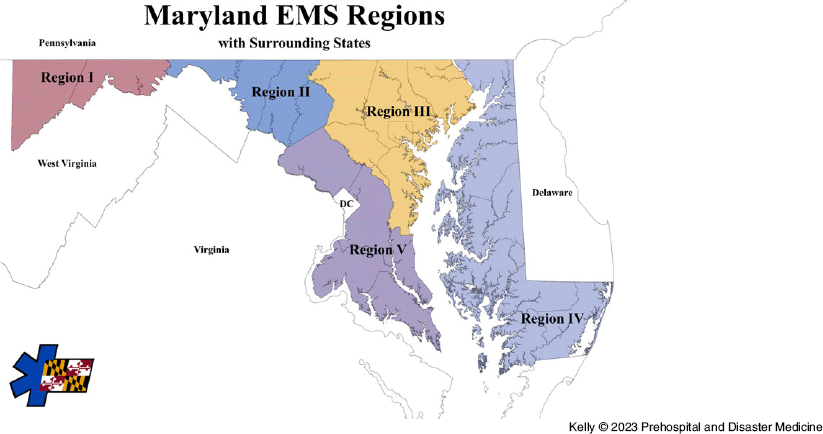
In November 2020, a collaborative effort between the Maryland Institute for Emergency Services Systems (MIEMSS; Baltimore, Maryland USA) and the University of Maryland R Adams Cowley Shock Trauma Center (Baltimore, Maryland USA) resulted in the creation of the MIEMSS Critical Care Coordination Center (C4) in response to the COVID-19 pandemic. As previously described, Reference Galvagno, Naumann, Delbridge, Kelly and Scalea5 the C4 operations center was based at MIEMSS, a coordinated state-wide network with central offices in Baltimore, that oversees and coordinates all components of the state-wide Emergency Medical Services (EMS) system, organized through five geographic regions. Regions III and V include large metropolitan areas, while regions I, II, and IV are largely rural areas (Figure 1). All EMS clinicians in Maryland are certified/licensed volunteers and/or career professionals operating in public service agencies (ie, public safety answering point [PSAP]) or commercial EMS services who provide care in accordance with the Maryland Medical Protocols for EMS. Basic Life Support (BLS) is the responsibility of emergency medical dispatchers, first responders, and Emergency Medical Technicians–Basic (EMT-B), while Advanced Life Support (ALS) is the responsibility of Cardiac Rescue Technicians (CRT), CRT–Intermediates (CRT-I), and EMT–Paramedics (EMT-P). Maryland’s requirements for EMS clinician licensing couple training standards defined by the National Registry of Emergency Medical Technicians (Detroit, Michigan USA) with demonstration of local competencies. The EMS services are segregated between commercial and emergency response, whereby PSAPs dispatch ambulances to emergent requests for assistance, while commercial EMS services provide interfacility transportation between hospitals of patients requiring specialized or definitive medical services.
EMS Regions for the State of Maryland (USA).
Abbreviation: EMS, Emergency Medical Services.

At the heart of the C4 concept, a central intensivist physician (CIP) and critical care coordinator (EMS clinician) were available 24 hours a day by telephone for consultation. Reference Romig, Latif, Pronovost and Sapirstein11 The CIPs were critical care physicians who were actively practicing intensive care in the region with a minimum of 800 dedicated hours per year in an ICU and selected from a variety of hospitals representing all major health care systems throughout Maryland and the Washington District of Columbia (DC) area. Critical care physicians were board-certified with a sub-specialization of critical care medicine in the disciplines of emergency medicine (8/34; 23.5%), anesthesiology (4/34; 11.7%), surgery (7/34; 20.6%), and medicine (15/34; 44.1%). Critical care coordinators were practicing, licensed ALS clinicians with intimate knowledge of regional critical care and ED capabilities, recruited and selected for their additional understanding of interhospital relationships and specialty resources throughout the state, including the most geographically isolated regions. The CIP and coordinator teams had access to resources that extrapolated current bed capacity information from online databases updated by hospitals to search for potential receiving facilities more efficiently. The C4 teams worked closely with existing hospital access centers and state incident command systems to ensure the most advantageous distribution of patients, including transport to geographically proximal and appropriate ICUs. The CIP provided critical care consultation, especially when transport was not possible due to capacity, necessitated by patient acuity, or if short-term ED management was likely to reduce patient acuity so a critical care bed could be saved.
The C4 retained contractual agreements with commercial EMS agencies to support interfacility transfers. Requirements included specialty care transport (SCT) capabilities as defined by Maryland law. 12 The SCT units met configuration standards for the care of critical patients with guidelines for equipment (eg, ventilators or other specialized medical equipment) and staffing, including an EMT-B/driver, an SCT-credentialed EMT-P, and usually a registered nurse (RN), or occasionally a physician, with training in interfacility care of critically ill patients. The C4 staff could activate these services if the sending facility could not arrange transport through their own contracts. The C4 team assisted with clinical management of patients in requesting facilities and coordinated communications with potential receiving facilities. After a patient was accepted and transportation arranged, interfacility management became the responsibility of the referring hospital and commercial EMS service.
The C4 was involved in requests for transfer to hospitals with ICUs throughout the state and in surrounding states. The C4 provided medical oversight and triage for interfacility critical care transports, coordinated specialty and sub-specialty services such as extracorporeal membrane oxygenation (ECMO), and provided medical direction and guidance for high-risk critical care transfers. In October 2021, C4 added a pediatric intensive care specialist and additional critical care coordinator to provide consultation for pediatric patients of all acuity levels. The C4 also devised algorithms to assist the CIPs and coordinators with scarce resource requests, including ECMO.
In this report, a description of the implementation process for the C4 is shared: created during a pandemic, then sustained to provide around-the-clock consultation and coordination for critically ill adults and all children in and around the state of Maryland. This EMS-based system is presented, which synergizes the unique strengths of both EMS clinicians and critical care physicians, as a model for ensuring equitable and timely access to critical and specialty care during both pandemic and non-pandemic operations.
Methods
This is a retrospective cohort study. Data were analyzed from a database created using Smartsheet (Smartsheet; Bellevue, Washington USA) to record and collect information relating to each request for transfer assistance. Data entry was performed by C4 coordinators and later validated by C4 administrative staff (ie, completion of missing entries) with a formal quality assurance program established. Reference tables were created using Smartsheet and Tableau (Salesforce; San Francisco, California USA) to access automated hourly ICU census feeds provided by a health information exchange system (Chesapeake Regional Information System for Patients [CRISP]; Columbia, Maryland USA). Cases were defined by date and time of request, origin of request, patient diagnosis, accepting institution, COVID-19 status, requests for ECMO, and code status. Pediatric cases were included after October 2021, as the C4 program expanded to serve this population. Identifiable patient information was stored in accordance with established health information protection guidelines and referenced to other data using unique row identifiers. Smartsheet data were imported into JMP Pro (v15.2.1; SAS Institute; Cary, North Carolina USA) for analysis. Stata SE (v.17; Statacorp; College Station, Texas USA) was utilized for z-score proportions testing using numerical information from the Maryland Facility Resource Emergency Database ([FRED] MIEMSS; Baltimore, Maryland USA), a published Maryland dataset. 13 All recorded requests for transfer assistance were considered for inclusion. Cases with significant unrecoverable missing information and duplicates were excluded. The JMP Pro and R Studio Statistical Software (v4.1.3; R Core Team 2022; Vienna, Austria) were used to create tables and figures. This study was reviewed by the University of Maryland School of Medicine Institutional Review Board (Baltimore, Maryland USA; HP_00099579) and was determined to be exempt.
Results
The C4 received 2,790 service requests from its inception on November 30, 2020 through June 30, 2022. Excluded were 50 requests (50/2,790; 1.82%) for lower than ICU-level services, cancellations, and transportation requests. Of the 2,740 included cases, 1,846 (67.37%) resulted in successful transfers facilitated by the C4 team and 763 (27.85%) were effectively managed with clinical guidance from the CIP within requesting facilities. The remaining cases (131/2,740; 4.78%) included transfer refusals and other dispositions.
From total cases, 29.53% (809/2,740) involved patients confirmed to test positive for COVID-19 or were persons under investigation (PUI) for COVID-19. The percentage of COVID-19 requests remained consistent around 33% throughout 2020 (68/204; 33.3%) and 2021 (590/1,754; 33.63%) before declining to 22.0% for 2022 (151/686). Over 60% of COVID-19 positive or PUI patients (491/809; 60.7%) were successfully transferred. Approximately 69% of cases reported a negative COVID-19 test result (1,835/2,644). For 175 cases (175/2,740; 6.39%), ECMO requests were received, of which 32.6% (57/175) were successfully transferred, and 58.3% (102/175) were managed in the requesting facility after receiving medical direction from the CIP.
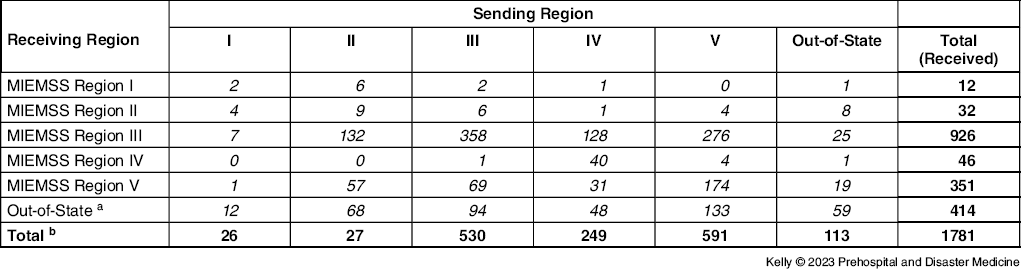
The largest proportion of requests originated in Region III (875/2,740; 31.93%) and Region V (844/2,740; 30.80%). Region II initiated 409 requests (409/2,740; 14.93%), Region IV initiated 346 requests (346/2,740; 12.63%), and Region I initiated the fewest number of transfer requests (38/2,740; 1.39%). The largest volume of out-of-state requests came from West Virginia (137/2,740; 5.0%), and additional out-of-state requests originated from Virginia (43/2,740; 1.57%), Pennsylvania (18/2,740; 0.66%), DC (15/2,740; 0.55%), and Delaware (12/2,740; 0.44%). The C4 received two requests regarding Maryland residents vacationing in Caribbean nations for repatriation back to hospitals in their home state, and three requests from non-hospital health care facilities (urgent care centers or primary care offices). Table 1 summarizes requests and transfers between Maryland EMS Regions and neighboring states.
C4 Transfer Requests between Maryland EMS Regions and Neighboring States

Abbreviations: C4, Critical Care Coordination Center; EMS, Emergency Medical Services.
a Include West Virginia, District of Columbia, Pennsylvania, Virginia, Delaware, and New Jersey.
b 63 cases were missing destinations.
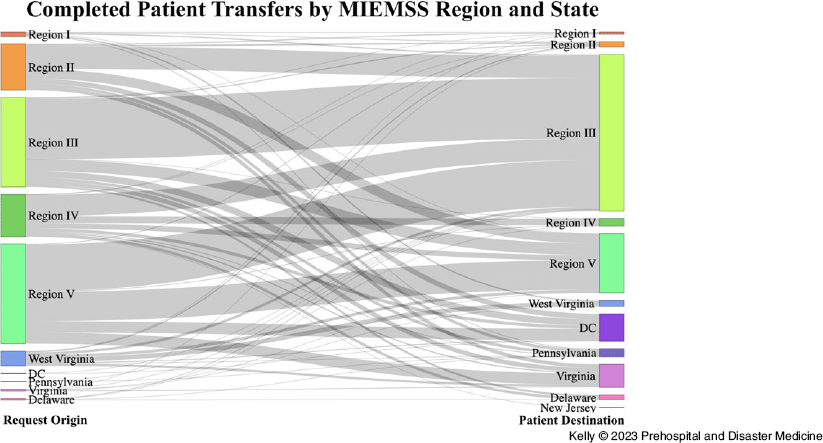
Most cases resulting in a successful transfer were received by hospitals in Region III (926/1,844; 50.22%), followed by Region V (351/1,844; 19.03%), DC (162/1,844; 8.78%), and Virginia (137/1,844; 7.43%), coinciding with higher distributions of hospitals in these areas. Patient transfers were received from hospitals in Maryland’s Region IV, Region II, and Region I, as well as hospitals in Delaware, Pennsylvania, West Virginia, and New Jersey (Figure 2).
Completed Transfers based on EMS Region for the State of Maryland and Neighboring States.
Abbreviations: EMS, Emergency Medical Services; MIEMSS, Maryland Institute of Emergency Medical Services Systems.

The average transfer distance between sending and receiving hospitals was 36.5 miles, with over 75% of transfer distances under 50 miles and 90% of transfer distances under 67 miles. When a closer option was unavailable to a patient in need, the C4 facilitated 75 transfers (75/1,846; 4.06%) to locations greater than 90 miles away from patient origin, recording a maximum distance of 193 miles.
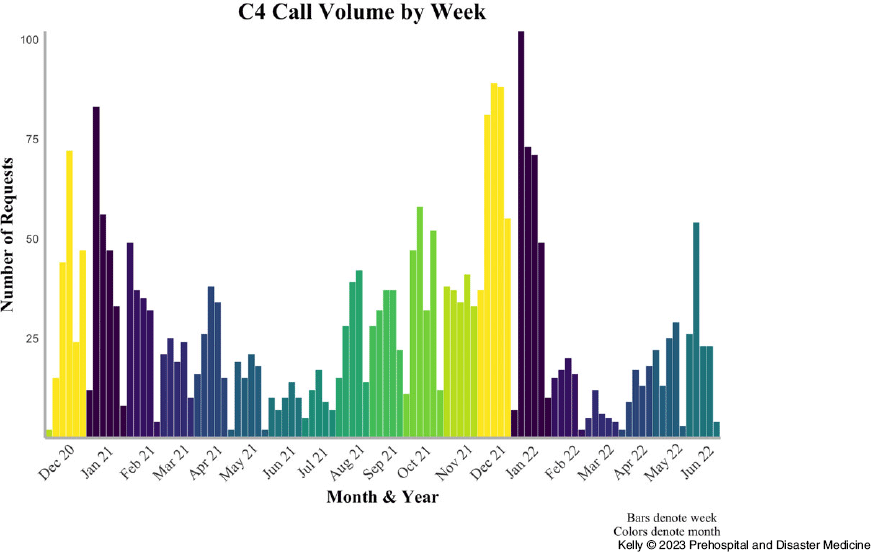
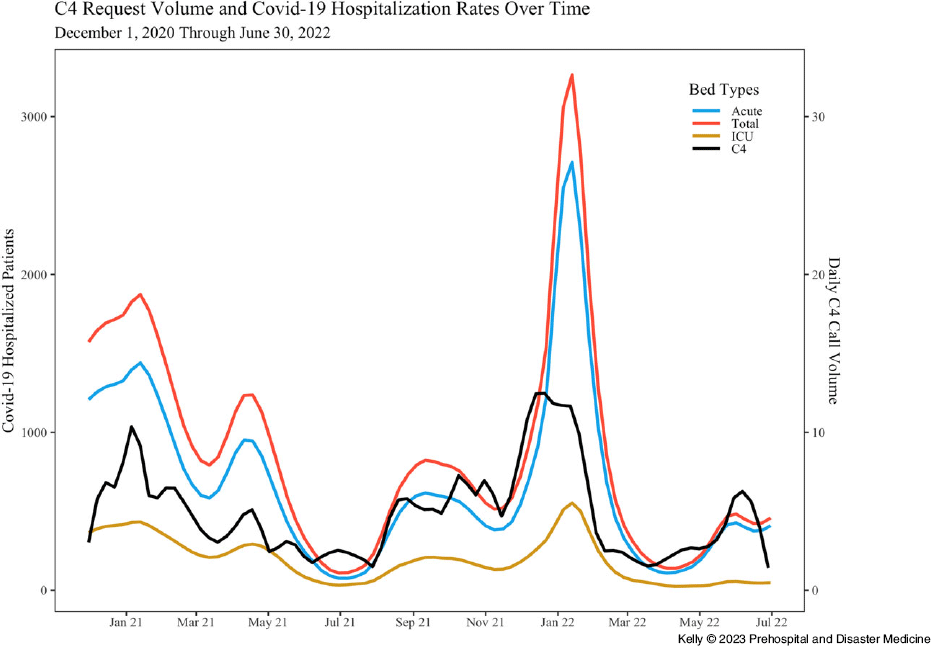
The number of cases managed by the C4 on a daily and weekly basis (Figure 3) fluctuated with Maryland COVID-19 hospitalizations (Figure 4).
Number of C4 Requests, by Week and Month.
Abbreviation: C4, Critical Care Coordination Center.

C4 Request Volume and COVID-19 Hospitalization Rates Over Time.
Abbreviations: C4, Critical Care Coordination Center; ICU, intensive care unit.

December 2021 was the busiest month for the C4 with 350 (350/2,740; 12.77%) consultations. January 2022 was the second busiest month (312/2,740; 11.39%), followed by January 2021 (239/2,740; 8.72%), October 2021 (212/2,740; 7.74%), and December 2020 (202/2,740; 7.37%). After expanding to include pediatric services, 142 pediatric cases required consultation, 128 of whom (128/142; 90.1%) were successfully transferred to pediatric specialty centers. The busiest months for pediatric requests were June 2022 (64/142; 45.1%) and May 2022 (23/142; 16.2%).
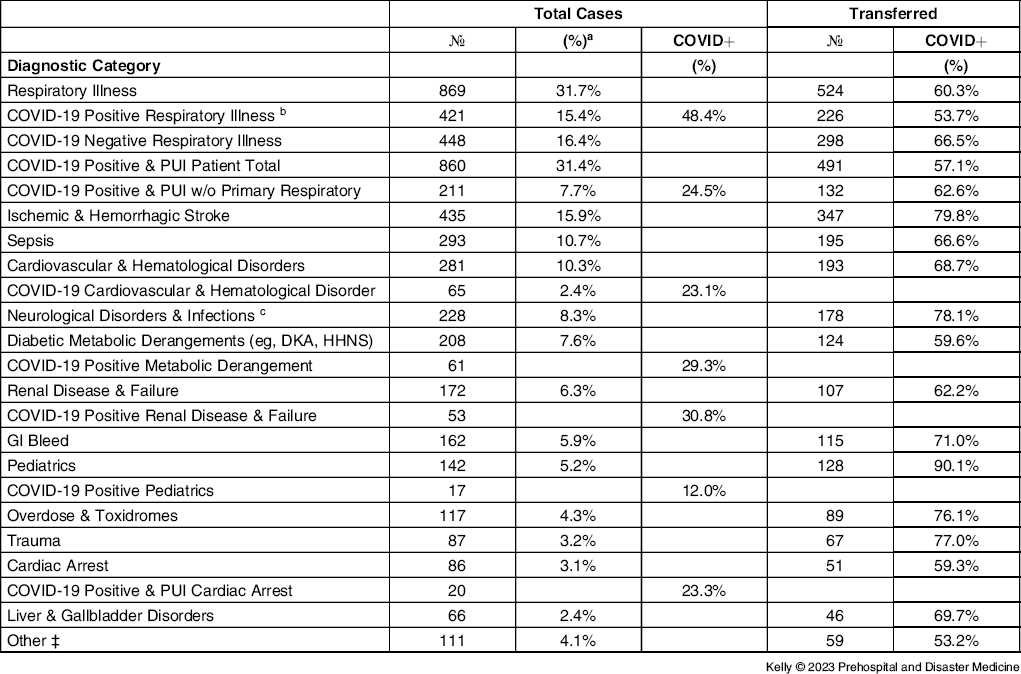
Table 2 lists primary diagnoses for C4 cases. The most frequently encountered diagnostic category for cases screened by the C4 was respiratory illness (869/2,740; 31.71%), of which nearly 50% were COVID-19 positive (421/869; 48.4%). Other frequent primary diagnoses encountered included stroke (435/2,740; 15.87%), sepsis (293/2,740; 10.69%), cardiovascular and blood disorders (281/2,740; 10.25%), neurological disorders including seizures (228/2,740; 8.32%), and metabolic disorders (208/2,740; 7.59%).
Diagnoses for C4 Interfacility Transfer Requests (N = 2,740)

Abbreviations: C4, Critical Care Coordination Center; PUI, persons under investigation; DKA, diabetic ketoacidosis; HHNS, Hyperosmolar Hyperglycemic Nonketotic Syndrome; GI, gastrointestinal.
a Can be more than one category.
b Confirmed Positive and PUI.
c Excludes stroke.
Discussion
A public safety-based model that was established in response to an unprecedented demand for critical care during the COVID-19 pandemic was described and implemented. Beyond the pandemic, including periods where COVID-19 cases declined, the C4 continued to coordinate critical and specialty care across a diverse geographic area, utilizing the complementary skills of paramedics and intensivists. The C4 is an example of a model that offers synergy between the medical fields of EMS and critical care. As issues pertaining to critical care delivery are often at the intersection of transport, consultation, triage, and medical direction—topics that are familiar to EMS clinicians and intensivists alike—the C4 is an example of how a well-organized and integrated team can help ensure that a population may receive appropriate and timely access to critical care services, even when systems become overwhelmed by an additional burden of critically ill patients during a pandemic or similar emergent event.
A unique aspect of the C4 was the pairing of a CIP with a paramedic coordinator. Paramedics are acutely aware of regional resources as they are directly involved with the transfer of patients to both specialty and non-specialty hospitals. Maryland’s unique geography required thorough knowledge of regional resources. Disposition percentages coupled with regional distribution of transfers (Table 1 and Figure 2) support the effectiveness of this team approach for finding the closest appropriate destination for each patient. Paramedic coordinator knowledge of out-of-state facilities and their capabilities proved advantageous for locating acceptable transfer destinations, as many intensivists were not as familiar with surrounding hospitals and their level of critical care, particularly non-tertiary facilities. Some patients were limited by insurance status, requiring transfers to in-state facilities, highlighting an important disparate distinction between physical location and income status. The potential for the complementary skill sets and knowledge of paramedic coordinators and intensivist physicians to help address these types of health care inequalities requires further exploration.
Although the pandemic was the initial stimulus for creation of the C4, less than one-third of cases involved COVID-19 patients. Notably, however, the patterns of COVID-19 prevalence in C4 requests became a predictor for ICU availability throughout the state during surges. The array of non-COVID-19 primary diagnostic categories of patients seeking transfer largely followed national trends for ICU admissions. 14–Reference Barrett, Smith, Elixhauser, Honigman and Pines16 Comparing monthly prevalence of COVID-19 positivity in Maryland ICU patients to the incidence of COVID-19 positive requests, C4 ratios aligned with state trends but increased just prior to an ICU surge. A significant example can be seen between August and December 2021, where ratios of COVID-19 C4 requests significantly outnumbered the prevalence of COVID-19 in ICUs and continued to increase comparatively throughout this period (P <.0001). Total request volume coupled with increased demand for placement of COVID-19 patients preceded ICU prevalence, then was significantly lower (P = .0275) in January 2022 when Maryland COVID-19 ICU volume peaked at 44%. Median length of stay for COVID-19 ICU hospitalizations is reported at 15 days (IQR 6-20), Reference Nguyen, Chinn and Nahmias17 therefore C4 requests, which predominantly represented new admissions, appeared to be predictive of both surge trends and plateaus during a pandemic event. Integrating this information with other patterns, such as those found by Levy and colleagues for PUI for COVID-19 transported by EMS and new COVID-19 hospitalizations in Maryland, Reference Levy, Klein and Chizmar18 could provide powerful tools for emergency preparedness planners. Overall, COVID-19 ICU case ratios fell from January peak to approximately 5.65% in June 2022, but hospital capacities continued to exceed pre-pandemic levels, affirming that additional considerations for state-wide bed availability need to be explored and defined. Precise allocation of critical care resources will likely remain a priority for hospital leaders and state planners until health care systems return to a pre-pandemic operational state.
The C4 demonstrated compelling potential for optimizing clinician time management while also highlighting potential areas for improved continuing education in emergency medicine and EMS. By examining commonalities within diagnostic categories and transfer patterns across jurisdictions, effective translational research strategies can be designed and distributed, and prehospital benchmarks for discriminating patient acuity may be assessed, improving destination decision making in EMS. Consultation between C4 physicians and referring clinicians from ED and ICU settings promoted broader dissemination of translational knowledge acquired through novel treatments and research conducted at tertiary and teaching hospitals, specifically concerning COVID-19 case treatment. Consultations for ECMO provided an exemplar for this. Without C4, clinicians seeking ECMO for their patients would have been required to contact each ECMO resource individually, resulting in significant time expense for both the requesting and referral centers alike. The C4 rapidly disseminated ECMO criteria. With CIPs who were well-versed in ECMO protocol, patient screening and recommendations for managing severe respiratory failure (eg, changes in ventilator settings, proning practices, and medication administration) were expedited. When transfer was deemed beneficial, the CIP was able to present the case to multiple potential receiving centers without the necessity to involve the referring clinician, allowing providers to continue focusing on patient care rather than patient transfer coordination.
Many lessons learned were captured following the implementation of the C4. A significant number of cases (137/2,740; 5.0%) involved requests for continuous electroencephalogram (EEG) monitoring to rule out seizures. Remote neuromonitoring, in the form of telemedicine or rapid response EEG, has enormous diagnostic potential and could be coordinated by the C4 as an effective screening tool. Reference Vespa, Olson and John19 Such modalities could assist with determining which patients truly require transfer to a neurological ICU, a limited and often-sought resource. The addition of a telemedicine component to C4 could potentially decrease the transfer necessity for qualifying cases and allow high-acuity centers to retain resources for patients with the greatest need for critical care. Similarly, the diagnosis of diabetic ketoacidosis (DKA) was another prevalent illness for which ED providers requested transfer (184/2,740; 6.71%). In these cases, consultation between the C4 team and the ED physician predominantly resulted in stabilization of the patient’s DKA, resulting in admission to a lower acuity level floor, obviating the need for an ICU admission. Avoiding unnecessary transfers is a prudent objective for not only reducing health care costs, but also for maintaining ICU availability for critically ill patients. Through subsequent evaluation of cases and supplementary information pulled from the patient health care database, quantification will be sought, using measurable data, of the cost benefits of telemedicine and reduced ED boarding times through C4-facilitated transfers, synonymously demonstrating the clinical benefit to patients and alleviated burden on hospitals and clinicians.
Management of limited resources requires novel approaches, including egalitarian and utilitarian principles, as well as well-coordinated systems such as the C4, to ensure that the maximal number of critically ill adult and pediatric patients receive the appropriate care. Reference Supady, Curtis and Abrams20 Hospital transfer processes prior to C4 inception were time-intensive for emergency room clinicians, resulting in funneling most patients to a tertiary center with established patient intake protocols. The C4 was an important part of critical care delivery as it helped prioritize transfer requests for multidisciplinary intensive care teams who continue to struggle with staffing challenges despite an ever-increasing presentation of patients with complex life-threatening critical illness, Reference Pastores, Kvetan and Coopersmith21,Reference Krell22 while simultaneously decreasing the time burden on the clinician. Triage for highly intensive and scarce resources such as ECMO, neurologic critical care, and pediatrics is vital to ensure optimal outcomes, as is medical consultation for less acute cases that might not require critical or sub-specialty care. A centralized capacity-management system like the C4 can be implemented to perform large-scale “load leveling” across a health care system or defined geographic area by providing the infrastructure to maintain situational awareness of critical care resources and simplified access for resource utilization.
Limitations
This work has several limitations. First, C4 coordinators were responsible for entering data and entry errors or omissions are possible, even after manual data cleaning. During the first months of C4, coordinators were MIEMSS agency staff who took on additional hours and helped develop the structural foundation of C4. As the C4 evolved, so did staffing, the supporting documents, and guidelines used to facilitate interfacility transfers, and the variability associated with each documented transfer. Second, the Smartsheet was not structured as a research database. The data reflected operational and clinical priorities, which later required a considerable amount of re-categorization and data cleaning. For future C4 operations, and for states or regions considering establishing a similar system, relational databases should be established for both quality assurance work and outcomes research. Third, during the data cleaning and re-categorization process, some data granularity was lost. For example, when creating the diagnoses for transfer requests, each diagnostic category was obtained from screening a “diagnosis” text field. Some details of the clinical information not directly associated with the primary diagnoses were lost. Future improvements for the C4 will include better diagnostic categorizations, including use of the World Health Organization (WHO; Geneva, Switzerland) International Classification of Disease methodology (ICD-10). 23 Fourth, Maryland represents a geographically unique United States territory with small land mass and large overall population density; thus, the results may not have external generalizability to other regions throughout the world. Finally, there is no link between the data entered and medical records for cases where the C4 was consulted, which limited the ability to associate C4 requests with patient outcomes. Work is on-going to couple health care outcomes and costs via probabilistic linkage, using large-scale health care databases, for reporting in future publications.
Conclusion
Providing a centralized asset with regional situational awareness of hospital capability and bed status played an integral role for directing the triage process of critically ill patients to appropriate facilities during and after the COVID-19 pandemic. A total of 2,790 requests were received by the C4. The pairing of a paramedic with an intensivist physician resulted in the successful transfer of 67.4% of requests, while 27.8% were managed in place with medical direction. Patients with COVID-19 comprised 29.5% of the cohort. The C4 concept is proposed, which leverages the complimentary skills of EMS clinicians and intensivist physicians, as a public safety-based model for other regions to consider world-wide. Additional research regarding patient outcomes and costs is warranted and forthcoming from the authors.
Conflicts of interest/funding
The authors report there are no competing interests to declare. The authors did not have a course of financial support for this study.
Acknowledgements
The authors thank Todd Bowman, BA, AA, NRP; Dwayne Kitis; and Alex Kelly, BA, NRP for their on-going operational and administrative support of the C4.