



1. Introduction
The propagation of surface waves (SWs) on the interface between two media has attracted considerable attention due to its relevance with real experimental and astrophysical plasma dynamics (Buti Reference Buti1985). Trivelpiece & Gould (Reference Trivelpiece and Gould1959) were the first to report the experimental observation of surface waves in a plasma in an experimental set-up involving a cylindrical plasma column bounded in a glass tube that was coaxial with a circular metallic waveguide. The frequency spectrum for SWs in plasmas has been investigated theoretically, numerically and experimentally (Cooperberg Reference Cooperberg1998; Kartwright et al. Reference Kartwright, Christenson, Verboncoeur and Birdsall2000), and theoretical results were found to be in good agreement with experimental observations (Gradov, Ramazashvili & Stenflo Reference Gradov, Ramazashvili and Stenflo1982; Gradov & Stenflo Reference Gradov and Stenflo1982, Reference Gradov and Stenflo1983a,Reference Gradov and Stenflob; Moisan, Shivarova & Trivelpiece Reference Moisan, Shivarova and Trivelpiece1982; Ghosh & Das Reference Ghosh and Das1988; Hussein Reference Hussein1990; Grozev, Shivarova & Tanev Reference Grozev, Shivarova and Tanev1991). The propagation of high-frequency surface waves in collisionless or weakly collisional electron–ion plasmas has been explored in a number of studies along with investigations in the magnetohydrodynamic (MHD) limit (Chandrasekhar Reference Chandrasekhar1968; Boardman Reference Boardman1982; Gradov & Stenflo Reference Gradov and Stenflo1983a,Reference Gradov and Stenflob; Landau & Lifshitz Reference Landau and Lifshitz1984; Kondratenko Reference Kondratenko1987; Zhelyazkov, Murawski & Goossens Reference Zhelyazkov, Murawski and Goossens1996; Allahyarov et al. Reference Allahyarov, Podloubny, Schram and Trigger1997; Tsintsadze Reference Tsintsadze1998; Aliev, Schluter & Shivarova Reference Aliev, Schluter and Shivarova2002). In fact surface wave instabilities form the majority of MHD instabilities originating from inherent non-uniformity of plasma (Hasegawa & Chen Reference Hasegawa and Chen1975).
An electromagnetic wave may propagate at the boundary between two media with different density, such as at a plasma–conductor boundary or on a plasma–vacuum interface; however, the pressure exerted by electromagnetic (EM) waves on the surface, known as the radiation pressure, is quite different when radiation is considered in a plasma medium rather than in vacuum (Tsintsadze et al. Reference Tsintsadze, Rozina, Shah and Murtaza2008). The plasma refractive index $I$ $(={kc}/{\omega })$
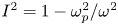
 for transverse EM waves is given by $I^{2}=1-{\omega _{p}^{2}}/{\omega ^{2}}$
 in terms of the plasma frequency $\omega _{p}=\sqrt {{e^{2}\,n_{e} }/{\varepsilon m_{e}}}$
 for electron–ion plasma), where $e$
 , $n_{e}$
 and $m_{e}$
 denote the electron (absolute) charge, density and mass, as usual, while $\varepsilon (={1}/{4{\rm \pi} })$
 is the dielectric permittivity. Based on this fact, it was shown by Tsintsadze, Callebauti & Tsintsadze (Reference Tsintsadze, Callebauti and Tsintsadze1996) that the photon energy, $\varepsilon _{r}(=\hbar \omega )$
 may read as

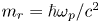
where $p_{r}={\hbar \omega I}/{c}$ , $m_{r}={\hbar \omega _{p}}/{c^{2}}$
 , $\hbar ={h}/{2{\rm \pi} }$
 , $c$
 is the speed of light and $h$
 is Planck's constant. One may notice here that, although the above equation is similar in structure to the expression for the total relativistic energy of material particles, it differs from the latter in that the rest mass of the photon, $m_{r}$
 , is a function of the plasma density. The detailed thermodynamics of EM (thermal) radiation was presented by Tsintsadze et al. (Reference Tsintsadze, Callebauti and Tsintsadze1996), where different thermodynamic quantities were formulated based on Planck's distribution function

(where $k_{B}$ is the Boltzmann constant, $T$
 is the gas temperature, $\omega _{k}$
 are the radiation eigenfrequencies corresponding to the excited states above the rest energy) and the pressure expression (equation of state) for a photon gas, both in vacuum and in a plasma medium. In fact, Tsintsadze et al. (Reference Tsintsadze, Callebauti and Tsintsadze1996) showed that the specific heat associated with electromagnetic/thermal radiation becomes infinite in the case of a low-density and high-temperature plasma, hence the Stefan–Boltzmann law is modified. The pressure for a photon gas in a plasma, assuming $\hbar \omega _{p\alpha }\ll k_{B}T_{\alpha }$
 (where $\alpha =$
 e or i, denoting electrons or ions respectively) was shown (Tsintsadze et al. Reference Tsintsadze, Callebauti and Tsintsadze1996) to be

where $P_{r,\alpha }$ , $U_{r,\alpha }$
 and $T_{\alpha }$
 denote the radiation pressure, the radiation energy density and the temperature of species $\alpha$
 respectively, and $\beta ={{\rm \pi} ^{2}}/{45(\hbar c)^{3}}.$
 Although, at transitive temperature and density, the radiation pressure may be small in comparison with the thermal pressure of the plasma particles (Zeldovich & Raizer Reference Zeldovich and Raizer1966), the impact of thermal radiation on plasma dynamics can be significant due to the fact that the radiant energy lost by the hot plasma, i.e. via radiative heat transfer in the plasma, may exceed the energy transferred by thermal conduction. This competition is due to the fact that photons usually have a much longer mean-free path than that of charged particles, so for hot plasmas (Tsintsadze et al. Reference Tsintsadze, Rozina, Shah and Murtaza2008) the radiation pressure cannot be neglected and must be added to the thermal pressure of species in the MHD model equations. Our aim in this article is to investigate the impact of the radiation pressure – given by expression (1.3) – on the dispersive properties of radiative gravitational surface waves.
Introducing a second building block in our model, gravitational forces are known to be very weak in astronomical systems. Generally, when the gravitational field of an object changes, this results in wrinkles in the outwards direction in space in the form of gravitational radiation. Unlike the well-known textbook paradigm of a hydrogen atom, where the electric force between the electron and the proton is of the order of $\sim 10^{39}$ times larger than the (attractive) gravitational force between them, self-gravitational forces may play a significant role in stellar collapse, and in the evolution and formation of dense astrophysical objects (Prajapati Reference Prajapati2011). Jeans (Reference Jeans1902) was the first to investigate gravitational collapse of an infinite homogeneous medium due to density oscillations; their seminal work was followed by various studies devoted to different aspects of gravitational waves (Chandrasekhar Reference Chandrasekhar1939, Reference Chandrasekhar1984). Chandrasekhar (Reference Chandrasekhar1968) studied the impact of magnetic fields on the stability analysis of gravitating astrophysical objects. The impact of EM radiation pressure on Jeans instability (JI) was studied by Tsintsadze et al. (Reference Tsintsadze, Rozina, Shah and Murtaza2008) and this same group later included anisotropic effects (Tsintsadze et al. Reference Tsintsadze, Rozina, Ruby and Tsintsadze2018). Interestingly, most of the work encountered in the literature addresses gravitational collapse as the main cause of contraction of astrophysical objects due to the increased gravity among dense and massive particles, while the mechanism of gravitational collapse due to surface oscillations was only pointed out recently (Rozina et al. Reference Rozina, Tsintsadze, Tsintsadze and Ruby2019; Ruby et al. Reference Ruby, Rozina, Tsintsadze and Iqbal2020).
In this paper, we shall adopt the model presented by Rozina et al. (Reference Rozina, Tsintsadze, Tsintsadze and Ruby2019), considering the dispersive properties of surface waves on the interface between gravitational radiative plasma and vacuum, on account of the pressure relation (1.3), assuming an incompressible plasma density and variable (inhomogeneous) temperature. As the basis for our study, we shall use an incompressible radiative electron–ion plasma subject to gravitational and magnetic fields in addition to temperature inhomogeneity. We will show that EM radiation does not affect the plasma dispersive properties much, but instead it appears as a gravitational radiation effect, which tends to stabilize the Jeans surface instability.
2. Basic model
We consider an electron–ion plasma in the presence of thermal radiation, magnetic and gravitational fields, which is dense enough to be treated as an incompressible fluid within the MHD model (Tsintsadze Reference Tsintsadze1998). The plasma is embedded in an ambient magnetic field directed along the $z$ -axis, i.e. $\boldsymbol {B}=B_{0}\hat {z}$
 (where $\hat {z}$
 is the unit vector along the $z$
 -axis). Plasma evolution is limited to the $y$
 –$z$
 plane, while vacuum is considered to extend in the direction normal to the plane i.e. along the $x$
 -axis. In order to address surface-wave phenomena at the interface between the plasma and vacuum, we assume that the temperature inside the plasma is kept constant, whereas small temperature fluctuations may occur at the interface, to be described as a function of the boundary coordinates. The MHD model equations, neglecting the electron inertia, read


where $n_{e}$ and $n_{i}$
 denote the number density for the electron and ion fluid component(s), $\boldsymbol {u}_{e}$
 and $\boldsymbol {u}_{i}$
 their respective fluid speed, $\varPsi$
 is the gravitational potential, and $P_{g,e}$
 and $P_{g,i}$
 are the usual gas pressure terms for electrons and ions, respectively; similarly, $P_{r,e}$
 and $P_{r,i}$
 (defined in (1.3) above) denote the radiation pressure terms for the respective species. The basic set of equations involves Poisson's law(s) for the gravitational potential $\varPsi$
 and for the electrostatic potential $\varPhi$
 , expressed respectively as


where $\rho _{i}=m_{i}n_{i}$ and $\sigma _{e}=en_{e}$
 are the total ion mass density and the charge density respectively. Here, we have considered $n_{e}\simeq n_{e,0}+n_{e,1}$
 and $n_{i}=n_{i,0}$
 , i.e. assuming density perturbations to be negligible (incompressibility assumption), yet retaining the electron density disturbance $n_{e,1}$
 ($\ll n_{e,0}$
 ) and neglecting their ionic counterpart. The continuity (mass conservation) equations read

Maxwell's equations


and the MHD equation

where $\boldsymbol {v=}({m_{e}u_{e}+m_{i}u_{i}})/({m_{e}+m_{i}})$ , while $\boldsymbol {J}=e( n_{i}\boldsymbol {u}_{i}-n_{e}\boldsymbol {u}_{e})$
 is the charge current density and $\bar {\eta }$
 is the thermal conductivity. Note here that gravity is significant only for the ions due to their large mass. Adding (2.1) and (2.2), we obtain

where $P_{r}^{(\textrm {total})}=P_{r,e}+P_{r,i}$ and $P_{g}^{(\textrm {total})}=P_{g,e}+P_{g,i}$
 . It is necessary to point out here that both thermal and radiation pressure effects are negligible for the ions, compared with the electrons, due to the large mass disparity between them, viz. $P_{r,i}\ll P_{r,e}$
 (recall that the electron inertia has been neglected, as mentioned above). Physically speaking, the electrons will move towards the interface more easily, thus charge separation may appear at the interface of the order of thermal energy, i.e. $e\delta \varPhi \sim k_{B}\delta T_{e}$
 . As a consequence, the separation of charges at the interface is normal to the surface of plasma, instead of the usual parallel component of electric field arising in the ordinary plasma wave description. The associated negative pressure gradient may be inferred from (2.4) as

where $E=-\boldsymbol {\nabla }\varPhi$ , viz. $E=-({\partial \varPhi }/{\partial x})$
 . Using (2.7) and (2.11), (2.10) reduces to

Here $\rho _{i}=m_{i}n_{i0}$ is the ion mass density, the first term on the right-hand side represents the negative pressure gradient acting perpendicular to the surface between the vacuum and the plasma. Since the plasma under consideration is incompressible, the continuity equation becomes $\boldsymbol {\nabla }\boldsymbol {\cdot }\boldsymbol {u=0}$
 , which allows us to express $u$
 as the gradient of a scalar function, say $\varphi$
 , i.e. $\boldsymbol {u} =\boldsymbol {\nabla }\varphi$
 (Landau & Lifshitz Reference Landau and Lifshitz1984), or

At equilibrium, the electrostatic field at the plasma–vacuum interface involves the surface charge density

where $\sigma _{se}=\sigma _{e}x$ is the equilibrium surface charge density of electrons. The resulting electrostatic potential $\varPhi$
 at equilibrium is

Similarly, the gravitational potential $\varPsi$ at equilibrium can be obtained from (2.3) as

where $\rho _{si}=\rho _{i}x$ is the surface mass density of ions. For an oscillating plasma–vacuum interface, the oscillating electrostatic and gravitational potentials may be defined from (2.15) and (2.16) respectively as


where $\delta \varPhi$ and $\delta \varPsi$
 are the perturbed electrostatic and gravitational potentials respectively, and $\chi (y,z,t)$
 is the spatial displacement of the surface under the action of perturbations. (Cf. (12)–(13) in Tsintsadze (Reference Tsintsadze1998).) For surface waves with small amplitude, we may represent the small variations of the potential functions as $\{\delta \varPhi ,\delta \varPsi \}\sim \exp [\textrm {i}( k_{y}y+k_{z}z-\omega t) -kx]$
 , where $k>0$
 is a positive quantity (representing an inverse characteristic decay length). (Note, for clarity, that $k$
 is not the wavenumber norm $(k_{y}^{2}+k_{z}^{2})^{1/2}$
 ($=k_{yz}$
 , say).) Note that both $\delta \varPhi$
 and $\delta \varPsi$
 decay exponentially in the $x-$
 direction and actually vanish for $x\rightarrow \infty$
 .
From (2.14), (2.15) and (2.17) we can write

where $\delta E_{x}=k\delta \varPhi$ . For linear oscillations, the perpendicular component of the ion velocity $u_{i,x}$
 (to the surface) is given as the time derivative of the surface displacement from the equilibrium position, viz. $u_{ix}={\partial \chi (y,z,t)}/{\partial t}$
 . Also, as discussed above (2.13), for an incompressible plasma $u=\nabla \varphi$
 or, in our case, $u_{i,x}={\partial \varphi }/{\partial x}$
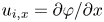 . Comparing both definitions, we arrive at ${\partial \varphi }/{\partial x}|_{x=0}={\partial \chi }/{\partial t}$
 . The plasma–vacuum interface is subject to two competing (oppositely directed) pressure mechanisms, namely the negative pressure gradient due to the surface electrons i.e. $\nabla _{n}E^{2}$
 acting upwards and the thermal pressure acting downwards to the surface. To describe this situation, we may follow Laplace's formula (Landau & Lifshitz Reference Landau and Lifshitz1984) for an incompressible radiative electron–ion plasma,

where $P$ and $P_{0}$
 denote the pressure terms due to the two distinct media (plasma and vacuum respectively) and $\epsilon$
 is the surface tension coefficient. Furthermore, we may obtain an evolution equation for the plasma variation on the interface by taking into account (2.19)–(2.20) and integrating (2.12) – taking into account (1.3) – to find

Assuming $T_{e}\gg T_{i}$ , we henceforth neglect radiation and thermal effects associated with the ion component; as for the electrons, we have introduced $\delta T_{e}$
 , which denotes temperature fluctuations on the interface as a function of the surface coordinates. (The subscript ‘$e$
 ’ may later be omitted where obvious.) At the interface, the sharp boundary conditions can be obtained from (2.17)–(2.18) as


From (2.8)–(2.9) we obtain the following MHD equation:

Linearizing (2.24) and writing down the $x-$ component, we obtain

Next, differentiating (2.21) with respect to $t$ and making use of (2.22)–(2.25), we get

where $V_{A}=B_{\boldsymbol {0}}/\sqrt {4{\rm \pi} \rho _{i}}$ is the standard (magnetic-field related) Alfvén speed and $V_{E}=E_{0}/\sqrt {4{\rm \pi} \rho _{i}}$
 represents an analogous characteristic (electric field related) speed for the ions.
To evaluate the (non-relativistic) temperature oscillations $\delta T$ , we shall make use of the energy equation (Tsintsadze Reference Tsintsadze1995)

where $T_{e}$ is the (non-relativistic) electron temperature, and $n$
 ($\simeq n_{e,0}=n_{i,0}$
 ) in the latter expression is the incompressible fluid density (at quasi-equilibrium) and $U_{r,e}$
 denotes the electron radiation energy density.
The Poynting vector $\boldsymbol {S}$ ($=\boldsymbol {S}_{e}$
 ) is defined in terms of the electron heat flux through radiative heat conduction (Chandrasekhar Reference Chandrasekhar1984; Mihalas & Mihalas Reference Mihalas and Mihalas1984) as

where $L_{0}=4( \lambda c/3) \beta T_{e}^{3}$ is the coefficient of thermal radiation conductivity and $\lambda$
 represents the Rosseland radiation mean free path $\lambda =A\,T_{e}^{\kappa }$
 , where $\kappa =1,2,3,\ldots$
 (i.e. a positive integer) and $A$
 is a positive quantity. (Note that Boltzmann's constant will henceforth be omitted for simplicity, hence the temperature symbol $T_{e}$
 appearing in forthcoming relations will be expressed in energy units.)
Substituting the expressions for $U_{r,e}$ and for $\lambda$
 into (2.28), we obtain

where $\eta =\kappa +4$ . At the interface, we may write

where $T_{e,0}$ denotes the electron temperature at equilibrium, which is a function of the surface coordinate(s), while $\delta T_{e}$
 represents small temperature variations on the interface and is independent of the surface coordinates.
At equilibrium, (2.27) reduces to $\boldsymbol {\nabla }\boldsymbol {\cdot }( {\boldsymbol {S}_{e}}/{n}) =0$ , hence following the procedure of Tsintsadze et al. (Reference Tsintsadze, Rozina, Shah and Murtaza2007) – cf. (1.3)–(2.2) therein – one obtains the relation

Integrating the above equation twice, with the boundary condition $T_{e,0}=0$ at $x=x_{s},$
 we get

where $x_{s}$ is the surface coordinate and $\theta$
 is the constant temperature inside the plasma. Equation (2.32) indicates that at equilibrium, temperature is a function of surface coordinate $x$
 . Furthermore, it shows that at $x=x_{s}$
 the temperature diminishes, representing the sharp variation on the boundary, i.e. across the plasma–vacuum interface. Substituting (2.29) into the linearized $x$
 -dimensional version of (2.27) leads to

Recall that the density $n( \simeq n_{e,0}=n_{i,0})$ is constant, i.e. time- and space-invariant. Applying a Fourier transformation, viz. $\delta {\varphi }\sim \exp [\textrm {i}( k_{y}y+k_{z}z-\omega t) +kx]$
 on the above equation, we obtain

where

Substituting (2.34) in (2.26), we obtain the following dispersion relation:

where

and

where $b^{2}=2\epsilon /\rho _{i}$ is the capillarity constant. (Note that the equation of state (1.3) was used in the last step, to show the dependence of the coefficients on the electron temperature $T_{e}$
 .) Equation (2.36) represents the propagation of capillary–gravity surface waves at the interface between a (magnetized radiative) plasma and vacuum.
Let us now explore the dispersion equation (2.36) in some special cases.
2.1. Capillary radiative Jeans surface instability
First, let us assume that the imaginary part of (2.36) is absent, hence that the dissipative term is absent in (2.27) (viz. $S_{e}=\boldsymbol {0}$ ), or $\nu =0,$
 to obtain the dispersion relation describing the magnetocapillary radiative Jeans surface instability of an inhomogeneous incompressible electron–ion plasma:

Note, for comparison, that the dispersion relation of the Jeans instability derived by Tsintsadze et al. (Reference Tsintsadze, Rozina, Shah and Murtaza2008) was for a homogeneous compressible dusty (i.e. three-component) plasma. The associated growth rate of the Jeans surface instability reads

Equation (2.40) governs the fragmentation of astrophysical objects via their surface oscillations when the electron surface charge density and the ion surface mass density couple together to enhance the oscillation rate of these objects, whereas gravity radiation, magnetic field and surface tension effects stabilize the Jeans surface instability.
2.2. Gravitational radiation
We may now assume that the plasma is unmagnetized and also neglect the surface tension. We thus obtain the simpler dispersion relation

We see that radiation does not modify the longitudinal dispersion relation, but it only appears as gravitational radiation on the interface, and actually plays a stabilizing role on the Jeans surface instability. Equation (2.41) provides us with a new definition of the Jeans wavelength, i.e. the Jeans wavevector

incorporates the effect of gravitational radiation. If we substitute the numerical values, shown below in § 3, in (2.42), we may eventually obtain the threshold value of the Jeans wavevector, $k_{J}=5.53\times 10^{-6}\ \textrm {cm}^{-1}$ . It may be noted here that for any length scale larger than $k_{J}(=5.53\times 10^{-6}\ \textrm {cm}^{-1}),$
 the electromagnetic field can overcome the Jeans instability as is evident from (2.41). Moreover, in the absence of surface charge and mass density, pure radiative gravity waves will propagate on the interface as

so that the group velocity of gravity radiation becomes, in terms of the wavenumber $k$ (and thus the wavelength $\lambda =2{\rm \pi} /k$
 )

2.3. Dissipative instability
Finally, in the presence of a dissipative surface effect, i.e. $\nu \neq 0$ , there may exist, in (2.36), values of propagation vector

for which (2.36) reduces to

or, assuming $|\nu |^{2}\ll \omega ^{2}$ ,

where $k_{\pm }=({1}/{b^{2}})(V_{E}^{2}-V_{A}^{2}\cos ^{2}\theta )\pm ({1}/{b^{2}})\sqrt {(V_{E}^{2}-V_{A}^{2}\cos ^{2}\theta )^{2}-(b^{2})^{2}( \gamma _{g}^{{\prime }}-4{\rm \pi} G\rho _{si}) }$ . Among the three possible complex roots of the above equation, one root leads to instability of surface waves due to electromagnetic (thermal) radiation in the plasma medium with a growth rate, say $\hat {\gamma }$
 , given by

provided that radiation acts for a short time, say $\tau \ll \omega ^{-2}$ (viz. $|\nu |^{2}\tau ^{2}\ll 1)$
 . Equation (2.47) shows that the growth rate of the radiative dissipative instability depends on the temperature inhomogeneity (due to radiative heat flux) as well as the thermal radiation pressure.
3. Numerical analysis
We have investigated the dispersion relation, as well as the growth rate of unstable modes, relying on (2.39), (2.41), (2.44) and (2.47) in their respective regions of validity, both numerically and graphically, to explore the impacts of the surface charge and mass densities, as well as the radiation energy flux and thermal radiation pressure on the growth rate of the surface Jeans instability in an incompressible, self-gravitating, radiative electron–ion plasma. For this purpose, we have chosen a set of representative values for the low-density and high-temperature plasmas (Post et al. Reference Post, Jensen, Tarter, Grasberger and Lokke1977) as $n_{i0}=n_{e0}=n_{0}\approx 10^{12}\ \textrm {cm}^{-3}$ , $T_{e,0}=( 2\times 10^{4}-8\times 10^{4})\ \textrm {K}$
 and $B_{0}=5.88\ G$
 . By substituting these parameters and taking the surface coordinate $x=0.12\ \textrm {cm}$
 and $T_{e,0} =2\times 10^{4}\ \textrm {K}$
 in (2.41), one can easily calculate various physical parameters, such as the electric Alfvén velocity $V_{E}(={E_{0}^{2}}/{4{\rm \pi} \rho _{i}}={4{\rm \pi} \sigma _{se}^{2} }/{\rho _{i}}) =1.28\times 10^{6}\ \textrm {cm}\,\textrm {s}^{-1}$
 and the gravitational radiation acceleration $\gamma _{g}=2.70\times 10^{9}\ \textrm {cm}\,\textrm {s}^{2}$
 ; the imaginary part associated with the surface Jeans instability turns out to be $\textrm {Im}(\omega )=6.05\times 10^{3}\ \textrm {s}^{-1}.$
 Furthermore, if $\gamma _{g}$
 increases to a higher value of $9.10\times 10^{9}\ \textrm {cm}\,\textrm {s}^{2}$
 (for $T_{e,0}=3\times 10^{4}\ \textrm {K}$
 ), while keeping all other parameters fixed, the magnitude of the imaginary part reduces to $\textrm {Im}(\omega )=8.92\times 10^{2}\ \textrm {s}^{-1}$
 . This analysis clearly depicts that inhomogeneous gravity radiations tend to stabilize gravitational collapse as shown in (2.36), (2.39) and (2.41).
Figure 1(a) depicts the onset of instability of Jeans surface waves under the influence of gravitational radiation acceleration, as described by (2.39). For $\gamma _{g}=9.13\times 10^{6}\ \textrm {cm}\,\textrm {s}^{2}$ , the threshold value of the Jeans wavevector is $k_{J}=3.25\ \textrm {cm}^{-1}.$
 Increasing $k$
 beyond $k_{J}$
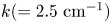
 tends to suppress the growth rate of the instability due to the competition between the surface charge and mass densities and the gravitational acceleration along with magnetocapillary effects in the magnetized plasma under consideration; the growth rate at the specific value of $k( =2.5\ \textrm {cm}^{-1})$
 is $8.71\,\times 10^{4}\ \textrm {s}^{-1}$
 and if the wavevector increases further, this results in a decrease in Im$\omega =6.06\times 10^{4}\ \textrm {s}^{-1}$
 . Furthermore, by increasing the gravity radiation ($\gamma _{g}$
 ) through $T_{e,0}$
 , the threshold value of $k_{J}$
 decreases significantly to reduce the frequency spectrum of magnetocapillary gravity surface waves, while the stability rate increases quickly as a function of $\gamma _{g},$
 pointing out that gravitational collapse may be stabilized through gravitational radiation acceleration. Moreover, the variation of Jeans surface wave instability as a function of electron temperature ($T_{e,0}$
 ) and wavenumber ($k$
 ) can be inspected from figure 1(b). Similar results can be visualized in figure 2, which shows a comparison of the growth rate of the surface Jeans instability with and without the effect of gravity radiation.
(a) The angular frequency ($\omega$ ) of magnetocapillary gravity surface waves (as given in (2.39)) is shown as a function of the wavenumber ($k$
 ) for different values of the gravitational radiation acceleration parameter, namely $\gamma _{g}=9.13\times 10^{6}\ \textrm {cm}\,\textrm {s}^{2}$
 (blue curve) and $\gamma _{g}=5.82\times 10^{8}\ \textrm {cm}\,\textrm {s}^{2}$
 (red curve). The solid curves are for the imaginary part Im($\omega$
 ) (occurring below a certain wavenumber cutoff; cf. panel b), while the dashed curves are for Re$(\omega )$
 . (b) The variation of the instability in Jeans surface waves is plotted against the electron temperature ($T_{e,0}$
 ) and the wavenumber ($k$
 ).

Comparison of the growth rate of the surface Jeans instability without gravity radiation (blue curve) and with gravity radiation (red curve). The solid curves are for $\operatorname {Im}(\omega )$ , while the dashed curves are for Re$(\omega )$
 .

Next, in order to visualize the impact of surface charge on the fragmentation of astrophysical objects, (2.39) is plotted in figure 3 in the absence of $\gamma _{g}$ . This shows an increase in the value of the Alfvén velocity $( V_{E})$
 , through equilibrium surface charge density of electrons $( \sigma _{se})$
 , results in the increase of the amplitude of surface oscillation. Furthermore, the group velocity $( V_{g}=\sqrt {\gamma _{g}/4k})$
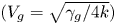 of pure gravity radiations (shown in (2.41)) propagating at the plasma–vacuum interface is plotted as a function of wavenumber $(k)$
 in figure 4 at fixed gravity radiations $\gamma _{g}=9.13\times 10^{6}\ \textrm {cm}\,\textrm {s}^{2}$
 , to depict that the group velocity becomes a function of wavelength $( \lambda =2{\rm \pi} /k)$
 . Finally, in order to visualize the influence of temperature inhomogeneity on the growth rate of radiative dissipative instability of self-gravitating electron–ion plasma, (2.47) is plotted in figure 5. Figure 5 suggests that the growth rate increases with an increase of the thermal radiation energy density and the radiation heat flux via $T_{e,0}$
 via $\gamma _{g}^{{\prime }}.$

The frequency $(\omega )$ of magnetocapillary gravity surface waves in the absence of gravitational radiation (as described by (2.39)) is shown as a function of the wavenumber $(k)$
 for different values of electric Alfvén velocity of ion grains, $V_{E}=1.285\times 10^{6}\ \textrm {cm}\,\textrm {s}^{-1}$
 (red curve) and $V_{E}= 1.284\times 10^{6}\ \textrm {cm}\,\textrm {s}^{-1}$
 (blue curve). The solid curves are for $\textrm {Im}(\omega )$
 , while the dashed curves are for Re$(\omega )$
 .

Group velocity $( V_{g})$ (as shown in (2.44)) as a function of the wavenumber $(k)$
 at fixed values of $\gamma _{g}.$


The growth rate of gravitational radiation instability $( \hat {\gamma })$ (as given by (2.47)) is plotted against the wavenumber ($k$
 ).

4. Conclusions
To conclude, a MHD fluid model has been employed to investigate the properties of surface waves at the interface separating a radiative, dense, incompressible, inhomogeneous, self-gravitating electron–ion plasma and vacuum. It was shown that a negative pressure gradient is generated due to thermal motion in the plane perpendicular to the interface, i.e. $e\delta \varPhi \sim K_{B}\delta T_{e}$ . We draw the conclusion that the Jeans surface instability may be associated with (and contribute to) fragmentation of astrophysical objects through surface oscillations of these objects. It was shown that the combination of gravitational and radiative effects for non-uniform plasma stabilizes the Jeans-type instability of surface waves. Furthermore, pure gravity waves may propagate at the plasma–vacuum interface if some particular condition is satisfied. Finally, we have shown that for a particular wavevector, the interface may undergo radiative dissipative instability.
Funding
This research received no specific grant from any funding agency, commercial or not-for-profit sectors.
Declaration of interests
The authors report no conflict of interest.



