Introduction
According to PAHO (2001) zoonoses are classified as diseases or infections that are naturally transmissible from vertebrates to humans and vice-versa. They are caused by all types of agents including bacteria, parasites, fungi und viruses. Food-borne diseases are especially widespread and pose a growing public health problem worldwide (WHO, 2010, USDA, 2010). As the latest EFSA report (2011a) showed, Salmonella spp. and Campylobacter spp. are two of the most important food-borne infections in humans. campylobacteriosis has been the most commonly reported zoonosis in the EU during the last years with 198,252 cases in 2009. Although a certain reduction in salmonellosis has already been achieved, it was the second most often reported zoonotic disease with 108,614 confirmed human cases in 2009 (EFSA, 2011a). Hence, the control of specified food-borne zoonotic agents in Gallus gallus is an important aim of the European Union (EU, 2003).
Even though both pathogens cause food-borne diseases, are found in the primary food production chain and pose serious threats for the human health, the epidemiology of these diseases differs greatly. A comparative analytical approach can be used to distinguish zoonoses by their risk factors and specific characteristics.
Although there are various publications and reports on risk factors for salmonellosis and campylobacter infections, these mainly investigate only a limited number of risk factors or place a special focus on specific variables (Glünder et al., Reference GLÜNDER, WEBER and AUERBACH2004, Hess, Reference HESS2006, Cox et al., Reference COX, RICHARDSON, BUHR, FEDORKA-CRAY and VIZZIER-THAXTON2010, Thornton, Reference THORNTON2010). An analysis of the interdependence between the complete set of risk factors is not currently available, and a comprehensive and explorative approach is needed to filter the existing information and identify the most important points. The following review covers this topic, applying the Delphi method to differentiate and distinguish the features of these two major diseases.
Study design and process
The Delphi method was developed in the field of science and technology forecasting (Sackman, Reference SACKMAN1974). It is an explorative technique to obtain consensus among expert opinions through a series of structured questionnaires, usually in two to four rounds. The methodological design is based on the features: 1) Anonymous response – the opinions are derived by a formal questionnaire. 2) Iteration and controlled feedback – interaction is effected by a systematic exercise conducted in several iterations, with carefully controlled feedback of the preceding round. 3) Statistical group response – the group opinion is defined as an appropriate aggregate of individual opinions on the final round. These features are designed to minimise the biasing effects of dominant individuals, of irrelevant communications, and of group pressure (Dalkey, Reference DALKEY1969). After each round, an anonymous summary of the experts’ answers from the previous round is given, which encourages participants to revise their earlier answers in light of the replies of other members of the panel. During this process the range of answers/estimates may decrease and converge towards consensus. The mean or median scores of the final round determine the results.
The Delphi design in this study consisted of three rounds in which the experts received a questionnaire by email. The questionnaire was based on literature and reports on Salmonella spp. and Campylobacter spp. All risk factors (112 for each species) gathered from this first step were attributed to 14 risk categories which were related to the likelihood of introduction onto a poultry farm. According to the Delphi procedure, the opinion on the importance of several risk factors related to introduction of salmonella and campylobacter infection at poultry farm level was determined. In round one, an expert panel selected the main risk categories and risk factors which could be used to distinguish between high, medium and low risk poultry farms for Salmonella spp. and Campylobacter spp. introduction. Furthermore, for each category the experts indicated their familiarity with the subject on a scale from one (‘highly competent’) to five (‘not familiar with subject’). Moreover, the experts had the opportunity to give suggestions for additional risk factors which were added to the questionnaire in the second round. In rounds two and three, the risk categories and factors were weighted according to their relative importance by dividing 100 points over each table of risk categories/factors. The questionnaires of rounds two and three included the results of rounds one and two, respectively.
Composition of the expert panel
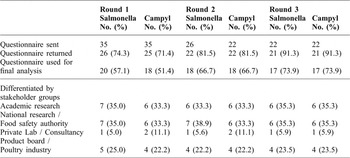
Experts were selected based on their experience in research on Salmonella spp. and Campylobacter spp. as well as in zoonoses prevention and control. In addition, emphasis was put on the involvement of experts from different countries worldwide and from different stakeholder groups (academia, national food safety authorities, industry, etc.). In total, 78 experts were approached; they were either invited directly or were referred to by other experts. The expert panel members were working either for national authorities (e.g. food safety) or at national institutes, universities or companies based in the following countries: Austria, Belgium, France, Germany, Italy, the Netherlands, the United Kingdom, the USA and South Korea. Table 1 shows the return rates of the questionnaires, as well as the composition of the expert panel, by stakeholder group, in rounds one to three. Only questionnaires with an average self rated expertise higher then 3.5 (categorised as ‘familiar’ or better) were used.
Return rate of the questionnaires in rounds one to three by composition of the expert panel by stakeholder groups.

Results
main risk categories for Salmonella spp. introduction
To get some basic insights into the relative importance of the different risk categories, the average weightings of round three were summarised (Figure 1) and visually compared to the uniform distribution. The highest average ratings for Salmonella spp. introduction included category (G) ‘cleaning and disinfection between cycles’ (13.1%) ; (J) ‘delivery and collection of live birds’, (12.1%) ; (E) ‘hygiene in the stocked poultry house’ (10.3%) ; (I) ‘pest control’ (9.3%) and (K) ‘feed management’ (9.1%). In total, more than half of the points (55.1%) fell within these top five categories. The categories (M) ‘litter & manure management’, (N) ‘carcass handling’ and (L) ‘water management’ together received less than ten points (Figure 1).
The standard deviation (SD) describes the dispersion of a set of data from its mean and can be used to interpret the opinion of the experts on certain risk categories or risk factors additionally. A low standard deviation indicates that the experts tend to use a similar weight whereas a high value shows that the weights are spread apart. One could assume that low SD values indicate reliable, sound results and high SD values unreliable results with a high potential for more research.
Category (J); ‘the delivery and collection of live birds’ showed the highest SD value (Figure 1) indicating that opinions varied a lot in this category and the interpretation of this category as the second most important category for Salmonella spp. introduction should be done only with special care. The category (L) ‘water management’ received the lowest SD value followed by (N) ‘carcass handling’ as well as (M) ‘litter and manure management’. Hence, a lower importance for introduction was deduced. The categories C, F and I could be interpreted as important factors for Salmonella spp. introduction as they are located below the average SD value and received higher mean weightings.
main risk categories for Campylobacter spp. introduction
Average weights for the introduction of Campylobacter spp. given in round three were highest for (J) ‘delivery and collection of live birds’ (13.7%), (E) ‘hygiene in the stocked poultry house’ (12.1%), (G) ‘cleaning & disinfection between cycles’ (10.2%), (I) ‘pest control’ (9.4%) as well as (F) ‘staff hygiene and education’ (8.5%). These top five categories achieved more than 55% of points (Figure 2). In total, less than 10% of the points fell upon the three categories (N) ‘carcass handling’, (M) ‘litter & manure management’ and (K) ‘feed management’.
According to Salmonella spp., the weighting for category J showed highest variation. Again the interpretation of this finding needs to be done carefully. The categories with the lowest SD values included (K) ‘feed management’, (M) ‘litter & manure’, (B) ‘farm management’ and (D) ‘poultry house – state of repair’. Once again the three categories (C) ‘poultry house management’, (I) ‘pest control’ and (F) ‘staff hygiene and education’ show a relatively low SD and higher mean weights.
A direct comparison can be seen in Figure 3. For both zoonoses, the risk categories J, G, E and I had the highest ratings. The most obvious difference was seen for the categories ‘feed management’ (K) and ‘water management’ (L). Whereas ‘feed management’ (K) is rated as a top five category (9.1%) for Salmonella spp. introduction, the meaning for Campylobacter spp. introduction was much less important, as it ranked 14 (2.9%). In case of the water management, this relationship was reversed.
important risk factors
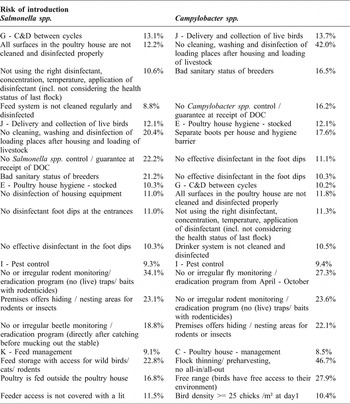
In Table 2, the most important risk factors (top three) of the highest rated risk categories are summarised. The top five risk categories were selected by the highest mean weightings.
A comparison of the highest rated risk factors (top three) in the top five risk categories showed that two thirds of the risk factors for Salmonella spp. and Campylobacter spp. match in each case, but show a difference within the rankings For category (J) ‘delivery and collection of live birds’ the risk factors are completely the same but differ in ranking. In this category, an outstanding high average weighting (42.0% of the total points) for Campylobacter spp. was given for the risk factor ‘no cleaning, washing and disinfection of loading places after housing/loading of birds’, whereas the risk factors on rank two and three only received 16.5% and 16.2% of the weighting. A comparison of the results for Salmonella spp. showed that the three most important risk factors received almost the same weighting (20.4-22.2% of the total points respectively). For Salmonella spp., the introduction category (I) ‘pest control’ showed the highest ratings for the factors of ‘rodent control’ (34.1%) and ‘beetle control’ (18.8%) as well as for the presence of hiding /nesting sites for rodents and insects (23.1%). In contrast to salmonellosis, the risk factors ‘fly control programs’, ‘rodent control’ and ‘hiding/ nesting areas’ received the highest ratings for Campylobacter spp. introduction. While the risk factors of ‘feed management’ (K) were important for Salmonella spp. they were not for Campylobacter spp. For the latter the factors for ‘poultry house management’ (C) were rated as the most important, especially flock thinning/ preharvesting, no all-in/all-out’ which received the highest ratings (46.7%).
Category (G) ‘cleansing & disinfection between cycles’ contained important factors for both zoonoses. The two main factors ‘not using the right disinfectant, concentration, temperature, application of disinfectant’ and ‘all surfaces in the poultry house not cleaned and disinfected properly' received almost similar weightings. Only the third risk factor differed between both zoonoses. While the cleaning of feed systems (8.8%) is rated as an important factor for Salmonella spp. introduction, the cleaning of the drinker system (10.5%) was found to be more important for Campylobacter spp. introduction.
Overview on risk factors of highest rated risk categories ranked by lowest standard deviation (SD).

results by stakeholder groups
To further differentiate the results, the mean weights of round three were examined by the four stakeholder groups described before. The number of participants in each of the stakeholder groups varies between two and eight experts per group.
The mean weights for Salmonella spp. risk categories by the different stakeholder groups are summarized in Figure 4. Three groups of experts gave their highest weightings to categories (G) ‘cleaning and disinfection between cycles’ and (E) ‘poultry house hygiene in the stocked house’. The experts of group ‘private lab/consultancy’ gave the highest weighting to the category (J) ‘delivery & collection of live birds’ and gave 37.5% of the total points to this category followed by (F) ‘staff hygiene and education’. Besides, the stakeholder group ‘academic research’ also considered high ratings above the average mean for (I) ‘pest control’ and (K) ‘feed management’ and (J) ‘delivery and collection of live birds’ as quite important.
Figure 5 displays the average weightings of the stakeholder groups for the Campylobacter spp. risk categories. Again, the category (J) ‘delivery & collection of live birds’ as well as (I) ‘pest control’ got by far the highest weighting (39% and 15% of the total weighting respectively) from the expert group ‘private lab/consultancy’. For this zoonosis, the stakeholder group ‘academic research’ follows this opinion by forgiving a share of 14.6% of the total points. In contrary, the stakeholder groups ‘National research / Food safety authority’ as well as ‘Product board/Poultry industry’ consider (E) ‘hygiene in the stocked poultry house’ as the most important risk categories. The category (G) ‘cleaning & disinfection measures between cycles’ got also high rates above the average from the groups ‘Product board/Poultry industry’ and ‘Academic research’. Furthermore, the academic group rated the category (H) ‘livestock and pets’ clearly higher than the others (11.3% against lower 4.8%).
Discussion of the results
In the following paragraph, the results for the risk categories and factors are compared with the findings of different publications as well as with the latest EFSA and USDA publications which summarise current European and American opinions. Moreover, the study design and the usage of this method will be discussed in the light of the results from the self rated expertise of the experts.
risk categories and factors
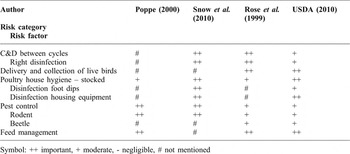
Table 3 and 4 present the top five risk categories and selected factors in contrast to other publications. For both zoonoses it can be seen that all papers identified missing or deficiencies in biosecurity measures (e.g. disinfection practices or hygiene barriers) as an important risk factor which was also rated as important (with low standard deviation) by the Delphi experts. For salmonella introduction risk, feed management is often mentioned as an important risk category. A low standard deviation (Figure 1) and various descriptions in literature show that Delphi experts as well as other authors are of the same opinion. Other categories mentioned in literature which received lower weightings by the expert panel were bird density, housing systems, litter- and water management as well as the presence of other animals like birds and other mammals. Snow et al. (Reference SNOW, DAVIES, CHRISTIANSEN, CARRIQUE-MAS, COOK and EVANS2010) analysed a set of factors and rated for example pest control, bird density as most important and for example the type of housing system and presence of other mammals as moderate important. Poppe (Reference POPPE2000) described the scientific opinion on different currently discussed factors. In addition to the listed factors of Table 3, he also identified housing systems, litter- and water management as more important than presence of other animals. The guideline of the USDA (2010) also suggested the categories water- and litter management for Salmonella introduction risk.
Comparison of the identified top five risk categories and factors of Salmonella introduction risk with the findings in other publications.

Symbol: ++ important, + moderate, - negligible, # not mentioned
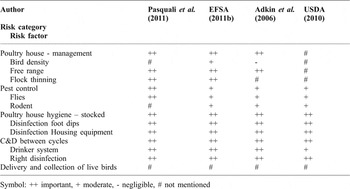
As can be seen from Table 4, cleansing and disinfection practices were rated as important measures to prevent the introduction of campylobacter. Poultry house management especially housing systems with free range and thinning practices were described as factors of high introduction risk scientifically. Other factors mentioned were litter and water management (Adkin et al., Reference ADKIN, HARTNETT, JORDAN, NEWELL and DAVISON2006, USDA 2010, Pasquali et al., Reference PASQUALI, DE CESARE, MANFREDA and FRANCHINI2011).
Notably, the fact that ‘delivery and collection of live birds’ was rated as important by the expert panel but was accompanied with a high standard deviation (Figure 1), indicating high uncertainty among the experts. In addition, this category was not specified in the analysed literature. The reason could be the fact that there is currently no Campylobacter spp. control/ monitoring for day old chicks as it is the case for salmonella control. Moreover, the research on campylobacter epidemiology has only become important in the last few years and there may be limited experience or investigations on this topic so far. Feed management was rated as the lowest risk factor for campylobacter introduction by the expert panel. Pasquali et al. (Reference PASQUALI, DE CESARE, MANFREDA and FRANCHINI2011) and Adkin et al. (Reference ADKIN, HARTNETT, JORDAN, NEWELL and DAVISON2006) identified a low risk, too. This is a clear difference compared to introduction risk of salmonellosis (Table 3).
Comparison of the identified top five risk categories and factors of campylobacter introduction risk with the findings in other publications.

Symbol: ++ important, + moderate, - negligible, # not mentioned
As recognised from the literature review as well as from the results obtained, it can be concluded that knowledge about Salmonella spp. is much more comprehensive than on Campylobacter spp. and that there is still a large demand for further research in this area.
pro's and con's of the analysis
The analysis of the dataset and the comments of the experts identified some weak parts of the questionnaire. The main weaknesses were the missing differentiation between egg and meat production as well as some less imprecisely specified risk categories and factors. A detailed and more extended pre-test should be implemented in further studies. The differentiation by serotypes was not content of this baseline study but it could be subject for further analysis.
In addition, the weighting procedure was rated as very time consuming by the experts. Due to the fact that all risk categories and factors were considered to be important, none of the factors were deleted after round one (threshold value of 75% was not reached). Therefore, the amount of risk factors remained high and made it quite difficult to distribute 100 points. For further studies, a lower threshold or a more focused collection on risk factors could improve the answer conditions for the experts. The alternative procedure only to focus on the factors with the highest obtained level of agreement in round one was suggested. It could not be used within this study because this design does not completely comply with the Delphi format. For future studies, the implementation of this idea could be an interesting approach.
In total, 60.7-75.0% of the experts rated their own expertise in round one as 1 (highly competent), 2 (competent) or 3 (familiar) for the single categories. This indicates that there was sufficient competence in the expert panel on all subjects in the questionnaire. However, when comparing the self-rated expertise, slight differences were found. This can be explained by the fact that both zoonoses differ considerably in their epidemiological character (Wedderkopp et al., Reference WEDDERKOPP, GRADEL, JORGENSEN and MADSEN2001, Thornton, Reference THORNTON2010, USDA, 2010).
The typical Delphi characteristic of convergence towards consensus by participants revising their earlier answers in light of the replies of other panel members seems to have been partly present. For some risk categories and factors, a relatively high dispersion of values was observed among the experts (e.g. delivery and collection of live birds) and it is not likely that for some of these factors consensus among the members of the expert panel will be reached. This is not surprising as there is still a lot of debate about some issues among stakeholders - especially on Campylobacter spp. (e.g. transmission paths) (Adkin et al., Reference ADKIN, HARTNETT, JORDAN, NEWELL and DAVISON2006). A complete analysis of the range of opinions for each risk category can be requested from the corresponding author.
Conclusions
Worldwide there is still a large number of campylobacteriosis and salmonellosis in humans. Control programs in food production and vaccination of animals induced a significant reduction of salmonellosis. But scientific research and control measures show that there is a clear epidemiological difference between both zoonoses and that salmonella control measures only partly work with the same success for campylobacter control.
The main objective of the presented study was to identify zoonosis-specific risk factors to further distinguish both zoonoses and to enable a target-oriented prevention on farm level. Both the results of this study and the review of latest publications highlighted a large gap in the research on campylobacter. Alter et al. (Reference ALTER, BERESWILL, GLÜNDER, HAAG, HÄNEL, HEIMESAAT, LUGERT, RAUTENSCHLEIN, WEBER, ZAUTNER and GROß2011) criticised this lack of knowledge on infection biology as it relates to the behaviour of zoonoses, especially campylobacter, to initialise efficient prevention and control measures.
A more focused and targeted knowledge of introduction paths and spreading patterns of both zoonoses on farm level, as well as on the other elements of the food chain (e.g. feed mill, hatchery) are important topics to deal with in future research (Fraser et al., Reference FRASER, WILLIAMS, POWELL and COOK2009); especially with respect to increasing antibiotic resistances (Kent et al., Reference KENT, FAROUK, MAIN and HOARE2008).
Acknowledgement
The following study is part of the research project ‘Complementary Use of Vaccination and Phage Technology for Improved Control of Campylobacter spp. and Salmonella spp. in Primary Poultry Production and Food Processing Industry’ funded by the NBank Niedersachsen (EU funds for technical and scientific development of single states in Germany).