INTRODUCTION
Prenatal alcohol exposure can result in a wide variety of detrimental effects on the fetus that confer risk for later impairments (Mattson, Crocker, & Nguyen, Reference Mattson, Crocker and Nguyen2011; Riley, Infante, & Warren, Reference Riley, Infante and Warren2011). Fetal alcohol spectrum disorders (FASD) encompass the range of physical, cognitive, and behavioral deficits due to prenatal alcohol exposure. Recent estimates suggest a prevalence of ~2–5% among school-age children (May et al., Reference May, Baete, Russo, Elliott, Blankenship, Kalberg and Hoyme2014, Reference May, Keaster, Bozeman, Goodover, Blankenship, Kalberg and Hoyme2015, Reference May, Chambers, Kalberg, Zellner, Fedlmen, Buckley and Hoyme2018), identifying FASD as a serious public health concern.
Extensive research has investigated the areas of neurobehavioral functioning impacted by prenatal alcohol exposure (Mattson & Riley, Reference Mattson and Riley1998; Mattson et al., Reference Mattson, Crocker and Nguyen2011; Riley et al., Reference Riley, Infante and Warren2011). One such area is communication (Crocker, Vaurio, Riley, & Mattson, Reference Crocker, Vaurio, Riley and Mattson2009; LaDue Streissguth, & Randels, Reference LaDue, Streissguth and Randels1992; Mattson et al., Reference Mattson, Crocker and Nguyen2011; Streissguth et al., Reference Streissguth, Aase, Clarren, Randels, LaDue and Smith1991), including both functional and social communication, which comprises one’s ability to exchange information as well as connect with others. Young children with FASD display greater impairment in communication ability as reported by parents and caregivers than typically developing controls (e.g., trouble maintaining conversation, answering questions, staying on topic). Furthermore, children with prenatal alcohol exposure show deficits on measures of receptive and expressive language (Akbarian, Reference Akbarian1992; Carney & Chermak, Reference Carney and Chermak1991; Church & Kaltenbach, Reference Church and Kaltenbach1997; Church, Eldis, Blakley, & Bawle, Reference Church, Eldis, Blakley and Bawle1997; Gentry et al., Reference Gentry, Griffith, Dancer, Davis, Eaton and Schulz1998; McGee, Bjorkquist, Riley, & Mattson, Reference McGee, Bjorkquist, Riley and Mattson2009; Wyper & Rasmussen, Reference Wyper and Rasmussen2011), which can impact communication skills. Importantly, communication abilities among individuals with FASD are worse at older ages than younger ages, suggesting that these individuals experience an arrest in development rather than a delay (Crocker et al., Reference Crocker, Vaurio, Riley and Mattson2009), although longitudinal studies are still needed to clarify this trajectory. The clinical impact of impaired communication ability is clear, as evidenced by the link between communication disorders, emotional disorders, and behavioral disorders in children and adolescents (Prizant et al., Reference Prizant, Audet, Burke, Hummel, Maher and Theadore1990). These communication deficits can result in diminished quality of life as impaired communication puts children at risk for learning and psychiatric disorders (Prizant et al., Reference Prizant, Audet, Burke, Hummel, Maher and Theadore1990), both of which are elevated among youth with FASD (Fryer, McGee, Matt, Riley, & Mattson, Reference Fryer, McGee, Matt, Riley and Mattson2007).
In other neurodevelopmental disorders (e.g., autism spectrum disorders, specific language impairment), cognitive variables such as executive function, working memory, and language contribute to communication ability (Finneran, Francis, & Leonard, Reference Finneran, Francis and Leonard2009; Im-Bolter, Johnson, & Pascual-Leone, Reference Im-Bolter, Johnson and Pascual-Leone2006; McEvoy, Rogers, & Pennington, Reference McEvoy, Rogers and Pennington1993; Spaulding, Plante, & Vance, Reference Spaulding, Plante and Vance2008). For example, among children with specific language impairment (SLI), deficits on measures of working memory have been shown to relate to language abilities (Weismer, Evans, & Hesketh, Reference Weismer, Evans and Hesketh1999). Aspects of executive function, such as inhibition, are likewise impaired, which contributes to language difficulties among children with SLI (Im-Bolter et al., Reference Im-Bolter, Johnson and Pascual-Leone2006). Similar to SLI, particular aspects of language are difficult for individuals with FASD (e.g., speech discrimination, comprehension; Akbarian, Reference Akbarian1992; McGee et al., Reference McGee, Bjorkquist, Riley and Mattson2009), making these individuals more vulnerable to impairment (Akbarian, Reference Akbarian1992). As such, individuals with FASD often struggle to meet the demands of social and functional communication, which require intact social cognition, executive functioning, and language skills (Coggins, Timler, & Olswang, Reference Coggins, Timler and Olswang2007). However, the relationship between cognitive variables and communication ability has not been explored in individuals with prenatal alcohol exposure.
While evidence exists for functional communication (i.e., practical communication to get one’s needs met) deficits among youth with heavy prenatal alcohol exposure, as emphasized above, the cognitive bases for these deficits have not been explored. Some studies highlight a link between certain cognitive skills, such as executive function, and social skills (Schonfeld, Paley, Frankel, & O’Connor, Reference Schonfeld, Paley, Frankel and O’Connor2006), but these connections have not been made with communication ability explicitly among youth with prenatal alcohol exposure. Theoretical frameworks for communication ability suggest social cognition, language, and executive function skills contribute to social and functional communication ability (Coggins et al., Reference Coggins, Timler and Olswang2007); thus, we might expect that these same variables relate to communication ability among individuals with FASD.
The majority of studies investigating communication ability in prenatal alcohol exposure have focused on young children or only individuals with fetal alcohol syndrome (FAS; Akbarian, Reference Akbarian1992; Carney & Chermak, Reference Carney and Chermak1991; Church & Kaltenbach, Reference Church and Kaltenbach1997; Church et al., Reference Church, Eldis, Blakley and Bawle1997; Coggins et al., Reference Coggins, Timler and Olswang2007; Gentry et al., Reference Gentry, Griffith, Dancer, Davis, Eaton and Schulz1998; McGee et al., Reference McGee, Bjorkquist, Riley and Mattson2009; Wyper & Rasmussen, Reference Wyper and Rasmussen2011). However, adolescence is a time during which greater difficulties can emerge due to decreased adult supervision, increased peer pressure, and greater requirement of independent functioning (Streissguth, Reference Streissguth1986). Further investigation is likewise needed to determine communication ability among all individuals with FASD, not just those diagnosed with FAS. In doing so, the profile of abilities across the full spectrum of alcohol exposure will be strengthened. Thus, exploration of these abilities among adolescents with prenatal alcohol exposure is of utmost importance.
Investigation into the cognitive bases of communication ability among youth with histories of heavy prenatal alcohol exposure will help clarify the cognitive mechanisms that contribute to communication deficits and identify potential routes for intervention to improve communication ability. We aimed to explore whether cognitive variables could significantly predict communication ability among adolescents with heavy prenatal alcohol exposure. We hypothesized that: (1) cognitive variables (working memory, executive function, language) shown to be predictive in other neurodevelopmental disorders would significantly predict communication ability in alcohol-exposed youth; and (2) these cognitive variables would show differential relationships with communication ability between alcohol-exposed youth and typically developing controls.
METHODS
General Methods
As part of the Collaborative Initiative on Fetal Alcohol Spectrum Disorders, Phase Three (CIFASD III) multisite study, subjects (N=302) aged 10–16 (M=13.28) completed a comprehensive battery including neuropsychological and behavioral measures. CIFASD methodology has been described elsewhere (Mattson et al., Reference Mattson, Foroud, Sowell, Jones, Coles and Fagerlund2010). Children were tested at four sites: (1) Center for Behavioral Teratology at San Diego State University, (2) University of Minnesota FASD Program, (3) Marcus Institute at Emory University, and (4) Children’s Hospital at the University of Southern California. Subjects were recruited through community and clinical referral, including schools, professional referrals, advertisements, and community outreach. Within one session, caregivers completed questionnaires and an interview while subjects were administered a standardized, 3-hr neuropsychological battery. Informed consent and assent were obtained from all caregivers and subjects before participation. Financial incentive was provided to caregivers and subjects. The Institutional Review Board at each site approved study procedures.
Subjects
Adolescent (age 10–16 years) subjects comprised two groups: prenatal alcohol exposure (AE; n=142) and typically developing controls (CON; n=160). Subjects in the AE group had confirmed histories of heavy prenatal alcohol exposure, defined as a pattern of heavy or binge drinking at any point in pregnancy evidenced by maternal consumption of >13 drinks per week or >4 drinks per occasion on average (Jones et al., Reference Jones, Robinson, Bakhireva, Marintcheva, Storojev, Strahova and Chambers2006; Mattson et al., Reference Mattson, Foroud, Sowell, Jones, Coles and Fagerlund2010). In cases where direct maternal report was not available, a review of medical, social services, or court records was required. In these cases, subjects were included in the AE group if there was documentation of alcohol abuse or dependence in the biological mother or if exposure was suspected and the child met criteria for FAS.
Specific information regarding maternal drinking patterns was not available for all subjects; within the AE group, 30% of subjects were direct report (i.e., biologic mother) and 70% of subjects were collateral report. Control subjects were recruited from the same communities as the AE group. Subjects were excluded from the CON group if prenatal alcohol exposure was more than minimal. Minimal exposure is defined as no more than 1 drink per week on average and never more than 2 drinks per occasion or if exposure was suspected or unknown. Confirmation of alcohol exposure histories occurred by direct report for 94% of control subjects, and the remaining 6% of subjects’ histories were verified by means of collateral report.
Subjects were also excluded from the CON group based on parent report (on study intake questionnaire) of clinically significant behavioral problems or previous clinical diagnoses [e.g., attention-deficit/hyperactivity disorder (ADHD)] at the time of initial study enrollment. Additional exclusion criteria for both groups included: primary language other than English, being adopted from abroad within 2 years of participation or after the age of 5, history of significant head injury and/or loss of consciousness greater than 30 min (no subjects had loss of consciousness greater than 5 min), or presence of a severe mental, psychiatric, or physical disability that precluded participation in the study (e.g., autism spectrum disorder, active mania or psychosis, blindness).
An estimate of general intellectual ability was obtained using the General Conceptual Ability (GCA) index score from the Differential Ability Scales – Second Edition (DAS-II; Elliott, Reference Elliott2007) and presence of symptoms associated with psychiatric conditions was determined using the Computerized Diagnostic Interview Schedule for Children Version IV (C-DISC-4.0; Shaffer, Fisher, Lucas, Dulcan, & Schwab-Stone, Reference Shaffer, Fisher, Lucas, Dulcan and Schwab-Stone2000), which was conducted in person while subjects completed testing. The rates of symptoms associated with psychiatric and behavioral conditions within the AE group are presented in Supplementary Table 1. Finally, all subjects were examined for the presence of FAS based upon CIFASD criteria (Jones et al., Reference Jones, Robinson, Bakhireva, Marintcheva, Storojev, Strahova and Chambers2006; Mattson et al., Reference Mattson, Foroud, Sowell, Jones, Coles and Fagerlund2010).
Measures
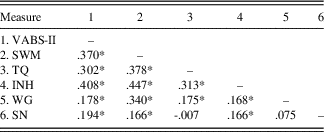
Measures from the CIFASD III test battery were selected to assess the relation between communication ability and performance in three cognitive domains: working memory, executive function, and language. The larger CIFASD neuropsychological test battery included the DAS-II, the California Verbal Learning Test-Children’s Version (CVLT-C), and selected subtests from the following tests: CANTAB, NEPSY-II, and Delis-Kaplan Executive Function System (D-KEFS). Initially, measures were chosen from this battery based on a theoretical relation with communication ability. Preliminary correlation analyses were used to test these relationships and selected measures were included in analyses if they showed a significant (p<.05) and strong correlation with Vineland Adaptive Behavior Scales – Second Edition (VABS-II) Communication (see Table 1). Measures included in final analyses are described below.
Correlation results for included measures

Note: *p<.001 level. Correlation analyses determined whether chosen variables significantly correlated with communication ability. Communication standard scores from the Vineland Adaptive Behavior Scales – Second Edition (VABS-II) served as the outcome variable of interest. Spatial Working Memory (SWM) was measured by Total Errors z-score from the CANTAB; Twenty Questions (TQ) was measured by Initial Abstraction scaled score from the Delis-Kaplan Executive Function System (D-KEFS); Inhibition (INH) was measured by Total Errors scaled score from the NEPSY-II; Word Generation (WG) was measured by Semantic and Initial Combined scaled score from the NEPSY-II; Speeded Naming (SN) was measured by Combined scaled score from the NEPSY-II.
Vineland Adaptive Behavior Scales – Second Edition, Questionnaire
The VABS-II (Sparrow, Cicchetti, & Balla, Reference Sparrow, Cicchetti and Balla2005) is a norm-referenced caregiver-report questionnaire that provides information regarding subjects’ ability on three domains of adaptive functioning: Socialization, Communication, and Daily Living Skills. VABS-II Communication domain standard scores served as the dependent variable in all analyses. The Communication domain assesses the individual’s ability to communicate his or her needs and understand others (e.g., “Easily moves from one topic to another in conversation”; “Answers or tries to answer with words when asked a question”; “Stays on topic in conversations; does not go off on tangents”; “Has conversations that last greater than 10 minutes”). Lower scores indicate weaker performance.
CANTAB Spatial Working Memory
The CANTAB (CANTAB; Cambridge Cognition Limited, 2006) is a computer-administered battery of neuropsychological tests. The Spatial Working Memory subtest assesses subjects’ visuospatial working memory ability. This measure requires the subject to locate a blue token hidden inside colored boxes on the screen. Subjects are instructed not to return to a box previously found to have a blue token hidden inside and thus must remember which boxes have revealed a blue token while locating the remaining blue tokens. Although Spatial Working Memory is a nonverbal measure, it may also tap into verbal skills as subjects may use verbal encoding strategies when completing the task. Total Errors z-score was included in analyses, with lower scores indicating weaker performance.
Delis-Kaplan Executive Function System Twenty Questions
The Delis-Kaplan Executive Function System Twenty Questions (D-KEFS; Delis, Kaplan, & Kramer, Reference Delis, Kaplan and Kramer2001)is a well-known collection of tests that assess executive function ability. The Initial Abstraction score from Twenty Questions was selected due to its ability to measure higher-level executive functioning skills. The Twenty Questions subtest is a measure of abstract reasoning, planning, and problem solving, all of which are higher-level components of executive function ability. The subject is required to ask yes/no questions to identify the object chosen by the examiner with the goal of asking the fewest questions possible to identify the object. The Initial Abstraction scaled score was included in analyses. This score measures the number of items eliminated with the first question with lower scores indicating weaker performance. Initial Abstraction captures the subject’s ability to use efficient, verbally mediated strategies to quickly solve a problem, skills that are likely implicated in functional and social communication.
NEPSY-II Inhibition, Word Generation, and Speeded Naming
The NEPSY-II (NEPSY-II; Korkman, Kirk & Kemp, Reference Korkman, Kirk and Kemp2007) is a battery of subtests that measure a wide array of neuropsychological constructs. Three measures were included in analyses to assess inhibition and language abilities: Inhibition Total Errors, Word Generation Initial and Semantic Combined score, and Speeded Naming Combined score. Inhibition was selected as a measure of inhibitory control. Word Generation and Speeded Naming were included as measures of executive function-based language skills and speed of verbal information processing. The Inhibition subtest has three parts: (1) Naming, which requires the subject to name objects (e.g., square or circle) as fast as possible, (2) Inhibition, which requires the subject to name the other object (i.e., square for circle), and (3) Switching, which requires the subject to name the objects under certain conditions (i.e., correct name when object is black, opposite name when object is white). The Total Errors score represents all errors across the three conditions. Word Generation requires the subject to name as many words that fall within a certain category (Semantic) or start with a certain letter (Initial) in 60 s. The Initial and Semantic Combined score represents all correctly named words. The Speeded Naming Combined score measures how quickly the subject can read letters and numbers printed on a page. All NEPSY-II scores are scaled scores (M=10; SD=3) with lower scores indicating weaker performance.
Statistical Analyses
SPSS statistical software v.23 was used for all analyses. Subjects with missing data were excluded from the corresponding analyses. Demographic data were analyzed using either Pearson’s chi-square (categorical data) or univariate analysis of variance (ANOVA; continuous data) techniques. Group differences in communication were tested using independent-samples t tests with VABS-II Communication measuring communication ability. Finally, the relation between the three cognitive domains and communication ability were tested using stepwise multiple regression analyses. Continuous predictor variables were mean-centered before running multiple regression analyses and interaction terms were created between each predictor variable and Group to formally test for group differences.
A stepwise, sequential process of conducting regression analyses was used as follows. We first determined cognitive variables that significantly related to communication ability through correlation analyses. Three domain-specific models of communication ability (working memory, executive function, language) were independently tested in separate domain-based regression analyses to determine those variables that significantly predicted communication. Within each model, variables were initially tested separately to determine those that displayed a main or interaction effect with communication ability. Higher order terms were initially tested with non-significant terms being removed sequentially.
Significant effects were combined into an overall domain-specific model; final models comprised those variables that had a significant main or interaction effect with Communication and accounted for the most variability in Communication scores as measured by R2 . Subsequently, each final domain model was included in the global model. Throughout this process, non-significant variables were removed to identify the strongest and most reliable variables available within our dataset that contribute to communication and to maintain parsimony. An alpha level of p<.05 was used to determine statistical significance.
Evaluation of Covariates
Age and sex were investigated as potential covariates due to their theoretical relationship with communication ability. Interactions between covariates (age, sex) and Group were created to assess homogeneity of regression assumptions for univariate analysis of covariance analyses. An alpha level of p<.05 was used to determine appropriateness as a covariate. Results showed no significant interactions between Group and sex (p=.925) or Group and age (p=.823) on the dependent variable (VABS-II Communication). However, neither sex (p=.338) nor age (p=.768) showed a significant relationship with the dependent variable. Site, race, and ethnicity (i.e., Hispanic or Latino, Not Hispanic or Latino, Unknown) were also investigated as potential covariates due to possible differences across sites. Results showed no significant relationships between the dependent variable (VABS-II Communication) and site (p=.106), race (p=.253), or ethnicity (p=.140). Thus, no covariates were included in subsequent analyses.
RESULTS
Demographic Data
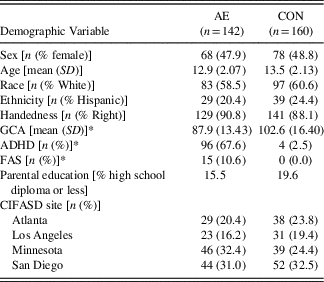
Groups were matched on all demographic variables except GCA (p=.001) and number of subjects meeting ADHD criteria (p<.001). Specifically, the AE group (M=87.9; SD=13.43) had significantly lower GCA scores than the CON group (M=102.6; SD=16.40) and the AE group (n=96; 67.6%) had a significantly higher number of subjects meeting research criteria for ADHD than the CON group (n=4; 2.5%). Based on the C-DISC-4.0, these four children in our control group were at-risk for a clinical diagnosis of ADHD. However, parents of these subjects denied any behavioral or clinical concerns upon study enrollment (an exclusion criterion), suggesting these symptoms have not reached the level at which parents would seek professional help. These subjects were retained in analyses. Demographic data are presented in Table 2.
Demographic data for alcohol-exposed (AE) and control (CON) groups
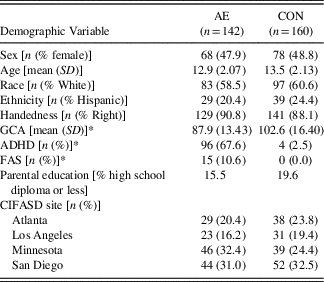
Note: *p<.05 level. General Conceptual Ability (GCA), an estimate of general intellectual ability, was measured using the Differential Ability Scales – Second Edition (DAS-II).
Neurobehavioral Data
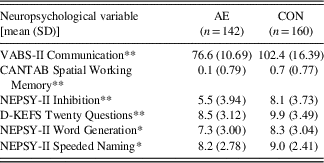
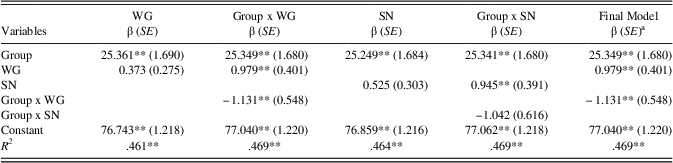
There was a significant difference in Communication scores for the AE (M=76.57; SD=10.69) and CON (M=102.36; SD=16.39) groups (t(285)=−15.60; p<.001). Group performance significantly differed (ps<.05) on all neuropsychological variables (see Table 3). Results from regression analyses are described below for each model. See Tables 4–7 for all final regression results and Figure 3 for final models.
Group performance on neuropsychological variables

Note: Groups significantly (ps<.05*, ps<.001**) differed on all measures. Groups comprised alcohol-exposed (AE) or typically developing control (CON) subjects. Communication was measured by the Communication standard score from the Vineland Adaptive Behavior Scales – Second Edition (VABS-II); Spatial Working Memory was measured by Total Errors z-score from the CANTAB; Inhibition was measured by Total Errors scaled score from the NEPSY-II; Twenty Questions was measured by Initial Abstraction scaled score from the Delis-Kaplan Executive Function System (D-KEFS); Word Generation was measured by Semantic and Initial Combined scaled score from the NEPSY-II; Speeded Naming was measured by Combined scaled score from the NEPSY-II.
Stepwise multiple regression results for Working Memory model

Note: *p<.08, **p<.05. Results presented are from stepwise multiple regression analyses investigating the relation between working memory variables and communication ability. Higher order terms (i.e., interactions) were evaluated first, with non-significant terms removed to maintain parsimony. Group included alcohol-exposed (AE) and typically developing control (CON) subjects. Spatial Working Memory (SWM) was measured by Total Errors z-score from the CANTAB. The dependent variable, communication, was measured by the Vineland Adaptive Behavior Scales – Second Edition (VABS-II) Communication domain standard score.
a The final model consisted only of SWM main effect.
Stepwise multiple regression results for Executive Function model

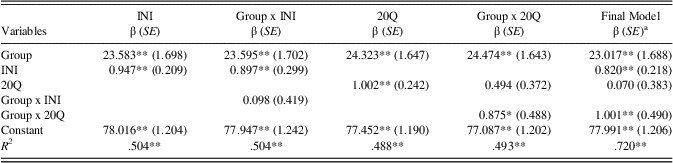
Note: *p<.08, **p<.05. Results presented are from stepwise multiple regression analyses investigating the relation between executive function variables and communication ability. Higher order terms (i.e., interactions) were evaluated first, with non-significant terms removed to maintain parsimony. Group included alcohol-exposed (AE) and typically developing control (CON) subjects. Inhibition (INI) was measured by Total Errors scaled score from the NEPSY-II; Twenty Questions (20Q) was measured by Initial Abstraction scaled score from the Delis-Kaplan Executive Function System (D-KEFS). The dependent variable, communication, was measured by the Vineland Adaptive Behavior Scales – Second Edition (VABS-II) Communication domain standard score.
a The final model consisted of INI main effect and Group x 20Q interaction effect.
Stepwise multiple regression results for Language model

Note: *p<.08, **p<.05. Results presented are from stepwise multiple regression analyses investigating the relation between language variables and communication ability. Higher order terms (i.e., interactions) were evaluated first, with non-significant terms removed to maintain parsimony. Group included alcohol-exposed (AE) and typically developing control (CON) subjects. Word Generation (WG) was measured by Semantic and Initial Combined scaled score from the NEPSY-II; Speeded Naming (SN) was measured by SN Combined scaled score from the NEPSY-II. The dependent variable, communication, was measured by the Vineland Adaptive Behavior Scales – Second Edition (VABS-II) Communication domain standard score.
a The final model consisted of Group x WG interaction effect.
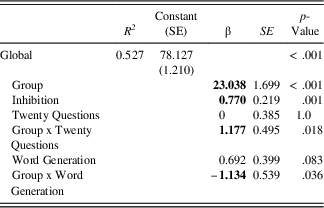
Multiple regression results for final global model

Note: Results presented are from multiple regression analyses investigating the relation between cognitive domain variables and communication ability. Group included alcohol-exposed and typically developing control subjects. Inhibition was measured by Total Errors scaled score from the NEPSY-II; Twenty Questions was measured by Initial Abstraction scaled score from the Delis-Kaplan Executive Function System (D-KEFS); Word Generation was measured by Semantic and Initial Combined scaled score from the NEPSY-II. The dependent variable, communication, was measured by the Vineland Adaptive Behavior Scales – Second Edition (VABS-II) Communication domain standard score.
Working memory
Results from the working memory regressions are presented in Table 4. Spatial Working Memory significantly predicted communication across group. No interaction effect was noted (p=.965); however, Spatial Working Memory showed a significant main effect (p=.039). As a result, the final working memory model comprised only a main effect of Spatial Working Memory (F(2,284)=123.901; p<.001; R 2 =.468).
Executive function
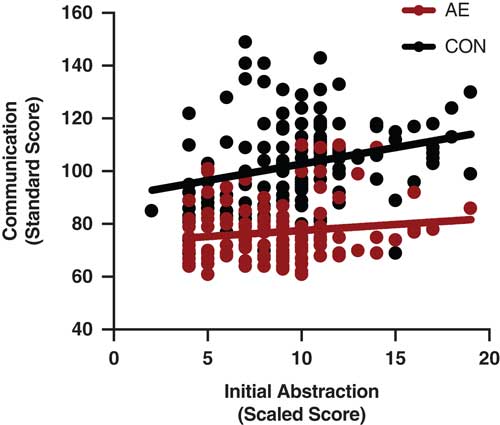
Results from the executive function regressions are presented in Table 5. Inhibition significantly predicted communication ability irrespective of group. No interaction effect was noted for Inhibition (p=.816); however, Inhibition showed a significant main effect (p<.001). The interaction effect of Twenty Questions Initial Abstraction Score was marginally significant (p=.074). Specifically, the relation between Twenty Questions and Communication was significant for the CON group, but not the AE group (see Figure 1). Both the main effect of Inhibition Total Errors (p<.001) and the interaction effect of Twenty Questions Initial Abstraction (p=.042) remained significant when combined into the final executive function model (F(4,278)=73.763; p<.001; R 2 =.720).
Relation between Twenty Questions Initial Abstraction score and Communication by group. In the control (CON) group only, as Initial Abstraction scores increase, predicted Communication scores also increase. Variables were not significantly related in the alcohol-exposed (AE) group. The regression line shows predicted Communication scores based on our model.

Language
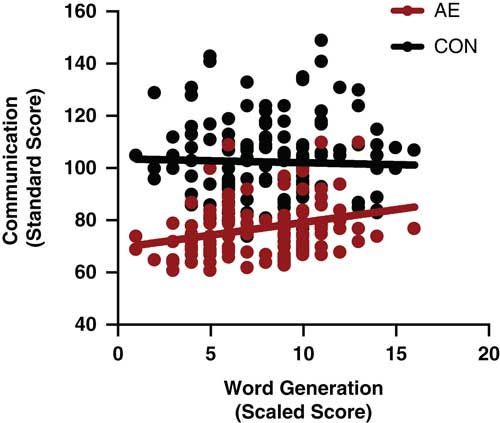
Results from the language regressions are presented in Table 6. No significant interaction (p=.092) or main effect (p=.085) was noted for Speeded Naming. Word Generation displayed a significant interaction effect (p=.040). Specifically, the relation between Word Generation and Communication was significant in the AE group, but not the CON group (see Figure 2). Thus, the final language model consisted of the Word Generation interaction effect (F(3,283)=82.572; p<.001; R 2 =.469).
Relation between Word Generation score and Communication by group. In the alcohol-exposed (AE) group only, as Word Generation scores increase, predicted Communication scores also increase. Variables were not significantly related in the control (CON) group. The regression line shows predicted Communication scores based on our model.

Global model
All significant variables from the three domain-specific models (Spatial Working Memory main effect, Inhibition main effect, Twenty Questions interaction effect, Word Generation interaction effect) were combined into a global model (see Figure 3). When all variables were combined into the global model, the main effect of Spatial Working Memory (p=.581) was no longer significant, and as such was removed from the model. Results from the final global model regressions are presented in Table 7. The main effect of Inhibition (p=.001), and the interaction effects of Twenty Questions (p=.018) and Word Generation (p=.036) remained significant in the global model (F(6,276)=50.111; p<.001; R 2 =.527).
Final models for each domain and final global model from regression analyses. Note: Y: Vineland Adaptive Behavior Scales-II Communication; X1: Group; X2: Spatial Working Memory; X3: Inhibition Total Errors; X4: Twenty Questions; X5: Word Generation.

Post hoc analyses
To investigate whether the presence of ADHD significantly contributed to our findings, we conducted sub-group analyses examining the impact of ADHD to each domain specific model within the AE group only. Within the working memory model, the relationship between Spatial Working Memory and Communication was not significant (p=.080) when accounting for ADHD and the main effect of ADHD was not significant (p=.188). Within the executive function model, the relationship between Twenty Questions Total Initial Abstraction and Communication was not significant (p=.138) and the effect of Inhibition Total Errors was significant (p=.012) when controlling for ADHD, and the effect of ADHD was not significant (p=.216). Finally, within the language model, the relationship between Word Generation and Communication was significant even after accounting for ADHD (p=.017), and the effect of ADHD was not significant (p=.211). Thus, with the exception of Spatial Working Memory, our results were unchanged when accounting for the presence of ADHD symptomology within the AE group.
DISCUSSION
We sought to determine whether cognitive variables (working memory, executive function, language) could significantly predict practical day-to-day communication ability among adolescents with heavy prenatal alcohol exposure. Our findings indicate that measures of executive function and language differentially relate to communication ability as reported by parents and caregivers across groups. The ability to inhibit one response in favor of another under certain conditions, as measured by Inhibition, related to communication ability across groups. Specifically, greater scores on Inhibition related to better Communication scores across groups. However, verbal fluency, or the ability to produce words associated with a certain category and within a given set of rules as measured by Word Generation, was significantly related with communication in only alcohol-exposed subjects. That is, among alcohol-exposed adolescents, greater scores on Word Generation related to better Communication scores. This relationship was not significant within the control subjects.
On the other hand, the ability to verbalize a question that efficiently solves a problem as measured by Twenty Questions Initial Abstraction, was significantly related with communication in controls. That is, among control adolescents, greater scores on Twenty Questions Initial Abstraction related to better Communication scores. This relationship was not significant within the alcohol-exposed subjects. While Spatial Working Memory was associated with communication ability across groups, this effect was not significant above and beyond other measures of executive function and language, possibly due to the visual component of this measure. In addition, the effect of Spatial Working Memory was no longer significant when accounting for ADHD symptomology, suggesting it may be more sensitive to attention difficulties. Our findings are consistent for both males and females, as observed relationships did not differ based on sex. Similarly, age did not differentially impact our findings (Panczakiewicz et al., Reference Panczakiewicz, Glass, Coles, Kable, Sowell and Wozniak2016).
Our results suggest differences in the relationship between aspects of executive function and communication ability between alcohol-exposed youth and typically developing controls. Specifically, verbal reasoning efficiency (i.e., the ability to integrate multiple sources of information to produce substantive and informed speech) may more strongly relate to communication ability in the relatively higher-level daily communications of non-exposed youth. Although not included in the main analyses, exploratory analyses showed that category fluency was driving the relationship between Word Generation and Communication, indicating that a poorer verbal knowledge store or inability to retrieve the appropriate word from this store may more strongly relate to communication ability in the relatively lower-level communications of alcohol-exposed youth.
It is possible that low overall word knowledge may be contributing to these findings; however, follow-up analyses showed that DAS-II Verbal Ability (a measure of verbal knowledge) was not correlated with Communication within the AE group (p=.544). Furthermore, Twenty Questions Initial Abstraction was related to communication ability within the control group only suggesting that abstract reasoning skills play an important role in these individuals’ everyday communication, although these skills may not be as well-developed among youth with prenatal alcohol exposure. Our findings are consistent with previous studies in that alcohol-exposed youth show greater impairment on measures of language production (for review, see Mattson et al., Reference Mattson, Crocker and Nguyen2011) and that verbal measures may be particularly sensitive to alcohol-exposure and provide a promising avenue for targeted interventions (Glass et al., Reference Glass, Ware, Crocker, Deweese, Coles and Kable2013; Mattson, Riley, Gramling, Delis, & Jones, Reference Mattson, Riley, Gramling, Delis and Jones1998; Mattson et al., Reference Mattson, Roesch, Glass, Deweese, Coles and Kable2013). Likewise, as in SLI, our results show that particular aspects of language are more difficult and complex, requiring more widespread recruitment of resources, and as such are more vulnerable to impairment in FASD (Akbarian, Reference Akbarian1992). As such, the current study adds to the extant literature examining cognitive bases of communication impairment among neurodevelopmental disorders, specifically within prenatal alcohol exposure.
Numerous studies have shown that youth with heavy prenatal alcohol exposure demonstrate impaired executive function (Glass et al., Reference Glass, Ware, Crocker, Deweese, Coles and Kable2013; Kodituwakku, Reference Kodituwakku2007; Kodituwakku & Kodituwakku, Reference Kodituwakku and Kodituwakku2014; Mattson et al., Reference Mattson, Crocker and Nguyen2011, Reference Mattson, Roesch, Glass, Deweese, Coles and Kable2013). Neuroimaging studies have also shown changes in brain structures important for language and executive function ability among youth with prenatal alcohol exposure (for review, see Riley, McGee, & Sowell, Reference Riley, McGee and Sowell2004) and future exploration of neural correlates of communication ability among this population is warranted. However, the association between executive functioning deficits and communication difficulty in the FASD population is not well delineated. Because aspects of executive function (e.g., the ability to inhibit, attend to certain stimuli selectively, plan) are essential to complicated processes such as communication (Singer & Bashir, Reference Singer and Bashir1999), it is reasonable to expect that impairments in executive function would translate to impaired communication. Indeed, a connection between executive function deficits and communication impairment has been shown in other neurodevelopmental disorders (Finneran et al., Reference Finneran, Francis and Leonard2009; Im-Bolter et al., Reference Im-Bolter, Johnson and Pascual-Leone2006; McEvoy et al., Reference McEvoy, Rogers and Pennington1993; Spaulding et al., Reference Spaulding, Plante and Vance2008), with greater impairment in executive functioning ability predicting greater impairment in communication ability. Furthermore, aspects of executive functioning (i.e., regulating interference, selecting an appropriate word over alternatives, inhibiting production of inappropriate words) are implicated in communication among typically developing children (Ye & Zhou, Reference Ye and Zhou2009). Thus, our findings are consistent with the extant literature examining the role of executive function in language and communication among neurodevelopmental disorders as well as typically developing populations.
Clinical interventions targeted at executive function may help improve communication deficits observed among those with heavy prenatal alcohol exposure. Interventions aimed at improving executive function ability among children with acquired traumatic brain injury have focused on training attention and providing instruction on metacognitive tasks, an aspect of executive function (Treble-Barna, Sohlber, Harn, & Wade, Reference Treble-Barna, Sohlber, Harn and Wade2015). Within the FASD population, interventions have focused on teaching metacognitive skills (Coles, Kable, Taddeo, & Strickland, Reference Coles, Kable, Taddeo and Strickland2015), improving self-regulation and attention (Kerns et al., 2010; Nash et al., Reference Nash, Stevens, Greenbaum, Weiner, Koren and Rovet2015; Wells, Chasnoff, Schmidt, Telford, & Schwartz, Reference Wells, Chasnoff, Schmidt, Telford and Schwartz2012), social skills (Keil, Paley, Frankel, & O’Connor, Reference Keil, Paley, Frankel and O’Connor2010; O’Connor et al., Reference O’Connor, Frankel, Paley, Schonfeld, Carpenter, Laugeson and Marquardt2006, Reference O’Connor, Laugeson, Mogil, Lowe, Welch-Torres, Keil and Paley2012; Timler, Olswang, & Coggins, Reference Timler, Olswang and Coggins2005), and certain academic skills (Adnams et al., Reference Adnams, Sorour, Kalberg, Kodituwakku, Perold, Kotze and May2007; Kable, Taddeo, Strickland, & Coles, Reference Kable, Taddeo, Strickland and Coles2015). Smaller pilot studies have shown promise in improving communication ability with cognitive control studies (Paley & O’Connor, Reference Paley and O’Connor2009).
Thus, the field would benefit from development of additional interventions targeted at improving executive function related communication skills to help alleviate functional impairment associated with communication deficits within FASD. Based on our findings, interventions aimed at cognitive control and/or self-regulation may be most relevant to the deficits we found. Improved cognitive control may translate to better word retrieval (i.e., skills measured by Word Generation), which could improve communication ability of adolescents with FASD. Likewise, improved self-regulation may translate to better inhibitory control (i.e., skills measured by Inhibition), which could also improve communication ability. By identifying the particular aspects of executive function that are implicated in communication among adolescents with FASD, we have provided more specific targets to refine existing interventions and develop targeted interventions. As similar constructs are targeted (i.e., executive function), adaptation or inclusion of verbal fluency specific skills in existing interventions may be effective in improving communication ability of individuals with FASD.
Limitations/Future Directions
While a promising start to investigating the cognitive bases of communication impairment among individuals with heavy prenatal alcohol exposure, several limitations should be noted. First, while we used standard measures of neurobehavioral function, other measures might provide additional information regarding the cognitive correlates of communication ability. For example, we were only able to include a visual measure of working memory (i.e., Spatial Working Memory), although a verbal working memory measure would likely be more appropriate. In addition, the available CIFASD test battery did not include specific measures of auditory attention, an important component of communication. Future studies should aim to expand upon measures studied here and examine other components of communication that may significantly mediate the effect of prenatal alcohol exposure on communication. Similarly, our measures may not have been pure measures of the constructs under study and there may be concern regarding collinearity between our variables as all are measuring aspects of executive function. Multiple regression can determine the unique contribution of each predictor variable while controlling for other predictors. As such, the issue of collinearity is greatly reduced, particularly with inclusion of the global model.
We also relied on parent report of communication ability rather than direct assessment of the subjects. Our results show group differences in VABS-II Communication and are consistent with previous studies, indicating that this test is sensitive to some communication deficits seen in FASD. Future studies could augment parent report measures with direct assessment of communication skills. Another concern may include validity with use of caregivers with lower levels of education. The majority of the subjects’ caregivers within our sample completed standard 4-year college or university. Within the AE group, the majority of caregivers had completed at least some college, with only 15.5% achieving high school diploma or fewer years of formal education (see Table 2). A reading level roughly equivalent to the fifth grade is required to complete the VABS-II (Sparrow et al., Reference Sparrow, Cicchetti and Balla2005). In follow-up analyses, caregiver education level did not significantly predict VABS-II Communication scores (p=.661). Therefore, it is unlikely that parental education levels significantly impacted our results.
It may be of concern to use measures of language in predicting communication ability, for which language is an important component. However, communication, as measured by the VABS-II, is a higher-level construct than language. Aspects of language are important for communication, although language is but one component of communication. Successful communication requires social cognition, executive function skills, and intact language skills. The current study aimed to identify those aspects of executive function, as one component of communication, that are significantly related to communication among youth with heavy prenatal alcohol exposure. We were also limited in the adolescent age range we were able to investigate (i.e., 10–16 years) based on CIFASD study design. Additional important information relevant to language development was also not available for study. Further information regarding subject developmental histories (e.g., early speech or language interventions, delayed language development) will be essential to help disentangle the impact of prenatal alcohol exposure on communication ability and contributing cognitive factors.
Additional confounds inherent to this population should also be considered. Other psychiatric disorders (e.g., ADHD) are highly prevalent among youth with prenatal alcohol exposure (Burd, Klug, Martsolf, & Kerbeshian, Reference Burd, Klug, Martsolf and Kerbeshian2003; Fryer et al., Reference Fryer, McGee, Matt, Riley and Mattson2007; Landgren, Svensson, Strömland, & Andersson Grönlund, Reference Landgren, Svensson, Strömland and Andersson Grönlund2010; O’Connor & Paley, Reference O’Connor and Paley2009; Mattson et al., Reference Mattson, Crocker and Nguyen2011; Rasmussen et al., Reference Rasmussen, Benz, Pei, Andrew, Schuller, Abele-Webster and Lord2010) and may have contributed to our results. Previous studies have shown that executive function deficits are not exacerbated by ADHD among youth with heavy prenatal alcohol exposure (Glass et al., Reference Glass, Ware, Crocker, Deweese, Coles and Kable2013). Thus, the deficits in executive functioning seen in the current study are likely not impacted by co-morbid ADHD diagnosis and post hoc analyses showed our results were not accounted for by the presence of ADHD. Furthermore, previous studies have also shown both independent and synergistic impacts of ADHD and prenatal alcohol exposure on adaptive functioning (Ware et al., Reference Ware, Crocker, O’Brien, Deweese, Roesch, Coles and Mattson2012, Reference Ware, Glass, Crocker, Deweese, Coles and Kable2014). As the goal of the current study was to examine cognitive bases of communication impairment, we first aimed to determine whether differences exist among alcohol-exposed youth. Future studies will be able to expand upon our results and investigate the specificity of these deficits further by addressing the role of ADHD directly as well as investigate how the communication dysfunction observed in FASD differs from other neurodevelopmental disorders (e.g., autism spectrum disorder). Information regarding stimulant or other medication usage was not available. Although we ask all subjects to refrain from using medication on the day of testing, possible cumulative effects due to medication use cannot be fully ruled out.
Other potential confounds include maternal smoking and use of drugs (e.g., cocaine) during pregnancy. As our study is retrospective in nature, we often do not have access to specifics regarding maternal smoking or other drug use and cannot include these variables in our analyses. However, for inclusion in our AE group, we require documentation that alcohol is the primary exposure substance. While alcohol is considered one of the most detrimental teratogens with effects above and beyond that of other drugs of abuse, we cannot rule out their effects. Additional information regarding exposure to other substances with detrimental effects on cognition would provide additional clarity regarding patterns observed in this study.
Findings may also be explained by overall performance (e.g., IQ or GCA) differences between groups, as the AE group performed below the CON group on all measures although the average GCA score for both groups fell within the average range. We did not test GCA as a covariate given the statistical and methodological limitations in doing so (Dennis et al., Reference Dennis, Francis, Cirino, Schachar, Barnes and Fletcher2009). Alternately, we considered whether differences in GCA performance could be driving the observed relationships. If this was the case, a general blunting of performance related to decreases in GCA or IQ would result in similar findings across measures for both groups, yet we observed differential relationships among variables within each group. In a separate unpublished study, we directly examined the relation between IQ and VABS-II domain scores in AE and CON groups. In the Communication domain, there was a significant interaction between IQ and Group resulting from stronger correlations in the control group between IQ and Communication than in the alcohol-exposed group. These results suggest that IQ does not fully account for communication deficits within the AE group, although other aspects of cognitive ability (not measured here) may play an important role in mediating alcohol’s effects on communication ability.
CONCLUSIONS
Youth with heavy prenatal alcohol exposure history demonstrate significant impairment on communication measures, as reported by caregivers. In highlighting specific executive function correlates of this impairment, the current study takes the first step in helping to address communication impairment among this population. To date, no known studies have investigated cognitive correlates of higher-level communication abilities among youth with prenatal alcohol exposure and as such the current study provides additional insight into the deficits associated with prenatal alcohol exposure. Impaired communication can prevent these individuals from functioning at the level expected for their age and affect quality of life in social, academic, and occupational domains. Findings from this study suggest that clinical interventions targeted at inhibition and verbal fluency may prove to be more beneficial in improving communication ability of these individuals and, ultimately, ability to function independently.
ACKNOWLEDGMENTS
Research described in this study was supported by NIAAA grant number U01 AA014834. Additional support was provided by U24 AA014811, U24 AA014815, K99/R00 AA022661, and F31 AA025256. The authors thank the families who graciously participate in our studies. The authors have no financial or other conflicts of interest. All or part of this work was done in conjunction with the Collaborative Initiative on Fetal Alcohol Spectrum Disorders (CIFASD), which is funded by grants from the National Institute on Alcohol Abuse and Alcoholism (NIAAA). Additional information about CIFASD can be found at www.cifasd.org.
SUPPLEMENTARY MATERIAL
To view supplementary material for this article, please visit https://doi.org/10.1017/S1355617718000772