


1. ARMS AND THE MANDATORY INTERTEXTFootnote 1
Arma uirumque cano … ‘Je chante les armes et l'homme …’ ainsi commence l’Énéide, ainsi devrait commencer toute poésie.Footnote 2
It is far from an overstatement to make the claim that in the surviving corpus of Latin poetry no phrase is more immediately identifiable than the pronouncement of the Virgilian narrator on the ‘arms and the man’ of his subject matter.Footnote 3 The presence of arma uirumque in a particular formation cannot fail to put us in mind of the Aeneid and its concomitant ideological associations.Footnote 4 A consequence of the epic's centrality as a canonical text was the emergence in antiquity of arma uirumque as a synecdochic quotation for the work as a whole and, as such, for the figure of the poet himself.Footnote 5 This transformation was further actuated by the ancient practice of ascribing titular authority to a poem's incipit, ensuring that arms and the man took on especial resonance.Footnote 6 Even within the Aeneid, self-referential intratextual play with the Virgilian utterance can be detected.Footnote 7 Furthermore, in post-Augustan verse, Fowler argues that arma alone is always loaded in a metaliterary fashion, serving as an identifying marker for Virgil's epic or, more broadly, for epic in general.Footnote 8 This was so marked a phenomenon that the opening word of the poem was recycled and reworked by Ovid around a decade after the compositional beginnings of the Aeneid,Footnote 9 in the first book of the Amores, in what formed an announcement of the redeployment of epic arma into the elegiac world of militia amoris (Am. 1.1–2):Footnote 10
I was preparing to tell of arms and violent wars in weighty verse, with material suitable to the metre.Footnote 11
In the Tristia, a more overt manipulation takes place with the tongue-in-cheek recontextualization of Virgil's own self-professed arma uirumque through Ovid's ‘reading’ of the quotation into an ‘obscene hendiadys’Footnote 12 for the writing of love elegy (Tr. 2.533–4):Footnote 13
And yet that celebrated author of your Aeneid has brought arms and man into a Tyrian bed.
This modification of Virgil's proemial designation became diachronically entrenched. Indeed, Persius, in one of his satires designed to establish his own stylistic isolationism in contrast to perceived poetic convention, puts a reference to the Aeneid in the mouth of his constructed conversationalist by means of arma uirumque (1.96–7):Footnote 14
‘Arms and the man!’ Isn't this something frothy with a fat crust, just like an ancient shrivelled branch whose bark is all swollen up?
In Book 8 of Martial's Epigrams, a poem addressed to Flaccus bemoaning the demise of artistic patronage refers, rather periphrastically, to the composition and dissemination of Virgil's epic as the work of a poet who conceived Italy and ‘arms and the man’ (protinus Italiam concepit et ‘arma uirumque’, 8.55.19). Martial also makes ‘titular use of the incipit’Footnote 15 in the Apophoreta, exhorting the lightweight reader to indulge their taste for poetic fripperies even once the nugae have been cast aside by taking up a copy of the Culex instead of consuming the mighty mass of martial epic (14.185):
Studious reader, accept the Culex of the eloquent Maro; when you have set aside your nuts, you don't need to read arms and the man.
It was not only the educated and the privileged, however, who manifested such cognizance of the scope and thrust of the Aeneid. Indeed, the universal signification of the phrase beyond the rarefied circles of elite literary aesthetes can be seen in the plethora of graffiti representing the words in some manner. A humorous example denoting an explicit intertextual refutation of the opening verse can be found on the laundry premises of the marvellously entitled Fabius Ululutremulus, as ‘arms and the man’ are jettisoned in favour of the fullers and their owl (fullones ululamque cano, non arma uirumq[ue], CIL 4.913).Footnote 16 Clearly, referencing and reworking ‘arms and the man’ became a method by which one could advertise one's literary immersion, cultural erudition and the generic substance of epic, synecdochically evoking the Aeneid. This is, of course, not to suggest that the usage of arma uirumque in such a fashion always signifies a profound learning on the part of the phraseological manipulator or recycler. The art of quotation is such that one can readily decontextualize the borrowing or, indeed, employ the words with little or no awareness of their original siting, attribution or significance. An illustrative example might be found in the commonplace citation and reformulation of Hamlet's paradoxical soliloquizing ‘to be or not to be’, often stated without specific knowledge of its source-text and essentially used as a synonym for the Shakespearean playwright himself and/or his own œuvre, becoming over time the socio-cultural product of a dialogic tractability, gradually altering and shedding the details of its generative milieu.
In what follows, I will identify and examine the reworking of the arma uirumque phraseology in Statius’ fratricidal epic, the Thebaid, arguing that there exists a deliberate and systematic modification of Virgil's words, forming part of the poet's metapoetic reflection on his relationship with his predecessor. As will become clear in the course of the discussion, my thesis is predicated on a Statius who, for this particular literary game, chooses to interpret the Aeneid as ‘optimistic’ in order to subvert and undermine its foundation in the Stygian world of the Thebaid.Footnote 17 This is, of course, not to assert that such a reading is uniform within the latter's text or to argue that decoding the voice of Virgil's epic so readily falls into twin dichotomous camps. Studied self-awareness of interpretative complexities marks the work of all those engaging self-reflexively both with the Aeneid and with their own poetic belatedness. Indeed, it is well attested that Virgil's successors suffuse their works with an innate self-consciousness as regards their ‘secondariness’,Footnote 18 explicitly making reference to, and capitalizing on, this epigonic status, in order to advertise the novelty of their works. Statius famously, albeit problematically, declares devotion to the Virgilian model, commanding the body of his poem to follow in his precursor's footsteps (nec tu diuinam Aeneida tempta | sed longe sequere et uestigia semper adora, Theb. 12.816–17).Footnote 19 Equally widely acknowledged is that reworked Virgilian intertexts abound in the Thebaid, as Statius thematically transforms the substance of the Aeneid into his own poetic foundation.Footnote 20 The epicist, however, also announces his usage of Virgil in a more symbolic fashion, adopting the cry of arma uirumque as an intertextual calling-card, which he subjects to syntactical, morphological and, indeed, metrical dismemberment. Just as Statius assails the wholeness of the bodies embedded within his poem, so too does he figuratively chop up the corpus of the Aeneid through a violent metamorphosis of this most well known of quotations, in a further reference to the problematic nature of his Virgilian engagement.
In the ancient world a well-established figurative programme existed equating the corpus of the poem with the corpus of the poet.Footnote 21 Farrell has demonstrated that this corporeal metaphor for the literary work was in good health from the Ciceronian era, despite its considerable longevity within the discourse of talking about texts.Footnote 22 In view of the deliberate reinvigoration of tropes self-consciously advertised as hackneyed and trite by Flavian poets, my examination of the Thebaid's usage of ‘arms and the man’ is grounded in the assertion that Statius’ epic explicitly exploits the metaphorical slippage between the textual and the physical bodies in order to argue that the arma uirumque subjected to the poetic scalpel is that of Virgil himself, in a metapoetic negotiation of Statius’ relationship with his predecessor. Moreover, I will read this dismemberment in the context of its Lucanian heritage, interpreting the Thebaid's literary mediation through a poem whose preoccupation with syntactical, metaphorical and metapoetic amputation of a variety of somatic fleshiness has been widely discussed.Footnote 23 We shall see that Statius adopts a Lucanian persona with respect to his interrelationship with Virgil, reinvigorating the attested ambiguity between martial arma and anatomical armi to corporealize further his metapoetic strategy.Footnote 24 I will argue, therefore, that the Thebaid emerges as born from the hacked-up body of the poem and the poet of the Aeneid in a bloody expression of epic one-upmanship. In this light, the footsteps in which Statius bids his poem to follow must be some very bloody tracks indeed.
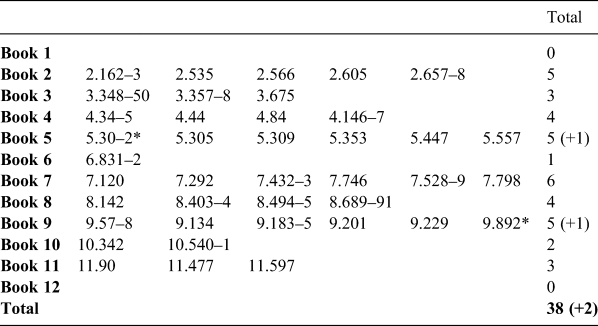
First, a few words on the synthesis of the analytical base are in order. Landrey's recent examination of arma uirumque in Silius Italicus’ Punica adopts a statistical measure entirely predicated on the four-line spacing between the proemial arma and uirum (1.1, 1.5), resulting in a system of ‘five lines apart or fewer’, which is openly conceded to be ‘somewhat arbitrary’, an occupational hazard of such examinations.Footnote 25 My approach will take as its foundation the notion that, in order for the mutilated quotation to retain real resonance for the oral/aural consumer and to be intertextually processed and intellectually comprehended, its components must appear within a distance of not more than one line apart and must be contained within the same ‘sense-unit’,Footnote 26 a principle which is admittedly equally subjective without access to the cognitive capacities and neural processes of ancient readers.Footnote 27 None the less, it is my contention that the presence of such a criterion, semantically sealing the quotation within contained syntactical parameters, is important for the allusive formula to be successfully converted from its manipulated configuration into the recognizable state of its original outing in the mind(s) of the reader(s). Indeed, as Wills states on enacted allusion, ‘a device cannot be too widespread or the point of reference is soon obscured and the boldness muted’.Footnote 28 I will also include instances in which a term similar to either arma or uir is deployed in conjunction with its Virgilian counterpart, both in the sense of a cognate relative and an audible/legible suggestibility. This modus operandi produces a core database of thirty-eight examples, of which, significantly, twenty-six usages, or 68.4%, involve the reproduction and reworking of the Aeneid's terms within the same verse (see Figure 1).Footnote 29
arma uirumque in the Thebaid

* Asterisked items designate ‘borderline’ cases wherein arma uirumque is invoked through the simultaneous presence of one of its signifying terms and a disparate intertext recalling the Aeneid.
This striking body of Statian exempla manifests a number of important trends which reveal much on the subject of the Thebaid's interaction with the Virgilian text. Indeed, I will demonstrate that Statius deploys clusterings of instances of modified arma uirumque in sections of the Thebaid explicitly advertising themselves as all that epic ought to be,Footnote 30 evoking, as Hinds terms it, a ‘generic essentialism’.Footnote 31 It will therefore become clear that Statius uses arma uirumque to summon the generic monolith of the constructed epic stereotype as represented by the Aeneid, and that he does this in order to characterize himself not as paying homage to Virgil but as surpassing him. By means of the syntactical, morphological and metrical butchering of ‘arms and the man’, Statius dismembers the corpus of the Virgilian poet/poem and scatters the bloody limbs across his hexameters.
2. ARMS AND THE MANIAC
So I began again, ‘Arma uirumque cāno –’
‘Cāno, you villain! Canō’, and he gave me a tremendous box on the ear.Footnote 32
The first significant congregation of the disfigurement of arma uirumque surrounds the figure of Tydeus, a Calydonian warrior who attaches himself to the cause of Polynices and exits the poem in a cannibalistic fever.Footnote 33 The grouping examined in the subsequent discussion is steeped in epitomizing epic comportment, as the hero embarks on a feat of brutal violence in over-exaggerated, bloody aristeia.Footnote 34 The episode is one characterized by, in Gervais's words, ‘intertextual confusion’,Footnote 35 assimilating the warrior with a number of allusive models, all of which work to demonstrate the disjunctive application of uirtus, the transgressive nature of civil war, and the breakdown of identity in a poem of fratricide. We shall see that Statius coats such disarray in the dismembered signifiers of arma uirumque.
In Book 2, Tydeus is dispatched on an embassy to Thebes on behalf of Polynices in order to reclaim the throne following Eteocles’ contravention of the pact of alternate years of kingship. Tydeus is refused, and the anger of the Theban king is such that he dispatches fifty soldiers to await the man and kill him in a surprise attack.Footnote 36 Upon espying these warriors, Tydeus questions them on their origin and their reason for concealment (Theb. 2.533–6):
He was astounded at what he saw but kept going, only moving closer his bristling darts and sword sheathed up to the hilt. Then he questions them first with a not-insignificant terror: ‘Men, where have you come from and why are you hiding amongst your arms?’
In doing so, he wrenches apart the arma from the uirumque, subjects both to morphological, syntactical and metrical violence, and redeploys these disarticulated terms in order to present in full the moment of ambush that the Aeneid failed to proffer in Book 11, as Turnus is forced to leave hiding following Camilla's death and spare Aeneas (ille furens … | deserit obsessos collis, nemora aspera linquit, 11.901–2). In this instance, separating the arms from the men serves as a marker of intertextual one-upmanship, as Tydeus outdoes the missed moment of Aeneas’ passing-by. Moreover, there is a poetic self-consciousness to the warrior's words, as Tydeus is practically made to question the men metapoetically, asking them in oratio recta as to why they are attempting to hide themselves in the newly ablative armis, evincing the unworkability of the guise of arma uirumque in the Statian sludge of endemic nefas.Footnote 38
In the course of the killings that ensue during the ambush, Tydeus scales a handily located cliff, also happily the former lair of the Sphinx, and seizes a huge boulder which he proceeds to hurl at the enemy.Footnote 39 In assaulting his foe in this manner, he is said to obliterate the faces of men, their own weapons and an accompanying range of anatomical manifestations (Theb. 2.566–7):
Men's faces lie crushed, and at the same time their weapons, hands and chests with steel mixed in.
The Virgilian ‘arms and man’ seems prima facie to be grammatically intact, albeit unyoked and inverted, but upon closer inspection uirum can be seen to exploit the morphological ambiguity inherent to the form as accusative singular or contracted genitive plural, wrong-footing the expectations of the ‘reader’ versed in the Aeneid.Footnote 40 Tydeus’ act of violence is responsible for this intertextual assault, subjecting the quotation to a violent cleaving foregrounded through anaphoric simul. The warrior annihilates the markers bearing the symbolic weight of Virgil's epic, overwhelming arma uirumque not only in an expansion of the numbers of men (uir[or]um) but also in bodily multiplication in associating intertextual arms with newly introduced hands and chests (manusque … | pectora), exploiting the lurking ambiguity to suggest arma as armi. This physical and textual dismemberment is further expressed through the dizzying synchysis of the arrangement of the verses, showering the text in a somatic and semantic residue that renders the ‘reader’ near-complicit in the very enactment of the represented mutilation.
The contextualization of Tydeus’ killings in this section also activates a specific allusion to the Aeneid that proclaims the entrenched Statian need to surpass. Indeed, the rock which Tydeus wields is distinctly intertextual, evoking the missile which Turnus’ failed strength prevented him from hurling at Aeneas in Book 12 of Virgil's poem. Gervais notes the weaker nature of the item handled by Turnus (uix illum lecti bis sex ceruice subirent, 12.898) in relation to Tydeus’ boulder which six groaning bullocks could scarcely raise (quod uix sena ceruice gementes | uertere humo, 2.559–60).Footnote 41 The intertextual evocation is strengthened by the littered arma uirumque, the separation of which reflects the men's fractured bodily forms, even as the terms are subverted and redirected by the Thebaid's narrative line. Moreover, the maimed appearance of arma uirumque adds further metapoetic force to the Virgilian overwhelming as, in tandem with the intertextual and numerical augmentation, the text furnishes a violent crushing of the Aeneid's corporeal synecdoche. In morphological terms, the very Virgilian identity inherent to the quotation is at stake, as the denoting ora are subjected to the dismembering contraction of the syncopated genitive uir[or]um in a gestural suppression compelling men to chop off their own semantic faces.Footnote 42 hic situs est Vergilius, Statius asserts, a bloody, butchered and battered body overcome by the force of a distinctly Lucanian nefas, fragmented limbs and fragmented terms irrupting into the Thebaid.
The perversity of the Statian Weltanschauung is made clear in a further example during the massacre. Tydeus brandishes a shield struck by so many weapons that they are said to arm the man, clearly evoking the extraordinary exertions of the Lucanian Scaeva (Theb. 2.603–5):Footnote 43
Meanwhile, he presses upon and threatens the trembling enemy, tearing out the javelins which quiver in their multitude as they are stuck across his entire shield and they arm the man.
Tydeus thus becomes the uir, transforming from Turnus into the Aeneas-figure of the Thebaid, a somewhat ironic denomination given the hero's pervasive bestial and superhuman associations and the anthropophagous manner of his demise,Footnote 44 and the spicula of his enemies are transposed into the expected arma, a term which is then itself verbally embedded (armant). We see the Virgilian quotation cut apart in the transplanted suffix -que from the uir to the arma-cognate, even as a metrical relocation drags the bloodied remains of the Aeneid to the third and fourth feet. To assimilate Tydeus simultaneously with the Virgilian uir therefore operates as a metapoetic pronouncement, the remark nothing less than a Bloomian swipe assigning the model of pius Aeneas to the incongruity demanded by a Thebaid.
The final mid-massacre mutilation of the quotation occurs as Tydeus, taunting the soon-to-be dispatched Menoetes, orders him to cast aside both his weapons and the light of life itself (Theb. 2.657–8):
Now cast aside arms and the day.
A new term is here introduced into the standard phraseology in forceful zeugma, as the dismembered syntax intensifies its violent exploits into the grafting of a fresh ‘limb’ with diem, at the same time as Tydeus essentially tells the man to cast aside the Aeneid. The Virgilian recollection is strengthened through the importation of Anchises’ words hopelessly warning against civil strife to the future Caesar (proice tela manu, Aen. 6.835). Such an anti-fratricidal clarion call is incorporated cleverly within Statius’ fratricidal epic, even as internecine combat itself is in progress, enacted by a crowing Tydeus. Furthermore, the pursuit of bellum ciuile is reinforced by the staging of this duel as a microcosmic recreation of the final exchange between Aeneas and Turnus, in mise en abyme for the fratricidal bout to come between Eteocles and Polynices, with the newfound Tydean Aeneas dispensing with doubting vacillation, ignoring the pleading remarks of his foe for survival, and cutting him down in a physical reflection of the rhetorical abandonment of arma uirumque in favour of the instruments and agents of civil war. These inter/intra-intratextual asides, then, are deployed so as to reject the fratricidal rejection informed by the associations with the Aeneid, transforming Tydeus from a perverted Anchises into a perverted Aeneas, reaffirming civil discord with the bombast and grandeur of heroic epic now discarded.
In Book 3, Tydeus, having returned to Argos following the massacre, rushes into the palace of Adrastus exclaiming arma, arma uiri for war, as if readjusting the opening of the Aeneid into his own epic recitatio on the skulduggery of Thebes.Footnote 45 Tydeus’ words invert the Ovidian recusatio of the Amores (arma … parabam | edere, 1.1–2), temporally recasting the imperfective intent of the famous reversion to elegiacs into what serves as a forceful announcement of epic ambition through the impassioned exhortation of an intertextual para (Theb. 3.348–50):
Men, to arms, to arms, and you most excellent leader of Lerna, if you have any of your ancestors’ blood, prepare arms!
Even as Tydeus embarks upon this revised Aeneid, using the signifying terms in programmatic appeal to the arma uirumque of the Roman Mission, he is also cast intertextually as a Turnus (improuidus adest, 3.347), simultaneously representing the other side, aping in his advent the sudden appearance of the Rutulian prior to the attack levelled against the Trojan fleet on the Italian shores (improuisus adest, Aen. 9.49). This intertextually unsettling doubling, affirmed via the Thebaid's adjectival hapax legomenon improuisus, complicates the Tydean portrait, reframing the imperializing ideology of the Aeneid as the preserve of an indistinguishable sameness, uncomfortably advertising the fratricidal in redirecting the Adrastan court towards internecine activity. This allusive force is further intensified through the anaphora of arma, a highly emphatic assertion of Statius’ drive to go beyond Virgil with more arms and more men, in an offering that Wills terms ‘the heaviest massing of martial gemination in Latin poetry’.Footnote 46 This ready evocation of ‘conventional’ epic warfare in redistributed arms and men, however, is polluted by the underlying madness of the nefas that haunts the Thebaid, marshalling the intertextual insanity of preceding panoplies of textual arma wielded by those in the grip of a dementia. Tydeus, therefore, is made to recall the mad Turnus, inflamed by Allecto's torch (arma amens fremit, arma toro tectisque requirit, Aen. 7.461), whilst intratextually anticipating his own frenzied cannibalistic last hurrah (amens | laetitiaque iraque, 8.751–2). Compounding this image of mad men bearing arms and co-opting arma uirumque in pursuit of their own ends is the reference to the suicidal Hercules in Seneca's eponymous drama, having slaughtered his wife and children in rage-fuelled frenzy (arma, arma, Theseu, HF 1242). The allusion is refracted still further through another cluster of arma designations in Ovid's Metamorphoses, announced in the words of the herdsman Onetor, informing the fratricidal Peleus of the escapades of a rampaging wolf, rousing men to take up arms against the frenzied creature (cuncti coeamus et arma | arma, Met. 11.377–8). Once again, arma uirumque in the Thebaid is contaminated through intertextual association, a recollection evoking Peleus’ murder of his brother Phocus, and thereby recalling Tydeus’ own Calydonian foray into brother-killing,Footnote 47 tempering the mustered Virgilian arms with the nefas of familial violation.Footnote 48 Not only does the tripartite arma of the Thebaid amplify and distort such resonances through complex intertextual perversions in this manner, therefore, but the verbal accompaniment signifying preparation and not the recitation demanded by such intertextually anticipated epic terminology as cano, a designation bringing imperative compulsion (para) in lieu of the indicative statement of Virgil's opening gambit, tears apart the quotation and replaces the incipit with an enormous semantic mass of weaponry. For Statius, intertextual size clearly matters.
As the warrior goes on to communicate the Theban entrapment to the ruler and his chieftains, the metapoetic push to supersede engineered by dissected arma uirumque is made patent, as the ambuscading warriors are said to be equipped not only with an enviable array of weaponry but also with the cloak-and-dagger assistance of darkness and deceit (Theb. 3.357–9):
Chosen for ambush and equipped with every weapon, the men futilely entrapped me, alone and unaware of the place, with darkness and deceit.
In the Thebaid, embarking on a killing spree in the manner of martial epic requires more resources than the arma uirumque of the Aeneid, as we see the now multiple Theban warriors in possession not only of arms but of all arms (omnibus armis). Moreover, the amputation of the morphologically butchered armis from the uiri represents Statius’ simultaneous adherence to, and detachment from, the associative thrust of Virgil's ‘arms and the man’.
In light of the above, I hope to have demonstrated that these localized Virgilian reworkings bring to bear an accumulated weight of poetic self-consciousness. In the figure of the über-epic Tydeus and the events surrounding his massacre, Statius establishes a site in which the limbs of arma uirumque can be cut apart, mutilated and scattered so as to reflect metapoetically on the relationship between the Thebaid and the Aeneid. Moreover, a further significance can be gleaned as a consequence of Tydeus’ association with so sizeable a grouping of examples, many of which also occur in the warrior's direct speech. Micozzi has demonstrated that the warrior can be considered a poet-figure.Footnote 49 In ascribing these instances of syntactical, morphological and metrical dismemberment to an individual with such tale-telling inclinations, Tydeus is made to serve as a metapoetic manifestation of Statian poetics, announcing the diversion of the Virgilian line towards the nefas-ridden gloom of the Thebaid. In the following section, we turn to another conglomeration of exempla surrounding the intradiegetic tale of the nurse Hypsipyle, whose story of Lemnian massacre serves as a rich locus for the exploration of epic's generic parameters, and whose arma-wielding acts go on to interrupt the virility of the Virgilian uir.
3. ARMS AND THE WOMAN
[…] we have seen instances of women who handle the musquet without finding any inconvenience from that protuberance.Footnote 50
As the Argives wander through the forests of Nemea, beset by a Bacchic drought bringing deviation and delay, they encounter the exile Hypsipyle nursing the infant Opheltes as a slave-captive in the court of King Lycurgus. Following her provision of water to the thirsting warriors, Hypsipyle responds to Adrastus’ enquiry as to her identity with a lengthy excursus on the killings enacted by the Lemnian women, a people over whom she had ruled as queen. In the course of the nurse's account, she entrusts her young charge to the lap of the earth, a bestowal which results in Opheltes’ death, smitten by the tail of a serpent.Footnote 51 The empowerment of a female narrator in this fashion is used by Statius so as to draw attention self-consciously to the ostensible generic conceptualization of epic as hyper-masculinized endeavour.Footnote 52 As Henderson states, ‘this promotion of the Woman's Voice to tell the underside of uirtus displaces the site of epic from within’.Footnote 53 This is arms and the woman, a female invasion of martial spatiality, charged site of truncated arma uirumque strewn across the hexameters.
We begin with one of the two instances identified above as ‘borderline’. As Hypsipyle responds to the king's invitation, she proffers an upfront potted summary of the story which she will go on to tell, a product of her initial distress at recollecting the murderous past. Her words are designed to evoke the Virgilian quotation, albeit rather more indirectly, through the combinatory efforts of twin intertexts (Theb. 5.30–2):
Furies, Lemnos and arms inserted into narrow beds and men warred down by shameful swords.
Such allusivity immediately aligns Hypsipyle with Aeneas, a clear comparative model in view of the propensity of both to become inset raconteurs.Footnote 55 Warring down mares by means of debellare must also refer to the portentous words of Anchises in the Underworld, a reframing that immediately positions itself as striving after grand epic utterance, a recasting of the Roman Mission into sexualized mariticide. Hypsipyle's arma as a riff on arma uirumque is subsequently strengthened still further by an echo of the Ovidian Tristia, nodding to the statement discussed in Section 1 that the author of the Aeneid brought arms and the man into Tyrian beds in eroticized epic. Whilst, therefore, there is no lurking uir in the nurse's remark, the intertextual environment of her words cannot but suggest arms and the man, and the absent component itself becomes a symbol of Statius’ brutalization of the Aeneid, amputating and discarding both the poetic body and the physical body of Virgil through the quotational carcass rent asunder.
As Hypsipyle continues her tale, she mutilates arma uirumque in such a way as to identify the very bloody locale of the now depleted island of Lemnos, and to reflect structurally the recent slaughter of its menfolk. The signifiers refashioned as ablative plurals construct the site as the setting of heightened epic (inter)activity in an exploitation of the quotation that also announces the nurse's own brand of arma-appropriating narration (Theb. 5.305–9):
The island, rich in land, wealth, arms and men, known for its site, recently enriched by a Getic triumph, not by a sea-invasion, nor by an enemy or inimical atmosphere, lost all its people at once, orphaned and cut out of the world.
The triple conglomeration of –que-suffixes emphatically underscores the transposition of arma uirumque to the closural locus of Statius’ verse in a metrical subjugation of Virgil's opening pronouncement. Moreover, an ominous note lingers throughout. Statius’ insula diues recalls the description of Tenedos in the Aeneid, the place whence came the serpents assailing Laöcoon and sons for the father's impiety (insula, diues opum Priami dum regna manebant, 2.22), a reference heavily foreshadowing Opheltes’ death caused by Jupiter's letifer anguis (Theb. 5.628). The portentousness of the Trojan priest's end, a passing symbolic of the city's fall and subsequent rebirth, is transferred into the imminent Lemnian scene of marital slaughter and the disappearance of each and every uir on the island, even as we witness the Virgilian ‘arms and the man’, contorted and skewed, subjected to nullification (perdidit una omnes … | indigenas).Footnote 56 In Hypsipyle's recollection, arma uirumque, an intertextual Virgilian posture unsustainable in a chronicle of nefas, has been left behind in a pre-Thebaid world.
A mere four lines later, Hypsipyle again employs the Virgilian quotation, on this occasion selecting an audibly proximate cognate in metrical similitude so as to recycle and replace the programmatic statement (Theb. 5.309–10):
Men do not turn the fields or trawl the waters, the houses are silent.
The metapoetic relationship with Virgil is here predicated entirely on negation. The men made multiple are said to not turn the fields in a poetological retraction that seemingly includes, but ipso facto removes, both arma and the uir from the poetic canvas. This is arma uirumque non cano, a narratorial masculine erasure mediating self-consciously on the interplay between Statius and Virgil, amputating and scattering the quotation in order to manifest, in Ganiban's words, ‘the irrelevance of pietas’ in this Thebaid.Footnote 57 The evocation is further supported by another thematically apt Virgilian intertext citing the reaction of the Carthaginians to Aeneas’ commencement of his Ilioupersis, as the entire audience is said to fall silent (conticuere omnes intentique ora tenebant, Aen. 2.1),Footnote 58 ironically recasting the awe-struck hush of the eager audience as the taciturnity of a murdered people, arma uirumque drained dry.
Following the massacre enacted by the Lemnian women, a series of ships approaching the island announces the untimely arrival of Jason and the Argonauts. Hypsipyle and her people are terror-stricken, mistaking the force for a Thracian contingent intent upon avenging the sack of their land by the Lemnian men, and, donning weapons and armour, they take up defensive positions atop the walls in perverted teichoscopia. In describing this militarization, Hypsipyle again activates an arma uirumque recollection, seeking in vain to authenticate her tale, even as she transgresses the supposed martial masculinity of epic agenda (Theb. 5.352–4):
To there, trembling, they convey rocks, stakes, the sad arms of their men and swords tainted by slaughter.
As we saw in Section 1 in relation to the example at 2.566–7, the expected terms appear morphologically intact with contracted genitive masquerading as the Virgilian uirum, adjectivally sundered from its counterpart by the arma-qualifier maesta. Just as the very swords themselves wielded by the Lemnian women are infectos caedibus, so too are the intertextual arms of the Aeneid morally charged and made guilt-laden by association. The moment is an arresting one, of armed women at which Minerva is made to blush and Mars is made to laugh (rubuit … | Pallas … risit Gradiuus, 5.357), reflective of the incongruity of the nurse's attempt to do an Aeneas and situate herself as the reappropriated uir of her own epic poem, quotation split apart and contaminated by the associated semantic gore (infectos caedibus) of the preceding Lemnian transgression.
The subsequent instance of the quotation's dismembering occurs as Juno suffuses the women of Lemnos with erotic ardour for the arriving Argonauts and the feminized arma uirumque of the killings is transposed into the stereotypically epic appearance of the disembarking warriors (Theb. 5.446–8):
Then regal Juno puts into their minds the arms and bearing of the men, markers of excellent heritage.
The phraseological butchery takes place at the very moment in which the formerly murderous Lemnian women begin to return to their expected generic roles as passive welcomers and thus potential Dido figures, putting aside their arma for amor and mora in the face of Argonautic agency, as one epicized tale bleeds into another. None the less, the need to demonstrate Virgilian suppression is again expressed through the mutilation of ‘arms and the man’ in a syntactical, morphological and metrical sense, even amidst the move to the tried and tested recipe of men bearing arms. Reading Juno's actions metapoetically, we see the goddess not only filling the women's minds with desire for Jason and his men (mentibus insinuat) but also inserting into their consciousness the memory of the arma uirumque of the Aeneid through the ostensibly apposite association of the fragmented citation with heroic men in a chimeral reversion to epic status quo. The return of the women of Lemnos from their former martial state to accustomed womanly roles, however, proves to be fleeting. In an accelerated Aeneid, Hypsipyle and her people are abandoned and the queen herself is expelled after having birthed Jason's sons and she is driven out of her own burgeoning epic into captivity by the Lemnian women, exposed as a murderous fraud in having refrained from patricide.Footnote 59 She stands preserved as a vehicle for future nefas, undone by the intertextual aspirations of her own narrative.
The final example in this grouping occurs once the tale of Hypsipyle has concluded and the dying screams of the infant she left on the grasses have led the Argives to his ophidian slayer, a creature whom they go on to assault in full-blown heroic mode (Theb. 5.556–8):
Then finally at the flashing of arms and the shouting of men the fierce creature moves its scaly neck.
Again, the Virgilian terms are cut apart, morphologically disfigured, and scattered across the verse, as the temporarily redundant Argives, beleaguered by drought, delay and digression inter siluas, take on anew epic bellicosity, reverting to a martiality that does not bespeak kleos, but is merely made necessary by the nurse's negligence amidst her tale of crime. The grammatically localized potential for ambiguity between arma and armi brings a lingering corporealization to the butchered Virgilian quotation in this genitive plural (armorum), thereby awarding a new literalization to the chopping up of the synecdochic words. Statius signals the conclusion of the physical wandering, and metaphorical deviation in generic terms, self-reflectively invoked in this episode through this anatomical and semantic assault on all that is Virgilian epic, seizing and severing both the martial and the corporeal arms of his predecessor in a gesture of poetic supremacy, all beneath the carefully constructed guise of a revived reges et proelia. In the final section to which we now turn, a third significant grouping can be detected, taking place amidst the relentless battles of the second half of the Thebaid, as the Argives finally assail Thebes. The occurrence of these examples in association with heroic figures during the culminating moments of their aristeiai and deaths further demonstrates the violent usage of arma uirumque as a deliberation over what it means to write an epic of nefas in which there are many tainted uiri but no uir.Footnote 60
4. ARMS AND THE MANIFOLD WAYS TO DIE
As Virgil famously began the Aeneid, ‘ARMA VIRUMQUE CANO.’ But some of the trends in the worlds of publishing and library management tempt me to change that to ‘ARMAGEDDON VIRUMQUE CANO’ (with apologies to Virgil).Footnote 61
Central to any rendition of the Seven against Thebes are, of course, the fates of the heroic combatants. Indeed, Statius commonly uses the deaths of the chosen Argive few as closural devices to conclude a specific book (7, 8, 9 and 10). He also associates a number of these figures with the programmatic mangling of Virgil's words, ensuring the subjugating dismemberment of his predecessor amidst a raft of poetic incidents self-consciously advertised as bombastic epic set-pieces. The first significant Argive demise in the poem is that of the warrior-priest Amphiaraus, adorned with the trappings of his military endeavours and still astride his horse and chariot as he is swallowed alive by the earth. This is aristeia with an unexpected twist, as climactic death surrenders to the terrestrial engulfment of a living and breathing figure incongruously bringing his ‘meaty corporeality’Footnote 62 into the bowels of the Underworld.Footnote 63 Prior to this inverted and involuntary katabasis, Amphiaraus’ martial singularity is accentuated through Apollo's commandeering of his chariot, as the god, leading the rampaging vehicle, strews both arms and men and arma uirumque across the battlefield by means of an aurally/legibly resonant verbal surrogate embedded in simile (Theb. 7.746–8):Footnote 64
The frightful terror leaps down upon the plain, sweeping with it fields, men and aged oaks in multiple paths.
In the process of representing the god's careering therefore, Statius not only makes a mess of arua uirosque and its less than covert arma uirumque relation, but, through the designation of the chariot's path (limite non uno), he also disorders his own proemial limes carminis (1.16), whose transgression in an epic rooted in boundary-transgression is inevitable and deliberate.Footnote 66 Indeed, the poet semantically dismembers the Virgilian quotation so as to demonstrate metapoetically the environmental and criminal ascendance of Thebes, replacing the military arsenal denoted by arma with agricultural arua and its forceful contextual exhortation of the autochthonous Boeotian city, a transition so paramount to this episode in which Amphiaraus transforms into a Spartos upended, fighting civil war on the plains before being ingested alive and fully armed by the jaws of Tellus.
The bloody travels of this priest run amok are subsequently disturbed by a number of seismic eruptions which anticipate the moment of devouring, and the reference to the Aeneid is made patent (Theb. 7.798–9):Footnote 67
A different tremor causes arms and men and marvelling horses to bend.
This instance of lacerated arms and man is expressly connected with the preceding outing of arua uirosque (7.746) through metrical congruence, both of them preceded by a dactylic fourth foot consisting of a disyllabic noun with a stem ending in –mor, all of which serves to lay the structural foundations of this final scene as embedded in the Virgilian outstripping which we have observed thus far. Here, a shuddering of the earth at odds with the expected clamour of battle (alius tremor) tears apart the Aeneid's intertextual footprint, subjugating the programmatic arma uirumque of Virgil's poem to the nefas-ridden bellicosity of the Thebaid by means of a verb (inclinat) that can also signify debasement.Footnote 68 At the same time, the pervasiveness of the poem's perversion is made clear in the movement from one man to many, with arma now accompanied by multiple warriors in the accusative plural (uirosque).
Subsequently, through the words of Palaemon, reporting the fate of Amphiaraus to Adrastus, another act of syntactical, morphological and metrical dismemberment can be seen, as the man speaks of the consumptive drive of the earth to swallow up arms and fighting men (Theb. 8.142–3):
The impious soil drinks down chariots and arms and fighting men.
Initiating the verse with arma inescapably evokes the Aeneid's phrasing, but then supersedes expectations in including a notation not merely of plain, unadorned uiri, but assigning a martial participle to the term in tautology that reflects a Virgilian subjugation through applied semantic excess (bellantesque). In Amphiaraus’ death, the Tellus of the Thebaid ingests not only prophet and chariot but also the arma uirumque quotation itself, drawing the mutilated fragments within the womb/stomach/tomb of the earth, and thereby interring the phrase within the spatial confines of the epic.Footnote 69
Once battle is renewed, the very mutilation of arma uirumque is arranged so as to represent the corporeal fleshiness of the poem, through the activation of the wordplay underpinning the equivocal relationship between arma and armi. During the mini-aristeia of Haemon in Book 8, the warrior attacks Damasus with a spear, and runs him through with the weapon, piercing his shoulders (armos) (Theb. 8.494–6):Footnote 70
But the spear slipped through the shoulders of the man and left through the chest and shook away the shield from him holding it.
In the very moment of anatomical onslaught, we hear the ring of the Virgilian utterance, even as both terms are exposed to the dismembering impetus of the personified hasta, metonymically appropriating the intertextual weight of the absent arma proper, bringing arms upon arms and man vs man. The words we expect to encounter are butchered and torn apart and, through the arma/armi intersection, Statius’ evocation of his predecessor is corporealized and the poet/poem of the Aeneid is hacked to pieces by an epicist who has clearly read his Lucan.Footnote 71 Indeed, in the midst of this heightened episode of martial slaughter, the bellicosity enshrined within arma uirumque is carved up to be subsumed within the transgressive bloodinesses that pervade the Thebaid.
In Book 9, the death of Hippomedon following a river-battle also furnishes an assortment of incidences of butchered arms and truncated man.Footnote 72 As the warrior strives to protect the corpse of his comrade Tydeus, he faces off against the Theban Leonteus, who comes near to obtaining the body (Theb. 9.133–8):
Leonteus, hiding behind men and arms, dared to put forward secretly his right hand and he was dragging the head put down by the grabbed hair. Hippomedon saw, although multiple threats faced him on every side, and he cut off the impudent hand with savage blade, upbraiding him at the same time: ‘Tydeus steals this hand away from you, Tydeus himself.’
We are told that the fighter's strategic move was to conceal himself behind the now-inverted arms and men, a strategy doomed to fail as the arma uirumque of the Aeneid cannot operate in the domain of a Thebaid, and Leonteus is dismembered like the very syntax behind which he attempted to hide (Hippomedon … | abstulit ense manum). The association of arms and man with behaviour indicative of cowardice (furto; pone … latens) further devalues the inherited synecdoche, immersing the Virgilian coinage in a martial degradation.Footnote 73 Moreover, the very versification by which we learn of Leonteus’ anatomical disintegration cites a disparate Virgilian intertext with metrical parity that serves to align the Argive Hippomedon with Turnus and the Theban Leonteus with the Trojan Phegeus, microcosmically representative of the intertextually laden uir in place of the absent and wounded Aeneas (Aen. 12.380–2):
Turnus, following, cut off his head between the very bottom of the helmet and the edge of the upper breastplate, and he left behind the torso on the sand.
Literal dismemberment, informed by phraseology of intertextual significance denoting decapitation, thus surrounds Statius’ own metaphorical dismemberment of the quotation. The body of Phegeus is sacrificed to the fulfilment of the Aeneid's teleology so that arma uirumque can progress to its inevitable conclusion. His form is rendered defunct, a mere truncus symbolically devoid of identity through the removal of the head.Footnote 74 Leonteus, however, is mutilated yet still living, his dismembered hand preventing the resumption of combat. Having attempted to grasp Tydeus’ body, his punishment is made to, as Dewar notes, ‘fit the crime’Footnote 75 in the loss of his manual ability in ignominious reprieve. Leonteus, with both armi and arma despoiled, can only now take refuge in the debased textual markers of arma uirumque, ideologically redirected towards the violent interiority of civil war. Indeed, such internecine disorder is reflected in the episode's intertextual disarray. Unexpectedly, Leonteus himself is subsequently cast as the Turnus-figure, as Hippomedon, vaunting over his defeated foe, transforms himself into a reanimated Tydeus in a revival of the crowing words of Aeneas, dispatching his Rutulian opponent in the guise of a resurrected Pallas (Pallas te hoc uulnere, Pallas | immolat, Aen. 12.948–9).Footnote 76 We are thus transported to the very end of the Aeneid, and the complexities of Aeneas’ final act of ira are subsumed within this encounter pre-empting, as do all face-offs in the Thebaid, the fratricidal duel between Eteocles and Polynices. Leonteus, made to take on the role of a Phegeus, and latterly a Turnus, finally emerges as neither. Alive and dismembered, allusively and physically, the warrior stands as a symbol of Statius’ own intertextual disarticulation.
The inconcinnity of the Aeneid as martial model in Statius’ poem can also be seen in the materialization of the lacerated Virgilian words following the Thebans’ acquisition of Tydeus’ cadaver (Theb. 9.183–5):
Nowhere are there arms, his hands are quiet; the man has no more savagery. It pleases them to maim the face rigid in death and the terrifying countenance with impunity.
Virgilian terminology is mutilated in a semantic reflection of the mutilation of the deceased warrior's body. This intertextual suppression is then compounded by the immediate context of repudiation. Indeed, the man is said in death to possess neither arms nor ferocity, in a distinct negation of the arma uirumque marker that signifies the warrior's literal demise and, simultaneously, the metapoetic demise of the Virgilian programme. In the lengthy detailing of Tydeus’ physical form, broken down into parts, with martial arms adjacent to anatomical hands, I would argue that there also exists a resulting activation of the interplay between arma and armi to represent Statius’ disintegration of the corpus of Virgil and the corpus of his epic poem.Footnote 77 Dead Virgil joins dead Tydeus, dismembered and left to rot on the plains of Thebes.
Subsequent to this, we see Hippomedon, enraged at the felling of Tydeus and the pilfering of his corpse, enter upon aristeia proper, accompanied by a recurrence of arma uirumque in order to announce the onset of another episode of elevated martiality. The rearrangement of the disfigured and defaced words again unfolds in a manner which reflects the criminal savagery of the Thebaid, as the warrior's progress is said to be impeded not only by arms but also by half-dead men (Theb. 9.200–2):
But now the ground is slippery with fresh carnage and arms, half-dead men, and broken chariots hold him up.
‘Arms’ and ‘man’ are transferred from the accusative case dictated by their appearance in the Aeneid, and awarded agency in the process, as the simultaneous carving up and revivification of the citation's limbs is made clear in the half-dead state of the newly nominative uiri. The battlefield has become a quagmire of human gore and shattered weaponry on which even the Virgilian intertext itself is cut apart and left to putrefy. Such semantic decay notwithstanding, the famous words are still able to exercise something of a weakened restraining force on the continuation of this narrative of nefas, as Hippomedon's movements are temporarily curtailed by the intertextual zombies of the Aeneid—the seminecesque uiri—and an assortment of discarded arma. Indeed, the very phraseology is itself a borrowing from Book 9 of Virgil's poem as the Rutulians mourn their own (un)dead following the expiration of Nisus and Euryalus (seminecisque uiros, Aen. 9.455). Ultimately, however, this homicidal Virgilian barrier, an impromptu blockade overflowing with bloody matter, abandoned bodies and the appurtenances of war, is deliberately erected by Statius so as to be ineffectual, with degraded arms and a man too enervated to fetter the gigantomachic epic superman that is the raging Hippomedon.Footnote 78
As the warriors move into the river Ismenus, whose furious torrent has been read as engaging with what can be termed Callimachean river-poetics,Footnote 79 a metapoetic signal is thereby given with reference to epic by means of the ‘arms and the man’ of the Virgilian exordium (Theb. 9.228–9):
The water, host to war, is amazed at the men and is inflamed by the clear reflection of their weapons.
The stream is said to be astounded and to increase its swell still further at the irruption of so many arms and men, in an inversion of the quotation that recasts the arma into the genitive and separates the term from its counterpart in uiros, scattering the lacerated morphemes across the line in a reflection of the scattering of the arms and men in the body of the stream. Whilst we perceive the cutting apart of this formula, the corresponding surge in numbers of warriors indicates that we are about to witness an intrinsically epic moment, as Hippomedon replays Achilles’ Iliadic battle with the Scamander (Il. 21.200–382).Footnote 80 The momentous martiality born from the swell of arma uirumque, however, is subverted both by its internecine environs and, also, by the impending overwhelming of the mighty fighting uiri and the fractured quotation itself by this Theban lymphatic body. Furthermore, the morphological ambiguity of armorum again rears its Lucanian head to suggest that the maimed and bisected quotation assails not only Virgilian poem but epic poet. Just as the mirrored weapons in the stream, arma uirumque is reflected back, albeit distorted and skewed, by a Statius bearing arms against his intertextual predecessor, employing the word umbra that cannot but echo the final word of the Aeneid (umbras, Aen. 12.952). Like Aeneas dealing the death-blow to the defeated Turnus, Statius sends Virgil down to the shades.
5. CONCLUSION
Harry Myrold couldn't help himself. ‘Arma uirumque cano’, he recited. ‘Troyae qui primus ab oris.’
The girl didn't say anything. Harry Myrold chuckled, but it didn't help. He was sorry he had said it. ‘Know that one?’
‘No, I don't believe so’, she said.Footnote 81
Virgil's proemial arma uirumque immediately proclaims its own allusive potential, reverberating with the intertextual significances of this opening utterance. The latter mode of reading signals the involvement of a literary work in the formation of a diverse and multilayered tapestry of referentiality, activating associations across a continuum ranging from interplay overseen by the author to resonances determined at the point of reception by the reader. The usage of quotation is one such form of intertextual transaction, a reclamative mechanism capitalizing on the intrinsic status of the appropriated material as fragmented borrowing. Serving as a form of textual shorthand, such citations, decontextualized and disassociated, are made to yield to the cultural proprietorship of succeeding consumers, overshadowing their in situ implications in an ever-expanding network of polyphonic voices reshaping and recapitulating the offering. To quote, then, is an act of ownership, to lay claim upon another's words in pursuit of one's own interpretative performance of meaning.
As Virgil's Aeneid emerged as the sine qua non for the composition of Latin epic and, indeed, of Latin poetry, casting a lengthy shadow over the practitioners of these arts, thus did that opening refrain of ‘arms and the man’ evolve into one such extracted notation, a loaded reference bespeaking the epic monolith, a synecdochic label of sorts for the work and its creator to be employed by those seeking to co-opt the phrase's designatory potency for their own ends. Indeed, poetic interplay with the incipit became a way in which those following in the Aeneid's grandiose tread might advertise their interaction with this new opus, this monumental mass dispatched by the author to be subsumed and recast by its literary heirs, this harbinger of a new era.
‘Arouse! For you must justify me’, wrote Walt Whitman, cognizant of such intertemporality in the hermeneutic process, directly challenging his descendants in the 1900 work Poets to Come, self-consciously fashioning his own poetic body as an œuvre of indeterminate boundaries, an exercise in curated endlessness awaiting absorption and digestion by a literary posterity. Just as others were to take up Whitman's summons, so too did subsequent Latin poets manifest a preoccupation with Virgil's declarative statement, negotiating a relationship between the latter's work and their own compositional exertions, labouring beneath the literary behemoth of ‘arms and the man’. As noted in Section 1, no other poet than Statius was to state this intertextual enthusiasm so explicitly, forging a direct line between Virgil's epic and his own, playfully offering up the image of an admiring Thebaid following in the wake of the Aeneid in zealous adulation (Theb. 12.816–17):
Live, I pray; and do not rival the divine Aeneid, but follow from afar and always adore her footsteps.
Through the examples discussed in the above sections, I hope to have drawn attention to one such way in which Statius navigates this aforesaid relationship between his own work and that of his epic antecedent. In subjecting Virgil's celebrated incipit to a syntactical, morphological and metrical sparagmos, the Thebaid is able to subvert its own statement of ostensible deference to the Aeneid as master-text. Furthermore, this dismemberment often occurs amidst episodes configured as vehemently and emphatically epic, episodes which themselves subjugate Virgilian foundation to the poetic belatedness of Statian aspirations. The hacking up of these words allows the poet to demonstrate not only imitatio but also inuentio: following in the footsteps of another need not mean travelling exactly the same path. Moreover, by manifesting the anatomical wordplay intrinsic to arma and armi, Statius is also able to represent the work of the Aeneid, and even the figure of Virgil himself through the corporeal assimilation of poet and poem, as a body to be carved up, and as a collection of limbs to be rearranged into the corpus of the Thebaid. Arma uirumque, indeed.