In the domain of sport, flow is defined as a coveted but elusive experience where an athlete performs to the best of his or her ability, mainly as a result of being totally focused on the task at hand (Moran, Reference Moran2004). Kee and Wang (Reference Kee and Wang2008), with insight derived from other authors (e.g., Jackson & Csikszentmihalyi, Reference Jackson and Csikszentmihalyi1999; Orlick, Reference Orlick1990), have argued that instructions encouraging performers to stay in the present are a psychological component of peak sport performance. Kee and Wang (Reference Kee and Wang2008) further contend that:
“Despite the potential link between a present focus and peak performance, little research has been conducted to examine athletes’ present moment focus in relation to their performance. To begin with, it is difficult to directly assess athletes’ present focus while they are in competition. Asking athletes in action whether they are focusing on the present moment will inevitably disrupt their current attention toward the task at hand, diverting their attention out of the present. An alternative for studying present moment focus is to examine the issue at the dispositional level” (p. 394).
Kimiecik and Stein (Reference Kimiecik and Stein1992) presented an interactionist framework that suggested that certain dispositional (e.g., attentional style) and state (e.g., state anxiety) psychological factors interact with various factors (e.g., type of sport) to determine whether an athlete is likely to experience flow. Trait-state distinctions in sport psychological constructs have been used to measure concepts such as anxiety (e.g., Martens, Vealey, & Burton, Reference Martens, Vealey and Burton1990) and confidence (Vealey, Reference Vealey1986). Spielberger (Reference Spielberger1966) developed a trait-state distinction in the anxiety research literature based on the idea that individuals can have both an immediate emotional state and a disposition to perceive situations in a particular way. Applying this idea to the concept of flow, in accordance with studies by Csikszentmihalyi (Reference Csikszentmihalyi1990), Kimiecik and Stein (Reference Kimiecik and Stein1992), and Jackson, Kimiecik, Ford, and Marsh (Reference Jackson, Kimiecik, Ford and Marsh1998) proposed that flow is a specific psychological state applicable to state-based assessments (state flow), and also that people differ in their propensity to experience flow on a regular basis (trait flow).
Conceptual and methodological issues related to flow research have been noted (Kimiecik & Stein, Reference Kimiecik and Stein1992). Conceptual concerns such as the nature of flow and how it occurs have been addressed in qualitative analyses of the flow concept (Jackson, Reference Jackson1995; Reference Jackson1996), yet other personal and situational variables such as gender and sport setting remain largely unexamined in their relationship with flow occurrence. Csikszentmihalyi and Csikszentmihalyi (Reference Csikszentmihalyi and Csikszentmihalyi1988) proposed that individual differences exist in capacity to attain optimal experience. That is, there are large differences in the frequency and intensity with which people experience flow. Accordingly, it has been reported that the amount of time spent in flow varies across individuals (LeFevre, Reference LeFevre, Csikszentmihalyi and Csikszentmihalyi1988). Scott (Reference Scott, Butler and Scott1992) argues that what individuals experience is already mediated, situated and constituted by factors such as race, class, power and normalized societal standards. Therefore, the experience of flow is situated within specific structures, systems, and perspectives that need interpretation, analysis, and critique (e.g., culture, race, gender, socio-economic levels, or ability).
Csikszentmihalyi and Csikszentmihalyi (Reference Csikszentmihalyi and Csikszentmihalyi1988) argued for the universality of flow, but most empirical research on flow has been conducted with Caucasian and Western populations (Moneta, Reference Moneta2004a). Consequently, little is known about the features, occurrence rates, situational/personal determinants, and behavioral implications of flow in other cultures. Duda and Hayashi (Reference Duda, Hayashi and Duda1998) argued that “if research on the psychological dimensions of sport and exercise behavior is delimited to the mainstream group only, such studies are running contrary to the very essence of scientific inquiry” (p. 473). It is therefore crucial to examine cross-cultural (both non-Western cultures and minority cultures embedded within Western cultures) similarities and differences in flow experience (Moneta, Reference Moneta2004a).
Research has indicated that athletes’ national culture plays a role in how they act and perceive the sport experience (Moneta, Reference Moneta2004a; Wang, Reference Wang1997). It is suggested that the “autotelic personality” in American makes them experience flow more frequently than others. Further, flow research has been critiqued from various feminist perspectives for the inherent masculine biases within the frameworks of the theories and models (Fox & Walker, Reference Fox and Walker2002). Besides cultural background and gender, specialized training time, skill level, and sport event type also appear to be strongly related to flow (Catley & Duda, Reference Catley and Duda1997; Hu, Zhang, Liu, Sun, & He, Reference Hu, Zhang, Liu, Sun and He2002). With regard to sport type, two commonly used sport classifications have been identified: (a) skill-showing events, and (b) physical ability showing events. According to Event-Group Training Theory (Tian, Reference Tian1983), all sports can be divided into one of these two sport classifications. The former classification of sports require more specialization in accuracy, difficulty, and beauty, such as tennis and basketball; while the latter group of sports require more specialization in speed, strength, and endurance, such as swimming and cannoning. Psychological factors, the key elements for skill-showing events, have been found to influence well-being and satisfaction, which are related to flow. Accordingly, athletes in skill-showing events are supposed to be more susceptible to flow.
Based upon the above-mentioned studies, along with Csikszentmihalyi’s (Reference Csikszentmihalyi1990) theory of flow, the purpose of this study was to determine if differences exist in one’s ability to experience flow based upon factors such as cultural background, gender, years of specialized training, skill level, and sport event type. Accordingly, five hypotheses were developed for the current study: (a) the flow scores of American participants would be higher than those of Chinese participants; (b) the flow scores of male athletes would be higher than those of female athletes; (c) more years of specialized training would result in higher flow scores; (d) higher skill levels would result in higher flow scores; and (e) the flow scores for athletes in skill-showing events would be higher than those of athletes participating in physical ability-showing events.
Method
Participants
Chinese sample
The Chinese sample consisted of 341 Chinese collegiate athletes recruited from sport universities, 193 of whom were male athletes (56.6%). Participants’ ages ranged from 18 to 25 years (M = 21.2, SD = 1.5) and their years of specialized training ranged from 0∼5 years (n = 174), 5∼8 years (n = 63), to over eight years (n = 104). Chinese participants ranged in participation levels from national (n = 36), prefecture/regional (n = 62), university (n = 168), and recreational (n = 75) participation. Further, Chinese participants reported participation in 10 different sports. Skill-showing events included basketball (n = 79), gymnastics (n = 44), soccer (n = 44), volleyball (n = 44), tennis (n = 36), hockey (n = 10), baseball (n = 4), and softball (n = 1); physical ability-showing events included swimming (n = 53) and kayaking (n = 26).
American sample
The American sample consisted of 160 collegiate athletes recruited from three large universities (two Division I and one Division II) in the United States with strong athletic programs, 101 of whom were female athletes (63.1%). Participants’ ages ranged from 18 to 23 years (M = 19.6, SD = 1.2) and their years of specialized training ranged from 0∼5 years (n = 13), 5∼8 years (n = 20), to over eight years (n = 127). The participation levels of these athletes ranged from Division I (n = 139) to Division II (n = 21), and the sample reported participation in 10 different sports. Skill-showing events included baseball (n = 30), soccer (n = 25), softball (n = 24), volleyball (n = 14), basketball (n = 9), tennis (n = 6), gymnastics (n = 3), and hockey (n = 2); physical ability-showing events included swimming (n = 30) and kayaking (n = 17).
Instruments
English version of DSF-2
The Dispositional Flow Scale-2 (DFS-2; see Jackson & Eklund, Reference Jackson and Eklund2002) is a 36-item questionnaire designed as a dispositional assessment of flow experience and has nine subscales (four items each) corresponding to the nine flow dimensions (i.e., challenge-skills balance, action-awareness merging, clear goals, unambiguous feedback, total concentration on the task at hand, sense of control, loss of self-consciousness, transformation of time, and autotelic experience). This instrument assesses the general tendency to experience flow characteristics within a particular setting nominated by the respondents. The questionnaire adopts a 5-point Likert-type response format, with responses ranging from 1 (Never) to 5 (Always). By summing the scores, a global flow score can be derived to represent an individual’s overall propensity to experience flow. The higher the scores, the more likely the individual will be to experience flow. It has been suggested by Jackson and Eklund (Reference Jackson and Eklund2004), that 15 years old may be an appropriate minimum age for individuals to validly complete this scale. No maximum age range has been suggested. Internal coefficient alphas ranged from .78 to .86, with a mean coefficient of .82 (Jackson & Eklund, Reference Jackson and Eklund2002). Given the aforementioned information, the DFS-2 was deemed to have good construct validity, and perceived to be a reliable and valid instrument for studying flow dispositions in the current sample.
Chinese version of the CDFS-2
The Chinese version of the Dispositional Flow Scale-2 (CDFS-2; see Liu et al., Reference Liu, Ji, Watson, Zhou and Yao2012) is a 33-item questionnaire adapted from the corresponding English version, deleting three items from the subscale (i.e., action-awareness merging, clear goals, and sense of control). Liu et al. (Reference Liu, Ji, Watson, Zhou and Yao2012) outline the procedures used in the development of this version of the instrument and provided strong support for the validity and reliability of the CDFS-2 in assessing flow experience in physical activities for Chinese participants. Internal coefficient alphas ranged from .67 to .78 (M = .75), and stability coefficients ranged from .53 to .70 (M = .62) over a four-week period; χ2 / df = 2.8, CFI = .90, NNFI = .89, SRMR = .05, RMSEA = .05 have been documented.
Procedures
Both the English and Chinese versions of the Dispositional Flow Scale-2 were completed under the supervision of a graduate student in physical education. When responding to the questionnaire, respondents were asked to recall how they have generally felt during previous participation in their sport. While the dispositional version of the flow scale is designed for grounding in a particular activity, it was completed at a time separate from immediate involvement in this activity.
Data Analysis
Data collected from the participants were entered into a database, and double checked by a trained research assistant. To control for the number of analyses conducted and the increased likelihood of a type I error, using the Bonferoni correction (α = .05/n, where α is the probability of Type I error and n is the number of comparisons; Huberty & Morris, Reference Huberty and Morris1989), the alpha levels for assessing the significance of results in this study were all reduced to .005. A Multivariate Analysis of Variance (MANOVA) was used to compare the effects of different demographic factors on measured variables. Wilks’ Lambda results revealed that there was no interaction among the demographic variables, and only cultural background had a main effect on flow, F(10, 455) = 5.688, p < .005. Results from the follow-up univariate tests were as follows.
Results
Cultural Differences of Athletes’ Trait Flow
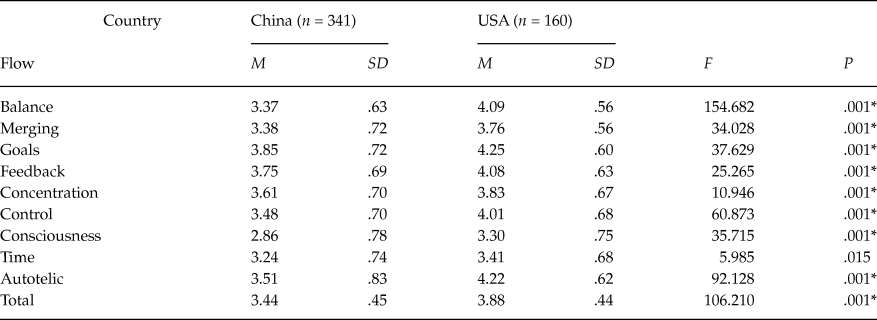
A one-way ANOVA was conducted with Flow as the dependent variable and Cultural Background (American vs. Chinese) as the independent variable to test the results of hypothesis 1. The results supported the hypothesis that the flow scores of the American participants would be higher than those of the Chinese participants. As shown in Table 1, with the exception of the Transformation of Time dimension, American participants were significantly higher than those of the Chinese participants, p < .005 in all of the dimensions of flow including total flow score. Moreover, the sorting order of flow scores for the Chinese and American participants was nearly the same, with the highest score on Clear Goals (M = 3.85 for Chinese participants, M = 4.25 for American participants) and the lowest score on Loss of Self-Consciousness (M = 2.86 for Chinese participants, M = 3.30 for American participants).
Cultural Differences of Trait Flow

Note: *P < .005.
Gender Differences of Athletes’ Trait Flow
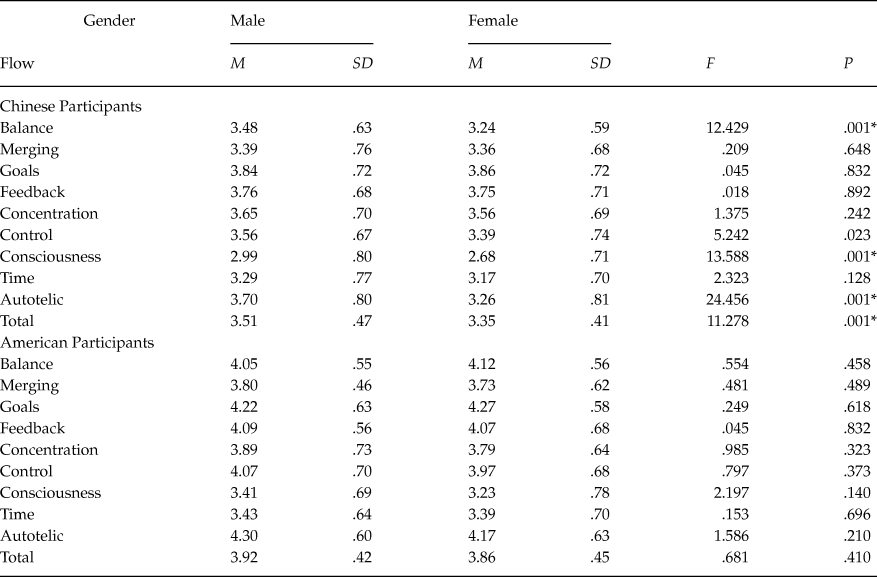
Two one-way ANOVAs were conducted with Flow as the dependent variable and Gender as the independent variable to test hypothesis 2. Results from the Chinese participants supported the hypothesis that flow scores of male athletes would be higher than those of female athletes, while results from the American participants failed to support this hypothesis. As shown in Table 2, significant gender differences existed within the Chinese sample for the Challenge-Skills Balance, F(1, 339) = 12.429, p < .005; Loss of Self-Consciousness, F(1, 339) = 13.588, p < .005; Autotelic Experience, F(1, 339) = 24.456, p < .005; and the total flow, F(1, 339) = 11.278, p < .005. In all cases, the male participants possessed higher scores than the female participants. No gender differences existed within the American sample.
Gender Differences of Trait Flow

Note: *P < .005.
Differences of Specialized Training Time of Athletes’ Trait Flow
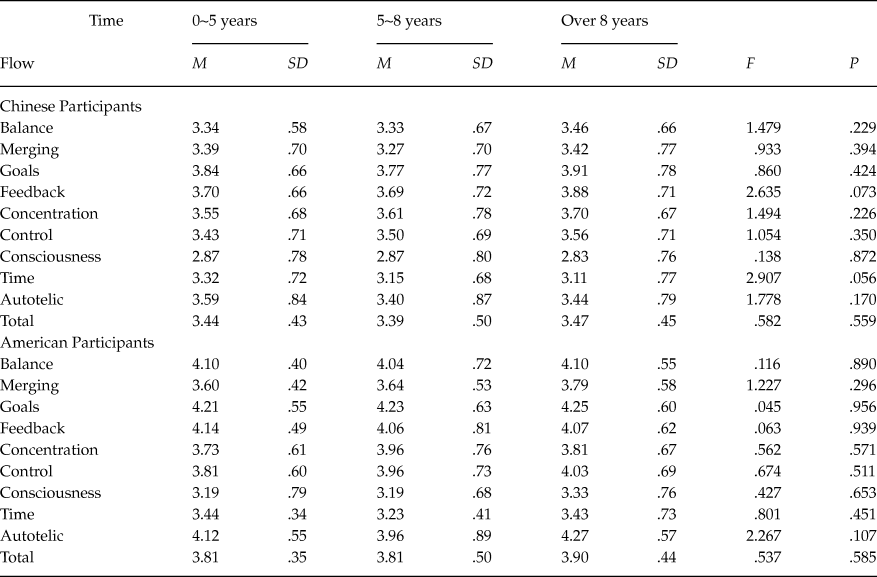
Two one-way ANOVAs were conducted with Flow as the dependent variable and Years of Specialized Training as the independent variables. Results failed to support hypothesis 3 that more years of specialized training would result in higher flow scores. As shown in Table 3, no significant differences were found as a result of years of specialized training for either the Chinese or American participants.
Differences of Specialized Training Time on Trait Flow

Skill level Differences of Athletes’ Trait Flow
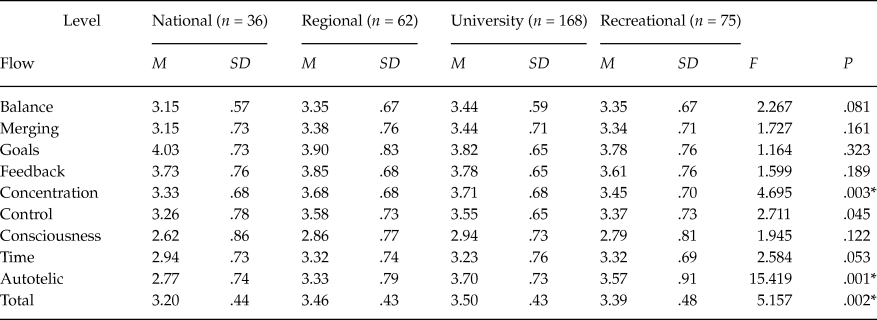
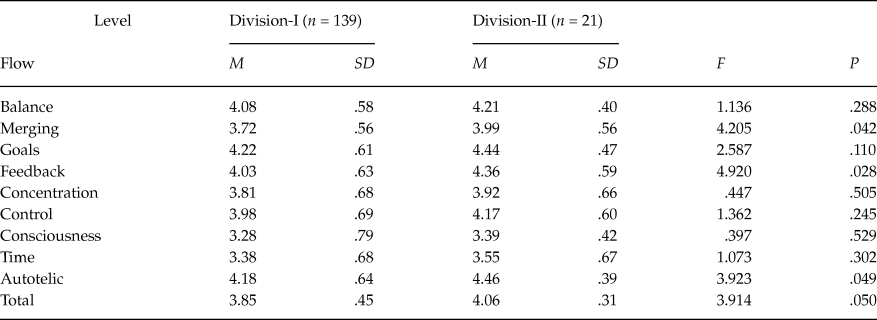
Two one-way ANOVAs were conducted with Flow as the dependent variable, and Skill level as the independent variables. Results failed to support hypothesis 4 that higher skill levels would result in higher flow scores. As shown in Table 4, significant skill level differences existed within the Chinese sample for Total Concentration on the Task at Hand, F(3, 337) = 4.695, p < .005; Autotelic Experience, F(3, 337) = 15.419, p < .005; and the total flow, F(3, 337) = 5.157, p < .005. Multiple comparisons (between all pairs of means) showed that the flow scores of university level participants were higher than those of national level participants. Although no significant skill level differences existed within the American sample (see Table 5), all of the dimensions and the total flow scores of Division-II participants were higher than those of the Division-I participants. Taken together, these results were primarily contrary to hypothesis 4.
Skill level Differences of Trait Flow of Chinese Athletes

Note: *P < .005.
Skill level Differences of Trait Flow of American Athletes

Sport Event Differences of Athletes’ Trait Flow
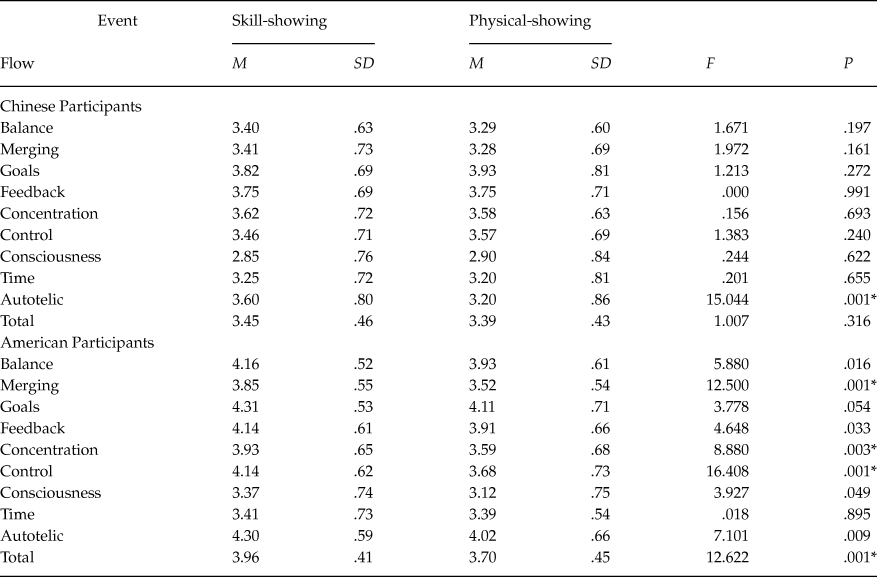
Two one-way ANOVAs were conducted with Flow as the dependent variable and Sport Event Type as the independent variable. Results from the American participants supported hypothesis 5 that the flow scores for athletes in skill-showing events would be higher than those of athletes participating in physical ability-showing events, while results from the Chinese participants failed to support this hypothesis. As shown in Table 6, significant sport event differences existed within the American sample for Action-Awareness Merging, F(1, 158) = 12.500, p < .005; Total Concentration on the Task at Hand, F(1, 158) = 8.880, p < .005; Sense of Control, F(1, 158) = 16.408, p < .005; and the total flow, F(1, 158) = 12.622, p < .005. All of these significant differences occurred with athletes from skill-showing events having higher flow scores than those from physical ability-showing events. Sport event differences existed within the Chinese sample only for Autotelic Experience, F(1, 158) = 15.044, p < .005, but not for the total flow score.
Sport Event Differences of Trait Flow

Note: *P < .005.
Discussion
Cultural Differences of Athletes’ Trait Flow
One could contend that the underlying dimensions of flow are somewhat rooted within a Western and mostly individualistic culture of self-oriented competence and achievement (i.e., dominant cultural perspective in western culture), while little attention has been devoted to understanding flow in cultures and group settings where competence and well-being are derived mostly from relatedness with the social group and from the attainment of collective goals (i.e., eastern culture; Fournier et al., Reference Fournier, Gaudreau, Demontrond-Behr, Visioli, Forest and Jackson2007). Cultural mores contend that Americans believe strongly in individualism, while Chinese advocate for collectivism. Individualism contributes to the development of an “autotelic personality”, which is consistent with the American sample in the current study. Flow theory postulates that individuals who have an ‘‘autotelic personality’’ experience flow more frequently and more intensely than others (Moneta, Reference Moneta2004a). On the contrary, findings from three studies (Asakawa, Reference Asakawa2004; Bassi & Delle Fave, Reference Bassi and Delle Fave2004; Moneta, Reference Moneta2004b) employing the Experience Sampling Method (Csikszentmihalyi & Larson, Reference Csikszentmihalyi and Larson1987) suggest that the East-West dichotomy fails to capture relevant cultural differences in flow experience, and that the flow model might be highly sensitive to specific cultural factors over and beyond the individualism-collectivism continuum (Moneta, Reference Moneta2004a). Therefore, whether the underlying dimensions of flow and the factors that facilitate it are different in collectivist cultures is an issue that warrants further investigations (Fournier et al., Reference Fournier, Gaudreau, Demontrond-Behr, Visioli, Forest and Jackson2007).
Gender Differences of Athletes’ Trait Flow
Flow, from numerous feminist perspectives, is perceived as problematic. First, the original research was conducted primarily with men in primarily privileged positions (i.e., surgeons, highly-ranked chess players, rock climbers, dancers and composers); second, there was little attention paid to class, culture, ethnicity, or ability (Fox & Walker, Reference Fox and Walker2002). Further complaints from the interweaving of flow and ethics indicate that very little attention has been paid to comparative analysis, constitutive elements, criticism of hegemonic and oppressive practices and self-reflexivity. Furthermore, flow theories must be consistently analyzed as a set of processes mediated through the simultaneous operation of gendered, sexualized and racialized hierarchies (Fox & Walker, Reference Fox and Walker2002).
With regard to possible gender differences in the flow experiences of Chinese athletes, the result was clear: similar to previous research (Sun, Reference Sun2005; Wang & Fu, Reference Wang and Fu2005), the flow scores of male participants were higher than those of female participants. Because of the cultural “sexual role expectations”, the female participants are apt to underestimate their own skills but overstate the task challenge, which leads to their lower scores in “Challenge-Skills Balance”. In physical activities, male participants display much more self-confidence, which contributes to “Loss of Self-Consciousness”. Over time, female Chinese athletes have competed with more international success than Chinese male athletes, but have had less attention paid to them with regard to material and spiritual benefits, which makes it difficult to have “Autotelic Experience” for female athletes.
In contrast, no significant gender differences existed for the American participants. This result supported the findings of Russell (Reference Russell2002), who indicated that college athletes appear to have similar experiences of flow, regardless of gender. This result could be indicative of less distinctive “sexual role” expectations in American society, and may also have been affected by an increased focus on and expectation for sport participation by women since the passing of Title IX of the Education Amendments Act of 1972. The passing of this Amendment has had dramatic effects upon women’s sport experiences in terms of numbers and available resources.
Differences of Specialized Training Time of Athletes’ Trait Flow
Hu et al. (Reference Hu, Zhang, Liu, Sun and He2002) found that specialized training time was one of the major factors influencing how baseball and softball players experienced flow. Wang and Fu (Reference Wang and Fu2005) found that more years of specialized training led to higher flow scores, indicating that they experienced flow to a greater extent than those with less training. Unfortunately, the current study failed to find similar support for the effects of the length of specialized training on how athletes experience flow. In the American sample, this lack of support may have been the result of the “autotelic personality” that is supported in Western cultures. Csikszentmihalyi (Reference Csikszentmihalyi1990) suggested that certain types of people might be better psychologically equipped, regardless of the situation, to experience flow. The individual difference factor is termed the “autotelic personality”. Personality should be relatively constant across time (i.e., years of specialized training). Although the autotelic personality is a central construct in flow theory and it presents one of the promising directions in flow research (Nakamura & Csikszentmihalyi, Reference Nakamura, Csikszentmihalyi, Snyder and Lopez2002), it has received little empirical attention from researchers (Asakawa, Reference Asakawa2004). Therefore, there remains much “to be learned about the nature of the autotelic personality and what qualities, meta-skills, and dispositions characterize individuals inclined and able to find flow in daily life” (Nakamura & Csikszentmihalyi, Reference Nakamura, Csikszentmihalyi, Snyder and Lopez2002, p. 100).
Skill level Differences of Athletes’ Trait Flow
According to the expertise effect, individuals with higher ability are more likely to experience flow (Rheinberg, Reference Rheinberg, Heckhausen and Heckhausen2008). Catley and Duda (Reference Catley and Duda1997) have stated that skill level is strongly related to flow. While Oh (Reference Oh2001) found that more skilled golfers did not experience flow with more frequency than less skilled golfers. Some studies (Hu et al., Reference Hu, Zhang, Liu, Sun and He2002; Liu, Reference Liu2005) have demonstrated that the higher the skill levels, the higher the flow scores (i.e., experienced with more intensity). However, the opposite was true in the present study (i.e., the higher the skill levels, the lower the flow scores), which is consistent with the research of Li and Sun (Reference Li and Sun2000). Results from analyses of the current Chinese sample may have been influenced by the level of competition. Athletes with higher levels of competitive experience (i.e., national team vs. regional team) may have focused more attention on outcome, while neglecting enjoyment. The expertise effect is based on the premise that expertise brings about more flow, instead of flow improving performance. Therefore, it is necessary to control for expertise differences so as to ascertain whether flow leads to better performance (Engeser & Rheinberg, Reference Engeser and Rheinberg2008). While these same significant differences were not found in the American sample, the trend was in this same direction. Given these cultural differences, further study is necessary before drawing any conclusions.
Sport Event Differences of Athletes’ Trait Flow
Wang and Fu (Reference Wang and Fu2005) found that athletes participating in skill-showing sports were more likely to experience flow than those in physical ability-showing events, and the present study supported their results. Psychological factors such as emotional stability, mental control, and self-regulation are common in skill-showing events (Tian, Reference Tian1983), which have been found to influence well-being (Geng & Zheng, Reference Geng and Zheng2006) and satisfaction (Markland & Tobin, Reference Markland and Tobin2010). If such events are truly able to influence these factors, it is certainly conceivable that they would also influence how athletes experience flow. However, it is interesting that analyses of the Chinese sample failed to support this hypothesis. Given these cultural differences, further study is necessary before drawing any conclusions.
Limitation & Future Directions
Although the findings from this study provide strong support for the individual differences of collegiate athletes’ trait flow, which fills a theoretical gap in trait flow research, it should be acknowledged that several salient limitations apply. First, it can not be determined whether or not these differences are sample-specific/generalizable due to the small sample size. This is especially true for the American samples (eg., only 21 Division II athletes were recruited). Second, only individual differences of trait flow were studied, making no reference to state flow and the relationship between the two. Third, both the experience of training and competing were included, no distinguishing the two. Lastly, the psychological characteristics of flow were examined, but the internal mechanisms influencing the experience of flow were not studied. Future research should focus on how the brain works during flow, what other physiological changes occur following the flow experience.
Despite the abovementioned limitations, the present study provided strong support for the understanding of culturally and gender based individual differences in trait flow. Nonetheless, further studies examining flow differences in athletes are necessary. One challenge is to determine if the cultural differences identified in this study consist of differences between two or more differing ways of experiencing flow. If such cultural differences do exist in how individuals experience flow, one means of experiencing flow might be consistent with the way flow was originally defined (through research with Western participants), and the other(s) would be qualitatively distinct context(s) of optimal functioning that are perhaps more salient and relevant to some non-Western cultures or diverse Western cultures. Marsh and Jackson (Reference Marsh and Jackson1999) suggested that a more appropriate evaluation of flow would be to evaluate it within a similar cultural context, rather than to evaluate it between different cultural contexts. In this approach, cultural context might constitute the unit of analysis (instead of the individual), and systematic differences among individuals might reflect residual variance that could not be explained by the variation in cultural context (and either disregarded or used as an “error term” to evaluate cultural differences).
There appears to be a need for employing qualitative research methods in the study of flow that ask respondents from different cultures to freely provide their culturally-specific definitions of optimal states. This line of inquiry may eventually lead to identifying indigenous constructs of optimal experience that are more valuable for understanding and promoting the subjective well-being of members of a specific culture (Moneta, Reference Moneta2004a).
Lastly, it is important to study the internal mechanism of flow from both the psychological and physiological perspectives. Zhang (Reference Zhang2004), a Chinese sport psychologist, put forward six hot topics deserving of exploration by sport psychologists, one of which was the feature of brain processing when athletes are in an optimal competitive state. This topic of research would certainly provide many opportunities to better understand how and why athletes experience flow.
Special thanks to Dr. Amanda Visek, Heather Deaner, Jessica Creasy, Katherine Cowan, Justine Vosloo, and Jamie Shapiro for their help with the data collection in America. This work was supported by the Major Project of the National Social Science Fund of China (No. 10ZD&052), and the Collaborative Innovation Center of POWER Project for Adolescent (No. 44801400).