The growing number of women who have entered the labor market, the more active participation of men in family life and the growing number of single-parent families have been identified as the social changes responsible for the appearance of increasing research regarding the interface between work and family. Although it is an interdisciplinary field of study, according to the literature regarding organizational behaviour and psychology of organizations, we have found numerous studies dedicated to this topic in recent decades (cf. Casper, Eby, Bordeaux, Lockwood, & Lambert, Reference Casper, Eby, Bordeaux, Lockwood and Lambert2007; Eby, Casper, Lockwood, Bordeaux, & Brinley, Reference Eby, Casper, Lockwood, Bordeaux and Brinley2005).
In this interface between work and family the idea of enrichment has become more important in recent years, according to which, and as opposed to the perspective of conflict, it is considered that the participation in multiple roles offers the subjects a large number of opportunities and resources, which can be used to promote growth and improved functioning in other areas of life (Grzywacz & Marks, Reference Grzywacz and Marks2000). In the specific case of work-family enrichment (WFE) it is considered that work benefits the family because the resources gained by the individual through his involvement in job activities help him to apply more positive affection and have an improved performance within the family (Aryee, Srinivas, & Tan Reference Aryee, Srinivas and Tan2005; Boyar & Mosley, 2007; Greenhaus & Powell, 2006; Grzywacz & Marks, Reference Grzywacz and Marks2000; Wayne, Musisca, & Fleeson, Reference Wayne, Musisca and Fleeson2004).
Work-family enrichment provides benefits for workers and organizations because, when workers consider that their organizational context allows them to perform better within the family, they also consider that the organization is looking out for their best interests and as such reciprocate with a more positive attitude towards it (Aryee et al., Reference Aryee, Srinivas and Tan2005; Wayne et al., Reference Wayne, Musisca and Fleeson2004).
However, the work-family enrichment and worker attitude relationship may vary between men and women. This relationship may be stronger in women since the integration of the work and family roles is more important for them (Andrews & Bailyn, Reference Andrews, Bailyn and Hood1993) and because they may experience and apply the resources provided to them through their involvement in their job activities (Wayne, Randel, & Stevens, Reference Wayne, Randel and Stevens2006).
We developed a scoping study, empirical in nature, which involved Portuguese workers of both sexes at a bank, with the objective of contributing towards the conceptualization of work-family enrichment, in its relationship with the affective commitment with the organization, and value the moderating effect of the social construction of gender in this field. We chose to analyze the relationship specifically in a work-to-family direction, first of all because it is more closely related to organizational policies and practices (Friedman & Greenhaus, Reference Friedman and Greenhaus2000), and because one of the aims of the current study was to obtain practical conclusions for the organizations. And secondly, because the number of studies focusing on a family-to-work direction are greater than those required in an inverse direction, and as such it would be necessary to undertake more studies to capture the complexity of a work-to-family relationship (Greenhaus & Powell, Reference Greenhaus and Powell2006).
This study contributes toward overcoming some of the flaws that exist in the literature on this topic. Firstly, few studies of the repercussions of WFE are undertaken in Portugal – for example, regarding the meta-analysis study developed by McNall, Nicklin and Masuda (Reference McNall, Nicklin and Masuda2010), no study for this country was included – and, when they are included, they usually focus on the repercussions for the family (for example, Andrade & Matias, Reference Andrade and Matias2009; Vieira, Ávila, & Matos, Reference Vieira, Ávila and Matos2012). The primary objective of the current study is to replicate the relationship between WFE and the affective commitment of workers from a sample of bank employees in Portugal. Secondly, the economic crisis currently being lived in Portugal has contributed towards the high demands being made of professionals in the banking industry (i.e.: the demand for overtime which exceeds normal office hours, the defining of ever higher performance objectives that are more difficult to achieve), which have been identified as having a negative influence on the relationship between work and family as they promote a conflict between work and family (Frone, Reference Frone, Quick and Tetrick2003). Notwithstanding these adverse situations, the aim of the current study is to analyze if the workers of this bank consider that their job activities enrich the family and reciprocate with an affective relationship towards the bank. Thirdly, and despite recognizing that gender is a crucial factor towards the understanding of the repercussions of a positive relationship between work and family (McNall et al., Reference McNall, Nicklin and Masuda2010) that are known to us, no study existed that analyzed the effect of gender on the relationship between work and family and affective commitment. As such, the objective of the current study is to test, for the first time, the moderating effect of gender in this relationship.
Work-family enrichment and affective commitment
For decades research regarding the relationship between work and family has focused on the conflicting perspective, valuing more the conjugation difficulties of the roles corresponding to each context and, as such, highlighting their incompatibility (Frone, Russell, & Cooper, Reference Frone, Russell and Cooper1992, Greenhaus & Beutell, Reference Greenhaus and Beutell1985, Greenhaus & Parasuraman Reference Greenhaus and Parasuraman1989;). More recently, Greenhaus and Powell (Reference Greenhaus and Powell2006), adopting Sieber’s theory (1974), highlighted the possibility that people could obtain several other benefits by taking part in various roles, such as a wider range of rewards, less pressure in a particular role due to the “buffer effect” of other roles, greater valuing of status and personality enrichment, by being more flexible and more tolerant towards differences. Thus, they consider the possibility of the existence of “enrichment between work and family when the extent of experiences in a determined role influences the experiences of another role” (Greenhaus & Powell, Reference Greenhaus and Powell2006, p. 73).
These authors' model defends the existence of five resource categories that can be obtained by participating in the various roles: competencies and perspectives, in other words, interpersonal and coping competencies, respect for individual differences; psychological and physical resources, such as, self-efficiency, optimism and robustness; social capital resources, such as, information and networking; flexibility; and material resources, such as, money and other material rewards. These resources may thus improve performance in another role directly (instrumentally) or indirectly (affectively). In the first instance, the resources generated while performing job activities may be transferred to performance in the family role, such as, through healthcare benefits obtained at the organization where he/she works, the employee may guarantee his/her family's well-being. In the case of affects, the resources earned by performing job activities may generate positive affects that are transferred to performance in the family role, such as a promotion at work, which may result in satisfaction for the individual and which translates into greater availability and willingness in the performance of the family role.
One of the repercussions of WFE refers to attitude towards work, namely satisfaction at work, affective commitment and turnover intentions (Greenhaus & Powell, Reference Greenhaus and Powell2006). According to Blau's social exchange theory (1964), when an employee understands that the organization works towards helping him/her integrate the two main roles in his/her life, he/she feels “compelled” to reciprocate with favorable attitudes at work and to the organization, namely in the form of heightened commitment to the organization. As a matter of fact, McNall et al. (Reference McNall, Nicklin and Masuda2010), in their meta-analysis study, proved that WFE was positively related to the affective commitment of workers towards the companies where they worked.
According to Meyer and Allen (Reference Meyer and Allen1991), organizational commitment is a psychological state that characterizes the relationship between the employee and the organization and has implications with regards to the decision of whether or not to remain it's member. According to a three dimensional model these authors considered that the concept encompassed three distinct areas: affective connection; perceived cost associated with abandonment; an obligation to stay. Each of these three areas corresponds, respectively, to affective, continuity (instrumental) and normative commitment. In other words, employees with a strong affective commitment remain at the organization because it is their wish; those that have strong instrumental commitment remain because they need to; and those that are characterized by strong normative commitment remain because they feel they should (Meyer, Allen, & Smith, Reference Meyer, Allen and Smith1993).
In the current study only the affective commitment aspect will be analyzed, seeing that we consider that the two other areas take into consideration characteristics that are less adequate to the reciprocity assumptions of the social exchange theory (Blau, Reference Blau1964), such as feelings of normative obligations and monetary issues. The same choice was made in previous studies that analyzed the relationship between the enrichment and commitment of workers (McNall et al., Reference McNall, Nicklin and Masuda2010). In addition to this, the assumption of an emotional connection by the worker is made through affective commitment, which will promote his performance in both, the tasks inherent to the job specification and organizational citizenship behavior, in other words, those that will benefit the organization beyond what is established in the job specifications thus contributing to the effectiveness of its functioning (Meyer et al., Reference Meyer, Allen and Smith1993; Meyer, Stanley, Herscovitch, & Topolnytsky, Reference Meyer, Stanley, Herscovitch and Topolnytsky2002).
In the current study we intend replicating the analysis of the relationship between WFE and affective commitment and formulate the first hypothesis:
Hypothesis 1: The worker's perception regarding work-family enrichment provided by the organization relates positively to his affective commitment towards the organization.
Gender moderation
The relationship between work and family environments with regards to both sexes has been the focus of growing attention by researchers, although with distinct focuses over time (Carlson, Grzywacz, & Zivnuska, Reference Carlson, Grzywacz and Zivnuska2009; Chang, McDonald, & Burton, Reference Chang, McDonald and Burton2010; Crompton, Reference Crompton2001; Duncan, Reference Duncan2002; Eby et al., Reference Eby, Casper, Lockwood, Bordeaux and Brinley2005). It is an issue that associates family, professions and organizations, contexts and entities that reflect and contribute towards the social construction of gender (Acker, Reference Acker1990), and as such the pertinence of adopting an analytic perspective within the organizational domain that values that construction has been defended (e.g.: Broadbridge & Hearn, Reference Broadbridge and Hearn2008; Mauno, Kinnunen, & Feldt, Reference Mauno, Kinnunen and Feldt2012). That perspective takes into consideration the existence of a gender system, as a set of individual, interpersonal and societal processes that maintains inequalities between men and women and is a part of the sociocultural structure (Connell, Reference Connell1987; Ridgeway & Correll, Reference Ridgeway and Correll2004).
Although some signs of change can be seen, the patterns of involvement of both sexes in their work have not change radically, due to the effects of socialization and repeated ideologies and practices, at the levels of family, organizations and social institutions (Mauno et al., Reference Mauno, Kinnunen and Feldt2012; Sheridan, Reference Sheridan2004). Generally, and in comparison to women, men tend to consider their role as workers as being predominant with regards to their identity, thus underestimating those roles associated with the family and domestic environments (Akerlof & Kranton, Reference Akerlof and Kranton2000; Powell & Greenhaus, Reference Powell and Greenhaus2010). As such, the ideals of male dedication to their work and careers (Moen, Reference Moen2011) and the representation of men as main breadwinners of the family prevail (Crompton, Lewis, & Lyonette, Reference Crompton, Lewis and Lyonette2007), which leads to tolerance of their lesser involvement in parenting (Kaufman & Uhlenberg, Reference Kaufman and Uhlenberg2000; Kimmel, Reference Kimmel2012) and tasks of domestic nature (Guerreiro & Pereira, Reference Guerreiro, Pereira, Crompton, Lewis and Lyonette2007). On the other hand, household and family management responsibilities keep being attributed to women in addition to professional involvement responsibilities (Crompton, Reference Crompton2001; Crompton et al., Reference Crompton, Lewis and Lyonette2007; Gatrell, Reference Gatrell2004; Greenhaus & Powell, Reference Greenhaus and Powell2006).
In objective terms, and with regards to Portugal, the fact that more than 80% of women work full-time (INE, 2012) and less than 25% have flexible working hours (Casaca, Reference Casaca2013), should be valued. Furthermore, and still regarding Portuguese reality, there is also the asymmetry of time spent on performing domestic and family related tasks, which is unfavorable for women (Amâncio, Reference Amâncio, Wall and Amâncio2007; Torres, Silva, Monteiro, & Cabrita, Reference Torres, Silva, Monteiro and Cabrita2004) and is a tendency that can be observed in most of the countries of the European Union (European Institute for Gender Equality, 2013).
In an organizational context, any behavior or situation that makes apparent the difficulty women have in conjugating family and work roles results in gender based judgment, by highlighting their stereotype feminine traits (Ridgeway & Correll, Reference Ridgeway and Correll2004), particularly when the workers are mothers (King, Botsford, & Huffman, Reference King, Botsford and Huffman2009), thus making them out to be less than the ideal worker (King, Reference King2008).
According to the social construction of gender, the boundaries between work and family environments tend to be more tenuous and permeable (Andrews & Bailyn, Reference Andrews, Bailyn and Hood1993; Jennings & McDougald, 2006). Seeing that they continue to have to dedicate themselves to family and domestic responsibilities, adapting their daily agenda (Friedman & Greenhaus, Reference Friedman and Greenhaus2000), they will tend to value more those strategies and resources that allow them to enrich the roles they play at work and in the family and promote less conflict (Shelton, Reference Shelton2006).
In opposition and also relating to the influence of the gender system, men have a greater tendency to separate the roles related to work and family (Andrews & Bailyn, Reference Andrews, Bailyn and Hood1993; Jennings & McDougald, Reference Jennings and McDougald2007), and it is expected that they exhibit autonomy and independence (Wood & Eagly, Reference Wood, Eagly, Fisk, Gilbert and Lindzey2010) and, as such, that they attribute less importance and value less the work-family enrichment potential (Wayne et al., Reference Wayne, Randel and Stevens2006).
The referred framing in the gender perspective contributes towards the understanding of rhetoric and analyses regarding the need to conciliate work and family responsibilities that focus in on the specific situation of women (Chandra, Reference Chandra2012; Hegewisch & Gornick, Reference Hegewisch and Gornick2011; Wattis, Standing, & Yerkes, Reference Wattis, Standing and Yerkes2013) so that they may demonstrate they have greater sensibility to the organizational policies of work-family enrichment (Duncan & Pettigrew, Reference Duncan and Pettigrew2012; Mauno et al., Reference Mauno, Kinnunen and Feldt2012; Scandura & Lankau, Reference Scandura and Lankau1997).
As a result of this, women will thus demonstrate greater levels of commitment towards the organization if they perceive it is making resources available to help them respond adequately to their work and family requirements (Scandura & Lankau, Reference Scandura and Lankau1997), as well as express less their wish to leave the organization (Blomme, Tromp, & van Rheede, Reference Blomme, Tromp, van Rheede and Chen2008).
Based on this concept and on the reviewed study results, a second hypothesis was formulated for this study:
Hypothesis 2: The relationship between work-family enrichment and affective commitment is moderated by the gender of the workers, and as such, this relationship is stronger among women.
Method
Procedure and sample
Data was collected by means of an online questionnaire, which was made accessible at the national branches and central services of a Portuguese bank, with the approval of management, guaranteeing confidentiality and anonymity to those who participated. The sample included 1885 workers (52% of total workers), of which 802 were women (42.5%) and 1083 were men (57.5%). All participants were workers with a permanent contract, working full-time (35h per week) performing different functions: management (N = 725, 38.4%), administrative (N = 305, 16.2%), commercial (N = 306, 16.3%), technical (N = 361, 19.1%), and other (N = 188, 10%). Of this group, 229 (12.1%) had been working for the bank for less than 5 years, 385 (20.4%) between 5 and 10 years, 630 (33.4%) between 10 and 20 years and 641 (34%) between 20 and 30 years. It was no possible to collect details regarding the various characteristics of the participants (i.e.: marital status, number and age of children) seeing that this information could compromise their anonymity.
Measures
Work-family enrichment.
This variable was assessed using a translation of the Carlson, Kacmar, Wayne, and Grzywacz (Reference Carlson, Kacmar, Wayne and Grzywacz2006) scale, which had already been used in previous studies (Carvalho & Chambel, Reference Carvalho and Chambel2014; Vieira, Lopez, & Matos, Reference Vieira, Lopez and Matos2014), and high internal consistency values were obtained (α = 0.94 and α = 0.91, respectively). This scale is made up of 9 items that consist of affirmations regarding the positive influence of work on the family (an example item is “My involvement in my work helps me gain knowledge and this helps me be a better member of my family”). To each of these items, participants could choose 5 answers on a scale ranging from “Completely Disagree” (1) to “Completely Agree” (5), in which the higher values correspond to more positive appreciations of WFE. A Confirmatory Factor Analysis was carried out to verify if the items adequately saturated the single assumed factor. The model obtained an acceptable fit χ2(27) = 952.89 p < .01; SRMR = .05; TLI = .91; CFI, = .94; IFI = .94. A Cronbach's alpha of .94 was obtained.
Affective commitment.
To evaluate affective commitment towards the organization, a translation of the Meyer et al. (Reference Meyer, Allen and Smith1993) scale was used, which had already been used in a previous study (Chambel & Sobral, Reference Chambel and Sobral2011), in which high internal consistency values were obtained (α = .84). The scale is made up of six items, half of which reflect a positive relationship and half that reflect a negative relationship (an example item is “I experience the problems in the company as if they were my own”). The participants answered according to the choice of answers provided, ranging from “Completely Disagree” (1) to “Completely Agree” (7). The last three items were posteriorly inverted for the purposes of statistical analysis, seeing that a higher global score represents a greater affective connection to the organization. A Confirmatory Factor Analysis was carried out to verify if the items adequately saturated the single assumed factor. The model obtained an acceptable fit χ2(9) = 274.11 p < .001; SRMR = .06; TLI = .91; CFI, = .95; IFI = .95. A Cronbach's alpha of .85 was obtained.
Sex.
The 'sex' variable in this study was considered to be a dummy variable, coded as 0 for the male sex and as 1 for the female sex.
Control Variable.
The amount of time on the job within the organization revealed itself to be a variable related to worker commitment (Meyer & Allen, Reference Meyer and Allen1997). In order to control its effect, the amount of time workers had been on the job was considered. This control variable, which had been measured according to 4 categories, less than 5 years, between 5 and 10 years, between 10 and 20 years and between 20 and 30 years, was transformed into a dummy variable by considering the group with most years on the job as the reference group.
Results
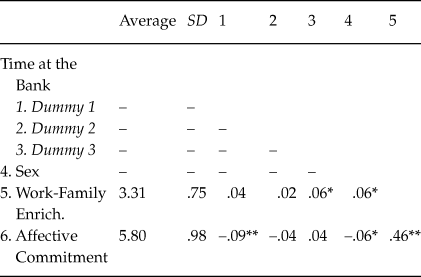
Based on the average values obtained (see Table 1), it was observed that the level of affective commitment workers had with the organization was quite high, seeing that the average values to their answers were 5.80 on a 7 point scale. Furthermore, a slightly positive perception towards WFE was also identified, seeing that the average obtained for the answers was 3.31 on a 5 point scale. Comparison between sexes shows significant differences with regards to organizational commitment, F(1, 5.44) = 5.70, p = .02, with higher values being obtained by men with regards to this attitude (M = 5.85, SD = .95) in comparison to women (M = 5.75, SD = 1), and in WFE, F(1, 3.85) =, p < .001, with higher values being obtained by women with regards to this perception (M = 3.36, SD = .74) in comparison to men (M = 3.27, SD = .75). Analysis of the correlations between the variables shows that WFE presents a positive and significant relationship with Affective Commitment.
Averages, standard deviation and correlations between the variables studied

Note: *p < .05; **p < .01.
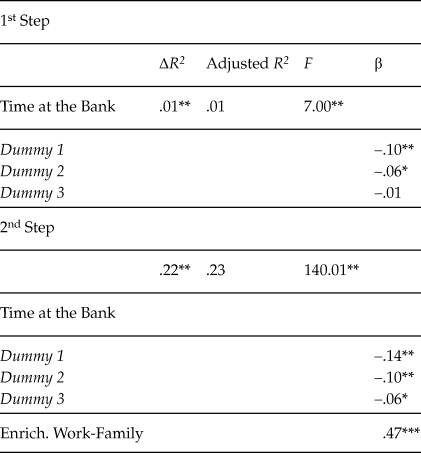
In order to test Hypothesis 1, which assumes that worker perception regarding the work-family enrichment provided by the organization is positively related to their affective commitment towards the same organization, a hierarchical linear regression was carried out. Subjacent to any regression is the construction of an estimates model, consisting of predictors whose introduction in the model may be more or less controlled by the researchers, according to the multiple regression method used. For this particular analysis, the hierarchical method was used, where the predictors used and their input order into the model depend directly on the researcher. This method allows for the analysis to be based on the expectations inherent to the research, in other words, it can be based on a previously defined theoretical model with the objective of finding empirical explanations relating to the magnitude and direction of a given relationship, the researcher has the liberty to define construction ‘rules’ for the regression model being tested (Field, Reference Field2009). During the first estimation step, a control variable was introduced (“time at the bank”), and during the second step and independent variable (WFE) was added, for which the values presented in Table 2 were obtained.
Relationship between WFE and Affective Commitment

Note: *p < .05; **p < .01;
The worker's perception regarding WFE provided by the organization relates positively to his affective commitment towards the organization. It was observed that 22% of Affective Commitment of the participants relating to the organization can be explained by WFE, in which the beta value is also significant, which leads to the consideration that Hypothesis 1 is supported by the data.
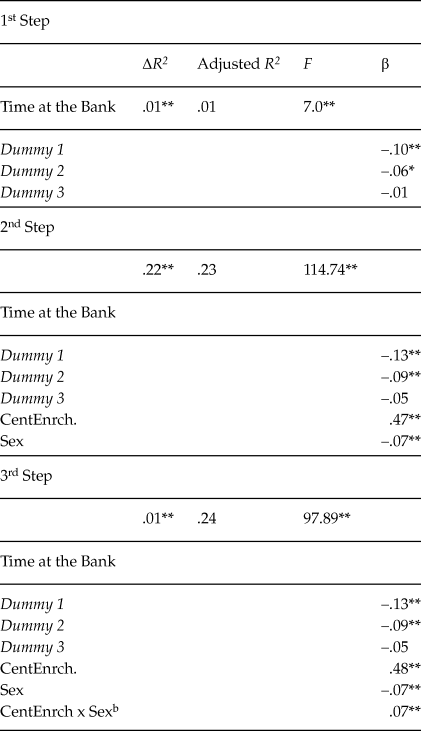
In order to test Hypothesis 2, which presumes that the relationship between work-family enrichment and affective commitment is gender moderated, in such a way that this relationship is stronger in the case of women, Baron and Kenny's (Reference Baron and Kenny1986) proposed approach was adopted. According to these authors, there are three paths that meet the needs of the independent variable: the influence of the independent variable, the influence of the moderating variable and the influence of interaction (ie.: the product) between these two variables. As such, the hypothesis for moderation is supported if the effect of the interaction is significant. Furthermore, it is still necessary to consider that, although significant effects may exist between the independent or moderating variables and the dependent variable, these are not conceptually relevant to test moderation (Baron & Kenny, Reference Baron and Kenny1986). We started by transforming the moderating variable (sex), previously coded as 0 and 1, into –.05 for men and .05 for women. Next, we proceeded with the centralization of the predictor variable (WFE), in order to avoid multicollinearity. After carrying out these procedures, a hierarchical linear regression analysis was undertaken, introducing, during a first step, the ‘time at the bank’ variable, in a second step, the variables ‘WFE’ and ‘sex’ and, in a third step, the interaction between these two variables (‘WFE’ and ‘gender’). Through these procedures, the values presented in Table 3 were obtained.
Sex Moderation

Note: **p < .01. ªCentred Work-Family Enrichment, bCentred Work-Family Enrichment and Sex.
The values obtained show that the ‘sex’ variable interacts with WFE to explain Affective Commitment, adding 1% to the explanation of this attitude, and this interaction has a significant beta. In order to observe how the relationship between WFE and affective commitment differed according to the sex of the participants, separate regressions were carried out for both sex and the relation was found to be β = .55 for men and β = .72 for women. Thus, the second hypothesis was considered as being supported seeing that the relationship between WFE and Affective Commitment is stronger in women.
Discussion
The results of this study contribute towards the understanding of the relationship between WFE and affective commitment and, furthermore, allow the moderating role of gender to be highlighted in this relationship. In fact, WFE shows a positive relationship with affective commitment of the workers, in which the women attribute greater importance to WFE to commit affectively to the organization.
As was observed by other authors (Allen, Reference Allen2001; Wiese & Salmela-Aro, Reference Wiese and Salmela-Aro2008) this study showed that worker perception regarding the enrichment of the role played in the family provided by carrying out their job activities is positively related to the affective commitment they have towards the organization. This result is fundamental for organizations because, as demonstrated, the affective commitment of workers is a relevant attitude towards assuring their efficiency and motivation (Meyer et al., Reference Meyer, Stanley, Herscovitch and Topolnytsky2002). As such, those organizations that manage to increase the affective commitment levels of their employees will be able to evolve in organizational terms, becoming more competitive.
Even though the results of the current study show that WFE may generally increase the levels of commitment towards the organization, women show a greater sensitivity to WFE to respond with such a positive attitude in terms of the organization. Besides the magnitude of the effect to explain this attitude when considering that the interaction of sex with WFE is quite reduced, the value is identical to those found in the studies that analyze the effect of the interaction between variables (ex.:, Bakker, Demerouti, & Euwema, Reference Bakker, Demerouti and Euwema2005; Bakker, Hakanen, Demerouti, & Xanthopoulou, Reference Bakker, Hakanen, Demerouti and Xanthopoulou2007). In fact, a significant interaction effect was obtained, which allowed for confirmation that women, when compared to men, will tend to value more resources that, within the organization, contribute towards an improved performance in the family, such as highlighted by other authors (e.g.: Blomme et al., Reference Blomme, Tromp, van Rheede and Chen2008; Mauno et al., Reference Mauno, Kinnunen and Feldt2012; Noonan, Estes, & Glass, Reference Noonan, Estes and Glass2007; Scandura & Lankau, Reference Scandura and Lankau1997). As a counterpoint, the lesser sensitivity of men to this type of transposition of resources from work to family, to reinforce their organizational commitment, also corroborates the conclusions of other authors (e.g.: Duncan & Pettigrew, Reference Duncan and Pettigrew2012; Scandura & Lankau, Reference Scandura and Lankau1997). These results lead to speculation regarding the vivacity of contents that constitute social representations associated to men and masculinity, in other words, focus on work and career, their role as main family breadwinners and decreased family responsibilities (Crompton et al., Reference Crompton, Lewis and Lyonette2007; Kimmel, Reference Kimmel2012).
The current study also highlighted that men, when compared to women, had greater levels of organizational commitment, as can be observed in other studies (Casper, Martin, Buffardi, & Erdwing, Reference Casper, Martin, Buffardi and Erdwing2002; Duxbury & Higgins, Reference Duxbury and Higgins1991). It can be considered that this difference may have occurred because men are more available to commit to the organization, because careers are a very prominent definition of the male identity (Akerlof & Kranton, Reference Akerlof and Kranton2000; Powell & Greenhaus, Reference Powell and Greenhaus2010) and, consequently, tend to highlight higher levels of commitment, even when they had little perception that their work experience enriched their family life (an average of 3.27 on a 5 point scale). On the other hand, in the case of women, because their commitment towards the organization was more dependent of their perception of WFE, even though their perception of the enrichment was higher than that of the men, it is a relatively weak perception (average of 3.37, on a 5 point scale), thus undermining their levels of commitment towards the organization.
It is considered that this set of results will be enriched and made more complex through gender perspective, avoiding essentialist scrutiny of the differences between sexes in the organizational and family universes (Broadbridge & Hearn, Reference Broadbridge and Hearn2008; Crompton et al., Reference Crompton, Lewis and Lyonette2007; Mauno et al., Reference Mauno, Kinnunen and Feldt2012; Moen, Reference Moen2011; Wattis et al., Reference Wattis, Standing and Yerkes2013). In other words, women, more than men, express greater interest in WFE to regulate their involvement with the organization, something that should be interpreted within the context and under the influence of gender associated social factors (Mandel, Reference Mandel2011; Powell & Greenhaus, Reference Powell and Greenhaus2010) and considered as being social conditionings, with regards to the gender asymmetries in the relationship with work and the family, as still occurs in the beginning of this century in Portuguese society (Amâncio, Reference Amâncio, Wall and Amâncio2007; Casaca, Reference Casaca2013; Guerreiro & Pereira, Reference Guerreiro, Pereira, Crompton, Lewis and Lyonette2007; Torres et al., Reference Torres, Silva, Monteiro and Cabrita2004).
Without the substantial and objective alteration of the inequalities present in the division of remunerated and non-remunerated labor, which is unfavorable to women, they can be considered to be less desirable to organizations (Estevez-Abe, Reference Estevez-Abe2005, Reference Estevez-Abe2006) and, still, their access to positions of higher status, power and better remuneration may be hindered (Mandel & Semyonov, Reference Mandel and Semyonov2005, Reference Mandel and Semyonov2006; Moen & Sweet, Reference Moen and Sweet2004). As a result of this, we think that work characteristics and organizational practices that allow for the increase of WFE (Carvalho & Chambel, Reference Carvalho and Chambel2014) should consider contextual and structural factors that support gender iniquities, which complicate the analysis of work-family relationships, considering the possibility that such an enrichment holds an interests to men (Byron, Reference Byron2005; Mauno et al., Reference Mauno, Kinnunen and Feldt2012; Moen, Reference Moen2011; Shockley & Allen, Reference Shockley and Allen2007). The construction of an organizational context that promotes WFE, with the objective of increasing commitment levels with no exclusive association to women, may thus be a contribute to the dilution of gender iniquities in an organizational context (Broadbridge & Hearn, Reference Broadbridge and Hearn2008) and, hypothetically, in society, safeguarding against the referred undesirable effects.
Four limitations were identified in the current study. Due to their being supported by a correlational design, the results of the current study do not allow cause-effect relationships to be established between variables, only the nature (positive or negative) of their relationships to be inferred. On the other hand, seeing that the current study occurred during a single moment in time, one should admit that the answers obtained and, as a consequence, the results, may change due to personal or organizational contingencies, which could lead to the pertinence of similar studies of longitudinal character in order to clarify the relationship of causality between the variables. The second limitation regards the characteristics of the sample. Seeing that that this limitation consists in employees of a single company in the banking sector, it is not possible to generalize with regards to other sectors of activity that are characterized by distinct tasks, working hours and support resources. As a third limitation we can refer the fact that it was not possible to obtain demographic information in order to assure the anonymity of the participants (ex.: marital status, number and age of sons or dependants) which may have high relevance for the understanding of the relationship between work and family. Lastly, we highlight the fact that only the work-to-family direction was analyzed in the current study, and did not include the direction family-to-work, which could enrich the understanding of worker attitudes in their work context, namely that of their affective commitment.
We consider it to be desirable that studies based on samples that allow for the collection of demographic data, assuming that this information may contribute towards greater insight relating to the way men and women, according to gender perspective, perceive WFE, in light of their family framework and stage of life they are currently in, as suggested by Moen (Reference Moen2011).
The current study highlights the importance of work-family enrichment with regards to the affective commitment of workers and their organizations, which benefits both parties. The need to reinforce and develop effective forms of promoting and assuring work-family enrichment is thus reinforced, in order to increase the positive attitude of workers with regards to their organizations. Portuguese workers are, in countries of the European Union, among those who perceive the least amount of trust with regards to keeping their jobs, due to the socio-economic crisis (Eurobarometer, 2010), which has stressed gender inequalities in the working universe (European Commission, 2013). On the other hand, as Carvalho and Chambel (Reference Carvalho and Chambel2014) demonstrated in another study involving Portuguese bank workers, the high intensity of work demands directly affects WFE, with which there is a positive gender relationship.
Thus, the identification of gender effects on WFE and the affective connection with the organization suggests that the measures used to promote this enrichment have to come from a careful analysis of the organizational and social contexts and the particularities of its workers. As such, it is considered that there is a need to focus on the effects of the socio-economic crisis with regards to WFE and, at the same time, undertake the systematic breakdown according to gender of the observations, avoiding their interpretation according to sex essentialist point of view, but rather according to psychosocial framing, as suggested by the theory of gender. Decisions regarding those measures should, as such, be creative, adaptive, localized and dynamic, in order to cater to the real needs of workers and, thus, also work in favor of the objectives of the organization.
This edition was partially funded by Instituto Politécnico de Setúbal.