For death is certain to one who is born…you should not grieve for what is unavoidable.
The Bhagavad-Gita, 300 B.C.E.INTRODUCTION
The prospect of the death of a patient presents challenges for all physicians (and especially for physicians-in-training). Cultural differences often complicate the process and interfere with much needed dialogues surrounding a patient's death. However, such cultural differences may be profoundly important to patients, and, therefore, relevant to their complete care, as well as to their family and their community.
In this article we review the medical, psychiatric, and (to a limited extent) religious literature on the Hindu perspective on death and dying, and provide examples of how physicians can address one aspect of “cultural competency” as it relates to end-of-life care. Given that physicians in the United States alone deliver medical and psychiatric care for an estimated 3,000,000 South Asian immigrants and their descendants, provision of culturally specific end-of-life information for English-speaking healthcare providers is needed (United States Census Bureau, 2007). A vocal Hindu diaspora also exists in Britain, Canada, the Pacific Islands, East Africa and the Caribbean (where South Asian immigrants and their descendants constitute up to 40% of the population in Trinidad and Tobago, and where rituals from one of the Hindu epics, the Ramayana, are celebrated annually)(Walcott, Reference Walcott1992).
After providing information in four areas relevant to end-of-life care (the physical environment and conditions at the end of life, the autopsy and handling of the dead, mourning a child's death, and expectations about the normal duration of bereavement), we will discuss approaches to the development of “cultural competency” to enhance the care provided by physicians.
BACKGROUND BELIEFS
Unlike Christianity, Judaism, or Islam, Hinduism has not been historically identified with a single book equivalent to the Bible, the Torah, or the Koran; Hindus have not been considered “people of the Book” by members of these Western religions. One school of Hinduism founded by Adi Shankara (the saint, sage, and scholar) in 788 C.E. is Vedanta; Shankara brought the Upanishads (part of the Vedas, discussed subsequently) and the Bhagavad Gita into prominence as Hindu scripture (Bose, Reference Bose1930). The sects of Hinduism (identified along the axes of one's principal deity, one's domicile [e.g., region of South Asia], one's language, and one's caste) are numerous, though many textbooks offer an introduction (Flood, Reference Flood1996). Many contemporary Hindus name “the Gita” as a vitally important text to their understanding of death and dying; they cite the famous battle scene in which the warrior Arjuna (the hero of a larger epic poem, the Mahabharata) has a metaphysical dialogue with the god Krishna (who acts as his charioteer and guide) and comes to understand the impermanence of human life as compared with an indestructible divine, to which the individual soul is connected and will return (Prabhavananda & Isherwood, Reference Prabhavanand and Isherwood2002).
One starting point is an understanding of Hinduism as encompassing both polytheism and monotheism, rather than simply being pluralistic or without a single foundational text (Flood, Reference Flood1996). A similar duality exists between the apparent intellectual fluidity of the religion, and the strictness of codes that govern intimate relationships, family obligations, permitted types of work and education, and dietary guidelines. Duty (dharma), as a concept, is central to an internalized adherence to these codes, and to the inextricability of family and social roles from one's personal identity (Eck, Reference Eck, Glazer and Glazer1990).
PHYSICAL ENVIRONMENT AT THE END OF LIFE
Given these complex categorizations, it may be challenging for patients and their families to articulate their wishes regarding who should be in the room, and to determine which other aspects of the physical environment are relevant at the end of life. General questions, such as, “Is there anything you think is very important for Mr/Ms [patient's name]?” or “Are there any rituals you would like to perform?” may be helpful.
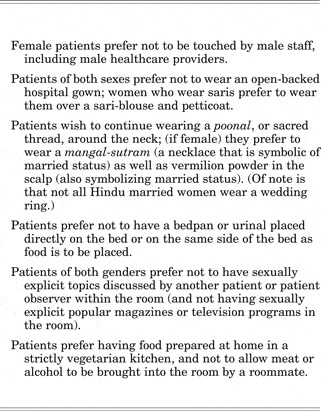
Religiously observant patients and their families may engage in more detailed discussions if a therapeutic alliance has been formed. Some specific wishes on the part of a Hindu patient are summarized in Table 1.
Common preferences of Hindu patients at the end of life

For many Hindus, vegetarianism involves beliefs about purity that make doubts about the contamination of food with meat or meat byproducts a reason to forego eating for weeks at a time (Polan, Reference Polan2012). Conversely, meat eating by Hindus has been sanctioned (dating back to cattle-raising Hindus as mentioned in Vedic literature); therefore, one should not assume that all Hindus are vegetarians (although some may wish to become vegetarians at the end of life to facilitate cleansing) (Ghosh & Khan, Reference Ghosh and Khan2005). Some conservative Hindus also have prohibitions against garlic, onions, and tomatoes in their food; allowing a patient to eat food brought from home may be helpful.
A commonly quoted saying (thought to originate in the Hindu Vedas and the Puranas [Hindu and Jain accounts of cosmology, narrated as stories]) against “crossing the seven seas” may weigh heavily for immigrant Hindus and may complicate the experience of terminal illness. Other sayings, such as, “Your mother and father are your first gods,” add significance to the act of departure. Numerous myths and religious images exist within Hinduism that dramatize filial piety, and many of these are recreated in songs or visual displays during religious holidays or in temple art (as seen in the story of the elephant-headed god Ganesha, son of the god Shiva and goddess Parvati, who “wins” a contest against his brother, to see who can circle the universe the fastest, by slowly walking in a circle around his parents) (Jansen & Langham, Reference Jansen and Langham1993). Ideas about personal guilt and sin, whether in connection to perceived failures in performing one's duty in this life, or in the past, may exist for Hindu patients and have an impact on illness experiences. For example:
Mr. A, a 40-year-old married man, learned over the telephone that his father (a long-time tobacco chewer and user of “snuff”) had been diagnosed with oropharyngeal cancer. For several years after learning of his father's diagnosis and subsequent death, he reported nightmares and flashbacks of the promises he had made to “see his father frequently” and “to not forget about him”. He had emigrated from India at the age of twenty-six, first for his education, then to raise a family with another Indian immigrant; he felt guilty that after becoming financially successful he merely sent his father money. While aware of his guilt, he felt that God would punish him for his neglect; he thought that his father might have stopped using tobacco if he had not been “abandoned” by him. Occasionally, as when he suffered any setback, he would say out loud in his native (South Indian) language, “Oh God, I have sinned, but if I am a bad man, please make me go blind.” When he was diagnosed with open-angle glaucoma in his early fifties, he considered this as confirmation of his guilt, although he was surprised that his sight remained normal.
Psychiatrists may be asked to evaluate requests for privacy (and refusals of various palliative or social services) and to determine if these represent a self-imposed isolation relating to guilt.
Reading the individual patient's interest in, and comfort with, cultural explanations is also important clinically. Many observant Hindu patients, on being told that returning home will not be possible, wish to have a small shrine in their room (that they decorate with flowers and incense as well as with a photograph or small painting of a cherished deity). Some keep a smaller wallet-sized picture of a deity in a purse or locket for protection. Asking directly about the meanings of these symbols, or asking “Who is that?” may be construed as impolite or intrusive; on the other hand, some patients regard this as an attempt both to build rapport and to learn about another culture. The safest course involves allowing the patient or family members to initiate conversations about these symbols, as for many Hindus in the United States, Canada, and Britain, past encounters (with racial epithets that escalated into physical confrontations) have historically begun with direct questions about what religious symbols mean. For example, “Dotbusters” (an organized group of perpetrators of hate-crimes against Hindus and other South Asians in 1990s New Jersey), have often begun episodes of harassment or outright physical violence by pointing out the bindi, or vermilion powder, worn by married Hindu women (or saris, Sikh turbans, or South Indian vaishti, a kind of sarong worn by men). Defacement of publicly displayed religious images has also been part of this history (Haines & Mortland, Reference Haines and Mortland2001).
Using active silence, or minimizing nonessential conversation, may also serve to quiet the minds of observant Hindus and prepare them for death (mahaprasthana, the great journey). Contemplating the ways in which he or she has attempted to achieve this may be a meaningful activity for a Hindu patient at the end of life. Control of pain, which may facilitate this contemplation, is likely to be accepted by most Hindu patients, although some may feel that the pain is expurgatory, and that excessive sedation will interfere with this process (Firth, Reference Firth2005).
Although a discussion of Ayurvedic medicine (and its contemporary scientific investigations) is beyond the scope of this article, it may be useful to ask questions in the initial interview, as well as in subsequent discussions with the patient, about whether he or she takes any “natural,” “herbal,” or Ayurvedic medicine. If a patient has recently traveled to South or Southeast Asia for a medical consultation (where Ayurveda, like acupuncture in East Asia, is a licensed and regulated branch of medicine), has bottles of Ayurvedic medicine by the bedside (which can be in powder, pill, or oil form), answers in the affirmative, or seems reluctant to disclose details of care (as taking unprescribed medicine represents a transgression against medical authority that many patients worry would alienate their doctors), a focused examination for signs of lead poisoning (as well as a determination of lead level), is indicated. Nonstandardized formulations of many Ayurvedic medicines for joint pain, infertility, menstrual cramps, and other conditions have been reported to cause lead poisoning (Saper et al., Reference Saper, Kales and Paquin2004). Arsenic and mercury poisoning are also associated with use of many of these compounds (Saper et al., Reference Saper, Kales and Paquin2004). Shankapulshpi, a compound prescribed for mental stress and its physical manifestations (including hypertension), has been reported to decrease phenytoin levels (Miller, Reference Miller1998). Karela, a bitter gourd prized as a fried, flavorful delicacy and as an Ayurvedic remedy, has unpredictable but clinically significant effects on blood glucose regulation (although more frequent monitoring, rather than depriving a terminal patient of this dish, may be warranted at the end of life) (Miller, Reference Miller1998). Pain medications used in Ayurveda, such as velvet beans (Mucuna pruriens, marketed as kapikachhu) should be used with caution in patients who are being treated for Parkinson's disease or in those who are at risk for psychosis, as the bean root appears to contain l-dopa (Tomita-Yokotani et al., Reference Tomita-Yokotani, Hashimoto and Fujii2004).
Two concepts bear mentioning when approaching management of pain and psychiatric symptoms at the end of life for Hindu patients and their families. The first is that by which psychosis, delirium, and other altered mental states may be interpreted as having sacred meanings, and may result in a patient's family feeling that, unless the patient poses some physical danger to self or to others, such states should not be “treated” or interfered with.
The second concept relates to the Ayurvedic description of “humors” as applied to mental illness in general, and to end-of-life psychiatric symptoms in particular. “Humoral imbalance” has been reported by Hindu patients as part of an explanation for numerous physical ailments, (including diabetic leg ulcers) (Lewis, Reference Lewis2007), but it may also play a role in the recognition of mental illness as well as in profound social and occupational dysfunction (Agarwal et al., Reference Agarwal, Abhijnan and Raviraj2007). In addition to external factors (such as divine or human ill-will), the patient's own mistakes and sins, in this life and prior lives, are also called on to account for psychiatric issues, rather than access to, or efficacy of, treatment.
AUTOPSIES AND HANDLING OF THE DEAD
Most Hindus choose cremation for their deceased. Before cremation, the body is washed, where possible, using holy water (traditionally understood as water from the Ganges River, which is also the preferred site upon which to scatter ashes from cremation). Sandalwood paste or vermilion powder may be used on the forehead and face, with markings that resemble those made on for Ash Wednesday (by Christians); this may be prepared in advance of the deceased being moved from the hospital, and it should not be washed off by hospital staff (Hinduism Today, 1997). The funeral ritual, in traditional form, involves a procession with mourners dressed in white, with the eldest son breaking the skull of the deceased (usually a deceased male) to open the pathway for the soul to leave the body (Axel & Harshav, Reference Axel and Harshav2004).
Before the rituals of procession and cremation (which are attended only by male relatives), autopsies are accepted as routine in South Asia. Unlike the traditions of several other cultures (including some Native American tribes) (Alvord, Reference Alvord2000), Hinduism does not forbid cutting or surgically altering the body for the purpose of a medically or legally necessary determination (although donation of the body to science for dissection or for the medical care of another individual is not encouraged, being seen as somehow disruptive to the soul of the deceased) (Gruessner, Reference Gruessner and Benedetti2007).
MOURNING THE DEATH OF A CHILD
Across cultures, the death of a child is often devastating for parents and for extended family members. Apart from the burial, which is often (although not always) witnessed by the family, few formal purification rites exist after a child's death as they do following the death of an adult. However, few studies have examined parental bereavement among Hindu families. One such study noted more severe acute grief symptoms (with hostility, restlessness, mutism, denial of the death, and impulsive gestures) among parents who had lost a first- or second-born son than among parents of daughters or younger sons in a family in which older heirs were still alive (Tamer et al., Reference Tamer, Tamer and Warey1991). In general, the teaching that parents should have contact with the body of the deceased infant or child has recently been called into question. Such contact is not the norm among Hindu patients, although it is not explicitly forbidden. Lack of social support has been predictive among nearly all parents for pathological grief, post-traumatic stress disorder, and difficulties with adjustment and the acceptance of loss (Chichester, Reference Chichester2007). Among Hindus, it is important to note that a visible tragedy, such as the loss of an infant or child, may meet with social disapproval, silence, and the belief that the parents who have experienced such a loss are “ill-fated,” have “bad luck,” or have erred in some way, and therefore necessitate social exclusion for some period. This may also extend to family and community reactions to the birth of a Hindu child with severe disabilities. For example:
Mr. C, a 32- year-old married Hindu man with a healthy and precocious first-born child, had never considered going to see a psychiatrist until the birth of his second child (who had pervasive developmental disabilities). Even after six months of depressed mood, spontaneous crying, and withdrawal from his friends at work, he still resisted the idea. His presentation to the Indo-American Mental Health Clinic of a community hospital was prompted by a letter from his older brother, who had asked him not to attend the upcoming ceremonies for the death anniversary of their father because of the “bad luck” he experienced with his second child's birth.
Psychiatric interventions that address self-blame and changes in social position related to parental bereavement among Hindu patients may be particularly important. In addition, an assessment for the risk of suicide should be performed (as with all patients who present with new-onset depressive symptoms or with grief that could be pathological) and it should include specific questions about anticipated supports and feelings about participating in community functions. It may also be helpful for the parents to define nontraditional social supports (e.g., co-workers, non-Hindu friends, and members of different clubs) in case their South Asian community contacts are delayed, inconsistent, or even hurtful, because of beliefs among community members about the meaning of a child's death or life-altering injury. The psychiatric team should encourage the parents to call on alternate, durable supports for better coping with the loss.
DURATION OF BEREAVEMENT
Mourning rituals can be divided into immediate and prolonged. In the first 10 days to 2 weeks, rituals include housecleaning and avoidance of social visits to the house (especially if that is where the loved one passed away). However, excessive lamentation is forbidden, as this is thought to direct negative emotional energy toward the dead. Joyful remembrance is the goal, but festive occasions, such as weddings, are avoided in the weeks after a death, and in many cases, in the year following the event (Firth, Reference Firth2005).
Twenty-four hours after the cremation, the male relatives gather the bones of the deceased, and collect the ashes for dispersal in a nearby river or pond, or, ideally, the Ganges. Offerings of pinda, rice balls, are made during the first 2 weeks, symbolizing the family's continued feeding and care of the departed relative through the transition to death (Mysorekar, Reference Mysorekar and Puchelski2006). Additional memorial services take place at the 1 month and the 1 year anniversary. Often the rites of the death anniversary precede the Navaratri festival; these are contrasting events: the death anniversary involves extensive cleaning and purification of the house and the physical surroundings where the deceased will be remembered (and again symbolically “fed”); the Navaratri or “nine night” festival involves many visitors; celebration with music, dance, and visual decorations; and bonding with community members outside the immediate family.
Bereavement lasts at least 1 month in the acute stage and 1 year in the chronic stage, with commemoration of the death anniversary or sraddha. Sraddha in Sanskrit means “faith” and represents the ritual of remembering one's ancestors; it is also performed after the 1 year death anniversary during subsequent Pitri Paksha (a fortnight in late September or early October when offerings to one's ancestors are believed to be well received and to reach them more quickly) (Urquhart, Reference Urquhart1857). Bereavement that involves frequent ruminations and that interferes with social or occupational function, or includes depressed mood and frequent tearfulness (for more than 1 year), could be considered socially appropriate (as for a female widow), although it is not dictated by Hinduism. On the other hand, many Hindu teachings urge against “excessive grief” in the larger goal of acceptance of death (Kubler-Ross, Reference Kubler-Ross1997). Therefore, any Hindu patient who presents with a prolonged grief reaction should be evaluated for complicated bereavement, even if the symptoms appear culturally consistent.
Suicidal ideation during Hindu bereavement may also be inflected with a sense of “duty,” as in the image of a wife so devoted that she wishes to join her husband in death, or a mother who wishes to join her child so that the child will not be alone in the afterlife (a journey that involves passing through gates that open on one's level of past “sinfulness” and being reborn or liberated from the cycle of rebirths). Expressions of marital devotion are often satisfied within the religion by having the Hindu wife place her jewelry on the husband's body, and in most immigrant communities, other rituals (such as breaking her bangles to show grief, shaving her head to renounce being a sexually attractive woman, wearing white as the color of mourning on a daily basis, and adopting a Spartan diet, in preparation for death) are not performed, although they still are in many communities within South Asia (Bhugra, Reference Bhugra2005). Vulnerability to elder abuse has been documented for Hindu women brought to live with their adult sons after their husband's deaths, and culturally sensitive screening for domestic violence should include questions about arguments at home, and whether they ever become physically threatening or assaultive. Elder abuse may also be manifest as neglect, and both elderly Hindu men and women should also be screened for geriatric depression and a duty to “die soon,” and for worries about placing a burden on their caregivers (particularly their sons) (Patel & Gaw, Reference Patel and Gaw1996). Discussions of sati (ritual self-immolation on the husband's funeral pyre), refer to a long-outlawed practice in South Asia, historically associated with the persecution of widows in South Asia, and in contemporary times, with “bride-burning” and “dowry deaths.” Therefore, suicide, homicide, and violence assessment of any patient with burn injuries inconsistent with history is always advisable.
CONCLUSION
Our discussion has focused on the content of relevant scriptural material for Hindu patients at the end of life, and offered insights about the clinical implications of this issue. Aspects of this discussion that may be especially salient to the issue of “cultural competency” include:
• Framing searches for information in terms of key clinical questions (e.g., What should the physical environment be like? How are children mourned? How long is normal bereavement?)
• Synthesizing information with a comparative perspective (e.g., mentioning Christianity and Buddhism, although other religions would also be relevant: the concept of “sitting shiva” in Judaism and the mourning period for up to 1 year in Hinduism)
• Applying cultural information to the examination of clinical vignettes, for a more in-depth and potentially therapeutic approach to the patient.
Building cultural competency in a specific area (e.g., end-of-life-care for different ethnic or religious groups), for a given religion or ethnic group (e.g., psychiatric care within a Hindu perspective) can enrich the clinical learning experience by nurturing empathy. Other specific suggestions for building cultural competence include:
• Keeping some type of personal journal or diary to jot down particularly striking clinical cases that illustrate some fundamental differences of cultural beliefs among members of multidisciplinary teams, the patient, and his or her family
• Attending religious services at least once for different religions (e.g., a Hindu or Buddhist chanting service) either in the hospital, or in the community, ideally with a member of that religious community, as an interested party
• Having an informal discussion with the hospital chaplain who is responsible for ministering to a religious group other than one's own
• Raising culturally relevant questions in teaching rounds, so they can be considered in the overall evaluation and plan.