INTRODUCTION
Increasing grain yield is one of the primary objectives of most bread wheat (Triticum aestivum L.) breeding programmes worldwide. During the last 50 years, most yield progress in wheat has been associated with increased harvest index. In particular, breeding efforts in raising grain yield have mainly modified one of the yield components, namely grain number/m2 (GN; Austin Reference Austin1982; Slafer & Andrade Reference Slafer and Andrade1989; Slafer et al. Reference Slafer, Andrade and Satorre1990). Grain number continues to be the component which best explains yield variations (Shearman et al. Reference Shearman, Scott and Foulkes2005), but it is a difficult trait to select for in early generations of a breeding programme, in which not enough seed is available for accurately determining traits per unit area. Therefore, understanding the physiology of GN determination is a good way to identify traits to further improve yield potential. Fischer (Reference Fischer, Smith and Banta1984) proposed that, under optimal growing conditions (i.e., without water or nutrient limitations and in the absence of pests and diseases), GN in wheat can be considered as the product of (i) the duration of the rapid spike growth period (SGP), (ii) the crop growth rate during the SGP, (iii) the dry weight partitioning to spikes during the SGP and (iv) the number of grains per unit of spike chaff dry weight, i.e., a measure of spike fertility (SF).
Data from Stapper & Fischer (Reference Stapper and Fischer1990) revealed differences in SF among Australian wheat cultivars; however, the authors considered that SF differences were not relevant in GN determination. Later, Abbate et al. (Reference Abbate, Andrade, Culot and Bindraban1998) observed that increased GN in high yielding Argentine cultivars was actually associated with higher SF values. Since then, several authors have reported the existence of substantial variation in SF among modern cultivars (Shearman et al. Reference Shearman, Scott and Foulkes2005; Fischer Reference Fischer2007; Acreche et al. Reference Acreche, Briceño-Félix, Sánchez and Slafer2008; González et al. Reference González, Terrile and Falcón2011, Lázaro & Abbate Reference Lázaro and Abbate2012; Abbate et al. Reference Abbate, Pontaroli, Lázaro and Gutheim2013). In addition, a few studies (Abbate et al. Reference Abbate, Andrade, Culot and Bindraban1997, Reference Abbate, Andrade, Lázaro, Bariffi, Berardocco, Inza and Marturano1998, Reference Abbate, López, Brach, Gutheim, Gonzalez, Kruk and Serrago2007, Reference Abbate, Pontaroli, Lázaro and Gutheim2013) have provided some proof of stability of the trait under different environments, although this needs to be further investigated.
Based on this evidence, several authors have suggested that this ecophysiological trait could be used as a selection criterion in breeding programs aiming at increasing grain yield (Fischer Reference Fischer2007, Reference Fischer2011; Foulkes et al. Reference Foulkes, Slafer, Davies, Berry, Sylvester-Bradley, Martre, Calderini, Griffiths and Reynolds2011; González et al. Reference González, Terrile and Falcón2011; Lázaro & Abbate Reference Lázaro and Abbate2012; Abbate et al. Reference Abbate, Pontaroli, Lázaro and Gutheim2013). Also, Abbate et al. (Reference Abbate, Pontaroli, Lázaro and Gutheim2013) have proposed a fast and simple method to screen for SF at maturity in a small sample of individual spikes. Hence, SF could be used as a selection criterion in early generations of a breeding programme. However, no information has yet been generated on the genetic basis of phenotypic variation for the trait and its mode of inheritance. The current paper reports (1) evidence of variation and stability of SF in six datasets combining commercial cultivars under different environments, (2) the estimation of trait heritability in F 1 hybrids derived from controlled crosses between commercial cultivars with contrasting SF and (3) an analysis of SF distribution pattern in two F 2 segregating populations.
MATERIALS AND METHODS
Assessment of spike fertility in commercial cultivars
Characteristics of experiments and datasets
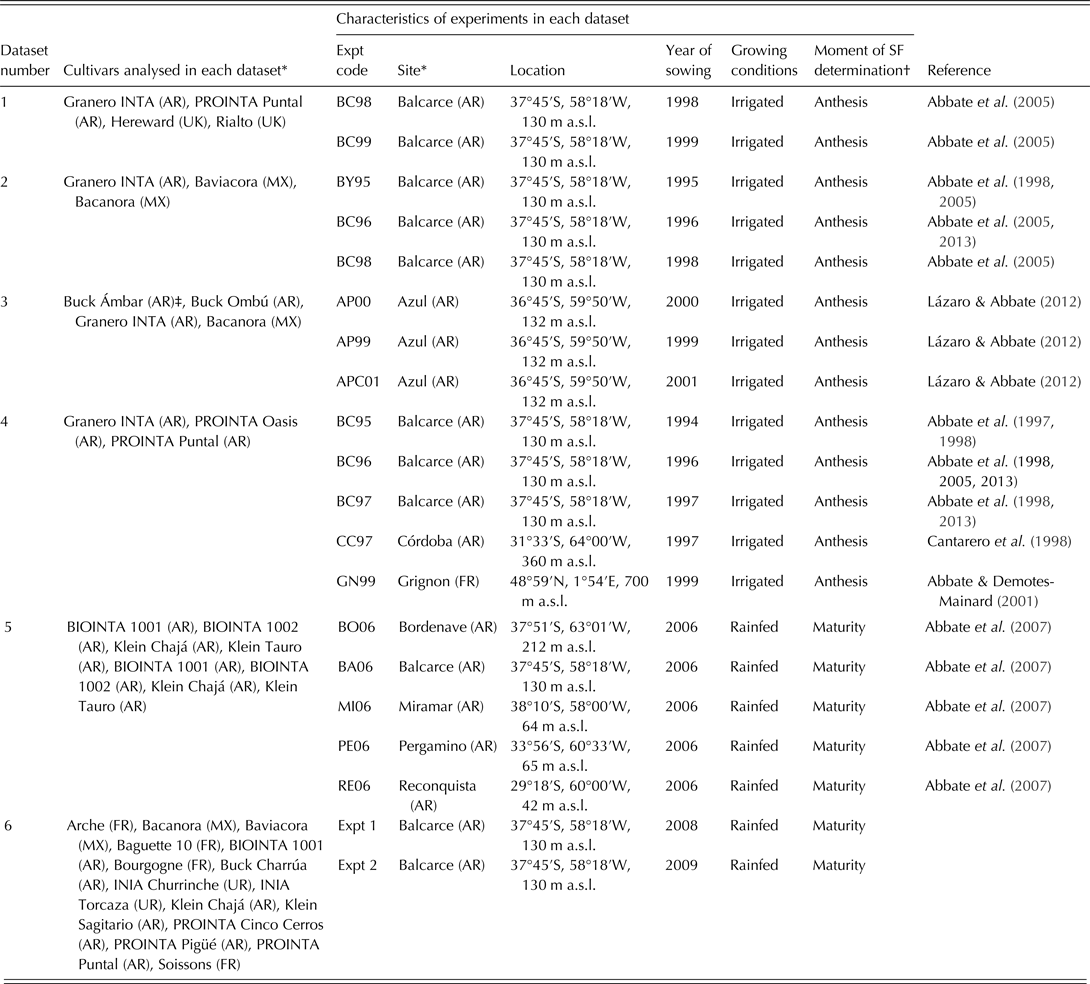
A wide set of partially published data (Abbate et al. Reference Abbate, Andrade, Lázaro, Bariffi, Berardocco, Inza and Marturano1998, Reference Abbate, Lázaro, Montenegro, Bariffi, Gutheim, Buck, Nisi and Salomón2005, 2007, 2013; Cantarero et al. Reference Cantarero, Dardanelli and Badiali1998; Abbate & Demotes-Mainard Reference Abbate, Demotes-Mainard, Nisi and Rubiolo2001; Lázaro & Abbate Reference Lázaro and Abbate2012) from 17 field experiments (Table 1) was used for analysing SF variation and stability in wheat commercial cultivars. Six datasets were built by combining two to five experiments per dataset, which were carried out under similar management practices but in different locations or years, and included at least three cultivars in common, all with chemical control of weeds, pests and fungal diseases. An overview of each dataset is presented in Table 1 and the distinctive characteristics of each dataset are described herein.
Commercial cultivars evaluated and distinctive characteristics of each field experiment in six datasets of combined experiments used for examining SF variation

* Country of origin (in parenthesis): AR, Argentina; UK, United Kingdom; MX, Mexico; FR, France; UR, Uruguay.
† Anthesis: Spike dry weight measured 7 days after anthesis and grain number at maturity; Maturity: spike dry weight and grain number measured at maturity.
‡ Durum wheat.
In Dataset 1, two Argentine and two British cultivars were compared, while two Argentine and two Mexican cultivars were evaluated in Dataset 2. Both datasets comprised experiments carried out without water or nutrient limitations (i.e., under potential conditions) at Balcarce, Argentina. Dataset 3 included one Mexican and three Argentine cultivars evaluated under potential conditions in Azul, Argentina, in 3 years with contrasting temperature and radiation. Dataset 4 compared three Argentine cultivars in three contrasting locations: Balcarce, Córdoba (Argentina) and Grignon (France), under potential conditions. Dataset 5 comprised experiments with four Argentine cultivars at five Argentine locations spanning 10° of latitude in the Argentine wheat belt, under rainfed conditions. In all cases, a randomized complete block design with three or four replications was used, and the experimental unit for each plot consisted of seven to nine rows wide (inter-row distance 17–20 cm) and at least 5 m long. Dataset 6 comprised two experiments with 15 cultivars of diverse origin which were used in controlled crosses, as detailed below.
Determination of spike fertility
Spike fertility was calculated as the quotient between grain number and spike chaff dry weight, either at ‘anthesis’ (growth stage GS62; Zadoks et al. Reference Zadoks, Chang and Konzak1974), as proposed by Abbate et al. (Reference Abbate, Andrade, Culot and Bindraban1997), or at ‘maturity’ (GS90) as proposed by Abbate et al. (Reference Abbate, Pontaroli, Lázaro and Gutheim2013). The first approach involved the determination of spike dry weight/m2 7 days after anthesis, and grain number/m2 at maturity, both by sampling 60–80 cm from the five central plot rows. Spike fertility determination at maturity was performed by taking two samples of at least 15 spikes each, in which spike chaff dry weight and grain number were determined. All samples were dried at 56 °C until constant weight before being processed.
Statistical analysis
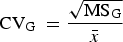
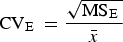
A combined ANOVA was performed for each dataset (Annicchiarico et al. Reference Annicchiarico2002) with fixed effects of cultivar (genotype), environment (location and/or year) and their interaction. Coefficients of variation of the ANOVA factors were calculated as follows:
 $${\rm C}{{\rm V}_{{\rm G\;}}} = \displaystyle{{\sqrt {{\rm M}{{\rm S}_{\rm G}}}} \over {\bar x}}$$
 $${\rm C}{{\rm V}_{{\rm E\;}}} = \displaystyle{{\sqrt {{\rm M}{{\rm S}_{{\rm E\;}}}}} \over {\bar x}}$$
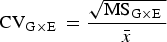 $${\rm C}{{\rm V}_{{\rm G} \times {\rm E\;}}} = \displaystyle{{\sqrt {{\rm M}{{\rm S}_{{\rm G} \times {\rm E\;}}}}} \over {\bar x}}$$
where CVG: genotype coefficient of variation, CVE: environment coefficient of variation, CVG × E: genotype × environment interaction coefficient of variation,  $\bar x$: general mean of variable, MSG: genotype mean square, MSE: environmental mean square, MSG × E: genotype × environment interaction mean square.
Assessment of spike fertility in parental cultivars and F 1 and F 2 generations
Crossing work
Fifteen bread wheat cultivars of diverse genetic background, contrasting for SF, were used in controlled crosses during the 2007/08 cropping season at the experimental field of the Unidad Integrada Balcarce, Argentina. Cultivars used were from Argentina (Baguette 10, BIOINTA 1001, Buck Charrúa, Klein Chajá, Klein Sagitario, PROINTA Cinco Cerros, PROINTA Pigüé and PROINTA Puntal), France (Arche, Bourgogne and Soissons), Mexico (Bacanora and Baviacora) and Uruguay (INIA Churrinche and INIA Torcaza). Flowers from several spikes per female parent were emasculated and bagged to avoid contamination with foreign pollen. Pollen was collected from each male parent immediately before pollination, which was done 2–3 days after emasculation. At maturity, seeds from each cross were harvested and stored individually. Most of the crosses, except a few, were made between cultivars of contrasting SF. Crosses performed depended on the coincident availability of spikes for both flower emasculation and pollen collection. This resulted in 20 crosses that yielded enough seed quantity for further experiments.
Crop husbandry
Two field experiments (termed Expt 1 and Expt 2) were conducted at Balcarce. Experiment 1 was carried out during the 2008/09 cropping season under a randomized complete block design with three replications. Treatments consisted of the parents and F 1 hybrids, grown at c. 65 seeds/m in a single 1 m-long row, 0·2 m from adjacent rows, as the experimental unit. Experiment 2 was carried out in the 2009/10 cropping season. Seeds of the 15 parental cultivars and of two F 2 populations (Baguette 10/Klein Chajá and Prointa Pigüé/Soissons) were sown in randomized 11 m-long plots consisting of seven rows spaced 0·2 m from adjacent ones, at c. 20 seeds per linear metre. Experiments were conducted under no nutrient or water limitations, and weeds, pests and fungal diseases were controlled chemically.
Determination of spike fertility
In Expt 1, all spikes per experimental unit were collected at maturity for SF determination. In Expt 2, all spikes from five random plants per parental cultivar and from 200 random F 2 plants per cross (Baguette 10/Klein Chajá and ProINTA Pigüé/Soissons) were harvested at maturity. Spike fertility was calculated following Abbate et al. (Reference Abbate, Pontaroli, Lázaro and Gutheim2013)'s protocol as described above, except for the fact that samples were air-dried in order to preserve seed viability.
Statistical analysis
An estimation of the narrow sense heritability (h 2) of SF was obtained by the mid-parent-offspring regression of data from the parental cultivars and their respective F 1 hybrids. According to Lush (Reference Lush1940), the regression coefficient (b) can be considered an estimator of h 2. However, the use of parent and offspring data collected in the same environment and year could lead to inflated h 2 values due to significant genotype × environment interaction and error covariances (Casler Reference Casler1982). One way to overcome this is to use parent data from 1 year and offspring data from a different year (Casler Reference Casler1982). Also, Frey & Horner (Reference Frey and Horner1957) recommend performing the regression analysis with standardized data to reduce the effect of the environment. Therefore, a regression analysis was carried out with the standardized SF of the parents determined in Expt 2, on standardized data of their respective F 1 determined in Expt 1. Standardization was done with the quotient between the residuals of the mean of each experiment and their standard deviation.
Histograms for frequency distribution of SF were built for each of the two F 2 populations evaluated in Expt 2. They were expressed as density of relative frequency, i.e., the quotient between relative frequency and class width. Normality of these distributions was tested with a Shapiro–Wilk test. In order to obtain the percentage of transgressive individuals in each population (i.e., the occurrence of F 2 plants with SF values that were more extreme than those of the parents) 95% confidence intervals were made for parental cultivars. Confidence intervals were made for each parental cultivar as follows:
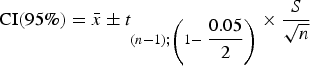 $${\rm CI}(95\% ) = \bar x \pm {t_{\left( {n - 1} \right);\left( {1 - \displaystyle{{0.05} \over 2}} \right)}} \times \displaystyle{S \over {\sqrt n}} \; $$
where  $\bar x$: mean of the cultivar; t: value of independent random variable of t distribution, with n − 1 degrees of freedom and P < 0·05; n: sample size; S: sample standard deviation.
RESULTS
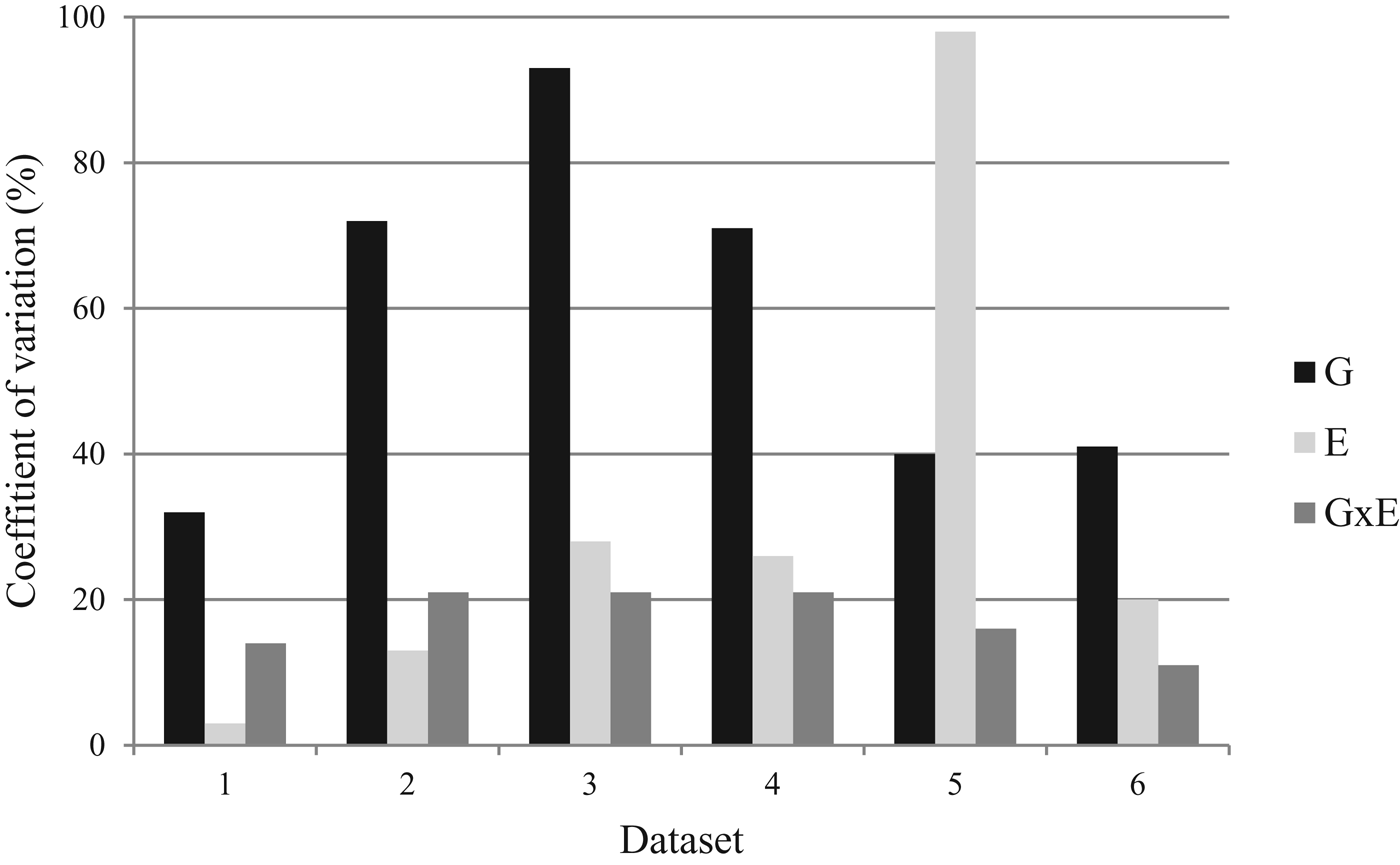
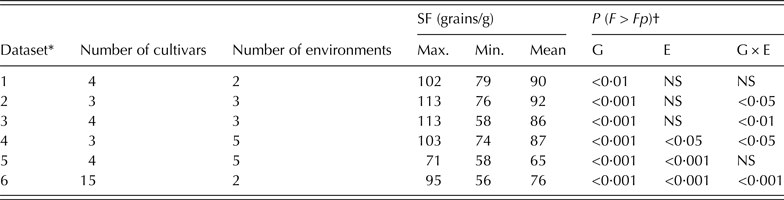
Table 2 shows the maximum, minimum and mean SF values per dataset of commercial cultivars, as well as the significance level of ANOVA factors. Considerable variation for SF among cultivars was observed in all datasets, under both optimal and sub-optimal growth conditions. Significant effects of genotypes were detected in all datasets, whereas genotype × environment interaction effects were significant in half of them; in addition, the CVG × E was always lower than the CVG (3·3 times lower, on average; Fig. 1).
Coefficient of variation of SF in ANOVA factors – genotype (G), environment (E) and genotype × environment interaction (G × E) – of six datasets of combined experiments with commercial cultivars.
Maximum, minimum and mean SF values per dataset of combined experiments; significance level of environment (E), genotype (G) and G × E effects of ANOVA
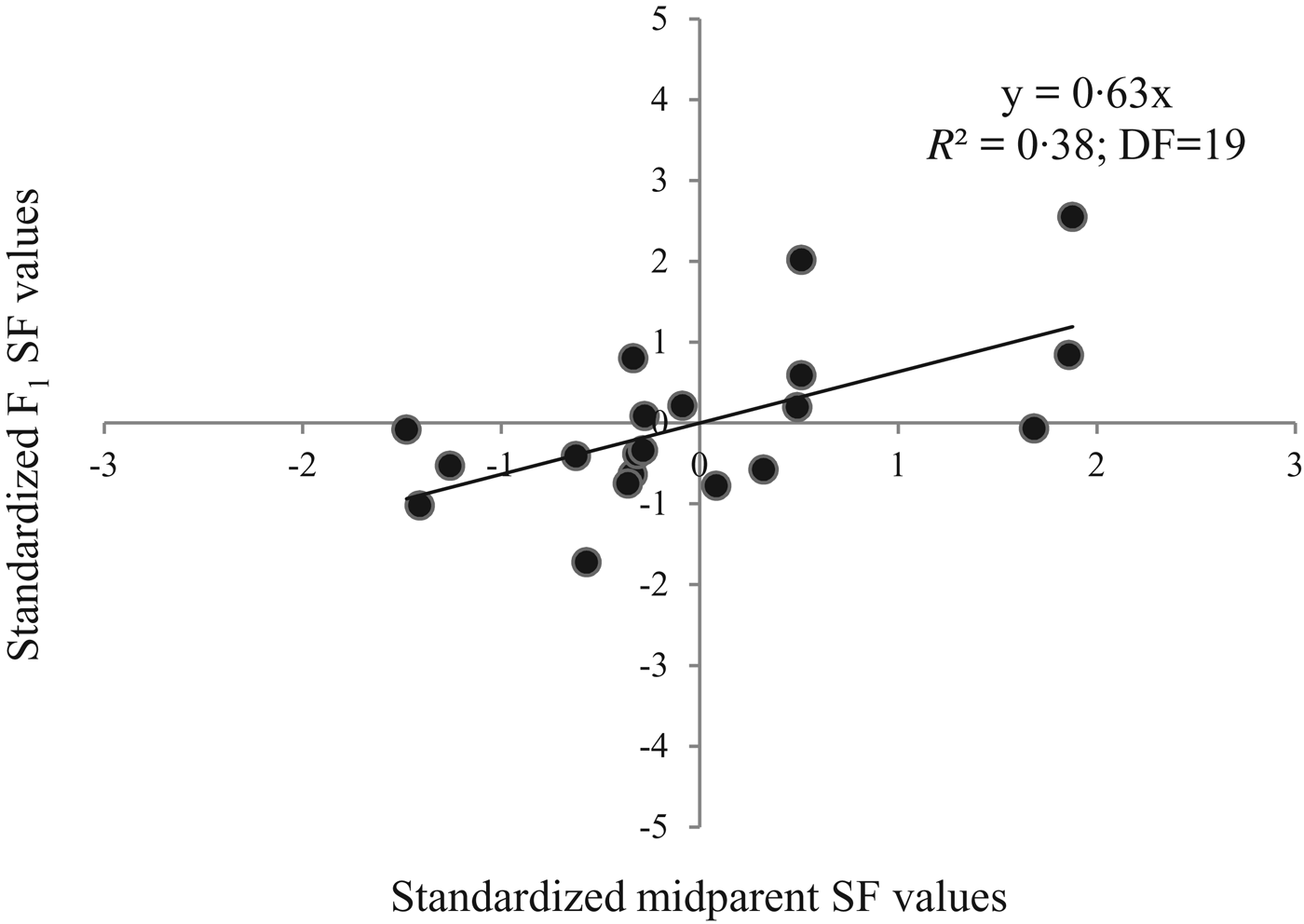
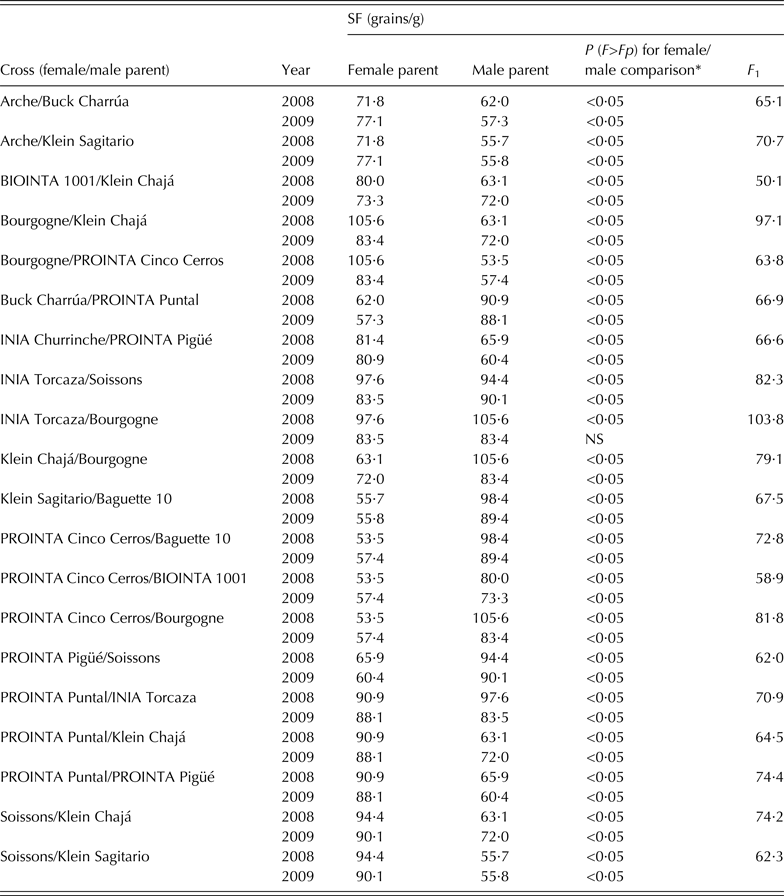
Narrow sense heritability of SF, as estimated by the mid-parent-offspring regression method with data from the 20 F 1 hybrids and their parents, was 0·63 (R 2 = 0·38, d.f. = 19, P < 0·05; Fig. 2; Table 3).
Regression of SF of the offspring (20 F 1 hybrids; data from Expt 1, Table 3) on the mid-parent SF value (data from Expt 2), in standardized units.
Spike fertility values in parental cultivars and F 1 hybrids, used for the estimation of narrow sense heritability by mid-parent-offspring regression
* Least significant difference for female/male parent comparison: 1·239. In all cases, significant differences were detected at P < 0·05, except where noted (NS).
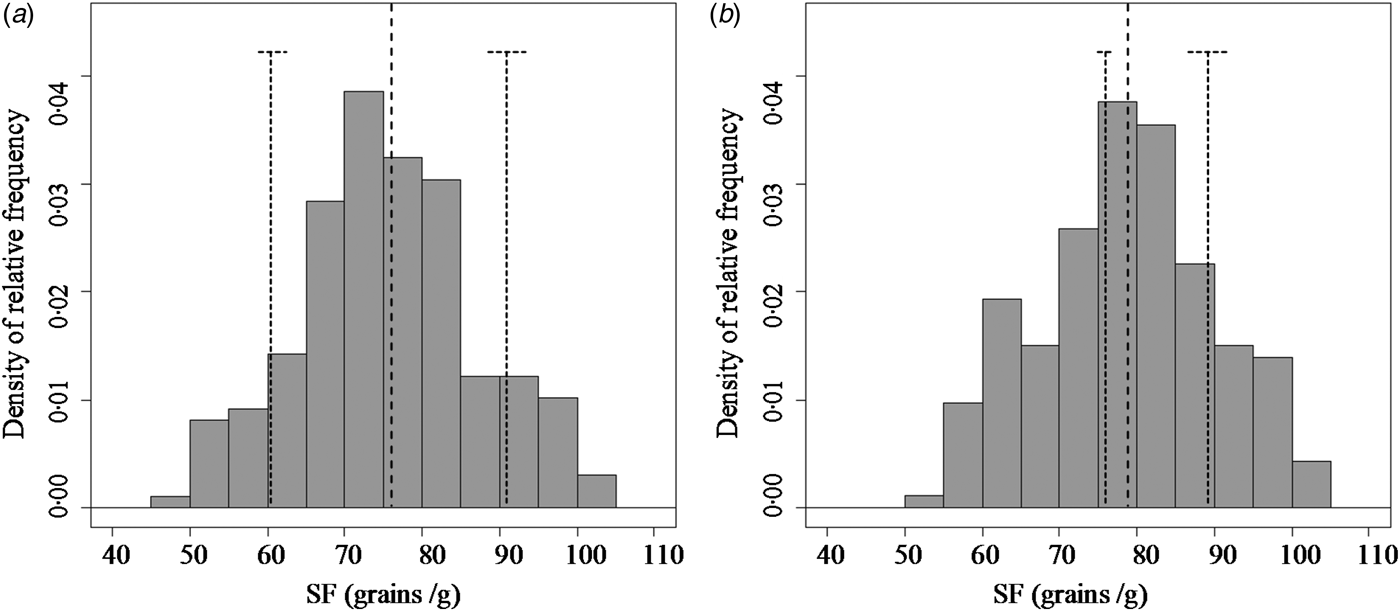
The density of frequency distribution of SF in the two F 2 populations is shown in Fig. 3. Both populations exhibited bell-shaped, symmetrical distributions with mean values intermediate between those of their parents. Transgressive segregation was detected in both populations. The F 2 population derived from the cross between Baguette 10 and Klein Chajá showed 7% of individuals with SF lower than that of Klein Chajá and 7% of individuals with SF higher than that of Baguette 10, while the F 2 population derived from the cross between PROINTA Pigüé and Soissons showed 33% of individuals with SF lower than that of PROINTA Pigüé and 10% of individuals with SF higher than that of Soissons (Fig. 3).
Density of frequency distribution of SF in two F 2 populations: (A) PROINTA Pigüé/Soissons, n = 197; (B) Baguette 10/Klein Chajá, n = 186. Population means are shown in thick, dashed vertical lines. Spike fertility of the parental cultivars are shown in thin, dashed vertical lines, with their respective standard deviation represented by a horizontal line at the top (A: left = PROINTA Pigüé; right = Soissons; B: left = Klein Chajá, right = Baguette 10).
DISCUSSION
The successful use of a given trait as a breeding target depends upon four pre-requisites: it should (1) be positively associated with crop performance, (2) be easily determined in early generations, (3) exhibit genetic variation and (4) have medium to high heritability (Andrade et al. Reference Andrade, Sala, Pontaroli, León, Sadras and Calderini2009). The association of SF with GN and, ultimately, yield in wheat was first anticipated by Fischer (Reference Fischer, Smith and Banta1984) through his ‘assimilate approach’, and then empirically confirmed by many authors (e.g. Abbate et al. Reference Abbate, Andrade, Culot and Bindraban1997, Reference Abbate, Andrade, Lázaro, Bariffi, Berardocco, Inza and Marturano1998; Shearman et al. Reference Shearman, Scott and Foulkes2005; Fischer Reference Fischer2007; Acreche et al. Reference Acreche, Briceño-Félix, Sánchez and Slafer2008; González et al. Reference González, Terrile and Falcón2011; Lázaro & Abbate Reference Lázaro and Abbate2012; Abbate et al. Reference Abbate, Pontaroli, Lázaro and Gutheim2013). Regarding the ease of determination of the trait, Abbate et al. (Reference Abbate, Pontaroli, Lázaro and Gutheim2013) proposed a simple, fast method of assessing SF, amenable to high throughput application in the context of a breeding programme. On the other hand, although many authors (cited above) have reported the existence of variability for SF among wheat cultivars, little information has been made available so far on the trait's stability under different environmental conditions and the genetic basis of phenotypic variation.
Analysis of several datasets of combined experiments with cultivars of diverse origin in different environments confirmed the existence of wide variation for SF among wheat cultivars, under both optimal and sub-optimal growth conditions. Different SF mean values observed among datasets were probably due to differences in environmental conditions, in the genetic constitution of the cultivars under study and/or in both. Despite the number of cultivars analysed here was not high (3–4 per dataset except for Dataset 6, with 15 cultivars), differences in SF were found in all datasets. Additionally, SF determination in cultivars more recently released in Argentina has revealed highly coincident results (P. E. Abbate and A. C. Pontaroli, personal communication).
Even though each dataset sampled a combination of a few cultivars and environments, a high number of experiments were analysed overall. In addition, genotypic variation was larger than genotype × environment interaction variation in all datasets, as reflected by comparing CVG and CVG × E at each dataset. This was observed consistently, regardless of the growing conditions, the method of SF determination used or the array of cultivars and environments under analysis.
The estimation of narrow sense heritability by mid-parent-offspring regression of F 1 hybrids and their respective parents suggests that additive effects play a relevant role in SF determination. The fact that symmetrical frequency distributions of SF were observed in two different F 2 populations segregating for the trait gives additional support to this hypothesis. Substantial transgressive segregation was also detected in both F 2 populations, which may indicate that several genes are involved in the control of SF. The fact that at least 7% of individuals showed higher SF values than the parental cultivar of high SF in both populations under study is encouraging in terms of the feasibility of achieving genetic progress for the trait. Notwithstanding, and despite environmental and genetic × environmental interaction effects might be low in comparison with genetic effects, as was detected in cultivars, F 2 data might be slightly biased due to the fact that each plant is a unique genotype that cannot be replicated. Thus, the occurrence of a significant percentage of transgressive segregants with greater SF than the superior parent should be confirmed in more advanced generations, in which more seed is available for carrying out field trials with increased replications and/or more than one environment.
Although heritability may be meaningful only when related to the specific genetic population structure from which it was estimated and to the environmental conditions in which the plants were grown (Fehr Reference Fehr1987), the estimation of heritability in a set of F 1 hybrids gives support to the idea that SF is a heritable trait with predominance of additive (and possibly additive by additive) effects. This is of great importance in the context of a breeding programme aimed at increasing yield. In addition, selection in early generations seems feasible because of the high narrow sense heritability observed in the current study. Further work is needed to determine whether early selection increases SF in subsequent generations and, ultimately, leads to increased grain number (and yield) in advanced generations of a breeding programme.
Help with experimental work from members of the Grupo Trigo Balcarce is acknowledged. The current study was partially financed by INTA (AEEV1513 and PNCER1331), Universidad Nacional de Mar del Plata (AGR246/08) and Ministerio de Ciencia y Tecnología de la Nación Argentina (PICT 2007-00494).