


Introduction
Natural disasters, particularly earthquakes, are crises that profoundly affect not only social life but also maternal and infant health. In disaster settings, the importance of breast milk—the most reliable source of nutrition for infants-increases due to limited food supplies, reduced access to safe drinking water, and disruptions in health care services.Reference Ratnayake Mudiyanselage, Davis and Kurz 1 , Reference Dall’Oglio, Marchetti and Mascolo 2 However, maintaining breastfeeding in such conditions often becomes challenging.
Women’s breastfeeding experiences after disasters are negatively influenced by physical exhaustion, inadequate shelter conditions, hygiene problems, and psychosocial stressors.Reference MirMohamadaliIe, Khani Jazani and Sohrabizadeh 3 , Reference Hwang, Iellamo and Ververs 4 In addition, cultural beliefs and the attitudes of the social environment play a significant role in shaping maternal breastfeeding behaviors, sometimes facilitating and at other times hindering the continuation of breastfeeding.Reference Hirani, Richter and Salami 5
Recent research has shown that disasters create multidimensional challenges for breastfeeding. Studies conducted after the 2023 Türkiye earthquakes revealed that mothers in temporary shelters faced difficulties in maintaining breastfeeding, experienced increased breastfeeding problems, and reported greater reliance on formula feeding.Reference Erat Nergiz, Barutçu and Güneş 6 –Reference Suzan, Topal and Çaka 8 Similarly, qualitative studies emphasized that emotional burden, anxiety, and lack of social support during earthquakes negatively affected the breastfeeding process.Reference Toker, Gӧkduman Keleş and Karakul 9
Comparable findings have been reported in the international literature. An ethnographic study conducted in rural Pakistan demonstrated that sociocultural factors significantly influence breastfeeding practices in disaster contexts.Reference Hirani, Richter and Salami 5 A study from Iran reported that maternal stress, insufficient support from health care providers, and misinformation created substantial barriers to sustaining breastfeeding during disasters.Reference MirMohamadaliIe, Khani Jazani and Sohrabizadeh 3 Policy- and practice-based studies conducted in the United States and Indonesia also highlighted the necessity of developing sustainable and inclusive strategies to support breastfeeding under disaster conditions.Reference Pramono, Hikmawati and Hartiningtiyaswati 10 –Reference Grubesic and Durbin 12
All these findings reveal that protecting, sustaining, and supporting breastfeeding in disasters is a critical public health priority. In the aftermath of disasters, breastfeeding is vital not only for infant survival and healthy growth but also for community resilience and recovery capacity.Reference Basibuyuk, Karabayir and Celep 13 , Reference Hargest-Slade and Gribble 14 However, the existing literature indicates a need for a more detailed understanding of maternal breastfeeding experiences in Türkiye, particularly following recent major earthquakes, as well as for strengthening support mechanisms. To our knowledge, this study is the first to investigate maternal breastfeeding experiences with the largest sample after the 2023 Türkiye earthquake. The aim of this study was to identify women’s breastfeeding experiences and the factors influencing breastfeeding continuity following the 2023 Türkiye earthquake.
Research Questions
-
1. What is the status of women’s ability to continue breastfeeding after the earthquake?
-
2. What are the factors that facilitated breastfeeding among women after the earthquake?
-
3. What are the factors that hindered the breastfeeding process after the earthquake?
Methods
Study Design and Setting
This study employed a retrospective descriptive design. It was conducted under the guidance of a faculty advisor by undergraduate midwifery students within the scope of the TÜBİTAK 2209-A University Students Research Projects Support Program. The research took place in one of the provinces most affected by the 2023 Kahramanmaraş-centered earthquakes, specifically in tent and container settlements established after the disaster.
Population and Sample
The study population consisted of women who experienced the February 6, 2023 earthquake and subsequently lived in tent/container settlements (N = 242). The sample included 217 women who met the inclusion criteria and voluntarily agreed to participate. Since the population size was known, the sample size was calculated using a 95% confidence level, P = 0.50, and a small population correction. Accordingly, reaching 109 participants was sufficient for a ±7 margin of error, and 149 participants for a ±5 margin of error. In this study, the 217 women who were reached exceeded the calculated sample size, ensuring statistical adequacy. A consecutive/convenience sampling method was employed. As this approach was based on accessibility and voluntariness in post-earthquake tent/container settlements, it carries the potential risk of selection bias (e.g., exclusion of women not present in the field or unwilling to participate) and survivorship bias. To minimize this risk, data collection was conducted across multiple settlements and at different times of the day. Standardized information was provided to eligible women, and participation invitations were delivered in an equitable manner. This limitation should be considered when generalizing the findings to the entire population.
Inclusion Criteria
-
• Having experienced the February 6, 2023 earthquake,
-
• Being in labor during the earthquake or having an infant within the first 6 months postpartum after the earthquake,
-
• Breastfeeding prior to the earthquake,
-
• Having the breastfed infant alive during the earthquake,
-
• Volunteering to participate in the study.
Exclusion Criteria
-
• Not having experienced the February 6, 2023 earthquake,
-
• Not being in labor during the earthquake or not having an infant within the first 6 months postpartum,
-
• Voluntarily withdrawing from the study during the research process.
Data Collection Tools
Data were collected using a 29-item Descriptive Information Form developed by the researchers. The form was constructed based on the breastfeeding literature in disaster contexts and covered the following content areas: (i) sociodemographic and obstetric characteristics, (ii) breastfeeding continuity (before/after status and categories), (iii) facilitating and hindering factors, and (iv) breastfeeding needs and the extent to which these needs were met. The degree of need fulfillment was rated on a numerical scale ranging from 0 to 10 (0 = not met at all, 10 = fully met).Reference Ratnayake Mudiyanselage, Davis and Kurz 1 –Reference Hwang, Iellamo and Ververs 4 In this study, basic needs referred to essential living requirements including access to food, clean water, shelter, and safety conditions, as perceived by the participants. Following a pilot application, the wording was simplified, and the logical sequence was revised.
Pilot Study
Following the approval of the ethics committee, a pilot study was conducted to assess the clarity and feasibility of the form. For this purpose, interviews were held with 5 women who had migrated from the earthquake-affected regions to the province where the researchers were located and who met the inclusion criteria. Based on the feedback obtained from the pilot study, some statements were simplified, and the order of the questions was revised. The women who participated in the pilot study were not included in the main study sample.
Data Collection Procedure
Research data were collected through face-to-face interviews with women who voluntarily agreed to participate. Participants were included in the study after providing informed consent. Each interview lasted approximately 20 minutes. During data collection, the students obtained verbal permission from the local authorities (district governorships) of the respective tent/container settlements and were present in the field. After each questionnaire was completed by the participant, item-by-item checks were performed on the spot; missing or inconsistent responses were clarified and completed during the same interview. Consistency checks (e.g., age–parity compatibility, out-of-range values) were applied during data entry. Therefore, analyses were conducted on a complete dataset.
The data collection was carried out by undergraduate midwifery students under the supervision of a faculty advisor. Prior to the study, the students received a brief training covering the study protocol, explanations of the questionnaire, standardized introduction text, privacy, and ethical considerations. Feedback from the pilot study was used to finalize the flow of the interviews. Interviews were conducted in a one-on-one format (one researcher–one participant) following standardized instructions and ensuring privacy as much as possible. Since the use of student data collectors may increase the risk of observation/adaptation bias, the researchers were trained to use non-directive language and to maintain impartial records throughout the process.
Ethical Approval
The study was approved by the Clinical Research Ethics Committee of a university on November 29, 2023 (decision no: 2023/836). Written permission was obtained from the Provincial Governorship and the Disaster and Emergency Management Authority (AFAD), and verbal consent was secured from the local administrations of the container settlements. The study was conducted in accordance with the principles of the Declaration of Helsinki, with an emphasis on voluntariness and confidentiality.
Statistical Analysis
Data were analyzed using SPSS for Windows, version 23.0. Descriptive statistics, including frequencies, percentages, means, and standard deviations, were employed. As missing data were checked and completed simultaneously during data collection, analyses were performed on a complete dataset. Continuous variables were presented as mean ± standard deviation, and categorical variables as numbers and percentages. Due to the descriptive design of the study, no hypothesis testing was conducted. Feeding categories before and after the earthquake were reported separately in tabular form for comparison purposes. All analyses were performed using SPSS version 23.0. As no significance testing was performed, P-values were not reported.
Reporting
This study was reported in accordance with the STROBE (Strengthening the Reporting of Observational Studies in Epidemiology) guidelines for observational studies.
Results
Sociodemographic Characteristics
The mean age of the participants was 28.45 ± 5.45 years, and the mean age of their infants during the earthquake was 6.91 ± 5.22 months. Among the women, 42.9% had completed primary education, and 40.1% had completed secondary education; the majority were married (97.7%) and unemployed (95.4%). More than half of the participants (57.6%) had spent the longest period of their lives in a provincial center. Regarding income status, 78.8% reported that their income was lower than their expenses (Table 1).
Sociodemographic characteristics of women (n = 217)

Table 1. Long description
The table consists of three columns: Variables, n, and percentage.
* Age (X-bar plus or minus S D): 28.45 plus or minus 5.45.
* Age of baby during earthquake in months (X-bar plus or minus S D): 6.91 plus or minus 5.22.
* Educational status: Illiterate (5, 2.3 percent), Primary education (93, 42.9 percent), Secondary education (87, 40.1 percent), Associate’s degree (21, 9.6 percent), Bachelor degree (11, 5.1 percent).
* Marital status: Married (212, 97.7 percent), Single (5, 2.3 percent).
* Place of longest residence: Village (35, 16.1 percent), District (57, 26.3 percent), Province (125, 57.6 percent).
* Working status: Not working (207, 95.4 percent), Working (10, 4.6 percent).
* Family income level: Income is less than expenses (171, 78.8 percent), Income equals expense (44, 20.3 percent), Income is more than expenses (2, 0.9 percent).
Obstetric Characteristics and Initial Breastfeeding Outcomes
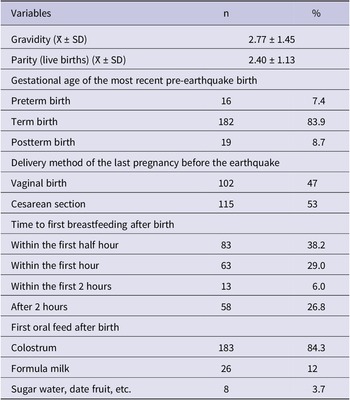
The mean number of pregnancies among the women included in the study was 2.77 ± 1.45, and the mean number of live births was 2.40 ± 1.13. Of the most recent pregnancies that occurred before the earthquake, 83.9% resulted in term deliveries, and 53% ended in cesarean sections. Regarding the timing of the first breastfeeding after birth, 38.2% of the infants were breastfed within the first half hour. The majority of the women (84.3%) reported giving colostrum to their infants as the first postnatal feed (Table 2).
Women’s obstetric characteristics and first breastfeeding outcomes (n = 217)

Table 2. Long description
The table is organized into three columns: Variables, n, and percent.
* Gravidity (X-bar plus or minus S D): 2.77 plus or minus 1.45.
* Parity (live births) (X-bar plus or minus S D): 2.40 plus or minus 1.13.
Gestational age of the most recent pre-earthquake birth:
* Preterm birth: 16 (7.4 percent).
* Term birth: 182 (83.9 percent).
* Postterm birth: 19 (8.7 percent).
Delivery method of the last pregnancy before the earthquake:
* Vaginal birth: 102 (47 percent).
* Cesarean section: 115 (53 percent).
Time to first breastfeeding after birth:
* Within the first half hour: 83 (38.2 percent).
* Within the first hour: 63 (29.0 percent).
* Within the first 2 hours: 13 (6.0 percent).
* After 2 hours: 58 (26.8 percent).
First oral feed after birth:
* Colostrum: 183 (84.3 percent).
* Formula milk: 26 (12 percent).
* Sugar water, date fruit, etc.: 8 (3.7 percent).
Impact of the Earthquake on Breastfeeding Processes
Before the earthquake, 59.0% of the women exclusively breastfed, whereas this rate decreased to 30.9% after the disaster. When combined feeding categories were considered, 94.9% of women reported exclusively or predominantly breastfeeding before the earthquake, compared to 74.2% after the disaster, indicating an overall decline in breastfeeding continuity. After the earthquake, the most common feeding pattern was predominantly breastfeeding, reported by 43.3% of participants. The vast majority of women (94.9%) were not separated from their infants after the disaster. Among the 11 women who experienced separation, the mean duration was 28.36 ± 70.67 days; upon reunification, 63.6% of these women were unable to continue breastfeeding. Breastfeeding-related complications were reported by only 8.3% of participants, and all women continued to breastfeed after treatment of these complications (Table 3).
Earthquake effects on breastfeeding outcomes (n = 217)

Table 3. Long description
The table is organized into three columns: Variables, n, and percentage.
Infant feeding method before the earthquake:
- Only breast milk: 128, 59.0 percent.
- Mostly breast milk: 78, 35.9 percent.
- Mostly formula or follow-on milk: 5, 2.3 percent.
- Only formula or follow-on milk: 6, 2.8 percent.
Infant feeding method after the earthquake:
- Only breast milk: 67, 30.9 percent.
- Mostly breast milk: 94, 43.3 percent.
- Mostly formula or follow-on milk: 24, 11.1 percent.
- Only formula or follow-on milk: 32, 14.7 percent.
Separation from baby after the earthquake:
- Yes: 11, 5.1 percent.
- No: 206, 94.9 percent.
- Duration of separation for the 11 cases: Mean of 28.36 plus or minus S D 70.67 days.
Breastfeeding continuation after reunification (n equals 11):
- Yes: 4, 36.4 percent.
- No: 7, 63.6 percent.
Development of complications preventing breastfeeding:
- Yes: 18, 8.3 percent.
- No: 199, 91.7 percent.
Continuing breastfeeding after treatment of complications (n equals 18):
- Yes: 18, 100 percent.
- No: 0, 0 percent.
Factors Related to Breastfeeding Continuity After the Earthquake
A total of 31.8% of participants reported that there were no facilitating factors for continuing breastfeeding. The most common facilitators were focusing on the infant (29.5%) and access to transportation (20.3%). The most frequently reported barriers were unmet basic needs (30.4%), lack of privacy (22.6%), and psychological difficulties (21.7%).
The most important need identified by women for maintaining breastfeeding was the fulfillment of basic living necessities (67.3%); however, the mean score for meeting these needs was low (3.5 ± 3.34 on a 0-10 scale). The majority of participants (82.5%) did not receive any breastfeeding education or counseling after the earthquake.
Regarding recommendations for sustaining breastfeeding, 40.5% of women emphasized the need for breastfeeding support (counseling, designated spaces for mothers, incentives), followed by the provision of basic living necessities (33.6%) (Table 4).
Information on continuing breastfeeding after an earthquake (n = 217)

Table 4. Long description
The table is organized into seven thematic sections with columns for Variables, n, and %.
1. Focusing on the infant and motivation to keep the baby alive:
- No facilitating factors: 69 (31.8%).
- Easy access to health care after changing cities: 31 (14.3%).
- Health services in disaster areas: 9 (4.1%).
- Private transportation: 44 (20.3%).
- Focusing entirely on baby: 64 (29.5%).
2. Factors preventing continued breastfeeding:
- No inhibiting factors: 31 (14.3%).
- Psychological reasons (stress, fear, anxiety): 47 (21.7%).
- Failure to ensure privacy: 49 (22.6%).
- Inability to meet basic living needs: 66 (30.4%).
- Lack of professional support: 13 (6.0%).
- Baby-related obstacles: 11 (5.0%).
3. Perceived requirements for breastfeeding continuation:
- No need: 19 (8.8%).
- Ensuring privacy: 35 (16.1%).
- Providing basic living needs: 146 (67.3%).
- Support for breastfeeding maintenance: 5 (2.3%).
- Psychological support: 12 (5.5%).
4. Score of the level of meeting breastfeeding needs (0 to 10):
- Mean plus or minus S D: 3.5 plus or minus 3.34.
5. Difficulties in choosing infant nutrition other than breastfeeding:
- No difficulty: 111 (51.2%).
- Lack of access to artificial products: 48 (22.1%).
- Lack of access to complementary foods: 47 (21.6%).
- Economic constraints: 11 (5.1%).
6. Status of receiving training or counseling:
- Yes: 38 (17.5%).
- No: 179 (82.5%).
7. Recommendations for maintaining breastfeeding:
- No suggestions: 17 (7.8%).
- Providing basic living needs: 73 (33.6%).
- Private breastfeeding environment: 21 (9.7%).
- Training and consultancy support: 88 (40.5%).
- Psychological support: 18 (8.4%).
Discussion
In this study, the breastfeeding processes of women who experienced the February 6, 2023 earthquake were examined, and it was determined that the disaster conditions significantly affected the continuation of breastfeeding. The findings underscore the critical importance of protecting and supporting breastfeeding in disaster contexts.
Breastfeeding Continuity
In this study, while 59% of women exclusively breastfed their infants before the earthquake, this rate decreased to 30.9% after the disaster. This marked decline demonstrates the direct negative impact of disaster conditions on breastfeeding behaviors. Similarly, studies conducted following the 2023 Türkiye earthquake also reported a significant reduction in exclusive breastfeeding.Reference Erat Nergiz, Barutçu and Güneş 6 –Reference Suzan, Topal and Çaka 8 These studies indicate that, particularly in the first months after disasters, restricted access to breast milk may result from decreased milk production, psychological stress, and inadequate breastfeeding environments.
International review studies have also highlighted that exclusive breastfeeding rates drop rapidly after disasters, with formula feeding and complementary foods becoming more common.Reference Ratnayake Mudiyanselage, Davis and Kurz 1 , Reference Dall’Oglio, Marchetti and Mascolo 2 This suggests that disasters may alter not only short-term but also long-term infant feeding practices.
In disaster-affected areas, formula distribution is frequently implemented as part of the initial emergency response. Undoubtedly, maintaining formula stocks is a strategic necessity in disaster management; however, the priority should also be sustaining breastfeeding. This is because formula feeding in disaster conditions presents several challenges: access to clean and warm water may be limited, hygiene conditions may be inadequate, and externally supplied formula support may be discontinued after a certain period.
Therefore, the approach of health care professionals working in disaster zones should primarily focus on supporting and empowering mothers and encouraging them to continue breastfeeding. Such an approach can help prevent not only short-term feeding problems but also long-term health risks.Reference Victora, Bahl and Barros 15
Facilitating Factors and Support Mechanisms
In our study, 29.5% of women reported that the motivation to keep their infants alive, and 20.3% cited access to transportation, facilitated their ability to continue breastfeeding. This finding demonstrates that both intrinsic motivation (mothers’ drive to protect and sustain their infants) and environmental factors are critically important for breastfeeding continuity in disaster contexts. Similarly, the literature emphasizes that the strongest driving force for mothers in disasters is the desire to protect their infants.Reference Hirani, Richter and Salami 5 , Reference Hargest-Slade and Gribble 14 In addition, mobile health services provided in the field and the support of volunteer health care workers were reported as significant facilitators for sustaining breastfeeding. Notably, tele-lactation support implemented after the 2023 Türkiye earthquakes provided remote counseling for mothers, offering both informational and psychosocial support, thereby contributing innovatively to the protection of breastfeeding.Reference Basibuyuk, Karabayir and Celep 13
The international literature also highlights the importance of technology- and policy-based support mechanisms in disasters. A review conducted in the United States stressed the need to integrate breastfeeding counseling into disaster management processes to ensure breastfeeding continuity.Reference Russell, Haushalter and Rhoads 11 Similarly, a policy analysis from Indonesia revealed that protecting breastfeeding in disasters requires not only strengthening clinical services but also enhancing legal regulations and community awareness programs.Reference Pramono, Hikmawati and Hartiningtiyaswati 10 These findings suggest that health care professionals in disaster areas should adopt a holistic approach that goes beyond providing clinical support by strengthening mothers’ intrinsic motivational factors, ensuring the continuity of accessible health services, and leveraging technological tools.
Barriers to Breastfeeding
In this study, 30.4% of women identified unmet basic needs, 22.6% cited lack of privacy, and 21.7% reported psychological problems as the most significant barriers to breastfeeding. These findings indicate that disaster conditions negatively affect breastfeeding not only at the physical level but also psychosocially. Qualitative studies conducted after the 2023 Türkiye earthquake similarly emphasized that women were unable to continue breastfeeding due to intense stress, fear, and uncertainty, and that lack of privacy and inadequate breastfeeding spaces in shelters made the process more difficult.Reference Mizrak Sahin and Kabakci 7 –Reference Toker, Gӧkduman Keleş and Karakul 9 A study from Iran showed that misinformation, insufficient support from health care professionals, and stress induced by the disaster were major determinants of breastfeeding discontinuation.Reference MirMohamadaliIe, Khani Jazani and Sohrabizadeh 3 A review conducted in middle- and high-income countries also highlighted that, despite different socioeconomic contexts, the barriers in disaster settings were similar, with psychological pressures, safety concerns, and lack of privacy being most prominent.Reference Hwang, Iellamo and Ververs 4
These findings suggest that ensuring the sustainability of breastfeeding in disasters requires not only individual efforts from mothers but also improvements in environmental and social conditions. In particular, health care professionals working in disaster zones should be aware of these barriers, prioritize breastfeeding support, and contribute to creating safe and private spaces for mothers. Moreover, integrating psychosocial support services can enhance mothers’ capacity to maintain breastfeeding. In this way, it is possible to protect and sustain breastfeeding despite the multidimensional challenges posed by disasters.
Needs and Recommendations
In this study, 67.3% of women reported that their most important need was the fulfillment of basic living necessities (food, water, shelter, safety). The level of need fulfillment was found to be quite low (X̄ = 3.5 ± 3.34, min-max = 0-10). In addition, only 17.5% of the women reported receiving counseling services on breastfeeding. This finding indicates that while women’s priority in disaster contexts is survival and safety, the support mechanisms necessary for sustaining breastfeeding remain largely neglected.
Studies conducted after the 2023 Türkiye earthquake also support this finding, emphasizing that women’s primary needs were shelter, food, and safety, while breastfeeding support remained secondary.Reference Mizrak Sahin and Kabakci 7 , Reference Suzan, Topal and Çaka 8 International guidelines clearly state that in disaster settings, ensuring safe living conditions should be the first priority, followed by providing support for breastfeeding and psychosocial assistance. Women’s recommendations in this study were consistent with these findings. 16 , 17 Specifically, 40.5% of participants requested that breastfeeding be supported through counseling, designated private spaces, and incentives. This demand highlights the necessity of establishing structured breastfeeding support programs in disaster settings. Therefore, disaster management should focus not only on improving physical conditions but also on creating breastfeeding-friendly spaces that ensure privacy for mothers, activating counseling services in the field, and strengthening psychosocial support mechanisms.
Strengths and Limitations
This study is one of the pioneering investigations to systematically document the breastfeeding experiences of women affected by the 2023 Türkiye earthquake. Data were collected directly from mothers living in tent and container settlements, thus providing unique and field-based insights into disaster conditions. The sample size (n = 217) exceeded the calculated minimum requirement, which increased the reliability of the descriptive findings. In addition, the data collection process was standardized through pilot testing and researcher training, and real-time checks during interviews minimized the risk of missing data.
However, this study also has limitations. Its descriptive design relied on self-reported data, which may increase the risk of recall bias. The use of convenience sampling carries the potential for selection bias, as the experiences of women who did not participate or declined participation may differ. The findings are specific to the city where the study was conducted and cannot be directly generalized to all earthquake-affected regions or other disaster contexts. The study included only women residing in tent and container settlements after the earthquake, excluding those living under different conditions. In addition, while the study’s measurement tools defined basic needs generally, the study did not differentiate between specific components such as food, water, or shelter; this may have affected breastfeeding outcomes differently.
Another limitation is that the age of infants varied widely, and some infants were approaching the natural weaning period. The study did not assess whether breastfeeding would have been discontinued regardless of the earthquake, which may have influenced the observed decline. Finally, the cross-sectional nature of the study does not allow causal inferences to be drawn between the determinants and breastfeeding continuation.
Conclusion
This study demonstrated that women’s breastfeeding experiences during the 2023 Türkiye earthquake were directly affected by disrupted living conditions, lack of privacy, and psychosocial stressors. The findings indicate that sustaining breastfeeding in disaster settings requires more than individual effort; health care services, infrastructural arrangements, social support, and psychosocial care must be mobilized simultaneously.
Breastfeeding in disaster contexts is not only a method of infant feeding but also a strategic public health component that protects maternal–infant health, enhances community resilience, and supports post-disaster recovery. Therefore, disaster management should prioritize creating environments that enable mothers to continue breastfeeding. Health care professionals should adopt approaches that empower and encourage mothers, ensure privacy arrangements in shelters, provide psychosocial support, and, when necessary, utilize innovative solutions such as tele-lactation to facilitate breastfeeding continuity.
In addition, policymakers and humanitarian organizations must address formula distribution not as a stand-alone solution but as part of strategies that also support and protect breastfeeding. Ultimately, recognizing breastfeeding as a core element of disaster management and strengthening health systems, social support mechanisms, and policies through an integrated approach will be the most effective way to safeguard the health of mothers and infants in the aftermath of disasters.
Author contribution
B.A. and G.G.I. contributed to the conception and design of the study. P.D., A.E., M.E., and S.I. contributed to data collection. G.G.I. performed the data analysis and interpretation and was responsible for project administration and supervision. B.A. and G.G.I. contributed to the writing of the original draft and to the review and revision of the manuscript. All authors reviewed and approved the final version of the manuscript.
Funding statement
This research was supported by the TÜBİTAK 2209-A Research Projects Support Program for University Students.
Competing interests
None.



 Open access

