1. Introduction
After a week’s work, on the evening of Saturday, 6 November 1920, the district medical officer of Stanisławów in eastern Poland sat down at his desk to fill out his weekly epidemiological report. He started to scribble numbers in the narrow columns of the preprinted form. Typhus and typhoid fever were still ravaging his district. He counted sixteen Christians and eight Jews who were ill with typhoid fever, three Jews and one Christian had died that week. Typhus had caused six deaths (three Jewish and three Christian) whereas 38 Christians and eight Jews were still lying ill with the disease.Footnote 1 The form required numbers for 21 other infectious diseases. But those slots remained void except for a few cases of scarlet fever and dysentery. However, the medical officer had to admit that he had not managed to oversee any disinfections or delousings in his district. He had to leave those slots blank and promised himself to definitely get this done the following week. On Monday morning the district medical officer stopped by the post office to send one copy of the form to the nearest Public Health Office situated in the city of Lwów,Footnote 2 and a second one to the Ministry of Public Health in Warsaw.
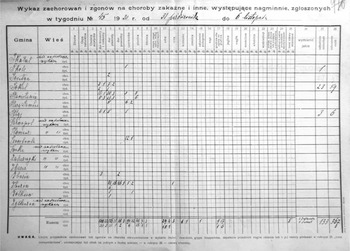
In Lwów, an employee of the Public Health Office received the mail from Stanisławów and placed it on top of the pile of forms collected from the past week. The pile had remained smaller than he had hoped. In contrast to the officer from Stanisławów, the colleagues from Skałat, Tarnopol, and seven other districts had again failed to provide their reports. Nevertheless, the employee carefully copied the numbers he had received onto a summarizing table – figures for Jews and Christians neatly separated (Fig. 1). For the non-reporting districts his slender handwriting noted “No report sent.”
Weekly Epidemiological Report of Lwów voivodship from 31.10.-6.11.1920 (TsDIAL 567/1/106).

In Warsaw the report from Stanisławów found its way onto the desk of an employee of the Statistical Department of the Ministry of Public Health. She collected all the data, conflated numbers for Jews and Christians and then prepared a national synopsis of the epidemiological situation of the Polish state.Footnote 3
The Polish state had come into being only two years earlier in 1918. Why it was so interested in the epidemiological situation of the country, how the paper technologies of epidemic surveillance worked (or did not work), and what epidemiological order of the Polish state they produced are the questions discussed in this paper. I will argue that the practice of epidemic surveillance was closely entwined with Polish state-building during the interwar period, and that therefore, the discourse about the Polish epidemiological order was dominated by the capacity of the different regions of the Polish territory to contribute to this state-building effort. Jews, meticulously separated in weekly reports on a local level, did not play a major role in the medical debate about the epidemiological situation in Poland. Rather, it was a badly reported, rural, and partly “Russian,” east that emerged from the surveillance.
Historical research has repeatedly shown that the techniques of surveying and visualizing the people, landscape, or resources of a country are powerful practices of state- and nation-building (e.g. Anderson Reference Anderson[1983] 2006; Scott Reference Scott1998; Judson Reference Judson2006; Lichtenstein Reference Lichtenstein2012; for a relativization of the power of statistics for the case of the Polish census, see Labbé Reference Labbé, Bauer, Jacques, Plésiat and Zombory2011). Yet, comprehensive and nation-wide (in contrast to local or district) epidemiological data collection did not start in many countries until the late nineteenth or early twentieth century and even then often remained a controversial subject (Sauerteig Reference Sauerteig1999; Mooney Reference Mooney1999; Fairchild et al. Reference Fairchild, Bayer and Colgrove2007; Mooney Reference Mooney2015). The quantitative measure of public health had been a new phenomenon altogether in the nineteenth century when trust in numbers gained more and more ground and states started to collect vital statistics or to register causes of death (Porter Reference Porter1995, 25; Magnello Reference Magnello, Magnello and Hardy2002, 99; Schneider Reference Schneider, Hüntelmann, Vossen and Czech2006). But it was quite a while before this trust in numbers took root within the medical profession. Medical statistics remained a marginal field within medical education, at least in Britain, until the 1930s and it was only then that first chairs for epidemiology were established in the UK and the US (Matthews Reference Matthews1995, 87–114; Magnello Reference Magnello, Magnello and Hardy2002, 111–116). When the Polish state entered the scene in 1918 it was therefore by no means self-evident that it put so much effort into the production of nation-wide epidemiological data.
I analyze the reasons for why this was the case and what epidemiological order the statistics produced, drawing special attention to the practices of data collection. I thus follow the ‘practice turn’ in social theory (Schatzki et al. Reference Schatzki, Cetina and von Savigny2001) and the many studies about scientific knowledge production which, following Latour and others (e.g. Latour Reference Latour1987), take practices and materiality seriously (for the field of medical statistics and bureaucracy, see e.g. Hess and Mendelsohn Reference Hess and Mendelsohn2010; Mendelsohn Reference Mendelsohn, Daston and Lunbeck2011; Prinz Reference Prinz, Gerstenberger and Glasmann2016).
Historical research usually reads statistics or their synoptic products as texts. They are scrutinized for what categories they create and how they draw boundaries according to nation, class, sex, race, religion, etc. (e.g. Judson Reference Judson2006; Lichtenstein Reference Lichtenstein2012). If my analysis remained on this level, then the separate registration of Christians and Jews in weekly reports would raise our greatest interest. Disease is long known to be a demarcation of the “other” and Jews have only too often been described as a pathological group (e.g. Briggs Reference Briggs1961; Gilman Reference Gilman, Schoeps and Schlör1995; Hamlin Reference Hamlin2009). What is more, Jewishness was, as I will show, a nationally and biologically loaded category in interwar Poland. However, we would find little explanation for why the category of Jewishness was of limited importance in the medical discussions that evolved around epidemiological statistics. We can find the reasons for that only if we take a closer look at how statistics on epidemics were actually produced. In what follows I will first show how fighting epidemics became a matter of importance to the Polish state in the early years of the Second Republic and why the category of Jews and Christians appeared separately in epidemiological reports in the first place. Second, I will discuss the practices of weekly epidemiological reporting throughout the interwar period. The multitude of actors, human and non-human, involved in establishing a constant paper flow between center and periphery makes us understand why, very often, the dense net of epidemiological surveillance had quite significant holes. It was these holes that worried Warsaw public health officials most and that were most heatedly debated. The epidemiological order which emerged, and which I analyze in part three, was therefore one that separated Poland into a well-reported western region and a backward and badly reported eastern region. While the category of Jewishness played a significant role when the paper forms of Polish epidemic surveillance emerged, they became of minor importance in medical debate about epidemics throughout the interwar period.
2. Typhus and the emergence of state epidemic surveillance in Poland
The emergence of an independent Polish state at the end of World War IFootnote 4 took place in the context of war, destruction, continuous military battle, riots, pogroms, and political conflict: Poland fought about the course of its border lines with almost all its neighboring countries. At the same time Socialists and National Democrats battled about political dominance leading to a highly unstable political situation in the capital. Furthermore, the plurality of religious, ethnic, and national loyalties of those living in the new state proved to be a challenge from the very beginning. The Ukrainian national movement claimed power in the east of the former Habsburg partition, anti-Jewish pogroms shook the country, and Upper Silesia went through several riots and uprisings before a border line between Germany and Poland was finally drawn by the Allies (Brzoza and Sowa Reference Brzoza and Sowa2006, 28–29; Borodziej Reference Borodziej2010, 91–95; Reder Reference Reder and Benz2011a). Building up an effectively ruled territory where, as Charles Maier has defined, “decision space, the writ of effective legislation, shared the same boundaries with identity space, the extended turf that claimed citizens’ loyalty” proved to be an extremely difficult task under these circumstances (Maier Reference Maier, Budde and Kocka2006, 35; emphasis in the original).
The establishment of a functioning Polish nation state (that it should be a nation state was clear to all actors from the very beginning)Footnote 5 faced yet another challenge. A typhus epidemic was ravaging the country’s eastern region, reaching its peak in January 1920 and costing several hundred thousand deaths. The severity and reach of the epidemic were contested questions at the time and numbers have to be treated carefully.Footnote 6 Regardless, or possibly even because, of the lack of accurate counting, the epidemic was perceived as a major threat to the existence of the Polish state.
This was due to the specific discursive framing typhus fever had received in Polish medical writing. It had taken off during World War I and the disease then became connected to war and the hostile and uncivilized “other.” In the beginning it was the Polish Jews who took this position. Later the Red Army or the “east” more generally joined their ranks. The story of how typhus became interconnected with Jews and Soviet Russia will show us why epidemic surveillance became such a vital part of Polish state-building and why a central tool of surveillance, the weekly report, counted Jews and Christians separately. Unfortunately, to my knowledge there is no archival or other source material that allows for a detailed reconstruction of the coming into being of the weekly report form. Yet, the analysis of the Polish typhus discourse gives us a good idea of why it turned out the way it did:
When the First World War broke out it seemed quite clear to Polish doctors and public health activists that the war would be accompanied by epidemic disease (e.g. Puławski Reference Puławski1915, 215; Jaworski Reference Jaworski1915a, 101).Footnote 7 That this disease would be typhus was not so clear, however. The “entry of typhus onto the international medical agenda” had happened only with the Balkan wars in 1912–13 (Weindling Reference Weindling2000, 73) and the topic was further strengthened by a great epidemic in Serbia at the beginning of World War I. It was especially the German medico-political discourse which then transformed typhus into the disease of the war and which brought this idea to Poland.
The German occupation of the Russian partition in 1915 made typhus a topic of great importance to the local society. The German sanitary corps regarded the east and especially its Jewish inhabitants as a major source of infection (Berger Reference Berger2009, 212–13). The General Government of Warsaw, established in August 1915, introduced a strict sanitary regime which targeted orthodox and poor Jews and included coercive shaving of beards and of women’s long hair as well as the closing of ritual baths, schools, and synagogues. Unsurprisingly, these measures did not meet with great approval by those concerned. What was more, despite the severe measures, several typhus epidemics occurred in Lodz, Warsaw, and other towns of Central Poland (Weindling Reference Weindling1997).
In this context Polish doctors started to discuss typhus. They debated about diagnostic techniques and necessary public health measures (e.g. Sterling Reference Sterling1916; Sierakowski Reference Sierakowski1917; Ruppert Reference Ruppert1917). Like the German discourse, Polish medical and sanitary circles established a linkage between typhus and (poor) Jews. It was mediated by the idea of typhus as a disease of filth and backwardness: The disease was a phenomenon of the “Jewish masses,” the Kutno physician Antoni Żółtowski reasoned, because Jewish religion and culture were leading to a lack of hygiene, filth, and “sloppiness” (niechlujstwo) (Zółtowski Reference Zółtowski1917, 20).Footnote 8 Others regarded the “heterogeneity of the population” (różnorodność zaludnienia) as a major obstacle to modernization and civilization and therefore to the effective fight against the epidemic. Jews would ignore public health legislation and “healthy carriers” in the Jewish streets of Warsaw would lead to outbreaks of the disease (Jaworski Reference Jaworski1915b; Szumlański Reference Szumlański1917, 336). It comes as no surprise, therefore, that when typhus registration was introduced by the public health department of the city of Warsaw under German occupation, the religion of the infected was recorded (Puławski Reference Puławski1916).
World War I thus witnessed the discursive and practiced interconnection of typhus with the poor strata of Jews and their supposedly uncivilized way of life in Polish public health circles. When the great epidemic in Poland’s east broke out in 1919, the role of the uncivilized “other” causing typhus was expanded to a new group of actors. Epidemic disease now also came from the outside and “invaded” Poland from the east (Godlewski and Schinzel Reference Godlewski and Schinzel1921–22, 677; Chodźko Reference Chodźko1923, 146).
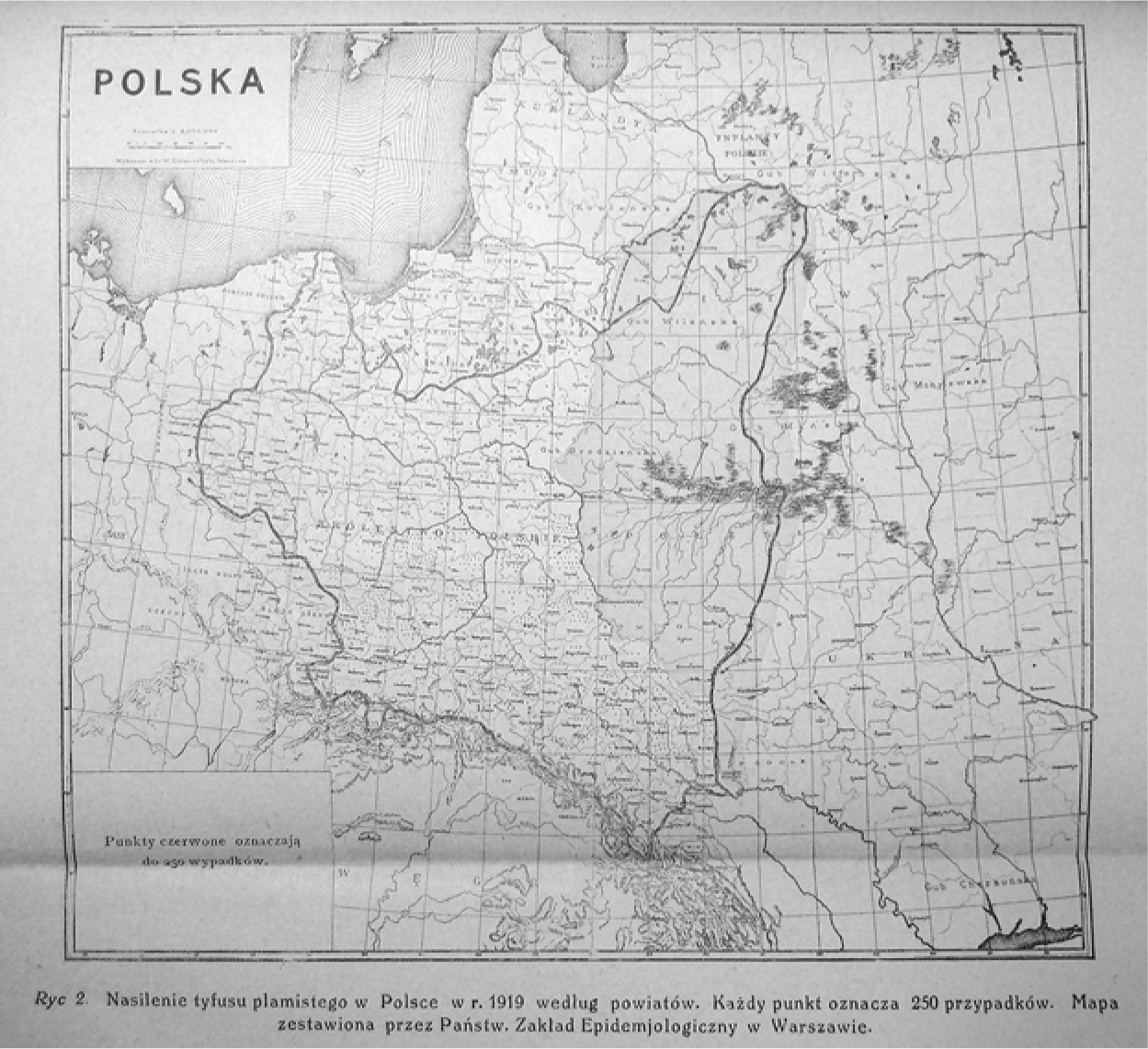
The image of typhus as an eastern invasion, not a Jewish disease threatening from within, was greatly enhanced by the Polish-Soviet war of 1919–1921. The Polish and the Red Army fought about the eastern border of the new state which Polish units pushed as far as Kiev in May 1920 and which the Red Army repelled to Warsaw in August of the same year. It was finally drawn to include the so called Polish Kresy Footnote 9 with the treaty of Riga in March 1921 (Brzoza and Sowa Reference Brzoza and Sowa2006, 30–36). Typhus became associated with the advancing Red Army and its spread was visualized accordingly. Emil Godlewski Jr. and Zygmunt Schinzel, both responsible for fighting the epidemic in different government positions, pictured the disease as a red carpet covering the entire Kresy and thus the area of fighting. It protruded from there as a dense net of red dots and diminished as they went further west (see Fig. 2).
“The spread of typhus in Poland in 1919 according to districts. Each point stands for 250 cases. Map composed by the State Epidemiological Institute in Warsaw” (Godlewski and Schinzel 1921/22, Annex).

Russian soldiers could easily join poor Jews as the bearers of disease in Polish discourse. They were assigned the same anti-modern characteristics. Gustaw Sztolcman for instance, a colleague of Godlewski and Schinzel, reasoned that it was clear that epidemics came from “huge, dark and half-wild Russia” (Sztolcman Reference Sztolcman1923, 27). This idea of Russia as the antipode of civilized modernity had a long tradition in Polish thought. Russian orthodoxy, a despotic tsar, or backwardness had served as motives for a religious, moral, political, or national “othering” since romanticism. In contrast, Polish society was regarded to represent civilization, democracy, liberty, catholic Christianity and under the heading of antemurale christianitatis also the bulwark of all this in Eastern Europe (Jedlicki Reference Jedlicki1999; Borodziej et al. Reference Borodziej, Brzosek, Górny, Duchhardt, Morawiec, Romsics and Borodziej2005). The Russian revolution and bolshevism were often regarded as just a continuation of the barbaric Russian tradition (Zloch Reference Zloch2010, 150, 157).
The expansion of the causes of typhus from the uncivilized Jews to the “half-wild” Russian east proved to be an easy one in Polish discourse also because it could rely on a specific connection of Jews and Russia established already in the late nineteenth century. When Jews from the pale of settlement migrated to the Polish Kingdom, Poles regarded them as Russians very loyal to the Tsar who had come to russify Polish society (Guesnet Reference Guesnet1998, 61–70; Weeks Reference Weeks2006, 89). At the same time, the stereotype of the socialist Jew was developed (Friedrich Reference Friedrich, Dahlmann and Hilbrenner2007, 62). It was reinforced during the Polish-Soviet war by national democrats and ecclesiastical circles: The żydokomuna was suspected to ally with the Soviets and to be an enemy of the Polish state (Pufelska Reference Pufelska2007, 46–58). The idea that Jews were Bolsheviks and supported the Red Army became one of the many reasons for anti-Jewish pogroms in several Polish cities after the retreat of the Red Army in the summer of 1920 (Reder Reference Reder and Benz2011b). A lack of civilized modernity as well as bolshevism were thus characteristics which were attributed to both Jews and Russians. To move the causes of typhus from one to the other therefore proved no difficulty.
From 1919 to 1920, the interconnection of typhus with Bolshevik Russia and pro-Soviet Jews transformed the epidemic in Poland’s east into more than just a public health problem. Rather, it became part of the country’s military and political striving for independent existence. With all its might the Polish state set out to fight the epidemic as it did its Russian enemy. Anti-epidemic measures became closely intertwined with military activity at the eastern front and took place in quasi-military fashion.
The Polish Regency Council had established a Ministry of Public Health already in April 1918 before the Germans left Warsaw in November (J. Górny Reference Górny1976; Więckowska Reference Więckowska1999, 30–31).Footnote 10 When confronted with the typhus epidemic the Ministry created a Chief Extraordinary Commissioner for Fighting Epidemics (Naczelny Nadzwyczajny Komisarz do walki z epidemiami).Footnote 11 The commissioner and his office had military rank and were by law awarded the same importance as the war against the Red Army. He could act upon his own decision without having to consult other ministries. The commissioner operated in Warsaw and maintained several branches in east and south-east Poland. The area of responsibility for the branches was adapted according to the movement of the Polish troops during the Polish-Soviet war (Więckowska Reference Więckowska1999, 51–52). Fighting epidemics and fighting the Soviets thus went literally hand in hand.
In fighting typhus and Bolshevik Russia, Poland received active support from the international community. The interconnection of the epidemic and the Soviet threat could mobilize several important actors of international diplomacy and international relief organizations. Among others, the American Red Cross, the League of Red Cross Societies, the American Relief Administration, the American Jewish Joint Distribution Committee, the Lister Institute and the League of Nations became active on Polish ground. Their activities clearly aimed at putting a stop to the advent of Bolshevism by public health measures (Balińska Reference Balińska and Weindling1995; Weindling Reference Weindling2000, 140–49).
Next to national and international emergency activities the epidemic threat also spurred the development of a state-run public health infrastructure in Poland. The epidemic surveillance system that emerged and made district physicians send reports on a weekly basis is an excellent example for the great importance of central institutions in Polish state-building (Zloch Reference Zloch2010, 98). Technically, Sanitary Law had placed public health work within the responsibility of local communities. This regulation was part of a supposedly strong local self-administration in the Second Republic. The idea of a powerful local government was prominently formulated in the Polish constitution of March 1921 as a means of a democratic state order and a system that was different from centralist Tsarist Russia. However, local governments suffered from a lack of funding throughout the interwar period and their competences were gradually transferred to central government bodies (Grzybowska Reference Grzybowska2003; Sidor Reference Sidor2010). Epidemics had been under Warsaw’s authority from the beginning and surveillance became a hierarchical and centralized system controlled by the capital. In July 1919 the Sanitary Law tried to homogenize the very different public health legislation of the three former partitions. A Law for Fighting Epidemics was issued the same month.Footnote 12 The two laws and subsequent decrees established the Ministry of Health as responsible for epidemics control. It was to supervise, monitor, and regulate anti-epidemic measures on the ground. On the central level it was supported and advised by the State Institute of Hygiene in Warsaw, PZH (Państwowy Zakład Higieny w Warszawie) which was established in November 1918 with the core task of research on epidemics, of providing facilities for laboratory diagnostics, and for the production of vaccines and sera (Balińska Reference Balińska1996; Więckowska Reference Więckowska2001).Footnote 13 On the ground, it was public health departments on district and later voivodship level and especially the district physicians (lekarz powiatowy) who were to subdue epidemics to Warsaw’s decision space.
The district physician or medical officer became the pivotal mediator between the center and the periphery. He (rarely she, especially in the countryside)Footnote 14 was expected to act as the state’s representative on local level. As such, on the one hand, he was to implement or promote the implementation of Warsaw’s epidemics regulations on the ground. On the other hand, he was to provide Warsaw with all the necessary information it needed in order to supervise and control the epidemic situation in the country. One of the central tools to do so was – among numerous other reporting duties – the weekly epidemiological report which the Stanisławów district physician we met at the beginning of this paper so dutifully filled and sent in November 1920. The Epidemics Law had introduced a notification requirement for 23 infectious diseases (Art. 3). The weekly report should inform Warsaw about the occurrence of these diseases in its territory. The notification system encompassed several levels: general practitioners, nurses, local hospitals, teachers, priests or other men of authority were to notify the community administration of a suspect case. The community was then to transfer the information to the district physician (Art. 2, 5, 8). He was then to translate the information into the official and preprinted form of the tabled weekly report, numbers for Jews and Christians separately, and send the data to the voivodship and to the ministry in Warsaw.
The introduction of such a centralized system of epidemic surveillance had not been uncontested. The honored initiator of Warsaw’s hygiene movement of the nineteenth century, Józef Polak, had argued against a Public Health Ministry and had instead suggested a locally organized public health administration following the example of Russian zemstvo-medicine (J. Górny Reference Górny1976, 485–86; for zemstvo-medicine, see Hutchinson Reference Hutchinson1990, chap. 1). But referring to a Russian example in public health could not win many followers in early independent Poland. Since 1867, in the Tsarist ruled Polish Kingdom public health questions had been under the authority of the Ministry of the Interior in St. Petersburg. But the ministry had remained largely inactive in the field which was widely received as purposeful negligence towards the Poles. Local administrations and philanthropists had started to take care of health matters and gathered considerable funds. But in Polish eyes selective activities could not replace systematic public health policy, especially in the case of epidemics (Więckowska Reference Więckowska1984, Reference Więckowska1985). Those arguing for strong central institutions therefore clearly won the battle (Chodźko Reference Chodźko1917; Janiszewski Reference Janiszewski1917, Reference Janiszewski1918). The Polish system showed many similarities to German public health administration. Although the German/Prussian example was hardly explicitly celebrated, we can assume that it set the standards. Communication chains that reached from a district medical officer to the district administration, and from there to the level of the individual state and then to a central federal institution, the Reichsgesundheitsamt, were established in the German Reich at the end of the nineteenth century. An Epidemics Law (Reichsseuchengesetz) introducing compulsory notification on a weekly basis and concentrating questions of epidemics in the hands of the central institutions was passed in 1900 (Sauerteig Reference Sauerteig1999, 321–27; Hüntelmann Reference Hüntelmann2008, 54, 182, 194–96). As in the Polish case these structures served to strengthen the central state which in the German Reich had to stand its ground against its strong individual states (Hüntelmann Reference Hüntelmann2008, 294–95).Footnote 15
Due to the German regulations, the position of the district medical officer which regularly reported to central institutions had been present in the Prussian part of Poland already during partition times. The office had also been introduced in the Habsburg Empire in the early nineteenth century. During the German occupation of the Russian partition in World War I the German sanitary administration made sure to leave its traces behind here as well: A system of weekly reporting district medical officers following the Prussian model was introduced. The position was first filled with German doctors but Polish physicians became their deputies, received courses and could gradually take over from the Germans until November 1918 (Frey Reference Frey1918).
That the Polish administration modelled its own public health regime according to the German example can be explained against the backdrop of the discourse about epidemics I have described above. When epidemics endangered the existence of the young state, then the dense and country-wide surveillance of infected Polish citizens by central institutions became an important part of Polish state-building. The “othering” of Jews in this reporting scheme was no simple take-over from the Prussian system. The weekly epidemics statistics of the German Reich did not record the religion of the infected. Rather, the introduction of the categories Jewish and Christian is very likely to stem from the strong connection of the epidemic disease which held a prominent place in this discourse, typhus, and Jews. In contrast to the interconnection of typhus and Bolshevik Russia the idea of a Jewish epidemic pattern materialized in weekly report forms in black and white.
However, in the years to come, a supposedly Jewish epidemic pattern did not gain a prominent place in medical debates about infectious diseases in Poland. Looking at the practices of epidemiological state-building in the following section we will better understand why this was the case. When we analyze how the paper technology of epidemiological reporting worked, we will see that the production of epidemics statistics was not just a means to produce synoptic images of an imagined national community. It was the practice itself which made the state.
3. Epidemiological state-building at work
That the weekly report was a preprinted form and that it was a table was not trivial (see Fig. 1). The form had an epistemic as well as a power-generating function. The tabled format filtered the knowledge that reached Warsaw and translated complex local epidemiological situations into neatly defined, legible, and comparable categories (Scott Reference Scott1998; Paris Reference Paris and Paris2005, 190–91). The epistemic clue of a table is the principle of discontinuity. It splits a phenomenon into the given categories (distinct diseases, diseased, and dead, Christian and Jewish) and thus enables the medial transformation from the physical event into a date in numerical form. In a second step the table makes it possible to put these individual dates into new relations (by summarizing, counting, comparing, etc.). They are put “in-formation” and only thus produce information which is of value to those structuring the table (Krajewski Reference Krajewski2007, 37–38).
The small squares that the district medical officer had to fill allowed for no other notation than a number. There was no room to write further details, to note doubtful diagnostic results or other observations. This reduction to quantitative units meant the creation of a most reliable form of knowledge (Porter Reference Porter1995). It was also a very flexible one which enabled the Polish capital to become a true center of calculation (Bruno Latour) of epidemics. Filtered, categorized, and reduced to mere numbers “in-formation” about epidemics all over Poland were copied onto paper and sent to Warsaw. Here, ministry officials and the statistics department of the PZH could further process these numbers. As they were all generated according to the same principles, the heterogeneous local situations could now be merged into synoptic national data that enabled comparisons. Thus, a national epidemiological space was produced which could be overlooked and controlled. Such “drawing things together” as Bruno Latour has called it is a necessary precondition to execute power over many people across distance (Latour Reference Latour, Lynch and Woolgar1990).
In order to fulfill these epistemic as well as power-generating functions it was central that the epidemiological tables were preprinted forms. Their fixity forced the district medical officers to fit their knowledge about local epidemics into the categories Warsaw had defined. It was a disciplining technique that prevented doctors from sending numbers about differing time periods or about different diseases or lengthy written reports. Such data had little value for the center of calculation in Warsaw. The preprinted form thus acted as a paper representative of Warsaw’s authority in the periphery (Brendecke Reference Brendecke, Oesterreicher, Regn and Schulze2003, 46–47). What was more, the official form materialized the Polish state in the hands of district medical officers. A form issued from a state printing press testified to the existence of a Polish state and the practices of filling and sending the weekly report transformed a normal doctor into a state official. Furthermore, sending the form physically connected Warsaw to its state territory. In a postal network such a state territory was materially produced and reproduced every week. The paper work of weekly epidemiological reporting thus not only produced a national epidemiological synopsis on the table of Warsaw officials. It also built the state in a very practical and material sense (Vismann Reference Vismann2000; Hess and J. Andrew Mendelsohn Reference Hess and Mendelsohn2010).
That the weekly reports were filled correctly and that they were sent on time was therefore of greatest importance to Warsaw (e.g. Decree No. 270, 21.11.1929, AP w Łodzi, UWŁ WZ, 3136f). In order to make weekly epidemiological reporting work, however, the cooperation of several human and non-human actors was necessary. First, there were the district medical officers who would have to conform to the discipline of correct reporting. The archival files of the public health departments of the voivodships hold multiple evidence that this was, quite often, not the case. District medical officers were kindly reminded or strictly admonished to send in their reports. They, instead, complained about the burden of paperwork costing them too much time (e.g. OUZT to district medical officer of Gniewno, 20.5.1920, AP w Bydgoszczy, UWPT 11860; PCZE to the City of Lodz, 23.1.1922 and 31.8.1922, AP w Łodzi, Akta Miasta Łodzi 19269, 2, 8; Cracow Voivodship to District of Żywiec, 20.2.1923, AP w Krakowie, StŻ II 334, 261). Warsaw also struggled to make doctors follow the given structure of the table. Doctors left slots empty without indicating whether this was due to a lack of cases or a lack of data, they forgot to mention the dates of the reported week or they did not note down the names of the community where infectious cases had occurred. Apparently, Warsaw’s paper authority could be circumvented (e.g. weekly reports collected at Lwów District in 1920, TsDIAL, OUZL, 567/1/106 and OUZT to district medical officer of Grudziądz, 26.3.1920, AP w Bydgoszczy, UWPT 11860). In “severe” cases, which occurred well into the 1930s and which caused the repeated protest of ministry and voivodships, district medical officers would not use the preprinted form at all but send notice about cases of infection on a postcard. What happened then was exactly what the paper authority of the preprinted table tried to prevent. Data which was important to the center of calculation, especially the exact location of the infected persons, was missing (WUZT to district medical officer of Wąbrzeźno, 21.5.1920, AP w Bydgoszczy, UWPT 11860; MOS to WUZT, Oct. 1933, ibid. 11604). A further problem occurred with the many German-speaking doctors in Poland’s west. They had trouble with the Polish language of the form and some districts introduced bilingual versions. Warsaw however did not accept this creative adaptation of its form. The ministry repeatedly requested of the voivodship of Torun to send in Polish forms only (ibid.).
A second group of actors needed to cooperate if the weekly reporting system was to work; they were grouped around the event of the first notification of a case. Patients themselves, their families, local doctors, teachers, priests, nurses or other persons of public life were all obliged to inform the head of their community if they suspected an infection. The community then notified the district medical officer. Very often, however, this did not take place. Instead the concealment of sick persons was a topic which greatly troubled public health authorities (e.g. Protocol of district medical officers meeting of Pomeranian voivodship on 21.-22.2.1930 in Grudziądz, AP Gdańsk Oddział w Gdyni, SGG, RS 682/539, 609; MZP to WUZL, 19.1.1924, DALO, WUZL 1/9/352, 5). Citizens had good reason not to report cases. Suffering from a severe infectious disease or having an infected family member had not only medical consequences. If the responsible medical officers acted according to the rules, the infected persons had to endure isolation in hospital, exclusion from work or school, their houses were marked by a warning sign and their possessions disinfected. If more people were affected, entire streets were barred and commerce was prohibited (see e.g. the guidelines for the case of a typhus epidemic in the district of Drohobycz, 14.1.1924, DALO, WUZL, 1/9/352, 1). Very often, the district medical officers did not follow these procedures. Nevertheless, they could have a deterrent effect on people. What was more, in the context of the chronic lack of money in Polish communities, there was ongoing debate about how to cover the hospital fees for compulsory isolation. Frequently, the patients or their families ended up with having to pay for it themselves which discouraged notification (Wierciński Reference Wierciński1930, 953–54).
Local doctors failed to make up for the patients’ reluctance to notify them, as did the district medical officers themselves.Footnote 16 There were several reasons for this. Large parts of Poland’s population were not in the medical care of a professional physician. In rural areas the doctor-patient ratio was 1 to 6,250 in 1938.Footnote 17 Medical infrastructure was especially poor in the country’s east. The doctor-patient ratio was worst here and physicians were responsible for vast territories of several hundred square kilometers (Więckowska Reference Więckowska2004, 37–52). Travel in these territories was usually not easy. Whereas the share of paved roads grew during the Second Republic, most of Poland’s traffic routes were still dirt roads and the vehicles you could observe wobbling along them were horse-drawn carriages in 80 percent of the cases (Ilustrowany Kurier Codzienny [1939] 2012, 394–404). Quite often, however, district medical officers did not even have a horse-drawn carriage available. Many of them complained to the health departments of their voivodships about the lack of an adequate vehicle. Without any means of transport, they lamented, it was impossible to fulfill their official duties (e.g. Quarterly reports of Dr. Kazimierz Mosser, Bóbrka, 14.1.1927 and of Dr. Jan Porejewski, Sanok, 10.1.1927, DALO, WUZL 1/9/752, 3, 10, 76). If they owned a car or a horse-drawn carriage, dirt roads posed a challenge nevertheless. Especially in the rainy autumn season, the district medical officer of Jaworów wrote to the voivodship in Lwów, he was unable to travel to the villages of his district (Quarterly report of district medical officer of Jaworów, 8.1.1927, ibid., 19). This meant that medical officers were greatly dependent on the cooperation of the infected or the local community to inform them about first cases. Muddy roads, the lack of a horse, and bad weather rendered it impossible to oversee and control their district territory themselves. Thus, Warsaw’s decision space which the district medical officers were expected to extend onto local ground was mediated by several heterogeneous actors and therefore remained fragile.
When putting together national epidemics statistics in Warsaw, those responsible were aware of these difficulties. The quality of the data actually played a decisive role in the epidemiological order the weekly epidemiological reports produced. It was the practices of epidemiological reporting that contributed to Polish state-building and therefore these practices were greatly valued and discussed by Poland’s public health statisticians. In the epidemiological order which resulted from this discussion the question if and how data was produced proved more important than the question of how many infected persons were Jews and how many were Christians.
4. Epidemiological order
4.1. East and West
Weekly epidemiological reports were addressed to the voivodships and to the responsible ministry in Warsaw. From 1929 onwards the ministerial department for public health statistics was headed by the director of the epidemics department of the PZH, Marcin Kacprzak, a physician trained in Kharkov, Paris and the United States, and by the medical doctor Stanisława Adamowicz who had received her education in St. Petersburg. They were the two leading figures who collected, produced, and discussed weekly epidemiological data on a national level. Let us have a look at what they made of the reports which were piled on their desks every week.
From 1926 onwards Kacprzak and Adamowicz published annual and sometimes biannual Epidemiological Chronicles which were published under Kacprzak’s sole authorship in the PZH journal Medycyna Doświadczalna i Społeczna (Experimental and Social Medicine). They presented tables of statistics of regional and national epidemiological data and discussed the data in text. The most prominent sorting pattern in their analysis was the difference between eastern and western Poland. This pattern was produced by Adamowicz’s and Kacprzak’s repeated lamentation about the low reporting morale of district medical officers in the east which they attributed to a general backwardness of this part of the country.
In the first years of their publication the chronicles were less a presentation of the epidemiological situation in Poland than a discussion of reporting discipline. When the cases of diphtheria rose in 1926 compared to 1925 Kacprzak reasoned that this was only due to improved reporting and not to an actual increase of the number of infected (Kacprzak Reference Kacprzak1927c, 303). Whooping cough, measles, and erysipelas were rarely noted in epidemics statistics but, Kacprzak stated, this was only due to their low reporting as they were underestimated (Kacprzak Reference Kacprzak1926a, 155–56, Reference Kacprzak1927b, 447–48). Truly desperate was the recording of cases of tuberculosis, he complained. Equally bad was the reporting of typhoid fever. Only typhus was reported almost appropriately which Kacprzak thought was due to the experiences of the great epidemic of 1919–20. Nevertheless, even with typhus, there was a need for improvement (Kacprzak Reference Kacprzak1926a, 153). The reason for the poor state of registration was obvious to Kacprzak:
The low level of culture of the population, the insufficient number of doctors and their uneven distribution in the country as well as the negligence of doctors in reporting – those are the difficulties we have to bear in mind when organizing epidemics statistics in Poland. Progress in this field can only be achieved gradually. It depends on a significant rise of the level of culture and well-being on the one hand and on the education of the masses as well as of the doctors on the other. (Ibid., 145)
So in Kacprzak’s eyes, reporting morale by doctors and the broader population was a matter of the level of culture. Here, the disciplined contribution to epidemiological state-building became an expression of civilization and modernity – two features which the Polish nation state was eager to represent.Footnote 18 If citizens and doctors submitted to Warsaw’s decision space and reported infections, then they belonged to this civilized sphere. If not, they remained on an inferior level of culture.
The Epidemiological Chronicles considered this to be a particular problem of the Polish east, not of the entire Polish territory. According to Kacprzak, the “uneven distribution” of doctors in the country most affected the east. He discussed the unfavorable doctor-patient ratio and the problem of large areas of responsibility in this part of the country in a series of articles in Warszawskie Czasopismo Lekarskie (Warsaw Medical Journal)Footnote 19 and he addressed the problem of rough terrain and the lack of vehicles which mostly troubled medical officers in the east (Kacprzak Reference Kacprzak1926a, 150). Also, he found typhoid fever registration to be in a particularly bad state in the eastern territories, which became evident when looking at the reported mortality rates. Whereas the “west” had a typhoid fever mortality of 12 percent, the “east” noted only 2 percent. This, Kacprzak noted, was highly improbable and could only be explained by negligent registration practices. Sanitary administration in the west was simply working better than in the east (Kacprzak Reference Kacprzak1926a, 149–50, Reference Kacprzak1926b, 311). The same was true for the overall well-reported typhus. Kacprzak complained that in some of the eastern districts only half of the cases were registered (Kacprzak Reference Kacprzak1926a, 153).
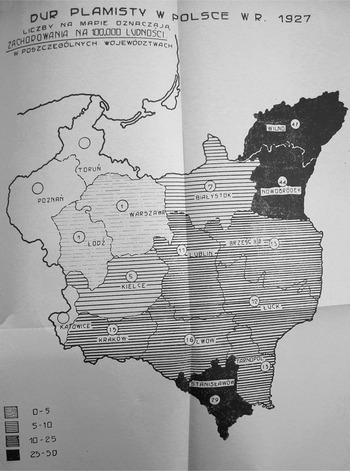
Despite insufficient reporting, Kacprzak and Adamowicz found that typhus infection remained highest in the eastern territories. A map picturing the spread of typhus on Polish territory in 1927 and published with the Epidemiological Chronicle of that year looked very similar to the one published in 1922 (see Fig. 2). The eastern and south-eastern territories were colored in dark in contrast to a brightly shaded west. The border between the two parts ran in a diagonal from the northeast to the southwest (see Fig. 3).
“Typhus in Poland in 1927” (Kacprzak 1927b).

The national epidemiological synopses in the form of tables, maps, and texts clearly established the eastern territories as part of Poland. However, the practices of homogenizing and comparing information from all over the country also produced the eastern region as the one that was farthest from Warsaw’s grip, and therefore of the state which was thought to be modern and civilized.
Kacprzak’s discussion of the east as the periphery of the modern and civilized Polish state was strongly connected to the rurality assigned to this part of the country. Rurality further strengthened images of primitivism and backwardness in Polish discourse (Linkiewicz Reference Linkiewicz2014, 18). So medical doctors discussing epidemics in the Kresy complained about the “low culture of the peasant population” (Szniolis Reference Szniolis1930, 412), “apathy, innate sloppiness [niechlujstwo], and fear of the basic requirements of personal hygiene” (Wierciński Reference Wierciński1930, 956) or peasants never washing their underwear (Grzegorzewski Reference Grzegorzewski1934, 589). In Kacprzak’s writing, backward rurality became yet another twist:
We can observe the greatest increase of typhus in Wilno voivodship. … This is the result of the well-known living conditions in the east. We have to ask ourselves if our disinfection squads, baths etc. are not a fiction as long as the average citizen lives together with his cattle under one roof. He is specifically susceptible to disease because he wears dirty rags which he only changes when they fall off his body by themselves. The demanded baths will not bring any benefit when after washing the man returns to his cramped, filthy, and infested hut. Even that Russian peasant [chłop rosyjski] who has the cleanest body and uses the bath most often is still the one in Europe who uses the least soap, is most infested by lice and presents a constant source of typhus. (Kacprzak Reference Kacprzak1929, 454)
Here, the cultural distance between the Polish state at its civilized center and the uncultivated eastern periphery was further strengthened by the fact that the peasant population of the north-eastern voivodships could be regarded as Russian and not as Polish. The “Russian peasants” were usually those inhabitants of the Kresy which were orthodox and spoke Belorussian, then considered a dialect and not yet codified, or a mixture of Belorussian, Russian, and Polish (Ackermann Reference Ackermann2010, 69). They were separated from the Polish-speaking higher social strata of the north-eastern voivodships which made up only a small minority. However, it was argued that the peasants’ lacking modernity also led to a lack in (Belorussian) national consciousness (ibid., 33). Being a “Russian peasant” therefore did not mean that he or she was lost for the Polish national cause. We can therefore assume that it was rurality and only partly nationality which distanced the east from the civilized and modern center of the Polish state in Kacprzak’s analysis.
The construction of the uncivilized eastern periphery in epidemics discourse ran parallel with east-west distinctions in other areas: an anarchical state of things had reigned in the eastern borderlands until massive investments in police and border control took place in 1924 and the situation calmed down (Schenke Reference Schenke2013, 286). Still, high criminality was proverbial for the Polish Kresy as was the inefficient public administration and a low number of schools in the region (Benecke Reference Benecke1999, 139, 146). With regard to economic development, Poland was separated into Polska A and Polska B with A standing for an industrialized and modern west and B for the underdeveloped and rural east (Borodziej Reference Borodziej2010, 160).
The drawing together of infected cases in the country had thus yet again marked the east as rural and uncivilized. It had been the practices of weekly reporting that had produced the idea of and the knowledge about a clearly defined epidemiological Polish territory. At the same time, these practices had allowed for the identification of eastern loopholes in Warsaw’s decision space. Non-registration marked a civilization gap between east and west in Poland’s epidemiological order. The gap was further strengthened by epidemics discourse assigning to the east rural backwardness and therefore an unhygienic living style.
4.2. Jews and Christians
Whereas the east became a distinct and important category within the Polish epidemiological order, there was almost complete silence concerning the category “Jewish.” Despite the fact that it had played such an important role in typhus discourse during World War I and thus found its way into registration practice it was hardly openly discussed in debates about epidemics throughout the Second Republic. This non-finding is surprising in many ways:
Although opposed to “Christian” in the epidemiological reports, the label Jewish meant a lot more than a religious denomination. Having been a representation of the “other” in numerous ways throughout history – the carrier of uncivilized disease being just one – in the Second Polish Republic Jewishness had also become a national marker. Spurred by the nationalization of the population since the 1880s and with Zionism gaining in strength, questions concerning the place of Jews in Polish society were now discussed under the heading of national minority issues (Weeks Reference Weeks2006, 88–101). Although the primary index for determining nationality was language in the Second Polish Republic (Labbé Reference Labbé, Bauer, Jacques, Plésiat and Zombory2011, 136), faith and national identity became strongly interconnected in Polish discourse. The idea of “Polak – Katolik”, meaning that Poles were Catholics, was further strengthened. By contrast Protestants were usually regarded as Germans, Greek-Catholics as Ukrainians, Orthodox as Russians – and Jews as of Jewish nationality (Henschel and Stach Reference Henschel and Stach2013, 183). The idea of Jewish Polishness which encompassed assimilated Jews considering themselves Polish and loyal to the Polish state (Steffen Reference Steffen2004) could not win against the nationalizing Polish state which excluded Jewish Poles from civil service and remained suspicious also towards converted Jews (e.g. Rodak Reference Rodak2013).
An epidemiological distinction of Jews would have seemed even more likely as we can observe a trend towards the “biologization of the social” in Poland as in other European countries since about 1900 (Lipphardt Reference Lipphardt2008, 39). Polish speaking anthropologists and physicians of Catholic and Jewish faith alike were actively participating in discussions about the racial characteristics of different peoples. During World War I anthropologists tried to favorably place Poles in a hierarchy of races and opposed them to “Asiatic Russians” as well as Ukrainians and Belarusians (M. Górny Reference Górny2010, Reference Górny, Böhler, Borodziej and von Puttkamer2014). The serologists Ludwik and Hanna Hirszfeld examined blood samples from thousands of soldiers in order to establish a “biochemical race index” which included Jews as a separate “nationality.” The Hirszfelds later rejected the idea of the specificity of “Jewish blood” (Spörri Reference Spörri2005a, b); nevertheless, the idea of race, including the Jewish one, had greatly influenced their research design during the war.
Already at the beginning of the twentieth century Jewish scientists had discussed the physical and pathogenic qualities of such a Jewish race in the Polish lands (Judt Reference Judt1903; Wengierow Reference Wengierow1903). Especially Zionists were concerned about constituting a homogeneous “Jewish tribe” with the help of statistics. The Lwów-born Alfred Nossig for example, published statistics about Jews since the 1880s and established the Association for Jewish Statistics in Berlin in 1903 (Hart Reference Hart1995, 87–88). The statistical material thus produced spurred a debate about the state of the physical fitness of Jews. Especially data about Jewish recruits alarmed Zionists who called for the physical strengthening of Jews by sports, physical work, and eugenics (see e.g. Wengierow Reference Wengierow1903, 305–6). The eugenics movement which took hold in the Polish lands as in the rest of the world (Gawin Reference Gawin2003; Stauter-Halsted Reference Stauter-Halsted2016) developed a specifically Jewish branch which followed the goal of strengthening the Jewish nation for the establishment of its own nation state in Palestine (Steffen Reference Steffen, Lappin and Nagel2007; Uzarczyk Reference Uzarczyk, Turda and Weindling2007). Thus, the idea of Jews as distinct in their biological characteristics was well established by the interwar period.
Yet, although Jewishness was such a loaded category with regard to the building of a Polish nation state, it was hardly reflected upon in the context of epidemics statistics. Doctors recorded this category without any objection. As far as archival evidence goes, the determination of a religious identity of those who were infected seems not to have posed any challenge to them. However, a Jewish “other” with regard to infectious disease is not openly debated by doctors and the public health administration during the Second Polish Republic. The differentiation between the Jewish and Christian infected population was dropped in the regional and national tables presented in the Epidemiological Chronicles. Neither do the categories appear in the weekly epidemiological reports Warsaw submitted to the League of Nations Health Organization in Geneva (Société des Nations. Section d’Hygiène 1926). Only once did the Epidemiological Chronicles discuss something explicitly Jewish, yet not with regard to epidemiology but rather concerning sanitary infrastructure in the country. In a list of public baths in Poland the statisticians from the PZH included Jewish ritual baths. If they were open to the non-Jewish population which was often the case, they could be subsumed under the general rubric of public baths, Kacprzak noted (Kacprzak Reference Kacprzak1927b, 442). In the context of baths, elements of Jewish religious life were thus introduced as something positive to Poland’s public health.
Other than that, contributions to the discussion about Jewishness and infectious disease are hard to find in Polish medical press of the interwar period.Footnote 20 In 1935, the doctor Mieczysław Szeynman published an article entitled “Racial and social elements in diphtheria morbidity and immunity.” He had analyzed diphtheria statistics for the city of Warsaw and found that the majority of cases was Christian. Jews, he concluded, had a greater immunity to the disease. Szeynman saw the reasons for this in “biological-racial” factors. Compared to the Christian population, he explained, Jews had been living in relatively closed communities for a long period of time and had therefore reached a certain degree of infestation which resulted in a balance of micro- and macroorganisms.Footnote 21 The “immunological constitution” allowing for this balance was passed on from generation to generation. However, next to the concept of inherited immunological constitution, Szeynman emphasized social factors in diphtheria epidemiology. Not race (non-Jewish in this case), but poverty should be regarded the main reason for falling ill with diphtheria (Szeynman Reference Szeynman1935, 304). In Szeynman’s argument, racial factors thus only went along the more important social factors in disease causation. Nevertheless, Jews and Christians were explicitly framed as not only nationally, culturally, and socially, but also biologically distinct.
Szeynman’s contribution to the debate remains an isolated case in Polish epidemics discourse, however. In the same issue of Medycyna Doświadczalna i Społeczna Szeynman’s analysis is mathematically verified by the statistician Aleksander Rajchman (Rajchman Reference Rajchman1935). Another article addressing the topic can be found in the conference volume of the first assembly of doctors belonging to the “Society for the Health Protection of the Jewish Population in Poland,” TOZ (Towarzystwo Ochrony Zdrowia Ludności Żydowskiej w Polsce) which took place in June 1928. I. Koniecpolski gave a talk regarding the “Racial factor in severe infectious diseases in light of the statistics of the city hospital of Częstochowa.” He briefly discussed the higher mortality of typhoid fever among Christian men compared to Christian women and he touched upon a lower mortality of typhus among Jews compared to Christians. Furthermore, he found that mortality of scarlet fever was higher among “Arians” than among “Semites.” Without analyzing these findings any further he then presented statistical data which testified to the greater immunity of Jews against tuberculosis (Koniecpolski Reference Koniecpolski1929).Footnote 22
Tuberculosis and also cancer were those diseases that were most likely to be discussed in relation to Jewishness. So when Stanisława Adamowicz presented tuberculosis mortality in the Polish section of the International Health Yearbook, she differentiated the numbers according to “sex and religion” (League of Nations Health Organization 1927, 535, 1929, 724). Cancer mortality was specified for the categories “sex and race” (ibid.). In this, the Polish discourse ran partly parallel to the German one. There, Jewish and non-Jewish scientists discussed a specific Jewish pathology with regard to tuberculosis but were actually most concerned about mental illnesses, not infectious diseases (Lipphardt Reference Lipphardt2008, 124–25, 146–50). In Poland tuberculosis and cancer belonged to a specific group of diseases. They were considered “chronic” and were differentiated from “severe infectious diseases” (ostre choroby zakaźne) such as typhus, cholera, plague, typhoid fever or diphtheria. The result of my analysis thus remains: Diseases which were regarded first and foremost “infectious” were hardly debated with regard to Jewishness during the Second Polish Republic.
However, even without explicitly talking about it, the weekly practices of differentiating Jewish and Christian infected persons was a technique of segregating the Christian (here not only Catholic) Polish nation state from the Jewish “other.” The fact that no discussion was necessary rather underlines that it was self-evident for doctors to register the two groups separately and that a clear and uncontested boundary line existed between the Jewish and non-Jewish population. The idea of a specific interconnection between Jewishness and typhus developed during World War I and the biological “othering” of Jews in so many other areas was strong enough to carry separate registration throughout the Second Polish Republic without raising any questions. What was more, the practices of epidemiological reporting contributed to refreshing this separation in the hands of writing district medical officers every week.
Yet, the interconnection of infectious disease and Jewishness, so easily at hand with the reports, did not become an important layer of the medical discourse about a Polish national epidemiological order. When talking about epidemics on a national level, the category of the east was much more important than that of Jewishness. The east was also related to national minorities. But the overall state of backwardness that was assigned to it was not only connected to the presence of Belarusians (and eventually also many Ukrainians and Jews) but to rurality and non-reporting medical officers. The east was thus perceived as reluctant to submit to Warsaw’s decision space. Weekly epidemiological reporting was one strategy to stabilize the Polish state on the ground. That there were so many actors who eluded this strategy in the eastern territories was of greater importance to epidemiological state-building than the biological “othering” of the Jews.
We can thus conclude that historical analysis should not reduce the productive power of statistics to the categories they explicitly suggest. Rather, we have to take the practices of doing statistics into account. I have shown that in the case of interwar Poland nation-wide epidemics statistics were a question of building the state, not only by producing synoptic images of an imagined national space but by materializing Poland with the help of the paper technology of weekly epidemiological reporting. This paper technology established the preprinted form of a table which acted as Warsaw’s paper representative on the ground, it transformed district physicians into state officials, it structured information according to central needs, and it literally connected Warsaw and the rest of the country in a weekly correspondence network. Yet, if it was to work, epidemiological reporting demanded the cooperation of several heterogeneous actors – physicians, patients, and streets, among others – and therefore was quite fragile. It was this fragility in producing nation-wide epidemics statistics which became of greatest importance to public health officials, but which we can only detect if we take seriously the practices and materiality of making statistics. The “backward” Polish east was identified as struggling most with the complexities of statistics production. Discourses about the national epidemiological situation in Poland therefore drew a clear line between a well-reported and civilized west and a badly-reported and uncivilized east. The category of Jews, which was separately recorded in every weekly report on local and district level, did not receive parallel attention. A Jewish specificity with regard to epidemics was produced every time a medical officer noted a number in his report form. It echoed discourses about a specific association of Jews with typhus and the “othering” of the Jewish body in different fields. However, the Jewish epidemiological “other” did not have a comparative impact on Warsaw’s capability of ruling its young state. The poor reporting morale of a district physician in Stanisławów was therefore more meaningful to Poland’s epidemiological order than the state of health of the Jewish population.
Acknowledgments
This paper is based in part on research conducted for my PhD-thesis which has been recently published as Kreuder-Sonnen, Katharina. 2018. Wie man Mikroben auf Reisen schickt. Zirkulierendes bakteriologisches Wissen und die polnische Medizin, Tübingen: Mohr Siebeck. I am very grateful to Nadav Davidovitch, Laura Meneghello, Stefan Scholl, Heiner Stahl, Rakefet Zalashik and two anonymous reviewers for comments on earlier versions of the paper.
Abbreviations
- AP w Bydgoszczy –
Archiwum Państwowe w Bydgoszczy (State Archive of Bydgoszcz)
- AP w Krakowie –
Archiwum Państwowe w Krakowie (State Archive of Cracow)
- AP w Łodzi –
Archiwum Państwowe w Łodzi (State Archive of Lodz)
- DALO –
Derzhavnii Arkhiv L’vivskoyi oblasti (State Archive of the District of L’viv)
- MOS –
Ministerstwo Opieki Społecznej (Ministry of Public Welfare)
- MZP –
Ministerstwo Zdrowia Publicznego (Ministry of Public Health)
- OUZL –
Okręgowy Urząd Zdrowia we Lwowie (District Health Office of Lwów)
- OUZT –
Okręgowy Urząd Zdrowia w Toruniu (District Health Office of Torun)
- PCZE –
Państwowy Centralny Zakład Epidemjologiczny (Central State Epidemiological Institute)
- RS –
Referat Sanitarny (Sanitary Department)
- SGG –
Starostwo Grodzkie w Gdyni (Administration of Grodzki District in Gdynia)
- TsDIAL –
Tsentral’nii derzhavnii istorichnii arkhiv Ukrayini, L’viv (Central State Historical Archive of Ukraine, Lviv)
- UWŁ –
Urząd Wojewódzki Łódzkie (Office of Lodz Voivodship)
- UWPT –
Urząd Wojewódzki Pomorski w Toruniu (Office of Pomeranian Voivodship in Torun)
- WUZL –
Wojewódzki Urząd Zdrowia we Lwowie (Health Department of Lwów Voivodship)
- WZ –
Wydział Zdrowia (Health Department)
Katharina Kreuder-Sonnen is Assistant Professor at the History Department of the University of Siegen. Her research interests encompass the circulation of knowledge, transnational Polish history, the history of bacteriology, as well as the global history of planning and management in the twentieth century. Her recent book, How to Make Microbes Travel. Circulating Bacteriological Knowledge and Polish Medicine, 1885-1939 (Tübingen: Mohr Siebeck 2018), follows Polish scientists in their efforst to make microbes travel.