During the Sino-Japanese War of 1937–45, between 60 million and 95 million people in China lived as refugees for at least a time (Gu and Peng Reference Xiuqing and Leiting2006, 100; MacKinnon Reference MacKinnon2008, 47–48). Despite the scale of this forced migration, historians have only just begun to gauge its demographic and geographic patterns. A few excellent studies have discussed the highly visible refugees who congregated in China's major urban centers (Chen Reference Chen2005, chap. 5; Henriot Reference Henriot2006; Liu Reference Liu2002; MacKinnon Reference MacKinnon2008; Sun Reference Yankui1993). But focusing solely on the urban experience overlooks rural residents who made up the vast majority of China's population. In rural China, refugee flight followed multiple paths. Some rural residents migrated to cities or towns in unoccupied regions. Many others found safety in the countryside until danger passed. Regardless of their destination, the trauma of war forced Chinese refugees to find ways of surviving in unfamiliar and often threatening environments. For this reason, wartime social dislocation had the potential to generate ecological change.
The refugee experience, writes Stephen MacKinnon, “changed the social and psychological landscape of modern China” (Reference MacKinnon, Lary and MacKinnon2001, 132). Historians have yet to appreciate the extent to which war—and the refugee flight that it caused—altered China's natural landscape as well. Recent historiography has highlighted the profound influence of war and the military in modern Chinese politics and culture (Lary Reference Lary2006; Van de Ven Reference Van de Ven1997). The present analysis of the ecological history of refugee flight reveals the extent to which the war with Japan changed the fabric of Chinese society, along with human relationships with China's environment. Throughout much of the twentieth century, China's political leaders held up the military as a model for emulation and employed military organization to achieve their goals. This militarization left its impression upon human interactions with the environment. Military metaphors occupied a prominent place in discourses that described and animated efforts to control, reshape, and exploit the environment. Military conflict and preparation for war generated environmental change, while military technology and organization enhanced the ability to transform nature and extract its wealth. The Sino-Japanese War of 1937–45 accelerated this militarization of China's natural landscape, as the Chinese state struggled to mobilize and exploit people and natural resources to realize its military objectives.
To a significant extent, the environmental impact of refugee flight resulted from measures that the Chinese state utilized to assist and at the same time mobilize displaced people to transform the environment for military ends. During the war, the Nationalist government carried out large-scale resettlement of refugees to bring underpopulated wasteland in unoccupied areas under cultivation. In this context, “wasteland” is a translation of the Chinese word huang, a catchall term that encompasses all types of uncultivated land. In Chinese, the word huang carries specific, value-laden connotations. It refers to desolate, neglected land full of weeds and devoid of civilizing influence. The culturally constructed meanings attached to this type of environment justified and even encouraged human alteration of uncultivated “wasteland” to exploit it for agricultural production (Williams Reference Williams1996, 671–72). By mobilizing refugees to civilize previously “uncivilized” landscapes, discourses that informed wartime land reclamation projects cast the chaos of war as an opportunity for national rejuvenation and renewal.
After the Japanese military occupied Manchuria in 1931, Chinese intellectuals and policy makers called on the Nationalist regime to resettle war refugees to open up uncultivated lands in China's northwestern provinces. By relocating to northwest China, displaced people were to devote their energies to developing the region's natural resources. Refugee resettlement promised to open up the northwest and harness its untapped wealth for national economic and military mobilization. With the onset of full-scale war with Japan in 1937, China's political and military leaders devoted even more attention to land reclamation to meet two objectives. First, reclamation projects were to assist refugees by giving them land to farm. Second, bringing wasteland under cultivation would help sustain agricultural output at a time when China's major grain-producing regions had fallen under Japanese occupation. Hence, China's leaders expected land cultivation initiatives to maintain social stability and support wartime economic mobilization by boosting grain production.
During the war, state-sponsored reclamation projects took in at least 500,000 refugees, who reclaimed an estimated 4 million mu of land for agricultural cultivation. Needless to say, the number of people who participated in such initiatives accounted for only a small percentage of China's refugee population. Nevertheless, mobilizing these refugees to bring wasteland under cultivation provided them with relief and played a role in stabilizing wartime China's economy (Liu Reference Liu2002, 277; Sun Reference Yankui1995, 91–92).
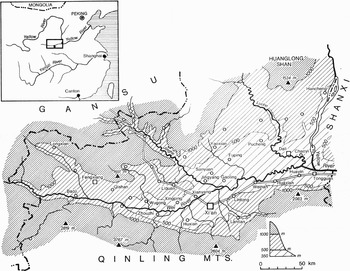
Shaanxi Province's Huanglongshan (Yellow Dragon Mountain) region was the site of one of wartime China's largest land reclamation initiatives, taking in more than 50,000 refugees. Huanglongshan is located in central Shaanxi, west of the Yellow River and east of the Luo River (see Figure 1). The mountains are remnants of a former plateau composed of beds of sandstone and shale. Over geologic time, streams cut through the plateau to form deep alluvial valleys with steep slopes and narrow ridges that reach 5,000 to 6,000 feet above sea level. During the last ice age, a layer of loess was deposited over the landscape, settling on flatter ridges and later spreading out in the narrow valleys as alluvium. As a result of long-term processes of naturally occurring erosion, loess was completely removed from Huanglongshan's steep hillsides (Lowdermilk Reference Lowdermilk1944, 203–4; Zhou Reference Changyun1938).
Map of central Shaanxi Province (Huanglongshan at upper right).

The relocation of refugees to this mountainous area during the 1930s and 1940s was one chapter in a longer history of interactions between war, society, and the environment. For much of the Qing dynasty, Huanglongshan supported a sizable farming population. Migrant farmers began to clear land on Huanglongshan's steep hillsides during the eighteenth century, which reduced biodiversity and accelerated erosion of the region's fragile loess soils. During the 1860s, internal rebellion devastated much of northwest China, causing virtually all of Huanglongshan's residents to flee. Human pressures on Huanglongshan's natural environment abated for more than six decades; forests and other vegetation returned. When seen in human terms, however, the military upheavals of the late nineteenth century made Huanglongshan into a desolate, uncivilized “wasteland” inhabited only by bandits.
The Sino-Japanese War of 1937–45 renewed human exploitation of Huanglongshan's environment. Shaanxi never came under Japanese occupation during the war, making it the main destination for refugees who migrated from Henan Province to the west. These refugees migrated from Henan to Shaanxi in two great waves following devastating war-induced natural disasters: the Yellow River flood of 1938 and the Henan famine of 1942–43. Central, provincial, and local government relief programs resettled thousands of Henan disaster victims and other war refugees to Huanglongshan, where they were to support themselves and China's war effort by bringing land under cultivation.
Wartime discourses cast refugee resettlement as an opportunity to turn deserted and unproductive “wastelands” into fertile fields. Productive power gained from displaced people and the transformed natural landscape made a vital contribution to the nation by supporting China's military resistance against Japan. However, most of this “wasteland” consisted of steep upland areas covered with trees and other types of vegetation. Land clearance denuded the forests that had returned to Huanglongshan's hillsides since the late Qing, leading to severe soil erosion. Ecological conditions that arose during China's war with Japan also exposed refugees to infectious disease, helping to spell the Huanglongshan reclamation project's demise.
Settlement and Abandonment under the Qing
After the chaos of the Ming-Qing transition, China's Manchu rulers promoted land reclamation to expand cultivated acreage and stimulate agricultural recovery. To achieve this goal, the Qing government granted tax exemptions to farm households that brought land back under cultivation, sometimes providing them with cattle, seeds, and tools. Initially, farmers cleared easily reclaimable lands that had been cultivated before the fall of the Ming. By the eighteenth century, China's growing population outstripped the limited amount of land suitable for cultivation in many regions, compelling migrants to open up ecologically fragile highland areas (Marks Reference Marks1998; Perdue Reference Perdue1987; Vermeer Reference Vermeer, Elvin and Liu1998).
The environmental history of the Huanglongshan region followed this general trend. During the uprisings of the late Ming and early Qing dynasty, most of Huanglongshan's residents fled, leaving the region largely depopulated. During the mid-eighteenth century, officials in Shaanxi encouraged migrants from nearby areas to resume agricultural production by recognizing ownership rights to reclaimed land and granting tax exemptions of up to ten years. Initially, migrants cleared fields in Huanglongshan's fertile lowland valleys. In the late 1700s, settlers began to plant maize on steeply inclined land, extending cultivation all the way up to mountain ridges.
By this time, according to a conservative estimate, Huanglongshan had a population of about 40,000. Huanglongshan had extensive forests during the late Ming and early Qing periods, but by the 1800s, land reclamation had reduced its vegetation cover. Clearing forests and other vegetation to cultivate Huanglongshan's hillsides led to accelerated erosion. After three to five years, the soil's fertility and productivity declined and farmers moved to other areas (Wang Reference Yuanlin2005, 285; Yang and Hou Reference Hongjuan and Yongjian2005, 127–29). Qing tax policies unintentionally promoted this cultivation pattern by granting tax breaks of six to ten years for newly reclaimed land and making the most unfavorable types of land (such as scattered plots in hilly areas) tax exempt. Inadvertently, these tax policies encouraged reclamation of fragmented plots of hilly land and gave households incentives to abandon them before they had to start paying taxes (Vermeer Reference Vermeer, Elvin and Liu1998, 260–61).
By the early nineteenth century, Huanglongshan's environment showed the effects of this pattern of exploitation. Soil erosion corrugated upper slopes and cut deep gullies into lower slopes. Loess topsoil on hillsides washed away, exposing the sandstones and shale underneath (Lowdermilk Reference Lowdermilk1944, 204). Soil erosion accelerated the buildup of silt in lowland waterways, which increased the threat of flooding downstream (Yang and Hou Reference Hongjuan and Yongjian2005, 130).
Eventually, the internal rebellions that plagued China during the late nineteenth century gave Huanglongshan's natural landscape a chance to recover. The Muslim Rebellion (1864–77) decimated the Huanglongshan region, leading many residents to take flight and abandon their farmland. Others fled later when drought and disease struck the region. By the end of the Qing, these cataclysms left Huanglongshan largely depopulated. From the perspective of government officials, the region reverted to desolate and uncultivated “wasteland” (Lowdermilk Reference Lowdermilk1944, 203; Wang Reference Yuanlin2005, 286; Yang and Hou Reference Hongjuan and Yongjian2005, 127–29). Villages established in valleys and along mountain ridges in the eighteenth and nineteenth century were left in ruins. Farmers feared they might fall prey to bandits who roamed Huanglongshan's forests and hills, so the area stayed practically devoid of settlement into the early twentieth century (Lowdermilk Reference Lowdermilk1944, 203; Wang Reference Yuanlin2005, 286).
From a nonhuman perspective, depopulation created an opportunity for plant life to return and for badly eroded land to recover. By the twentieth century, grasses spread over corrugated upper slopes, while shrubs and trees grew in gullies. Dense stands of birch, aspen, maple, and oak trees returned to Huanglongshan's hillsides. By the 1920s and 1930s, this secondary growth had given Huanglongshan more extensive forests than any other part of Shaanxi. Surrounding counties relied on the area for their wood supply (SXSZ 1994, 24). After several decades without intensive agricultural cultivation, soil erosion no longer took place under Huanglongshan's regenerated vegetation cover (Lowdermilk Reference Lowdermilk1944, 204–5). To most Chinese observers, Huanglongshan had reverted to huang—wild, uncultivated wasteland devoid of agricultural settlement.
Reclamation Plans in the Republican Period
During the turmoil that struck China in the 1930s, Huanglongshan's valleys and hillsides again attracted attention as a site of human settlement. The initial impetus came from Li Xiangjiu, a left-wing officer in Yang Hucheng's Northwest Army (Xibei jun) who was originally from Shaanxi's Baishui County. Li Xiangjiu had joined the Chinese Communist Party in the mid-1920s, and carried out organizing in the Northwest Army's ranks. After supporting Feng Yuxiang's failed revolt against Chiang Kai-shek's Nanjing regime in 1930, Li came back to Shaanxi and lobbied the provincial government to open up Huanglongshan's abandoned lands to recruit and maintain local military forces (Yang Reference Changfa1988). In a petition to Yang Hucheng in 1932, Li praised the region's “abundant riches.” In addition to land for breeding livestock and harvesting grain, the area had timber, lacquer oil, mushrooms, and enough charcoal and coal to “supply the whole province.” To take advantage of these natural benefits, Shaanxi needed to “set aside Huanglongshan as a military agricultural colony (tuntian) and transfer troops to cultivate it, imitating the ancient system of supporting the military through agriculture” (Shaanxi sheng zhengfu xunling 1932).
The notion of relying on land reclamation to maintain troops harkened back to the time-honored military agricultural colonies that had existed throughout virtually all of China's imperial history. As early as the second century bce, officials proposed self-supporting agricultural colonies to solve the logistical problem of supplying military garrisons on China's Inner Asian frontiers. Colonists under the command of military officers settled in border areas, with each contingent of soldier-colonists receiving tracts of land to cultivate. Peasants migrated to the frontier settlements as well, relieving population pressure in other regions and diminishing the threat of famine and revolt. In late imperial times, as Peter Perdue notes, the purpose of agricultural colonies was to increase grain production to feed armies, ward off social unrest by relieving population pressure in the interior, and ensure permanent control of the frontier (Perdue Reference Perdue2005, 342).
After Japan occupied Manchuria in 1931, many Chinese reenvisioned military agricultural colonies as a mechanism for strengthening the nation's borders by developing what they perceived as the untapped resources of the northwest. A prime example was the 1932 treatise A Discussion of Agricultural Colonization in the Northwest (Xibei kenzhi lun) written by An Han, a French-trained agronomist who was employed in the Nationalist government's Ministry of Industry (Shiyebu). An Han wrote that Japanese actions had made the world aware of Manchuria's abundant resources, but northwest China had “more treasures than our citizens could ever dream of.” The Chinese public mourned the loss of Manchuria, but gave little thought to the northwest. Hence, the northwest's “natural treasures were abandoned in the earth” for foreigners to take. First priority in developing China's northwestern frontier was “research on military agricultural colonies (yanjiu tunken)” (An Reference Han1932, 16–17). Following Japan's full-scale invasion of China in 1937, relocating refugees to reclaim land in China's northwest grew even more urgent. Resettling in the northwest could enable refugees to find a new way of making a living while “increasing the nation's productive and organizational power.” Land reclamation would relieve the refugees' livelihoods and devote “mobile labor power” to wartime economic mobilization (ZMDZH 1991, 219).
Li Xiangjiu's proposals for reclaiming Huanglongshan's “wastelands” dovetailed with these national discourses. As Li explained in another petition to Shaanxi's provincial government in 1937,
For years the nation has had many difficulties, and hardships have multiplied. Natural disasters and man-made calamities have frequently appeared. As a result, agricultural villages are bankrupt and society is unstable. Vagrants fill cities and villages, while bandits fill the mountains and plains. There has been turmoil caused by war in northwest China for a particularly long time, and its vital energy (yuan qi) has been greatly harmed. (Shaanxi sheng zhengfu xunling 1937)
Natural disasters, economic collapse, social disorder, and warfare indicated disruptions in the vital energy (qi) that connected humans and nature. Mobilizing refugees to reclaim land and increase agricultural production would bring order and stability by restoring equilibrium between people and the environment.
In light of the social and economic circumstances that existed in the two nations, as Li Xiangjiu pointed out, Japan had the advantage in a quick and decisive conflict, while China had a better chance of winning a protracted war of resistance (chijiu kangzhan). To wage this type of war, China had to find resources to use as military supplies and ensure that its citizens had adequate means of subsistence. Land reclamation at Huanglongshan could accomplish both tasks. Droughts that struck northwest China in 1929 and 1930 displaced large numbers of people. Relying on the vagrants who roamed the northwest to reclaim wasteland would give them property and transform them into diligent farmers. Many war refugees had also fled to Shaanxi in 1937 after the Japanese invasion. By developing Huanglongshan, displaced people could be taken in and used to carry out wartime production. When farming season wound down, former vagrants and refugees could be “trained as strong and powerful reserve troops” (Shaanxi sheng zhengfu xunling 1937).
In late 1937, Shaanxi moved forward with Li Xianjiu's idea of resettling war refugees to open up Huanglongshan's wastelands, calling land reclamation a “necessity for waging war” (Shaanxi sheng Huanglongshan kenqu banshichu di yi nian gongzuo baogaoshu 1938). To provide “production relief” (shengchan zijiu) for refugees, Shaanxi set up the Huanglongshan Reclamation Office in January 1938, appointing Li as its director. The project received support from the Nationalist general Zhu Qinglan, who oversaw refugee relief work in Shaanxi and other parts of northwest China for the National Relief Commission (Zhenji weiyuanhui) (Chen Reference Zhixin1992, 261). In February 1938, the first group of more than 300 refugees was sent to Huanglongshan. Resettled households received 10 mu of land per person, along with monthly food rations and loans to purchase draft animals, seed, and other farming supplies. Refugees were exempt from taxes and conscription for five years (SXSZ 1994, 420).
Settlers were to remake the landscape by transforming Huanglongshan's “wastelands” into productive fields, but the influence between people and nature was not unidirectional. Relocating refugees to this new environment, in the eyes of Nationalist officials, promised social transformation and rejuvenation. When refugees abandoned their home villages, they left their old lives behind. For China's Nationalist leaders, wartime dislocation was an opportunity to eliminate improper customs and lay the foundation for a new society (Luo et al. Reference Jialun1968, 294). After coming to Huanglongshan, refugees had to comply with strict prohibitions against vices such as opium smoking and wife selling, and uphold modern standards of hygiene. A 1938 report from the reclamation office claimed that many refugees had already been “reformed by the favorable influence of the environment.” The area had been “built up from scratch,” so popular customs were not “wasteful, obstinate, corrupt, or depraved.” In the future, to fulfill the needs of the War of Resistance and national reconstruction, refugees would “foster every aspect of the spirit of New Life (xin shenghuo jingshen)” (Shaanxi sheng Huanglongshan kenqu banshichu di yi nian gongzuo baogaoshu 1938).
Invoking the New Life Movement launched by Chiang Kai-shek in the 1930s, this “spirit of New Life” entailed nothing less than revolutionizing public morality and militarizing the common people for the purpose of national defense (Kirby Reference Kirby, Goldman and Gordon2000, 235). When they were not clearing fields, resettled refugees were expected to train in paramilitary tactics to resist a possible Japanese advance into Shaanxi (Zhu Reference Dejun1986, 216). The rationale was straightforward: “These refugees have come from the battle zones and have suffered the depredations of the Japanese. Their animosity towards the enemy is already deep. If they are given military training, they will act as the foundation for anti-Japanese resistance forces” (Huanglongshan kenqu diaocha ji 1938).
Resettlement of Yellow River Flood Refugees to Huanglongshan
While the first groups of refugees came to Huanglongshan in the wake of the Japanese invasion, far greater numbers were resettled after war-induced natural disasters. On June 9, 1938, Chiang Kai-shek ordered the destruction of the Yellow River's dikes at Huayuankou in Henan to block a Japanese advance toward Wuhan. The resulting floods bogged down Japanese tanks and mobile artillery in fields of mud, delaying the seizure of Wuhan by several months and giving Chinese forces a chance to withdraw and regroup (Lary Reference Lary2001; Mackinnon Reference MacKinnon2008, 35–36; Van de Ven Reference Van de Ven2003, 226). Yet any military advantages gained by “using water as a substitute for soldiers” (yi shui dai bing) paled in comparison to the cost. Floods inundated at least 32 percent of the fields in eastern Henan and deposited around 100 million tons of silt, which covered large amounts of cultivated land (Su Reference Xinliu2004, 81; Xu and Zhu Reference Youli and Lanlan2005, 152). According to Diana Lary, floodwaters inundated 70,000 square kilometers of land to the southeast of the Yellow River breach in Henan, Anhui, and Jiangsu provinces, killing more than 800,000 people and making 2 million into refugees (Lary Reference Lary, Selden and So2004, 151–52).
With water control systems in disarray, the Yellow River and its tributaries experienced sudden shifts and frequently flooded throughout the war, which pushed the refugee toll even higher. A survey of war damage in Henan conducted in 1940 reported 1,963,257 disaster victims and 1,285,565 people in need of relief in Yellow River flood regions, as well as 4,176,100 disaster victims and 2,740,574 people in need of relief due to other floods. Battle zones in Henan had much lower numbers, with 674,996 disaster victims and 522,521 people in need of relief (ZMDZH 1991, 522–27).
When the war ended in 1945, relief agencies estimated that 1,700,000 flood refugees had moved from Yellow River flood regions to Shaanxi (Han and Nan Reference Qitong and Zhongwan1948, 142). Some refugees settled in the cities of Xi'an, Xianyang, and Baoji, as well as in smaller towns and villages along railway lines or major roads (Li and Wang Reference Lixia and Jianjun2006, 5–6). Refugees from the flood zone had to walk for almost two weeks to reach Luoyang, fending off hunger by begging for food. From Luoyang, they traveled for three days by train to Xi'an, where most looked for work as day laborers or lived on the streets and begged (Lü and Zhu Reference Fangting and Anlu1987, 80). Official relief organizations and foreign missionaries stationed in Henan and Shaanxi set up camps to distribute food and medical care, but could not assist everyone in need (Su Reference Xinliu2004, 156–57; Zhang Reference Jinxing1987, 173–74).
With the breaking of the Yellow River dikes, land reclamation emerged as a favored method of providing relief to flood refugees. On June 28, 1938, the newspaper Dagongbao declared, “In addition to emergency relief, work relief and land reclamation should be carried out in the future to give refugees a lasting way of making a living” (1938, 28–29). The Nationalist general Zhang Fang was particularly adamant about the importance of relocating refugees to reclaim wasteland. If the Chinese government failed to assist flood victims, Zhang warned, they might ally with the Japanese. “The enemy will use this opportunity to carry out small acts of kindness to drug our people, which will have a great influence on social order in rear areas of the War of Resistance.” Resettling peasants displaced by the Yellow River flood was the only way to avert this possibility. Flood victims, Zhang asserted, differed from other refugees.
Regular refugees from war zones only flee temporarily, and every one of them intends to return to their native place after the national emergency has been resolved. Furthermore, their backgrounds are mostly in the fields of academics or business and they come from families with a little bit of property, who have never personally engaged in farming. Yellow River flood refugees, by contrast, have no way to make a living aside from plowing fields. (1983, 43)
The nation, Zhang maintained, had a responsibility to help restore the livelihoods of the victims of this “extraordinary disaster.” Handing out relief funds was a temporary solution. Resettling refugees to reclaim land enabled them to become self-sufficient and earn a permanent living.
Because thousands of Henan flood victims had already migrated west to Shaanxi, Huanglongshan was a prime destination for resettlement. In October 1938, Shaanxi started to relocate refugees from the Yellow River flood region to reclaim wasteland in Huanglongshan, allocating funds to procure food, prepare their dwellings, and outfit them with farming supplies. At the year's end, a total of 12,130 flood refugees had settled in the reclamation area, along with 13,001 other war refugees (SXSZ 1994, 661–62, 665).
Huanglongshan's long period of human abandonment had created favorable environmental conditions for agriculture. Decomposed grasses, leaves, and other vegetation accumulated as green fertilizer that enriched soil nutrients. For that reason, during the 1930s, the content of nitrogen and other nutrients in Huanglongshan's soil was several times higher than that of other parts of Shaanxi. With steep hillsides covered by trees and grasses, soil erosion was not a problem and clear water ran in Huanglongshan's rivers and streams. Much of Huanglongshan's uncultivated land consisted of fields that had been abandoned during the nineteenth century, making it relatively easy to bring back under cultivation (Zhou Reference Changyun1938).
Even though it enriched the area's soil, Huanglongshan's long period without agricultural settlement made conditions difficult for resettled refugees. Many refugees took up residence in old villages abandoned during the late Qing, inhabiting caves carved into the loess hillsides and using grinders, millstones, and tools left behind decades before (Shaanxi sheng Huanglongshan kenqu banshichu gongzuo baogaoshu 1939). While the humans were away, wildlife such as leopards, jackals, wild boar, and yellow sheep (huangyang) had taken possession of Huanglongshan's forests. Leopards sometimes attacked refugee settlers, and other animals trampled and ate crops. In 1940, wild boar damaged more than 7,000 mu of maize, sorghum, and wheat fields. When the reclamation project organized 3,000 refugees into crop protection and hunting regiments, the area damaged by wild animals declined to 700 mu. More important than hunting, the large-scale conversion of “wastelands” that were also wildlife habitats into farmland likely accounted for the bulk of this decrease (Nonglinbu Huanglongshan kenqu gaikuangshu 1941; Zhu Reference Dejun1986, 224).
In addition to its animal inhabitants, refugees had to contend with the region's unruly social fabric. For decades, the area had been a haven for bandits who colluded with “local bullies” from nearby counties, calling themselves “lords of the mountain” (shanzhu). These local strongmen profited from tree cutting, occupying publicly owned wasteland, burning charcoal, and gathering plants for medicinal ingredients. To eliminate these activities, Huanglongshan's reclamation office persuaded neighboring counties to prohibit illegal woodcutting. Poor people could burn charcoal and sell it as fuel in neighboring counties only if they applied to county officials for permits, which were checked by local baojia headmen (Shaanxi sheng Huanglongshan kenqu banshichu di yi nian gongzuo baogaoshu 1938; HLXZ 1995, 660–61). After the prohibitions were put in place, refugees were still allowed to gather firewood and medicinal ingredients to supplement their incomes. These regulations were a point of tension with neighboring counties, which did not have any forests of their own and depended on Huanglongshan for their fuel supply. Once the Huanglongshan reclamation office restricted woodcutting, these counties had difficulty meeting their fuel demands (Nonglinbu Huanglongshan kenqu gaikuangshu 1941; Wu 1944, 32).
Even after land was reclaimed, local strongmen took advantage of ambiguous property rights to extort rent payments from refugee households. As a 1938 report from the reclamation project's directors explained,
When the settlers who reclaim land in places on the border of this area receive wasteland to reclaim, they are frequently cheated by evil gentry in neighboring counties, who falsely claim property rights and demand rents or fabricate facts and petition the local government, obscuring the truth and wantonly causing disturbances. (Huanglongshan kenqu diaocha ji 1938)
Refugees had cleared wastelands and turned them into fertile fields, while grain prices had increased due to demand from the area's growing population. As a result, local elites whose families had moved away from Huanglongshan during the disorders of the late Qing and early Republican period saw a chance to profit by claiming the right to collect rents, giving rise to frequent conflicts with settlers (Huanglongshan kenqu diquan xianjie wenti shicha baogao 1943). Because property rights were not clearly defined, the reclamation office also had to mediate disputes that broke out when settlers claimed that other refugees had encroached on their holdings (Huanglongshan kenqu diaocha ji 1938).
Land Reclamation and Wartime Mobilization
During the reclamation area's first year of existence, resettled refugees lived in hardship without sufficient food and clothing. In February 1939, an investigation team from the National Relief Commission found that Huanglongshan needed 95,600 yuan for grain, farm tools, draft animals, seeds, and medicine. If refugees received aid, they would live; if not, they would die. According to the investigators, the reclamation area's problems were attributable to lack of official guidance. Given the scale and importance of the undertaking, they concluded, China's central government needed to take over Huanglongshan as a nationalized (guoying) reclamation area (He Reference Zhong1940, 16; SXSZ 1994, 420). At the same time, misgivings had surfaced about the reclamation office's leadership. Previously, Zhu Qinglan's political influence had shielded communists working at Huanglongshan from Nationalist reprisals (Liu and Zhang Reference Zaishi and Junxiang1985, 73). But even with Zhu's protection, Nationalist intelligence agents grew suspicious of Li Xiangjiu's communist connections. In light of these financial problems and political concerns, the Nationalist regime took over the reclamation area in May 1939, placing it under the Ministry of Agriculture and Forestry (Nonglinbu). With the central government in charge, Li Xiangjiu was dismissed as director and Zhu Qinglan replaced him. The agricultural expert An Han was later appointed assistant director and handled the reclamation project's day-to-day affairs in Zhu's absence (Li Reference Fenbai1988, 68).
Even after the Nationalist government's reorganization of the land reclamation project, settlers in Huanglongshan did not have adequate provisions for the severe Shaanxi winter. To alleviate this crisis, Zhu Qinglan traveled to Chongqing in January 1940 and met with directors of the National Relief Commission and the Ministry of Economics (Jingjibu) to arrange loans for grain, winter clothing, draft animals, seeds, and farming equipment. With this assistance, refugees could achieve self-reliance and “provide for themselves through production” (Zhu Reference Dejun1986, 216–17). In spring 1941, some settlers were leaving the reclamation area because they felt the financial support they were receiving was insufficient. Other refugees refused to make the long, arduous journey to Huanglongshan, as they could earn more working as wage laborers hauling coal along the Longhai railway in Shaanxi (Zhenji weiyuanhui gonghan 1941). But conditions in Huanglongshan soon improved. The reclamation project depended on government relief funds until 1941, but an abundant harvest that year and income from hemp production and other side employments made refugee settlers self-sufficient for the first time (Nonglinbu Huanglongshan kenqu gaikuangshu 1941).
For the Nationalist regime, the goal of land reclamation was not simply to relieve wartime China's displaced population. Expanding cultivated acreage by opening up wasteland was critical for China's wartime economic mobilization. Because the Japanese had occupied China's main grain-producing regions, maintaining food supplies in areas under Nationalist control was a serious concern. According to a Nationalist government memorandum,
To meet the urgent and wide-spread demand for staple food supplies for both the civilian population and the armed forces, crop production in all the interior provinces had to be stepped up. It was to achieve the latter aim that nation-wide land reclamation has been deemed of utmost importance. It was also thought that the best way to carry out the construction program was to finance it with government loans. (Farm Credit Division of the Farmers Bank of China 1942, 2)
Between 1937 and 1940, the Ministry of Economics loaned 8,700,000 yuan to Shaanxi and other unoccupied provinces to fund land reclamation projects (Farm Credit Division 1942, 3). Much of China's best farmland had fallen to the Japanese, but unoccupied provinces increased grain production to meet civilian and military demand (Guo Reference Jianxuan1940, 6). Land reclamation initiatives, as a Nationalist military leader recalled, relied on refugees to promote economic mobilization in unoccupied regions and “arouse the people's energies (min qi) to increase grain production” (Ma Reference Lingfu1989, 15). China's northwest and southwest had enough uncultivated land to “take in the population that the Japanese bandits have driven into the rear areas.” Boosting production would make it possible to “take in an even larger population” (Wang Reference Wenxuan1938, 49). Huanglongshan was far and away the most successful of the Nationalist regime's wartime land reclamation initiatives. From spring 1938 to summer 1944, settlers reclaimed 331,000 mu of land and harvested 760,000 shidan of grain (Li Reference Shuang2006, 97; Lu Reference Hejian2005, 89; Sun Reference Yankui1993, 172).
Along with the economic importance of expanding cultivated acreage, the Nationalist military also had strategic reasons for garrisoning Huanglongshan. Holding the location made it possible to flank any Japanese thrust westward along the Wei River to Xi'an and beyond (Lowdermilk Reference Lowdermilk1944, 203). From 1939 onward, the Nationalist army maintained a blockade around the Chinese Communist Party's Shaan-Gan-Ning Border Region in northern Shaanxi. Because Huanglongshan was to the immediate south of the communist base area, developing the “mountain stronghold” tightened the Nationalist grip on the Communist Party's power center (Vermeer Reference Vermeer1988, 75, 86). Following Zhu Qinglan's death in 1941, an intelligence officer from the Nationalist Military Statistics Bureau (Juntong) named Hu Baoyi took over as the reclamation project's director on the recommendation of Hu Zongnan, the general in command of the Nationalist blockade (Zhu Reference Dejun1986, 228).
Refugee Flight during the Henan Famine
Huanglongshan received a new population influx in 1942–43, when wartime economic conditions led to devastating famine in Henan. Throughout the conflict with Japan, taxes and grain levies collected to support the armies stationed in Henan weighed heavily on the civilian population. After poor harvests in 1941–42, the provincial government did not reduce taxes. Drought hit the province in the summer of 1942, but relief arrived too late to prevent famine. Even under these conditions, military demands took priority over civilian needs, as Chinese armies in Henan requisitioned grain and enlisted farm laborers as soldiers and porters. The result was famine and widespread starvation. Some 2 to 3 million people died of hunger and disease, and at least 3 million fled to other provinces in search of food (Lary Reference Lary, Selden and So2004, 160–61; Wou Reference Wou, MacKinnon, Lary and Vogel2007).
Thousands of desperate famine refugees journeyed from Henan to Shaanxi. Thomas Megan, the Catholic missionary in charge of dispensing foreign relief funds in the famine region, stated, “With the grain gone, with nothing to eat, there was only one avenue of escape: Migrate and ‘Go West!”’ Word circulated that Shaanxi, Sichuan, and Gansu had harvested good crops and could provide “work, food, and escape from starvation” (Wojniak Reference Wojniak1957, 162). In August 1942, about 500 refugees per day passed through Luoyang en route to Shaanxi, and their numbers grew even larger in the fall and winter. Megan estimated that a million and a half refugees evacuated Henan by train, while “countless thousands” traveled to neighboring provinces by other means. By 1943, Megan stated, up to 4 million people had fled Henan to find relief in other provinces (Wojniak Reference Wojniak1957, 163). According to another missionary, most of the refugees “were people who only a few years ago had had to leave their homes because of the breaking of the Yellow River dikes. They had found work in villages with farmers, but now that the crops had failed they had no work and no food.” Upon hearing about good crops in Shaanxi and hoping to find work there, refugees decided to migrate west (Wampler Reference Wampler1945, 233).
The American journalist Theodore White famously recounted the misery he saw in 1942 at the end of the railway line from Henan to Xi'an. Peasant refugees “sprawled about the station for acres, were waiting for the next train to take them away to the west and food.” Refugees crammed into trains bound for Shaanxi and climbed atop their roofs. More traveled by cart, wheelbarrow, or on foot. On the flat plain stretching between the Yellow River and the mountains of southern Shaanxi, “The endless procession rose beyond the horizon, wound across the paths between the fields, passed silently into the grayness behind” (White and Jacoby Reference White and Jacoby1946, 167–68). The city of Zhengzhou had a prewar population of 120,000, but after the famine, it dwindled to only 40,000. Villages in Henan's famine areas “echoed with emptiness; streets were deserted, compost piles untended waiting for spring, doors and windows boarded up” (White and Jacoby Reference White and Jacoby1946, 169–70).
As they moved west, famine victims begged for food or foraged in fields near roads looking for anything they could lay their hands on (Christensen Reference Christensen2005, 97, 103). In 1943, a government investigation team reported that there were 150,000 to 200,000 refugees along the section of the Longhai railway from Huayin to Baoji, and 12,000 inside the town of Baoji itself. Most of these refugees “would surely die during these winter months unless something was done at once to provide them with food, proper housing and medical help” (Ling and Xu Reference Daoyang and Weijian1943, 4). Most Henan refugees did not have relatives and friends in Shaanxi or a place to stay after their arrival. Missionaries and Chinese relief agencies distributed grain to Henan refugees and the Shaanxi poor, some of whom lost their jobs to Henan people who migrated to the province. Large numbers of refugees congregated in western Henan when Shaanxi authorities tried to stem the flow of refugees across the border (Wampler Reference Wampler1945, 256). To cope with this refugee crisis, official relief agencies relocated thousands of Henan famine victims to Huanglongshan so they could reclaim land and cultivate their own food. Local officials in Shaanxi ordered township, village, and baojia headmen not to let refugees leave the area once they were given shelter and land to reclaim (Wu Reference Zhixuan1944, 30–31).
Wartime Environmental Change
By the early 1940s, refugee resettlement had dramatically altered Huanglongshan's natural environment. A description of these changes appears in the writings of the American soil conservation expert Walter C. Lowdermilk, assistant chief of the U.S. Soil Conservation Bureau. Lowdermilk had taught at Nanjing University in the 1920s and returned to China as an agricultural advisor to the Nationalist government during the war (Helms Reference Helms1984; Stross Reference Stross1989, 106–16). As part of his tour of northwest China in 1942–43, Lowdermilk visited Huanglongshan and carefully noted the effects of land reclamation on the area's natural landscape.
In Lowdermilk's opinion, Huanglongshan's rugged topography was best suited for animal husbandry and forestry, but alluvial valleys and remnants of loess soils on plateaus could be farmed to supplement livestock and timber products (Lowdermilk Reference Lowdermilk1944, 204). This observation was not all that original: Chinese agricultural experts who surveyed Huanglongshan in the late 1930s had warned against cultivating the area's steep hillsides and urged protections for the area's forests (Huanglongshan kenqu diaocha ji 1938; Zhou Reference Changyun1938). But during the war, the urgent need to assist China's displaced people greatly outweighed any lingering concerns about soil conservation.
By the time Lowdermilk came to Huanglongshan, refugee farmers had cleared tracts of land previously covered in brush, grass, and trees. “Valley floors were cleared and cultivated, the loessial cappings of border ridges as well, but now as formerly fields on slopes are being cleared again and cultivated to food crops” (Lowdermilk Reference Lowdermilk1944, 205). On this hilly land, refugees cultivated corn, potatoes, hemp, and buckwheat (Lowdermilk Reference Lowdermilk1944, 206–7). War refugees had begun to settle in Huanglongshan only four years earlier, but had already exhausted the limited amount of land suitable for cultivation. “Lacking sufficient level land suited for farming, refugees have been pushing the cultivation line up the slopes and generally misusing lands better suited for the production of forests and livestock” (Lowdermilk Reference Lowdermilk1943, 9). Ten years earlier, Lowdermilk's Chinese colleagues told him, one parcel of land had been covered in tall grass and wild pear trees. Now refugees had cleared the area and planted it with corn and potatoes. Because their native regions were practically level, refugees from Henan were not accustomed to farming steeply inclined land. As a result, they farmed in straight rows and “took no account of topography or of contour farming.” Land reclamation destroyed vegetation cover that had grown up on Huanglongshan's natural landscape since the late 1800s, leading to the return of accelerated soil erosion (Lowdermilk Reference Lowdermilk1944, 206).
The resettlement of war refugees in Huanglongshan exposed what Lowdermilk described as a perpetual, universal human struggle to adapt to the natural environment:
This great drama of people fleeing the invader and seeking to find an adjustment to resources of the land is the most fascinating drama of reality. Uprooting the people, making them seek out new adjustments, only brings into bold relief the fundamental—the basic—the foundation factors of such adjustments that our complex society obscures from general perception. (1944, 206)
From Lowdermilk's technocratic perspective, resettling refugees in northwest China was an opportunity to readjust people's relationship with the land to achieve a permanently sustainable form of agriculture. During his brief visit to Huanglongshan, as Lowdermilk claimed, he demonstrated conservation techniques for 300 refugee farmers, and director Hu Baoyi “declared his intention that rules for farming the land assigned to refugees should follow the principles of conservation.” Refugees did not have deeds to land they farmed, so it would be possible to rearrange farm boundaries “to fit into a program of conservation treatment of all classes of the area's land” (Lowdermilk Reference Lowdermilk1944, 206–7).
In Lowdermilk's eyes, refugees used inappropriate cultivation techniques that scarred the land, necessitating state interventions informed by modern conservation science. Yet Lowdermilk's understanding of the ecological processes that led to renewed deforestation and soil erosion issues in Huanglongshan underestimated the dislocations that compelled refugees to leave their homes and migrate to Shaanxi. The crises created by foreign invasion and war-induced natural disasters gave displaced people few alternatives but to eke out an existence by cultivating Huanglongshan's fragile hillsides. For the refugees who had endured these upheavals, survival was a far more pressing concern than soil conservation.
Since the start of the land reclamation project, settlers had cut down trees and destroyed forests “to an unimaginable extent” (Huanglongshan kenqu guanliju shicha baogao 1943). This deforestation resulted from felling or burning trees to clear land, as well as from accidental forest fires. In addition to burning charcoal, settlers cut down trees to get materials for building houses, barns, and other structures. About 100,000 trees were felled to construct irrigation works. At the current rate of exploitation, it was predicted, in ten years Huanglongshan would not have any forests left (Shaanxi sheng Huanglongshan kenqu senlin shicha baogao 1943). The reclamation office also encouraged Henan famine victims to gather grass for fodder, cut firewood, and burn charcoal for sale in neighboring counties to earn income, thereby adding to the loss of vegetation cover (Huanglong shezhiju jiuji nanmin huiyi jilu 1943; Shaanxi sheng zhenjihui kuaiyou daidian 1943). Accelerated erosion and siltation caused riverbeds to rise, weakening their drought resistance and drainage capacity.
The reclamation project's directors hesitated to take in refugees in large numbers so as to avoid negative economic and environmental outcomes, but wartime social and political considerations outweighed their concerns. In 1943, director Hu Baoyi asked central and provincial relief agencies to stop relocating famine victims to Huanglongshan. First, Huanglongshan barely had enough grain reserves to feed its current residents. Taking in additional refugees put pressure on food supplies and caused panics before the harvest when grain was most scarce. Second, Huanglongshan's landscape was mostly made up of forests and hillsides. All the land that was suitable for reclamation had already been distributed, so taking in more settlers was impossible (Nonglinbu Shaanxi Huanglongshan kenqu 1943). But thousands of Henan famine victims were in need of assistance, and letting them roam about in Shaanxi was seen as a threat to social order. Thus, the Nationalist government and its relief agencies insisted that Huanglongshan keep taking in refugees. Not coincidentally, the reclamation area also acted as buffer between displaced people from Henan and the communist base area in northern Shaanxi. Resettling refugees in Huanglongshan prevented them from augmenting communist strength by slipping into the Shaan-Gan-Ning Border Region (Shaanxi sheng zhengfu daidian 1943).
As a result, Huanglongshan's population grew. According to a Nationalist investigation, in 1941, the reclamation area had already taken in 29,500 refugees, who opened up 178,886 mu of wasteland (ZMDZH 1991, 220). Refugee flight during the Henan famine led to a major jump in the area's population. By June 1943, the number of settlers reached 52,377, and the amount of reclaimed land totaled 251,496 mu (Huanglongshan kenqu guanliju shicha baogao 1943). Average holdings (4.8 mu per person) came to less than half of the 10 mu that refugees were supposed to receive. Given the number of settlers and the limited amount of land for reclamation, investigators warned that the reclamation area had “already reached saturation levels.” If additional refugees were taken in, “land will certainly be used inappropriately. In addition to forests being destroyed, water and soil will not be conserved, and the people's livelihoods will also grow more impoverished” (Huanglongshan kenqu guanliju shicha baogao 1943).
Living standards varied considerably depending on how early refugees settled in Huanglongshan. On the whole, refugees who arrived earlier in the war possessed more land and lived better than those who came later. Villages established by refugees who arrived before 1942 produced large amounts of grain, which they used to raise pigs and chickens, make oil, and brew wine. These activities consumed substantial amounts of grain, but the residents of these villages could slaughter pigs for food and drink wine, which improved their standard of living. Villages inhabited by refugees who arrived after the spring of 1942 experienced far greater deprivation, and their residents were often malnourished (Huanglongshan kenqu guanliju shicha baogao 1943; Liu and Qi Reference Zaishi and Honghao1988, 180). Each refugee received 20 yuan per month after arriving in Huanglongshan. But population growth led to an increase in grain prices, so they were unable to maintain a minimum standard of living on this sum. The reclamation area's leaders tried to support new arrivals with allotments from charitable granaries, but begging and starvation were prevalent. As a result, many of the new refugees had to rely on loans from the older settlers. Some new refugees abandoned the land they had been allotted and worked as hired laborers, tending the fields of settlers who were self-sufficient (Huanglongshan kenqu jinkuang 1942, 50; Huanglongshan kenqu guanliju shicha baogao 1943).
Disparities in standards of living also affected susceptibility to disease. Beginning in 1941, the northern parts of Huanglongshan experienced occurrences of Keshan disease. While its etiology and pathogenesis are still not well understood, this disease is a form of endemic cardiomyopathy associated with selenium deficiency, which is believed to raise susceptibility to certain virus strains. Keshan disease's manifestations include severe fatigue, loss of appetite, cardiac arrhythmia and palpitations, and congestive heart failure. Because of the disease's most noticeable symptom, the residents of Shaanxi and other parts of northwest China referred to it as “vomiting yellow water disease” (tu huangshui bing). For reasons not entirely clear, children under fifteen and women of childbearing age have greatest susceptibility to Keshan disease. The disease is most common in winter, and its prevalence fluctuates from year to year (Beck and Levander Reference Beck and Levander2000; Miao Reference Chengbo1998, 9; WHO 2004, 197–98; Y. Xia Reference Xia, Kiple and Ornelas2000, 939–40). Keshan disease is most widespread in regions of China where surface soils have low selenium levels. The highest incidences occur in isolated rural areas that—like Huanglongshan—have hilly land, with heavily eroded loess soils (Reilly Reference Reilly2006, 92–94; Tan Reference Jian'an1996, 64; Y. Xia Reference Xia, Kiple and Ornelas2000, 942–43).
The earliest evidence of Keshan disease's occurrence in China comes from temple inscriptions found near Huanglongshan that date to the eighteenth century, indicating that it affected the area during the Qing dynasty (Miao Reference Chengbo1998, 1). But during the Qing, Keshan disease did little to slow human settlement in Huanglongshan. Keshan disease vanished from the area after its residents left in the nineteenth century, reemerging only after its resettlement during the Sino-Japanese War. As displaced people moved to cultivate hilly, eroded, selenium-deficient soils on Huanglongshan's steep hillsides, the sociopolitical circumstances generated by the war ushered in the reappearance of Keshan disease.
During an especially severe Keshan disease outbreak in 1944, all deaths occurred in villages inhabited by recent refugees who experienced greater hardship and farmed marginal land susceptible to erosion. In older villages where people had higher living standards and farmed better land, on the other hand, not a single person died. Keshan disease outbreaks occurred regularly in Huanglongshan during the mid-1940s, with outbreaks occurring each winter and spring. The casualties grew especially severe in 1946, when the disease killed 481 men and 731 women in a matter of months. Those who were lucky enough to survive fled the area, leaving many villages without a single person left. The recurrent threat of Keshan disease and the return of refugees to their homes in Henan after the end of the war with Japan ended the reclamation project that same year (Huanglongshan ge xiang wenti zhi cankao 1946; Huanglongshan xishou kenmin banfa 1946; Liu and Qi Reference Zaishi and Honghao1988, 180; Miao Reference Chengbo1998, 2).
Conclusion
The Sino-Japanese War of 1937–45 subjected China to almost unfathomable levels of violence and brutality, giving rise to one of the largest forced migrations in Chinese history. By displacing large segments of China's population, the war curtailed economic productivity in many areas and damaged the health and nutrition of vulnerable segments of society. Much of this redistribution of population resulted from the terror that accompanied the Japanese military's assaults on and occupation of China's cities, but it was not the only cause. Especially for China's rural populace, natural disasters that emerged as a second-order effect of warfare were an important catalyst for refugee migration (Xia Mingfang Reference Mingfang2000, 59). For this reason, population movement in wartime China cannot be fully understood unless its ecological dimensions are considered.
The Nationalist army's destruction of the Yellow River's dikes caused prolonged flooding in Henan, leading millions of people to seek refuge away from their home villages. By submerging 30 percent of the fields in Henan under water and silt, flooding combined with poor weather and military grain exactions to generate famine of awful proportions, forcing as many as 4 million people to flee starvation. Warfare generated ecological and economic imbalances that catalyzed mass migration. As a steady stream of displaced people migrated out of regions in Henan afflicted by flood and famine during the war, rural infrastructure collapsed, crop cultivation came to a standstill, and villages and towns lay abandoned. By depriving people of access to scarce resources near their homes, war caused refugees to put additional pressure on the environments of regions in which they resettled.
In Huanglongshan, most of the environmental changes associated with refugee settlement during the war with Japan had appeared previously under the Qing, when the cultivation of wooded, sloping lands led to deforestation and erosion. But after the area's abandonment following the rebellions of the late nineteenth century, forests and other vegetation returned to Huanglongshan's hillsides. During the Sino-Japanese War of 1937–45, the Chinese Nationalist regime's mobilization of refugees to cultivate these abandoned lands once again cleared away Huanglongshan's forests and led to faster soil erosion. The war did not simply witness a recurrence of well-established ecological patterns, but increased the pace of environmental change. Loss of forest cover and worsening soil conditions, which came into existence over a century agricultural settlement under the Qing, reappeared in Huanglongshan during the Sino-Japanese War in a short five-year period of refugee resettlement and land reclamation. The massive scale of wartime social and economic dislocations, in other words, led to accelerated environmental change.
As they struggled to survive, resettled refugees understandably gave little thought to forest preservation or soil conservation. But to attribute the ecological degradation experienced in Huanglongshan during the Sino-Japanese War to the desperation of China's displaced population overlooks its political causes. China's wartime state took a direct role in sponsoring and directing resettlement projects, giving refugees incentives to clear more land and plant more crops. For China's Nationalist government, mass migration and land reclamation made up an important component of military mobilization efforts. Along with expanding production for the war effort by bringing more land under cultivation, reclamation projects were an opportunity to try to reform and instill military discipline in wartime China's refugee population. State-orchestrated environmental transformations functioned as a means to social and political ends.
Seen from this perspective, wartime refugee land reclamation initiatives fit into a larger pattern of militarization in modern China. Throughout most of the twentieth century, as Hans van de Ven puts it, “leading conceptions about China's future and how to reach that future were influenced by the military and military ways of thinking” (Reference Van de Ven1997, 373). China's leaders consistently promoted military regimentation, mobilization, and struggle as ideals for emulation and employed military organization to achieve their goals. The military goals, ideals, and organization that infused refugee land reclamation projects indicate that these militarizing tendencies also left an impression upon human interactions with China's environment. The planners who engineered these wartime resettlement initiatives imagined displaced people and the natural environment alike as resources for the state to harness in order to achieve its military objectives. Even as they appropriated the model of military agricultural colonies from imperial times, wartime land reclamation projects drew upon modernist discourses that linked environmental transformation to national mobilization. The act of remaking the natural environment into an instrument of warfare promised to imbue refugees with the discipline and self-sacrifice required to defend and rejuvenate the Chinese nation.
A strikingly similar and even more intense militarizing logic appeared under the People's Republic of China in the 1950s and 1960s, as communist-initiated mass campaigns sent millions of people to western China to reclaim land, secure the frontier, and increase grain yields by conquering nature and wresting farmland from wilderness (Millward Reference Millward2007, 251–54; Shapiro Reference Shapiro2001, 142–43, 161–62). The persistence of these aspirations and the tendency to use military-inspired organizational structures to make them a reality indicates that the environmental dimensions of militarization in modern China call out for more careful investigation. The drive to control and exploit the environment for nationalistic or military purposes reached unprecedented levels of urgency during the Sino-Japanese War of 1937–45, profoundly altering human relationships with the environment. Environmental transformations linked to warfare and preparation for war predated the conflict with Japan and persisted long after 1945, but the war greatly expanded and intensified this militarization of China's natural landscape.
Acknowledgments
Part of the research for this paper was funded by a Summer Academic Grant from the Georgetown University Graduate School. The author thanks Carol Benedict, James Z. Gao, Philip Kafalas, Christine Kim, David Pietz, Jordan Sand, Aparna Vaidik, and the two anonymous readers for their constructive comments.