INTRODUCTION
In a 1977 article in this journal, Christopher Simpson pointed out the remarkable connection between the dedication of Trajan's Column on 12 May a.d. 113 and the dedication on the same day, 12 May in the year 2 b.c., of the Temple of Mars Ultor in the Forum of Augustus.Footnote 1 The first goal of this paper is to suggest that the choice of 12 May had significance far beyond the Column itself, in particular that it was part of a comprehensive and dramatic attempt by Trajan to set the stage for his new war against Parthia, rooted in the close association between Mars Ultor and vengeance against Parthia. While it is clear that Mars Ultor was understood by the Romans as having more than one specific function, there is a trend in modern scholarship to put more emphasis on the idea of vengeance for the murdered Caesar. Here it is suggested that this runs contrary to the general ancient understanding of the function of the god, and perhaps also contrary to his original purpose. Thus the second goal of this paper is to clarify the Roman understanding of the rôle of Mars Ultor by tracing the evidence for his invocation though time.
The first part of the paper examines the historical circumstances of the Column's dedication on 12 May a.d. 113; the textual and especially the numismatic evidence suggests a link to Trajan's new war against Parthia. Section II establishes the significance of 12 May, the date of the annual ludi circenses (circus games) for Mars Ultor. Section III discusses the events of the same day in 2 b.c., the date of dedication of the Temple of Mars Ultor in the Forum of Augustus, and highlights the parallels between the events of 2 b.c. and a.d. 113, both of which were focused on an impending Parthian war. In order to determine how the Romans themselves thought of Mars Ultor, the fourth part of the paper traces the evidence for invocations of the god from the time of Augustus to that of Severus Alexander; Section V presents an analysis of this evidence. Finally, the conclusion returns to the events of 12 May a.d. 113, sets them in the physical context of the Imperial Fora, and explores how Trajan may have used these architectural spaces as a stage from which to launch his new war against Parthia. An appendix considers the appearance of the cult statue of Mars Ultor.
I DEDICATION OF TRAJAN'S COLUMN
The Column of Trajan was dedicated later than the other major monuments of Trajan's Forum. The Fasti Ostienses record that Trajan dedicated the Basilica Ulpia and his Forum on 1 January a.d. 112, the same day on which the emperor assumed his sixth consulship.Footnote 2 These events were presumably arranged to happen together and they were duly commemorated on the coinage, along with another major monument of the Forum, the emperor's monumental equestrian statue (see below). But the Column was dedicated later: the inscription (CIL 6.960) on the pedestal records the emperor as holding the tribunician power for the seventeenth time; this dates the inscription, and presumably the dedication of the monument, between December 112 and December 113. The exact date of the dedication appears to be given by the Ostian Fasti, which record that on 12 May in the year 113, ‘imp(erator) Traianus / […]neris in foro Caesaris et / […]m in foro suo dedicavit’. The missing letters were restored by Calza as ‘[templum Ve]neris in foro Caesaris et / [columna]m in foro suo’: ‘the emperor Trajan dedicated the Temple of Venus in the Forum of Caesar and the Column in his own forum’. The restoration of columna[m is not certain, but it fits the number of missing letters and corresponds to the date range given by the Column's inscription, which as far as we know was the only major monument of the Forum that had not yet been dedicated.Footnote 3
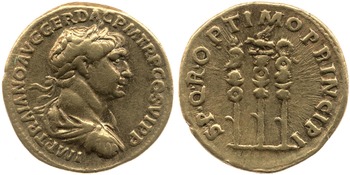
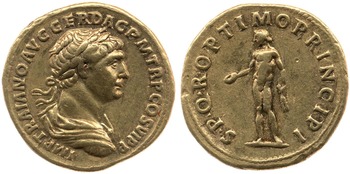
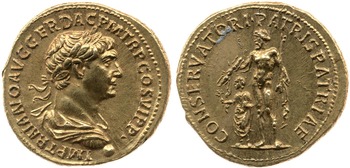
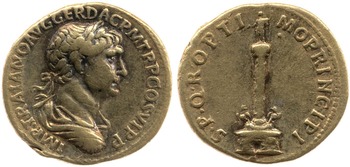
Although our historical evidence is poor, as it is for much of the reign of Trajan, two sources provide some context for the date of 12 May a.d. 113. First, from the fragmentary text of Dio (68.16.3) we have a brief remark on the completion of Trajan's new Forum; this is immediately followed by an equally brief note (68.17.1) that Trajan next set out on a campaign against the Armenians and the Parthians. This major new war occupied the remainder of Trajan's reign. The second source that illuminates this period is the coinage. All three major buildings of Trajan's Forum — façade, basilica and column — are shown on Trajan's coinage. Die links observed in the gold coinage make it possible to reconstruct its exact production sequence.Footnote 4 The gold coinage of Trajan marked COS VI (beginning January 112) but not yet bearing the title Optimus (awarded fall 114) falls into two mutually exclusive groups, one earlier and the other later.Footnote 5 The first group dates from early 112 to early 113 and is documented by a complete chain of die links. It includes new types depicting the Forum Traiani, the Basilica Ulpia, an equestrian statue, and images of Divus Nerva and Pater Traianus. At the very end of the die-link chain there appears a unique die depicting Mars Victor.Footnote 6 These Forum-centred coin types then vanish from the gold coinage and are replaced by a group of entirely new reverse types, again all connected by die links. These are: Roman military standards (an aquila flanked by two standards, one topped with a wreath, the other with a hand; Fig. 1); Bonus Eventus (the personification of good outcomes) in the act of sacrificing (Fig. 2); Jupiter Conservator with his arm raised above a diminutive figure of Trajan (Fig. 3); and the Column of Trajan (Fig. 4).Footnote 7 The Column gives the second group an earliest start date of May 113.
Aureus of Trajan, a.d. 113–14; reverse: Roman standards. BMCRE Trajan 457. (© Trustees of the British Museum)

Aureus of Trajan, a.d. 113–14; reverse: Bonus Eventus. BMCRE Trajan 426. (© Trustees of the British Museum)

Aureus of Trajan, a.d. 113–14; reverse: Jupiter Conservator. BMCRE Trajan 493. (© Trustees of the British Museum)

Aureus of Trajan, a.d. 113–14; reverse: Trajan's Column. BMCRE Trajan 450. (© Trustees of the British Museum)

The new coin types associated with Trajan's Column have a coherent message. The appeal to Jupiter Conservator and the depiction of Bonus Eventus indicate vows made for the protection of the emperor and for the positive outcome of an impending undertaking; the depiction of military standards suggests that the undertaking was related to the army. The only military expedition we know of in this time period is the war with Parthia. The evidence of the coinage suggests that the beginning of this campaign coincided with the dedication of Trajan's Column.
II 12 MAY AND MARS ULTOR
The idea of a connection between the dedication of the Column and the Parthian War is strengthened by the significance of the specific date of its dedication, which was the same day as the annual ludi circenses for Mars Ultor, held on the anniversary of the dedication of that god's temple in the Forum of Augustus.
Multiple calendars from the Imperial period record that 12 May was the day on which games in honour of Mars were held. The Fasti Maffeiani record ‘lud(i) Mart(i) in circ(o)’, ‘games to Mars in the circus’; the Feriale Duranum records ludi for Mars Pater Ultor: ‘iiii idus maias ob circenses ma[rtiales] marti pa[tri ult]ori ta[u]rum’; ‘on 12 May, for the circus games of Mars, to Mars Father Avenger, (sacrifice) a bull’.Footnote 8 It was normal for games for a particular god to coincide with the anniversary of the dedication of a temple.Footnote 9 Caesar followed this practice when he initiated games for Venus Genetrix on the occasion of the dedication of her temple in his forum.Footnote 10
Both Velleius Paterculus and Cassius Dio record that games for Mars were celebrated by Augustus on the occasion of the dedication of the Temple of Mars Ultor. Velleius notes (2.100.2) that this happened when Augustus was consul with Gallus Caninius (2 b.c.) and that the games included gladiatorial shows and a naval battle. Dio (55.10.6–9) gives further details, noting that the naval battle was staged as a fight between ‘Persians’ and ‘Athenians’. The specific date given by Velleius corresponds to Augustus’ own account (RG 22.2) that he was the first to celebrate the ludi Martiales when he held the consulate for the thirteenth time (2 b.c.).Footnote 11 Ovid's description of the Temple of Mars Ultor in his entry for 12 May in his Fasti (5.545–98) describes the temple as ‘justly given’ to the god (‘rite templum datum’) and concludes with a command for the Romans to celebrate his games (‘sollemnes ludos Circo celebrate, Quirites!’).
Thus 12 May was both the date of the annual ludi circenses for Mars Ultor and the anniversary of the dedication of his temple in the Forum of Augustus.Footnote 12 The reason for the choice of 12 May is unknown, though Degrassi speculated that it marked the anniversary of the return of the standards, and Spannagel makes the attractive suggestion that it celebrated the adoption of Gaius and Lucius Caesars.Footnote 13
This — the celebration of the ludi circenses of Mars Ultor on 12 May — is significant from the point of view of the dedication of the Column of Trajan, since the earliest evidence for the rôle of the god highlights him as agent of vengeance against the Parthians (see Section IV below). The Parthian aspect of the vengeance embodied in Mars Ultor might be taken as a sufficient, if general, explanation for why Trajan chose 12 May to dedicate his own column and to begin a new war against Parthia.Footnote 14 But a more specific connection can be made between the events of 2 b.c. and a.d. 113, one that casts Trajan's undertaking as following in the footsteps of Augustus.
III EVENTS OF 12 MAY 2 B.C.
In the Ars Amatoria (a poem earlier by at least six years than the Fasti) Ovid attributes not two, but only one meaning to Mars's epithet Ultor. This happens in an awkward insertion of a passage praising Gaius Caesar into a discussion of where in Rome one might meet women.Footnote 15 Ovid considers the possibilities of meeting women at gladiatorial shows and then bursts out:
‘What happened when Caesar of late brought on Persian and Athenian vessels under the fashion of a naval fight?’ Young men and women came from far and wide, says Ovid, and found love in the crowd. Then:
‘Look! Caesar is preparing to add what was lacking to the conquered world: now, farthest East, you will be ours.’Footnote 16 The ‘naval fight’ used by Ovid to segue into his panegyric is generally understood as being the one held during the first ludi of Mars Ultor in 2 b.c., mentioned by Velleius Paterculus and described specifically by Dio.Footnote 17 The Caesar mentioned is Gaius, who was then preparing for a campaign against Parthia.Footnote 18
For Ovid's segue to make sense to the reader, these two events must have been connected. Ovid proceeds to give the exact purpose of Gaius’ mission:
Parthian, you shall pay the penalty; rejoice, you buried soldiers of Crassus, and you standards that shamefully endured barbarian violence. Your avenger is at hand, and though his years be few, proclaims his captaincy, and, though a boy, handles wars that no boy should handle.Footnote 19
The goal of Gaius’ campaign is clear: revenge not only for the dead soldiers of Crassus, but also for the standards that, although already returned to the Romans and safely housed in the Temple of Mars Ultor, still bore the shame of Parthian abuse.Footnote 20 That is, in 2 b.c. vengeance had not yet been achieved, the simple return of the standards had not been enough.Footnote 21 They and the dead soldiers of Crassus were still to be avenged and this was the task of Gaius Caesar. Gaius was now the avenger, and on his march eastward he was honoured in Athens with a statue as ‘the New Ares’.Footnote 22
Gaius achieved limited success in the East; he subjugated Armenia (for which he was hailed imperator shortly before his death), but he did not complete his vengeance against the real enemy and died in a.d. 4 with Parthia still unconquered.Footnote 23 We should consider the possibility that Trajan purposefully chose 12 May in order to emphasize that he was taking up the sword that had fallen from the hand of Gaius and that he was setting out to accomplish the vengeance that had eluded Augustus.
IV OTHER INVOCATIONS OF MARS ULTOR
This conclusion, if correct, demonstrates that the connection between Mars Ultor and the idea of vengeance against Parthia was strong in the Roman mind in the early second century a.d. But in modern commentaries, the origin of the epithet Ultor is more commonly (and often exclusively) connected to a vow to avenge Caesar made by Octavian on the eve of the Battle of Philippi in 42 b.c.Footnote 24 Vengeance against the Parthians, if mentioned, is considered a later addition.Footnote 25 Given the prevalence of this belief it is worth examining the evidence on which it is based. This section traces the known invocations of Mars Ultor from the first century b.c. to the third century a.d., with the goal of identifying patterns that might reveal how the Romans understood his rôle.Footnote 26 The sources indicate that Mars Ultor was understood in different ways, and also that this understanding may have changed over time. In order to ensure as far as possible an accurate reflection of the contemporary understanding of Mars Ultor and to highlight any changes in his image through time, the evidence is presented in the order of the dates of the sources themselves, not necessarily the period which they claim to illuminate. Thus the most frequently cited authority for Mars Ultor's invocation at the Battle of Philippi, Suetonius, Augustus 29.2, is reserved for discussion in the time when it was written, the early second century a.d.
From the Battle of Philippi to the 20s b.c.
There is no source for Mars as Ultor contemporary to the Battle of Philippi, and not for more than twenty years after it. The epithet does not appear in conjunction with Mars in the poetry of the 20s b.c., and Mars is associated neither with vengeance for the murder of Caesar nor with vengeance against Parthia. Horace, Odes 1.2, perhaps written c. 30 b.c., is a useful example.Footnote 27 This is an appeal to the gods to restore Rome after the Civil Wars, which Horace describes as a crime (scelus) and a waste of energy that could have been better spent against the Parthians.Footnote 28 Horace addresses Mars (epithets or descriptions of the various gods are underlined for emphasis):
Or you, if as our founder you have any regard for the race you have neglected and for your own descendants, cease (for you have had your fill) from the game which has gone on, alas, too long.Footnote 29
After Mars comes Mercury, whom Horace compares with Augustus:
Or you come, o winged son of kindly Maia, if you take on the shape of a young man on earth and are willing to be called Caesar's avenger.Footnote 30
Horace finally appeals to Augustus to stay long on earth and to exact vengeance against the Parthians:
Here rather may you enjoy glorious triumphs, here may you be glad to be called Father and First Citizen, and refuse to allow the Medes to ride unpunished while you are our leader, Caesar.Footnote 31
Vengeance for Caesar's murder has been accomplished by Mercury, Augustus will extract vengeance against the Parthians, and Mars is hailed as founder of the Roman race.
The theme of an impending victory over the Parthians is also evoked by Propertius in his Elegy 3.4, written c. 22–21 b.c., where the poet addresses in turn Jupiter, Mars and Venus in the context of an impending war. At the beginning, deus Caesar (Augustus) plans a war against the East. Naturally this will be a victory, and once won, ‘Parthia's trophies shall become familiar with Latin Jupiter’ and the soldiers are urged to ‘avenge Crassus’ men and the defeat’.Footnote 32 Then Mars, who is called pater (father), is invoked by Propertius (3.4.11–18) that he might allow the poet to see Augustus’ triumph, laden with spoils, the names of captured cities, and the captured enemy leaders. Finally Propertius (3.4.19) invokes Venus to protect her child (‘ipsa tuam serva prolem, Venus’: ‘save your own offspring, Venus’). In the poetry of both Horace and Propertius, Mars is qualified as an ancestral/paternal figure and is not directly associated with revenge.
The First Invocation of Mars Ultor
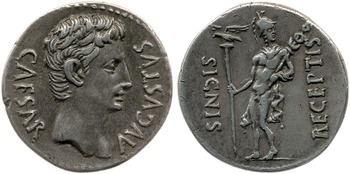
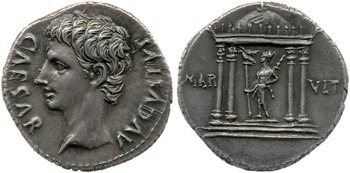
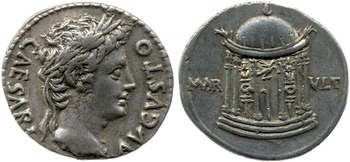
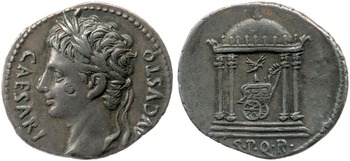
The earliest specific evidence for Mars Ultor is found on coinage of 19/18 b.c.Footnote 33 These coins have varied iconography, though common to all is the depiction of one, two or three Roman military standards. These are the standards of Crassus (and of two other defeated Roman armies; RG 29.2), which Augustus compelled the Parthians to return in 20 b.c. The standards are shown either held by a young Mars (Fig. 5; sometimes in a small shrine or temple, Fig. 6) or standing by themselves in a temple (either alone, Fig. 7, or in a chariot, Fig. 8), with legends specifying MARTIS VLTORIS (or similar), ‘of Mars Ultor’, or SIGNIS RECEPTIS, ‘the standards recovered’. In a remarkable example of co-ordinated dissemination of iconography, these coins were struck at multiple locations in the Empire: aurei and denarii in Spain for circulation in the West, cistophori at Pergamum for circulation in Asia Minor (Fig. 9), and even bronze coins in Egypt for use solely in that province.Footnote 34
Denarius of Augustus, Spain, c. 19 b.c.; reverse: Mars Ultor with standards. BMCRE Augustus 332. (© Trustees of the British Museum)

Denarius of Augustus, Spain, c. 19 b.c.; reverse: Mars Ultor with standards in temple. BMCRE Augustus 369. (© Trustees of the British Museum)

Denarius of Augustus, Spain, c. 18 b.c.; reverse: standards in temple. BMCRE Augustus 371. (© Trustees of the British Museum)

Denarius of Augustus, Spain, c. 18 b.c.; reverse: aquila in chariot in temple. BMCRE Augustus 388. (© Trustees of the British Museum)

Cistophorus of Augustus, Ephesus, 19–18 b.c.; reverse: standard in temple. Cf. BMCRE Augustus 704. (© Trustees of the British Museum)

These coins would have served to publicize in all parts of the Empire the connection between Mars Ultor and the standards returned by the Parthians. The depiction of the standards together with the name of the god would have cemented the public understanding of Mars Ultor as the god of vengeance against the Parthians. This revenge against Parthia represented the achievement of a major goal of the Roman state since the time of Caesar,Footnote 35 and it was fitting that Augustus should publicize it across the Empire. The coin types struck in Augustus’ name in and after 19 b.c. appear to declare this vengeance achieved, and perhaps also to announce Augustus’ plan to build the temple that was to rise in his own Forum (this is extensively debatedFootnote 36 ).
The next source in chronological order reinforces the association of Mars Ultor and Parthia, but appears to qualify the degree of vengeance achieved by Augustus in 20 b.c. This is Ovid's description of the games that attended the dedication of the Temple of Mars Ultor in the Ars Amatoria, written c. 2 b.c. (discussed in Section III above). The poet calls on both the standards and the dead soldiers of Crassus to rejoice because their avenger, Gaius Caesar, is at hand. This suggests that, at least in 2 b.c., the vengeance achieved by Augustus in 20 b.c. was not considered complete.
The First Connection to Philippi
The first mention of the vow of vengeance at Philippi in association with Mars Ultor comes at least six years after this, in Ovid's Fasti, probably written after a.d. 4.Footnote 37 Here Mars is presented as the agent of vengeance against both Parthia and the murderers of Caesar; nine lines of the Fasti are devoted to the vow at Philippi, while fourteen describe Mars's vengeance against the Parthians. Ovid purports to give the very words of Augustus' vow at Philippi: ‘you will have a temple, when I am the victor, and you will be called Avenger’ (‘templa feres et, me victore, vocaberis Ultor’; Fasti 5.577). Herbert-Brown has pointed out that Ovid casts Augustus' vow in a carefully nuanced way: Augustus invokes Mars to avenge Caesar the god, not the man.Footnote 38 Revenge against Parthia is also a theme, but in contrast to the Ars, in the Fasti Ovid is clear that the humiliation caused by the capture of the standards had been removed by the act of their return (Fasti 5. 589–90 and 594). The poet appears to have changed his mind about the significance of the return of the standards between the time he wrote the Ars and the Fasti.
The First Century a.d.
In his Res Gestae, which Augustus says he wrote in his seventy-sixth year (the last year of his life; RG 35.2), the emperor records both his vengeance against the Parthians and his vengeance against the murderers of Caesar. But he (RG 2) disassociates his revenge against the murderers of his father from the battles that followed; revenge was accomplished by the exile of the offenders, while the following battles were fought in defence of the republic when these men attacked it.Footnote 39 Augustus' only reference (RG 29) to the function of Mars Ultor's temple is as a repository for Roman military standards recovered from Spain, Gaul, Dalmatia and Parthia.
The next record of the invocation of Mars Ultor is found in the Commentarii Fratrum Arvalium, an inscribed record of ceremonies and sacrifices made by the Arval Brethren, an ancient college of priests dedicated to Dea Dia but which also offered sacrifice and made vows on important occasions associated with the emperor.Footnote 40 On 23 June a.d. 59 the Arval Brethren sacrificed on the Capitol to Jupiter, Juno, Minerva, Salus, Felicitas, Divus Augustus, Diva Augusta and Divus Claudius, and in the Forum of Augustus to Mars Ultor and the Genius Augusti, on the occasion of a vow for the safety and return of Nero (‘pro salute et] reditu Neronis').Footnote 41 Scheid suggests that Mars is included here (as he is later in sacrifices for the dies imperii) because of the triumphal nature of Nero's return and the functions of the temple in this context as spelled out by Augustus.Footnote 42
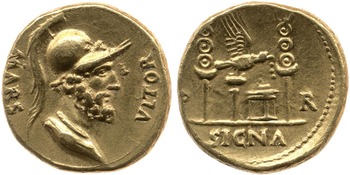
Only ten years later Mars Ultor appears again, this time on coinage. During the Civil Wars of the years a.d. 68/69, Mars Ultor was a major type on the anonymous coinage struck in Gaul under C. Iulius Vindex and in Spain under Galba to pay troops in their revolt against Nero.Footnote 43 Vindex, governor of Transalpine Gaul, was the first to revolt against Nero in the spring of 68; he obtained the support of Galba but was defeated by the still-loyal troops of the governor of Germany before Galba could come to his aid, after which he committed suicide.Footnote 44 This coinage bears no imperial portrait but instead is adorned with gods, personifications and other objects. One type (Fig. 10) shows Mars as a naked helmeted figure striding with shield and raised spear, identified by the inscription as Mars Ultor; the obverse of these coins normally bears a portrait of the Genius of the Roman People.Footnote 45 On the other major type (Fig. 11) the god is shown on the obverse as a helmeted, bearded male bust with the legend MARS VLTOR. This bust is most often paired with a reverse showing three legionary standards, an altar, and the legend SIGNA P R.Footnote 46
Aureus of Civil Wars, Gaul, a.d. 68–69; reverse: Mars Ultor. BMCRE Civil Wars 21. (© Trustees of the British Museum)

Aureus of Civil Wars, Gaul, a.d. 68–69; obverse: Mars Ultor; reverse: standards, altar, SIGNA P R. BMCRE Civil Wars 38. (© Trustees of the British Museum)

The significance of Mars Ultor in this context is unclear. Chambalu favoured an interpretation focused on vengeance against Nero, while Croon interpreted the coins in a more general way, as intended to support Galba's claim as a successor of Augustus.Footnote 47 Mattingly made a different argument, suggesting that in the Latin word ultor ‘we may reasonably see a direct allusion to the Gallic leader’, since vindex also means avenger.Footnote 48 Mattingly's idea of a connection with Vindex is strengthened by two observations. The first is that Mars Ultor does not appear on any coins of Galba struck at Rome, even though that coinage does repeat a number of earlier Spanish types (suggesting that the type was pertinent to the provincial theatre, not the capital).Footnote 49 The second is that Mars Ultor continues to be struck on Spanish issues even into the beginning of the reign of Vespasian (from whose Roman coinage the god is also absent).Footnote 50
The Commentarii Fratrum Arvalium record the inclusion of a sacrifice to Mars Ultor (along with Jupiter, Juno, Minerva, Victoria, Salus, Felicitas and the Genius Augusti) in a.d. 69 on the dies imperii of Galba's immediate successor, Otho, then five months later for the dies imperii of Vitellius, and again for Vitellius' safety and arrival (both times with a similar constellation of other gods).Footnote 51 Chambalu argued that this was directly related to the strong theme of vengeance that he believed permeated the whole period of the Civil Wars.Footnote 52 Scheid on the other hand suggests that the military functions ascribed to the Temple of Mars Ultor by Augustus provide a better explanation for a sacrifice to the god on the occasion of a dies imperii; he also suggests, noting that Mars (no epithet specified) is included in sacrifices on dies imperii of Domitian, that the god became part of the normal commemorative ritual on that occasion.Footnote 53 The incompleteness of the Commentarii (no entries preserved between Caesar and Claudius) makes it impossible to know when Mars Ultor first appeared in the sacrifices of the Arvals.
The Tropaeum Traiani
The next evidence for the invocation of Mars Ultor, and the only major monument known to have been dedicated to this god since the time of Augustus, is the Tropaeum Traiani at Adamklisi, just south of the Danube in Moesia Inferior. The monument was a large stone trophy atop a massive cylindrical masonry base decorated with relief sculptures depicting scenes from Trajan's Dacian Wars. The inscription begins MARTI VLTOR[I]; the mention of Trajan's thirteenth tribunician power dates the monument to a.d. 107/108.Footnote 54 The dedication is followed by Trajan's name and titulature, but the second part of the inscription, where presumably the reason for its dedication was given, is not preserved except for a few letters that may reference ‘the army of the Dacians'. Trajan had won two major wars against the Dacians, but the dedication to Mars Ultor shows that this was not a simple victory monument. The god appears to have been invoked by Trajan as avenger of past Roman defeats at the hands of the Dacians, including the loss under Domitian (and later recovery by Trajan) of a Roman standard.Footnote 55 A nearby funerary altar commemorates by name 3–4,000 Roman soldiers who died fighting for the republic; whether these were soldiers of Domitian or Trajan is not clear, but the siting of a trophy dedicated to Mars Ultor only 250 m from a monument to Roman dead was almost certainly intended to show a connection between the two.Footnote 56
Tacitus and Suetonius
Tacitus and Suetonius wrote in the early second century a.d. I have delayed considering their testimony in order to avoid mingling contemporary records with later sources that may reflect an understanding of Mars Ultor at the time of writing, rather than as it was in the period referred to. The references of Tacitus and Suetonius to Mars Ultor are discussed here in chronological order within each author's work.
Tacitus records (Ann. 2.64) that in the year 17 Germanicus, having installed a new king of Armenia (the control of which the Romans regularly contested with the Parthians), was rewarded with an arch built beside the Temple of Mars Ultor. This appears to support the Parthian association of the god. On the other hand, in a.d. 20, after the conspiracy of Piso, Tacitus records (Ann. 3.18) proposals by senators to set up a golden statue in the Temple of Mars Ultor and an ‘altar of vengeance’ (‘aram ultionis’); in addition it was suggested that certain people should be publicly thanked for avenging Germanicus (‘ob vindictam Germanici’). This seems to point to a more personal interpretation of the vengeance expressed by Mars Ultor, presumably derived from the idea of vengeance against the murderers of Caesar.
Tiberius’ reaction (as recorded by Tacitus) is striking: he forbade both the statue and the altar on the grounds that ‘these memorials were consecrated after victories abroad; domestic calamities called for sorrow and concealment’ (‘prohibuit, ob externas ea victorias sacrari dictitans, domestica mala tristitia operienda’; Ann. 3.18, trans. J. Jackson). Here Tacitus depicts the emperor dismissing an association between Mars Ultor and personal vengeance, instead emphasizing his function as avenger against foreign enemies. Another foreign (and specifically Parthian) connection is related by Tacitus in the time of Nero. In a.d. 54 the Parthians seized Armenia and Nero ordered Roman forces to be mobilized and allied kings to cross the Parthian borders (Ann. 13.6–7). A domestic rebellion caused the Parthians to withdraw from Armenia, but the Senate reacted as if a great victory had been won. They voted Nero triumphal regalia, an ovatio, and a statue of the emperor equal in size to that of Mars Ultor, to be set up in the same temple (Ann. 13.8).
Suetonius, Augustus 29.2 is the second and most frequently cited source for the vow at Philippi (the first being Ovid, Fasti), despite a generally overlooked uncertainty in its reading. While discussing the many public works of Augustus, Suetonius records the building of his Forum and the Temple of Mars, to which he adds: ‘aedem Martis bello Philippensi pro ultione paterna suscepto voverat’: ‘he had made a vow to build the temple of Mars in the war of Philippi, which he undertook to avenge his father’ (J. C. Rolfe trans.). However, the archetype from which all our manuscripts are derived had a different reading: provisione instead of pro ultione; the latter is a correction supplied by a twelfth-century scribe.Footnote 57 Gustav Becker, commenting on Roth's edition of 1858, suggested splitting this word and reading pro visione paterna, ‘in accordance with a paternal vision’; he connected this to the story (given by both Suetonius and Dio) that the ghost of Caesar had appeared on the eve of the battle, in one version (Suetonius) promising victory.Footnote 58
On the other hand, there is good reason to accept the correction pro ultione. The text of Suetonius is very corrupt and the archetype contains hundreds of errors.Footnote 59 Robert Kaster notes that the process by which visione might have been introduced for a misspelled ultione can be easily envisaged: VLTIONE becomes VITIONE (VL- and VI- being barely distinguishable in ancient capital script) which is ‘corrected’ to VISIONE. In addition, Kaster notes that pro is rarely used by Suetonius to mean ‘in accordance with’ and that visio (a rare word before Late Antiquity except for a limited number of Classical authors) is not used elsewhere by Suetonius, though he frequently uses ultio.Footnote 60
Suetonius references Mars Ultor in two other places. Augustus is said by Suetonius (Aug. 21.2) to have used the Temple of Mars Ultor as part of a ritual to ensure that barbarians maintained peace with Rome. The point was presumably that should they break their oath, Mars would aid the Romans in exacting vengeance. Suetonius also relates that Caligula ‘dedicated to Mars the Avenger, with an explanatory inscription, three swords designed to take his life’ (‘tres gladios in necem suam praeparatos Marti Ultori addito elogio consecravit’; Caligula 24.3, trans. Rolfe). The number three was in reference to Caligula's three sisters, whom he believed had conspired against him with Drusilla's husband Lepidus.Footnote 61 Newlands cites Suetonius, Vitellius 8.1 as evidence that a sword belonging to Julius Caesar was kept in the Temple of Mars Ultor, but this appears to be incorrect.Footnote 62
Later Invocations of Mars Ultor
After the time of Trajan, it seems that Mars Ultor receded into the background. He was rarely represented on coinage: Mars Ultor appears (as a simple standing type with spear and shield) once on the coinage of Antoninus Pius and once again on the coinage of Commodus; in neither case does the issue appear to have been large, or the type to have been associated with any particular event.Footnote 63 Perhaps surprisingly, Mars Ultor does not appear on the coinage of Lucius Verus or of Septimius Severus, both of whom fought campaigns against Parthia.Footnote 64 But the god does appear during Severus' lifetime on the coinage of his eldest son, Caracalla, dated a.d. 197/198.Footnote 65 A youthful helmeted Mars Ultor marches right, a trophy over his left shoulder and a spear in this right hand. On the obverse Caracalla is titled Caesar and pontifex. The most common type of that year is Caracalla as princeps iuventutis, and it is to this that we should probably connect the appearance of Mars Ultor, following Dio's note (55.10.2) that one of the functions decreed by Augustus for the Temple of Mars Ultor was as the site of enrolment of youths attaining military age.
The final written source, in order of writing, is the text of the historian Cassius Dio. The historian concludes his work in the year 229, when he was ordinary consul with Severus Alexander and after which he retired, as he says, to his homeland of Bithynia. His history is preserved more or less fully between 69 b.c. and a.d. 46, after which it is very fragmentary. Dio (55.10.6–9) describes the games held to mark the dedication of the Temple of Mars Ultor (see Section II above), noting that they included a sea battle between Persians and Athenians — probably meant to call to mind the Parthians and the Romans — which the Athenians won. Dio's description (55.10.2–4) of the functions of the temple specified by Augustus includes multiple military associations, in particular that generals embarking on foreign campaigns should start there, that the Senate should meet there to award triumphs to victors, and that those honoured by a triumph should have statues in the Forum. Dio does not mention the function of vengeance against the murderers of Caesar.
At the end of Dio's history a new eastern enemy makes its appearance. Dio (speaking now of his own time) reports fear and alarm across the Roman Empire and beyond, because of the situation in Mesopotamia.Footnote 66 Artaxerxes had defeated the Parthians, thus establishing a new Persian empire, and had gathered a large army and intended to reconquer the territory that had belonged to the old Persian empire.Footnote 67 This crisis may have inspired the depiction of Mars Ultor on two very-large-volume issues of the coinage of Severus Alexander, taking a prominent place in this medium for the first time since the Civil Wars after the death of Nero.Footnote 68
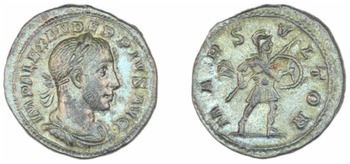
These coins belong to the later part of Alexander's reign and, though the dating is not certain, probably are to be associated with the emperor's Persian war, fought between a.d. 231 and 233.Footnote 69 On the coins Mars Ultor is shown standing with spear and shield and, significantly, a Roman military standard (Fig. 12) or advancing with shield and spear (Fig. 13).Footnote 70 Also from the reign of Severus Alexander is the Feriale Duranum, the military calendar of Dura Europos discussed in the second part of this paper, that specifies a sacrifice to Mars Pater Ultor on 12 May.Footnote 71 The epithet Pater appears to have been officially associated with Mars Ultor in the reign of Severus Alexander, when it also appears in the commentaries of the Arval Brethren.Footnote 72
Sestertius of Severus Alexander, c. a.d. 231–33; reverse: Mars Ultor with spear, shield and standard. Cf. BMCRE Alexander 806. (After BMCRE VI, pl. 27)

Denarius of Severus Alexander, c. a.d. 231–33; reverse: Mars Ultor with spear, shield. Cf. BMCRE Alexander 833. (© Trustees of the British Museum)

V THE CHANGING UNDERSTANDING OF MARS ULTOR
The sources, considered in order of their creation, show the following: before 19 b.c. there is no mention of Mars as Ultor; if an epithet is given to Mars in the poetry of the 30s–20s b.c., he is called Pater or Auctor, both of which highlight his rôle as founder of the Roman people. In this period vengeance, both against the Parthians and against the murderers of Caesar, is a prominent theme, but Mars it not connected to this function. Mars Ultor appears for the first time on the coins of 19/18 b.c., associated exclusively with the standards recovered from the Parthians. He is hailed again as avenger against the Parthians in 2 b.c., by Ovid in the Ars Amatoria, in a passage that is connected to an account of the games held at the dedication of the Temple of Mars Ultor and the departure of Gaius Caesar for the East.
The first mention of Mars as avenger of Caesar occurs after a.d. 4, in the Fasti, where he is specifically connected to an oath made by Octavian at Philippi. The difference in the way Ovid describes vengeance against Parthia in his two poems is striking. In the Ars, Ovid focuses on the completion of the vengeance against Parthia that had been begun by Augustus, to be achieved by the god's instrument, Gaius Caesar. In the Fasti, vengeance against Parthia is said to have already been achieved by the return of the standards in 20 b.c. Ovid's change of mind may be explained by a major change in the political situation: the death of Gaius. This event, which left the goal of vengeance expressed at the dedication of the Temple of Mars Ultor in 2 b.c. unachieved, may have called for a distraction: the story of the oath at Philippi. If the story of the oath was not invented at this time, it must have had a very low profile to not have appeared in any of our sources up to this point.
After Ovid, there appear to have been two ways of thinking about Mars Ultor: as agent of vengeance against foreign enemies, and as agent of personal vengeance. If Tacitus' story of Tiberius rejecting a senatorial proposal of a dedication to Mars Ultor for avenging Germanicus is true to contemporary events, it suggests that there was confusion even at high levels as to how the god should be understood. That such confusion could exist is perhaps surprising, but it may be connected to the nuanced manner in which Ovid presented Mars as avenger of Caesar (as priest of Vesta and a god himself); the senators under Tiberius may not have appreciated this distinction, until corrected by Tiberius. But the idea of Mars Ultor as an agent of personal vengeance persisted: it may have been part of the motivation behind the depiction of Mars Ultor on the coinage of the Civil Wars after the death of Nero, and it was foremost in the mind of Suetonius when he wrote about the god's temple. On the other hand, official state invocations of the god in the second and third century highlight his function as avenger against foreign enemies: against the Dacians under Trajan, the Parthians under Trajan and their successors the Persians under Severus Alexander. Persian associations may have persisted into, or have been revived in, the fourth century: the Fasti Filocali record, in addition to Marticali on 12 May, ludi Persici from 13 to 17 May.Footnote 73
VI 12 MAY A.D. 113
Trajan's orchestration of the dedication of his Column on 12 May is clearly in keeping with the most common Roman understanding of Mars Ultor: vengeance against Parthia. The dedication of the Temple of Venus Genetrix on the same day invoked the support of Venus, the natural companion of Mars, and perhaps recalled Caesar's original plan to wage war against Parthia. The co-ordination of these events on one specific and symbolic day strengthened the connection between the gods through their temples in the Imperial Fora: now both shared the same day of dedication.
The simultaneous dedication of these two monuments also presented Trajan with the opportunity to elevate the events to an elaborate ritual set within the topographic context of the Imperial Fora. The gods Mars and Venus would have been linked by the actual movement of the emperor and his party on 12 May. After dedicating the Temple of Venus in the Forum of Caesar, Trajan would have needed to proceed to his own Forum (if we accept that the sequence of dedications listed in the Fasti Ostienses reflects the actual order in which these happened), probably via the Forum of Augustus and through the new monumental courtyard connecting the two complexes.Footnote 74 The dedication of the Column of Trajan that followed would have recalled the only other major monument dedicated to Mars Ultor, the Tropaeum Traiani at Adamklisi, which honoured the god for the same victories commemorated by (and on) the Column. The successes of the past would have augured well for Trajan's new undertaking. It is even possible that the actual decision to go to war with Parthia was integrated into the events of the day and made in the Temple of Mars Ultor itself, as Ovid notes that ‘from it [the temple of Mars Ultor] might the Marching God fitly open his fierce campaigns', while Suetonius asserts that this was an official function of the temple, decreed by Augustus.Footnote 75 And on this day the very contents of the temple were surely of the highest significance, the standards lost by Crassus and recovered by Augustus. One wonders if the standards on the coinage of a.d. 113 (Fig. 1) might be a specific reference to those returned from Parthia, rather than merely a general allusion to the army.
Having more closely aligned Venus with Mars and linked his Column, the symbol of his earlier military success, to both, Trajan would have been well placed both religiously and topographically to initiate a new Parthian campaign. Unlike Gaius, Trajan was successful: after an arduous campaign in the East he defeated the Parthians and on 20 February 116 was named Parthicus by the Senate, becoming the first Roman emperor to bear this name.Footnote 76 This was not merely a diplomatic victory, or a successful scuffle over Armenia; the Parthians were routed in battle and their territory seized. Two new provinces, Armenia and Mesopotamia, were created and Trajan assigned a king to the Parthians to rule what was left of their land; these actions were prominently commemorated on the coinage.Footnote 77 The significance of his victory was well understood by the Senate, which according to Dio (68.28.2–3) offered the emperor not one but as many triumphs as he desired. Trajan died before reaching Rome but he was honoured with a posthumous Parthian triumph (Fig. 14) and Dio (69.2.3) reports that Parthian Games were celebrated and continued yearly thereafter. The association between Trajan and victory over Parthia remained strong into the third century, when Septimius Severus appears to have chosen to celebrate his Parthian victory on the same date, 28 January, as the dies imperii of Trajan.Footnote 78
Aureus of Hadrian, c. a.d. 118; obverse: Divus Traianus Parthicus; reverse: Trajan in chariot, TRIVMPHVS PARTHICVS. BMCRE Hadrian 47. (© Trustees of the British Museum)

Trajan's choice of 12 May to dedicate his Column tells us something of how Trajan understood the function of Mars Ultor. To Trajan, Mars Ultor was avenger of Roman defeats, both against the Dacians and the Parthians. Trajan also apparently did not consider vengeance against the Parthians to have been fully achieved by the return of the standards in 20 b.c. Like Gaius in 2 b.c., Trajan was setting off to complete this task.
APPENDIX: THE ALGIERS RELIEF AND THE CULT STATUE OF MARS ULTOR
There is no certain evidence for the appearance of the cult statue in the Temple of Mars Ultor. The earliest depictions of the god (I refer here only to depictions that are clearly identified by an inscription as Mars Ultor), on coins c. 19 b.c., show a youthful Mars wearing only a crested helmet and cloak, holding the recovered standards (e.g., Figs 5–6). This cannot be an image of the cult statue in the temple in the Forum of Augustus, since it had not been built at that time. This exact image of Mars Ultor does not appear again. The next appearance of the god is on the coinage of the Civil Wars in a.d. 68–69, where he is bearded but still naked, advancing with raised spear and shield (Figs 10–11). These coins were produced far from Rome and it is not known what the designers used as their model. The first possible depiction of the actual cult statue appears on coins of Antoninus Pius, where the god is shown bearded and in full armour, holding a spear and resting his left hand on a shield, with a cloak draped over his arms and behind his back. What qualifies this as a possible image of the cult statue of Mars Ultor is that it is the first certain depiction of the god created in Rome after the completion of the Temple of Mars Ultor.Footnote 79 This fact does not make it certain that these coins of Antoninus Pius represent the cult statue, but it is a sensible assumption that the designers of these coins, working in the capital (the mint at the time was located south-east of the Colosseum, about 1 km from the Forum of Augustus), would have taken this as their model.
The iconography of Mars Ultor on the coinage of Antoninus Pius is closely paralleled in a relief sculpture from Carthage, now in Algiers. This relief is frequently cited not only as evidence for the appearance of the cult statue of Mars Ultor, but also for the presence of statues of Venus and especially Caesar inside the temple of Mars Ultor. The relief depicts Venus, Mars and a semi-draped figure of a young man with a portrait characteristic of the Julian period, though without sufficient individuality to allow exact identification.Footnote 80 Venus and Mars seem to stand on pedestals, which give them the appearance of statues, and they seem to gaze at each other. Stéphane Gsell linked this composition to a passage of Ovid's Tristia (2.295–6) where the poet says in the Temple of Mars ‘stat Venus Ultori iuncta’, ‘Venus stands joined with the Avenger’. Gsell proposed that these figures represent the actual cult statues from the temple; he identified the young man as Caesar on the basis of a hole on his forehead for (perhaps) the addition of a metal star.Footnote 81 Paul Zanker initially rejected Gsell's connection of Ovid's verse to this relief, preferring to link the reference in the Tristia instead to a version (perhaps the original) of the well-known Mars/Venus group in the Museo Nazionale delle Terme, but later appears to have changed his mind.Footnote 82 Zanker did consistently follow Gsell in taking the Algiers relief as a depiction of the cult statue group and in identifying the third figure as Caesar.Footnote 83 Reception of this idea has varied from enthusiastic to highly sceptical.Footnote 84 Countering one objection, that the third figure is too young to be Caesar, Fishwick has recently argued that it represents a youthful Nero.Footnote 85 But there are two further problems with this idea. The first is that the relief does not give any specific indication of a setting in the Temple of Mars Ultor. The second and more important is that the relief with its three figures is not a complete composition. Instead, the relief was part of a longer frieze with other figures (part of Venus's left foot, for example, was carved on the now-missing frieze block joining on the left).Footnote 86 In the context of a long relief with many gods, the pairing of Mars and Venus might be expected, and it is possible that the young figure may not be related to them at all. The iconography of Mars in the Algiers relief may well be derived from the Augustan cult statue of Mars Ultor, but there is no firm evidence that the Algiers relief represents a group of statues in the temple in the Forum of Augustus.
ABBREVIATIONS
- BMCRE (British Museum Catalogue, Roman Empire)
-
= Coins of the Roman Empire in the British Museum
- RIC
-
= Roman Imperial Coinage