Fifty-years ago, President Lyndon Johnson signed the Voting Rights Act (VRA), a monumental law that changed the political landscape, especially with respect to elections in the South. African-Americans were subjected to discrimination at the polls and institutional election law tools had a widespread effect of disenfranchisement. The VRA was meant to ensure that African-Americans, and later other racial and ethnic minorities, were represented in WA as well as in their local communities. In particular, the process of preclearance which required many states, especially in the South, to submit any changes to election law helped ensure the creation of majority-minority districts and the election of minorities to Congress and legislatures across the South. The strength of the VRA has waned as the preclearance Section 5 provision is no longer in effect due to the Supreme Court's ruling in Shelby County v. Holder (2013) that invalidates the formula in Section 4b. During the 2016 election season, there was an ongoing discussion about new forms of disenfranchisement such as voter ID laws, shortening poll hours, decreasing the number of polling locations, and eliminating a day of registration (Berman Reference Berman2016; Keysar Reference Keysar2016). All are ways that further limit the political voice of minority voters and their subsequent representation. It is, therefore, a highly salient time to examine minority representation.
This paper examines whether individuals express commonality with their co-ethnics on matters related to public policy and whether they feel it is important to live in the legislative districts with people of their same race or ethnicity. Our work builds on prior recent research examining public attitudes toward descriptive representation (Casellas Reference Casellas2010; Casellas and Wallace Reference Casellas and Wallace2015; Schildkraut Reference Schildkraut2017; Wallace Reference Wallace2014a). While Section 5 and its preclearance provision has been effectively eliminated, Section 2 of the VRA still stands. This section establishes a nationwide prohibition of discrimination against voters on account of race or ethnicity. Thornburg v. Gingles (1986), a landmark Section 2 court case, established a three-pronged test in order to demonstrate the existence of discrimination. One of the most important components of this test is the political cohesiveness of a given minority group (Canon Reference Canon1999). If racial and ethnic minorities perceive commonality with one another and express preferences to live in districts with members of their racial or ethnic group, this can be conceived of as evidence of political cohesion.
In addition, growing political polarization and its interaction with race and ethnicity is an important issue that raises critical questions about democratic representation. Indeed, the New York Times magazine featured a story discussing what they termed as an attempt by Republicans to roll back the VRA since its enactment in 1965 (Rutenberg Reference Rutenberg2015). Rutenberg traces historical epochs to show efforts to disenfranchise or otherwise dilute the minority vote since the 1960s, using methods such as the elimination of early voting, enactment of voter identification laws, and racial gerrymandering. As racially polarized voting has increased in most parts of the country, how does this affect attitudes about representation? In particular, for people of color who are Republicans is party or race the more salient political identity when it comes to their attitudes about representation? Additionally, do whites perceive themselves as having similar views on public policy? In studies of race and representation, the examination of attitudes on representation often focuses on a single racial or ethnic group. Our contention is that it is important to know how all racial and ethnic groups view representation and, more importantly, what drives their views—race and ethnicity or political party or a combination of both?
In many states, including the very populous states of CA and TX, the population of racial and ethnic minorities have become the new majority, over 50%, if one combines all of these groups together in comparison with the white population (Phillips Reference Phillips2016). In some cases, such as CA, the Latino population is larger than any other racial or ethnic group (Panzar Reference Panzar2015). As the proportion of Black, Latino, and Asian residents gradually increases in relation to the white population nationwide, we expect individuals of different races and ethnicities to react in different ways. In particular, the growth of anti-immigrant sentiment among many voters might manifest in a backlash against the growing diversity in many communities (Parker and Barreto Reference Parker and Barreto2013; Paxton and Mughan Reference Paxton and Mughan2006; Ybarra, Sanchez, and Sanchez Reference Ybarra, Sanchez and Sanchez2016). Such backlash might lead to even more segregation. The proverbial “birds of a feather flock together” might be an apt way to describe the phenomenon of citizens perceiving themselves as part of a shared group identity living in communities, which share their values. Sharing public policy views often means sharing party identification, especially in recent times.
This research, therefore, investigates three primary questions:
(1) Do members of racial and ethnic groups perceive commonality in public policy interests with members of their own racial and/or ethnic group?
(2) How does the race and ethnicity of individuals influence how important they think it is to live in legislative districts with members from their own racial or ethnic group?
(3) How does partisanship influence perceptions of shared racial and ethnic group policy preferences and attitudes toward legislative district composition?
In assessing these questions, this research connects to the broader literature on political sorting and residential choice. Previous research has shown that citizens’ residential choice is often linked to their party preferences to reside next to individuals who share their ideological beliefs (Bishop and Cushing Reference Bishop and Cushing2008; Gimpel and Hui Reference Gimpel and Hui2015; Sussell Reference Sussell2013). In a related stream of research, individuals also have a strong racial preference to reside next to individuals with a similar racial background, and thus race has long been associated with residential choice (Charles Reference Charles2000; Clark Reference Clark1991; Sampson and Sharkey Reference Sampson and Sharkey2008). Our work, however, broadens the literature to demonstrate that preferences about residential selection for minorities is neither solely based upon party nor is it solely based upon race and ethnicity, but rather that it is a combination of both. Racial and ethnic minorities who share a political commonality place a high level of importance on residing next to one another. We turn now to an examination of our theoretical expectations situated within the context of various literature.
COMMONALITY IN PUBLIC POLICY ATTITUDES
In this study, we are interested in directly testing the extent to which members of racial and ethnic groups perceive commonality with co-ethnics on public policy issues and explaining variation in these preferences. Why should we care about what voters say about their perceptions of public policy commonality? It is important to understand individuals’ perceptions of commonality with members of their racial and ethnic group because perceptions of commonality may substantially impact political opinions on other issues. For policymakers and political scientists, it is essential to know the extent to which there might be any differences among groups when it comes to perceptions of public policy commonality. Answers to this question can help us understand the extent to which a racial or ethnic group experiences in-group solidarity and internal cohesion.Footnote 1
Research has demonstrated that social identity has an important impact on political attitudes and the relationship between constituents and representatives (Butler Reference Butler2014; Butler and Broockman Reference Butler and Broockman2011; Landa and Duell Reference Landa and Duell2015). For example, Dawson (Reference Dawson1994), examines the role of African-American group consciousness and articulates his theory of the “black utility heuristic,” which explains how blacks have coalesced politically in light of external discrimination. Dawson contends that African-Americans are united around group interests in part because they see their individual fates as linked to the fate of the group as a whole, thus it is rational to make calculations on whether something is good for oneself based on what is good for the group (Reference Dawson1994, 61). With regard to Latinos, Sanchez (Reference Sanchez2006) extends Dawson to examine whether Latinos also express a sense of linked fate with one another and he finds substantial evidence that shared experiences of marginalization bind Latinos together. Masuoka and Junn (Reference Masuoka and Junn2013) suggest that not only is group membership “a critical reference point for how individuals orient preferences” but also linked fate in its role “as a measure of racial consciousness” (90). Individuals from racial and ethnic groups might, therefore, perceive themselves as connected to other in-group members and may view their racial and ethnic groups as having shared public policy interests.
When we evaluate cohesion in attitudes on public policy between racial and ethnic groups, the main method of evaluation is comparing responses on various public opinion on surveys and looking for differences between groups. For example, research has examined how groups differ on their support for public policy issues such as abortion (Abrajano Reference Abrajano2010), religion (McKenzie and Rouse Reference McKenzie and Rouse2013), immigration (Han Reference Han2009), and attitudes about other racial groups (Jackson, Gerber and Cain Reference Jackson, Gerber and Cain1994; McClain et al. Reference McClain, Carter, Soto, L. Lyle, Grynaviski, Nunnally, Scotto, Kendrick, Lackey and Davenport Cotton2006). Several studies using survey data demonstrate that having representatives of the same race or ethnicity generates tangible benefits for constituents, such as greater feelings of self-efficacy and trust in government (Pantoja and Segura Reference Pantoja and Segura2003; Sanchez and Morin Reference Sanchez and Morin2011; Schildkraut Reference Schildkraut2013), as well as higher rates of political participation (Barreto Reference Barreto2007; Gay Reference Gay2002). In work examining the group interests of Latinos and African-Americans, representation scholars usually rely on public opinion data to identify which issues are ranked as the most important by members of that group (Lublin Reference Lublin1999; Minta Reference Minta2011; Rouse Reference Rouse2013; Wallace Reference Wallace2014b) to determine what are the group interests. Canon (Reference Canon1999) utilizes opinion data but also suggests that group interests should include objective public policy issues and problems that groups face. He calls these interests objective group interests (22). However, these studies assume that groups are politically cohesive by the examination of survey data or election returns to determine what percentage of minorities voted for a candidate in a given election or what percentage of a group ranks an issue as number one.
The use of the most important problem/issue question can provide a sense of salience of a political issue for members of a group or a sense of group cohesion on importance. It cannot tell us whether members of a racial or ethnic group perceive themselves as having similar public policy preferences as members of their own group. For example, 65% of Latinos may rank immigration as the most important issue, but that does not necessarily mean that 65% of Latinos view themselves as having a lot in common on public policy issues with other Latinos.
Very little research has directly asked respondents about their perceptions of public policy commonality within their racial and ethnic groups. We believe it is important to directly test this for several reasons. First, these perceptions are important for theories of racial and ethnic group identities. To what extent can we discuss linked fate or African-American interests or Latino vote without knowing whether members within a group think they have commonality with other members of the group on public policy? Second, these perceptions have important second- and third-order effects. If minority groups have a strong sense of in-group cohesion, then it follows that political mobilization involves different considerations and presumably fewer challenges. It may actually be easier to mobilize and increase political participation among people who believe they share public policy views with their co-ethnics. On the other hand, if a particular group does not perceive public policy commonality, then this might make it more difficult for political mobilization and advancement if one is using appeals based on a group identity. While we are interested in examining perceptions of commonality in this paper, it is important to note that in litigation involving cohesiveness, social scientists often employ ecological inference to ascertain cohesiveness in voting among racial and ethnic minority groups. Our discussion of cohesiveness is more about perceptions on public policy issues rather than a dichotomous vote choice. Future work with additional data sources might test precisely how these perceptions might reflect reality.
Due to a shared history of discrimination, we expect racial and ethnic minority group members will place greater value on in-group cohesion and perceive a greater sense of commonality because of this shared experience. The process of racialization has also led to greater degrees of in-group commonality among members of disadvantaged groups (Schmidt et al. Reference Schmidt, Edwina and Torres2000; Zepeda-Millán and Wallace Reference Zepeda-Millan and Wallace2013). Minorities will also feel a strong sense of in-group solidarity, especially because of observing co-ethnic representatives engaging in collective representation (Casellas Reference Casellas2010; Grose Reference Grose2011; Mansbridge Reference Mansbridge1999; Minta Reference Minta2011; Rouse Reference Rouse2013). Such observations will enhance the notion of a collective community with similar interests and goals, and lead to greater degrees of experienced responsiveness (Bowen and Clark Reference Bowen and Clark2014). Our first hypothesis, therefore, is that African-American and Latino respondents will perceive greater levels of public policy commonality with members of their own racial group than white respondents.
Influence of Race and Ethnicity on Districts
In Our Patchwork Nation, Chinni and Gimpel (Reference Chinni and Gimpel2011) show that Americans reside in areas with like-minded individuals. It is too simplistic to divide America into red states and blue states. Even red states, such as TX, have areas that are decidedly blue. Communities are becoming more homogenous and residential segregation rates are increasing (Lichter, Parisi, and Taquino Reference Lichter, Parisi and Taquino2015). We examine the influence of race and ethnicity on legislative district composition preferences by examining the extent to which people indicate living in districts with individuals of their own race is important. We believe this directly taps how important racial or ethnic identity is to preferences about residential patterns. We hypothesize that African-Americans and Latinos will be more likely to say that it is important to live in districts with their co-ethnics. Moreover, if African-Americans and Latinos perceive commonality on public policy questions, it stands to reason that they may think it is important to live in areas with individuals who share their values and elect a representative who does as well. That is, the mechanism for believing it is important to live among co-ethnics rests with perceptions of commonality. The more a respondent expresses commonality with members of their own co-ethnic group, the more they are likely to desire to live among them.
It is unclear, however, if white respondents will also reveal this preference in a survey. How important is it to whites that they live in districts with other whites? While often not expressing this desire explicitly, actions speak louder than words on this question, as the phenomenon of “white flight” to suburbs from cities in the post-World War II era clearly demonstrates (Kruse Reference Kruse2007). However, the recent process of gentrification and the return of millennial whites to the cities might be changing these patterns. As Hyra (Reference Hyra2015) additionally points out, cities have become more gentrified thereby affecting the descriptive representation of minorities in city councils and other legislative bodies. For many Americans, however, it is difficult to impossible to move to areas just to be near like-minded partisans or members of your own racial or ethnic group. Many other factors, including work opportunities, economic resources, segregation patterns, and family considerations also come into play. Our question is aimed at assessing variation in the preferences of individuals in terms of how important they believe it is to live in homogenous districts, not their willingness to move to live in such districts.
Another, and perhaps more important theoretical reason for expecting people of color to place a high importance on living in districts with members of their own racial or ethnic group is because of group empowerment theory. Bobo and Gilliam (Reference Bobo and Gilliam1990) first argued that the presence of minority officeholders leads to greater participation of minority voters. Likewise, if minority voters live in districts that elect minority candidates who implement their public policy concerns, then these greater degrees of efficacy are noteworthy. For example, Tate (Reference Tate2003) finds that blacks living in districts with black representatives are more likely to rate their members of Congress more highly. We, therefore, expect that minority citizens will place a higher importance on living in districts with people from their own group because this will enhance their efficacy and presumably lead to greater degrees of representation.
Partisanship
Partisanship has important influences on perceptions of commonality and the political participation of ethnic and racial minorities (Wright Austin, Middelton and Yon Reference Wright Austin, Middelton and Yon2012). Scholars have long demonstrated partisan identification on vote choice and public opinion attitudes (Campbell et al. Reference Campbell, Converse, Miller and Stokes1960; Miller and Shanks Reference Miller and Shanks1996) and the salience of political party as a political identity (Gerber, Huber and Washington Reference Gerber, Huber and Washington2010; Green, Palmquist, and Schickler Reference Green, Palmquist and Shickler2004). Race and ethnicity of individuals is also an important political and social identity (Barreto Reference Barreto2010; Dawson Reference Dawson1994; Masuoka and Junn Reference Masuoka and Junn2013; McConnaughy et al. Reference McConnaughy, White, Leal and Casellas2010). Griffin and Keane (Reference Griffin and Keane2006) find, for example, that black Democrats are more inclined to turn out to vote when they are descriptively represented, but moderate blacks are not. Box Steffensmeier et al. (Reference Box-Steffensmeier, Kimball, Meinke and Tate2003) note that race and party are the two salient dimensions of descriptive representation. Partisanship must be accounted for in addition to race when it comes to perceptions of commonality and desire to live in districts with co-ethnics.
For racial or ethnic minorities, which political identity is most important and how do these overlapping identities affect their political attitudes toward representation? Do Latino Republicans place a higher importance on living in districts with Latino Democrats? Members of racial and ethnic groups who strongly believe in group-based interests based rooted in race, may prioritize being in legislative districts with members of their same racial and ethnic group, rather than party. Partisanship in other circumstances may play a role equal to ethnicity and influence preferences about the desire to live in districts with co-ethnics. Indeed, some argue that discrimination against Democrats by Republicans and vice-versa is actually “just as strong as polarization based on race” (Iyengar and Westwood Reference Iyengar and Westwood2014, 690). This does not mean that polarization based on race is no longer an issue or not as prevalent. It suggests, however, that we must take seriously how partisanship might exert strong effects on these questions of public policy commonality and desire to live in districts with individuals from one's own racial or ethnic group.
We hypothesize that partisanship will influence perceptions of commonality and desire to live in districts with co-ethnics. In particular, white Republicans will indicate they share policy preferences with other white Republicans and will desire to live in districts with them. We expect this relationship based on work demonstrating white Republican preferences for descriptive representation and desire of needing more (Casellas and Wallace Reference Casellas and Wallace2015). On the other hand, Latino Republicans may accurately believe that Latinos tend to share public policy views, but they may not have a preference for living in districts with other Latinos. For them, partisanship might be more important than ethnicity in this scenario. For these reasons, Latino Republicans are less likely to be invested in descriptive representation because most elected officials from their ethnic group are Democrats.Footnote 2 When it comes to political representation, we expect that Latino Republicans will place less importance on living in districts with other Latinos compared with Latino Democrats.Footnote 3 They may prefer living in districts with other Republicans, who share their political views, and for the most part will not be minorities. We now turn to a discussion of the data and survey items.
DATA
To examine racial and ethnic group attitudes toward public policy, legislators, and legislators, we fielded a module on the Cooperative Congressional Election Study, (CCES). The CCES is conducted annually and run by the survey research firm, YouGov/Polimetrix. The survey is composed of common content and individual team modules of 1,000 adult respondents. Respondents were given the choice to conduct the survey instrument in Spanish or in English. Our module was in the field in the 2 weeks after the November 6, 2012 election. It was conducted over the Internet and uses a matched random sample. This involves collecting a random sample drawn from the target population and then identifying one or more members from the opt-in panel that are matched to a member of the target population, to create the matched sample (Ansolabehere and Schaffner Reference Ansolabehere and Schaffner2012).Footnote 4 The common content on the CCES also collected additional items for each respondent including partisan affiliation, income, education, geographical location, federal elected legislative representatives, and race and ethnicity, as well various positions on public policy.
When comparing the CCES to other instruments such as the American National Election Survey and the National Election Study, it appears to over-represent the number of voters and highly educated respondents (Bafumi and Herron Reference Bafumi and Herron2010). The 2012 CCES comprises mostly registered voters with 92.5% of respondents indicating they are registered. While this may cause concern, Jacobson (Reference Jacobson2007) finds no significant differences in outcomes when comparing the CCES with other commonly used instruments in an analysis of vote choice and political preferences. In our analysis, the over-representation of voters in the sample does not pose a significant theoretical problem since the focus of our study is on legislative districts, public policies, and elected officials.
We fielded substantive questions on representation to assess feelings of desire and satisfaction with current levels for descriptive and substantive representation, perceptions of interests of racial and ethnic groups, desire to live in districts with people of the same race or ethnicity, and willingness to contact their representative. This paper focuses on two survey items designed to assess respondents’ views of shared public policy views and preferences regarding the legislative district. The question wording and answer choices for the survey items analyzed are listed below:
(1) How strongly do you agree with the following statement: people of my race or ethnicity share similar preferences on public policies?
(Strongly Agree/ Somewhat Agree/Somewhat Disagree/ Strongly Disagree, Don't Know)
(2) How important is it for you to live in a legislative district with people of the same race or ethnicity as you?
(Very Important/Somewhat Important/Not Important at All/Don't Know)
The sampleFootnote 5 contained 694 Whites, 117 African-Americans, and 153 Latinos. Given the small number of respondents in racial and ethnic groups who are not White, Latino, or Black, we focus our analysis on these three groups.Footnote 6 One potential critique of our data concerns the number of respondents who are members of racial and ethnic minority groups. While we concede that the sample size is too small to examine some complexities of in-group variation, we are able to identify meaningful differences across racial and ethnic groups. Rather than introduce bias in favor of our theoretical expectations, the sample size actually makes it more difficult to produce statistically significant findings. Moreover, studies utilizing the CCES individual modules and other survey instruments with comparable sample sizes of racial and ethnic minority groups have also been able to make similar distinctions in their analyses (Casellas and Wallace Reference Casellas and Wallace2015; McClain et al. Reference McClain, Carter, Soto, L. Lyle, Grynaviski, Nunnally, Scotto, Kendrick, Lackey and Davenport Cotton2006; Rocha et al. Reference Rocha, Tolbert, Bowen and Clark2010; ). We now turn to a discussion of the models and the empirical results.
MODELS
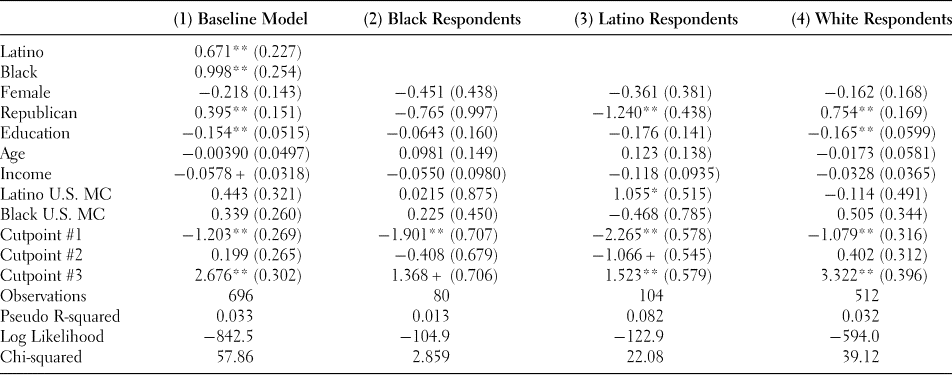
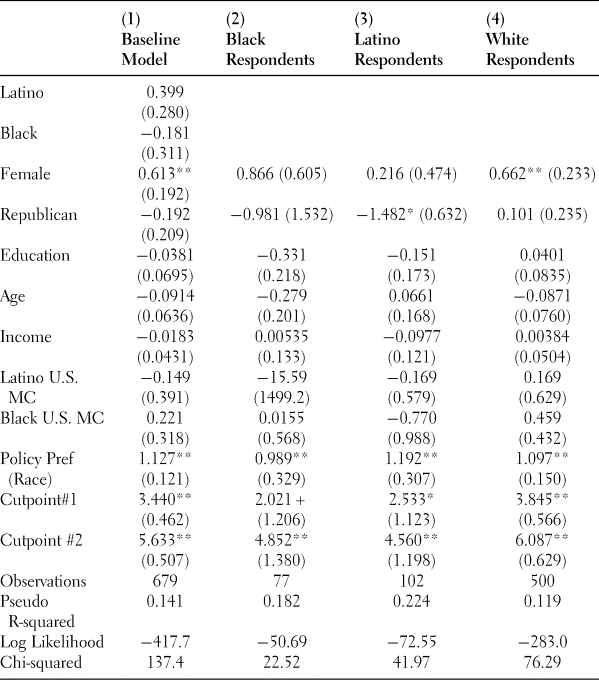
Due to the nature of the dependent variables, our models employ ordered logistic regression (Long Reference Long1997). Our first model focuses on the degree to which respondents view people from their own race or ethnicity as having similar public policy preferences. Model 1 in Table 1 presents the results of this model. We also present the results of the general baseline model for each racial and ethnic group to ascertain the effects of each of the independent variables. These results are contained in Models 2–4 in Table 1. The second set of models assesses how important respondents believe it is to live in a legislative district with individuals of the same racial or ethnic group as themselves. Model 1 in Table 2 contains the results of this analysis. Similar to the first set of models, we also present the results for each racial and ethnic group in Models 2–4 in Table 2. In each model, we use a similar set of covariates, however, in the latter set of models on legislative districts we also include the variable on public policy preferences of one's racial group as an independent variable.Footnote 7
Attitudes toward Similarities in Public Policy Preferences

Standard errors in parentheses. McFadden pseudo R 2.
+p < 0.10; *p < 0.05; **p < 0.01.
Attitudes toward Legislative District Racial and Ethnic Composition

Standard errors in parentheses. McFadden pseudo R 2.
+p < 0.10; *p < 0.05; **p < 0.01.
The majority of the covariates in the statistical models concern personal demographic attributes of the CCES respondents. To examine the effect of a respondent's race or ethnicity on attitudes, we created dummy variables for whether a respondent is Latino or Black. We also created a dichotomous measure for whether a respondent is female to explore potential differences in attitudes by gender. Older respondents may have different attitudes from younger respondents, thus we include a measure of age. To examine potential differences by educational background, we created a 6-point scale of education background ranging from no high school degree, high school degree, some college, 2-year degree, BA degree, and graduate education. No high school is represented by a zero value and graduate education is represented by a value of 5. To examine socio-economic factors, the models also incorporate a measure of income. Income is on a 9-point scale ranging from below $30,000 up to above $150,000. We also include a measure of political party identification to assess differences between Republicans and Democrats and because prior work has demonstrated Latino Republicans can have substantially different views on representation than Latino Democrats (Casellas and Wallace Reference Casellas and Wallace2015) and Latino Republicans can hold very different viewpoints and vote choice compared with Latino Democrats (Alvarez and García Bedolla Reference Alvarez and García Bedolla2003).
Finally, to supplement the survey data and to provide contextualization of respondents’ attitudes, we collected data on the racial and ethnic background of each respondent's U.S. House of Representative. We created a dummy variable for whether a respondent has a Black Member of Congress (MC) and whether they have a Latino MC in order to determine if legislators form minority groups influences attitudes. Latino, Black, Female, Republican, Black MC, and Latino MC are all dichotomous variables. Education, age, and income are categorical. We now turn to the analysis of the results and a discussion of the findings.
RESULTS AND DISCUSSION
The statistical results indicate there are substantial differences in attitudes between members of different racial and ethnic groups. The first set of models examines the dependent variable that asks whether people agree that members of their race or ethnicity share public policy views. The results are presented below in Table 1. In the subsequent models presented in Table 2, the dependent variables ask respondents how important it is to have people of their race or ethnicity in their legislative district.
Race and Ethnicity of Respondents
One of our key variables of interests is the race and ethnicity of respondents. As we hypothesized both Latino and Black respondents in the general model on policy preferences, they are more likely to agree with the statement regarding shared policy preferences within their racial and ethnic group. A raw examination of the data indicates that 53.7% of African-Americans and 49.6% of Latinos express agreement that individuals within their racial and ethnic group share public policy preferences. Compared with 34% of white respondents who express agreement, Latino and African-American respondents are significantly more likely to agree with this statement.Footnote 8 Further, the baseline regression model in Table 1, Model 1 indicates that African-Americans and Latinos do perceive public policy commonality. For African-Americans, this is consistent with previous literature about linked fate and the shared experiences of discrimination in American society and recognized and acted upon by African-American members of Congress (Dawson Reference Dawson1994; Minta Reference Minta2011; Tate Reference Tate2003). Latinos have also been able to coalesce and exhibit high levels of linked fate and racialized identity thus leading to these perceptions of commonality (Zepeda-Millán and Wallace Reference Zepeda-Millan and Wallace2013). Latino members of Congress and other legislators recognize shared interests on issues ranging from immigration to education policy (Casellas Reference Casellas2010; Rouse Reference Rouse2013; Wallace Reference Wallace2014b). These findings matter because they provide evidence of perceived group interests, which can be the basis from which marginalized groups can coalesce for political mobilization.
Republicans
Another focus of this paper is the role of partisanship. The models indicate that partisanship plays a key role in two main ways. Overall, Republicans and specifically white Republicans are more likely to agree that they share policy preferences with members of their own racial group. These effects are strong and statistically significant in Models 1 and 3 in Table 1. These findings are particularly interesting with respect to white Republicans who in a sense also exhibit public policy commonality with members of their own race. Respondents are probably reflecting the fact that they live in communities with members of their own race who happen to share their policy preferences (Chinni and Gimpel Reference Chinni and Gimpel2011).
However, Latino Republicans appear to be very different in their attitudes than White Republicans in the sense that they are less likely to agree that members of their ethnic group share views on public policy and are less likely to place importance on living in a legislative district with more Latinos. One potential explanation for these findings is that for Latino Republicans their partisanship trumps their ethnic identity. Latino Republicans may not view Latinos as sharing views on public policies, because Latino Republicans represent less than a third of Latinos, and thus they perceive a high level of dissimilarity between themselves and Latino Democrats (Alvarez and García Bedolla Reference Alvarez and García Bedolla2003). The acquisition of Latino partisanship is distinct compared with non-Latinos because of multifaceted identities that become activated and politicized through exposure to the political system (See Saavedra Cisneros Reference Saavedra Cisneros2016). In particular, there is a divergence between social and political identities for Latinos. This is even more so for Latino Republicans whose political identities and often religious identities trump any social identity they might have. For most other Latinos, linked fate and a strong social identity often culminate in a pan-ethnic identity yielding Democratic partisanship. Latino Republicans will, therefore, recognize that more Latinos in their legislative district are likely to translate into more Latino Democrats, thus changing the orientation of their district to be more Democratic. For Latino Republicans, they may perceive this as an undesirable outcome because it decreases the probability of having a Republican MC. Thus, the results on partisanship indicate that party plays a major role in explaining attitudes on commonality and district composition.Footnote 9
Race and Ethnicity of MC
We theorized that having minority MCs may influence attitudes particularly of Latino and Black respondents. The results of the models largely indicate there are no effects on these particular dependent variables.Footnote 10 The only exception is that for Latino respondents, having a Latino MC does increase the likelihood of perceiving shared public policy preferences among Latinos. This finding suggests that descriptive representation may not have a strong influence on perceptions of policy cohesion and legislative district composition preferences. This result may also be driven by a lack of knowledge citizens have on the racial background of their specific representative in Congress. Alternatively, these results may be driven by the relatively small number of minority MCs and thus few respondents have an opportunity to be represented by a MC from their own group. Thus, we should be careful in deciding that descriptive representation plays a limited role in this area, but rather it is more complicated to analyze given sample sizes.
Education
Turning towards the role of education, respondents with higher levels of education were less likely to perceive shared preferences on public policy in their racial or ethnic group. Highly educated individuals may be more likely to parse out exceptions and nuances to this question. More educated individuals may be more likely to come into contact with others from the same race or ethnicity with different views or read about them in the news. As such, one possible explanation is that the more educated a person is, the more likely they are to say that there are diverse and multiple viewpoints in their racial or ethnic group.
Public Policy Preferences of Racial and Ethnic Groups
In the second set of models examining preferences about district composition with members of one's own racial or ethnic group, we incorporated the variable on perceptions of shared public policy preferences of one's own racial/ethnic group. We do this because those who believe strongly that members of their own racial and ethnic group share public policy preferences may be significantly more likely to then place a high-level importance on districts made of people from their own racial or ethnic group. The results indicate this variable is statistically significant in the general model and in the models run for each racial and ethnic group separately. Latino, Black, and White respondents who agreed members of their own racial or ethnic shared public policy preferences were, in fact, more likely to view it as important to live in legislative districts with members of their racial or ethnic group. This finding is important because this relationship is not restricted to Latino and Black respondents. We also find that whites were more likely to prefer to live in districts with co-ethnics.
Substantive Effects
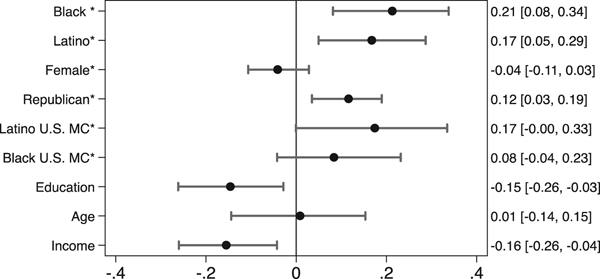
To estimate the substantive effects of each variable on the outcomes of interest, we use Clarify. Footnote 11 The substantive effects are presented in Figures 1 and 2a–c. For the first dependent variable regarding public policy preferences of racial and ethnic groups, we create a dichotomous dependent variable. It is measured as agree or disagree by collapsing the two answer choices for agree and disagree. Thus, respondents are coded as 1 if they somewhat or strongly agreed with the statement that members of their own racial or ethnic groups share similar preferences on public policy. This allows us to examine the substantive effect of each variable on the probability of agreeing with the statement. We present the substantive effects for the general model presented in Table 1, Model 1 to highlight overall effects of race and ethnicity of respondents as well as partisanship.
Attitudes Toward Similarities on Public Policies within Racial Group

Attitudes toward Racial/Ethnic Composition of Legislative Districts

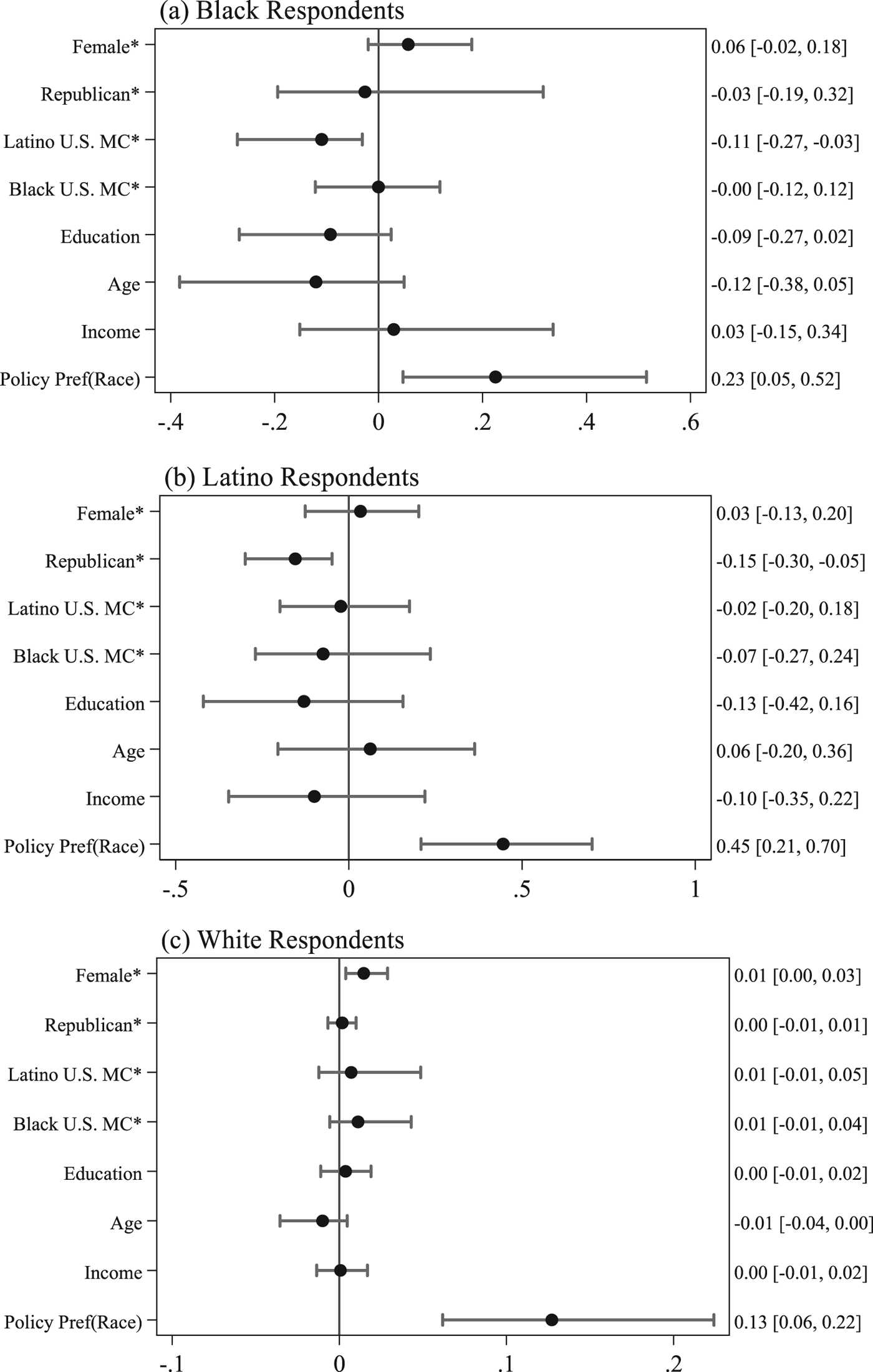
The values in Figure 2 report the difference in probability a respondent will answer the highest value on the survey item (very important) on the question of how important it is for them to live in a district with people from their own racial or ethnic group, if a given variable is changed from its minimum to its maximum, while holding all other variables constant. We present the results of the Models 2–4 in Table 2, to highlight the effects of the independent variables for each racial group. For dichotomous variables, the first difference represents a change from 0 to 1 whereas for continuous variables the estimate shows the first differences as a result of moving from the minimum to the maximum. Ninety-five percent confidence intervals are indicated by the lines in the figures and in brackets.
Up to this point, we have spoken generally about the relationship individuals have with one another on public policy issues, but we can be more specific on the level of political commonality that exists. To offer a more substantive example, the likelihood that African-Americans believe that they share similar preferences on public policies with their own racial minority group is 21 points higher than whites in Figure 1. Indeed, there is a great sense of commonality among black citizens that are not matched by their white counterparts.Footnote 12 Similarly, a greater percentage of Latinos than whites believe they share similar policy preferences to their ethnic group. The likelihood of Latinos perceiving that they share similar policies to their ethnic group is 17 points higher than whites. Ironically, when we focus on party affiliation it is those individuals who identify as being a Republican that are more likely to believe that they share similar public policy preferences with their racial and ethnic group. The likelihood of Republicans holding this belief is 12 points higher than the average Democrat. These findings illustrate the complex relationship between the political party and racial identification.
Finally, there are factors that lead individuals to believe there are weaker policy preferences among their racial and ethnic group. Respondents with more education and income, for example, are less likely to have public policy preferences that are similar to their group. When we delve deeper into this result and divide individuals into their various sub-minority groups, we see that white respondents are largely driving this result.
It is informative to know that great differences exist in the belief of a shared public policy preference among individuals of various racial and ethnic backgrounds, party affiliations, and socioeconomic status. Yet some might question whether there are political consequences for having such a belief. We might expect, and probably be more impressed by, the idea of political beliefs that later shape political preferences.
Indeed, we find that citizens’ belief of shared public policy preferences among their racial and ethnic group is one of the greatest predictors for their geopolitical preference to reside in a congressional district with citizens of a similar racial or ethnic background. In Figures 2a–c, the effect is strong and consistent for African-Americans, Latinos, and whites. While all three groups experience this effect, the belief in a shared political commonality has varying levels of influence among the different racial and ethnic groups. The smallest impact is seen among white respondents, where a belief in shared policy preferences leads to a 13-point increase in an individual's likelihood to place a high importance on residing in a congressional district with members of their same racial background. Black respondents, on the other hand, demonstrated a significantly stronger preference with a 23-point increase among those with a belief in shared policy preferences.
The largest increase is found among Latinos. Latinos that possess a belief in a shared public policy preference display a 45-point increase in their likelihood to place a high importance on residing next to individuals with a similar ethnic background. This effect is three times greater than the effect we see among white respondents and nearly twice as great as the effect experienced among black respondents. However, there is another narrative that emerges for Latinos. Latino Republicans are less likely to place a high level of importance on other Latinos residing in the same district as them. There is a startling 15-point decrease in the likelihood that Latinos believe it is important to have individuals in their district with a similar ethnic background. As we have suggested earlier, this could be a result of Latino Republicans knowing that the majority of Latinos are Democratic. And thus, there may be a desire on the part of Latino Republicans to retain a more homogeneous political ideology in their community.
CONCLUSION
This work contributes to the literature on race and representation that examines public attitudes and demonstrates that Latinos, African-Americans, and whites can place a significant level of importance on having descriptive representatives (Casellas and Wallace Reference Casellas and Wallace2015; Schildkraut Reference Schildkraut2013; Reference Schildkraut2017). It does so by affording a deeper understanding of the extent to which voters perceive commonality with their racial and ethnic minority group on matters related to public policy. It further shapes our understanding of how these expressions of political commonality influence citizens’ perceptions of the importance of living in legislative districts with individuals of the same race and ethnicity. As a consequence of this exploration, this work has demonstrated that for many people a shared sense of policy preferences among their racial and ethnic group strengthens how important they think it is to reside in a similar congressional district with other co-ethnics, thus embodying the proverbial phrase that “birds of a feather, flock together.”
Scholars have shown that Americans increasingly reside in areas with other like-minded individuals (Chinnni and Gimpel Reference Chinni and Gimpel2011). However, we add that the preference about living next to individuals that look like you is greatest among racial and ethnic minorities. This is likely because there is strength in numbers; and those numbers matter more when one belongs to a population minority in a democratic system. Minorities increase their political power when they increase their numbers in a congressional district and rally behind common goals that benefit the group. This was evident in the 1960s and 1970s as the unity of African-Americans and Latinos, and even the mutual efforts of sympathetic groups fueled the civil rights and Chicano movements and led to public policies at the local level (Gillion Reference Gillion2013).
While this research has highlighted the benefits of minorities’ political commonality leading to a desire for group cohesion in their local neighborhoods, future research must also consider the potential dangers of a homogeneous political society. Residential choice, motivated by race and policy preferences, can quickly turn into residential segregation. Massey and Denton (Reference Massey and Denton1998) warn of the dangers that lurk from this “American Apartheid” and indicate that these segregated environments can produce a deterioration of social and economic conditions in minority communities. Consequently, scholars must carefully weigh the benefits of perceived political commonality alongside the practical dangers of segregated minority communities.
This work also has important implications regarding the VRA. With the removal of preclearance and absent a congressional reauthorization, the 2021 redistricting cycle will be the first since 1965 without an external check on the possibility of racial or ethnic vote dilution. If redistricting leads to the retrogression and loss of descriptive representation, then this might lead to greater linked fate and stronger perceptions of commonality. Additionally, as recent court cases striking down voter identification laws in TX, NC and ND suggest, the perception and evidence that such laws were designed to limit the participation of racial and ethnic minorities might lead to even stronger group cohesion and greater vigilance of electoral changes.
Finally, this work highlights the importance of considering how voters’ beliefs in shared policy preferences influence other political attitudes and sociological behavior. Much work has been done that showcase the link between shared beliefs and political attitudes. The paramount work of Dawson (Reference Dawson1994), in particular, highlights the strong link between political commonality and behavior. Our work attempts to contribute to this line of research and suggests that belief in shared policy preferences is also linked to the sociology of communities in terms of preferences about the composition of legislative districts.
Acknowledgments
The authors would like to thank the editors, anonymous reviewers, David Leal, and Geoff Wallace for their helpful suggestions and comments. This project received financial support from the Irma Rangel Public Policy Institute at the University of Texas at Austin.