There are enormous differences in health and health care worldwide, as evidenced by indices such as maternal death rates, early childhood mortality, and life expectancy.Reference Dwyer 1 Until recently, most attention in humanitarian work was focussed primarily on infectious diseases such as malaria and human immunodeficiency virus.Reference Lopez and Murray 2 Lately, however, physicians and scientists interested in global health have recognised that non-communicable diseases, for example cardiovascular diseases and cancer, cause a much larger proportion of disability, suffering, and premature death than was previously recognised, even in developing countries.Reference Lopez and Murray 2 , Reference Lozano, Naghavi and Foreman 3 Furthermore, increased attention is now being placed on the need for investment in surgical care, which has been neglectedReference Dare, Grimes and Gillies 4 – Reference Meara, Leather and Hagander 6 despite the fact that more than a quarter of the global burden of disease is recognised to be amenable to surgical treatment.Reference Shrime, Dare, Alkire and Meara 7 Low-income countries have a disproportionately high share of surgical problems, yet often little or no access to surgical care.Reference Dare, Grimes and Gillies 4 , Reference Meara, Hagander and Leather 8
Congenital heart defects are the most common birth defects, occurring in about 1% of newborns. At the end of 2016, the world’s population was more than 7.4 billion, 9 with an estimated 371,520 live births per day (https://www.cia.gov/library/publications/the-world-factbook/geos/xx.html), meaning that more than about 1.3 million infants were born last year with cardiac problems. Of those born with CHD, approximately half need surgery or cardiac intervention in childhood in order to survive. These treatments are readily available in wealthy nations in North America, Western Europe, Australia and parts of the Pacific Rim, as well as in major metropolitan areas in some other places, but 85% of the world’s children are born in areas where there is little or no access to heart surgery.Reference Higashi, Barendregt and Vos 10 , Reference Van der Linde, Konings and Slager 11 As international governmental and humanitarian organisations work to improve health care and decrease childhood mortality in developing countries, how should provision of heart surgery be prioritised?
Questions using words like “should” and “ought” are, in the deepest sense, ethical questions. We can use different systems of ethical analysis to help us determine the best way to address the disparity in availability of paediatric heart surgery in the world.
Methods
Examination is initially based on the four principles of medical ethics: autonomy, beneficence, non-maleficence, and justice (Table 1). Consideration of beneficence and justice is expanded using a consequentialist approach.
Brief summary of ethical system approaches.

Results
Principlist analysis
Although it may not seem, at first glance, to be directly applicable to our questions, the commonly used principlist approach to medical ethicsReference Beauchamp and Childress 12 can be a good starting point for our analysis. This system, most often used to help evaluate bedside dilemmas in clinical bioethics, primarily serves to facilitate the identification of the areas of conflict; it can similarly help us here. It relies on the application of four arguably universal principles: autonomy – sometimes known as respect for persons, beneficence, non-maleficence, and justice. How do these relate to congenital heart surgery services?
The principle of beneficence seems obvious: it is good to take care of sick children. Providing the needed and successful, life-saving, disability-reducing surgery is a noble thing. On the contrary, the principle of autonomy may, at first, appear to be unrelated. In medical ethics, autonomy is most often considered in relationship to informed consent and the patient’s or individual’s right to self-determination. Here, we can apply this principle, by extension, to the sovereignty of individual societies: we must recognize that whatever we suggest or recommend, based on our ethical analysis, needs to take into consideration the value systems, priorities, and preferences of the people involved.
More directly applicable to our question are the other two principles. Some ethicists have recently emphasised the importance of considering non-maleficence when discussing matters related to global health, at least on a large scale. Before we even begin to consider how a “first world” country should help impoverished nations, they argue, we should recognise and minimise the ways in which we do harm, for example in terms of environmental damage and economic exploitation.Reference Benatar and Brock 13 This is obviously important, and it is, in fact, tangentially related to our question because, for example, malnutrition is associated with vitamin deficiencies, which can cause some congenital heart defects.
We can apply the principle of non-maleficence, however, even more directly to our question. In the first place, surgery that is not successful clearly causes harm, at least in the most immediate sense. We can only recommend providing surgery, from an ethical standpoint, if it can be done with generally good results. Another application of the principle of non-maleficence is connected with the fourth principle, justice. In a resource-limited setting, does investing in heart surgery cause harm to other patients, by virtue of the fact that their own needs are not met? Some paediatric heart surgeons have argued that providing heart surgery does not take resources away from other needs;Reference Leon-Wyss, Veshti and Veras 14 this may be true more often than is immediately recognised, given the complexities of its current funding. A large proportion of heart surgery in developing countries is currently provided by volunteer surgeons supported by private donations, effort and money that perhaps would not be made available for different projects. In limited-resource settings, however, just allocation is clearly important. The question of distributive justice, then, is key to deciding when and where to recommend that congenital heart surgery be offered.
Consequentialist analysis
We can expand our consideration of the ethics of providing congenital heart surgery using a consequentialist approach, particularly as it applies to the principles of non-maleficence and justice. MillReference Mill 15 famously called actions “right” according to how much happiness, or pleasure, or absence of pain they caused, and “wrong” in proportion to the reverse. The “rightness” or “wrongness” of an action, according to utilitarian or consequentialist ethics, then, depends not on the nature of the act itself, rather on its actual or expected outcome. In order to apply consequentialist ethics to our question, we need to know the likely outcome of providing paediatric heart surgery in any given situation: who would benefit, who would lose, and by how much?
On the “benefit” side, the benefits belong to not only the children who obtain longer, healthier lives, along with their families and friends but also the doctors, nurses, and others who learn and practice advanced skills, perhaps many other patients who benefit from the improved level of health care,Reference Meara, Leather and Hagander 16 , Reference Wright, Walker and Yacoub 17 and society as a whole that benefits from the increased productivity of citizens who would have otherwise been disabled, or dead. Maybe that baby with transposition, who died because surgery was not available, would have become the Prime Minister or the next Mozart! On the “loss” side, we must place, most obviously, any patients with other medical problems who may not receive care if scarce resources are diverted to congenital heart surgery, as well as any losses sustained by the population as a whole related to “necessary” things that are not done, like building a bridge or a school. Deciding where to place patients who undergo surgery but with a bad result is difficult; although in some cases suffering may be reduced for the child depending on the diagnosis and course, and for the family who often feel better, since “everything” was done. As a general rule, these patients probably belong to the “loss” side.
Then, keeping in mind that CHD requiring surgery is relatively common, two things become immediately apparent merely by spelling out the “winners” and “losers” of paediatric heart surgery. In the first place, because its benefits are so clear and it affects so many people, cardiac surgery should not be provided only if there are proportionately serious reasons not to perform it. Examples of this would include conditions that render it impossible to achieve good results on a consistent basis – assuming these conditions cannot be improved – or inability to fund it without taking resources away from something that would result in even more “happiness” or less “pain”, to return to Mills’ terminology. Second, it is apparent that in order to even begin to use consequentialist reasoning to decide whether or when to recommend investing in congenital heart surgery programme development, we need to have some way to compare its benefits to other interventions, whether by vaccination programmes or by primary education.
Application of cost-effectiveness data
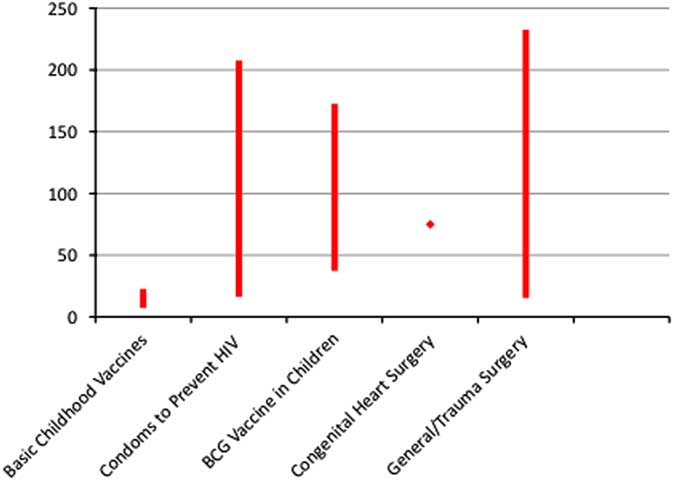
Data from cost-effectiveness analysis can be used to inform our consequentialist ethical analysis. One of the earliest ways introduced to compare interventions is based on the cost per year of life saved: the World Bank defined $100 as the limit of a “highly cost-effective” intervention.Reference Jamison, Breman and Measham 18 In order to take into account not only lives saved, but improved quality of life, the World Bank in 1993 introduced the now widely used concept of the Disability Adjusted Life Year 19 as a tool to compare the cost-effectiveness of different interventions. The Disability Associated Life Year accounts for years of life lost because of premature death, as well as “healthy” years lost because of chronic illness. This metric was specifically developed to facilitate comparison of health between different populations so as to help identify priorities on a global level. 20 According to these measures, both surgery in generalReference Beauchamp and Childress 12 and congenital heart surgery in particular,Reference Saxton, Poenaru and Ozgediz 21 have been found to be highly cost-effective (Fig 1). These cost-effectiveness data serve to inform our consequentialist analysis that according to its expected outcome, paediatric heart surgery should generally be provided whenever it does not take away from those relatively few interventions that give an even bigger “bang for the buck”, such as basic childhood vaccines and primary education. It should, according to utilitarian reasoning, be provided along with, or ahead of, commonly provided measures such as the similarly cost-effectiveReference Jamison, Breman and Measham 18 distribution of condoms to prevent the spread of human immunodeficiency virus, and Bacille Calmette Guerin vaccination to prevent tuberculosis.
Range of report values of cost-effectiveness of various interventions, expressed as cost in US$ per year of life saved.Reference Chao, Sharma and Mandigo 29 , Reference Fenton, Hernandez and Duarte 30

Discussion
Cost-effectiveness and humanitarian medicine
Whereas Western medicine traditionally places its primary emphasis on the individual patient, and on treating all the patient’s medical problem(s), public health focusses on the population as a whole, and often on maintaining health or preventing a particular disease.Reference Pezzella 22 Humanitarian medical work falls at the intersection of these two: on a day-to-day basis, the provider’s attention is directed towards caring for individual patients, but this is always done with a necessary sense of the “big picture”, which must inform not only planning of the work, but at times the allocation of resources at the bedside. Organisations such as Doctors Without Borders have made conscious decisions and established specific protocols for such situations.Reference Benatar and Brock 13 The decision of whether to recommend that a government or non-governmental organisation invests in establishing a paediatric heart surgery programme is one that must similarly be made after deliberate reflection.
Why would paediatric heart surgery, which seems so expensive, be so cost-effective? In the first place, in most developing countries, a large proportion of heart defects are simple ones that can be repaired with good results.Reference Edwin, Tettey and Aniteye 23 Most of the high-quality programmes have success rates above 90%, and operating on a small child represents a one-time cost that saves a life, adding many, generally healthy, years to the cost-effectiveness calculation. The high mortality rate, which is often preceded by disability and its associated health care costs, of not offering surgery combined with the usually excellent results are compared based on the cost effectiveness analysis with interventions such as mosquito nets or vaccinations that require multiplication of the small cost of a single intervention by the fairly low incidence of disease, and then by the often also low chance that the disease will cause death.
Our utilitarian analysis supports the conclusions of others, who have stated, based on cost-effectiveness, that addressing the global deficit of surgical care is a “moral imperative”,Reference Meara, Hagander and Leather 8 and have named congenital heart surgery, in particular, as one of the “essential children’s surgical procedures”.Reference Saxton, Poenaru and Ozgediz 21 The most recent recommendation of the Disease Control Priorities project, 24 although less specific, suggests that “all countries can begin to consider building capacity for the treatment of CHD”.
Individual countries make individual informed choices
It would be inappropriate, however, to draw an immutable line based on cost-effectiveness data and economic resources, and demand that every country should provide all of the care above the line and none of that below it, lest the country be labelled “unethical”. In the first place, the very calculation of the Disability Adjusted Life Year, on which the analysis is based, is open to criticism because of the subjective nature of the disability weights used: who decides how much to deduct for losing a leg as compared with being blind or having a stroke, and will that valuation be the same in every country? The numbers, and the utilitarian analysis that relies on them, are best used as a source of information, with the label of “unethical” being reserved for those societies that clearly and knowingly choose to waste scarce resources on things that are not effective, while denying needed and effective care. Given two different, similarly cost-effective and therefore equally “right” or “good” choices, in which do the people of a country wish to invest? Returning to the principle of autonomy, either choice could be correct, and therefore ethical.
Factors that could favour the choice of offering heart surgery as opposed to other mathematically equivalent options include things that don’t enter into cost-effectiveness analysis, but that in a truly complete utilitarian analysis would add to total pleasure. One clear example relates to the rule of rescue: providing a curative procedure that saves the life of a dying child will always be more “rewarding” for the physicians, nurses, and parents than would be distributing the large number of mosquito nets or vaccines that would be needed to save one’s life, merely because the life saved under the second scenario remains faceless and anonymous. The ability of providers to grow and use their skills and the prestige for the country that is associated with having a successful surgical programme are similarly intangible “goods”.
What should be done, and whose responsibility is it?
Our ethical analysis certainly, though, supports the conclusion that paediatric heart surgery should be provided in many places where it is currently not available. This leaves us with two important questions. In the first place, the philosopher Immanuel Kant is famous for pointing out that ought implies can,Reference Kant 25 which is to say that no one has a moral duty to do something that he is unable to do. How can poor countries even begin to provide the open-heart surgery for children that our analysis suggests they “ought” to provide? Humanitarian work in developing countries is supported by both governments and private donations, with increasing reliance in recent years on the latter.Reference Benatar and Brock 13 , Reference DeCamp 26 Reallocation of these resources, in keeping with known cost-effectiveness data, in order to set up surgical programmes that include congenital heart surgery, can go a long way to begin to resolve the shortage, and will raise the level of overall patient care in the country or society.Reference Meara, Leather and Hagander 16
The second question we must address comes from the fact that rights are always mirrored by duties. If health care is, according to the United Nations, a human right,Reference Pezzella 22 and if children with heart disease deserve to have care,Reference Ott and Olson 27 on whom does the duty to provide cardiac surgery fall? RawlsReference Dwyer 28 described three levels of justice, moving from inside to outside, that can help us. The first level is at the level of the institution: if a hospital has the capability to offer needed care, for example, then it should be provided. The next two levels, domestic justice and international justice, refer to the right ordering of society. According to this, we can reason that each country should allocate its own resources in a just manner, and following this, there should be fair allocation on a global scale. Although it is beyond the scope of this paper to recommend how much money “rich” individuals or governments should share with those less advantaged, we can surely say that, of the resources currently dedicated to humanitarian work, more should be allocated to surgery in general and to paediatric heart surgery in particular, both within individual countries and at the level of international support. At the same time, Rawls’ first level of justice would support the assertion that participation in humanitarian work by surgeons and other providers, to the extent possible, is a moral duty, and that their employers and institutions should make efforts to support this work.
Acknowledgements
The original draft of this work formed a part of the Master’s Thesis project for the first author’s Master’s degree in Bioethics at Alden March Bioethics Institute. The authors would like to acknowledge the advisory contributions made by Dr Paul Burcher and Professor Evelyn Tenenbaum.
Financial Support
This research received no specific grant from any funding agency or from commercial or not-for-profit sectors. Dr Fenton’s Masters studies were supported in part by a Cardiothoracic Ethics Forum Scholarship.
Conflicts of Interest
None.