Introduction
Many monothalamous Devonian and pre-Devonian foraminifers, which are more or less spherical and have a single, terminal, rounded aperture, are considered as members of the foraminiferal class Astrorhizata; or even as members of the class Textulariata, which more traditionally includes plurilocular agglutinated foraminifers. This similarity has even been taken to its logical extreme: the assignment of Paleozoic taxa to extant genera of Astrorhizata/Textulariata (e.g., Saccammina, Psammosphaera, Lagenammina, Thurammina, Hyperammina and Sorosphaera) (Loeblich and Tappan, Reference Loeblich and Tappan1964, Reference Loeblich and Tappan1987; Poyarkov, Reference Poyarkov1969, Reference Poyarkov1977, Reference Poyarkov1979; Ross and Ross, Reference Ross and Ross1991; Vdovenko et al., Reference Vdovenko, Rauzer-Chernousova, Reitlinger and Sabirov1993).
The parathuramminids are considered as foraminifers principally because the fossil genus Parathurammina is homeomorphous of the extant genus Thurammina (Vachard, Reference Vachard2016a). However, there are several arguments against this assignment, and other putative phyla have been proposed, to which parathuramminids may be assigned: (1) Kaźmierczak (Reference Kaźmierczak1975, Reference Kaźmierczak1976) considered this group to be related with calcisphaeraceans and radiosphaeraceans, and might be interpreted as volvocale algae; (2) Vachard (Reference Vachard1994) designated these forms as pseudoforaminifers; (3) Préat et al. (Reference Préat, Blockmans, Capette, Dumoulin and Mamet2007) included in the calcispheres the genera Calcisphaera, Parathurammina, and Vicinesphaera; (4) Versteegh et al. (Reference Versteegh, Servais, Streng, Munnecke and Vachard2009) assigned the calcisphaeraceans to the Calcitarcha, which probably, like the acritarchs, constitute a heterogeneous group that includes dinoflagellates, chlorophytes, haptophytes, foraminifers, and radiolarians; (5) Vachard and Clément (Reference Vachard and Clément1994) indicated possible morphological and paleobiological similarities between some irregularinids or usloniids with thaumatoporellacean incertae sedis algae; Schlagintweit et al. (Reference Schlagintweit, Hladil, Nose and Salerno2013) even synonymized both groups; (6) Vishnevskaya and Sedaeva (Reference Vishnevskaya and Sedaeva2002a, Reference Vishnevskaya and Sedaevab), Afanasieva and Amon (Reference Afanasieva and Amon2011), and Nestell et al. (Reference Nestell, Heredia, Mestre, Beresi and González2011) considered that these forms are radiolarians, the tests of which were calcified after diagenesis, returning to outdated assumptions about the calcispheres (Williamson, Reference Williamson1880; Pia, Reference Pia1937); (7) E. Armynot du Châtelet (personal communication, 2016) advocates a relationship with thecamoebian protozoans; this assignment has also been proposed for upper Proterozoic agglutinated, monothalamous tests of Namibia and Mongolia (Bosak et al., Reference Bosak, Lahr, Pruss, Macdonald, Dalton and Matys2011, Reference Bosak, Lahr, Pruss, Macdonald, Dalton and Matys2012); and (8) the tintinnids, which are other agglutinating protists (Tappan and Loeblich, Reference Tappan and Loeblich1968; Henjes and Assmy, Reference Henjes and Assmy2008), also display sizes and shapes corresponding to some parathuramminids.
Rich assemblages of parathuramminoids and irregularinoids discovered in our material provide: (1) a more precise systematics of these taxa, which have not been investigated for more than half a century; (2) more extensive illustrations of these poorly known taxa; (3) additional paleoecological data; and (4) an opportunity to discuss the taxonomical problems of these foraminifers, pseudoforaminifers, or algae.
Geologic setting
The Carnic Alps, which are part of the Southern Alps and form an east-west-trending mountain range along the border between southern Austria and Italy, are well known for its almost continuous and well-preserved sedimentary succession ranging in age from the Late Ordovician to the Late Permian (e.g., Schönlaub, Reference Schönlaub1979, Reference Schönlaub1980, Reference Schönlaub1985a, Reference Schönlaubb; Schönlaub and Heinisch, Reference Schönlaub and Heinhisch1993; Schönlaub and Histon, Reference Schönlaub and Histon2000). The Devonian of the Carnic Alps, which is best exposed in the Plöckenpass-Wolayersee area, is developed in different facies ranging from shallow marine environments (including carbonate buildups formed by stromatoporoids and tabulate corals and lagoonal sediments) to reef slope deposits, condensed pelagic cephalopod limestones, and deep marine offshore shales and siliceous sediments (bedded chert). The shallow marine facies is up to 1200 m thick, whereas the condensed pelagic limestone facies measures ~100 m (Schönlaub, Reference Schönlaub1979, Reference Schönlaub1985a, Reference Schönlaub1985b; Schönlaub and Heinisch, Reference Schönlaub and Heinhisch1993; Schönlaub and Histon, Reference Schönlaub and Histon2000).
The Feldkogel Limestone is part of the Devonian shallow marine facies of the Feldkogel Nappe (“northern shallow-water facies”) and is described as algal laminite with dolomite layers (Schönlaub, Reference Schönlaub1985a, Reference Schönlaub1985b; Kreutzer, Reference Kreutzer1992b). The Feldkogel Limestone is more than 330 m thick and dated as Eifelian–Late Devonian (Kreutzer, Reference Kreutzer1990).
The Gamskofel Limestone is developed in a similar facies (800 m thick bedded succession of algal laminites with intercalated Amphipora limestone beds), but is older (Pragian–Givetian?) and belongs to the “southern shallow-water facies” of the Kellerwand Nappe according to Kreutzer (Reference Kreutzer1992a).
From the Feldkogel Limestone at Mount Polinik, Kreutzer (Reference Kreutzer1992a) described the following microfacies types: (1) MF-Type 5c—bindstone (stromatolite with rare ostracodes and parathuramminids), (2) MF-Type 12—quartz-rich dolosparite and stromatolites, and (3) MF-Type 13—ostracode and Parathurammina-packstone (peloid-pack-/grainstone with parathuramminids of Kreutzer, Reference Kreutzer1992b). Kreutzer (Reference Kreutzer1992a) assigned the monolocular foraminifers to Parathurammina dagmarae Suleimanov and cf. Cribrosphaeroides sp.
Recently, Pohler et al. (Reference Pohler, Bandel, Kido, Pondrelli, Suttner, Schönlaub and Mörtl2015) introduced the term Polinik Formation, in which they included the Gamskofel Limestone and Feldkogel Limestone. These authors described the Polinik Formation as a bedded, cyclic, shallow marine succession of dominantly algal laminites and Amphipora limestone. The type locality is at Mount Polinik. The Polinik Formation is of Pragian to Frasnian, probably of younger, age; its estimated thickness is 700–800 m.
Materials and methods
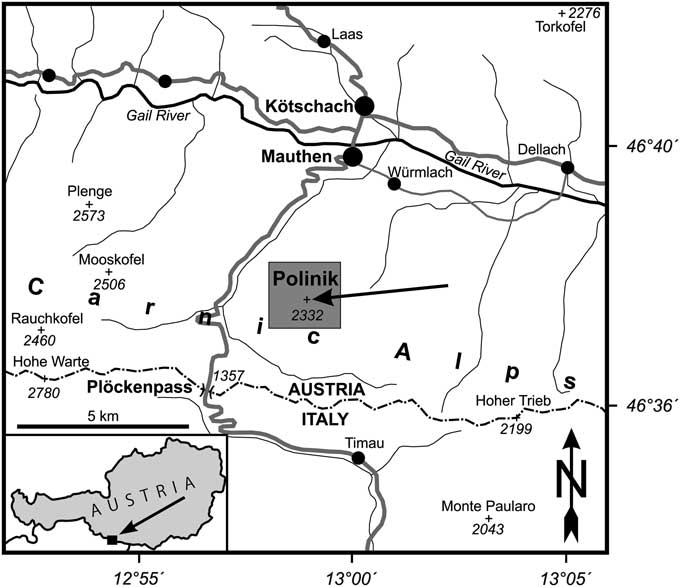
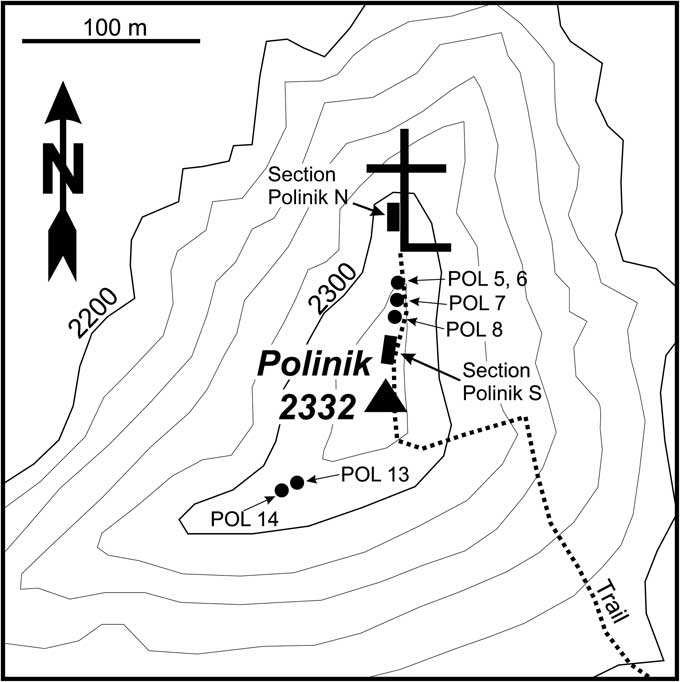
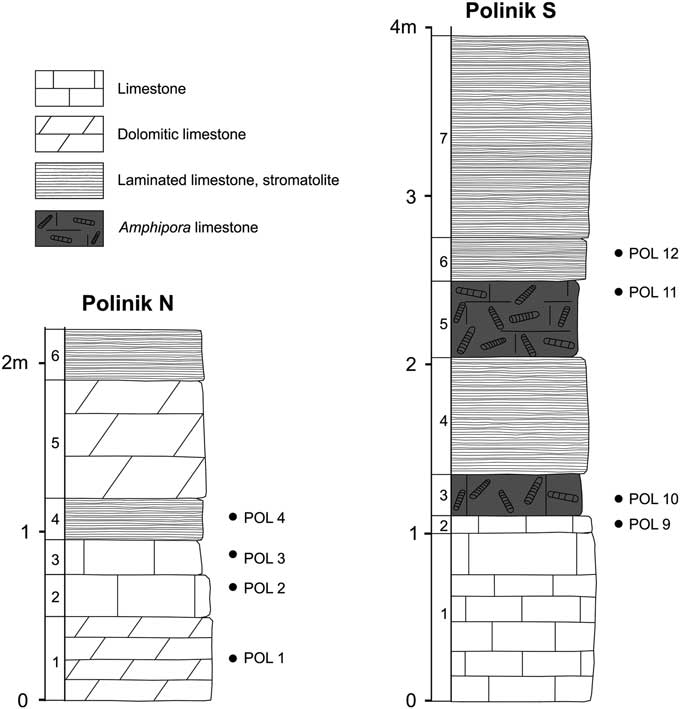
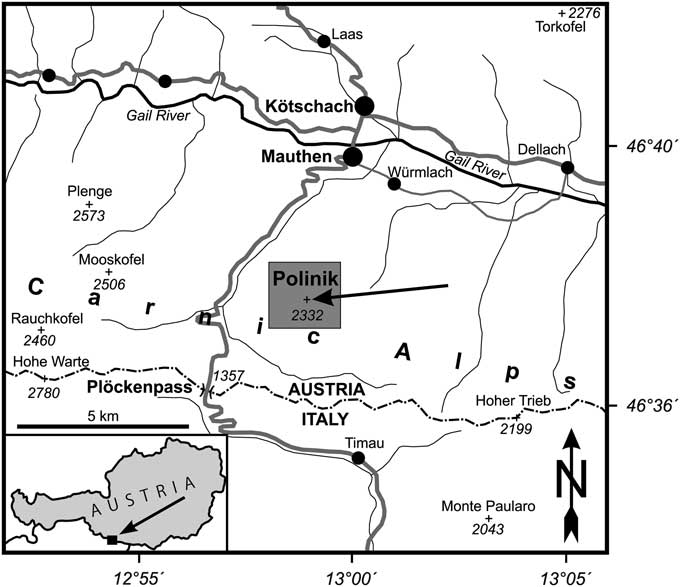
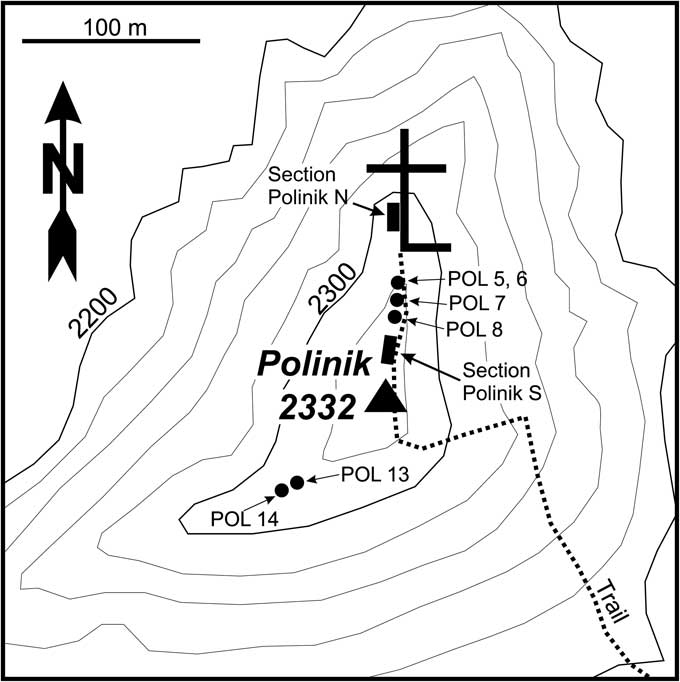
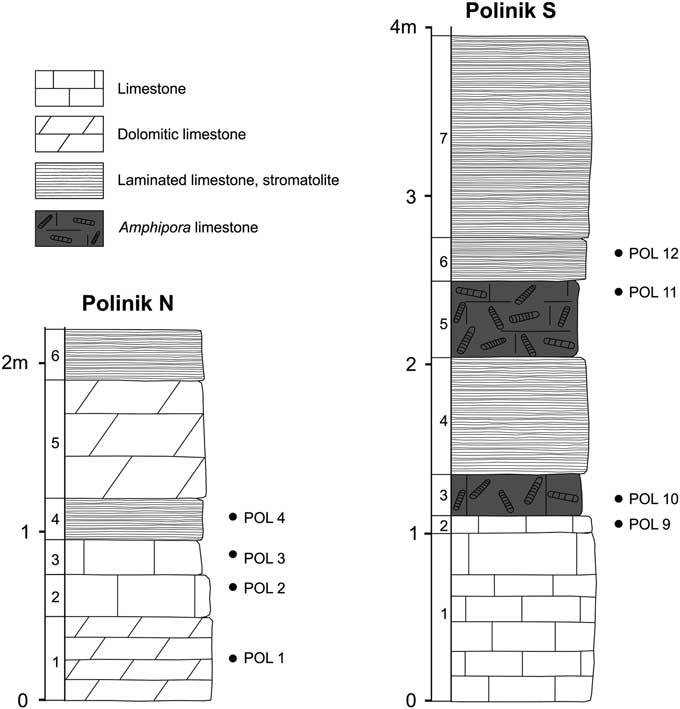
The studied samples are derived from bedded limestones of the Devonian “Feldkogel-Kalk” (Feldkogel Limestone) of the Polinik Formation exposed at the summit of Mount Polinik (2332 m) in the Carnic Alps (Figs. 1, 2), ~5 km SSW of Kötschach in the Gail Valley (Carinthia, southern Austria) (see geologic map of Schönlaub, Reference Schönlaub1985a). At the summit of Mount Polinik, we measured two short sections that characterize the facies of the Feldkogel Limestone (Figs. 2, 3). Section A is located ~10 m north of the summit cross of Mount Polinik and is 2 m thick. Section B was measured ~50 m south of the summit cross and measures ~4 m. Four samples were collected from section A and four samples from section B. Additionally, samples were collected from bedded limestones of the summit area of Mount Polinik (Fig. 2). From all samples, 16 thin sections were prepared, which were studied under the microscope in terms of microfacies and paleontology.
Geographical map of the studied area with location of Mount Polinik.
Top of Mount Polinik with locations of the two sections (Fig. 3) and the fossiliferous samples. Contour lines (2200, 2300) in meters.
Repositories and institutional abbreviations
All thin sections used in this study are stored in the collection of the Institute of Geology (POL 1–POL 15), University of Innsbruck, Austria. Other repositories and abbreviations include: Geological Museum of Novosibirsk (IGiG SO AN SSSR); UTGU, Ural Geological Museum; VNIGRI, Leningrad/Sankt Petersburg.
Lithofacies
At Mount Polinik, the Feldkogel Limestone is composed of medium- to thick-bedded limestone and dolomitic limestone/dolomite. Bed thickness ranges from 20 cm to 120 cm. We observed the following lithofacies (Fig. 2): (1) dark gray massive Amphipora limestone, 20–50 cm thick; (2) well-laminated dark gray limestone that weathers light gray, with individual beds up to 120 cm thick; (3) massive to indistinctly laminated limestone and dolomite beds, 20–70 cm thick; (4) stromatolite beds, 20–50 cm thick; and (5) intraclast breccia composed of reworked, poorly sorted, angular intraclasts up to 30 cm in diameter. The intraclast breccia is rare, up to 50 cm thick, displays a channel-form geometry, and thins laterally. The base is erosive.
Microfacies
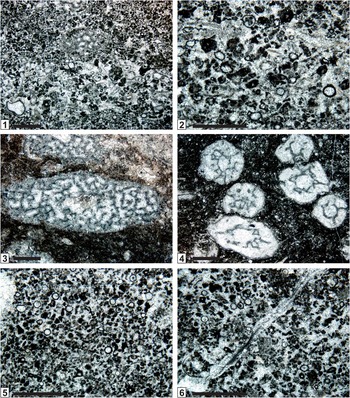
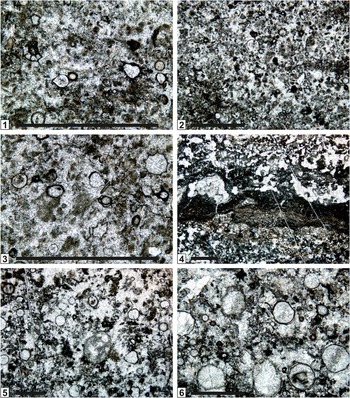
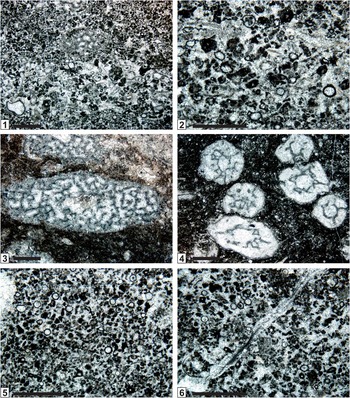
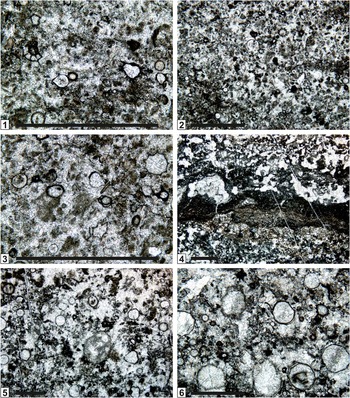
Limestones of the Feldkogel Limestone at the summit of Mount Polinik are composed of four microfacies types (Mörtl, Reference Mörtl2014; Figs. 4, 5).
(1) Bioclastic and pelloidal grainstone with Vasicekia? sp. (tubular specimens with clear wall), Neoarchaesphaera ellipsoidalis, Ivanovella sp., Cribrosphaeroides (Parphia) robusta, and Amphipora sp., sample POL3. (2) Bioclastic and pelloidal grainstone with Vasicekia? sp. (tubular specimens with clear wall), Neoarchaesphaera ellipsoidalis, Parathurammina sp., and Suleimanovella sp., sample POL3c. (3) Dolomitized floatstone with Amphipora sp., sample POL10a. (4) Floatstone with Amphipora cf. A. pervesiculata and parathuramminids in the matrix, sample POL11. (5) Bioclastic and pelloidal grainstone with Vasicekia sp. (tubular specimens with clear wall), Neoarchaesphaera ellipsoidalis, Parathurammina sp., and Suleimanovella sp., sample POL11-10. (6) Bioclastic and pelloidal grainstone with Uralinella sp., Parathurammina sp., Neoarchaesphaera ellipsoidalis, Suleimanovella sp., and ostracodes, sample POL11a. Scale bars=1 mm.
(1) Bioclastic and pelloidal grainstone with Vasicekia? sp., Uralinella sp., Radiosphaerella sp., Neoarchaesphaera ellipsoidalis, and Suleimanovella sp., sample POL11a-2. (2) Bioclastic and pelloidal grainstone with Uralinella sp., Parathurammina sp., Salpingothurammina sp., Suleimanovella sp., and ostracodes, sample POL11d. (3) Bioclastic and pelloidal grainstone with Uralinella sp., Parathurammina sp., Neoarchaesphaera ellipsoidalis, and Suleimanovella sp., sample POL11a-7. (4) Three layers of microbialites; two with parathuramminids, sample POL12b. (5) Bioclastic and pelloidal grainstone with Uralinella sp., Parathurammina sp., Bykovaella sp., Suleimanovella sp., and Amphipora sp., sample POL13a. (6) Bioclastic and pelloidal grainstone with Uralinella sp., Parathurammina sp., Bykovaella sp., Suleimanovella sp., and Vasicekia? sp., sample POL13c. Scale bars=1 mm.
(1) Amphipora floatstone to rudstone (Fig. 4.2, 4.3). Skeletons of Amphipora are embedded in a matrix of grainstone composed of abundant peloids and foraminifers. Rare skeletons of brachiopods occur. Amphipora skeletons are up to several cm in size, mostly complete, rarely fragmented. The following species are present (J. Hladil, written communication, 2014): Amphipora cf. A. angusta Lecompte, Reference Lecompte1952; A. cf. A. rudis Lecompte, Reference Lecompte1952; A. cf. A. laxeperforata Lecompte, Reference Lecompte1952; and A. cf. A. pervesiculata Lecompte, Reference Lecompte1952 (Mörtl, Reference Mörtl2014, text-fig. 31).
(2) Grainstone to packstone containing abundant peloids and foraminifers (Figs. 4.1, 4.2, 4.5, 4.6, 5.1–5.6). This microfacies is partly laminated, locally bioturbated. Locally, small amounts of micritic matrix are present. Subordinately, fragments of brachiopods, Amphipora, and ostracodes are observed (Mörtl, Reference Mörtl2014, text-fig. 32).
(3) Ostracode wackestone to packstone. This microfacies is composed of alternating densely and less densely packed ostracode layers. Ostracode shells are oriented parallel to bedding and are embedded in peloidal micrite. Many ostracodes are preserved with both valves, and the interior is filled with calcite cement (Mörtl, Reference Mörtl2014, text-fig. 29).
(4) Bindstone, composed of laminated cyanobacteria mats (microbial mats, stromatolites), alternating with thin layers containing abundant peloids and aggregate grains, rare micritic intraclasts and some fossils, such as ostracodes and foraminifers. LF-fabrics are common (Mörtl, Reference Mörtl2014, text-fig. 30).
Systematic paleontology
Subkingdom Rhizaria Cavalier-Smith, Reference Cavalier-Smith2002
Phylum Foraminifera d’Orbigny Reference d’Orbigny1826 emend. Cavalier-Smith, Reference Cavalier-Smith2003
Class Fusulinata Gaillot and Vachard, Reference Gaillot and Vachard2007 emend. Vachard, Reference Vachard2016a
Subclass Afusulinana Vachard, Pille, and Gaillot, Reference Vachard, Pille and Gaillot2010
Order Parathuramminida Mikhalevich, Reference Mikhalevich1980 emend. Vachard, Reference Vachard2016a
Diagnosis
Unilocular (= monothalamous), free to temporarily attached foraminifers showing a large central chamber. Rarely bilocular with two concentric chambers or several chambers built alongside. Apparently, no true plurilocular tests exist, but clusters of unilocular chambers can be encountered (e.g., Tschernyncevella Antropov, Reference Antropov1950; Rauserina Antropov, Reference Antropov1950; Uralinella Bykova, Reference Bykova1952; and various tuberitinoids). Wall thin (Eovolutina Antropov, Reference Antropov1950) to thick (Vicinesphaera Antropov, Reference Antropov1950), dark-microgranular, occasionally bilayered with an inner hyaline-pseudofibrous layer, rarely more differentiated. Apertures are typically emplaced at the extremity of hollow necks connecting the central chamber with the external environment; often also, the walls are finely perforated by very numerous minute foramina; or the apertures are inconspicuous. Wall thin to moderately thick, dark-microgranular, occasionally bilayered with an inner hyaline-pseudofibrous layer, rarely more differentiated (e.g., Tubesphaera Vachard, Reference Vachard1994 and some parathuramminids).
Occurrence
Questionable in the middle Cambrian, rare in the Ordovician–early Silurian, present during the late Silurian–Early Devonian, common during the Middle and Late Devonian, present in the Mississippian, rare in the Pennsylvanian–Permian (except for the tuberitinoids, which remain common during this time interval); very rare in the earliest Triassic, during which only tuberitinids locally subsist (Vachard, Reference Vachard2016a, Reference Vachard2016b, with references therein).
Remarks
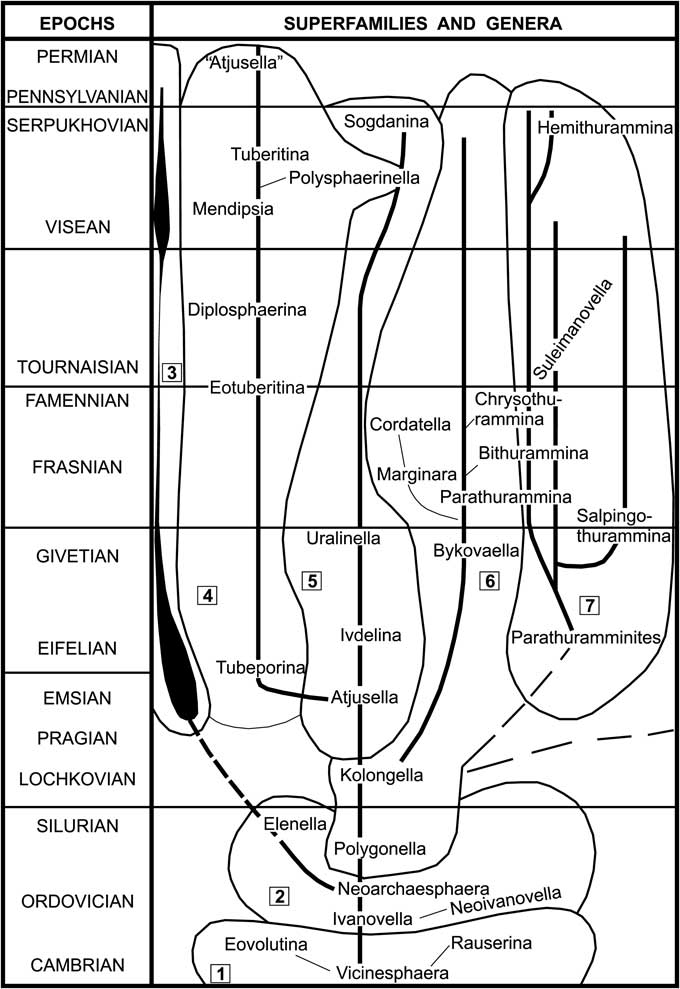
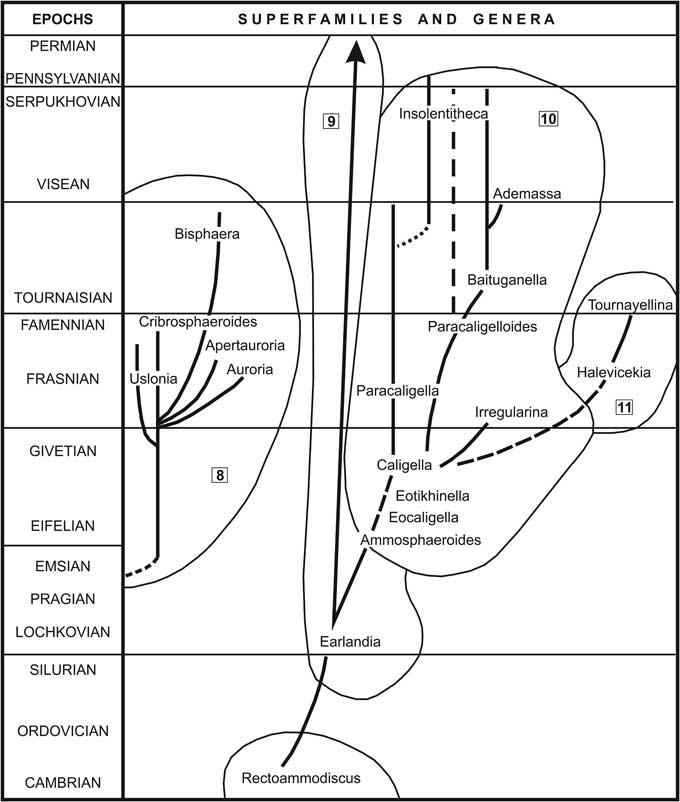
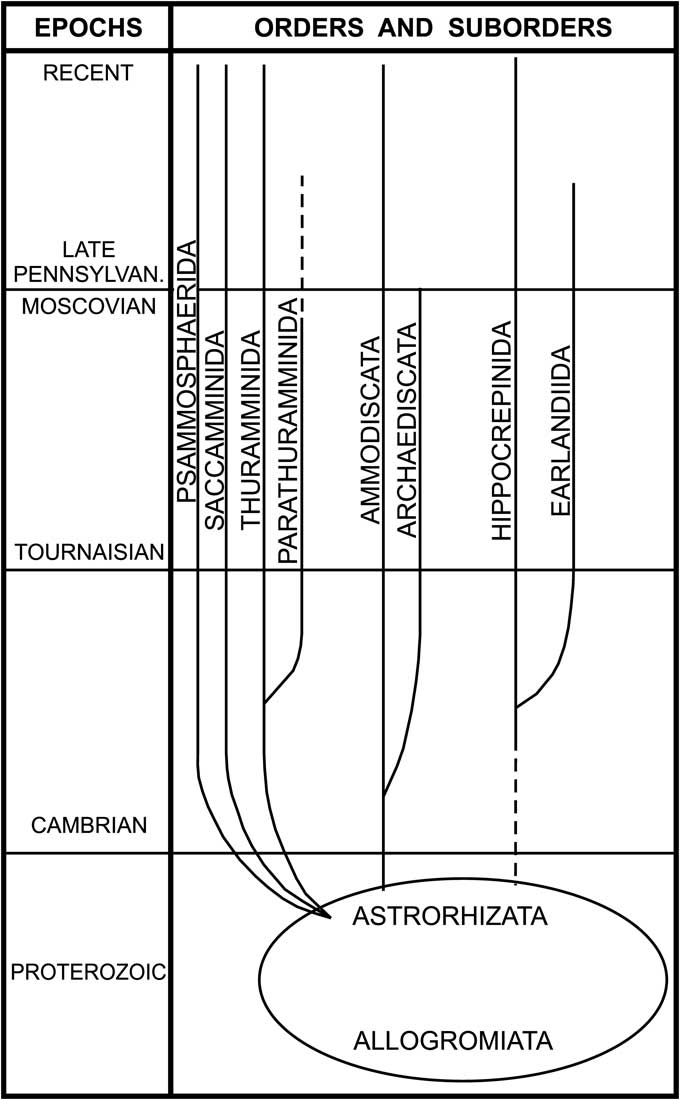
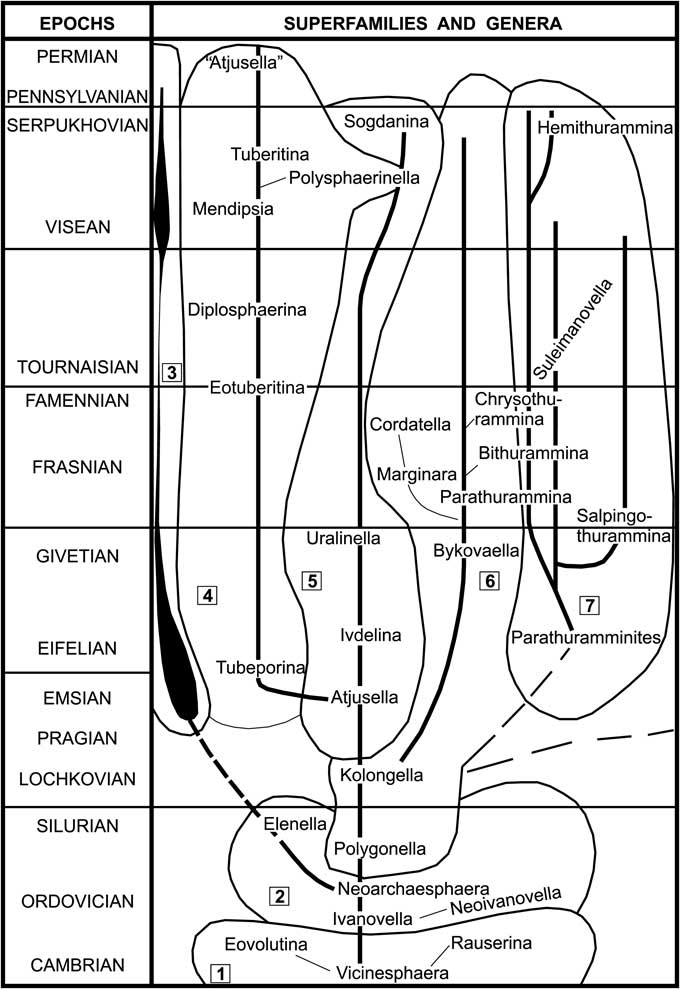
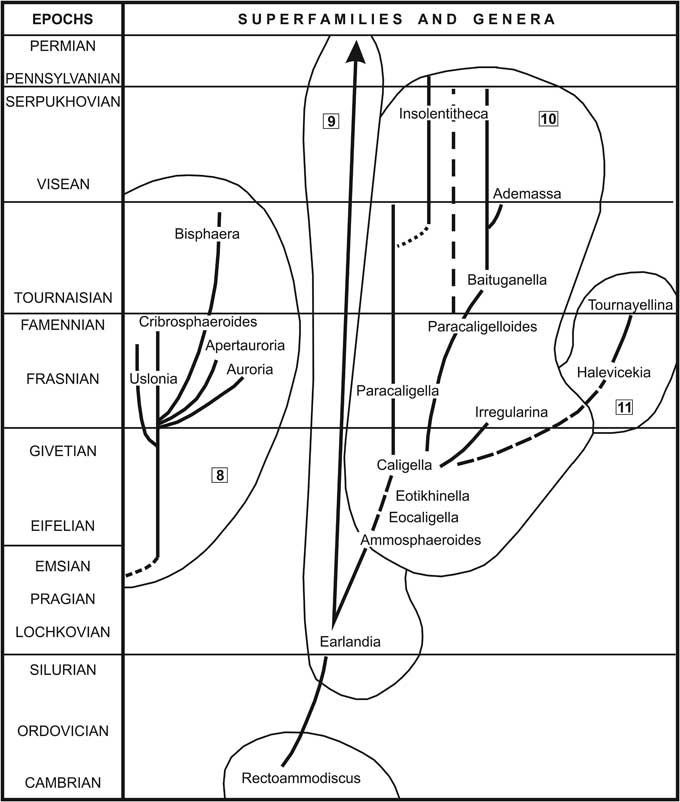
Suspected to be micritized envelopes of volvocacean algae by Toomey and Mamet (Reference Toomey and Mamet1979) or acritarchs that underwent an early post-mortem calcification (Kaźmierczak and Kremer, Reference Kaźmierczak and Kremer2005), these taxa remain enigmatic; nevertheless, it seems to be possible to reconstruct their phylogeny as follows (Figs. 6, 7). First, the forms with one or two chambers and a non-perforated dark-microgranular wall (i.e., the eovolutinoids) appear. After that, the wall thickens and becomes ornamented with necks, with the ivanovellids, which can give rise, more or less coevally, to the parathuramminids, uralinellids, and tuberitinoids. Eovolutinids also give rise to the tuberitinoids, whereas the irregularinoids derive either from the eovolutinoids, ivanovellids, or parathuramminids (and in this case, “Parathurammina” mirabilis Saltovskaya, Reference Saltovskaya1981, the diameter of which is 0.80–0.85 mm, may be transitional). The order Parathuramminida encompasses four superfamilies (Vachard, Reference Vachard2016a, and this work: Figs. 6, 7): Parathuramminoidea Rauzer-Chernousova and Fursenko, Reference Rauzer-Chernousova and Fursenko1959 nomen correctum Loeblich and Tappan, Reference Loeblich and Tappan1961; Irregularinoidea Gaillot and Vachard, Reference Gaillot and Vachard2007; Tuberitinoidea Gaillot and Vachard, Reference Gaillot and Vachard2007 emend. Vachard, Reference Vachard2016a; and Calcisphaeroidea Vachard, Reference Vachard2016a.
Superfamilies, families, and genera of the Parathuramminida. 1: Eovolutinidae; 2: Ivanovellidae; 3: Calcisphaeroidea; 4: Tuberitinoidea; 5: Uralinellidae; 6: Parathuramminidae; 7: Parathuramminitidae.
Superfamilies, families, and genera of the Irregularinoidea and Caligelloidea. 8: Irregularinoidea; 9: Earlandioidea; 10: Caligelloidea. 11: Tournayellinidae.
Superfamily Parathuramminoidea Fursenko in Rauzer-Chernousova and Fursenko, Reference Rauzer-Chernousova and Fursenko1959 nomen correctum Loeblich and Tappan, Reference Loeblich and Tappan1961 (as Parathuramminacea) and Zadorozhnyi and Yuferev, Reference Zadorozhnyi and Yuferev1984 (as Parathuramminidea) (non Parathuramminoidea Zadorozhnyi, Reference Zadorozhnyi1987, described as a suborder) emend. Vachard, Reference Vachard2016a.
Diagnosis
Unilocular free foraminifers. Large central chamber, spherical to polygonal. Apertures inconspicuous or absent (Eovolutinidae emend. herein, even if some intercameral connections may exist in Rauserina), perhaps blind (Ivanovellidae) or at the extremity of radiate necks connecting the central chamber with the external environment (Parathuramminidae, Parathurammininae, Parathuramminitinae, and Uralinellidae). Wall thin (e.g., Eovolutina) to thick (e.g., Vicinesphaera), dark-microgranular, occasionally bilayered with an inner hyaline-pseudofibrous layer, rarely more differentiated with possibly three layers. Apertures inconspicuous or absent, some intercameral connections may exist (e.g., Rauserina).
Occurrence
Late Silurian–Mississippian, rare to very rare in the Pennsylvanian–Permian; probably cosmopolitan.
Remarks
This superfamily is composed of four families (Fig. 6): Eovolutinidae Loeblich and Tappan, Reference Loeblich and Tappan1986 (synonym of Rauserinidae Sabirov, Reference Sabirov1987b); Ivanovellidae Chuvashov and Yuferev in Zadorozhnyi and Yuferev, Reference Zadorozhnyi and Yuferev1984 emended herein; Parathuramminidae Bykova in Bykova and Polenova, Reference Bykova and Polenova1955 emend. Vachard, Reference Vachard1994; and Uralinellidae Chuvashov, Yuferev, and Zadorozhnyi in Zadorozhnyi and Yuferev, Reference Zadorozhnyi and Yuferev1984.
Family Eovolutinidae Loeblich and Tappan, Reference Loeblich and Tappan1986 emend. herein
Diagnosis
Small parathuramminoids, with a proportionally broad central, spherical chamber. Apertures inconspicuous or absent. Wall thin to moderately thick, dark-microgranular.
Occurrence
Questionable in the middle Cambrian, rare in the Ordovician–early Silurian (Vachard, Reference Vachard2016a), present during the late Silurian–Mississippian, rare to very rare in the Pennsylvanian–Permian.
Remarks
Eovolutinidae (= Rauserinidae) emend. herein encompasses the eovolutinins (with two concentric chambers), rauserinins (with clusters of unilocular chambers), and vicinesphaerins (strictly unilocular) (e.g., the genera Eovolutina Antropov, Reference Antropov1950; Rauserina Antropov, Reference Antropov1950; Vicinesphaera Antropov, Reference Antropov1950; Archaesphaera Suleimanov, Reference Suleimanov1945 [partim]; Serginella Pronina, Reference Pronina1963; Paralagena Sabirov, Reference Sabirov1986; and ?Tscherdyncevella Antropov, Reference Antropov1950). They are the most primitive parathuramminids due to the presence, among them, of Vicinesphaera Antropov, Reference Antropov1950 as early as in the Cambrian of Kazakhstan and the Early Ordovician of Mexico (Vachard et al., Reference Vachard, Clausen, Palafox, Buitrón, Devaere, Hayart and Régnier2017). The family Eovolutinidae is often confused with the Archaesphaeridae Poyarkov, Reference Poyarkov1979 auctorum, which could therefore have priority; nevertheless, it is more probable that Archaesphaera Suleimanov, Reference Suleimanov1945 is a transverse section of Eotuberitina Miklukho-Maklay, Reference Miklukho-Maklay1958, and therefore is a tuberitinoid rather than a parathuramminoid. However, true Eotuberitina seem to appear in Upper Devonian deposits, and an “Archaesphaera”, such as that of Flügel and Hötzl (Reference Flügel and Hötzl1971, fig. 1.1, 1.2), belongs to another taxon, which are either oblique sections of Eovolutina cutting only the external chamber, or oblique sections of Ivanovella, which do not pass by the external spines.
Family Ivanovellidae Chuvashov and Yuferev in Zadorozhnyi and Yuferev, Reference Zadorozhnyi and Yuferev1984
Diagnosis
Small- to moderate-sized unilocular tests with spherical to polygonal central chamber. Radiate to irregularly arranged protuberances of the wall; either unperforated or when possessing a central neck, the latter does not communicate with the external environment. Inconspicuous apertures. Wall dark-microgranular.
Occurrence
Early Ordovician to Late Devonian in Laurussia, Siberia and eastern Paleotethys (Tian Shan and South China).
Remarks
The Ivanovellidae are partly synonymous with Psammosphaeridae sensu Miklukho-Maklay, Reference Miklukho-Maklay1965 (non Haeckel, Reference Haeckel1894, nec Cushman, Reference Cushman1927). They are composed of Ivanovella Pronina, Reference Pronina1969; Lechangsphaera Lin, Reference Lin1984; Neoivanovella Chuvashov and Yuferev in Dubatolov, Reference Chuvashov and Yuferev1981; Neoarchaesphaera Miklukho-Maklay, Reference Miklukho-Maklay1963 (non 1958); Elenella Pronina, Reference Pronina1969; ?Ratella Kotlyar, Reference Kotlyar1982; and ?Turcmeniella Miklukho-Maklay, Reference Miklukho-Maklay1965. The mazzuelloid microproblematica are probably recrystallized (phosphatized) ivanovellids. Mazzuelloids were interpreted as microfossils with an original phosphatized wall (Kozur, Reference Kozur1984), but a secondary phosphatization is more probable (Hüsken and Eiserhardt, Reference Hüsken and Eiserhardt1997; Kremer, Reference Kremer2005; and general discussion of the problems of phosphatization in Porter, Reference Porter2004 and Zhuralev and Wood, Reference Zhuravlev and Wood2008). Hüsken and Eiserhardt (Reference Hüsken and Eiserhardt1997) advocated for a phosphatization of the organic wall of acritarchs, but it seems that their illustrations (pl. 1, fig. 15, pl. 2, figs. 1–4) most probably correspond to secondarily phosphatized ivanovellids (perhaps Neoarchaesphaera spp.). The material illustrated by Kremer (Reference Kremer2005) seems also to belong to Neoarchaesphaera. Moreover, because the mazzuelloids are known from Late Ordovician to Early Devonian, they have a stratigraphic distribution similar to that of the ivanovellids.
Genus Ivanovella Pronina, Reference Pronina1969
Type species
Ivanovella isensis Pronina, Reference Pronina1969.
Other species
See Chuvashov and Yuferev in Dubatolov (Reference Chuvashov and Yuferev1981) and Zadorozhnyi and Yuferev in Dubatolov (Reference Zadorozhnyi and Yuferev1981).
Diagnosis
Test unilocular, with spherical central chamber and radiate necks, prominent at the periphery and not communicating with the external environment. Inconspicuous apertures. Wall dark-microgranular.
Occurrence
Ludlovian–Pridolian of the central and northern Urals. Late Emsian of Gornyi Altai. Middle Devonian–Frasnian of the Tomsk area (SW Siberia). Late Emsian–Frasnian of southwestern Siberia (the Famennian age indicated by Vdovenko et al., Reference Vdovenko, Rauzer-Chernousova, Reitlinger and Sabirov1993, p. 29, is possibly due to a lapsus calami). Discovered in the Givetian of Mount Polinik (Carnic Alps, Austria).
Ivanovella sp. 1
Diagnosis
The test is small; the chamber is subhexagonal; the necks are short and subtriangular.
Occurrence
Only one sample in the Givetian of Mount Polinik (Carnic Alps, Austria).
Description
Outer diameter=0.08 mm; inner diameter=0.04 mm; test wall thickness=0.01 mm.
Diagnosis
The test consists of an irregularly polygonal chamber; the necks are long, thin and triangular.
Occurrence
Only one sample in the Givetian Feldkogel Limestone of Mount Polinik (Carnic Alps, Austria).
Description
Outer diameter=0.13 mm; inner diameter=0.08 mm; test wall thickness=0.005 mm.
Diagnosis
The test consists of a polygonal chamber with a thick wall; the necks are long, triangular to thin and occasionally curved.
Occurrence
Rare in the Givetian Feldkogel Limestone of Mount Polinik (Carnic Alps, Austria).
Description
Outer diameter=0.26 mm; inner diameter=0.12 mm; test wall thickness=0.03 mm.
Materials
Three specimens (sample POL11-5).
Ivanovella reitlingerae new species
urn:lsid:zoobank.org:act:11BF6627-39AF-4F5C-8C30-48A3841DC9DB
1965 Parathurammina cf. spinosa Lipina; Reference Ferrari and VaiFerrari and Vai, text-fig. 2e.
1971 Parathurammina aperturata Pronina; Reference Menner and ReitlingerMenner and Reitlinger, p. 29, pl. 8, figs. 2, 7–9.
Holotype
Fig. 10.16 (sample POL11a-38); Institute of Geology, University of Innsbruck, Cat. Nr. P 10139-POL 11a (thin section); early Givetian of Feldkogel Limestone, Polinik Formation, Mount Polinik (Austria).
Diagnosis
An Ivanovella with a central chamber subtrapezoidal to subhexagonal, and numerous thin cylindrical necks.
Occurrence
Givetian of Norilsk region (NW Siberia). ?Frasnian of northern Italy. Discovered in the Givetian Feldkogel Limestone of Mount Polinik (Carnic Alps, Austria).
Description
Outer diameter=0.21–0.23 mm; inner diameter=0.12–0.14 mm; test wall thickness=0.003–0.005 mm; neck diameter (nd)=0.01–0.02 mm.
Etymology
Named in honor of E.A. Reitlinger who illustrated the taxon.
Materials
A dozen specimens (samples POL11a-23, POL11a-38, and POL11a-40).
Remarks
Differs from Parathurammina aperturata by the unilayered wall, the polygonal central chamber, and longer necks; and from the other Ivanovella by thinner wall and necks, and more regularly arranged around the central chamber.
Ivanovella luginensis Zadorozhnyi and Yuferev in Dubatolov, Reference Zadorozhnyi and Yuferev1981
1981 Ivanovella luginensis Reference Zadorozhnyi and YuferevZadorozhnyi and Yuferev in Dubatolov, p. 56, pl. 1, figs. 5, 9, 10.
1984 Ivanovella luginensis; Reference Zadorozhnyi and YuferevZadorozhnyi and Yuferev, p. 99, pl. 3, figs. 12, 13.
1988 Ivanovella luginensis; Reference Bogush, Zarodozhnyi and IvanovaBogush et al., p. 18.
1990 Ivanovella lunginensis (sic); Reference Bogush and YuferevBogush and Yuferev, p. 22.
Holotype
Axial section (No. 576/8, IGiG SO AN SSSR) from the Frasnian of the oblast of Tomsk, SW Siberia, Russia (Zadorozhnyi and Yuferev in Dubatolov, Reference Zadorozhnyi and Yuferev1981, pl. 1, fig. 5).
Diagnosis
Small species characterized by numerous necks, irregularly arranged. Necks short to fairly long. Wall relatively thick.
Occurrence
Late Emsian of Altai, and Frasnian of Tomsk area (SW Siberia, Russia). Discovered in the Givetian of Mount Polinik (Carnic Alps, Austria).
Description
Outer diameter=0.12–0.15 mm (the type material is even smaller: 0.08–0.13 mm); number of necks: 6–15; length of necks=0.03–0.05 mm (with a wall from 0.005 to 0.01 mm); test wall thickness=0.02–0.03 mm.
Materials
25 specimens (samples POL11a–9a, POL11b–18a, and POL11b–21b).
Ivanovella sp. 4
1994 Parathurammina stellata Lipina; Reference VachardVachard, pl. 2, fig. 8 (only).
Diagnosis
Moderate-size species characterized by few abundant necks, irregularly arranged and short to moderate. Wall relatively thin.
Occurrence
Frasnian of western France. Rare in the Givetian of Mount Polinik (Carnic Alps, Austria).
Description
Outer diameter=0.17 mm; inner diameter=0.09 mm; number of necks: six; length of necks=0.05–0.06 mm; test wall thickness=0.01–0.02 mm.
Materials
Three specimens (sample POL11a-8).
Genus Neoarchaesphaera Miklukho-Maklay, Reference Miklukho-Maklay1963 (non 1958)
Type species
Neoarchaesphaera bykovae Miklukho-Maklay, Reference Miklukho-Maklay1965 (= Archaesphaera magna sensu Bykova in Bykova and Polenova, Reference Bykova and Polenova1955 non Suleimanov, Reference Suleimanov1945=Neoarchaesphaera magna Miklukho-Maklay sensu Loeblich and Tappan, Reference Loeblich and Tappan1987).
Other species
See Zadorozhnyi and Yuferev in Dubatolov (Reference Zadorozhnyi and Yuferev1981).
Diagnosis
Small-sized Ivanovellidae with an irregular angular-rounded to spherical profile. Central chamber spherical, relatively broad. Fairly abundant papilliform to longer protuberances, as radiate necks, prominent at the periphery and not communicating with the central chamber. Inconspicuous apertures. Wall dark-microgranular.
Occurrence
Early Ordovician of Sonora (Mexico; Vachard et al., Reference Vachard, Clausen, Palafox, Buitrón, Devaere, Hayart and Régnier2017). Silurian of the Urals and Poland. Late Emsian of Gornyi Altai. Late Silurian–Early Devonian Zeravshano-Gissar (Saltovskaya, Reference Saltovskaya1981 as Parathurammina [partim]). Relatively frequent and probably widespread during the Devonian (with e.g., Parathurammina sensu Malakhova, Reference Malakhova1969, pl. 48, figs. 330, 331, pl. 49, fig. 337); Parathurammina? sensu Racki and Soboń-Podgórska (Reference Racki and Soboń-Podgórska1993, text-fig. 9a–c); and “Thurammina without marked projections” sensu Holcová and Slavík (Reference Holcová and Slavík2013, text-fig. 3). Late Devonian of the Urals and western Siberia (Russia) Kok Shaal and Tian Shan (Kyrgyzstan), and southern Fergana (Uzbekistan).
Description
See discussions in Loeblich and Tappan (Reference Loeblich and Tappan1987) and Vdovenko et al. (Reference Vdovenko, Rauzer-Chernousova, Reitlinger and Sabirov1993). Parathurammina spinosa sensu Grozdilova and Lebedeva (Reference Grozdilova and Lebedeva1954, pl. 2, fig. 3) is a Neoarchaesphaera, whereas other specimens figured by Grozdilova and Lebedeva (Reference Grozdilova and Lebedeva1954, pl. 2, figs. 1, 2) belong to Salpingothurammina.
Remarks
In the literature, Neoarchaesphaera has been described under the names Parathurammina (partim); Archaesphaera (partim), Salpingothurammina auctorum, and Calcispheric structure sensu Kaźmierczak and Kremer (Reference Kaźmierczak and Kremer2005, figs. 6B, 7B, C).
Neoarchaesphaera ellipsoidalis (Poyarkov, Reference Poyarkov1969)
1969 Parathurammina (Salpingothurammina) ellipsoidalis Reference PoyarkovPoyarkov, p. 89, pl. 1, fig. 9.
1971 Parathurammina ellipsoidalis; Reference Menner and ReitlingerMenner and Reitlinger, p. 29, pl. 8, figs. 1, 3, 6.
1979 Parathurammina (Salpingothurammina) ellipsoidalis; Reference PoyarkovPoyarkov, text-fig. 14.
1981 Parathurammina (Salpingothurammina) ellipsoidalis; Reference PetrovaPetrova, pl. 6, fig. 10.
1981 Parathurammina ellipsoidalis; Reference ZadorozhnyiZadorozhnyi, p. 111 (no. 21 of the table).
1990 Bykovaella ellipsoidalis (Poyarkov); Reference Bogush and YuferevBogush and Yuferev, p. 20.
2008 Parathurammina elipsoidales (sic); Reference AnfimovAnfimov, p. 78.
Holotype
Axial section (No. 225/70; Akademiya Nauk SSSR) from the Givetian of Fergana, Turkmenistan (Poyarkov, Reference Poyarkov1969, pl. 1, fig. 9).
Diagnosis
Small species characterized by numerous necks, irregularly arranged, short to moderate. Wall relatively thin.
Occurrence
Eifelian of the northern Urals; Givetian of Norilsk area (NW Siberia); Givetian–Frasnian of southern Fergana (Uzbekistan); Givetian of Mount Polinik (Carnic Alps, Austria).
Description
Outer diameter=0.22–0.30 mm (type material: 0.23–0.30 mm); number of necks: 10–14; length of necks=0.17–0.22 mm (with a wall of 0.015–0.045 mm); test wall thickness=0.01–0.03 mm.
Diagnosis
Small species characterized by numerous necks, irregularly arranged and short to moderate. Wall relatively thin, dark-microgranular; a very thick fibrous inner layer is present, but seems to be more diagenetic than eogenetic. The specimen is questionably assigned to Neoarchaesphaera.
Occurrence
Givetian of Mount Polinik (Carnic Alps, Austria).
Description
Outer diameter=0.13 mm; inner diameter=0.15 mm; number of necks: 6–9; length of necks=0.025 mm (with a wall of 0.008 mm); test wall thickness=0.006 mm. The ontogenetic wall is dark-microgranular; a very thick fibrous inner layer is present, but seems more diagenetic than eogenetic. The specimen is questionably assigned to Neoarchaesphaera.
Type species
Neoarchaesphaera (Elenella) multispinosa Pronina, Reference Pronina1969.
Other species
See Vachard (Reference Vachard1991).
Diagnosis
Small-sized Ivanovellidae with a spherical central chamber, relatively broad. Fairly abundant papilliform to longer protuberances, as radiate necks (or trabecules), prominent at the periphery and not communicating with the central chamber. Inconspicuous apertures. Wall dark-microgranular in the protuberances and grayish in the spaces between the protuberances.
Occurrence
Ludlovian–Pridolian of the Urals (Petrova and Pronina, Reference Petrova and Pronina1980), and late Emsian of northern Spain (Vachard, Reference Vachard1991).
Remarks
Assigned to “algal spore cysts” by Toomey and Mamet (Reference Toomey and Mamet1979), considered as a foraminifer in the Russian literature and by Loeblich and Tappan (Reference Loeblich and Tappan1987) and Vachard (Reference Vachard1991), this genus remains poorly known. In the literature, it corresponds partially to some Archaesphaera and Neoarchaesphaera.
Elenella cf. E. losvica (Petrova, Reference Petrova1981)
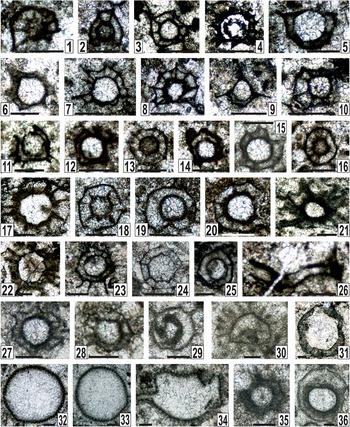
Figure 8.5, 8.6, 8.9, 8.15, 8.35
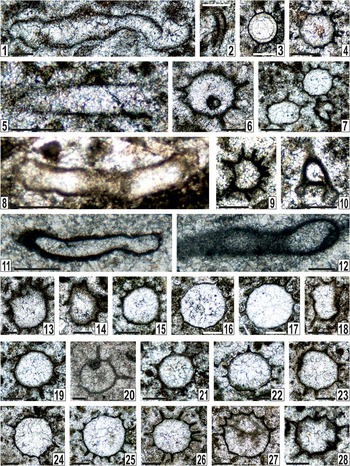
(1–3, 10, 11, 14, 25) Uralinella antiqua Petrova, Reference Petrova1981: (1) sample POL11-11; (2) sample POL11a-1; (3) sample POL11a-28; (10) sample POL11a-27; (11) sample POL11a-27; (14) sample POL11b-16; (25) sample POL 13b-3. (4?, 7, 8, 13, 16, 18?, 24?) Uralinella sabirovi n. sp.: (4) paratype?, sample POL11a-26; (7) paratype, sample POL11a-5; (8) holotype, sample POL11a-3; (13) paratype, sample POL11b-19c; (16) paratype, sample POL11b-23; (18) paratype?, sample POL13a-2; (24) paratype?, sample POL13b-8. (5, 6, 9, 15, 35) Elenella cf. E. losvica (Petrova, Reference Petrova1981); (5) sample POL11-8; (6) sample POL11a-26a; (9) sample POL11a-14a; (15) sample POL11b-19c; (35) sample POL14-6a. (12?, 17, 19, 20, 21?, 22, 27, 28) Elenella polinikensis n. sp.; (12?) paratype?, sample POL11b-14; (17) paratype, sample POL13a-1a; (18) paratype, sample POL13a-2; (19) paratype, sample POL13a-3; (20) holotype, sample POL13b-4; (21?) paratype?, sample POL 13a-5a (see also the morphotaxon Ratella); (22) paratype, sample POL13a-5; (27) sample POL13b-6; (28) paratype, POL13b-11. (23) Elenella sp. 3, sample POL14-9. (26) Paracaligella ex gr. antropovi Lipina, Reference Lipina1955, sample POL11b-14a. (29) Bithurammina? sp., sample POL14-7. (30) Auroria cf. A. singularis Poyarkov, Reference Poyarkov1969, sample POL14-17. (31) Auroria cf. A. triangularis Saltovskaya, Reference Saltovskaya1981, sample POL13a-4. (32, 33) Cribrosphaeroides (Parphia) robusta Miklukho-Maklay, Reference Miklukho-Maklay1965; (32) sample POL13a-1; (33) sample POL13b-1. (34) Uslonia cf. U. incomposita (Petrova, Reference Petrova1981), sample POL13b-12. (36) Auroria? sp. Givetian of Mount Polinik (Carnic Alps, Austria); sample POL14-8. Scale bars=0.1 mm.

1981 Parathurammina? losvica Reference PetrovaPetrova, p. 89, pl. 7, figs. 13, 14, 16, 17.
1984 Uralinella lozvica (sic); Reference Zadorozhnyi and YuferevZadorozhnyi and Yuferev, p. 97, pl. 3, figs. 3–5.
1987 Uralinella losvica; Reference ZadorozhnyiZadorozhnyi, pl. 2, figs. 21–23.
1988 Uralinella lozvica (sic); Reference Bogush, Zarodozhnyi and IvanovaBogush et al., p. 32.
1990 Uralinella losvica; Reference Bogush and YuferevBogush and Yuferev, p. 22.
2008 Parathurammina lozvica; Reference AnfimovAnfimov, p. 78.
2013 Saltovskajina lozvica; Reference Makarenko and SavinaMakarenko and Savina, p. 128.
2016a Ellenella spp.; Reference VachardVachard, fig. 3.5, 3.6, 3.9, 3.15, 3.35.
Holotype
Axial section (No. 23/1868, UTGU) from the Eifelian of the northern Urals, Russia (Petrova, Reference Petrova1981, pl. 7, fig. 13).
Diagnosis
Small species for the genus, characterized by a moderate number of necks, a relatively broad inner spherical chamber and a polygonal external chamber.
Occurrence
Eifelian–Givetian of the western slope of the middle and northern Urals. Eifelian of the Tomsk area (SW Siberia). Givetian–Frasnian of the southeastern part of the western Siberian Plain. Discovered in the early Givetian of Mount Polinik (Carnic Alps, Austria).
Description
Outer diameter=0.18–0.21 mm; inner diameter=0.06–0.10 mm; number of necks: (3)–6–8; test wall thickness(s)=0.02–0.05 mm.
Remarks
As for E. losvica, the taxon shares a wall of uralinellid with a shape of parathuramminid; our material slightly differs from E. losvica by the less acute shape of protuberances. As indicated by our synonymy list, the genus assignment and the species spelling vary in the literature.
Materials
20 specimens (samples POL11-8, POL11a-14a, POL11b-19c, POL11a-26a, and POL14-6a).
Elenella polinikensis new species
urn:lsid:zoobank.org:act:D33F76C5-55F5-4B65-878D-3DD160BCB135
Figure 8.12?, 8.17–8.20, 8.21?, 8.22, 8.27, 8.28
2014 Parathuramminide; Reference MörtlMörtl, text-figs. 33e, 33g.
2016a Uralinellla spp.; Reference VachardVachard, fig. 3.12, 3.17–3.20, 3.21, 3.22, 3.27, 3.28.
Holotype
Fig. 8.20 (sample POL13a–4); Institute of Geology, University of Innsbruck, Cat. Nr. P 10141-POL 13a (thin section); early Givetian of Feldkogel Limestone (Polinik Formation); Mount Polinik (Austria).
Diagnosis
Elenella relatively large, spherical, but generally periphically poorly preserved. Central chamber subpolygonal with thick dark-microgranular wall. Necks more regular and thinner than the wall. Peripheral thin, dark-microgranular wall. Intermediary wall grayish recrystallized/filled by microsparite.
Occurrence
Givetian of Mount Polinik (Carnic Alps, Austria).
Description
Outer diameter=0.16–0.36 mm; inner diameter=0.08–0.17 mm; inner chamber wall thickness=0.01–0.03 mm; outer chamber wall thickness=0.06–0.08 mm; number of necks: 8–14 (their width is 0.01–0.02 mm).
Etymology
After Mount Polinik (Carnic Alps, Austria).
Remarks
Similar to the upper Emsian species E. monielli Vachard, Reference Vachard1991, the new species differs by a larger central chamber with a thicker wall, and fewer necks/trabecules within the wall.
Materials
25 specimens (samples ?POL11b-14, POL13a-1a, POL13a-2, POL13a-3, POL13a-5, ?POL13a-5a, POL13b-4, POL13b-6, and POL13b-11).
Elenella sp. 3
Diagnosis
The test is composed of two almost spherical, concentric chambers; the necks are long, thin and occasionally curved.
Occurrence
Givetian of Mount Polinik (Carnic Alps, Austria).
Materials
Only one specimen (sample POL14-9).
Family Uralinellidae Chuvashov, Yuferev and Zadorozhnyi in Zadorozhnyi and Yuferev, Reference Zadorozhnyi and Yuferev1984
Diagnosis
Test bilocular, probably attached, at least temporarily. Inner chamber spherical, central or excentered. Outer chamber, larger, polygonal to ellipsoidal or subspherical. Radiate necks crossing through the space between the two chambers and often prominent at the periphery. Aperture inconspicuous or single at the extremity of each neck. Wall dark-microgranular, although this interpretation is often discussed.
Occurrence
Late Silurian (Ludlovian)–latest Viséan of western and central Europe, former USSR (the Urals, Preural, eastern Russian Platform, western Siberia, Kyrgyzstan, and Tajikistan), up to early Tournaisian in South China, Vietnam, and Australia.
Remarks
The family Uralinellidae encompasses the following taxa: Uralinella Bykova, Reference Bykova1952; radiospherid calcispheres forms A and C sensu Veevers (Reference Veevers1970, pl. 46, figs. 1–3, pl. 47, figs. 1–5); Sogdanina Saltovskaya, 1974; Arakavaella Pronina, Reference Pronina1963; Maclayina Saltovskaya, Reference Saltovskaya1981; ?Ivdelina Malakhova, Reference Malakhova1963 (= “well-preserved radiosphaerid calcispheres” sensu Berkyova and Munnecke, Reference Berkyova and Munnecke2010, fig. 3A–D, 3F–I); ?Radiina Reitlinger, Reference Reitlinger1957; and ?Algaeformis Anfimov, Reference Anfimov2012. Contrary to Vachard (Reference Vachard1994), we consider that the latest Viséan genus Sogdanina is not synonymous with the Devonian genus Uralinella because its intermediary layer of the wall is entirely calcified (see for example Sogdanina sp. illustrated by Sanz-Lopez et al., Reference Sanz-Lopez, Vachard and Perret2005, pl. 6, fig. 9, under the name of Uralinella cf. U. augusta Sabirov). Ivdelina and “well-preserved radiosphaerid calcispheres” (sensu Berkyova and Munnecke, Reference Berkyova and Munnecke2010, p. 588) belong either to the Uralinellidae or to the Tuberitinidae. The genus Algaeformis, initially assigned to the Uralinellidae, more probably belongs to the Auroriidae as redefined herein, as well as the genus Radiina.
Genus Uralinella Bykova, Reference Bykova1952
Type species
Uralinella bicamerata Bykova, Reference Bykova1952.
Other species
See Zadorozhnyi and Yuferev (Reference Zadorozhnyi and Yuferev1984) and Vachard (Reference Vachard1994).
Diagnosis
Uralinellidae with a well-developed, polygonal to subspherical outer chamber. Radiate necks crossing through the space between the two chambers, and markedly prominent at the periphery. Aperture single at the extremity of each neck. Wall dark-microgranular, apparently formed by an inner layer around the inner chamber, and an outer layer at the periphery. Calcified wall of the necks and hollow intermediary spaces secondarily filled by neosparite.
Occurrence
Early Devonian of Tajikistan. Late Devonian of northern Spain. Middle Devonian of the northern and central Urals, western Siberia, Zeravchan Gissar and Turkestan ranges (Kyrgyzstan, Tajikistan). Givetian of western France and Morocco. Late Devonian of Molotov area, Bashkorotostan, Tatarstan, Urals, and SW Siberia (Russia), Moravia (Czech Republic), and Belgium. Latest Famennian–early Tournaisian of Greece (Vachard and Clément, Reference Vachard and Clément1994), central Urals (Chuvashov, Reference Chuvashov1965), Tian Shan (Poyarkov, Reference Poyarkov1969), South China (Wang, Reference Wang1987), Vietnam (Doan in Tong et al., Reference Tong, Dang, Nguyen, Nguyen, Nguyen, Nguyen, Ta, Pham and Doan1988) and Australia (Veevers, Reference Veevers1970; Stephens and Sumner, Reference Stephens and Sumner2003).
Uralinella antiqua Petrova, Reference Petrova1981
Figure 8.1–8.3, 8.10, 8.11, 8.14, 8.25
1981 Uralinella antiqua Reference PetrovaPetrova, p. 93, pl. 11, figs. 15–18.
1984 Uralinella antiqua; Reference SabirovSabirov, pl. 2, fig. 6.
1984 Uralinella antiqua; Reference Zadorozhnyi and YuferevZadorozhnyi and Yuferev, p. 97, pl. 3, figs. 6–8.
1985 Uralinella antiqua; Reference ZadorozhnyiZadorozhnyi, pl. 17, fig. 15.
1987 Uralinella antiqua; Reference ZadorozhnyiZadorozhnyi, p. 34, pl. 3, figs. 1, 2.
1988 Uralinella antiqua; Reference Bogush, Zarodozhnyi and IvanovaBogush et al., p. 32.
1990 Uralinella antiqua; Reference Bogush and YuferevBogush and Yuferev, p. 21.
2008 Uralinella antiqua; Reference AnfimovAnfimov, p. 78.
2008 Uralinella antique (sic); Reference TsygankoTsyganko, p. 71, text-fig. 3.
2008 Uranovella antique (sic); Reference TsygankoTsyganko, p. 73.
2013 Uralinella antiqua; Reference Makarenko and SavinaMakarenko and Savina, p. 128.
Holotype
Axial section (No. 92/1868, UTGU) from the Middle Devonian of the northern Urals, Russia (Petrova, Reference Petrova1981, pl. 11, fig. 17).
Diagnosis
Small species for the genus, characterized by a relatively broad inner spherical chamber, a relatively small external polygonal chamber, and a few necks.
Occurrence
Early Devonian of Tajikistan and western Siberia. Eifelian of Tomsk area (SW Siberia). Middle Devonian of the northern and central Urals. Frasnian of SW Siberia. Discovered in the Givetian of Mount Polinik (Carnic Alps, Austria).
Description
Test outer diameter=0.09–0.18 mm (0.09–0.12 mm; rarely 0.18–0.20 mm for the type material); test inner diameter=0.05–0.12 mm (0.05–0.09 mm for the type material); number of necks: 3–6 (4–5 for the type material); inner diameter of necks=0.005–0.008 mm; test wall thickness=0.005–0.001 mm (0.008–0.013 mm for the type material).
Materials
24 specimens (samples POL11-11, POL11-13, POL11a-1, POL11a-27, POL11a-27a, POL11a-28, POL11b-16. 25, and POL13b-3).
Uralinella sabirovi new species
urn:lsid:zoobank.org:act:48FFF09A-8C87-4A98-8245-131F8158126C
Figure 8.4?, 8.7, 8.8, 8.13, 8.16, 8.18?, 8.24?
2016a Uralinella spp.; Reference VachardVachard, fig. 3.4?, 3.7, 3.8, 3.13, 3.16, 3.18?, 3.24?.
Holotype
Fig. 10.8 (sample POL11a–3); Institute of Geology, University of Innsbruck, Cat. Nr. P 10139-POL 11a (thin section); Givetian of the Feldkogel Limestone (Polinik Formation); Mount Polinik (Austria).
Diagnosis
This species of Uralinella is characterized by the greater number of canals; small size; thin wall, and a festooned profile of the second chamber.
Occurrence
Givetian of Mount Polinik (Carnic Alps, Austria).
Description
Outer chamber=0.12–0.23 mm; inner chamber=0.06–0.10 mm; number of canals: 9–12, mainly 10; test wall thickness=0.005–0.006 mm, rarely 0.01 mm.
Etymology
Named in honor of A.A. Sabirov, for his contributions to parathuramminid micropaleontology.
Materials
10 specimens (samples POL11a-3, POL11a-5, ?POL11a-26, POL11b-19c, POL11b-23, ?POL13a-2, and ?POL13b-8).
Remarks
Differs from U. antiqua by the greater number of canals, and from U. bicamerata and U. parva Sabirov, Reference Sabirov1974 by a smaller size, more canals, and a festooned profile of the second chamber.
Family Parathuramminidae Bykova in Bykova and Polenova, Reference Bykova and Polenova1955 emend. Vachard, Reference Vachard1994
Diagnosis
Test free or rarely atttached, unilocular with a globular to polygonal chamber with rare to abundant tubular, mamillate, or subconical projections variously arranged and developed; wall dark-microgranular, occasionally with an inner pseudofibrous layer, or recrystallized and in this case mimicing the agglutinated wall of the homeomorphous Thurammininae. Aperture at the end of the projections, on the surface, or inconspicuous.
Occurrence
?Early Cambrian of Russia (Winchester-Seeto and McIlroy, Reference Winchester-Seeto and McIlroy2006; as Thurammina? sp.); Ordovician–Mississippian; probably cosmopolitan at least during their acme during the Givetian–Frasnian. The last, Mississippian, well-represented genus is Hemithurammina Mamet, Reference Mamet1973 (see Perret and Vachard, Reference Perret and Vachard1977); in younger strata, the parathuramminids are very rare and doubtful (Nguyên, Reference Nguyên1986, pl. 1, fig. 15).
Remarks
Parathuramminidae is synonymous with Thurammininae Miklukho-Maklay, Reference Miklukho-Maklay1963 (partim); Chrysothuramminidae Loeblich and Tappan, Reference Loeblich and Tappan1986; and Dagmarellinae Chuvashov, Yuferev, and Zadorozhnyi in Zadorozhnyi and Yuferev, Reference Zadorozhnyi and Yuferev1984, which is a nomen nudum because Dagmarella is an invalid genus. Parathuramminidae includes two subfamilies: Parathurammininae Bykova in Bykova and Polenova, Reference Bykova and Polenova1955 emend. Vachard, Reference Vachard1994; and Parathuramminitinae Antropov, Reference Antropov1970. The collective morphogenus Parathurammina Suleimanov, Reference Suleimanov1945 was progressively subdivided into numerous genera or subgenera: Salpingothurammina Poyarkov in Purkin et al., Reference Purkin, Poyarkov and Rozhanets1961; Parathuramminites Antropov in Poyarkov, Reference Poyarkov1969; Chrysothurammina Neumann, Pozaryska, and Vachard, Reference Neumann, Pozaryska and Vachard1975; Saltovskajina Sabirov, Reference Sabirov1982b; Cordatella Petrova in Zadorozhnyi and Yuferev, Reference Zadorozhnyi and Yuferev1984; Marginara Petrova in Zadorozhnyi and Yuferev, Reference Zadorozhnyi and Yuferev1984 (nomen correctum Loeblich and Tappan, Reference Loeblich and Tappan1986 for Margarinarae, incorrect name because in the plural); Suleimanovella Yuferev in Zadorozhnyi and Yuferev, Reference Zadorozhnyi and Yuferev1984; Cushmanella Zadorozhnyi in Zadorozhnyi and Yuferev, Reference Zadorozhnyi and Yuferev1984 (pre-occupied); Bykovaella Zadorozhnyi in Zadorozhnyi and Yuferev, Reference Zadorozhnyi and Yuferev1984; Radiosphaerella Yuferev in Zadorozhnyi and Yuferev, Reference Zadorozhnyi and Yuferev1984; Kolongella Zadorozhnyi in Zadorozhnyi and Yuferev, Reference Zadorozhnyi and Yuferev1984; and Polygonella Zadorozhnyi in Zadorozhnyi and Yuferev, Reference Zadorozhnyi and Yuferev1984.
All these taxa were considered to be homeomorphs of the extant agglutinating genus Thurammina Brady, Reference Brady1879, which is, however, undoubtedly known only from Jurassic deposits (e.g., Häusler, Reference Häusler1883; Kaźmierczak, Reference Kaźmierczak1973; Munk, Reference Munk1994; Guilbault et al., Reference Guilbault, Krautter, Conway and Vaughn Barrie2006; Reolid et al., Reference Reolid, Nagy, Rodríguez-Tovar and Olóriz2008; Reolid and Molina, Reference Reolid and Molina2010). Parathurammina sensu stricto is one of these Devonian foraminiferal genera, which shows a dark-microgranular wall in shallow water, transformed into an agglutinating and/or recrystallized wall in deeper waters (Vachard et al., Reference Vachard, Pille and Gaillot2010; Vachard, Reference Vachard2016a). The name Parathurammina is therefore entirely appropriate to replace the Paleozoic Thurammina of the literature. Similarly, other names could be given to the Paleozoic representatives of Saccammina, Rhabdammina, Bathysiphon, etc. A parathuramminid character, which is unusual among the foraminifers, is the presence of double chambers joined together; examples are known in Bithurammina, Bisphaera, Bituberitina, Eovolutina, and various parathuramminidae and uralinellidae (e.g., Grozdilova and Lebedeva, Reference Grozdilova and Lebedeva1954, pl. 2, fig. 9; Reitlinger, Reference Reitlinger1962, pl. 2, fig. 1; Miklukho-Maklay, Reference Miklukho-Maklay1965, pl. 2, fig. 2; Chuvashov, Reference Chuvashov1965, pl. 3, fig. 7; Poyarkov, Reference Poyarkov1969, pl. 3, fig. 10; Brunner, Reference Brunner1975, pl. 2, fig. 7, 1976, pl. 4, fig. 9; Poyarkov, Reference Poyarkov1979, pl. 6, fig. 6; Zukalova, Reference Zukalova1981, pl. 2, figs. 1, 2; Petrova, Reference Petrova1981, pl. 11, figs. 3, 5; Kotlyar, Reference Kotlyar1982, text-fig. 4; Lin and Hao, Reference Lin and Hao1982, pl. 1, fig. 24; Doan in Tong et al., Reference Tong, Dang, Nguyen, Nguyen, Nguyen, Nguyen, Ta, Pham and Doan1988, pl. 1, fig. 4; Vachard and Clément, Reference Vachard and Clément1994, pl. 2, fig. 8). If the external additional chamber is often questionable (except for Parathurammina praetuberculata ramosa Reitlinger, Reference Reitlinger1962, pl. 1, fig. 7), internal chambers are most significant, as for example, in Parathurammina (?) aff. P. dagmarae (sic) sensu Grozdilova and Lebedeva, Reference Grozdilova and Lebedeva1954, pl. 2, figs. 7, 8; and Parathurammina sp. (Grozdilova and Lebedeva, Reference Grozdilova and Lebedeva1954, pl. 2, fig. 9; Reitlinger, Reference Reitlinger1962, pl. 2, fig. 1; and Poyarkov, Reference Poyarkov1969, pl. 3, fig. 10). These forms have been termed Bithurammina Miklukho-Maklay, Reference Miklukho-Maklay1963, even if this taxon remains invalid because its type species, Parathurammina (?) aff. P. dagmarae sensu Grozdilova and Lebedeva, was never correctly re-named (see Miklukho-Maklay, Reference Miklukho-Maklay1965; Ektova, Reference Ektova1968; Poyarkov, Reference Poyarkov1969, Reference Poyarkov1979; Kotlyar, Reference Kotlyar1982; Doan in Tong et al., Reference Tong, Dang, Nguyen, Nguyen, Nguyen, Nguyen, Ta, Pham and Doan1988; Vachard, Reference Vachard1991).
Subfamily Parathurammininae Bykova in Bykova and Polenova; Reference Bykova and Polenova1955 emend. Vachard, Reference Vachard1994
Diagnosis
Test free, moderate to large in size, globular with many papilliform projections; thin wall unilayered dark-microgranular, or bilayered with an additionally inner pseudofibrous layer. One distal, areal aperture at the end of each projection.
Occurrence
Ordovician–early Visean; probably cosmopolitan.
Remarks
Synonym of Parathuramminae (sic) Zadorozhnyi, Reference Zadorozhnyi1987 and Dagmarellinae Chuvashov, Yuferev and Zadorozhnyi in Zadorozhnyi and Yuferev, Reference Zadorozhnyi and Yuferev1984 (nomen nudum; see earlier), this subfamily encompasses the genera: Parathurammina Suleimanov, Reference Suleimanov1945; Bykovaella Zadorozhnyi in Zadorozhnyi and Yuferev, Reference Zadorozhnyi and Yuferev1984; Kolongella Zadorozhnyi in Zadorozhnyi and Yuferev, Reference Zadorozhnyi and Yuferev1984; and ?Bithurammina Miklukho-Maklay, Reference Miklukho-Maklay1965 non 1963.
Genus Parathurammina Suleimanov, Reference Suleimanov1945
Type species
Parathurammina dagmarae Suleimanov, Reference Suleimanov1945.
Other species
Parathurammina arguta Pronina, Reference Pronina1960; P. eodagmarae Reitlinger, Reference Reitlinger1954; P. graciosa Pronina, Reference Pronina1960; P. kokschaalica Ektova, Reference Ektova1968; P. magna Antropov, Reference Antropov1950; P. oldae Suleimanov, Reference Suleimanov1945; P. parabreviradiosa Saltovskaya, Reference Saltovskaya1981; P. paradagmarae Grozdilova and Lebedeva, Reference Grozdilova and Lebedeva1954; P. uralica Petrova, Reference Petrova1981; ?P. cordata Pronina, Reference Pronina1960; ?P. eoarguta Sabirov, Reference Sabirov1984; ?P. marginara Pronina, Reference Pronina1960; ?P. tamarae Petrova, Reference Petrova1981 (eventually with a median layer, more or less diaphanothecal, within the external dark layer, supposed characteristic of Cordatella and/or Marginara); ?Thurammina adamsi Conkin and Conkin, Reference Conkin and Conkin1964; ?T. arcuata Moreman, Reference Moreman1930; ?T. arenacorna Gutschick, Weiner, and Young, Reference Gutschick, Weiner and Young1961; ?T. echinata Dunn, Reference Dunn1942; ?T. elegans Dunn, Reference Dunn1942; ?T. elliptica Moreman, Reference Moreman1930; ?T. foerstei Dunn, Reference Dunn1942 (= Amphitremoidea according to Nestell and Tolmacheva, Reference Nestell and Tolmacheva2004); ?T. globosa Ireland, Reference Ireland1939; ?T. hexagona Dunn, Reference Dunn1942: ?T. ?hexactinellida Dunn, Reference Dunn1942; ?T. irregularis Moreman, Reference Moreman1930; ?T. inflata Dunn, Reference Dunn1942; ?T. jubata Dunn, Reference Dunn1942; ?T. lawrencensis Ireland, Reference Ireland1956; ?T. limbata Dunn, Reference Dunn1942; ?T. limbata var. disciformis Dunn, Reference Dunn1942; ?T. magna Dunn, Reference Dunn1942; ?T. melleni Dunn, Reference Dunn1942; ?T. papillata Moreman, Reference Moreman1930; ?T. papillata var. monticulifera Ireland, Reference Ireland1939; ?T. parvituba Dunn, Reference Dunn1942 (= Amphitremoidea according to Nestell and Tolmacheva, Reference Nestell and Tolmacheva2004); ?T. phasela Moreman, Reference Moreman1930; ?T. polygona Ireland, Reference Ireland1939; ?T. pustulosa Gutschick, Weiner, and Young, Reference Gutschick, Weiner and Young1961; ?T. quadrata Dunn, Reference Dunn1942; ?T. sphaerica Ireland, Reference Ireland1939; ?T. subpapillata Ireland, Reference Ireland1939; ?T. tubulata Moreman, Reference Moreman1930; and ?T. micropapillata Blumenstengel, Reference Blumenstengel1961, perhaps belong to Parathurammina, even if the microstructure of their wall remains unknown.
Diagnosis
Test free, moderate to large in size, globular with many papilliform projections; thin wall dark-microgranular with an inner pseudofibrous layer. One distal, areal aperture at the end of each projection.
Occurrence
Ordovician–Mississippian; cosmopolitan.
Remarks
Parathurammina s.s. is partially synonymous with Thurammina (partim), ?Cordatella (partim), ?Marginara (partim), and ?Guangxithurammina Lin et al., Reference Lin, Li and Sun1990. The genus Chrysothurammina Neumann, Pozaryska, and Vachard, Reference Neumann, Pozaryska and Vachard1975 differs from Parathurammina because the pseudofibrous layer of the wall that surrounds the inner chamber also penetrates the necks.
Parathurammina graciosa Pronina, Reference Pronina1960
Figures 9.4, 9.6, 9.7, 9.15, 9.19–9.23, 9.27, 9.28?, 10.2
(1, 8) Paracaligella ex gr. antropovi Lipina, Reference Lipina1955: (1) longitudinal section of a tubular chamber resembling Irregularina, sample POL 3-7; (8) more regular longitudinal section, sample POL 11b-25. (2) Earlandia sp. 1, small curved longitudinal section, sample POL11a-30. (3) Neoarchaesphaera? sp., sample POL11a-20. (4, 6, 7, 15, 19, 21–23, 27, 28?) Parathurammina graciosa Pronina, Reference Pronina1960: (4) sample POL11a-24; (6) sample POL3-1a; (7) with Bykovaella breviradiosa (Reitlinger, Reference Reitlinger1962), sample POL11-2; (15) sample POL11-1; (19) sample POL11-7; (21) sample POL11-9; (22) pseudofibrous, inner layer well visible here, sample POL11a-4; (23) sample POL 11a-10; (27) sample POL11a-14; (28) sample POL11a-39. (5) Earlandia sp. 2. Broader, rectilinear, slightly tapering test, sample POL11a-31. (9) Neoarchaesphaera ellipsoidalis (Poyarkov, Reference Poyarkov1969), sample POL11a-29. (10) Suleimanovella cf. S. totaensis (Petrova, Reference Petrova1981), sample POL11a-16. (11, 12) Paracaligella sp. 2: (11) sample POL 13b-9; (12) sample POL13b-14. (13, 14, 18) Parathurammina cf. P. uralica Petrova, Reference Petrova1981: (13) sample POL3-1; (14) sample POL3-2; (18) sample POL11b-12a. (16, 17, 24, 25) Bykovaella aperturata (Pronina, Reference Pronina1960) emend. Zadorozhnyi and Yuferev, Reference Zadorozhnyi and Yuferev1984: (16) sample POL11-3; (17) sample POL11-6; (24) POL11a-12; (25) sample POL11a-6a. (20) ?Bithurammina aff. B. sphaerica Ektova, Reference Ektova1968, sample POL.14-33. (26) Parathurammina arguta Pronina, Reference Pronina1960, sample POL11a-6. Scale bars=0.1 mm.

1960 Parathurammina graciosa Reference ProninaPronina, p. 47, pl. 1, figs. 1, 2.
1969 Parathurammina graciosa; Reference MalakhovaMalakhova, pl. 51, figs. 350, 351, 355.
1969 Parathurammina cf. graciosa; Reference MalakhovaMalakhova, pl. 48, fig. 329, pl. 51, fig. 361.
1969 Parathurammina (Salpingothurammina) graciosa; Reference PoyarkovPoyarkov, table 19.
1971 Parathurammina graciosa; Reference Menner and ReitlingerMenner and Reitlinger, p. 29, pl. 8, fig. 5.
1979 Parathurammina graciosa; Reference Lavrusevich, Lavrusevich and SaltovskayaLavrusevich et al., p. 322.
1979 Parathurammina (Salpingothurammina) graciosa; Reference PoyarkovPoyarkov, text-fig. 14.
1981 Parathurammina graciosa; Reference PetrovaPetrova, pl. 8, figs. 4, 5, 8.
1985 Parathurammina graciosa; Reference ZadorozhnyiZadorozhnyi, p. 126, 131?, pl. 17, fig. 1, pl. 18, figs. 1, 2.
1990 Parathurammina graciosa; Reference Bogush and YuferevBogush and Yuferev, p. 20.
2008 Parathurammina graciosa; Reference AnfimovAnfimov, p. 78.
2011 Parathurammina graciosa; Reference AnfimovAnfimov, p. 16.
2014 Parathuramminide; Reference MörtlMörtl, text-fig. 33b.
Holotype
Axial section (No. 476/3 Museum of the Geological Direction of the Urals) from the early Givetian of the central Urals, Russia (Pronina, Reference Pronina1960, pl. 1, fig. 1).
Diagnosis
Relatively large species characterized by a large central chamber, and numerous necks, asymmetrically arranged. Necks short, with a narrow central channel, entirely cylindrical (i.e., with neither proximal nor distal enlargement). Wall thin, bilayered, dark-microgranular, and hyaline-microgranular.
Occurrence
Middle Eifelian–early Givetian of eastern slope of the central Urals. Givetian of northern and southwestern Siberia and Zeravshano-Gissar (Tajikistan). Frasnian of SW Siberia (Bogush et al., Reference Bogush, Bochkarev and Yuferev1975). Discovered in the Givetian of Mount Polinik (Carnic Alps, Austria).
Description
Test outer diameter=0.15–0.31 mm (type material: 0.09–0.27 mm); central chamber diameter=0.12–0.20 mm; number of necks: 11–13; length of necks=0.004–0.13 mm (for a wall thickness of 0.008 to 0.01 mm); test wall thickness=0.003–0.007 mm (type material: 0.004–0.007 mm).
Materials
32 specimens (samples POL3-1a, POL11-1, POL11-2, POL11-7, POL11-9, POL11a-4, POL11a-10, POL11a-14, POL11a-21, POL11a-24, ?POL11a-39).
Parathurammina cf. P. uralica Petrova, Reference Petrova1981
Figures 9.13, 9.14, 9.18, 10.1, 10.10
1981 Parathurammina uralica Reference PetrovaPetrova, p. 86, pl. 6, figs. 3, 5, 6.
1990 Bykovaella uralica; Reference Bogush and YuferevBogush and Yuferev, p. 21.
?2009 Parathurammina crassitheca Antropov; Reference Mamet and PréatMamet and Préat , fig. 1.19 only (non fig. 1.18=Kolongella).
2011 Parathurammina uralica; Reference AnfimovAnfimov, p. 16.
Holotype
Axial section (No. 3/1868; Geological Museum of the Urals UTGU) from the Eifelian of the northern Urals, Russia (Petrova, Reference Petrova1981, pl. 6, fig. 3).
Diagnosis
Relatively large species characterized by numerous necks, asymmetrically arranged. Necks short, with a narrow central channel, entirely cylindrical (i.e., without proximal or distal enlargement). Wall thin, bilayered, dark-microgranular, and hyaline-microgranular.
Occurrence
Eifelian of the northern and central Urals. Doubtful in the late Eifelian of Belgium. Givetian of SW Siberia. Givetian of Mount Polinik (Carnic Alps, Austria).
Description
Outer diameter=0.17–0.40 mm (type material: 0.13–0.24 mm); inner diameter=0.14–0.30 mm; length of necks=0.03–0.04 mm (for a wall of 0.01–0.02 mm); test wall thickness=0.015–0.04 mm (type material: 0.015–0.03 mm).
Materials
12 specimens (samples POL3-1, POL3-2, POL11, POL11b-12a, POL13a-2b).
Remarks
This species might be a homeomorph of Bykovaella irregulariformis (Zadorozhnyi and Yuferev, Reference Zadorozhnyi and Yuferev1984) and/or B. oblisa (Petrova, Reference Petrova1981), but it has a bilayered wall and consequently belongs to Parathurammina. In this genus, P. uralica is the most similar species compared to our taxon.
Parathurammina arguta Pronina, Reference Pronina1960
Figures 9.26, 10.7 (partim), 10.9, 10.10
1960 Parathurammina arguta Reference ProninaPronina, p. 7, pl. 1, fig. 5.
1969 Parathurammina arguta; Reference PoyarkovPoyarkov, table 12.
1979 Parathurammina arguta; Reference Lavrusevich, Lavrusevich and SaltovskayaLavrusevich et al., p. 323.
1979 Parathurammina (Parathurammina) arguta; Reference PoyarkovPoyarkov, text-fig. 13.
1981 Parathurammina (Parathurammina) aperturata; Reference PetrovaPetrova, pl. 7, figs. 9–11.
1985 Parathurammina arguta; Reference ZadorozhnyiZadorozhnyi, p. 127, pl. 17, fig. 6.
2013 Parathurammina arguta; Reference Makarenko and SavinaMakarenko and Savina, p. 128.
2014 Parathuramminide; Reference MörtlMörtl, text-fig. 33a.
Holotype
Axial section (No. 476/8 Museum of the Geological Direction of the Urals) from the early Givetian of the central Urals, Russia (Pronina, Reference Pronina1960, pl. 1, fig. 5).
Diagnosis
Relatively large species characterized by numerous necks, regularly, radially arranged. Necks short, papilliform. Wall thin, bilayered, dark-microgranular and clear-pseudofibrous.
Occurrence
Eifelian–early Givetian of the central Urals and Givetian of the northern Urals (Pronina, Reference Pronina1960; Petrova, Reference Petrova1981), Zeravshano-Gissar (Lavrusevich et al., Reference Lavrusevich, Lavrusevich and Saltovskaya1979), and Siberia (Zadorozhnyi, Reference Zadorozhnyi1985, Reference Zadorozhnyi1987). Givetian of Mount Polinik (Carnic Alps, Austria).
Description
Outer diameter=0.27–0.50 mm (type material: 0.34–0.52 mm); inner diameter=0.15–0.37 mm; number of necks: 13–15; length of necks=0.01–0.06 mm (for a wall of 0.015 mm); test wall thickness=0.01 mm (type material: 0.01 mm).
Materials
Eight specimens (samples POL11a-6, POL11b-5, POL13a-1, POL13a-7).
Genus Bykovaella Zadorozhnyi in Zadorozhnyi and Yuferev, Reference Zadorozhnyi and Yuferev1984
Type species
Parathurammina aperturata Pronina, Reference Pronina1960.
Other species
Parathurammina breviradiosa Reitlinger in Varsanofieva and Reitlinger, Reference Reitlinger1962; P. argensis Sabirov, Reference Sabirov1987a; P. bykovae Poyarkov in Purkin et al., Reference Purkin, Poyarkov and Rozhanets1961; P. crassitheca Antropov, Reference Antropov1950; P. dagmarae var. crassitheca Antropov, Reference Antropov1950; P. iniqua Pronina, Reference Pronina1970; Polygonella irregulariformis Zadorozhnyi and Yuferev, Reference Zadorozhnyi and Yuferev1984; Parathurammina irregularis Pronina, Reference Pronina1960; P. khavsakiensis Sabirov, Reference Sabirov1987a; P. macilenta Pronina, Reference Pronina1970; P. mirabilis (sic mirabile) Saltovskaya, Reference Saltovskaya1981; P. praeaperturata Saltovskaya, Reference Saltovskaya1981; P. turgida Chuvashov, Reference Chuvashov1965.
Diagnosis
Test free, moderate in size, globular with many tubular projections; thin wall dark-microgranular. One areal aperture at the end of each projection.
Occurrence
Late Silurian, Early–Middle Devonian, Late Devonian (Frasnian–early Famennian), early Tournaisian of Russian Platform, the Urals, western Siberia, Tian Shan (Tajikistan), South China, Spain, western and northern France, ?Germany (see Vachard, Reference Vachard1991). Discovered in the Givetian of Austria.
Remarks
Many Bykovaella of the literature have been designated by Parathurammina (partim), Thurammina (partim), Salpingothurammina (partim), and Polygonella (partim).
Bykovaella aperturata (Pronina, Reference Pronina1960) emend. Zadorozhnyi and Yuferev, Reference Zadorozhnyi and Yuferev1984
1928 Calcisphères de La Villedé, formes épineuses; Reference MilonMilon, fig. 35.1, 35.2, 35.4, 35.6 (non 35.3, 35.5, 35.7, 35.8), pl. 2, fig. 1a, 1a’.
1960 Parathurammina aperturata; Reference ProninaPronina, p. 47, pl. 1, fig. 3.
1969 Parathurammina aperturata; Reference PoyarkovPoyarkov, p. 87, pl. 1, figs. 2, 5.
1969 Parathurammina aperturata; Reference MalakhovaMalakhova, pl. 49, figs. 337, 338, pl. 50, fig. 344, pl. 52, fig. 359.
non1971 Parathurammina aperturata; Reference Menner and ReitlingerMenner and Reitlinger, p. 29, pl. 8, figs. 2, 7–9 (= Elenella reitlingerae n. sp.).
1977 Parathurammina aperturata; Petrova, p. 4, text-figs. 1, 2.
1979 Parathurammina aperturata; Reference PoyarkovPoyarkov, p. 44, pl. 5, fig. 2.
1979 Parathurammina aperturata; Reference Lavrusevich, Lavrusevich and SaltovskayaLavrusevich et al., p. 322.
1979 Parathurammina (Salpingothurammina) aperturata; Reference PoyarkovPoyarkov, p. 96, text-fig. 14.
1979 Parathurammina apertura (sic); Reference Dubreuil and VachardDubreuil and Vachard, p. 241.
non 1981 Parathurammina aperturata; Reference SaltovskayaSaltovskaya, p. 107, pl. 2, fig. 6, pl. 3, figs. 6, 8 (= Neoarchaesphaera).
1984 Bykovaella aperturata; Reference Zadorozhnyi and YuferevZadorozhnyi and Yuferev, p. 79, pl. 1, figs. 3–5.
1985 Bykovaella aperturata; Reference ZadorozhnyiZadorozhnyi, p. 126, pl. 17, fig. 2, pl. 18, fig. 3.
1987 Bykovaella aperturata; Reference ZadorozhnyiZadorozhnyi, p. 16, pl. 1, figs. 4–7.
non 1987 Parathurammina aperturata; Reference Loeblich and TappanLoeblich and Tappan, pl. 207, fig 17.
1988 Bykovaella aperturata; Reference Bogush, Zarodozhnyi and IvanovaBogush et al., p. 5.
1990 Bykovaella aperturata; Reference Bogush and YuferevBogush and Yuferev, p. 20.
1991 Parathurammina crassitheca Antropov; Reference VachardVachard, p. 261, pl. 1, fig. 25.
1994 Parathurammina aperturata; Reference VachardVachard, p. 20, text-fig. 12.6.
1994 Parathurammina crassitheca; Reference VachardVachard, p. 20, text-fig. 12.5 only (non pl. 1, figs. 2, 12–23, nec pl. 2, figs. 1, 7) (with 40 references in synonymy).
2002 Bykovaella aperturata; Reference KalvodaKalvoda, p. 26, text-fig. 11.
2008 Bykovaella aperturata; Reference TsygankoTsyganko, p. 70, text-fig. 3.
2009 Parathurammina du groupe P. dagmarae Suleimanov; Reference Mamet and PréatMamet and Préat, pl. 1, figs. 12, 15, 17 (non figs. 11, 14, 16=other species of Bykovaella, nec fig. 13=Kolongella).
2011 Parathurammina aperturata; Reference AnfimovAnfimov, p. 16.
2013 Parathurammina aperturata; Reference SabirovSabirov, p. 115, text-fig. 1.
2013 Parathurammina aperturata; Reference Makarenko and SavinaMakarenko and Savina, p. 128.
Holotype
Axial section (No. 476/6 Museum of the Geological Direction of the Urals) from the early Givetian of the central Urals, Russia (Pronina, Reference Pronina1960, pl. 1, fig. 3).
Diagnosis
Relatively large species characterized by numerous necks, regularly, radially arranged. Necks long with a narrow central channel, entirely cylindrical (i.e., without either proximal or distal enlargement). Wall thin.
Occurrence
Eifelian–early Givetian of the central and southern Urals (Pronina, Reference Pronina1960); Eifelian of the Tomsk area (SW Siberia; Makarenko and Savina, Reference Makarenko and Savina2013). Givetian of western France (Milon, Reference Milon1928, re-interpreted here; Dubreuil and Vachard, Reference Dubreuil and Vachard1979), Zeravshano-Gissar (Lavrusevich et al., Reference Lavrusevich, Lavrusevich and Saltovskaya1979), southern Fergana (Tian Shan; Poyarkov, Reference Poyarkov1969; Saltovskaya, 1981), Siberia (Menner and Reitlinger, Reference Menner and Reitlinger1971; Zadorozhnyi and Yuferev, Reference Zadorozhnyi and Yuferev1984; Zadorozhnyi, Reference Zadorozhnyi1985, Reference Zadorozhnyi1987; Bogush and Yuferev, Reference Bogush and Yuferev1990), Germany (Flügel and Hötzl, Reference Flügel and Hötzl1971), South China (Lin and Hao, Reference Lin and Hao1982), and Belgium (Mamet and Préat, Reference Mamet and Préat2009). Givetian of Mount Polinik (Carnic Alps, Austria).
Description
Outer diameter=0.30–0.35 mm (type material: 0.18–0.34 mm); inner diameter=0.22–0.25 mm; number of necks: 15–16; length of necks=0.01–0.07 mm (with a wall of 0.007–0.015 mm); test wall thickness=0.005 mm (type material: 0.005–0.01 mm).
Materials
Twelve specimens (samples POL11-3, POL11-6, POL11a-6a, POL11a-12).
Remarks
Bykovaella crassitheca (Antropov, Reference Antropov1950) differs only by a thicker wall (0.02–0.025 mm) and a Frasnian age.
Bykovaella breviradiosa (Reitlinger, Reference Reitlinger1962)
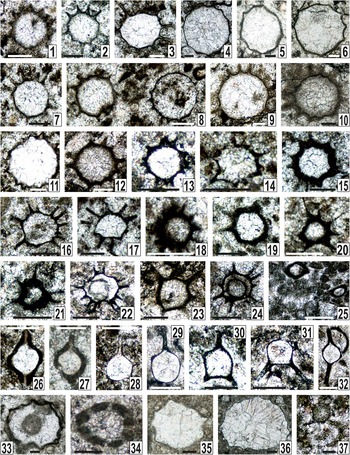
(1, 10) Parathurammina cf. P. uralica Petrova, Reference Petrova1981: (1) sample POL11b-13; (10) sample POL13a-2b. (2) Parathurammina graciosa Pronina, Reference Pronina1960, sample POL11a-21. (3) Bykovaella breviradiosa (Reitlinger, Reference Reitlinger1962), sample POL11b-19b. (4–8) Bykovaella bykovae (Poyarkov in Purkin et al., Reference Purkin, Poyarkov and Rozhanets1961): (4) sample POL13a-5; (5) sample POL13a-6; (6) sample POL13a-8; (7) right, with P. arguta (left), sample POL11b-5; (8) sample POL11b-19. (7, 9, 10) Parathurammina arguta Pronina, Reference Pronina1960; (7) (with Bykovaella bykovae), sample POL11-2; (9) sample POL13a-1; (10) sample POL13a-7. (11) Kolongella cf. K. pojarkovi Zadorozhnyi and Yuferev, Reference Zadorozhnyi and Yuferev1984, sample POL11b-21. (12) Salpingothurammina sp. 1, sample POL13a-3. (13) Ivanovella sp. 1, sample POL11a-9. (14) Ivanovella sp. 2, sample POL11a-10b. (15) Ivanovella sp. 3, sample POL11-5. (16, 17, 22?) Ivanovella reitlingerae n. sp.: (16) holotype, sample POL11a-38; (17) paratype, sample POL11a-40; (22) paratype?, sample POL11a-2. (18, 20, 21) Ivanovella luginensis Zadorozhnyi and Yuferev in Dubatolov, Reference Zadorozhnyi and Yuferev1981: (18) sample POL11b-18a; (20) sample POL11b-21b; (21) sample POL11a-9a. (19) Ivanovella sp. 4, sample POL11a-8. (23) Salpingothurammina cf. S. kakvensis (Petrova, Reference Petrova1981), sample POL13a-3a. (24) Bithurammina aff. B. sphaerica Ektova, Reference Ektova1968, sample POL11a-34. (25) Suleimanovella sp. 2., sample POL4c. (26, 27) Suleimanovella sp. 3: (26) sample POL11b-12; (27) sample POL13b-10. (28–32) Radiosphaerella poyarkovi n. sp.: (28) holotype, sample POL11b-24; (29) paratype, sample POL11a-25a; (30) paratype, sample POL11a-22; (31) paratype, sample POL11a-17; (32) paratype, sample POL11a-11. (33) Marginara? sp., sample POL14-24. (34) Parathuramminites sp., sample POL14-1. (35, 36) Bykovaella cf. B. macilenta (Pronina, Reference Pronina1970): (35) sample POL14-21; (36) sample POL14-20. (37) Vasicekia? sp., sample POL3-6. Scale bars=0.1 mm.

1962 Parathurammina breviradiosa Reference ReitlingerReitlinger, p. 52, pl. 1, figs. 1, 2.
1965 Parathurammina breviradiosa; Reference ChuvashovChuvashov, p. 19, pl. 1, figs. 4–6.
1969 Parathurammina breviradiosa; Reference PoyarkovPoyarkov, table 12.
1969 Parathurammina breviradiosa; Reference MalakhovaMalakhova, pl. 51, fig. 356.
1979 Parathurammina breviradiosa; Reference PoyarkovPoyarkov, pl. 3, fig. 4.
1979 Parathurammina (Parathurammina) breviradiosa; Reference PoyarkovPoyarkov, text-fig. 13.
1981 Parathurammina breviradiosa; Reference PetrovaPetrova, pl. 8, fig. 19.
1981 Parathurammina breviradiosa; Reference ZadorozhnyiZadorozhnyi, p. 111 (no. 3 of the table).
?1981 Parathurammina magna Antropov; Reference ZukalovaZukalova, pl. 1, fig. 2.
1984 Parathurammina breviradiosa; Reference Zadorozhnyi and YuferevZadorozhnyi and Yuferev, p. 77, pl. 1, figs. 1, 2.
1987 Parathurammina breviradiosa; Reference ZadorozhnyiZadorozhnyi, p. 14, pl. 1, figs. 1–3.
1988 Parathurammina breviradiosa; Reference Bogush, Zarodozhnyi and IvanovaBogush et al., p. 22.
1989 Parathurammina dagmarae Suleimanov; Reference Préat and MametPréat and Mamet, pl. 6, fig. 5 only (non figs. 4, 6=Parathuramminites).
1990 Parathurammina breviradiosa; Reference Lin, Li and SunLin et al., p. 124, pl. 3, figs. 1–4.
1990 Parathurammina breviradiosa; Reference Bogush and YuferevBogush and Yuferev, p. 20.
1994 Parathurammina breviradiosa; Reference VachardVachard, text-fig. 12.1.
?1999 Parathurammina du groupe P. dagmarae Suleimanov (= Salpingothurammina breviradiosa [Reitlinger]) (sic); Reference Mamet, Préat and LehmamiMamet et al., pl. 5, figs. 13, 14.
2005 Late Devonian calcisphere; Reference Kaźmierczak and KremerKaźmierczak and Kremer, fig. 6F.
2008 Parathurammina breviradiosa; Reference AnfimovAnfimov, p. 80.
2013 Parathurammina breviradiosa; Reference Makarenko and SavinaMakarenko and Savina, p. 128.
2014 Parathuramminide; Reference MörtlMörtl, text-fig. 33b.
Holotype
Axial section (No. 3456/2 Geological Institute Nauk, Akademiya Nauk SSSR) from the Frasnian of the central Urals, Shezhym oblast, Russia (Reitlinger, Reference Reitlinger1962, pl. 1, fig. 1).
Diagnosis
Relatively moderate species, characterized by a few necks, irregularly arranged, short to medium-sized, with a narrow central channel, and with a distal enlargement. Wall thin.
Occurrence
Eifelian of the Tomsk area (SW Siberia). Givetian of the northern Urals (Petrova, Reference Petrova1981), and perhaps Moravia (Zukalova, Reference Zukalova1981) and Morocco (Mamet et al., Reference Mamet, Préat and Lehmami1999). Late Devonian of Siberia (Zadorozhnyi and Yuferev, Reference Zadorozhnyi and Yuferev1984; Bogush and Yuferev, Reference Bogush and Yuferev1990), Frasnian of the northern Urals, early Famennian of the central Urals (Chuvashov, Reference Chuvashov1965). Late Famennian of SW Siberia (Bogush and Yuferev, Reference Bogush and Yuferev1990). Discovered in the Givetian of Mount Polinik (Carnic Alps, Austria).
Description
Outer diameter=0.20–0.40 mm (type material: 0.20–0.48 mm); inner diameter=0.13–0.41 mm; number of necks: 4–9; length of necks=0.70–0.90 mm (with a wall of 0.007–0.015 mm); test wall thickness=0.003–0.006 mm.
Materials
10 specimens (samples POL11-2 and POL11b-19b).
Bykovaella bykovae (Poyarkov in Purkin et al., Reference Purkin, Poyarkov and Rozhanets1961)
Figure 10.4–10.6, 10.7 (partim), 10.8
?1955 Parathurammina magna Reference Bykova and PolenovaBykova, p. 17, pl. 2, figs. 4, 5, pl. 4, fig. 5.
1961 Thurammina (Salpingothurammina) bykovae Poyarkov in Reference Purkin, Poyarkov and RozhanetsPurkin et al., p. 31, pl. 1, fig. 1 (non fig. 6).
1969 Parathurammina (Salpingothurammina) bykovae; Reference PoyarkovPoyarkov, p. 86, pl. 1, figs. 3–6.
?1971 Parathurammina dagmarae Suleimanov; Reference Flügel and HötzlFlügel and Hötzl, p. 370, fig. 2.1–2.4.
1979 Parathurammina (Salpingothurammina) bykovae; Reference PoyarkovPoyarkov, text-fig. 14.
1979 Parathurammina bykovae (Reference PoyarkovPoyarkov); Reference Lavrusevich, Lavrusevich and SaltovskayaLavrusevich et al., p. 322.
?1981 Parathurammina dagmarae; Reference ZukalovaZukalova, pl. 1, fig. 1.
1984 Bykovaella bykovae; Reference Zadorozhnyi and YuferevZadorozhnyi and Yuferev, p. 80, pl. 1, fig. 6.
1988 Bykovaella bykovae; Reference Bogush, Zarodozhnyi and IvanovaBogush et al., p. 5.
?1994 Parathurammina bykovae; Reference VachardVachard, p. 22, text-fig. 12.1, pl. 2, figs. 1, 2 (with 11 references in synonymy) (see B. cf. B. macilenta).
2002 Bykovaella bykovae; Reference KalvodaKalvoda, text-figs. 11, 12.
?2004 Parathurammina dagmarae; Reference FlügelFlügel, text-fig. 10.24.
2008 Bykovaella bykovae; Reference TsygankoTsyganko, p. 71, text-fig. 3.
2008 Bykovaella bykovella (sic); Reference TsygankoTsyganko, p. 74.
2008 P. bykova (sic) Poyarkov (sic: without parentheses); Reference AnfimovAnfimov, p. 78.
2013 Parathurammina bykovae; Reference Makarenko and SavinaMakarenko and Savina, p. 128.
2013 Parathurammina bykovae; Reference SabirovSabirov, text-fig. 1.
2014 Parathuramminide; Reference MörtlMörtl, text-fig. 33c, 33d.
Holotype
Axial section (No. 3935, VNIGRI) from the Givetian of Makarovskii raion, Russia (Poyarkov in Purkin et al., Reference Purkin, Poyarkov and Rozhanets1961, pl. 1, fig. 1).
Diagnosis
Large species characterized by relatively numerous necks, irregularly arranged. Necks short to long with a broad central channel, and with proximal and distal enlargements. Wall relatively thin.
Occurrence
Eifelian of the Tomsk area (SW Siberia) and the northen Urals. Givetian of Fergana, Tian Shan, Zeravshano-Gissar, SW Siberia, the central Urals, Germany, western and northern France, and ?Moravia. Givetian of Mount Polinik (Carnic Alps, Austria).
Description
Outer diameter=0.23–0.60 mm (type material: 0.28–0.47 mm); inner diameter=0.16–0.55 mm; number of necks: 13–16; length of necks=0.07–0.13 mm (with a wall of 0.015–0.045 mm); test wall thickness=0.013–0.016 mm (type material: 0.012–0.03 mm).
Materials
10 specimens (samples POL11b-5, POL11b-19, POL13a-5, POL13a-6, and POL13a-8).
Remarks
Givetian and Frasnian Parathurammina specimens assigned to P. dagmarae more probably belong to Bykovaella bykovae, whereas true P. dagmarae only appear in the Famennian (Poyarkov, Reference Poyarkov1969, Reference Poyarkov1979).
Bykovaella cf. B. macilenta (Pronina, Reference Pronina1970)
1970 Parathurammina macilenta Reference ProninaPronina, p. 106, pl. 30, fig. 5.
1994 Parathurammina bykovae (Poyarkov); Reference VachardVachard, p. 22, pl. 2, figs. 1, 2.
2013 Parathurammina macilenta; Reference SabirovSabirov, text-fig. 1.
Holotype
Axial section (No. 2/1060; Museum of the Geological Direction of the Urals, UTGU) from the Givetian of the northern Urals, Russia (Pronina, Reference Pronina1970, pl. 30, fig. 5).
Diagnosis
Very large species characterized by relatively numerous papillae, short and irregularly arranged. Wall thin.
Occurrence
Givetian of the central Urals and western France. Givetian of Mount Polinik (Carnic Alps, Austria).
Description
Outer diameter=0.45–0.70 mm (type material: 0.50–0.95 mm); inner diameter=0.36–0.65 mm, number of papillae: 8–14; tests wall thickness=0.006–0.012 mm (type material: 0.015–0.022 mm).
Remarks
Bykovaella turgida (Chuvashov, Reference Chuvashov1965), poorly known, probably belongs to the same group of species.
Materials
Three specimens (samples POL14-20 and POL14-21).
Genus Kolongella Zadorozhnyi in Zadorozhnyi and Yuferev, Reference Zadorozhnyi and Yuferev1984
Type species
Parathurammina kolongensis Pronina, Reference Pronina1969.
Other species
See Zadorozhnyi and Yuferev (Reference Zadorozhnyi and Yuferev1984).
Diagnosis
Test unilocular. Central chamber spherical. Infundibuliform, radiate necks, prominent at the periphery and not communicating with the central chamber. Apertures at the extremities of the necks. Wall dark-microgranular.
Occurrence
Late Silurian–Middle Devonian, eastern slope of the Urals and southwestern Siberia. Late Eifelian of Belgium. Givetian of El Bisani sections (Sonora, Mexico; D.V. unpublished data). Discovered in the early Givetian of the Carnic Alps.
Kolongella cf. K. pojarkovi Zadorozhnyi and Yuferev, Reference Zadorozhnyi and Yuferev1984.
1984 Suleimanovella (Kolongella) pojarkovi Reference Zadorozhnyi and YuferevZadorozhnyi and Yuferev, p. 89, pl. 2, figs. 6, 7.
1985 Suleimanovella (Kolongella) pojarkovi; Reference ZadorozhnyiZadorozhnyi, p. 126, pl. 17, fig. 4, pl. 18, fig. 4.
1987 Suleimanovella (Kolongella) pojarkovi; Reference ZadorozhnyiZadorozhnyi and Yuferev in Zadorozhnyi, p. 27, pl. 2, figs. 9–11.
1988 Suleimanovella (Kolongella) pojarkovi; Reference Bogush, Zarodozhnyi and IvanovaBogush et al., p. 31.
1990 Suleimanovella (Kolongella) pojarkovi; Reference Bogush and YuferevBogush and Yuferev, p. 21.
2008 Parathurammina pojarkovi; Reference AnfimovAnfimov, p. 78.
2009 Parathurammina du groupe P. dagmarae Suleimanov; Reference Mamet and PréatMamet and Préat, fig. 1.13 (non fig. 1.11, 1.12, 1.14–1.17=Bykovaella spp.).
2009 Parathurammina crassitheca Antropov; Reference Mamet and PréatMamet and Préat, fig. 1.18 (non fig. 1.19=Parathurammina uralica).
?2013 Parathurammina aff. pojarkovi (Reference Zadorozhnyi and YuferevZadorozhnyi and Yuferev); Reference Makarenko and SavinaMakarenko and Savina, p. 128.
Holotype
Axial section (No. 619/18; Geological Institute of Novosibirsk) from the Givetian of Tomsk oblast, SW Siberia, Russia (Zadorozhnyi and Yuferev, Reference Zadorozhnyi and Yuferev1984, pl. 2, fig. 6).
Diagnosis
Moderate species characterized by numerous short necks (17), irregularly arranged. Wall relatively thin.
Occurrence
Eifelian of SW Siberia. Givetian of SW Siberia and the central Urals. Late Eifelian of Belgium. Givetian of Mount Polinik (Carnic Alps, Austria).
Description
Outer diameter=0.32 mm (type material: 0.13–0.28 mm); inner diameter=0.29 mm; number of necks: 17; test wall thickness=0.007 mm (type material: 0.004-0.012 mm).
Materials
Three specimens (sample POL11-21).
Genus Bithurammina Miklukho-Maklay, Reference Miklukho-Maklay1965 non 1963
Type species
Bithurammina dagmarae Miklukho-Maklay, Reference Miklukho-Maklay1965 (= Parathrammina? aff. P. dagmarae Grozdilova and Lebedeva, Reference Grozdilova and Lebedeva1954).
Other species
Bithurammina sphaerica Ektova, Reference Ektova1968; ?B. angulata Kotlyar, Reference Kotlyar1982.
Diagnosis
Test bilocular (or unilocular with daughter-cell?). Inner chamber and outer chamber spherical, similar to Parathurammina ex gr. dagmarae, with radiate, papilliform protuberances. No apertures at the inner chamber, apertures of outer chamber at extremity of each neck. Wall dark-microgranular, but possibly bilayered as in Parathurammina.
Occurrence
Late Early Devonian of northern Spain (Vachard, Reference Vachard1991). Givetian of Vietnam (Doan in Tong et al., Reference Tong, Dang, Nguyen, Nguyen, Nguyen, Nguyen, Ta, Pham and Doan1988), Zeravshano-Gissar (Lavrusevich et al., Reference Lavrusevich, Lavrusevich and Saltovskaya1979), and Austria (this paper). Late Devonian of the Pre-Urals, Urals, Russian Platform, Tajikistan and Kyrgyzstan, ?Famennian of Ukraine, ?Tournaisian of NW Mexico (as Foraminifera? sensu Brunner, Reference Brunner1976, pl. 4, fig. 9) and SW Siberia (Kazennov et al., Reference Kazennov, Bogush and Benediktova1975, pl. 1, figs. 13, 14).
Remarks
As defined by its type species, Bithurammina is probably a development stage of Parathurammina sensu stricto; however, some other atypical species of Bithurammina can entail the same stages in the genus Salpingothurammina; as, for example, B. sphaerica Ektova, Reference Ektova1968 and the material described herein; whereas other ones, like B. angulata Kotlyar, Reference Kotlyar1982, are more difficult to interpret. These stages of development are apparently opposed to assignment of the parathuramminids to the foraminifers, but are more consistent with daughter-cells of volvocales evokated by Kaźmierczak (Reference Kaźmierczak1976).
Bithurammina aff. B. sphaerica Ektova, Reference Ektova1968
?1968 Bithurammina sphaerica Reference EktovaEktova, p. 98, pl. 34, figs. 2–4.
2016a Bithurammina? sp.; Reference VachardVachard, fig. 3.29.
Holotype
Axial section (No. 1-3a/8283.Ts.GM, Leningrad/Sankt Petersburg) from the the Famennian of Kok-Shaal, Kyrgyzstan (Ektova in Markosvskyi, Reference Ektova1968, pl. 34, fig. 2).
Diagnosis
Test unilocular. Inner chamber apparently spherical. Outer chamber spherical with radiate necks, prominent at the periphery and communicating with the outer chamber. Inconspicuous apertures at the inner chamber. Wall relatively thin.
Occurrence
Famennian of the Kok Shaal Range (Kyrgyzstan). Givetian of Mount Polinik (Carnic Alps, Austria).
Description
Test outer diameter=0.20 mm (type material: 0.14–0.16 mm); inner chamber diameter=0.07 mm (type material=0.07–0.08 mm); test wall thickness=0.007 mm (type material: 0.006–0.011 mm).
Materials
Three specimens (samples POL11a-34, ?POL14-7, ?POL14-33).
Subfamily Parathuramminitinae Antropov, Reference Antropov1970
Diagnosis
Test free, globular to polygonal, with few or fairly abundant, papillate prominences; thick to medium-sized, wall dark-microgranular, unilayered wall. One areal aperture at the end of each projection.
Occurrence
Late Silurian–Mississippian; probably cosmopolitan.
Remarks
Parathuramminitinae is a senior synonym of Cushmanellinae Yuferev, Chuvashov, and Zadorozhnyi in Zadorozhnyi and Yuferev, Reference Zadorozhnyi and Yuferev1984. It is composed of the following genera: Parathuramminites Antropov in Poyarkov, Reference Poyarkov1969; Salpingothurammina Poyarkov in Purkin et al., Reference Purkin, Poyarkov and Rozhanets1961 (= Saltovskajina Sabirov, Reference Sabirov1982b); Suleimanovella Yuferev in Zadorozhnyi and Yuferev, Reference Zadorozhnyi and Yuferev1984; Radiosphaerella Yuferev in Zadorozhnyi and Yuferev, Reference Zadorozhnyi and Yuferev1984; and ?Polygonella Yuferev in Zadorozhnyi and Yuferev, Reference Zadorozhnyi and Yuferev1984.
Genus Parathuramminites Antropov in Poyarkov, Reference Poyarkov1969
Type species
Parathurammina cushmani Suleimanov, Reference Suleimanov1945.
Other species
Parathurammina cushmani var. minima Antropov, Reference Antropov1950; P. clivosa Pronina, Reference Pronina1963; P. devonica Vissarionova, Reference Vissarionova1950; P. insolita Sabirov, Reference Sabirov1978; P. kolongensis Pronina, Reference Pronina1969; P. (Parathuramminites) micula Petrova, Reference Petrova1981; P. monstrata Chuvashov, Reference Chuvashov1965; P. obnata Chuvashov, Reference Chuvashov1965; P. polygona Pronina, Reference Pronina1963; P. regularis Chuvashov, Reference Chuvashov1965; P. suleimanovi forma concisa Chuvashov, Reference Chuvashov1965; Parathuramminites mutilatus Anfimov, Reference Anfimov2012; P. stellaeformis Anfimov, Reference Anfimov2012 nom. correct. (sic: stelliformis); P. subrus Anfimov, Reference Anfimov2012; P. minutus Anfimov, Reference Anfimov2012; ?Parathurammina crassa Pronina, Reference Pronina1970; ?P. guangxiensis Lin, Li, and Sun, Reference Lin, Li and Sun1990; ? P. praetuberculata Reitlinger, Reference Reitlinger1954; ?Thurammina delicata Ireland, Reference Ireland1939.
Diagnosis
Test free, globular to polygonal, with few papillate prominences, almost not prominent; thick wall dark-microgranular. One areal aperture at the end of each projection.
Occurrence
Late Silurian–Mississippian; probably cosmopolitan.
Remarks
Parathuramminites is sometimes attributed to Antropov, 1967, but this publication in reality was published in 1970 (see Vdovenko et al., Reference Vdovenko, Rauzer-Chernousova, Reitlinger and Sabirov1993). Between 1967 and 1970, the genus name was validly introduced by Poyarkov (Reference Poyarkov1969), who correctly attributed it to Antropov; hence, the taxonomy adopted herein is: Parathuramminites Antropov in Poyarkov, Reference Poyarkov1969. It corresponds to Parathurammina (partim), Cushmanella Zadorozhnyi in Zadorozhnyi and Yuferev, Reference Zadorozhnyi and Yuferev1984 (this latter genus has the same type species as Parathuramminites and moreover it is pre-occupied; see Loeblich and Tappan, Reference Loeblich and Tappan1987), Salpingothurammina Poyarkov in Purkin et al., Reference Purkin, Poyarkov and Rozhanets1961 (partim), and Saltovskajina Sabirov, Reference Sabirov1982b (partim).
Parathuramminites? sp.
Diagnosis
Test ovoid, without prominences with necks limited to the thickness of the wall.
Occurrence
Givetian of Mount Polinik (Carnic Alps, Austria).
Description
Outer diameter=0.22 mm; inner diameter=0.16 mm; number of necks: 8; diameter of apertures: 0.017 mm; test wall thickness=0.03 mm.
Remarks
This form resembles some illustrations of Parathuramminites cushmani, but apparently differs from the holotype of this species.
Materials
Two specimens (sample POL14-1).
Genus Suleimanovella Yuferev in Zadorozhnyi and Yuferev, Reference Zadorozhnyi and Yuferev1984
Type species
Parathurammina suleimanovi Lipina, Reference Lipina1950.
Other species
Parathurammina ovalis Brazhnikova and Vdovenko, Reference Brazhnikova and Vdovenko1971; P. paulis Bykova, Reference Bykova1952; Suleimanovella (Kolongella) pojarkovi Zadorozhnyi and Yuferev, Reference Zadorozhnyi and Yuferev1984; P. quadrata Brazhnikova and Vdovenko, Reference Brazhnikova and Vdovenko1971; P. suleimanovi var. stellata Lipina, Reference Lipina1950; P. (Salpingothurammina) totaensis Petrova, Reference Petrova1981; P. triangula Brazhnikova and Vdovenko, Reference Brazhnikova and Vdovenko1971; ?Thurammina minuscula Pokorny, Reference Pokorny1951, and ?T. strikeri Conkin and Conkin, Reference Conkin and Conkin1964.
Diagnosis
Small-sized Parathuramminidae with a very irregular angular profile, a spherical cavity, fairly abundant papilliform protuberances, very short canals, and a thick, dark-microgranular wall.
Occurrence
Devonian–Mississippian, cosmopolitan.
Remarks
Suleimanovella morphologically and microstructurally corresponds to Parathurammina (partim), P. (Salpingothurammina) (partim), P. (Parathuramminites) (partim), and Suleimanovella (Kolongella) (partim).
The subgenus Kolongella of Suleimanovella was rarely described, but probably really exists (see this work and Mamet and Préat, Reference Mamet and Préat2009 as Parathurammina crassitheca [pl. 1, figs. 18, 19]).
Suleimanovella cf. S. totaensis (Petrova, Reference Petrova1981)
1981 Parathurammina (Salpingothurammina) totaensis Reference PetrovaPetrova, p. 88, pl. 8, figs. 7, 10, 11, 15.
?1981 Palachemonella beckmanni Flügel and Hötzl; Reference Zadorozhnyi and YuferevZadorozhnyi and Yuferev, p. 55, pl. 1, fig. 7.
1985 Suleimanovella (Suleimanovella) totaensis; Reference ZadorozhnyiZadorozhnyi, p. 126, pl. 17, fig. 11.
?1988 Palachemonella beckmanni; Reference Bogush, Zarodozhnyi and IvanovaBogush et al., p. 21.
1990 Suleimanovella (Suleimanovella) totaensis; Reference Bogush and YuferevBogush and Yuferev, p. 21.
2008 Parathurammina totaensis; Reference AnfimovAnfimov, p. 78.
2013 Parathurammina totaensis; Reference Makarenko and SavinaMakarenko and Savina, p. 128.
Holotype
Axial section (No. 35/1868; Museum UTGU) from the Eifelian of the northern Urals, Russia (Petrova, Reference Petrova1981, pl. 8, fig. 7).
Diagnosis
Triangular test with triangular inner chamber. Some necks are ended by rounded parts, and are apparently blind (see also Irregularina angulata Poyarkov, Reference Poyarkov1969, pl. 3, fig. 6).
Occurrence
Eifelian of the central and northern Urals. Eifelian, Givetian, and Frasnian of Tomsk oblast (SW Siberia). Givetian of Mount Polinik (Carnic Alps, Austria).
Description
Outer diameter=0.13 mm (type material: 0.10–0.18 mm); inner diameter=0.05 mm (type material: 0.06–0.09 mm); test wall thickness=0.01 mm (type material=0.01 mm).
Diagnosis
Rhomboidal to subspherical tests, rhombic to ovate inner chamber. Very short prominences.
Occurrence
Givetian of Mount Polinik (Carnic Alps, Austria).
Description
Outer diameter=0.07–0.08 mm; inner diameter=0.04–0.05 mm; test wall thickness=0.01 mm.
Diagnosis
Subrhombic to ovate tests and inner chambers. Slightly prominent necks relatively well-developed for the genus (morphologically, this taxon is possibly transitional between Suleimanovella and Salpingothurammina, due to its necks).
Occurrence
Givetian of Mount Polinik (Carnic Alps, Austria).
Description
Outer diameter=0.15–0.17 mm; inner diameter=0.08–0.10 mm; wall thickness=0.01 mm.
Materials
Five specimens (samples POL11b-12 and POL13b-10).
Genus Salpingothurammina Poyarkov in Purkin et al., Reference Purkin, Poyarkov and Rozhanets1961
Type species
Parathurammina tuberculata Lipina, Reference Lipina1950.
Other species
?Parathurammina bella Reitlinger in Bogush and Yuferev, Reference Bogush and Yuferev1962; P. (Salpingothurammina) elegans Poyarkov, Reference Poyarkov1969; P. gekkeri Antropov, Reference Antropov1950; P. horrida Chuvashov, Reference Chuvashov1965; P. hunanensis Lin and Hao, Reference Lin and Hao1982; P. ivdelensis Pronina, Reference Pronina1970; P. kazankaensis Pronina, Reference Pronina1970; P. lipinae Antropov, Reference Antropov1950; P. miklukhomaclayi Saltovskaya, Reference Saltovskaya1974; P. pachysphaerica Bogush and Yuferev, Reference Bogush and Yuferev1962; P. paratuberculata Zadorozhnyi and Yuferev in Dubatolov, Reference Chuvashov and Yuferev1981; P. scitula Chuvashov, Reference Chuvashov1965; P. shishkatica Sabirov, Reference Sabirov1978; P. spinosa Lipina sensu Grozdilova and Lebedeva Reference Grozdilova and Lebedeva1954; P. spinosa kakvensis Petrova, Reference Petrova1981; P. stellaeformis Grozdilova and Lebedeva, Reference Grozdilova and Lebedeva1954; P. subquadrata Sabirov, Reference Sabirov1978; P. subvasta Bykova in Bykova and Polenova, Reference Bykova and Polenova1955; P. tansaica Marfenkova, Reference Marfenkova1991 (nomen nudum); ?Thurammina congesta Gutschick, Weiner, and Young, Reference Gutschick, Weiner and Young1961; ?T. coronata Dunn, Reference Dunn1942; T. diforamens Ireland, Reference Ireland1956; ?T. furcata Gutschick and Treckman, Reference Gutschick and Treckman1959; ?T. phialaeformis Crespin, Reference Crespin1958; ?T. quadritubulata Dunn, Reference Dunn1942; ?T. triradiata Gutschick and Treckman, Reference Gutschick and Treckman1959; ?T. tubulata fixa Langer, Reference Langer1969; ?T. sp. A sensu Blumenstengel, Reference Blumenstengel1961; ?T. sp. B sensu Blumenstengel, Reference Blumenstengel1961; ?T. sp. 1 sensu Holcová, Reference Holcová2004; ?T. sp. 2 sensu Holcová, Reference Holcová2004; and ?Pseudoastrorhiza obtusiconus Langer, Reference Langer1969.
Diagnosis
Medium-sized Parathuramminidae with an irregular angular–rounded profile, fairly abundant papilliform to longer apertural protuberances, broad chamber, and thickness of the wall and around the necks is almost equidimensional. Wall thin to thick, unilayered, dark-microgranular.
Occurrence
Early Ordovician of Sonora, Mexico (Vachard et al., Reference Vachard, Clausen, Palafox, Buitrón, Devaere, Hayart and Régnier2017). Relatively frequent in the Devonian–Tournaisian of western Siberia, Italy, Czech Republic, western France, the northern, central, and southern Urals, and southern Fergana; probably up to the Visean (see Vachard et al., Reference Vachard, Haig and Mory2014); ?Pennsylvanian of Kansas, ?Permian of Australia.
Remarks
See discussions in Loeblich and Tappan (Reference Loeblich and Tappan1987), Vdovenko et al. (Reference Vdovenko, Rauzer-Chernousova, Reitlinger and Sabirov1993), and Vachard et al. (Reference Vachard, Haig and Mory2014). The differences with Saltovskajina seem to be specific and not generic; hence, we synonymized both genera herein. In the literature, Salpingothurammina was designated under the names Saltovskajina Sabirov, Reference Sabirov1982b; Parathurammina (partim); Thurammina (partim) auctorum; Irregularina (partim); Polygonella (partim); Bykovaella (partim); Ivanovella (partim); Guangxithurammina Lin et al., Reference Lin, Li and Sun1990 (partim); Suleimanovella (partim); Parathuramminites (partim); Cordatella (partim), Marginara (partim); and Radiosphaerella (partim).
Salpingothurammina sp. 1
Diagnosis
Test spherical with numerous, radiate, triangular necks, wall thick.
Occurrence
Givetian of Mount Polinik (Carnic Alps, Austria).
Description
Outer diameter=0.36 mm; inner diameter=0.18 mm; number of necks: 13; test wall thickness=0.02 mm.
Materials
Two specimens (sample POL13a-13).
Salpingothurammina cf. S. kakvensis (Petrova, Reference Petrova1981)
1981 Parathurammina spinosa kakvensis Reference PetrovaPetrova, p. 87, pl. 6, figs. 8, 9.
1990 Parathurammina spinosa kakvensis; Reference Bogush and YuferevBogush and Yuferev, p. 21.
?1999 Parathurammina gekkeri Antropov; Reference Mamet, Préat and LehmamiMamet et al., pl. 5, fig. 12.
2002 Salpingothurammina spinosa kakvensis; Reference KalvodaKalvoda, text-figs. 11, 12.
2008 Parathurammina kakvensis; Reference AnfimovAnfimov, p. 78.
2011 Parathurammina kakvensis; Reference AnfimovAnfimov, p. 16.
Holotype
Axial section (No. 7/1868; UTGU Museum) from the Middle Devonian of the central Urals (Petrova, Reference Petrova1981, pl. 1, fig. 8).
Diagnosis
Small species characterized by 5–6 long necks, irregularly arranged. Wall relatively thin.
Occurrence
?Early Eifelian–Givetian of SW Siberia and the central and northern Urals. ?Givetian of Morocco. Givetian–Frasnian of SW Siberia. Givetian of Mount Polinik (Carnic Alps, Austria).
Description
Outer diameter=0.26 mm (type material: 0.12–0.15 mm); inner diameter=0.12 mm; number of necks: 5–6; test wall thickness=0.015–0.03 mm.
Materials
Three specimens (sample POL13a-3a).
Genus Radiosphaerella Yuferev in Zadorozhnyi and Yuferev, Reference Zadorozhnyi and Yuferev1984
Type species
Parathurammina radiosphaerica Bogush and Yuferev, Reference Bogush and Yuferev1962.
Other species
Parathurammina radiata Antropov, Reference Antropov1950; P. spinosa Lipina, Reference Lipina1950; P. tuberculata sensu Poyarkov, Reference Poyarkov1969; ?Palachemonella beckmanni sensu Zadorozhnyi and Yuferev in Dubatolov, Reference Zadorozhnyi and Yuferev1981 non Flügel and Hötzl, Reference Flügel and Hötzl1971.
Diagnosis
Medium-sized Parathuramminidae with very thin wall and very long necks, wall unilayered dark-microgranular.
Occurrence
Eifelian of the Tomsk area, SW Siberia (Makarenko and Savina, Reference Makarenko and Savina2013). Givetian of Austria (this study). Givetian–Frasnian of South China. Givetian–Tournaisian of Tian Shan (Kyrgyzstan). Frasnian–Famennian of Poland, eastern part of Russian Platform, the Urals, SW Siberia, and southern Fergana. Late Devonian–Tournaisian of western and northeastern Siberia (Gagiev and Bogush, Reference Gagiev and Bogush1990).
Remarks
Radiosphaerella has been designated as Parathurammina (partim); Salpingothurammina (partim); Suleimanovella (partim); Archaelagena Howchin, Reference Howchin1888 (partim); and acritach sensu Kaźmierczak and Kremer, Reference Kaźmierczak and Kremer2005, fig. 6D.
Radiosphaerella poyarkovi new species
urn:lsid:zoobank.org:act:F5040BBB-AA4E-43FB-AD04-3D110B66FAF8
?1954 Archaelagena shesmae (Antropov); Reference Grozdilova, Lebedeva, Lipina, Malakhova, Mikhailova, Chermnykh, Postoyalko, Simonova, Sinitsyna and ShcherbakovaGrozdilova and Lebedeva, p. 27, pl. 2, fig. 6.
?1960 Archaelagena borealis (sic borealia) Reference ProninaPronina, p. 52, pl. 1, fig. 12.
?1969 Parathurammina (Salpingothurammina) tuberculata Lipina; Reference PoyarkovPoyarkov, p. 94, pl. 2, fig. 4.
1969 Archaelagena shesmae (Antropov); Reference PoyarkovPoyarkov, p. 137, table 66, pl. 8, figs. 2–4.
1969 Archaelagena borealis (sic borealia); Reference PoyarkovPoyarkov, p. 138, table 66, pl. 8, figs. 5, 6.
1979 Archaelagena shesmae; Reference PoyarkovPoyarkov, pl. 4, fig. 8.
?1982 Parathurammina horrida Chuvashov; Reference Lin and HaoLin and Hao, p. 93, pl. 1, fig. 2.
?1982 Parathurammina paulis Bykova; Reference Lin and HaoLin and Hao, p. 93, pl. 1, figs. 10, 11.
1988 Archaelagena shesmae; Doan in Reference Tong, Dang, Nguyen, Nguyen, Nguyen, Nguyen, Ta, Pham and DoanTong et al., p. 144, pl. 1, fig. 2.
?1999 Parathurammina spinosa (Williamson, Reference Williamson1880) (= Parathurammina spinosa Lipina) (sic); Reference Mamet, Préat and LehmamiMamet et al., pl. 5, fig. 11.
Holotype
Fig. 10.28 (POL11b-24); Institute of Geology, University of Innsbruck, Cat. Nr. P 10140-POL 11b (thin section); Givetian Feldkogel Limestone (Polinik Formation) of Mount Polinik (Austria).
Diagnosis
A species of Radiosphaerella characterized by a few necks communicating with each angle of the subpentagonal inner chamber.
Occurrence
?Eifelian–early Givetian of the Urals. ?Givetian of Morocco. Givetian and Frasnian of southern Fergana. Frasnian of Vietnam. Famennian of Russian Platform. Discovered in the Givetian of Mount Polinik (Carnic Alps, Austria).
Description
Outer diameter=0.10–0.17 (0.35 mm); inner diameter=0.07–0.11 mm; number of necks: 1–4 (5?); test wall thickness=0.007–0.01 mm.
Etymology
Named in honor of B.V. Poyarkov.
Materials
10 specimens (samples POL11a-11, POL11a-17, POL11a-22, POL11b-24, POL11a-25a).
Remarks
Differs from Parathurammina radiosphaerica by fewer necks (up to seven for P. radiosphaerica) for similar measurements.
?Family Marginaridae Loeblich and Tappan, Reference Loeblich and Tappan1986
Diagnosis
Test globular, with numerous papilliform protuberances at surface. Trilayered wall with a diaphanothecal (?) median layer. Apertures at the end of the protuberances.
Occurrence
Givetian–Famennian of the former SSSR.
Remarks
Only two genera are included in this family: Marginara Petrova in Zadorozhnyi and Yuferev, 1984, and Cordatella Petrova in Zadorozhnyi and Yuferev, 1984.
Genus Marginara Petrova in Zarodzhonyi and Yuferev, 1984
Type species
Parathurammina tamarae Petrova, Reference Petrova1981.
Diagnosis
Parathuramminid-like tests with three layers in the wall.
Occurrence
Givetian of the former SSSR.
Remarks
The initial name Marginarae Petrova in Zarodzhonyi and Yuferev, 1984, which is a Latin plural, was emended according to the International Commission on Zoological Nomenclature (ICZN, 1999, article 11), which asks for singular names, into Marginara by Loeblich and Tappan (Reference Loeblich and Tappan1986, Reference Loeblich and Tappan1987). The original microstructure is discussed, in relation to specimens recrystallized to apatite-quartz (Chuvashov et al., Reference Chuvashov, Anfimov, Soroka and Yaroslavtseva2012) in the late Eifelian–Givetian of the central Urals.
Marginara? sp.
Diagnosis
Large species (the maximal diameter of M. tamarae is 0.60 mm; Zadorozhnyi, Reference Zadorozhnyi1987).
Occurrence
Givetian of Mount Polinik (Carnic Alps, Austria).
Description
Outer diameter=0.70 mm; inner diameter=0.60 mm; number of necks: 13; test wall thickness=0.05 mm. A spherical inclusion/chamber measures 0.25 mm in diameter.
Materials
Two specimens (sample POL14-24).
Superfamily Irregularinoidea Gaillot and Vachard, Reference Gaillot and Vachard2007
Diagnosis
Globular to elongate and lobate tests medium- to large-sized for parathuramminids. Wall dark-microgranular, very rarely bilayered with an inner hyaline-microgranular layer (latest Famennian–Tournaisian Bisphaeridae; see for example Herbig and Mamet, Reference Herbig and Mamet2006, pl. 3, fig. 6). More complex wall microstructures (Auroriidae) are not well understood. Very fine to coarse, numerous apertures through the wall (Uslonia; Cribrosphaeroides), or a supposed terminal aperture (Apertauroria).
Occurrence
Llandoverian of central and northern Urals–early Tournaisian; genera either cosmopolitan or restricted to the Tethys and Ural oceans. As mentioned above, we reject the assignment of the middle Permian Bisphaera? improvisa to the irregularinoids.
Remarks
The superfamily is composed of five families: Irregularinidae Zadorozhnyi and Yuferev, Reference Zadorozhnyi and Yuferev1984; Usloniidae Conil and Longerstaey in Conil et al., Reference Conil, Longerstaey and Ramsbottom1980; Cribrosphaeroididae Sabirov in Zadorozhnyi and Yuferev, Reference Zadorozhnyi and Yuferev1984 nom. correct. Sabirov, Reference Sabirov1987b; Auroriidae Loeblich and Tappan, Reference Loeblich and Tappan1986; and Bisphaeridae Sabirov, Reference Sabirov1987b. The irregularinoid genus Bisphaera Birina, Reference Birina1948 was recently synonymized with the algal or cyanobacterial genus Thaumatoporella Pia (Schlagintweit et al., 2013), as well as the radiolarian Trochodiscus Haeckel (Afanavieva and Amon, 2011). The discussions about this genus and the irregularinoids in general are therefore very difficult. Middle Permian Bisphaera? improvisa Nestell and Nestell, Reference Nestell and Nestell2006, as indicated by these authors, is questionable; in our opinion, it corresponds more to the “Algen Sporen” or cortoid grains described by Flügel (Reference Flügel2004). Similarly, some Parastegnammina or Corbiella are other cortoid grains (see Vachard, Reference Vachard1994), whereas some “Irregularina” sensu Schlagintweit et al., 2013 correspond more to fenestrae and other microcavities.
Family Usloniidae Conil and Longerstaey in Conil et al., Reference Conil, Longerstaey and Ramsbottom1980
Subfamily Usloniinae Miklukho-Maklay, Reference Miklukho-Maklay1963
Diagnosis
Test relatively large, elongate, irregular, sometimes ramified, with more or less coarsely perforated, dark-microgranular wall.
Occurrence
Early Devonian–Frasnian (first, Uralian–Tethyan; then, cosmopolitan during the Frasnian).
Remarks
Synonyms of Usloniinae are: Groupe 4 sensu Vachard, Reference Vachard1976; Cribrosphaerinae Zadorozhnyi and Yuferev, Reference Zadorozhnyi and Yuferev1984 (partim); Irregularininae Zadorozhnyi and Yuferev, Reference Zadorozhnyi and Yuferev1984 (partim, and nomen correctum herein for Irregularinae); Irregularinidae Zadorozhnyi and Yuferev, Reference Zadorozhnyi and Yuferev1984 sensu Vachard, Reference Vachard1991 and Reference Vachard1994 (partim); and Kalijanellinae Zadorozhnyi and Yuferev, Reference Zadorozhnyi and Yuferev1984.
Genus Uslonia Antropov, Reference Antropov1959
Type species
Uslonia permira Antropov, Reference Antropov1959.
Other species
Uslonia permira (sic: Uslonia polymorpha in Miklukho-Maklay, Reference Miklukho-Maklay1965); Cribrosphaera novita Pronina, Reference Pronina1960; Uslonia orientalis Miklukho-Maklay, Reference Miklukho-Maklay1965 not 1963; Vermiporella myna Wray, Reference Wray1967; Kalijanella incomposita Petrova, Reference Petrova1981; Kalijanella karpinensis karpinensis Petrova, Reference Petrova1981; and K. karpinensis giganteus Petrova, Reference Petrova1981.
Diagnosis
Test elongate, free or temporarily attached. Slightly undulating wall with two or three large necks with an aperture at each extremity. Wall dark-microgranular, porous.
Occurrence
Eifelian and Givetian of the western slope of the northern and central Urals, Russian Platform, eastern and western slopes of the southern Urals and western Siberian Platform. Shandinsky horizon of Salair (SW Siberia). Givetian of Belgium (Mamet and Préat, Reference Mamet and Préat2009), western France (Milon, Reference Milon1928; Vachard, Reference Vachard1994), Germany (Flügel and Hötzl, Reference Flügel and Hötzl1971; May, Reference May1992; Kröck, Reference Kröck2016), Poland (Racki and Soboń-Podgórska, Reference Racki and Soboń-Podgórska1993), and Morocco (Mamet et al., Reference Mamet, Préat and Lehmami1999). Discovered in the Givetian of the Carnic Alps (Austria). Middle–Late Devonian of West Canada (Toomey et al., Reference Toomey, Mountjoy and MacKenzie1970). Late Devonian of the Urals, eastern part of Russian Platform, Kazakhstan (Kara Tau), Kok-Shaal, southern Fergana, Norilsk area, southwestern Siberia, former “central Asia” (Turkmenistan), England, ?Italy, South China and Australia (Wray, Reference Wray1967). The specimen from the late Famennian of Omolon (NE Siberia), illustrated by Conil in Shilo et al. (Reference Shilo, Bouckaert, Afanasjeva, Bless, Conil, Erlanger, Gagiev, Lazarev, Onoprienko, Poty, Razina, Simakov, Smirnova, Streel and Swennen1984, pl. 16, fig. 1), is most probably an Irregularina or a deformed Bisphaera, as well as the Uslonia sp. of Brunner (Reference Brunner1975, p. 23, pl. 2, fig. 7), as well as that of Mamet (Reference Mamet1976, pl. 57, figs. 3, 4). Unlike Loeblich and Tappan (Reference Loeblich and Tappan1987), the earliest Serpukhovian genus Pachythurammina Vachard, Reference Vachard1977, totally differs by its spherical morphology, much smaller size, and calcisphaerid wall.
Remarks
Uslonia may be synonymized with “Calcisphères” sensu Milon, Reference Milon1928 (partim); Vermiporella auctorum (partim); Kalijanella Petrova, Reference Petrova1981; Cribrosphaeroides sensu Chuvashov, Reference Chuvashov1965 (partim), Flügel and Hötzl, Reference Flügel and Hötzl1971 (partim), Mamet et al., Reference Mamet, Préat and Lehmami1999, Timokhina and Klets (Reference Timokhina and Klets2002), and Anfimov, Reference Anfimov2008 (partim); Kaljanella (sic) sensu Anfimov, Reference Anfimov2008 and Reference Anfimov2011; and Cribrosphaeroides? sensu Mamet and Préat, Reference Mamet and Préat2013. Uslonia is clearly a junior synonym of Kalijanella due to its Givetian age, elongate and irregular shape, and coarse perforated dark-microgranular wall. Recently, Kalijanella was generally used (e.g., Vachard, Reference Vachard1994; Anfimov, Reference Anfimov2008, Reference Anfimov2011), but Uslonia was re-introduced, with good reason, by Mamet and Préat (Reference Mamet and Préat2009, pl. 5, fig. 5). Misinterpretions about Uslonia probably resulted in the fact that this genus was indicated with “no aperture observed” by Loeblich and Tappan (Reference Loeblich and Tappan1987), while this genus was synonymized with Cribrosphaeroides sensu Chuvashov (Reference Chuvashov1965) by Zadorozhnyi (Reference Zadorozhnyi1987). Uslonia, Corbiella Antropov, Reference Antropov1950, and Parastegnammina Poyarkov, Reference Poyarkov1969 were erroneously interpreted as cortoid grains by Vachard (Reference Vachard1994). If Parastegnammina really is a cortoid, Uslonia and Corbiella are two skeletons and probably synonyms of Kalijanella and Irregularina Vissarionova, Reference Vissarionova1950, respectively. Uslonia sensu Brunner (Reference Brunner1975, pl. 2, fig. 7) also differs from true Uslonia and are probably synonymous of Irregularina cf. I. karlensis illustrated on the same plate (Brunner, Reference Brunner1975, pl. 2, fig. 2). The reconstruction in 3D of Racki and Soboń-Podgórska (Reference Racki and Soboń-Podgórska1993, text fig. 1) was puzzling and surrealistic. As indicated by Mamet and Préat (Reference Mamet and Préat2009), the Devonian Vermiporella, especially, V. myna Wray, Reference Wray1967, in reality belongs to Uslonia, a genus that, in our opinion, has nothing in common with Vermiporella.
Uslonia cf. U. incomposita (Petrova, Reference Petrova1981)
?1971 Cribrosphaeroides simplex (Reitlinger); Reference Flügel and HötzlFlügel and Hötzl, pl. 1, fig. 7 (only).
1981 Kalijanella incomposita Reference PetrovaPetrova, p. 90, pl. 11, figs. 1–5.
1987 Kalijanella incomposita; Reference ZadorozhnyiZadorozhnyi, p. 40, pl. 3, fig. 9.
1987 Pachythurammina incomposita; Reference Loeblich and TappanLoeblich and Tappan, p. 192, pl. 209, figs. 5, 6.
1993 Kalijanella incomposita; Sabirov in Reference Vdovenko, Rauzer-Chernousova, Reitlinger and SabirovVdovenko et al., p. 35, pl. 7, fig. 3.
2011 Kaljanella (sic) incomposita; Reference AnfimovAnfimov, p. 78.
2016a Uslonia sp.; Reference VachardVachard, fig. 3.34.
Holotype
Axial section (No. 77/1868; UTGU Museum) from the Middle Devonian of the central Urals (Petrova, Reference Petrova1981, pl. 1, fig. 1).
Diagnosis
Our specimen is similar to that illustrated by Zadorozhnyi (Reference Zadorozhnyi1987, pl. 3, fig. 9), by its measurements, more than to the type material of Petrova (Reference Petrova1981).
Occurrence
Eifelian–Givetian of the northern and central Urals. Shandinsky horizon of Salair (SW Siberia). Givetian of Germany. Discovered in the Givetian of Mount Polinik (Carnic Alps, Austria).
Description
Test length=0.70 mm (type material: 0.38–1.20 mm); outer diameter=0.45 mm; test wall thickness=0.04 mm (type material: 0.012–0.045 mm).
Materials
One specimen (sample POL13b-12).
Family Cribrosphaeroididae Sabirov in Zadorozhnyi and Yuferev, Reference Zadorozhnyi and Yuferev1984 nom. correct. Sabirov, Reference Sabirov1987b
Diagnosis
Test relatively large, globular with more or less coarsely perforated, dark-microgranular wall.
Occurrence
Silurian–Tournaisian and Uralian–Tethyan.
Remarks
The following taxa are synonyms of the family Cribrosphaeroidae: Stegnammininae Moreman, Reference Moreman1930 (partim); Bisphaeridae Sabirov, Reference Sabirov1987b (partim); Cribrosphaeridae Sabirov in Zadorozhnyi and Yuferev, Reference Zadorozhnyi and Yuferev1984; and Cribrosphaerinae Zadorozhnyi and Yuferev, Reference Zadorozhnyi and Yuferev1984.
Genus Cribrosphaeroides Reitlinger in Rauzer-Chernousova and Fursenko, Reference Rauzer-Chernousova and Fursenko1959
Type species
Cribrosphaera simplex Reitlinger, Reference Reitlinger1954.
Other species
Cribrophaeroides simplex donica Brazhnikova and Rostovceva, Reference Brazhnikova and Rostovceva1966; Cribrosphaera crassa Pronina, Reference Pronina1960; C. ovalis Poyarkov in Purkin et al., Reference Purkin, Poyarkov and Rozhanets1961; Cribrosphaeroides enormis Pronina, Reference Pronina1963; C. incomptus Chuvashov, Reference Chuvashov1965; C. turcmenica Miklukho-Maklay, Reference Miklukho-Maklay1965; C. (Cribrosphaeroides?) rariporus Poyarkov, Reference Poyarkov1969; C. semicircularis Pronina in Petrova and Pronina, Reference Petrova and Pronina1980; C. irregularis irregularis Pronina in Petrova and Pronina, Reference Petrova and Pronina1980; C. irregularis serotinus Petrova, Reference Petrova1981; C. (Cribrohemisphaeroides) apertus Pronina in Petrova and Pronina, Reference Petrova and Pronina1980; C. multiformis Saltovskaya, Reference Saltovskaya1981; C. instabilis Zadorozhnyi and Yuferev in Dubatolov, Reference Zadorozhnyi and Yuferev1981; C. parasimplex Lin and Hao, Reference Lin and Hao1982; C. urmitanica Sabirov in Zadorozhnyi and Yuferev, Reference Zadorozhnyi and Yuferev1984; C. beatus Sabirov, Reference Sabirov1984; C. tschukalikensis Sabirov, Reference Sabirov1984; and ?C. (Cribrosphaeroides) grandiporus Poyarkov, Reference Poyarkov1969 (type of Cribrauroria Vachard, Reference Vachard1994).
Diagnosis
Cribrosphaeroididae globular, almost spherical, with coarse perforations in the wall, C. (Cribrosphaeroides), or finer perforations in the wall, C. (Parphia).
Occurrence
Llandoverian–Ludlovian of the Urals (Pronina, Reference Pronina1963; Petrova and Pronina, Reference Petrova and Pronina1980). Early Devonian of northern Spain, Tajikistan, western Siberia, and Salair. Eifelian of SW Siberia and Tian Shan. Late Eifelian of the central Urals. Givetian of the northern and central Urals, western Siberia, Tian Shan, western and northern France, Belgium, Germany, Moravia, and the Carnic Alps (this work). Late Devonian of the central Urals, southern France (Vachard, Reference Vachard1974a, Reference Vachardb), Czech Republic, Moravia, northern Turkey (Zonguldak: Dil, Reference Dil1976, pl. 1, figs. 6, 7), western Siberia, Tian Shan, and South China. Early Tournaisian of Donbass (Ukraine) and Tian Shan.
Remarks
“Calcisphères” sensu Milon, Reference Milon1928 (partim); Cribrosphaera Reitlinger, Reference Reitlinger1954 (pre-occupied); Bisphaera Birina, Reference Birina1948 (partim); and Cribrosphaerella sensu Toomey and Mamet (Reference Toomey and Mamet1979: lapsus calami) all belong to Cribrosphaeroides. According to Toomey and Mamet (Reference Toomey and Mamet1979), Vachard (Reference Vachard1994), Schlagintweit et al. (2013), and Kröck (Reference Kröck2016), Cribrosphaeroides could be an incertae sedis alga.
Subgenus Parphia Miklukho-Maklay, Reference Miklukho-Maklay1965
Type species
Cribrosphaeroides (Parphia) robusta Miklukho-Maklay, Reference Miklukho-Maklay1965.
Diagnosis
Test globular, moderate-sized wall, dark-microgranular with numerous fine microperforations.
Occurrence
Middle Devonian of Tukmenistan, Kyrgyzstan, Uzbekistan, Urals, and Morocco. Late Devonian of Tukmenistan and the Urals.
Cribrosphaeroides (Parphia) robusta Miklukho-Maklay, Reference Miklukho-Maklay1965
1965 Parphia robusta Reference Miklukho-MaklayMiklukho-Maklay, p. 32, pl. 1, figs. 4, 5, 6?
1969 Cribrosphaeroides (Parphia) robusta; Reference PoyarkovPoyarkov, p. 122, pl. 6, fig. 10.
?1971 Sphaerella? sp.; Reference Flügel and HötzlFlügel and Hötzl, p. 378, fig. 3.9.
?1971 Radiosphaera sp; Reference Flügel and HötzlFlügel and Hötzl, p. 379, fig. 3.6, 3.7.
1979 Cribrosphaeroides (Parphia) robusta; Reference PoyarkovPoyarkov, pl. 8, fig. 4.
1979 Cribrosphaeroides robustus; Reference YuferevYuferev, pl. 1, fig. 8.
1979 Cribrosphaeroides robustus; Reference Lavrusevich, Lavrusevich and SaltovskayaLavrusevich et al., p. 322.
1981 Cribrosphaeroides robustus; Reference PetrovaPetrova, pl. 13, figs. 1, 2.
1981 Cribrosphaeroides robusta; Reference ZadorozhnyiZadorozhnyi, p. 112 (no. 56 of the table).
1982a Cribrosphaeroides robusta; Reference SabirovSabirov, p. 92, fig. 2.III.b.
1987 Parphia robusta Reference Loeblich and TappanLoeblich and Tappan, p. 195, pl. 211, figs. 6, 7.
1990 Cribrosphaeroides robustus; Reference Gagiev and BogushGagiev and Bogush, text-fig. 3.
1994 Cribrosphaeroides (Parphia) robusta; Reference Vachard, Zahraoui and CattaneoVachard et al., p. 7, pl. 1, fig. 1.
2014 Parathuramminide. Reference MörtlMörtl, text-fig. 33f .
2016a Cribrosphaeroides sp.; Reference VachardVachard, fig. 3.32, 3.33.
Holotype
Axial section (No. 30; Leningrad/Sankt Petersburg University) from the Late Devonian of Turkmenistan (Miklukho-Maklay, Reference Miklukho-Maklay1965, pl. 1, fig. 4).
Diagnosis
Two specimens have the same parameters as Parphia robusta.
Occurrence
Middle Devonian of Turkmenistan, Tian Shan, Urals, and western Siberia. Givetian of Morocco. ?Givetian Zerevshano-Gissar (Tajikistan) and Germany. Early Famennian of northeastern Siberia. Late Famennian of the eastern slope of the central Urals. Early Tournaisian of northeastern Siberia (Omolon Massif). Discovered in the Givetian of Mount Polinik (Carnic Alps, Austria).
Description
Outer diameter=0.57–0.60 mm; inner diameter=0.55–0.56 mm; wall thickness=0.017–0.02 mm.
Materials
Two specimens (samples POL13a-1, POL13b-1).
Family Auroriidae Loeblich and Tappan, Reference Loeblich and Tappan1986
Diagnosis
Test globular to ellipsoidal, medium-sized, with a spherical to trapezoidal central chamber, wall dark-microgranular bilayered with an inner thin, dark-microgranular layer, numerous coarse microperforations, and a thick, caniculicate, gray outer layer.
Occurrence
Middle Devonian of Moravia, western Siberia, Tian Shan, Urals, Germany, Morocco. Late Devonian of Moravia, Tukmenistan, Urals, and northeastern Siberia.
Remarks
The family is composed of Auroria Poyarkov, Reference Poyarkov1969, Apertauroria Sabirov in Zadorozhnyi and Yuferev, Reference Zadorozhnyi and Yuferev1984, and Cribrauroria Vachard, Reference Vachard1994.
Genus Auroria Poyarkov, Reference Poyarkov1969
Type species
Auroria singularis Poyarkov, Reference Poyarkov1969.
Other species
Auroria ferganensis ferganensis Poyarkov, Reference Poyarkov1969; A. ferganensis crassa Poyarkov, Reference Poyarkov1969; A. ferganensis globula Poyarkov, Reference Poyarkov1969; A. ferganensis parva Petrova, Reference Petrova1981; A. delineata Petrova, Reference Petrova1981; A. triangularis Saltovskaya, Reference Saltovskaya1981; A. (A.) gissarica Sabirov in Zadorozhnyi and Yuferev, Reference Zadorozhnyi and Yuferev1984; A. (A.) lentisiformis Sabirov in Zadorozhnyi and Yuferev, Reference Zadorozhnyi and Yuferev1984; and A. (A.) sphaerica Sabirov in Zadorozhnyi and Yuferev, Reference Zadorozhnyi and Yuferev1984.
Diagnosis
Test unilocular, free, irregularly globular. Internal chamber polygonal to ovoid. Insconpicuous apertures (except for the internal layer of the wall). Bilayered wall, inner layer thin, dark-microgranular, finely porous; external layer apparently spongy, gray, with dark bifurcated pillars or canalicules.
Occurrence
Middle Devonian of the central and northern Urals, Salair, southern Fergana, and Moravia. Middle–Late Devonian of southern Tian Shan, Zeravshano-Gissar, Urals, southwestern Siberia, Moravia, western France (Ancenis Basin), and southern France (Causse de Laurens). ?Tournaisian of Kazakhstan (Marfenkova, Reference Marfenkova1991, pl. 1, fig. 20). Discovered in the Givetian of the Carnic Alps.
Auroria cf. A. singularis Poyarkov, Reference Poyarkov1969
1969 Auroria singularis Reference PoyarkovPoyarkov, p. 115, pl. 6, figs. 1–3.
1969 Auroria cf. singularis; Reference PoyarkovPoyarkov, pl. 6, fig. 11.
1979 Auroria singularis; Reference Lavrusevich, Lavrusevich and SaltovskayaLavrusevich et al., p. 323.
1979 Auroria singularis; Reference Dubreuil and VachardDubreuil and Vachard, p. 241.
1981 Auroria ex gr. singularis; Reference SaltovskayaSaltovskaya, p. 111, pl. 4, fig. 9.
?1981 Auroria ferganensis Poyarkov; Reference SaltovskayaSaltovskaya, p. 111, pl. 4, fig. 11.
1981 Auroria singularis; Reference PetrovaPetrova, p. 96, pl. 9, figs. 1–4.
1981 Auroria singularis; Reference ZadorozhnyiZadorozhnyi, p. 112 (no. 51 of table).
1981 Auroria singularis; Reference ZukalovaZukalova, pl. 4, fig. 3.
1984 Auroria singularis; Reference ZukalovaZukalova, table 1.
1984 Auroria singularis; Reference SabirovSabirov, pl. 2, fig. 2.
1985 Auroria singularis; Reference ZadorozhnyiZadorozhnyi, pl. 17, fig. 7.
1987 Auroria singularis; Reference ZadorozhnyiZadorozhnyi, p. 38, pl. 3, fig. 8.
1987 Auroria singularis; Reference Loeblich and TappanLoeblich and Tappan, pl. 210, figs. 16–18.
1993 Auroria singularis; Sabirov in Reference Vdovenko, Rauzer-Chernousova, Reitlinger and SabirovVdovenko et al., p. 35, pl. 7, fig. 1.
1999 Auroria singularis; Reference Mamet, Préat and LehmamiMamet et al., pl. 5, figs. 6, 7.
2008 Auroria singularis; Reference AnfimovAnfimov, p. 78.
2008 Auroria singularis; Reference ChuvashovChuvashov, p. 180.
2009 Auroria singularis; Reference Mamet and PréatMamet and Préat, pl. 5, fig. 4.
2016a Cribrosphaeroides sp.; Reference VachardVachard, fig. 3.32, 3.33.
Holotype
Axial section (No. 226/26) from the Givetian of Fergana, Kyrgyzstan (Poyarkov, Reference Poyarkov1969, pl. 6, fig. 1).
Diagnosis
The dimensions correspond to A. singularis, but the pillars/canalicules apparently are not bifurcated.
Occurrence
Early Devonian of Tajikistan. Eifelian–Givetian of the northern and central Urals, western Siberia and Zeravshano-Gissar. Givetian of southern Fergana and Moravia. Early Givetian of Belgium (Mamet and Préat, Reference Mamet and Préat2009). Givetian of western France (Dubreuil and Vachard, Reference Dubreuil and Vachard1979). Early Givetian of Mount Polinik (Carnic Alps, Austria).
Description
Outer diameter=0.45 x 0.32 mm (type material: 0.37–0.88 x 0.37–0.84 mm); inner diameter=0.26 x 0.20 mm (type material: 0.16–0.71 x 0.16–0.45 mm); wall thickness=0.05–0.10 mm (type material: 0.03–0.12 mm). The dimensions correspond to A. singularis, but the pillars/canalicules apparently are not bifurcated.
Materials
Two specimens (sample POL14–17).
Auroria cf. A. triangularis Saltovskaya, Reference Saltovskaya1981
?1971 Typus 2 Reference Flügel and HötzlFlügel and Hötzl, p. 375, pl. 3, figs. 1, 2.
1981 Auroria triangularis Reference SaltovskayaSaltovskaya, p. 111, pl. 4, figs. 10, 12.
?1981 Polyderma sp. Reference ZukalovaZukalova, pl. 4, fig. 2.
?1984 Auroria (Auroria) sphaerica Reference ReitlingerSabirov in Reference Zadorozhnyi and YuferevZadorozhnyi and Yuferev, p. 110, pl. 5, figs. 2, 3.
?1985 Auroria sphaerica Sabirov; Reference ZadorozhnyiZadorozhnyi, p. 126, pl. 17, fig. 8.
2016a Apertauroria? sp.; Reference VachardVachard, fig. 3.31.
Holotype
Axial section (No. 320/61, Institut Geologii AN TadzhSSR) from the Middle Devonian of Zeravshano-Gissar, Tajikistan (Saltovskaya, Reference Saltovskaya1981, pl. 4, fig. 10).
Diagnosis
Parameters seem to correspond with the type material of this species; nevertheless, the inner surface of our specimens is more irregular.
Occurrence
Eifelian of western Siberia. ?Middle Devonian of Zeravshano-Gissar. ?Givetian of Germany. ?Givetian of Moravia. ?Frasnian of Zeravshano-Gissar. Early Givetian of Mount Polinik (Carnic Alps, Austria).
Description
Outer diameter=0.60–0.66 mm (type material: 0.25–0.42 mm); inner diameter=0.42–0.60 mm (type material: 0.20–0.31 mm); test wall thickness=0.07–0.09 mm (type material: 0.028–0.045 mm).
Materials
Two specimens (sample POL13a-14).
Auroria ? sp.
2016a Apertauroria? sp.; Reference VachardVachard, fig. 3.36?
Diagnosis
A single oblique section is questionable, but displays some characters of Auroria.
Occurrence
Early Givetian of Mount Polinik (Carnic Alps, Austria).
Description
Outer diameter=0.66–0.70 mm; inner diameter=0.30–0.38 mm; test wall thickness=0.07–0.13 mm.
Materials
One specimen (sample POL14-8).
Order Earlandiida Sabirov in Vdovenko et al., Reference Vdovenko, Rauzer-Chernousova, Reitlinger and Sabirov1993 emend. Vachard et al., Reference Vachard, Pille and Gaillot2010
Diagnosis
Tests regularly cylindrical (Earlandiina) to irregularly tubular (Caligellina). Generally, they are bilocular with a spherical or polygonal proloculus followed by a chamber, undivided or with pseudosepta. Tikhinella with complete septa is transitional to the Eonodosariina. Wall dark-microgranular on the shallow platforms, recrystallized and convergent with the Astrorhizata Hyperamminidae in deeper environments. Aperture terminal simple (Earlandiina) or inconspicuous apertures (Caligellina).
Occurrence
Ordovician–Cretaceous; cosmopolitan.
Remarks
Earlandinitida Reitlinger and Sabirov in Vdovenko et al., Reference Vdovenko, Rauzer-Chernousova, Reitlinger and Sabirov1993 is a junior synonym. Earlandiida is subdivided into three suborders: Earlandiina Vachard, Reference Vachard2016a; Caligellina Vachard, Reference Vachard2016a; and Eonodosariina Vachard, Reference Vachard2016a.
Suborder Earlandiina Vachard, Reference Vachard2016a
Superfamily Earlandioidea Loeblich and Tappan, Reference Loeblich and Tappan1982
Family Earlandiidae Cummings, Reference Cummings1955 emend. Vachard, Reference Vachard1994
Diagnosis
Test free, bilocular, elongate, undivided or with pseudosepta, or very rarely true septa (Tikhinella). Wall calcareous, secreted, dark-microgranular. Aperture terminal, round, simple, at the extremity of the tubular chamber.
Occurrence
Ordovician–Cretaceous; cosmopolitan.
Remarks
Junior synonyms are Earlandinitidae Loeblich and Tappan, Reference Loeblich and Tappan1984, and Paratikhinellidae Loeblich and Tappan, Reference Loeblich and Tappan1984.
Genus Earlandia Plummer, Reference Plummer1930.
Type species
Earlandia perparva Plummer, Reference Plummer1930.
Diagnosis
Earlandiidae undivided, rectilinear, cylindrical to tapering with more or less prominent proloculus.
Occurrence
Silurian (upper Ludlovian; Pronina, Reference Pronina1968; Petrova and Pronina, Reference Petrova and Pronina1980; Sabirov, Reference Sabirov1987a)–Cretaceous (e.g., Arnaud-Vanneau, Reference Arnaud-Vanneau1980; Altıner, Reference Altıner1991), cosmopolitan (Gaillot and Vachard, Reference Gaillot and Vachard2007).
Remarks
Junior synonyms of Earlandia are Quasiearlandia Brazhnikova in Brazhnikova and Vdovenko, Reference Brazhnikova and Vdovenko1973; Biorbis Strank, Reference Strank1983; Gigasbia Strank, Reference Strank1983; Aeolisaccus Elliott, Reference Elliott1958 (partim); Hyperammina Brady, Reference Brady1878 (partim); and Decastronema Golubic, Radoicic, and Lee, Reference Golubic, Radoicic and Lee2006 (partim). The genus Hyperammina sensu lato is a homeomorph among the Astrorhizata.
Earlandia sp.1
Description
A small curved longitudinal section of this genus.
Occurrence
Givetian of Mount Polinik (Carnic Alps, Austria).
Description
Length=0.13 mm; outer diameter=0.03 mm; wall thickness=0.01 mm.
Diagnosis
Broader, rectilinear, slightly tapering test.
Occurrence
Givetian of Mount Polinik (Carnic Alps, Austria).
Description
Length=0.26 mm; outer diameter=0.07 mm; wall thickness=0.007 mm.
Materials
One specimen (sample POL11a-31).
Suborder Caligellina Vachard, Reference Vachard2016b
Superfamily Caligelloidea Gaillot and Vachard, Reference Gaillot and Vachard2007 emend. Özkan and Vachard, Reference Özkan and Vachard2015
Family Caligellidae Reitlinger in Rauzer-Chernousova and Fursenko, Reference Rauzer-Chernousova and Fursenko1959
Genus Paracaligella Lipina, Reference Lipina1955
Type species
Paracaligella antropovi Lipina, Reference Lipina1955.
Diagnosis
Test elongate with irregularly curved growth, probably endofaunal, irregularly pseudoseptated. Wall dark-microgranular. Aperture probably terminal simple.
Occurrence
Late Silurian–late Serpukhovian of the Paleotethys; rare in Siberia, Japan, and North America (see Vachard, Reference Vachard1994).
Remarks
As illustrated by Vachard and Cózar (Reference Vachard and Cózar2004), Caligella has a more granular wall and a more irregular shape (therefore, it can partially correspond to Irrregularina Vissarionova, Reference Vissarionova1950; especially, Irregularina paradoxica Lin, Li, and Sun, Reference Lin, Li and Sun1990). Eocaligella Pronina in Petrova and Pronina, Reference Petrova and Pronina1980 is similar in shape to Paracaligella with a wall microstructure more similar to Caligella. Eotikhinella has diaphragms in the tubular chamber. Areniconulus and Serpenulina theoretically have an agglutinated wall. Glubkoevella Pronina, Reference Pronina1970, which apparently has a proloculus, may constitute the transition between Earlandia and Caligella. This taxon was initially described as a subgenus of Paracaligella by Pronina (Reference Pronina1970). The family Caligellidae encompasses the following genera: Caligella Antropov, Reference Antropov1950 (partim); Eotikhinella Pronina in Petrova and Pronina, Reference Petrova and Pronina1980 (partim); Eocaligella Pronina in Petrova and Pronina, Reference Petrova and Pronina1980 (partim); ?Areniconulus Eisenack, Reference Eisenack1969; and ?Serpenulina Chernyk, Reference Chernykh1967.
Paracaligella ex gr. antropovi Lipina, Reference Lipina1955
1955 Paracaligella antropovi Reference LipinaLipina, p. 26, pl. 2, figs. 15–17, 20.
?1960 Paracaligella antropovi; Reference LipinaLipina, p. 19, text-figs. 2, 4, 5, 7, 9 (most probably, due to the stratigraphical distribution, this is a Paracaligelloides).
1962 Paracaligella antropovi; Reference Bogush and YuferevBogush and Yuferev, p. 97, pl. 1, fig. 35.
1964 Paracaligella antropovi; Reference Aizenverg and BrazhnikovaAizenverg and Brazhnikova, pl. 1, fig. 13a, b.
1964 Caligella antropovi; Reference Loeblich and TappanLoeblich and Tappan, text-fig. 229:5.
1965 Paracaligella antropovi; Reference ChuvashovChuvashov, p. 38, pl. 5, fig. 13.
1966 Paracaligella antropovi; Reference Brazhnikova and RostovcevaBrazhnikova and Rostovceva, p. 18, pl. 5, figs. 5–7, 9.
1969 Caligella antropovi; Reference PoyarkovPoyarkov, p. 141, pl. 8, figs. 21, 22.
1970 Paracaligella antropovi; Reference Bogush, Buchmina and DomnikovaBogush et al., pl. 1, fig. 8.
1970 Paracaligella antropovi; Reference Bogush and YuferevBogush and Yuferev in Obut, pl. 1, fig. 23.
1971 Paracaligella antropovi; Reference Brazhnikova and VdovenkoBrazhnikova and Vdovenko, p. 28, pl. 6, figs. 13, 14.
1971 Paracaligella antropovi; Reference Menner and ReitlingerMenner and Reitlinger, p. 31, pl. 11, fig. 6.
1973 Paracaligella antropovi; Reference GrozdilovaGrozdilova, pl. 1, fig. 13.
1973 Paracaligella antropovi; Reference Brazhnikova and VdovenkoBrazhnikova and Vdovenko, p. 110, pl. 1, fig. 11.
1975 Paracaligella antropovi; Reference Grozdilova, Lebedeva, Lipina, Malakhova, Mikhailova, Chermnykh, Postoyalko, Simonova, Sinitsyna and ShcherbakovaGrozdilova et al., p. 28, pl. 1, fig. 4.
1975 Caligella antropovi; Reference Bogush, Zarodozhnyi and IvanovaBogush et al., table 1, pl. 1, figs. 24, 25.
1977 Caligella ex gr. antropovi (Lipina); Reference VdovenkoVdovenko, pl. 5.1, fig. 4.
1981 Caligella ex gr. antropovi; Reference SaltovskayaSaltovskaya, p. 113, pl. 1, figs. 14–17, 19.
1987 Paracaligella antropovi; Reference Loeblich and TappanLoeblich and Tappan, pl. 219, fig. 12.
1989 Paracaligella aff. antropovi; Reference Skompski, Conil, Laloux and LysSkompski et al., pl. 7, fig. 38.
1990 Paracaligella antropovi; Reference Gagiev and BogushGagiev and Bogush, text-fig. 3.
1991 Paracaligella antropovi; Reference MarfenkovaMarfenkova, pl. 1, fig. 9.
?1992 Caligella antropovi; Reference TrifonovaTrifonova, p. 40, pl. 5, figs. 14, 15.
2001 Caligella ex gr. antropovi; Reference VdovenkoVdovenko, pl. 1, fig. 3.
2002 Paracaligella antropovi; Reference Timokhina and KletsTimokhina et al., p. 125, text-figs. 3, 4.
non?2008 Paracaligelloides antropovi Lipina (sic: without parentheses); Reference AnfimovAnfimov, p. 80.
2011 Caligella sp.; Reference ÖzkanÖzkan, text-fig. 4, pl. 1, fig. 22.
?2011 Paracaligella sp.; Reference ÖzkanÖzkan, text-fig. 4.
2011 Paracaligella antropovi; Reference BandelGrechishnikova and Levitskii, p. 27.
2013 Caligella antropovi; Reference KulaginaKulagina, p. 276 (no. 34 of table 1).
2016a Paracaligella sp.; Reference VachardVachard, fig. 3.26.
Holotype
Axial section (No. 3415/39; Museum of Institute of Geological Sciences of the SSSR) from the Late Devonian of the European Russian Platform (Lipina, Reference Lipina1955, pl. 2, fig. 15).
Diagnosis
Sinusoidal, cylindrical test, with short pseudosepta and a thin wall.
Occurrence
Early Silurian (Gissar, Tajikistan; Saltovskaya, Reference Saltovskaya1981). Late Devonian of Norilsk area (Siberia, Russia). Famennian of eastern slope of the Urals, Donbass, and western Siberia. Tournaisian of Russian Platform, eastern slope of the Urals, Kazakhstan, Tian Shan, and Donbass. Visean of Kolyma (eastern Siberia), Donbass, and Poland. ?Triassic of Bulgaria. Discovered in the Givetian of Mount Polinik (Carnic Alps, Austria).
Description
Length=0.85–3.50 mm; outer diameter=0.15–0.60 mm; wall thickness=0.01–0.015 mm.
Materials
Six specimens (samples POL3-7, POL11b-14a, and POL11b-25).
Paracaligella sp. 2
Diagnosis
Two elongate longitudinal sections with thick wall. They were possibly named Irregularina intermedia Bykova in Bykova and Polenova, Reference Bykova and Polenova1955.
Occurrence
Givetian of Mount Polinik (Carnic Alps, Austria).
Description
Length=3.10–5.50 mm, outer diameter=0.15–0.50 mm, wall thickness=0.015–0.02 mm.
Materials
Three specimens (samples POL13b-9 and POL13b-14).
Discussion
Biostratigraphic results
The biostratigraphic scales of Emsian, Eifelian, Givetian, and Frasnian stages, based on foraminifers and algae, have been established by Antropov (Reference Antropov1950, Reference Antropov1959, Reference Antropov1970); Bykova (Reference Bykova1952); Reitlinger (Reference Reitlinger1954, Reference Reitlinger1957, Reference Reitlinger1962); Bykova and Polenova (Reference Bykova and Polenova1955); Pronina (Reference Pronina1960, Reference Pronina1963, Reference Pronina1968, Reference Pronina1969, Reference Pronina1970); Chuvashov (Reference Chuvashov1965, Reference Chuvashov2008); Poyarkov (Reference Poyarkov1969, Reference Poyarkov1979); Coen et al. (Reference Coen, Bultynck and Pel1974); Sabirov (Reference Sabirov1974, Reference Sabirov1978, Reference Sabirov1984, Reference Sabirov1987a, Reference Sabirov1987b, Reference Sabirov2013); Saltovskaya (Reference Saltovskaya1974, Reference Saltovskaya1981); Pel (Reference Pel1975); Petrova (Reference Petrova1977, Reference Petrova1981); Petrova and Pronina (Reference Petrova and Pronina1980); Préat and Mamet (Reference Préat and Mamet1989); Langer (Reference Langer1991, Reference Langer1997); Vachard (Reference Vachard1991, Reference Vachard1994); Mamet and Boulvain (Reference Mamet and Boulvain1992); Racki and Soboń-Podgórska (Reference Racki and Soboń-Podgórska1993); Vachard and Mouravieff (Reference Vachard and Mouravieff1994); Mamet et al. (Reference Mamet, Préat and Lehmami1999); Chuvashov and Anfimov (Reference Chuvashov and Anfimov2005); Mamet and Préat (Reference Mamet and Préat2009); and Özkan (Reference Özkan2011). New studies are in progress in Europe (Mörtl, Reference Mörtl2014; Kröck, Reference Kröck2016).
As indicated by Vachard et al. (Reference Vachard, Pille and Gaillot2010), parathuramminids, caligellids, true foraminifers, as well as microproblematical issinellids and moravamminids predominate in the calcareous microfacies since the Givetian (Givetian revolution) after a progressive replacement of the so-called agglutinated foraminifers from late Silurian to Eifelian. As early as the Eifelian, the foraminifers provide their first markers (Poyarkov, Reference Poyarkov1969) with the genus Ivdelina in the Urals, not observed in this study, but mentioned in Western Europe by Berkyova and Munnecke (Reference Berkyova and Munnecke2010, p. 588) under the name “well-preserved radiosphaerid calcispheres.”
According to the data of Poyarkov (Reference Poyarkov1969), the age of the studied samples from the Feldkogel Limestone (Polinik Formation) at Mount Polinik is late Eifelian to early Givetian, or corresponds to the Eifelian–Givetian boundary interval (samples 1–10) and probably early Givetian, as dated by Bykovaella bykovae (samples 11 and 12). Early to middle Givetian foraminifers are present in samples 13 and 14 with Auroria cf. A. singularis, A. cf. A. sphaerica, A.? sp., etc.
Depositional environment
Kreutzer (Reference Kreutzer1992a, Reference Kreutzerb) interpreted the Feldkogel Limestone as intertidal deposits. Pohler et al. (Reference Pohler, Bandel, Kido, Pondrelli, Suttner, Schönlaub and Mörtl2015) described the Polinik Formation (including the Feldkogel Limestone) as cyclic, shallow marine (inter- to supratidal) deposits of a sheltered lagoon (see also Bandel, Reference Bandel1972).
The microfacies encountered in this study have been described by numerous authors (Wilson, Reference Wilson1975; Préat and Mamet, Reference Préat and Mamet1989; Vachard, Reference Vachard1993; Préat and Kasimi, Reference Préat and Kasimi1995; Flügel, Reference Flügel2004; Mamet and Préat, Reference Mamet and Préat2005, Reference Mamet and Préat2007, Reference Mamet and Préat2009; Préat et al., Reference Préat, Blockmans, Capette, Dumoulin and Mamet2007; Vachard et al., Reference Vachard, Pille and Gaillot2010; Mörtl, Reference Mörtl2014; Kröck, Reference Kröck2016). They are classically interpreted as follows, from deep lagoonal to intertidal and supratidal: (1) Amphipora floatstone to rudstone formed in a low-energy, restricted subtidal environment of an inner platform or lagoon (Machel and Hunter, Reference Machel and Hunter1994; Da Silva and Boulvain, Reference Da Silva and Boulvain2004); (2) grainstone to packstone with parathuramminids, issinellids, and earlandiids are interpreted as deposits of a high-energy intertidal environment; laminated grain- and packstone are typical intertidal lithologies and may also occur in the shallow subtidal (Pratt, Reference Pratt2010); (3) ostracode wackestone-packstone indicates a low-energy restricted intertidal lagoonal environment; (4) bindstone (stromatolite) formed in an upper intertidal to supratidal environment (e.g., Shinn, Reference Shinn1983; Pratt, Reference Pratt2010); and (5) intraclast breccia represents tidal channel deposits, which are common in the intertidal environment (Shinn, Reference Shinn1983; Pratt, Reference Pratt2010).
The described lithofacies of the Feldkogel Limestone at Mount Polinik are locally arranged to form shallowing-upward cycles, starting with subtidal Amphipora limestone, overlain by intertidal wackestone, grainstone and packstone with locally intercalated intraclast breccia and finally by shallow intertidal to supratidal stromatolite.
Amphipora grew upright on the bottom in a subtidal lagoonal environment, attached to the carbonate mud, and toppled in situ after death. Their ecology was well explained by Mörtl (Reference Mörtl2014). Amphipora floatstone is a typical lithology in the backreef (lagoonal) facies of many Upper Devonian reefal environments, representing relatively shallow- and quiet-water conditions (Machel and Hunter, Reference Machel and Hunter1994). The paleocology of the parathuramminids, issinellids, and earlandiids is more difficult to reconstruct (see below).
Parathuramminid, issinellid, and earlandiid ecologies.—As the Devonian foraminifers of the class Fususulinata have no modern representatives, it is preferable to reconstruct the paleoecology of the Devonian foraminifers using the method of the morphogroup rather than that of comparative autoecology. The term morphogroup refers to broad groupings of similar shapes or growth patterns of foraminifers that are independent on the exact taxonomy and of the possible homeomorphs. Morphogroups offer a way of overcoming taxonomic differences and thereby making comparisons between assemblages of different geological ages (Murray et al., Reference Murray, Alve and Jones2011); consequently, they have been generally used to reconstruct fossil paleoenvironments (Chamney, Reference Chamney1976; Jones and Charnock, Reference Jones and Charnock1985; Murray, Reference Murray1991; Nagy, Reference Nagy1992; Kaminski et al., Reference Kaminski, Boersma, Tyszka and Holbourn1995; Nagy et al., Reference Nagy, Gradstein, Kaminski and Holbourn1995; Jones, Reference Jones1999; Preece et al., Reference Preece, Kaminski and Dignes1999; Van Den Akker et al., Reference Van Den Akker, Kaminski, Gradstein and Wood2000; Mancin, Reference Mancin2001; Jones et al., Reference Jones, Pickering, BouDagher-Fadel and Matthews2005; Kender et al., Reference Kender, Kaminski and Jones2008a, Reference Kender, Kaminski and Jonesb; Cetean et al., Reference Cetean, Bălc, Kaminski and Filipescu2011). Within the morphogroups, it is also interesting to try to reconstruct the microhabitats of the different components of the morphogroups. As indicated by Sen Gupta (2002, p. 163), “a ‘microhabitat’ is a microenvironment characterized by a combination of physical, chemical and biological conditions (oxygen, food, toxic substances, biological interactions, etc.).” Several authors have suggested a close relationship between microhabitat and test morphology (Sen Gupta, 2002, with references therein). Because the foraminiferal test morphology is directly controlled by morphofunctional factors such as nutrient strategy and life position (Tyszka, Reference Tyszka1994; Coccioni et al., Reference Coccioni, Galeotti and Gravili1995; Reolid et al., Reference Reolid, Nagy, Rodríguez-Tovar and Olóriz2008), it is easy to admit that the same morphogroups have been present since the Devonian into the Holocene (Coccioni et al., Reference Coccioni, Galeotti and Gravili1995, with references therein). Consequently, in our material, the morphogroups A and C of Charnock and Jones (Reference Jones and Charnock1985); and their equivalents A-1 and A-2 of Coccioni et al. (Reference Coccioni, Galeotti and Gravili1995), ED1, ED2, and ED4 of Holcová and Slavík (Reference Holcová and Slavík2013), A and B1 of Murray et al. (Reference Murray, Alve and Jones2011), are represented. Morphogroup A is constituted by the earlandiids, which are tubular, epifaunal suspension-feeders. Morphogroup C is represented by the caligellids, which are elongate forms, infaunal herbivores, or detritivores. The pseudoammodiscids (i.e., primitive archaediscates) and saccamminids were not encountered in our material, and it is noteworthy that all representatives of morphogroup B are absent. Similarly, the epiphytic foraminfers of morphogroup D are totally absent from the Mount Polinik microfacies.
Due to their shape, calcisphaeroids and parathuramminids have often been interpreted as elements of phytoplankton or zooplankton (Munnecke and Servais, Reference Munnecke and Servais2008; Mörtl, Reference Mörtl2014), and do not belong to benthic foraminifer morphogroups. Nevertheless, these microorganisms appear related, if not restricted, to confined enviroments: lagoon and/or microbialitic and even stromatolitic build-ups. They appear more as resistance cysts than as planktonic tests or skeletons. The arguments to justify the assignment to plankton given by Munnecke and Servais (Reference Munnecke and Servais2008) were: (1) abundance; (2) occcurences in different facies; and (3) spherical shape. Finally, the saccamminid and parathuramminid foraminifers, which are possibly detrital/bacterial scavengers, might be partially transported in suspension. Given such hypotheses, it is no wonder that calcispheroids and parathuramminids were confused with calcified radiolarians by Vizhnevskaya and Sedaeva (Reference Vishnevskaya and Sedaeva2002a, Reference Vishnevskaya and Sedaeva2002b) and Afanasieva and Amon (Reference Afanasieva and Amon2011).
The other taxon to discuss is Vasicekia? sp. This taxon can also correspond to Palachemonella (Flügel and Hötzl, Reference Flügel and Hötzl1971, pl. 2, figs. 8–10). It belongs to the incertae sedis Moravamminida and Issinellina (Vachard and Cózar, Reference Vachard and Cózar2010). Vasicekia Pokorny, Reference Pokorny1951 was erroneously assigned to the Nanicellidae by Poyarkov (Reference Poyarkov1979), who included all the Moravamminidae in the superfamily Hippocrepinoidea, which encompassed: Hippocrepinidae (Astrorhizata), Moravamminidae (incertae sedis in our opinion; see Vachard and Cózar, Reference Vachard and Cózar2010), Earlandiidae, and Caligellidae (also linked together in this paper). Another Moravammina confused with a Nanicella was recently published by Préat et al. (Reference Préat, Blockmans, Capette, Dumoulin and Mamet2007). This misinterpretation explains how the Moravammina, which is so frequent in the type Givetian, were almost never mentioned by Préat or Mamet in their works about this stage: these authors confused the first coiled part of Moravammina with Nanicella, and the uncoiled last parts of Moravammina with Triangulinella or Kamaena.
Paleobiogeography
Similar pararathuramminid microfaunas seem to be present in the entire Palaeotethys from western France to Tajikistan and even South China. Our assemblage in particular aligns with those of the calcaires de Chalonnes in western France (Dubreuil and Vachard, Reference Dubreuil and Vachard1979) and of Causse de Laurens in southern France (Vachard unpublished data), but they seem to be relatively distinct from those of Germany (Körk, Reference Kröck2016) and Moravia (Pokorny, 1951); however, a paleoecologic control is possible, because these latter inhabited deeper seas. In the Carnic Alps, the Givetian sea was probably located between the Armorica-Perunia and Peri-Mediterranean microcontinents, which communicated easily with other shallow seas with the Ural Ocean, Siberia, and Kazakstania on one side, and eastern North America and other parts of Laurussia on the other side (Kalvoda, Reference Kalvoda2001, Reference Kalvoda2002; Kalvoda and Bábek, Reference Kalvoda and Bábek2010). The shallow-marine Devonian limestone (Feldkogel Limestone; Polinik Formation) was deposited on a shallow shelf that was part of the Noric Composite Terrane (Frisch and Neubauer, Reference Frisch and Neubauer1989), of the Carnic-Dinaric Microplate (Vai, Reference Vai1991, Reference Vai1998), or of the Adria-Dinaria Megaterrane (Ebner et al., Reference Ebner, Vozárová, Kovács, Kräutner, Krstic, Szederkényi, Jamicic, Balen, Belak and Trajanova2010).
Foraminiferal macroevolution
There are no direct arguments to prove that the parathuramminids, earlandiids, pseudoammodiscids, irregularinoids, and tuberitinids are foraminifers, but two indirect arguments permit this interpretation: (1) all these groups are first agglutinated, and then all become secreted with microgranular tests during the Givetian revolution; and (2) even if monothalamous skeletons exist in different botanical and zoological groups, tests such as those of parathuramminids are only known among foraminifers, with an indisputable extant genus Thurammina. It seems also that the Paleozoic foraminifers can display either agglutinated tests or secreted tests (Fig. 11). That is clear for the plurilocular foraminifers (see Vachard, Reference Vachard2016a; particularly with the example of Rectoseptatournayella and Ammobaculites), but is more disputable for the monothalamous and bilocular taxa in which the nomenclature is double, both for genera (Thurammina/Parathurammina; Ammodiscus/Pseudoammodiscus; Earlandia/Hyperammina; Archaelagena/Paralagena; etc.), as well as for orders (Fig. 11): (Thuramminida/Parathuramminida; Ammodiscida/Archaediscida; Hippocrepinida/Earlandiida); and finally between the classes Fusulinata and/or Textulariata/Astrorhizata (Vachard, Reference Vachard2016a, Reference Vachardb). As a result, it is probable that many homeomorphs of different classes have been confused in the foraminiferal literature. Inversely, with the hypothesis of a calcareous foraminiferal test secreted in isotopic equilibrium with ambient seawater (Langer, Reference Langer1995), it is possible that when calcification is weaker in deeper waters, an agglutinate can replace the deficient calcification of a shallow-water genus. However, it is noteworthy that, because all foraminiferal agglutinated tests are contemporeaneously replaced by secreted calcareous forms (Fig. 11) in the five groups (parathuramminids, irregularinoids, tuberitinoids, pseudoammodiscids, and earlandiids) during the Givetian revolution (Vachard et al., Reference Vachard, Pille and Gaillot2010), it is possible to conclude: (1) that the five groups have common wall microstructures, (2) consequently all belong to foraminifers, and (3) they belong to distinct orders (Fig. 11).
Phylogenetic hypothesis about the most primitive lineages of foraminifers (agglutinated and secreted). Abbreviation: Pennsylvan.=Pennsylvanian.
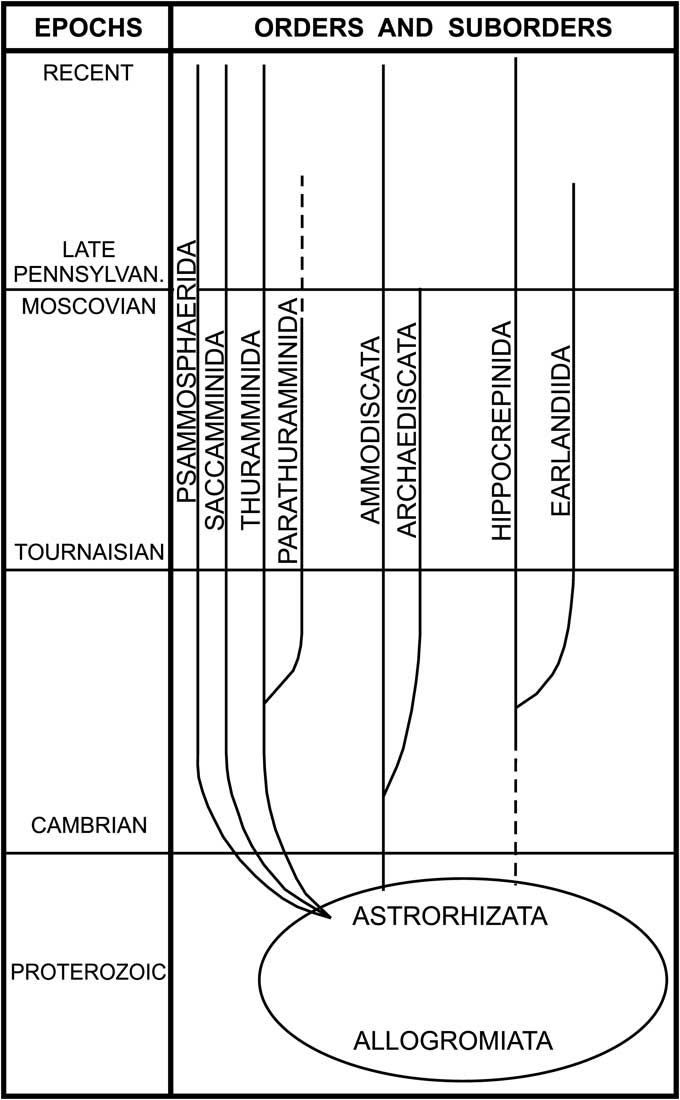
The initial phase of foraminiferal history, from Cambrian to Early Devonian, was dominated by agglutinated tests. The Givetian (Middle Devonian) revolution resulted in the replacement of these agglutinated tests by calcareous secreted tests (Vachard et al., Reference Vachard, Pille and Gaillot2010). Lower Paleozoic agglutinated foraminifers are considered to belong to the classes Textulariata (Loeblich and Tappan, Reference Loeblich and Tappan1964, Reference Loeblich and Tappan1987) and/or Astrorhizata (Vdovenko et al., Reference Vdovenko, Rauzer-Chernousova, Reitlinger and Sabirov1993; Mikhalevich, Reference Mikhalevich2003), but these so-called agglutinates also could have resulted from recrystallization of secreted tests. With the Frasnian-Famennian crisis, the first evolutive phase of the foraminifers was completed, and the second phase started and lasted until the Permian-Triassic boundary, where life on the Earth nearly disappeared completely and our biological references almost entirely changed.
Conclusions
There are nine main conclusions from this study: (1) a rich microfauna of foraminifers, which is accompanied by an amphiporid macrofauna, has been discovered in the Feldkogel Limestone (Polinik Formation) at Mount Polinik (Carnic Alps, Austria); (2) the limestones of Mount Polinik possibly display the Eifelian–Givetian boundary interval (samples 1–10), the early Givetian (samples 11 and 12), and possibly the middle Givetian (samples 13 and 14); (3) the microfauna of Mount Polinik is remarkably similar to the microfauna reported from the limestone of the Urals and western Siberia (Russia); (4) the microfauna of Mount Polinik is composed of taxa that are typical dark-microgranular Fusulinata; (5) these atypical Fusulinata have no relationships with the thecamoebians; (6) consequently, the nomenclature of these Paleozoic monothalamous and bilocular taxa is currently double, depending on assignment to Astrorhizata or Fusulinata: there are Parathurammina sensu lato (= Parathurammina sensu stricto, Parathuramminites, and Salpingothurammina) or Thurammina; Hyperammina or Earlandia; Lagenammina or Paralagena; etc.; (7) plurilocular foraminiferal taxa such as Pseudopalmula, Paratextularia, Semitextularia, and Nanicella are absent in our material; (8) their absence may result from stratigraphic and/or paleoecologic controls; and (9) planktonic microfossils are absent, but some parathuramminids might be pelagic and/or may have been transported in suspension.
Acknowledgments
We greatly appreciate the reviews and comments of J. Jin and an anonymous reviewer, which helped to improve the manuscript. Thanks for their help to C. Colpaert (Novosibirsk), E. Locatelli, J. Cuvelier, and S. Clausen (Villeneuve d’Ascq). We thank J. Wallraf (Innsbruck) for the preparation of thin sections.