

1 Introduction
The extent to which ex ante estimates of the costs of regulation differ from ex post estimates is an empirical question of considerable interest to policymakers, regulated entities, and the public. Several recent Executive Orders encourage the use of retrospective analysis as a mechanism for reviewing and potentially revisiting the design of existing regulation “in light of changed circumstances, including the rise of new technologies” (White House, 2012). The accuracy of ex ante cost estimates for proposed regulations also is frequently the subject of public comment. However, despite its potential importance, “rigorous retrospective analysis of federal regulation is not commonly conducted…[as it is] both complicated and expensive to develop” (Morgenstern, Reference Morgenstern2015).
In this paper, we compare ex ante estimates of the direct costs of complying with the 2004 National Emission Standard for Hazardous Air Pollutants (NESHAP) for automobile and light-duty truck surface coating to ex post estimates of costs. Surface coating operations for automobile and light-duty trucks were listed as a major source category for hazardous air pollutants (HAPs) in 1992.Footnote 2 In 1999, the U.S. Environmental Protection Agency (EPA) requested information from automobile assembly plants on HAP emissions from surface coating operations. The NESHAP was proposed at the end of 2002 and finalized in 2004. Surface coating operations at existing plants had up to three years from promulgation to comply; new plants had to comply as soon as operations began.Footnote 3
The 2004 NESHAP was chosen at random for retrospective cost analysis from 42 economically significant regulations promulgated by the U.S. EPA between 1995 and 2005.Footnote 4 At the time of promulgation, the regulated universe consisted of a relatively well understood and already regulated sector for pollutants such as volatile organic compounds (VOCs), and the U.S. EPA had identified several available technologies that could be used to bring HAP emissions into compliance. To our knowledge, this is the first retrospective study of the costs of the 2004 NESHAP. Unlike many prior retrospective studies on the cost of regulatory compliance, we also attempt to identify the key drivers of any differences between the ex ante and ex post estimates. We utilize a U.S. EPA (2014) conceptual framework to accomplish this task.
The paper is organized as follows. Section 2 briefly describes the prior literature, including the conceptual framework we use to evaluate costs of compliance ex post. Section 3 summarizes the U.S. EPA’s ex ante cost estimates for the 2004 surface coating NESHAP, including key drivers, sources of uncertainty, and possible exogenous factors. Section 4 discusses the approach and data used to conduct an ex post assessment of compliance costs. Section 5 presents the results. Section 6 discusses overall implications and key limitations of the analysis.
2 Prior literature
Several reviews of ex post studies indicate that the U.S. EPA tends to overestimate aggregate compliance costs ex ante (e.g., Putnam, Hayes, & Bartlett, Inc, 1980; Hodges, Reference Hodges1997; Goodstein & Hodges, Reference Goodstein and Hodges1997; Harrington et al., Reference Harrington, Morgenstern and Nelson2000; U.S. OMB, 2005). Researchers point to failure to account for technological innovation, errors in baseline specification, optimistic compliance assumptions, and reliance on maximum instead of mean cost information as possible explanations for overestimation (Goodstein & Hodges, Reference Goodstein and Hodges1997; Harrington et al., Reference Harrington, Morgenstern and Nelson2000). Evidence of the U.S. EPA’s ability to accurately estimate per-unit costs ex ante is more mixed (Harrington et al., Reference Harrington, Morgenstern and Nelson2000). It is difficult to generalize to the larger universe of U.S. EPA regulations due to a paucity of ex post data, differences in scope of analysis and methodology across studies, the relatively small number of regulations that have been examined ex post, and a bias toward examining market-based approaches, a relatively rare regulatory approach (e.g., U.S. EPA, 2014; Harrington et al., Reference Harrington, Morgenstern and Nelson2000).
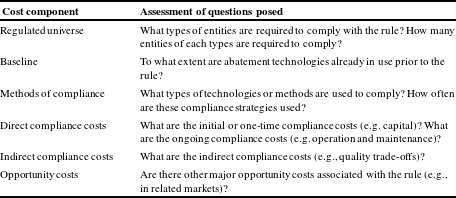
Two recent projects by the U.S. EPA (2014) and Resources for the Future (Morgenstern, Reference Morgenstern2015) aimed to conduct ex post cost evaluations for a wider array of environmental regulations than previous studies and focused on the underlying reasons for inconsistencies between ex ante and ex post estimates. The U.S. EPA (2014) also sought to bring greater consistency to retrospective cost assessment through development and use of a common conceptual framework (Table 1).

In line with older studies, the U.S. EPA and Resources for the Future efforts found evidence of ex ante cost overestimation in several cases. Identified reasons for differences between ex ante and ex post estimates included incorrect assumptions regarding the pace of technological innovation, failure to account for flexibilities available in the regulation as well as behavioral responses, and unexpected exogenous changes in factors such as fuel prices. Both studies cautioned against generalizing their findings to the larger regulatory space given numerous data challenges, and the non-representative nature of the case studies (U.S. EPA, 2014; Morgenstern, Reference Morgenstern2015). Our study adds evidence to the growing literature of ex ante overestimation of compliance costs.
3 The U.S. EPA’s ex ante cost estimates
This section describes the methods used and main drivers of compliance costs in the ex ante analysis of the 2004 NESHAP and assesses the sources of uncertainty and exogenous factors (e.g., unrelated changes in market demands, oil prices) that may influence ex post assessment.
3.1 Ex ante cost estimation
The U.S. EPA estimated ex ante that the total annualized costs of the 2004 surface coating NESHAP would be $154 million (in 1999$) and expected them to be divided fairly evenly between capital ($75 million) and operating and maintenance ($76 million) costs. Administrative costs accounted for about $2 million of total ex ante compliance costs, annually. On average, compliance costs translated to about $25,000 per ton of HAP controlled (U.S. EPA, 2004). The U.S. EPA used an engineering cost approach to estimate facility-level compliance costs for the 2004 NESHAP (i.e., no behavioral market adjustments by producers or consumers).Footnote 5
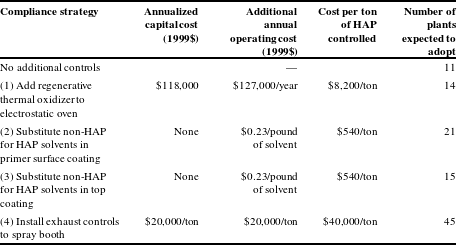
In 1999, automobile assembly plants reported to the U.S. EPA estimated HAP emissions and any control technologies or practices already in place for each paint shop, differentiated by coating stage.Footnote 6 The U.S. EPA characterized the data associated with primers and topcoats as particularly reliable. Based on this information, the U.S. EPA determined that 60 paint shops were subject to the rule, and identified the following compliance options (U.S. EPA, 2002, 2004):
(1) Add an oxidizer for facilities that do not already have electrodeposition oven controls;
(2) Reformulate primer-surfacer coating to substitute non-HAP for HAP solvents if the HAP/VOC ratio for the primer surfacer is greater than 0.3;
(3) Reformulate top coating if the HAP/VOC ratio for the topcoat is greater than 0.3; and
(4) Add controls to the exhaust from the automated zones of spray booths to control any remaining HAPs above the Maximum Achievable Control Technology (MACT) floor, after applying (1), (2), and (3).Footnote 7
The costs of these strategies varied widely, from an average of $540 per ton of HAPs controlled for strategy 2 or 3 to $40,000 per ton for strategy 4 (Table 2). By far, the most common projected compliance strategy was strategy 4. Only two plants were expected to rely solely on process changes, by modifying or reformulating coating materials. About 60 percent of plants were expected to use more than one compliance strategy. In addition, 11 plants (eight of which were used to set the MACT floor) were expected to only face administrative costs.

Ex ante costs were drawn from the literature or industry sources (U.S. EPA, 2002). For plants expected to implement one or more compliance strategy, total annualized capital and operating costs ranged from $1,800 to $13 million per plant, with an average annualized cost of $2.6 million. In addition to capital and operating costs for controlling HAP emissions, the U.S. EPA assumed existing plants that installed add-on controls would incur performance testing costs once every 15 years (U.S. EPA, 2004). Because plants already had detailed recordkeeping systems in place to comply with pre-existing VOC regulations, the U.S. EPA assumed a one-time cost to modify these systems for HAP emissions of $20,000 per plant, as well as annual recordkeeping and reporting costs of $18,000 per plant (U.S. EPA, 2004). Plants not already in compliance were assumed to incur $15,600 in annual monitoring costs (U.S. EPA, 2002).
3.2 Main drivers of ex ante cost estimates
One ex ante driver of capital and operating costs was the degree to which a plant emitted organic HAPs above the standard for each step in the surface coating process. The plants with the highest estimated annual rate of organic HAP emissions from combined operations were among those with the highest annualized cost of compliance. Those with the lowest annual rate of organic HAP emissions either had no or very low estimated direct compliance costs.
Another key driver of ex ante compliance costs was the assumption that plants would sequentially adopt control strategies not already in place (i.e., begin with strategy 1 and end with strategy 4). However, applying control strategies in this way assumes that plants will not necessarily implement the lowest cost strategy first, contradicting what we might expect based on economic theory. If in fact firms minimized costs, then fewer thermal oxidizers would be installed in favor of greater reformulation relative to the U.S. EPA’s ex ante expectation. A possible caveat to this is the possibility of hard-to-quantify indirect costs such as loss of market share over time due to lower quality (i.e., less durable) coatings (U.S. EPA, 2002, 2004).
The U.S. EPA assumed that new paint shops would incur few additional compliance costs since they would have to install controls for VOCs and odors from topcoat systems that rely on water or solvent-based materials. However, it acknowledged that, even with these controls, new plants may still need to lower the HAP content of coatings to meet the NESHAP (U.S. EPA, 2004). It also assumed that new plants would not incur additional testing and monitoring costs, though they would have annual recordkeeping and reporting costs (U.S. EPA, 2002).
3.3 Main sources of uncertainty
The key sources of uncertainty when estimating compliance costs were how each plant would actually comply and the per-unit cost of doing so. MACT standards are performance-based, which means that firms can choose how to comply with emission limits, so one might expect firms to pursue available lower cost and/or more effective techniques than those evaluated by the U.S. EPA. Compliance costs attributable to the rule would also hinge on already planned equipment and material upgrades. The U.S. EPA’s ex ante analysis did not address whether plants were already planning to replace equipment in painting shops prior to the rule, though it acknowledged that plants made regular upgrades.
3.4 Exogenous factors
A major unknown, potentially exogenous, factor is the role of technological change. The U.S. EPA recognized that it was possible to (1) reformulate liquid coatings to rely on low or non-HAP chemicals (e.g., use water or lower HAP solvents); (2) switch to powder coatings, which do not release HAPs; (3) raise the solids content of the coating, which reduces the “amount of solvent carrier needed” and therefore reduces HAP emissions; or (4) modify the way coatings are applied to achieve a higher transfer efficiency. Nevertheless, it did not explicitly factor any of these into its analysis (U.S. EPA, 2002).
The options discussed in greatest detail by the U.S. EPA were (1) and (2). Water-based and powder coatings represented almost 20 percent and less than 10 percent of coatings (by weight) applied to motor vehicles in 1998, respectively (U.S. EPA, 2004).Footnote 8 Absent the standard, experts projected only a moderate increase in water-based and powder coatings – to 25 percent and 13 percent, respectively – by 2008 (Freedonia Group, 1999). The U.S. EPA also mentioned an existing joint effort between auto manufacturers and suppliers to develop low-HAP coatings, with an initial focus on powder coatings, though it recognized barriers to their use (e.g., application method and equipment changes to achieve the coating quality needed) (U.S. EPA, 2002).Footnote 9
4 Data for ex post evaluation
While the literature contains some information on technological change in the automobile coating process (e.g., Akafush et al., Reference Akafush, Poozesh, Salaimeh, Patrick, Lawler and Saito2016; Freedonia Group, 2008) and the manufacturer–supplier relationship when developing new processes or technologies to reduce emissions in paint shops (Geffen & Rothenberg, Reference Geffen and Rothenberg2000), we found no studies that assessed compliance costs retrospectively or yielded specific data on key drivers of compliance costs for the 2004 NESHAP.Footnote 10 Given this lack of information, we administered a pilot survey followed by interviews with nine plants subject to the 2004 NESHAP. As a means of verifying the survey results, we also commissioned a cost estimate based on contractor expertise. While the contractor relied on confidential facility-level information from the pilot survey to identify specific compliance actions, estimated costs were generated independently using publicly available sources.
The pilot survey and interview approach is motivated by lessons learned from the 2014 U.S. EPA retrospective cost study. In particular, we are interested in demonstrating its viability as a retrospective cost assessment tool, given that those “case studies suffer from a lack of comprehensive cost information on treatment technologies and mitigation strategies at the plant level, limiting our ability to make definitive statements on the reasons for differences between ex ante and ex post cost estimates” (Kopits et al., Reference Kopits, Cynthia Morgan, Ron Shadbegian, Simon, Simpson and Wolverton2014).
We originally intended to mimic the information collection strategy of the Pollution Abatement and Cost Expenditures (PACE) survey (Gallaher et al., Reference Gallaher, Murray, Nicholson and Ross2006): the survey on plant-level compliance strategies was to be followed by site visits to gain a better understanding of the industrial processes at play and, later, independent cost estimates of compliance to verify the results. Responses to the pilot survey, however, revealed that compliance was achieved primarily through reformulation of coatings rather than installation of capital equipment. As such, site visits were deemed unnecessary and replaced with telephone interviews to discuss survey responses in detail and to gain a better understanding of reformulation costs.
4.1 Pilot survey participants
We designed and administered a pilot survey to nine automotive assembly plants operating in the United States. We chose nine in line with Paperwork Reduction Act requirements.Footnote 11 Criteria used to select a plant for the sample were:
∙ responded to the U.S. EPA’s original data collection request for the rulemaking;
∙ had an operating paint shop;
∙ was owned and operated by the same company as at the time of rule promulgation; and
∙ did not have an open U.S. EPA enforcement investigation at the time of the study.
Approximately 30 (three of which have multiple production lines/facilities) of the 60 assembly plants that the U.S. EPA had identified as subject to the 2004 NESHAP met these criteria, representing 10 different manufacturers. Twenty of the plants were located in the Midwest (i.e., Michigan, Ohio, Illinois, Indiana, and Kansas), seven in the Southeast (i.e., Kentucky, Tennessee, Missouri, and South Carolina) and three in the South (i.e., Louisiana, Alabama, and Texas). Annual production at these plants averaged 211,000 vehicles in 2003, with the smallest plant producing about 20,000 vehicles and the largest producing more than 450,000 vehicles. Eight of these plants were expected ex ante to already be in compliance with the regulation at the time of promulgation and therefore to only incur monitoring and reporting costs.
Auto Industry Forum, a trade association actively involved in the rule’s development, shared project information with members and provided us with contact information for manufacturers willing to participate in the pilot study. While our sample of plants is not necessarily representative of the industry, we aimed for diversity among participants in terms of company ownership, geography, sales volume, and degree to which a plant was expected to be above the MACT standard. Information that could connect specific responses to individual plants or companies is kept confidential.
The nine facilities that participated in the pilot survey are owned by six different manufacturers. No manufacturer responded for more than two facilities. Four respondents are in the Midwest; five are in the Southeast. In one case, a firm provided responses for two production facilities at the same plant. In only one case had a production line/facility permanently ceased production since the promulgation of the NESHAP. One of the selected paint shops was used to set the MACT floor while another was initially considered for setting the rate; thus, neither was expected to need additional HAP reductions to meet NESHAP requirements. Plants ranged in age from 17 to 35 years old with an average age of 28 years. Though six of the plants had undergone major paint shop renovations or expansions since they were established, none were HAP-related. Respondents had slightly larger production volumes (about 250,000 vehicles) in 2003, on average, compared to the larger sample of qualifying plants. The plants in our sample represented about 25 percent of total annualized ex ante compliance costs and 29 percent of domestically produced vehicles in 2007.
A comparison of our sample of nine to the 30 plants that met our criteria for potential inclusion shows that we oversampled plants from the Midwest and under-sampled plants from the Southeast. The percent of the sample expected to already be in compliance (22 percent) is roughly similar to what was expected for all 30 plants (27 percent). A clear limitation of our sample is that we cannot generalize our findings to plants owned by the four manufacturers that did not receive the survey. In addition, it is not clear to what degree our findings can be generalized to other plants owned by the same firm; we discuss this in the conclusion.
4.2 Survey instrument and interviews
We modeled the survey instrument after the 2005 PACE survey redesign administered by the U.S. EPA and the U.S. Census Bureau, which emphasized improved identification of production process changes associated with regulatory requirements (Ross et al., Reference Ross, Gallaher, Murray, Throneburg and Levinson2004).Footnote 12 The questionnaire asked about baseline HAP or VOC abatement activities prior to 2004, capital expenditures and operating costs for each major HAP or VOC abatement activity between 2004 and 2007, as well as monitoring, recordkeeping, and reporting costs.Footnote 13 The pilot survey was administered in 2013 by Abt Associates.
We conducted follow-up phone interviews with six auto manufacturers to better understand changes to the surface coating process and the costs incurred to meet the 2004 NESHAP (compliance was primarily through reformulation of primer-surfacer and top coatings). Generally, interview participants were either plant managers or corporate engineers. The interviews were approximately 45 minutes in length, also administered by Abt Associates, and included an engineer with expertise in the automobile manufacturing and abatement process.
When conducting these interviews, we encountered a somewhat unanticipated challenge: the passage of time. Actions taken by plants to comply with the 2004 NESHAP occurred more than a decade ago. Staff, recordkeeping, and even ownership structure at some plants changed substantially over this time. While staff could often tell us what actions the plant took to comply, it was more difficult to supply data on the cost of complying. Because of the difficulty in estimating certain elements of the cost of compliance, we also interviewed representatives from two major paint suppliers with the permission of the auto manufacturers they serve.
5 Assessing costs retrospectively
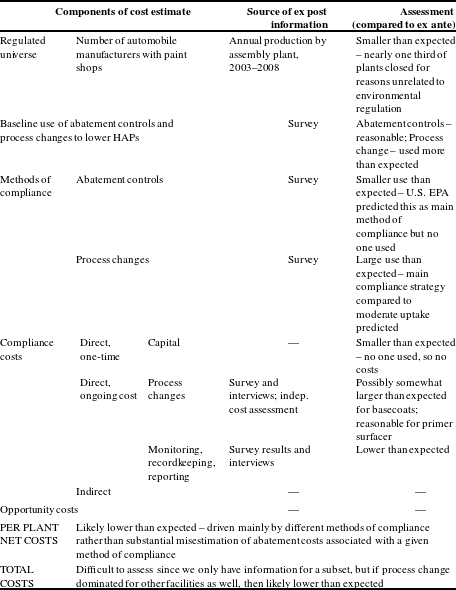
This section compares ex ante to ex post estimates for each cost component from the U.S. EPA (2014) conceptual framework, identifying possible key drivers of substantial differences when possible. Table 9 summarizes the main sources of information and overall findings by cost category. Since the U.S. EPA focused on direct compliance costs associated with the 2004 NESHAP in its ex ante analysis, they are also the focus of our assessment.
5.1 Regulated universe
Recall that the U.S. EPA determined that 60 plants would be subject to the NESHAP. Since that time, substantial restructuring and consolidation in U.S. vehicle manufacturing resulted in the closure of 23 facilities. Web searches confirm that seven of these plants closed before or during the period in which controls would have been put in place to comply with the 2004 NESHAP and therefore likely did not incur compliance costs. In its regulatory analysis, the U.S. EPA estimated that the impact of the regulation on market prices would be small (U.S. EPA, 2004).Footnote 14 Thus, it concluded ex ante that no plant would close due to the regulation.Footnote 15 Media reports also suggested that facility closure decisions had little to do with U.S. EPA HAP (or VOC) regulations, instead being driven by high workforce costs, increasing pressure from foreign competition, and a mismatch between the composition of types of vehicles produced and consumer demand (Gordon, Reference Gordon2005; Kropko, Reference Kropko2006; Taylor, Reference Taylor2007).Footnote 16 , Footnote 17 While we do not evaluate the accuracy of the U.S. EPA’s benefits estimation for the 2004 surface coating NESHAP in this paper, it is also worth noting that a smaller than expected regulated universe would lower benefits relative to the ex ante estimate.
5.2 Baseline information
Characterizing the baseline for a cost analysis typically involves identifying a counterfactual: what emission-reducing technologies or process changes would have been adopted by plants absent the new regulation (holding possible future regulations constant)? To characterize the baseline, the U.S. EPA relied on 1996, 1997, and 1998 calendar year data from a questionnaire on the types of emission controls already in place, including changes to coatings or solvent mixtures. While the U.S. EPA described the types of technologies used to control paint shop HAP and VOC emissions prior to the 2004 NESHAP, it did not identify the specific approaches in use at particular plants (U.S. EPA, 2002). Thermal oxidation, which destroys organic HAP or VOC emissions in the waste stream over a wide range of concentrations, was identified as the most common abatement approach at automotive paint shops prior to the 2004 NESHAP (U.S. EPA, 2002). At times, installation of a carbon-based system was also used to concentrate the waste stream prior to feeding it into the oxidizer.
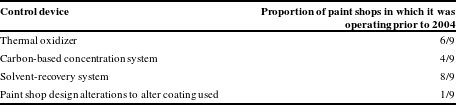
The U.S. EPA’s assumptions of what technologies were in use and adopted prior to the rule fit with our survey data. We asked a question regarding technologies adopted and already in use – HAP controls installed or process changes – implemented before 2004.Footnote 18 While the nine plants were given the option of identifying additional control strategies, none did so. The results confirm that thermal oxidizers, often in combination with a carbon-based concentration system, were relatively common in our sample prior to 2004 (Table 3). We identified a single discrepancy: the U.S. EPA assumed one plant did not have a thermal oxidizer, but the pilot survey revealed that it had one in place prior to promulgation. As expected, paint shop design alterations to accommodate low-emission coatings were relatively rare before 2004.Footnote 19
Survey results on baseline control devices operating in a plant’s paint shop.

With regard to process changes that may not necessarily require capital expenditures, the U.S. EPA observed in its ex ante analysis that use of water- and powder-based coatings in primer-surfacer operations was increasing prior to 2004 and was expected to grow slowly over time absent regulation. Low-HAP reformulated solvent-based coatings were described ex ante as a current approach but also an area of active research due to quality concerns (U.S. EPA, 2002).
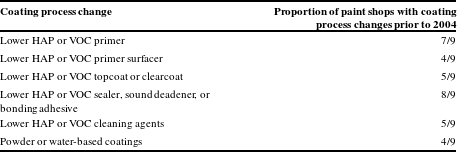
Based on the questionnaire, we find that four of the nine plants in our sample used lower HAP or VOC coatings at every stage in the paint shop process prior to 2004. Four plants also used water-based or powder coatings (Table 4), while all but one plant reported that it had reformulated one or more coatings to lower HAP or VOC emissions. The one plant that did not use this approach relied on powder or water-based coatings prior to 2004. Use of lower HAP or VOC materials was also relatively common in primer, sealer, sound deadener, and bonding adhesive prior to 2004.Footnote 20
Survey results on baseline coating process changes.

While the use of powder or water-based coatings may appear to be relatively widespread in our sample prior to 2004, Freedonia Group (2008) data suggest non-solvent-based coatings represented about 44 percent of automotive industry demand in 2007, which is somewhat higher but still close to what the U.S. EPA had expected ex ante for powder and water-based coatings alone (37 percent).Footnote 21 Since the U.S. EPA did not provide information on baseline process changes on a plant-by-plant basis in the ex ante analysis, we are not able to specify an alternative counterfactual for adoption of low-HAP solvent-based coatings.Footnote 22
In follow-up interviews, several manufacturers opined on the reasons for investing in strategies that lowered HAP emissions prior to the 2004 NESHAP. Water-based coatings were used in some plants prior to 2004 to replace old solvent-based paint lines at the end of their natural life, due to global initiatives at the corporate level to comply with state-level regulations (i.e., New Jersey and California), or by design from the beginning for new plants. Reformulation of solvent-based coatings to lower HAPs was mainly driven by global, corporate-level initiatives prior to 2004. Investments in abatement technologies that lower HAPs prior to 2004 were reportedly to control VOC emissions or replace old devices that had reached the end of life.
5.3 Methods of compliance
For plants not yet in compliance with the 2004 NESHAP, the U.S. EPA anticipated that they would comply using one or more of four strategies: (1) install a regenerative thermal oxidizer, (2) substitute non-HAP for HAP solvents in primer surface coating, (3) substitute non-HAP for HAP solvents in top coating, or (4) install exhaust controls in the spray booth.Footnote 23 Ex post evidence suggests that manufacturers often pursued corporate-level strategies to comply with the 2004 NESHAP, which likely substantially reduced heterogeneity in compliance strategies relative to the plant-by-plant evaluation approach used by the U.S. EPA.
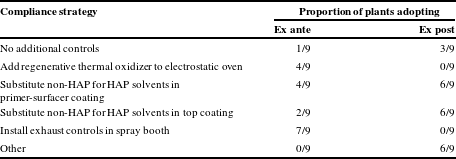
While the U.S. EPA anticipated that only two of the nine plants were already in compliance with the 2004 NESHAP, survey results indicated that three plants did not take further action to comply with the regulation (Table 5). Of the six remaining plants, none installed an abatement control device, anticipated to be a common compliance strategy ex ante. Instead, they implemented process changes to comply with the NESHAP. In follow-up interviews, two manufacturers stated that they implemented process changes in all their facilities, even when they could demonstrate compliance based on pre-existing controls.
Comparison of ex ante and ex post compliance strategies for surveyed plants.

The U.S. EPA predicted that five of the nine plants surveyed would either use lower HAP or VOC solvents in their primer-surfacer coating or topcoat (only one was predicted to rely on both), but that these process changes would almost always be accompanied by installation of a thermal oxidizer, exhaust controls, or both. Ex post information indicates that all six plants that took action to comply with the 2004 NESHAP relied entirely on process changes in both the primer-surfacer and topcoat stages.Footnote 24 In addition, these plants used compliance strategies not quantified by the U.S. EPA ex ante: lower HAP or VOC cleaning agents, lower HAP or VOC primer, or actions to lower solvents in the surface coating process more generally.Footnote 25
Many manufacturers started to work on lowering HAP emissions from coatings before the 2004 NESHAP was promulgated, even though they described significant uncertainty regarding the ultimate standard. More than one manufacturer noted that the data request made by the U.S. EPA in 1999 gave them time to strategize regarding how they might meet the NESHAP. Another manufacturer mentioned that as new colors were introduced, it simultaneously reformulated coatings to reduce HAPs; some of these reformulations occurred as early as 2002. (Existing colors were not reformulated until promulgation of the NESHAP.)Footnote 26
Because manufacturers also reformulated existing paint colors to lower HAP emissions, implementation typically took several years (e.g., began in 2004/2005 with full conversion by 2007) and proceeded in stages. One manufacturer introduced lower HAP coatings for higher-volume colors first, followed by lower-volume colors. Another manufacturer reformulated darker colors first, which were viewed as more forgiving in their application, before moving onto lighter colors.
Why did reformulation dominate as a compliance strategy among survey respondents? First, several sources point out that major manufacturers (as well as paint suppliers) were already cooperatively exploring low-HAP paint formulations prior to promulgation of the NESHAP in part as a response to increased competition by foreign automobile manufacturers and what were anticipated to be “formidable technical challenges” to develop low-emission technologies to meet as-yet unpromulgated requirements of the 1990 Clean Air Act Amendments (New York Times, 1993; Meschievitz et al., Reference Meschievitz, Rahangdale and Pearson1995). Second, the automotive coatings industry was fairly concentrated; there were three major U.S. paint suppliers at the time (U.S. EPA, 2004). Pursuing a corporate-level reformulation approach was therefore attractive because it yielded substantial economies-of scale; as one automobile manufacturer noted, eventually non-compliant paints would be more expensive than reformulated paint. In addition, another manufacturer observed that, while coating specifications are unique to a manufacturer, paint suppliers received similar requests from multiple manufacturers to develop compliant coatings.Footnote 27
5.4 Compliance costs
In this section, we examine the ex post evidence related to the initial cost of installing abatement equipment, ongoing annual operating costs, and ongoing administrative costs.Footnote 28 For process changes, one-time research and development (R&D) costs incurred by paint suppliers are also relevant, although these should eventually manifest as a change in a manufacturer’s operating costs.
5.4.1 Capital costs
Because none of the plants invested in abatement control technology, ex post capital costs associated with the 2004 NESHAP were essentially zero.Footnote 29 One manufacturer indicated that its goal was to satisfy the NESHAP requirements while avoiding the costs of installing control equipment. This contrasts with what the U.S. EPA anticipated ex ante: For the seven plants expected to be out of compliance, it estimated upfront total capital costs ranging from $6 million to $60 million per plant and a one-time cost of $9,000 to $18,000 per plant for performance testing of add-on control device systems (in 1999 U.S. dollars).
5.4.2 Operating costs
Generating ex post estimates of operating costs for the 2004 NESHAP proved challenging. On the survey and in follow-up interviews, most plants included an estimate of zero or offered a qualitative explanation that implied very low annual costs. Adopting a lower HAP formulation was described by plant managers as having a calibration and testing process similar to what occurs when introducing a new paint color (lower HAP or otherwise).Footnote 30
Information provided by manufacturers indicated that paint suppliers conducted R&D over multiple years to design and refine lower HAP formulations. Ultimately, this should manifest as a change in the cost of coatings. However, only one manufacturer roughly quantified incremental operating costs of reformulating its topcoat (specifically, the basecoat) in a follow-up interview. Other manufacturers could not quantify these costs for several reasons: (1) since compliance was at the corporate level, costs passed along by the paint suppliers were not obvious; (2) changes in the cost of coatings due to reduced HAP content would have been difficult to separate out from other factors but were minimal if present at all; (3) they did not work directly with paint suppliers to develop new low-HAP coatings, instead piggy-backing on work performed for other manufacturers; and (4) the amount of time that had passed between promulgation and the survey made it difficult to recall actual costs incurred.
Because of the paucity of detailed information on the cost of complying with the 2004 NESHAP, we also interviewed two major U.S. paint suppliers, with manufacturer permission, on the R&D costs associated with developing low-HAP emission coatings. The paint suppliers indicated that development of a new formulation requires two to three years of lead time before it can be introduced into the paint line at a manufacturing facility. For the 2004 NESHAP, new formulations were developed to achieve the necessary reduction in solvent content, and the performance of the paint was validated through testing. In 80 to 90 percent of the cases, HAP reductions were achieved by substituting butyl acetate for xylene (the supplier noted that ethyl glycol acetate was more expensive and therefore rarely used). The two suppliers agreed that the testing process for a reformulated topcoat – in particular, the basecoat, the first step in the finishing process – is identical to what would have occurred for a new color. One supplier noted that additional quality testing was required to reformulate the primer surfacer. The electrodeposited primer and clearcoat were reportedly not reformulated.
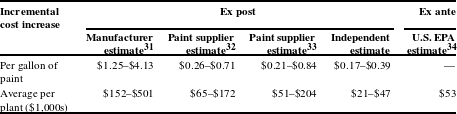
Estimated incremental operating costs of a reformulated topcoat (1999$).

One paint supplier stated that it took one person-year to develop a new primer surfacer and 0.5 person-year to develop a new topcoat (basecoat), with each person-year valued at about $100,000. The supplier confirmed that these costs were passed onto manufacturers indirectly via paint prices. Both paint suppliers offered rough estimates of the change in the per-gallon cost of reformulating a NESHAP compliant basecoat, which is equivalent to the increase in the price of the paint to the manufacturer once all reformulation costs are passed through (Table 6). In general, the estimates provided by the suppliers were significantly lower than those from the manufacturers, who are one step removed from the actual reformulation process.
To verify the results, we commissioned an independent cost estimate from a contractor (Table 6), who used publicly available historical information on the cost of two possible substitute solvents to develop bottom-up estimates of the incremental cost per gallon of basecoat paint.Footnote 35 The per-gallon cost estimates developed through this process are lower than the manufacturer or supplier estimates. This may be because they are based solely on the replacement cost of the solvent and do not account for the cost of validation and testing.
Comparison of ex post and ex ante operating cost estimates
To compare ex post and ex ante estimates, it is necessary to calculate compliance costs at the plant level. If we rely on the manufacturer-provided estimate that a vehicle requires about 1/2 gallon of paint on average, we can calculate the increase in costs on a per-vehicle basis and combine this information with sales data to calculate the average ex post compliance cost per plant (Table 6).Footnote 36 The ex post basecoat reformulation estimates from paint suppliers, which are likely to be the most accurate, range from about $50,000 to $250,000 per plant. The U.S. EPA’s ex ante estimate falls at the low end of the range of these ex post estimates.
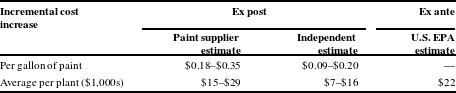
One paint supplier indicated that the cost of primer surfacer increased one to two percent after compliance with the NESHAP (Table 7).Footnote 37 As with the basecoat estimate, the independent cost estimate is low and likely missed important validation and testing costs.Footnote 38 The U.S. EPA’s ex ante estimate for reformulating the primer-surfacer coating for the plants we surveyed is well within the estimated ex post range offered by the paint supplier.
Incremental operating costs of reformulated primer-surfacer coating (1999$).

In addition to the costs incurred by paint suppliers to reformulate coatings, two manufacturers noted that a small amount of staff time was periodically dedicated to coordinating with paint suppliers, particularly during the testing and paint-line conversion stages.Footnote 39
5.4.3 Administrative costs
Ex ante, the U.S. EPA assumed that almost all plants would incur one-time costs of $20,000 (in 1999 dollars) to modify existing recordkeeping systems as well as annual costs of about $2,000 per plant, which is somewhat consistent with ex post estimates. One of the five manufacturers that provided quantitative estimates incurred no additional monitoring or recordkeeping costs because it already tracked the information required by the 2004 NESHAP. The remaining manufacturers described costs associated with modifying an existing or building a new database to track HAP emissions. Estimates ranged from $26,000 to $52,000 (in 1999 dollars) at the corporate level.Footnote 40 The U.S. EPA estimated that monitoring would cost $15,600 per plant annually. Most manufacturers made no mention of monitoring costs in the ex post pilot survey.
5.5 Total compliance costs
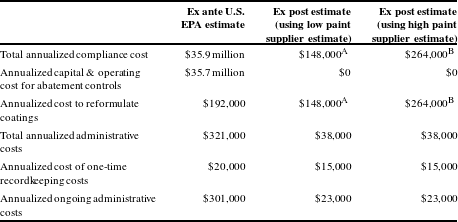
Since a main difference between the ex ante and ex post estimates is the choice to comply by reformulating coatings instead of installing abatement controls, it is not surprising that there is a large discrepancy between total ex ante and ex post compliance costs for the nine plants we surveyed (Table 8). Once the cost of installing and operating abatement controls is deducted from the total, the U.S. EPA’s ex ante estimate falls within the estimated ex post range.
The U.S. EPA’s ex ante estimate of administrative costs is more than eight times larger than ex post estimates. The magnitude of the U.S. EPA’s estimate is driven by the assumption that plants would incur substantial annual costs for monitoring and recordkeeping, for which there is little ex post evidence. Ex ante and ex post estimates of the cost to set up or modify an existing recordkeeping system are roughly similar. However, the U.S. EPA assumed ex ante that plants would individually set up recordkeeping systems, while ex post information indicates that most manufacturers updated or built databases at the corporate level.
Comparison of total ex ante and ex post compliance cost estimates for nine surveyed plants.

A Uses the low paint supplier estimate;
B Uses the high paint supplier estimate. All other ex post estimates in columns 3 ad 4 are from manufacturer responses.
Summary of findings by cost component.

6 Overall implications and study limitations
We compare ex ante estimates of the direct costs of compliance with the 2004 NESHAP for surface coating of light-duty vehicles to ex post estimates based on data collected through a pilot survey and follow-up interviews administered to nine assembly plants. Unlike many prior retrospective studies on the cost of regulatory compliance, we use this information to identify the key drivers of any differences between ex ante and ex post estimates.
Analysis of the data indicates that the U.S. EPA likely substantially overestimated the direct cost of complying with the 2004 NESHAP for the plants we surveyed. This is primarily because plants reformulated their coatings to emit fewer HAPs rather than install expensive abatement control technology. Managers often had difficulty in estimating compliance costs associated with these process changes. Thus, we supplemented the plant-level information with data from two paint suppliers that had performed R&D to reformulate coatings for several leading manufacturers. While we do not consider the indirect costs of the 2004 NESHAP, given the relatively low direct cost estimates, it seems likely that there were few if any quantifiable indirect costs.
Because we only have ex post information for a subset of plants, it is not possible to produce an aggregate ex post compliance cost estimate. However, there are several reasons we might expect that the U.S. EPA also overestimated compliance costs for the sector as a whole. First, fewer plants likely incurred compliance costs than expected since many plants closed prior to 2007 for reasons unrelated to the regulation. Second, many companies pursued a corporate-wide compliance strategy of reformulating coatings. If process changes also dominated for other firms, then ex post compliance costs were likely lower than expected. Third, by design the MACT standards are performance-based, which means that firms can choose how to comply with emission limits. Since lower cost techniques than those evaluated by the U.S. EPA were available, it is likely that other firms also pursued lower cost abatement options.
Many manufacturers were already taking action or actively supporting R&D to reduce HAPs from paint shops prior to the 2004 NESHAP as part of global and/or corporate-level initiatives, in response to state regulations, or when upgrading outdated equipment. While many of these pre-existing efforts were accounted for by the U.S. EPA ex ante, the 2004 NESHAP may have accelerated technological change already under way in the industry, which could also lower compliance costs relative to the ex ante estimate. Some of the manufacturers also noted that the 1999 U.S. EPA data request on HAPs prompted them to introduce reformulated coatings prior to promulgation, though they described significant uncertainty about the stringency of the eventual MACT standard and thus limited anticipatory actions to new colors.
While this study only represents ex post evidence on compliance with a single environmental regulation, the findings also suggest that there may be ways to improve analyses of similar types of regulations ex ante. For instance, analysis that explores how ex ante estimates may change when lower cost technologies in development become more widely available could help regulators understand how robust cost estimates are to alternative scenarios. In addition, a clear understanding of whether investment decisions are made at the plant or firm level could inform whether it is most appropriate to evaluate plant compliance strategies as independent from one another.
Acknowledgments
The authors thank Bob Morehouse, Larry Sorrels, Aaron Hula, Kim Teal, and Keith Barnett for useful feedback and input throughout this process. In addition, we thank Lauren Praesel, Dan Basoli, Erik Edgar, and Jen Lewis of Abt Associates and ERG consulting groups, who provided key inputs into the study with U.S. EPA funding, including conducting the surveys, interviews, and an independent cost analysis.