Introduction
Radionuclides and radiation are constituents of the Earth and play important roles in natural processes. Ever since Becquerel discovered natural radioactivity in 1896, radioactive materials have been utilized for society’s benefit in science, medicine, industry, and defense. However, using naturally occurring and artificially created radioactive materials leads to waste products, many of which contain significant levels of radionuclides. In particular, the radioactive wastes generated during production of nuclear weapons have high chemical complexity, as they are the result of multiple chemical processes and contain a range of fission products. These so-called “legacy” wastes, as well as those created during used nuclear-fuel reprocessing, constitute the bulk of “high-level waste” (HLW) as defined by the International Atomic Energy Agency (IAEA). Reference Lee, Ojovan and Jantzen1 Other nuclear-waste sources include medical treatments, oil and gas exploration, research reactors, nuclear facility decommissioning activities, and accidental releases requiring cleanup activities (e.g., the Fukushima Daiichi disaster in recent years). Reference Donald, Metcalfe and Taylor2
HLW is typically heat generating, due to extensive radioactive decay, and is the most hazardous, but the lowest volume of nuclear waste. Lower radioactivity classes such as low-level/low-activity wastes (LLWs/LAWs) and intermediate-level wastes (ILWs) generally have higher volumes and different disposal regulations. Classification of these wastes and regulations about their disposition depend on many factors, including the quantities and half-lives (t 1/2) of the various radioisotopes, types of radiation generated, and origination of the material. Reference Lee, Ojovan and Jantzen1 The intent of radioactive waste management is to immobilize wastes in suitable matrices (known as waste forms) such that any release is controlled below thresholds set by local and international regulations protecting humankind and the environment. Depending on the applicable regulations, immobilized wastes are intended to be stored in various ways, including landfill disposal, shallow burial, or deep geologic repository, with risk and economics being the primary driving requirements. Since long-term stability of the waste form is desirable, chemically durable materials with high resistance to radiation damage are considered for waste forms.
Various material types have been considered as matrices for immobilization of specific radioactive wastes, including glasses, ceramics, cements, bitumen (hydrocarbon, also known as asphalt), and metals. However, the use of glasses, crystalline ceramics, and glass-ceramics for immobilization of HLW and for many other wastes has garnered the maximum support among scientists. Reference Ojovan and Lee3–Reference Caurant, Loiseau, Majerus, Aubin-Chevaldonnet, Bardez and Quintas5 Glass is widely considered to be the benchmark material for long-term immobilization of complex mixed radioactive wastes, while single-phase ceramics may have advantages when considering highly uniform separated wastes such as actinides (An). Reference Weber, Ewing, Catlow, de la Rubia, Hobbs, Kinoshita, Matzke, Motta, Nastasi, Salje, Vance and Zinkle6
Glass-ceramics used for immobilization of nuclear waste were first proposed in 1976 by researchers at the Hahn-Meitner-Institute Berlin Reference De, Luckscheiter, Lutze, Malow and Schiewer7 as a potential means to improve the mechanical properties of nuclear-waste glasses and their thermal stability in the presence of decay heat. In these original studies, deliberate devitrification (i.e., crystallization) of borosilicate-based glasses was designed to yield one or more major crystalline phases that would incorporate some of the waste components (details discussed further). However, it is important to note that despite extensive research and development, glass-ceramics have not yet been used in any broad scale in actual nuclear-waste immobilization efforts. Current renewed interest in glass-ceramic waste forms is due to present requirements to treat “difficult” waste streams that are poorly suited for borosilicate glass and too complex for single-phase ceramic-waste forms. In this article, a brief typology of nuclear-waste glass-ceramics is given, according to either the microstructure of the product or synthesis process, an overview of the main relevant glass-ceramic families is offered, and some open science questions are discussed.
Classification of waste forms considered as glass-ceramics
Classification by the product
In materials science, glass-ceramics are defined as materials with ≥10 vol% crystal phase obtained by controlled crystallization. Reference Caurant, Loiseau, Majerus, Aubin-Chevaldonnet, Bardez and Quintas5,Reference Höland and Beall8 Normally, this involves bulk nucleation of crystals, as surface crystallization is not considered to be controlled. However, in the nuclear-waste-form community, several types of product materials have been described as “glass-ceramics” or a similar moniker, so a brief review is warranted.
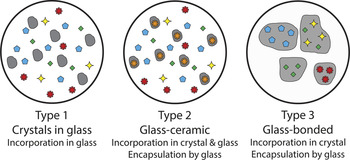
The US National Research Council (NRC) has classified waste forms Reference Donald, Metcalfe and Taylor2,9 based on the inclusion mechanism of radioactive elements (see Figure 1 ). In general, the immobilization of radionuclides can be considered as due to incorporation, encapsulation, or both. Chemical incorporation occurs at the atomic scale, while encapsulation involves embedding or physical sequestration. The following typology has been modified from the NRC classification.
Illustration of radionuclide incorporation and definition of various materials considered as glass-ceramics. In Type 1, crystals (gray) form in glass but radionuclides (colored symbols) are not in crystals but in glass (white). In Type 2, crystals form in glass, some radionuclides are in these crystals (orange in gray) while some are in the glass (other colored symbols), and the glass forms an additional barrier around the crystals. In Type 3, most or all of the radionuclides are incorporated into the crystalline structure of one or more phases (gray grains containing colored symbols), and the surrounding glass (white) serves to connect and further protect these crystals. Reference Donald, Metcalfe and Taylor2,9 Note: Different symbols denote radionuclides such as Cs, Sr, Tc, U, and Pu, and are schematic only.

In the first type of glass-ceramic, a small fraction (a few vol%) of crystals form that do not incorporate radionuclides, thus the radioactive component is only incorporated in the glass. The formation of crystals here is generally undesirable, Reference Ojovan and Lee10,Reference Hrma11 but may or may not affect long-term performance of the system. For example, in Hanford HLW glasses, the formation of Fe-Cr-Mn spinels is acceptable, while the formation of nepheline (NaAlSiO4) crystals is detrimental to performance. Reference Hrma11,Reference Kim, Peeler, Hrma, Jain and Palmer12 In the second type of glass-ceramic, at least one radionuclide is targeted for containment in a crystalline phase, using a tailored waste stream and crystal chemistry considerations to select an appropriate host phase. The partitioning between glass and ceramic phase may not be complete, but the goal is to incorporate the radionuclide into a durable crystalline phase (e.g., zirconolite [CaZrTi2O7]), Reference Loiseau, Caurant, Baffier, Mazerolles and Fillet13 which is surrounded by (encapsulated in) a durable glassy phase (e.g., alumino-boro-silicate), thus providing double containment. The main technical issue in this case lies with the effective partitioning of the radionuclide into the crystalline phase. The third glass-ceramic material type is one in which a crystalline phase is initially produced containing the waste and radionuclides. This phase, usually in the form of a high-surface-area powder, is then consolidated, often with a glass binder, producing a “glass-bonded” material (or “glass-composite material”), Reference Lee, Ojovan, Stennett and Hyatt14 where the glass provides further encapsulation of the radionuclides that are present in durable crystalline phases. One example of this scheme is a composite based on a borosilicate or lead silicate glass matrix with crystals of pyrochlore (e.g., (Ca, Ln, An)2(Ti, Hf, Zr)2O7, where Ln indicates lanthanide elements). Reference Boccaccini, Bernardo, Blain and Boccaccini15 However, details of the interface interactions between the glass binder and crystals vary considerably with the system in question and must be carefully studied to ensure long-term waste form performance, particularly in terms of radiation stability and chemical durability in the presence of water.
Classification by the process
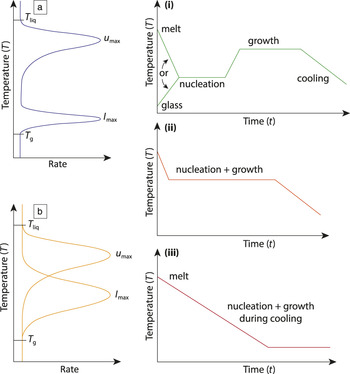
Some researchers classify “glass-ceramics” by the process by which the crystallization is obtained (see Figure 2 ). Traditionally, glass-ceramics for other applications are produced by quenching a glass, nucleating at an elevated temperature, and then growing crystals at a higher temperature. This scenario with separate nucleation (I) and growth (u) steps gives the greatest control over crystallization, but requires a reheat step that may not be desirable for nuclear facilities, although scenarios of this kind have been proposed for glass-ceramics based on celsian (BaAl2Si2O8), fresnoite (BaTiSi2O8), sphene (CaTiSiO5), basalt, and zirconolite. Reference Donald4,Reference Caurant, Loiseau, Majerus, Aubin-Chevaldonnet, Bardez and Quintas5,Reference Hayward, Lutze and Ewing16,Reference Lutze, Borchardt, De, McCarthy, Schwoebel, Potter, Friedman, Moore, Burkholder and Lutze17 A potentially more desirable approach for nuclear-waste glass-ceramics occurs when the nucleation and crystallization maximum rates overlap substantially in temperature, so crystals can form by either holding at high temperature or by cooling continuously. This approach has been considered for nuclear glass-ceramics based on diopside (CaMgSi2O6), basaltic phases like augite [(Ca, Mg, Fe)Si2O6], zirconolite, apatite [(Na, Ca, Ln)10(SiO4)6O2 or (Ca, Ln)10(PO4)6O2], and powellite (CaMoO4). Reference Donald4,Reference Crum, Turo, Riley, Tang and Kossoy18 Systems with nucleation and growth maximum temperatures that are well separated cannot be made by the continuous cool method. Those systems with overlapping I-u curves can be grown using separate nucleation and growth steps, a single nucleation plus growth step, or continuous cool, depending on the overlap (see Figure 2). In glass-ceramic systems where more than one crystal phase forms, details of the crystal nucleation and growth process can be quite complicated and difficult to untangle.
Illustration of the possible thermal treatments used for nuclear glass-ceramics with (a) widely separated maximum nucleation rate (I max) and growth rate (u max) temperatures or (b) closely overlapping nucleation and growth temperature dependencies. Processing of type (a) systems only allows (i) separate nucleation and growth, while systems of type (b) can be processed by either (i), (ii) simultaneous isothermal nucleation and growth, or (iii) nucleation and growth on controlled cooling. Reference Donald, Metcalfe and Taylor2,Reference Caurant, Loiseau, Majerus, Aubin-Chevaldonnet, Bardez and Quintas5 Note: T liq, liquidus temperature; T g, glass-transition temperature.

Glass-ceramic families studied for nuclear-waste management
Many different glass-ceramic systems have been considered for immobilization of nuclear waste, as alluded to earlier. The wide variety of crystalline phases examined is due to the compositional complexity of wastes and the fission product spectrum, as well as various chemical processing steps, resulting in the consideration of many more phases than would be typically needed in a glass-ceramic used for mechanical or optical applications.
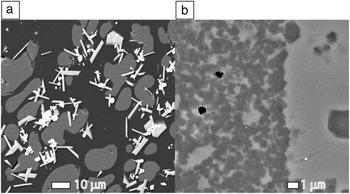
Arguably, the best-studied nuclear glass-ceramic system, at least for immobilization of An- or Ln-rich wastes, is zirconolite (see Figure 3 ). Reference Maddrell, Thornber and Hyatt19,Reference Ebert, Snyder, Riley and Frank20 Single-phase zirconolite glass-ceramics have been produced by nucleation and growth methods, and surface versus bulk crystallization was assessed as a function of nucleation temperature in order to ensure control of crystal phase, size, density, and location in the glass-ceramic, thus optimizing target radionuclide immobilization. Reference Caurant, Loiseau, Majerus, Aubin-Chevaldonnet, Bardez and Quintas5 Major alternative phases to zirconolite for An immobilization include apatite, perovskite [(Ca, Sr, Ba, An, Ln)TiO3], and pyrochlore. It has been shown that apatite better concentrates Ln3+ than zirconolite due to stoichiometric considerations, but zirconolite has better long-term stability in the presence of radiation. Reference Caurant, Loiseau, Majerus, Aubin-Chevaldonnet, Bardez and Quintas5 Crystal chemistry can influence site preferences through the ionic radius of the substituting ion, such that zirconolite prefers smaller Ln3+ and An4+ while the Ca site in perovskite prefers larger Ln3+ (Nd, Ce) and An3+. Reference Lumpkin21 Finally, pyrochlore glass-ceramics appear to be less sensitive to processing oxidation/reduction conditions and can potentially increase the waste loading of An. Reference Zhang, Zhang, Thorogood and Vance22
Microstructures of example nuclear glass-ceramics, including (a) zirconolite (CaZrTi2O7) and (b) sodalite (Na8Al6Si6O24Cl2). In (a) PuO2 contaminated CaF2 slags from the Sellafield nuclear site (UK) were targeted for immobilization; dark phase is the glass matrix, gray island-type structures are the CaF2, white needle-shaped crystals are zirconolite, and white spherical shapes are excess ZrO2. Reference Maddrell, Thornber and Hyatt19 Courtesy of E. Maddrell, National Nuclear Laboratory. In (b), the glass-bonded sodalite was made from 26 wt% glass and 74 wt% salt-occluded zeolite. Dark gray crystals are sodalite and light gray is glass. Reference Ebert, Snyder, Riley and Frank20 Courtesy B. Riley, Pacific Northwest National Laboratory.

In addition to An, other important radionuclides require immobilization. Prominent among these are the high-yield, highly radioactive (beta and gamma decays), medium-lived fission products of the alkali and alkaline-earth type, primarily as 137Cs (t 1/2 = 30.23 y) and 90Sr (t 1/2 = 28.9 y). These radionuclides can be in a mixed-waste stream or separated. Durable crystalline phases typically considered include pollucite (CsAlSi2O6) and hollandite [(Ba, Cs)Al2Ti2O6] for Cs, and celsian, scheelite [(Ba, Sr)MoO4], and perovskite for Sr (and Ba). Reference Hayward, Lutze and Ewing16
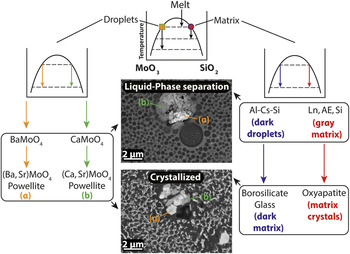
The immobilization of 137Cs and 90Sr is even more challenging in molybdenum-rich wastes that are produced from used nuclear-fuel reprocessing streams such as the UMo-MoSnAl fuel from gas-graphite reactors Reference Pinet, Grandjean, Frugier, Rabiller and Poissonnet23 or the mixed-lanthanide-transition-metal waste stream proposed for US aqueous-fuel reprocessing. Reference Crum, Turo, Riley, Tang and Kossoy18 Both of these waste streams are not suitable for a glass-only waste form, as they contain significant quantities of the highly radioactive and decay heat producing Cs and Sr as well as high Mo content, above that which would be soluble in borosilicate glasses. Reference Caurant, Majérus, Fadel, Quintas, Gervais, Charpentier and Neuville24 This waste is currently planned to be mixed with an alumino-boro-silicate, but on cooling, a liquid–liquid phase separation occurs followed by crystallization of molybdate phases and subsequent additional liquid–liquid phase separation (see Figure 4 ). Reference Crum, Maio, McCloy, Scott, Riley, Benefiel, Vienna, Archibald, Rodriguez, Rutledge, Zhu, Ryan and Olszta25,Reference Schuller, Pinet and Penelon26 The composition of the starting melt (waste plus additives) strongly affects the cooled phase composition, since each consecutive phase separation or crystallization changes the composition of the residual melt, thus effecting phase evolution at lower temperatures. Reference Caurant, Loiseau, Majerus, Aubin-Chevaldonnet, Bardez and Quintas5,Reference Schuller, Pinet, Grandjean and Blisson27,Reference Magnin, Schuller, Mercier, Trébosc, Caurant, Majérus, Angéli and Charpentier28 For instance, if a large concentration of alkali (Na, Cs) is present, undesirable water-soluble alkali molybdates result. If more alkaline earth elements (Ca, Sr, Ba) are present, durable alkaline-earth molybdates like powellite will form, often with multiple compositions. Additionally, changes in starting composition involving other components, such as B, P, and Zr, affect the distribution and availability of Na for crystallization. Therefore, a detailed understanding of thermochemistry of these glass compositions is required to ensure the formation of desired crystalline phase assemblage.
Complex phase separation and crystallization in powellite [(Ca, Ba, Sr)MoO4]/oxyapatite [(Na, Ca, Ln)10(SiO4)6O2] system. Reference Crum, Maio, McCloy, Scott, Riley, Benefiel, Vienna, Archibald, Rodriguez, Rutledge, Zhu, Ryan and Olszta25 At high enough temperatures, the MoO3- and SiO2-rich melts are miscible (above the dome), but as temperatures drop (dashed lines), phase separation occurs of the droplet–matrix type. In other similar diagrams, y-axis is temperature, x-axis is composition, dashed lines indicate fixed temperatures, and region under the curve is the immiscibility region. (Left) Droplets rich in Mo further separate into (a) Ba-rich and (b) Sr-rich phases that crystallize as powellite with different compositions. (Right) The silica-rich matrix phase separates as a new droplet–new matrix. This new droplet phase is enriched in Al and Cs and becomes a residual borosilicate glass on full cooling. The new matrix phase is enriched in lanthanides (Ln) and alkaline earths (AEs) and on full cooling, transforms to oxyapatite crystals.

One last example of the types of glass-ceramic used for nuclear applications are those for halide (Hd) ions (see Figure 3). Typically, Hd elements, of which fission product radioactive 129I is one, have low solubility in silicate glasses, Reference Donald4,Reference Riley, Crum, Matyáš, McCloy and Lepry29 though they can have higher solubilities in other glass systems such as phosphate Reference Lemesle, Méar, Campayo, Pinet, Revel and Montagne30 and tellurite. Reference Riley, Rieck, McCloy, Crum, Sundaram and Vienna31 Particular waste streams high in chlorides, such as contaminated molten salt utilized in reprocessing used metallic nuclear fuel (electrochemical or pyrochemical process), do not lend themselves to borosilicate glass waste forms. The current approach for these wastes is to produce a sodalite (Na8Al6Si6O24Cl2) mineral powder and bond it together using a sodium borosilicate glass. Reference Riley, Crum, Matyáš, McCloy and Lepry29,Reference Bateman, Knight and Solbrig32,Reference Vance, Davis, Olufson, Chironi, Karatchevtseva and Farnan33
Open and relevant problems for nuclear-waste glass-ceramics
While the chemistry of nuclear wastes and the development of respective waste forms are country-specific, the fundamental science governing the design and development of these waste forms is the same globally. For example, the chemical composition of Mo-rich wastes is different for the United States, France, the United Kingdom, and Japan, but the scientific challenges faced by researchers in the development of glass and glass-ceramic waste forms for their immobilization are common. One such problem is the complex interaction between multiple liquid–liquid phase separations (both droplet-in-matrix and spinodal) in glass melts. The order in which these events occur affects the ultimate partitioning of elements in the final crystalline phases through effects on the residual melt compositions after phase separation and crystallization events. A testimony to this statement is the sequence of phase separation and crystallization in Ln3+ containing Mo-rich borosilicate glasses, as shown in Figure 4. While Nd3+ is known to suppress the phase separation of the Mo-rich phase in these glasses, the partitioning of Nd3+ in the glass matrix results in premature crystallization of Nd-containing oxyapatite, leading to uncontrolled phase separation of the Mo-rich phase. Reference Chouard, Caurant, Majérus, Dussossoy, Ledieu, Peuget, Baddour-Hadjean and Pereira-Ramos34,Reference Chouard, Caurant, Majérus, Guezi-Hasni, Dussossoy, Baddour-Hadjean and Pereira-Ramos35 Therefore, it is crucial to understand the thermodynamics and kinetics of phase separation and crystallization in nuclear-waste glasses in order to design glass-ceramics with desired crystalline phase assemblage.
The other major problem with design and development of nuclear-waste glasses/glass-ceramics is their compositional complexity. In general, a nuclear-waste glass-ceramic comprises ≥30 elements, including all types of metals and their oxides (alkali, alkaline earth, multivalent transition metals, noble metals, Ln, An), oxide glass-formers and intermediates (Si, B, P, Al), and Hd elements. Therefore, even if the phase-separated interfaces themselves play little role in nucleation, Reference Zanotto36 the compositional complexity of a nuclear-waste glass-ceramic makes the mapping of nucleation and growth of different phases difficult. While inducing volume nucleation in these glass-ceramics is generally not a limiting factor—as undissolved noble metals, TiO2, and ZrO2 in the glass melts act as nucleation agents—it is important to understand the distributions of elements in crystalline phases, their size and morphology, and the chemistry of the residual glassy phase, in order to design durable glass-ceramic waste forms. Therefore, traditional methods of performing nucleation and growth studies from quenched glasses may not be completely relevant to potentially inhomogeneous production-scale glass-ceramic systems, which are produced in large ingots and thus cool with differing thermal profiles in different locations. Reference Crum, Maio, McCloy, Scott, Riley, Benefiel, Vienna, Archibald, Rodriguez, Rutledge, Zhu, Ryan and Olszta25 High-temperature in situ characterization techniques, such as x-ray or neutron ultrasmall to wide-angle scattering, are difficult to perform, but they are needed to show temperature-dependent phase evolution. Reference Hill, Calver, Stamboulis and Bubb37,Reference Fernandez-Martin, Bruno, Crochet, Ovono Ovono, Comte and Hennet38
It is known from optical glass-ceramics with nanoparticles that some crystal growth can be self-limiting due to composition-related viscosity and topology changes at the interface. Reference Bocker, Rüssel and Avramov39 This interfacial viscosity increase is effective for limiting crystal growth in nonstoichiometric systems where the growing crystal depletes the residual glass of elements that lower the viscosity at the melt/crystal interface (e.g., F). However, when the growing crystal produces a lower viscosity at the growing interface, such as nepheline growing in a borosilicate nuclear-waste glass-ceramic, Reference McCloy, Schweiger, Rodriguez and Vienna40 crystal growth is uninhibited and undesirably large crystals may grow unimpeded. Since every nuclear glass-ceramic is a nonstoichiometric system, more studies on crystallization and interface effects are needed, such that compositions can be designed to control growth rates, particularly for continuously cooled waste forms.
Finally, due consideration needs to be given to the chemical durability of nuclear-waste glass-ceramics. During final geological disposal, the intrusion of groundwater through a repository is the most likely mechanism by which radionuclides may be removed from the glass-ceramic waste forms once the canister containing the glass-ceramic degrades (likely ∼103 years at most). Radionuclides may then be carried to the biosphere unless the waste forms are stable in the presence of water over geological time scales (103 to 109 years). Reference Trocellier41,Reference Gin, Abdelouas, Criscenti, Ebert, Ferrand, Geisler, Harrison, Inagaki, Mitsui, Mueller, Marra, Pantano, Pierce, Ryan, Schofield, Steefel and Vienna42 The performance of a glass-ceramic waste form in a geological repository is dictated by its crystalline phase assemblage and the chemical composition of the residual glassy phase, as well as local geochemical conditions. Reference Pinet, Grandjean, Frugier, Rabiller and Poissonnet23,Reference Li, Vienna, Hrma, Smith, Schweiger, Gray and Triay43 Therefore, a fundamental understanding of the compositional dependence of crystallization behavior and its impact on the durability of the final waste form is essential. Reference Vienna, Ryan, Gin and Inagaki44
Summary
In this review, an introduction to glass-ceramics as nuclear-waste forms is offered. The different types of glass-ceramics studied as waste forms are described and contrasted, based on their microstructures and processing methods. A summary of some of the most important glass-ceramic families for nuclear-waste immobilization is presented, along with important fundamental insights offered by some of these studies. Finally, selected ongoing research directions are described showing some ties to new knowledge from traditional glass-ceramics, in the hopes that other researchers can contribute to the understanding of complex glass-ceramics for nuclear-waste immobilization.
Glass-ceramics have not been implemented on any widespread scale in actual nuclear-waste immobilization efforts to date due to the acceptability of borosilicate glass for most efforts. However, there is renewed interest in glass-ceramic waste forms for treating problematic wastes containing high fractions of poorly soluble components, high contents of radioactive decay heat-generating materials, wastes from new reactor types, and higher waste loading scenarios than could be accommodated by borosilicate glass. Rather than being seen as problematic, crystallization can be beneficial for immobilization of nuclear waste and long-term thermal and chemical stability of nuclear-waste forms, while the benefits of processing materials as glasses has always been one of the central advantages to glass-ceramic technology for all applications.
Acknowledgments
The authors gratefully acknowledge research funding from the US Department of Energy, offices of Nuclear Energy (Nuclear Energy University Program) and Environmental Management (Office of River Protection), Contract Nos. DE-EM0002904, DE-EM0003207, DE-NE0008431, and DE-NE0008257. We also thank E. Maddrell, J. Marra, and J. Crum for assistance with the manuscript and especially B. Riley for assistance with the figures.

John S. McCloy joined Washington State University in 2013, and is currently the Director of the Materials Science and Engineering PhD program. From 2008 to 2013, he worked at the Pacific Northwest National Laboratory, where he continues as a joint appointee. He received his SB degree in 1996 from the Massachusetts Institute of Technology and PhD degree in 2008 from The University of Arizona, both in materials science and engineering. His current research focuses on the development of glasses and glass-ceramics for nuclear-waste immobilization, as well as the application of new material characterization techniques to study phase evolution on cooling from the melt. McCloy can be reached by phone at 509-335-7796 or by email at john.mccloy@wsu.edu.

Ashutosh Goel joined Rutgers, The State University of New Jersey, as an assistant professor in January 2014. Prior to this, he worked as a senior scientist at Sterlite Technologies Ltd., India, and as a materials scientist at Pacific Northwest National Laboratory. His current research focuses on understanding nucleation and crystallization in nuclear-waste glasses, and chemical durability of glasses. He is an associate editor for the “Glass Science” section of Frontiers in Materials. He has authored more than 60 articles and holds two patents. Goel can be reached by phone at 848-445-4512 or by email at ag1179@soe.rutgers.edu.