Introduction
Due to their longevity and exposure to large seasonal changes, trees and perennial woody plants from the temperate and boreal regions have developed systems to modify their phenotype to tolerate changes in climatic conditions. Plant responses to the environment are based on the natural evolution of mechanisms leading to tolerance, resistance and avoidance of environmental constraints. In species of wide latitudinal and altitudinal distribution, adaptive traits between populations are visible as clinal variations. However, adaptive phenomena do not always fit well into the traditional Mendelian genetic framework based on changes in allelic frequencies but are more likely shaped by epigenetic mechanisms (Yakovlev et al., Reference Yakovlev, Asante, Fossdal, Junttila and Johnsen2011).
The evolutionarily ancient conifers, which are one of the four divisions of gymnosperms, include the ecologically and economically important genera such as Pinus, Abies, Larix and Picea. Furthermore, the longest-living terrestrial organisms are found among the conifers, e.g. a more than 9000-year-old spruce found in the Dalarna province of Sweden or trees of bristlecone pine (Pinus longaeva), which can live at least 5000 years. Conifers not only exhibit longevity but also have very long generation times, and are able to tolerate a wide range of edaphic and climatic growing conditions, ranging from the northern subarctic region to subtropical zones. Thus, conifers display a wide phenotypic plasticity, making them masters in adaptation (Rohde and Junttila, Reference Rohde and Junttila2008). However, there are concerns that the long generation intervals (>30 years) might make them less able to respond to rapid changes in temperature by classical evolutionary means such as mutations and natural selection (Rehfeldt et al., Reference Rehfeldt, Ying, Spittlehouse and Hamilton1999, Reference Rehfeldt, Tchebakova, Parfenova, Wykoff, Kuzmina and Milyutin2002). While the predicted climate changes, with increasing temperatures, might challenge their adaptive capabilities, conifers such as Norway spruce appear to have elaborate epigenetic regulatory mechanisms which can facilitate and retain changes in gene activities, enabling them to survive and reproduce successfully in changing environments (Yakovlev et al., Reference Yakovlev, Fossdal and Johnsen2010).
Epigenetic modification is a concept referring to what occurs when phenotypes persistently alter their performance during repeated cell divisions, and sometimes transgenerationally, without any causal change in the primary DNA sequence, but through differences in gene activity profiles. The modifications may play a role in short-term adaptation of a species by contributing to phenotype variability, and may be of importance for long-lived organisms such as trees with long generation times. Most work on epigenetic regulation in plants has focused on Arabidopsis thaliana and other plants with short generation times and very short life spans, such as herbaceous crops (Matzke and Mittelsten Scheid, Reference Matzke, Mittelsten Scheid, Allis, Jenuwein and Reinberg2006; Gehring and Henikoff, Reference Gehring and Henikoff2007; Li et al., Reference Li, Wang, He, Ma, Su, He, Stolc, Tongprasit, Jin, Jiang, Terzaghi, Li and Deng2008; Lister et al., Reference Lister, O'Malley, Tonti-Filippini, Gregory, Berry, Millar and Ecker2008; Wang et al., Reference Wang, Elling, Li, Li, Peng, He, Sun, Qi, Liu and Deng2009; Chen et al., Reference Chen, Lv and Meng2010; Feng and Jacobsen, Reference Feng and Jacobsen2011; Furner and Matzke, Reference Furner and Matzke2011), and only a few papers dealing with tree species have been published (Klevebring et al., Reference Klevebring, Street, Fahlgren, Kasschau, Carrington, Lundeberg and Jansson2009; Lira-Medeiros et al., Reference Lira-Medeiros, Parisod, Fernandes, Mata, Cardoso and Ferreira2010; Viejo et al., Reference Viejo, Rodríguez, Valledor, Pérez, Cañal and Hasbún2010). The known epigenetic modifications and transgenerational inheritance in plants were recently reviewed by (Jablonka and Raz, Reference Jablonka and Raz2009), but surprisingly conifers and other gymnosperms were not mentioned.
This review highlights the importance of studying gymnosperms with long generation times to better unravel the pivotal role of epigenetics in adaptive traits important for surviving in a changing environment. Although far from being understood at the molecular level, we summarize the available information related to epigenetic memory regulation in gymnosperms, and its implications for seed production with special emphasis on the conifer Norway spruce.
Epigenetic memory in Norway spruce
It came as a great surprise to forest geneticists that an epigenetic memory influences adaptive traits. These traits follow clear variation patterns among natural Norway spruce populations that parallel geographical or climatic clines at the origins of the populations. The prevailing theory suggests that strong natural selection is the causal factor shaping such variation. Our discovery of the epigenetic memory phenomenon arose from studying seedlings from seeds produced in Norway spruce seed orchards. Breeders planted parental grafts of northern Norwegian ecotypes in a southern seed orchard, obtained seeds there, and the resulting plants expressed a phenology surprisingly similar to that of native southern ecotypes (Bjørnstad, Reference Bjørnstad1981; Johnsen, Reference Johnsen1989a, Reference Johnsenb). This was later confirmed by the observation that seedlings from central European trees, growing and producing seeds in central Norway, perform similarly to local Norwegian families, and very differently from seedlings from seeds produced at their central European origin (Skrøppa et al., Reference Skrøppa, Tollefsrud, Sperisen and Johnsen2010). Earlier, similar effects had been demonstrated on seedlings from seeds collected in a seed orchard located close to sea level, produced by parents originating from altitudes above 600 m in Norway (Skrøppa et al., Reference Skrøppa, Kohmann, Johnsen, Steffenrem and Edvardsen2007). Field experiments over many years have shown that the effects are long lasting.
Differences in day length and temperature applied during male meiosis and microsporogenesis (pollen formation) did not affect progeny performance (Johnsen et al., Reference Johnsen, Skrøppa, Junttila and Dæhlen1996, Reference Johnsen, Fossdal, Nagy, Molmann, Dælen and Skrøppa2005); however, differences in the maternal environment did. The temperature during post-meiotic megagametogenesis (zygotic embryogenesis) and seed maturation shifted the developmental programme of the embryos, resulting in significant long-lasting phenotypic changes affecting the growth cycle of the progeny (Skrøppa et al., Reference Skrøppa, Kohmann, Johnsen, Steffenrem and Edvardsen2007). No other stages in the reproductive development were sensitive to this long-lasting epigenetic effect (Johnsen et al., Reference Johnsen, Fossdal, Nagy, Molmann, Dælen and Skrøppa2005).
The traits that are affected include the timing of dehardening and bud burst in the spring, cessation of leader shoot growth in the summer, as well as bud set and cold acclimation in the autumn. All of these events occur earlier or later depending on the temperature during female reproduction (i.e. the temperature conditions of the developing embryo) in progeny with identical genetic backgrounds. A colder environment during seed development epigenetically advances bud set and cold acclimation during autumn and dehardening and bud burst during spring in the progeny) (Kohmann and Johnsen, Reference Kohmann and Johnsen1994; Johnsen et al., Reference Johnsen, Skrøppa, Junttila and Dæhlen1996; Hänninen et al., Reference Hänninen, Slaney and Linder2007). The photoperiod during seed production also interacts with temperature in influencing these traits in the progeny (Johnsen et al., Reference Johnsen, Fossdal, Nagy, Molmann, Dælen and Skrøppa2005). Progeny resulting from seed production at different temperatures during zygotic embryogenesis, followed by propagation of genetically identical clones at different temperatures during somatic embryogenesis, expressed a difference in timing of terminal bud formation equivalent to a 4–6° latitudinal ecotypic difference (Kvaalen and Johnsen, Reference Kvaalen and Johnsen2008; Johnsen et al., Reference Johnsen, Kvaalen, Yakovlev, Dæhlen, Fossdal, Skrøppa, Gusta, Wisniewski and Tanino2009). The memory effects acting on the phenological traits last for more than 20 years after germination, and accordingly have implications for long-term growth under field conditions (Skrøppa et al., Reference Skrøppa, Kohmann, Johnsen, Steffenrem and Edvardsen2007). Thus, this memory, affecting the climatic adaptation in Norway spruce, must be of an epigenetic nature and permanently fixed by the time the seed is mature.
Similar epigenetic effects have been observed in progeny of white spruce (Picea glauca), P. glauca × P. engelmannii crosses (Stoehr et al., Reference Stoehr, L'Hirondelle, Binder and Webber1998; Webber et al., Reference Webber, Ott, Owens and Binder2005), Scots pine (Pinus sylvestris) (Dormling and Johnsen, Reference Dormling and Johnsen1992), Larix spp. (Greenwood and Hutchison, Reference Greenwood, Hutchison, Hom, Birdsey and O'Brian1996) and longleaf pine (Pinus palustris) (Schmidtling and Hipkins, Reference Schmidtling and Hipkins2004). Furthermore, land race formation in conifers is much faster that can be expected from classical selection (Skrøppa et al., Reference Skrøppa, Tollefsrud, Sperisen and Johnsen2010). There is a lack of research on this phenomenon in angiosperm trees.
Epigenetic memory within the epigenetic concept
Epigenetics is a rapidly growing research field. There are several definitions of epigenetics and the narrow contemporary meaning is ‘the study of mitotically and/or meiotically heritable changes in gene function that cannot be explained by changes in primary DNA sequence’ (Bock and Lengauer, Reference Bock and Lengauer2008). Furthermore, ‘an epigenetic trait can be defined as a stably heritable phenotype resulting from changes in a chromosome without alterations in the DNA sequence’ (Pavangadkar et al., Reference Pavangadkar, Thomashow and Triezenberg2010). An attempt at a unifying definition of epigenetic events is ‘the structural adaptation of chromosomal regions so as to register, signal or perpetuate altered activity states’. However, events caused by movement of transposable elements (TEs) and somatic recombination events may also be epigenetic phenomena or (more correctly defined) cause phenotypic changes similar to those from epigenetic events.
Being a largely novel area of research and not fully incorporated into classical genetics, the term ‘epigenetics’ is employed loosely and inconsistently. Epigenetics, in a broad sense, touches upon several central features in biology: (1) cell differentiation and specialization during development from a single cell (fertilized egg) to events in the fully differentiated tissues/organism; and (2) the molecular mechanisms contributing to phenotypic changes such as phenotypic plasticity resulting in responses to changes in the environment.
Cellular differentiation is considered to be an epigenetic phenomenon. The majority of cells in multicellular organisms share an identical genotype with significantly differing, in some cases, and relatively stable cellular functions. It shows that from the same genome many different cell types, specializations and functions can arise. Both the classical genetic and epigenetic mechanisms influence these changes. However, the contribution of each, and their interactions while regulating and affecting differentiation, are not entirely clear. Changes in gene regulation during morphogenesis, i.e. cell division and subsequent cell fate decision (differentiation), are likely caused by the internal genetic programme. The mainly genetically driven processes should probably predominate and somehow be protected or restricted from external environmental influence.
However, it is clear that for some organisms cues from the external environment have some impact during development. Even the same types of tissues can differ significantly in responses. This is considered as phenotypic plasticity or environmental sensitivity for a trait (e.g. Sultan, Reference Sultan2000; Chambel et al., Reference Chambel, Climent, Alia and Valladares2005). The epigenetic memory, observed in Norway spruce, is a kind of phenotypic plasticity. It arises during embryo development, and lasts for the whole life span of the progeny and is apparently not invertible.
The molecular epigenetic machinery (i.e. molecular memory) that allows for long-lasting adaptive phenotypic changes has important evolutionary and practical implications for a sessile tree growing in changing environments. In an evolutionary context, epigenetics is likely highly important for explaining how ‘acquired characteristics' or more accurately how the epitypes are maintained in a stable state (mitotically), and acted upon by natural selection. In the epigenetic memory of Norway spruce the adjusted phenotype (epitypes) has to be laid down in the nucleus by some type of heritable markers in the chromatin. These might include DNA methylation, histone modifications or epigenetic initiators such as small RNAs (sRNAs). To be maintained during the life of an organism, such epigenetic markers must be inherited between generations of cells through mitosis. In addition, to fix and propagate new characters, epigenetic traits should be inherited between generations of a species by meiotic inheritance. For plants this seems to be a way in which adaptive gene regulation in response to a changing environment can be inherited (Grant-Downton and Dickinson, Reference Grant-Downton and Dickinson2006). It is important to distinguish between mitotic and meiotic inheritance, as highlighted by Jablonka and Raz, Reference Jablonka and Raz2009. These authors defined epigenetics as ‘the study of the processes that underlie developmental plasticity and canalization, and that bring about persistent developmental effects in both prokaryotes and eukaryotes’. They also stated that, ‘epigenetic inheritance is a component of epigenetics. It occurs when phenotypic variations that do not arise from variations in DNA base sequences, are transmitted to subsequent generations of cells or organisms’. Due to the long generation intervals, it is not known if epigenetic marks are inherited from one generation to the next in Norway spruce. What is known, however, is that there is a significant family variation in how strongly the epigenetic memory is displayed. This may indicate that the machinery that allows for this mechanism is heritable and, if so, it likely involves allelic variation.
The epigenetic memory in Norway spruce affecting adaptive traits is probably limited to mitotically heritable changes in the phenotype and involves alterations in the growth cycle, sRNAs and gene expression but no change in the DNA sequence. The changes occur exclusively during embryogenesis in response to environmental impact, and the epitype is fixed by the time the embryo is fully developed. The epigenetic memory is present from the time of embryo development and exhibits long-lasting phenotypic expression, which is stable for at least 20 years. In certain aspects, the epigenetic memory is also similar to the epigenetic inheritance concept and to somatic plasticity, but again differs from the former in being mitotically inherited and from the latter in not being a pure morphological change but fixed at the time of embryo development.
Adaptive value of an epigenetic memory
An epigenetic memory as a means of adapting to a changing environment should have a great evolutionary impact on the development and evolution of species. The magnitude of the epigenetic memory in different families in Norway spruce appears to be heritable just like any normal genetic trait. In this species there exist epigenetically indifferent families with a low epigenetic memory response, epigenetically strong responding families, and families with an intermediate response (Johnsen et al., Reference Johnsen, Fossdal, Nagy, Molmann, Dælen and Skrøppa2005). This implies that the epigenetic memory most likely has a genetic basis with allelic variants of the genes. Thus, phenotypic plasticity may be genetically determined, and both genotype and environmental impact determine the particular epitype. Phenotypic shift may be either a direct maternally induced effect or the result of a recently induced stress or defence response in the offspring of impacted maternal cells, or both. The latter resembles the case of epigenetic recall (memory), supported by unknown epigenetic engrams. Such a memory and recall are clearly of potential advantage to organisms that live in a fluctuating but recurring environment: when inputs are likely to recur and the adaptive developmental response to these inputs is very costly, it is beneficial to reduce the cost by memorizing (Ginsburg and Jablonka, Reference Ginsburg and Jablonka2009).
Epigenetic processes could be the buffers or amplifiers of existing genetic variation, pending an epigenetic (or epiallelic) change of state that leads an identical combination of genes to produce a different developmental outcome (Bird, Reference Bird2007). Genotype and phenotype describe the relationship between DNA sequence and differences in gene expression and development at different levels. In the field of epigenetics, epitype and phenotype describe the parallel relationships between information in chromatin structure/DNA modifications and its manifestation during development (Meagher, Reference Meagher2010). The epitype of a single gene or entire genome is determined by cis-linked differences in chromatin structure (Meagher, Reference Meagher2010). Progeny originating from warm and cold temperatures during embryogenesis should be considered as epitypes.
A memory is probably essential to all plant behaviours and adaptations. There are multiple examples that stresses such as cold, heat, salinity, drought, ultraviolet (UV) light, mineral imbalance and disease can be remembered by plants and influence later responses (Goh et al., Reference Goh, Nam and Park2003) and some may even be passed on to subsequent generations (Molinier et al., Reference Molinier, Ries, Zipfel and Hohn2006; Jablonka and Raz, Reference Jablonka and Raz2009; Boyko and Kovalchuk, Reference Boyko and Kovalchuk2010). Probably no plant in the wild could survive without some type of short- or long-term memory of perceived signals or without a cumulative memory that collates its past experiences and integrates them with present conditions so that the probabilities of the future could be assessed (Trewavas, Reference Trewavas2009). In the absence of a nervous system, plants must rely on a cellular memory, which is putatively realized through epigenetic molecular mechanisms. The most well-studied example of cellular memory is vernalization (Turck and Coupland, Reference Turck and Coupland2011). This results from an altered FLOWERING LOCUS C (FLC) chromatin structure, repressing its transcription. Cold-induced chromatin modification includes histone3 (H3) deacetylation by the HISTONE DEACETYLASE/VERNALIZATION INSENTIVE 3 (HDAC/VIN3) complex, followed by H3 lysine 27 trimethylation (H3K27me3) by the POLYCOMB REPRESSIVE COMPLEX 2 (PRC2). PRC2 includes two SET-domain polycomb-group proteins VERNALIZATION1 and 2 (VRN1 and VRN2), which are responsible for the stable maintenance of the vernalized state by repressing the chromatin at FLC. During the spring, FLC repression is supported by the VRN1 and VRN2 complex together with some other proteins, like HETEROCHROMATIN PROTEIN 1 (HP1), while VIN3 is considered responsible for the initial repression of FLC during cold exposure (Sung and Amasino, Reference Sung and Amasino2004, Reference Sung and Amasino2006). PRC2 also includes a long intronic non-coding RNA, termed COLD ASSISTED INTRONIC NON-CODING RNA (COLDAIR). COLDAIR targets PRC2 to FLC (Swiezewski et al., Reference Swiezewski, Liu, Magusin and Dean2009; Heo and Sung, Reference Heo and Sung2011). How the low temperatures actually turn on COLDAIR is still to be discovered. The epigenetic memory in Norway spruce may employ a similar but much more long-lived molecular mechanism. The prevailing temperatures during embryogenesis might cause mitotically heritable changes in heterochromatin structure of certain unknown transcription factors and/or micro-RNA (miRNA) genes or other non-coding RNAs (ncRNA). These might, in turn, affect the expression patterns of signalling proteins in a transcriptional and/or post-transcriptional manner, leading to the acquired phenological behaviour. How this is maintained is unknown, but possibly small, ncRNAs would be involved in maintaining this, season by season, year after year.
In the context of predicted climatic changes, epigenetic phenomena are likely to be of significance with respect to the vegetative bud phenology of forest trees with long generation intervals. Their productivity, adaptability and distribution would be affected, providing trees with an adaptive advantage. A shortening of the photoperiod and altered light-quality conditions are considered as the primary factors inducing cessation of growth and development of bud dormancy before the onset of the harsh winter conditions (Olsen et al., Reference Olsen, Junttila, Nilsen, Eriksson, Martinussen, Olsson, Sandberg and Moritz1997; Mølmann et al., Reference Mølmann, Junttila, Johnsen and Olsen2006). In widely distributed tree species the existence of latitudinal and altitudinal ecotypes (provenances) adapted to the local light climate has been demonstrated (Olsen, Reference Olsen2010). An extensive northwards (toward changed day lengths) migration by seed transfer upon global warming may thus challenge the inwintering mechanisms and lead to frost damage. However, there is also evidence that temperatures modulate these responses ((Mølmann et al., Reference Mølmann, Asante, Jensen, Krane, Ernstsen, Junttila and Olsen2005; Olsen, Reference Olsen2010; Tanino et al., Reference Tanino, Kalcsits, Silim, Kendall and Gray2010). High temperatures under short-day conditions accelerate dormancy development and result in deeper dormancy than cooler conditions. This implies that trees cease their growth earlier and show later dehardening and spring bud burst, thus reducing the risk of spring frost damage. Furthermore, in northern ecotypes and some photoperiod-insensitive species, a low night temperature in combination with long photoperiod can induce growth cessation and winter bud formation, reducing the risk of frost damage. Thus, trees seem to have a certain inherent flexibility in their response to varying temperature conditions, as recently reviewed (Olsen, Reference Olsen2010; Tanino et al., Reference Tanino, Kalcsits, Silim, Kendall and Gray2010).
The epigenetic memory effect is adding to the flexibility in climatic adaptation by delaying and enhancing the inwintering processes after warm and cold embryo development, respectively. Thus, epigenetic shifts in offspring phenotypes can considerably increase the adaptive potential to different and changing environmental conditions of a population as a whole, through generation of different heritable epitypes from specific genotypes. The memory may act as a mechanism to help trees to cope with a rapid change in temperature, e.g. due to global warming (Johnsen et al., Reference Johnsen, Kvaalen, Yakovlev, Dæhlen, Fossdal, Skrøppa, Gusta, Wisniewski and Tanino2009). The existence of different levels of epigenetic response among genotypes (epitypes), as observed in Norway spruce (Kvaalen and Johnsen, Reference Kvaalen and Johnsen2008), might also indicate a genetic component of the epigenetic memory. This phenomenon is not only of great evolutionary significance but has clear practical implications for seed production (Skrøppa et al., Reference Skrøppa, Kohmann, Johnsen, Steffenrem and Edvardsen2007). It will also be of importance for the deployment of seedlings from seeds produced in seed orchards under warmer or colder conditions relative to sites where the plants are to be planted. It may also be possible to exploit the phenomenon in producing seedlings by somatic embryogenesis with distinct phenotypes (epitypes), and thus specific adaptive properties. Although the epigenetic effect provides a highly important additional layer of adaptive flexibility, the genetic diversity and potential of a species are still of basic importance for the influence of adaptive traits.
Evolutionary history between gymnosperm and angiosperm may have implications for why epigenetic memory is so evident in conifers
Ancestral gymnosperms originated during the Givetian stage of the middle Devonian period ( ≈ 391–385 million years ago, MYA), and were among the first woody plant forms. Pines originated in the early–middle Mesozoic era ( ≈ 250–160 MYA) and clearly separated from other genera by the Cretaceous period ( ≈ 145 MYA). Zoologists consider the Mesozoic era as the ‘Age of Dinosaurs’, but for botanists it is the ‘Age of the Gymnosperms’. Evolutionary forces have acted on Picea (spruce) genomes since they diverged from the closely related genus Pinus (pines) at least 87–145 MYA (Grotkopp et al., Reference Grotkopp, Rejmánek, Sanderson and Rost2004; Morse et al., Reference Morse, Peterson, Islam-Faridi, Smith, Magbanua, Garcia, Kubisiak, Amerson, Carlson, Nelson and Davis2009). Angiosperms appeared in the Early Cretaceous period ( ≈ 130–112 MYA) and prospered after the Late Cretaceous period (Cenomanian stage, ≈ 100 MYA). Thus, evolutionarily, extant conifers may be considered as being two to three times older than extant angiosperms.
As long as 325 MYA, the Coniferales had differentiated from other seed plants, and have remained the largest and most diverse lineage of the gymnosperms, with at least 600 living species. Coniferales are distinguished by their needle-like leaves, often with adaptations to drought. The tendency of cones to foster polyembryony may be critical to the clade's success, combined with the ability of a single embryo to subdivide into several identical embryos early in development; this attribute is exploited for the propagation of somatic embryos in the laboratory. Within the Coniferales there are two sister groups: the Pinaceae and the Cupressophyta (Cantino et al., Reference Cantino, Judd, Soltis, Omstead and Graham2007).
A main difference between angiosperms and gymnosperms lies in their life cycles, in megasporangium structure and seed development. A key feature distinguishing gymnosperms from angiosperms is that the former lack ‘double fertilization’ which gives rise to a triploid endosperm in most angiosperms and the diploid zygote. This has likely given the angiosperms an evolutionary advantage over non-flowering plants, although its selective advantage is unknown. The seeds of gymnosperms contain a maternal haploid (n) endosperm (megagametophyte) and a diploid (2n) embryo and seed coat.
Gymnosperm trees have significantly higher DNA amounts and larger genome sizes than angiosperm trees, woody eudicots and woody monocots (Murray et al., Reference Murray, Peters and Thompson1981; Ahuja and Neale, Reference Ahuja and Neale2005; Ohri, Reference Ohri2005). In general, conifers have genome sizes ranging from 9291 to 35,208 Mbp (1C content in Mbp); for pines and spruces they range between 16,235 and 35,208 Mbp and 15,452 and 19,756 Mbp, respectively (Kinlaw and Neale, Reference Kinlaw and Neale1997). All the coniferous gymnosperms are diploid with 2n = 24 chromosomes and have no known natural polyploids. It appears that the haploid genome in gymnosperms is close to the limiting size for polyploidization, in contrast to angiosperms where polyploidization is a major factor in increasing taxonomic diversity (Murray et al., Reference Murray, Peters and Thompson1981).
The lack of a reference sequence for genomes of gymnosperms limits our knowledge of their organization, structure and gene spacing, even though there is considerable expressed sequence tag (EST) data for both pine and spruce species, and a Norway spruce genome sequencing project has been initiated in Sweden. A larger genome size implies a larger proportion of non-coding DNA. Genome complexity values describe all of the novel sequence information in a genome (reviewed in Magallóan and Sanderson, Reference Magallóan and Sanderson2005), and can be expressed in base pairs or as a proportion of the genome size. These values in selected conifers expressed in base pairs are 2890 Mb for Pinus banksiana, 5160 Mb for Pinus resinosa, 5740 Mb for Picea glauca and 7820 Mb for Pinus lambertiana (Magallóan and Sanderson, Reference Magallóan and Sanderson2005). This is enormous compared to typical diploid angiosperms, e.g. 82.6 Mb for Arabidopsis thaliana, 290 Mb for Sorghum bicolor, 735 Mb for Solanum lycopersicum and 955 Mb for Zea mays (Morse et al., Reference Morse, Peterson, Islam-Faridi, Smith, Magbanua, Garcia, Kubisiak, Amerson, Carlson, Nelson and Davis2009). An accurate reassociation study estimated that the Pinus strobus genome contains 14% or 3100 Mb of single-copy elements (Kohler and Makarevich, Reference Kohler and Makarevich2006). Such a very large genome complexity in conifers relative to the angiosperms could be due to the presence of larger complex gene families, as evidenced by Southern hybridizations performed on Pinus taeda (Kinlaw and Neale, Reference Kinlaw and Neale1997), and more abundant complementary DNA (cDNA)-derived serial analysis of gene expression (SAGE) tags (Grini et al., Reference Grini, Thorstensen, Alm, Vizcay-Barrena, Windju, Jørstad, Wilson and Aalen2009). Additional repeats and retrotransposon derivatives may have accumulated in the low-copy fraction, thereby inflating it. At least one-fifth of the low-copy sequences in P. taeda are retroelements and one-third contain microsatellite repeats (Vázquez-Lobo et al., Reference Vázquez-Lobo, Carlsbecker, Vergara-Silva, Alvarez-Buylla, Piñero and Engström2007; Bock and Lengauer, Reference Bock and Lengauer2008; Morse et al., Reference Morse, Peterson, Islam-Faridi, Smith, Magbanua, Garcia, Kubisiak, Amerson, Carlson, Nelson and Davis2009; Lee et al., Reference Lee, Smith and Shilatifard2010). In addition, recent assembly and analyses of four bacterial artificial chromosome (BAC) sequences in P. glauca revealed that high-complexity repeats comprise 22% and 18% of the two BAC assemblies, with a high prevalence of retroelement-based sequences (Hamberger et al., Reference Hamberger, Hall, Yuen, Oddy, Hamberger, Keeling, Ritland, Ritland and Bohlmann2009). The repetitive DNA content may be similar in spruces and pines. Retrotransposon expansion followed by mutation of similar taxon-specific families of retrotransposons could presumably have contributed to both the size and complexity of present-time coniferous genomes.
The maintenance of such large amounts of non-coding DNA over millions of years of evolution implies some function, e.g. in climatic adaptation, and that this is linked to ncRNAs and epigenetic regulation. Transposable and repeated elements, which mostly reside in the less-expressed regions of the genome, are emerging as major players in evolution. Their interactions with the genome and the environment could affect translation of genes and resulting phenotypes (Black and Whetstine, Reference Black and Whetstine2011). Large genome sizes might also indicate a greater need for epigenetic regulation of chromatin structure through sRNA-based silencing. It might be important to keep the chromatin in a ‘sleeping’ or untranscribed state until activated in response to a changing environment.
Molecular mechanisms of the epigenetic memory in spruce
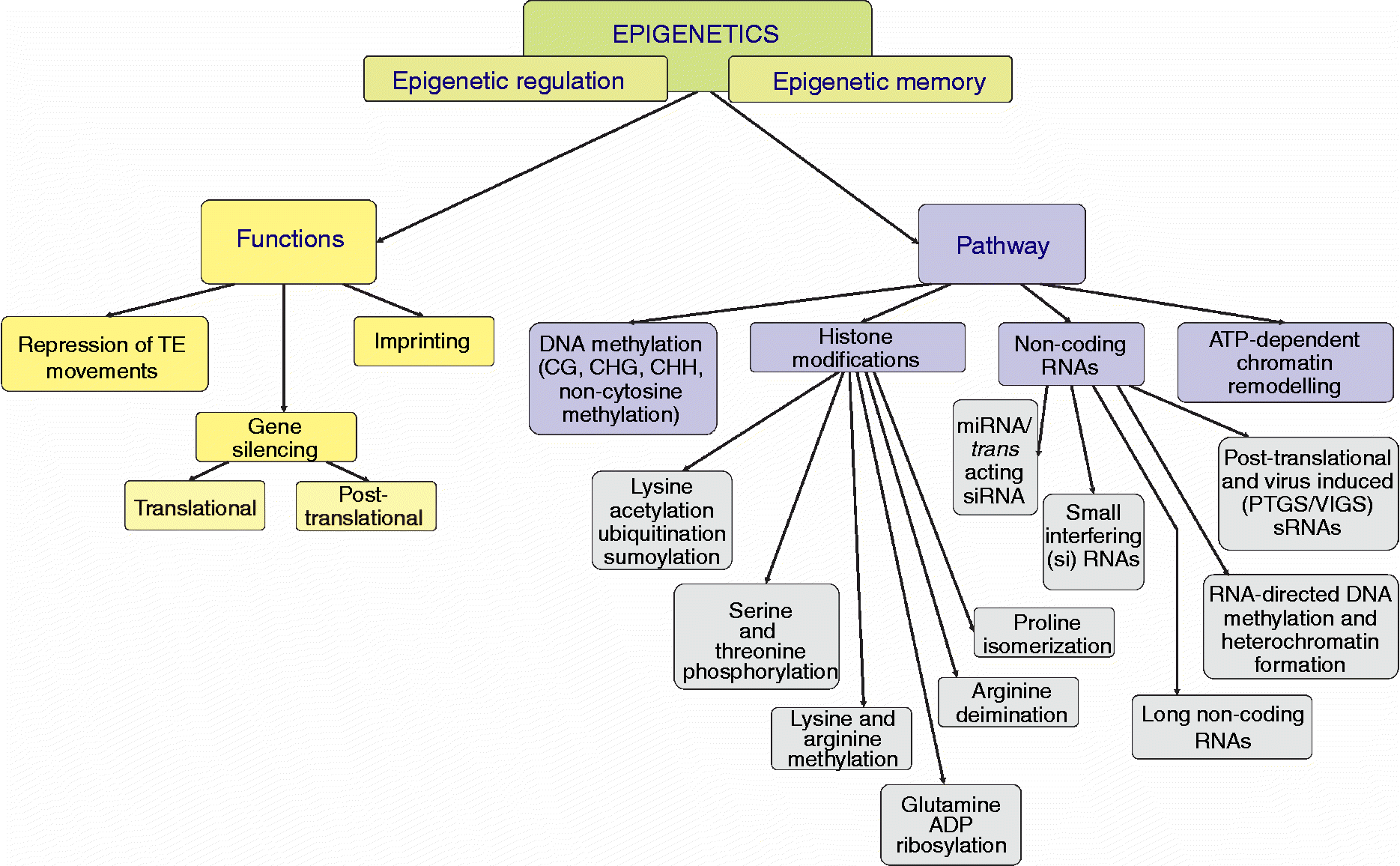
Epigenetic mechanisms influence phenotype through altering the regulation of gene expression. The epigenetic state is transmitted mitotically (and sometimes meiotically) through propagation. To shed light on the significance of epigenetic mechanisms in climatic adaptation it is important to understand the mechanisms involved in the initiation, maintenance and heritability of epigenetic states. Figure 1 lists several recently discovered, distinct but interconnected molecular pathways.
Overview of epigenetics, and epigenetic memory: functions and mechanisms. We distinguish between epigenetic memory and epigenetic regulation. Epigenetic memory is always caused by external impacts and has long-lasting effects, providing the stable realization of ‘acquired characters’, while epigenetic regulation is also affected by the internal developmental programme. Epigenetic mechanisms include several distinct, but interconnected molecular pathways. Epigenetics influence the phenotype by altering the regulation of gene expression in some form or another. The epigenetic state transmits mitotically (and sometimes meiotically) through propagation. CG, CHG, CHH, sequence contexts for cytosine methylation; miRNA, micro-RNA; PTGS, post-transcriptional gene silencing; sRNAs, small RNAs; TE, transposable element; VIGS, viral-induced gene silencing. (A colour version of this figure can be found online at http://www.journals.cambridge.org/ssr).

Another important question concerns how related, environmentally determined epigenetic markers and epigenetic changes are genetically determined by the developmental programmes. A large proportion of epigenetic events, such as DNA methylation, histone modification and action of sRNAs, which are dynamically changing during morphogenesis, are apparently strictly genetically encoded. Warmer or cooler conditions could silence some pathways and activate others more suitable to the change. This response must somehow be stored in the genome and some kind of key sensing elements should activate subsequent regulatory cascades, providing a changed adaptive response. An important question is: which are the regulators of the factors involved in the epigenetic memory effect? Obviously, sRNA biogenesis must involve specific regulatory genes, which in turn require one or more transcriptional factors to be expressed, proteins involved in post-translational modification(s), and a means to combine different proteins into complexes. All transcription events accompanied by chromatin remodelling, histone modification, DNA methylation/demethylation, etc., must in turn involve specific proteins, encoded by corresponding genes, which are regulated by sRNAs or transcription factors. At the level of transcriptional regulation, transcription factor families are known to interact in a complex combinatorial manner with each other and with a subset of downstream targets with multiple cross-regulatory (direct and feedback) loops. This also depends on particular epigenetic modifications. At the level of post-translational control sRNAs appear to be important (Chen and Rajewsky, Reference Chen and Rajewsky2007; Kaufmann et al., Reference Kaufmann, Pajoro and Angenent2010). Moreover, although general mechanisms of epigenetic modification can be studied in herbaceous model plants, such as Arabidopsis, specific regulatory mechanisms might differ in the more long-lived gymnosperm and angiosperm woody species.
DNA methylation is perhaps the best-characterized chemical modification of DNA. It involves the addition of a methyl group (–CH3) to the fifth position of the cytosine in a variety of DNA sequence contexts: CpG (adjacent cytosine and guanine linked by a phosphate), CpNpG and at CpNpN (N could be A, C, G or T) (Law and Jacobsen, Reference Law and Jacobsen2010).
Studies of DNA methylation in conifers are scarce. Global epigenetic changes are related to ageing and phase changes (hypermethylation of DNA) as well as reinvigoration (hypomethylation of DNA) of forest trees like P. radiata (Fraga et al., Reference Fraga, Cañal and Rodríguez2002a, Reference Fraga, Rodríguez and Cañalb) and Sequoiadendron giganteum (Monteuuis et al., Reference Monteuuis, Doulbeau and Verdeil2008). Increased total methylation is related to maturation and decreasing organogenic capability in P. radiata needles and vice versa (Valledor et al., Reference Valledor, Hasbún, Meijón, Rodríguez, Santamaría, Viejo, Berdasco, Feito, Fraga, Cañal and Rodríguez2007, Reference Valledor, Meijón, Hasbún, Cañal and Rodríguez2010). However, due to complex relations between DNA methylation and gene expression, more detailed studies should be conducted to establish whether there is a causal relationship.
Searches for DNA sequences that putatively code for DNA methylation enzyme genes among spruce EST collections, revealed the existence of spruce homologues for DNA METHYLTRANSFERASE1 (MET1), CHROMOMETHYLASE3 (CMT3), REPRESSOR OF SILENCING1 (ROS1), VARIANT IN METHYLATION1 (VIM1) and HOMOLOGY-DEPENDENT GENE SILENCING1 (HOG1). At the same time, no homologues were found for DEMETER (DME), DOMAINS REARRANGED METHYLTRANSFERASES (DRM1 and DRM2). However, it appears unlikely that such highly conserved protein genes are not present in the spruce genome. A full spruce genome sequence will help to address this matter.
Histones are subject to a wide variety of known post-translational modifications, including lysine acetylation, ubiquitination and sumoylation, lysine and arginine methylation, serine and threonine phosphorylation, glutamine ADP ribosylation, proline isomerization and arginine deimination (Kouzarides, Reference Kouzarides2007). Histone modifications function as regulators of transcription and play critical roles in seed development (Baroux et al., Reference Baroux, Pien and Grossniklaus2007), plant development (Wagner, Reference Wagner2003) and plant stress response and defence mechanisms (Chinnusamy and Zhu, Reference Chinnusamy and Zhu2009; Alvarez et al., Reference Alvarez, Nota and Cambiagno2010). Multiple histone modifications can interact with other histone modifications or DNA methylation. This allows for the hypothesis of the existence of a ‘histone code’ that functions to direct specific and distinct DNA-templated programmes (Jenuwein and Allis, Reference Jenuwein and Allis2001; Loidl, Reference Loidl2004).
Three types of histone methylation, histone H3K4me1, 2 or 3 (histone 3 lysine 4 mono/di/tri-methylation), histone H3K27 tri-methylation (H3K27me3) and histone H3K9 di-methylation (H3K9me2), are well known to be involved in plant epigenetic modification. H3K9me1, a mark classified as heterochromatin-specific in angiosperms, also labels the euchromatin in gymnosperms P. sylvestris and P. abies. The other histone marks are either equally distributed along the chromosomes, such as H3K9me2 and H3K27me1 in both species and H3K9me3 only in P. abies, or are enriched at specific types of heterochromatin, such as H3K27me2 and H3K27me3 in both species and H3K9me3 in P. sylvestris only (Fuchs et al., Reference Fuchs, Jovtchev and Schubert2008). There are several groups of protein involved in histone methylation: SET-domain proteins (consisting of a suppressor of the variegation 3–9 (Su(var)3–9)) group, the enhancer of the zeste (E(z)) group and the trithorax (TRX) group, polycomb-group (PcG) proteins, and the homeotic discs (ASH) group that induce methylation of lysine residues in different contexts and often function in an antagonistic manner.
Among the spruce EST collections we found six different homologues of SET (Su(var)3–9) genes and seven homologues of the polycomb-group PcG protein genes – MEDEA (MEA), C2H2 SET DOMAIN TRANSCRIPTION FACTOR (similar to CURLY LEAF (CLF)), FERTILIZATION-INDEPENDENT ENDOSPERM (FIE), two variants of VRN and EMBRYONIC FLOWER 2 (EMF2) – which are obvious candidates for further study. Surprisingly, no trithorax TrxG gene homologues have been found among the spruce ESTs.
Chromatin remodelling plays a central role in establishing specific patterns of gene expression, and in maintaining epigenetic transcriptional states through successive rounds of mitosis that take place within a cell lineage. Chromatin remodelling involves an effective shifting of nucleosome cores along the length of the DNA molecule, a process known as ‘nucleosome sliding’, which loosens histone/DNA contacts and increases the accessibility of nucleosomal DNA. Recent studies suggest that this involves disassembly and reassembly of the nucleosome core, and gene activators or inhibitors can thereby bind to the DNA sequences. Homologues of several genes encoding proteins involved in chromatin remodelling – FASCIATA (FAS1 and 2), MULTICOPY SUPPRESSOR IRA1 (MSI1), IMITATION SWITCH (ISWI), and two variants of BRAHMA (BRM1 and 2) and BRUSHY (BRU1 and 2) – are found among spruce ESTs.
Increasing evidence is indicating that most epigenetic mechanisms of gene expression control include regulation by ncRNAs, mostly sRNAs. It is becoming clear that these molecules play very important roles in various epigenetic modification mechanisms and plant development (Chen and Rajewsky, Reference Chen and Rajewsky2007; Henderson and Jacobsen, Reference Henderson and Jacobsen2007; Costa, Reference Costa2008; Simon and Meyers, Reference Simon and Meyers2011).
In plants, there are two families of sRNA: miRNAs and small interfering RNAs (siRNAs). Both act to regulate target mRNAs negatively, but they are distinguished by their genomic origin, the nature of their target genes and their evolutionary conservation. miRNAs are non-coding, on average 21–22 nt long and derived from hairpin-structured single-stranded precursors transcribed from genetically defined loci (encoded in their own genome) (Axtell and Bowman, Reference Axtell and Bowman2008; Carthew and Sontheimer, Reference Carthew and Sontheimer2009; Lelandais-Brière et al., Reference Lelandais-Brière, Sorin, Declerck, Benslimane, Crespi and Hartmann2010). siRNA populations are normally 24 nt long and derived from endogenous and exogenous long, double-stranded RNAs (dsRNAs) arising from converging or overlapping transcription, inverted gene duplication, or through RNA-dependent RNA polymerase (RDRs) acting on single-stranded RNA (Bourc'his and Voinnet, Reference Bourc'his and Voinnet2010). siRNAs provide specificity to transcriptional (TGS) and post-transcriptional gene silencing (PTGS) in plants (Almeida and Allshire, Reference Almeida and Allshire2005; Matzke and Mittelsten Scheid, Reference Matzke, Mittelsten Scheid, Allis, Jenuwein and Reinberg2006). However, siRNAs are also involved in siRNA-directed DNA methylation (Almeida and Allshire, Reference Almeida and Allshire2005; Simon and Meyers, Reference Simon and Meyers2011) and TE (transposable element) transposition silencing (Slotkin and Martienssen, Reference Slotkin and Martienssen2007; Slotkin et al., Reference Slotkin, Vaughn, Borges, Tanurdzić, Becker, Feijó and Martienssen2009; Simon and Meyers, Reference Simon and Meyers2011).
Most plant miRNA studies have been carried out in angiosperms and just a few publications exist involving miRNAs in conifers. A total of 26 miRNAs from 11 conserved and novel families were identified in loblolly pine, possibly associated with the fusiform rust gall disease (Lu et al., Reference Lu, Sun, Amerson and Chiang2007). Recently, five additional conserved miRNAs were identified in loblolly pine seeds (Oh et al., Reference Oh, Wartell, Cairney and Pullman2008). In red pine, 11 conserved miRNAs were found in needle tissues, supporting the idea that many plant miRNA families have been conserved during the evolution of land plants (Axtell and Bartel, Reference Axtell and Bartel2005). Analysis of the P. contorta sRNA transcriptome by 454-sequencing allowed identification of 18 highly conserved and 51 novel miRNA families (Morin et al., Reference Morin, Aksay, Dolgosheina, Ebhardt, Magrini, Mardis, Sahinalp and Unrau2008). Post-transcriptional gene silencing in gymnosperms involves specific DICER LIKE family (DCL) genes which are not present in angiosperms (Dolgosheina et al., Reference Dolgosheina, Morin, Aksay, Sahinalp, Magrini, Mardis, Mattsson and Unrau2008). In addition, 40 novel and conserved miRNAs have been identified in Norway spruce. Expression analysis has shown significant differences in transcript levels of 16 miRNAs under warm and cold embryogenesis, suggesting their putative participation in epigenetic regulation (Yakovlev et al., Reference Yakovlev, Fossdal and Johnsen2010).
In all studies of conifers so far, the 21 nt sRNAs were more abundant than the 24 nt sRNAs, which is inversed compared to Arabidopsis and crop plants, suggesting that either the 21 nt sRNAs replace heterochromatin siRNAs or that the number of miRNA genes is more important in gymnosperms (Lelandais-Brière et al., Reference Lelandais-Brière, Sorin, Declerck, Benslimane, Crespi and Hartmann2010). Hitherto, there are no published studies of siRNAs in conifers. Probably, this is partially due to the lower share of 24 nt RNAs in conifers and due to the lack of genome sequence data for conifers, making it difficult to establish the origin of sRNAs.
To combat the potentially harmful effects of active TEs, the genome employs ‘epigenetic defence’ mechanisms to suppress their expression and mobility. There are two ways of transposon silencing: RNA-directed post-transcriptional silencing and RNA-interference (RNAi)-directed chromatin modification (methylation). The need for silencing machinery may be an evolutionary response to TEs, and thus TEs appear to be the origin of all epigenetic phenomena, now present at both the level of single genes and across larger chromosomal regions (Slotkin and Martienssen, Reference Slotkin and Martienssen2007).
Among the spruce ESTs we found 25 homologues of genes involved in sRNA biogenesis. These included six argonaut (AGO)-like genes, four DCL-like, three RDRs and 12 other genes. Thus, sRNA biogenesis genes are very well represented in the spruce genome, which indirectly supports the importance of sRNAs for conifer development.
The molecular mechanisms involved in adaptive epigenetic memory in Norway spruce are starting to be unravelled (Yakovlev et al., Reference Yakovlev, Asante, Fossdal, Junttila and Johnsen2011). Analyses of subtracted cDNA libraries reveal differences in the transcriptomes of plants showing epigenetically different bud phenology after exposure to warm and cold environments during embryogenesis. Real-time quantitative reverse transcription polymerase chain reaction (qRT-PCR) studies of 41 candidate genes (encoding proteins) and a number of genes involved in sRNA biogenesis revealed that eight genes exhibited differential expression in the epigenetically distinct progeny subjected to cold or warm conditions during embryogenesis. The differentially expressed genes included two related to TEs, three novel, unknown genes and three from the sRNA pathways involved in post-transcriptional gene silencing – PaDCL1 and 2 and SUPRESSOR OF GENE SILENCING 3 (PaSGS3). This indicates that sRNA- and TE-related pathways are affected by temperature during embryogenesis. The sRNAs are 21–24 nucleotides long and act in the regulation or silencing of genes, TEs and viruses, and are important modulators of chromatin structure. The three novel genes with unknown function have not been described in Arabidopsis or other angiosperms and may be involved in, or affected by, implementation of epigenetic memory in spruce.
Pursuing the possible roles of sRNAs in epigenetic memory, an analysis of miRNAs was conducted in Norway spruce. Two sRNA libraries from epigenetically different seedlings of two full-sib families originating from seeds developed in a cold and warm environment, revealed 191 distinct sRNAs. Since families of Norway spruce contrast in their memory expression, we further examined one family showing a strong epigenetic response to temperature treatment and another showing no significant response. From these libraries, we identified 24 novel and four conserved 20–22 nucleotide-long miRNAs. These constitute a class of sRNAs that are negative regulators of target genes controlling a wide range of developmental events. Further screening for miRNAs among spruce ESTs allowed us to identify an additional 17 conserved miRNAs. In total we identified and confirmed 40 spruce miRNAs, submitted to the miRNA Database (miRBase – http://www.mirbase.org/cgi-bin/query.pl?terms = spruce) (Yakovlev et al., Reference Yakovlev, Fossdal and Johnsen2010).
Unfortunately, target genes were not found for most of the identified miRNAs when using similarity searches in the wealth of known spruce transcripts in sequence databases. In the cases when putative target mRNAs (ESTs) were identified, most of them belonged to genes with no known function. The lack of target genes with known or putative function in the available spruce ESTs databases implies the existence of one or more unknown epigenetic regulation pathways. This underlines the necessity for specific and complete EST libraries related to the epigenetic memory regulation of the transcriptome in Norway spruce.
Four miRNAs putatively targeted to described genes were found: miR159a to a GIBBERELLIC ACID MYB transcription factor (PaGAMYB); pab-miR858 to a MYB10 transcription factor (PaMYB10); pab-miR100 to a SUPRESSOR OF TY 4 transcription elongation factor (PaSPT4), and pab-siR156c to a SQUAMOSA PROMOTER BINDING-domain-like protein 13 (PaSPB13). These miRNA–mRNA pairs showed significant differences in transcript content between epigenetically different samples. However, the relationship between miRNA transcripts and their target mRNAs was not linear. Of the 40 studied miRNAs 16 showed significant differences in transcript amounts in epigenetically different samples. These included seven conserved and nine novel miRNAs unknown in other organisms.
In summary, Norway spruce contains a set of conserved miRNAs as well as a large proportion of novel non-conserved miRNAs. The differential expression of specific miRNAs suggests their participation in epigenetic regulation (Yakovlev et al., Reference Yakovlev, Fossdal and Johnsen2010). However, more detailed studies in epigenetically different progenies or on different stages of embryo development, as well as manipulation of the activities of such candidate genes, are needed to better explain their role in the molecular mechanisms behind this epigenetic phenomenon.
ncRNAs might be considered the best candidates as epigenetic memory determinants, since they are implicated in mechanisms of genetic information transfer in yeasts, plants and animals (Kouzarides, Reference Kouzarides2007; Costa, Reference Costa2008; Hollick, Reference Hollick2008). sRNAs may originate from many loci in the genome, including very extensive non-genic parts, and could be transmitted to the next generation. sRNAs are likely to be highly precise in their delivery, since their guiding system includes nucleic acids, and they participate in a number of pathways for fine regulation of gene expression. Suppression or mutations in the sRNA processing enzymes are known to affect numerous epigenetic processes (Kouzarides, Reference Kouzarides2007). DNA methylation and sRNAs are also considered as inheritable factors of epigenetic stress responses (Kovalchuk et al., Reference Kovalchuk, Abramov, Pogribny and Kovalchuk2004; Chinnusamy and Zhu, Reference Chinnusamy and Zhu2009; Angers et al., Reference Angers, Castonguay and Massicotte2010; Boyko and Kovalchuk, Reference Boyko and Kovalchuk2010; Boyko et al., Reference Boyko, Blevins, Yao, Golubov, Bilichak, Ilnytskyy, Hollander, Meins and Kovalchuk2010).
A new class of long ncRNAs was recently described, similar to si/miRNAs, that are suggested to act on target mRNAs by integration into ribonucleoprotein particles (RNPs) to modulate their function, localization or stability (Jouannet and Crespi, Reference Jouannet, Crespi and Ugarkovic2011). The important role of long intronic ncRNAs in cellular memory is supported by the importance of COLDAIR in vernalization (Swiezewski et al., Reference Swiezewski, Liu, Magusin and Dean2009; Heo and Sung, Reference Heo and Sung2011).
DNA methylation and histone modifications may be the final executers of the epigenetic phenomena rather than the transgenerational carriers of memory. However, they might play important roles in the stabilization of acquired genetic modifications across cell divisions and generations. ncRNAs and other sRNAs might represent the true epigenetic memory determinants and transmitter mechanisms enabling DNA to retain its chromatin status, which affects gene regulation, translationally and post-translationally.
Other, more far-fetched candidates have been proposed to be involved in the memory mechanism. Plant memory has, for example, been suggested to be stored in magnetite in the core of phytoferritin, an iron–protein complex in plant chloroplasts (Størmer and Wielgolaski, Reference Størmer and Wielgolaski2010). There are 14 different ferritin genes in spruce ESTs, but nothing is known about their transcription and gene interactions with respect to their memory effect.
Taken together, the present knowledge on epigenetic inheritance is far from complete. In addition, information about possible epigenetic inheritance in mitochondria and chloroplasts is lacking. Furthermore, epigenetic inheritance systems may well vary between different taxa (Jablonka and Raz, Reference Jablonka and Raz2009) and larger divisions and taxa (Jablonka and Raz, Reference Jablonka and Raz2009). The epigenetically best-studied plant species is the short-lived Arabidopsis, which is not necessarily representative of the less-studied and extremely long-lived woody species. Nevertheless, several interconnected components are likely to be involved in establishment, maintenance and transmittance of epigenetic marks, as well as the epigenetic memory, to new generations of cells in seeds.
Conclusions
The gymnosperm Norway spruce expresses an epigenetic memory of the embryogenesis temperature that changes the growth cycle of the tree in an adaptive manner, as a result of an ‘imprinting’ in the embryo of the resulting seed. This epigenetic effect is fixed by the time the seed is fully developed, and the altered phenology of the resulting plants is long lasting (at least 20 years). From the same genotypes, the memory gives rise to epitypes that likely have an adaptive value, since they increase the diversity of adaptive behaviour and inflate the clinal variation pattern, mimicking the outcome from classical Mendelian selection. The epigenetic memory is present from the time of embryo development and seed maturation, and is long lasting with respect to phenological traits; therefore, it is transmitted mitotically and leads to changes in response to temperature and light as well as altered gene expression, but probably not to changes in the primary DNA sequence. Since conifers are evolutionarily more ancient than the angiosperms, they might possess specific adaptive mechanisms and features. The very large genome sizes of conifers indicate the presence of large amounts of non-coding DNA. This seemingly excess DNA might also demand a higher extent of epigenetic regulation. Also, much of this extra DNA might code for, or be involved in, gene regulation by sRNAs and in shaping of the chromatin structure and DNA availability. These are already known to play a direct role in modulating epigenetic modifications and transposon silencing in plants. DNA methylation, histone modification, ncRNAs and TE are the main components of epigenetic modifications. ncRNAs might turn out to be the most important epigenetic memory determinants because they are mobile within and between cells and can act if DNA methylation, histone and other DNA-binding protein modifications are lost during repeated cell divisions.
We propose that the environmental influences leading to increased genomic dynamics (i.e. epitypes) in the seed progeny of a tree can increase the potential for adaptive evolution in a species. Alternatively, because the generation intervals are so long, this might at least give the species the time to evolve by classical means. Gaining an understanding of the underlying molecular mechanism that causes the ‘epigenetic memory’ in long-lived woody species such as Norway spruce is still in its infancy. However, rapid progress in the field of epigenetics in general, as well as new possibilities for rapid sequencing of large genomes, open the possibility for exciting new findings. Somatic and embryogenic in vitro cultures that display epigenetic memory at different temperature regimes will be important tools.
The epigenetic memory effect has practical implications for forest tree breeding and seed production. In breeding of Norway spruce, care must be taken that family seed lots generated for progeny testing and for selection of the next generation are produced under similar temperature and daylength conditions. When establishing and producing seeds in seed orchards, records of temperature conditions during the seed-ripening period should influence the choice of deployment area of the resultant seedlings. In years with aberrant temperature conditions, early or short-term tests should be conducted to assess the adaptive properties of the seedlings. However, the epigenetic effect offers breeders the possibility to generate seedlings with well-defined adaptive properties when seeds are produced under more controlled climatic conditions, such as in greenhouses. The epigenetic effect also has legal implications as it challenges the concepts of provenance and region of provenance as defined by European Union and Organization for Economic Co-operation and Development regulations (EC, 2000; OECD, 2011).
Acknowledgements
We apologize to the many authors involved in studies of plant epigenetics whose papers have not been cited here due to limited space. Preparation of this review was supported by the Norwegian Research Council (Grants # 155873, 1565041/140 and 191455/V40).