Introduction
Plants have strategies to persist and endure the frequent disturbance regime of fire-prone ecosystems (Pausas and Keeley, Reference Pausas and Keeley2014; Lamont and He, Reference Lamont and He2017; Pausas et al., Reference Pausas, Lamont, Paula, Appezzato-da-Glória and Fidelis2018). Protected buds and storage organs are frequent in many fire-adapted plants (Pausas et al., Reference Pausas, Lamont, Paula, Appezzato-da-Glória and Fidelis2018), establishing a persistence niche in which populations are maintained by resprouting after fire (Bond and Midgley, Reference Bond and Midgley2001; Pausas and Keeley, Reference Pausas and Keeley2014). Even so, some individuals are expected to be killed and seedling recruitment is important for long-term population stability. Seed production and seedling recruitment regenerate individuals that could not resprout, while also maintaining the genetic diversity in plant populations subjected to frequent disturbance (Grubb, Reference Grubb1977).
For some plants, seed production is linked to fire events. Post-fire flowering (PFF) is a strategy found in many fire-prone ecosystems in which plants are triggered to simultaneously resprout and produce seeds after a fire (Pyke, Reference Pyke2017). While resprouting assures the persistence of the established individuals, cueing flowering to fire events synchronizes reproduction to conditions that benefit seedling recruitment. The reduced vegetation cover facilitates pollination and seed dispersal, and the gaps cleared by fire increase the chances of establishment in the recently burned environment. Therefore, this strategy can be an important source of seeds to colonize new sites and increase population sizes taking advantage of the post-fire conditions. In fact, PFF is a common strategy to many fire-prone ecosystems (Lamont and He, Reference Lamont and He2017; Pyke, Reference Pyke2017), including the Cerrado ecoregion (Fidelis and Zirondi, Reference Fidelis and Zirondi2021). This region is a biodiversity hotspot comprised of tropical grassy ecosystems where fire shapes plant communities and population dynamics (Coutinho, Reference Coutinho and Goldammer1990; Ribeiro and Walter, Reference Ribeiro, Walter, Sano, Almeida and Ribeiro2008; Miranda et al., Reference Miranda, Sato, Neto, Aires and Cochrane2009). The ground layer is strongly influenced by fire, and perennial resprouters are the predominant life form (Pilon et al., Reference Pilon, Cava, Hoffmann, Abreu, Fidelis and Durigan2021; Zupo et al., Reference Zupo, Daibes, Pausas and Fidelis2021). Many species are fire-stimulated, particularly graminoids, forbs and subshrubs that drastically increase flowering and seed availability in the recently burned areas (Munhoz and Felfili, Reference Munhoz and Felfili2005; Pilon et al., Reference Pilon, Hoffmann, Abreu and Durigan2018, Reference Pilon, Cava, Hoffmann, Abreu, Fidelis and Durigan2021).
The seeds released in the post-fire environment are prone to interacting with residues and compounds derived from plant burning (Nelson et al., Reference Nelson, Flematti, Ghisalberti, Dixon and Smith2012; Soós et al., Reference Soós, Badics, Incze and Balázs2019). Smoke and ash are the main chemical cues released by fire, sharing compounds that may promote germination particularly for seeds with permeable coats (Van Staden et al., Reference Van Staden, Brown, Jäger, Johnson, Van Staden, Brown, Jäger and Johnson2000; Nelson et al., Reference Nelson, Flematti, Ghisalberti, Dixon and Smith2012; Soós et al., Reference Soós, Badics, Incze and Balázs2019). Smoke is shown to stimulate the germination of several fire-prone species (Keeley and Pausas, Reference Keeley and Pausas2018), including some Cerrado grasses (Le Stradic et al., Reference Le Stradic, Silveira, Buisson, Cazelles, Carvalho and Fernandes2015; Ramos et al., Reference Ramos, Valls, Borghetti and Ooi2019), shrubs (Zirondi et al., Reference Zirondi, Silveira and Fidelis2019) and post-fire flowerers (Fernandes et al., Reference Fernandes, Oki, Fernandes and Moreira2021). As the chemical cues persist in the soil for short periods after burning (Preston and Baldwin, Reference Preston and Baldwin1999; Ghebrehiwot et al., Reference Ghebrehiwot, Kulkarni, Light, Kirkman and Van Staden2011, Reference Ghebrehiwot, Kulkarni, Szalai, Soós, Balázs and Van Staden2013; Soós et al., Reference Soós, Badics, Incze and Balázs2019), species that quickly resprout, flower and disperse seeds may benefit from them in an alternate mechanism of fire-stimulated germination coupled to fire-triggered flowering (Fernandes et al., Reference Fernandes, Oki, Fernandes and Moreira2021), increasing the recruitment potential. Ash, although not always considered in germination studies, could also have a positive effect on the germination of recently dispersed seeds due to the shared compounds with smoke and the likely higher concentration and close contact with seeds (Van Staden et al., Reference Van Staden, Brown, Jäger, Johnson, Van Staden, Brown, Jäger and Johnson2000; Nelson et al., Reference Nelson, Flematti, Ghisalberti, Dixon and Smith2012; Soós et al., Reference Soós, Badics, Incze and Balázs2019). As PFF species have their reproduction tied to fire events, seeds have been in contact with this fire-cue along their evolutionary history, possibly resulting in ash-stimulated germination (Lamont and He, Reference Lamont and He2017).
Seed and germination traits can help to understand the importance of fire cues to the seedling recruitment in the post-fire scenario as well as the contribution of PFF to the regeneration niche (Grubb, Reference Grubb1977; Jiménez-Alfaro et al., Reference Jiménez-Alfaro, Silveira, Fidelis, Poschlod and Commander2016). Despite the recent efforts to understand seed traits in the Cerrado, most information is concentrated in experimental heat shocks and smoke water (Le Stradic et al., Reference Le Stradic, Silveira, Buisson, Cazelles, Carvalho and Fernandes2015; Ramos et al., Reference Ramos, Liaffa, Diniz, Munhoz, Ooi, Borghetti and Valls2016, Reference Ramos, Valls, Borghetti and Ooi2019; Zirondi et al., Reference Zirondi, Silveira and Fidelis2019), and often focused on single families, particularly grasses (Carmona et al., Reference Carmona, Martins and Fávero1999; Aires et al., Reference Aires, Sato and Miranda2014; Ramos et al., Reference Ramos, Diniz, Ooi, Borghetti and Valls2017). Although PFF is a common strategy at the community level (Pilon et al., Reference Pilon, Cava, Hoffmann, Abreu, Fidelis and Durigan2021; Fidelis and Zirondi, Reference Fidelis and Zirondi2021), few studies consider it when studying seed traits and germination patterns (Fernandes et al., Reference Fernandes, Oki, Fernandes and Moreira2021). In fact, the quality and germination potential of PFF seeds has rarely been investigated (but see Le Stradic et al., Reference Le Stradic, Silveira, Buisson, Cazelles, Carvalho and Fernandes2015; Fontenele et al., Reference Fontenele, Cruz-Lima, Pacheco-Filho and Miranda2020) and much remains unknown about their reproductive biology, especially the role of ash in their germination. Therefore, in this study, we explored the relations of seed quality, germination and ash in 13 common PFF species of the Cerrado asking the following questions: (1) Is there a pattern of seed quality and pre-dispersal predation for dicots and monocots? (2) Are the seeds of PFF species dormant? (3) Is the germination of PFF species stimulated by ash?
Methods
Seeds
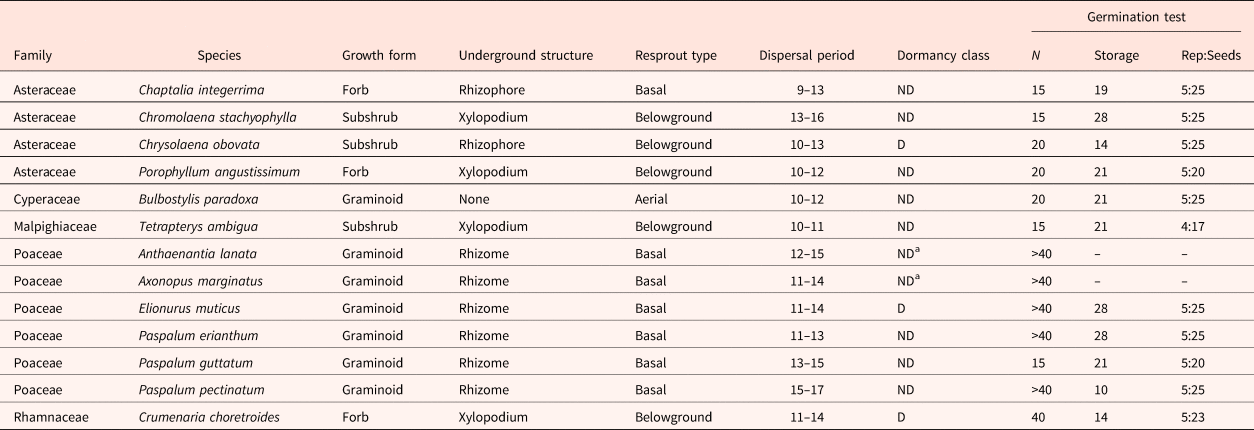
We collected the seeds of 13 species that regularly flower in the first months after fire (Table 1). The species included three forbs, three subshrubs and seven graminoids, comprising the most abundant species in the post-fire scenario of the study site. Seeds were collected from several individuals in a recently burned shrub savanna (cerrado sensu stricto; Ribeiro and Walter, Reference Ribeiro, Walter, Sano, Almeida and Ribeiro2008) at Parque Nacional de Brasília (15°40′48″–15°40′58″S, 47°58′26″–47°58′50″W), Brasília, Brazil. In the first week of May 2021 (early dry season), a 20-ha area was subjected to a prescribed fire as part of the Integrated Fire Management program after 15 years of fire suppression. The area was monitored for reproductive species, and we collected the seeds around 3 months after fire when fire-stimulated species peaked in dispersal.
Post-fire flowering species used in the experiment.

The dispersal period is the number of weeks after fire the species can be found dispersing their seeds. Seeds were classified as dormant (D; physiological dormancy) and non-dormant (ND).
N is the number of individuals seeds were harvested from, storage is the number of days prior to germination test and Rep:Seeds is the number of replicates and seeds per replicate.
a Information retrieved from the literature.
(–) Germination was not tested due to low seed quality and seed availability.
All seeds are orthodox, permeable and anemochoric, except for Bulbostylis paradoxa that has barochoric seeds. Seeds were left to dry in the shade for 1–2 d and then stored in paper bags inside a closed cabinet (mean temperature 26°C, humidity 45%; details in Supplementary Material S1). Seeds were examined to estimate the amount of empty, filled and predated seeds. We used five samples of 100 seeds for each species (except for Tetrapterys ambigua that we used 25 seeds), and gently pressed all seeds with tweezers (Frischie et al., Reference Frischie, Miller, Pedrini and Kildisheva2020). Empty seeds collapse when pressed but filled seeds are hard. Malformed seeds were also considered empty. Seeds with holes and scars in the diaspores were considered predated. Seeds were stored for 10–28 d before germination trials (Table 1), and germination protocols were based on the recommendations of Baskin and Baskin (Reference Baskin and Baskin2014).
Germination
Germination was tested for 11 species using two treatments: control and addition of ash. We did not germinate the seeds of Anthaenantia lanata and Axonopus marginatus due to low seed availability and quality. The seeds were not treated with fungicides or dormancy-breaking treatments and were sown uniformly on a filter paper moistened with distilled water inside Petri dishes (9 mm diameter dish). For the ash treatment, we uniformly placed a thin layer of ash on the filter paper, and seeds were sown above the ash.
Ash was collected by hand right after the fire (at least 30 collection points). All samples were taken to the lab and sieved in a 2 mm metal mesh to remove charcoal and pebbles, ensuring that only fine-grained ash was used. Samples were then homogenized and stored in paper bags inside a cabinet (conditions described above). At the moment of use, a sample was taken from the bags, left to oven-dry at 60°C for 48 h, and then weighted to 0.40 g. This procedure was repeated for every Petri dish separately. The amount of ash in each Petri dish was proportional to half of the ash covering the soil after the fire and was based on field observations (Supplementary Material S2).
For each species, five replicates of 20–25 filled undamaged seeds were used per treatment (except for Tetrapterys ambigua that we used four replicates of 17 seeds). The germination test was carried out for 4 weeks in a germination room with a 12 h/12 h photoperiod (white light), temperature regime of 25–35°C, and 15–40% relative humidity (detailed information on Supplementary Material S1). The number of the germinated seeds was counted three times a week when seeds were moistened. Seeds with the geotropic curvature of the radicle or with the shoot ≥2 mm were considered germinated. At the end of the observation period, non-germinated seeds were tested for viability. Brown, fungi-infected seeds that collapsed when pinched gently were considered unviable (Baskin and Baskin, Reference Baskin and Baskin2014). Hard non-collapsible seeds were tested for viability with a 1% tetrazolium solution (Frischie et al., Reference Frischie, Miller, Pedrini and Kildisheva2020). The solution was kept in the dark within a cabinet (conditions described above), and embryos that stained red after 48 h were considered viable. Final viability was calculated as germinated seeds + seeds that stained red. Seeds were classified as non-dormant if ≥70% of the total viable seeds had germinated in the control treatment (Dayrell et al., Reference Dayrell, Garcia, Negreiros, Baskin, Baskin and Silveira2017); they were otherwise considered physiologically dormant.
Data analyses
The data were analysed separately for each species using generalized linear models with binomial distribution and logit link (Zuur et al., Reference Zuur, Ieno and Smith2007). Germination and viability were modelled individually using treatment as the predictor variable. To account for over-dispersed data, the models of Chaptalia integerrima used a quasibinomial distribution. The assumptions of each model were validated by visually inspecting the residuals (Zuur et al., Reference Zuur, Ieno and Elphick2010), and by performing formal tests (Kolmogorov–Smirnov, Hosmer–Lemeshow Goodness-of-Fit, dispersion parameter and outlier tests). Analyses were carried out in the R software (version 4.2.1; R Core Team, 2022) using the packages DHARMa, easystats, ResourceSelection and tidyverse (Lele et al., Reference Lele, Keim and Solymos2019; Wickham et al., Reference Wickham, Averick, Bryan, Chang, McGowan, François, Grolemund, Hayes, Henry, Hester, Kuhn, Pedersen, Miller, Bache, Müller, Ooms, Robinson, Seidel, Spinu, Takahashi, Vaughan, Wilke, Woo and Yutani2019; Hartig, Reference Hartig2020; Lüdecke et al., Reference Lüdecke, Patil, Ben-Shachar, Wiernik and Makowski2022). Figures were created using the packages ggplot2 and extrafont (Chang, Reference Chang2014; Wickham, Reference Wickham2016).
Results
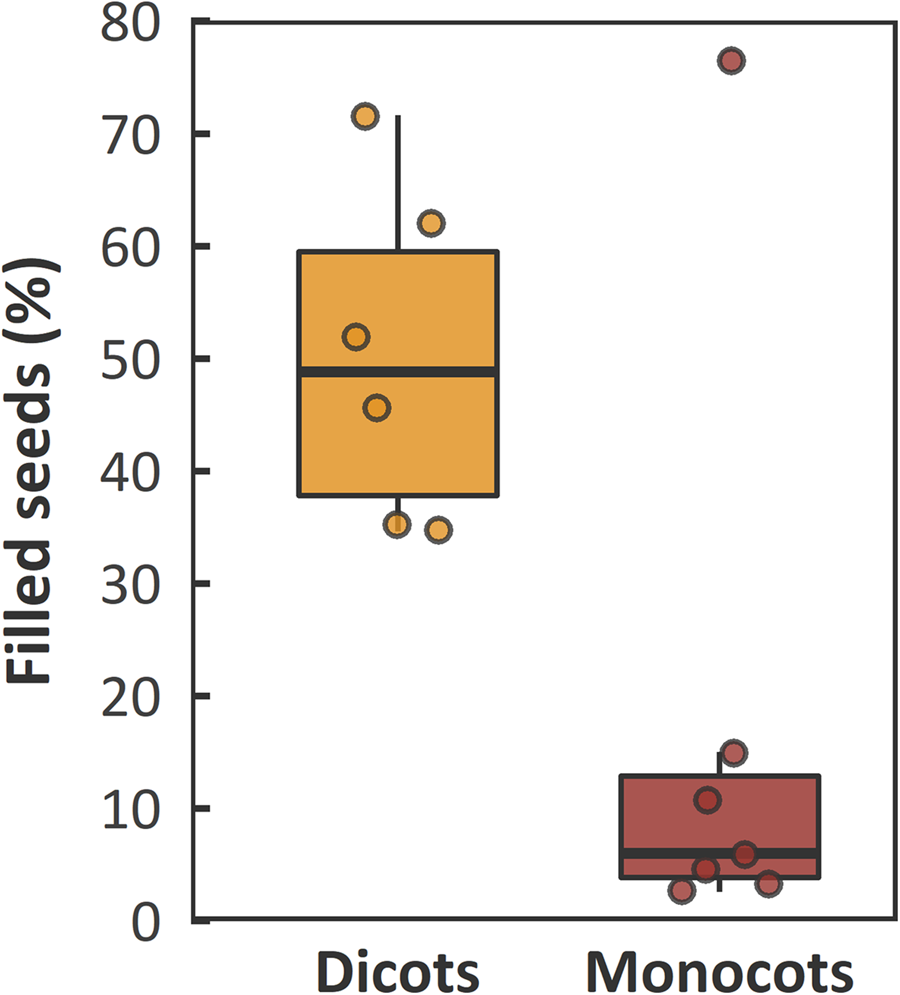
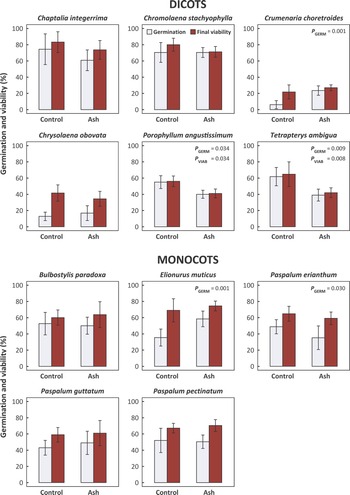
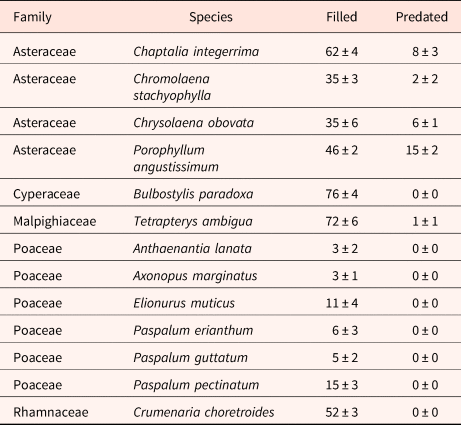
Dicots and monocots showed a clear separation in seed quality (Fig. 1). In general, dicots showed a much higher percentage of filled seeds (35–70%) and a small percentage of predation, while monocots had ≤15% filled seeds (except for Bulbostylis paradoxa that had 76%) and no signs of pre-dispersal predation (Table 2). Percentages of germination and viability showed high variation among studied species (Fig. 2), and the seeds of three species were classified as physiologically dormant: Chrysolaena obovata, Crumenaria choretroides and Elionurus muticus.
Seed fill for post-fire flowering Cerrado species after an early-dry season fire in an open savanna.

Percent germination and viability (±SD) of the seeds of post-fire flowering Cerrado species germinated with or without the addition of ash. Significant differences between treatments are assigned by the P-value.

Percentages of filled and predated seeds (±SD) for common post-fire flowering Cerrado species after an early-dry season fire in an open savanna

Percent germination of half of the species was not affected by the ash treatment (Supplementary Material S3). However, the ash treatment increased the germination of the dormant seeds of Crumenaria choretroides (17% increase, P = 0.001) and E. muticus (23% increase, P = 0.001). For the non-dormant species, ash reduced the germination of Paspalum erianthum in 14% (P = 0.030). Ash also decreased both the germination and viability of Porophyllum angustissimum and Tetrapterys ambigua by 15 and 23%. For all other species, germination and viability were not affected by the treatment.
Discussion
The post-fire dynamics of plant communities is tied to strategies that allow persistence and regeneration (Pausas and Keeley, Reference Pausas and Keeley2014). Plants in the Cerrado show a persistence niche based on resprouting from protected bud banks rather than regenerating from the soil seed bank; obligate seeders are uncommon (Pilon et al., Reference Pilon, Cava, Hoffmann, Abreu, Fidelis and Durigan2021; Zupo et al., Reference Zupo, Daibes, Pausas and Fidelis2021). Even so, recruitment via seeds may be an important step in the regeneration of disturbance-prone communities (Grubb, Reference Grubb1977). Together with resprouting, fire also triggers massive seed production for many species of the ground layer (PFF; Pilon et al., Reference Pilon, Hoffmann, Abreu and Durigan2018; Fidelis and Zirondi, Reference Fidelis and Zirondi2021), dispersing propagules in a favourable environment. Safe sites for germination can be created by the reduced vegetation cover, and chemical residues from fire can stimulate the germination of the newly dispersed seeds (Van Staden et al., Reference Van Staden, Brown, Jäger, Johnson, Van Staden, Brown, Jäger and Johnson2000; Nelson et al., Reference Nelson, Flematti, Ghisalberti, Dixon and Smith2012; Soós et al., Reference Soós, Badics, Incze and Balázs2019). Therefore, although resprouting is the prevalent strategy in the Cerrado, fire-stimulated flowering in the first weeks after fire could contribute to the regeneration niche.
Seed quality is the first important trait to recruitment success (Grubb, Reference Grubb1977), and various reasons cause plants to fail seed development in a fire-prone scenario. For instance, long-lived resprouters can accumulate deleterious mutations that decrease seed quality over many resprouting cycles (Lamont and Wiens, Reference Lamont and Wiens2003), and in the case of PFF, vegetative recovery competes with reproduction for resources, decreasing seed fill and viability (Lamont and Wiens, Reference Lamont and Wiens2003; Pyke, Reference Pyke2017). Our fire-stimulated resprouters showed a large variation in seed fill (Fig. 1) and a clear separation between grasses (many empty seeds) and dicots. That is not surprising since many grasses have low seed quality in the Cerrado (Carmona et al., Reference Carmona, Martins and Fávero1999; Aires et al., Reference Aires, Sato and Miranda2014), especially those with the PFF strategy (Fontenele et al., Reference Fontenele, Cruz-Lima, Pacheco-Filho and Miranda2020). Yet, they are the most abundant group of the ground layer (Munhoz and Felfili, Reference Munhoz and Felfili2006; de Souza et al., Reference de Souza, Almeida, Bijos, Fagg and Munhoz2021), and almost entire populations of fire-stimulated species will flower together a couple of months after fire (Munhoz and Felfili, Reference Munhoz and Felfili2005; Pilon et al., Reference Pilon, Hoffmann, Abreu and Durigan2018). The massive seed production of the population balances the low seed fill suggesting that PFF grasses may invest individually less in seed quality but more in seed quantity.
Dicots, however, have smaller seed sets and population densities but larger and more specialized underground organs (Pausas et al., Reference Pausas, Lamont, Paula, Appezzato-da-Glória and Fidelis2018; Pilon et al., Reference Pilon, Cava, Hoffmann, Abreu, Fidelis and Durigan2021) that allow higher storage and usage of resources (e.g. carbohydrates, nutrients, water; De Moraes et al., Reference De Moraes, De Carvalho, Franco, Pollock and Figueiredo-Ribeiro2016; da Silva and Rossatto, Reference da Silva and Rossatto2019). This trait may lessen conflict between the stages of resprouting and seeding, and the high percentages of filled seeds (Fig. 1) are a good indication that nutrient storages could afford both stages even during the dry season. Nevertheless, dicot seeds were also predated by insects after fire, reducing the number of seeds available for recruitment (Table 1). All these relations help to explain differences in seed set and how PFF is a viable seeding strategy for both dicots and monocots in the Cerrado.
After seed quality, germination traits can help to explain the regeneration of plant communities (Grubb, Reference Grubb1977; Jiménez-Alfaro et al., Reference Jiménez-Alfaro, Silveira, Fidelis, Poschlod and Commander2016). Most of the studied species had non-dormant seeds, a strategy to colonize gaps as soon as water availability allows germination (Baskin and Baskin, Reference Baskin and Baskin2014; Jiménez-Alfaro et al., Reference Jiménez-Alfaro, Silveira, Fidelis, Poschlod and Commander2016). As seeds are dispersed some weeks after fire (Table 1), sites will soon be covered by the resprouting vegetation (Coutinho, Reference Coutinho and Goldammer1990; Miranda et al., Reference Miranda, Sato, Neto, Aires and Cochrane2009) and any advantage in the timing of recruitment is important. Despite that, we also found three species with dormant seeds, two of which were stimulated by ash (Fig. 2). Compounds derived from plant burning may remain active in the upper layers of the soil for a few months after fire (Preston and Baldwin, Reference Preston and Baldwin1999; Ghebrehiwot et al., Reference Ghebrehiwot, Kulkarni, Light, Kirkman and Van Staden2011, Reference Ghebrehiwot, Kulkarni, Szalai, Soós, Balázs and Van Staden2013) and can stimulate the germination of permeable seeds (Van Staden et al., Reference Van Staden, Brown, Jäger, Johnson, Van Staden, Brown, Jäger and Johnson2000; Nelson et al., Reference Nelson, Flematti, Ghisalberti, Dixon and Smith2012; Soós et al., Reference Soós, Badics, Incze and Balázs2019), being important to signalize gaps and adequate recruitment conditions (Jiménez-Alfaro et al., Reference Jiménez-Alfaro, Silveira, Fidelis, Poschlod and Commander2016). However, three non-dormant species were inhibited by the treatment. Detrimental effects of ash can be related to high concentrations of compounds (Van Staden et al., Reference Van Staden, Brown, Jäger, Johnson, Van Staden, Brown, Jäger and Johnson2000; Nelson et al., Reference Nelson, Flematti, Ghisalberti, Dixon and Smith2012), and we cannot discard that our study overestimated the amount of ash that seeds would experience in the field at the time of germination. Rainfall rapidly solubilizes compounds into the soil, which are slowly degraded and have their concentrations reduced after fire (Preston and Baldwin, Reference Preston and Baldwin1999; Ghebrehiwot et al., Reference Ghebrehiwot, Kulkarni, Light, Kirkman and Van Staden2011, Reference Ghebrehiwot, Kulkarni, Szalai, Soós, Balázs and Van Staden2013). So, there is a chance that ash is completely washed away by rains before seeds are dispersed and the observed results may not fully represent field conditions when smaller concentrations are likely more common.
To further understand the success of PFF as a recruitment strategy, we must consider fire regimes in the Cerrado. Lighting-ignited fires occurred for millennia during the wet season and in the dry to wet season transition (Ramos-Neto and Pivello, Reference Ramos-Neto and Pivello2000; França et al., Reference França, Ramos-Neto and Setzer2007; Simon et al., Reference Simon, Grether, De Queiroz, Skemae, Pennington and Hughes2009), but represent a small percentage of the current burned area (Pivello et al., Reference Pivello, Vieira, Christianini, Ribeiro, da Silva Menezes, Berlinck, Melo, Marengo, Tornquist, Tomas and Overbeck2021). Frequent late-dry season anthropogenic fires are prevalent in grasslands and savannas, and early-dry season burns are applied in some Protected Areas as part of the Integrated Fire Management program (Berlinck and Lima, Reference Berlinck and Lima2021; Pivello et al., Reference Pivello, Vieira, Christianini, Ribeiro, da Silva Menezes, Berlinck, Melo, Marengo, Tornquist, Tomas and Overbeck2021). Each fire season could affect regeneration and recruitment strategies since plants are adapted to predictable regimes rather than fire per se (Pausas and Keeley, Reference Pausas and Keeley2009). Therefore, although fire triggers resprouting and flowering independent of the season, deviations from the natural fire regime could desynchronize seed production and favourable germination conditions. Thus, the success of recruitment will be dependent on the timing of dispersal and seed persistence (Long et al., Reference Long, Gorecki, Renton, Scott, Colville, Goggin, Commander, Westcott, Cherry and Finch-Savage2015).
Seeds produced after early-dry season fires will remain exposed on the soil for 3–4 months before a germination window, and the entire reproductive output could be lost if seed viability fades before the wet season. Seeds on the soil are also subjected to post-dispersal predation and removal by ants, which may reduce viability but carry seeds to further germination sites (Christianini et al., Reference Christianini, Mayhé-Nunes and Oliveira2007; Rebolo et al., Reference Rebolo, Zirondi, Fidelis and Christianini2022). Also, the ash of early-dry season fires can be removed by wind before rains start germination (Coutinho, Reference Coutinho and Goldammer1990; Castro-Neves and Miranda, Reference Castro-Neves, Miranda, Miranda, Saito and Dias1996), suggesting that other germination stimuli may be important in these conditions. There is a large knowledge gap regarding the seed longevity of ground-layer species, and further work on the persistence of PFF seeds could clarify the recruitment potential after early-dry season fires. On the other hand, in late-dry and early-wet burns, ashes are solubilized into the soil right after fires (Coutinho, Reference Coutinho and Goldammer1990), and seeds will be dispersed in periods of high rainfall. Non-dormant seeds have the advantage of germinating after dispersal, minimizing losses to senescence and predation (Long et al., Reference Long, Gorecki, Renton, Scott, Colville, Goggin, Commander, Westcott, Cherry and Finch-Savage2015). Dormant seeds, if not stimulated by ash, may spread germination over longer periods to overcome intraspecific competition (Long et al., Reference Long, Gorecki, Renton, Scott, Colville, Goggin, Commander, Westcott, Cherry and Finch-Savage2015), risking losses to post-dispersal predation (Christianini et al., Reference Christianini, Mayhé-Nunes and Oliveira2007; Alcolea et al., Reference Alcolea, Durigan and Christianini2022) and to a shorter growth period as the next dry season approaches. In the end, however, even if seeding fails in any situation or scenario, short- and mid-term population persistence will be guaranteed by resprouting and underground organs (Bond and Midgley, Reference Bond and Midgley2001; Pausas et al., Reference Pausas, Lamont, Paula, Appezzato-da-Glória and Fidelis2018).
Overall, seeds produced in response to fire could be an important source of genetic variability in an ecosystem that has resprouting as the main persistence strategy. Seeds produced in the PFF are ready to germinate, with dicots producing filled (but predated) seeds while grasses produce mostly empty propagules. Most PFF species are non-dormant and non-responsive to ash, showing prompt germination if conditions are favourable. However, further studies on germinative traits could elucidate changes in germination timing, sensibility to ash concentrations, and how seeds in the soil seed bank are affected. Furthermore, while the most common PFF graminoids have been covered by this and other studies, basic germination knowledge remains unknown for most PFF dicots. There is little work assessing the relations of seed traits and fire regimes in the Cerrado, and further work on fire season, phenology and germination could clarify the contribution of PFF to the post-fire regeneration.
Supplementary material
To view supplementary material for this article, please visit: https://doi.org/10.1017/S0960258522000277.
Acknowledgements
We thank Parque Nacional de Brasília and Instituto Chico Mendes de Conservação da Biodiversidade for the permission to develop this research (77702-1) and for conducting the prescribed fires. We also thank the Universidade de Brasília for technical support and facilities. We thank Augusto César Franco for his useful comments and suggestions on the experiment and the manuscript. We thank the anonymous reviewers for their useful suggestions.
Financial support
This study was supported by Fundação de Apoio à Pesquisa do Distrito Federal (FAPDF), conceding a scholarship to the first author under the research grant 00193.00000052/2019-48.
Conflicts of interest
The authors declare no conflict of interest.