I. A Flower's Bed: Visiting Rose
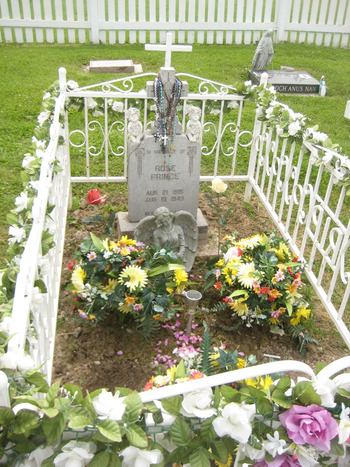
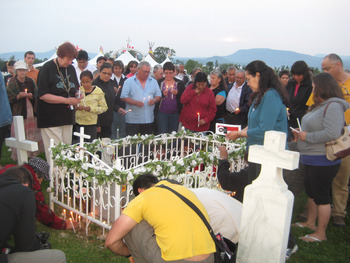
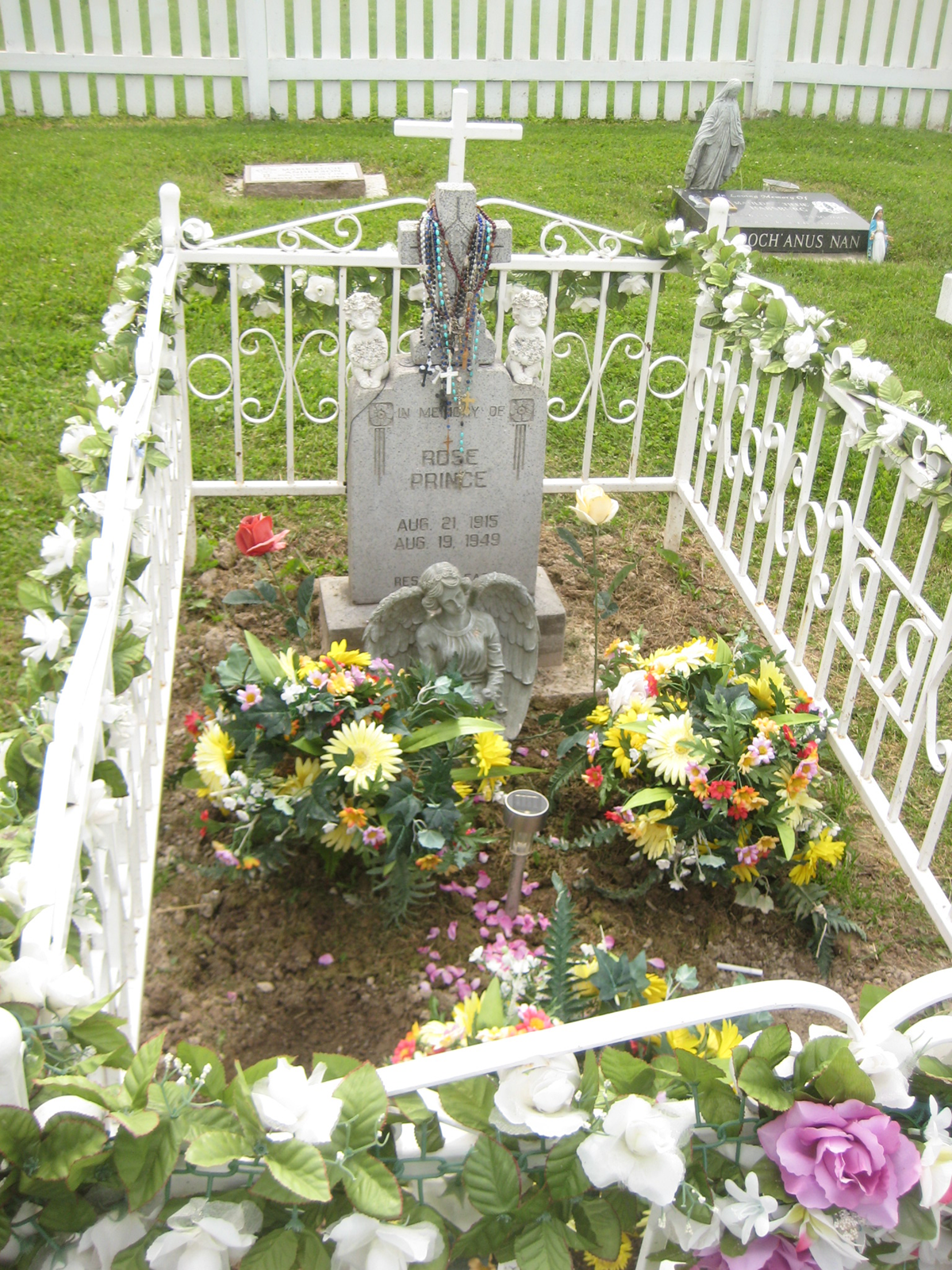
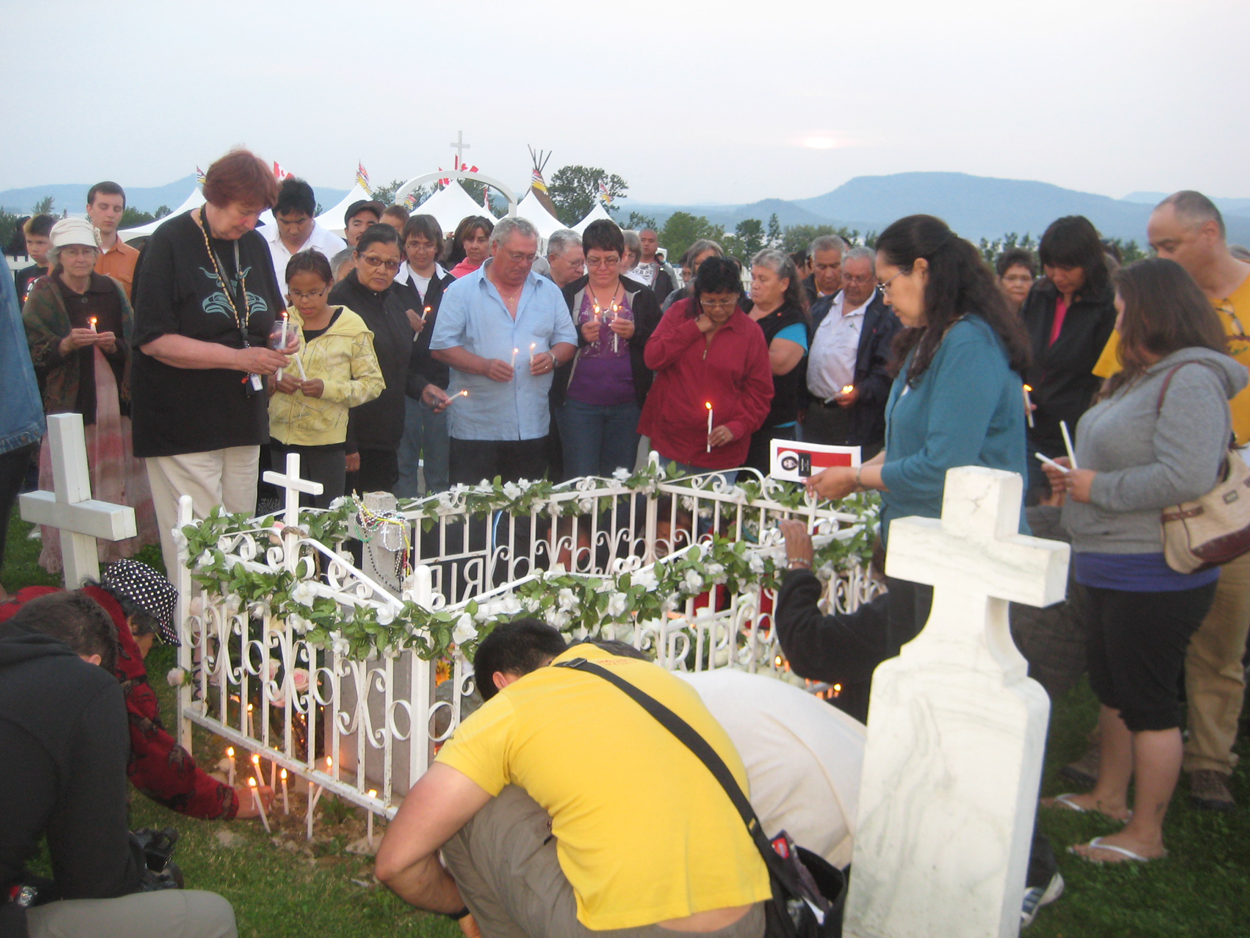
They gather in the twilight, singing, massing around the poignantly small grave: its whitewashed ironwork frame making it look strangely like an old-fashioned child's bedstead (fig. 1). Reaching across the divide, they plant their candles in the earth. The light shines on their faces, tracing the wet tracks on some cheeks in its silver. In the gathering dark, the dots of candlelight, hovering near the earth, resemble fireflies in the strange blue light of dusk. A woman begins to chant the rosary in Carrier. Others join her, their voices braiding together, high and low, clear and muffled, rising heavenward. Some cross themselves. Some touch their prayer beads to the gravestone. Others kneel to scoop dirt from the grave into sandwich baggies (fig. 2). One hundred yards away, the tents erected for the pilgrimage, and the teepee that houses the Eucharist, glow a hallucinatory white in the darkness like the billowing sails of a great ship. The pilgrims’ prayers are seconded by the long, low, lonely howl of a freight train.
Rose Prince's grave on the former grounds of the Lejac Indian School near Fraser Lake, British Columbia. Earth from Prince's grave, usually mixed with holy water or oil, is often used in healing rituals by her devotees. Photograph by the author.
Singing pilgrims cluster around Rose Prince's grave, placing lit candles in its soil during her annual July pilgrimage. Photograph by the author.
It is a July evening near the small town of Fraser Lake, British Columbia, Canada, and the second, climactic night of a pilgrimage to honor a young Dakelh (Carrier) woman who lived and died more than half a century ago: Rose Prince.Footnote 1 Hundreds of pilgrims from across British Columbia and Canada's Prairie provinces have come to this huge grassy field, the former site of the “Lejac Indian Residential School” on the ancestral territory of the Nadleh Whut'en First Nation.Footnote 2 The setting, a low bluff above the glass of Fraser Lake, is verdant, treed, bucolic. But it is also eerie. At the far end of the property, where the field dissolves into the darker trees, there is the pulsing void where the imposing three-story brick structure once stood. It has been so thoroughly erased that not even its foundations are traceable in the lush grass. This part of the property pulses with its own potent force field. Its absence draws the gaze like a pulled tooth attracts a probing tongue.
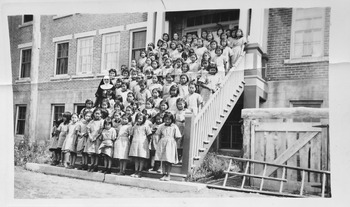
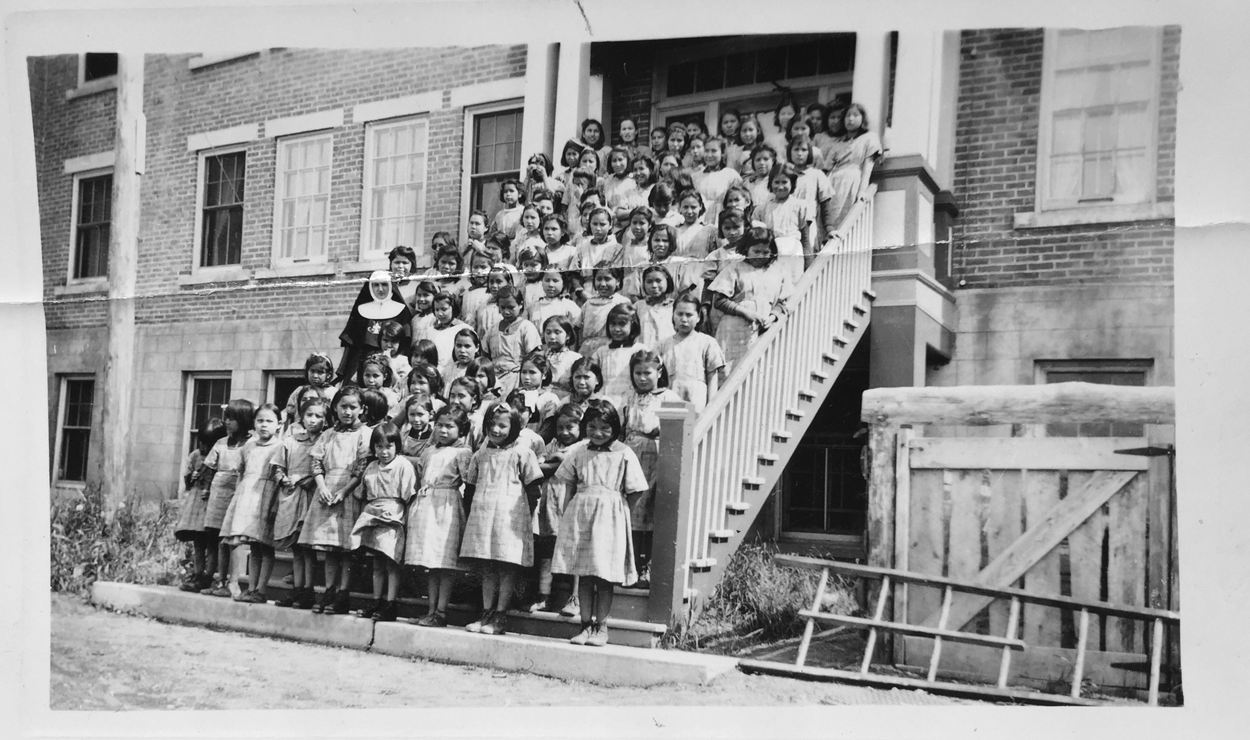
For those who know where to look, the vanished school has left its hidden traces. If one searches in the scrubby brush, over by the looming trees, one might find an overlooked shard of red brick to pocket. Or one might come upon a crumbling concrete stairway to nowhere, marooned in a clump of lilac bushes, drifting like flotsam from the school's shipwreck. Pilgrims assemble upon it for photos that evoke, with their serried ranks of smiles, the careful formality of generations of institutional group portraits, which froze students forever in their identical uniforms (fig. 3).
Female students of the Lejac Indian Residential School, carefully arranged by age and accompanied by a Sister of the Child Jesus, pose on the stairs of their school for a formal portrait. Note the extreme youth of the girl in the middle of the front row: children as young as four were sent far away from their families to these assimilative residential institutions. Undated photo, courtesy of the Archives of the Roman Catholic Diocese of Prince George, held in Saint Andrew's Parish, Fraser Lake, British Columbia.
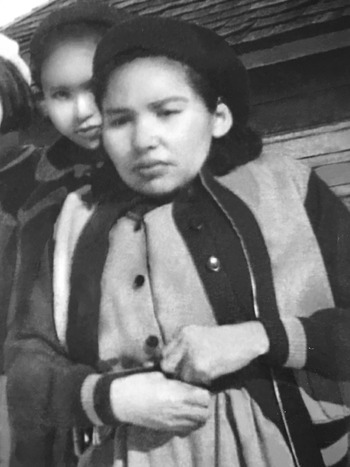
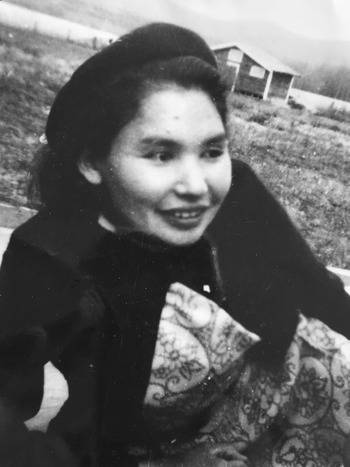
The pilgrims—many of them former students of Lejac or of residential schools further afield—have assembled on this July night because they believe that the young woman around whose grave they cluster, Rose Prince (fig. 4), is a saint. By visiting her final resting place and taking the soil from her grave, pilgrims testify to their conviction that Rose can work miracles on their behalf. Many tote heavy containers of the soil to the luggage compartments of their rented buses for the later ritual use of those too ill to make the journey themselves. Their prayers, voiced in an exercise called the “Living Rosary” in which each petitioner represents a living “bead” in a human chaplet, are raw expressions of personal pain that contrast sharply with the soft, repetitive waves of “Hail Marys” and “Glory Bes.” Rose's supplicants ask in their own words—their voices dense with emotion—for her intercession in a range of ills, from cancer to alcoholism, drug addiction to chronic unemployment, failing marriages to family estrangement, to the pain and guilt of a loved one's suicide.
A pensive looking Rose. In this image, the disfigurement caused by her childhood back injury is evident in the slight thrusting forward of her body and in the hunching of her shoulders. Undated photo courtesy of the Archives of the Roman Catholic Diocese of Prince George, held in Saint Andrew's Parish, Fraser Lake, British Columbia.

This pilgrimage, the most visible aspect of the embryonic cult of a twentieth-century Indigenous woman virtually unknown during her lifetime, is the shared improvisation of the clerical hierarchy of the Catholic Church in British Columbia and of Rose's own Carrier people. Though at odds on much else, they are unanimous that the Lejac Indian Residential School unwittingly hosted, between its opening in 1922 and her death in 1949, a saint. Soft-spoken, shy, and retiring in life, Rose's understated holiness was rewarded by a postmortem miracle generally reserved only for God's greatest saints: incorruption.
The fragile unanimity that their shared belief in Rose's sanctity creates exists in dynamic tension with sharply divergent interpretations of her holiness among her lay and clerical supporters, particularly as it pertains to the legacy of residential schools. For some within the Catholic hierarchy, Rose's sanctity is a compensatory silver lining amid the many dark clouds of scandal and shame engendered by its historic involvement in the residential school system. They see Rose as proof that these embattled institutions did do some lasting good by producing a genuine saint. Many Carrier, however, see Rose's holiness in quite another light. To them, her sanctity is not a retrospective ratification of residential schools, but the system's starkest repudiation. Rose's virtue was not the product of this hated system, they argue, it was a rebuke to the very notion that such a system was deemed necessary. For them, Rose was—and is—the heart of a heartless world, incarnating gentle, compassionate humanity within a system that, while it trumpeted these Christian virtues, was itself notably lacking in them.
Saints live in more than one time. Having eked out the contours of their historical lives in one era, saints are perceived as active and accessible by their contemporary devotees, who often interpret their life and its meanings within the ideological and theological rubrics of their own period. Even through at present Rose is only a saint in the popular sense (having not received the imprimatur of Rome), it is nevertheless helpful to distinguish between the facts of her life and the many accretions that have come to cling to her vitae like barnacles to a ship. One must hack through some “Brothers Grimm” thickets to find the real Rose. For what could invite more fanciful embroidery than the name “Rose Prince”? Her story, after all, contains so many fairy tale conventions: the oppressed yet sweet heroine, persecuted by an “evil stepmother,” humming uncomplainingly as she works, and even achieving an improbable final victory over the forces of death and decay as a kind of latter-day “Sleeping Beauty.”
II. In Bud: Rose's Early Childhood
Rose Prince was born on August 21, 1915 in Fort Saint James, British Columbia. A former fur-trading outpost, Fort Saint James is 940 kilometres (585 miles) north of Vancouver. At the time of Rose's birth, Dakelh (Carrier) culture was undergoing widespread and disorientating social change. Traditional norms, practices, and values, though still extant, were under growing assimilative pressures.
Traditionally, Rose's people reaped a rich living by living symbiotically with the land.Footnote 3 Salmon caught in elaborate river weirs served as a staple of their diet, with gathered fruit and the vegetables produced through small-scale pottage agriculture rounding out the traditional fare. The Carrier demonstrated their respect for the nonhuman beings around them by extending the values of the human community outward into the natural world and its flora and fauna. Animals in particular were pivotal figures in the Dakelh spiritual universe. Relations with them were critical to the transformation of Carrier girls and boys into women and men. An adolescent's adoption by a guiding guardian animal-spirit during a cathartic vision quest represented the critical first encounter in an intense, lifelong bond between individual human and nonhuman beings.Footnote 4 Like many other Indigenous peoples of North America's West Coast, the Carrier practiced elaborate rituals of wealth redistribution that had spiritual, social, and political overtones. Known among the Dakelh as balhats (though they were often referred to as “potlatches” by outsiders), the ritual redistribution of food, clothing, and goods in magnificent ceremonies helped to level social and economic inequalities, ensuring community cohesion.Footnote 5
Women played a strong role in Dakelh culture, particularly matriarchs and female elders, who claimed part of their authority from their revered role as wives, mothers, and grandmothers.Footnote 6 Female fertility was seen as powerful, though potentially dangerous, and menstrual seclusion and taboos were commonly observed.Footnote 7 Most Yenke Dene marriages were monogamous, with the exception of powerful chiefs, who sometimes practiced plural marriage.Footnote 8 Traditionally, Carrier women enjoyed considerably more sexual, social, and political freedom than did their white contemporaries. Yenke Dene society was matrilineal, and women habitually acted as chiefs, shamans, healers, and political advisors.Footnote 9
Permanent white incursion and a “live-in” colonial culture only began in British Columbia in the early nineteenth century. These social changes further accelerated in the second half of the century, stimulated by the gold rush of 1869, British Columbia's entry into the Canadian confederation in 1871, and the building of Canada's transcontinental railway between 1881 and 1885.Footnote 10 It was during this period that the Dakelh acquired the nickname “the Carrier” in non-Indigenous circles, a name that supposedly made reference to the Dakelh's elaborate bereavement rituals, which mandated that mourners carry their deceased loved ones’ bones on their backs in a leather bag for the entire year following the deceased's demise.Footnote 11
Contact and colonization brought a host of changes and challenges for the Carrier. As traditional hunting and fishing patterns were increasingly disrupted, the Yenke Dene sought alternatives to supplement their diets and livelihoods, including wage work as gold panners, loggers, miners, and construction workers, in addition to the more traditional occupations of hunting, fur trapping, and guiding. Like other First Nations across the newly created Dominion of Canada, the Dekelh were subject to expanding, intrusive supervision and regulation by the federal government, particularly after the 1885 amendment to the Indian Act, which banned the balhats.Footnote 12
The Dakelh's relationship with European religiosity during this period was complex. The Carrier first encountered Christianity through the efforts of the Oblates, the peripatetic Catholic male missionary order who would later play a pivotal role in the administration of residential schools. Much like the Jesuits centuries earlier in eastern and central Canada, the French-founded Oblate order sought to convert the Indigenous peoples of the Canadian North and far West. As intimated by their dramatic name, “the Oblates of Mary Immaculate” (OMI)—which literally means “the burnt sacrifices of the spotless Mother of God”—they preached a fiery, uncompromising brand of Roman Catholicism that viewed all spiritual competitors, from traditional Dakelh spirituality to Protestantism, as false, fallen, and heretical faiths.Footnote 13 The Oblates insisted that converts conform completely to Roman Catholicism, and reject and denounce their former beliefs and practices.Footnote 14 Some Oblate-controlled Carrier villages in northern British Columbia became virtual theocracies in which corporal punishment was meted out by the missionaries for a range of infractions, particularly the sexual sin of adultery. Oblate ambition extended beyond merely the molding of children and adolescents in residential schools: they sought nothing less than the total transformation of Indigenous cultures, root and branch.Footnote 15
However, though they were uncompromising and severe, even violent in religious matters, the Oblates proved willing allies of the Dakelh in their efforts to preserve key elements of their traditional lifeways. In 1906, Father Niccolaus Coccola (an energetic Corsican whom Rose Prince would later serve as a personal secretary at the Lejac Indian Residential School) accompanied two chiefs to Ottawa in a failed bid to persuade federal government officials to allow the Carrier to continue their traditional large-scale weir fishing on British Columbia's rivers.Footnote 16 Although their bid was ultimately unsuccessful, it persuaded many Yenke Dene of Oblate good will, at least in some areas of community life.Footnote 17
Although Rose was only two generations removed from her animist, polygamous great-grandfather, the Great Chief Kw'eh, the spirituality of the Prince family became deeply imbued with Roman Catholicism during these two intervening life spans.Footnote 18 Her parents, Jean-Marie Prince and Agathe Todd, met in residential school—St. Joseph's in Williams Lake, British Columbia—and married upon their graduation.Footnote 19 Returning north to Fort Saint James, the couple lived “on the top of the little hill in a house just behind the convent . . . all their children were born in that house.”Footnote 20 Rose was the third of their nine offspring.Footnote 21 Jean-Marie, his second name given in honor of the Virgin Mary, translated the mass into Carrier and served as Fort Saint James's “Church Chief.”Footnote 22 Agathe was a noted beauty and respected local midwife, described by a family friend as “a very, very holy and humble person. She never missed church once. . . . She was very shy and never spoke to anyone unless spoken to.”Footnote 23
Although she would live less than six of her thirty-four years with her natal family, Rose's attachment to her parents and to her eight brothers and sisters (her two older siblings, Marie and Alfred, and her six younger: William, Paul, Lina, Seraphine, Sophie, and Sally) was strong.Footnote 24 Decades later, at Lejac, Rose would recount vivid memories of her early childhood, remembering affectionately how her beloved mother, out on the trap line, would take the extra time and trouble to shape out individual little pies for each of her kids.Footnote 25
III. Stations of the Cross: The Canadian Residential School System
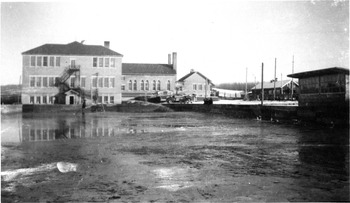
As a very young child, Rose attended Necoslie School at Stuart Lake near her family home.Footnote 26 But on January 17, 1922, she joined the “great exodus” of Fort Saint James's schoolchildren to Lejac.Footnote 27 Together with Lejac's first director, Father Joseph Allard, OMI, seven Sisters of the Child Jesus, and three lay teachers, Rose and seventy-four other Indigenous children made the grueling twelve-hour-long journey south to Fraser Lake, the town nearest the school site, via horse-drawn sleigh and train.Footnote 28 Their destination was the brand new, three-story, redbrick facility (fig. 5), the Lejac Indian Residential School, named for pioneering nineteenth-century Oblate missionary Jean Marie Le Jacq.Footnote 29 Their arrival was carefully choreographed to impress. Wrote Father Allard of the spectacle he had orchestrated:
At two the next morning the train stopped at Lejac, one hundred yards away in front of the school where, according to my orders, all lights, in and out, were lit. When the students saw the magnificent palace that the Indian Department had built for them they could not believe that it was for them, and when Sister Catherine told them, “Children, this is your school,” they said, “No, sister, you are fooling us.” But they were not slow to climb the hill and get into the school. The electric light switches and the flush toilets worked overtime before the children understood that these were not playthings.Footnote 30
Lejac Indian Residential School in the 1930s. Residential schools, built to house hundreds of Indigenous children, were often large and imposing structures. Photo courtesy of the Archives of the Diocese of Prince George, Prince George, British Columbia.

As a seven-year-old, the newly arrived Rose Prince would have had no way of knowing that this imposing building, illuminating the dark horizon like a blazing Titanic before the iceberg, would be her home for the twenty-seven years of life that remained to her. For, with the exception of some summer visits to her family up north, Rose would remain at Lejac, first as a student and then as an unpaid worker—a cook, seamstress, substitute teacher, and secretary—until her premature death from pulmonary tuberculosis, just two days shy of her thirty-fourth birthday.Footnote 31
In order to comprehend Rose Prince and the contradictory contemporary interpretations of her life and legacy, one needs to understand the functioning of the Lejac Indian Residential School. Lejac was typical of many other assimilative educational institutions across the country, which were funded by the Canadian federal government and administered by both Protestant and Catholic entities. Although the strategy of transforming Native society through the isolation and comprehensive re-education of its children had been implemented in New France, modern residential schools, which enjoyed a new vogue of popularity from the mid-nineteenth century on, were more ambitious, coercive, and racist than their seventeenth-century predecessors.Footnote 32 In these “totalistic” institutions, the considerable power of the newly formed Canadian state was brought to bear in an attempt to transform Indigenous societies culturally, spiritually, and linguistically in the persons of their youngest and most vulnerable members.Footnote 33 Seen as the benevolent gesture of a dominant and enlightened civilization toward those still laboring in primitive heathenism, the creation of residential schools was one of several new policies enacted by the young Dominion of Canada with the aim of controlling and assimilating Native peoples. Other such policies included their confinement to reserves and the outlawing of seminal rituals, such as the Sundance and the Potlatch. By 1922, when Lejac opened, children's attendance at residential schools had been legally mandated for two years, and parents’ failure to comply could result in criminal conviction. The entire might of Canada's state, judiciary, and police, then, was deployed in the residential school experiment, which concluded only in the late twentieth century.
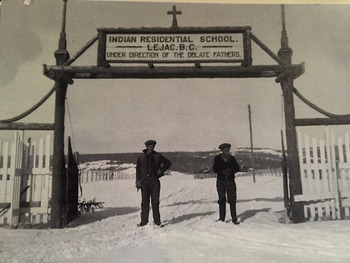
For its young Indigenous students, daily existence, lived out inside Lejac's imposing gates (fig. 6), was an experience of rigour, conformity, and the inculcation of an exacting, exclusive pre-Vatican II Roman Catholicism. Surrounded by religious iconography, students were inducted into a never-ending round of prayer, ritual gestures, and mandated collective worship. “God got an earful,” ruefully recounted one Lejac alum.Footnote 34 Religious instruction, basic literacy and numeracy, and farm work (for boys) or domestic labor (for girls) comprised the core of Lejac's curriculum which, until 1947, went only through the eighth grade. Teaching, which took place in classes comprised of students of varying ages and abilities, emphasized rote memorization rather than creativity or critical thought. The Sisters of the Child Jesus, Lejac's teaching corps, generally lacked any formal teaching qualifications.Footnote 35
Two workmen stand in the snow beside the entry gates to the Lejac Indian Residential School. As a matter of policy, residential schools were built far from their students’ home communities, deliberately making visits between children and their families infinitely more rare, difficult, and expensive. Undated photo, courtesy of the Archives of the Roman Catholic Diocese of Prince George, held in Saint Andrew's Parish, Fraser Lake, British Columbia.

For many pupils, Lejac was a world of baffling unfamiliarity, arbitrary rules, authoritarianism, and strict discipline, including—in direct contravention of traditional Carrier values—corporal punishment.Footnote 36 It was a world of packed dormitories, wearying, unvaried routine, vivid fears of hell, and unappetizing food.Footnote 37 It was a world of constant, low-grade illness and hunger, endless waiting, and marching in two-by-two lines like Noah's animals off to the ark. Lejac's primary mission, the enforced conversion of its students to Roman Catholicism, often dovetailed with its punishment techniques. Disobedient students were sentenced to long periods of painful kneeling on hard wooden floors, in the very posture of prayer. Same-sex students sported identical haircuts and wore identical uniforms.Footnote 38 Because each pupil was assigned a number, students had the unsettling sense that they were simply an impersonal digit rather than a whole person: a number rather than a name.Footnote 39
At Lejac and other Catholic residential schools in British Columbia, sexual segregation was so strict that even brothers and sisters were not permitted to fraternize. Boys and girls ate in segregated dining rooms and played in separate yards since the Oblates felt that inter-sex mingling encouraged unwholesome sexual attraction and flirtation.Footnote 40 In all of their dealings with the Dakelh, the Oblates stressed the holy necessity of female subordination and male leadership in all aspects of family and community life, attempting to squelch the Dakelh's “sinful” emphasis upon women's personal autonomy, political and economic clout, and sexual freedom.Footnote 41
At Lejac, many students experienced crushing loneliness and homesickness. Because traditional Carrier culture was seen as threatening efforts to catholicize and “civilize” their young native charges, school officials took every possible measure to limit family visits, and thus parental influence. Indeed, the school was founded at Fraser Lake precisely because of its distance from students’ natal homes, which were considerably farther north.Footnote 42 Parents coming from afar were permitted to bunk on the floor of the “visitors’ parlour,” but the length and frequency of their stay (as well as their mobility on Lejac's campus) was strictly controlled.Footnote 43 At night, then, far from home, among priests and nuns whose appearance was often unfamiliar and frightening, and separated from even their siblings by the gendered barriers of the school, many young students wept from fear, shock, and loss in Lejac's darkened dorm rooms.
In compensation, many pupils forged fierce friendships with same-sex peers at Lejac.Footnote 44 Even decades later, and in defiance of death, these bonds remain tight: evidence of the difficult circumstances in which they emerged. Together with other fond memories—of their participation in a concert, perhaps, or on a sports team; of the kind gesture of a nun or an unexpected reprieve from punishment; of a particularly hilarious practical joke or a generous Christmas—it is the recollection of these strong childhood friendships that often feature most prominently in alumni's bittersweet memories of Lejac. It is in this context that Rose is most often remembered—her early death pressing her, like a flower, between the pages of a now-vanished world.
If this had been all there was to life at Lejac, then this would have been bad enough. But the school's diurnal world of precision, conformity, and submission—its world of state-mandated abuse—was not the only Lejac. An unacknowledged, covert, and nocturnal Lejac also existed, one that dared not speak its name. In addition to proudly and publically denuding students of their traditions, culture, beliefs, and language—a robbery enforced through coercion, ridicule, physical punishment, and humiliation—Lejac's extreme power asymmetry fostered a climate of sexual abuse, in which students were preyed upon by the authority figures who controlled virtually every aspect of their lives.Footnote 45
This, then, was the institution that Rose Prince was compelled by Canadian law to attend. At the age of sixteen, this was the institution that she embraced as home for the remainder of her all-too-short life.
IV. Every Rose has its Thorn: Prince's Life at Lejac
Rose Prince's uneventful life and early death created few obvious waves in the busy, overcrowded world of Lejac Indian Residential School. Though those who met Prince retain vivid memories of her, she left only the most cursory imprint upon the school's official records.Footnote 46 Concludes Father Vince James, the folksy, personable parish priest of Fraser Lake: “She lived humble and she died humble. People looked to her and honored her, but no one was thinking in those terms [e.g., that she could be a saint].”Footnote 47 Only in the miraculous aftermath of her death would Prince's modest, quiet, and seemingly “ordinary” life be reevaluated.Footnote 48
Rose herself generated few written traces: she does not seem to have kept a diary or written any lengthy letters that would give us insight into her inner life. Prince's failure to produce a written corpus poses difficult challenges for her causa: the determined, often lengthy campaign by believers in an individual's sanctity to have that sanctity receive official Vatican recognition, first by being declared “venerable,” then through beatification, and finally by canonization, after which the individual can finally adopt the honorific “saint” before their name. The paucity of Prince's literary production stands in sharp contrast with that of the two saints to whom she is most often compared: Kateri Tekakwitha (a seventeenth-century Indigenous convert to Roman Catholicism, canonised in 2012) and Thérèse de Lisieux (a nineteenth-century French Carmelite nun raised to the altars in 1925). Both of these saints enjoyed reputations for sanctity during their lifetimes that either prompted others to write copiously about them or to commission their spiritual autobiographies.Footnote 49 By contrast, all of the material traces that Rose left behind—notably her finely worked embroidery and painting on ecclesiastical stoles and altar linens—are mute.
In addition to the paucity of documents written by or about Rose, there is another daunting barrier to our understanding of her: the fact that so many of her apparently distinctive life experiences, when analyzed contextually, are revealed to be tragically commonplace. Indeed, with the exception of her alleged incorruptibility, Rose's biography actually typifies the experiences of female residential school students at Lejac and beyond during the first half of the twentieth century. The similarities shared by Rose and her peers include behavioral traits such as an exaggerated obedience to school authorities and a retreat into a comforting, compensatory inner world. The parallels also encompass life experiences, such as the endurance of serious illness or injury (or both), repeated bereavements, and the decision to remain at Lejac into adulthood. Only Rose's response to her entirely typical deprivation, isolation, injury, pain, and loss—her development of an exceptionally intense religiosity and an unfailing commitment to the emotional support and guidance of others, particularly those weaker or younger than herself—appears to have been at all unusual.
V. Serenity or Submission?
Douglas Todd, the writer of scores of newspaper articles about Rose and her cult, has repeatedly asked: “Does Prince's life make the grade of goodness? Or was she an overly obedient product of an oppressive residential school system? . . . Clearly, Prince was no revolutionary.”Footnote 50 As Todd intimates, Rose's scrupulous submission to Lejac's strict rules was noted by everyone who knew her: family, friends, and faculty alike. Popular adjectives used to describe Prince are “gentle” and “humble.” Respondents are unanimous that Rose was “a real nice girl,” quiet, shy, and “holy,” and that she never did anything to draw attention to herself or to (directly) question Lejac's authorities.Footnote 51 These qualities sometimes lead to a trace of condescension slipping into descriptions of Rose. One of her teachers fondly recalled Rose's unquestioning “obedience” while another characterised Prince as “a humble little person.”Footnote 52
But others remember Rose quite differently. Bernie McCorry, who describes Rose as her “best friend,” notes that she was “very humble, very humble, but by the same token she had [a] nice sense of humour.”Footnote 53 Sister Susan Songary, a Carrier nun who worked at Lejac and knew Rose well, sees her apparent passivity as a misunderstood facet of her Dakelh identity:
I want to say something about a quality that we can't seem to put into words . . . as the only native [nun] here [at Lejac] . . . there is a particular quality about natives that others don't—well, it's not their natural habitat. We don't spontaneously share things . . . we keep it deep inside until the moment comes when perhaps something will happen and we will share it with other people. But there is a very passive aspect to Indians that is in their nature . . . so Rose certainly shared that and I know I felt that when I was with her. . . . You would call her passive, but to me it was not that, it was just that she was Indian completely.Footnote 54
Rose's family members claim that her humility and quiet gentleness are family traits: the personal attributes of her mother, Agathe, which she seems to have passed along to all of her children, not just Rose. Wilma Pattison, Rose's niece and herself a remarkably shy and sensitive woman, notes that this quality characterized all of Rose's surviving siblings: “She was a very humble person. Meek. And in my mind's eye I could visualize her being that way because all her siblings were that way . . . my Auntie Sophie, my Auntie Sally . . . my Dad. He was the last one to pass. He said, ‘I guess I am the last of the Mohicans.’”Footnote 55
Rose's much-sought-after counsel generally advised her female peers to adopt a similar stance of spiritual submissiveness, stressing compassion and humility over anger and hatred, and private prayer over public confrontation. Prince repeatedly recommended to her friends when they were feeling resentful of or furious with a fellow student or an authority figure at Lejac—particularly when that person was, objectively, in the wrong—that “rather than curse them or hate them [they should] just pray for them [the perpetrator].”Footnote 56
Viewed hagiographically, Rose's quiet modesty and her message of Christian charity and forgiveness can be read as evidence of her dawning inner life of holiness. Seen anthropologically, however, Prince's placidity reveals itself to be a common female response to the residential school environment. In her excellent studies of assimilative institutions in British Columbia, anthropologist Jo-Anne Fiske notes the presence of certain sex-specific coping mechanisms. Fiske reports that male students were often openly rebellious in their shorter, less scholastically successful residential school careers. Boys failed classes, swore, talked back, kicked or punched priests, and “stole”—that is, they took by stealth food they badly needed to supplement their meager rations. Proud of being a “wild bunch,” they talked trash about the nuns and chewed tobacco.Footnote 57 They also ran away: runaways from Lejac were almost always boys rather than girls. Sometimes they were caught and severely punished. Yet on other occasions, particularly during the harsh winter months, runaway boys died before they could be found, perishing from cold or hunger.Footnote 58
Female students, on the other hand, were much more cautious. Though some girls clearly shared their male peers’ attitudes about “God damned Lejac,” they generally transmuted these emotions into a prolonged guerilla campaign of tiny, deniable protests—death by a thousand cuts.Footnote 59 Girls wreaked their subtle revenge by putting too much starch in the laundry, sewing up the flies on priests’ pants, pulling fire alarms, brazenly wearing makeup, sneaking notes or food to boys, and covertly conversing in their own languages.Footnote 60 But most girls concluded that apparent acquiescence, rather than overt revolt, was the best way to survive residential school.
Rose's reputation as a “good girl” facilitated her cordial relationships with the teaching and administrative staff of Lejac. Remarks Margaret Nooski, one of Rose's fast friends at Lejac: “I think Rose was very special to all the sisters and the priests. She was always in church—when she had got the time, she goes to church and prays.”Footnote 61 It is certainly going too far to claim that Rose had been “pretty much” adopted by the Sisters of the Child Jesus, as some sources suggest.Footnote 62 However, Prince's careful deference to school rules did facilitate her strong relationships with Lejac's authorities, for the very reason that any intimacy with them would have been unthinkable without student docility as its precondition.
Throughout her life at Lejac, first as a student and then as an unpaid worker, Rose was repeatedly assigned tasks that required a strong spirit of service and deference to clerical authority.Footnote 63 Prince was probably one of the exemplary female students selected to perform personal domestic chores for individual members of the Oblate administration, such as cleaning their personal quarters. To be selected for these tasks was considered a great honor, as the girls chosen for this privilege received a special white uniform that visually distinguished them from their peers.Footnote 64 Rose was also the first Lejac alumna to serve as a private secretary to the school's director, Father Niccolaus Coccola.Footnote 65 Finally, in an offer reminiscent of Jesus's humble washing of his disciples’ feet, Prince volunteered to render personal home care services to an incapacitated elderly bishop.Footnote 66
The strong biblical overtones of Rose's offer prompts us to recall the inversion that lies at the heart of the Christian message: the promise that the meek will inherit the earth, and that the last shall be first. For Christians, life in the shadow of the cross teaches that in submission there is spiritual strength, and in humility, triumph. Viewed from this angle, Rose's reported words to one of her teachers, “I prayed for you,” reveal an intimation of spiritual equality, if not superiority.Footnote 67 Perhaps, too—given Rose's repeated advice to friends that they must pray especially hard for those who had wronged them—such words even contain a muted tinge of rebuke.
VI. The Sisterhood
Rose's cordial relationships with Lejac's staff were far from unusual. Fiske notes that many girls in residential school settings sought to forge emotional connections with the most sympathetic and humane personnel, often exhibiting “good” behavior in the classroom and in church in a bid to win affection, get attention, or obtain the “special treatment” often given to “teacher's pets.”Footnote 68 Poignantly, girls likely attempted to engender such relationships in an attempt to compensate for chronic emotional deprivation caused by the enforced separation from their relatives. Such distress was only intensified by the death of many family members lost to them in the waves of epidemic that plagued the early twentieth century, pandemics that proved (then as now) particularly deadly in Indigenous communities.Footnote 69
Student testimony, however, makes it clear that relating to the nuns was not always easy for Lejac's female students. On the contrary, given their frequent references to the sisters’ “inhumanity,” forging these relationships involved considerable time, effort, adaptation, and imagination.Footnote 70 Recalls one Lejac alumna: “They were so cold, remote, hardly people, you know. But we got used to them. I learned to like them.”Footnote 71
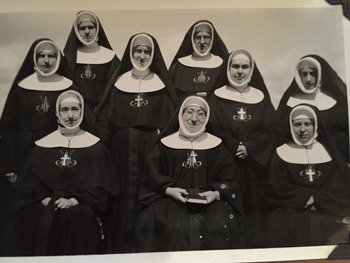
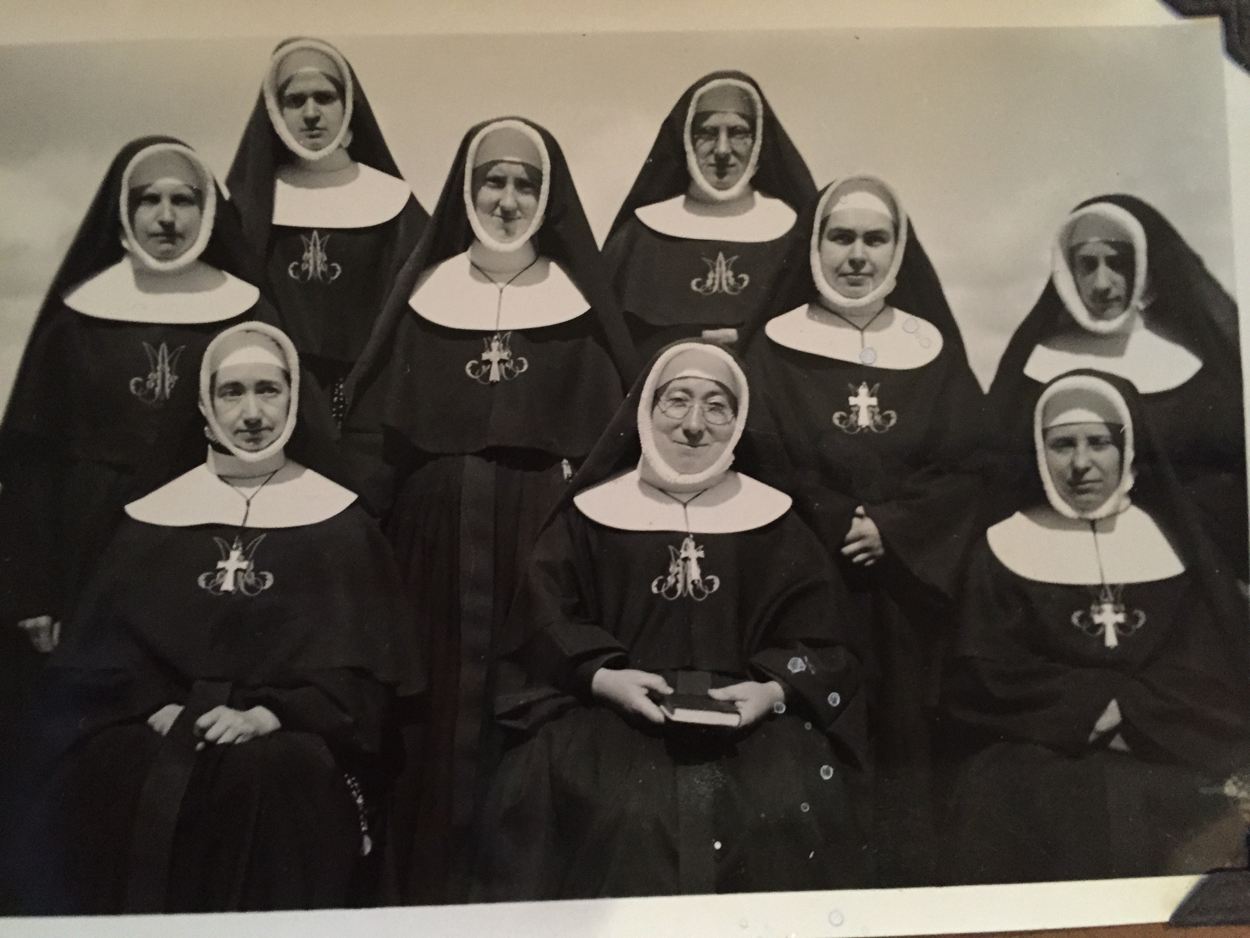
One factor thwarting students’ forging of emotional bonds with nuns was the sisters’ unusual appearance. Some of Lejac's pupils, particularly those from the remotest regions, had never seen nuns (or priests) before.Footnote 72 Children of both sexes found their teachers’ long black habits and veils mysterious, even scary. The sisters’ pre-Vatican II garb suppressed its wearer's individuality, stressing instead their corporate identity, forcing children to make a conscious effort to look beyond the nuns’ anonymous, all-covering garb from which only “their faces and heads peeked out” (fig. 7). The hidden bodies of the nuns were the subject of fierce (and sometimes ribald) speculation by students of both sexes.Footnote 73 One girl claimed to have seen a nun's cloth sanitary napkin soaking in a tub prior to being washed. Her audacious conclusion—that nuns menstruated like other women—was greeted with incredulity by her peers.Footnote 74
Sisters of the Child Jesus. Students at Lejac Indian Residential School were taught by this female religious order, while the administration of the school was in the hands of a male missionary order, the Oblates of Mary Immaculate. Undated photo, courtesy of the Archives of the Roman Catholic Diocese of Prince George, held in Saint Andrew's Parish, Fraser Lake, British Columbia.
Many students found the nuns’ non-Indigenous physical characteristics even more unsettling than their unusual garb. One young girl, mesmerized by a sister's “icy blue eyes,” the first she had ever seen, asked: “How can you see through those eyes?” Unfortunately, her genuine curiosity was interpreted as offensive impudence and strictly punished.Footnote 75
Lejac pupils also felt alienated from the nuns due to the sisters’ unusual life choices, which were so different from those of the family-centric Carrier. The sisters’ abstention from marriage and motherhood through vows of lifelong celibacy was not perceived by their students as admirable, holy, or self-sacrificing, but rather as unnatural, ludicrous, and even pitiable. In the eyes of their Carrier pupils, nuns’ failure to marry and have children did nothing save deny them the comfort of a husband and children. Moreover, their consecration to God's service in schools located far from their own natal families denied them the invaluable support of their own mothers and kinfolk. Recalls Celena John: “We pitied them. They had no one to turn to. No wonder some of them could be so mean.”Footnote 76
Perhaps the most serious challenge to the formation of meaningful student-teacher bonds was the unbridgeable gap in authority, often expressed through sudden and unpredictable acts of classroom violence. Lejac alum Jack Lacerte remembers that turning his head ever so slightly to watch a pretty girl earned him a hard blow on the side of his head that left his ears ringing—an experience that was all the more disconcerting because of the swiftness and silence with which the nun had delivered it. Similarly, Lizette Hall recalls an incident when “all of a sudden I was jarred by a blow on the right side of my face. . . . She [the teaching sister] shouted words at me to the effect that I was this, that and the other. All I felt was my right jaw and how it hurt. I could not chew my food after this.”Footnote 77
Female students often resented this unpredictability: nuns’ sudden pulling away from a fragile intimacy back into reasserted authority, right when their emotional support was most desperately needed.Footnote 78 Remembers one Lejac alumna: “I sure was a ‘teacher's pet.’ Then I got away with ‘murder.’ I talked in the hall, smiled at the boys. But you really couldn't get across to the nuns, not about how you felt. Like [when] I had cramps, I cried all day. Gee, that sure burns me up to this day. You could be their pet, but you couldn't get across to them.”Footnote 79 For their part, some nuns felt trapped by the formality, authoritarianism, and sisterly solidarity that they felt their role demanded: “The girls were a great joy to me. Mind you, they had their pranks. We laughed afterwards, but in front of them we never showed it. We had to keep our discipline.”Footnote 80
The inescapable asymmetry and chronic vicissitudes of even the most rewarding nun-student relationship explains why peer-to-peer friendships and mentor-protégé relationships between older and younger students were so popular among the female cohort of Lejac's student body.Footnote 81 Such relationships were facilitated by students’ shared experiences, similar status, and cultural and linguistic ties, resulting in a sustained emotional intimacy that easily exceeded any that students could hope to achieve with the sisters.
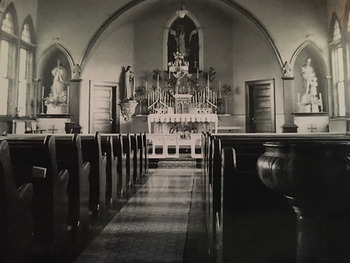
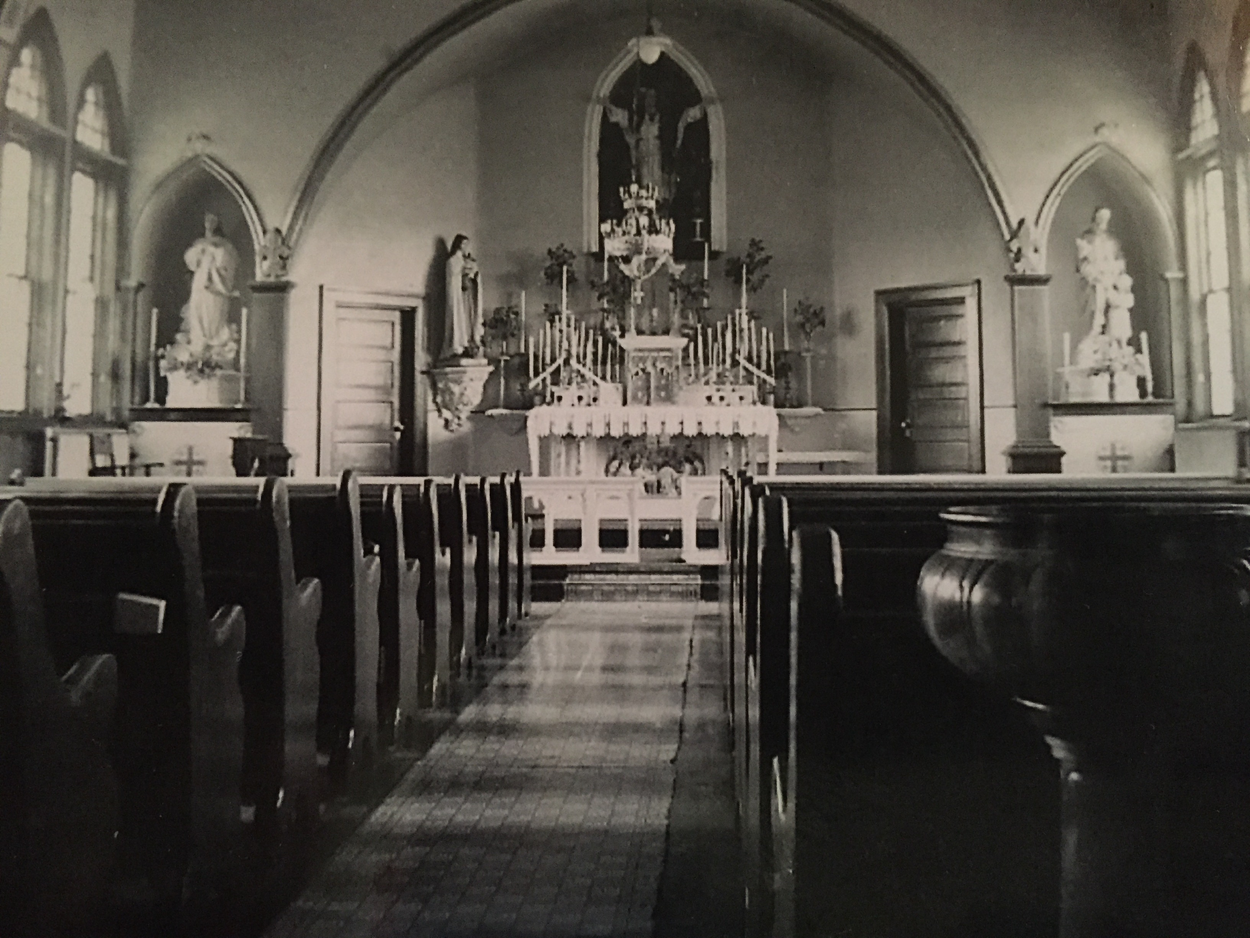
It was in this métier that Rose truly excelled. While those who knew her celebrate her talent, piety, and stoicism under suffering, even these fond points of pride are eclipsed by what Rose meant to them as a friend. Those who knew her best describe a kind of peaceful cocoon that Prince wove around herself, using the threads of prayer, song, and quiet, independent work. Her friends were brought into this peaceful bubble when they sat down at the table with Rose, listened to her hum as she chopped vegetables in the Lejac kitchen, or prayed the rosary alongside her in the school's small chapel (fig. 8).Footnote 82 Prince seems to possess that indefinable “there for you” quality that characterizes the truest, most enduring friendships. Notes Mabel George: “She would sit in the corner of the recreation room and talk with any girl. She was a good listener, nonjudgmental. It didn't seem to bother her if you broke the rules. I think she saw Jesus in everybody.”Footnote 83
Interior of the small, elaborate chapel at the Lejac Indian Residential School. Prince spent much of her spare time here, praying her rosary. So pronounced was this habit that her friends, when looking for Rose, knew to check the chapel first. Undated photo, courtesy of the Archives of the Roman Catholic Diocese of Prince George, held in Saint Andrew's Parish, Fraser Lake, British Columbia.
The subtle pull of Rose's compassion communicated itself far beyond her immediate peer group. Inexorably, it drew Lejac's youngest children toward her. Relates Sister Rita Martin: “She would console the children when they felt badly.”Footnote 84 Adds Jack Lacerte, whose mother worked in the kitchen with Rose: “When the children had a problem, they did go not to the priests and the nuns, they went to her. And she resolved it for them, somehow, some way, some gifted way.”Footnote 85
VII. The Artist formerly Known as Prince
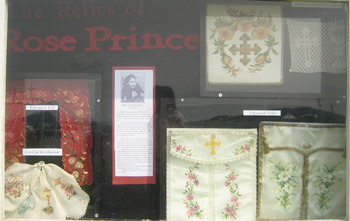
Although Prince mastered all of the scholarly and domestic skills required of her at Lejac, and wore a number of “hats” in her working life at the school, her preferred activities consistently involved escape into an inner world of beauty and rapt concentration. Prince became legendary at Lejac for the quality and detail of her embroidery and painting as well as for her near-constant prayer. Her richly embroidered clerical stoles and altar linens are displayed in a glass case during the annual Rose Prince Pilgrimage: partly out of pride in their stellar workmanship, and partly as treasured secondary relics that were repeatedly touched—indeed brought into being—by her saintly hands (fig. 9).
Each July, organizers of the Rose Prince Pilgrimage put together a display of Rose's liturgical embroidery for pilgrims’ admiration. Photograph by the author.

Prince's pursuits, however, were not unusual among Lejac's female students. In fact, the teaching of embroidery was an integral part of the girls’ curriculum.Footnote 86 Like many other residential schools, Lejac depended heavily on the unpaid labor of its young female students in the making and mending of all the school uniforms. The girls were also expected to contribute to other essential domestic tasks such as cooking, baking, canning, cheese making, cleaning, and nursing.Footnote 87 Additionally, female students were taught knitting, tatting, and other fancywork such as embroidery, as accoutrements of early twentieth-century domestic femininity.Footnote 88 Rose's artistic expression through both needle and brush differed from the output of her peers only in its exceptional quality.
Like Prince, many of Lejac's more intelligent students may also have deliberately utilized the more elastic, creative skills accessible to them (like painting or embroidery—or prayer, for that matter) to blunt the endemic boredom and restlessness that were common reactions to the stifling intellectual limitations and mindless repetition of school life. Lejac's curriculum of religious education, basic literacy and numeracy, and practical, gendered work was simply too rudimentary to hold the interest of bright, curious students for very long. Student disengagement was also encouraged by the large, heterogeneous classes composed of pupils of widely varying ages and abilities; classes that, during Rose's lifetime, only included the first eight grades.Footnote 89
Lejac's brightest responded to the challenge of intellectual deprivation in a number of ways. Some withdrew inward, escaping into imaginative flights of fancy during dull classes. As one former student remembered: “I sat and looked very attentive but I let my mind escape. If you were smart you learned it the first time around and then you just turned off.”Footnote 90 More scientifically minded girls covertly satisfied their curiosity by taking apart and putting back together mechanisms in the school's plumbing and heating systems to see how they functioned.Footnote 91 Kinetic learners, preferring virtually any activity to the enforced inertia of lessons and the dull routines of “play time,” worked energetically at virtually any task assigned to them from the infirmary to the kitchen, opting for bustle over boredom. “There was nothing to do. Couldn't go past grade eight then. So I worked a lot. Mostly in the infirmary. And in the kitchen. That's when I served the priest and sisters.”Footnote 92 Still others, like Rose, dove deeper and deeper into one or more of the skills taught at Lejac, becoming progressively more adept at creating a dynamic inner world of creative exploration from the very limited spectrum of possibilities available to them.Footnote 93
VIII. Crown of Thorns: Rose's Injury, Bereavements, and Her Choice to Remain at Lejac
Sometime around 1925 or 1926, after Prince had been at Lejac for about three or four years, she suffered a catastrophic injury in a freak accident. Relates Bernie McCorry, one of Rose's closest childhood friends:
You know, at Lejac we had these benches. . . . Rose, she was putting on, changing her shoes, sitting on the floor . . . maybe 9, 10 years old, this is what my sister told me, and somebody grabbed the end of the, that long bench . . . and it just hit Rose behind the back. And after that Rose was very ill and they sent her home . . . and when she came back, that's when she had that hunch-back. . . . Her back was broken. They broke her back with that bench.Footnote 94
Though Rose's injury clearly resulted from an unintentional accident, this incident is nevertheless frequently distorted in hagiographic accounts of her life. Some devotional accounts fail to explain altogether why Prince's back became deformed.Footnote 95 Others invent an entirely spurious accident scenario that effectively blames Rose for her injury by claiming that she fell off a swing.Footnote 96 Others attribute the pronounced curvature of her back to a congenital malformation, present from her birth, the preferred explanation of the former Bishop of Prince George, Gerald Wiesner. When asked about Rose's deformity, Wiesner replied: “I thought it [Rose's hunched back] was from birth, but I don't know. I honestly never heard about a bench at the residential school hitting her. I would almost think that somebody created that [story about the bench] just to try to emphasize something negative about the residential school. That would be my interpretation.”Footnote 97
The fact that these false explanations of Rose's deformity are present in devotional accounts of her life demonstrates the Catholic Church's sensitivity to allegations of child abuse and neglect in its former residential institutions. More specifically, it shows their recognition of the need to shelter Prince's story from even the most oblique hint that she personally experienced criminal abuse or criminal neglect while at Lejac. While the Catholic Church may have the chutzpah to claim Rose as a “residential school saint” or a “patron of reconciliation,” even the most insensitive cleric would recognize that this would be impossible if the Church was directly responsible for Prince's painful stigmata.
Lejac authorities, then, claimed no responsibility for Rose's devastating accident. But the institution did have a long, troubling history of student injury and death from its opening in 1922 until its shuttering in 1976.Footnote 98 In addition to the scores of runaway boys who perished in failed attempts to make it home, students of both sexes died in the aftermath of severe corporal punishment endured for infractions of Lejac regulations. The tragic example of Melanie Quaw is a kind of distorted, through-the-looking-glass reflection of Prince's own life and death. Quaw was only two years older than Rose when she died at Lejac at the age of sixteen in 1929. Melanie, like Rose, suffered from a serious back injury, though hers was the result not of an accident, but a severe disciplinary beating. Following Quaw's death months later, her angry, grieving parents demanded an inquiry. Its findings were bleakly ironic. It excused Lejac, arguing that Quaw's heavy-handed punishment had not directly caused her death since she had also been suffering from acute tuberculosis at the time.Footnote 99 Melanie's systemic neglect by an institution that had undermined her health was thus used, effectively, to excuse her horrifying physical abuse.
Rose's own injury was fateful, decisively impacting the remainder of her short life. Her accident led to a permanent curvature of the spine that further shortened Prince's already diminutive stature. Mabel George, a long time schoolmate and intimate, says that her friend's petite body, with its curved back and thrust-out chest, always looked “as if somebody had pushed her down.”Footnote 100 The injury also sentenced Prince to a lifelong struggle with chronic pain. Those who knew her say that she bore this burden with extraordinary bravery, refraining even from mentioning her suffering.Footnote 101 Such stoicism was typical of how both male and female Dakelh, Dene, and Sekani students conducted themselves at Lejac. Many students saw their ability to remain visibly unmoved during corporal punishment as both a point of honor and as an oblique victory over school authorities.Footnote 102 In Prince's case, however, this silent stoicism may have backfired, resulting in only superficial medical intervention at the most critical, initial stage of her injury, before her broken back had improperly healed. Nevertheless, for the rest of her life Rose would continue to spend hours kneeling in prayer and in adoration of the Eucharist, to which she had a special devotion, in the small chapel behind Lejac, even though this posture amplified her pain.Footnote 103 Those who searched for Prince always checked the chapel first.Footnote 104
Rose's painful deformity seems to have played a decisive role in her decision to remain at Lejac following her graduation. While it was not at all unusual for alumna, particularly orphans, to linger at the school into their late adolescence, working for the institution as cooks, cleaners, nurses, laundresses, seamstresses, or Janes-of-all-trades, this was generally a stopgap measure to give the Oblate matchmakers time to find them suitable husbands.Footnote 105 Rose's disfigurement may partially explain her remaining single during an era in which, as Fiske's research clearly indicates, clerically arranged marriages between female residential school graduates and demonstrably devout Catholic Carrier men was virtually a universal norm.Footnote 106
The other key factor prompting Rose's decision to remain at Lejac was a series of tragic losses she would endure in close succession. In 1931, when she was sixteen and on the brink of completing her studies and returning home, Prince's mother died in an influenza epidemic out on the family's remote trap line. To make matters worse, Agathe was pregnant with her tenth child at the time of her death, and Rose's youngest sister or brother also perished.Footnote 107 The loss devastated Prince. The blow, moreover, was not an isolated one, as two of Rose's beloved younger sisters, Lina and Seraphine, also succumbed to the deadly virus shortly after their mother.Footnote 108
In the aftermath of this devastating loss, Prince also faced the increasing emotional distance of her father, Jean-Marie, whose eventual remarriage to Angelique Yassalt (a woman who apparently “did not take to Rose”) further compounded the young woman's pain.Footnote 109 Deprived of her mother, estranged from her father, and timid of dating because of her deformity, Rose adopted Lejac as “her comfort zone” and permanent home.Footnote 110 As she confided to her close friend, Celena John: “I've got my parents here [at Lejac]: our blessed Mother and her Son Jesus. I feel so close to them here that I just don't want to go.”Footnote 111
IX. Goodnight, Sweet Prince; May Clouds of Angels Sing Thee to thy Rest: Rose's Final Illness and Death
Rose Prince likely developed the first symptoms of the pulmonary tuberculosis that would kill her long before her death on August 19, 1949, two days shy of her thirty-fourth birthday. She probably bore them uncomplainingly, even secretly, much as she did her chronic back pain.Footnote 112 In her diagnosis, Rose was not alone: tuberculosis was endemic in residential schools across Canada in this period.Footnote 113 The insidious condition, which infects the lungs, rips through bodies weakened by insufficient nutrition and life in overcrowded, inadequately heated housing.Footnote 114
Sadly, even if Rose had been less stoic, little could have been done to save her once she had contracted the illness. In Prince's time, tuberculosis was often fatal, for the antibiotics that would bring the disease's dark reign to an end were only just starting to be developed. Specialized tuberculosis sanatoriums, moreover, offered no magic bullet, only simple therapies that could easily be copied at home—bed rest, lots of sleep, and a nourishing diet.
By the time Rose was hospitalized in August of 1949, the disease had long since taken hold and was set on its disastrous trajectory. The Sisters of Providence of Saint John's Hospital in Vanderhoof, British Columba could only provide Prince with compassionate end-of-life care in its segregated facility that separated Indigenous and white patients into different wings.Footnote 115 In the absence of efficacious medical treatment, the sisters fervently prayed that Rose's family, urgently summoned southward from their distant trap line, would make it to her bedside in time to say goodbye, despite Rose's pessimistic (and ultimately correct) prophesy that they would not.Footnote 116
In August of 1949, Caroline Linitski was a twenty-seven-year-old Sister of Providence fresh from her medical training at Saint Paul's Hospital in Vancouver, British Columbia.Footnote 117 When I interviewed her at the 2012 Rose Prince Pilgrimage, Linitski, though then ninety-one years old, retained the almost intimidating combination of no-nonsense briskness and down-to-earth practicality so common to those in the nursing field. Linitski vividly recalls attending the dying Rose, who was only a few years older than herself:
I nursed her, you know, I bathed her. Because we were always short-staffed, there was no time just to sit and visit with someone . . . the way I would have liked to do, as a nurse. You know, to spend time with her. . . . The only time you had to talk to people as people was giving them their back rub or giving them a bath in the morning. . . . But I knew her well enough. She was very pleasant, and there was an air of serenity about her. Peaceful and pleasant, grateful for everything you did for her, every least little thing. And there was always the rosary slipping through her fingers, and that's the picture of her that has stayed with me over the years.
Linitski remembers that a special mass was said for Prince by Father James Mulvihill, Lejac's seventh director, in the hospital chapel. Rose died toward the end of the service, or shortly thereafter.Footnote 118 Despite the religious consolation, Liniski recalls her powerful sense of sorrowful impotence during Rose's final moments: “I remember being there, she's hemorrhaging, she's dying, and being helpless to do anything.”
Breathing her last, Rose shut her eyes for the final time. Even in her ebbing consciousness, she likely would have taken comfort from knowing that grave, Latinate phrases were unrolling their familiar sequence of poetic prayer two floors below her deathbed. Rose's historic life was over. But her unruly and surprising afterlife had just begun.
X. A Once and Future Prince: Rose's Remains
Though Linitski clearly liked and respected Rose Prince, the main reason that she recalls her “pleasant and peaceful” patient so clearly after more than six decades was because of the unforgettable, unsettling postmortem behavior of Prince's mortal remains in the hours after her passing:
She became a medical problem for us . . . her body wasn't cooling off like it should, and she wasn't developing rigor mortis. . . . Usually, when a person dies, the extremities get cool very quickly, and then the cooling down proceeds very quickly throughout the body. And rigor mortis usually starts, I would say, ten, fifteen minutes you start getting the stiffness, sometimes a little longer, but there's not the suppleness like there was with her. . . . It was just like trying to move a sleeping person's arm, there's no resistance. . . . And so we said, you know, I felt, well, had she really died? Or is this profound shock from blood loss?
Confronted by these strange symptoms, Linitski began to think that perhaps she had made a grave error and that Prince might still be alive. Disturbed, she called for her Mother Superior, and together, the two nuns checked again for vital signs. “So we kept checking her pulse and respiration,” Linitski recalled, “and it wasn't there, of course. And then, um, the Superior of the place, like there were six of us [sisters] there but only two of us were nurses, and so she came and pulled a little cotton ball apart and held the wisps up to her [Rose's] nose and there was no movement. So she said, ‘She's really gone,’ and phoned the doctor . . . to say that Rose had died.” Once Dr. Moody arrived, he too was unnerved by the anarchic behavior of Prince's corpse, and conducted yet another test: “So he had to come to certify the death. And when he came, just over an hour after she died, probably, he put a needle into her arm. . . . He withdrew a syringe full of blood that was almost black. Which indicated no oxygen, so she's obviously dead.”
Interestingly, though Rose died in a Catholic hospital and Linitski and her Superior were both nuns, at no time during this surreal series of events did it occur to either of them to attribute the body's strange behavior to spiritual phenomena:
What really amazed me, when I found out that her [Rose's] body was incorrupt, is that none of the sisters that were there (not even myself and the Superior, who was a nurse, who had a hands-on experience of her) it simply didn't occur to us, “Is this a supernatural thing?” . . . We were not at a stage in our spiritual development where we would see the supernatural happening, you know. We were blind to it. You have eyes, but you don't see. It gives me goose bumps just thinking about it, now.
Though understandably unsettled by the behavior of her patient's body, Linitski was soon pressed to attend to other patients in the overstuffed, understaffed hospital. Unable to continue her vigil at the bedside of her deceased patient, she eventually lost track of what happened to Rose's body. Linitski became aware that her former patient's remains had apparently continued to defy the laws of nature only in 2009 when she heard a radio documentary about Rose's alleged incorruption, prompting her to participate in several pilgrimages to Prince's grave.
XI. Lo, How a Rose E'er Blooming: Prince's Exhumation
Following her death, Rose's body was returned to Lejac, as she had requested burial in the school cemetery.Footnote 119 The nuns carefully laid her out: washing and dressing her and positioning her in her coffin using pillows so that she would appear to lie flat despite her twisted back.Footnote 120 Prince was interred with a crucifix, clasping a bouquet of flowers.
Following her funeral, life at Lejac continued apace without Rose. The school population waxed and waned. Semesters passed, exams were taken, the grand liturgical sweep of the seasons and the feasts of its newborn, dying, and rising God were all duly observed. Some students graduated. Some married. Some, like Rose, died. Small, seemingly insignificant changes took place. Notably, school holdings of livestock expanded considerably. As a consequence, the barns’ muddy, stinky footprint began indecorously to encroach upon the nearby school graveyard. Thus, during the summer of 1951, two years after Rose's death, the decision was made to relocate the final resting place of Lejac's students and staff to a more “respectful spot on a nearby hill.”Footnote 121
The macabre, physically demanding task of exhuming, transporting, and reinterring the coffins was outsourced to the male members of a local family, the Lacertes, who had strong ties to the school and had known Rose well. The family's matriarch, Katherine Lacerte (née Seymour), had been her close friend and schoolmate, and had worked in the kitchens with Rose after they both graduated.
In July of 2012, when our interview was taped at his home in Burns Lake, British Columbia, Jack Lacerte was the last living eyewitness of Prince's exhumation, having been only eleven years old in 1951 when he helped his father Phillipe and his older brother Victor with the disinterment. An observant and expressive man, Lacerte had lived an adventurous life, working as a roughneck on an oil derrick before becoming a Royal Canadian Mounted Police officer in Edmonton, Alberta. His religious life had been similarly eclectic. Though his spiritual indoctrination at Lejac had stressed Catholicism, as an adult Lacerte had explored traditional Carrier spirituality, even briefly becoming a medicine man before finally finding peace in a fervent evangelical Protestantism. Despite his chosen faith's traditional distrust in saints and miracles, Rose has nonetheless remained Lacerte's North Star in all his spiritual wanderings. Affirmed Lacerte: “I believe in God and his Word, but I still know and respect Rose Prince.”Footnote 122
Although the opening of Rose's coffin is described as “accidental” or “inadvertent” in virtually every account of her disinterment, this was not in fact the case, Lacerte confided to me.Footnote 123 The violation of Rose's coffin was entirely premeditated:
We had the stone boat right there, alongside the grave. . . . We exhumed the body, the whole thing, you know, the whole box, it came out, we put it on the stone boat and then, uh, I don't know why but my dad wanted to open this coffin, you know. So, all he had was a shovel, so he jammed it in the lid or on the side and opened it up, you know? And when he done that it went “psssschrt” [makes noise like air escaping], you know?
Recounting the incident more than six decades after it occurred, Lacerte was as indignant about this “profanation” as he had been as an eleven-year-old witness to it:
In the Holy Bible it says, like, respect the dead, but, in that case the people involved, except me, did not respect the dead. . . . And I personally attribute it to what Jesus Christ was saying, and that's when you disrespect the dead, he'll take you. And he took all of them. All the people that disrespected ‘em. They were drinking beer while they were digging out the graves, you know? Oooof! [Makes sound of disapproval.] Even as a little guy . . . I have always had that respect, cause that was what Mum taught me, not so much Dad, because Dad wasn't interested in teaching you anything about the Bible.Footnote 124
And yet, Lacerte mused, the Lord clearly works in mysterious ways, because it was only through his father's cavalier impiety that Rose's miraculous preservation from postmortem decay was revealed to the world. God had chosen, once again, to bring good from evil and sanctity from sin. Moreover, his older kinsmen's desecration of all the other coffins also served to make it clear that Rose's incorruption was the exception, rather than the rule, as all of the other corpses had succumbed to the normal processes of nature.
It is clear from how Lacerte narrates his encounter with Rose's body some six decades earlier that he sincerely believes he witnessed something truly miraculous:
So he got that lock undone and we opened it. . . . My Dad was in awe, he didn't know what to say, so he called the other guy over, “Come over here and look at this!” . . . I was looking at her—there was nothing mouldy about her body or the coffin, or her hands. . . . Everything, you know, was like brand new. Her blouse was nice and white and clean and her dress. It was . . . like . . . strange. And we were wondering, like, “Why? Why is she still like this?” When you dig up other dead bodies . . . their hair comes out wavy, it keeps on growing. . . . Her hair was, you know, it was just like yours, she looked very nice, and . . . she looked like she was happy, ok? She didn't look like she was dead, or asleep, she looked just like she was there with her eyes closed, that's all. . . . I can see it in my mind's eye, when they opened up the coffin and there she is, you know, like, fresh as a daisy and smiling.Footnote 125
The gravediggers then brought Rose's coffin, on the horse-drawn stone boat, closer to the central brick school building so that the Oblates and nuns could witness the apparent miracle. Many of those present that day testify to their experiences in descriptions strikingly similar in tone and detail to Lacerte's account. Remarked Sister Eleanor Klusa: “It looked like she'd died the day before. She was really lovely looking. She looked as if she were sleeping. After two years, there were no marks on her face. The only thing that had withered were the flowers we had put in her hands. She was very close to God. . . . She's a saint, that's all. She's a saint.”Footnote 126 The students of Lejac were not permitted to come out of the building to see Rose in her coffin. Nevertheless, many were aware that something unusual was afoot, and some covertly observed through the windows.Footnote 127
XII. Thou Shalt Not Suffer Thy Holy One to See Corruption
Rose's disinterment occurred in the immediate aftermath of Pope Pius XII's 1950 bull that declared the Assumption of Mary to be an official dogma of the Catholic Church. In this document, the pope formally sanctioned Catholics’ longstanding popular belief that the Virgin Mother of God had been “assumed,” body and soul, into heaven, allowing her to escape the normal human experience of death and decay. Musing on the promise implied in Acts 13:35, “Thou shalt not suffer thine Holy One to see corruption,” Catholic theologians had argued for centuries that it was only meet that the holy body of the Virgin Mary—the instrument of the Incarnation—be preserved from all taint of death and decay and accompany her saintly soul heavenward. Mary's Assumption thus served as a kind of corporeal correlate to the Immaculate Conception, which affirmed that her soul was free from any stain of Original Sin, the hereditary taint of Adam and Eve's fateful disobedience.
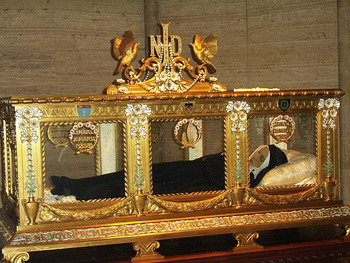
The Virgin Mary, of course, has long been seen by Catholics as enjoying a special, peerless sanctity. Her Assumption, her own special version of her Son's Ascension, is likewise unique and inimitable. Yet over the course of the nineteenth century, much the same sort of logic used to elevate Mary to dizzying, immaculate heights inspired an intensified interest in the miraculous preservation of the bodies of other holy figures, particularly virginal female saints graced by receiving Marian apparitions. In 1909, the exhumation of famed Marian seer Bernadette Soubirous of Lourdes caused a sensation when her body was discovered to be incorrupt.Footnote 128 Her body, its face and hands now touched up with wax to hide the mottled blackening of her skin caused by its sudden exposure to air, was enshrined in a glass reliquary—much like Snow White's crystal coffin—at her convent in Nevers, France (fig. 10).
The body of Saint Bernadette in its glass coffin in Nevers, France. The nineteenth century witnessed a new Catholic vogue for incorruption as a kind of proof positive of sanctity. Young, virginal female saints were most strongly connected with such phenomena. Photograph by Rabanus Flavus.
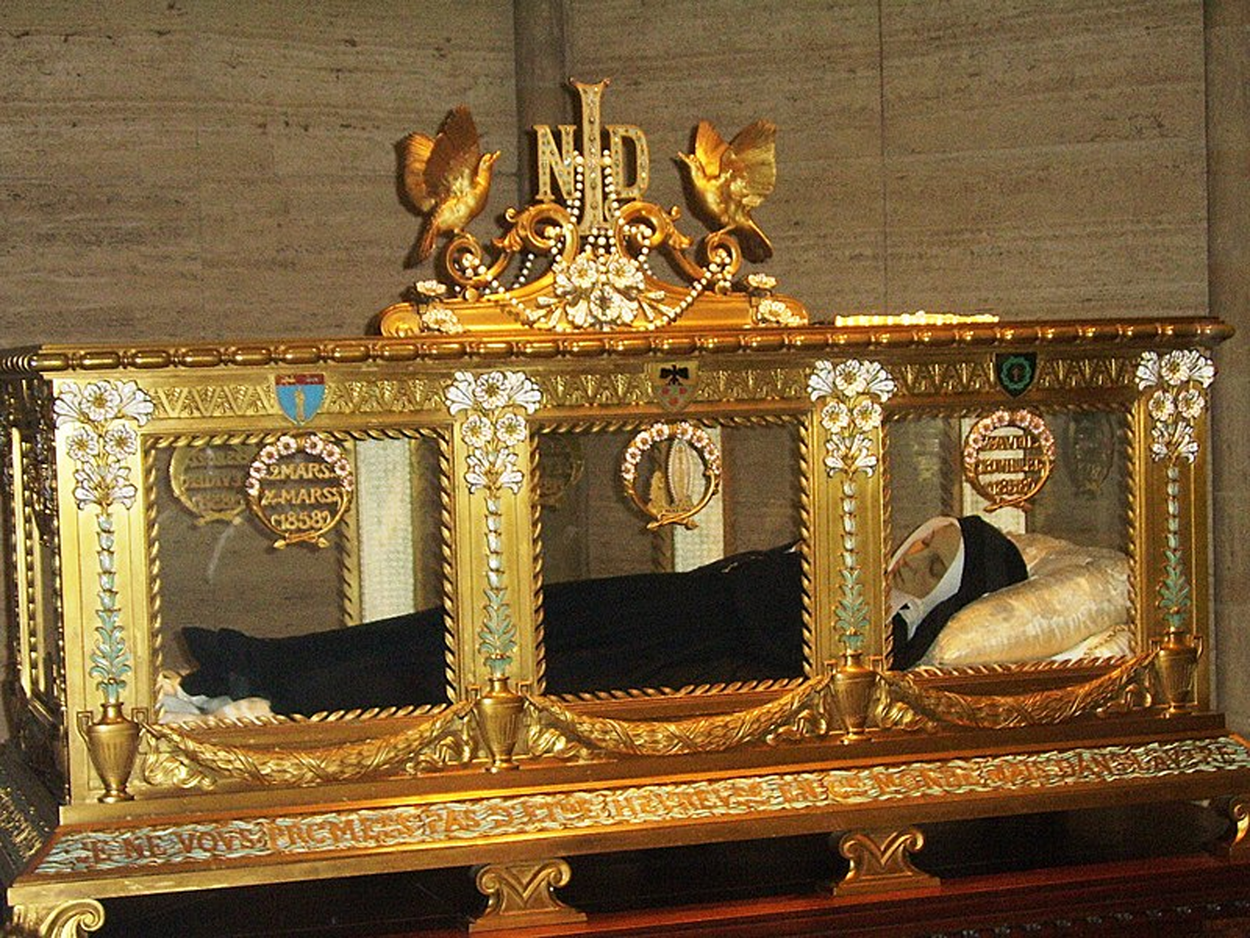
Bernadette's incorruption upheld the same holy logic that would later formally buttress the Assumption. Her eyes had been transfixed by seeing the Virgin during the eighteen apparitions accorded her at Lourdes, just as Mary's womb had been sanctified by bearing within it the God-man. Centuries of Catholic experience testifies that proximity to the sacred has lasting physical as well as spiritual effects. In Bernadette's case, it had miraculously halted the natural processes of postmortem decay. This testimony to her personal sanctity also created a latter-day sign and wonder for unbelievers.
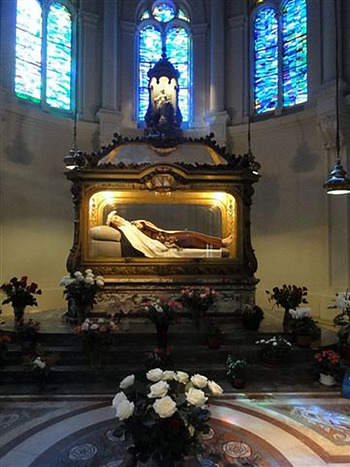
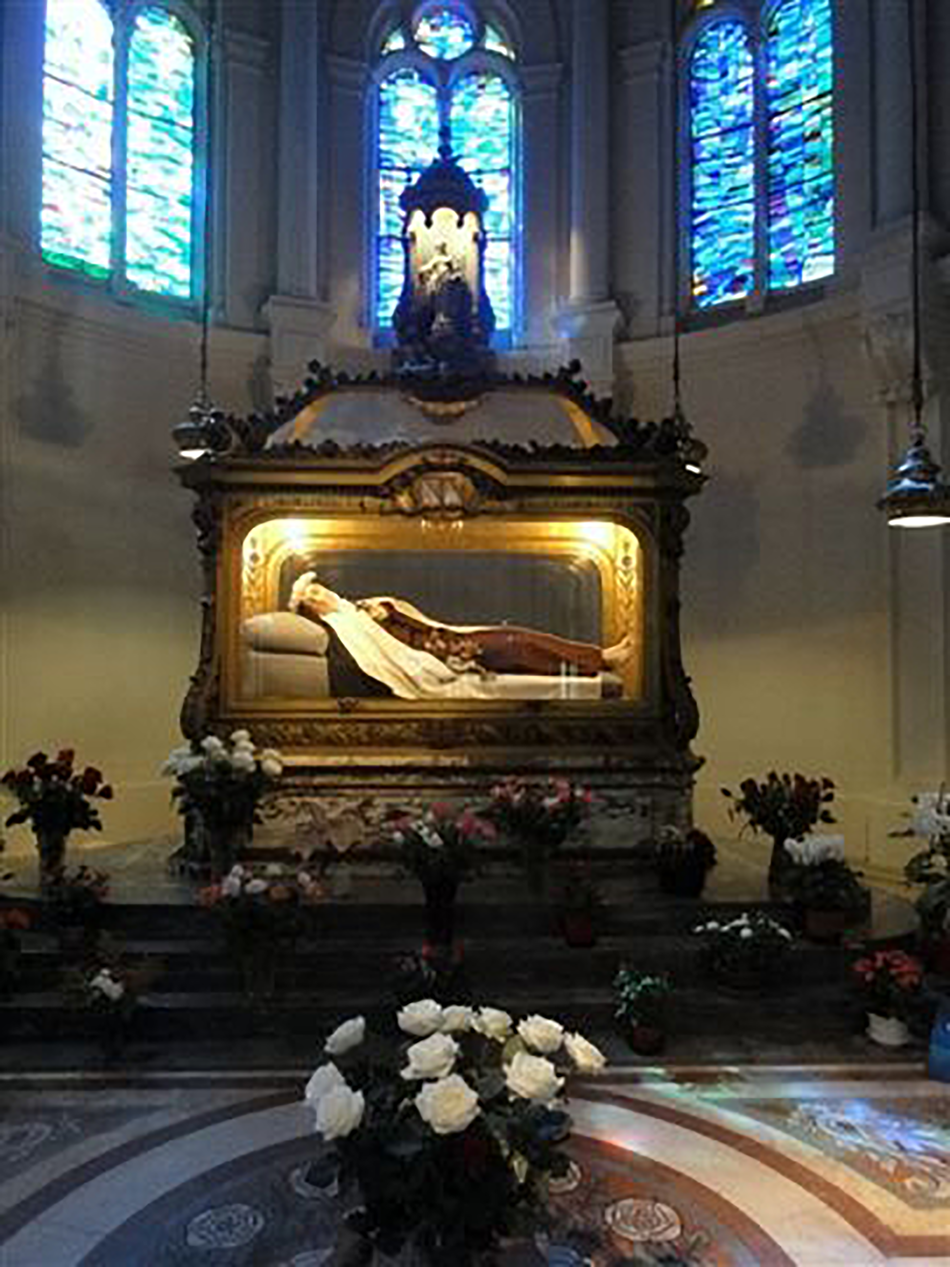
Such was the power of incorruption in the late nineteenth and early twentieth-century Catholic world that it led to a vogue for falsely creating the impression of the miracle even in its absence. The tomb of Saint Thérèse de Lisieux—the young nun to whom Rose's own fresh, girlish, innocent spirituality is so often compared—is one notable example.Footnote 129 Constructed in obvious imitation of Saint Bernadette's tomb at Nevers, it features a horizontal glass box enshrining a recumbent statue of Thérèse, sculpted to resemble the saint in her much-publicized postmortem photos: barefoot and reclining gracefully in her brown habit, with her pale, beautiful face wreathed in flowers (fig. 11). In fact, Thérèse's mortal remains are actually entombed below the statue, in the marble vault on which it rests. But the monument's encouraged misidentification of the figurine for Thérèse's actual body is incredibly effective. When visiting her tomb in the Norman town, one constantly overhears murmurs of “Isn't she lovely?” as people reach out to touch their rosaries to the glass surrounding her saintly “body.”
A lifelike statue of Saint Thérèse de Lisieux, posed on top of her actual tomb, misleads many venerators into believing that she, too, is incorrupt. Photograph by Dee Cursi.
In contrast with the lavish display given to Bernadette's incorrupt body, triumphantly displayed in its magnificent glass and gilding overseas, Rose's allegedly miraculous corpse was not even photographed. Muses Father Vincent James: “It's strange that the Oblates have no documents, no photos of the occurrence. It was all very hushed in those days and though they found her body incorrupt, they reburied her.”Footnote 130 Echoes Bishop Stephen Jensen: “I've often wondered: if a body was found in that condition, why didn't they document it better? What might the impact have been?”Footnote 131
The likeliest explanation is simply that no camera was available at the school. It seems unlikely that the Lejac Indian Residential School, with its meager yearly budget of $125 per student, its ubiquitous student diet of barley meal, and its heavy reliance on the unpaid labor of its students and boarding female alums, could have afforded the relative luxury of a school camera. Indeed, the school was heavily in debt until 1949, the year of Rose's death.Footnote 132 Although formal, collective portraits of the institution's faculty, administration, and students were taken, it seems probable that these were not in-house efforts, but rather commissioned pieces done by professionals who brought their own photographic equipment. Whatever the reason, only hours after her exhumation and examination by school officials, Rose's body was reburied, un-photographed, in her new gravesite, where it lies to this day.
The puzzling failure of Lejac's administrators to further investigate or report this incident to their religious superiors, or to Rome, significantly hobbled the progress of Rose's causa, ensuring that her cult remained largely a local affair for decades. Wrote Fergus O'Grady, OMI, then Bishop of Prince George in 1991: “For the past thirty years, the staff and students of the Lejac school have asked the intercession privately of Rosie Prince to obtain favours which, they claim, have been received.”Footnote 133
XIII. Far beneath the bitter snows/Lies the seed that, with the sun's love/In the spring becomes the Rose: Prince's Cult
It was only in the early 1990s that two pivotal features of Prince's cult began to emerge: the formal, collective pilgrimage to her grave site and the prayerful application of its soil to ill and afflicted persons in the expectation of miraculous intervention. Both of these developments were due largely to the initiative of one man: Father Jules Goulet, OMI, a devoted believer in Prince's sanctity and an energetic, imaginative promoter of her informal cultus. Though Goulet never met Rose during her lifetime, he quickly became Prince's “Saint Paul” after his appointment as the parish priest of Fraser Lake, British Columbia, once stating candidly of Rose: “I wish I'd met her. I feel in love with her and her wisdom.”Footnote 134 Together with Carrier elder Celena John, Goulet spearheaded what would be retroactively recognized as the first Rose Prince Pilgrimage in 1990, although the event also functioned as an unofficial school reunion for its many local alumni. Like the decades of pilgrimages to come, this small, low-key event unfolded on the former grounds of the Lejac Indian Residential School, on the lakeside lands now recognized as belonging to the Nadleh Whut'en (Dakelh) First Nation. The school building, which had seemed so huge and formidable to the first generation of its students when lit up against the dark backdrop of woods and night sky, had now vanished. A brooding husk since its abandonment in 1976, Lejac's copper plumbing was sold for scrap and its skeleton dismembered brick by brick in 1983, until nothing of the school remained but its haunting memories.Footnote 135
In August 1991, barely a year after he had helped to organize the first pilgrimage to Rose's grave, Father Goulet became the first parish priest to bring its soil to the bedside of one of his suffering parishioners in an improvised “Hail Mary” ritual. For weeks, Goulet had been visiting Nick Loza, who worked at the local Endako open-pit mine.Footnote 136 Much like Rose, Loza now suffered from excruciating back pain caused by an inoperable broken disk. Speaking to me at the 2012 Rose Prince Pilgrimage, the affable, talkative Loza, a lean, suntanned figure with a mischievous grin, remembers the crisis of suffering and sleeplessness all too well: “On August 9 [1991] I could not move at all. The pain increased and was unbearable. For five days I could not move, nor could I sleep. If I attempted to move I would find myself screaming in agony.”Footnote 137
Weakened by pain, Loza wanted to die. Though family, friends, and Goulet—his parish priest—all kept a prayerful vigil by his bed, Loza's suffering continued unabated. Finally, in desperation, the priest made a poultice from Rose's grave soil, moistened with holy water, and applied it to his parishioner's back, all the while earnestly imploring Prince's intercession in his healing.Footnote 138 Loza reports, smiling widely, that his screams following the priest's ritual intervention soon drove the hapless Oblate from his house, with Goulet fearing that he had unwittingly exacerbated Loza's ailment.Footnote 139 But gradually, the pain eased enough for Loza to finally be able to sleep through the night for the first time in weeks. That morning, his wife's first, horrified thought upon waking was that Loza must have died overnight, as she had not been awoken as usual by the sound of his torment.Footnote 140 Loza's back continued to steadily improve until he was pain free and able to function virtually as normal and resume his job at the mine.Footnote 141 In gratitude, the entire Loza family attends the Rose Prince Pilgrimage annually, having learned through bitter experience that when they fail to do so, Nick's condition rapidly degenerates.Footnote 142
Although Loza's case remains the best-known of the healing miracles attributed to Rose's intercession, other striking cases of physical healing—each involving the ritual use of Prince's grave soil—have also been reported, as have experiences of smelling the sweet scent of roses whilst praying for her intercession or when visiting her grave, regardless of the season.Footnote 143
XIV. A Rose by Any Other Name: Divergent Interpretations of Prince and her Legacy
Those who gather to pray at Prince's grave—to plant their white candles deep in its soil, to touch their rosaries to its holy earth, and to voice their earnest entreaties for her intervention as living beads in a rosary made up of pain and prayer—have evolved many shared beliefs about this saint-in-waiting. Together, Prince's partisans have formulated a four-point credo, affirming, firstly, that Rose is indeed a saint in heaven, and that her modest, unremarked, and yet palpably holy life deserves, indeed demands, the official recognition of the Roman Catholic Church.
Secondly, Rose's devotees assert that her sanctity has been dramatically and miraculously confirmed by her body's failure to decompose after death.Footnote 144 Unsurprisingly, those who actually saw her corpse tend to be the most adamant on this point. Sister Eleanor Klusa, one of Rose's teachers, states emphatically: “She was holy. She should become a saint.”Footnote 145 Echoes Jack Lacerte, yet more bullishly: “I personally would have had her canonized immediately! Immediately, whether they liked it or not! . . . If the Pope was here, and he saw what we saw, he would put her in glass. . . . I am as positive, as positive as positive can be, [that if Rose was disinterred again] she would be just like she was. You could see her just like she was, still perfect.”Footnote 146
Thirdly, Prince's venerators insist that she is capable of interceding with God to obtain miraculous intervention for those who seek her heavenly intercession, pointing to her apparent responsibility for several medically inexplicable cures. They agree, furthermore, that the best ways to invite Rose's intercession are prayer, pilgrimage, and the ritual application of dirt from her grave to the diseased or infirm body parts of those who seek her help.Footnote 147
Fourthly, and perhaps most astonishingly, all of Prince's proponents allege that she remains incorrupt to this day, and advocate a second exhumation of her body. Though he is candid that there is a risk in exhuming Rose—the obvious risk that her incorruption has ceased—Father Vince James, the current parish priest at Fraser Lake, argues that it is still worth doing, simply because revelation of Prince's continued incorruption “would really be special. That would really bring us to our knees.”Footnote 148 Rose's family members concur. Wilma Pattison, her niece, supports disinterment, suggesting that if her aunt's body were to be found incorrupt after more than seventy years in her grave, such a powerful sign would “give peace to people that don't believe, and maybe to give faith to people who do believe.”Footnote 149
That Rose's devotees agree on these many points, separated as they are by the yawning lay-clerical and Indigenous-white divides, is a considerable achievement for a cult as young, as poor, and as ineffectively coordinated as that of Rose Prince. Her supporters’ unanimity on these key issues is all the more extraordinary given the lack of any official endorsement of Prince by the Vatican, whose response to date has been markedly cool and noncommittal. But it is well-nigh miraculous given the highly sensitive—indeed, explosive—nature of the residential school legacy in British Columbia, and across Canada, in the early twenty-first century.
As always, however, the devil is in the details. These important points of convergence exist uneasily alongside dramatic differences of opinion among Prince's proponents regarding the crucial questions of what Rose's sanctity means, who it is for, what it demands of those who recognize it, and how her cult can most effectively be advanced. Cleavages of opinion on all of these questions tend to fracture along clear lay/clerical and ethnic lines, with Rose's (mostly) non-Indigenous clerical (and other professional religious) boosters and her (largely) Indigenous lay following answering them in dramatically divergent ways.Footnote 150
Many of Rose's supporters from British Columbia's clerical elite, particularly priests and nuns who themselves participated in the operation of residential schools (or who belong to Catholic orders that did so), generally interpret Rose's life and legacy as a refreshing change from the monotonous drumbeat of culpability, loss, and shame surrounding residential schools. To them, Rose's sanctity mitigates, if not absolves, the sins of Catholic colonization in Canada. For all of its abuses, they suggest, Rose's life, death, and miraculous preservation from postmortem decay prove that the residential school system, despite its many faults, succeeded in one striking way: it produced a saint.
The former Bishop of Prince George, Gerald Weisner, makes much of Prince's decision to remain at Lejac into her adulthood rather than returning to her shattered family at Fort Saint James:
If we really came to realize that she spent her entire life at the residential school and pretty much chose that as a way of life, what greater sign can we have? . . . If we go to Rose Prince, who lived her whole life in the residential schools, she would know what were the bad things about the residential school [and] what were the good things about the residential schools. And if there is anybody who would like to bring about healing around the residential school issue, it would be Rose Prince.Footnote 151
Other Catholic clerics also seek to bask in her halo's reflected glow, seeing Rose's sanctity as a kind of reward for their orders’ obedience to Jesus's clarion call to share the Good News with all nations. Says Weisner's successor, Bishop Stephen Jensen: “The life of Jesus flows to people everywhere. They [the missionaries] weren't coming to get rich or to conquer, but to share Christ. Rose is proof that that message got through. . . . Lots of things were done wrong that were the result of white man's racism, but the Gospel still came through to a new people. . . . The real story is that Rose is in glory forever, where we all want to be.”Footnote 152 Many of Prince's clerical supporters also wish to cast her as something of a patron saint of national reconciliation between Indigenous and non-Indigenous people, a patron who could heal the painful scars of Canada's colonial past. Some of them, like Father Vince James, who lives and works among Rose's people, are aware of just how deep these scars run. As James relates:
There are people who have been wounded and hurt deeply. And, in their own way, they need to work that through. . . . There are some who have returned [to Lejac on pilgrimage] and a lot of these are former students who will say “I hated this place, and I didn't think I would ever come back, but I made the trip and I am glad that I did,” you know. They find that a great healing for them. And there's others who wouldn't set foot on the place, I'm sure, because of their memories. . . . If you haven't been in that situation, you don't know, but you have to be sensitive to those who have. . . . We may think they should do this or that, but we don't know what they went through. . . . Rose didn't let the ups and downs of the school destroy her. She triumphed over her suffering. She's a great example to those who suffer. And Rose is a peacemaker. She's bringing people to pray on the very grounds where people were hurt.Footnote 153
For less sensitive clerics, however, or those whose daily duties do not bring them into close contact with the suffering, Prince's experiences can be used as a way of foreclosing a painful and embarrassing conversation about the legacy of residential schools that, in their view, has already dragged on for far too long. Weisner, in his statements, often seems to use Rose's example to try to shame her people into silence or a false reconciliation with the Church. In 2012, Weisner said:
We should be praying to Rose Prince to help heal the whole aspect of the residential school issue. Like today you hear among the First Nations people all the consequences of the residential schools, all the negative things that it has caused, you know, you hear very little about the good of the residential schools. . . . She [Rose] would like to have all people reconciled and healed so that people could live peacefully and not carry around this anger and resentment on their backs and be reconciled, be peaceful.Footnote 154
For many of her clerical supporters, Rose's saintliness is clearly the product of her residential school education. Where else, they ask, could she have learned the rudiments of Catholic theology and participated in its ritual practices to such a significant extent that her heart and soul were moulded to reflect the three cardinal Catholic virtues of faith, hope, and charity? From this perspective, sanctity is indivisible from a deep knowledge of the Church's teachings and a thorough immersion in its sacramental life, both of which characterized life at Lejac.
Finally, in assessing why Rose's causa has not progressed further, her clerical supporters place the blame squarely upon her own Carrier people, chastising them for their supposed inability to put into word Rose's heroic virtues. States Weisner: “I think that's why Rome has been rather reluctant in promoting the cause, because of the comments that are made when you talk to the elders: ‘She was very holy,’ ‘She was very simple.’ ‘She was very pious.’ That's what they say, all those kind of things, and we've submitted them to Rome, twice now, and Rome has basically said, ‘That is insufficient to pursue the cause of canonization.’”Footnote 155 Weisner's clear implication is that the Dakelh's collective lack of rhetorical sophistication is ultimately responsible for Rome's failure to appreciate Rose.
But the problem of ineffability clearly extends well beyond Rose's kith and kin, as the professional religious who knew Prince use all of the same inadequate adjectives to describe her personality—“humble,” “holy,” “kind”—words that can seem empty or anemic when not irradiated with a living presence. Jesuit Father John O'Brien, who has been collecting family and community memories of Rose in order to prepare a more thorough case for her sanctity, understands this. Yet despite the real (and universal) difficulties of expressing the quality of Rose's lived holiness in words, O'Brien argues, such testimony is ultimately very compelling:
What would it be like to be a cousin of Rose—to grow up with her, share meals with her, share grandparents with someone who is now being thought of as a saint? . . . People do have these stories, but there's been no one for them to tell them to, no one to document them. . . . It's hard for them to articulate why they think she's a saint, but they do. They don't have the vocabulary to describe what it was about her. But they do describe something.Footnote 156
Some of Prince's clerical proponents also fault the Carrier for failing to “take ownership” of her pilgrimage and wider cult, blaming this purported lack of initiative for their own inability to convincingly make the case to Rome that a vibrant popular cult exists.Footnote 157 Priests complain that they are doing far more to promote Rose and prepare for her annual pilgrimage than Prince's Indigenous supporters, whom they see as failing to “pull their weight” or “take control.” Regardless of the truth of this complaint, clerics’ demands that Indigenous people show greater initiative are deeply ironic given the Church's determination to completely control the thoughts, behaviors, and beliefs of the Indigenous children and youth during the residential school era. If Catholic officials like Weisner are now seeking independence, energy, and drive from Indigenous parishioners, this marks a stark break from the Church's policy of encouraging Indigenous passivity throughout much of the twentieth century. Indeed, many of the same Carrier leaders that clerics wish would “step up” were, as children, often violently punished (frequently by members of the same religious orders as their clerical critics) for demonstrating just the “agency” and “independence” that these religious now want to see.
Yet the unkindest cut of all is the charge that Rose's people have failed to understand or embrace her luminous sanctity. Weisner warns that Prince's cult will remain stalled until the Carrier people take her as their “model” and fully “integrate Rose into their prayer lives.” In a 2012 sermon to the Rose Prince Pilgrimage, the then bishop tried to persuade his Indigenous audience to “have her [Rose's] virtues exemplified in their lives,” thundering: “Do we, as aboriginal people, do we really value Sunday mass? Rose did. Rose valued it.”Footnote 158 In statements of shocking insensitivity (particularly given his own predecessor's behavior at Lejac), Weisner then blamed the Carrier people for their ongoing struggles with substance abuse and child neglect, intimating that the obvious solution to all of these thorny problems would be the community's collective re-grounding in Roman Catholicism.Footnote 159 Speaking with me privately, Weisner went even further, suggesting that perhaps the underlying problem is that the Carrier never completely converted in the first place: “I don't know if the First Nations people are really Christian. They talk a lot about the Creator, you read their spirituality, the Great Creator. Jesus? Not so much, not so much.”Footnote 160 With its judgmental, disdainful, and authoritarian tone, Weisner's attitude recapitulates the familiar residential-school-era notion that priests can and should stand in lofty judgment of the adequacy of Indigenous people's religiosity, family lives, and community cohesion.
Rose's Indigenous devotees, on the other hand (particularly those who themselves attended residential schools or who are the family members of those who did), tend to see Rose's saintliness and stalled causa in an entirely different light. Though many wholeheartedly agree that her holiness cannot be separated from her often tragic and always challenging lifetime of experiences in residential school, their perceptions of Rose's impact upon Lejac, and Lejac's upon Rose, differ markedly from those of her clerical boosters.
Whereas clerics often emphasize the residential school system's benign formation of Prince's spirituality, her people generally stress what Rose herself taught the system. In their reading, Prince's life cannot be claimed as a belated affirmation of the value of the residential school experiment. On the contrary, they argue, Rose was a quiet rebel who wordlessly demonstrated to Lejac's leadership what their much vaulted (but seldom enacted) Christian virtues of acceptance, tenderness, and caring actually looked like in action. She did this simply by being there for the school's most vulnerable in a reliable, compassionate, and nonjudgmental way.Footnote 161
This interpretation sees Rose's holiness as something inherent in and fundamental to her gentle nature. Rather than being something that Rose learned at school, hers was a holiness so profound that it effectively transcends Catholicism. Rather than celebrating Rose as the perfect student of an imperfect system, a latter-day “Rose among the Thorns,” this vision casts Prince as the system's ultimate teacher. It celebrates Prince as a “saviour of her own people” whose compassionate presence during her lifetime and anarchic, supernatural acts of love and of healing after her death radically question the system's harsh depersonalisation and endemic violence.Footnote 162 In the words of Ramona Johnson, Rose's cousin: “She was a true blessing for all who attended Lejac Residential School. . . . She was a true saint by helping others in their time of need.”Footnote 163
Rose's Indigenous supporters also differ markedly in what they feel she demands of them. Weisner uses Prince as a kind of holy yardstick with which to measure the deficits in collective Carrier performance of Catholicism, negatively comparing their rates of mass attendance with hers. Rose's friends, family, and community, on the other hand, see their supernatural relationship with her through prayer as a completely natural extension of the heartfelt conversations they enjoyed with her during her lifetime. Mabel George says that praying to Rose is like talking to an old friend.Footnote 164 Bernie McCorry agrees: “She's my friend, you know. I talk to her every day, you know, every day. When I am not well, you know, I say morning and night prayers. . . . When I need help I say Rose, my friend, help me, just look after me.”Footnote 165 Even those Carrier who did not know Rose Prince personally honor her by attending her pilgrimage, hanging her portrait in their homes, amassing, using, and passing on dirt from her grave, and naming their daughters after her.Footnote 166 For them, Prince's holiness transcends the bean counting of how many masses she attended or how many rosaries she said. For them, Rose is holy less for what she did than for who she was.
Unlike her clerical supporters, Rose's Indigenous devotees do not see her as someone who broke with one religious world to belong to another, or as someone who turned her back on her Indigenous family and community when she chose to stay on at Lejac. Rather, like Sister Susan Songary, they claim Rose as “wholly Indian.”Footnote 167 Many perceive Prince as a spiritually gifted woman who united the best of her Carrier heritage with the highest virtues of Christianity, two spiritual paths that they themselves often do not see as contradictory or as mutually exclusive. Notes one Lejac alumna of her experiences there: “I learned to pray. I never gave up my Carrier religion, but I learned to be a Catholic too.” States another: “My lifestyle, my faith, and my virtues are as much to do with my grandparents as with the school and church.”Footnote 168
Rose's Carrier devotees tend to blame the Church hierarchy for the lack of traction of Prince's causa, finding fault with its efforts both past and present. Church officials, they claim, took too long to report Rose's incorruption, failed to photograph her miraculous remains, and were too quick to rebury Prince.Footnote 169 Despite its stated support of her causa, they feel the Church has been lax in collecting testimony from those who knew Rose (even through many are now very elderly) and in verifying Prince's miracles. To date, they complain, Church authorities have taken no steps to disinter Prince and seem content to use the historically slow pace of canonization to shield them from the impatient queries of Rose's Indigenous supporters. To Jack Lacerte, the problem is clearly one of clerical inaction. “I talked to Father James,” Lacerte said, quoting James’ reply: “‘Well, we are working on it,’ like a broken record, ‘we are working on it.’ . . . It [Rose's elevation] should happen, but it doesn't.”Footnote 170 Despite his awareness of grassroots discontent, Bishop Jensen still counsels caution. “We don't know if Rose is a saint.” Jensen said, “We await the judgment of the Church. The Church is a very prudent mother. It would be imprudent to rush to judgment, we can't assume anything.”Footnote 171
Finally, many of Rose's Indigenous supporters feel that she deserves a far more imposing monument. Says Alex Nooski, a Carrier elder: “If they dig her out, they should build a big church down there, with a tomb, so that people in this world can believe that she's a saint.”Footnote 172 Rose Luggi, an Alberta woman named for Prince, says that while Rose is already holy to the Carrier, such recognition would allow her to “become a saint for the whole world.”Footnote 173
While united by their appreciation of Rose's sanctity, sharing a sense of blessing to find themselves under her spiritual mantle, and profoundly humbled by the young woman's ordinary courage and everyday kindness, Prince's heterogeneous supporters disagree fundamentally about what her holiness really means. For the Carrier, Rose's relationship with them remains essentially unchanged from when she was alive. Just as she was there for an ever-enlarging circle at Lejac, so she continues to support them now as an empowered, supernatural presence: encouraging, guiding, and helping all of those who call upon her in both their daily struggles and the panic of sudden crises. For Prince's priestly devout, on the other hand, Rose is a model of lay Catholic femininity: one whose practices of frequent prayer, Eucharistic adoration, and assiduous attendance of mass beg imitation, not simply veneration. Her choice to live, to die, and to be buried in the institution's cemetery suggests that the residential school system deserves more than simple castigation: it deserves acknowledgement as the “steep and stony way” to heaven.
When not hard at work or dissolved in prayer, Rose used to wander the woods and fields of the lake-lands around Lejac. Sometimes she was alone, sometimes in the company of Sister Frances, sometimes accompanied by a close friend, Celena John, to whom she once confided that the peace and beauty of the sunset over Fraser Lake made her think of the glories awaiting in heaven.Footnote 174 Rose would often look for flowers to use in her “holy painting”—seeking to petrify them in silken embroidery floss, crawling up a surplice or meandering along an altar cloth.Footnote 175 A candid photo captures a young Rose resting in the grass, perhaps on one such “flower hunt.” Her beret pushed far back on her head, her broken back giving her shoulders their distinctive hunch (fig. 12), Rose looks (shyly? mischievously? demurely?) away from the photographer to someone or something off camera, caught in a broad smile which lights up her whole face. In this one bright glance, Rose intimates that she has found her heaven and that all is right in her world.
A smiling Rose, sporting a beautifully patterned dress and jaunty beret, poses for a photo outside, likely on the grounds of the Lejac Indian Residential School. Undated photo, courtesy of the Archives of the Roman Catholic Diocese of Prince George, held in Saint Andrew's Parish, Fraser Lake, British Columbia.

Acknowledgments
I would like to dedicate this article to my late father, Simon M. Evans, who accompanied me on a very special research trip out to British Columbia in 2012 to attend the Rose Prince Pilgrimage. In addition to being my road trip buddy, Dad always shared his sensitive insights and helped me conduct many of the interviews for this article. Dad, I miss you every day.
I would also like to express my gratitude to Dorothy Gerrits; Bishop Gerald Weisner, OMI; Caroline Linikski; Susan P. Huack; Father Vincent James, OMI; Wilma Pattison; Nick Loza; Bishop Stephen Jensen; and Father John O'Brien, SJ who kindly gave their time for interviews and generously allowed me to publish their words, and also to thank the family of Jack Lacerte, who passed away recently. I am profoundly indebted to both Father O'Brien and Richard Sinclair, Archivist of the Diocese of Prince George, for generously sharing their wealth of images of Rose Prince and her world. Special thanks also go to Jo-Anne Fiske for her sensitive and pioneering ethnographies of Lejac, which proved essential sources for this piece. Finally, I would like to thank the Faculty of Arts of the University of Ottawa. Their generous “Young Researcher of the Year” Award enabled the fieldwork that made this article possible.