INTRODUCTION
Lung cancer is the leading cause of cancer deaths worldwide. In the UK alone, it accounts for 30,000 deaths per year. Approximately 80% of lung cancer patients present with a non-small-cell lung cancer (NSCLC).Reference Alberg and Samet1 The main curative treatment is surgery for which less than 20 per cent of all lung cancer patients are suitable. In patients for whom surgery is not possible due to medical reasons or patient choice, curative radiotherapy is a widely accepted alternative.2
In line with the National Institute of Clinical Excellence guidelines, which are followed in the UK, it is necessary to determine the most appropriate modality of treatment for a patient with lung cancer based on the stage of the disease and patient’s general condition. Surgical resection is recommended for patients with stage I and II NSCLC, who have adequate lung function and do not have medical contraindications. Patients who are medically inoperable, but suitable for radical radiotherapy should be offered the continuous hyperfractionated accelerated radiotherapy (CHART) or as an alternative conventionally fractionated radiotherapy.3
There is emerging evidence that a new radiation therapy in the form of the stereotactic body radiation therapy (SBRT) could be used in stage I and II NSCLC not only in patients considered medically inoperable, but also in those who are traditionally managed with surgery. Although more research in this field is needed, those developments could lead to a dramatic change in the current surgically managed group of patients with stage I and II NSCLC.
MATERIALS AND METHODS
The study group consisted of 39 patients who were treated with radical radiotherapy for early stages of NSCLC between January 2005 and December 2009 at the North Wales Cancer Centre in Wales, United Kingdom.
All patients identified from the radiotherapy planning registry were included in the analysis. Radical radiotherapy was hypofractionated in 20 fractions, provided on weekdays, in the once-a-day regime, with a total dose of 55Gy. Radiotherapy planning was based on the three-dimensional computed tomography (3D-CT). None of the patients underwent elective nodal irradiation.
Treatment was offered to patients who had a good lung function with forced expiratory volume in 1 second (FEV1) > 40% of predicted value, as well as diffusing capacity of lung for carbon monoxide (DLCO) >40% of predicted value. Patients were also required to have WHO performance status (PS) 0–1. None of the patients had synchronous cancer or received neoadjuvant treatment. Where possible, histology was obtained and treatment provided to patients with histologically proven NSCLC. Disease was staged radiologically based on contrast CT of the chest and in some cases supported by the positron emission tomography (PET) findings. Disease stage was classified according to the 6th edition of TNM classification for lung cancer.Reference FL, Fleming, Fritz, Balch and Haller4
Sociodemographic characteristics, data regarding tumour size and extension, histology were obtained from patient’s medical records. Radiotherapy doses, fractionation and overall treatment time were determined from the radiotherapy treatment cards. Response rates, radiation related complications, local and distant recurrence, overall and disease free survival period were recorded from the follow-up notes and CT chest reports.
To calculate disease specific survival, deaths attributed to causes other than lung cancer were censored at the date of death. Survival was determined as the interval from the date of commencing radiation therapy to the date of death. Kaplan Meier curves were used to demonstrate overall and disease specific survival. Analysis of variance (Anova) single factor test was used to compare mean values of survival depending on PS, tumour size, gender, histological type or lung cancer staging. Log-rank test was used to compare survival curves and calculate hazard ratio. All analyses were performed with MedCalc statistical software version 11.5.1.
RESULTS
A total of thirty-nine patients were studied. Twelve patients were female, and twenty-seven were male, with a median age of 75 years (range: 52–90 years). All patients were Caucasian, referred from three district hospitals within the North Wales Cancer Centre catchment area.
All patients had contrast CT chest and 28 patients (72%) had further disease evaluation with PET scan. Sixteen patients (41%) had stage IA; 16 patients (41%) had stage IB; 1 patient (2.5 %) had stage IIA and 6 patients (15.5 %) had stage IIB disease according to the 6th edition of AJCC/UICC staging system.Reference FL, Fleming, Fritz, Balch and Haller4 At the time of diagnosis three patients (8%) were classified to have PS2. After review and re-assessment their PS was changed to PS1. Overall thirty-four patients (87%) had PS1 and five patients (13%) had PS0. Seventeen patients (44%) were ex-smokers; 16 patients (41%) were self reported current smokers at diagnosis and during therapy and 6 patients (15%) were lifelong non-smokers. Thirty-three patients (85%) who received radiation therapy were medically inoperable; the remaining 6 patients (15%) declined surgical treatment and opted for radiotherapy. Histological confirmation of NSCLC was achieved in 24 patients (62%) (n = 6 adenocarcinoma, n = 6 squamous, n = 12 not otherwise specified).
Hypofractionated radiotherapy treatment resulted in acute and subacute morbidities in 11 patients (28%). Mild oesophagitis grade II was reported by 4 patients (6%), and grade II pneumonitis was recorded in 7 cases (16.5%). There were no episodes of treatment interruption or long-term morbidity.
The median follow-up of the study was 24 months (range: 1–62). During the investigated period 11 patients (28%) had local in field progression, median 18 months (range: 1–49) and 9 patients (23%) had distant metastases, median 19 months (range 6–24): n = 2 brain, n = 3 abdomen, n = 4 chest, all findings confirmed radiologically.
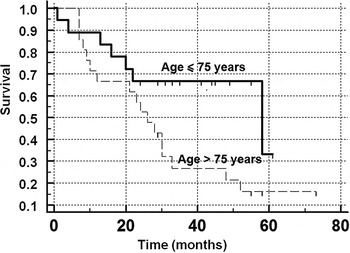
Kaplan-Meier age related survival curves.

The median survival in patients with stage I disease was 29.5 months as compared to 21 months in patients with stage II disease (P = 0.34). Fifteen patients (38%) were still alive at the time of reporting. The longest surviving patient had a follow-up time of 73 months. The overall-survival (OS) and the disease-free-survival (DFS) at 2 years were 61% and 41% respectively. The median OS and DFS were 29 months (95% CI 21.9173–33.1654) and 19 months (95% CI 12.9173-26.1654) respectively. Survival at 12 months was 79%. There were not any significant associations between survival and PS, gender, histological type or lung cancer staging. Difference in survival based on tumour size T1 vs T2, HR 0.9674 (95% CI 0.4329–2.1621) was insignificant. The median OS for patients over 75 years was 28 months versus 32.2 months in the younger group. Age was the only prognostic factor identified in this analysis that affected survival, HR 2.3481, (95% CI 1.0548 to 5.2272), P = 0.0479 (Figure 1.).
DISCUSSION
Surgery remains the primary modality for radical treatment of the early stage NSCLC in medically fit patients. But radical radiotherapy can also provide overall survival benefit in selected patients as shown by Rowell et al. in his systematic review. Patients who received radiotherapy for the early stages of lung cancer, compared with those who did not receive any treatment had a better outcome.Reference Rowell and Williams5
The vast majority of patients referred for radical radiotherapy has cardiopulmonary co-morbidities and is medically inoperable. Another group is elderly patients who are not candidates for surgery due to reduced cardiopulmonary reserve, which can occur without cardiopulmonary disease. And finally the smallest groups are those patients who despite operable tumours decline surgical treatment. Although these patients population must be considered as an unfavourable prognostic group, radiotherapy alone is commonly regarded as the standard option in this setting. It can be an efficient and safe method of treatment in these technically operable but medically inoperable patients.
The purpose of this study was to analyse retrospectively the survival of patients referred with early stages NSCLC at the North Wales Cancer Treatment Centre. All patients underwent radical radiotherapy from 2005 to 2009 inclusive. The overall survival rates in presented analysis were similar to that in other reports. In one of the systematic reviews, which included twenty-six retrospective studies, authors found that the two-year survival after radical radiotherapy in patients with early stage NSCLC varied between 22% and 72%. Additionally the five-year survival varied from 0% to 42%.Reference Rowell and Williams5 In another study, researchers presented a retrospective review of more than twenty thousand patients diagnosed with NSCLC over a ten-year period. The authors found that nearly 4% of those patients had stage I and II disease and were treated non-surgically. Although survival figures were lower than those obtained with surgery, radical radiotherapy resulted in a median survival time of up to 30 months and five-year survival of up to 30% of patients with stage I and up to 25% in stage II NSCLC.Reference Motohiro, Ueda, Komatsu, Yanai and Mori6 Similar results were achieved in the presented study with the median survival of 29 months with 61% and 41% patients alive at 1 and 2 years respectively.
Most authors report lack of correlations between age and OS, but there is some evidence that age > 75–80 years is a poor prognostic factor.Reference Morita, Fuwa and Suzuki7,Reference Lagerwaard, Senan, van Meerbeeck and Graveland8 In the studies done by us, group survival was statistically better in the younger patients than in the group ≥75 years with the OS 28 months and 32 months respectively.
Although different fractionation schedules have been proposed to take advantage of differences between tumour and normal tissue biology in an attempt to increase tumour control without increasing complications, the optimal fractionation regime or total radiation dose have not been defined yet. Hayakawa et al. found that a total dose of 60 Gy in 2 Gy daily standard fractionation resulted in the 2-year OS of 28–32%.Reference Hayakawa, Mitsuhashi and Katano9 We demonstrated that a total dose of 55 Gy with 2.75 Gy per fraction resulted in the improved 2-year OS of 61%.
Radiotherapy fractionation in the UK differs from that in the rest of the western world. It consists of shorter courses and uses fractions larger than the classic 1.8Gy–2.0 Gy per fraction. Although there is nothing intrinsically wrong with doses per fraction higher than 2 Gy, the identification of the optimal regimen is still somewhat empirical. The therapeutic ratio is dependent not only on the single fraction dose or total radiation dose, but is also related to the time-dose delivery method. In the UK, accelerated hypo-fractionated regimen of 52.5 to 55 Gy in 20 daily fractions over 4 weeks is commonly used for the radical treatment of lung cancer. All patients in our series received 55Gy in 20 fractions over 4 weeks. The treatment was in general well-tolerated with only 4 patients developing mild oesophagitis grade II and grade II pneumonitis in 7 patients (16.5%). No grade III or IV pneumonitis was reported.
The poor results with conventional radiotherapy for stage I and II NSCLC triggered development and implementation of newer radiotherapy techniques like CHART and SBRT.
CHART schedule was first introduced at Mount Vernon Hospital, UK, in 1985.Reference Ataman, Bentzen, Saunders and Dische10 This regimen uses thirty-six fractions of 1.5 Gy given three times per day, in 12 consecutive days with a total radiation dose of 54 Gy. Sanders et al. evaluated the long-term outcome of CHART against conventional radiotherapy (30 fractions of 2 Gy in 6 weeks) in patients with locally advanced NSCLC. There was a 24% reduction in the relative risk of death, with an absolute improvement in 2-year survival of 9% from 20% to 29% (p = 0.004).Reference Saunders, Dische, Barrett, Harvey, Gibson and Parmar11 In another study researchers compared outcomes of the CHART against lobectomy and wedge resection (WR) in patients with stage I NSCLC. The OS at 1 and 5 years was significantly better after WR (98% and 74%) or lobectomy than with the CHART (80% and 39%), (P = 0.0484). Also local recurrence in the CHART group (27%) was higher than in surgically managed patient (18.4–19.1%). Overall surgery was superior to the CHART.Reference Ghosh, Sujendran, Alexiou, Beggs and Beggs12
SBRT is another newer mode of radical radiotherapy. It offers higher local control rates and better survival in stage I NSCLC when compared to other radiotherapy treatment modalities including hypofractionated radiotherapy. In one of the studies, inoperable patients with stage I and II NSCLC underwent SBRT treatment with 3–5 fractions of 7–15Gy per fraction prescribed to the 60% isodose. These patients were free from local recurrence at 1 and 3 years in 89% and 83%, respectively. The OS at 1 and 3 years was 79% and 38%.Reference Andratschke, Zimmermann and Boehm13
The importance of the dose and fractionation of radiotherapy is now well-known and widely recognised. Despite that there is still conflicting evidence regarding ideal total radiation dose and number of fractions required for a better local control and improved OS in early stage NSCLC.
The efficacy of different SBRT regimes was evaluated in patients who underwent treatment at the Mallinckrodt Institute of Radiology. Treatment regimens of total dose of 50 Gy in 5 fractions and 54 Gy in 3 fractions provided superior local control for 2 years 100% and 91%, respectively when compared with the regime of 45 Gy in 5 fractions (50%).Reference Olsen, Robinson and El Naqa14 In another study researchers used 4 fractions of different radiation doses (44, 48, and 52 Gy) depending on tumour diameter. Overall survival was 71% and local control was 80% at 3 years. There was no difference in local control between patients with T1 or T2 tumours.Reference Baba, Shibamoto and Ogino15 Also Baumann et al. found that survival between patients with T1 and T2 tumour was not significantly different and local control at 3 years was 92%. SBRT in this study was delivered in 3 fractions of 15 Gy at the 67% Isadore of the planning target volume.Reference Baumann, Nyman and Hoyer16
SBRT availability for patients with early NSCLC has increased over recent years, but long-term follow-up reports are still limited. Bongers et al. studied the incidence of chest wall pain (CWP) and rib fractures in 500 patients followed-up for 33 months. SBRT was delivered in three fractions of 20 Gy, five fractions of 12 Gy, or eight fractions of 7.5 Gy. Grade 3 CWP (2%) and rib fractures (1.6%) were associated with larger volumes of chest wall receiving doses of 30 to 50 Gy and rib fractures specifically with a higher maximum dose in the chest wall.Reference Bongers, Haasbeek, Lagerwaard, Slotman and Senan17
Radical radiotherapy at present is often offered to elderly patients who are medically inoperable and SBRT could be a good alternative as shown by Haasbeek et al. Total dose of 60 Gy in 3 fractions, 5 fractions, or 8 fractions was given depending on the patient's risk for toxicity. The OS at 1 year and 3 years were 86% and 45%, respectively. Local control rate at 3 years was achieved at 89%.Reference Haasbeek, Lagerwaard, Antonisse, Slotman and Senan18
There is emerging evidence that SBRT could also challenge the role of surgery in the medically operable patients with stage I NSCLC. Louie et al. constructed a Markov model to compare a 5-year quality-adjusted life expectancy and OS depending on treatment method. Predicted OS favoured role of surgery, with a benefit ranging from 2.2% to 3.0% for all cohorts. Mean quality-adjusted life expectancy ranged from 3.28 to 3.78 years after surgery and from 3.35 to 3.87 years for SBRT.Reference Louie, Rodrigues and Hannouf19
There are some non-randomised studies in which researchers already compared outcomes of SBRT versus WR for stage I NSCLC. They included 124 patients who were ineligible for anatomic lobectomy. Radiation dose was based on tumour size: 48 Gy (T1) or 60 Gy (T2) and given in four to five fractions. SBRT reduced the risk of local recurrence 4% versus 20% for wedge (P = .07). The OS was higher with WR but cause-specific survival was identical.Reference Grills, Mangona and Welsh20
Our results are comparable with those available in the literature. On the other hand there is also evidence that radiotherapy modalities like the SBRT or CHART could further improve survival in medically inoperable patients with early stage NSCLC. SBRT is already available at a number of the UK trusts and we also will be able to offer it at the North Wales Cancer Treatment Centre within the next several months. This technique gives better local control and disease specific survival than hypofractionated radiotherapy with acceptable acute toxicity. It also has potential to challenge role of surgery in the near future.