


For centuries, scholars have debated how the size of political jurisdictions affects the quality of government. This question can be traced back almost 2,500 years to Plato and Aristotle, who preferred smaller entities, large enough to be self-sufficient, but small enough to ensure that citizens can know one another's characters (Dahl and Tufte Reference Dahl and Tufte1973, 4–5). Today, the debate over the number and size of political jurisdictions is framed in terms of decentralization, federalism, and local and urban politics. Small is often perceived as beautiful because, it is argued, citizens are closer to decision makers and feel more efficacious, politics is less abstract, and preferences more homogeneous, allowing for a better fit between what citizens want and what they get. Large is lovely because larger jurisdictions are more likely to be self-sustainable, can be responsible for broader ranges of political questions, and can benefit from economies of scale.Footnote 1 Although the question of size and democracy is old and prominent, empirical studies of the effect of size on democracy and its underpinnings are strikingly scarce.
In this article, we focus on one psychological condition that many see as necessary for high-quality participatory democracy: internal political efficacy (IPE), or individual citizens’ beliefs that they are competent to understand and take part in politics. Since the 1950s, scholars have studied the determinants and consequences of IPE (Almond and Verba Reference Almond and Verba1963; Campbell, Gurin, and Miller Reference Campbell, Gurin and Miller1954; Finifter Reference Finifter1970; Hayes and Bean Reference Hayes and Bean1993; Morrell Reference Morrell2003; Verba and Nie Reference Verba and Nie1972). Using original survey data from a unique quasiexperiment conducted in Denmark since 2001, we provide evidence that increasing the size of local jurisdictions has a causal effect on IPE. As the size of municipalities increases, citizens feel less qualified to play an active role in municipal politics.
The optimal size of a jurisdiction is a fundamental question in political science. Since Plato and Aristotle, political philosophers, political scientists, and economists have debated how size is related to democratic participation and the efficient production of collective goods. Plato argued that the optimal size of a state should be “sufficient to maintain a certain number of inhabitants in a moderate way of life” (Plato, Book of Laws V), and even suggested that 5,040 citizens would be appropriate. Also, Aristotle argued that a population must be of a certain magnitude to “be self-sufficient for the purpose of achieving a good way of life,” but that a state should be small enough to ensure that the citizens can “distribute offices of government according to the merit of the candidates” and “know one another's characters” (Aristotle Reference Barker1948, 292). Dahl and Tufte (Reference Dahl and Tufte1973, 4–12) show how the question has remained relevant to thinkers in the history of political thought from Jean-Jacques Rousseau, who argued that the average citizen's share in decisions must vary inversely with the size of the polity, to John Stuart Mill, who found that the need for the whole people to participate implies that the perfect government must be representative. Of course, the question of size is also prevalent in more recent discussions. Robert A. Dahl, in his presidential address to the American Political Science Association's annual meeting in 1967, argued that the optimum size of a city would be between 50,000 and 200,000 citizens (Dahl Reference Dahl1967, 965). Dahl and Tufte (Reference Dahl and Tufte1973, 3) give a clear account of the central dilemma in the question of the effect of size: Smaller polities provide better opportunity to participate, but larger polities offer citizens the opportunity to influence a wider range of potentially more important political decisions.
Although the question of whether size affects IPE is both simple and important, the empirical literature is inconclusive. Of six studies addressing the question, three find that jurisdiction size is not, or almost not, correlated with political efficacy (Almond and Verba Reference Almond and Verba1963, 234; Lyons and Lowery Reference Lyons and Lowery1989; Muller Reference Muller1970, 797), and three that jurisdiction size is negatively associated with efficacy (Finifter Reference Finifter1970; Finifter and Abramson Reference Finifter and Abramson1975; Vetter Reference Vetter2002, 13). The fact that all six studies are cross-sectional constitutes a major methodological challenge. Cross-sectional estimates may reflect the deliberate decisions of people with differing interests to sort themselves into jurisdictions with different characteristics, as emphasized by Tiebout (Reference Tiebout1956). This makes it difficult to interpret existing empirical estimates as reflecting a causal effect of jurisdiction size. At the same time, time variation in jurisdiction structure is rarely observed, and studies that make use of such variation when analyzing local political issues, including DeHoog, Lowery, and Lyons (Reference DeHoog, Lowery and Lyons1990), are subject to sample selection due to the voluntary political nature of most amalgamations and mergers.
To get at estimates of causal effects in this setting, we turn to administrative reform. As noted by Campbell (Reference Campbell1969), administrative reforms occasionally provide researchers in the social sciences with opportunities to estimate causal effects by generating quasiexperiments that exogenously determine, or at least significantly influence, the treatment assignment in a nonexperimental setting (Meyer Reference Meyer1995; Shadish, Cook, and Campbell Reference Shadish, Cook and Campbell2002). We exploit a recent large-scale administrative reform of the Danish municipal structure, the so-called Structural Reform (SR). Through amalgamation with one or more neighboring municipalities, individuals residing in reform (treatment) municipalities suddenly experienced a dramatic increase in the population size of their jurisdiction, whereas residents in nonreform (control) municipalities experienced no change in jurisdiction size. The fact that 33 municipalities were not amalgamated enables us to control for exogenous national shocks and national-level trends in overall survey response and local political interest. The latter could well be affected due to both the public debate on the large-scale reform and the concurrent revision of the system of intergovernmental grants. The reform was, as we argue in detail later, largely exogenous from the viewpoint of individual municipalities and definitely so for individual citizens. The empirical analysis focuses on the short-run effects of reform in an attempt to identify the pure effect of change in size.
We estimate the causal effect of jurisdiction size on IPE using individual-level survey data collected before and after the reform in both unaffected (control) and affected (treatment) municipalities. We find, using various difference-in-difference (DiD) and matching estimators on both repeated cross-sectional data and retrospective evaluations, that citizens in amalgamated municipalities report lower IPE after the reform, and, crucially, that the decline is larger, the larger the change in population size as a result of the reform. Our preferred specification suggests that the largest experienced increases in population size translate into an estimated decrease in IPE of 1.7 on a scale from 2 to 10; to put this into perspective, this corresponds approximately to a drop from the 75th percentile to the median or from the median to the 20th percentile. The result that population size has a causal, significant effect on IPE is robust across samples and estimators, and we demonstrate that local variations in the amalgamation process, as well as changes in local public finances and municipal political control following reform, do not affect this relationship.
JURISDICTION SIZE AND INTERNAL POLITICAL EFFICACY
Various scholars have argued that high-quality democracy requires that citizens participate actively in politics, above and beyond voting in elections or referenda. In a healthy democracy, in this view, individuals should attend and speak at public meetings, petition officials, and seek to influence decisions in other ways. Two conditions are necessary, although, of course, not sufficient, for citizens to participate. First, they must believe that the government authorities are responsive to citizens’ demands, so that their participation is likely to achieve something. Second, they must believe that they are competent to understand and contribute effectively to political decision making. Together, these beliefs are often referred to as political efficacy. The first is known as external political efficacy, whereas the second is known as internal political efficacy.
Building on the work of Almond and Verba (Reference Almond and Verba1963), Dahl and Tufte (Reference Dahl and Tufte1973) argue that citizens tend to feel more competent to participate in government in small jurisdictions. Simply because any particular citizen's share in power declines when the number of citizens increases, it is reasonable to expect that “[t]he larger the citizen body, the weaker the sense of individual effectiveness (the greater the sense of powerlessness)” (43). In small jurisdictions, it is easier to “know the ropes of politics,” and it is possible to focus on the local community (Verba and Nie Reference Verba and Nie1972, 231). In addition, size is likely to affect the nature of political discussions. In small jurisdictions, discussions often concern very specific questions. In large jurisdictions, it is impossible to discuss every single detail; political discussions must be more general to be tractable. Consider local political discussions on primary schools, which in many countries is one of the most important tasks of local government. Small municipalities with, say, 5,000 citizens, corresponding to the smallest included in this study, have perhaps two or three schools, and debates on school policy often concern a specific school. To be effective, arguments must be specific and related to particular problems in one of the schools. Larger municipalities with perhaps 500,000 citizens, corresponding to the largest municipality included in this study, have more than 50 public schools, and school policy is typically more general. Arguments referring to particular problems in a particular school often drown in a flood of ideas and complaints. To be effective, arguments should apply more generally and generate a larger coalition extending beyond the boundaries of just one school district.
Dahl and Tufte (Reference Dahl and Tufte1973, 61–65) conclude, based on a review of existing empirical studies, that feelings of efficacy are lower in large jurisdictions. Although Almond and Verba (Reference Almond and Verba1963) find that political efficacy does not depend on city size (see also Muller Reference Muller1970, 797), Finifter and Abramson (Reference Finifter and Abramson1975) argue that this conclusion is misleading; because education levels tend to be higher in larger cities, and because education is positively related to the sense of political efficacy, the true relationship between city size and political efficacy may be suppressed. When education is controlled for, it is revealed that city size is, in fact, negatively related to feelings of IPE (Finifter Reference Finifter1970, 403–4; Finifter and Abramson Reference Finifter and Abramson1975, 194). More recent studies contribute to this somewhat blurry picture; Lyons and Lowery (Reference Lyons and Lowery1989) find no effects, whereas Vetter (Reference Vetter2002, 13) finds a small effect.
In the next section, we discuss the concept of IPE, how it is defined, and how it is related to other important aspects of a well-functioning democracy. We then discuss methodological problems endemic to existing empirical studies of the effect of size on efficacy.
Concept of Internal Political Efficacy
The concept of political efficacy was originally defined as the “feeling that individual political action does have, or can have, an impact upon the political process, i.e., that it is worthwhile to perform one's civic duties” (Campbell, Gurin, and Miller Reference Campbell, Gurin and Miller1954, 187). As noted by Lane (Reference Lane1961, 149), however, this definition includes two dimensions of efficacy: one related to self-image, which is closely related to the concept of subjective political competence analyzed by Almond and Verba (Reference Almond and Verba1963, 181–213), and one to the image of democratic government. The two dimensions are referred to as internal political efficacy, defined as “beliefs about one's own competence to understand, and to participate effectively in, politics,” and external political efficacy, which is “beliefs about the responsiveness of governmental authorities and institutions to citizen demands” (Niemi, Craig, and Mattei Reference Niemi, Craig and Mattei1991, 1407). Since the 1960s, internal political efficacy has been a central measure in the literature; Morrell (Reference Morrell2003, 591) has thus identified more than 75 studies of its measurement, causes, and consequences.
The feeling of political efficacy is positively correlated with participation (Clarke and Acock Reference Clarke and Acock1989; Pollock Reference Pollock1983, 404), but although empirically related, feelings of efficacy and actual participation are two distinct phenomena. First, just that people feel more competent to participate does not imply that they will participate more. Despite confidence in their own competence, they may believe that government is unresponsive (i.e., they may have low external political efficacy), or they may simply be too busy or uninterested in participating. It is also perfectly possible to feel efficacious and have plenty of time without having particular reasons to participate. We do not have data on whether individuals actually participate less in the large amalgamated jurisdictions of Denmark or whether governments in small jurisdictions are more responsive to citizen demands. Second, feelings of IPE and rates of participation have different implications for democracy. Almond and Verba (Reference Almond and Verba1963, 255–57) conclude that the feeling of efficacy, compared to actual participation, which may also have a destabilizing effect, has several desirable effects: It increases the legitimacy of a system; it leads to political stability, greater acceptance of participatory democratic systems, and higher valuation of the participation of fellow citizens; and it “may be taken as an index of the extent to which they consider their nation democratic.” Self-confident citizens are also more likely to be active (Almond and Verba Reference Almond and Verba1963, 257; Pollock Reference Pollock1983) and more satisfied (DeHoog, Lowery, and Lyons Reference DeHoog, Lowery and Lyons1990), and a well-functioning participatory democracy increases feelings of efficacy (Clarke and Acock Reference Clarke and Acock1989; Madsen Reference Madsen1987). When it comes to the quality of a democratic order, the question of whether citizens believe that they have adequate possibilities to participate in and influence political decision making, rather than whether they believe that they have sufficiently weighty reasons to actually participate, is crucial. According to Dahl (Reference Dahl1989, 109), the central question is whether citizens “have adequate and equal opportunities for placing questions on the agenda and for expressing reasons for endorsing one outcome rather than another.”
IPE has been measured in a number of ways. Five survey questions, labeled Qualified, Understand, Public office, Informed, and Complex, have been used in different combinations. We use these questions, translated into Danish (see Lolle Reference Lolle, Kjær and Mouritzen2003) and adapted to local politics (see Table 2 for wordings). Niemi, Craig, and Mattei (Reference Niemi, Craig and Mattei1991) recommend using Qualified, Understand, Public office, and Informed, but not Complex. Morrell (Reference Morrell2003, 592) identifies four frequently used ways of measuring IPE. He concludes that the four-item index developed by Niemi, Craig, and Mattei (Reference Niemi, Craig and Mattei1991) is among the most popular, and that it consistently performs as a reliable and valid measure (Morrell Reference Morrell2003, 600). We call this measure IPE-Niemi. The survey question “Complex,” which is not employed in IPE-Niemi, is used much more in the American National Election Studies (ANES), where it, unlike the other questions, has appeared since 1952 (ANES 1994, 504)—and, in contrast to Qualified, Public office, and Informed, still appears. Together with “Understand,” this question offers an alternative and, we believe, more robust measure because it does not involve indirect evaluations of the respondent's organizational and managerial capacity. We call this measure IPE-Complex and employ both measures in the empirical analysis that appears later in this article, commenting on differences where appropriate.
Empirical studies of the causes of individual citizens’ sense of IPE show the importance of several individual-level factors, including gender, age, education, and income (Almond and Verba Reference Almond and Verba1963; Hayes and Bean Reference Hayes and Bean1993, 269–70; Titus Reference Titus1981). As seen, although the results of existing studies are not unequivocal, the effect of size on internal political efficacy, if any, is negative. This also applies to other aspects of democracy. For example, Verba and Nie (Reference Verba and Nie1972, 237–47) conclude that participation tends to be higher in small local government units. Dahl and Tufte (Reference Dahl and Tufte1973, 63) report evidence from Swedish local government that supports the size–participation relationship. Following Dahl and Tufte, a large number of studies have investigated the effects of jurisdiction size and consolidation on democracy broadly construed; some with specific focus on size, and some as parts of studies of decentralization more broadly.Footnote 2 In a study of the longitudinal relationship between aggregate turnout and waves of municipal consolidation, Morlan (Reference Morlan1984) finds that turnout is higher in national elections than in local elections. However, at the local level, turnout is inversely related to jurisdiction size (see also, among others, Larsen Reference Larsen2002 and Oliver Reference Oliver2000). Jurisdiction size is also negatively related to citizens’ likelihood of contacting officials and politicians (Verba and Nie Reference Verba and Nie1972, 231), as well as to attending meetings on local issues or in local organizations (Larsen Reference Larsen2002; Oliver Reference Oliver2000).
To sum up, many cross-sectional, and a few longitudinal, studies investigate the democratic consequences of differences in jurisdiction size, and there is some, but by no means unequivocal, evidence that larger size is associated with lower quality, however measured, of democracy and its underpinnings. However, these studies face two methodological challenges.
A Simple Idea, But a Difficult Test
The idea that jurisdiction size matters for IPE in a causal sense is simple, but due to two thorny methodological challenges, it is difficult to evaluate empirically. First, differences in observable, but unmeasured or poorly measured population characteristics can affect estimates, as shown in Finifter and Abramson (Reference Finifter and Abramson1975). The populations of small and large jurisdictions can be different on many dimensions, which causes problems of common support rarely addressed in this literature. Education is one important example, but also income levels, occupations, and employment patterns are different in small and large jurisdictions. This problem can be partly solved by statistical control for the confounding variables, but a fully satisfactory solution requires that all such variables are known, identified, and measurable.
Second, cross-sectional studies cannot address problems of selection that arise if people with unobservable preferences over local democracy self-select into jurisdictions of different size, partly with an eye on exactly this. The idea that people may sort themselves into different jurisdictions is classic (Tiebout Reference Tiebout1956), and solid evidence for sorting based on preferences for local public goods such as school quality and environmental quality is beginning to emerge (Banzhaf and Walsh Reference Banzhaf and Walsh2008). This constitutes a problem of endogeneity. When sorting effects exist, differences in political efficacy among citizens residing in jurisdictions of varying size may reflect reverse causality (i.e., that people with interest in local politics are drawn to smaller jurisdictions), rather than a causal effect of jurisdiction size on IPE.
The problem of endogeneity is difficult to handle statistically. One way to correct for endogeneity is to use an instrumental variable approach, but valid instruments can be difficult to find, and we have not seen any studies on size and democracy that attempt this. Another solution would be to study jurisdiction size and the quality of local democracy over time, but this is often infeasible because important jurisdictional boundaries rarely change. When change is observed in connection with large-scale reform, two additional complications arise. First, in large-scale reforms, several factors, such as local political institutions or systems of intergovernmental grants, often change simultaneously, making it difficult to isolate the effects of changing jurisdiction size. Second, such reforms are often encompassing, leaving no individuals or jurisdictions unaffected.
In addition, when jurisdictional change occurs, or is refrained from, it typically does so endogenously. In many settings, jurisdictional change, whether at the city (Lassen Reference Lassen2005), county (Alesina, Baqir, and Hoxby Reference Alesina, Baqir and Hoxby2004), or country level (Alesina and Spolaore Reference Alesina and Spolaore1997), is often decided by voting. Alesina, Baqir, and Hoxby (Reference Alesina, Baqir and Hoxby2004) find that jurisdictions in the United States forego consolidation by voting against it, if it means increasing population heterogeneity. Such majority consent is necessary for consolidation in most countries and introduces the issue of selection bias into estimates of the effect of jurisdiction size on local democracy indicators.Footnote 3
To identify a causal effect of the size of the populace on IPE, it is therefore necessary to identify a quasiexperiment that provides an exogenous source of variation in jurisdiction size. In the next section, we introduce the SR of Danish municipalities and argue that this is an excellent opportunity to test how jurisdiction size affects IPE.
DANISH STRUCTURAL REFORM AS A QUASIEXPERIMENT
The SR, implemented politically in 2005 and administratively in January 2007, was an exogenous shock to the size of Danish municipalities. The SR was planned and implemented by the Danish central government. Of the 271 original municipalities, 238 were merged into 65. The 33 municipalities that were not amalgamated allow us to control for exogenous national shocks and national-level trends in local political interest. Hence, by exposing citizens to shocks of different sizes, the SR introduced an exogenous element into the size of the local polity. We use this exogeneity for identification of causal effects.
Danish Local Government
The local level is a vital part of the Danish public sector, both culturally and politically. Culturally, a majority of Danes identify primarily with their local area, rather than with their region or country.Footnote 4 Politically, Danish local governments are responsible for about 40% of total Danish public expenditure and are relatively autonomous. They are, within certain restrictions, free to set the local income tax rate and have wide discretion in most policy areas. Most notably, they control welfare services such as the school system, child care, and elderly care. The municipalities are governed by a city council elected for 4-year terms in popular elections. Turnout is generally high, typically 70% to 80%. The mayor is elected indirectly by the city council. In addition to presiding over the council and being the formal head of the municipality, the mayor is the only full-time politician, head of the local administration, and chairman of the economic committee, which assumes a central role in the political process (Berg and Kjær Reference Berg and Kjær2005). The local party systems are typically dominated by local branches of the national parties, but there are some so-called local lists.
Just as in Almond and Verba's results, the sense of political efficacy in Denmark tends to be higher toward the local level than toward the national level and the European Union, although the differences between the local and the national levels are limited (Andersen Reference Andersen, Andersen, Torpe and Andersen2000, 128–30). In a thorough cross-sectional study of the effect of jurisdiction size on IPE in Danish municipalities, Lolle (Reference Lolle, Kjær and Mouritzen2003) concludes that jurisdiction size does not have a strong effect on political efficacy. The association between characteristics of citizens and their sense of political efficacy is much stronger. In particular, education is strongly correlated with IPE (Andersen Reference Andersen, Andersen, Torpe and Andersen2000, 141–42).
Structural Reform of 2007
The SR has three parts. First, the number of municipalities was reduced from 271 to 98, increasing average jurisdiction size from 20,100 to 55,600 citizens. Second, 14 counties were merged into five new administrative units, so-called regions. Third, municipalities were given additional responsibilities (most important, certain social services for the disabled, health-related prevention, and environmental regulation), whereas tax collection was transferred away from municipalities. The net transfer of tasks to the municipalities was limited and amounts to DKR 25 billion compared to the total municipal expenditure of (in 2007) DKR 333 billion.
The idea of reforming Danish local government was first mentioned in 2002. The SR was enacted in 2004, and took effect starting on January 1, 2007. The reform process was initiated by the central government, with the explicit aim to generate larger municipalities to reap economies of scale in local public goods production. The process began in 2002, when the government appointed the Commission on Administrative Structure with a chairman appointed by the Minister of the Interior, three independent expert members, four representatives from municipalities and counties, and four civil servants from Danish ministries. In January 2004, the committee published its four-volume report, which recommended a large-scale structural reform. Based on this, the center-right minority government introduced a bill, which immediately got a majority when the Danish People's Party declared that it had only one question: Where do we sign? In June 2004, it was clear that Danish local government would experience dramatic reform. It is the fact that the SR was imposed on municipalities by the central government, combined with the fact that not all municipalities were equally affected by the SR, that makes it an attractive setting for studying the causal effect of jurisdiction size on the quality of local democracy.
According to the agreement between the government and the Danish People's Party, municipalities would be merged into larger units with at least 30,000 citizens. In practice, all municipalities with less than 20,000 citizens (205 of the 271 municipalities) were asked to arrange for mergers before January 1, 2005. Only neighboring municipalities would be allowed to merge; however, apart from this general restriction, the central government did not choose the merging partners.Footnote 5 Already before this agreement, 11 of the new 98 municipalities had announced how they wanted to merge, and most of the remaining municipalities were very close to agreeing on whom to merge with (Blom-Hansen, Elklit, and Serritzlew Reference Blom-Hansen, Elklit, Serritzlew, Blom-Hansen, Elklit and Serritzlew2006, 17–18). A few municipalities, especially islands, would be allowed to continue with less than 20,000 citizens, but would have to cooperate with larger neighbors on service provision. The end result is seen in Figure 1: many small municipalities before the reform, whereas larger municipalities dominate after the reform.
Danish Municipalities before and after 2007 Reform; Relative Shares by Population

A Quasiexperiment
The SR changed the municipal structure, notably the size of jurisdictions, in a way that would not have occurred otherwise. In this sense, the SR constitutes an exogenous shock to the size of more than 200 municipalities, and we use this exogeneity to break the correspondence between preferences and choice, which leads to selection problems in observational data. We classify this type of intervention as a quasiexperiment, following Campbell (Reference Campbell1969), but note, as Barabas and Jerit (Reference Barabas and Jerit2010, 227), that the literature does not agree on experimental terminology. For example, some see natural experiments as synonymous with quasiexperiments, defining as “[g]ood natural experiments . . . studies in which there is a transparent source of exogenous variation in the explanatory variables that determine the treatment assignment” (Meyer Reference Meyer1995, 151), whereas others, for example, Shadish, Cook, and Campbell (Reference Shadish, Cook and Campbell2002), distinguish between natural experiments, reserved for a “naturally occurring contrast between a treatment and a comparison condition” (17) and quasiexperiments, with the latter term now being reserved for “experiment[s] in which units are not assigned to conditions randomly” (12). Angrist and Krueger (Reference Angrist and Krueger2001) share, without mentioning quasiexperiments explicitly, Meyer's sentiment, writing that natural experiments are “situations where the forces of nature or government policy have conspired to produce an environment somewhat akin to a randomized experiment” (73). In sum, our opinion is that because the SR provides exogenous variation in the explanatory variable, but is neither a naturally occurring event nor a source of random shocks, it constitutes a quasiexperiment rather that a natural experiment.
This exogenous variation is a crucial component in our research design. However, for us to be able to interpret any postreform differences in IPE as being caused by larger jurisdiction size, we need to address three additional issues. First, differences unrelated to jurisdiction size between small and large municipalities could imply a problem of comparability. Second, citizens relocating as a result of the reform could be a source of endogeneity. Third, change itself could affect feelings of IPE. We discuss these issues in turn.
The problem of comparability will arise if, for example, larger jurisdictions are subject to different institutional constraints, tasks of larger units are different or more complex in nature, or harder to understand because these factors alone could affect feelings of IPE. However, due to regulation from the central government, Danish municipalities have the same set of tasks, are organized in similar ways, and follow identical rules for the democratic process. The differences between large and small municipalities have to do with the process citizens need to engage in if they aspire to influence political decisions. Although the formal democratic rights of citizens are identical, strategies that are effective in small jurisdictions are likely to fail in large jurisdictions. For example, parallel to the argument presented previously, organizing protests among citizens affiliated with a certain municipal institution would be fairly easy in a small municipality and could quickly involve quite a large proportion of the electorate. Simple messages on specific problems concerning this particular institution are likely to be heard. However, such strategies would often be inadequate in a large municipality. Protests from users of one particular institution do not carry much weight, and, to be effective, citizens need to organize much broader, principled protests. This requires the citizen to be capable of formulating an abstract political problem. In a large municipality, a promising strategy would be to mobilize support from interest groups. Although the formal democratic rights are identical, and the tasks of large and small municipalities are of the same inherent complexity, the political process may well be more complex and difficult for many citizens to understand in larger jurisdictions. Hence, if changes in jurisdiction size affect IPE, this is not the result of differences between the tasks of small and large municipalities.
The second issue is the possibility that individual citizens respond to the new municipal structure by relocating, which would be a source of endogeneity. Individuals with strong preferences for political participation at the local level who suddenly find themselves in a large municipality may move to a small municipality. In practice, we do not consider this a major problem because the postreform survey was conducted within a year after the reform, and we exclude recent movers from the analysis. In addition, although individuals were not allowed to choose whether and how their municipality should be merged, the municipalities and their citizens did have some influence on the merger. For example, municipalities of citizens with a strong preference for local democracy may have aimed for a merger with a small municipality. In our analysis, this would make citizens of such municipalities relatively happier with the amalgamation, which would bias the analysis against finding a detrimental effect of the reform on IPE. Finally, although the assignment of the treatment is not random, the municipalities were severely constrained by the size requirements and the condition that merging municipalities should be geographically connected. Bhatti and Hansen (Reference Bhatti and Hansen2011) show that, apart from the obvious geographic constraints, social connectedness, measured by shared commuters, is the most important predictor of mergers such that socially connected municipalities are more likely to merge. Hence, the nonrandomness of the treatment may imply that merged municipalities are more connected and coherent. If this causes bias, then the bias will again be against finding a negative effect of size.
Some insight into the process of amalgamation can be obtained from the fact that referenda were held in 63 of the original 271 municipalities (Jørgensen Reference Jørgensen and Mouritzen2006, 168). Most of the referenda were concerned with adjustments of boundaries, but some involved the choice of which municipality to merge with. In our sample of 32 municipalities, referenda took place in six cases, marked with asterisks in Table A.1 in the Appendix. In these cases, the group of citizens did have a direct influence on what would happen to their municipality, but individual citizens, of course, only had a minuscule chance of affecting the result. We observe no differences in results.
The final issue is that change in itself may alter feelings of IPE. The major components of the SR that did not involve changing jurisdictional boundaries are, as already discussed, accounted for by having a control group in the sample. However, for the amalgamated municipalities, we can decompose the jurisdictional change into two components: the fact that jurisdictional boundaries change at all and the fact that population size increases. If citizens react in a negative way to change per se, then any change in jurisdiction size, both positive and negative, should be associated with lower political efficacy. If population size is more important and has a systematic effect on political efficacy, then increasing and decreasing population size should have differing effects, and the effect should be larger, the larger the change in population. Although we distinguish amalgamated municipalities by the change in size when conducting the analysis, we do not observe jurisdictions decreasing in size as a consequence of the SR.
Evidence against the hypothesis that change in itself matters can be drawn from an experiment involving decentralization of the municipality of Copenhagen, the capital and by far the largest municipality in Denmark, into 15 administrative and political districts. Four city districts were exogenously selected as pilot districts, providing a natural experiment for the entire city to learn about the consequences of decentralization; Lassen (Reference Lassen2005) documents the exogenous selection process, although with focus on information. In surveys carried out after a citywide referendum on implementation of the city district model, survey respondents overwhelmingly favored smaller units with respect to political efficacy, both internal and external, even if the proposal eventually failed due to concerns about economic efficiency (Lassen Reference Lassen2005). The fact that the selection process was exogenous, allowing citizens to learn about the consequences of smaller jurisdictions in an unbiased way, as well as the finding that citizens overwhelmingly favored change rather than the status quo when considering IPE, in combination support the hypothesis that changes in population size rather than change per se cause lower IPE in large jurisdictions.
DATA
We use two individual-level telephone surveys, conducted by professional polling firms, one in 2001, before the SR, and the other in late 2007 and early 2008, a year after the SR was implemented. A core set of identical questions were asked in both surveys, making it possible to compare pre- and post-SR response patterns.
In the 2001 survey, 2,763 interviews were obtained. The response rate was 44%. An equal number of respondents were randomly selected in 60 of the then 275 Danish municipalities (Houlberg and Pedersen Reference Houlberg, Pedersen, Kjær and Mouritzen2003, 209). The 60 municipalities were randomly selected from six strata based on size, with 10 municipalities from each. The 2007 survey resulted in 1,255 interviews. The response rate was 48%.Footnote 6
Because our aim is to compare the two surveys, only residents aged 24 (who were 18 when the first survey was carried out) or older were included in the postreform sample. Younger respondents were excluded to rule out any cohort effects. The 60 municipalities in the 2001 survey were divided into five strata, one with continuing municipalities and four with reform municipalities. This latter group was constructed by combining below and above median size before the reform with below and above median share of the population size of the new municipality after the reform. We randomly selected eight municipalities from the control group stratum and six from each of the other four strata. The 2007 survey was stratified by pre-SR municipalities, making it possible to compare municipal-level responses in pre-SR municipalities within the same area, now part of a new, larger postreform municipality. Table 1 shows the strata; the 32 selected municipalities are listed in Table A.1 in the Appendix.
Strata in the Post-SR Survey

Note: SR, Structural Reform.
Municipalities belonging to the stratum denoted “small-small part” in Table 1 were below median size before the reform and ended up being a small (below median) part of the new municipality as a consequence of the reform, and likewise for the other strata. In the following, we refer to these strata as small-small (SS), small-large (SL), large-small (LS), and large-large (LL). Table 2 shows descriptive statistics on the final samples and definitions of the variables used in the following analyses. The prereform sample includes only municipalities sampled postreform. Both samples contain only individuals with responses to all efficacy questions; recent movers are excluded in both samples, as are the very young in the postreform sample, as described previously.
Questions, Definitions, and Descriptive Statistics

Note: IPE, internal political efficacy; SR, Structural Reform.
RESEARCH DESIGN AND EMPIRICAL SPECIFICATION
The exogenous shock to jurisdiction size implied by the reform constitutes, together with the repeated survey data, the basis of our research design. To estimate the causal effect of jurisdiction size on IPE, we use the DiD method on repeated cross-sectional data. DiD is well known in the program evaluation literature (see, e.g., Imbens and Wooldridge Reference Imbens and Wooldridge2009, for a recent treatment). Under DiD, units receiving treatment are compared to their pretreatment levels, and the same is done for a control group. This yields the first level of differences. Subsequently, the two differences are subtracted from each other, resulting in a second-level difference, leaving an estimate of the causal effect of treatment under certain assumptions, which are detailed in this section.
The Difference-in-Difference Estimator
Let the internal efficacy of an individual i be Y 1i in the treated case, that of municipal amalgamation, and Y 0i be the outcome for the same person in case of no treatment. Our object of interest is the difference Δi=Y 1i−Y 0i, which is the causal effect of municipal population size on the IPE experienced by individual i. In practice, however, an individual i cannot be treated and nontreated at the same time, which means that either Y 1i or Y 0i will be missing. The difference Δi results from the pair of potential outcomes, a term coined by Rubin (Reference Rubin1974), which is to be distinguished from the realized outcome Yi. Because a counterfactual for the realized outcome is not available at the individual level, the statistical approach is to estimate the missing variable from appropriate group means.
We study a repeated cross-section model of different individuals surveyed before and after the reform:

where I is the set of respondents. Mi∈{0, 1} is an indicator for reform (as opposed to continuing) municipalities. Later, we also consider a treatment indicator of the form Mi∈{0, SS, SL, LS, LL}, where we distinguish treated municipalities both by their prereform size and by their postreform relative size, as explained previously. Ti∈{0, 1} is a time period indicator equal to 0 before the reform and 1 after the reform. The interaction(s) MiTi take(s) on the value 1 for reform municipalities after implementation, and zero otherwise. Finally, ui represents unobservable characteristics and is assumed to be independent of treatment status conditional on observables and across periods; we return critically to this assumption later.
It can be useful to consider the conditional means for the four groups: reform and nonreform municipalities before and after reform:

The before–after estimator for the treated (BAT), used when no control group is available, is given by (1.D) – (1.C):

The BAT estimator includes both the effect of treatment and the common trend or aggregate change. In our case, γP includes the effects on IPE from overall trends and aspects of the reform common to all municipalities. To estimate consistently the effect of size, we need to subtract this common trend, which is equal to the before–after estimator of the control group (BAC):

The BAC estimates the effect of reallocation of government tasks and any aggregate time trends, possibly due to changing survey participation, in IPE with respect to local government; the latter may have increased or decreased in reaction to the substantial nationwide public debate on municipal politics and the SR. Similarly, increased fiscal pressure will also be captured by this trend, as long as it is similar across all municipalities. Based on our setup in Eq. (1), we get the DiD estimator as BAT – BAC; that is,

The assumption that the trend in Eq. (2) is common for treatment and control groups alike is a key identifying assumption in the DiD approach (Blundell and MaCurdy Reference Blundell, MaCurdy, Ashenfelter and Card1999). We first proceed under the assumption that this assumption is satisfied; for example, as noted previously, the reallocation of government tasks across vertical levels of government was the same for all municipalities. However, if the impact of the reform is heterogeneous with respect to observable characteristics, and the distributions of such observable characteristics differ across control and treatment groups, then additional assumptions are needed to ensure that a comparison is based on suitably similar groups; we return to this later, where we consider matching. The second key identifying assumption, denoted no composition bias (Blundell and MaCurdy Reference Blundell, MaCurdy, Ashenfelter and Card1999, 1612), is that the populations considered are the same across time. At the population level, this means that no individuals change from treatment to control group and vice versa. This is sometimes problematic in studies of individual responses to changes in taxation or job training programs; however, in our case, this would be directly relevant only if people moved with the explicit aim of living in a treatment or control municipality, which seems highly unlikely. In addition, our empirical analysis excludes respondents who recently relocated from another municipality. The assumption is more problematic when we consider the actual sampling of individuals; we return to this later in the article.
When estimating individual-level responses to aggregate-level variables, here treatment status and other municipal-level variables, it is important to account for the possible covariance in errors. We do this by allowing for clustering at the municipal level.
Nonrandom Assignment: Different Surveys and Differences in Observables across Treatment Groups
In existing DiD studies on repeated cross-sectional data, the analysis is typically carried out on different waves of a particular representative survey, such as the General Social Survey. In our case, we compare IPE measures across surveys carried out in the same municipalities, using identically worded questions, but with different sampling strategies. The existence of differential sampling probabilities across surveys raises the problem that the surveys are not stratified in the same way, which means that controlling for confounding variables may not solve the problem of composition bias, the absence of which, as noted previously, is necessary for identification of causal effects in a DiD model. To solve this problem, we want to match respondents across surveys on a number of individual-level variables.
At the same time, treatment and control municipalities may differ with respect to observable characteristics, which can lead to a violation of the common trend assumption if effects of the reform are heterogeneous across observables. As noted previously, for example, an explicit aim of the SR was to create municipalities with a minimum of 30,000 inhabitants, which in itself affects the probability of treatment. To solve this issue, we want to match survey respondents across treatment status. In sum, there are two assignments that may be nonrandom: assignment to treatment or control group and assignment to prereform or postreform survey. To address this, we employ a variant of difference-in-difference with matching (DiDM), an estimator developed in the program evaluation literature by Heckman, Ichimura, and Todd (Reference Heckman, Ichimura and Todd1997) and Heckman et al. (Reference Heckman, Ichimura, Smith and Todd1998).
We proceed by propensity score matching (see, e.g., Dehejia and Wahba Reference Dehejia and Wahba2002). Although intuitively desirable, exact matching on a vector of characteristics is often infeasible. However, Rosenbaum and Rubin (Reference Rosenbaum and Rubin1983) show that if potential outcomes are independent of treatment conditional on X, which is a precondition for estimating a causal effect from the data anyway, then this is also the case conditional on the propensity score, defined as the probability of receiving treatment conditional on X. Because we have two assignments that are potentially nonrandom, we follow Blundell et al. (Reference Blundell, Dias, Meghir and Van Reenen2004) in defining two propensity scores. Conditional on X, P M = Pr(M = 1|X) is the probability of being observed in a treated municipality and P T = Pr(T = 1|X) is the probability of being surveyed in the postreform sample. Based on the propensity scores, we can now write the identifying common trend assumption as

This allows the time effects to differ by X and assures that the distribution of observed characteristics is the same across all four samples. In practice, we estimate the two propensity scores by running a probit regression of assignment status (treatment and time, respectively) on X. The resulting predicted values are the estimated propensity scores. Our point of departure is the group of individuals in the treated group, pretreatment (M = 1, T = 0). To match these individuals with respondents in each of the three comparison groups, we perform a variant of nearest-neighbor caliper matching with replacement by pairing each treated respondent with a respondent in each comparison group. The respondent in each comparison group is chosen to minimize the Euclidean distance from the treated individual's two estimated propensity scores, given restrictions on the maximum allowable distance (the caliper) as well as a common support restriction. Based on these matched samples, we carry out standard DiD analysis to form estimates of the average treatment effect on the treated (ATT) under the assumption of separable additivity of time and group effects.Footnote 7 Because matching is carried out with replacement, we correct the sample sizes of the comparison groups to reflect this procedure; the distribution across municipalities within each of the four groups is shown in Table A.1 in the Appendix for both the regression and the matching analyses.
As is standard in the literature, we report bootstrapped standard errors throughout for the estimated ATTs based on the DiDM procedure. One study shows that this may, in fact, result in biased estimates for the standard error, but the issue is not resolved (Abadie and Imbens Reference Abadie and Imbens2008). In performing the bootstrap, we resample at the cluster level of new municipalities, as previously described.
Balance, Unobserved Heterogeneity, and Exact Matching
Although the DiDM procedure allows for unobserved heterogeneity under the assumption of a common trend conditional on X and, as such, represents a considerable improvement of the use of standard cross-section estimators, two potential sources of bias remain. First, remaining unobserved heterogeneity can obviously influence results; and second, to the extent that propensity score matching does not achieve perfect balance across treatment regimes on variables that are strong predictors of the outcome, observed differences in outcomes may be erroneously attributed to treatment, in which case it may be efficient to match directly, or exactly, on these key variables (Barnard et al. Reference Barnard, Frangakis, Hill, Rubin, Gatsonis, Kass, Carlin, Carriquiry, Gelman, Verdinelli and West2002; Rosenbaum and Rubin Reference Rosenbaum and Rubin1983).
We explicitly include population size as a matching criterion in the calculation of propensity scores to reflect decision making, and, as a consequence, the matching procedure allows us to compare individuals in both small and large municipalities. However, if there are systematic differences in unobserved attitudes toward and interest in local politics among citizens in small and large municipalities, which we suspect ex ante, then including population size alongside individual-level variables in the calculation of propensity scores may not be a sufficient safeguard because population size may carry little weight in the calculation of the propensity scores. To address this, we carry out additional analyses where individuals in small (large) treatment municipalities are explicitly restricted to be matched with individuals in small (large) control municipalities. As emphasized by Heckman, Ichimura, and Todd (Reference Heckman, Ichimura and Todd1997) and Cook, Shadish, and Wong (Reference Cook, Shadish and Wong2008), DiDM functions best when matching individuals who reside within a given geographic unit and, if possible, who are administered identical surveys. This is what we do here.
Finally, to address concerns arising from the less than perfect balance of covariates in the main matching specification, we carry out propensity score matching under the restriction of exact matching on public sector employment; this being an example of an important explanatory variable for which it is difficult to achieve balance in the simple propensity score specification.Footnote 8 In practice, this requires the matching procedure to look for matches based on the two-dimensional propensity score only among individuals with the same type of employment.Footnote 9
Retrospective Evaluations
To supplement the evidence from the repeated cross sections, we also asked postreform survey respondents to assess, in retrospect, the consequences of the SR for measures of IPE. Although there are well-known issues with retrospective questions of this kind, they allow us to address unobserved heterogeneity in a different way: By asking one person to evaluate the differences before and after the reform, we essentially control for individual-level factors and get a direct estimate of the first-level differences. Hence, the retrospective evaluations serve as a robustness check. The limitations of retrospective questions are of a different nature than the potential methodological problems of comparing answers across samples.
We can now compare these differences across treatment and control municipalities as well as within the group of treatment municipalities. We analyze these data using both a regression-based, cross-sectional framework and matching across treatment and control groups. Throughout, we take into account the clustered nature of the data by allowing for within-municipality dependence in estimated standard errors.
RESULTS
In this section, we first present the qualitative insights from the analyses and then illustrate the substantive significance of the results in a separate section.
Regression-based Difference-in-Difference Estimates
Table 3 reports results from the standard, regression-based DiD analysis for four specifications: analysis of binary, categorical, and two continuous treatments on the full sample. The second column reports results for the IPE-Complex measure, whereas the third column reports results from identical specifications using the IPE-Niemi as the dependent variable. This yields a total of eight regression analyses. Standard control variables were included, but results for these are not shown; a full table for IPE-Complex is available in Table A.2 in the Appendix.
Effect of Municipal Amalgamation and Size on Political Efficacy: Evidence from Difference-in-Difference Analysis

Notes: Standard errors are corrected for clustering at the municipal level. The entries show beta coefficients and associated standard errors [in brackets] for two dependent variables (in columns) in four models (rows). Model 1 compares amalgamated municipalities (=1) to continuing, unaffected municipalities (=0). Model 2 distinguishes between amalgamated municipalities by their pre- and postreform size and compares them to continuing, unaffected municipalities (cf. Table 1). Model 3 shows the effect of the absolute population difference (in ten thousands) between a postreform municipality and a prereform municipality. Model 4 shows the relative population difference, calculated as the absolute population difference divided by prereform population. Each model shows the results of a difference-in-difference linear regression specification. Each model includes the same set of control variables (not shown in the table). Full results including controls for IPE-Complex are available in the Appendix; for IPE-Niemi, they are available from the authors on request. IPE, internal political efficacy.
*Significant at 10%; ** significant at 5%; *** significant at 1%.
The results for the binary treatment—shown as model 1 at the top of Table 3, where citizens in all reform municipalities are considered identically treated—suggest strong average effects of the increase in population size. This is the estimated coefficient on the combined interaction term. It measures the average effect of the change in population size on citizens’ feelings of IPE in treated municipalities. We estimate the DiD effect to be −0.36 for the full sample. This estimate is significant at the 10% level.Footnote 10
Model 2 presents results from the categorical treatment. In this case, we distinguish municipalities by prereform size and postreform relative size, creating the four categories Small-Small, Small-Large, Large-Small, and Large-Large presented in Table 1. Municipalities in all four categories experienced an increase in size. Municipalities in Small-Large and Small-Small used to be small prereform. These municipalities tend to experience a large increase in population size in relative terms. Municipalities in Large-Small and Small-Small constitute a small part of the newly formed municipality (postreform). These municipalities tend to experience a large increase in population size in absolute terms. This way of looking at the data shows reasonably similar results for the four treatment categories: Respondents living in municipalities that have seen a large absolute population increase (Small-Small and Large-Small) experience the largest declines in IPE, significant at the 5% level, but respondents in the two other categories also experience declines.
Finally, models 3 and 4 report results from continuous treatment specifications, where we consider directly the effect of the change in population size experienced by respondents. In models 3 and 4, the absolute change and the relative change in population size, respectively, are used. Population size difference corresponds, by definition, in a monotonic way to the categorical treatment variables used in model 2, and we find similar results: the loss of IPE experienced by respondents is increasing in the size of the population increase, both absolute and relative, with the former being more precisely estimated and significant at the 5% level.Footnote 11 This is fully consistent with the results for the four treatment categories. We return to the interpretation of the substantive effects later in the article, following the results on matching.
Results from Difference-in-Difference with Matching
Figure 2 presents scatter plots of the two propensity scores. Each observation in Figure 2 is an individual, and we observe a wide range of observed propensity scores in both dimensions, documenting substantial differences in the probability of being observed in samples both across time and across treatment status.Footnote 12
Distribution of Propensity Scores across Treatment Status and Scores

As described previously, each observation in the treatment prereform group is matched to its nearest neighbor measured by the Euclidean distance in each of the three other groups, subject to a maximum distance requirement, set to 0.05, and the exact matching requirement on public sector employment; furthermore, the samples are trimmed to the common support. This procedure results in 1,148 observations being dropped from the main sample as used in Table 3, leaving 880 of which some will be weighted several times as sampling was done with replacement; this number is sensitive to the choice of caliper, but, as shown later in the article, results are not. In standard one-dimensional propensity score analysis, it is common to focus on the postmatching densities of propensity scores and the resulting covariate balance between treatment and control groups, testing for significant differences in the latter. However, this is less straightforward in the present case, with four comparison groups and two propensity scores. To give some sense of the change in balance as a result of the matching procedure, consider Figure 3.
Balance of Covariates, before and after Matching

In Figure 3, we present covariate balance before and after matching using a radar plot. In a perfectly balanced sample, the plotted figure is a (tilted) square; the further away from a square the quadrangle, the worse the balance. Consider the bottom graph on the left: The dashed line indicates that mean populations in the control group samples before and after reform (groups 1 and 2) are 90,000 and 80,000, respectively, and approximately 25,000 in the treatment groups. Postmatching covariate means, illustrated by the solid line, show an almost perfect square, with mean population for each of the four groups around 20,000. Not surprisingly, balance on public sector employment is perfect following exact matching and improves on all important variables. Education remains less than perfectly balanced; we return to this later, when we consider robustness issues.
Table 4 shows results from the matching analysis for IPE-Complex (second column) and IPE-Niemi (third column) following the template from Table 3. The average effect for IPE-Complex equals −1.0, which is significant at the 1% level and almost three times the estimate from the full-sample, regression-based result reported in Table 3. Here, the categorical treatment suggests larger differences across categories: The largest effect, which is estimated with considerable precision, is for individuals from small prereform municipalities. The pattern is generally the same as in the regression-based analysis, with smaller and less precisely estimated effects for citizens living in municipalities with little change ex post, as their prereform municipality remained the larger one.
Effect of Municipal Amalgamation and Size on Political Efficacy: Evidence from Difference-in-Difference with Matching

Notes: Standard errors are corrected for clustering at the municipal level, and bootstrapped with 50 replications and resampling at the cluster level. The entries show beta coefficients and associated standard errors [in brackets] for two dependent variables (in columns) in four models (rows). Model 1 compares amalgamated municipalities (=1) to continuing, unaffected municipalities (=0). Model 2 distinguishes between amalgamated municipalities by their pre- and postreform size and compares them to continuing, unaffected municipalities (cf. Table 1). Model 3 shows the effect of the absolute population difference (in ten thousands) between a postreform municipality and a prereform municipality. Model 4 shows the relative population difference, calculated as the absolute population difference divided by prereform population. Each model shows the results of a difference-in-difference with matching specification. The matching is based on exact matching on public sector employment combined with two-dimensional Euclidian metric matching with caliper = 0.05. IPE, internal political efficacy.
*Significant at 10%; ** significant at 5%; *** significant at 1%.
A similar picture emerges from the continuous measures: Estimates of the effect of population difference and relative population difference both increase by approximately a factor of 3 compared to the full sample case. These results are strongly statistically significant at the 1% level. In unreported results, we find the effects on the individual questions Understand and Complex to be almost exactly identical, both in terms of size and statistical significance. In the third column, we show results for IPE-Niemi. The results are qualitatively similar to those identified for IPE-Complex. They are numerically only slightly larger, which indicates a smaller effect on these dimensions of efficacy, because the scale is now different. The relative differences between the DiDM estimates and the full-sample results are similar to those identified for IPE-Complex. The differences in size arise largely from the fact that the variable Public office does not show up significant in analyses of the individual efficacy components.
The overall conclusion is clear: The qualitative results of the regression-based DiD analysis remain valid, but taking into account nonrandom assignment across samples, in both the treatment and the time dimensions, increases the estimated effects of population size on IPE considerably. What accounts for the observed differences in results? Two things occur in the matching analysis compared to the regression analysis: The sample is different, and the estimation method, based on nearest neighbor matching, is nonparametric, dispensing with the assumptions on functional form inherent in the linear model. If we apply the linear regression model of Table 3 to the matched sample obtained previously, then we observe results essentially similar to those identified by the matching analysis, suggesting that the differences in results are a consequence of the different samples, not the different estimation methods.
Next, we attempt to gauge the importance of possible remaining unobservable heterogeneity. To do this, we match on prereform municipality size (in addition to public sector employment, as previously). This means that respondents in treatment municipalities that were small before the reform are required to be matched to respondents in municipalities of comparable size. In practice, for the nonreform group, this means the municipalities Læsø, Dragør, and Vallensbæk (see Table A.1 in the Appendix). The remaining control municipalities are used for matching respondents in large prereform municipalities. For the treatment municipalities, we use our classification of prereform small and large. The result is a considerably reduced sample of 602 observations compared to the 1,532 in the main matching analysis, down from 2,028 in the regression specification. The results are shown as models 1 and 2 in Table 5: The estimates are only slightly lower than those reported in Table 4 for both efficacy measures, suggesting that if additional unobserved heterogeneity relating to municipality size is present, it does not substantially affect results.
Effect of Municipal Amalgamation and Size on Political Efficacy: Evidence from Difference-in-difference with Exact Matching

Notes: Standard errors are corrected for clustering at the municipal level, and bootstrapped with 50 replications and resampling at the cluster level. N = 602 for models 1 and 2; N = 1,056 for models 3 and 4; N = 864 for models 5 and 6. The entries show beta coefficients and associated standard errors [in brackets] for two dependent variables (in columns) in six models (rows). In models 1 and 2, matching is carried out under the restriction of exact matching on public sector employment combined with size (small vs. large). Model 1 is estimated with the absolute change in population; model 2 with the relative change. In models 3 and 4, matching is carried out under the restriction of exact matching on public sector employment combined with education group (no college vs. some college or more). Model 3 is estimated with the absolute change in population; model 4 with the relative change. In models 5 and 6, matching is carried out under the restriction of exact matching on public sector employment and caliper = 0.025. Model 5 is estimated with the absolute change in population; model 6 with the relative change. Each model shows the results of a difference-in-difference with matching specification. All models are based on exact matching on public sector employment combined with two-dimensional Euclidian metric matching with caliper = 0.05, except where noted. IPE, internal political efficacy.
*Significant at 10%; ** significant at 5%; *** significant at 1%.
Finally, we consider two robustness results. First, in models 3 and 4, we carry out exact matching on both public sector employment and education because education is the only variable with less than perfect balance in Figure 3. Again, results are unaffected. Second, in models 5 and 6, we choose a stricter matching criterion, a maximum distance equal to 0.025 instead of 0.05, which tends to increase estimates even further.
Substantive Significance of Results
In addition to statistical significance, the results from Tables 4 and 5 based on matching also have substantive significance, particularly for citizens experiencing large changes: A citizen experiencing a change of 72,500 in population size, which is the maximum observed in the sample, will, based on the estimated model, report a level of IPE on a 2-to-10 scale, which is lower by 7.25 × (0.23) = −1.7. A similar calculation based on relative population increase yields −1.5. The standard deviation of IPE-Complex is 2.0 in the matched sample. We put the estimates into perspective by comparing them with the empirical distribution of the feelings of efficacy within our sample, the effects of other variables, and the trend in levels of political efficacy over time.
Examining the distribution of IPE-Complex in the matched sample shows that a decrease of 2 in the index corresponds to a drop from the 75th percentile to the median or from the median to the 20th percentile in the matched sample, meaning that an individual experiencing the maximal observed change will find him- or herself passing on average approximately one fourth of the population on the way to the new level. This is a substantive effect.
To give an alternative interpretation of the quantitative importance of the effects brought about from changes in jurisdiction size, we also compare the estimated effect to other important explanatory variables, focusing on gender, education, and public employment because they are among the most important individual-level predictors of efficacy (see, e.g., Hayes and Bean Reference Hayes and Bean1993). The unconditional difference between women and men in the matched sample equals −0.4, the effect of holding a Master's degree relative to having completed lower secondary school is 1.0, and the effect of public employment is only 0.1. Hence, the maximal effect of size is much larger than the observed gender difference and larger than the difference between low and high education.
Finally, we compare the effect of size with the long-term trend in one of the IPE indicators. The question Complex has appeared in the ANES since 1952; in the ANES cumulative data file, answers to complex are coded as agree, disagree, and, from 1988, neither agree nor disagree (ANES 2005, 422). To facilitate a comparison with this time series, we recoded our survey question to indicate the share of respondents who disagree with the statement (i.e., do not find politics complex). We see 50.8% of respondents in the matched sample disagreeing with the statement that local politics is too complex. Carrying out the analysis with this (now binary) dependent variable, we observe an estimated coefficient for the average treatment effect, comparable to the binary treatment effect discussed previously, based on a linear probability model, equal to −0.24, which is much larger than the span—over time—of responses to the ANES: Here, the percentage of respondents disagreeing with Complex has been between 0.74 (in 1972) and 0.58 (in 2000), equal to a span of 0.16.
Retrospective Evaluations
Table 6 shows the results from the retrospective questions, for both IPE-Complex and IPE-Niemi. Again, we show results of a number of estimated models in the form of either linear regression with a full set of controls (models 1–4) or standard propensity score kernel matching (model 5).
Effect of Municipal Amalgamation and Size on Political Efficacy: Evidence from Postreform Retrospective Evaluations

Notes: Standard errors are corrected for clustering at the municipal level. The entries show beta coefficients and associated standard errors [in brackets] for two dependent variables (in columns) in five models (rows). Model 1 compares amalgamated municipalities (=1) to continuing, unaffected municipalities (=0). Model 2 distinguishes between amalgamated municipalities by their pre- and postreform size and compares them to continuing, unaffected municipalities (cf. Table 1). Model 3 shows the effect of the absolute population difference (in ten thousands) between a postreform municipality and the prereform municipality. Model 4 shows the relative population difference, calculated as the absolute population difference divided by prereform population. Model 5 compares amalgamated municipalities (=1) to continuing, unaffected municipalities (=0), based on standard propensity score matching. Models 1 to 4 each show the results of one regression analysis and include the same set of control variables (not shown in the table). Full results including controls are available on the authors’ Web site. IPE, internal political efficacy.
*Significant at 10%; ** significant at 5%; *** significant at 1%.
For all estimation methods and samples, we consistently find a statistically significant decline in IPE for individuals in reform municipalities. However, the effect is not homogenous across treatment categories: The impact of reform is larger for individuals residing in small prereform municipalities and, generally, small and less significant for inhabitants of the largest reform jurisdictions, when these jurisdictions constitute a large part of the newly formed municipality. For both measures, F tests reject the null hypothesis of equal parameter estimates for the four categories. These results are confirmed by the continuous treatment variables: The effect of amalgamation is larger, the larger the change in population size resulting from the reform; thus, individuals experiencing larger (both absolute and relative) changes in the size of their jurisdiction reported greater losses of IPE.
The retrospective evaluations also allow us to assess whether other factors associated with the amalgamation process influence individual evaluations of the change in political efficacy. If, for example, amalgamation changed local public finances dramatically, then individual evaluations of the change in political efficacy could be affected by (dis)satisfaction related to this fact. We construct two variables to account for economic and political change: Economic change is measured by the difference in municipal tax base per capita as a consequence of the reform. Political change is measured by an indicator variable capturing whether a voter reporting to vote for the mayor's party prereform experienced a loss of political control for that party postreform. These variables do not affect the relationship between population size increases and political efficacy.
CONCLUSION
Internal political efficacy is influenced by many factors. In this article, we focus on one of the most fundamental factors that has been argued to influence the functioning of government and governing in democracies throughout the history of political thought: population size of the polity or political jurisdiction.
Our main conclusion is that jurisdiction size has a causal, detrimental effect on citizens’ sense of IPE. Our estimates of the effects of jurisdiction size on IPE are based on survey data collected before and after a recent comprehensive administrative reform of Danish local government. The identification strategy is based on two key features of the reform. First, the reform was largely exogenous from the viewpoint of individual citizens and municipalities, which enables us to address problems of sorting and endogenous political change not considered in the existing literature. Second, it affected only some jurisdictions, allowing us to control, using a DiD approach, for other concurrent changes. Although DiD methods are routinely employed in political science, little attention has been given to their structural assumptions. To address potential threats to our identifying assumptions arising from a lack of common trend in IPE among amalgamated and continuing municipalities, we combine the DiD analysis with exact and propensity score matching. The estimated effects, based on the matching analysis, are substantial: For respondents experiencing large changes, the detrimental effect of the increase in size is approximately equivalent to moving a quartile down the empirical distribution of IPE. These results are robust across different estimators, samples, and measurements of the dependent variable.
We find the effects to be concentrated among dimensions of IPE related to respondents’ evaluation of their understanding of local politics, whereas effects are less pronounced in dimensions tapping respondents’ evaluation of their organizational or managerial capabilities; this makes sense, we believe, given that municipal responsibilities are the same regardless of size and were largely unaffected by the reform. At the same time, the short time frame since the implementation of the reform allows us to focus on the pure effects of size differences, keeping constant other potential sources of change in the possibilities for political participation in a broad sense, including the number and location of polling places, local adjustments to changes in decision-making procedures, and realignment of the local political environment following reform.
Our approach can have implications for research on the architecture of government. First, the results contribute to the debate about the optimal level of decentralization (Treisman Reference Treisman2007) by substantiating with empirical evidence the argument that having smaller jurisdictions increases IPE. Our analysis could be extended by considering a richer selection of outcomes, by looking at potential heterogeneity in treatment beyond that studied here, and by adding to the analysis, in the future, another round of data collection to study the long-term effects of amalgamation. In particular, a longer time frame would allow the collection of measures of participation.
Second, we believe that our approach, explicitly addressing issues of sorting and endogeneity identified in the literature on urban economic geography (Alesina, Baqir, and Hoxby Reference Alesina, Baqir and Hoxby2004; Tiebout Reference Tiebout1956), can be applied to other parts of the (de)centralization trade-offs, specifically other dimensions of local democracy, service delivery, and economies of scale, providing a micro-level foundation for decisions on decentralization and municipal architecture.
Finally, and perhaps most important, the results have implications for jurisdictional reform. Large entities are desirable for several reasons. Large units are necessary to reap economies of scale and to influence a wider range of potentially crucial political decisions. However, larger size has real costs for a central indicator of the quality of the democratic order. According to Dahl's (Reference Dahl1989) ideals, citizens ought to have adequate and equal access to influencing political decisions. Citizens in large jurisdictions are less likely than citizens in small jurisdictions to believe that this is possible. Although other determinants of feelings of IPE, including education levels and income structures, are difficult to change as such, the institutional framework is amenable to change and does, as demonstrated here, actually matter in a causal sense. When the size of municipalities increases, internal political efficacy drops.
APPENDIX
Municipality Characteristics

Notes: Municipality name refers to name before reform. LL, large before reform, large share after; LS, large before reform, small share after; NM, not merged; SL, small before reform, large share after; SS, small before reform, small share after.
a Refers to municipal referendum on amalgamation process, as described in text.
Regression-based DiD Analysis of Effect of Municipality Size on Political Efficacy

Notes: Standard errors are corrected for clustering at the municipal level. The table shows the full output of models 1 to 4 in Table 3 with IPE-Complex as the dependent variable. DiD, difference-in-difference.
*Significant at 10%; **significant at 5%; ***significant at 1%.
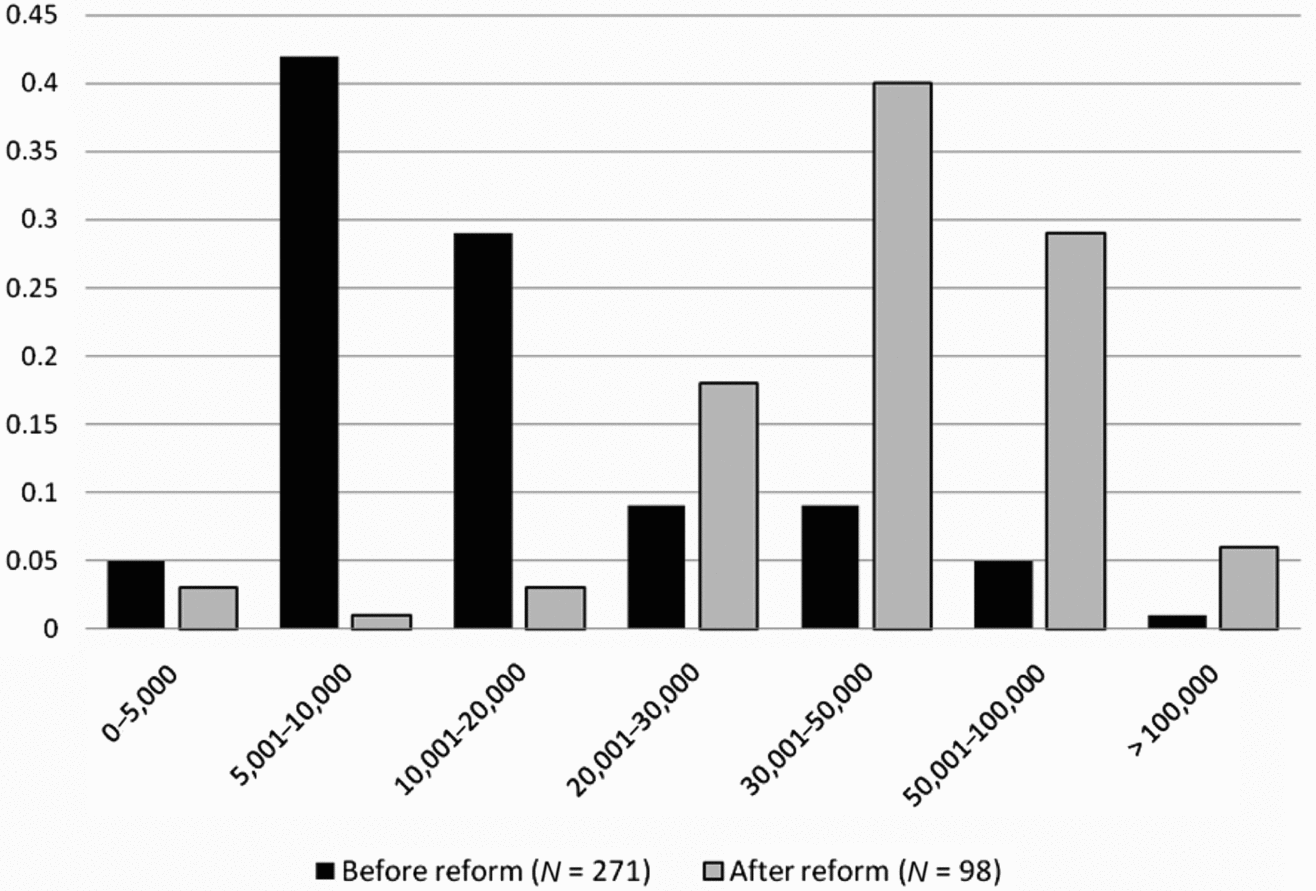
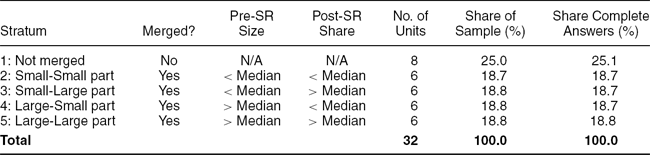
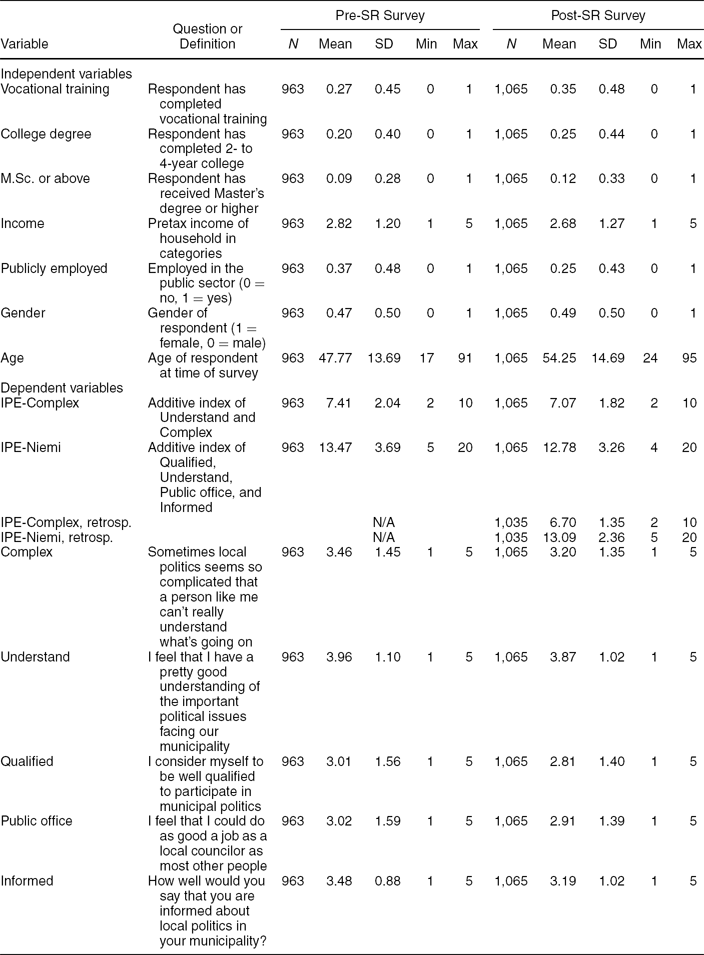
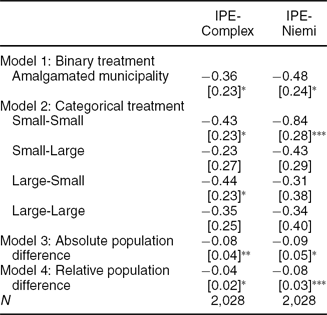
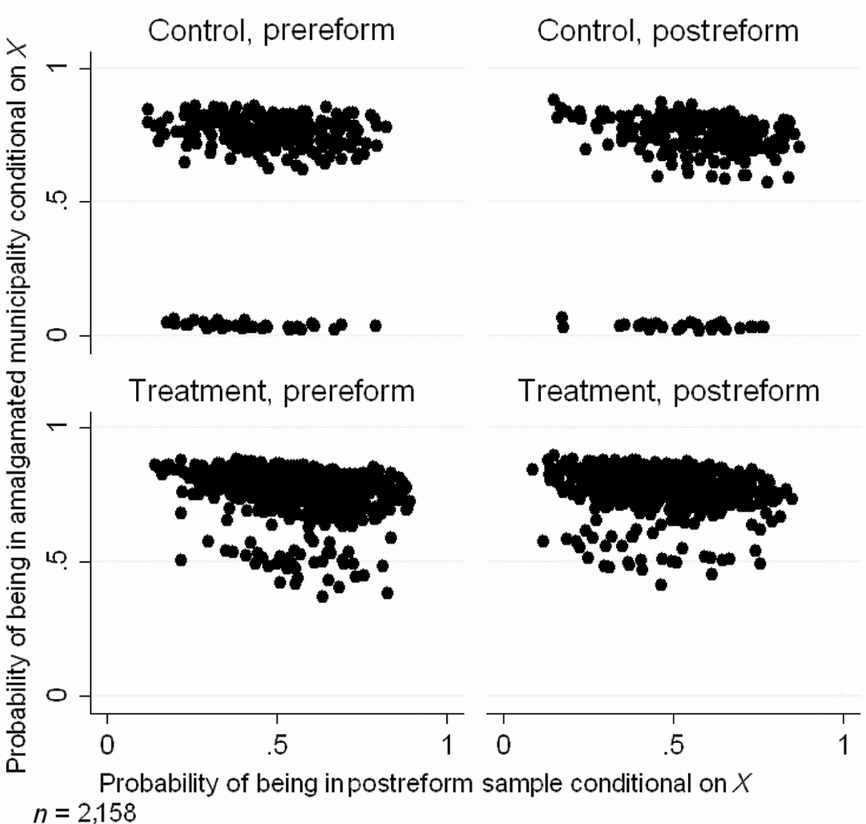
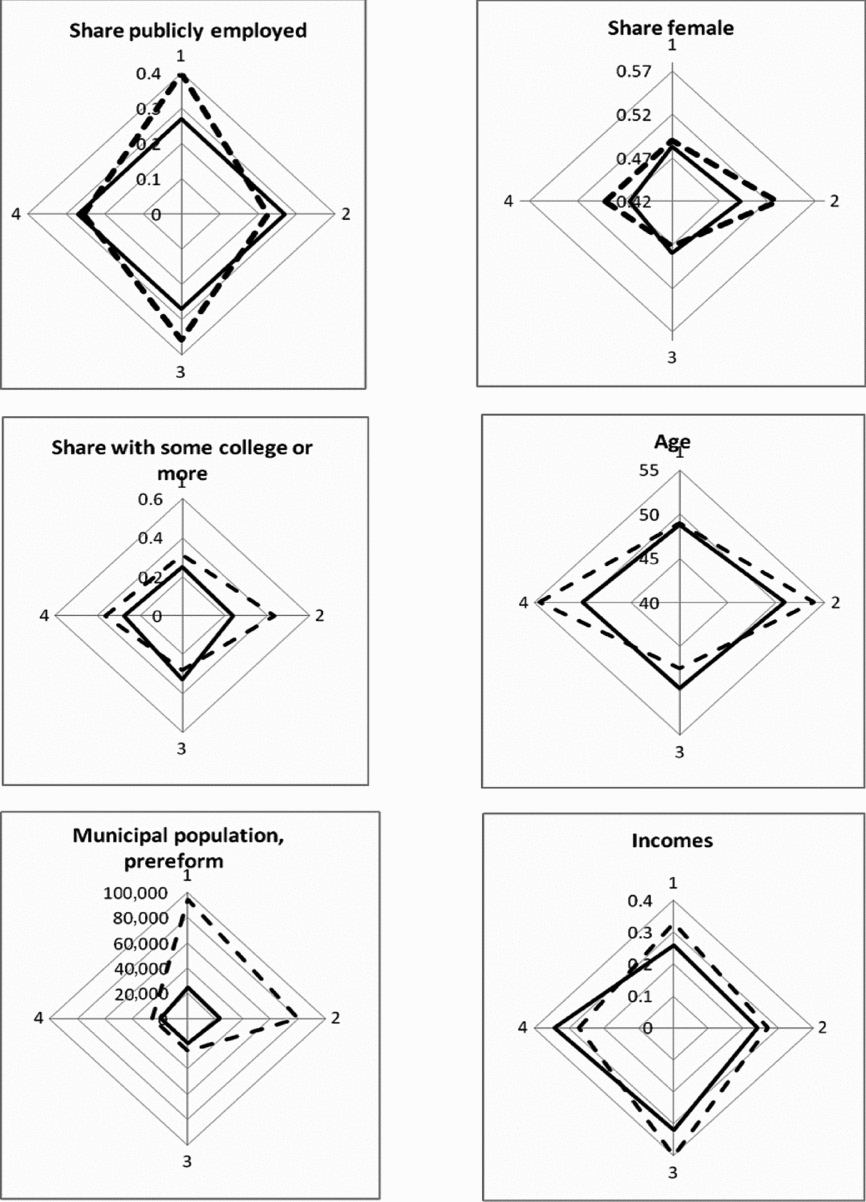
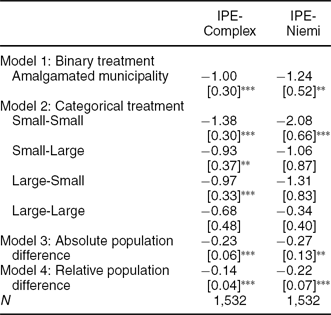
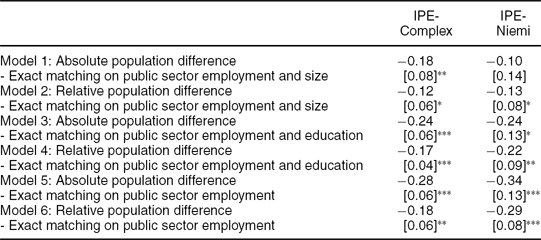
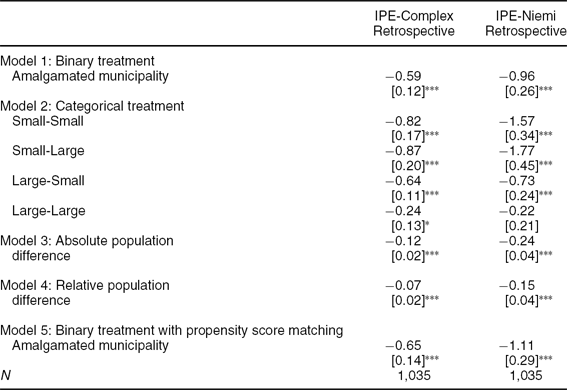
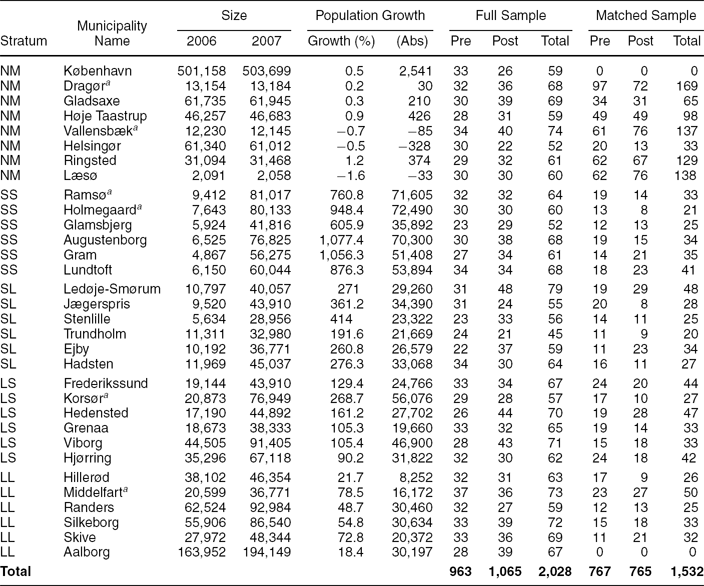
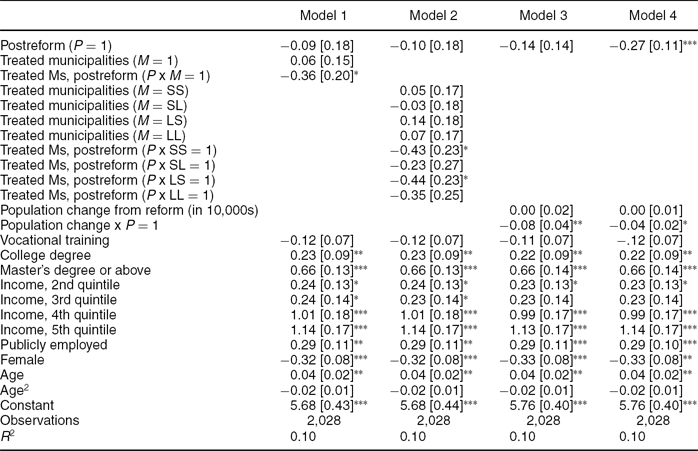



Comments
No Comments have been published for this article.